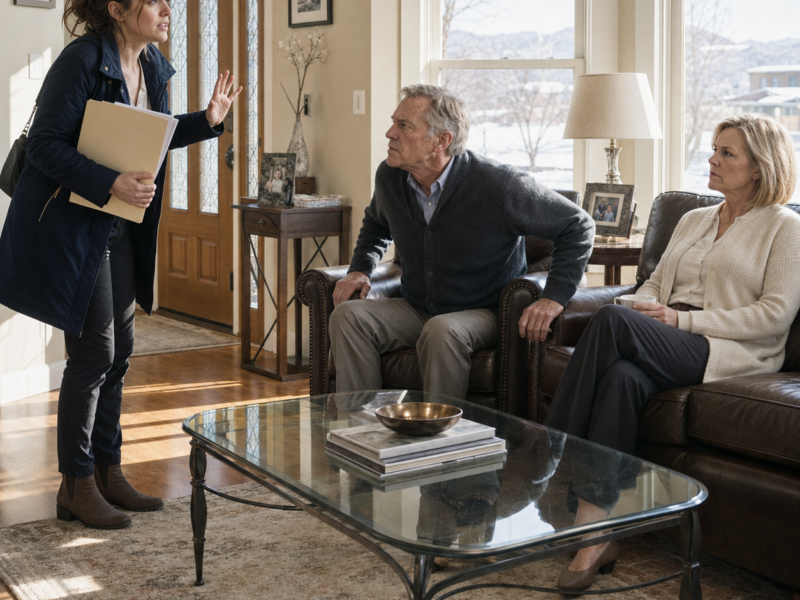
“You’re on your own. If your son doesn’t make it, that’s not our business,” my father said while I begged my parents to return the $100,000 they had owed me for more than a year. My son needed a bone marrow transplant, and every day mattered. My mother did not even look sorry. She only said, “Consider it payment for raising you.” That was the last day I asked them for anything. Two years later, they stood on my doorstep begging me to save them, and I finally gave them the answer they had taught me.
The second time I knocked, my father turned on the porch light but did not open the door.
I could see him through the narrow pane of glass beside it.
He stood six feet away with one hand resting against the entry table, listening while I begged from the other side.
“Dad, please.”
My voice had gone hoarse.
“The donor is cleared. They’re ready to start conditioning. I need you to give me back what you borrowed.”
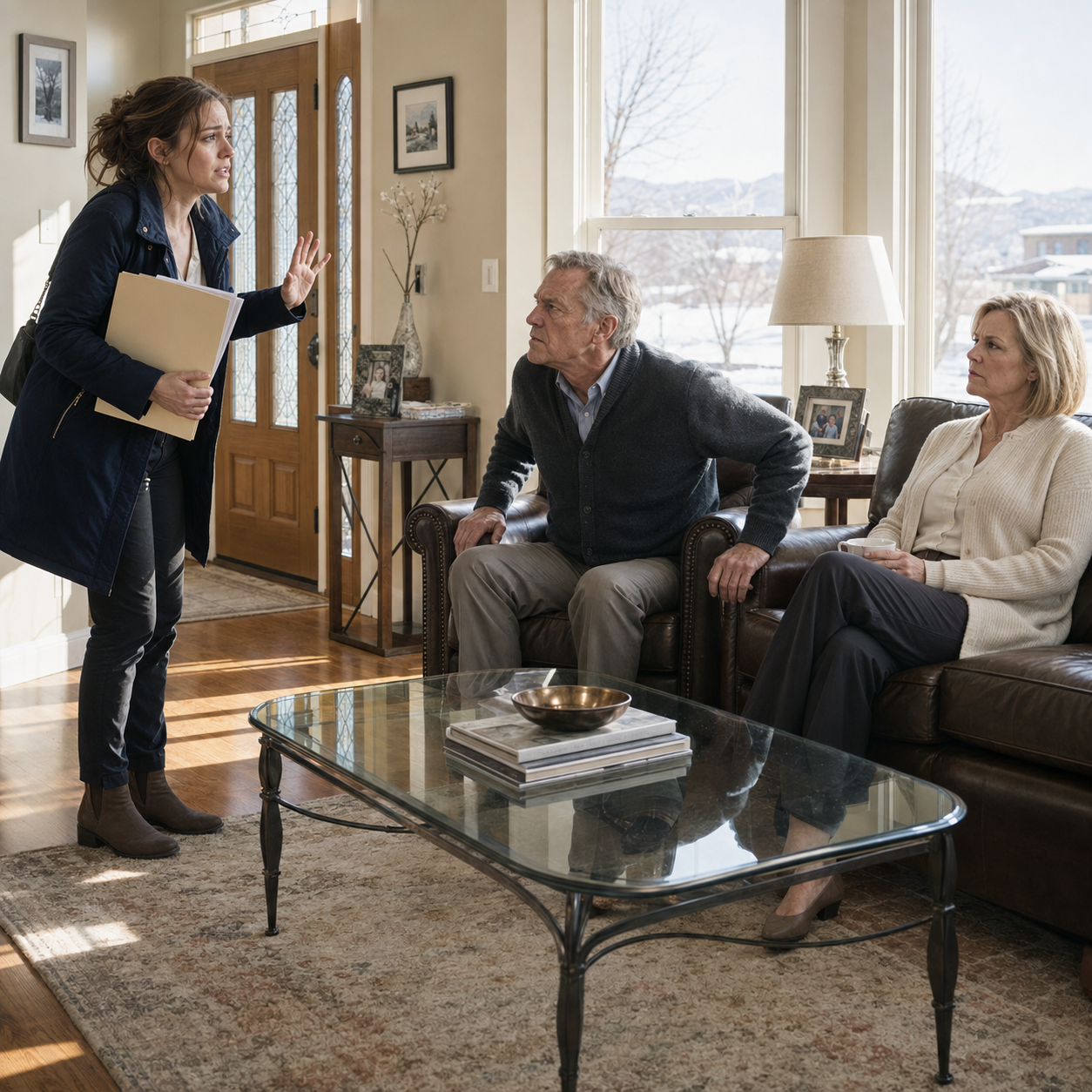
Behind him, my mother sat on the cream leather sofa with her arms folded. My sister Amanda was beside her. Amanda’s husband, Brian, leaned against the fireplace holding a glass of wine as though the most important thing happening that night was the discussion I had interrupted.
I knocked again.
My father finally opened the door.
Not all the way.
Just enough to look at me without inviting me inside.
“Cara, stop making a scene.”
“My son is in the hospital.”
“We know.”
“They found a donor.”
“We know.”
“The transplant team wants to move now. Leo’s disease is progressing. The insurance authorization is still being worked through, the donor collection has costs they haven’t cleared, and the transplant center needs a financial guarantee for the portions they know won’t be covered.”
My father’s expression hardened.
“I said we know.”
“Then you understand why I need my money.”
His eyes shifted away from mine.
That was the first sign.
Not anger.
Avoidance.
My stomach tightened.
Fourteen months earlier, Robert and Diane Mitchell had borrowed one hundred thousand dollars from me.
They did not call it borrowing at first.
They called it temporary help.
The roof needed replacement.
The kitchen had water damage.
Dad said refinancing at his age would be expensive.
Mom cried on my couch and said she was embarrassed to ask.
I had the money because my late husband, Daniel, had left a modest life-insurance policy, and I had spent years saving before that.
It was not billionaire money.
It was not even retirement money.
It was security.
Daniel had died suddenly when Leo was four.
After funeral expenses, debts, and setting aside a portion for our son, I still had enough that giving my parents one hundred thousand dollars would not make us homeless.
I hesitated anyway.
Dad became offended.
“Do you think we’d take advantage of you?”
“No.”
“Then what?”
“I need some of that money for Leo.”
At the time, Leo had already been having strange bruises and repeated infections, though nobody yet knew what they meant.
Dad put his hand over mine.
“We’ll pay every dollar back.”
Mom nodded.
“Within a year.”
I transferred it.
There had been no formal loan contract.
That was one of the mistakes I would never make again.
There were emails.
Bank records.
Texts where Dad wrote:
Once the house is refinanced, your hundred comes straight back.
Enough to prove it was not a gift.
Not enough to make repayment magically appear when I needed it.
Now I stood on their porch in Albuquerque in January with the transplant coordinator’s number in my phone and less than twenty-four thousand dollars left across all my accounts.
“Please.”
I hated how small the word sounded.
Dad stepped onto the porch and pulled the door almost closed behind him.
“We don’t have a hundred thousand dollars sitting around.”
“It was mine.”
“I know whose it was.”
“Where is it?”
His face changed.
That was when I understood.
“You spent it.”
“We used it.”
“For the renovation?”
No answer.
I looked past him at the house.
Same stucco.
Same cracked tile near the front walk.
Same kitchen window.
The roof looked exactly as it had the year before.
My stomach dropped.
“What did you do with it?”
Dad’s mouth tightened.
“Not tonight.”
“My seven-year-old is in a pediatric oncology unit.”
I stepped closer.
“Tonight is exactly when.”
The front door opened farther behind him.
Brian appeared.
He wore one of those quilted vests men in real estate seem to acquire when they begin using the phrase capital structure at dinner.
“Cara.”
I looked at him.
“This doesn’t involve you.”
“It does when you come barging into their house screaming.”
“I’m not screaming.”
“You were.”
“I’m asking my parents to return money they borrowed.”
Amanda appeared next.
She crossed her arms.
“You always do this.”
I stared.
“Do what?”
“Make everything a crisis.”
For a second, I actually wondered whether grief and exhaustion had changed the meaning of the word crisis.
My son had acute leukemia.
After months of treatment, the disease had returned aggressively.
His physicians believed a bone marrow transplant offered his best chance at durable remission.
A donor had been identified through the registry.
His transplant was not literally a simple surgery happening in an operating room that night.
It was a complicated process.
More chemotherapy.
Conditioning.
Donor-cell collection.
Hospital admission.
Weeks of infection precautions.
Possible complications nobody wanted to describe too vividly in front of me.
And money.
American health care can transform fear into paperwork with astonishing efficiency.
Leo had insurance through the plan Daniel once carried and that I maintained through COBRA before moving him onto coverage available through my employer.
The policy covered much.
Not everything.
Donor-related expenses.
Travel.
Specialist care.
Out-of-network components.
Deductibles.
Coinsurance.
Medications.
Housing near the transplant center after discharge if required.
Lost wages.
The hospital had a financial-assistance process, but approvals moved slowly.
His medical team was pushing to proceed because delay carried its own risk.
The transplant center had not told me, Pay one hundred thousand dollars or your son dies tonight.
Real medicine does not usually work like a movie villain.
What they told me was worse in a more ordinary way.
The treatment plan was ready.
The donor timing mattered.
Several financial clearances were still unresolved.
If I could provide sufficient funds or a credible guarantee, one entire layer of delay disappeared.
And the money my parents had promised to return would have done that.
Amanda shook her head.
“Brian and I were having an important conversation with them.”
“About what?”
“Business.”
Brian sighed.
“You chose a difficult life.”
I stared.
“What?”
“You married Daniel when everybody told you he had no family support.”
My chest went cold.
Daniel had never been poor.
He had been an electrician.
He worked.
He paid bills.
We were not wealthy.
That was different.
Brian continued.
“Then he died and left you with a kid.”
Amanda whispered:
“Brian.”
But she did not tell him to stop.
He looked at me.
“I’m saying you can’t expect everybody to keep rescuing you.”
“My parents borrowed my money.”
“That’s between them and you.”
“Yes.”
I almost laughed.
“That is literally why I’m here.”
Dad stepped closer.
“Lower your voice.”
I looked at him.
“Where is the money?”
“Cara.”
“Where?”
Mom finally came to the doorway.
Her expression was colder than Dad’s.
“We invested it.”
The world seemed to move an inch.
“In what?”
Nobody answered.
I looked at Brian.
There.
His eyes shifted.
“His deal.”
I whispered.
Dad said:
“It was a good opportunity.”
I stared.
“You gave Brian my money.”
“Invested.”
“That is not what I asked.”
“Your father and I believed—”
“You told me you needed a roof.”
Mom’s jaw tightened.
“We still need repairs.”
“You lied.”
“No.”
“Yes.”
Dad’s face reddened.
“We planned to replace the money before you ever needed it.”
“With what?”
“The return.”
Brian stepped in.
“The project is still developing.”
“How much of my money is left?”
Silence.
“How much?”
Dad snapped:
“Enough.”
“No.”
I felt myself begin to shake.
“Tell me the number.”
Brian answered.
“Most of the initial capital is committed.”
Committed.
Corporate language for gone somewhere I could not reach.
I looked at Mom.
“You gave him all of it?”
“It wasn’t like that.”
“How much?”
She stared.
“Ninety-five.”
I almost fell.
“Ninety-five thousand dollars.”
“Cara—”
“My son needs a transplant.”
Dad’s face hardened as panic turned my voice louder.
“Your son is not dying tonight because we can’t produce a suitcase of cash.”
“You don’t know that.”
“The doctors are treating him.”
“They are.”
I wiped my face.
“I’m trying to remove every delay I can.”
“That’s what parents do.”
Brian rolled his eyes.
“You’re being emotional.”
I turned toward him.
“Yes.”
“My child has cancer.”
“I’m allowed.”
Amanda stepped between us.
“You need to calm down.”
“No.”
She stared.
“No?”
“No.”
The word surprised even me.
“I’m not calming down so everyone else can enjoy the evening.”
Dad grabbed my arm.
Not violently enough to injure me.
Firmly enough that the intention was unmistakable.
“You need to leave.”
I looked down at his hand.
“Dad.”
“You came here accusing everyone.”
“I came here for my money.”
“You are on your own.”
He opened the front door wider.
“Dad, please.”
The humiliation arrived before the next sentence.
Because I heard my voice.
A thirty-one-year-old widow begging her father.
“Leo needs me.”
“He needs the money.”
“Please.”
Dad’s face became something I had never seen before.
Maybe because Brian was watching.
Maybe because being challenged in his own house made him feel cornered.
Maybe because shame sometimes dresses itself as cruelty when pride cannot tolerate exposure.
“If your son doesn’t make it, that is not our responsibility.”
Everything stopped.
Even Brian looked uncomfortable.
Mom did not.
She stood behind Dad.
Then said:
“Consider the money payment for raising you.”
I stared at her.
The sentence entered slowly.
Payment.
For raising me.
There are things children know intellectually but cannot emotionally accept until they hear them spoken.
I knew my parents favored Amanda.
I knew Dad cared deeply about appearances.
I knew Mom kept mental accounts.
Who called.
Who visited.
Who gave gifts.
Who owed gratitude.
I did not know they viewed childhood itself as a debt that could mature when convenient.
Dad moved his hand to my shoulder.
“Go.”
I stepped backward before he had to push.
Not because I was surrendering.
Because something inside me had finally gone quiet.
The door closed.
Deadbolt.
I stood on the porch.
Wind moved along the street.
Albuquerque winter is not Chicago winter, but high desert cold has its own cruelty after midnight.
Dry.
Sharp.
I returned to my car.
Sat behind the wheel.
Did not cry.
That came later.
First, I called the transplant coordinator.
“I don’t have the money.”
My voice barely worked.
Her name was Melissa Grant.
She had spent three weeks answering questions I asked twice because fear had destroyed my short-term memory.
“Cara, listen to me.”
“I’m listening.”
“We are not abandoning Leo.”
I closed my eyes.
“We are working every financial path.”
“Insurance.”
“Foundation support.”
“Donor-assistance funds.”
“The physician team is proceeding with the medical steps they can proceed with.”
“We need to keep moving, but this is not you versus a cashier at a door.”
I started crying then.
“My parents took the money.”
She went quiet.
“I’m sorry.”
“I don’t know what to do.”
“Come back.”
So I did.
Leo was asleep when I returned.
Seven years old.
Dark curls almost entirely gone after treatment.
A stuffed coyote beside his pillow because a volunteer had brought Southwestern animals to the pediatric floor and Leo said bears were “too obvious.”
I sat beside him.
His eyes opened.
“Mom?”
“Hey.”
“Did Grandma help?”
My throat closed.
Children know which questions adults are afraid to answer.
“Grandma can’t help tonight.”
He looked at my face.
“Are you crying?”
“No.”
He squinted.
“Bad liar.”
Daniel used to say that.
The resemblance hit me so hard I had to look away.
Leo held out his hand.
“Can you sit?”
“Yes.”
That was all he wanted.
Not one hundred thousand dollars.
Not answers.
Mom.
Chair.
Presence.
I sat until he slept again.
At 4:23 the next morning, my phone rang.
International number.
I almost ignored it.
Hospital spam.
Debt collection.
Insurance.
Everybody wanted something.
Then I answered.
“Hello?”
“Cara Bennett?”
The voice was male.
Older.
Precise.
“Yes.”
“My name is Walter Whitmore.”
I knew the surname.
Not from business magazines.
From Daniel.
My late husband rarely spoke about his mother’s family.
His mother, Elizabeth Whitmore Bennett, died when Daniel was twenty-four.
Her father had been Walter Whitmore.
There had been a family rupture years before Daniel and I met.
Money.
Control.
Expectation.
Daniel was vague.
“He thinks everything can be managed like a company.”
“Who?”
“My grandfather.”
“Are you close?”
“No.”
“Why?”
“Long story.”
He never finished it.
By the time we married, Walter was merely a name inside Daniel’s past.
When Daniel died in a highway collision five years later, I sent notices to every family contact I could find.
Nothing from Walter.
I assumed he either did not know or did not care.
Now his voice came through my phone.
“I learned about Daniel’s death four months ago.”
I said nothing.
“That is not an excuse for learning late.”
“No.”
“I was told he had remarried.”
“He never remarried.”
Silence.
Then:
“I have apparently spent years receiving inaccurate information from people I should not have trusted.”
I looked through the glass toward Leo.
“What do you want?”
“My great-grandson is sick.”
“Yes.”
“I want to help.”
My first reaction was anger.
Not relief.
“Where were you?”
Fair question.
Walter accepted it.
“Absent.”
“Why?”
“Pride.”
Simple.
“I assumed Daniel wanted no contact.”
“He assumed you did.”
“Then we were both fools.”
I pressed my forehead against the wall.
“They found a donor.”
“I know.”
“How?”
“My attorney has been trying to locate you since I learned Daniel died.”
“That sounds terrifying.”
“It should.”
Despite everything, I almost laughed.
Walter continued.
“Yesterday, one of our investigators contacted your former landlord. He knew Leo had been treated at University of New Mexico Hospital.”
“You investigated me?”
“I looked for my family.”
“You could have called.”
“I’m calling.”
“At four in the morning.”
“I was told time mattered.”
That stopped me.
“How much do you know?”
“Enough.”
“My counsel is in Albuquerque.”
“Why?”
“He was already there to verify records before contacting you.”
“We were trying not to walk into your life with a claim you had no reason to believe.”
Reasonable.
Still strange.
Walter said:
“His name is Richard Hayes.”
“He is going to meet with the transplant center’s financial office.”
“You do not have to sign anything.”
“You do not have to accept money directly.”
“If the hospital permits, the Whitmore family trust will issue an irrevocable medical payment guarantee for Leo’s qualified treatment costs that are not covered by insurance or existing assistance.”
I stared at the floor.
“You can do that?”
“Yes.”
“Today?”
“Yes.”
“What do you want from me?”
“Nothing.”
I laughed once.
Nobody with that much money says nothing without creating suspicion.
Walter heard it.
“Good.”
“What?”
“You don’t believe me.”
“I don’t know you.”
“Exactly.”
He lowered his voice.
“Do not trust me because I am Daniel’s grandfather.”
“Trust documents.”
“Your own lawyer.”
“The hospital.”
“Take time.”
Then:
“But let me remove the financial problem first.”
My hands started shaking.
“What if Leo—”
I could not finish.
Walter’s voice softened.
“Cara.”
That was the first time he sounded old.
“We cannot purchase an outcome.”
I closed my eyes.
“We can pay for access to appropriate care.”
“We can remove delay where money is the delay.”
“We can bring specialists into the discussion.”
“We can help you stay beside him instead of spending every night negotiating bills.”
“But nobody gets to promise you Leo will live.”
That honesty convinced me more than any declaration.
“Okay.”
“Good.”
Thirty-eight minutes later, Richard Hayes arrived.
Not with a suitcase of cash.
With documents.
Identification.
Trust certifications.
A financial guarantee.
Proof that the family office could meet the obligation.
The hospital’s patient financial services director joined.
So did social work.
So did the transplant coordinator.
The medical team did not suddenly become more talented because a wealthy family appeared.
They were already trying to save Leo.
What changed was the administrative weather around them.
Financial holds cleared.
Donor logistics secured.
Housing for the post-transplant period arranged.
A specialty medication that had required additional authorization was guaranteed if insurance delayed.
Richard said:
“We will pursue reimbursement correctly later.”
“Today, treatment planning should not depend on whether Cara can produce cash by noon.”
For the first time in months, somebody with power had used it to make the system quieter instead of making me smaller.
Leo began conditioning two days later.
The transplant itself followed the schedule his physicians believed was medically appropriate.
Walter flew in before donor cells were infused.
He did not arrive with cameras.
No entourage.
One driver.
One assistant who left after carrying a briefcase.
Walter was seventy-six.
Tall.
Silver hair.
Dark suit.
He looked like somebody a newspaper would call formidable because rich older men are rarely described as tired even when they are.
He stood outside Leo’s room.
“May I go in?”
That question mattered.
“Yes.”
Leo looked at him.
“Who are you?”
Walter stopped.
Then smiled.
“I’m your great-grandfather.”
Leo frowned.
“I have one of those?”
“Apparently.”
Leo looked at me.
“Did you know?”
“Sort of.”
Walter laughed.
That was their beginning.
He did not tell Leo he owned companies.
Leo would not have cared.
He asked whether the stuffed coyote had a name.
“Daniel.”
Walter’s face changed.
Leo explained.
“After Dad.”
Walter turned toward the window.
I gave him a minute.
Later, in the hallway:
“I did not deserve him naming anything after my grandson.”
“No.”
He looked at me.
“I appreciate your consistency.”
“I’m tired.”
“That helps.”
Leo’s transplant recovery was difficult.
Not in a cinematic way.
No single moment where machines screamed and heroes ran.
Long weeks.
Fevers.
Appetite problems.
Blood counts that became the most important numbers in the world.
Infection precautions.
Isolation.
Tiny victories.
A nurse saying:
“His counts are moving.”
A doctor saying:
“This is encouraging.”
Then another day:
“We’re watching this closely.”
No certainty.
Walter stayed in Albuquerque for nearly a month.
Not every day at the hospital.
He understood presence could become pressure.
He rented a small furnished house nearby for me because the transplant team wanted us within reach after discharge.
Chloe, my best friend since community college, became my practical anchor.
She flew from Phoenix twice.
Brought groceries.
Sat with Leo so I could shower.
Walter paid for her flight once.
She told him:
“I could’ve paid.”
Walter answered:
“I know.”
That was why she accepted.
Six weeks after the transplant, Leo was discharged.
Not cured.
Stable enough to leave.
His physician, Dr. Miriam Salazar, gave me a binder thick enough to stun livestock.
Medications.
Monitoring.
Emergency numbers.
Diet.
Clinic schedule.
Warning signs.
I carried the binder like scripture.
Leo walked slowly beside me.
Mask.
Baseball cap.
Hand in mine.
Outside, New Mexico sunlight felt almost disrespectfully bright.
He looked at the parking lot.
“Are we going home?”
I hesitated.
Home.
Our rental lease ended in five weeks.
My parents knew the address.
Brian knew.
Amanda.
I had received two messages since the night on the porch.
Mom:
I hope Leo is okay. When you’re calmer, we need to talk.
Dad:
You had no right to accuse Brian.
No:
How is he?
No hospital visit.
No call.
Walter had watched my face after each message.
Never asked.
Now I told Leo:
“We’re going somewhere temporary.”
“Does it have Wi-Fi?”
“Yes.”
“Then okay.”
Children simplify survival beautifully.
The temporary house had two bedrooms and a little courtyard.
Nothing palatial.
Walter could have put us in a hotel penthouse.
He did not.
He asked what would feel normal.
Normal sounded luxurious after oncology.
The first night, Leo fell asleep before eight.
I sat at the kitchen table with bills.
Hospital.
Insurance.
Pharmacy.
Old credit cards.
I began doing what fear had taught me.
Reading.
Before Leo got sick, I had worked as an administrative coordinator for a regional wholesale company.
Invoices.
Vendor reconciliation.
Basic budgeting.
Not finance.
Not high-level accounting.
Still, I understood numbers well enough to notice when they did not match.
Cancer turned that skill into obsession.
I found duplicate charges.
Incorrectly classified services.
A medication billed after it had been discontinued.
A room charge that overlapped with another facility fee.
Some corrections were simple.
Some charges were legitimate but terrifying.
I filed appeals.
Requested itemized statements.
Called insurance.
Took names.
Dates.
Reference numbers.
I learned that anger gets you placed on hold.
Documentation gets you case numbers.
Walter’s family office had accountants willing to handle everything.
I refused at first.
“Why?”
Walter asked.
“Because I need to know.”
“What?”
“What happens if you disappear.”
He became quiet.
Good.
He understood.
“Then learn.”
He assigned one of his benefits specialists to teach me rather than replace me.
That decision changed my life more than the hospital guarantee.
Her name was Naomi Chen.
Forty-two.
Former hospital finance executive.
She sat beside me one afternoon.
“You want to understand medical billing?”
“Yes.”
“Why?”
“So nobody can scare me with a number I don’t understand again.”
She nodded.
“Good reason.”
We spent weeks reviewing.
Insurance contracts.
Allowed amounts.
Appeals.
Coding.
Charity policies.
Coordination of benefits.
Not glamorous.
Power often begins as knowing which question to ask.
Leo improved.
Slowly.
At day one hundred post-transplant, his marrow evaluation showed no detectable leukemia by the testing used then.
Dr. Salazar refused the word cured.
I loved her for that.
“Remission.”
She said.
“Good remission.”
I cried.
Leo asked:
“Can I have pizza?”
She laughed.
“Eventually.”
That mattered more to him.
Three months after transplant, Walter asked me to meet at the Albuquerque office of Whitmore Capital Partners.
He had built much of his wealth through transportation, industrial services, commercial property, and investment holdings accumulated over fifty years.
Daniel had rejected that world.
I understood why within fifteen minutes of entering.
Glass.
Walnut.
People who spoke quietly because nobody needed to prove they belonged.
Walter’s conference table seemed designed for countries negotiating treaties.
He sat across from me.
Naomi joined.
Richard Hayes.
No surprise contract.
First, questions.
“What are you going back to?”
Walter asked.
“Work.”
“Same employer?”
“Probably.”
“Do you want to?”
I stared.
“People usually ask whether I can.”
“I asked whether you want to.”
I thought.
“No.”
Why?
Because after managing Leo’s medical bureaucracy, reconciling wholesale invoices felt like returning to kindergarten.
Not beneath me.
Too small for what my brain now wanted.
“I want to understand money.”
Walter nodded.
“Why?”
“So I never beg people for my own again.”
There.
He did not smile.
Good.
“Then I will make you an offer.”
He slid a folder toward me.
Not chief operating officer.
Not empire.
An entry-level analyst position inside a family-office operations group.
Salary respectable.
Benefits excellent.
Hours demanding but flexible around Leo’s medical appointments.
Training.
No guarantee of promotion.
No inheritance.
No gift disguised as employment.
“If you are bad at it, you will be fired.”
Walter said.
I laughed.
“Comforting.”
“I am serious.”
“So am I.”
“People will assume you are here because of me.”
“I am here because of you.”
“Access.”
He corrected.
“Whether you stay should become your work.”
I looked at Naomi.
She nodded.
“Walter makes everybody uncomfortable.”
Good.
I signed after having my own employment attorney review the agreement.
That detail irritated Walter.
Also pleased him.
“You’re learning.”
“I’m not signing anything you hand me because you saved Leo.”
“I did not save Leo.”
He looked at me.
“Doctors treated him.”
“Donor donated.”
“Trust paid bills.”
“Words matter.”
They did.
My training began after Leo started school remotely and his doctors agreed my work schedule was manageable.
The first six months were brutal.
Not because Walter made me work eighteen-hour days like some movie tyrant.
Because finance has its own language.
Valuation.
Cash flows.
Debt covenants.
Capital structure.
Operating margins.
Real-estate underwriting.
Trust accounting.
Tax constraints.
Risk.
I studied at night after Leo slept.
Naomi gave me work nobody glamorous wanted.
Reconcile this.
Verify that.
Find why these numbers disagree.
Review vendor concentration.
Check lease rollover schedules.
Boring.
Perfect.
Boring work teaches where reality hides.
I made mistakes.
One cost us twelve thousand dollars in unnecessary consulting work because I misread a contract renewal.
I thought Walter would fire me.
He called me into his office.
“What happened?”
I explained.
“Will you repeat it?”
“No.”
“How do you know?”
I showed him the checklist I created.
He looked.
“Good.”
That was all.
Failure became information.
I had spent childhood in a family where mistakes became character.
Amanda forgot Mom’s birthday?
Busy.
Cara forgot to call?
Selfish.
Brian lost money?
Market conditions.
Cara questioned him?
Jealous.
At Whitmore Capital, a bad number was a bad number.
That clarity changed me.
I improved.
A year later, I moved into portfolio operations.
Not because Walter declared me brilliant.
Because Naomi recommended me.
That mattered.
I began reviewing troubled investments.
Commercial properties.
Small logistics companies.
Regional distribution businesses.
I was good at finding places where management stories did not match cash.
Not ruthless.
Skeptical.
Different.
One acquisition involved a downtown Albuquerque commercial block with three buildings, restaurant tenants, medical offices, and a parking structure.
The seller wanted speed.
Several buyers wanted discounts.
I did not “threaten to expose rivals.”
That would have been unethical and stupid.
I did something less cinematic.
I read the leases.
One anchor tenant had renewal options analysts had undervalued.
Parking income was understated because of an outdated management contract.
Two deferred-maintenance issues were worse than advertised.
I adjusted our price.
Structured reserves.
Offered certainty of closing.
We won.
Not twenty percent below market through intimidation.
At a fair price reflecting risk.
Walter called.
“Good work.”
That was all.
I remembered Dad on the porch.
Funny how simple praise sounds when it is not being rationed.
Then came a logistics subsidiary in trouble.
The company served New Mexico, Arizona, and West Texas.
Margins had collapsed.
Executives blamed fuel.
Labor.
Customers.
Everything external.
Walter sent a team.
I was one member.
Not an apex predator.
An operations manager with enough authority to ask uncomfortable questions.
We found real problems.
Overpriced vendor contracts.
Poor routing.
Duplicate management layers.
Expense abuses.
No giant fraud conspiracy.
A senior executive had approved contracts with a vendor partly owned by his brother-in-law without proper disclosure.
That became a governance issue.
Independent review.
Termination.
Some managers left.
Others stayed.
We renegotiated contracts.
Improved scheduling.
Closed an underused warehouse.
Invested in routing software.
The turnaround took eighteen months.
Not two brutal quarters.
By the end, the business was profitable again.
I became vice president of portfolio operations at thirty-five.
Then senior vice president.
Walter did not make me COO of a billion-dollar empire because I was family.
He was not that foolish.
He did something better.
He built a board strong enough to tell him no.
I learned from people who had no reason to flatter me.
The company became a career.
Not revenge.
That distinction saved me.
Because if I had built everything to prove my parents wrong, they would still have owned the purpose.
Leo became healthy enough that annual oncology visits replaced monthly fear.
At ten, he went back to regular school.
At twelve, he played soccer badly.
I cried at the first game because he complained about the referee like a normal child.
Chloe laughed.
“You are crying because your kid is obnoxious.”
“Yes.”
“Therapy.”
“Probably.”
We moved into a comfortable home near the foothills.
Not a penthouse.
Leo wanted a yard.
I wanted privacy.
Walter insisted I should buy something bigger.
I ignored him.
Eventually, when I became financially comfortable, I bought the house myself.
Mortgage.
Down payment from my earnings.
No Whitmore trust.
That mattered.
Two years after the night on my parents’ porch, my security system chimed at 12:17 a.m.
I was still awake in my home office reviewing an investment committee memo.
Leo was upstairs.
The camera showed two people at the front gate.
For several seconds, I did not recognize them.
Then my mother lifted her face.
I stopped breathing.
Dad stood beside her.
Older.
Thinner.
Not ragged strangers from a disaster movie.
Real people who had been losing a financial war for months.
Dad wore an old brown coat.
Mom had a cardigan beneath a jacket too light for the weather.
Two suitcases stood behind them.
Not trash bags.
Real luggage.
Still.
The image hit the same place.
The porch.
The cold.
The locked door.
Dad pressed the intercom.
“Cara.”
I did not answer immediately.
He looked toward the camera.
“Please.”
I could have called security.
Could have told them to leave.
Instead, I called Chloe.
It was midnight.
She answered anyway.
“What?”
“My parents are outside.”
Silence.
Then:
“Do you want me to come?”
That was why Chloe was family.
Not:
Let them in.
Not:
Throw them out.
What do you want?
“I don’t know.”
“Then don’t open the door until you do.”
Good.
I called Walter next.
He answered on the second ring because old men apparently do not sleep.
“My parents are here.”
“Do you feel unsafe?”
“No.”
“Then what do you want?”
“I don’t know.”
“Good.”
I almost laughed.
“How is that good?”
“Means you are thinking.”
He paused.
“Do not confuse mercy with access.”
“Do not confuse anger with a decision.”
Also good.
I went downstairs.
Opened the pedestrian gate remotely.
Not the front door.
Dad and Mom walked to the porch.
I kept the security chain on when I opened.
Three inches.
Exactly enough.
Dad looked at me.
“Cara.”
“Why are you here?”
Mom began crying.
Real tears.
Maybe.
“We lost the house.”
I felt almost nothing at first.
Numbness is not cruelty.
Sometimes memory needs time to receive new information.
“How?”
Dad looked down.
“Brian.”
There.
“Amanda?”
“Gone.”
I closed my eyes.
Of course.
“Tell me.”
Dad swallowed.
“We never renovated the house.”
“I know.”
“We gave Brian ninety-five thousand.”
“I know.”
“The project was worse than we realized.”
“How much worse?”
“It wasn’t a project.”
Mom whispered:
“Not really.”
Dad continued.
Brian had created a development entity.
Some land existed.
Some investor presentations.
Some legitimate expenses.
But projected approvals were exaggerated.
Other investors’ money had been used to cover previous obligations.
The investment failed.
My parents lost nearly all the hundred thousand.
That should have been the end.
It wasn’t.
Brian convinced them recovery required additional capital.
They had none.
So he proposed restructuring their real-estate holdings.
The house.
A rental property Dad inherited.
Some retirement-linked investments.
Then came the power of attorney.
Not a magical document allowing Brian to walk into a bank and steal everything unchallenged.
A broad durable financial power of attorney executed during what Dad described as a period when he was having heart trouble and wanted Brian to “handle paperwork.”
Their attorney had not drafted it.
Brian found a template.
Dad and Mom signed before a notary.
Why?
Family.
Trust.
Convenience.
The same things they expected from me.
With that authority and separate signatures obtained on loan documents they later claimed not to understand fully, Brian facilitated a second mortgage and other transactions.
Some were legally authorized.
Others became disputed.
By the time my parents recognized the extent, the money had moved into entities controlled by Brian.
Then Brian and Amanda disappeared.
Not internationally.
Phoenix first.
Then Nevada.
Investigators eventually found them.
Civil litigation followed.
A criminal investigation considered whether documents or representations crossed into fraud.
But none of that restored cash quickly.
My parents fell behind.
The house went into foreclosure.
Their lender completed the process after months of notices, loss-mitigation attempts, and court-related procedures where applicable.
Not a sheriff suddenly arriving because Brian waved paper.
Slow.
Bureaucratic.
Still devastating.
They sold what they could.
Paid lawyers.
Moved briefly into a motel.
Then arrived at my house.
Dad looked through the three-inch opening.
“We need somewhere to stay.”
The sentence settled between us.
Mom pressed both hands together.
“Just for a few weeks.”
Memory arrived.
You are on your own.
Consider the money payment for raising you.
If your son doesn’t make it, that is not our responsibility.
I could have repeated every word.
Part of me wanted to.
Not because I had become cold.
Because symmetry is seductive when pain finally holds leverage.
I opened the chain.
Not the door.
I looked at Dad.
“Where did you stay last night?”
“Motel.”
“You have money for another?”
“A few nights.”
Good.
Not immediate physical danger.
“Do you have food?”
“Yes.”
“Medication?”
Dad nodded.
“Then you are not sleeping here tonight.”
Mom gasped.
“Cara.”
“No.”
My voice remained steady.
“I need time.”
Dad closed his eyes.
“We don’t have time.”
“That sentence sounds familiar.”
He flinched.
Good.
I hated that part of me enjoyed it.
Then I continued.
“Tomorrow, I will pay directly for seven nights at a hotel.”
Mom stared.
“I will also pay for an appointment with an independent elder-law and financial counselor.”
Dad looked up.
“You’ll help?”
“I said what I will do.”
“Not cash.”
“Not this house.”
“Not access to my accounts.”
“Not while I decide what relationship I want with you.”
Mom started crying harder.
“You would leave your own parents in a hotel?”
“Yes.”
The answer was easy.
“Because a hotel is warm.”
“You left me outside a locked door while Leo was in the hospital.”
Dad looked as if I had struck him.
I did not say the crueler line.
Payment for raising me.
I almost did.
Instead:
“You taught me that family need does not automatically create entitlement.”
Silence.
“I wish I had learned that from someone else.”
Dad looked at the ground.
“I’m sorry.”
“No.”
I held his eyes.
“Not tonight.”
“Tonight, you need a room.”
“Tomorrow, we can discuss apologies.”
That was my answer.
Not revenge.
Boundary.
I called a hotel near the airport.
Paid one week directly.
Ordered a rideshare.
Mom stared at my house.
“Leo?”
“Sleeping.”
“Can we see him?”
“No.”
Her face collapsed.
“He’s our grandson.”
“Yes.”
“You haven’t seen him since he was seven.”
“That was your choice.”
She looked away.
The car arrived.
Dad picked up both suitcases.
Before leaving, he turned.
“Cara.”
“What?”
“I know we don’t deserve this.”
I said nothing.
“Thank you for the hotel.”
I closed the door.
Then leaned against it and cried.
Not victory.
Grief.
Leo came downstairs ten minutes later.
Thirteen now.
Tall.
Healthy enough to complain about homework and eat cereal at midnight.
“You okay?”
“My parents came.”
He knew the history broadly.
Not every ugly sentence.
“What did they want?”
“A place to stay.”
“Did you let them?”
“No.”
He nodded.
Then:
“Are they safe?”
I looked at him.
“Yes.”
“Okay.”
That was my son.
No revenge instinct.
No lecture.
Safe?
Yes.
Okay.
The next morning, I met my parents at the office of Miriam Ortega, an elder-law attorney Walter recommended but did not control.
I paid her consultation fee.
Then left the room for part of the financial discussion because their privacy mattered even after betrayal.
Miriam helped them understand the foreclosure aftermath.
Possible claims against Brian.
Debt priorities.
Social Security.
Retirement income.
Housing options.
They were not penniless.
That mattered.
Dad still had monthly retirement income.
Mom had Social Security.
They had lost most home equity.
Some savings.
Not every dollar.
The real problem was lifestyle and legal costs.
They needed to downsize dramatically.
The word homeless had been emotionally true for three nights.
Not destiny.
Miriam found a senior apartment with income-adjusted rent.
Not luxurious.
Safe.
Available within three weeks.
I paid the deposit as a one-time gift.
Directly.
No loan.
No ongoing promise.
Dad protested.
“I’ll repay.”
“No.”
He looked confused.
“Then what?”
“It’s a gift.”
“I want paperwork.”
Miriam almost smiled.
I continued.
“It does not buy relationship.”
“It does not create access.”
“It does not mean you can call me for every problem.”
Dad nodded.
“Understood.”
Mom did not.
Not yet.
“After everything?”
She asked.
There it was.
The old phrase.
I looked at her.
“After everything what?”
“We’re your parents.”
“Yes.”
“We raised you.”
Miriam looked down at her papers.
Professional mercy.
I stared at Mom.
“You already collected that payment.”
Silence.
The sentence finally came.
Not shouted.
Not triumphant.
“You told me the hundred thousand was payment for raising me.”
Mom went pale.
Dad closed his eyes.
“So that account is settled.”
No pleasure.
Just accuracy.
“If we are going to have a relationship, it starts from zero.”
“Not debt.”
“Choice.”
Mom cried.
That was the beginning.
Not forgiveness.
The beginning.
Amanda and Brian were found four months later.
Their situation was less glamorous than disappearance suggested.
They had moved to Las Vegas, staying in a furnished condo rented through one of Brian’s associates while attorneys negotiated creditor claims.
The real-estate scheme had unraveled.
Several investors sued.
Prosecutors eventually charged Brian with financial offenses related to misrepresentations and misuse of investor funds.
Amanda was not charged with the same conduct, though civil litigation examined transfers into accounts she controlled.
My parents wanted me involved.
I refused.
Not my case.
Not my money.
Except the original hundred thousand.
Could I sue?
Yes.
My attorney reviewed the evidence.
My parents had borrowed from me.
They had diverted the funds contrary to what they told me.
I had a plausible civil claim.
The statute of limitations still allowed action.
Walter asked:
“What do you want?”
“The money.”
“Do you need it?”
“No.”
“Then why?”
I hated the question.
“Because it was mine.”
“Good answer.”
Then:
“Is litigation worth the cost?”
Different question.
Emotionally?
Maybe.
Financially?
Probably not.
My parents had limited assets.
Brian’s entities were tangled in other claims.
Collecting might become expensive and ugly.
I chose not to sue my parents.
I did file a creditor claim where appropriate in proceedings related to Brian’s failed entity, supported by the documented transfer trail.
Years later, I recovered less than twelve thousand dollars.
Not justice.
Accounting.
I put it into Leo’s college account.
That felt right.
My parents moved into the senior apartment.
Dad found part-time work doing bookkeeping for a hardware store because retirement made him restless.
Mom joined a church group.
For six months, I saw them nowhere.
They wrote.
Dad’s first letter:
Cara,
I have replayed the night you came to us for Leo.
I keep wanting to tell myself I panicked because I knew the money was gone.
That is true.
It is also not enough.
I was ashamed.
Brian was sitting in my house.
I had spent years treating him like the successful son I never had.
When you demanded the money, I felt exposed in front of him.
So I chose pride over you.
And over Leo.
I am sorry.
Specific.
I kept reading.
I also understand now that saying his survival was not my responsibility was technically a fact used as cruelty.
A grandparent is not legally responsible for a transplant bill.
That did not make my sentence morally acceptable.
You were not asking me to take responsibility for your whole life.
You were asking me to return something I owed.
I failed.
Dad.
I cried.
Did not reply.
Not yet.
Mom’s first letters were worse.
We were manipulated.
Brian lied.
We were afraid.
We didn’t know what to do.
Everything true.
Nothing enough.
I stopped reading after the second.
Three months later, another arrived.
No explanation.
Cara,
I told you the money was payment for raising you.
I have tried to understand why I could say that.
The ugliest answer is that I had always kept an account in my head.
I remembered what we spent on school.
Clothes.
Your wedding.
The times we helped with Leo after Daniel died.
I turned parenting into something you were supposed to repay.
I did not do that with Amanda because I expected her to stay close.
With you, I felt every boundary as rejection, so I started treating generosity like debt.
I am sorry.
That sentence hurt because it explained too much.
Then:
When you paid our hotel and apartment deposit, you did more for us than I did for you that night.
I do not expect that to earn forgiveness.
Mom.
No but.
I answered:
I received your letter.
Thank you for being specific.
Nothing else.
Boundaries should sometimes be boring.
A year passed.
Leo turned fourteen.
His five-year transplant milestone approached.
Dr. Salazar had moved to another hospital, but she sent a note.
Still cheering for him.
I framed that.
Walter attended Leo’s birthday.
Not in a suit.
Jeans.
He was terrible at casual clothing.
Chloe told him he looked like a CEO in witness protection.
Leo laughed for five minutes.
Walter became family slowly.
Not because of money.
Because he showed up.
Sometimes badly.
He tried to give Leo a car at fourteen.
I nearly killed him.
“What?”
Walter looked genuinely confused.
“He’ll need it eventually.”
“He’s fourteen.”
“We can store it.”
“No.”
Leo whispered:
“I vote yes.”
“No one asked you.”
Walter learned.
By sixteen, Leo was healthy.
Annual oncology visits.
No evidence of disease.
His immune system had recovered.
He had scars.
Memories.
A hatred of hospital gelatin.
Good.
I became executive vice president of operations at Whitmore Capital, not because Walter declared me heir but because the independent board approved it after years of performance.
That distinction protected all of us.
Walter also changed his estate plan.
Leo would inherit through a trust because he was Daniel’s son.
I had no claim to Walter’s personal estate beyond what he chose.
He told me:
“I am not making you dependent on my death.”
“Thank you.”
“Strange sentence.”
“Your family specializes.”
He almost smiled.
My parents learned about my career through public business news eventually.
That could have restarted the old pattern.
It did not.
Dad wrote:
Saw the article. Congratulations.
No request.
Mom sent:
You look tired. I hope the photographer was the problem.
I laughed.
They were learning ordinary contact.
I agreed to coffee with Dad first.
Public diner.
He arrived early.
Of course.
He had lost weight.
Not starved.
Aging.
Stress.
We talked about Leo.
Work.
Then:
“Do you hate Brian?”
I asked.
Dad thought.
“Yes.”
“Do you hate Amanda?”
His face changed.
“I don’t know.”
“She was your favorite.”
I regretted it instantly.
Dad did not deny.
“That’s true.”
I stared.
“You admit it?”
“I’m seventy-two.”
He smiled sadly.
“Apparently honesty becomes cheaper when you lose the house.”
I laughed despite myself.
Then:
“Why?”
“Amanda needed admiration.”
“You didn’t?”
“I acted like I didn’t.”
There.
Strong child problem.
“You were competent.”
“Independent.”
“You left Albuquerque.”
“You married Daniel even after we had concerns.”
“You did what you wanted.”
“So I treated you like the child who needed less.”
“That wasn’t fair.”
“No.”
He looked at his coffee.
“And because you needed less, I gave less.”
“That becomes a habit.”
I swallowed.
“Yes.”
“You know what the worst part was?”
“What?”
“I stopped asking because I learned not to expect.”
His eyes filled.
“I’m sorry.”
That coffee mattered.
Not enough to restore everything.
Enough.
Mom took longer.
She still slipped.
One Thanksgiving invitation:
We would love to have the whole family together again.
I called.
“Whole family means Amanda?”
Silence.
“She’s still my daughter.”
“I know.”
“She’s asking to come home.”
Amanda and Brian had separated during his legal troubles.
She entered a settlement on civil claims.
Moved back to New Mexico.
Worked at an insurance office.
No glamorous exile.
I had not spoken to her since the porch night.
Mom said:
“I thought maybe everyone could—”
“No.”
“Cara.”
“No.”
I was surprised by how calm it sounded.
“I’m not attending a reunion designed around your need to see everyone at one table.”
Mom became quiet.
“You’re right.”
Another new sentence.
“I’m sorry.”
I spent Thanksgiving with Chloe, Walter, Leo, and a neighbor whose flight to Denver was canceled.
Excellent turkey.
No family theater.
Amanda contacted me directly six months later.
Email.
Cara,
I have written this many times.
I was cruel the night you came to Mom and Dad.
I had known for weeks that they invested your money with Brian.
I did not know every detail, but I knew enough to understand why you were panicking.
I stayed loyal to him because admitting he had misused your money meant admitting things about my marriage I was not ready to face.
Then:
When you said Leo needed the money, I still chose my comfort.
I’m sorry.
No excuses.
Then:
I am not asking you to forgive me or to let me see Leo.
I wanted you to know I understand what I did.
Specific.
I stared at the email.
Leo found me at the kitchen counter.
“What?”
“Aunt Amanda wrote.”
He barely remembered her.
“Is she nice now?”
Children and teenagers ask impossible questions casually.
“I don’t know.”
“Are you going to answer?”
“I don’t know.”
He poured cereal.
“You always say information first.”
That was my line from work.
Annoying child.
I replied:
Thank you for acknowledging it. I’m not ready for more.
She responded:
Understood.
Then actually understood.
No birthday invasion.
No messages through Mom.
A year later, I agreed to lunch.
Amanda looked older.
No designer handbag.
No Brian.
We sat at a chain restaurant because neutral spaces help.
“I was jealous of you.”
She said.
I almost laughed.
“Of what?”
“You had Daniel.”
“He died.”
“I know.”
She closed her eyes.
“That came out wrong.”
“Yes.”
“I mean before.”
“You married someone who loved you without caring whether Dad approved.”
“I married Brian partly because Dad approved.”
There.
“Then he became successful.”
“Or looked successful.”
“And suddenly I was the daughter who had done everything right.”
“Until you needed your money back.”
I stared.
“You thought giving it back would hurt him.”
“Yes.”
“And I chose him.”
She cried.
“I’m sorry.”
Understanding hurt.
But it also loosened something.
I did not want my sister punished forever.
I wanted her accurate.
She became accurate.
Our relationship never returned to childhood closeness.
We had not really had it anyway.
We became women who occasionally called.
Enough.
Walter’s health declined when I was forty.
Heart valve problems.
Then heart failure.
He still worked too much.
I told him.
He said:
“You are not my doctor.”
“Neither are you.”
He eventually stepped down from active leadership.
The board appointed a professional CEO.
Not me.
Good.
I remained operations chief for several years, then moved to an investment committee and foundation role because I wanted time.
Leo was preparing for college.
Walter needed family more than management.
One evening, we sat on his patio.
He said:
“I owe Daniel an apology.”
My throat tightened.
“He’s dead.”
“I know.”
“Still.”
He looked toward the mountains.
“I spent years waiting for him to come back because I thought the younger person should repair the relationship.”
“He probably thought the same.”
“Pride is expensive.”
“Yes.”
Then:
“I’m glad you answered the phone.”
“So am I.”
That was enough.
Walter died at eighty-four.
His estate was large.
Headlines cared.
I did not.
Leo inherited through trust.
I received a modest personal bequest and a letter.
Cara,
If I had found Daniel sooner, perhaps much of this would have been different.
Do not waste time building alternate histories.
You taught me that family is not the same as authority.
I hope I taught you that wealth is not the same as safety unless it is structured well.
Then:
Keep asking what the documents actually say.
Very Walter.
I cried.
After his death, I stepped back further from Whitmore Capital.
Not because I was pushed out.
Because I had spent almost a decade in work that began as protection.
I no longer wanted every decision organized around never being vulnerable again.
Therapy helped.
Dr. Naomi Keller.
Not the same Naomi from the office.
Apparently the universe had a limited name inventory.
She asked:
“What would happen if you were financially vulnerable?”
“I’d hate it.”
“That is not an outcome.”
“I don’t know.”
“Exactly.”
I had built an entire identity around fortress.
Money.
Systems.
Contracts.
No begging.
Useful.
Then exhausting.
“Security is good.”
Naomi said.
“Total invulnerability is fantasy.”
I hated that.
Leo left for college.
Engineering.
Daniel would have loved it.
My parents attended his high-school graduation.
Only because Leo asked.
That mattered.
He had reconnected with them slowly.
His choice.
At first, I resisted.
“What if they hurt him?”
Naomi asked:
“Is Leo seven?”
“No.”
“Does he know the history?”
“Age appropriate.”
“Does he want to see them?”
“Yes.”
“Then?”
I had spent years insisting nobody should control access through family entitlement.
I could not become controlling in the opposite direction.
Leo met Dad for lunch.
Then Mom.
They apologized to him.
Specific.
Grandma:
“When you were sick, I cared more about defending my choices than helping your mother.”
Grandpa:
“I said something about your life that a grandfather should never say.”
Leo told me later:
“They cried a lot.”
“Did you?”
“No.”
He shrugged.
“I barely remember them.”
That was the real consequence.
Not revenge.
Absence.
They had missed years.
Nobody could reimburse those.
Leo did not hate them.
He did not need them intensely either.
Relationship built from where it was.
At his graduation from the University of New Mexico, Mom and Dad sat three rows behind me.
Amanda sat with them.
Chloe beside me.
No Brian.
He had served time related to financial fraud and later worked in another field after release.
I had no contact.
That chapter ended.
Leo crossed the stage.
I cried.
Of course.
Dad leaned forward afterward.
“Daniel would be proud.”
My throat closed.
“Yes.”
That was the first time my father spoke Daniel’s name with uncomplicated respect.
Progress can arrive decades late.
My career after Whitmore shifted toward healthcare finance and patient advocacy.
That surprised everyone.
Not me.
The night of Leo’s transplant had never really left.
I understood something wealthy people often miss.
Medical crises create financial panic even when treatment itself is clinically available.
Transportation.
Housing.
Deductibles.
Lost wages.
Childcare.
Noncovered supportive care.
Paperwork.
People sell cars.
Use credit cards.
Miss mortgage payments.
Not because hospitals are cartoon villains demanding cash over dying children.
Because a long illness erodes households from every direction.
I joined the board of a nonprofit helping families navigate transplant costs.
Then became executive director.
Lower compensation than Whitmore.
More satisfaction.
Walter would have hated the salary.
Loved the balance sheet.
We built emergency grants.
Housing partnerships.
Insurance-navigation programs.
Donor travel support.
No Cara Bennett Center.
No plaque.
One family arrived with a six-year-old girl whose father looked exactly the way I must have looked that night.
Exhausted.
Ashamed.
He said:
“I don’t want charity.”
I answered:
“Good.”
He looked confused.
“This isn’t charity.”
“It’s assistance designed for this exact problem.”
Words matter.
He cried.
So did I later.
I never told him my story.
No need.
I did not want people feeling they had to become inspiring enough to deserve help.
Leo’s transplant remained successful.
At twenty-five, his oncologist officially described him as a long-term survivor with an extremely low risk of recurrence.
We celebrated by eating terrible hospital cafeteria fries because he insisted.
He eventually became an engineer working in renewable-energy systems.
Not wealthy.
Comfortable.
He married a teacher named Julia.
Before their wedding, he asked:
“Should we do a prenup?”
I laughed.
“Do you have assets?”
“Student loans.”
“Romantic.”
He did eventually use a financial agreement because his Whitmore trust created complexity.
Independent counsel for both.
Clear.
No family office pressure.
That was how cycles changed.
My parents aged.
Dad developed Parkinson’s.
Mom became his caregiver.
For the first time, she called me asking for help without expectation.
“Can you help me understand his long-term care insurance?”
“Yes.”
No guilt.
I reviewed.
We found benefits.
Later:
“Thank you.”
No invoice for raising me.
Small.
Real.
I started visiting every few months.
Not because they deserved unlimited reconciliation.
Because I wanted to.
Choice had transformed the same acts.
Groceries given freely feel different from groceries demanded.
Money given freely feels different from debt disguised as love.
Time too.
Dad’s final apology came when he was seventy-nine.
His speech had become slower.
He sat in a recliner in their senior apartment.
“Do you remember the night at the house?”
“Yes.”
“I remember your face.”
I stayed quiet.
“When I said Leo wasn’t my responsibility.”
His hands trembled.
“I have heard that sentence in my head for twenty years.”
I swallowed.
“Good.”
Harsh.
True.
He nodded.
“I deserved that.”
Then:
“I need you to know something.”
“What?”
“I was terrified.”
“Because the money was gone.”
“Yes.”
“I knew Brian’s project was failing.”
“I knew we had lied to you.”
“When you came through the door, I realized my grandson might pay for what I had done.”
His eyes filled.
“And I couldn’t bear being the man responsible.”
“So I told myself I wasn’t responsible at all.”
That was the mechanism.
Denial turned into cruelty because admitting responsibility threatened his identity.
“I’m sorry.”
I looked at him.
“I forgave you years ago.”
He started crying.
“That doesn’t mean the sentence stopped mattering.”
“I know.”
That was forgiveness.
Not amnesia.
Dad died two years later.
I attended the funeral.
Spoke.
Not about the porch.
I talked about him teaching me to change a tire.
His terrible pancakes.
How he volunteered at the hardware store after retirement and knew every customer by name.
He was more than his worst night.
That did not make the night unreal.
Both.
Mom lived longer.
Her final years became surprisingly peaceful.
We never became mother-daughter best friends.
Too much history.
We became people who cared.
She called on Sundays.
Sometimes.
Not every Sunday.
No scorekeeping.
One afternoon, she asked:
“Did Walter’s money save Leo?”
I thought.
“No.”
She frowned.
“It paid.”
“Yes.”
“It removed barriers.”
“Yes.”
“Doctors saved him?”
“Doctors treated him.”
“The donor gave him cells.”
“His body responded.”
“Insurance covered much.”
“Walter covered gaps.”
“A lot of people.”
She nodded.
“I used to tell myself if Walter had not appeared, Leo would’ve died and that made what we did unforgivable in some special way.”
I stared.
“It was already unforgivable enough.”
“Yes.”
She looked down.
“I understand.”
Then:
“If Leo had died, I don’t think I could have survived knowing what I said.”
My throat tightened.
“But he didn’t.”
“No.”
“And you still had to live with it.”
“Yes.”
Consequences are not only external.
Sometimes the hardest one is becoming a person who knows exactly what she did.
Mom died at eighty-three.
I held her hand.
Amanda on the other side.
No grand final confession.
She whispered:
“I’m tired.”
I said:
“You can sleep.”
That was all.
Afterward, Amanda and I sorted photographs.
We found one of Leo at three.
Daniel holding him.
My parents behind.
Everybody smiling.
Amanda touched it.
“We really destroyed something.”
“Yes.”
“Did we ever fix it?”
I thought.
“Something else grew.”
That was more accurate.
The old family did not return.
A different family relationship emerged.
Less entitlement.
Less assumption.
More asking.
That was repair.
At sixty, I reduced my work at the nonprofit.
A younger director took over.
I stayed on the board.
Leo and Julia had a daughter.
My granddaughter, Anna.
The first time I held her, memory hit so hard I had to sit.
Daniel.
Hospital.
Leo.
Walter.
Porch.
Money.
All of it.
Leo noticed.
“You okay?”
“Yes.”
Then:
“No.”
He sat beside me.
I looked at Anna.
“You were this small.”
“Probably.”
“You were sick.”
“I know.”
“I begged people.”
“Mom.”
I cried.
“I hate that part.”
Leo touched my shoulder.
“I don’t remember it the way you do.”
That surprised me.
“What do you remember?”
“Hospital TV.”
“The coyote.”
“You sleeping in a chair.”
“Walter saying my stuffed animal needed a better name.”
I laughed.
Then:
“Do you remember Grandma and Grandpa?”
“Not then.”
He looked at me.
“I remember later.”
That mattered.
Children’s lives are not always defined by parents’ worst memories.
Good.
At sixty-five, I visited my parents’ old house.
Not inside.
A young family owned it.
Blue trim now.
New landscaping.
The porch light had been replaced.
I parked across the street for less than a minute.
Why?
Curiosity.
The house did not feel evil.
Buildings rarely are.
That night had happened there.
Other nights too.
Christmas.
Birthdays.
Dad teaching me to ride a bike in the driveway.
Mom waiting on the porch when I came home from college.
Human history.
I drove away.
No need to reclaim.
The hundred thousand dollars became less important over time.
That surprised me.
At thirty-one, it represented everything.
Security.
Betrayal.
Leo’s chance.
By sixty-five, inflation had changed the number.
My career had changed my finances.
Still, the principle remained.
It was mine.
They borrowed it.
They lied.
That mattered.
But the deeper wound had never been loss of money.
It was learning my parents could hear I was frightened for my son and still make the conversation about themselves.
That is what I healed from.
Not a bank balance.
My financial success later could not undo that.
It also did not need to.
One of the worst traps in revenge stories is making future wealth the answer to past humiliation.
As though becoming rich proves the person who rejected you was wrong.
No.
My father was wrong while I was still a tired office worker with medical debt.
My mother was wrong before Walter called.
My dignity did not increase when I learned how to read a balance sheet.
Leo’s worth did not increase because he was Walter’s great-grandson.
That was perhaps the most important thing Walter taught me accidentally.
He had wealth.
Enormous wealth.
When he discovered Leo, he could have treated bloodline as ownership.
Instead, he asked.
May I visit?
May I help?
Can the trust cover this?
Do you want advice?
He was imperfect.
Controlling by instinct.
We corrected him often.
Still, he learned.
My parents had much less money but felt far more entitled to my choices.
Wealth was not the variable.
Respect was.
I spent years working around rich families afterward.
Some generous.
Some predatory.
Some healthy.
Some convinced every dollar allowed them another vote in someone else’s life.
Money magnifies habits.
It rarely creates them from nothing.
Walter’s money magnified his ability to solve logistical problems.
My parents’ fear magnified their entitlement.
My eventual success magnified my ability to choose.
Choice was the real luxury.
At seventy, I stepped down from the transplant nonprofit entirely.
The board hosted dinner.
Too many speeches.
I hated them.
One young social worker approached afterward.
“You changed the program.”
“No.”
I corrected.
“We changed it.”
She smiled.
“I heard you always say that.”
“Because it’s true.”
Teams.
Doctors.
Donors.
Accountants.
Social workers.
Families.
Survival is rarely one hero.
The original story of Leo had become a legend in some circles.
Widowed mother denied help.
Estranged wealthy grandfather appears.
Child survives.
Mother becomes finance executive.
Parents later lose everything.
Neat.
Too neat.
Reality was richer.
Walter did not arrive because the universe rewarded my suffering.
He arrived because an investigator finally connected old records.
The transplant worked because medicine, a donor, and biology aligned.
My career grew because I studied and had extraordinary access.
My parents lost their house because they made poor decisions and trusted Brian, not because cosmic karma took notes.
I helped them later because I wanted to remain someone Leo could respect.
Not because they had earned rescue.
That distinction became my favorite.
Mercy is not necessarily a reward.
Sometimes it is simply how you choose to behave when power changes hands.
Would I have let them move into my house that midnight?
No.
I still believe that was right.
Access would have been too much.
Could I have left them without shelter?
Also no.
Not because they were my parents.
Because they were elderly people in trouble and I had the capacity to purchase a hotel without exposing myself.
Boundaries and humanity were not opposites.
That night taught me.
At seventy-four, Leo asked me to tell Anna the whole story.
She was sixteen.
“Why?”
“She asked why Great-Grandpa Walter hated surprise financial gifts.”
I laughed.
“Long answer.”
We sat around my kitchen table.
Anna listened.
When I reached the porch part, she became furious.
“They said that?”
“Yes.”
“About Dad?”
“Yes.”
“Did you hate them forever?”
“No.”
She looked disappointed.
Teenagers like clean justice.
“Why not?”
“Because forever is a long time.”
“That’s not an answer.”
“Good.”
She had inherited Leo’s annoying logic.
I explained.
“I stopped trusting them.”
“Then they changed some things.”
“I changed some things.”
“We built limited relationships.”
“That does not make what happened okay.”
“Did you forgive?”
“Yes.”
“Why?”
I thought.
“Because eventually anger stopped protecting anything.”
She looked at me.
“Would you have forgiven if they never apologized?”
“I don’t know.”
“Maybe internally.”
“Maybe not relationally.”
“What’s the difference?”
“Forgiveness is what I carry.”
“Access is what I give.”
She wrote that down in her phone.
Of course.
Then:
“What happened to Aunt Amanda?”
“Lives in Arizona.”
“Uncle Brian?”
“Not family.”
“Fair.”
“What happened to the hundred grand?”
“Most gone.”
She frowned.
“That would bother me forever.”
“At sixteen, everything bothers you forever.”
She rolled her eyes.
Good.
Walter’s old office building eventually sold.
Whitmore Capital merged with another firm years after his death.
My name disappeared from the corporate website.
That felt wonderful.
People underestimate how freeing it is for the institutions you helped build to survive without needing your portrait in the lobby.
The transplant nonprofit continued.
No Cara wing.
No Walter wing.
Leo’s name on nothing.
Good.
Families receiving help should not have to walk through someone else’s miracle story to access support.
At seventy-eight, my health began declining.
Nothing dramatic.
Heart disease.
Arthritis.
The normal indignities of surviving long enough to complain about survival.
I moved into a smaller condo near Leo.
Not because I needed daily help.
Because I liked knowing he was fifteen minutes away.
I gave him no key initially.
He laughed.
“Mom.”
“What?”
“You taught me access.”
“Exactly.”
He held out his hand.
“May I have an emergency key?”
“Yes.”
Healthy.
One evening, he came over with Anna, who was in college by then.
We ate takeout.
They left.
I stood at the door.
Cold air entered.
For some reason, I remembered the night Dad closed his door.
The deadbolt.
The porch.
I realized I no longer remembered exactly what coat I wore.
Or what Brian’s wineglass looked like.
Good.
Trauma had surrendered details.
What remained was meaning.
You are on your own.
For years, I heard that sentence as abandonment.
Later, I heard something else too.
A challenge I never wanted but ultimately corrected.
I was not on my own.
That had been the lie.
I had Chloe.
Doctors.
Nurses.
A donor whose name we learned only after the permitted waiting period.
His name was Kevin Morales.
Twenty-six.
Warehouse supervisor from El Paso.
He joined the donor registry in college because a roommate organized a drive.
Years later, he matched Leo.
We met after the required anonymity period.
Leo cried.
So did Kevin.
Walter tried to give him money.
Kevin said no.
Good.
Walter donated to the registry instead.
Better.
Kevin became part of our extended family for several years.
Christmas cards.
Birthdays.
Then life moved.
Still important.
I had Richard Hayes.
Naomi.
Walter.
Eventually even parts of my biological family.
The idea that anyone survives “on their own” is mostly mythology.
Independence is valuable.
Interdependence is real.
My parents’ mistake was not telling me to become independent.
It was pretending relationship carried no obligation of care while still expecting obligation from me.
One-way family.
That broke.
We rebuilt something reciprocal.
Not equal every day.
Reciprocal over time.
That is different.
I think about Mom’s sentence too.
Consider that money payment for raising you.
Parents sometimes joke that children owe them.
I stopped finding it funny.
Children do not sign contracts before birth.
Food.
Housing.
Medical care.
Education to the extent parents can provide.
Those are parenting.
Not loans.
Adult children may choose gratitude.
Support.
Caregiving.
Money.
Love.
But turning childhood into debt corrupts both directions.
I gave my parents help later because I chose.
That gave the help meaning.
If I had paid because I owed them for existing, generosity would become tribute.
Choice matters.
It was the thread through everything.
Daniel chose to marry me despite Walter’s family expectations.
Walter chose pride for years, then chose to repair.
My parents chose Brian’s opportunity over returning my money.
I chose not to let them into my home.
Then chose a hotel.
Amanda chose her husband.
Later chose honesty.
Leo chose contact with grandparents I had stopped needing.
I chose to allow it.
Family is less about permanent roles than repeated choices.
At eighty, I kept four documents in a fireproof box.
Leo’s transplant discharge summary.
Daniel’s last letter to me.
Walter’s letter after death.
The original bank transfer showing one hundred thousand dollars sent to my parents.
Why keep the transfer?
For years, evidence.
Later, history.
One day I took it out.
Looked.
Then shredded the paper copy.
Digital financial archives existed if anyone ever truly needed them.
Nobody did.
I no longer needed proof.
The debt had been legally unresolved but emotionally settled long ago.
I had recovered some.
Lost most.
Built more.
Money moved.
The lesson stayed.
I kept Leo’s discharge summary.
Not because survival required proof.
Because on the bottom, a nurse named Angela had written by hand:
Good luck, Mom. He’s lucky to have you.
At thirty-one, that sentence nearly destroyed me.
Now it makes me smile.
Leo was lucky to have me.
I was lucky to have him.
No debt.
When people ask what I would change, I know the expected answer.
I would never lend my parents the money.
Maybe.
I certainly would have documented it properly.
Promissory note.
Repayment schedule.
Security if appropriate.
Walter would approve.
But I do not regret helping people I loved before they proved unreliable.
Trust is not stupidity simply because it later gets betrayed.
That matters.
We cannot build lives where every act of generosity requires assuming future harm.
The lesson was not:
Never trust.
It was:
Trust with clarity when money can damage relationships.
Write things down.
Separate gifts from loans.
Do not lend money you cannot afford to have delayed.
And if the sum is large enough to change your safety, treat the paperwork seriously even when the borrower shares your last name.
Family contracts are not insults.
They are sometimes the thing that lets love survive reality.
Would documentation have made my parents repay when Leo needed it?
Not necessarily.
The money was gone.
It would have made accountability clearer.
That alone matters.
The other thing I would change?
I would not drive to their house alone while in panic.
Chloe should have come.
A lawyer could have made the demand.
I wanted parents.
Not debt collection.
That is why I went.
Emotional need made me seek comfort in the exact place the financial conflict lived.
Bad combination.
Still human.
I do not blame young Cara for trying.
I feel tenderness toward her now.
She had lost a husband.
Was watching her child fight leukemia.
Working.
Arguing with insurance.
Carrying fear twenty-four hours a day.
Then discovered her safety net had been invested in a brother-in-law’s project.
Of course she begged.
For years, I felt ashamed of the knees.
Yes.
At one point, inside the house before Dad led me out, I had dropped to my knees.
Not theatrically.
My legs stopped holding.
I remember gripping his hand.
“Please.”
I hated remembering that.
Corporate Cara later built an identity around never kneeling again.
That was another trap.
There is no shame in begging when someone you love is in danger.
The shame belonged to the people who used my desperation to feel powerful.
Eventually, I stopped needing to erase that woman.
She was brave too.
Not because she was strategic.
Because she loved Leo enough to ask anyone.
Even people who had disappointed her.
My career did not kill her.
It grew from her.
The phrase “corporate apex predator” would have made Walter laugh until he choked.
He hated business language pretending competent people were animals.
“Finance is mostly arithmetic plus behavior.”
He said.
“Anyone describing themselves as a shark is usually trying to sell you something.”
I adopted that.
I never needed executives to fear me.
I needed them to know I read the documents.
Fear is unstable.
Competence travels better.
That became my reputation.
Not ruthless.
Prepared.
I was proud of that.
Maybe because preparedness was the opposite of the porch.
That night I had nothing prepared.
No written loan.
No alternate source.
No support in the room.
I built systems afterward.
Then learned systems should support life, not replace it.
Walter’s final years taught me that.
He had created trusts for everything.
Education.
Medical care.
Business continuity.
Estate planning.
Then one Christmas, Leo asked:
“Can we just play cards?”
Walter said:
“I have a call.”
Leo looked disappointed.
Walter canceled.
That was growth no trust agreement could produce.
At eighty-two, I spoke at a conference for financial counselors serving families facing major illness.
My last public talk.
I told them:
“Money becomes emotionally loud during medical crises.”
“Do not confuse the loudest financial question with the only problem.”
A mother may ask about a deductible when she is really asking:
Will my child receive care?
A father may refuse help because he is asking:
Will accepting this make me powerless?
A grandparent may offer money when what the family needs first is somebody to sit in a chair.
Then:
“Clarity reduces panic.”
“What is covered?”
“What isn’t?”
“What can wait?”
“What assistance exists?”
“What needs a guarantee?”
“What is a loan?”
“What is a gift?”
“Who decides?”
Those questions came directly from my life.
No need to tell the audience everything.
I mentioned Leo only as:
“My son underwent transplant when he was young.”
Enough.
Afterward, a woman approached.
Her husband needed a stem-cell transplant.
They were drowning in paperwork.
“I’m scared.”
She said.
I looked at her.
“Yes.”
Not:
Don’t be.
Fear deserved recognition.
Then:
“Who is helping you?”
She listed names.
Good.
“You are not alone.”
I almost laughed at the symmetry.
My father’s sentence.
You are on your own.
My final correction.
No one should have to be.
The last time I saw Amanda, we were both in our seventies.
Coffee.
She had grandchildren.
So did I.
Brian had died years earlier.
We barely discussed him.
Amanda said:
“I still dream about that night.”
“Which?”
“The one you came for the money.”
I waited.
“I remember being annoyed.”
She stared at her hands.
“That’s what haunts me.”
“Not what Brian did later.”
“Not losing everything.”
“You came in crying and I was annoyed because we were talking about an investment.”
She looked at me.
“I don’t know who that woman was.”
“Yes, you do.”
She flinched.
I continued gently.
“She was you.”
“Then.”
“You don’t have to turn your past self into a stranger to change.”
That was something therapy taught me.
She cried.
“Do you forgive me?”
“Yes.”
“Really?”
“Yes.”
“Why?”
I smiled.
“Because we’re seventy.”
She laughed.
Then I became serious.
“Because you stopped asking me to pretend it didn’t happen.”
That was the answer.
People who want forgiveness often ask for editing.
Amanda eventually asked for truth.
We could live there.
I visited Dad’s grave rarely.
Mom’s too.
Not because I was angry.
Cemeteries were never where I felt them.
Dad appeared when I checked a tire pressure.
Mom when I folded a fitted sheet wrong.
Daniel when Leo laughed.
Walter when someone handed me a contract and said:
“It’s standard.”
Nothing is standard.
Read.
I taught Anna that.
She called me before signing a lease in college.
“Grandma.”
“What?”
“It says joint and several liability.”
I smiled.
“What do you think that means?”
“Oh God.”
Good.
Generational healing sometimes looks like a nineteen-year-old reading paragraph seven.
Leo eventually told Anna about the hundred thousand.
She called.
“You gave Great-Grandma a hundred grand without a contract?”
“I was emotionally young.”
“You were thirty.”
“Rude.”
She laughed.
Then:
“Would you do it again?”
“Not the same way.”
Good.
That is the right ending for mistakes.
Not shame.
Better method.
When I became too old to live independently, I moved into an assisted-living community near Leo.
My choice.
He wanted me in his house.
I said no.
“Why?”
“I like you.”
“That’s why.”
He laughed.
I did not want care to become obligation if alternatives existed.
I had learned from my parents in both directions.
Still, Leo came often.
Anna too.
Chloe had died before me.
That loss was enormous.
At her memorial, I told the grocery story.
She would have hated anything sentimental.
So I said:
“Chloe’s greatest contribution to my survival was threatening to throw my phone out a hospital window that did not open.”
People laughed.
Good.
She had been the person who never made help feel like ownership.
The night before one of my final surgeries, Leo sat beside me.
Not cancer.
Old-age repairs.
He asked:
“Scared?”
“Yes.”
“Want me to stay?”
“Yes.”
He stayed.
Same chair.
Different hospital.
I looked at him.
Healthy man.
Gray beginning at his temples.
It felt impossible.
I remembered the child sleeping with a stuffed coyote.
The donor.
Walter.
Porch.
Everything.
“Leo.”
“Yeah?”
“If you ever tell your kids they owe you for raising them, I’ll haunt you.”
He laughed.
“Very moving pre-op speech.”
“I’m serious.”
“Noted.”
Then he took my hand.
“We’re good, Mom.”
Yes.
We were.
The story people like most ends at my front door two years after the betrayal.
My parents arrive broke.
I repeat their cruel words.
Security removes them.
Perfect revenge.
That is not how I want to remember it.
They did arrive.
They did ask for shelter.
I did remember every word.
I also gave them a hotel.
Then a financial counselor.
Then one apartment deposit.
Not because they deserved access.
Because mercy under boundaries was the woman I wanted to become.
I did not let them move in.
I did not hand over cash.
I did not save their old house.
I did not erase consequences.
They downsized.
Lived with choices.
Apologized slowly.
Rebuilt parts of the relationship.
That ending gave me more than revenge could.
If I had left them outside simply to reproduce my pain, perhaps I would have felt powerful for a night.
Then what?
I would still be organizing my life around them.
Instead, I decided according to my values.
Warm bed.
Independent counsel.
No access.
Time.
That was freedom.
The hundred thousand never returned in full.
Leo lived anyway.
That sentence used to feel like proof the universe had chosen me.
Now it feels like gratitude without mythology.
He lived because medicine worked for him.
Many parents do everything right and still lose children.
I know that.
Working around transplant families ensured I never forgot.
I never told grieving parents:
Everything happens for a reason.
Cruel sentence.
Some things happen.
Then humans respond.
That is enough.
My parents’ cruelty did not cause Walter to call as cosmic repayment.
Brian’s later fraud was not divine justice.
He made choices.
They made choices.
Consequences followed through ordinary systems.
Banks.
Contracts.
Courts.
Medicine.
Work.
Time.
Reality does not need karma to be meaningful.
Sometimes cause and effect are enough.
Dad trusted Brian because he admired him.
Mom converted parenting into debt because she feared losing family control.
Amanda protected her marriage because admitting the truth threatened the identity she built.
Brian lied because money and status rewarded his confidence until they didn’t.
Walter withdrew from Daniel because pride told him the younger man should return first.
Daniel refused because he wanted to build his own life.
I kept asking my parents for approval longer than I admitted.
Everyone carried something.
Not equal blame.
Different responsibility.
That became another lesson.
Nuance should never be used to dilute wrongdoing.
Dad still owed the money.
Mom still said the sentence.
Amanda still dismissed Leo’s crisis.
Brian still misused trust.
Understanding why did not transform those acts into misunderstandings.
It simply made me less interested in monsters.
Monsters teach little.
Humans teach patterns.
I wanted Anna to understand patterns.
Not fear family.
If someone asks for money:
Clarify gift or loan.
If loan:
Write it.
If someone says an investment is guaranteed:
Walk away.
If somebody wants broad power of attorney:
Independent counsel.
If medical bills arrive:
Ask for itemization.
If a relative says family means you cannot say no:
It probably means no matters more than ever.
If someone has hurt you and later needs help:
You may help.
You may decline.
Neither choice automatically makes you good or cruel.
Ask what keeps you safe.
Ask what aligns with who you want to be.
That was my framework.
Not revenge.
Not obligation.
Choice.
At the end of my life, my documents were immaculate.
Walter would approve.
Will.
Trust.
Healthcare directive.
No ambiguity.
Leo knew where everything was.
Anna had no surprise inheritance responsibilities.
I left most assets to Leo and charitable programs supporting transplant families.
Some to Amanda’s grandchildren.
Why?
Because inherited guilt is as unhealthy as inherited entitlement.
They did nothing to me.
Leo objected.
“You don’t need to.”
“I know.”
“Then why?”
“Because I want to.”
He smiled.
Choice again.
I left the original hospital binder to nobody.
Shredded most.
Kept one page.
Leo’s day-one-hundred marrow result.
No detectable disease.
I touched it.
Paper.
Just paper.
The best paper I ever held.
The worst was probably Dad’s bank transfer record showing my money moved into the account later invested with Brian.
Different paper.
Same lesson.
Documents can establish facts.
They cannot tell you what facts mean emotionally.
That work remains ours.
If I could stand beside thirty-one-year-old Cara before she drove to her parents’ house, I would not tell her to stop loving them.
I would tell her to call Chloe.
Bring someone.
Bring the bank records.
Ask once.
Then leave when the answer becomes clear.
Do not fall to your knees and later shame yourself for it.
You are afraid.
You are a mother.
Fear is allowed.
Go back to Leo.
The hospital has more options than panic is letting you see.
Call the transplant social worker.
Call the insurer again.
Call every foundation.
Let Walter’s attorney verify everything before accepting help.
Do not trust him instantly because he is rich.
But do not reject good help merely because pride makes receiving feel dangerous.
When Leo survives the transplant, do not promise yourself you will never be vulnerable again.
Impossible promise.
Build reasonable protection.
Then live.
Take the job if you want the work, not because corporate power seems like revenge.
Do not become cruel just because you learn how leverage works.
When Mom and Dad appear later, you do not owe them your home.
You also do not owe younger Cara a reenactment.
Give whatever you choose.
Not what symmetry demands.
Let them repair if they truly change.
Keep the door closed if they don’t.
And above all, stop measuring whether you mattered by whether people finally regret underestimating you.
Leo needed you before Walter knew your name.
You mattered before the job.
Before the house.
Before the title.
Before anyone came begging.
That is what I would tell her.
I do not know if she would believe me.
She believed money could save everything then.
Understandable.
Sometimes money does save options.
It can buy time.
Transportation.
Medicine.
Housing.
Legal advice.
Education.
It can remove pressure.
It is worth understanding and protecting.
But money could not force my parents to care correctly.
It could not make Daniel come back.
It could not guarantee Leo’s transplant worked.
It could not make Walter a good great-grandfather automatically.
And later, when my parents had nothing, their lack of money did not make them worthless either.
That was important.
I refused to repeat their mistake in reverse.
They had treated my usefulness as value.
I would not treat their poverty as proof they deserved contempt.
They needed boundaries.
Not degradation.
At eighty-five, I sat by a window in assisted living watching snow fall over Albuquerque.
Rare.
Beautiful.
Leo came in carrying coffee.
“Decaf?”
“Yes.”
“Liar.”
He checked.
“Half-caf.”
“Close.”
He sat.
For a while, we watched.
Then:
“Mom?”
“Yeah?”
“Do you remember calling Grandpa Walter?”
“He called me.”
“Right.”
“Do you ever think what would’ve happened if he didn’t?”
I had.
Thousands of times.
“Yes.”
“And?”
“I don’t know.”
He waited.
“Maybe the hospital assistance would’ve come through.”
“Maybe the transplant would’ve been delayed.”
“Maybe your doctors would’ve found another financial path.”
“Maybe not.”
“We don’t know.”
Leo nodded.
“I hate that.”
“So do I.”
Then:
“But I know what did happen.”
He took my hand.
“Me too.”
That was enough.
Outside, snow continued.
Not a blizzard.
No porch.
No locked door.
I thought about Dad’s final years.
Mom’s letters.
Amanda’s apology.
Walter’s stubborn suits.
Chloe threatening hospital architecture.
Kevin Morales joining a donor registry in college without knowing a child named Leo would someday need him.
So many people.
So many decisions.
My father had once told me:
You are on your own.
He was wrong in more ways than one.
I was not alone.
I had simply been asking the wrong people to prove otherwise.
That is perhaps the cleanest truth I carried.
Family is not always the people who arrive first in the family tree.
Sometimes it is the friend who answers at midnight.
The donor who never met your child.
The nurse who remembers your name.
The lawyer who tells you not to sign.
The old grandfather who admits pride wasted years and then changes what he still can.
Sometimes biological family becomes family again after learning that blood is not an unlimited line of credit.
Sometimes it does not.
Either way, you are allowed to build from the people who show up.
The final time I dreamed about my parents’ porch, I was very old.
In the dream, I knocked.
Dad opened immediately.
No Brian.
No Amanda.
No money.
Mom stood behind him.
Leo was beside me, healthy.
I expected the dream to rewrite history.
It did not.
Dad simply said:
“Come in.”
I woke crying.
Not because I wished the past had happened differently.
Of course I did.
But because after a lifetime, I understood what the sentence represented.
Not money.
Not repayment.
Not victory.
Welcome.
The thing I had wanted long before the hundred thousand dollars.
I had spent decades believing financial betrayal was the center of that night.
It was not.
The money mattered because Leo needed it.
But beneath it, I had arrived at my parents’ home terrified and asked:
Do I still belong to you when I am not useful?
Their answer was no.
Years later, when they arrived at mine, I had a chance to answer the same question.
Do you still have human value to me when you have nothing I want?
My answer was yes.
But value did not mean unrestricted access.
That was the difference.
I paid for warmth.
Not control.
Helped them reach professional advice.
Did not turn over my house.
Allowed apology.
Did not erase history.
Over time, opened parts of the relationship again because behavior earned the opening.
That was the kind of power I wanted.
Not the ability to make people suffer.
The ability to choose without fear.
Walter’s wealth gave me some of that.
Work gave me more.
Therapy.
Documents.
Time.
But the first piece appeared before any of those.
It appeared when I left my parents’ porch and went back to Leo.
I thought I had been defeated.
I had not.
I still knew where I needed to be.
Beside my son.
That was the beginning.
Not Walter’s call.
Not the job.
Not my parents losing their house.
The chair beside Leo’s hospital bed.
His small hand in mine.
“Can you sit?”
“Yes.”
I sat.
Everything else came later.









