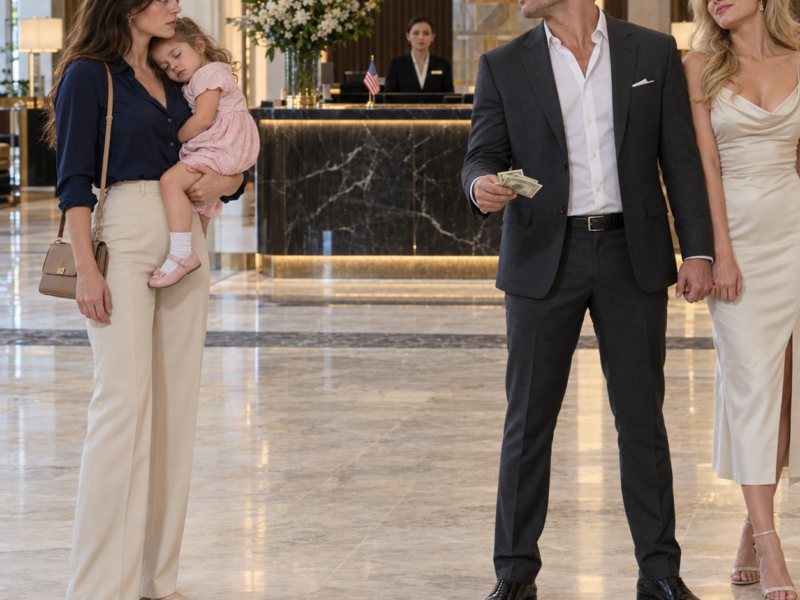
“Go home. Figure out your own lunch,” my husband said, tossing cash at my feet in a marble hotel lobby. His mistress laughed while our sleeping three-year-old daughter rested against my shoulder. I bent down to gather the bills, and Grant smiled. Then I pulled a black phone from my handbag, and his expression changed. “Mara… don’t.”

My husband threw the money while our daughter was asleep against my shoulder.
Several bills landed on the marble floor. One slid beneath the edge of a chair. Another stopped beside the toe of my shoe.
“Go home, Mara,” Grant said. “Figure out your own lunch.”
He was still holding the other woman’s hand.
That was the detail I would remember later. Not the money, not the hotel guests pretending not to look, not the startled expression of the receptionist behind him.
His hand remained around hers.
He had seen me enter the lobby carrying our three-year-old daughter, and he had chosen not to let go.
The blonde woman gave a short laugh.
Ellie shifted against my neck. Her rabbit was trapped between our bodies, one worn ear resting beneath her chin. She had fallen asleep in the car after preschool, and I had carried her inside because I expected to find her father finishing a meeting.
We were supposed to have lunch.
Nothing elaborate. Twenty minutes together before his next appointment. Ellie had asked whether Daddy’s hotel served grilled cheese, and Grant had told her he would make sure it did.
I looked at the bills.
Then at him.
A few minutes earlier, I had asked who the woman was.
Grant had answered, “Someone who understands that I’m busy.”
I had asked why he was holding her hand.
He had looked toward the elevators, irritated that I was speaking where people could hear.
“Mara, not here.”
As if I had brought the betrayal into the room.
As if the problem were my noticing it.
When I said we needed to talk, he reached into his wallet.
Now the money lay between us.
For a moment, I felt the impulse he expected. Tears. Raised voices. A desperate attempt to make him explain himself in front of the woman he had chosen to stand beside.
Then Ellie sighed in her sleep.
I adjusted my grip on her.
There were things I could endure for a few more minutes. There were things she should never have to witness.
I bent carefully and gathered the bills with one hand.
Grant’s mouth lifted.
He thought I was accepting the terms he had set.
Instead, I opened my handbag and took out a black satellite phone.
A small gold falcon was stamped across its back.
The Kingsley crest.
The woman stopped laughing.
Grant took a step toward me.
“Mara.”
Before I married him, before I stepped away from the family office to raise Ellie, I had spent years learning how the Kingsley investment structure worked. I knew which funds supported Mercer Group, which guarantees enabled its expansion, and which approvals Grant could exercise only because our family had authorized him to do so.
The phone did not create that authority.
It gave me a secure way to reach the people responsible for carrying out decisions I was already entitled to make.
I pressed the call button.
When the family office answered, I gave my identification and authorization.
“Restrict every account and investment facility connected to Grant Mercer’s discretionary authority. Suspend extraordinary transfers and pending acquisitions until counsel completes a review.”
Grant moved closer.
“Mara, wait.”
“Payroll and ordinary operating expenses remain active,” I added. “This concerns executive authority.”
The person on the other end repeated the instructions.
I confirmed them.
Then I ended the call.
Grant stared at me.
For years, he had known exactly who I was. He had benefited from it, joked about it, and sometimes resented it.
Standing in that lobby, he looked as though he had forgotten until the moment I reminded him.
His phone began vibrating.
He looked down.
The woman’s phone sounded next.
Some authorizations changed immediately. Other notices arrived as the family office contacted the institutions and executives involved. Cards tied to restricted facilities were suspended. Pending transfers were held. Corporate approvals were withdrawn for review.
Grant read the screen, then looked at me.
“You can’t do this.”
“I just did.”
“The company employs eight hundred people.”
“I know.”
“Then you know what this means.”
“I know what it would mean if I shut down your operating accounts. That is not what I authorized.”
He stopped.
I could see him reconsidering the woman in front of him.
Perhaps he had expected me to be so angry that I would make a decision broad enough for him to criticize.
I was angry.
I was also familiar with the difference between his personal freedom to move money and a housekeeper’s right to receive her paycheck.
The people who cooked breakfast, changed linens, repaired elevators, and worked the night desk had nothing to do with our marriage.
I would not make them pay for it.
Before Grant could speak again, my own phone vibrated.
A restricted file had been released to my authorized account as part of the review.
I frowned.
The heading concerned Northstar, one of the pending transactions now subject to scrutiny. Beneath it were linked documents that had been held within a protected project archive.
Three names appeared.
Grant Mercer.
Sloane Vale.
Eleanor Mara Mercer.
Ellie.
My grip tightened around the phone.
I opened the first linked document.
The heading read CUSTODY.
Grant saw my face.
“Mara, give me the phone.”
I stepped backward.
“What is this?”
“Not here.”
There it was again.
Not here. Not now. Not in a place where I could ask questions he could not quietly dismiss.
I scrolled.
There were travel records, preschool forms, legal drafts, and a medical report involving our daughter.
The file had begun months earlier.
Before the moment in the lobby. Before I knew there was another woman. Before I had understood how much of our marriage Grant was discussing with someone else.
At the bottom of one document was his signature.
Sloane’s appeared on the accompanying material.
Then I saw a third.
Theo Kingsley.
My older brother.
For several seconds, I heard nothing but Ellie’s breathing and the distant movement of luggage across the lobby.
“Who were you planning to take my daughter from me with?”
Grant said nothing.
The satellite phone rang.
Theo’s name filled the screen.
Grant stopped moving toward me.
I answered.
“Theo.”
“Mara, listen before you do anything else.”
His voice was controlled in a way I recognized. Theo became very calm when he was frightened and did not want anyone to know.
“I’m listening.”
“Take Ellie somewhere quiet. Don’t sign anything. Don’t agree to anything Grant says until we’ve talked.”
I looked at the signature again.
“You’re giving me advice now?”
A pause.
“Your signature is here.”
“I know.”
The answer hurt more than a denial would have.
“What did you sign?”
“I need to explain.”
“Then explain.”
“Not in the lobby.”
I almost laughed.
Apparently, every man in my life had agreed that the lobby was unsuitable for telling me what they had been doing behind my back.
The woman beside Grant released his hand.
I looked at her properly for the first time.
She wore a cream jacket and carried a leather portfolio beneath one arm. A firm’s name was embossed on it.
Bennett, Vale & Hart.
I knew that firm.
I knew her name too.
Outside counsel. Trust matters. Corporate restructuring.
“You’re Sloane Vale.”
Her face had lost its color.
“Yes.”
I looked from her to the custody file.
Then at Grant.
Ellie moved again. Her eyes opened slightly, then closed.
Whatever was happening among the adults could wait long enough for me to get her somewhere safe and ordinary.
“I’m taking Ellie home.”
Grant looked up.
“Our home?”
“No.”
His jaw tightened.
For a moment, I thought he would argue.
Then he looked at the phone in my hand and the child against my shoulder.
He did not.
“The company,” he began.
“Will continue operating.”
“Northstar—”
“Will be reviewed.”
He looked at me as though he had several explanations ready and could not decide which one might still work.
I put the phone in my handbag.
Behind the desk, the receptionist was looking down at her keyboard with exaggerated concentration. I knew she had seen everything.
I wished she had not needed to.
As I turned, Grant said my name.
I stopped, but did not face him.
“I’m sorry.”
There were too many things in that apology for me to sort through while holding our daughter.
I walked out.
In the car, I settled Ellie into her seat. She opened her eyes and looked at me.
“Lunch?”
“We’re going to Grandma’s.”
“Does Grandma have lunch?”
“She’ll find something.”
Ellie considered this.
“Muffins?”
“Probably.”
That satisfied her.
I sat behind the wheel with my hands resting against it.
For a few seconds, I did not start the engine.
I could still see Grant’s hand around Sloane’s.
Then I looked at Ellie in the mirror.
She was examining the rabbit’s ear as if nothing important had happened.
I drove.
My mother’s townhouse had always made me feel slightly underdressed.
Even when I arrived wearing something expensive, I wondered whether it was the right expensive thing.
Evelyn Kingsley kept polished walnut tables, fresh flowers, and rooms in which every object seemed to have an approved place. Her composure had once made me believe she could anticipate anything.
That afternoon, she opened the door with flour on the sleeve of her blouse.
Theo stood behind her.
I looked at him.
He did not try to hug me.
That was wise.
Mother reached for Ellie, who immediately asked about muffins.
“I made some,” she said.
Theo glanced toward the kitchen.
“That may be a generous description.”
Mother gave him a look.
We went inside.
Ellie climbed onto a stool at the island, set her rabbit beside her, and accepted a muffin.
She took a bite.
Chewed.
Looked at it.
“It’s hard.”
Theo pressed his lips together.
Mother lifted her chin.
“It has a good crust.”
For the first time since entering the hotel, I laughed.
Only briefly.
But it helped.
Mother found crayons and a pad of paper. Ellie began drawing purple circles, narrating a story that seemed to involve a whale, a birthday cake, and someone named Kevin whom none of us knew.
I watched her for a moment.
Then I followed Theo into the library.
Mother came with us, leaving the door open so we could hear Ellie.
I placed the phone on the desk.
“Tell me everything.”
Theo sat opposite me.
“I signed a statement four months ago.”
“For custody.”
“Not a custody petition.”
“It was in the file.”
“Yes.”
I waited.
He rubbed a hand across his face.
“Grant told me the marriage was struggling.”
“That was not your business to discuss with him without telling me.”
“I understand.”
“You understood then.”
Theo looked at me.
“Yes.”
Mother stood near the window.
For once, she did not intervene to make the conversation easier.
Theo opened a folder.
“Grant said you had discussed taking Ellie to London if you separated.”
I remembered the conversation immediately.
It had happened after an argument late at night. We were both tired. Ellie had been sick the week before, I had missed several nights of proper sleep, and Grant had been spending more evenings at the office.
I had said perhaps Ellie and I should spend a few weeks in London with my mother.
A few weeks.
I had not said I would disappear. I had not said Grant would never see her.
I had wanted room to think.
“He turned that into a threat?”
“He said he was worried.”
“That isn’t an answer.”
Theo lowered his eyes.
“He was worried that if the marriage ended, your family could make decisions faster than he could respond.”
I looked at him.
“He asked you for help against me.”
“He asked me to confirm some facts. The statement says the family has residences abroad.”
“And?”
“That, to my knowledge, you had never expressed an intention to deny him access to Ellie.”
Theo slid the document across the desk.
I read it.
Then read it again.
The statement was not what I had feared.
It did not accuse me of planning to take our daughter away.
It said the opposite.
I looked up.
“Why was it signed without telling me?”
Theo took a breath.
“Because I thought I was preventing something worse.”
“What?”
“A fight between Grant and the family.”
“And you thought keeping me outside the discussion would help.”
His face tightened.
“Yes.”
The answer was honest.
It was also familiar.
In my family, protection often meant decisions made in rooms I had not been invited into.
Mother had done it when she wanted me to remain at the family office after marrying Grant. Theo had done it when he thought a business matter might upset me. Both had been convinced that good intentions made secrecy easier to excuse.
Now my husband had created his own version.
Mother spoke.
“We have not always made it easy for people to disagree with us.”
I turned toward her.
She looked at the phone on the desk.
“Your father and I built a family that could act quickly. We were proud of that. We rarely considered what it felt like to someone who believed he might be on the other side of it.”
“So you’re defending him.”
“No.”
Her answer came firmly.
“I am saying there may be things we need to understand without forgiving them.”
I did not want to understand Grant.
Not yet.
I wanted the sharp clarity of a simple villain. A man who had wanted my money, betrayed me, and prepared to take my daughter.
The file was already making that story more complicated.
Complicated did not mean acceptable.
I turned back to Theo.
“What did you know about Sloane?”
“She was his lawyer.”
“Before she was his mistress.”
“Yes.”
“How long?”
“He consulted her about five months ago.”
“And the affair?”
Theo looked toward the open door.
Ellie was telling Mother’s housekeeper that whales could have birthdays if they wanted.
I waited.
“I saw them together six weeks ago,” he said.
“Where?”
“A restaurant.”
“Did you ask?”
“Yes.”
“What did he say?”
“That there was nothing between them.”
“Did you believe him?”
Theo did not answer immediately.
“No.”
I looked down at my hands.
That was the part I had not been prepared for.
Theo had not simply signed a statement. He had seen something, suspected more, and decided I could wait to know.
“You should have called me.”
“Yes.”
“Not Grant. Me.”
“Yes.”
“You let me keep living with him.”
His eyes filled.
“I was trying to be certain.”
“You were trying to avoid a difficult conversation.”
He sat back.
“Yes.”
There was no explanation attached to the word.
I appreciated that more than I wanted to.
I looked through the medical report.
It was Ellie’s annual pediatric record. Her height, weight, vaccinations, and a note about a harmless murmur that had already been evaluated.
A recommendation appeared concerning a routine future screening because of a minor hereditary rhythm condition in my family.
There was no new diagnosis.
No frightening discovery Grant had concealed.
I closed my eyes.
Relief came so quickly that it left me weak.
Then I read the page again.
“Why did he include this?”
Theo answered carefully.
“He appears to have been collecting records of his involvement in her care.”
“He could have kept appointment dates.”
“Yes.”
“He took her private medical information and put it in a legal strategy.”
“Yes.”
The travel documents were similar.
Flights we had taken together. Preschool enrollment material. Family photographs.
Grant had been gathering proof that he was an involved father.
I thought about the afternoons he had taken Ellie to the park. The pediatric appointments where he held her hand. The first time he called me from preschool because she had cried at drop-off and he could not stop thinking about it.
Those moments had been real.
He had turned them into evidence.
I did not know which part upset me more.
“I want to meet with him,” I said.
Theo looked surprised.
“Tonight?”
“Tomorrow. With independent lawyers present.”
Mother nodded.
“Sloane will not be there,” I added.
“She has withdrawn,” Theo said.
“Already?”
“Her notice came after the hotel.”
I looked at him.
“That was quick.”
“It would need to be.”
I did not want a discussion of her professional judgment.
I wanted it established that I would not sit across a table from my husband while his mistress advised him.
Outside the window, traffic moved along the street. A man was walking a small dog in a red sweater. Someone carried grocery bags toward the building opposite us.
The ordinary world steadied me.
Then Theo said, “There is another matter.”
I turned.
“What now?”
“The Northstar acquisition.”
“I restricted it.”
“I know. Do you know what the property is?”
“A hotel.”
“Which hotel?”
Something in his voice made me sit down again.
He placed another folder on the desk.
I opened it.
The address stopped me.
Seabrook Lane.
Cape Alder, Maine.
I knew the place before I reached the name beneath it.
Seabrook House.
My father’s first hotel.
Not one of the large properties people associated with Kingsley. Not the towers, resorts, or conference centers.
A weathered thirty-room inn overlooking the Atlantic.
I had learned to swim there. Theo and I had washed breakfast dishes for pocket money. Mother had taken reservations at a desk near the entrance, and Dad had repaired the porch himself.
When I remembered my family before business became the center of everything, I remembered Seabrook.
After my father died, I had been told it was sold.
I had not returned.
“Grant was buying it?”
Theo nodded.
Mother came closer.
“What?”
“You didn’t know?”
“No.”
I turned the page.
The planned buyer was Northstar Holdings. The financing was connected to Mercer Group and Kingsley-backed facilities.
After renovation, the property was supposed to be transferred into a separate trust.
The proposed beneficiary was Eleanor Mara Mercer.
Ellie.
I stared at her full name.
Grant had been preparing for a custody dispute and arranging an affair.
He had also been trying to return my childhood home to me through our daughter.
The contradiction exhausted me.
I remembered an evening almost a year earlier. Ellie had spilled flour across the kitchen floor while trying to help us bake. Grant and I had sat down in the mess because there was nowhere clean to stand.
We had laughed.
I had told him about Seabrook. About my father teaching me to swim. About Theo falling off the dock and insisting a shark had pushed him.
I had said I wished Ellie could spend one summer there.
Grant had listened.
Apparently, he had remembered.
Mother looked at the documents.
“Why would he do this?”
“I don’t know.”
I did not feel grateful.
Not then.
I felt worn out by learning that the man who could remember something tender could also behave so cruelly.
I turned another page.
“Where is the seller’s authorization?”
Theo searched the folder.
“It should be included.”
“It isn’t.”
I reopened the secure archive on the phone.
The transaction documents were there.
So was an authorization added that afternoon.
The property was held through a trust.
I read the name aloud.
“The Daniel Kingsley Preservation Trust.”
Mother gripped the back of the chair.
“That cannot be right.”
“Why?”
“I was told that trust was dissolved eighteen years ago.”
Theo looked at her.
“Who told you?”
Mother’s face had become very pale.
“Arthur Bell.”
I had not heard his name spoken in years.
Arthur had been Dad’s lawyer and his friend. He had eaten Christmas dinner with us, taught Theo to play chess, and stood beside Mother at the memorial.
After Dad died, Arthur handled the paperwork none of us wanted to look at.
Three years later, he retired.
Then he disappeared quietly from our lives.
Mother sat down.
“He told me the preservation trust had been dissolved to cover obligations connected with the estate.”
“Did you see the dissolution?” Theo asked.
Mother looked at him sharply.
“I saw what he gave me. I signed what required signing. The estate was reviewed. I was running the company and trying to keep the two of you from falling apart.”
I remembered those years as my mother becoming harder to reach.
She remembered them as years in which she could barely keep standing.
Both could be true.
I examined the document again.
Arthur remained listed as one trustee.
The second appeared only as D.K.
My father’s initials.
But Daniel Kingsley had been dead for nineteen years.
I looked at Theo.
“We need the complete trust documents.”
He reached for his phone.
I stopped him.
“Through ordinary counsel.”
He frowned.
“What do you mean?”
“No investigators calling people at night. No threats. No one using the family name to make someone panic before we understand what happened.”
“An asset may have been concealed.”
“Then we will find out how.”
He studied me.
I knew he was thinking about the call I had made in the lobby.
Perhaps I was thinking about it too.
“Quietly,” I added.
Theo nodded.
“All right.”
Mother remained seated, her hands clasped tightly.
For the first time that day, I saw the same fear on her face that had been on mine.
The fear of discovering that someone you trusted had made a private version of your life.
The next morning, Grant and I met in a conference room at a neutral law office.
Ellie was not there.
Neither was Sloane.
Our lawyers sat beside us. Two glasses of water stood between the folders on the table. Beyond the windows, the October sky was gray.
Grant looked as though he had not slept.
I had slept perhaps two hours.
The meeting began with business.
The restrictions would remain on extraordinary transactions while an independent review examined Northstar and the authority used to finance it.
Ordinary operations would continue.
Grant agreed.
His lawyer asked several questions about the scope. Mine answered them. The conversation was precise, controlled, and almost restful compared with the uncertainty of the previous afternoon.
Then we reached Ellie.
My lawyer asked whether Grant intended to pursue the custody petition prepared in Sloane’s file.
“No.”
He answered before his lawyer could speak.
I looked at him.
“Why did you have it?”
“Because I was afraid.”
“That explanation is becoming popular.”
He accepted the remark.
“I thought that if you left, I might lose Ellie too.”
“Did I ever say you wouldn’t see her?”
“No.”
“Did I threaten to keep her from you?”
“No.”
“Then what were you responding to?”
Grant stared at the glass of water.
After a moment, he said, “When I married you, I thought I was marrying Mara.”
“You were.”
“I know. But I also married the Kingsleys.”
I sat very still.
He continued.
“I had three properties when we met. They weren’t much compared with what your family owned. But I understood every bill and every problem. They were mine.”
I remembered the first one.
A converted brick warehouse with beautiful windows and elevators that behaved as though carrying people were an unreasonable request.
I had loved it.
“Then the family invested,” he said. “Three became fifteen. Fifteen became thirty-two. Every success was described as Kingsley-backed. Every mistake could be fixed with a call I was grateful for and ashamed of needing.”
“Did I ever make you feel small?”
“No.”
He hesitated.
“That was part of it.”
I frowned.
“You didn’t make me feel small. I felt that way anyway. And because you hadn’t done anything to cause it, I didn’t know how to admit it without sounding ungrateful.”
I let him finish.
“I kept accepting help while resenting the people who gave it. Then I brought that resentment home.”
The words explained things I had noticed without understanding.
His irritation when Mother asked a simple business question. The way he dismissed Theo’s suggestions even when they were useful. His increasingly sharp response whenever I offered to call the family office.
There had been evenings when he acted as though my ability to solve a problem were proof that I had caused it.
“You could have told me.”
“Yes.”
“Instead, you told Sloane.”
“Yes.”
No excuse followed.
I looked at the table until the pressure in my throat eased.
Grant described the consultation. He had asked about separation and temporary travel abroad with Ellie. Sloane had explained options. Then he asked her to prepare a custody strategy.
The request had been his.
So had the decision to include the medical report.
“I wanted proof that I was at her appointments,” he said.
“You were her father at those appointments. You didn’t need to turn them into a case against me.”
“I know.”
“You know now.”
“Yes.”
My lawyer made a note.
I asked when the affair began.
“Seven weeks ago.”
Theo had seen them six weeks earlier.
I counted backward without wanting to.
A dinner. A school event. A Sunday when Grant had taken Ellie for a walk so I could sleep late.
Seven weeks contained ordinary family memories I would now have to reconsider.
“When did you decide to leave me?”
Grant looked up.
“I didn’t.”
“That makes no sense.”
“I know.”
“You prepared for a custody dispute. You began an affair. You humiliated me in public.”
“Yes.”
“And you never decided to leave.”
His face tightened.
“I never made the decision. I made other decisions instead.”
That was closer to the truth than anything he had said.
He had not chosen to end the marriage.
He had stopped making choices that kept it alive.
I looked away.
For a while, nobody spoke.
Then I asked about Seabrook.
Grant’s expression changed.
“You found that.”
“I found enough. Explain the financing.”
He rubbed his palms against the table.
“I learned the property might go to a developer. Private residences. I knew what it meant to you.”
“So you decided to buy it.”
“Yes.”
“For Ellie?”
“For you.”
The answer did not soften me as much as he might have hoped.
“Why put it in her name?”
“I thought you would refuse it if it were yours.”
“You leveraged twelve million dollars because you thought I might refuse a gift.”
He closed his eyes briefly.
“When you say it that way—”
“How else should I say it?”
“As a terrible decision.”
For half a second, I could hear the man I had once laughed with.
Then the hotel returned to me.
The cash.
Sloane’s laugh.
His hand around hers.
I sat back.
“How did you find the trust?”
“Sloane traced the ownership.”
“Did she know it was connected to my father?”
“Eventually.”
“And neither of you thought I should know.”
“It was meant to be a surprise.”
“A surprise does not explain using company financing without the authority to do it.”
“No.”
He did not argue.
That was something.
It was not enough to save us.
I asked for a temporary parenting arrangement.
Ellie would remain with me during the week. Grant would have daytime visits over the weekend while we established a predictable routine. Overnight changes would come later, when she was comfortable.
We would tell her together that we were living in different houses and both loved her.
Nobody would discuss money, lawyers, Sloane, Seabrook, or blame within her hearing.
Grant agreed.
His lawyer worked through the details with mine.
Before I left, Grant asked me to wait.
I remained standing.
“What I did in the lobby was awful.”
“Yes.”
“The money. I don’t know why I did that.”
“I do.”
He looked at me.
“You wanted to feel powerful for ten seconds.”
His eyes dropped.
“Yes.”
I picked up my bag.
“It cost more than ten seconds.”
“I know.”
This time, I believed he had begun to understand.
That afternoon, Sloane requested a meeting through my lawyer.
My first answer was no.
I had nothing to gain by listening to a woman tell me my marriage had already been over, that Grant was lonely, or that things simply happened.
Then her message indicated she had information concerning Seabrook.
I agreed to meet in a quiet café.
She arrived with her hair tied back and none of the confidence she had worn in the lobby.
“I have withdrawn from every matter involving Grant, Mercer Group, and your family.”
“That should have happened seven weeks ago.”
“Yes.”
I waited.
“What happened between Grant and me was wrong,” she said. “I knew he was married. I am not going to ask you to believe otherwise.”
“And you laughed.”
Her face changed.
“Yes.”
“Why?”
“I was uncomfortable.”
“So you laughed at the person being humiliated.”
“Yes.”
There was nothing useful to add.
At least she seemed to understand that.
“I’m sorry.”
I folded my hands.
“Tell me about Seabrook.”
She took an envelope from her bag.
“This is something Grant hasn’t seen.”
I did not touch it.
“What is it?”
“When I traced the trust, I requested archival material. A response came through a Maine firm on behalf of the second trustee.”
“D.K.”
“Yes.”
“Who?”
“I wasn’t given the identity. But they released a copy of a letter relevant to the proposed sale.”
She pushed the envelope toward me.
I opened it.
The handwriting stopped me before I read a word.
My father’s.
It had been nineteen years since I last watched him write something. He used to leave notes on the kitchen counter, reminders that looked hurried until you noticed how carefully he formed every capital letter.
This letter was dated three months before his death.
It was addressed to Arthur Bell.
The first paragraph concerned Seabrook.
Dad did not want it absorbed into Kingsley Group, pledged to support another expansion, or demolished for development.
Then I reached a sentence that made me put the page down.
When Mara is old enough to decide what home means to her, give her the choice I was never brave enough to give myself.
I read it again.
Below it, he explained that if I wanted to take responsibility for Seabrook, I should have the opportunity.
If I did not, the property could be sold and the proceeds divided equally between Theo and me.
He did not want Mother turning the decision into another corporate matter.
I could almost hear him saying it gently, trying to make a difficult request without making it sound like criticism.
“There is another page,” Sloane said.
I turned it.
The successor trustee was identified.
Diane Kingsley.
D.K.
Not Daniel.
Diane.
My father’s younger sister.
Aunt Diane had left the family’s daily life after his funeral. Mother described her as difficult and impulsive. Theo remembered her as funny. I remembered sitting beside her on Seabrook’s porch while she taught me how to tell when rain was coming off the water.
I had not seen her since I was fourteen.
“She’s alive?”
“As far as I know.”
“Why hasn’t she contacted me?”
“I don’t know.”
“Why has nobody told me any of this?”
Sloane looked down.
“I don’t know.”
For once, the unanswered questions were not a wall.
They pointed toward someone I could ask.
I put the letter back in the envelope.
“Thank you for bringing it.”
She nodded.
“I know it doesn’t change anything else.”
“It doesn’t.”
We stood.
I did not hug her. I did not offer forgiveness so she could leave feeling better.
I left with my father’s handwriting in my bag.
That evening, Theo found an address in old family correspondence.
A small town on the Maine coast, forty minutes from Seabrook.
Our lawyers made contact before we traveled.
Mother declined to come.
“I don’t think Diane will speak freely with me there.”
I studied her face.
There was sadness in it.
“Did you know about Dad’s letter?”
“No.”
I believed her.
It was a small beginning, but it mattered.
Two days later, Theo and I drove north.
The October trees grew brighter as we traveled. Red maples stood against dark pines. Small roadside houses had pumpkins on their steps.
Ellie stayed with our nanny for the morning and was scheduled to spend the afternoon baking cookies with Grant.
I checked once that the arrangement was on time.
Then I put away my phone.
Whatever Grant had broken between us, he loved his daughter.
I was trying to let that fact remain separate from the rest.
For the first hour, Theo and I talked about the route.
Then he said, “I should have told you.”
I kept my eyes on the road.
“Yes.”
“I keep looking for a better explanation.”
“Do you have one?”
“No.”
I nodded.
He watched the trees pass.
“I thought certainty was required before I hurt you.”
“You let uncertainty hurt me instead.”
“I know.”
There was no quick forgiveness waiting inside that conversation.
But it was the first time he seemed more interested in understanding what he had done than in proving he had meant well.
That gave me room to stay beside him.
Diane’s house was white and small, with a harbor visible beyond the yard.
She opened the door before we knocked.
Her hair was silver now.
She looked at Theo.
Then at me.
Her eyes filled.
“You have Daniel’s face.”
People had said that all my life.
From her, it felt less like a comparison than a reunion.
“You knew we were coming?”
“The lawyer called.”
She stepped aside.
“Come in.”
The house smelled of coffee and cedar. Gardening catalogs covered part of the kitchen table. A pair of muddy shoes stood on newspaper by the back door.
Nothing had been arranged to impress us.
I liked it immediately.
We sat while Diane poured coffee.
Then she brought an old wooden document box to the table.
“I wondered when you would come.”
“Nineteen years is a long time to wonder.”
She accepted the edge in my voice.
“Yes.”
“Why didn’t you contact me?”
“Your father asked me to wait until you came looking.”
“I was fourteen when he died.”
“I know.”
“How was I supposed to look for something I thought no longer existed?”
Diane sat down.
“That is a fair question.”
Theo leaned forward.
“Did you really spend nineteen years waiting?”
“I maintained the building. Arranged operators. Paid taxes. Repaired the roof twice. It was not untouched.”
“But you did not tell Mara.”
“No.”
She opened the box.
“Daniel was afraid Seabrook would become another responsibility handed to you before you knew what you wanted. He wanted you to arrive at the choice yourself.”
“I could have made a choice if someone had told me there was one.”
Diane looked at me.
“Yes.”
The admission was quiet.
It did not make the lost years disappear.
It did keep the conversation from becoming another argument about why I should be grateful for decisions made without me.
Theo asked about Mother being told the trust was dissolved.
Diane looked genuinely surprised.
“I did not tell her that.”
“Arthur did.”
“I assumed Evelyn knew the arrangements and preferred a simpler explanation for the company.”
“She didn’t.”
Diane sat very still.
“That I did not know.”
I looked at the box.
I had expected a villain hiding money.
Instead, I was finding a chain of assumptions, evasions, and private decisions that had lasted almost two decades.
Arthur had given Mother information she trusted.
Diane believed Mother knew more than she did.
Dad had wanted me protected from an obligation and had left me unaware of an opportunity.
None of it erased the responsibility involved.
It did mean I could not understand the family by dividing everyone neatly into protectors and threats.
Diane pushed the box toward me.
“The complete records are here. Your counsel should review them. I will answer what I can.”
At the bottom was a sealed envelope.
Mara.
My father’s handwriting again.
I touched it.
Diane said, “That one is only for you.”
The letter was two pages.
I read slowly.
Dad wrote about the first summer at Seabrook, when the roof leaked and Mother took reservations at the breakfast table. He wrote about Theo being convinced that guests would pay extra for a room with a gull outside the window.
He remembered me following him with a paintbrush I was too young to use properly.
Then he wrote about expansion.
How each new property had seemed to promise more time and security.
How he kept postponing the life he thought success would eventually allow.
Near the bottom of the second page, he had written:
Power is useful, Mara, but be careful not to confuse having the ability to control an outcome with having the right to control the people inside it.
I thought about the phone.
Grant’s fear.
Mother’s authority.
Theo’s silence.
My own temptation to make every route out of the disaster lead through me.
I put the letter down.
Diane waited.
“Did he know he was dying?”
“He knew his health was uncertain. He was trying to finish things he had left unfinished.”
I looked at the handwriting again.
“He should have told me.”
“Yes,” she said.
It was the answer I needed.
I could love him without pretending secrecy had been a perfect form of care.
The final paragraph concerned Seabrook.
If I chose to take responsibility for it, Dad wanted me to decide within five years what purpose it would serve.
I could operate it, preserve it as a family place, or choose not to keep it.
Before deciding, he asked that the immediate family spend a weekend there.
Not to vote on my life.
To remember the place together before turning it into another transaction.
One sentence made me smile despite everything.
If Mara has married by then, invite the poor fellow too. He deserves to understand what he has gotten himself into.
Theo read it over my shoulder and laughed.
“That sounds like Dad.”
It did.
Then I thought of Grant.
The smile left my face.
“I don’t know if I can do that.”
Diane reached for her coffee.
“You do not have to decide today.”
For once, someone gave me time without withholding the information I needed.
We spent the afternoon looking through photographs and records.
There were images of Mother in jeans, standing on Seabrook’s porch with a paint roller. Dad looked younger than I had ever remembered him. Theo appeared in several photographs with a serious expression and a ridiculous haircut.
I found one of myself sitting beneath the reception desk.
“What was I doing?”
“Refusing to leave,” Diane said. “You thought the guests needed you.”
I smiled.
At the end of the day, we arranged for the records to be reviewed properly. The informal family stories would no longer serve as substitutes for documents.
I did not want another surprise years from now.
As Theo and I drove back, he asked whether I would go to Seabrook.
“Yes.”
“With Mother?”
“Yes.”
“Grant?”
I looked ahead.
“If I invite him, it will not mean I am inviting him back into the marriage.”
“I know.”
“I need everyone to know that.”
“They will.”
I glanced at him.
“Do not tell them for me.”
He nodded.
“All right.”
It was a small correction.
He accepted it.
I made the invitations myself.
Mother said yes immediately.
Theo complained about Maine weather, then asked which room he should book.
Diane agreed to come.
Grant was quiet when I told him.
“Are you sure?”
“No. But I am choosing it.”
He took a breath.
“I’ll drive separately.”
“Thank you.”
The decision mattered more than a grand apology would have.
He was beginning to understand that giving me space meant not filling it with evidence of his regret.
In the weeks before the trip, the business review continued.
I received updates through counsel.
Grant had exceeded his authority in arranging the Northstar financing, but the review did not uncover stolen Mercer funds, hidden personal accounts, or an attempt to transfer my assets.
The facts were narrower than the story I could have imagined in the lobby.
They were still serious.
Northstar would not proceed as planned. The bridge financing would be unwound. Grant would resign from two Kingsley-backed committees.
Mercer Group would refinance without the family office serving as guarantor.
It would grow more slowly.
That was not ruin.
It was a company beginning to operate within limits that should have been clearer before.
When the restructuring was complete, I approved lifting the restrictions on Grant’s executive authority.
Theo asked whether I was comfortable.
“No.”
“Then why?”
“Because discomfort is not a reason to keep using a business safeguard as leverage in my marriage.”
He considered that.
Then he nodded.
Grant would answer to his board.
I would answer for the decisions I made.
We needed that distinction if Ellie was ever going to grow up without learning that power excused anything.
Sloane left Bennett, Vale & Hart.
I learned through counsel that she had taken a position at a smaller firm in another city.
She sent a final written apology.
I read it and filed it.
I did not need another meeting.
There were subjects I could close without making a declaration about forgiveness.
Grant moved into an apartment fifteen minutes from Ellie’s preschool.
He brought her favorite yogurt. He learned where she liked her rabbit placed at bedtime. He arrived when he said he would.
None of that repaired the marriage.
It did begin to give our daughter a routine she could trust.
When we explained that Daddy had another home, she listened carefully.
Then she asked whether she could leave crayons there.
“Yes,” Grant said.
“All the colors?”
“All the colors.”
She accepted the arrangement more easily than we did.
Some days, I grieved the family she would not have in the form I had expected.
Then I reminded myself that the shape of a household was not the only thing a child noticed.
She would notice whether the adults kept their promises.
She would notice whether she was allowed to love both parents without upsetting either one.
Those were things we could still give her.
We signed a formal separation agreement before the Seabrook weekend.
There was no promise that the trip would restore us.
I would not let the setting become an argument.
When I arrived at Seabrook, the house seemed smaller than my memory.
The porch was narrower. The stairs did not stretch as far. The dining room where I once felt every dinner was a large occasion had only a handful of tables.
The ocean had not changed.
Gray-blue water moved beyond the lawn. Gulls circled above the rocks. The wind had the same cold edge I remembered from mornings when Dad insisted we should go outside before breakfast.
Ellie ran across the grass with Theo following.
“Uncle Theo, look!”
“I’m looking.”
“You’re looking wrong.”
He turned toward me.
“I have no idea what that means.”
“Neither does she.”
Mother stood beside me.
She had been quiet since entering the house.
“Are you all right?” I asked.
She looked at the porch rail.
“Your father sanded that twice because I said he had missed a spot.”
“Had he?”
“Yes.”
I smiled.
She did too.
It was easier to stand beside her when she was remembering a husband instead of representing a family.
Grant arrived later with one bag and Ellie’s yellow rain boots.
She saw him from the lawn.
“Daddy!”
He crouched to catch her.
She wrapped her arms around his neck.
“Grandma made pancakes.”
“Were they good?”
“They were not hard.”
Mother closed her eyes.
“The muffins will follow me to my grave.”
Grant laughed.
The sound hurt.
But it did not make me want to punish him.
It reminded me that I was losing a husband who had sometimes made me happy, not merely escaping a man who had done wrong.
Both truths deserved room.
We spent the first evening doing very little.
Theo insisted on walking down to the dock. Ellie demanded to go with him, then decided the wind was too cold. Diane showed Mother which part of the garden had survived and which had needed to be replanted.
Grant looked at the west wing without volunteering advice.
I noticed.
Later, he asked whether I wanted the structural survey he had commissioned.
“Yes. Send it through counsel.”
“All right.”
There was no complaint that I did not trust him enough to accept it directly.
That helped.
The family meeting took place the next morning in the old dining room.
Ellie sat nearby coloring. We kept the difficult parts of our conversation low and careful, stopping whenever she came to ask for help.
Dad’s letter lay in the middle of the table.
“Before we discuss the property,” I said, “I need one agreement.”
Theo leaned back.
“That sounds like something I will be expected to sign.”
“No more deciding what I should know.”
He grew serious.
I looked at Mother.
“No more protecting me from information by keeping it to yourself.”
She nodded.
“Agreed.”
I turned to Theo.
“Agreed.”
Grant sat at the far end.
“You do not need to ask me.”
“Yes, I do.”
He straightened.
“Then agreed.”
Diane lifted her coffee.
“Does that include aunts?”
“Especially aunts.”
Theo smiled.
“Historic aunts.”
“I’m sixty-two.”
“Practically an archive.”
She threw a napkin at him.
Ellie laughed so hard she dropped a crayon.
For a moment, the room became the kind of room Dad had described.
Then Mother rested her hands on the table.
“I owe you an apology.”
She looked at Theo and me.
“After Daniel died, I became frightened that everything he built would disappear. I understood the company. I knew what could be signed, secured, and maintained.”
Her gaze moved toward the windows.
“So I protected that.”
I waited.
“Sometimes I protected it more carefully than I protected the people in it.”
I felt my throat tighten.
“When you left the family office after marrying Grant, I thought you were abandoning responsibilities,” she told me.
“I know.”
“I wanted you to become the person I had needed to become. I did not ask whether that was the life you wanted.”
The apology did not feel triumphant.
I had imagined hearing it many times.
In those imagined scenes, I usually had the perfect answer.
Now I mostly felt sad for the years we had spent misunderstanding each other.
“I could have talked to you more plainly,” I said.
Mother looked surprised.
“I left whenever we disagreed. Sometimes that was necessary. Sometimes it meant you never heard what I needed.”
“I should have asked.”
“Yes.”
She nodded.
Theo looked into his cup.
“I suppose this is where I admit that being an older brother does not give me authority over Mara’s life.”
“It doesn’t.”
“I have been gathering evidence of that.”
I almost smiled.
“You signed something without telling me.”
“Yes.”
“You saw Grant with Sloane and kept it to yourself.”
“Yes.”
“I am still angry.”
“You should be.”
“I don’t want to lose my brother.”
His eyes became bright.
“I would prefer not to lose my sister.”
He reached across the table.
I took his hand.
It was not complete reconciliation.
It was a place to begin.
Then I looked at Grant.
The room became quiet.
He did not reach for me.
“I embarrassed you deliberately,” he said.
“Yes.”
“I betrayed our marriage.”
“Yes.”
“I prepared for a fight over Ellie instead of telling you what frightened me.”
I swallowed.
“Yes.”
He looked toward our daughter.
She was drawing hair on something purple.
Then he looked back at me.
“I cannot undo it. I will not ask you to treat it as smaller because I regret it.”
For weeks, I had been waiting for him to ask me to make his apology easier.
He did not.
“I loved you,” he said.
I shook my head.
“Do not put it in the past only because we are separating.”
He looked up.
“I believe you loved me,” I continued. “I believe part of you may still love me.”
His eyes lowered.
“But that did not keep you honest.”
“No.”
“It did not keep you respectful.”
“No.”
“It did not make you choose us when there was nobody watching.”
He wiped a tear from his cheek.
“No.”
I let the silence remain.
Then I said, “You do not have to fail at being Ellie’s father because you failed at being my husband.”
His face changed.
“She loves you.”
“I love her.”
“I know.”
“I will not make her pay for what I did.”
“I need that to remain true when things are difficult. Not only while you are sorry.”
He nodded.
“Yes.”
I looked at our daughter.
She had abandoned the purple drawing and was now making a house with too many windows.
“I will not take your relationship with her away because I am hurt,” I said.
“Thank you.”
“That is not a gift to you.”
“I understand.”
“It is what she deserves.”
Grant nodded again.
The distinction mattered to me.
I had spent weeks trying to decide whether forgiveness meant returning to the marriage.
It did not have to.
I could stop making every decision from the place where he had hurt me.
I could learn to trust him with Ellie while remaining unwilling to trust him with my heart.
I could wish him a better life without building that life beside him.
Those possibilities did not require me to pretend the lobby had never happened.
They required me to decide what would happen next.
When we turned to Seabrook, Grant immediately said he would withdraw from the purchase.
“The business should never have been used for a personal plan.”
Diane nodded.
“That will simplify the records.”
Mother looked at me.
“What do you want?”
The question surprised me.
Not because she had never asked it, but because she had often asked with an answer already waiting behind her eyes.
This time, she waited.
I walked to the window.
Outside, the grass moved in the wind. The old porch needed work. The west wing required more than cosmetic attention.
Seabrook was not a polished dream someone could hand me.
It was a place that would demand choices.
“I don’t want another Kingsley luxury property.”
Mother smiled slightly.
“I suspected that.”
“I don’t want to move here permanently.”
Theo looked relieved.
“Excellent. Maine winters are an assault.”
Diane shook her head.
“You are soft.”
“I enjoy feeling my hands.”
I turned back.
“I want to reopen the inn.”
Grant leaned forward, interested despite himself.
“Thirty rooms?”
“Yes. Keep the dining room. Restore the cottages. Keep the scale it was built for.”
Mother looked toward the entrance.
“No marble lobby?”
I raised an eyebrow.
The room laughed.
Even Grant.
Especially Grant.
I continued.
“I want part of the property used through the foundation. Family retreats. Hospitality scholarships. Small-business programs. Something useful to people who could never afford one of our larger properties.”
Theo considered it.
“That could work.”
“I don’t want it managed only as a memory of Dad. I want it to be a living place.”
Diane’s eyes filled.
“He would have liked that.”
“Maybe.”
She smiled.
“You’re right. It should be what you want.”
Grant said the west wing needed substantial structural repairs.
“You have the survey?”
“Yes.”
“Send it.”
“I will.”
For once, information he had gathered privately would become something we could use openly.
Mother asked what I would call it.
Through the window, I could see the old sign.
The paint had faded, but the carved name remained.
“Seabrook House,” I said. “Why change it?”
Nobody argued.
The following year was less dramatic than the weeks that had brought us there.
It was also more demanding.
Restoration involved meetings, estimates, delays, and choices that did not fit into a moving speech about home.
A wall concealed a problem that made a repair more expensive. A delivery arrived late. A room I had thought was ready needed to be redone because I had approved something too quickly.
I learned to ask practical questions before falling in love with how a drawing looked.
Diane knew the building well enough to save us from mistakes.
Theo was useful when he remembered to offer help rather than assume command.
Mother surprised me by being patient with decisions that were smaller than anything she usually handled.
We argued sometimes.
But increasingly, the arguments concerned the actual subject.
A budget. A date. A room.
Not who I was allowed to become.
When Mother disagreed, she said so.
When she learned something important, she told me.
Those were small changes.
They mattered more than promises.
Grant sent the survey and answered technical questions when asked.
He did not use the work as a reason to call me late at night or remind me of the gift he had intended.
Sometimes I could tell that restraint cost him.
I appreciated it without rewarding it with hope.
Our divorce moved forward.
There were difficult conversations.
There were days when one of us said something too sharply and had to begin again.
But there was no courtroom fight over Ellie.
No attempt to make money substitute for emotional injury.
Grant retained Mercer Group.
I retained my Kingsley holdings.
We worked out parenting responsibilities and the practical details of two households.
By the time the divorce became final, sadness had replaced most of my fury.
Sadness was harder to direct at someone.
It required me to live with what had ended.
Ellie grew used to having crayons, pajamas, and yogurt in both homes.
She sometimes forgot where a favorite toy was. Grant and I learned not to turn the resulting trip into an inconvenience to complain about in front of her.
He called when she developed a mild fever at his apartment.
At first, I wanted to go immediately.
Then I listened.
He had taken her temperature. He knew the pediatrician’s instructions. She was drinking water and demanding a particular cartoon.
“Call if anything changes,” I said.
“I will.”
He did.
That was how trust returned.
Not in a declaration that he was a different man.
In information shared when it mattered.
In promises kept without anyone applauding.
I sent preschool updates.
He arrived on time.
We learned to speak about our daughter without letting every conversation become a review of our marriage.
There were days when I resented how much work ordinary cooperation required.
Then Ellie would run from one of us to the other without checking our faces first.
That was worth the effort.
Sloane did not return to our lives.
I did not follow her career or wonder whether she and Grant might reconcile.
Their relationship had ended, but its ending was no longer something I needed to inspect.
My life had enough real work in it.
Seabrook reopened a year after the hotel incident.
We invited the town.
Former employees came. So did neighbors who remembered my father repairing the porch. Diane cried when the old brass room keys were placed behind the reception desk.
Theo gave a speech eleven minutes longer than promised.
Mother served blueberry muffins.
They were still too hard.
People ate them politely.
I saw Diane examining one with a thoughtful expression and shook my head before she could comment.
The inn was not exactly as it had been.
It should not have been.
The rooms were safer and more comfortable. The cottages had been restored. The dining room retained its old character without requiring anyone to sit on a chair that wobbled.
Photographs of Dad and Mother hung beside newer pictures of the restoration.
There was one of Theo holding a paintbrush badly.
He objected.
I kept it.
Grant arrived with Ellie.
Our divorce had been final for four months.
He brought her in yellow rain boots because she had insisted they were celebration boots.
Mother agreed.
“An excellent choice.”
Ellie beamed.
Watching them, I felt a tenderness I would once have mistaken for wanting the marriage back.
I did not want it back.
I wanted the people around my daughter to remain capable of kindness.
Those were different things.
During the afternoon, I stepped onto the porch for a moment of quiet.
The ocean was bright beyond the rail.
Inside, I could hear laughter and the sound of dishes.
Grant came out a minute later.
“Am I interrupting?”
“No.”
He leaned against the railing, leaving space between us.
“You did it.”
“We had help.”
“I know. But you chose this.”
I looked at the lawn.
He was right.
For so long, I had been reacting to decisions others made.
Seabrook was something I had chosen.
Grant reached into his jacket.
“I found something while clearing the last boxes from the house.”
He held out an envelope.
I looked at it suspiciously.
“If it is another trust document, I am throwing you into the Atlantic.”
He laughed.
“No documents.”
Inside were folded bills.
For a second, I did not understand.
Then I did.
The same amount he had thrown at my feet.
Not the same bills. I had donated those weeks earlier because I did not want them sitting in a drawer waiting to become a symbol.
On the envelope, he had written one word.
Lunch.
I looked at him.
“That is not an apology large enough to fit everything.”
“I know.”
“It is also not an invitation.”
“I know that too.”
Despite myself, I smiled.
“She still likes grilled cheese.”
“So do I.”
“Grant.”
He lifted a hand.
“I’m not asking.”
The sadness in his expression was quiet now.
For a while, we listened to the water.
Then he asked, “Do you think you will ever forgive me completely?”
I watched Ellie appear behind the dining room window. She held up two cookies and waved.
I waved back.
“I don’t know what completely means.”
He nodded.
“Fair.”
“I don’t wake up angry every morning.”
“That’s good.”
“I want you to have a good life.”
He looked surprised.
“I mean it.”
“After everything?”
“Yes.”
I turned toward him.
“But wanting that does not mean I need to build it with you.”
His eyes filled slightly.
“I understand.”
I believed him.
That was enough for the conversation.
Ellie pushed open the door.
“Mommy! Daddy! Grandma says cake!”
Grant crouched.
“Is it good?”
“I don’t know. Uncle Theo ate three pieces.”
“That is encouraging.”
She grabbed one of his hands and one of mine.
For a moment, we stood connected.
A year earlier, that sight would have filled me with grief for what I could not keep.
Now I looked down at her and felt something gentler.
We were still responsible for making a family around her.
It simply had a different shape.
“Hurry,” she said.
“We’re coming.”
Inside, Mother and Diane were disagreeing about frosting.
Theo denied taking another piece of cake while holding a plate that made the denial unconvincing.
Guests filled the dining room.
The old house was busy again.
I thought about the woman I had been in the marble lobby, holding a sleeping child while money landed at her feet.
I had believed the most important power available to me was the phone in my handbag.
It had been useful.
It had stopped transactions that needed to be examined and brought information into the open.
But it had not told me what to do with any of it.
The difficult decisions came afterward.
Choosing not to make Ellie evidence of my pain.
Choosing not to let Theo’s guilt become authority over my life.
Choosing to hear my mother without becoming the person she expected.
Choosing to end a marriage without making every shared responsibility a punishment.
Those decisions did not happen in seconds.
They took a year of ordinary days.
Some were handled well.
Some required another attempt.
By evening, the guests began leaving.
Mother went upstairs to check on Ellie. Diane sat at the reception desk turning one of the old room keys in her fingers. Theo carried plates into the kitchen and complained that the speech had not been that long.
Grant left after saying goodnight to our daughter.
He told me when he would pick her up the next day.
I told him where her overnight bag was.
An ordinary exchange.
Once, I would have wanted more from him.
That evening, ordinary was enough.
Later, I walked onto the porch alone.
The ocean was dark.
A lighthouse flashed in the distance.
I thought about Dad.
I wished he could see the inn without needing to imagine what might become of it.
I wished he could see Mother laughing.
Theo asking before helping.
Ellie running across the grass without knowing the weight of the documents that had brought us there.
I wished I could tell him I understood part of his letter now.
I also wished I could tell him that we should have known the truth sooner.
Love did not make secrecy harmless.
Good intentions did not return lost time.
But a mistake did not have to become the only thing a person was remembered for.
That was something I had learned about him.
About Mother and Theo.
Even about Grant.
Behind me, small footsteps crossed the floor.
I turned.
Ellie stood in the doorway wearing yellow pajamas and holding her rabbit.
“You’re supposed to be asleep.”
“I waked up.”
“You woke up.”
“That’s what I said.”
I laughed and lifted her.
Her head settled against my shoulder.
Almost exactly as it had in the hotel lobby.
This time, there was no money on the floor.
No man asking me to leave.
No file waiting to tell me what everyone else had decided.
“Mommy?”
“Yes?”
“Is this our house?”
I looked through the windows.
At the dining room.
The reception desk.
The photographs beside the stairs.
“It belongs to a lot of people in different ways.”
She frowned.
That was more explanation than she wanted.
I kissed her forehead.
“But yes. It is one of our homes.”
She accepted that.
I carried her upstairs.
Halfway there, she whispered, “Grandma’s muffins are still hard.”
I pressed my lips together.
“Yes.”
“Don’t tell her.”
“I won’t.”
Ellie smiled against my shoulder.
At the top of the stairs, I stopped for a moment.
A lamp was on in her room. Her bag was ready for the next day. Through the open window came the sound of the ocean, steady and familiar.
I put her in bed and tucked the rabbit beneath her arm.
She reached for my hand.
“Stay a little.”
I sat beside her.
Downstairs, someone laughed.
There were no instructions waiting for me to discover.
No secret I needed to solve before I could rest.
Only my daughter’s warm hand around one of my fingers, the quiet room, and the next day waiting to be lived.
I stayed until she fell asleep.