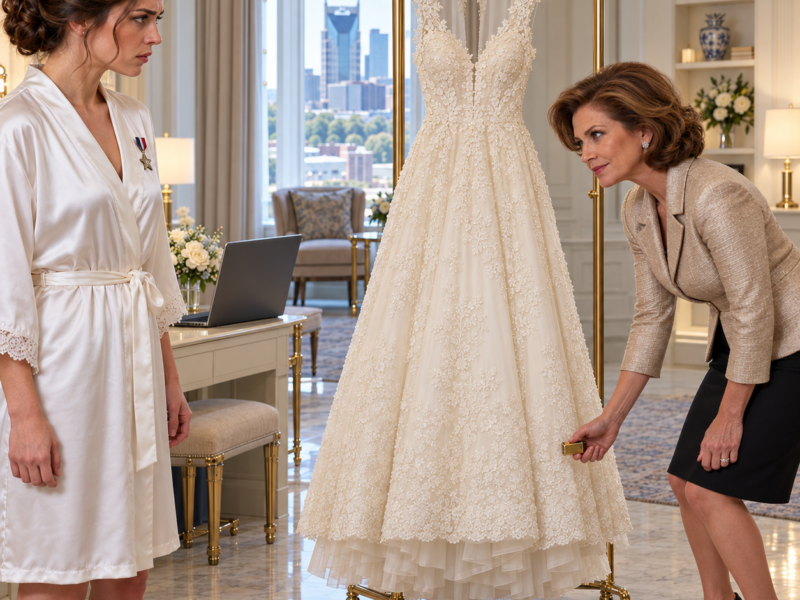
Fifteen minutes before my wedding ceremony, my future mother-in-law held a brass lighter to the hem of my gown and watched it burn. “You will never be part of this family,” she told me. Then she glanced at the Silver Star pinned to my bridal robe. “That little trinket means nothing here.” Behind me, a laptop sat open on the vanity. She hadn’t looked at its screen.
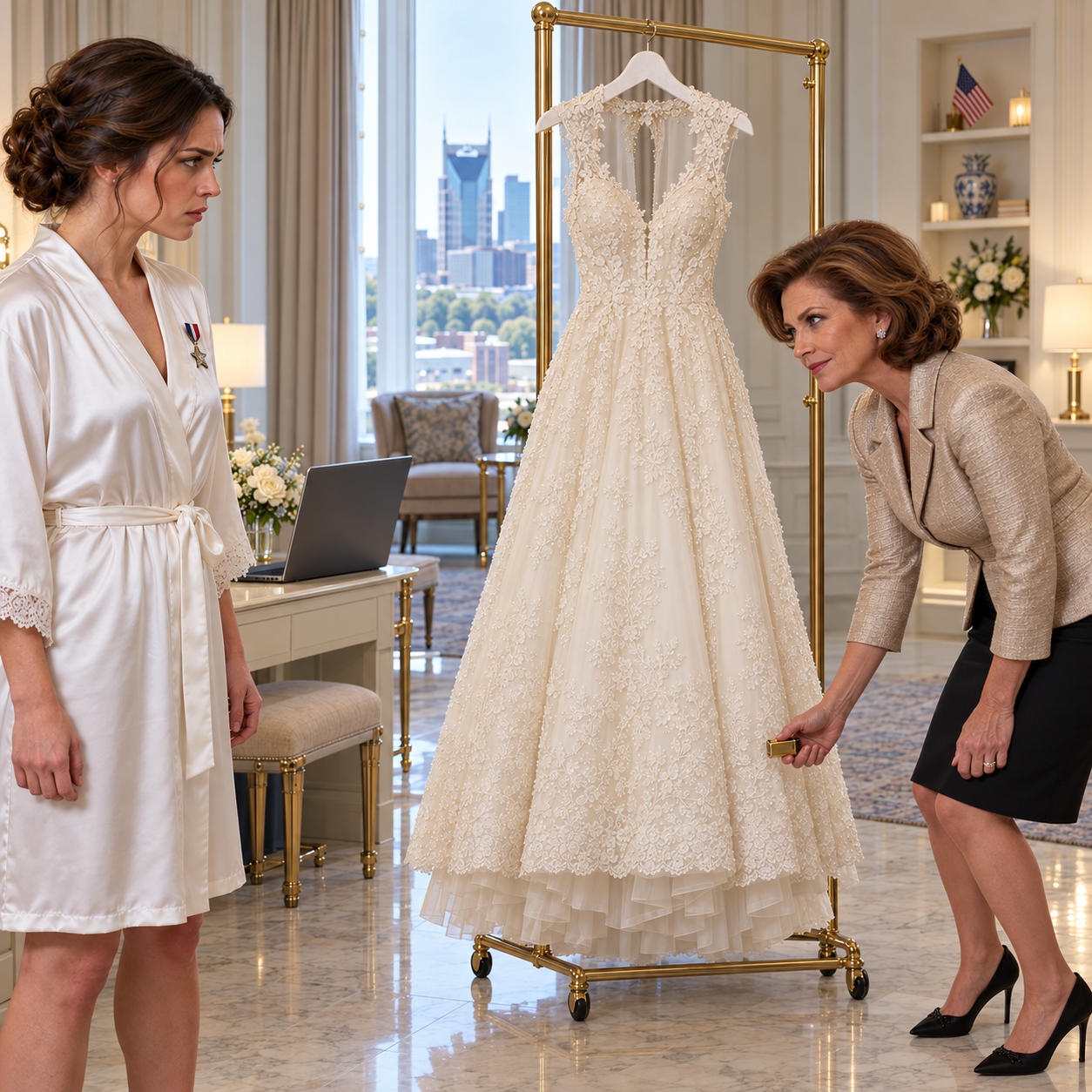
Fifteen minutes before I was supposed to walk down the aisle, Vivien Cross struck a brass lighter beside the hem of my wedding gown.
The dress hung from a padded hanger near the window.
I was still wearing my bridal robe.
For one bewildering second, I thought she was showing me something wrong with the fabric. Then a small flame caught at the edge, and the room changed.
“Denise,” I said.
My maid of honor was already moving.
One bridesmaid called the front desk. Another pulled the door open. Denise reached for what she needed to contain the fire while I moved everyone away from the dress.
Vivien did not help.
She stood beside the window in her cream Chanel jacket and looked at me.
“You will never be part of this family.”
Her voice was quiet.
Certain.
As though the fire were only a practical step in a decision she had made long before entering the room.
Hotel staff reached us quickly. The flame was put out, the immediate danger contained, and the dress removed from where it could damage anything else.
Nobody was hurt.
The gown was ruined.
I stood in the middle of the bridal suite, looking at what remained of four months of work.
Then Vivien glanced at the Silver Star I had attached to the sash of my robe earlier that afternoon, while my friends watched me get ready.
“That little trinket means nothing here.”
Denise went still beside the vanity.
Vivien continued.
“My son needs a wife who belongs in boardrooms, not cockpits. Someone who can plan a fundraiser, not land a helicopter in a sandstorm.”
I looked at her.
She seemed to mistake my silence for agreement.
“Your father drives a school bus. Your mother works at JCPenney. There is no version of this life where you fit.”
Behind me, on the vanity, my laptop was open.
The video connection had been running for twenty-two minutes.
Friends from my unit at Fort Campbell had joined because they could not attend the wedding. Other military friends and invited guests had been dropping in to see us get ready and would watch the ceremony afterward.
The camera had initially shown the vanity, the bridesmaids, and me.
When Vivien reached for the lighter, Denise had turned it.
Not instead of dealing with the danger.
While calling for help and making sure there would be a record of what had happened.
Vivien had not noticed.
She had been too certain that the people in the room were the only ones who could see her.
I turned toward the laptop.
“You have no idea what you just did.”
For the first time since she entered the suite, her expression changed.
My name is Lieutenant Norah Hayden. I was twenty-nine years old that day, and I flew Black Hawks for the United States Army.
I had been frightened before.
I had made decisions while tired, worried, and far from anyone who could tell me afterward that everything would be all right.
None of that made the bridal suite easy.
People sometimes assume training removes emotion.
It does not.
It gives you something to do while emotion is trying to take over.
Move people away.
Get help.
Make sure nobody is injured.
Deal with the next problem.
The feelings come whether you invite them or not.
That afternoon, mine waited just long enough for me to understand that the dress was gone.
My mother and I had made it in her sewing room in Clarksville, Tennessee.
We had worked on it during weekends I was home and evenings when our schedules overlapped. She would finish her shift, make supper, and sit beside the sewing machine while I tried to remember which fitting notes we had agreed to change.
We did not have the budget for an expensive designer gown.
We had a Bernina that had been repaired more often than Mom cared to count, and a pattern my grandmother had clipped from a magazine in 1987.
The envelope was soft at the corners.
Inside, the tissue pieces had been folded and unfolded until some needed reinforcing.
Mom laid them on the table the first evening.
“We are not making it exactly like the picture,” she said.
“I hope not.”
The sleeves in the photograph were enormous.
She laughed.
“Your grandmother thought those were elegant.”
“She also thought every living room needed a lace curtain.”
“Be careful. She was right about some things.”
We kept the shape we liked and changed the rest.
Mom handled the difficult construction. I did the work I could manage without pretending enthusiasm was the same as skill.
We pressed seams.
Adjusted the bodice.
Changed the way the skirt fell.
Hand-stitched four hundred seed pearls along the neckline.
That last task took longer than I expected.
One evening, I complained that nobody would notice if we left out a few.
Mom looked up over her glasses.
“You would.”
She was right.
When it was finished, she stood back while I looked in the mirror.
For a moment, she said nothing.
Then her eyes filled.
“You look like somebody’s answered prayer.”
I laughed because otherwise I would cry.
“Mom.”
“I’m allowed.”
I turned slowly.
The dress was not perfect in the way an untouched showroom gown might be perfect.
It was perfect in the way something made for one person could be.
My mother knew where I wanted room to move. She knew I disliked anything too tight across my shoulders. She knew I wanted to sit, walk, dance, and hug people without thinking about the fabric.
It fit the life I had, not the life someone else wanted to display.
That was what Vivien destroyed.
Not simply an ivory dress.
Hours at the sewing table.
My mother leaning close to check a seam.
My grandmother’s pattern becoming something new.
The ordinary evidence that people had loved me enough to make something carefully.
I did not fully feel that loss while hotel staff were in the room.
Later, it would reach me in pieces.
A pearl found near the window.
The empty hanger.
Mom looking at the replacement gown and saying it was beautiful before she asked anything about the original.
But first, I needed to understand what Vivien was still doing.
She had dropped the lighter onto the floor.
One of the staff members had moved it aside while securing the area.
She straightened her jacket.
“My son made a mistake.”
Nobody answered.
“Men make mistakes when they are young.”
I looked at her.
Callum was an architect, old enough to make his own decisions and patient enough to consider most of them too long.
She spoke about him as though he had misplaced his judgment rather than chosen a woman she disliked.
“I am doing you a kindness,” she said. “Better to end this now than let the two of you ruin each other in five years.”
That was the sentence I found hardest to bear.
The kindness.
People could call cruelty almost anything if they expected everyone else to cooperate.
Denise stood beside me.
Her hands were no longer moving, but her eyes were alert.
She had served two tours with me in Afghanistan. She knew when I was calm, when I was frightened, and when I was holding still because too many feelings had arrived at once.
She did not tell me not to cry.
She did not tell me I had survived worse.
A person’s wedding was not a flight exercise.
The skills helped.
The hurt remained.
“Norah,” she said quietly, “do you want the connection closed?”
I looked at the laptop.
“No. Not yet.”
Vivien followed my gaze.
Then I turned the screen toward her.
The first time I met Vivien Cross, Callum warned me before we reached the house.
“She can be particular.”
I looked at him.
“About what?”
“People. Plans. How things are done.”
“Does she know what I do?”
“Yes.”
“Does she object?”
He hesitated.
“She has opinions.”
I should have asked what those opinions were.
Instead, I heard the embarrassment in his voice and tried to make it easier for him.
“Everyone has opinions.”
He smiled with relief.
That was our first mistake together.
I made his mother’s behavior easier to approach before I had even seen it.
He accepted the help.
We had met in a coffee shop near Fort Campbell.
I was tired, wearing ordinary clothes, and trying to answer an email on a phone that kept dimming.
Callum sat at the next table with drawings spread in front of him.
One slid toward the edge.
I caught it before it reached the floor.
“Thank you,” he said.
I looked at the drawing.
“Is that a house?”
“It is supposed to be.”
“What else could it be?”
“A very expensive argument.”
I laughed.
He asked whether I worked nearby.
I told him.
He did not ask whether flying helicopters was difficult for a woman.
He asked whether I liked it.
“Yes.”
“All of it?”
“No. Enough of it.”
He smiled.
“That sounds honest.”
We talked until my coffee went cold.
Later, he brought me drawings of buildings he admired. I told him about landscapes seen from the air, about how terrain that looked simple on paper could ask different things of you when you approached it.
He listened.
He did not treat my work as a curiosity.
I listened when he explained why a room could feel wrong even if every measurement looked correct.
He was gentle without being passive in his work.
Thoughtful.
Funny in a way that did not require someone else to be made smaller.
I loved those things about him.
I would learn that a person could be capable of standing firmly in one part of life and become a child again in another.
At his parents’ house in Brentwood, I brought peach preserves.
Mom made them every August from the tree in our backyard.
I had tied twine around the lid because the jar looked too plain without it.
It was the nicest thing I could think to bring.
Vivien accepted it at the door.
“How thoughtful.”
Her smile was exact.
Ten minutes later, I saw someone in a catering uniform carry it toward the back of the house.
It was never mentioned again.
At dinner, Vivien spoke about Adrienne Bleu Weston.
Adrienne had attended Vanderbilt and Oxford.
Adrienne sat on nonprofit boards.
Adrienne had overseen a gala that raised four million dollars for pediatric cardiology.
Adrienne’s parents had impressive careers.
I learned more about Adrienne that evening than I learned about either of Callum’s parents.
Vivien never said he should have chosen her.
She did not need to.
Callum sat across from me, watching the comparison arrive one detail at a time.
Once, he began to speak.
His mother continued.
He stopped.
On the drive home, he apologized.
“I didn’t know she would do that.”
I looked out the window.
“Didn’t you?”
He was quiet.
Then he said, “I hoped she wouldn’t.”
I could work with honesty.
I told myself that was what he had given me.
I did not yet ask what he would do the next time hope failed.
There were good moments with his family.
That complicated everything.
Kenneth Cross could be reserved, but he asked real questions.
At Christmas, I gave him a first-edition biography of a World War II aviator.
Callum had mentioned that his father had looked for it for years.
I searched for three months before finding a copy I could afford.
Kenneth held it carefully.
Turned it over.
Looked at me.
“How did you know?”
“Callum told me.”
His face softened.
For a moment, I saw the beginning of something ordinary and warm.
Then Vivien began describing the wine she had selected.
Everyone turned toward her.
Kenneth put the book beside his plate.
The moment passed.
I noticed that he did not bring it back.
That was the part I understood later.
Vivien did not create the family’s silence alone.
Other people kept giving it room.
At a spring dinner, she told the table that Callum’s natural peer group lived at a different altitude.
She did not look at me.
I looked at him.
He gave a tired smile that meant he knew what she had done and hoped I would not make the evening harder.
Afterward, he said her remarks had nothing to do with what he believed.
I asked whether she knew that.
“Of course.”
“Because you tell me?”
He looked at me.
“Or because you tell her?”
We argued that night.
Not loudly.
We rarely argued loudly.
He said he did not want to spend every family dinner fighting.
I said I did not want to spend every family dinner being the reason he avoided a fight.
He apologized.
We made up.
The next dinner came.
So did the same problem.
One afternoon, I arrived early to pick him up and heard Vivien through the open study window.
“What can she possibly offer you?”
I stopped on the porch.
“She flies a helicopter, Callum. That is a job. It is not our life.”
I stood with my hand near the door handle.
“You have a name to consider.”
A pause.
“You have this family to consider.”
I waited for him to answer.
He did.
Quietly enough that I could not make out every word.
Then his mother continued.
I walked back to my truck.
I sent a message saying I was running late.
It was easier than entering with the truth.
I regretted that afterward.
Not because I should have confronted her on the porch.
Because I had begun protecting Callum from knowing how much I heard.
He apologized for her constantly.
“She will come around.”
“She needs time.”
“Once we’re married, she will have to accept it.”
That last promise frightened me more than he understood.
I did not want marriage to become an experiment in whether his mother could be forced to tolerate me.
I wanted it to be something the two of us chose clearly.
Before the engagement, I told him that.
He said he understood.
He began setting some limits.
He interrupted a comparison at dinner.
He told Vivien our wedding would include the people we wanted.
He corrected her when she described my military schedule as inconvenient.
Those changes mattered.
They were also smaller than the problem.
I did not know that until the bridal suite.
The wedding was in Nashville, in a hotel near the Country Music Hall of Fame.
Vivien cared intensely about the arrangements.
The flowers.
The seating.
Who should sit near whom.
Which guests should be introduced to which donors, executives, and family friends.
I cared about marrying Callum, seeing my parents enjoy themselves, and making sure my friends who could not attend could watch.
That was why the laptop was on the vanity.
It was not a trap.
I had not arranged a camera to catch Vivien.
I had arranged a connection so people important to me could be part of the day.
Twenty-two minutes before the incident, Denise had checked the sound.
Someone at Fort Campbell complained that we were making them look at a ceiling.
She adjusted the angle.
I leaned into the frame wearing my robe.
People cheered.
I laughed.
One friend asked whether I was nervous.
“Yes.”
Someone else said Callum should be nervous because Denise was there to inspect him.
Denise replied that the inspection had been completed and she remained cautious.
The room laughed.
The Silver Star lay on the vanity beside my earrings.
I had brought it because several of the people watching shared the part of my life it represented. While we talked, I attached it to the sash of the robe for a moment.
It was not wedding decoration.
It was not an invitation to admiration.
It belonged to memories I did not discuss in detail.
The crew.
The aircraft.
A mountainside.
People coming home.
My mother understood that.
She touched it once, then returned to smoothing the gown.
Vivien entered later, after Mom went downstairs to join Dad.
That was the detail I kept returning to.
She waited until the woman who had made the dress was out of the room.
I could not know whether that was deliberate.
I knew she arrived carrying a decision.
Her first comments concerned the gown.
The fabric.
The handmade work.
How generous it was of my mother to try.
Denise looked at me.
I gave a small shake of my head.
I did not want another argument before the ceremony.
Then Vivien moved toward the dress.
The rest happened quickly enough that no one in the room would ever describe every second the same way.
But the recording was clear.
The lighter.
Her words.
The help.
The ruined gown.
And now she was looking at herself on the screen.
Messages moved beside the image.
Friends asking whether everyone was safe.
People saying they had seen what happened.
Master Sergeant Dorian Webb’s message was simple.
We see you, ma’am.
It was not directed at me.
Vivien stared.
She understood the camera before she understood the people.
The connection had grown as invited viewers shared the ceremony link with others who knew us. More people were watching than had been there at the beginning.
I did not count them.
I saw familiar names.
People who knew my parents.
People who knew Callum.
People who knew me outside the narrow description Vivien had chosen.
“This is private,” she said.
I looked at her.
“The wedding connection was running before you came in.”
“Turn it off.”
Denise stood beside the laptop.
She did not move.
Vivien looked at the screen again.
Then the door opened.
Callum stood in the doorway.
One of the people watching had alerted him, and he had seen enough on his phone to know where he needed to be.
He looked at the dress.
At the staff finishing the safety check.
At Denise.
At me.
Then at his mother.
“Mom.”
Only one word.
But it sounded unlike every other time I had heard him say it.
Vivien turned toward him immediately.
Her shoulders lowered.
Her voice softened.
“I was trying to protect you.”
Callum did not answer.
“This was never the right match. I have watched you compromise yourself for two years.”
He looked at her.
“Someone needed to say it before it was too late.”
For a moment, I expected the old sequence.
He would tell her she should not have gone so far.
He would apologize to me.
He would find words that allowed everyone to leave the room without fully naming what had happened.
Instead, he walked toward me.
“Are you hurt?”
“No.”
“Did you breathe much smoke?”
“The staff checked. We’re all right.”
He looked at my hands.
Then my face.
“Do you want to leave?”
The question mattered more than anything else he could have said.
Not do you still want the wedding.
Not can we fix this.
Not will you help me manage my mother.
Do you want to leave?
I took a breath.
“Not because she wants me gone.”
He nodded.
“That is not what I asked.”
I looked at him.
For the first time that afternoon, I felt my own choice return.
“No,” I said. “I don’t want to leave.”
“All right.”
He took out his phone.
Called his father.
Then messaged the coordinator to delay the ceremony and explain that we needed time.
Vivien tried again.
“Callum.”
He looked at her.
“You do not get to tell me this is protection.”
She blinked.
“You destroyed something that belonged to Norah. You put people at risk. You do not get to explain it as love for me.”
Her face changed.
“Do not speak to me that way.”
His voice remained level.
“Then hear me this way. You are not attending the ceremony.”
She stared at him.
It was the first time I had seen a consequence arrive before an excuse.
Kenneth reached the suite a few minutes later.
He did not speak immediately.
His eyes moved through the room.
The damaged gown.
His wife.
His son.
The laptop.
Me.
Then he walked directly toward me.
“Lieutenant Hayden, I am deeply sorry.”
There was no performance in it.
No quick phrase intended to close the matter.
He looked as though he had discovered something he should have recognized long before.
“Thank you,” I said.
It felt inadequate.
It was all I had.
Kenneth turned toward Vivien.
“You need to leave this room.”
“Kenneth, I—”
“Hotel security will help you get to the car. We will speak later.”
“You cannot expect me to miss my son’s wedding.”
Callum stood beside me.
“I expect you to leave.”
She looked at him.
He did not look away.
The security staff were waiting near the doorway.
They had already been involved because of the incident. Nobody needed to turn the suite into another scene to establish what had happened.
Vivien looked at me once more.
I could not tell whether she wanted me to intervene.
Perhaps she expected kindness to mean I would soften the limit that had finally been set.
I said nothing.
She left.
The room remained still for a few seconds.
Then Denise looked at the coordinator’s latest message on Callum’s phone.
“We have eighteen minutes in the new schedule.”
She looked at me.
“Do you still want to do this today?”
“Yes.”
She nodded.
“All right. Let’s sort it out.”
Those eighteen minutes were not enough to restore the original afternoon.
They were enough to decide what we could save.
Callum went downstairs to speak with the chaplain and guests.
Kenneth stayed long enough to make certain the hotel staff had what they needed, then went to my parents.
Denise turned to the bridesmaids.
One would update the coordinator.
One would help with hair and makeup.
Another would make sure the online guests knew we were safe and that the ceremony would continue.
Then she called Phoebe.
Phoebe and I had trained together before our lives took different directions. She now ran a small bridal studio in Nashville.
She answered on the second ring.
Denise told her what had happened.
There was a brief silence.
Then Phoebe asked my size.
“I have an ivory crepe sample that may work. I can bring it.”
“How quickly?”
“About twelve minutes.”
She arrived in ten.
Not because the city rearranged itself for us.
Because she was nearby, the dress was ready, and she knew where to come.
I had learned to appreciate that kind of luck.
It was not a miracle.
It was a person answering a phone.
Before the new dress arrived, Mom came back.
She stopped at the doorway.
I saw the moment she understood.
I wanted to tell her the gown could perhaps be repaired.
I wanted to say something practical enough to stop her face changing.
I could not.
She looked at the damaged fabric.
Then at me.
“Are you all right?”
“Yes.”
She crossed the room.
Held me.
For several seconds, neither of us said anything.
“I’m sorry,” I whispered.
She drew back.
“What for?”
“The dress.”
“You did not do this.”
“I know.”
“Then don’t carry it for her.”
I looked at Mom.
She had worked late shifts, saved what she could, and spent evenings stitching tiny pearls because her daughter wanted a wedding dress.
Vivien had described that life as insufficient.
Standing there, I could not imagine a more sufficient person.
Mom touched the robe near my shoulder.
“We can be sad about the dress later.”
“I already am.”
“So am I.”
Her voice shook.
Then she took a breath.
“But you are here.”
Phoebe entered with the replacement gown.
It was different from the one Mom and I had made.
Simple.
Structured.
Ivory crepe.
No seed pearls.
No lace from my grandmother’s pattern.
Phoebe laid it carefully where we could see it.
“This is what I have.”
Mom touched the fabric.
“It’s beautiful.”
I looked at her.
She nodded.
“It is.”
That generosity nearly undid me.
Phoebe helped me into the dress.
Denise managed the zipper.
We made the small adjustments we could manage in the time available.
I stood before the mirror.
The woman looking back was tired, a little pale, and wearing a dress she had never expected to choose.
She was still a bride.
More importantly, she was still herself.
I remembered something my flight instructor had told me at Fort Rucker before my first solo.
“The aircraft does not know you are nervous. It responds to what you do.”
He had not meant feelings were irrelevant.
He meant I still needed to make the next decision correctly.
In the bridal suite, the next decision was smaller.
Take a breath.
Stand still while Phoebe checked the fit.
Let someone help.
Mom fixed a strand of my hair.
Denise handed me tissues without comment.
I used them.
There was no dignity in refusing to cry until the tears had nowhere safe to go.
When I was ready, I went to the door.
Dad waited in the hallway.
He had driven a school bus in Clarksville for twenty-six years. He coached youth baseball, made his own hot sauce, and wore suits so rarely that Mom usually checked his tie twice before they left the house.
That day, the tie was straight.
His eyes were bright.
He looked at me for a long moment.
“Norah girl.”
I went into his arms.
For a few seconds, I was not an officer, a pilot, or the woman trying to hold together a wedding.
I was his daughter.
He held me until I stepped back.
“You still want to walk?” he asked.
“Yes.”
He offered his arm.
Then he smiled faintly.
“You look like someone who found out the plan changed and decided she could still finish the day.”
I laughed through the pressure in my throat.
“That is one way to put it.”
“It’s the way I have.”
I took his arm.
We walked.
News had moved through the guests while we were upstairs.
Some had seen the recording.
Others had been told enough to understand why the ceremony was delayed.
Nobody needed a public account of every second.
They needed to know everyone was safe and that Callum and I still intended to marry.
When the doors opened, applause began before I took my first step.
At first, I thought people were simply relieved the ceremony was happening.
Then I saw their faces.
My mother near the front.
Kenneth sitting without Vivien beside him.
Friends from my unit.
People who had watched something ugly happen and wanted me to know I had not entered a room that agreed with it.
Several stood.
Then others.
An older man in military dress straightened as I passed. I recognized his respect without needing the ceremony to become a display.
I held Dad’s arm.
The tears came.
I let them.
Callum waited at the front.
He did not look relieved in the simple way I expected.
He looked attentive.
As though he finally understood that getting me there was not the same as proving I was all right.
When I reached him, he took my hands.
“Are you sure?” he whispered.
“Yes.”
He nodded.
The chaplain had known enough people in difficult moments not to fill ours with unnecessary words.
He acknowledged that the afternoon had been hard.
Then he said that marriage began with choices, not perfect circumstances.
He kept the rest brief.
I appreciated that.
We had already had more speeches about our lives than we needed.
Callum’s vows were not the ones he had prepared.
I could tell from the first sentence.
“For two years, I asked you to be patient with things I should have stopped.”
The room was quiet.
He held my gaze.
“I told you what my mother said was not what I believed. But I made you carry the difference between those two things.”
My voice would not have worked if I had tried to speak.
So I listened.
“I am sorry. I cannot promise we will never face anything difficult. I can promise I will not ask you to face it alone so I can avoid an argument.”
He took a breath.
“I choose you. Not as a compromise with anyone else. Not as something I hope they will eventually accept. I choose this life with you.”
I believed him.
Not because vows could erase the previous two years.
Because his actions in the room had begun to match the words.
My own vows were less steady.
I spoke about the man in the coffee shop.
About the way he listened.
About wanting a marriage where neither of us needed to disappear to keep things peaceful.
My voice broke twice.
I did not apologize.
When the chaplain pronounced us married, Callum held me carefully.
Not as though I needed rescuing from myself.
As though he understood I had reached him carrying more than a bouquet.
The applause returned.
Through the connection Denise had moved to the ceremony, we could hear distant cheers from friends who had watched from elsewhere.
The sound was small and imperfect.
It was also unmistakable.
I laughed against Callum’s shoulder.
The reception did not follow every part of the original plan.
The coordinator made the changes practical.
People moved where they needed to move.
The empty place beside Kenneth was removed rather than left as a statement everyone had to look at.
My parents sat with him.
Denise stayed close enough to ask real questions without hovering.
Had I eaten?
Did I need water?
Did I want a quiet room for five minutes?
Those questions mattered more than being told I was strong.
Strength was not a substitute for supper.
Callum and I danced.
For part of the evening, I forgot.
Not completely.
But long enough to laugh at something he said, notice my father speaking animatedly with one of our military friends, and watch Mom enjoy a piece of cake without looking worried.
Then I would see a pearl somewhere in my memory and feel the loss again.
That was how the day continued.
Joy and hurt sharing space.
Neither canceling the other.
Kenneth approached me later.
He waited until I was not speaking with anyone.
“I should have said more long before today.”
I looked at him.
“Yes.”
He accepted it.
“I liked to tell myself keeping things calm was useful.”
“It was useful to someone.”
His eyes lowered.
“Not to you.”
“No.”
For a while, we stood beside the table.
Then he said, “I have admired the wrong behavior in my own house. That needs to change.”
I did not know whether he could make every change he intended.
I knew an apology that asked nothing from me was a beginning.
“Thank you for coming upstairs,” I said.
He looked at me.
“I should have come sooner.”
I nodded.
We left it there.
Around nine, someone shared a clip from the stream publicly.
I had not asked them to.
The footage spread quickly.
By midnight, it had been watched more than two hundred thousand times. By morning, the number had grown well beyond that.
People sent it to us.
People offered opinions.
Some were kind.
Some were cruel in ways that had nothing to do with helping me.
There were strangers speaking about my marriage as though watching forty-five seconds entitled them to decide whether it should exist.
There were comments about Vivien’s appearance, age, and family that made me uncomfortable even while I understood the anger behind them.
I did not need cruelty committed on my behalf.
I asked friends not to send me every reaction.
I also asked that my parents and the bridesmaids be left out of public arguments.
They had been present.
That did not make their lives public property.
One comment from Staff Sergeant Raul traveled widely.
He wrote that someone had tried to destroy a Black Hawk pilot’s wedding and apparently forgotten that handling an unexpected problem was part of my working life.
It made me smile.
Then I closed the screen.
I did not want the internet to become the largest witness to my marriage.
The people in the room mattered more.
Callum and I reached our hotel room after midnight.
For most of the drive, he was quiet.
I let him be.
I was quiet too.
Once inside, I sat on the edge of the bed while he brought water.
The dress felt heavier simply because I had worn it for hours.
I changed carefully.
Hung it up.
Phoebe had given me something that deserved care, even if I had received it in an emergency.
The Silver Star rested on the nightstand.
I had removed it from the robe before the ceremony.
Vivien had called it a trinket.
I looked at it.
The award represented people and decisions that did not belong in a wedding argument.
I did not need to tell the world the whole story behind it to prove she was wrong.
She had been wrong before she recognized anything about my service.
My parents’ work deserved respect.
My handmade dress deserved respect.
A woman without an award would have deserved respect.
That was the point I kept returning to.
The medal had not made me worthy of marrying Callum.
It had only revealed how willing Vivien was to dismiss anything she could not control.
Callum sat beside me.
“I will have to speak with her.”
“I know.”
“Not tonight.”
“No.”
He looked toward the window.
“I don’t know what happens now.”
I took a sip of water.
“Neither do I.”
He seemed relieved I did not have an immediate answer.
“We need to decide what we are willing to do,” I said. “And what we are not.”
“Together.”
“Yes.”
He put his arm around me.
For a long time, we sat without trying to turn the evening into a lesson.
Outside, Nashville remained bright and noisy.
Cars moved.
People laughed on the sidewalk.
The city had no reason to stop because our lives had changed.
I found that comforting.
The next morning, Mom called before I was fully awake.
“Do not open your phone to the news first.”
I smiled.
“You called my phone.”
“You know what I mean.”
“I do.”
She asked whether I had slept.
A little.
Whether I had eaten.
Not yet.
Whether I wanted them to come over before they drove home.
Yes.
My parents arrived with breakfast.
Dad carried the bag.
Mom carried a small container.
Inside were a few seed pearls recovered from the damaged gown.
I looked at them.
For a moment, I could not speak.
“I did not want everything to go,” she said.
I touched one.
“We can keep them.”
“Yes.”
“We don’t have to make something immediately.”
“No.”
She sat beside me.
For the first time since the suite, we spoke about the dress without an emergency waiting behind the conversation.
The hours.
The pattern.
The last fitting.
I told her I was sorry she had lost her work.
She shook her head.
“I lost the dress. I did not lose making it with you.”
I cried.
She did too.
Dad pretended to examine the breakfast receipt until we were ready for him to stop pretending.
Callum sat across from us.
He did not explain his mother.
He did not ask us to understand her fear.
He listened.
That mattered.
In the weeks afterward, there were practical conversations with the hotel about the incident and the damage.
We supplied the recording and answered the questions we were asked.
I did not invent a punishment for Vivien because people online wanted one.
I did not dismiss what had happened because Callum was her son.
The matter was documented.
The personal consequences were ours to establish.
Those took longer.
Vivien sent messages.
Some expressed regret.
Others described the situation as a terrible misunderstanding.
Callum did not let the second kind pass as the first.
He told her that attempting to explain her intentions would not replace acknowledging her actions.
He did not bring every message to me.
He also did not conceal important communication under the excuse of protecting me.
We worked out how to do that.
Not perfectly at first.
Sometimes he would begin saying, “She didn’t mean—” and stop himself.
Sometimes I would become so tense at her name that I could not hear anything else.
We learned to pause.
To ask what the other person needed.
To remember that a boundary made in anger still needed to work on an ordinary Tuesday.
We established clear limits.
No unannounced visits.
No private attempts to persuade one of us against the other.
No disparaging remarks about my family or work treated as harmless opinions.
No expectation that an invitation would be restored simply because time had passed.
We made those decisions together.
That was more important than the wording.
For two years, I had often been asked to tolerate something so Callum could avoid choosing.
Now he chose with me.
I could see the effort it required.
I appreciated it.
I did not treat it as a favor.
It was part of the marriage we had promised to build.
I returned to duty.
The work was familiar.
Schedules.
Briefings.
Training.
People who knew what had happened mostly gave me room to discuss it or not.
Denise asked once how I was doing.
I told her the truth.
“Better. Then not better. Then better again.”
She nodded.
“That sounds about right.”
“Were you ever worried I would cancel?”
“I was worried you would continue because you thought you had to.”
I looked at her.
“That is why you asked.”
“Yes.”
I had mistaken her efficiency for certainty.
She had been making sure the decision remained mine.
“I’m glad you were there,” I said.
“So am I.”
Then she asked about something ordinary.
A schedule.
A piece of equipment.
The work waiting that afternoon.
I was grateful.
I did not want to become the woman whose wedding dress burned every time I entered a room.
I was still a pilot.
Still her friend.
Still responsible for doing the next thing correctly.
A few weeks after the wedding, I flew a night training mission over the Cumberland River Basin.
The air was dark beyond the cockpit.
My copilot and I worked through the approach.
The familiar sounds, checks, and responsibilities settled me.
Not because the sky was a place without feelings.
Because it was a place where attention had a clear purpose.
Below us, the lights of the base became visible.
Steady.
Ordered.
I thought briefly of Denise in the bridal suite.
All right. Let’s sort it out.
She had not meant pretend nothing happened.
She meant the decision in front of us still deserved care.
I brought my attention back to the approach.
We completed the landing.
Afterward, I sat for a moment before getting out.
The day was not a metaphor.
The aircraft needed to be secured.
The paperwork needed finishing.
There were people waiting for us to do those things.
I did them.
Then I went home.
Callum was at the kitchen table with a drawing.
He looked up.
“How was it?”
“Good.”
“Hungry?”
“Yes.”
He stood to warm supper.
I watched him move around the kitchen.
There was nothing impressive about the scene from outside.
A husband.
A wife.
Food reheated after a long day.
No audience.
No speech.
That was where I began to trust the vows more fully.
In what happened when nobody needed to applaud.
Three months after the wedding, Kenneth invited us to dinner.
We discussed the invitation before accepting.
Vivien would not be present.
Kenneth did not make that sound like a sacrifice he expected us to reward.
He simply told us the arrangement.
At dinner, he asked about my parents.
Not as an investigation into their place in society.
As people.
How was Mom?
Had Dad’s baseball season started?
Did they still make the peach preserves?
I answered.
Then, over dessert, he said he was establishing a foundation.
Its first initiative would support housing assistance for female veterans and military families relocating after service.
I put down my fork.
“That could do a lot of good.”
“I hope it does.”
He described the work quietly.
The practical people he wanted involved.
The need to listen before deciding what help should look like.
I appreciated that he did not announce a project in my name without asking.
I appreciated that he did not treat charitable funding as an apology I was required to accept.
“It should have mattered to me earlier,” he said.
“Yes.”
He nodded.
“Better late.”
“Better late.”
That was all.
It was enough for dinner.
The relationship with Vivien remained unfinished.
I wish I could say she watched the recording, understood herself completely, and became a different woman.
People rarely change that neatly.
I also wish I could say Callum never found it difficult to hold a boundary with his mother.
He did.
There were birthdays.
Family questions.
Messages from people who thought reconciliation should move faster because they were tired of the discomfort.
We did not make our marriage answerable to their timetable.
Sometimes we revisited decisions.
Not because the fire had become less serious.
Because our lives continued and we needed limits that remained clear as circumstances changed.
I did not promise forgiveness.
Callum did not demand it.
I did not ask him to pretend his mother had no history in his life.
He did not ask me to pretend my experience was a small interruption in hers.
That balance required work.
We kept doing it.
The original dress could not be restored to what it had been.
Mom and I looked at the damaged portions once we were ready.
We kept what was worth keeping.
A few pearls.
The pattern.
A piece of fabric that still showed her stitching.
For a while, they rested in a box.
Then Mom suggested we leave them there until I wanted something else.
“I don’t need to turn every sad thing into a project,” she said.
I loved her for that.
The replacement dress stayed in our closet.
I wrote Phoebe a letter.
Not a public tribute.
A real letter.
I told her I remembered the sound of the hanger when she came into the suite and how much it meant that she had brought what she could without making me feel like an inconvenience.
She replied that some days you got to help in the exact way you knew how.
I kept that letter too.
For our first ordinary holiday season as a married couple, Callum and I made plans early.
We did not wait for Vivien to decide where everyone would sit.
We asked my parents when they were free.
We asked Kenneth.
We worked around my schedule.
There were adjustments.
Some disappointment.
Nobody burned anything.
That should not have counted as an achievement.
It still felt like one.
One afternoon, Callum came home with a small jar of peach preserves.
I looked at it.
“Where did you get that?”
“Your mother sent it.”
“She sends us preserves all the time.”
“I know.”
He set it on the counter.
Then he said, “I was thinking about the first jar you brought.”
I went quiet.
“I saw it disappear,” he continued. “I told myself it was not important because it was only food.”
I looked at him.
“It mattered because you brought it.”
“Yes.”
He nodded.
“I understand that now.”
He was not asking for absolution.
He was showing me that the smaller moments had not been lost beneath the fire.
That mattered more than he knew.
We opened the jar at breakfast the next morning.
Toast.
Coffee.
A table cluttered with mail.
The preserves tasted exactly like home.
I did not need Vivien to approve of them.
A year after the wedding, I took the Silver Star from the drawer where I kept it and held it for a moment.
It was heavier than people expected.
I thought about the people behind it.
Then about the bridal suite.
For a long time, those memories had been too close together.
Now I could separate them.
The award belonged to my service.
The destroyed gown belonged to a day my mother and I had made beautiful before someone tried to take it from us.
My marriage belonged to the choices Callum and I continued making.
None of those things needed to be used as proof against the others.
I put the medal away carefully.
Then I went downstairs.
Callum was trying to fix a loose cabinet hinge.
He had made a drawing first.
I leaned against the doorway.
“It is a hinge.”
“It has geometry.”
“Everything has geometry.”
“Exactly.”
I laughed.
He looked over his shoulder.
“What?”
“Nothing.”
He smiled.
“An encouraging review.”
I went to stand beside him.
For a moment, I thought about the man waiting in the lobby on our wedding day, seeing the stream on his phone and finally understanding what his mother’s opinions had become.
He had come upstairs.
That choice mattered.
But it was not the last one that mattered.
There had been hundreds afterward.
Some easy.
Some not.
The way he answered a message.
The way he spoke about my parents.
The way he asked before assuming I could tolerate something.
The way he stayed beside me without needing my hurt to resolve quickly.
Those were the things I had married.
Not a promise that the family would become simple.
A man willing to stop making simplicity my responsibility.
I reached for the screwdriver he had put down.
“Tell me what you need.”
He smiled.
“Hold the door steady.”
I did.
Outside, the afternoon moved on.
There was no livestream.
No applause.
No audience waiting for the right ending.
Only the two of us in our kitchen, keeping something ordinary in working order.