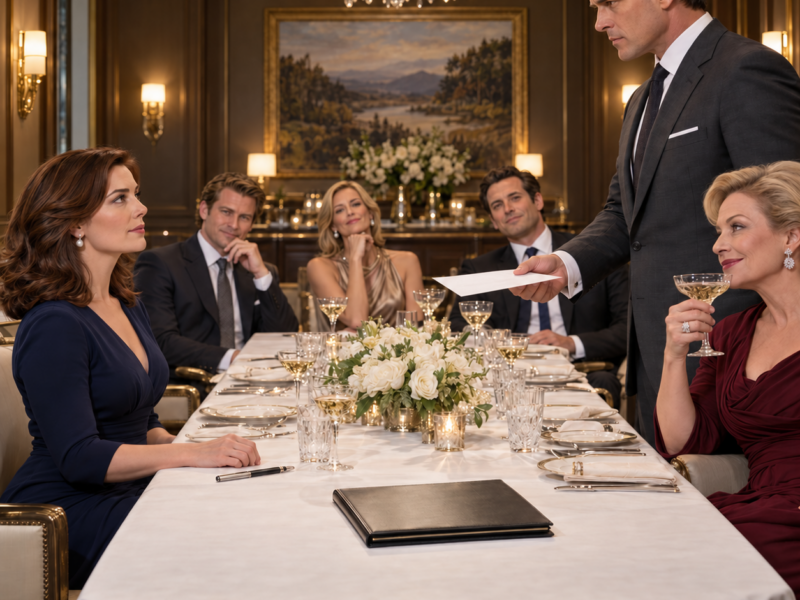
“You’re nothing without my money,” my husband said as he threw divorce papers across the table in front of his entire family. His mother was still laughing when I finished signing and slid them back to him with two words: “Thank you.” The next morning, Blake’s banker called him. He went silent for ten seconds, then turned toward me. “Eleanor… who are you?”
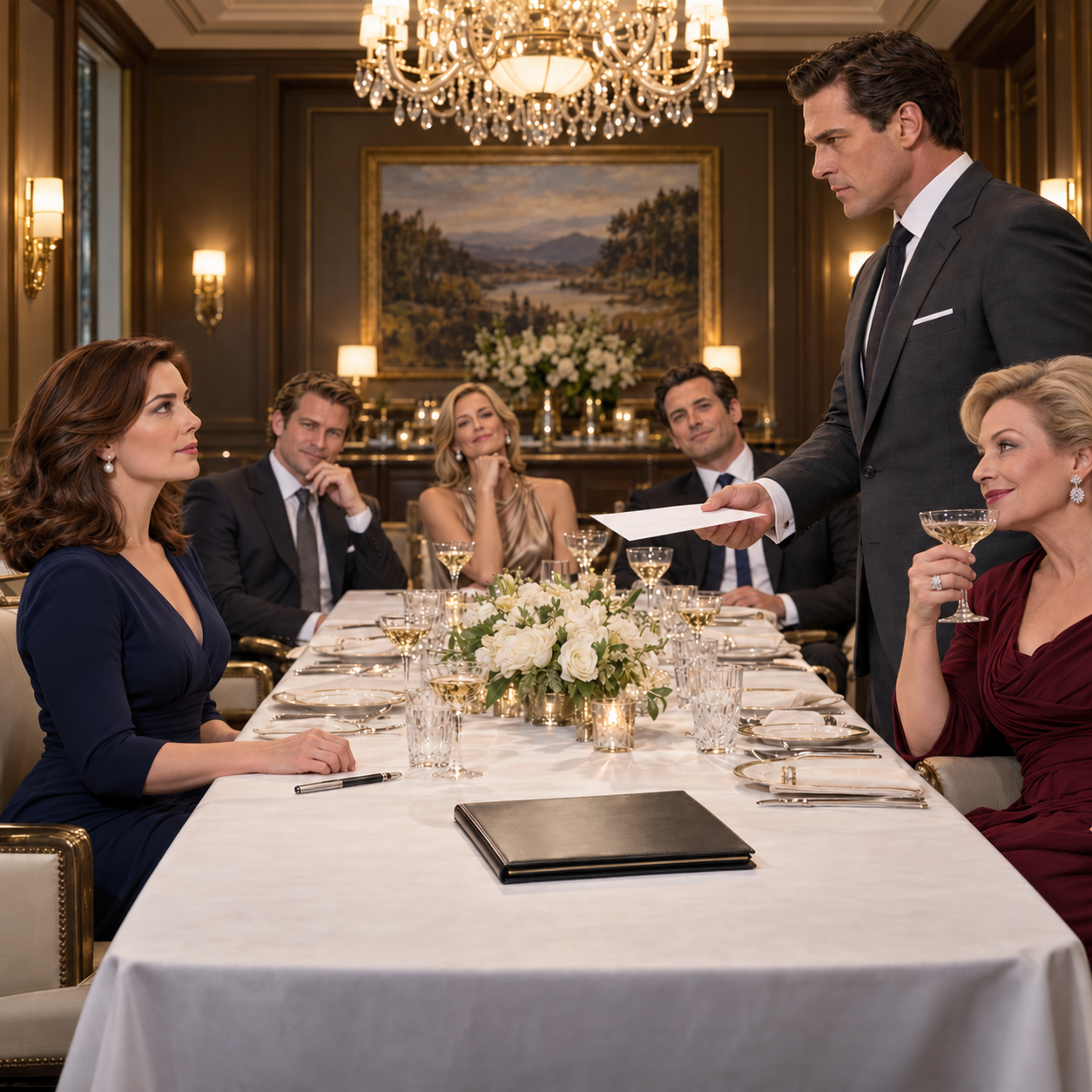
My husband handed me divorce papers and asked how long I would last without his money, but the next morning his banker asked him who I really was
For eight years, my husband reminded me that my comfortable life was an act of his personal generosity.
“You are lucky, Eleanor.”
Blake Crawford said it softly when he wanted to sound affectionate and sharply when he needed me to feel small. He said it over grocery receipts, vacation plans, restaurant checks, and every household decision he believed his income entitled him to control.
“You are lucky I do not mind carrying both of us.”
The final performance took place at his mother’s sixty-fifth birthday dinner in the private conservatory of L’Aurore, the flagship restaurant of Crawford Hospitality Group.
The room was designed to make ordinary people lower their voices. Venetian plaster glowed beneath brass sconces. White calla lilies rose from crystal vases. Heavy linen covered a table long enough to separate enemies politely. Beyond the glass ceiling, October rain turned the Manhattan night into streaks of silver.
Blake sat at the center in a charcoal three-piece suit, holding court over his family. His mother, Priscilla, wore antique sapphires and the expression of a woman who considered kindness a defect of breeding. His younger brother, Julian, drank bourbon beside his fiancée. Three cousins completed the audience.
I sat near the foot of the table in a dove-gray cashmere dress. Priscilla had once described it as “appropriate for a secretary attending a funeral.”
To the Crawford family, I was the quiet wife Blake had rescued from an unremarkable life. I worked in financial analysis, wore no visible designer labels, and declined most society invitations. Blake told people my salary was “useful for books and little personal things,” although he had never asked what I earned.
That ignorance was not accidental on my part.
It was not an accident on his either.
When the dessert plates were cleared, Blake tapped a silver fork against his water glass. Conversation stopped. Julian smiled before a word had been spoken, which told me the scene had been rehearsed.
“Before we bring out Mother’s digestif,” Blake said, “there is one piece of personal housekeeping I need to address.”
He reached into his jacket and removed a set of legal papers bound in blue.
He slid them down the table.
The packet stopped beside my saucer.
PETITION FOR DISSOLUTION OF MARRIAGE was printed across the first page.
Blake leaned back and gave the room the grin he used for television interviews.
“Let us see how long you last in this city without my money, Eleanor.”
Priscilla laughed. Julian tapped his knuckles against the table. One cousin looked down, embarrassed but unwilling to interfere.
My pulse remained steady.
For nearly three thousand days, Blake had prepared me for that moment. Each insult removed another reason to remain surprised.
Beside my plate was a brushed-steel restaurant pen. I picked it up and reviewed the signature line Blake had marked. It was not a final property settlement, despite the theatrical language he used. It acknowledged receipt of the petition and waived formal personal service. Signing meant he would not send a process server to my office or home. It did not waive my rights, divide assets, or approve terms I had not reviewed.
Blake either did not understand the distinction or assumed I did not.
I signed.
Eleanor Vance Crawford.
The click of the pen silenced Priscilla’s laughter.
I squared the pages against the linen and returned them to Blake.
“Thank you,” I said.
His smile held for half a second, then weakened.
This was not the response he had scripted. He expected tears, a plea, perhaps a humiliating request for temporary access to a credit card. He expected his family to watch me discover that my life had no structure without him.
“Smart girl,” he said, though his voice had thinned. “Save us both the spectacle. Your suitcases can be placed on the portico by Friday.”
“Tomorrow morning will be fine.”
I folded my napkin, placed it beside my untouched pear tart, and stood.
“Where are you going?” Blake asked.
“Home. Briefly.”
“Do not touch anything that belongs to me.”
I looked around the restaurant his family believed was the center of his empire.
“I will be careful with ownership,” I said.
I walked twelve blocks to our brownstone in the cold rain. I did not call a car because I needed the city beneath my feet. Wet pavement reflected traffic lights. Steam rose from street grates. For the first time in years, the air entering my lungs did not have to pass through Blake’s opinion first.
He thought he had cut my lifeline.
He had no idea he had just severed his own anchor.
The woman Blake married had never existed in the form he preferred to imagine.
I was not a struggling office clerk rescued from a modest Pennsylvania family. I was the founder, principal owner, and managing director of Meridian Capital Partners, a private investment and restructuring firm headquartered behind an unmarked glass door on East 54th Street.
Meridian did not place its name on stadiums or sponsor society galas. We purchased distressed debt, recapitalized companies, reorganized operations, and made most of our money by recognizing value before anyone else admitted it existed.
I built the firm before I was thirty.
My father had been a public-school music teacher and my mother a municipal clerk. Neither left me a fortune. I worked through college, earned scholarships, and spent my twenties in rooms where I was often the youngest person, the only woman, or both. I learned restructuring law, debt instruments, supply-chain finance, and the difference between a company with bad timing and one with a bad core.
At twenty-eight, I led my first cross-border debt exchange. At thirty-one, I structured the breakup of a logistics holding company that returned forty-eight million dollars to Meridian’s investors and established my private trust. By the time I met Blake at thirty-four, I was wealthy enough that money had become less interesting than the ways people changed when they sensed it nearby.
Men who knew my position rarely met me as a person. They met access, contacts, capital, and proof of their own importance. They asked about sovereign funds before asking where I grew up.
Blake was different because Blake did not listen.
We met at a small West Village bistro he was trying to turn around. He leaned across the bar with his sleeves rolled up, laughing about a delayed shipment of truffles. He had charm, energy, and a gift for making a room feel brighter when he entered.
“What do you do?” he asked.
“Capital allocation and risk analysis.”
His eyes glazed with benevolent boredom.
“Spreadsheets,” he said. “My accountant gives me a migraine with those. I prefer real things. Copper pans. Wood smoke. A dining room full of people.”
I should have recognized the dismissal.
Instead, I felt relieved.
For the first time in years, a man looked at me without calculating what my balance sheet could do for him. He noticed my eyes, remembered how I took coffee, and wanted to explain the right way to sear a scallop.
I did not lie to Blake. I told him I worked at Meridian and used the title managing director. I disclosed my assets in the prenuptial agreement negotiated before our wedding. His attorney received schedules through counsel. Blake was represented independently and signed after the required review.
He never studied the schedules.
He saw that our premarital property remained separate and assumed the detail benefited him because Crawford Hospitality predated the marriage. He did not ask how many entities appeared beneath my name or why his lawyer recommended a longer meeting.
“Eleanor handles spreadsheets,” he told his attorney. “I build things people can touch.”
The prenup remained in a safe he never opened.
For the first two years of our marriage, I loved him. I enjoyed the simplicity of being underestimated because I mistook it for being seen without money. I kept Meridian separate, paid my own expenses quietly, and allowed Blake to cover the public lifestyle he insisted on displaying.
Then his restaurant group nearly collapsed.
He had opened three high-concept locations in eighteen months: a raw bar in Tribeca, an artisanal rotisserie in SoHo, and a subterranean cocktail lounge in the Meatpacking District. He financed expansion through mezzanine debt, personal guarantees, and vendor credit priced for disaster.
One rainy night, he came home without removing his coat. He sat at the kitchen table, put his face in his hands, and began to cry.
“It is over,” he said. “Payroll is sixty-two thousand dollars tomorrow. There is nine hundred in the operating account. The meat supplier will lock the coolers at six. By Friday, the landlords will begin default proceedings.”
He looked terrified, not only of financial ruin but of public ordinariness.
“If I fail, Mother and Julian will know I was a fraud. The critics will know. Everyone will know.”
I sat beside him and held his hands.
I could have written a personal check. Instead, I protected the architecture of his pride.
At five the next morning, while Blake slept, I called my cousin Marcus Vance, Meridian’s senior operating director.
“I need an emergency review of Crawford Hospitality Group,” I said.
“We reviewed them last quarter,” Marcus replied. “The debt load is irrational, margins are inconsistent, and the founder spends like attention is an asset.”
“The founder is my husband.”
Silence.
“What do you want?”
“A legitimate recapitalization, not a gift. Two and a half million in immediate working capital. Existing debt purchased or refinanced where possible. A special-purpose vehicle takes sixty percent equity, board control, strict covenants, and security over his remaining stake.”
“You want Meridian to own your husband’s company without telling him you control Meridian.”
“The investment committee will decide on commercial terms. I will disclose my conflict and abstain from the formal vote.”
Marcus exhaled. “Even if the committee approves, this will not protect your marriage. It will only protect the company.”
“The company is what needs saving before noon.”
Our committee approved the transaction after an expedited review because the four core restaurants had recoverable value. Meridian formed Aegis Holdings LLC to make the investment. Outside counsel drafted sixty pages of clear terms. Blake’s lawyer received them and urged him to review the control provisions.
Blake read the liquidity amount and signed every page his attorney marked.
That afternoon, the funds cleared payroll and vendor liens. Creditors paused enforcement. Employees kept their jobs.
Blake came home carrying roses and a bottle of vintage champagne.
“I did it,” he said, popping the cork in our foyer. “An institutional fund saw what the banks were too blind to see. They recognized my vision.”
I held the glass he handed me.
“That is wonderful.”
“Nobody was coming to save me, Eleanor. I saved myself.”
I swallowed the champagne and said nothing.
At the time, silence felt like love.
Later, it became the room where contempt learned to live.
With Aegis capital and professional oversight, Crawford Hospitality stabilized. Meridian’s team renegotiated leases, consolidated purchasing, and closed a planned location before it consumed more cash. Blake interpreted every improvement as proof of his instincts.
Two new restaurants succeeded. A food magazine placed him on its cover. He began telling the story of the great turnaround at dinner parties.
“We were minutes from death,” he would say over cognac. “I locked myself in my office, restructured the debt, and pulled two and a half million dollars out of thin air through force of will. Nobody saves you. You save yourself.”
I often sat three seats away, cutting my dinner while the people around him admired the myth.
Once, on our fifth anniversary, I tried to anchor him to reality. Aegis had requested documentation for a capital expenditure that exceeded the limit in his financing agreement.
“Those investors saved the company,” I said. “Should you not treat their oversight with respect?”
Blake looked at me as if a chair had offered an opinion.
“They are money people. They got lucky on my talent.”
“They own sixty percent.”
“On paper.”
“That paper controls the company.”
He leaned over my chair.
“My quiet little bookkeeper should remember that reading contracts is not the same as building an empire. Leave the corporate decisions to people who understand pressure.”
That was the moment relief became humiliation.
I did not reveal myself. I told myself Blake would feel deceived, that the truth might destabilize the company, and that the marriage deserved patience. The explanations sounded responsible because capable women can make endurance look like strategy.
His contempt grew.
At Easter brunch, Priscilla criticized our guest rooms. Blake interrupted her.
“Eleanor has the ambition of a field mouse. If she had her way, we would live in a studio and eat canned lentils. She is lucky I fund a civilized life.”
Priscilla patted his arm. “Some women are meant to be decorative, darling, though she could put more effort into that part.”
The table laughed.
Inside my handbag was an encrypted tablet containing a ninety-million-dollar acquisition Meridian would close the next morning.
I complimented the mint sauce.
Why did I tolerate it?
Because competence and self-worth do not always grow together. I could command a boardroom while carrying an old belief that love was earned by being undemanding. I thought making myself smaller created space for Blake to become secure.
Instead, he expanded his cruelty to fill it.
By our eighth year, he spent three nights a week at industry events and returned smelling of bourbon and unfamiliar perfume. I did not hire an investigator. The exact details of infidelity were less important than the fact that our marriage had already become an arrangement in which I disappeared.
Two weeks before Priscilla’s birthday, I asked Marcus to bring me the complete Crawford file.
We met in Meridian’s private conference room. The binder was thick enough to make the table shake when he set it down.
Blake had used company liquidity for unauthorized personal expenses: vintage cars leased through a restaurant subsidiary, a yacht charter described as vendor development, private travel, and executive bonuses paid to himself while two locations missed performance targets. He had borrowed repeatedly under the Aegis facility and violated six financial covenants.
Crawford Hospitality owed Aegis $4.8 million. Blake’s forty-percent interest and certain personal assets secured part of the debt. The agreements allowed Aegis to accelerate the loans, exercise voting remedies, and remove him from operational control after notice and cure periods.
“He has been in technical default for fourteen months,” Marcus said. “We delayed action because you requested patience. The board will not tolerate another quarter.”
I closed the binder.
“Prepare notices. Follow every cure requirement. No shortcuts and no public announcement until counsel confirms completion.”
“Are you ready?”
“I am ready to stop protecting him from information he signed.”
Meridian’s attorneys served preliminary default notices through Blake’s corporate counsel. He treated them as routine pressure and delegated the response to an underqualified controller. The cure deadline passed on the morning of Priscilla’s dinner.
I knew the documents were ready when Blake slid divorce papers toward me that night.
I had planned to give him one final opportunity to act with basic dignity. Instead, he staged my humiliation before his family.
When I thanked him, I was not being gracious.
I was thanking him for unlocking the cage from the outside.
At the brownstone, I packed one suitcase. Most of the furniture and art had been purchased by Blake or Crawford family entities, and I wanted no argument over objects. I took clothing, personal jewelry, medication, my passport, two framed photographs of my parents, and the prenup from the safe.
Then I called my matrimonial attorney, Celeste Morgan.
She had negotiated the agreement before my wedding and never understood why I remained married after Blake began insulting me publicly.
“He filed?” she asked.
“Tonight.”
“Did you sign anything?”
“Acknowledgment of receipt only. I photographed every page first.”
“Good. Send the images. Do not discuss assets with him and do not sign a settlement without review.”
I emailed the packet.
Blake proposed that each party keep premarital assets, that he retain the brownstone and all interest in Crawford Hospitality, and that I waive maintenance in exchange for three months of living expenses. The proposal assumed my financial dependence and ignored several marital-property questions Celeste would examine.
“He offered you fifteen thousand dollars to disappear,” she said.
“It is generous by his understanding of me.”
“Where will you stay?”
“My apartment.”
Blake knew I kept a small one-bedroom near Meridian for late work nights. He believed the firm rented it. In fact, my trust owned the building.
At six the next morning, I left the brownstone. I placed my key on the entry table and sent Blake a written notice that communication should go through counsel except for urgent logistics.
At eight, I entered Meridian’s offices wearing a navy suit and took my seat at the head of the boardroom table.
The investment committee met with outside counsel, restructuring advisers, and a representative from Metropolitan Commerce Bank, the depository bank for several Crawford accounts. I disclosed again that Blake had filed for divorce and that I would not vote on remedies involving any disputed personal collateral until counsel confirmed the separation between corporate and marital matters.
The independent directors voted unanimously to enforce the defaults.
Aegis issued the acceleration notice, exercised its contractual board rights, and removed Blake as chief executive pending an investigation of unauthorized expenditures. The bank restricted transactions according to the authorized resolutions. Payroll and ordinary vendor payments continued. Personal transfers stopped.
Nothing was stolen overnight. Contracts were enforced.
At 8:43, Blake’s banker, Warren Ackerman, called him.
I know the time because Warren recorded it in his contact log.
Blake was still at Julian’s apartment after the birthday celebration. His first reaction was disbelief.
“You cannot freeze my company,” he told Warren. “I own it.”
“You own a minority interest,” Warren replied. “Aegis Holdings has exercised control rights following uncured defaults. You need to speak with your corporate counsel.”
“Who authorized this?”
“The Aegis board representative and Meridian’s managing director.”
“Who is the managing director?”
There was a pause.
Warren had assumed Blake knew.
“Eleanor Vance,” he said.
Blake went silent for ten seconds.
Then he called me.
I was in my office reviewing an employee-protection plan. I answered because I wanted no claim that I had hidden the corporate action.
“Who are you?” he asked.
His voice was not angry yet. It was empty.
“The same woman you married.”
“Warren says you run Meridian.”
“I founded Meridian.”
“Aegis belongs to you?”
“Aegis is a Meridian investment vehicle governed by its agreements and board.”
“You own my restaurants.”
“Aegis owns sixty percent of Crawford Hospitality. You signed that transaction six years ago.”
“You tricked me.”
“Your lawyer reviewed every term. You declined meetings with the investor representatives. You signed because you needed capital.”
“You sat in my house while I thanked strangers for saving me.”
“I sat in our house while you thanked yourself.”
His breath caught.
“Reverse it.”
“The independent directors authorized enforcement after fourteen months of defaults. I cannot reverse it because you demand it, and I will not interfere with their duties.”
“This is revenge for the divorce.”
“The cure deadline was established before dinner. The enforcement record documents every step. Your divorce filing ended my willingness to request further delay. It did not create the defaults.”
“Eleanor, listen to me.”
“Future corporate communication goes through company counsel. Divorce communication goes through Celeste.”
“You cannot do this to me.”
“It is already done.”
I ended the call.
My hands shook afterward.
Power did not erase grief. Knowing I could protect myself did not make eight years disappear.
Marcus entered without speaking and set a cup of coffee on my desk.
“Did he ask who you were?”
“Yes.”
“What did you tell him?”
“The truth. I am the same person.”
Marcus sat across from me.
“No, Eleanor. You are the same person to yourself. To him, you have just become visible.”
By noon, Crawford Hospitality’s managers had been briefed. An interim chief executive from Meridian’s operating group took control. Employees were told that payroll, benefits, and scheduled operations would continue. A forensic review began.
We did not release a triumphant statement about Blake’s downfall. Meridian issued three sentences announcing a governance transition after covenant defaults. The purpose was to stabilize the business, not feed gossip.
Gossip arrived anyway.
Priscilla called at 2:04.
“What have you done to my son?”
“Crawford Hospitality is undergoing a contractual restructuring.”
“Do not speak to me like a bank notice. Blake says you hid millions and stole his company.”
“My assets were disclosed in the prenup. Aegis’s investment was reviewed by his counsel. His company spent funds outside agreed limits and failed to cure defaults.”
“He gave you a name in this city.”
“I had a name before I met him.”
“Our lawyers will destroy you.”
“Then they should speak with mine.”
She continued shouting. I did not threaten her house, her trust, or Julian’s office. Wealth did not entitle me to imitate the people who misused it.
“Priscilla,” I said, “you may communicate through counsel. Do not call me again.”
I blocked her number.
That boundary was enough.
The following month was less dramatic than the telephone call and far more important.
The forensic review found that Blake had directed $1.3 million of corporate money toward expenses without a legitimate business purpose. Not every extravagant dinner or trip was improper. Hospitality companies cultivate clients, vendors, and press. The problem was documentation, personal benefit, and repeated efforts to override controls.
The vintage cars had been leased under a transportation subsidiary that never transported anyone. The Saint-Tropez charter included Blake, Julian, two friends, and three women with no business relationship to the company. Executive bonuses were approved through minutes prepared after the payments occurred.
The interim team closed two unprofitable concepts, renegotiated three leases, and preserved the core restaurants. We retained kitchen staff, servers, managers, and vendors whenever possible. These people had mortgages, medical bills, and children. Blake’s humiliation was not a reason to destroy their livelihoods.
One restaurant manager, Rosa Delgado, came to my office during the second week.
She had worked at L’Aurore since it opened, first as a server and later as general manager. Blake praised her publicly and blamed her privately for costs he approved.
“Are you shutting us down?” she asked.
“Not if the restaurant can operate profitably and safely.”
“Mr. Crawford told us Meridian wanted to liquidate everything.”
“Meridian wants accurate numbers. If the numbers support L’Aurore, it stays.”
Rosa placed a folder on my desk. It contained unpaid vendor invoices, emails ordering her to classify private events as promotional expenses, and records showing that Blake had withheld scheduled equipment maintenance to fund a magazine launch party.
“Why did you keep these?” I asked.
“Because he always said someone else made the decision. I wanted proof.”
I understood that instinct.
“You are protected under the investigation policy. Give copies to counsel and keep the originals.”
She hesitated near the door.
“Mrs. Crawford, did you really own the company all this time?”
“A Meridian entity held control. I managed Meridian.”
“He used to joke that you could not read a restaurant budget.”
“I know.”
Rosa shook her head. “He could have learned so much from you.”
The sentence hurt more than Priscilla’s insults because it named the life that might have existed.
Blake challenged the enforcement through arbitration as required by the investment agreement. He alleged conflict of interest, concealment, and bad faith. Meridian produced committee minutes showing my disclosures and abstentions, fourteen months of notices, his lawyer’s acknowledgments, and repeated opportunities to cure.
The arbitrator allowed interim control to remain with Aegis while the case proceeded.
Blake’s attorneys then tried a different story. He claimed my secret wealth made the prenup invalid because he did not understand the schedules.
Celeste responded with the signed financial disclosures, correspondence from his independent lawyer, and a video recording of the premarital execution meeting. On that recording, the lawyer told Blake that my holdings were substantial and complex and recommended a forensic accountant.
Blake laughed.
“If Eleanor wants to protect her little funds, fine. Crawford Hospitality will be worth ten times whatever she has in a few years.”
He declined the accountant in writing.
Arrogance had preserved evidence more effectively than secrecy ever could.
The divorce still required real negotiation. Our eight-year marriage had produced jointly acquired furnishings, certain accounts, tax obligations, and questions about the brownstone. Blake purchased it before the marriage, but marital funds had paid part of the mortgage and improvements. My trust had also covered several renovations through documented reimbursements.
I did not want the house. I wanted a clean, enforceable division based on law rather than revenge.
Celeste and Blake’s attorney exchanged proposals. The fifteen-thousand-dollar disappearance offer vanished. Blake demanded half of Meridian’s appreciation during the marriage, despite the prenup. We rejected it. He threatened to expose my identity to the press. Meridian’s communications team prepared for attention, but I refused to buy silence.
“If he discloses confidential business information, enforce the agreement,” I told Celeste. “If he tells people I am wealthy, let him.”
For years, secrecy had protected my peace. Once Blake used it as leverage, it stopped being peace.
The first divorce mediation lasted eleven hours.
Blake arrived in a dark suit with three lawyers and an accountant. I arrived with Celeste and a financial expert. We spent the morning in separate rooms while the mediator carried proposals between us.
At four, Blake requested a direct conversation.
Celeste asked whether I wanted it.
“Ten minutes. Everyone stays.”
We met in the main conference room. Blake had lost weight. The skin beneath his eyes looked gray. For the first time since I met him, his clothes seemed to be wearing him.
“Why did you not tell me?” he asked.
“I did. Before the wedding, my disclosures identified Meridian, my ownership, the trust, and estimated values.”
“You know what I mean.”
“You mean why did I not force you to understand information you chose to dismiss?”
“Why did you let me believe I was supporting you?”
“Because at first, it made you happy to provide our public lifestyle, and I did not need your money. Later, correcting you meant revealing that I had saved the company, and I knew your pride would turn gratitude into resentment.”
“So you manipulated me.”
“I protected you from the truth because I believed your ego was fragile. That was unhealthy and patronizing. I accept responsibility for it.”
He seemed unprepared for me to admit fault.
“Then give me back the company.”
“My mistake in our marriage does not erase corporate debt, investor rights, or your misuse of funds.”
“It was my vision.”
“And Meridian’s capital. Employees’ labor. Vendors’ patience. Managers’ competence. Your vision was one part.”
His mouth tightened.
“You enjoyed listening to my family laugh at you because you knew you were richer than all of us.”
“No. I endured it because I confused silence with strength.”
“You made me look like a fool.”
“I did not place divorce papers on a restaurant table.”
The mediator ended the conversation when Blake began repeating accusations.
We reached no settlement that day.
At home in my apartment, I removed the dove-gray dress from its garment bag. I had kept it from the birthday dinner without knowing why. The fabric still carried a faint trace of Priscilla’s perfume from her greeting kiss.
I considered throwing it away.
Instead, I took it to a tailor and had the sleeves shortened and the waist reshaped. I wore it to Meridian’s annual meeting three months later.
Reclaiming an object was not necessary, but I enjoyed refusing to let their worst memory own good cashmere.
Public attention arrived after arbitration filings became accessible. Business reporters connected Eleanor Vance, Meridian’s founder, to Blake Crawford’s quiet wife. Articles called me a secret billionaire, a hidden owner, and an avenging spouse.
Most estimates of my wealth were wrong. Some were wildly wrong. Photographers waited outside Meridian for a week.
I issued one statement.
“Meridian Capital Partners invested in Crawford Hospitality Group six years ago through a fully documented transaction reviewed by independent counsel. Recent governance actions followed contractual defaults and were authorized through established procedures. My pending divorce is separate, and I will not discuss private family matters.”
I gave no revenge interview.
The absence of spectacle disappointed people, then bored them.
My parents called from Pennsylvania. They had always known I was successful but not the full scale of Meridian. I kept them financially secure through a trust and visited regularly. They had never asked for details because privacy in our family meant respect, not disinterest.
“Are you safe?” my mother asked.
“Yes.”
“Are you eating?”
“Mostly.”
“Then come home Sunday. Your father is making soup.”
At their small house, no one asked about billions. My father had prepared lentil soup and fresh bread. The kitchen table was the same one where I completed scholarship applications in high school.
“I should have told you how Blake spoke to me,” I said.
My mother reached across the table. “Why didn’t you?”
“I was ashamed that I allowed it.”
“His behavior was not evidence against your intelligence.”
“It felt like it.”
My father looked down at his bowl.
“Smart people stay in bad situations for ordinary reasons,” he said. “Hope. Habit. Love. Fear of admitting the thing they built is hurting them.”
He had taught music for thirty-seven years and never managed more than a household budget. His sentence contained more wisdom than most investment committees.
I began seeing a therapist named Dr. Miriam Chen. In our first session, she asked why I had hidden my identity from my marriage.
“To know whether Blake loved me without money.”
“Did he?”
“At first, I think he loved the woman he imagined.”
“Was that woman you?”
“Partly.”
“Then the problem was not simply that he did not know your net worth. It was that neither of you required him to know your whole person.”
I disliked the observation because it was true.
Blake was responsible for cruelty, infidelity, arrogance, and financial misconduct. I was responsible for presenting disappearance as devotion. Holding both truths did not make the harm equal. It made my healing more honest.
Under the interim management team, L’Aurore improved. Rosa reduced waste, changed scheduling practices, and renegotiated a produce contract. The Tribeca raw bar became profitable after we simplified its menu. The subterranean cocktail lounge closed because no amount of branding could overcome its rent and poor layout.
Employees received bonuses based on recovery milestones. Meridian’s board approved a profit-sharing pool for senior restaurant managers.
Blake called the changes vandalism.
Industry numbers called them effective.
The arbitration concluded seven months after the birthday dinner. The decision upheld Aegis’s control rights and most of the accelerated debt. Certain personal expenses were charged back to Blake’s capital account. His remaining equity was diluted under provisions triggered by unpaid obligations, but he retained a minority interest subject to the final restructuring.
Meridian offered two paths.
Blake could remain as a creative consultant with no unilateral spending authority, report to a board-appointed chief executive, and preserve a small equity interest.
Or he could accept a negotiated $400,000 buyout, release claims, and sign reasonable non-disparagement and non-compete terms.
The offer did not make him destitute. It removed him from an empire he no longer controlled and gave him enough capital to begin again at a smaller scale.
He chose the buyout.
Working beneath professional management would have required him to learn what he spent eight years pretending to know.
The divorce settlement followed soon afterward. The prenup was upheld. Blake kept the brownstone, his separate investment accounts, the buyout, and his remaining personal property after corporate reimbursements. I kept Meridian and my premarital assets. Joint items were divided or sold. Neither party paid maintenance.
The final signing took place in a neutral conference room in Lower Manhattan.
After the attorneys left to make copies, Blake stood by the window.
“Every time I said I carried you, you were laughing at me,” he said.
“I never laughed.”
“You must have thought I was pathetic.”
“I thought you were afraid of being ordinary. I loved you, so I protected that fear until it became a weapon you used against me.”
He turned.
“If I had known who you were, none of this would have happened.”
“That is the part you still do not understand. You knew enough. You knew I was intelligent. You knew I worked. You knew humiliation hurt. Basic kindness did not require my financial statements.”
“I would have respected you.”
“Then it would have been my money you respected, not me.”
His eyes filled, but no tears fell.
“Did you ever love me?”
“Yes. That is why I stayed too long.”
I collected my portfolio.
At the door, I looked back.
“I was never lucky because you tolerated me, Blake. You were lucky to be loved by someone who saw you at your lowest and protected your dignity. You turned that love into a punchline at your mother’s birthday.”
Then I left.
Freedom did not feel triumphant that evening.
It felt quiet.
I returned to the apartment near Meridian, changed out of my suit, and ate soup at the kitchen counter. The divorce was final. The corporate dispute was resolved. No one was waiting to criticize how I held my spoon.
I cried until midnight.
Grief is not proof that leaving was wrong. It is proof that something mattered, even when it could not be saved.
The next morning, I went to work.
Meridian renamed Crawford Hospitality Group after a transition period. The new company became Vanguard Dining Collection. We did not erase Blake from its history. Corporate records credited him as founder and documented the concepts he created. Removing his operational authority did not require pretending his talent never existed.
Rosa became chief operating officer. We recruited a chief executive with restaurant finance experience and gave culinary leaders more authority over menus within disciplined budgets. We sold the vintage vehicles, canceled unnecessary memberships, and moved executive offices out of an overpriced suite.
The first year produced a modest operating profit.
At the annual employee meeting, Rosa invited me to speak.
“Do not tell them you saved us,” she warned.
“I was not planning to.”
“Good. They did.”
She was right.
I told the staff that capital could prevent a company from dying but could not make guests return, meals arrive correctly, or employees trust management. Those things were accomplished one shift at a time.
Afterward, a dishwasher who had been with L’Aurore for nine years shook my hand.
“Mr. Crawford never learned my name,” he said. “You do not know it either.”
“You are right.”
He smiled slightly. “It is Tomas.”
“Thank you, Tomas.”
The exchange stayed with me. Wealth can create the illusion that seeing systems is the same as seeing people. Blake was not the only person vulnerable to that mistake.
I began spending one day each quarter inside companies Meridian controlled, not on staged executive tours but beside the people who understood where procedures failed. At a warehouse, a forklift operator showed me why an efficiency plan created unsafe congestion. At a medical distributor, a customer-service representative explained how a software change increased errors. At Vanguard, servers described scheduling policies that looked flexible on paper but punished parents.
Listening changed our decisions.
It also changed me.
For years, I had taken pride in moving through power invisibly. Silence protected focus and reduced performance. But invisibility had also become habit. I avoided claiming work because I associated recognition with exploitation.
Dr. Chen asked me to distinguish privacy from erasure.
“Privacy means you choose what to share,” she said. “Erasure means you believe sharing your existence creates a burden.”
I knew which one had defined my marriage.
I began using my full title in public business settings. I spoke at a university program for women in finance. I accepted an industry award and thanked the analysts, operators, and administrative staff whose work produced the results. I still declined society pages and celebrity panels. Visibility became a tool rather than a threat.
Priscilla did not disappear as completely as I hoped. Six months after the divorce, she sent a letter through Celeste.
It was not an apology.
She wrote that Blake had become depressed, Julian’s consultancy was struggling, and the family’s reputation had suffered. She said I had achieved enough and should consider restoring Blake to a leadership role as an act of grace.
I sent no response.
A second letter accused me of enjoying disproportionate punishment. Celeste returned it with a reminder that all personal contact was unwelcome.
Two years later, Priscilla wrote again. This time, the letter contained only four paragraphs.
She admitted that she had encouraged Blake to treat the birthday dinner as an execution. She had believed my dependence made cruelty harmless because, in her words, “a woman without leverage eventually accepts reality.” She wrote that discovering my wealth did not make her ashamed of insulting a powerful woman. It made her ashamed that she considered a powerless woman safe to insult.
That sentence was the first evidence of insight I had seen from her.
I replied once.
Understanding why your behavior was wrong may improve the life you live next. It does not create an obligation for me to reenter it. I wish you well.
She never contacted me again.
Julian resolved his unpaid commercial rent through a payment plan negotiated with Vance Commercial Properties. I did not evict him to frighten Priscilla or forgive the debt because of family history. The property manager treated his company like any other tenant. Julian downsized to a smaller suite and paid the arrears over eighteen months.
When the final payment cleared, he sent me an email.
I was cruel at that dinner because I thought cruelty proved loyalty to my brother. I am sorry.
I acknowledged the apology and nothing more.
Not every repaired truth needs to become a renewed relationship.
Blake moved to coastal Georgia after his non-compete period ended. He opened a sixty-seat seafood bistro in a leased storefront. The restaurant had no celebrity designer, private dining salon, or international press campaign. It served local fish, cornbread, and simple cocktails.
Industry contacts occasionally sent me news. The opening reviews were uneven. One praised the food and criticized service. Another called it “a promising neighborhood restaurant from a chef learning restraint.”
I did not celebrate when the first year was difficult.
Blake had always possessed genuine hospitality instincts. His tragedy was not lack of talent. It was the belief that talent excused contempt and made other people’s contributions invisible.
In the second year, the bistro improved. He promoted a longtime line cook to kitchen manager and gave credit publicly. A local article quoted him saying that restaurants were teams rather than monuments.
Perhaps he had changed. Perhaps he had learned which phrases sounded wise.
Either possibility belonged to his life, not mine.
I purchased a penthouse overlooking the East River after the divorce. It had floor-to-ceiling windows, pale wood floors, and a wall long enough for bookshelves. I chose every piece without imagining whether Blake or Priscilla would approve.
The first object I placed in the living room was my parents’ upright piano from Pennsylvania. They had decided to move into a smaller home, and the instrument would not fit. Its walnut case bore scratches from decades of students. It looked imperfect among the clean architecture.
That was why I loved it.
My father visited and played the same Chopin nocturne he practiced when I was a child. He missed two notes and laughed.
“You could have bought a better piano,” he said.
“I did not want a better piano.”
I wanted something connected to a life where worth had never depended on spectacle.
For my forty-fifth birthday, I invited twelve people to dinner. Marcus came with his husband. Rosa brought her daughter. Celeste arrived late from court. My parents took the train from Pennsylvania. We ate lentil soup, roasted vegetables, and bread from a bakery downstairs.
No private chef. No calla lilies. No announcement made by tapping crystal.
Before dessert, Marcus raised his glass.
“To Eleanor,” he said. “Who has finally invited us into a room that does not contain a board table.”
Everyone laughed.
The sound did not make me brace for humiliation.
That was how I recognized safety.
Meridian established a fellowship for analysts from public universities and community colleges who lacked traditional Wall Street connections. I named it after my parents, though my mother objected that she had only worked at a municipal office.
“You taught me that every number represented someone’s rent, tax bill, or grocery money,” I told her. “That matters in finance.”
The first fellowship class included a former restaurant server named Aisha Bell. During her interview, she challenged an assumption in our case exercise that every underperforming location should be closed.
“The spreadsheet treats workers as a termination cost,” she said. “What is the cost of losing local knowledge if the company later returns?”
We hired her.
Three years later, she led a restructuring that saved a regional food distributor and hundreds of jobs.
Leadership, I discovered, was not being the smartest person in a room. It was creating a room where useful truth could survive rank.
Blake’s world had failed because truth was required to flatter him before entering.
I would not build the same structure with a different person at the top.
Three years after the divorce, Vanguard received an acquisition offer from a national hospitality company. The price would have delivered an excellent return to Meridian and allowed us to exit a business that carried painful history.
Some directors favored the sale. Marcus expected me to resist because of sentiment.
I surprised both of us by supporting a formal review.
We evaluated price, employee protections, lease obligations, growth plans, and the buyer’s operating record. Rosa presented management’s concerns. The acquiring company wanted to centralize purchasing and reduce local authority, changes that could improve margins but threaten the culture responsible for the turnaround.
During the final committee meeting, an independent director asked whether my history with Blake influenced my vote.
“It would be dishonest to say it has no emotional weight,” I replied. “That is why the commercial record must be explicit.”
The numbers showed that Vanguard’s long-term value under current management likely exceeded the offer. More important, the proposal shifted too much risk onto employees while rewarding investors immediately.
We declined.
I did not keep the company to preserve victory over Blake. I kept it because the business had become sound and the offer was inadequate.
That difference mattered.
Vanguard later expanded through partnerships rather than debt-heavy openings. Rosa became chief executive when her predecessor retired. She closed one restaurant, opened another, and refused to let either decision become a referendum on the past.
At L’Aurore’s fifteenth anniversary, she held a dinner for employees, vendors, and longtime guests. I almost declined. The private conservatory still existed. So did the table where Blake served me divorce papers.
“You do not have to reclaim every room,” Dr. Chen said.
“I know.”
“Then why are you considering it?”
“Because Rosa asked me, and the night belongs to her team.”
I attended.
The conservatory looked smaller than I remembered. The calla lilies were gone, replaced by low bowls of herbs from a community garden. Tables were arranged in a wide square so no one sat at a symbolic head.
Rosa spoke for five minutes. She thanked dishwashers, cooks, servers, hosts, farmers, and maintenance workers by name. She mentioned Blake as the founder who conceived L’Aurore and Meridian as the investor that stabilized it. The story contained all contributors without turning any into a god.
I sat beside Tomas, the dishwasher who had introduced himself years earlier. He was now facilities supervisor.
“You know my name this time,” he said.
“I do.”
Dessert was pear tart.
I laughed when it arrived.
“What?” Tomas asked.
“An old memory.”
I ate every bite.
Dating presented a different kind of work. For nearly two years, I avoided it. Then a friend introduced me to David Lin, an architect who specialized in restoring public libraries. He was divorced, close to my age, and entirely unimpressed by restaurants where the menu had no prices.
On our second date, I told him exactly who I was.
Not the estimated net worth reporters printed. The relevant truth.
“I founded Meridian. I control significant assets. My last marriage involved secrecy and power, so I will not build another relationship around missing information.”
David took a sip of coffee.
“Thank you for telling me.”
“Does it change anything?”
“It explains why the restaurant manager looked terrified when you asked about table availability.”
I laughed despite myself.
Then he said, “Your work is important, but I am more interested in why you carry a paperback with six sticky notes in it.”
“Because the author is wrong about municipal bond risk.”
“That answer is alarming and attractive.”
We dated slowly. David paid for some meals. I paid for others. We discussed money, work, time, and privacy before affection could disguise incompatibility. When he disagreed, he did not turn disagreement into a referendum on my gratitude.
The first time he stayed at my penthouse, he noticed the piano scratches.
“Beautiful instrument,” he said.
“You do not think I should have restored the case?”
“Those marks are part of its life.”
I remembered all the years I tried to polish myself smooth enough to be loved.
David and I did not marry quickly. After four years, we maintained separate homes and shared large parts of our lives. Some friends found the arrangement unromantic. To me, romance was not fusion. It was closeness without ownership.
When he eventually proposed, he did so at my parents’ kitchen table after helping my father repair a cabinet hinge. There was no crowd.
“I know you do not need marriage to secure your life,” he said. “I want to share it without taking it over.”
I asked for time.
He said, “Of course.”
No sigh. No wounded performance. No suggestion that love required immediate surrender.
I accepted two weeks later.
Our lawyers negotiated a clear agreement. David read every page. He asked questions about Meridian, housing, estate planning, and what would happen if either of us required care. I disclosed everything relevant and insisted he retain independent counsel.
“This is remarkably unromantic paperwork,” he said after the third meeting.
“It is one way we protect the romance from assumptions.”
He agreed.
We married at a public garden with thirty guests. My mother played the piano during dinner. Marcus gave a toast but was prohibited from mentioning internal rates of return. Rosa brought pear tarts as a private joke.
I kept my name.
David expected me to.
Marriage did not cure the old reflex to disappear. When David’s architecture firm faced a delayed payment, I immediately considered arranging financing through a Meridian affiliate. I stopped before making the call.
“Do you need help?” I asked him.
“I need to complain for ten minutes, then meet my accountant tomorrow.”
“Do you want capital?”
“Not from your firm. If that changes, I will prepare a proposal and accept that the answer may be no.”
The crisis passed through ordinary management. No hidden rescue. No secret ownership. No future gratitude poisoned by shame.
I learned that love did not require anticipating every need before it was spoken. Sometimes love was allowing another adult to solve his own problem.
Five years after the birthday dinner, Blake wrote to me through Celeste. The non-disparagement agreement did not prohibit private communication, but Celeste asked permission before forwarding the letter.
Blake said his mother had died after a brief illness. Sorting her papers, he found an old photograph from our wedding. On the back, Priscilla had written that I looked “grateful enough to be manageable.”
He wrote that the sentence made him understand the system he and his mother built around me. They did not simply misunderstand my finances. They interpreted my kindness as evidence that I could be controlled.
The letter included an apology without a request for money, employment, or reunion.
I am sorry I needed you beneath me in order to feel tall, he wrote.
I read the letter twice.
Then I placed it in a drawer for a month.
When I answered, I thanked him for acknowledging the truth. I told him I was glad his bistro had survived and hoped he treated the people who worked there with respect. I did not offer friendship.
His reply was one line.
I understand.
That was the end of our correspondence.
Forgiveness came gradually and without reunion. I stopped rehearsing arguments in which Blake finally understood everything. I stopped imagining a different answer at L’Aurore. I no longer needed him to suffer for my life to feel restored.
His ordinary restaurant remained open. Mine was not the life he had lost as punishment. It was the life he had never taken time to know.
Meridian also changed as I grew older. I reduced my ownership through an employee trust and expanded independent governance. Marcus became chief executive when I moved into an executive-chair role. Aisha joined the investment committee. I retained strategic authority but no longer required every decision to pass through me.
The transition frightened me.
I had built Meridian as a place where my competence could not be dismissed. Letting others lead felt, at first, like surrendering the only identity no one could take.
Dr. Chen asked whether I wanted a company or a monument.
“A company,” I said.
“Then it must be able to live beyond your control.”
The lesson applied to business, marriage, and every form of love I once confused with ownership.
Under Marcus, Meridian entered markets I would have approached too cautiously. Some decisions succeeded. One failed and cost us money. No one was humiliated for the failure. We reviewed the assumptions, corrected the process, and moved forward.
The absence of blame produced better accountability than fear ever had.
I remained wealthy. There is no noble ending in which I surrendered every asset to prove money did not matter. Money mattered enormously. It created security, choices, medical care, time, and the ability to leave a harmful marriage without wondering where I would sleep.
What changed was my willingness to let wealth determine human worth.
I established a legal and financial clinic with a nonprofit serving women rebuilding after economic abuse. The clinic did not hand out revenge plans or promise secret empires. It helped clients obtain credit reports, identify shared debts, understand leases, locate account records, and meet qualified attorneys.
At one workshop, a woman asked whether leaving still counted as brave if she had only six hundred dollars.
“Courage is not measured by the balance available when you need it,” I said. “But courage deserves practical support. Let us build the plan.”
The clinic director later reminded me not to turn generosity into control. Donations came without naming rights over individual services. Clients chose their own goals. Staff, not I, ran the program.
Even help can become ownership if the giver requires the recipient’s life to validate it.
That was the deepest lesson Blake and I had taught each other.
On the tenth anniversary of Meridian’s investment in Crawford Hospitality, Warren Ackerman retired from Metropolitan Commerce Bank. His colleagues held a dinner at L’Aurore and invited several longtime clients, including me.
Warren was the banker who had called Blake the morning after the divorce papers and accidentally delivered the question that followed me for years.
Who are you?
During dessert, he approached my table.
“I have always wondered whether I should apologize for telling him,” he said.
“You answered a legitimate corporate question.”
“I assumed he knew his wife founded his controlling investor.”
“So did several people.”
He smiled. “He was silent so long I thought the call had dropped.”
“Ten seconds.”
“You timed it?”
“He did. He mentioned it later.”
Warren looked around the dining room. Rosa had redesigned the space years earlier, but the brass sconces and conservatory glass remained.
“The company survived,” he said.
“Because people who understood it were allowed to do their jobs.”
“And you?”
“I survived too.”
The word seemed inadequate. Survival was what happened when danger stopped. My life had grown far beyond the absence of Blake.
I had parents aging with dignity, a husband who knew the full architecture of my life, colleagues who challenged me, and a company capable of functioning without my constant intervention. I had work that mattered and quiet mornings that belonged to no performance.
“I did more than survive,” I corrected.
Warren raised his glass. “That sounds right.”
After dinner, I walked through the conservatory alone. The table from Priscilla’s birthday had been replaced by smaller round tables. A young couple sat near the place where Blake’s papers had stopped beside my saucer. They were sharing a dessert and laughing over something on a phone.
No trace of my humiliation remained in the room.
That realization did not erase the memory. It restored proportion. The dinner had been a turning point, not a permanent address.
Outside, October rain fell exactly as it had that night. David waited beneath the awning with an umbrella.
“How was the retirement dinner?” he asked.
“Good. Sentimental bankers are surprisingly long-winded.”
“Do you want a car?”
I looked down the avenue. Twelve blocks separated the restaurant from the brownstone I once shared with Blake. My penthouse lay in another direction.
“I want to walk.”
David opened the umbrella, then handed it to me rather than assuming I wanted him to hold it. We walked side by side.
At a corner, we passed a small bistro where a cook was stacking chairs. The smell of garlic and wood smoke reached the sidewalk, carrying me back to the night I first met Blake.
I did not regret loving him.
Regret would have turned eight years into dead space. Those years taught me how easily privacy becomes self-erasure, how generosity without boundaries invites entitlement, and how power concealed cannot protect intimacy from contempt.
I regretted the harm. I regretted the employees who lived under unstable management and the parts of myself I kept locked away. But I could honor those losses without wishing away the woman who survived them.
At home, David made tea while I changed clothes. On my desk lay the original prenuptial disclosure schedule, preserved with the divorce file. I had reviewed it recently while updating my estate plan.
Page after page listed the truth Blake never wanted to understand: Meridian ownership, trusts, real estate, investment vehicles, and values. My life had not been invisible because the information was absent. It had been invisible because he considered my interior world less important than his assumptions.
I placed the schedule back in the file.
Beside it was a photograph from my forty-fifth birthday. My parents, Marcus, Rosa, Celeste, and friends crowded around the scratched piano. No one occupied the center. No one needed to.
For much of my life, I believed there were only two choices. I could reveal my power and become a target, or hide it and be loved as ordinary. Both choices treated money as the most important truth about me.
It was not.
I was the daughter of a music teacher who believed missed notes did not ruin a song. I was the child of a municipal clerk who taught me that numbers represented human lives. I was an investor who could read distress inside a balance sheet. I was a woman capable of making serious mistakes in the name of love. I was a wife who finally understood that peace purchased through disappearance was not peace.
Blake had asked, “Who are you?” only after a banker said my name.
The answer no longer depended on whether he understood it.
I did not become powerful the morning Aegis enforced its contracts. I had been powerful when I sat beside Blake at the kitchen table and chose to save thousands of jobs along with his company. I had been powerful when I endured his contempt, though I had not yet learned to use that power on my own behalf. I had been powerful when I signed acknowledgment of his petition and walked into the rain.
The difference was not the amount of money under my control.
The difference was that I stopped using power to make myself disappear.
David entered the study and placed a cup of tea beside me.
“Everything all right?”
“Yes.”
“Do you want company?”
The question was simple. It contained room for either answer.
“I do.”
He sat in the chair across from my desk and opened his book. We remained there in companionable silence while rain moved against the windows and the city shone below.
Years earlier, silence had been where I hid the truth to protect a man’s pride.
Now silence was something I shared with a person who already knew me.
The next morning, sunlight filled the apartment. I made coffee and opened the quarterly Meridian report. Marcus had included a note beside Vanguard’s results.
L’Aurore achieved its strongest employee-retention rate in company history. Rosa recommends another profit-sharing increase.
I approved the recommendation and closed the file.
There was no magazine photographer. No family audience. No crystal glass waiting to be tapped for attention.
Only the quiet evidence of a company repaired by people who had once been treated like background.
I walked to the window with my coffee.
Blake once believed an empire was a room in which every person knew his name.
I had learned that a worthy life was a room where no one had to become smaller so someone else could feel large.
At Priscilla’s birthday dinner, he asked how long I would last without his money.
The question was built on the same mistake as every insult that came before it. He believed money was the reason I could stand.
It was not.
Money gave me options. Evidence gave me protection. Skilled colleagues gave Meridian strength. Attorneys gave structure to the separation. Friends and family gave me places where I did not have to perform.
But the decision to leave came from something no account could hold.
It came from finally believing I did not have to earn respect by tolerating its absence.
Blake wanted the birthday dinner to be the moment everyone watched me lose my place.
Instead, it became the last night I accepted the place he assigned me.
I finished my coffee, took my coat, and left for the office.
On my way out, I passed the scratched piano and pressed one key. The note rang through the quiet apartment, clear but imperfect. My father always said music did not become meaningful because every sound was flawless. It became meaningful because tension moved toward resolution without pretending the tension had never existed.
My life had not resolved into a perfect ending. Meridian would face new risks. Marriage would still require honesty. Old shame would sometimes return without invitation. Power could still tempt me to control outcomes that belonged to other people.
The difference was that I no longer confused perfection with safety. I knew how to ask for help, how to disclose what mattered, how to accept a boundary, and how to leave a room that required my humiliation as its price of admission.
One clear note was enough to remind me.
The elevator doors opened onto East 54th Street. People hurried through the morning carrying umbrellas, briefcases, coffee, and private worries. No one stopped to ask who I was.
I did not need them to.
I knew.









