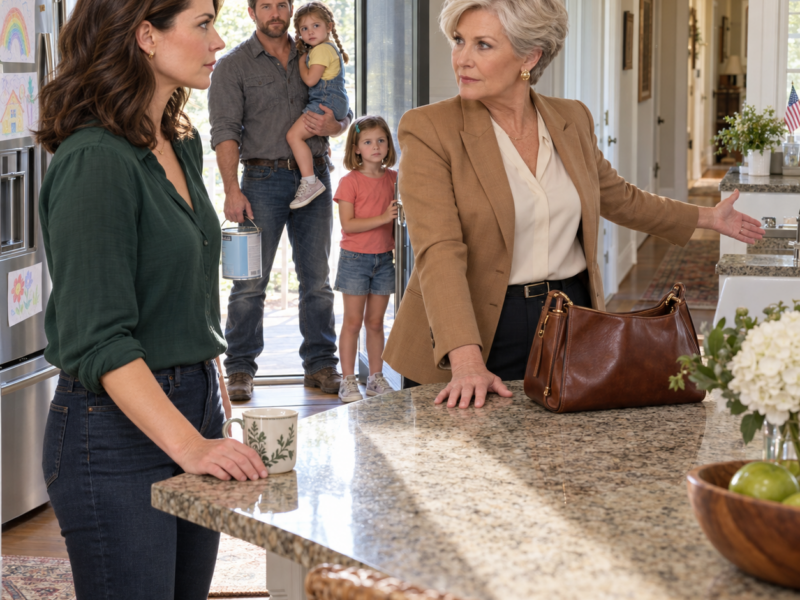
“Your brother’s family is moving in. He’s already given notice to his landlord,” my mother announced, assigning bedrooms in the house I had bought back. She hadn’t seen me in eleven years. She hadn’t asked who lived there. Then my husband walked into the kitchen carrying our three-year-old daughter, with our six-year-old right behind him. Mom stared. “When did you get married?” Two days later, my brother arrived with his daughters’ school transfer papers and a very different account of what our mother had promised him.
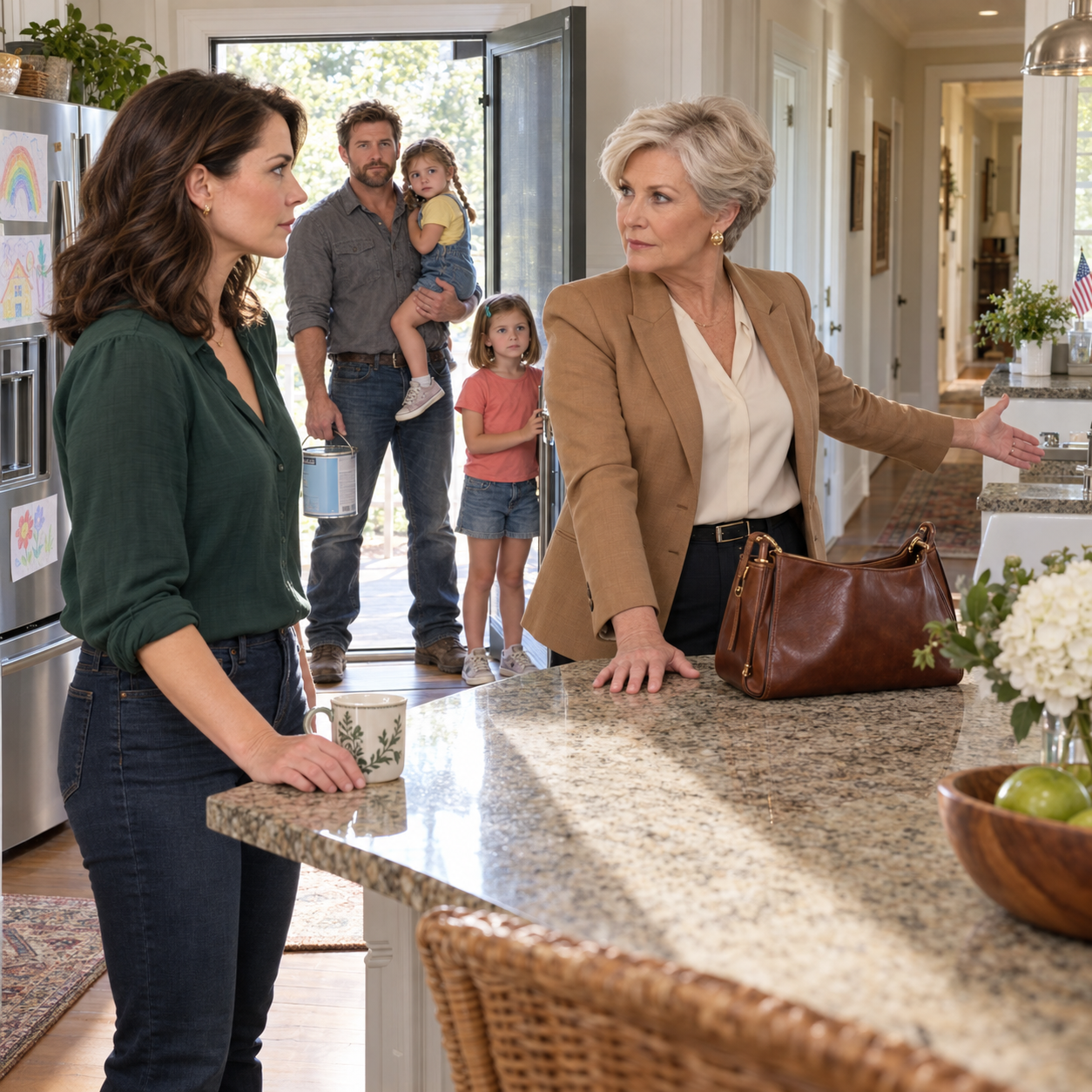
“The craftsmanship in this kitchen is simply breathtaking,” my mother declared, a serene smile plastered across her face. “And with those three vacant bedrooms down the hall, your brother’s family will have more than enough space when they move in. He’s already severed his lease.”
She dragged a perfectly manicured hand down the sheer length of my kitchen island. Her palm rested flat against the glacial surface of the polished granite, claiming territory in a house she had already mentally partitioned and gifted away. She had been standing inside my home for less than thirty minutes. In all that time, she had not posed a single inquiry. Not one. I am Rosalie Danner. To the woman inspecting my drawer glides, I was still Rosalie Teague.
I remained rooted to the hardwood, letting the silence stretch, letting her finish her delusion.
Then, the heavy wooden screen door at the back of the house groaned open. The coiled spring attached to the frame let out a sharp, metallic whine, a distinctive screech I could pick out of a sonic lineup of a hundred identical doors. My husband stepped into the kitchen. He had our three-year-old daughter balanced effortlessly on his right hip, while a heavy gallon jug of grayish wall primer dangled precariously from two fingers of his left hand.
A heartbeat later, our six-year-old barreled past his legs, making a beeline for the stainless steel refrigerator, yanking the heavy door open with both small hands.
My mother’s jaw unhinged. The confident, proprietary gleam in her eyes shattered into a million confused shards.
“When… when exactly did you get married?” she stammered, the words tumbling out as she darted her gaze wildly from the two little girls to the hallway she had just moments ago converted into her son’s impending sanctuary.
My brother was currently packing his entire life into cardboard boxes, fueled by a promise of three rooms within a life she had never once bothered to investigate.
To understand the sheer gravity of this collision, you have to stay with me and rewind the clock to a few hours earlier. We need to begin at the dawn of that muggy Saturday morning, starting in the very hallway my mother never walked down.
At seven o’clock that morning, I padded down that corridor the exact same way I navigate it every single day of my life, flicking off the plastic night lights with the calloused pad of my thumb. There are three doors. Ours is the heavy oak one on the left. Next is my eldest daughter’s room, her name spelled out in painted wooden letters she had proudly slapped onto the wood herself when she was barely four. The ‘M’ sits a rebellious quarter-inch higher than the rest of the alphabet. Finally, there is the room at the far end, claimed by the youngest, positioned exactly where the golden morning light breaches the house first.
By nine-forty, Dean had taken Ada and Maisie to the hardware store for paint. I was alone when an unfamiliar silver sedan slowed at the end of our gravel drive. It idled long enough for a cold knot to form in my stomach. Then the driver’s door opened.
The driver’s side door swung open, and my mother, Beverly Teague, emerged.
She was draped in the stiff navy-blue jacket she reserves exclusively for somber funerals and events she has internally designated as highly significant. She was sixty-four years old. It had been eleven agonizing years, four thousand days of absolute radio silence, since she had last stood in my physical presence.
I must articulate precisely what transpired biologically in my body in that fleeting moment, because stripping away the poetry is the only honest way to convey the shock. My right hand moved with a mind of its own, plunging deep into the fabric pocket of my jeans. My fingers blindly sought out my heavy keyring, closing around it in a white-knuckled death grip. That was it. Six suffocating seconds of paralysis, my thumb pressing agonizingly hard against the jagged brass teeth of the house key until the skin threatened to break.
Then, I exhaled, commanded my legs to move, and swung the heavy front door open.
Later, even Dean asked why I had opened the door instead of locking it.
Let me be perfectly clear: it was not born of weakness, nor was it birthed from some pathetic, lingering ember of hope. I had mentally rehearsed defending this exact doorway for eleven years. I had fought this phantom battle while waiting at red lights, while scrubbing shampoo from my hair, while mechanically folding tiny socks at midnight. I was entirely unwilling to cower behind a pane of decorative glass and forfeit the singular opportunity to hear what grand manipulation she had driven all the way out to the rural route to unleash.
“Well,” she breathed, stepping boldly over the threshold, brushing past my shoulder, bringing with her the cloying scent of floral perfume and stale car air. “Just look at you.”
She offered no embrace. Her arms remained stiffly at her sides. Instead, her eyes darted like a hawk’s. She scrutinized the entryway rug. She judged the vintage light fixture overhead. She inspected the grain of the restored hardwood floors, and then her gaze tracked upward, tracing the ceiling line where it perfectly intersected the door casing, a behavioral tic unique to someone who had spent their formative years memorizing the geometry of this exact house.
“The craftsmanship in this kitchen is simply breathtaking.”
Her hand slid the entire length of the stone. She didn’t caress it the way someone admires a beautiful object. She tested it the way a ruthless appraiser runs a hand along the fender of a repossessed classic car at a police auction.
“These are custom cabinets. They sit at a fantastic height.” She tilted her head back, evaluating the crown molding. “You went all the way up to the ceiling line. You actually did it. Good lord, this used to be a suffocating drop ceiling.”
She mentally cataloged and priced the modern pendant lighting suspended over the center island. She evaluated the expensive, deep-basin sink and the brushed nickel faucet. She yanked a drawer open two inches and released it, watching the soft-close mechanism pull it silently shut.
She stood dead-center in a magnificent room that my husband had painstakingly constructed over eleven grueling weekends, utilizing his own calloused hands and a borrowed, temperamental table saw. She measured every square inch of his labor, praised the architecture, and never once asked the name of the man who had bled to build it.
She kept her monologue running, her fingers drumming a steady rhythm on the stone.
“And with those three vacant bedrooms down the hall, your brother’s family will have more than enough space when they move in. He’s already severed his lease.”
There it sat. A bomb dropped on my counter. Flat. Warm. Finished. A decree from the throne.
Before I could even process the audacity, she pushed forward.
“Now, Clay and Angie will naturally take the master in the back. That’s the most spacious one. The two girls can take the room adjacent to the bathroom. They’re accustomed to sharing a space anyway, so it won’t be a shock to their systems. They will absolutely need to be fully moved in before the autumn school term begins. You certainly don’t want to be drowning in district paperwork in the sweltering heat of August. Furthermore, there is absolutely no logic in renting a commercial storage unit when you possess a two-car garage sitting out there completely empty. Clay owns a heavy table saw and all that cumbersome equipment. He can line it up neatly against the far brick wall. Angie is a hard worker. You’ll genuinely like her. She’ll whip this overgrown yard back into respectable shape within thirty days. You will also require a secondary refrigerator eventually. Everyone claims they won’t, and then they end up needing one.”
The answer is ruthlessly simple. She did not travel to Sudali Road to ask for a favor. She came to arrange a reality. And prior to the month of June, there was simply no crisis for her to arrange.
There are four sturdy wooden chairs arranged around my kitchen table. She remained standing the entire duration of her invasion.
“The room positioned at the very end of the hall captures the absolute best morning sun,” she stated with absolute authority, finally lifting her heavy leather purse and dropping it onto my spotless counter with a meaty thud. “Come along, I’ll point out exactly which room I mean for the girls.”
She physically pivoted to march down my hallway, intending to assign my childhood memories to children I had never met.
And that is precisely the moment the back screen door groaned, the spring screeching its familiar metallic protest. Dean, Ada, Maisie, and the primer.
As my mother’s jaw dropped and the question “When did you get married?” hung suspended in the dust motes, the true horror of her blind confidence clicked into place. But before I could deliver the fatal blow to her plans, her eyes darted from the primer in Dean’s hands to the crayon drawings taped to the fridge.
“Well,” she whispered, her voice tightening into something dangerous. “It seems we have a lot of rearranging to do.”
She recovered from the shock far more rapidly than my wounded pride desired.
That is the primary miscalculation people make regarding my mother. When outsiders hear snippets of this family saga, they conjure an image of a foolish, bumbling, out-of-touch matriarch. Beverly Teague is many things, but she is fundamentally not a fool. She endured exactly eight seconds of her facial muscles betraying a reality she had not explicitly authorized.
Then, she effortlessly reapplied her armor.
“Well,” she repeated, the single syllable stretched thin and sharp. “Well, then.” She extended a rigid arm outward. “Beverly Teague. It is a pleasure.”
Dean didn’t blink. He smoothly shifted Ada’s solid weight onto his opposite hip and engulfed her small hand in his large, calloused one. “Dean.”
“They certainly favor your side of the family,” she remarked, her eyes sweeping over the girls like a judge at a livestock show. She didn’t inquire about their names. She didn’t ask their ages. She merely clinically reported a genetic resemblance to thin the awkwardness.
She turned her gaze to my oldest. “And what specific shade of paint did we ultimately settle on today, sugar?”
Maisie, entirely oblivious to the decades of generational trauma standing in her kitchen, pointed at the can. “Blue! But not the scary dark one. The one that has the sneaky green hiding inside it.”
“And Daddy told me the green one costs way more money, but they look exactly the same,” Ada chimed in from Dean’s shoulder.
“Isn’t that just precious?” my mother cooed, the gears in her head visibly grinding, already recalibrating her offensive strategy. She pivoted back to Dean, dismissing the children instantly. “Now, Dean, you are absolutely going to want to rip that invasive hedge off the boundary line before the root system compromises the integrity of your fence posts.”
Ada, sensing a shift in the atmospheric pressure, buried her small face deep into the crook of Dean’s neck and refused to look up for the remainder of the visitation.
My husband is a man of profound economy when it comes to words. He gently placed the heavy gallon of primer onto the counter next to her purse. He mumbled a vague, noncommittal agreement about the structural decay of the corner post. Then, he began methodically opening kitchen drawers, aimlessly searching for a phantom tool he did not actually require. It is his instinctual tell, the physical action that man takes when he is silently calculating whether his presence is required in a hostile room, or if his wife has the perimeter secured.
“It appears I have caught you all at a remarkably chaotic time,” my mother announced, her tone implying our lives were a mild inconvenience to her schedule. “You all need time to get yourselves properly situated.”
She snatched her leather purse back off the granite. She launched into a brief complaint regarding the anticipated traffic congestion on the drive back to civilization. She mentioned, almost offhandedly, that she would have baked a pound cake had she been informed of the ‘new additions’, which was the absolute closest she ventured all morning to admitting there was a universe of information she was ignorant of.
As I escorted her to the front door, she paused. She reached out and patted my shoulder exactly once. It was a sterile, perfunctory double-tap, the exact physical motion a cautious buyer uses to test the structural integrity of a used car hood before making a lowball offer.
“Well, you just take your time and get properly settled first. I will return later in the week to finalize the measurements for those two vacant rooms in the rear of the house.”
Then, the navy-blue jacket vanished past the front bay window, retreating to the silver sedan.
Maisie tugged at the hem of my shirt. “Mommy? Who was that lady?”
She had said, “the two vacant rooms in the rear of the house,” without ever having walked down that hallway to confirm their existence.
To fully comprehend the apocalyptic weight of that single, arrogant sentence, we have to travel back through the years, back to an elderly woman rhythmically peeling tart green apples on a sun-drenched wooden porch.
Louise Teague was my grandmother. She passed away in the biting chill of March 2015, at the age of eighty-three, drawing her final, rattling breath in the primary back bedroom of the very house I am currently sitting in.
I had surrendered every golden summer of my youth to the care of this house. My grandmother possessed a heavy, weather-beaten rocking chair permanently stationed on the front porch, angled specifically to monitor the sparse traffic on the rural road. She would sit for hours, methodically peeling green apples with a carbon-steel paring knife she had utilized for so many decades that the blade had been worn down to a dangerous, needle-thin sliver, resembling an antique letter opener.
She possessed a mesmerizing talent; she could separate the skin from the flesh in one continuous, curling ribbon. She would hold the spiraling green peel aloft like a trophy before letting it drop into the tin bowl resting in her lap.
For the final ten years of her life, the gospel she preached to whoever occupied the adjacent chair was unvarying.
“When the Lord takes me, this house goes directly to Rosalie.”
She didn’t whisper it as a secret. She proclaimed it to the postal carrier leaning out of his mail truck. She shouted it over the sagging wire fence to Dell Pruitt while clutching a sack of his tomatoes. She declared it aggressively to my mother while sitting at this very kitchen table on multiple, highly uncomfortable occasions.
And she promised it to me the humid summer I turned nineteen. I vividly recall the hypnotic rhythm of the apple spinning in her weathered hands, the green curl cascading downward. She had looked at me with eyes clouded by age but fierce with intent.
“You are the solitary person in this bloodline who ever asked me a difficult thing about the history of this place, Rosalie,” she had rasped. “The rest of them just show up here to eat my food and wait for me to die.”
Grandmother believed spoken promises carried the weight of signed contracts. Unfortunately, she never put that promise into a deed or will. After her death, Beverly became the legal heir. Her years of caring for Grandmother were real, but she also used that history as the opening argument for taking complete control of the estate.
My mother, Beverly, was Louise Teague’s sole surviving child. Intestate succession laws are brutal, blind to spoken promises. Everyone in our family was acutely aware that the porch-side vows were legally worthless.
Four weeks after the dirt was shoveled over the casket, a pristine ‘For Sale’ sign was violently hammered into the front yard by a real estate agent.
Ten weeks after the funeral, the house legally belonged to a stranger named Ray Estes.
I was not consulted. I was not forewarned. I discovered the betrayal through a cold, digital group text message. Six sterile words: “House closed today. Check your mail.” Attached was a high-resolution photograph of the front door, a heavy metal real estate lockbox dangling obscenely from the brass handle.
In late June of that year, my mother summoned us to dispense the spoils. She distributed the checks on the very same front porch, sitting in the very same weathered rocking chair, simply because no one had possessed the emotional fortitude to move it into storage yet.
Ten thousand dollars.
She held the crisp bank check out toward me, pinching it between her index and middle fingers. Her facial expression was a mask of horrifying generosity. I must strive for absolute objectivity here, because painting her as a cackling villain makes dismissing her too easy, and I refuse to take the easy road. She was not sneering. She genuinely, fundamentally believed she was acting as a benevolent monarch.
“That is your designated share of the estate, honey,” she said, her voice dripping with maternal satisfaction. “You take this and do something wonderful for yourself. Go on that European trip you’re always daydreaming about.”
I stared at the slip of paper. “Where is Clay’s check?” I asked, my voice dangerously hollow.
“Oh, he’s already collected his share earlier this morning,” she replied casually. “He has a hefty payment due on that new truck of his.”
I reached out and pinched the very corner of the paper. I deposited the funds into a new savings account that Friday afternoon. I never spent a single, solitary dollar of that blood money.
She had casually handed me ten thousand dollars in the exact geographical location where my grandmother used to peel apples and promise me my future.
The catastrophic, relationship-ending fight occurred during the final week of May, preceding the distribution of the checks, standing on those exact same creaking porch boards.
“Rosalie, simply wanting a thing very badly is not the legal equivalent of owning it.”
I unleashed a string of words after that. It was a vicious, unrepeatable verbal assault, and it isn’t relevant to the core truth when you look back with calmer eyes.
She merely sighed, adjusted her collar, and said, “Call me when you’ve managed to compose yourself.”
I stomped down those three wooden porch steps in the oppressive heat of May 2015, and I swore to goodness I would never, ever walk back up them.
But there was a third party present during that porch massacre, hovering just inside the perimeter.
My younger brother, Clay, was twenty-two. He stood behind the screen door holding a glass of sweet tea and heard everything. He did not defend me. In my anger, I treated his frightened silence as if it were the same betrayal as Beverly’s deliberate sale. I changed my phone number, cut him off, and ignored every possible path back for eleven years. That part of the estrangement belonged to me.
Then, on the Monday after Beverly’s first visit to my home, a mud-splattered truck climbed my driveway.
A man stepped out into the morning mist, clutching a thick manila folder against his chest. He was thirty-three years old now. The last time my eyes had rested upon him, he was a terrified, skinny kid hiding behind a screen door with a glass of tea.
“Hey, Ro.”
Not a single living soul had utilized that nickname since 2015.
He stood awkwardly at the base of the front steps, staring up at the house. And then he did something that took considerable effort, something he had clearly been agonizing over. He offered a profound, unvarnished apology.
“I should have opened my mouth on that porch, Ro. I’ve thought about it. You wouldn’t believe how many nights I’ve laid awake replaying it. I was twenty-two, and I was about sixteen different varieties of a coward. I’m not going to stand here on your property and pretend I was anything else.”
“Come inside, Clay,” I whispered, the decade of ice cracking.
He aggressively wiped the mud from his work boots twice on the mat before crossing the threshold. He carefully deposited the manila folder onto the kitchen island and stood rigidly next to it, shoving his hands deep into the back pockets of his denim jeans. He began speaking at a frantic, breathless pace, the manic cadence of a desperate man who had been frantically rehearsing a monologue in the cab of his truck for forty miles.
“That folder right there is the girls’ official school transfer records,” he babbled, gesturing with his chin. “I took the initiative and secured them from the front office last Friday so we aren’t running around scrambling when August hits. And listen, we are absolutely going to pay our exact share of the Georgia Power bill. I’ve already discussed it with Angie, water bill too, fifty-fifty split. I also noticed that main corner post on your fence line is rotting out. I can easily knock out that repair over a weekend. I’ve got access to a heavy-duty auger… Yes, ma’am, I…”
He abruptly choked off his own sentence, letting out a hollow, self-deprecating laugh. “Lord, I’m so sorry. Nervous habit.”
“Clay,” I interrupted softly, studying the deep stress lines framing his eyes. “When exactly did you give your landlord notice to vacate?”
His face instantly brightened.
That is the specific, heartbreaking visual I want you to anchor in your mind, because it is the image I have been entirely incapable of banishing. Every logistical question I posed to him made his expression lighter. He genuinely, foolishly believed I was collaborating with him on the transition plan.
“The end of April,” he recited, sounding like a soldier reporting a successful mission parameter. “The current lease officially expires on the 30th of this month.”
He practically vibrated with gratitude. He thanked me profusely, twice, before the horrific reality finally penetrated my defenses. He wasn’t simply exercising Southern politeness. I prompted him to explain the full scope of his situation, and he spilled it all while standing in my kitchen, his hand resting on the folder containing his children’s future.
His lease expired in precisely two weeks. The landlord had already secured a new tenant slated for July and had a massive industrial dumpster scheduled for delivery to clear out their remaining possessions.
And then came the revelation that completely obliterated the floor beneath my feet, because it suddenly rendered every desperate action he had taken completely rational.
His rent had been drastically hiked in March. They had been frantically touring prospective rentals for three solid months. They had physically walked through two dismal properties in Woodstock and one cramped duplex in Canton. One of the Woodstock options possessed a ‘bedroom’ so claustrophobic you physically could not wedge a standard twin mattress into the space. The other strictly prohibited dogs.
So, when the miraculous offer of salvation was presented to him, it did not arrive like a casual favor. It manifested as a divine rescue operation for a catastrophic problem he was already drowning in.
“The girls have been packing for six weeks,” Clay admitted, rubbing the back of his neck. “Mom told me she had a long phone call with you back in April. She swore to me that you desperately wanted us out here, but that you firmly insisted all the logistics be routed directly through her. You didn’t want to speak to me directly. Not yet.”
I closed my eyes. Eleven years of my impenetrable silence had made the solitary, cruel condition she invented sound completely, undeniably in character for me.
I delivered the brutal truth within the next ten seconds.
I must emphasize this point, because there is a dramatic, cinematic version of this narrative where I wickedly hoard this explosive truth, waiting to deploy it at a highly theatrical moment to maximize the devastation. I possess zero interest in occupying that role. Not because I am inherently pure of heart, but because I have spent a lifetime on the receiving end of a woman who weaponizes and manages the flow of information, and I would vastly prefer to lose a battle than mutate into a reflection of her.
“Clay. Look at me,” I said, my voice barely a whisper. “I have not spoken a single syllable to our mother since the day I walked off that porch in 2015. I never initiated a phone call. I did not invite you here. I did not invite anyone.”
He didn’t immediately argue. He didn’t erupt into accusations.
He just physically stopped. He froze, resembling a man who had confidently stepped onto a solid floorboard, only to hear the unmistakable, sickening crack of rotting timber beneath his weight.
“Then… who?” he stammered, his hand gripping the edge of the granite counter for stability. “Okay. Okay.”
“Come here,” I instructed.
I led my brother down the hallway. I didn’t point; I physically opened all three doors.
First, the master suite on the left. Unmade bed, Dean’s work boots kicked into the corner.
Next, Maisie’s room. The door adorned with the wooden letters, the stubbornly crooked ‘M’. Inside, a plastic nightlight molded in the shape of a Holstein cow, and a meticulously curated collection of forty river rocks lined up sequentially along the windowsill.
Finally, I pushed open the door at the end of the hall. The space still carried the faint, lingering chemical scent of the primer applied two summers ago. A tiny crib mattress lay directly on the rug, because Ada possessed violently strong opinions regarding the acceptable height of a bed.
Three solid doors. Three distinct names. Not a single square inch of empty space.
Clay stood paralyzed at the terminus of the hallway, his large hand pressed flat against the door frame for support.
“I did try to look you up once, you know,” he whispered into the silence. “Rosalie Teague. There was absolutely nothing. The internet was a ghost town.”
The image of my brother searching the digital void for an estranged sister and interpreting the blank result as proof of her hatred forced me to remember the frightened young man who had once stood behind a screen door holding a glass of tea.
Before he trudged back to his truck, we silently exchanged our current phone numbers, standing side-by-side at the kitchen counter. Neither of us dared to utter a word about the monumental significance of that transaction.
He declared he was driving straight to confront our mother. He had searched for a surname I had legally abandoned in the autumn of 2018, and in doing so, he had stumbled into the exact informational vacuum she required him to find to execute her masterpiece.
On Tuesday afternoon, I dialed the phone number Dell Pruitt had forcefully pressed upon my husband.
Dell confirmed that he had run into Beverly at the Methodist church in March. He told her I had bought the old house back. She did not ask whether I was married, whether I had children, or even how to contact me. She simply said she assumed I already knew.
Eleven years had evaporated without a single physical visit, a solitary phone call, or a generic holiday card traversing the divide in either direction.
There was no grand, cinematic mystery embedded in the silence. There was simply a heavy door, and neither the inhabitants on the inside nor the outside ever possessed the courage to turn the knob. And my hand had remained firmly pressed against my side of the deadbolt the entire decade.
Dell sounded genuinely bewildered. “How in goodness’s name does a mother not know something like that?”
I summarized the entire traumatic saga in four concise sentences.
Then, Dell inadvertently handed me the final, jagged piece of the puzzle, completely oblivious to the weapon he was arming me with.
“Well, when I told her you were back in the house, she just nodded and said, ‘I figured she already knew.’”
One single, dismissive sentence, uttered in a humid fellowship hall while clutching a styrofoam cup of decaf. And following that sentence: an absolute vacuum of curiosity.
She hadn’t asked when I purchased it. She hadn’t inquired how a single woman managed the financing. She didn’t ask what I did for a living, if I was healthy, or if I had someone to share the burden.
From that one fleeting sentence, my mother had mentally constructed an entire, elaborate architectural blueprint based on a floor plan she hadn’t laid eyes on in eleven years.
And that is the precise moment my confusion regarding her motivations permanently evaporated. This wasn’t driven by financial greed. It never was.
My mother has never, in her sixty-four years of existence, requested permission to alter reality. She aggressively arranges the facts to suit her narrative first, and then aggressively forces everyone in her blast radius to adapt to the new terrain.
She had ruthlessly sold this house and only informed us of the transaction after the ink was dry. She had relocated my fading grandmother into that cramped back bedroom instead of a specialized care facility, and only informed my great-uncle after he had already mailed the non-refundable deposit. She had unilaterally inserted her own name onto the prestigious church flower committee in 2011, subsequently informing the woman who had held the position for nine years that her services were no longer required.
This behavior has never once cost her anything of value. Not a single time. Because the people trapped in her orbit have always, without fail, scrambled out of her way.
She hadn’t been maliciously lying to Clay. She was simply preemptively arranging a fact she fully expected me to eventually swallow.
Wednesday evening, under the dim glow of the kitchen pendant lights, I narrated the entire horrifying sequence to Dean. I was about halfway through the timeline when my cell phone illuminated face-up on the granite island between us.
Clay’s name flashed on the screen.
He had confronted her.
Her response was a masterclass in psychological warfare. She told Clay he had completely misinterpreted the situation. She insisted that his estranged sister had merely “moved some furniture around” specifically to manufacture drama and make a vindictive point. She claimed I had always possessed a flare for the dramatic, even as a little girl. Finally, she announced she would be driving out to the property to “inspect the reality for herself.”
She didn’t offer a denial. She initiated a total override.
Dean leaned over, his eyes scanning the digital text twice. Then, he calmly picked up my phone, flipped it face-down onto the stone, and rested his massive, calloused hand flat against the protective case.
“What exactly do you want to do about this?” he asked, his voice a low rumble.
He didn’t dictate his planned actions. He didn’t forcefully interject his own opinion on the madness. He asked the question once, and then he allowed the silence to stretch. The quiet expanded long past the threshold where most ordinary people would have frantically babbled to fill the void, but he just let it breathe.
Our mugs of coffee grew icy in front of us. Neither of us shifted in our chairs.
Then, he finally voiced the only personal grievance he allowed himself that entire evening.
“Eleven years,” he muttered, his fingers slightly rotating the phone a quarter-inch on the counter. “Not a single one of them knows the names of my children. Maisie has blown out candles at a birthday party every single year of her existence, and not one person sharing her blood has ever bothered to ask what she wished for. That is the singular detail I cannot force myself to move past. And that is the absolute last time I am going to vocalize it.”
He kept his word. He never resurrected the topic. Not during that chaotic week, not on the impending Sunday showdown, not ever.
“I don’t know the play yet,” I admitted, rubbing my temples. “She told him I moved things around just to be vicious. She says she’s coming to see for herself.”
I first crossed paths with Dean Danner in the blistering heat of 2017, on a dusty, chaotic commercial job site in Canton where my logistics firm was desperately untangling local permit nightmares.
The very first sentence he ever directed toward me was a question about my preferences, not a demand about my job function, or an order regarding what I ought to be doing. There was an artisanal coffee shop located across the busy thoroughfare, and a grimy, high-volume gas station perched on the adjacent corner. He wiped sweat from his brow, pointed, and asked which one I preferred: the high-quality roast, or the lightning-fast sludge.
So, I opted out of the room entirely.
And by abandoning that arena, I unwittingly guaranteed that absolutely nothing concerning my actual, breathing life ever contaminated the air supply of that family. No husband existed. No courthouse wedding occurred. No surname was altered.
Eight years down the line, that absolute blackout of information proved to be more critical than any words we could have ever shouted in anger.
The tired woman behind the courthouse glass slid the official form across the counter and monotonically asked if I intended to alter my legal name.
“Yes,” I stated clearly.
I pressed the pen to the paper and signed a surname that my estranged brother would desperately query in a search engine eight years later, finding only ghosts.
Maisie crashed into our world in 2019. Ada followed in 2022.
And in the blustery winds of March 2024, the property on Sudali Road quietly resurfaced on the real estate market.
Ray Estes had occupied the space for nine years and was currently downsizing, relocating south to be closer to his son in Perry. He aggressively negotiated, ultimately selling the property back to me for more than double the price my mother had originally stolen it for. I have never harbored a micro-ounce of resentment toward Ray for the markup. That is simply the cruel reality of what nine years of economic inflation does to property values in this county. Furthermore, the man had funded a brand-new architectural shingle roof.
More importantly, the substantial down payment utilized to reclaim the property contained my grandmother’s exact ten-thousand-dollar check.
That money had been languishing, gathering pathetic interest in a forgotten savings account since the summer of 2015, utterly untouched. I was psychologically paralyzed, incapable of forcing myself to spend the blood money, and equally incapable of returning it to her hand.
During the final property walkthrough, Ray escorted me through the rooms, adopting the demeanor of a weary man surrendering a beloved, slightly problematic dog to a new owner.
“The water heater downstairs is ticking on borrowed time, maybe four years left in the tank. I’d highly recommend getting ahead of a catastrophic leak,” he advised, pointing at the basement door. “I personally installed the seamless gutters. They’re solid. But that long run off the back patio? You’re going to have to drag a heavy hose up there and blast it out every November, otherwise the pine straw packs it solid and it backs up into the fascia.”
We stepped out into the side yard. He hooked a calloused thumb in the direction of the sagging perimeter posts. “I deliberately left the old original fence line alone. Figured somebody down the line might want to restore the history of it someday.”
The very week we moved our boxes in, Dell Pruitt hiked up the incline with his sack of tomatoes.
I transmitted this joyous victory to absolutely no one in my biological family. Not a single person. Not a whispered word. And, predictably, no one inquired.
I am forced to simultaneously cradle both of those truths, because for two painful years, I only acknowledged the latter. The brutal toll extracted for my silence was two little girls deprived of a grandmother, and I paid that exorbitant invoice every single Sunday without once having the courage to label it a price.
I weaponized her ten thousand dollars to buy my legacy back, and I denied her the knowledge of that victory, too.
That humid July, four-year-old Maisie developed an intense, non-negotiable obsession with acquiring bunk beds. She aggressively demanded the top bunk for herself, insisting the bottom cavern be held in strict reserve for “when Ada gets big”, a developmental milestone that was a minimum of two years away, but one she debated with the ferocity of a lawyer every single afternoon for eleven consecutive days.
The two bedrooms situated at the rear of the property were claustrophobically small. My grandmother’s depression-era generation constructed them purely for utility; you entered them to sleep, and you performed zero other activities within those walls. It was physically impossible to wedge a standard wooden bunk bed frame into either space without blocking the door swing.
Consequently, Dean systematically obliterated the dividing wall between them over the course of a single, chaotic July weekend.
He swung the heavy sledgehammer on Saturday morning. He framed the new support studs and the load-bearing header on Sunday. This was followed by two grueling evenings of applying mud and sanding drywall compound, a massive box fan reversed in the window frame desperately trying to suck out the suffocating clouds of white drywall dust that miraculously managed to coat every single possession we owned.
Four distinct doors were permanently reduced to three.
Once the fresh coat of “sneaky green” paint had cured, Maisie proudly slapped her wooden letters onto her newly expanded domain, balancing precariously on a plastic step stool, ensuring the ‘M’ sat slightly higher than the rest of her name. No one has ever attempted to correct its alignment, and no one ever will.
That was the specific summer this structure ceased functioning as a four-bedroom house, and absolutely no one outside our perimeter was aware of the architectural shift.
Which brings us back to Friday. I sat paralyzed at my kitchen island, my hand pressed flat against the cold edge of the stone, staring directly into the abyss of the impending collision.
My mother had never, in her entire life, been ambiguous regarding which category I occupied. She possessed the cognitive ability to flawlessly describe the exact height and material of my countertops, yet she was incapable of producing the first names of her own grandchildren.
That omission is not born of hatred. Honestly, overt hatred would have been infinitely easier to process. Hatred, at its core, implies you hold significance to the person despising you.
No, this was the terrifying reality of a predator surveying a landscape and only registering its utility.
From the depths of the hallway, Dean called out, asking if I was coming to bed.
“One minute,” I called back into the dark.
I wasn’t going to set a trap. I was simply going to cease saving her from herself.
Would you have slammed the deadbolt shut on the entire inferno, or would you have cracked a window anyway?
This is the exact moral precipice I stood upon, and I refuse to dress it up in noble clothing. The ticking clock attached to this bomb belonged to a property manager in Woodstock whom I have never met. I did not ignite the fuse. I did not accelerate the timer. I stood to gain absolutely nothing from the fallout.
My mother had meticulously packed the explosives, and my brother, operating as a desperate but entirely reasonable man acting on intelligence he had every historical right to trust, had unwittingly carried the bomb home and placed it directly on his own kitchen table.
I possessed every moral and legal right to do absolutely nothing.
Possessing a right and exercising that right are not always morally identical.
I could have permanently sealed the door on the entire toxic franchise and remained completely insulated in the clear. I sat paralyzed with that agonizing realization for the majority of a Saturday afternoon, the kitchen radio silenced.
Ultimately, what I could not endure was the prospect that whatever action I chose could be interpreted as either unspeakable cruelty toward children, or a pathetic surrender to her manipulation.
So, Dean and I sat at the table and calculated a number.
“First month’s rent, plus the security deposit,” I murmured, staring at the grain of the wood. “A decent three-bedroom unit in Canton is currently running around eighteen hundred. Let’s call it thirty-seven hundred total, factoring in the non-refundable pet fee. He can’t abandon that dog.”
“We write it out straight to the property management company,” Dean stated firmly, turning his empty mug in slow circles. “Not directly to him. Not to him.”
“Agreed,” I said.
“And if this isn’t the absolute end of the saga,” Dean continued, his eyes locking onto mine. “If we find ourselves staring down the barrel of May again next year, then I am going to vocalize my boundaries out loud, one time, and I will strictly enforce them.”
“Okay,” I agreed.
“You aren’t going to talk me out of it when the time comes, Rosalie.” He offered a faint, almost imperceptible smile. “I’m just making sure you can actually live with the terms. Helping them and welcoming them are two different concepts.”
I grabbed a blue ink pen and scribbled the number $3,700 onto the blank reverse side of a crumpled feed store receipt, sliding it carefully beneath the ceramic sugar bowl.
They pulled into the driveway right at ten o’clock.
Angie is thirty-two, making her living as a resilient teaching assistant in a chaotic pre-K classroom in Woodstock. She was crossing my threshold to meet her husband’s estranged sister for the first time in her life, clutching that same battered manila folder in both hands like a shield.
She extended the folder toward me before she even offered a greeting.
“These belong to you,” she said, her voice steady. “The girls’ transfer records. We are going to secure another arrangement.”
Clay hovered a half-step behind her left shoulder, nervously twisting his baseball cap in his hands. He managed to force out about four disjointed syllables before stalling completely, allowing his wife to commandeer the narrative because she was demonstrably more equipped to navigate brutal realities than he was.
“You absolutely do not owe us this bailout,” Angie stated, looking me dead in the eye. “I simply needed to look you in the face and say that out loud.”
Nine days of absolute hell. The very first sentence my brother’s wife ever directed toward me was an absolute absolution of my debt.
We congregated around the kitchen table for thirty tense minutes, and miraculously, no one in the room acted like a hysterical fool.
Clay painstakingly outlined the timeline, start to finish, and refused to grant himself a single ounce of grace.
“I questioned her,” he admitted, rubbing his eyes. “I pushed back twice. Both times I told her, ‘Mom, that just doesn’t sound like Ro’s style.’ And both times she looked right back at me and said, ‘Well, Clayton, people evolve.’ And I just… I let it go. I dropped it because I was desperate for it to be the truth.”
He looked up at the ceiling. “That failure is entirely on my shoulders. I wanted the lifeline so badly that I purposely stopped interrogating the rope.”
“I told her I was going to call you directly to verify,” Clay continued, his voice thick with shame. “She immediately countered, informing me your cell number had changed years ago, which was true. She insisted you were adamant that all logistics be handled strictly through her for the time being. And I sat there like an idiot and thought, ‘Yeah, that sounds exactly like the behavior of someone who hasn’t spoken to this family in eleven years.’“
He leaned forward, his elbows on the table. “I actually drove out here once. The final Sunday in May. I made it as far as the gravel turnoff past Pruitt’s property. I sat idling in the truck for twenty minutes, and then I put it in reverse and drove back home, because I could not fabricate a single coherent sentence a man is supposed to deliver when he shows up eleven years late to an apology.”
Angie placed her hand firmly over his on the table. “He challenged her twice. Stop beating yourself up.”
Then, Angie delivered her perspective, proving she was the most tactically astute person sitting in that room by a massive margin.
She had personally requested a sit-down meeting with me. Not once, but twice during the month of May, and a third time during the first week of June. Every single time, my mother had miraculously produced an ironclad, verifiable excuse for why I was unavailable. First, a sudden funeral up in Marietta. Then, an emergency hospitalization of a prominent church member.
“After the second deflection,” Angie said, her voice dropping lower, “I warned Clay something was rotting beneath the floorboards.”
She spoke without malice, just cold analysis. “I didn’t have a smoking gun. It was simply the intuition that you don’t aggressively invite a family of four to move into your home, yet remain entirely incapable of carving out twenty minutes for a phone call with the mother of those children. So, I completely ceased packing my kitchen. I left four boxes taped shut by the front door for appearances, and I left everything else sitting out on the shelves, just in case.”
That is not the profile of a woman who was easily conned. That is the profile of a survivor who smelled smoke and was tragically outvoted by a looming eviction notice.
Then, Clay uttered a sentence so agonizingly mundane that not a single one of the three adults sitting at that table registered the incoming artillery fire.
“I called Mom this morning and mentioned I was heading over here. Figured she had a right to know.”
Angie leaned toward me, her voice dropping to a whisper. “So… what exactly is the damage control plan?”
I opened my mouth, fully intending to speak the figure $3,700. The number was resting on my tongue.
That was the exact moment the heavy crunch of tires on gravel echoed through the open window.
She had parked her silver sedan directly behind Clay’s heavy work truck, completely blocking him in. She bypassed the front door entirely. She marched purposefully around the side perimeter of the house, navigating past the discarded primer cans, stepping over the wooden sawhorses, ignoring the stack of replacement fence boards leaning against the siding.
She gripped the handle of the back screen door, and she barged into my kitchen without knocking. Exactly how one enters their own kingdom.
Three heads snapped toward the door simultaneously.
“Clayton informed me you’d all gathered here this morning,” she announced, smoothing the lapels of her jacket. “I figured I’d drive down and save everyone a tedious conference call.”
Then, she directed a beam of weaponized warmth straight at my brother’s terrified wife. It was the exact, cloying greeting one reserves for a slightly dim-witted acquaintance at a Sunday church potluck.
“Angela! Just look at you. You’ve chopped all your beautiful hair off.”
Complete, paralyzing silence reigned for two excruciating seconds. The only sound was the coffee maker clicking off its heating cycle with a sharp pop.
She had invaded through the back door. Unannounced. Unapologetic.
She visually conquered the geography of the kitchen in roughly forty seconds. She refused to sit. There was an empty, fourth chair positioned exactly eighteen inches from her left hip, and she aggressively refused to acknowledge its existence.
Furthermore, she did not direct a single syllable toward me. I was a ghost in my own home.
She focused her offensive entirely on Angie. She declared that everyone in the room was unnecessarily hysterical. She insisted that a simple logistical hurdle didn’t need to mutate into a grand, theatrical production. She proclaimed that she had anchored this family for sixty-four years and had yet to encounter a crisis that couldn’t be smoothed over if people would simply behave rationally and sit down.
And then, she deployed her masterstroke.
It was not a foolish gambit. It was the strongest card remaining in her depleted hand, and that calculated brilliance was exactly what made the maneuver so obscene.
“The little girls can simply share a room,” she announced to the room at large. “Sisters share. It builds character. That is a perfectly acceptable bedroom right there, and absolutely no one needs to escalate this minor miscommunication into a vendetta.”
She delivered that decree while standing directly in front of two adults who had physically walked the length of that hallway with their own two eyes not ten minutes prior.
“Mom,” Clay pleaded from his chair, his voice cracking. “That’s exactly how I came up.”
She bulldozed straight over his objection. “Two of us crammed into one tiny room, and miraculously, neither of us perished from the exposure. Angela, you are a reasonable woman, you know I am correct.”
Angie did not utter a sound. She lowered her gaze, staring intensely at the grain of the wooden table.
“No,” my mother insisted, misinterpreting the silence as victory. “I said that is a perfectly fine room right there.”
And then, she initiated her march to present the physical evidence. She didn’t march down that hallway to inspect the layout; she marched down the hallway to legally prove her jurisdiction.
She was three confident strides ahead of the rest of us, her arm extended, pointing, her voice dripping with the exaggerated, slow-tempo patience she exclusively reserves for the mentally deficient.
“One,” she declared, her finger jabbing at the master bedroom door.
“Two,” she said, passing Maisie’s room.
She blew past the bathroom door, correctly omitting it from her count.
“Three.”
And then, she arrived at the absolute terminus of the hallway. She had completely run out of wooden doors, yet a phantom room still occupied the architectural blueprint locked in her mind.
She froze. She physically spun around. She marched back three aggressive paces, halting in front of a flat, featureless stretch of painted drywall located dead center between Maisie’s door and the bathroom frame.
Her right hand shot out to indicate the fourth room. Her palm moved perfectly level, stopping exactly at the precise, historical height of a brass doorknob.
Her manicured palm slammed flat against solid, painted drywall.
It stayed there. Pressed against the blank space.
No one breathed. No one shifted their weight.
She slowly retracted her hand, her eyes darting wildly. She returned to the beginning of the hallway and repeated the count, her pace noticeably slower, bordering on frantic.
“One. Two. Three.”
Her hand shot out a second time. She reached for a brass doorknob that my husband had violently removed with a crowbar twenty-four months ago.
She spun around, her eyes blazing, the polished mask completely disintegrating.
“This is the family’s estate!”
Her voice shattered the quiet, rising to a hysterical pitch. It was the first time in four thousand days I had heard her lose control of her volume.
“That is the reality that absolutely no one in this room possesses the spine to admit out loud! This is the family’s house! It has always, historically, been the family’s house! And I absolutely refuse to stand inside the walls of my family’s home and be managed like some trespassing stranger!”
Four hysterical outbursts inside of sixty seconds.
“You obliterated a structural wall.” She finally locked eyes with me, unleashing a decade of venom. “You tore down a wall in a perfectly good house simply to win a petty, vindictive argument with your own mother. That is precisely the caliber of malicious stunt you have pulled since you were a spiteful child, Rosalie. Everyone in this bloodline is acutely aware of it, and I am the only one with the courage to say it!”
“Mom,” Clay begged, rising from his chair, hovering in the kitchen doorway. “No. Stop.”
“And I will tell you something else!” she shrieked, whirling on him, her finger slashing through the air. “Your saintly grandmother had absolutely no legal or moral right promising property that did not belong to her! A senile, dying woman sitting on a porch, dictating real estate law to a mail carrier! That was a profoundly cruel thing to inflict upon this family. And I have silently carried the burden of that cruelty for eleven agonizing years. And not a single one of you ungrateful children has ever once uttered a word of thanks for my sacrifice!”
I remained silent. I did not offer a single word of defense. I let her drown in her own echo.
“I understand the dynamics of this family better than anyone breathing!” she gasped, her chest heaving.
And then Angie, the woman who corrals chaotic four-year-olds for a living, a woman whose entire professional existence revolves around posing microscopic, non-threatening questions in a soothing, modulated voice, asked the executioner’s question. She asked it softly, with lethal precision.
“Beverly… what are their names?”
My mother’s mouth snapped shut. Her jaw trembled.
Down the hallway, the exhaust fan in the bathroom was still humming from Dean’s morning shower. That low, mechanical drone was the only sound occupying the space.
My brother’s wife had politely requested the first names of my two daughters, and the hallway remained absolutely, suffocatingly silent.
Clay slowly reached down and placed his baseball cap onto the kitchen table.
“You’ve known the reality since Monday,” he stated, his voice devoid of anger, entirely hollowed out.
She attempted to launch a defense, but the words withered on her tongue.
“Monday, I stood in your kitchen and told you,” Clay continued, barely above a whisper. “Today is Sunday, Beverly. That is six days.”
He stared down at the scuffed toes of his work boots.
“I severed the lease on my children’s home,” he said, the reality crushing him. The bathroom fan hummed. “No one signed that termination notice but me.”
He placed the two facts side-by-side on the table. That was the entirety of his prosecution.
I took a deep breath, stepped past my mother, and initiated my final tour.
I placed my hand on the first door. “This is Ada’s room. She is three years old.”
I moved to the second door. “This is Maisie’s room. She is six. She proudly installed those wooden letters by herself, they are permanently crooked, and we will never correct them.”
I placed my hand on the master door. “This is my room. Shared with my husband, Dean.”
I turned around to face her. I looked directly into her eyes, and I utilized her given name. Because for eleven years, I had been reflexively calling her ‘Mom’ in the safe confines of my own mind, and that unearned title had cost me a piece of my soul every single time.
“Beverly. There is absolutely no spare room in this structure. There hasn’t been a vacancy since the summer of 2024. And frankly, regardless of whether a room exists or not, it is fundamentally not yours to arrange.”
Three doors. I anchored a living, breathing child’s name to every single one of them.
I walked back into the kitchen, deliberately turning my back on her for the final time. I reached beneath the ceramic sugar bowl, retrieved the crumpled feed store receipt, flipped it over, and slid it across the smooth wood toward Angie.
“Thirty-seven hundred,” I instructed quietly. “One time. You make the cashier’s check out directly to your property manager, and you call me. You do not call her.”
Angie stared at the ink. She vigorously shook her head, tears finally breaching her eyes. “No. No, ma’am. We will figure it out. I can’t let you absorb this.”
“Why not?” I asked.
She looked up at me. It wasn’t a prideful challenge; she was desperately searching for the real motive, and she possessed the emotional intelligence to spot a fabricated savior complex from a mile away.
“Because Brin didn’t sign that termination notice,” I answered truthfully.
Angie slowly flattened her trembling hand over the receipt, pinning it to the table, and left it there.
“I swear to you, I will pay every cent back,” Clay vowed, his voice thick. “I am declaring that right now, in front of witnesses. Every dollar.”
“Alright,” I conceded. Because forcefully denying a broken man the dignity of repaying his debts is simply another method of standing on his neck. And I had survived enough of that specific arrangement to last me three lifetimes.
From the shadowy periphery of the hallway, my mother muttered something incoherent about how this chaotic outcome was exactly the scenario she had been attempting to gracefully arrange in the first place, and that if people would merely follow her guidance instead of violently destroying architecture, everything would be fine.
No one answered her. Not one of the three adults in the kitchen acknowledged her existence.
That pathetic, rambling justification was the absolute final sentence Beverly Teague ever spoke inside the walls of my home.
She turned and exited through the front door.
At the threshold, she paused, gripping the frame. She turned back over her shoulder, and she delivered the line exactly the way she had delivered it on the porch in 2015. She used the exact same flat, instructional register, as if the words had been marinating in her mouth for a decade, patiently waiting for the proper audience.
“Wanting a thing, Rosalie, is simply not the same as owning it.”
Then, she descended the three wooden steps she had bounded up and down her entire childhood, the exact same three steps I had retreated down in the blistering heat of May 2015. She climbed into her silver sedan, threw it into reverse, and backed out past my brother’s truck.
I walked over and pulled the door shut.
I didn’t slam it. I didn’t aggressively throw the deadbolt. The metal latch clicked into place with that quiet, definitive snick a solid door makes when it seals out the weather. My hand lingered on the cool brass knob for a fraction of a second after it engaged.
And then, I let go.
She had stood on my porch and regurgitated her favorite mantra, but this time, the house itself had provided the answer.
Yesterday, Angie sent me a digital photograph. It was a snapshot of a sunlit living room in a Canton apartment complex, featuring two large windows and a worn, secondhand couch that isn’t entirely theirs yet. Beneath the photo was a single line of text expressing profound gratitude.
My mother’s name did not appear anywhere in the body of that message.
Clay has already initiated the repayment process. He transfers small amounts at a time, adhering to no strict schedule, and entirely without prompting. I accept every single deposit without protest, because refusing his money would instantly mutate the transaction back into a poisonous favor, and it is fundamentally not a favor. It is a contract between equals.
I am going to confess this fact exactly once, and then I am going to bury it for good:
My mother’s ten thousand dollars purchased this physical house back. And my thirty-seven hundred dollars secured the sanctuary of an apartment in Canton for her son.
And I do not intend to share that exquisite irony with another living soul for as long as I draw breath.
Brin and Maisie were finally introduced last weekend at a neutral playground situated off Highway 5. They engaged in that agonizingly awkward ritual where children pretend to be entirely unaware of each other’s existence. The charade held strong for approximately four minutes, and then it spectacularly collapsed into chaotic laughter and chasing.
Brin still keeps her wooden letters secured in the plastic sandwich bag, tucked deep inside her backpack. Angie confided in me that she is simply waiting until the dust fully settles, waiting until she feels unequivocally sure.
My mother has not attempted to call.
I am not going to dress up that silence as some profound, zen-like peace, and I am equally refusing to dress it up as a festering wound. It is simply a geographical fact. It is where the road abruptly terminates for now.
Last Tuesday, while I was wrestling a stubborn sneaker onto Ada’s foot, Maisie looked up from her coloring book and asked if her grandmother was ever going to come back to visit.
I froze, holding the tiny shoe suspended in the air. I held it for a duration far exceeding the socially acceptable limit for holding footwear.
“I genuinely don’t know, baby,” I finally answered, my voice steady.
“Okay,” she chirped, completely unbothered. She snatched the shoe from my grip and skipped off to retrieve the matching one.
Meanwhile, Ada, who possesses absolute sovereignty over her own bedroom at the end of the hall, the room bathed in the spectacular morning light, has spent the previous three nights camped out on the hardwood floor of her sister’s bedroom, cocooned in a zipped sleeping bag. Apparently, that is the standard protocol when you are three years old and your older sister graciously permits your presence.
Maisie fiercely guarded that bottom bunk for two solid years. She declared it was strictly reserved for “when Ada gets big,” and that two-year embargo officially expired this very month.
Ada stubbornly insists the hardwood floor is structurally superior, and Maisie hasn’t initiated a single argument regarding the arrangement.
Out on the front porch, Dean called out, mentioning that the wooden handrail requires tightening before someone carelessly leans their weight against it.
For three consecutive nights, this house inadvertently possessed a spare room.
And absolutely no one bothered to count it.









