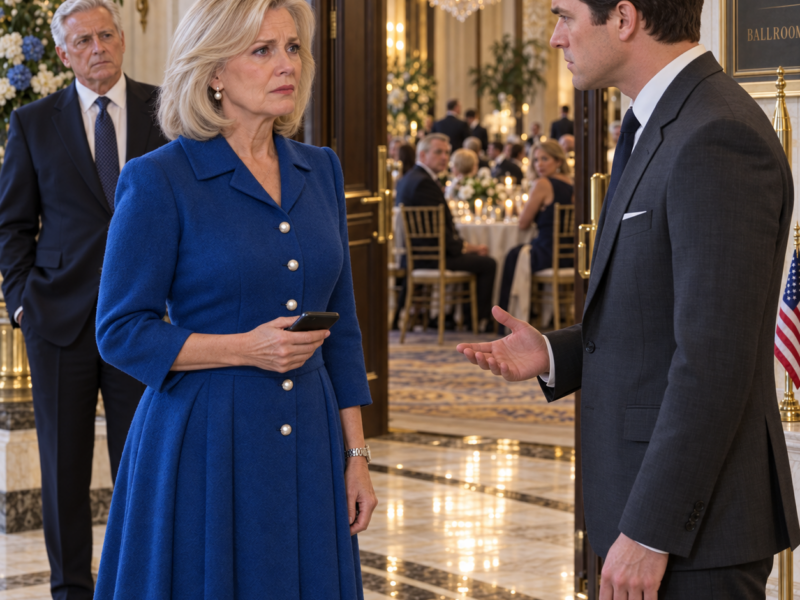
“You can sleep in the lobby,” my son texted after canceling my hotel room twenty minutes before his wedding rehearsal. Then another message arrived: “Please don’t cause a scene.” I paid for my own room and went to dinner, where he looked at my blue dress and said, “Everyone can see where I came from.” Later, the silver-haired man who had stood behind me at the front desk found me outside the ballroom. He was holding the hotel’s cancellation records. Beneath my son’s name was an instruction I hadn’t seen.
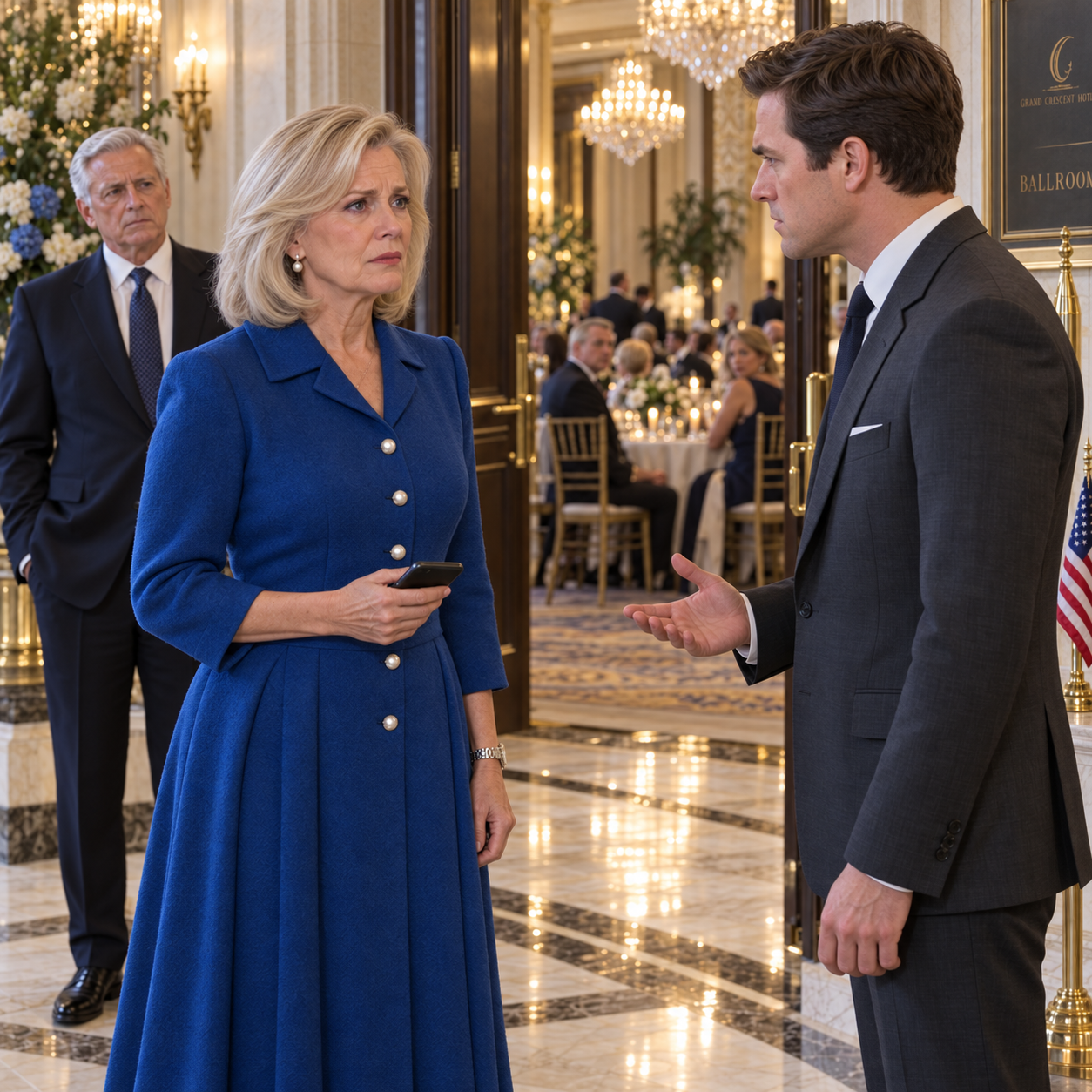
My son canceled my hotel room and told me to sleep in the lobby twenty minutes before his wedding rehearsal.
I learned about it beneath the crystal chandeliers of Cincinnati’s Grand Crescent Hotel, with one hand wrapped around the handle of my suitcase and the other holding a confirmation email that apparently no longer meant anything.
The front desk clerk avoided my eyes as he searched the computer.
“I’m sorry, Mrs. Harper. The reservation was canceled through the wedding account.”
My phone vibrated against the marble counter.
You can sleep in the lobby.
For several seconds, I heard nothing except the piano near the bar. A young man in a dark jacket was playing a slow instrumental arrangement while guests crossed the lobby carrying garment bags, flower boxes, and bottles of champagne.
My son had not forgotten my room.
Brian had deliberately removed it.
“Please check again,” I said.
The clerk searched using my name, confirmation number, and the wedding block. He called a supervisor, typed several more commands, and finally looked at me.
“It was canceled twenty minutes ago.”
There was no replacement reservation. No call. No explanation.
My phone buzzed again.
Please don’t cause a scene. We have enough to deal with already.
That message hurt more than the first.
Brian had already decided what every possible reaction from me would mean. If I cried, I would be dramatic. If I objected, I would embarrass him. If I stayed silent, I would disappear exactly as he wanted.
I placed the phone facedown on the counter.
“What is the best room you have available?”
The clerk blinked.
“Tonight?”
“Tonight.”
He checked the screen again.
“The presidential suite is available, but I should warn you that the rate is considerably higher than a standard room.”
“How much?”
When he told me, my stomach tightened.
But I had an emergency account.
For years, Brian had referred to it as money I was “just letting sit there.” To me, it was the difference between needing help and having choices.
That afternoon, a room became a choice.
“I’ll take it.”
The clerk studied my face as if waiting for me to reconsider. Then he nodded and began the registration.
Behind me, a silver-haired man in a dark suit stood near the end of the counter. I had noticed him when I arrived because he carried himself with the quiet confidence of someone who never needed to announce that he belonged in a place. A woman holding a leather folder stood beside him.
Neither interrupted.
I signed the room agreement, accepted two key cards, and followed a bellman toward the elevators.
The presidential suite occupied a corner of the nineteenth floor. It had a sitting room larger than the first apartment my late husband and I had shared, windows overlooking downtown Cincinnati, a dining table for eight, and a bedroom with pillows arranged in rows.
The bellman set my suitcase on a luggage stand.
“Will there be anything else, Mrs. Harper?”
I almost said no automatically.
Then I looked at the coffee station, the enormous room, and my trembling hands.
“Could you send up some tea?”
“Of course.”
After he left, I sat on the edge of the bed without removing my coat.
Then my niece Emily called.
Emily was my sister Carol’s daughter and the closest thing I had to a second child. She was thirty-two, practical, observant, and incapable of pretending not to notice a problem.
“Aunt Linda, are you checked in?”
“Yes.”
“What room?”
I hesitated.
“Nineteenth floor.”
“That is not where the wedding block is.”
“There was a change.”
Silence.
“What kind of change?”
“Emily, I need to get dressed.”
“What did Brian do?”
Her certainty almost made me laugh.
“Nothing we need to discuss before dinner.”
“That means he did something terrible.”
“It means I want one hour without explaining myself.”
She softened immediately.
“All right. Call me if you need help with anything.”
“I will.”
“That sounded unconvincing.”
“It was the best I could manage.”
After we hung up, room service delivered tea on a silver tray. I poured a cup and stood near the window.
Below me, traffic moved along Fifth Street. Church spires and office towers rose against a pale October sky. Somewhere in the hotel, Khloe Bennett was probably surrounded by bridesmaids, garment bags, and makeup cases. Brian would be moving through the rehearsal schedule, checking his watch, charming people, and making sure no one knew he had canceled his mother’s room.
I wondered what story he planned to tell when someone found me asleep beside the lobby fireplace.
Maybe he assumed no one would ask.
That possibility hurt most.
I opened my suitcase and took out the blue dress.
Brian had called it old-fashioned when I showed him a photograph. The dress was midnight blue, cut below the knee, with pearl buttons and a soft collar. I had bought it five years earlier for my retirement dinner. My husband, David, had still been alive then. He said the color made my eyes look brighter.
David’s silver watch rested in a small case beneath the dress.
He had worn it for thirty-one years. After he died, I began wearing it on days when I needed courage. It did not keep perfect time anymore, but neither had David. He was late to movies, parent conferences, and nearly every dinner reservation we ever made. Yet when something truly mattered, he arrived before anyone else.
I fastened the watch around my wrist.
“I wish you were here,” I said to the empty room.
The rehearsal dinner was scheduled in the hotel’s smaller ballroom, though nothing about it was small. Tall arrangements of white hydrangeas stood on every table. Gold chargers framed each place setting. A string trio played near the windows, and waiters circulated with trays of drinks.
I arrived exactly on time.
Brian crossed the room almost immediately.
He stopped in front of me.
“Where have you been?”
“Getting settled.”
His eyes moved over my dress. I saw the old disapproval flicker.
“I heard you caused trouble downstairs.”
“I asked what happened to my room.”
He lowered his voice.
“You were supposed to call me.”
“You told me to sleep in the lobby.”
Conversations nearby softened.
Khloe hurried toward us. She was thirty-eight, elegant, and always perfectly arranged. Her rehearsal dress was cream silk, and her blond hair fell in controlled waves over one shoulder.
“There was a booking problem,” she said.
I turned toward her.
“No. There was a decision.”
Brian’s jaw tightened.
“This is exactly what I asked you not to do.”
“I’m not shouting. I’m asking why my son removed me from his hotel.”
Khloe’s father stepped away from the nearest table.
Walter Bennett was a retired judge, a broad-shouldered man in his late sixties whose calm attention could make a room reorganize itself. He had always treated me courteously, though we had spoken only a handful of times.
“What happened?” he asked.
Brian answered before I could.
“The hotel overbooked.”
I held his gaze.
“That isn’t true.”
The atmosphere changed.
Walter turned to me.
“Who canceled the reservation?”
“It was canceled through the wedding coordinator’s account twenty minutes before I arrived.”
Khloe looked away.
Brian leaned toward me.
“Stop.”
I straightened.
“No.”
He stared at me because I had spent years saying yes.
Yes to being removed from the rehearsal program.
Yes to having no speech.
Yes to arriving later because he did not want me hovering.
Yes to hearing that my dress was wrong for the photographs.
But not this.
“You canceled my room,” I said.
His composure slipped.
“Because you never listen.”
Silence spread across the tables.
Then his eyes moved toward my dress.
“You wear things like that.”
I glanced down.
“What does that mean?”
“It means everyone can see where I came from.”
The words struck harder than shouting.
I remembered packing lunches before sunrise, working double shifts after David was laid off, selling his tools to pay for Brian’s eighth-grade class trip, and driving through two Ohio summers without air-conditioning so our son could have soccer cleats and college application fees.
I looked at Brian.
“You came from me.”
He hesitated.
“You came from a small house and a mother who worked until her feet ached. You came from packed lunches, overdue bills, and love.”
“Mom.”
“If that history humiliates you, the shame belongs to you.”
I turned.
Brian caught me lightly by the elbow.
“Don’t walk away from me.”
I looked down at his hand.
“Let go.”
He released me.
Walter stepped forward.
“You should apologize.”
Brian turned sharply toward him.
“This is a family matter.”
Walter remained calm.
“You made it public.”
I walked out before the tears came.
Emily found me near the elevators and wrapped both arms around me.
“He said everyone could see where he came from,” I whispered.
Then a voice came from behind us.
“Mrs. Harper.”
The silver-haired stranger from the lobby approached with the woman carrying the folder.
“My name is Jonathan Pierce,” he said. “I’m chairman of the Grand Crescent Hospitality Group.”
I stared at him.
The Grand Crescent in Cincinnati was one of twelve hotels owned by the group. Brian had talked about Jonathan for months, always in the careful tone people use when describing someone whose approval might change their career.
Jonathan opened the folder.
“I witnessed what happened downstairs. After you left the desk, I asked our manager to review the cancellation record.”
He turned a printed page toward me.
Brian’s name appeared on the authorization log. Directly beneath it was another instruction.
Do not upgrade or relocate her without checking with us.
My body went cold.
Canceling the room had not been a last-minute response to overbooking. Brian had also tried to prevent the hotel from helping me.
Jonathan glanced toward the ballroom.
“Your son invited me to this wedding because he wants a leadership position at my company.”
The doors opened behind him.
Brian stepped into the hallway. Then he saw Jonathan holding the record, and the color left his face.
Jonathan turned toward him.
“I was standing behind your mother when you told her to sleep in the lobby.”
Brian stopped.
For one second, no one spoke.
Then Brian recovered the polished expression he used with executives.
“Mr. Pierce, this is a misunderstanding.”
Jonathan looked at the paper.
“Which part?”
“The hotel was having capacity issues.”
“It was not.”
“I was given incorrect information.”
“You entered the cancellation yourself through the event portal.”
Brian glanced at me as if I had betrayed him by standing there.
“There were family circumstances.”
Jonathan’s voice stayed quiet.
“You used access provided for wedding logistics to cancel a confirmed reservation. Then you instructed our staff not to relocate the guest.”
“I can explain.”
“You will have an opportunity to provide a written explanation.”
Brian’s mouth tightened.
“For what?”
“The leadership role you requested requires judgment, honesty, and appropriate use of company systems. Tonight raised questions about all three.”
Khloe appeared at the ballroom doors with Walter behind her.
“Brian?” she said.
He turned on her.
“Did you tell them?”
Her face changed.
“Tell them what?”
“About the room.”
“I knew you were going to move your mother to another hotel.”
The hallway became still.
I looked at Khloe.
“Another hotel?”
She swallowed.
“Brian said he found you a room near the airport.”
“He told me to sleep in the lobby.”
Khloe’s eyes moved toward him.
“You said you made another reservation.”
Brian’s face hardened.
“I was handling it.”
“By leaving her without a room?”
“She booked the presidential suite, so clearly she managed.”
There it was again. The result used to excuse the intention.
Because I had solved the problem, he believed the problem no longer counted.
Jonathan handed the folder to his assistant.
“Mrs. Harper, the suite charge will be removed. The hotel should not have accepted an event-account instruction designed to deny reasonable assistance to a registered guest.”
I shook my head.
“I chose the room. I can pay.”
“And you may choose to pay,” he replied. “But first, the hotel must acknowledge its own failure.”
His answer surprised me.
He was not offering charity. He was accepting institutional responsibility.
Brian stepped closer.
“Mr. Pierce, please. We have discussed the regional operations position for weeks.”
Jonathan studied him.
“We discussed the experience listed on your résumé. We had not yet discussed your character.”
Brian’s face flushed.
Walter spoke from the doorway.
“Perhaps this conversation should pause.”
Jonathan nodded.
“Agreed. Mr. Harper, do not access the event portal again. My staff will secure it tonight. You will receive instructions from human resources on Monday.”
“I don’t work for your company yet.”
“Correct.”
The single word closed something.
Jonathan turned to me.
“Mrs. Harper, I’m sorry your arrival was handled this way.”
Then he and his assistant walked toward the elevators.
Brian stared after them.
Khloe stared at Brian.
I wanted to leave. I also wanted an answer to the question that had been growing since the lobby.
“Why?” I asked.
Brian looked at me.
“Not now.”
“You canceled my room twenty minutes before I arrived. You told the hotel not to help me. Why?”
His eyes moved toward Jonathan’s closing elevator doors.
“Because you were going to ruin this.”
“How?”
“By being yourself.”
Emily’s hand tightened around mine.
Khloe closed her eyes.
Walter looked at his daughter.
“Did you know he felt this way?”
“No.”
Brian laughed without humor.
“Everyone needs to stop pretending. Mom turns every event into a story about sacrifice. She tells people about the old neighborhood. She wears Dad’s watch. She talks about how hard things were.”
“I have never discussed our finances with the Bennetts,” I said.
“You don’t have to. People can tell.”
I looked at the son I had raised.
“So you wanted me away from the rehearsal dinner.”
“I wanted one weekend where I did not have to manage your feelings.”
“Then why invite me at all?”
He had no answer ready.
Khloe did.
“Because people would ask why his mother was missing.”
Brian looked at her.
She looked sick.
“That’s why, isn’t it?” she continued. “You wanted her at the ceremony, dressed the way you approved, seated where you chose, and quiet. But you didn’t want her near Jonathan tonight.”
Brian’s silence confirmed it.
The rehearsal dinner was not only a family event. It was an audition.
Jonathan Pierce was the guest Brian cared most about impressing, and I was the part of his history he wanted hidden.
Walter removed his glasses.
“Khloe, we need to talk.”
Brian turned toward him.
“The rehearsal is starting.”
“It can wait.”
“Two hundred people are coming tomorrow.”
“Then this is the last moment to ask whether tomorrow should happen.”
Brian went completely still.
Khloe’s eyes filled.
“Dad.”
“I am not making the decision for you,” Walter said. “I am reminding you that a schedule is not a command.”
I stepped away.
Whatever happened between them next was not mine to direct.
“Emily, will you walk upstairs with me?”
Brian called after me.
“Mom, if you leave now, everyone will think something is wrong.”
I looked back.
“Something is wrong.”
The elevator doors opened.
Emily and I entered.
For once, I did not stay to make the room comfortable after my son had made it cruel.
In the suite, Emily poured water while I removed my shoes.
“I’m going to say something you won’t like,” she said.
“That has never stopped you.”
“You have been helping Brian hide from consequences for years.”
I stared at her.
“He is not a bad person.”
“I didn’t say he was.”
“He has worked hard.”
“I know.”
“His father’s death affected him.”
“It affected you too.”
That stopped me.
Emily sat across from me.
“Aunt Linda, every time Brian hurts you, you explain the part of him that once hurt first. That may be compassion, but it also means he never has to finish explaining himself.”
I looked toward the city lights.
“He is my son.”
“Yes.”
“I cannot stop loving him.”
“I’m not asking you to.”
“Then what are you asking?”
“Stop translating love into permission.”
The sentence settled over the room.
My phone vibrated on the table.
Brian.
I let it ring.
That was the first boundary.
It lasted thirty seconds.
It felt like lifting a car.
Brian called seven more times over the next hour.
Khloe called twice.
Walter sent one message.
Linda, Khloe has postponed tomorrow’s ceremony. You are not responsible for this decision. Please rest. We will speak in the morning if you wish.
I read the message three times.
Postponed.
The word seemed too quiet for what it meant. Two hundred guests had traveled to Cincinnati. Flowers had been installed. Food had been prepared. A string quartet, photographer, officiant, florist, and dozens of hotel employees had organized their weekend around a ceremony that might not happen.
My first instinct was to fix it.
I stood so quickly that Emily nearly dropped her glass.
“I need to speak to Khloe.”
“Why?”
“She cannot cancel a wedding over an argument about my room.”
“Sit down.”
“Emily.”
“The bride just learned her fiancé lied to her, abused access to a hotel system, humiliated his mother, and tried to turn a family dinner into a job interview. This is not about a room.”
“People have spent money.”
“Some money will be lost.”
“Her grandparents flew in from Arizona.”
“Then they can have breakfast with her.”
I stared at my niece.
“You make everything sound simple.”
“No. I make it sound like Khloe’s decision.”
That was harder to argue with.
I sat again.
At ten-thirty, someone knocked on the suite door. Emily checked through the peephole.
“It’s Walter.”
He stood in the hallway holding his suit jacket over one arm. Without it, he looked less like a retired judge and more like a tired father.
“I apologize for disturbing you,” he said. “May I come in?”
I stepped aside.
He remained near the door until I invited him to sit.
“How is Khloe?” I asked.
“Shaken. Angry. Embarrassed.”
“I’m sorry.”
Walter’s expression sharpened.
“Why?”
“Because this happened the night before her wedding.”
“You did not cause it.”
“If I had stayed quiet.”
“Then my daughter might have married a man she did not fully know.”
The words landed heavily.
Emily moved toward the bedroom.
“I can give you privacy.”
Walter shook his head.
“You may stay. Khloe asked me to clarify several facts, not conduct a private negotiation.”
He placed his phone on the table.
“First, she has postponed the ceremony. The hotel will contact guests in the morning. We are not assigning blame in the notice.”
I nodded.
“Second, Khloe says she did not approve canceling your room. Brian told her that you wanted to stay elsewhere because the wedding block was noisy.”
“I never said that.”
“I believe you.”
“Did she know I had been removed from the rehearsal program?”
Walter paused.
“She knew there would be no parent speeches. Brian said you disliked public speaking.”
I had taught adult literacy classes for eleven years and delivered a eulogy at David’s funeral before a church filled with people. Brian knew I could speak.
“What about the arrival time?”
“He said you preferred to miss the early photographs.”
Every decision I had accepted as Khloe’s rejection had passed through Brian first.
That did not excuse her coldness. She had criticized my dress directly and rarely made an effort to know me. But the architecture of the weekend had been designed by my son.
“Why would he do this?” I asked.
Walter looked toward the windows.
“Khloe believes he has been under severe professional pressure. That is an explanation, not an excuse.”
“He wants the position with Jonathan.”
“Very much.”
“Enough to hide his mother.”
Walter’s face softened.
“Linda, I suspect he was hiding more than you.”
I looked at him.
“What does that mean?”
“Khloe asked him tonight whether the résumé he submitted was accurate. He refused to answer.”
My stomach tightened.
“Brian has experience.”
“I am sure he does. But he told Jonathan he had managed three hotel turnarounds. Khloe knows of one consulting engagement that ended before implementation.”
“Maybe there were projects she did not know about.”
Walter watched me carefully.
“Perhaps. She is asking him to document them.”
I recognized what I was doing.
Explaining the part of Brian that had not yet explained itself.
I stopped.
“What does Khloe need from me?”
“Nothing tonight. Tomorrow, if you are willing, she would like to speak with you privately.”
“I’m willing.”
Walter stood.
At the door, he turned.
“For what it is worth, I liked your dress.”
I laughed despite myself.
“Thank you.”
“My late wife would have called it dignified. She had very little patience for the idea that dignity requires a particular price tag.”
After he left, Emily looked at me.
“Are you going to call Brian back?”
“No.”
“Are you saying no because you mean it or because I’m here?”
“Both can be true.”
We slept badly.
Emily used the second bedroom. I lay awake listening to the hotel’s muted nighttime sounds: an elevator bell, a closing door, distant laughter from guests who did not yet know the wedding had been postponed.
At six-fifteen, I made coffee and watched the city brighten.
The first cancellation notice reached guests at seven. It said the ceremony would not proceed as scheduled due to unforeseen personal circumstances. The Bennett family apologized for the inconvenience and provided a number for travel questions.
Within minutes, family messages filled my phone.
What happened?
Is Brian sick?
Did they break up?
Are you all right?
One cousin wrote, I heard there was a fight about your hotel room. Please tell me you did not make Khloe cancel the wedding.
I deleted nothing and answered almost no one.
To the closest relatives, I sent the same sentence.
Khloe postponed the ceremony after a private matter came to light. Please give both families space.
At eight, Brian knocked.
This time Emily did not tell me to ignore him.
“Your choice,” she said.
I opened the door but kept the security latch attached.
Brian wore the same suit trousers and white shirt from the night before. His tie was gone. His eyes were red.
“Let me in.”
“Why?”
He stared at the narrow opening.
“Because you’re my mother.”
The sentence might once have opened every lock I owned.
“That explains who I am. It does not explain why you’re here.”
His face tightened.
“Khloe canceled the wedding.”
“Postponed.”
“Same difference.”
“Not to her.”
“She won’t speak to me.”
“Then give her time.”
He glanced down the hallway.
“Can I please come inside? People are walking past.”
I almost laughed at how reliably appearances governed him.
I closed the door, removed the latch, and opened it again.
Brian entered. Emily stayed in the sitting room.
He noticed her.
“This is private.”
“No,” I said. “You do not get to isolate me and decide what version of a conversation survives.”
Emily said nothing.
Brian paced toward the windows.
“You need to tell Khloe this was a misunderstanding.”
“It wasn’t.”
“Tell her I was trying to move you because the wedding floor was full.”
“That is not true.”
“The details don’t matter.”
“The details are the matter.”
He turned.
“Do you want me to lose everything?”
There it was. The question that had ruled our relationship for years.
Whenever Brian faced a consequence, I was asked whether I wanted his destruction. The scale allowed only two choices: rescue him completely or admit I wanted him ruined.
“I want you to tell the truth.”
“Jonathan is withdrawing the position.”
“Did he say that?”
“He froze the process.”
“That is not the same thing.”
“It might as well be.”
“Did you lie on your résumé?”
His face changed.
Emily looked toward him.
“Who told you that?”
“Walter said Khloe had questions.”
“Walter needs to stay out of my career.”
“Answer me.”
“I presented my experience in the strongest possible way.”
“Did you manage three hotel turnarounds?”
“I contributed to three projects.”
“Did you manage them?”
He looked away.
“Titles in consulting are flexible.”
I felt tired rather than shocked.
The lie about my room had not appeared by itself. It was part of a larger belief that words existed to arrange appearances, not describe truth.
“You need to leave,” I said.
His eyes widened.
“Mom.”
“I am meeting Khloe later. I will tell her exactly what happened.”
“If you do that, we’re done.”
Pain moved through me, clean and immediate.
Emily started to stand. I raised one hand.
“Is that a threat?” I asked.
Brian’s breathing was uneven.
“I’m telling you that I cannot have someone in my life who works against me.”
“I worked two jobs to support you.”
“That was decades ago.”
“I used my retirement savings to cover part of your graduate tuition.”
“You offered.”
“I guaranteed the loan for your first consulting office.”
“You offered.”
“I paid the deposit on your first house.”
“You offered.”
Each answer sounded like a receipt being torn in half.
He was right that I had offered. A gift does not purchase lifelong obedience. But gratitude was not obedience, and honesty was not repayment. I had confused those ideas too often, usually in his favor.
“Then you owe me nothing,” I said.
He blinked.
“What?”
“Everything I gave you was offered. You do not owe me control, agreement, or a particular life.”
His shoulders relaxed slightly.
“But I owe you nothing more.”
The relaxation vanished.
“What is that supposed to mean?”
“It means you will no longer use my money, my labor, or my silence as part of your plans.”
“I didn’t ask for money.”
“Last month you asked me to invest in the restaurant property.”
“That was an opportunity.”
“Then find another investor.”
His face went pale.
“You already said yes.”
I had said I would review the final documents after the wedding. Brian expected $85,000 from an investment account David and I had built over forty years.
“I am saying no now.”
“You can’t make financial decisions because you’re emotional.”
The irony was so complete that Emily looked down to hide her expression.
“It is my money.”
“Dad intended it for the family.”
“Your father intended it to support both of us in retirement. He died before he could use his share. That does not make you the owner.”
Brian stared.
I saw the calculation happen. The hotel position. The wedding. Khloe. The restaurant investment. In his mind, all the structures he expected other people to hold were suddenly moving.
“You’re doing this to punish me.”
“I’m doing it because I no longer trust your account of an opportunity.”
He stepped closer.
“You will regret this.”
“Possibly.”
“When you need someone, don’t call me.”
I thought of all the years that fear had governed me. Who would drive me after surgery? Who would help if the furnace failed? Who would sit beside me if I became ill? I had tried to buy protection from future loneliness by making myself permanently useful.
The hotel room proved usefulness was not belonging.
“I will remember what you said,” I replied.
Brian walked out.
The door closed.
My knees weakened, and I sat down.
Emily knelt in front of me.
“You did the right thing.”
“It does not feel right.”
“It feels new.”
I began to cry.
She held my hands until I could breathe normally.
At ten, Khloe came to the suite alone.
She wore jeans, a gray sweater, and no makeup. I had never seen her look so young or so uncertain.
“May I come in?”
I nodded.
Emily offered to leave, but Khloe asked her to stay.
“I’m tired of conversations with no witnesses,” she said.
The words told me her night had resembled mine.
We sat at the dining table.
For a moment, no one knew where to begin.
Then Khloe looked at my dress, which hung over a chair.
“I’m sorry I criticized it.”
“Why did you?”
She rubbed her thumb against the side of her coffee cup.
“Brian said you chose clothes that made people feel sorry for you.”
I stared at her.
“How can a dress make people feel sorry for someone?”
“I don’t know. It sounds absurd now.”
“It sounded absurd then.”
She nodded.
“Yes.”
Her willingness to accept the correction softened something, though not enough to erase the months of coldness.
“He told me you disliked me,” she said.
“I barely knew you.”
“He said you compared me to his first wife.”
“I met his first wife twice.”
“He said you wanted to give a long speech about raising him alone.”
“No one asked me to speak.”
Khloe closed her eyes.
“I believed him because some of it matched what I thought I saw. You were quiet around me. You declined invitations.”
“What invitations?”
Her eyes opened.
“The bridal luncheon. The tasting. The dress fitting.”
“I was never invited.”
She looked ill.
Emily leaned back slowly.
Brian had not merely hidden me from his new world. He had built two women into enemies and presented himself as the exhausted bridge between them.
“Why?” Khloe whispered.
I knew the answer before she did.
“Because if we spoke directly, we might compare stories.”
She covered her mouth.
Then she took out her phone.
“There’s more.”
She showed me messages Brian had sent during the previous six months. In them, he described me as demanding, unstable, jealous of Khloe’s family, and fixated on money. He claimed I threatened to withdraw support unless I controlled the ceremony.
I read until the words blurred.
“None of this happened.”
“I know that now.”
“Do you?”
She flinched.
I continued.
“You know what I tell you today. Yesterday, you believed him. Why should either of us accept the most convenient version now?”
Khloe took a breath.
“We shouldn’t. That’s why I postponed the wedding instead of ending it or going through with it. I need facts.”
That answer sounded like Walter.
“What facts?”
“Finances. Work history. Debts. The restaurant deal. Everything.”
I looked at her.
“What restaurant deal did he describe to you?”
“He said you had already invested eighty-five thousand dollars.”
Emily and I exchanged a glance.
“I had not.”
Khloe became still.
“He showed me a funding schedule with your name.”
“I agreed to review final documents after the wedding. I never signed a commitment.”
Khloe opened a folder she had brought.
Inside was a one-page capital summary. My name appeared beside $85,000 under the heading Committed Family Investment.
There was no signature, but the wording suggested certainty.
Below my name was Walter Bennett, $100,000.
Khloe tapped that line.
“Dad never agreed either.”
The restaurant property was not simply an opportunity Brian hoped to discuss. He had been using anticipated family money to persuade other participants that the funding was secure.
“Who else has seen this?” I asked.
“At least two investors and a lender.”
My stomach tightened.
“Did he represent it as signed?”
“I don’t know.”
Emily spoke for the first time.
“You need an attorney.”
Khloe nodded.
“Dad has already called one.”
I wanted to defend Brian.
The instinct rose automatically, searching for a harmless explanation. Maybe he planned to confirm before closing. Maybe “committed” was informal. Maybe the lender knew the figures were projections.
Then I remembered Emily’s words.
Stop translating love into permission.
“I have an attorney in Dayton,” I said. “I will contact her today and state in writing that I made no commitment.”
Khloe looked relieved.
“Thank you.”
“I’m not doing it for your investigation. I’m protecting my name.”
“I understand.”
We talked for another hour.
Khloe admitted she had enjoyed the social advantages Brian seemed able to create. He knew whom to invite, where to sit, and how to make ambition look like inevitability. She had interpreted my modest life as evidence that I resented their success. Brian encouraged that interpretation because it made every boundary I set look like jealousy.
I admitted I had judged Khloe too. Her clothes, her expectations, the expensive wedding. I had assumed her family’s money explained Brian’s new embarrassment. It was easier to blame the bride than accept that my son had become ashamed of me on his own.
Neither of us left the table innocent.
But only one person had lied to both of us.
Before leaving, Khloe paused at the door.
“I don’t know whether I will marry him.”
“That is your decision.”
“Does part of you hope I don’t?”
I considered lying.
“Part of me wants him to experience the full cost of what he did.”
She nodded slowly.
“Thank you for being honest.”
“Another part of me knows pain does not automatically produce character. Whatever you decide, do not use your life to teach my son a lesson.”
Her eyes filled.
“That may be the first advice anyone has given me that isn’t really about him.”
After she left, I called my attorney, Susan Park.
Susan had handled David’s estate and helped me organize my retirement accounts. She listened without interruption, then asked me to send the funding summary and every message involving the proposed investment.
“Did you sign anything?”
“No.”
“Did you transfer money?”
“No.”
“Did you authorize Brian to use your name?”
“I said I would consider investing after reviewing the final documents.”
“Then we will make the limits of that conversation clear in writing.”
Within two hours, Susan sent notices to Brian, the project attorney, and the lender. The letter stated that I had made no binding commitment, authorized no representation to the contrary, and withdrew from consideration of the investment.
She also asked a question that embarrassed me.
“Does Brian have access to any of your accounts?”
“He is listed as payable-on-death beneficiary on one account.”
“Access while you are living?”
“He has a key to my house and knows where I keep files.”
“Online passwords?”
“No.”
“Power of attorney?”
“A durable form David and I signed twelve years ago names him if I become incapacitated.”
Susan became quiet.
“We should update that.”
The thought felt disloyal.
That feeling told me it was necessary.
“Yes,” I said.
We scheduled an appointment for Monday.
The rest of the weekend unfolded without a wedding.
The Bennetts hosted a breakfast for guests and explained only that the couple needed time. Some people were kind. Others treated uncertainty like entertainment. Rumors moved through the hotel faster than room service.
I attended breakfast because hiding would have made Brian’s shame my burden again.
I wore the blue dress.
Emily sat beside me. Walter greeted us at the door. Khloe remained upstairs.
Brian did not attend.
Jonathan Pierce stopped by our table before leaving the hotel.
“Mrs. Harper, has the room issue been resolved to your satisfaction?”
“The staff has been very helpful.”
“And the charge?”
“I would like to pay the standard room rate I originally confirmed. I will accept the suite as the hotel’s corrective accommodation, but I do not want the entire stay provided free.”
He smiled slightly.
“That is a reasonable solution.”
“What will happen to the clerk?”
“Nothing punitive. He followed a system instruction he did not have authority to override. We are changing that system.”
I appreciated the answer. Accountability that simply pushed blame downward would have taught the wrong lesson.
Jonathan glanced around the dining room.
“Your son’s application is under review.”
“I’m not asking you to hire or reject him.”
“I know.”
“Please do not make a career decision as a favor to me.”
“I won’t.”
“And do not make one as revenge for what you witnessed.”
His expression became thoughtful.
“A leader’s behavior toward someone who cannot advance his career is relevant. But it will not be the only evidence considered.”
That was fair.
He handed me a business card.
“Our guest advocacy director would like your feedback on a new cancellation safeguard.”
I almost refused. Then I thought about another older woman arriving alone and being told an event organizer had erased her room.
“I’ll speak with her.”
Jonathan left.
Across the room, two relatives watched us with obvious curiosity. I returned to my coffee.
For once, I did not explain why an important man had stopped at my table.
I checked out Sunday morning.
The clerk who had helped me was at the desk.
“Mrs. Harper, I’m sorry again.”
“You were kind when the system put you in a difficult position.”
“I should have called a manager sooner.”
“Perhaps. Next time you will.”
He handed me the corrected bill. The total reflected the standard room rate, exactly as Jonathan and I had agreed.
I paid with my own card.
That mattered to me.
The presidential suite had not been a prize. It had been proof that when someone removed a place prepared for me, I could still choose another.
Emily drove behind me for the first thirty miles toward Dayton, then exited toward Columbus. At a rest stop, she hugged me.
“Call when you get home.”
“I will.”
“And change the locks.”
I sighed.
“Emily.”
“He threatened to cut you off when you refused an investment. He has a key and knows where the documents are.”
“Brian would never steal from me.”
She held my eyes.
“Maybe not. A changed lock is not an accusation. It is a boundary with hardware.”
I laughed.
“You rehearsed that.”
“All morning.”
On Monday, a locksmith changed the front and back door locks.
I did not tell Brian.
Susan updated my power of attorney, health directive, beneficiaries, and emergency contacts. I named Emily as primary financial agent and my longtime friend Patricia as backup. Brian remained a beneficiary in my will, but no longer controlled the process.
“You can love someone and still choose a different fiduciary,” Susan said.
I signed every page.
When I returned home, there were eleven messages from Brian.
The first were angry.
You destroyed my wedding.
You poisoned Khloe against me.
You humiliated me in front of Jonathan.
The later messages changed tone.
Please call me.
I’m sorry.
I don’t know how to fix this.
The final one said only:
Mom, I think something is wrong with me.
I sat at my kitchen table with the phone in front of me.
David’s photograph stood on the windowsill. In it, he was fifty-eight and laughing at something outside the frame.
I wanted to call Brian.
I wanted to drive to Cincinnati, place both hands around his face, and tell him no mistake could take him outside my love.
That statement was true.
It was also not the statement he needed first.
I wrote:
I love you. I will speak with you when our conversation can begin with the full truth and not with a request for me to repair a consequence. If you believe something is wrong, contact a licensed counselor today. Emily has my permission to confirm that I am safe. Do not come to my house without an invitation.
I read it twice and sent it.
Brian did not answer for two days.
Then he wrote:
I made an appointment.
That was the first useful thing he had said.
For six weeks, Brian and I communicated only by text.
He attended counseling twice a week. I knew because he told me, but I did not ask for details or congratulate him each time. Making an appointment was not transformation. It was an appointment.
Khloe moved into a furnished apartment owned by one of her cousins. She and Brian remained engaged on paper for another month, then ended the engagement privately. The decision became public only when vendors began issuing refunds and credits under their contracts.
Some deposits were lost.
Walter absorbed the costs his family had agreed to cover. Brian was responsible for several services booked in his name. Khloe returned gifts. Guests complained, speculated, and eventually moved on to the next event in their own lives.
No one died because a wedding did not happen.
That fact would have shocked the version of me who stood in the presidential suite believing I needed to save the schedule.
The restaurant proposal collapsed as well. Susan’s notice prompted the lender to verify every listed commitment. Two other “committed” investors said they had only expressed interest. Without the projected family capital, the financing did not qualify.
Brian blamed me at first.
Then the project attorney sent him a formal warning about representing tentative discussions as confirmed commitments. He avoided litigation by providing corrected disclosures and written withdrawals to everyone who had received the summary.
He had not forged signatures or transferred money. That mattered legally. It did not make his conduct honest.
Jonathan’s company completed its review in three weeks.
Brian was not selected for the regional operations position.
The letter cited discrepancies in the way he described previous consulting roles, misuse of the event portal, and concerns about judgment during the selection period. It did not mention me by name.
When Brian forwarded the letter, he added one sentence.
I earned this result.
I did not reply immediately.
For years, I had rushed to soften every impact. A failed exam became a teacher’s unfairness. A lost client became bad luck. A divorce became a former spouse’s failure. I had helped Brian survive, but I had not always helped him see.
The next morning, I wrote:
Taking responsibility is painful. It is also the only part of this outcome you can use.
He answered:
My counselor said something similar.
I wrote:
Listen to the person you are paying.
To my surprise, he responded with a small laughing symbol.
It was the first ordinary moment between us since the hotel.
I did not mistake it for reconciliation.
During those weeks, I began counseling too.
My therapist, Dr. Nina Feld, asked why I had kept an emergency fund large enough for a presidential suite but allowed Brian to remain the person legally designated to control everything if I became incapacitated.
“He is my only child.”
“That describes biology, not qualification.”
I smiled reluctantly.
“You sound like my attorney.”
“Good attorneys and good therapists occasionally occupy neighboring houses.”
We talked about David’s illness and death. During his final year, Brian had visited often, but he had struggled to be useful. He offered business ideas, researched experimental treatments, and tried to organize problems that could not be solved. I comforted him while caring for his father. After the funeral, I continued comforting him because his grief was visible and mine felt like private weather.
Brian learned that pain brought my attention and helplessness brought my labor.
I learned that solving his problems distracted me from my empty house.
Neither lesson had been spoken. Both shaped us.
“Did you give because he demanded?” Nina asked.
“Sometimes.”
“And other times?”
“I offered before he could ask.”
“Why?”
The answer embarrassed me.
“Because I wanted to be needed.”
Nina nodded without judgment.
“Being needed can feel safer than being known.”
That sentence followed me home.
Brian had known what I could provide. Money. Labor. Forgiveness. A house key. He had not known that I still missed dancing with David in the kitchen, that I feared losing my independence, or that I sometimes sat in the grocery store parking lot because returning to an empty house felt harder than buying food.
I had not offered those truths. I offered solutions instead.
Two months after the canceled wedding, Brian asked to meet.
I chose a diner halfway between Dayton and Cincinnati. Public places felt safer, not because I feared violence, but because privacy had too often allowed him to rewrite tone and meaning.
Emily knew where I was. Susan did too, though she told me that notifying my attorney about breakfast was probably excessive.
Brian arrived early.
He wore jeans and a navy sweater. Without the tailored suit and executive posture, he looked closer to the boy who once waited for me outside the elementary school office.
We ordered coffee.
“Thank you for coming,” he said.
“What do you want to discuss?”
He took a folded sheet of paper from his pocket.
“My counselor suggested I write down what I did before I tried to explain why.”
“That sounds wise.”
He looked at the page.
“I canceled your room because Jonathan was staying on the wedding floor and I was afraid he would see you before I could control the introduction.”
The bluntness hurt, but I appreciated its accuracy.
“I told Khloe you wanted another hotel. I told you to sleep in the lobby because I was angry that the front desk contacted me after the cancellation. I added the instruction not to relocate you because I thought the staff might undo what I had done.”
He swallowed.
“I lied about the overbooking. I lied to Khloe about inviting you to wedding events. I lied to you about Khloe excluding you. I exaggerated my work history. I listed investments as committed when they were not.”
He placed the paper down.
“I used people’s assumptions to avoid asking questions that might produce no.”
I wrapped both hands around my coffee.
“Why were you ashamed of me?”
His eyes filled.
“Because I was ashamed of myself.”
I waited.
“Everyone in Khloe’s circle seemed established. Her father had been a judge. Her mother came from a family with money. Jonathan built an international company. I kept thinking they would realize I was a consultant whose business had never become what I promised.”
“So you made your childhood the problem.”
“Yes.”
“My dress.”
“Yes.”
“The small house.”
“Yes.”
“Your father’s watch.”
He looked at my wrist.
“Yes.”
I felt anger move through me again.
“Your father wore this while he repaired boilers, drove to your soccer games, and sat beside you after your first marriage ended.”
“I know.”
“No. You knew the facts. You did not value what they meant.”
He nodded.
“That’s true.”
He did not defend himself. That allowed the anger to remain clean instead of turning into an argument.
“What do you expect from me?”
“Nothing.”
“That is not honest.”
He thought for a moment.
“I hope you will eventually let me be part of your life. I hope you will believe I can change. But I don’t expect you to make me feel better today.”
That answer was better.
“What happened with Khloe?”
His face tightened.
“She ended it.”
“Do you blame her?”
“Some days.”
“And on the other days?”
“I understand.”
He looked out the window at trucks moving along the wet highway.
“I miss her, but I was asking her to marry a résumé. The person underneath it was terrified she would compare notes.”
I took a breath.
“I will not invest in your projects.”
“I know.”
“You will not have a key to my house.”
He nodded.
“You are no longer my power of attorney.”
Pain crossed his face.
“Who is?”
“Emily.”
He looked down, then back at me.
“Okay.”
“You may call once a week. If I do not answer, you may leave one message. You may not contact friends or relatives to pressure me.”
“Okay.”
“If you lie to me, contact pauses.”
“For how long?”
“As long as I decide.”
He nodded again.
“Is there anything I can do about the hotel bill?”
“It is paid.”
“I know. I meant reimburse you.”
“The standard room was always my expense.”
“What about the suite?”
“The hotel corrected that portion.”
He looked disappointed that there was no debt he could pay quickly.
“Accountability is not always a bill,” I said.
“I’m learning that.”
We finished breakfast.
He did not ask for a hug.
At the door, I touched his arm.
“I love you.”
His eyes closed briefly.
“I love you too.”
“Love is not the same as trust.”
“I know.”
“Trust will depend on what you do repeatedly when there is nothing immediate to gain.”
He looked at me.
“Like how I treat someone who cannot advance my career.”
Jonathan’s lesson had reached him.
“Exactly.”
Over the next year, Brian built a smaller life.
He accepted an operations job at an independent conference center outside Cincinnati. The title was manager, not regional vice president. The salary was lower than he wanted. His duties included weekend events, vendor disputes, room blocks, and guest complaints.
On his second month, an older couple arrived for an anniversary celebration and discovered their reservation had been canceled by a relative trying to surprise them elsewhere.
Brian called me afterward.
“I found them a room.”
“Good.”
“I upgraded it.”
“Was that within your authority?”
He laughed softly.
“Yes, Mom. I checked.”
“Then good.”
He became quieter about achievements. He stopped sending photographs from executive dinners. Our calls concerned ordinary things: a leaking faucet, a book he was reading, an anniversary that made us both miss David.
Once, he asked whether I needed help replacing the back steps.
“I have hired a carpenter.”
“I could do it.”
“Can you?”
He considered the question.
“Not well.”
“Then come have lunch while the carpenter does it well.”
He did.
It was the first time he returned to my house after the locks changed. He stood on the porch without trying his old key.
I noticed.
He noticed me noticing.
Neither of us mentioned it.
Khloe and I exchanged occasional messages. She moved to Chicago for a position with a nonprofit arts foundation. Six months after the postponed wedding, she sent me a photograph of the blue dress from a charity resale listing.
For a moment, I thought she was making fun of me.
Then I read her note.
I donated several wedding-event outfits and saw this. It reminded me that I judged a woman by her dress because I trusted a man more than my own observations. I’m sorry again.
I replied:
The dress and I are doing fine. I hope you are too.
She answered:
Getting there.
That was enough.
Walter called on the anniversary of the canceled ceremony. He had started volunteering with a legal clinic for older adults and wanted permission to use a generalized version of my hotel experience in a presentation about financial and digital access.
“No names,” I said.
“Of course.”
“And do not portray me as helpless.”
“I would not dare.”
The Grand Crescent changed its event-account policy. A wedding organizer could still create and pay for reservations, but canceling a room occupied by another named adult required direct notice to that guest. Instructions restricting relocation or assistance triggered review by a manager. Front desk employees received clearer authority to escalate suspicious requests.
Jonathan’s guest advocacy director invited me to review the language sent to customers. I suggested one sentence:
Payment authority does not replace guest consent.
They added it.
The company offered me a consulting fee for my time. I accepted.
At first, that made me uncomfortable. Then I remembered that experience has value even when it was painfully acquired.
I donated half the fee to a Cincinnati shelter for older women and used the other half to take a train trip through New England with Emily.
Brian did not ask what it cost.
That was progress.
Eighteen months after the hotel, Brian invited me to the conference center where he worked. His employer was recognizing several staff members for guest service. The event was modest: coffee, sheet cake, folding chairs, and a small American flag beside the lectern.
I wore the blue dress.
When Brian saw me, emotion crossed his face.
“You look beautiful.”
“Thank you.”
No embarrassment. No glance around the room. No suggestion that I change.
During the ceremony, his supervisor described a winter night when a bus carrying senior travelers broke down nearby. Though the center had no obligation to help, Brian opened an unused meeting wing, arranged hot drinks, contacted local hotels, and stayed until every passenger had safe transportation.
He had not mentioned it to me.
That mattered more than the plaque.
Afterward, he introduced me to his coworkers.
“This is my mother, Linda Harper.”
Nothing added. Nothing hidden.
One woman smiled.
“Brian says you taught him hospitality before he knew it was an industry.”
I looked at him.
He seemed nervous.
“Did he?”
“He said you never let anyone leave your house hungry.”
That was true.
On the drive home, I cried.
Not because one compliment repaired everything. It did not. I cried because the son who once treated his history like a stain had named it as instruction.
Another year passed before I gave Brian a new key to my house.
I did not do it after a speech, birthday, or holiday. I did it on a Tuesday afternoon after cataract surgery, when he drove me home, prepared soup, checked the medication schedule, and left at the time we had agreed.
He did not search my papers, offer investment ideas, or imply that helping earned him authority.
At the door, I handed him a small envelope.
“What is this?”
“An emergency key.”
He stared at it.
“Are you sure?”
“Yes.”
“Do you want me to give it to Emily instead?”
“She already has one.”
He smiled.
“Of course she does.”
“The key is for emergencies. It is not permission to enter whenever you want.”
“I understand.”
He placed the envelope carefully inside his wallet.
That evening, Emily called.
“You gave him a key?”
“How do you know already?”
“He called to ask what you consider an emergency.”
I laughed until my healing eye watered.
“What did you tell him?”
“Fire, flood, ambulance, or you explicitly saying, ‘Brian, use the key.’”
“Perfect.”
“I also said running out of coffee is not an emergency.”
“That depends on the morning.”
Trust did not return as a feeling.
It returned as evidence collected over time.
Brian told the truth when a lie would have been easier. He accepted no without turning it into rejection. He stopped using family members as messengers. When he made mistakes, he named them before explaining them.
He was not transformed into a perfect man.
He remained impatient. He still cared too much about titles. He occasionally presented advice as though he had invented it five minutes earlier. But when those habits harmed someone, he became capable of correction.
That was what David had always believed maturity meant.
Not never failing.
Repairing what failure exposed.
Three years after the canceled wedding, Brian met a woman named Marisol at a hotel conference. She managed food service for a university and had no interest in being impressed by a résumé. They dated for nearly a year before he introduced us.
Before dinner, he called.
“I want to tell you something awkward.”
“That is a promising start.”
“I told Marisol what happened at the Grand Crescent.”
“All of it?”
“Enough that she asked whether you would confirm my version.”
I smiled.
“What version?”
“That I canceled your room because I was ashamed of where I came from, lied to everyone, lost the wedding and the job opportunity, went to counseling, and spent several years trying to become less awful.”
“That is reasonably accurate.”
“Would you answer her questions?”
“If she asks.”
Marisol did ask.
Not during the first dinner. Months later, over coffee, she wanted to understand how Brian responded when confronted and what boundaries remained.
I answered honestly.
“Do you trust him now?” she asked.
“In many things.”
“Not all?”
“I do not trust anyone in all things, including myself.”
She laughed.
“That may be the healthiest answer I have heard.”
When Brian and Marisol became engaged, they planned a small ceremony at a public garden in Dayton. Forty-two guests attended. The reception was held at a family-owned restaurant with long wooden tables and bowls of flowers from a local market.
Brian paid for it himself.
He did not ask me to approve a bill.
He asked me to choose one reading for the ceremony.
My name appeared on the printed program beneath Mother of the Groom.
There was no wedding block at a hotel. Marisol reserved a room for me at a nearby inn and sent the confirmation directly to my email. Two weeks before the ceremony, the inn called me personally to verify the reservation.
Brian had requested that safeguard.
The night before the wedding, we had dinner in a private room at the restaurant. No chandeliers, string trio, or corporate chairman. Just family, friends, roasted chicken, and a lemon cake Marisol’s aunt made.
Brian stood after dessert.
For a moment, fear tightened my chest. I did not want a public confession that turned my pain into his redemption story.
He did not give one.
He thanked guests for coming. He spoke about Marisol. Then he looked at me.
“My mother taught me that hospitality is not the room, table, or price. It is whether the person in front of you knows there is a place for them.”
His voice shook.
“I learned that lesson late. I’m grateful she allowed me to keep learning it.”
He sat down.
That was all.
It was enough.
The next afternoon, before the ceremony, Brian found me near the garden’s small brick pavilion.
He held a rectangular box.
“I have something for you.”
Inside was David’s silver watch, restored and polished but still bearing the small scratch near the clasp.
I looked at my empty wrist. I had given Brian the watch several months earlier when he was promoted to general manager at the conference center. Unlike the position he once chased, that promotion came after years of documented work.
“Why are you giving it back?”
“I want you to wear it today.”
“Your father intended it for you.”
“I know. But it belonged to both of you before it belonged to me.”
He fastened it around my wrist.
“And I want everyone to see where I came from.”
I could not speak for several seconds.
Then I touched his face the way I had wanted to on the night he first admitted something was wrong.
“Your father would be proud of that sentence.”
“Are you?”
“Yes.”
I meant it.
Pride did not erase memory. The lobby still existed in me. I remembered the clerk’s lowered eyes, the message on my phone, and the awful clarity of realizing my son had planned for me to have nowhere to sleep.
But memory did not have to remain the final room in our relationship.
The ceremony began at four.
Brian stood beneath an oak tree while Marisol walked toward him. When he saw her, he did not check who else was watching. He did not scan the guests for executives. He looked at the woman he intended to marry.
I sat in the front row beside Emily.
“Good seat,” she whispered.
“Excellent symmetry,” I whispered back.
She covered a laugh with her hand.
After the vows, Brian and Marisol walked down the aisle together. As they passed, he reached for my hand for one brief second.
Then he kept walking.
He did not need me to rescue the day.
I did not need to purchase my place in it.
At the reception, I gave the reading I had selected, a short passage about love being patient enough to tell the truth. I did not mention the Grand Crescent. I did not speak about sacrifice. The people who needed to know our history already knew it.
Later, Brian asked me to dance.
David’s watch rested between us as Brian held my hand.
“Is this all right?” he asked.
“Yes.”
“Too fast?”
“I worked double shifts in hospital laundry for eight years. I can survive your dancing.”
He laughed.
For the length of one song, I let myself remember him at five, twelve, twenty, and forty-three. The child I loved had not vanished when the adult failed me. The adult did not become innocent because the child had once needed me.
Both truths moved with us.
That balance was the relationship we had finally learned to hold.









