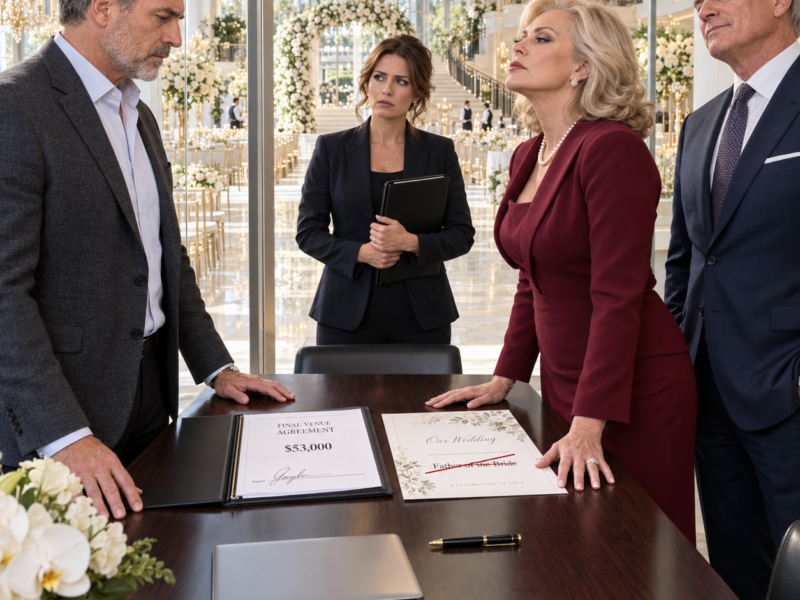
Three days before I was supposed to walk my only daughter down the aisle, the groom’s family told the wedding planner to erase my name from the guest list. No ceremony seat. No toast. No father-daughter dance. They even wanted me removed from the printed program. The strange part? They still expected the $53,000 I had already committed to stay exactly where it was. I didn’t argue. I asked the planner to pull up the final venue agreement and check one thing for me. She went silent. Then she said, “I don’t think they know.”
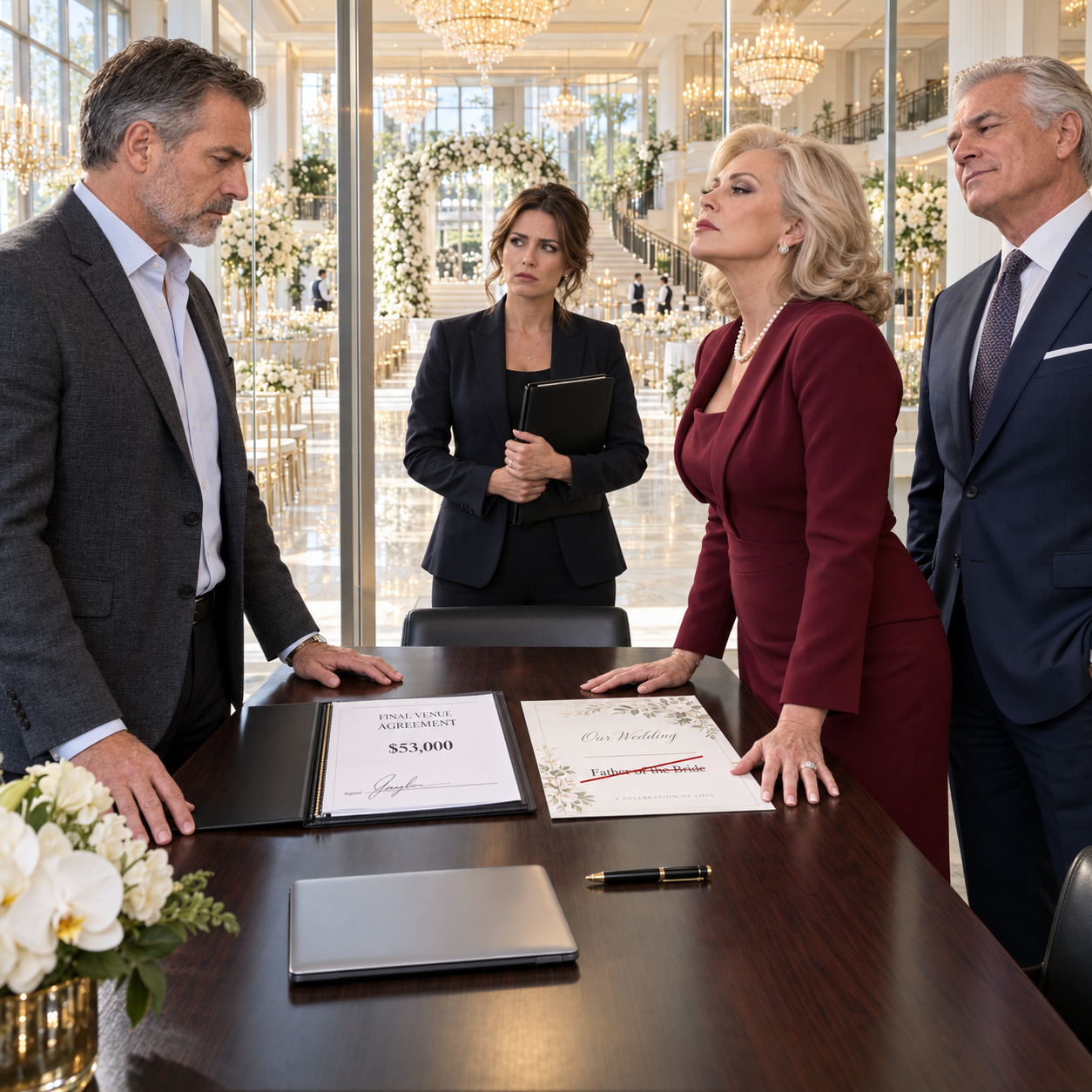
The wedding planner called me at 4:47 on a Tuesday afternoon and asked if I was sitting down.
I wasn’t.
I was standing in my kitchen with a coffee mug in one hand and the pot in the other, watching late-summer sun settle across the backyard I had rebuilt after my wife died.
“Clare?”
“Mr. Michael, I need to tell you something before somebody else does.”
Her voice was wrong.
For four months, Clare Donnelly had handled my daughter’s wedding with the calm of a woman who could tell a florist that two hundred blush peonies were arriving six hours late without changing her pulse. She had coordinated caterers, hotel rooms, rehearsals, seating charts, shuttle schedules, dietary restrictions, linen colors, band breaks, and one argument over whether the groom’s grandmother could bring her own priest to bless the champagne.
She never sounded nervous.
Now she sounded as though she had been handed a box marked fragile and told it contained a live grenade.
“What happened?”
She inhaled.
“I received a request from Daniel’s family.”
“Richard and Elaine?”
“Yes.”
“What kind of request?”
Another pause.
“They want you removed from the guest list.”
I set the coffee pot on the counter.
“Removed?”
“Entirely.”
I did not understand the word at first.
Not emotionally.
Administratively.
I thought perhaps she meant moved from one table to another. Maybe the Whitmores wanted some absurd rearrangement of the front row because Elaine had discovered a third cousin from Greenwich who outranked a widowed father in whatever social mathematics she used.
Clare continued before I could ask.
“They don’t want you in the ceremony seating.”
“Or at the reception.”
“They asked that your toast be removed from the program.”
“The father-daughter dance too.”
“And they want the printed materials revised so your name doesn’t appear as host.”
The refrigerator hummed.
Somewhere outside, a lawn mower started.
I looked at the coffee mug in my hand and realized I had been gripping it hard enough for the handle to press into my fingers.
“My daughter knows about this?”
Clare’s silence answered first.
“I don’t know.”
“That means no.”
“I don’t believe she made the request.”
“Did Daniel?”
“It came through his mother’s office.”
“Of course it did.”
Clare lowered her voice.
“I’m sorry.”
I looked out the window.
Three days.
My only daughter was supposed to be married Saturday.
Emily was twenty-six years old, but in that moment I saw her at eight in a yellow raincoat, running across our diner parking lot with both shoelaces untied. I saw her at eleven asleep in a hospital waiting room with her head on my thigh while her mother received another round of chemotherapy. I saw her at sixteen standing in our kitchen in a homecoming dress, crying because some boy had told her she was “too much,” and asking me whether there was something wrong with caring deeply about things.
There wasn’t.
There still isn’t.
I had spent eighteen years raising her after Rachel died.
I had signed $53,000 worth of deposits and vendor commitments for the wedding because Emily had dreamed about that day since she was a child cutting photographs from bridal magazines and taping them into a notebook she kept beneath her bed.
And now the family she was marrying into wanted me erased from it as if I had become an embarrassing line item.
I did not yell.
People sometimes assume anger is loud.
The most dangerous anger I have ever felt became extremely quiet.
“Clare.”
“Yes?”
“Who signed the master venue agreement?”
There was a pause.
“You did.”
“Who is the named financial guarantor?”
“You are.”
“Who holds the cancellation authority under the sponsor clause?”
Another pause.
“You do, subject to the contract terms.”
“Good.”
“Mr. Michael—”
“One more question.”
“Yes.”
“Did anybody from the Whitmore family request a contract amendment removing me as sponsor?”
“No.”
“So they want me financially responsible for the event while being prohibited from attending it.”
“That appears to be the position.”
I smiled.
Not because anything was funny.
Because facts were finally catching up to intuition.
“Put every requested change on hold.”
“I already did.”
“Good.”
“Do not cancel anything yet.”
Clare sounded surprised.
“I thought—”
“I know what you thought.”
I looked at the clock.
4:51.
“I need an hour.”
“Of course.”
“And Clare?”
“Yes?”
“Do not discuss my ownership structure with the Whitmores.”
Silence.
Then:
“Understood.”
She knew.
Not everything.
Enough.
I hung up.
For several minutes, I remained in the kitchen.
No dramatic phone call.
No fist through drywall.
No shattered mug.
I poured the coffee.
Sat at the table.
And let myself think.
The first uncomfortable truth was that the request did not surprise me as much as it should have.
I had been watching the Whitmores push me toward the edge of Emily’s life for months.
Never crudely.
That would have been easier.
People like Richard and Elaine Whitmore did not often insult directly when politeness could produce the same injury while protecting their image.
Richard ran Whitmore Capital Partners, a private investment firm with offices in Manhattan and Greenwich. The website used words like disciplined, generational, and strategic stewardship over photographs of glass conference rooms and men wearing navy suits.
Elaine served on hospital boards, museum committees, school foundations, and charitable councils with such consistency that I once wondered whether she actually had hobbies.
They lived in Westchester in a house large enough to have a library no one read in.
They knew the names of every important donor at every important gala.
They also knew precisely how long to look at a man’s shoes before asking what he did for a living.
The first time Elaine asked me, we were having dinner at a restaurant Daniel chose.
“What do you do, Michael?”
“I’m in hospitality.”
She waited.
As though more impressive words might arrive.
When they didn’t, she smiled.
“How lovely.”
Richard asked:
“Hotels?”
“Some.”
“Restaurants?”
“Those too.”
“Family business?”
“Started with one.”
He nodded in the way people nod when they believe they have completed a financial profile.
“Small businesses are admirable.”
I said:
“They can be.”
Then he spent ten minutes explaining his firm’s latest infrastructure deal.
I listened.
I liked understanding how people thought.
Especially when they assumed I had nothing useful to add.
My answer had been technically true.
I was in hospitality.
What I did not say was that the one roadside diner I began with twenty-seven years earlier had become twelve restaurants, two catering divisions, three event properties, a hotel-management company, and controlling interests in four boutique resort properties across New York and New England.
I did not say that the private wedding venue where their son planned to marry my daughter sat inside one of those holdings.
Or that the hotel wing where their relatives had booked seventy-three rooms was ours.
Or that the catering company they selected from a list of six “preferred independent vendors” was also mine, though operated separately for exactly the kind of practical reason that had nothing to do with secrecy and everything to do with controlling service quality.
None of it had been hidden.
Ownership records existed.
Corporate websites existed.
Annual state filings existed.
Emily knew I did well.
She had grown up around restaurants and hotel renovations.
She knew I had employees.
She knew there was a family office.
She knew I could afford her wedding without borrowing.
But I had deliberately kept the numbers out of our relationship.
I did not want my daughter growing up believing net worth was personality.
Rachel would have hated that.
My wife had been a public-school art teacher who once returned a diamond bracelet I bought her for our tenth anniversary because, as she put it:
“I teach eighth graders who think glue sticks are a luxury. Buy me earrings and take Emily somewhere.”
So I bought earrings.
We took Emily to Maine.
After Rachel died, money became even less interesting to me except as a form of security.
Hospital bills had taught me how quickly life can make numbers urgent.
I built.
Bought.
Reinvested.
But I kept driving pickup trucks until my operations director threatened to ban me from client meetings if I arrived in one with a cracked windshield.
People like Richard Whitmore interpreted quiet as limited.
Elaine interpreted modesty as social inferiority.
I let them.
That had seemed harmless.
Until they started treating Emily the same way.
The first shift came about six months before the wedding.
Emily began canceling Sunday dinner.
At first, normal.
Wedding planning.
Work.
Daniel’s schedule.
Then calls became shorter.
She would say:
“Everything’s good, Dad.”
Too quickly.
If I asked what she wanted for the rehearsal dinner, she said:
“Elaine’s handling it.”
If I asked whether she needed help with invitations:
“Daniel thinks we should keep things centralized.”
Centralized.
My daughter had never used that word about family.
Then came the dinner at the Whitmores’ house.
A Thursday in June.
Six weeks before the wedding.
Elaine had their chef serve halibut with something foamed on top that tasted like lemon-flavored air.
Halfway through dinner, she placed her fork down.
“After the wedding, we’d really like Emily to focus fully on the Whitmore family.”
Emily’s shoulders changed.
Tiny movement.
I noticed.
“What does that mean?”
I asked.
Elaine smiled.
“Exactly what it sounds like.”
“That depends on the listener.”
Richard chuckled.
“Michael.”
“Don’t interrogate her.”
“I’m not.”
I looked at Elaine.
“I’m asking.”
She dabbed her mouth.
“Marriage requires a shift in loyalty.”
Emily looked at Daniel.
He stared at his plate.
Elaine continued.
“Not abandonment.”
“Of course.”
“But adulthood.”
“She can’t continue running to her father every time something becomes uncomfortable.”
Emily whispered:
“I don’t run to Dad.”
Elaine turned toward her.
“Sweetheart, of course you do.”
The endearment sounded more cutting than criticism would have.
“You call him.”
“You ask his opinion.”
“You let him influence decisions that belong between you and Daniel.”
I felt something in me become alert.
Not angry yet.
Professional.
The same instinct I had when a vendor contract contained a clause that looked ordinary until you noticed how much control it shifted after default.
“What decisions?”
I asked.
Daniel answered this time.
“Nothing serious.”
“Then why are we discussing it?”
He smiled.
“Dad—”
He had started calling Richard Dad two months into the engagement.
Me, he still called Michael.
“Emily and I are establishing boundaries.”
I looked at my daughter.
“Is that what you call it?”
She looked embarrassed.
“I don’t know.”
Elaine leaned toward her.
“You see?”
“This is what I mean.”
“She looks to you before answering.”
I had not realized Emily was doing that until Elaine said it.
Then I saw it.
My daughter was watching me.
Not for permission.
For safety.
I leaned back.
“Emily can answer for herself.”
“Thank you.”
Elaine smiled.
“My point exactly.”
No one enjoyed dinner after that.
In the car home, Emily called me.
I answered through the truck speaker.
“I’m sorry.”
“For what?”
“Dinner.”
“You didn’t cook it.”
“Dad.”
“I know.”
She was quiet.
Then:
“Elaine thinks we’re too close.”
“What do you think?”
“I think she’s used to everybody doing things her way.”
“That is not an answer.”
“I know.”
I waited.
Rachel and I had made one rule when Emily was little.
Do not fill silence for her.
Children often say what they actually think if adults stop rescuing them from the pause.
Eventually:
“I think Daniel wants peace.”
“That sounds reasonable.”
“He thinks if I just let his mom have certain things, she’ll calm down after the wedding.”
“Do you believe that?”
Another pause.
“No.”
I gripped the steering wheel.
“Then pay attention to that.”
“I love him.”
“I know.”
“Do you like him?”
She laughed nervously.
“What?”
“I asked if you like him.”
“Yes.”
“Most of the time?”
“Yes.”
“Can you disagree with him without being punished?”
Silence.
I did not like that silence.
“Emily?”
“He doesn’t punish me.”
“Does he withdraw?”
“Sometimes.”
“Get cold?”
“He needs space.”
“Make you apologize for things you still believe?”
“Dad.”
“I’m not telling you what to do.”
“It sounds like you are.”
“Then I’ll stop.”
I meant it.
She was twenty-six.
Her life.
Her marriage.
My job was not to prevent every mistake.
But being a father does not end when your legal authority does.
You simply lose the right to substitute your judgment and keep the responsibility to tell the truth when asked.
A week later, Emily came to my office.
Not the corporate office.
The little second-floor office above the first diner I still owned even though it made no financial sense anymore.
She brought a folder.
“Can you look at something?”
I closed the laptop.
“What?”
“Daniel’s family has a holding company.”
“Most families with enough assets do.”
“They want me to sign these before the wedding.”
I did not touch them immediately.
“Did you read them?”
“Some.”
“Do you understand them?”
“Not really.”
“Then you don’t sign.”
She gave me the look she had used since middle school when she thought I was being annoyingly obvious.
“I know.”
“Good.”
“Can you look?”
“Yes.”
I read.
Not as a lawyer.
I am not one.
But after three decades of acquisitions and lender agreements, I knew enough to recognize documents designed to require professional review.
One was an acknowledgment related to a family investment partnership.
One dealt with confidentiality.
Another referenced future beneficial interests.
The wording was dense.
Not necessarily sinister.
Dense.
I closed the folder.
“Who drafted these?”
“Whitmore counsel.”
“Do you have your own lawyer?”
“No.”
“You will.”
“Dad.”
“Not mine.”
“Yours.”
“Independent.”
“Send these to someone who represents only you.”
She sighed.
“Elaine says everybody signs them.”
“That is not legal advice.”
“She says I’m joining the family.”
“That is also not legal advice.”
Emily smiled despite herself.
Then looked worried.
“Daniel thinks bringing in another lawyer makes it adversarial.”
I stared.
“Documents written by his family’s lawyer are already legal.”
“That horse left the barn.”
She nodded.
I referred her to Angela Ruiz, an attorney I knew socially but had never used professionally.
Emily hired her independently.
I stepped away.
That was the moment, I later learned, when Elaine’s opinion of me shifted from unsophisticated father to obstacle.
Nothing dramatic happened immediately.
But my name began disappearing from things.
The invitation draft originally said:
Together with their families, Emily Rachel Michael and Daniel Edward Whitmore invite you…
The final printed version simply listed the couple.
Fine.
Modern.
The rehearsal dinner moved from a restaurant I suggested to the Whitmores’ club.
Fine.
Their event.
Then I was told the father-daughter dance should be “shorter” because the band schedule was tight.
My toast moved from before dinner to after dessert.
Then maybe during rehearsal.
Then perhaps private.
I noticed.
I did not fight.
Why?
Because Emily looked tired every time family logistics came up.
I did not want to become another person pulling on her.
So I said:
“Whatever you want.”
That sentence can be loving.
It can also make room for people who know exactly what they want.
Now, at 4:47 Tuesday afternoon, I finally understood the endpoint.
Not shorter dance.
No dance.
Not later toast.
No toast.
Not less prominent father.
No father.
Erase the alternative source of loyalty.
Keep the money.
Three days before the wedding.
I called Walter Klein.
Walter had been my attorney for fifteen years.
Corporate.
Real estate.
Contracts.
He was sixty-two, wore the same brand of blue oxford shirt every day, and had never once made a problem sound larger to justify his fee.
He answered:
“Michael.”
“I need you at my house.”
“Emergency?”
“I don’t know yet.”
He arrived forty-five minutes later carrying a leather portfolio and no curiosity in his face.
Good lawyers know curiosity comes after documents.
I showed him Clare’s written summary of the request.
Then the venue agreement.
Then the sponsor clause.
Walter read slowly.
“Did Emily authorize this?”
“Not that I know.”
“Daniel?”
“Request came from Elaine’s office.”
“Who are the contracting parties?”
He checked.
The venue entity.
Emily and Daniel as event principals.
Me as sponsoring guarantor.
The wedding planner as authorized coordinator.
Whitmore family representative for guest logistics only.
Walter looked up.
“Elaine does not have unilateral authority to remove you from the event.”
“I know.”
“More importantly, nobody can remove a guarantor from obligations while pretending the underlying agreement stays untouched unless the contract allows it.”
“Exactly.”
“What do you want?”
I looked at the backyard.
“I don’t know.”
He waited.
Then I said:
“I want to know whether this is only about the wedding.”
Walter looked at me.
“What makes you think it isn’t?”
I told him about the documents Emily brought.
Elaine’s comments.
The way Emily had changed.
He asked:
“Did Angela review the papers?”
“Yes.”
“Result?”
“I stayed out.”
“Good.”
He made a note.
“Call her only through Emily’s permission.”
“I know.”
“Any other concern?”
“Richard’s company.”
“What about it?”
“I don’t like the way he talks about liquidity.”
Walter’s eyebrow lifted.
That was not evidence.
I knew.
“I’m not asking you to investigate him privately.”
“Good.”
“I want our own contracts reviewed.”
“Wedding vendors?”
“Yes.”
“Every related agreement touching one of our companies.”
“That’s reasonable.”
“Why?”
“Because if they’ve been asking my daughter to sign something, I want to make sure no wedding contract has been used to attach her to anything else.”
Walter nodded.
“Now we have a legitimate scope.”
That was why I called him.
He separated fear from action.
We spent two hours reviewing.
The situation was less magical than people later imagined.
I did not own every florist, photographer, and bus company in Westchester.
That would have been ridiculous.
But our hospitality group had preferred-vendor agreements, logistics partnerships, and operating relationships with many services tied to the resort.
The catering company was a wholly owned subsidiary.
The hotel was ours.
The venue was ours.
The transportation service was a joint venture in which we had a controlling interest.
The florist was independent.
The band independent.
The photographer independent.
The cake baker independent.
Good.
Real businesses.
Real contracts.
Not an empire designed around revenge.
One thing did bother Walter.
A supplemental transportation agreement had been amended three weeks earlier.
The revised client contact included Whitmore Meridian LLC.
“Who is this?”
I asked.
Walter searched public corporate records.
“Affiliate of Richard’s group.”
“Why is it on wedding transportation?”
“Could be billing convenience.”
“Could be.”
Then he found an acknowledgment signed electronically by Emily.
Not a guarantee.
Not transfer of money.
A consent allowing certain wedding-related charges to be credited against an account described only by number.
Walter frowned.
“I want Angela to see this.”
I called Emily.
“Are you alone?”
“Yes.”
“Can Walter send Angela one document?”
“What document?”
“Something you signed in the wedding logistics file.”
She went quiet.
“Which?”
“I’ll send you first.”
I did.
Five minutes later, Emily called back.
“I don’t remember that page.”
“Your electronic signature is on it.”
“I signed a transportation packet.”
“Then maybe it was included.”
“Dad.”
“I’m not accusing anyone.”
“I need you to ask Angela.”
“Okay.”
“Are you safe?”
She sounded irritated.
“Yes.”
“Good.”
Then:
“Did you ask to remove me from the wedding?”
Silence.
My chest tightened.
“No.”
“Did Daniel?”
“I don’t know.”
“Did Elaine tell you she was doing it?”
“No.”
“Where are you?”
“At Daniel’s.”
“Do you want me to come?”
“No.”
“Do you want to come here?”
Another pause.
“Maybe later.”
“Door’s open.”
I hung up.
Walter looked at me.
“That’s the issue.”
“Yes.”
Not the venue.
Emily.
I called Clare back at 6:18.
“Do not cancel the event.”
She sounded surprised.
“Okay.”
“Freeze all discretionary changes.”
“No reprinting.”
“No seating alteration.”
“No program revision.”
“Nothing without written confirmation from Emily and Daniel.”
“What about Mrs. Whitmore’s request?”
“She has no authority to modify sponsor terms.”
“Understood.”
“Also, no one mentions my ownership.”
“Yes.”
Then I called James, our catering president.
“Wedding Saturday.”
“I know.”
“Any unusual amendments?”
“Define unusual.”
“Whitmore affiliate involved in payment.”
He was quiet.
“I’ll review.”
“Do not change service.”
“Do not threaten cancellation.”
“Just review.”
“Got it.”
Karen at the hotel received the same instruction.
Review.
Do not act beyond contract.
No retaliation.
Walter looked at me after the last call.
“You’re calmer than I would be.”
“No.”
“I’m older than my anger.”
He almost smiled.
At 7:06, Richard Whitmore called.
His usual voice was smooth enough for investor presentations.
That night:
“What the hell are you doing?”
I sat at my kitchen table.
“Good evening, Richard.”
“Don’t patronize me.”
“I’m not.”
“The venue has frozen our change requests.”
“Yes.”
“The hotel says Elaine no longer has modification authority on the room block.”
“She never had unilateral authority.”
“You are interfering with my son’s wedding.”
“No.”
“I’m making sure the contracts are followed.”
“This is because we asked you not to attend.”
“We?”
A pause.
“Elaine and I.”
“Did Daniel ask?”
“That isn’t relevant.”
“Did Emily?”
Another pause.
“Emily is emotional.”
I closed my eyes.
“My daughter’s answer is very relevant to her wedding.”
Richard laughed sharply.
“You’re making this about control.”
“That’s interesting.”
“What is?”
“The family removing the bride’s father without asking the bride is accusing someone else of control.”
“We were trying to avoid disruption.”
“What disruption?”
“You.”
I smiled.
“Specific.”
“You question everything.”
“Sometimes.”
“You make Emily second-guess Daniel.”
“I told her to have her own attorney review documents.”
“Exactly.”
“That is normal advice.”
“Not in a family.”
“Especially in a family.”
His voice hardened.
“You don’t understand how these structures work.”
“I understand enough to know nobody should sign documents they do not understand.”
“That wasn’t your decision.”
“No.”
“It was Emily’s.”
Silence.
Then:
“We don’t want you at the ceremony.”
There.
Direct.
“Why?”
“This marriage needs a clean start.”
“From her father?”
“From your influence.”
I looked at Rachel’s photograph on the bookshelf.
She would have hated this man.
Not loudly.
Rachel rarely hated loudly.
She would have smiled at him until he heard himself.
I said:
“Richard, you are welcome to dislike me.”
“You are not welcome to financially bind me to a celebration where I am prohibited from appearing.”
“We never asked you to pay.”
I almost laughed.
“I’ve already paid fifty-three thousand dollars.”
“That was your choice.”
“Yes.”
“Which is why my contractual rights remain relevant.”
He threatened litigation.
Not unusually.
People say lawsuit when they mean:
I do not like the available choices.
I said:
“Have your counsel call Walter.”
Then hung up.
At 8:30, Emily arrived.
No Daniel.
She stood on my porch in leggings and an oversized college sweatshirt, hair pulled into a knot.
For one second she looked nineteen again.
I opened the door.
She walked inside.
I did not hug her immediately.
Choice.
She hugged me.
Hard.
Then cried.
We sat at the kitchen table.
The coffee from 4:47 still sat untouched near the machine.
I made tea instead.
Emily wrapped both hands around the mug.
“Daniel says you’re trying to destroy the wedding.”
“What do you think?”
“I don’t know.”
“That’s okay.”
“He says the venue is threatening to cancel.”
“It isn’t.”
She looked up.
“What?”
“I told them not to cancel.”
“Then what’s happening?”
“Your future mother-in-law requested contract changes she did not have authority to make.”
“The venue froze those changes.”
“That’s all.”
Emily frowned.
“Richard said the hotel rooms were canceled.”
“They aren’t.”
“Catering?”
“Still active.”
“Transportation?”
“Under review because of a supplemental document carrying your signature.”
She looked away.
“The one you sent.”
“Yes.”
“I talked to Angela.”
“And?”
“She wants me to come in tomorrow.”
“Good.”
Emily started crying again.
I waited.
Finally:
“Dad, I think they wanted me to sign more than I understood.”
My chest tightened.
“Tell me.”
She opened her phone.
Emails.
PDFs.
Messages.
Daniel saying:
Mom says this is routine.
Dad needs signatures before the wedding.
It’s just estate planning.
Don’t make this bigger.
One email came from Elaine.
Sweetheart, once you and Daniel are married, we want to simplify the family structure so nobody has to worry about competing loyalties or outside interference.
Outside interference.
Me.
Another email referenced future capitalization of a Whitmore investment vehicle and expected “family liquidity events.”
Nothing illegal on its face.
But the language was not marriage language.
It was capital language.
Then Emily showed me something worse.
A forwarded message Daniel had accidentally left visible months earlier when they shared a tablet on a trip.
From Daniel to Elaine.
Once the wedding is done, Michael will eventually give her access to everything. He has no other children. We just need to be patient.
I read it.
Once.
Twice.
A third time.
The kitchen changed around me.
Not because the sentence revealed a crime.
It did not.
People speculate about inheritance every day.
Families talk about money.
But my daughter had been turned into a bridge.
Michael will eventually give her access.
We just need to be patient.
Not:
Emily and I are building something.
Not:
I love her.
Not even:
She’ll inherit.
We.
The Whitmores.
Access.
I placed the phone down carefully.
Emily whispered:
“Say something.”
I looked at her.
“What do you want me to say?”
“That I’m stupid?”
“No.”
“Then what?”
“You’re not stupid.”
Tears slipped down her face.
“I saw signs.”
“Yes.”
“I ignored them.”
“Yes.”
“Why aren’t you mad?”
“I am.”
“At me?”
“No.”
“You should be.”
I reached across the table.
“Emily.”
She looked up.
“You are allowed to be wrong about a person without becoming stupid.”
Her face crumpled.
I moved around the table and held her.
She cried against my chest the way she had after Rachel’s funeral.
Then pulled away.
“I love him.”
“I know.”
“That’s the worst part.”
“I know.”
“What do I do?”
There it was.
The question I had feared.
Because fathers want to answer.
Leave.
Run.
Do not marry him.
But the moment I answered for her, I risked becoming exactly what the Whitmores accused me of being.
So I said:
“Do you want to marry him Saturday?”
She stared.
“No.”
The word was almost inaudible.
I waited.
Then:
“No.”
she said again.
Stronger.
“I don’t.”
“Okay.”
“Is that all you’re going to say?”
“No.”
I smiled sadly.
“I’m also going to say I’m sorry.”
“For what?”
“I knew something felt wrong.”
“I kept trying not to influence you.”
She shook her head.
“You did influence me.”
“Maybe.”
“You told me to get a lawyer.”
“That helped.”
“Good.”
She wiped her face.
“What happens to the wedding?”
“You decide.”
“I don’t want it.”
“Then tomorrow we cancel it.”
“Can we?”
“Yes.”
“What about all the money?”
I almost laughed.
That was my daughter.
Heart breaking.
Still worried about deposits.
“Some comes back.”
“Some doesn’t.”
“That is what contracts are for.”
“Dad, fifty-three thousand—”
“I have survived more expensive lessons.”
She looked guilty.
“Don’t.”
I said.
“What?”
“Turn my money into another reason to marry someone you do not trust.”
That silenced her.
Then she whispered:
“Okay.”
I slept maybe three hours.
At seven Wednesday morning, Emily met Angela Ruiz.
At eight-thirty, Angela called Walter with Emily’s written permission.
The situation became clearer.
Not more criminal.
More manipulative.
The Whitmore family had proposed that after marriage, Emily contribute certain future inherited or gifted interests into a family investment partnership.
Again, not inherently improper.
Plenty of wealthy families use trusts and partnerships.
The problem was presentation.
Daniel had described documents as wedding formalities.
Elaine had discouraged independent advice.
Some provisions created broad rights of first refusal, voting proxies, and restrictions that could have limited Emily’s control over assets she might later place into the structure.
Angela’s advice was simple.
Do not sign.
Emily agreed.
Then she instructed Clare in writing to cancel the wedding.
That mattered.
My companies did not cancel because I was angry.
The bride canceled because she did not want to proceed.
Once that happened, every vendor followed the ordinary cancellation provisions.
The venue retained only the contracted nonrefundable portion associated with actual preparation and third-party commitments.
Catering calculated recoverable food and labor costs.
The hotel released most rooms without penalty because we had enough lead time to resell many of them.
Transportation canceled under its schedule.
Independent vendors handled their own contracts.
No punishment.
No secret surcharge.
No spite.
That was important to me.
Richard still called it revenge.
At 10:14 Wednesday morning, he arrived at my office without an appointment.
Walter happened to be there.
Good timing.
Richard walked into the diner upstairs wearing a suit that probably cost more than the register downstairs made before lunch.
He did not sit.
“You poisoned her.”
I looked at him.
“Good morning.”
“Emily canceled.”
“Yes.”
“Because of you.”
“She spent two hours with her own lawyer.”
Richard laughed.
“Your lawyer.”
“Not mine.”
“She works in your network.”
“Everyone works in someone’s network.”
“Emily hired her independently.”
“You turned my son into some kind of predator.”
“I have not described Daniel to anyone.”
“You showed her private emails.”
“She showed me.”
His face changed.
Good.
He had not known.
“What emails?”
I said nothing.
Walter did.
“Richard.”
He stepped forward.
“You should speak with your own counsel.”
Richard ignored him.
“This can still be fixed.”
I looked at him.
“What can?”
“The wedding.”
“Your son’s relationship with Emily is their business.”
“You’re her father.”
“Yes.”
“Then act like it.”
“I am.”
“Tell her she’s making a mistake.”
“I won’t.”
Richard stared at me as though I had failed some obvious test.
“You would throw away two families over paperwork?”
“No.”
“Paperwork revealed a question.”
“What question?”
“Why your family was discussing my daughter’s future inheritance before the marriage happened.”
His jaw tightened.
“Every serious family discusses wealth.”
“Yes.”
“Usually with the person whose wealth it may become.”
He started pacing.
“Emily is marrying into responsibilities.”
“She was.”
“Daniel has responsibilities too.”
“I’m sure.”
“You have no idea what pressures he carries.”
“That may be true.”
“Then stop judging.”
“I’m not.”
“What are you doing?”
“Refusing to pretend I didn’t read what I read.”
Richard’s face flushed.
Then he said:
“You don’t understand how much money is at stake.”
Silence.
Walter looked at me.
I looked at Richard.
The sentence seemed to arrive in his own ears a second later.
His expression changed.
“What money?”
I asked.
He recovered.
“Families.”
“Assets.”
“Estate planning.”
“Business structures.”
“No.”
“You said how much money is at stake.”
“For whom?”
Richard closed his mouth.
I felt no triumph.
Only confirmation.
“I think you should leave.”
He stared.
“You think because you own a few hotels you can humiliate us?”
There it was.
“A few.”
I almost smiled.
“No.”
“I think because my daughter does not want to marry your son, the wedding is canceled.”
“That is the beginning and end.”
“The contracts will be handled fairly.”
“You are welcome to have your attorneys review every invoice.”
“And if Daniel wants to speak to Emily, he can ask her.”
“Not me.”
Richard stood there for several seconds.
Then:
“You ruined his future.”
I shook my head.
“No.”
“I stopped financing a wedding Emily no longer wanted.”
He left.
Walter waited until the door closed.
Then:
“That could have gone worse.”
“It may.”
“It probably will.”
He was right.
Elaine called Emily.
Three times.
The fourth time, Emily answered with Angela present.
Elaine did what people often do when they sense emotional control slipping.
She reframed the story around sacrifice.
Do you understand how embarrassed we are?
Guests are traveling.
Daniel loves you.
Your father is controlling you.
This is what he wanted.
You are humiliating our family.
Emily listened.
Then said something she later repeated to me.
“My father did not ask me to cancel the wedding.”
“You did.”
Elaine apparently went quiet.
“You asked to erase him.”
“You asked me to sign documents without my own lawyer.”
“You and Richard were talking about money I don’t even have yet.”
“I am not marrying into a family that treats my questions like betrayal.”
Then she hung up.
When Emily called me afterward, her voice sounded different.
Not happy.
Larger.
“I told her no.”
“Good.”
“That’s all?”
“What do you want?”
“A parade?”
She laughed through tears.
“Maybe.”
“I can arrange one.”
“No.”
“I own a shuttle company.”
“Dad.”
That was the first real laugh she had given me in weeks.
Daniel came the next afternoon.
My house.
Not office.
He stood on the porch wearing khakis, a blue shirt, no tie.
He looked young.
That complicated my anger.
Daniel was twenty-nine.
Old enough to know better.
Young enough that I could still see the son somebody else had shaped.
“I love Emily.”
he said before I invited him inside.
“I believe you.”
That surprised him.
“Then help me.”
“With what?”
“Get her to talk.”
“She decides.”
“She won’t answer.”
“Then give her time.”
“You’re enjoying this.”
“No.”
He laughed bitterly.
“You hated me.”
“I didn’t.”
“You never thought I was good enough.”
“I thought you were polished.”
He stared.
“That isn’t a compliment.”
“It isn’t an insult.”
“You never trusted my family.”
“No.”
“Why?”
“Because they kept telling my daughter independence was disloyalty.”
Daniel looked away.
“My mother can be difficult.”
“That is a very small sentence.”
He almost smiled.
Then:
“The paperwork was Dad’s idea.”
“Did you agree with it?”
“At first.”
“Why?”
“It is what our family does.”
“Did you understand all of it?”
He hesitated.
That caught me.
“No.”
“Then why ask Emily to sign?”
“Because Dad said it was standard.”
I looked at him.
Something in his face was real.
Fear, maybe.
Loyalty.
The same pressure Emily had been under, from another direction.
“Daniel.”
He looked up.
“When you told your mother Michael will eventually give her access to everything, what did you mean?”
His face emptied.
He knew.
So Elaine had told him about the email.
Or he remembered.
“I was talking about Emily.”
“You said we.”
He closed his eyes.
“I was talking loosely.”
“Then explain tightly.”
He rubbed his jaw.
“My father’s firm is under pressure.”
There.
Not confession of a crime.
Truth.
“What kind?”
“Some investments haven’t performed.”
“Liquidity?”
He stared.
“How do you know?”
“I know what financial stress sounds like at dinner.”
He sat on the porch step.
I remained standing for a second.
Then sat one step above him.
Daniel looked toward the road.
“My parents have spent years telling me everything is fine.”
“Maybe it is.”
“It isn’t.”
“How bad?”
“I don’t know.”
That answer sounded honest.
“Dad said after Emily and I married, our families could create opportunities together.”
“And you assumed her inheritance would eventually be part of that.”
“Yes.”
He looked ashamed.
“Not immediately.”
“No one said give us money.”
“That’s how I justified it.”
“Did Emily know?”
“No.”
“Then it was wrong.”
“Yes.”
He whispered.
“I know.”
The anger inside me changed shape.
Not disappeared.
Daniel was not some mastermind seducing my daughter for an inheritance.
That would have been easier.
He was a son inside a family system built on status, secrecy, and financial pressure.
He loved Emily.
He also allowed his parents’ needs to infect the marriage before it began.
Both things could be true.
“If your parents had no financial problem, would you still marry Emily?”
“Yes.”
Immediate.
“If she inherited nothing?”
“Yes.”
“If I left everything to charity?”
He looked at me.
“Yes.”
I believed him.
“Then why didn’t you protect her from your family’s plan?”
Silence.
Finally:
“Because I thought marriage meant she would become part of my family.”
“What about you becoming part of hers?”
Daniel looked down.
There.
The imbalance.
He had never asked.
I continued.
“Emily lost her mother at eleven.”
“I know.”
“I raised her.”
“I know.”
“You were asking her to prove love by loosening the one remaining family bond that made your mother uncomfortable.”
Daniel’s eyes filled.
“I didn’t see it like that.”
“I know.”
“That is the problem.”
He sat there for a long time.
Then asked:
“Can I fix it?”
I looked at him.
“Maybe yourself.”
His face tightened.
“Not the wedding?”
“No.”
“That belongs to Emily.”
He nodded.
I stood.
Before he left, he asked:
“Do you really own the resort?”
I almost laughed.
“Yes.”
“The hotel?”
“Yes.”
“Catering?”
“Yes.”
He rubbed his face.
“Oh my God.”
“Not relevant.”
“It feels relevant.”
“That’s another problem.”
He smiled despite himself.
Then left.
The day the wedding was supposed to happen arrived sunny.
Of course.
Weather has no respect for emotional timing.
The garden pavilion had been decorated because flowers arrived before the cancellation was finalized and some could not be redirected.
Clare asked what to do.
We donated most arrangements to two assisted-living facilities and a hospital foundation gala happening that weekend.
The cake baker repurposed components for another event.
Food products the catering company could safely redirect went to scheduled functions or staff meals.
Some costs were lost.
Business.
At eleven Saturday morning, I drove to the resort.
Not for a confrontation.
Work.
Canceled events create operational messes.
Guests had still arrived because travel plans are difficult to reverse.
The hotel honored room rates.
We set up concierge staff to help people find restaurants, hiking trails, winery tours, and alternate weekend plans.
No one needed to be punished because two people did not get married.
Richard found me near the reception building.
His face looked as though he had not slept.
“You could have moved the wedding somewhere else.”
I stared.
“What?”
“Emily could have married Daniel today.”
“Not according to Emily.”
“You had to bring lawyers into it.”
“Your family brought documents.”
He looked away.
Guests moved in the distance.
Men in jackets.
Women in dresses.
Some still hoping for clarity.
Richard lowered his voice.
“Do you understand what this does to us socially?”
That sentence told me more about Richard than any financial statement.
“My daughter is not a social asset.”
“I didn’t say she was.”
“You keep explaining her decisions in terms of what they cost your family.”
His jaw tightened.
Then Walter arrived.
We used a private meeting room because the last thing I wanted was a lobby scene.
Emily came.
So did Daniel.
Angela represented Emily.
Daniel’s attorney attended by phone.
Richard and Elaine had counsel.
No shouting.
No dramatic trial.
Just people trying to disentangle contracts and relationships.
Walter summarized the wedding cancellations.
Refunds.
Nonrefundable costs.
Independent vendor balances.
Nothing punitive.
Then Angela addressed the documents Emily had been asked to sign.
She was careful.
No accusations of fraud.
No claims unsupported by evidence.
She simply stated that Emily would not enter the proposed Whitmore family partnership, would not grant proxies or future rights over assets, and would withdraw any wedding-related consent that had been bundled with unrelated financial acknowledgments.
Elaine called it a misunderstanding.
Richard called the paperwork standard.
Daniel said very little.
Emily listened.
Then she turned to him.
“Did you ask me to marry you because you loved me?”
“Yes.”
He answered immediately.
“Did you also think marrying me would help your family financially?”
Daniel closed his eyes.
No one moved.
Emily waited.
“Yes.”
He said.
The word barely carried.
Elaine snapped:
“Daniel.”
He looked at her.
“No.”
Something in him changed.
“I’m answering.”
Then back to Emily.
“I loved you.”
“I still love you.”
“But yes.”
“I let Dad convince me that our marriage could solve things.”
Emily’s eyes filled.
“Why didn’t you tell me?”
“Because then you might say no.”
Silence.
That was the marriage ending.
Not the guest list.
Not my ownership.
Not the emails.
That sentence.
Because then you might say no.
Emily removed her engagement ring.
Slowly.
Set it on the table.
No throwing.
No speech.
“I need a life where no one has to hide information to keep me saying yes.”
Daniel cried.
So did Emily.
I looked away.
There are moments a father wants desperately to intervene and should not.
That was theirs.
Richard stood.
“You ruined my son’s future.”
I looked at him.
“No.”
He was shaking.
“Your family could have helped.”
“There it is.”
“What?”
“You keep calling access to someone else’s money a future.”
His face hardened.
I continued.
“Daniel has a future.”
“Emily has a future.”
“You have a business problem.”
“Those are three separate things.”
Richard stared.
Then:
“You think you’re better than us.”
“No.”
“I think my daughter is not collateral.”
That was all.
The wedding was formally terminated that afternoon.
No celebration.
No victory champagne.
I walked through the empty pavilion after everyone left.
White chairs.
Flowers.
An aisle ending beneath an arbor.
Three days earlier, I had imagined walking Emily down that aisle.
Rachel should have been there.
That was the grief beneath everything else.
Every milestone after your spouse dies contains two events.
The one happening.
And the one you once expected to share.
I sat in the last row.
For the first time that week, I cried.
Not about money.
Not Richard.
Not being removed.
I cried because Emily had been hurt.
Because Rachel was gone.
Because I had spent twenty-seven years building the kind of security I thought could protect my daughter and discovered money cannot protect someone from believing the wrong person.
It can buy lawyers.
Time.
Options.
A safe place to come home.
Important things.
Not wisdom in advance.
Clare found me.
She sat two chairs away.
“Are you okay?”
“No.”
She nodded.
“Me neither.”
I laughed softly.
“You lost a commission.”
“I lose weddings.”
She looked toward the arbor.
“Usually not like this.”
Then:
“I’m sorry I made that call.”
“Why?”
“It hurt you.”
“You told the truth.”
“That is rarely the thing to apologize for.”
We sat quietly.
The next weeks were ugly in boring ways.
Emily returned gifts.
Wrote notes.
Closed the registry.
Canceled her honeymoon.
Deleted wedding reminders from her phone.
There were boxes everywhere.
One afternoon, I found twenty-three personalized cocktail napkins on my kitchen counter.
M + D.
She stared at them.
“What do I do with these?”
“Bonfire?”
“Dad.”
“Recycling?”
“They have foil.”
“Trash.”
She put them in a drawer.
They stayed there for eight months.
Grief is strange.
People can throw away a dress faster than a napkin.
Emily moved into my house temporarily.
Her old room had become a guest room, but she still knew which floorboard squeaked.
For the first week, she slept late.
Then cried because she had slept late.
I told her:
“You canceled a wedding.”
“You are allowed to be inefficient.”
She laughed.
Then cried more.
I never said:
I told you so.
Not once.
Not because I am unusually disciplined.
Because nothing could have been crueler.
She knew.
She replayed every dinner.
Every comment.
Every time Daniel told her she was overreacting.
Every time Elaine called me interfering.
Self-reproach is efficient.
It does not need help.
Daniel wrote twice.
Emily read the letters.
Did not answer for months.
The first letter apologized.
The second tried to explain.
His father’s financial pressure.
His mother’s control.
The expectations of being the only son.
The fear of disappointing everyone.
Some of it moved her.
None of it restored trust.
Good.
Compassion does not require reunion.
Richard’s firm did not collapse.
That was another important truth.
The family had financial strain.
Not ruin.
Walter’s review, based only on public records and legitimate contract information, suggested leverage and underperforming investments.
Nothing illegal we could prove.
No dramatic indictment.
No federal agents.
No castle falling into the sea.
Whitmore Capital restructured some obligations over the next year.
Sold a property.
Exited two investments.
Richard remained rich by any ordinary standard.
The problem was not poverty.
It was the terror of losing rank.
People can behave desperately long before they are actually destitute.
Elaine disappeared from our lives.
Fine.
Daniel did not.
Not entirely.
Three months after the canceled wedding, he called me.
“Can I see you?”
“Why?”
“I owe you an apology.”
“You owe Emily one.”
“I gave her one.”
“Then why me?”
“Because I treated you like you were beneath us.”
That was unusually direct.
I agreed.
We met at my original diner.
Daniel arrived first.
He ordered coffee.
When I sat, he looked around.
“This is where it started?”
“Yes.”
“Your company?”
“Yes.”
“Wow.”
He stared at the counter.
Chrome stools.
Pie case.
Regulars.
A waitress named Patty who had worked with me twenty-one years and considered everyone’s personal business part of her retirement package.
Daniel said:
“I thought you just owned restaurants.”
“I do.”
“You know what I mean.”
“Yes.”
He looked embarrassed.
“Dad said hospitality margins are terrible.”
“They can be.”
“I repeated that.”
“I remember.”
“He said you were probably comfortable but not liquid.”
I smiled.
“That sounds like Richard.”
Daniel stared into his coffee.
“I asked questions about your money.”
“How much.”
“What Emily would inherit.”
“How the trust worked.”
My chest tightened.
“Did you ask Emily?”
“No.”
“Why not?”
“Because that would look bad.”
“So you knew.”
“Yes.”
He swallowed.
“I told myself I was only trying to plan.”
“I wanted to know what kind of life we could build.”
“Then Dad started talking about co-investments.”
“It became normal.”
I listened.
He looked at me.
“I really did love her.”
“I know.”
“Do you think she’ll ever forgive me?”
“Probably.”
Hope flashed.
I raised one hand.
“Forgiveness does not mean marriage.”
He nodded.
“I know.”
Good.
Then he said:
“I’m moving out of my parents’ house.”
He had not literally lived there full time, but he meant financially.
Richard’s firm had employed him.
He was leaving.
“Where?”
“Boston.”
“A private-credit firm.”
“Smaller.”
“Good.”
“My mother thinks I’m throwing away my future.”
I smiled faintly.
“What do you think?”
“I think I need a future that isn’t the same thing as my father’s.”
That was a good sentence.
I hoped he meant it.
He paid the check.
Patty brought it to him deliberately.
I saw her.
When he left, she walked over.
“That him?”
“Yes.”
“The almost son-in-law?”
“Yes.”
She watched through the window.
“Cute.”
“Patty.”
“What?”
“I’m married forty years.”
“I can still identify faces.”
Then:
“He looks sad.”
“He is.”
“Good.”
“Patty.”
“What?”
“He hurt Emily.”
“Doesn’t mean I want him dead.”
I laughed.
That was the right scale.
Emily began therapy.
Then, after four months, she grew restless.
She had worked in nonprofit communications before the engagement.
Good job.
Not a calling.
One morning she sat at my kitchen table with spreadsheets open.
“What are you doing?”
“Nothing.”
“That looks expensive.”
She smiled.
“I have an idea.”
“For what?”
“Events.”
I waited.
“I spent a year planning a wedding.”
“Then watched Clare handle a disaster better than anybody.”
“I think I’m good at logistics.”
“You are.”
“I like people.”
“Sometimes.”
She rolled her eyes.
“I want to build a small event-planning company.”
My first instinct:
How much?
My second:
I can fund it.
Both wrong.
So I asked:
“What do you need from me?”
She stared.
“Money?”
“Is that what you need?”
She hesitated.
“Maybe.”
“How much?”
“I don’t know.”
“Then you do not need money yet.”
She frowned.
“You’re annoying.”
“I have experience.”
We spent three weeks building a business plan.
Market.
Pricing.
Insurance.
Contracts.
Software.
Vendor relationships.
Customer acquisition.
Cash reserve.
No fancy office.
No new car.
No unnecessary branding package from an agency charging $20,000 to choose beige fonts.
She named it Northlight Events.
Rachel had loved north-facing windows.
I did not point out the reference.
Emily knew.
When she had numbers, she came back.
“I need forty-eight thousand dollars.”
“For what?”
She explained.
I listened.
Then:
“I’ll invest twenty-four.”
Her face fell.
“I’ll lend twelve under formal terms.”
“And you need to save or earn the other twelve.”
“Dad.”
“You said you wanted it to be yours.”
“It will be.”
“Then own the difficulty too.”
She stared.
“I hate when you use my words.”
“I raised you.”
She saved.
Freelanced.
Sold things from the canceled wedding that still had value.
She did not sell the dress.
That stayed boxed.
Not my business.
Northlight launched seven months after the wedding that never happened.
Her first client was a pediatric charity dinner.
Eighty people.
Not glamorous.
The florist delivered the wrong centerpieces.
One donor demanded a gluten-free dessert after eating two bread rolls.
The microphone failed.
Emily came home exhilarated.
“It was a disaster.”
“You’re smiling.”
“I fixed everything.”
“Then it wasn’t.”
That was how I knew she had found something.
A year after the canceled wedding, she coordinated a wedding at my resort.
Not as favor.
Northlight bid.
Clare reviewed.
Emily won a small contract for day-of coordination.
She wore black pants, comfortable shoes, and a headset.
No bridal silk.
No flowers in her hair.
At four that afternoon, I stood near the garden watching her direct a shuttle driver away from the ceremony path.
Clare came beside me.
“Proud?”
“Annoyingly.”
“She’s good.”
“I know.”
Then Clare smiled.
“Remember the fifty-three-thousand-dollar wedding?”
“Which one?”
“Very funny.”
I looked across the garden.
Emily was laughing with a bridesmaid.
Relaxed.
Loud.
Her old laugh.
The one that had disappeared during the final months with Daniel.
“That wasn’t the expensive part.”
Clare looked at me.
“What was?”
“Watching her get smaller.”
She nodded.
We stood there.
Then a wedding guest approached me.
“Excuse me.”
“Yes?”
“Do you work here?”
I smiled.
“Sometimes.”
He asked where the restroom was.
I pointed.
Perfect.
Two years passed.
Emily paid back the loan ahead of schedule.
I did not forgive it.
She insisted.
“I want the receipt.”
“You sound like me.”
“Terrifying.”
Northlight expanded.
One employee.
Then three.
She handled corporate retreats, weddings, charity events, private dinners.
Good business.
Not empire.
Hers.
She dated.
Badly at first.
One man spent dinner talking about her father’s company after Googling us.
No second date.
Another called her independence “intimidating.”
She laughed so hard retelling it that I knew she was fine.
Then she met Nathan Cho.
Architect.
Divorced parents.
Good listener.
Knew how to cook.
Asked me more about Rachel than my assets.
Promising.
The first time he visited my house, he brought a bottle of wine and said:
“Emily told me not to ask what you do.”
I looked at her.
She smiled.
“I’m in hospitality.”
Nathan laughed.
“So I’ve heard.”
Good.
They dated two years before engagement.
When Nathan asked me for my blessing, I said:
“You don’t need it.”
He looked nervous.
“I know.”
“I’d still like it.”
“Why?”
“Because you matter to her.”
Correct answer.
I gave it.
Then:
“Do not ask me what she inherits.”
His face went blank.
Emily shouted from the next room:
“Dad!”
Nathan stared.
Then started laughing.
Good.
Their wedding was smaller.
By choice.
Ninety guests.
At a botanical garden owned by absolutely none of my companies.
Emily insisted.
“Neutral territory.”
I laughed.
I paid for part.
Nathan’s family paid for part.
They paid for part.
Contracts in their names.
Everyone read everything.
I had a seat in the front row.
No negotiations.
No drama.
When I walked Emily down the aisle, she squeezed my arm.
“You okay?”
“No.”
“Good.”
“That’s what I thought.”
Rachel’s photograph was tucked inside the bouquet locket.
At the end of the aisle, Nathan shook my hand.
Not as transfer.
Recognition.
Then I sat.
The father-daughter dance happened after dinner.
No one shortened it.
We danced to an old James Taylor song Rachel loved.
Emily whispered:
“I’m glad the first wedding didn’t happen.”
I swallowed.
“So am I.”
Then:
“I’m not glad it hurt.”
“No.”
“Me neither.”
That was enough.
Daniel did not disappear into misery.
I learned years later through Emily that he married someone in Boston.
No trust-fund heiress.
A physician.
They had a son.
Good.
Richard’s firm downsized but survived.
Elaine resigned from several boards after some social retreat I understood only through rumors and had no interest in investigating.
Their lives moved.
As they should.
I never exposed the emails publicly.
Never called reporters.
Never told donors.
Never tried to damage Richard’s firm.
There would have been satisfaction in watching some social mask crack.
Short satisfaction.
Expensive character cost.
I had already learned the difference between power and appetite.
Power is having options.
Appetite is needing everybody to watch you use them.
I preferred options.
The $53,000 never fully returned.
Some deposits were nonrefundable.
Some services had already been performed.
Planning labor.
Custom printing.
Purchased materials.
Roughly $21,000 became unrecoverable by the time everything unwound.
People love asking whether I made the Whitmores reimburse me.
No.
Why would they?
I signed the agreements.
I knew cancellation provisions.
The expense belonged to the decision.
I did not send Richard an invoice for my disappointment.
Emily tried to repay me years later.
I refused that too.
“That was my wedding gift.”
“For the wedding I canceled?”
“For the judgment you eventually used.”
She rolled her eyes.
“That is not accounting.”
“No.”
“It’s parenting.”
Walter retired five years later.
At his dinner, he gave a speech.
Short.
Thankfully.
Then came to my table.
“Do you remember the Whitmore file?”
“Yes.”
“I kept waiting for you to tell me to destroy them.”
I smiled.
“Were you disappointed?”
“Relieved.”
Then:
“That was the year I realized you were either unusually disciplined or emotionally constipated.”
I laughed.
“Retirement has made you bold.”
“No more hourly billing.”
He raised his glass.
“Do you know what would have happened if you had canceled everything the minute Clare called?”
I thought.
“Lawsuit?”
“Probably.”
“More importantly, Emily might have married him anyway just to prove you couldn’t control her.”
That possibility chilled me even years later.
Walter nodded.
“You waited until she decided.”
“Yes.”
“That was the real move.”
I looked toward the room.
Emily was there with Nathan.
Pregnant with their first child.
Laughing.
Walter followed my eyes.
“You did okay.”
“No.”
I said.
“She did.”
A father’s greatest temptation is to confuse providing options with earning the outcome.
I did not save Emily.
I created space.
She stepped into it.
The hospitality group eventually became large enough that people stopped misunderstanding what I meant when I said I was “in hospitality.”
That was unfortunate.
I liked the old days better.
Business magazines called.
I declined most.
One profile referred to me as a “quiet hotel magnate.”
Emily framed it and put it in my office.
“Magnate?”
I asked.
“You hate it?”
“Yes.”
“Excellent.”
Nathan drew a tiny magnet beneath the word and added a plus sign.
Family.
When my granddaughter Rachel was born, named for the grandmother she would never meet, Emily asked me to hold her while she slept.
I sat in the hospital chair with six pounds of warm life against my chest and remembered another hospital.
My Rachel dying.
Emily eleven.
The years between.
All the things money could not stop.
Then Emily said:
“Dad?”
“Yes?”
“If something happened to me…”
“No.”
“Listen.”
I looked at her.
“I want you and Nathan’s sister to be guardians.”
“That is a terrible conversation.”
“It’s responsible.”
I smiled sadly.
“Who raised you?”
“You did.”
We talked.
Lawyers later.
Proper documents.
Independent decisions.
No assumptions.
That was another inheritance from the wedding that never happened.
Clarity.
Not wealth.
Clarity.
Years later, I found the original guest list inside an archive box while we renovated the resort office.
My name was there.
Table one.
Father of the bride.
Host.
Then beside it, a printed email from Elaine requesting removal.
Clare had preserved the event file because businesses preserve records.
I stood with the page.
For a moment, I felt the old coldness.
Erased.
The word that started everything.
Then I realized how little the page mattered.
Elaine could remove my name from paper.
She could never remove me from the eighteen years before Daniel.
Could not erase midnight fevers.
School pickups.
College tuition.
Rachel’s funeral.
Driving lessons.
Birthday pancakes.
The night Emily called from college because she had locked herself out while wearing slippers.
The first diner shift she worked at fourteen.
The $53,000.
None of it created ownership over her.
That was the point too.
I was her father.
Not her proprietor.
I shredded the guest list.
Clare, who still consulted occasionally, caught me.
“Historical document.”
“No.”
“Evidence.”
“Of what?”
She thought.
“Bad judgment?”
“We have enough of that without storage costs.”
She laughed.
The email went too.
I kept the contract.
Tax records.
Always.
There are limits to sentiment.
On the tenth anniversary of the canceled wedding, Emily came to the resort with Nathan and Rachel, now seven.
There was another ceremony in the garden.
Rachel watched from a distance.
“Mommy, did you get married here?”
Emily looked at me.
Then at her daughter.
“No.”
“Why?”
“I almost did.”
“What happened?”
Emily thought.
“I changed my mind.”
Rachel frowned.
“Was Grandpa mad?”
I laughed.
Emily smiled.
“No.”
“Grandpa helped me make sure I was allowed to change it.”
The child accepted that instantly.
Adults make autonomy sound complicated.
Children understand.
Can I change my mind?
Yes.
That afternoon, Rachel ran across the lawn chasing bubbles from another wedding party.
Emily stood beside me.
“You know something weird?”
“What?”
“For years, I thought the story was about you owning the venue.”
“It isn’t?”
“No.”
“That’s what everybody likes.”
“Secret rich dad.”
“Big reveal.”
“You canceled everything.”
“I didn’t.”
“I know.”
She smiled.
“That’s the part people get wrong.”
“What is the story about?”
She looked across the garden.
“Consent.”
I waited.
“You paid.”
“They assumed that meant you would keep paying.”
“I was engaged.”
“They assumed that meant I would keep saying yes.”
“Daniel loved me.”
“He assumed that meant I would sign.”
“Elaine welcomed me.”
“She assumed that meant I would become what she wanted.”
Emily looked at me.
“Everybody kept treating previous yeses like permanent permission.”
That was better than anything I had ever said about it.
“Write that down.”
“I run an events company.”
“Not a philosophy department.”
“Still.”
She laughed.
Then:
“You did one thing right.”
“One?”
“Maybe two.”
“Generous.”
“You didn’t tell me what to do.”
I looked at her.
“I wanted to.”
“I know.”
“How?”
“You have a face.”
“Apparently everyone audits my face.”
She smiled.
“I think if you had ordered me not to marry Daniel, I might have fought you.”
“Walter said the same.”
“Smart man.”
“I hated it.”
“I’m glad.”
We stood quietly.
Then a hotel employee came over.
“Mr. Michael, the kitchen needs approval on the revised banquet order.”
Emily laughed.
“Hospitality.”
I sighed.
“Apparently.”
I followed him inside.
That, more than anything, is how the story sits with me now.
Not as revenge.
Not as an empire reveal.
Just another set of doors.
Some doors were mine to open.
Some were Emily’s.
The trouble began when the Whitmores forgot the difference.
I had money.
Contracts.
Ownership.
Lawyers.
Those things helped.
But I have known wealthy men whose daughters still stopped speaking to them because they used every advantage to control instead of protect.
I could have done that.
When Clare called, I could have canceled the venue from anger.
I could have announced ownership.
Could have humiliated Richard publicly.
Could have told every vendor to walk.
Could have made the story about a rich father proving who held power.
That would have been emotionally satisfying for approximately an hour.
Then my daughter would still have needed to decide whether to marry Daniel.
So I did the harder thing.
I slowed down.
Reviewed.
Asked.
Waited.
Let her read.
Let her choose.
There is a difference between standing behind someone and standing in front of them.
A parent has to learn it eventually.
When Emily was five, protecting her meant holding her hand in a parking lot.
At twenty-six, protecting her meant keeping my hand out of the way long enough for her to use her own.
The day she placed Daniel’s ring on that conference table, I did not feel victorious.
I felt relieved.
Sad.
Proud.
Angry.
All at once.
Most adult emotions travel in groups.
The sentence people remember is the one I gave Richard.
You didn’t ruin my son’s future, he said.
No, I answered. I simply stopped financing it.
That line gets repeated because it sounds clean.
Life was not.
Daniel had a future.
Richard had a future.
Emily had a future.
So did I.
They simply no longer shared the one everybody had scheduled for that Saturday.
And $53,000?
Money recovered.
Money lost.
Businesses earn more.
Spend more.
Contracts close.
Another wedding fills the date next year.
But a daughter learning that love should not require surrendering her independent judgment?
That pays differently.
Rachel used to tell me:
“Don’t make Emily grateful for having a father.”
“She didn’t choose us.”
I thought she was talking about diapers and college tuition.
I understand it better now.
Parenthood is not a loan.
You do not get authority back with interest.
You do the work.
Then, if you are lucky, the adult your child becomes still wants you nearby.
Emily does.
That means more to me than any name printed on a wedding program.
Last spring, Northlight Events celebrated ten years.
Emily held the anniversary party in the original diner.
Not the resort.
Not a ballroom.
The diner.
Patty had retired but came back for the night and complained the new coffee machine was “too complicated for civilization.”
Nathan hung string lights.
Rachel, now old enough to roll her eyes professionally, worked the dessert table.
Clare came.
Walter came.
My operations team.
Emily’s staff.
At one point she stood near the counter and tapped a spoon against a water glass.
I shouted:
“No speeches.”
Everybody laughed.
She ignored me.
“Ten years ago, I was supposed to have a wedding.”
The room grew quiet.
“I didn’t.”
“Instead, I got a business.”
More laughter.
“Very American.”
Nathan said.
Emily smiled.
“I also got something better.”
She looked at me.
I immediately disliked where this was going.
“My father taught me that having a safety net is not the same as living inside one.”
I looked down.
“He could have handed me a company.”
“He didn’t.”
“Could have solved every problem.”
“He refused.”
“Could have told me who to marry.”
“He didn’t.”
“Could have ruined people who hurt me.”
“He didn’t.”
“Mostly because Walter stopped him.”
Walter shouted:
“Correct.”
Everyone laughed.
Emily continued.
“What he did was keep a door open until I was ready to walk through it myself.”
My throat tightened.
“That’s what Northlight became.”
“A door I walked through.”
“Thank you, Dad.”
I hated every second.
Then she hugged me.
I held her.
Over her shoulder, I saw the old diner.
Chrome counter.
Coffee.
Pie case.
The place where everything began before Rachel died.
Before hotels.
Before Richard Whitmore ever asked me what I did.
Before anybody called me wealthy.
I thought about that Tuesday afternoon at 4:47.
Coffee untouched.
Clare’s shaking voice.
They want you removed.
For years, I believed that was the insult.
Now I understand it was information.
The Whitmores thought removing me from a room would remove the alternative Emily represented.
Her history.
Her independence.
The person who would ask:
Did you read it?
Do you understand it?
Do you actually want this?
They were wrong.
Because by the time they tried to erase me, I had already spent twenty-six years teaching my daughter those questions.
She did not need me in the ballroom to carry them.
She only needed enough quiet to hear herself answer.
That was the wedding that mattered.
Not the one with flowers.
Not the one that cost fifty-three thousand dollars.
The moment my daughter finally said no to a future everybody else had already planned for her.
And the greatest thing I could do as her father was not cancel it for her.
It was make sure that when she decided to walk away, the door still opened.









