
The night my husband handed me divorce papers and announced that his mistress was pregnant, he expected me to collapse in front of them. Adrian stood beside Vanessa in our mansion, watching me like he had already decided how the scene would end. She wore a designer dress he had charged to one of his corporate accounts and smiled as though my husband, my home, and my future had already become hers. What neither of them understood was that almost everything Adrian believed he had built alone had survived because my family had quietly kept it standing.
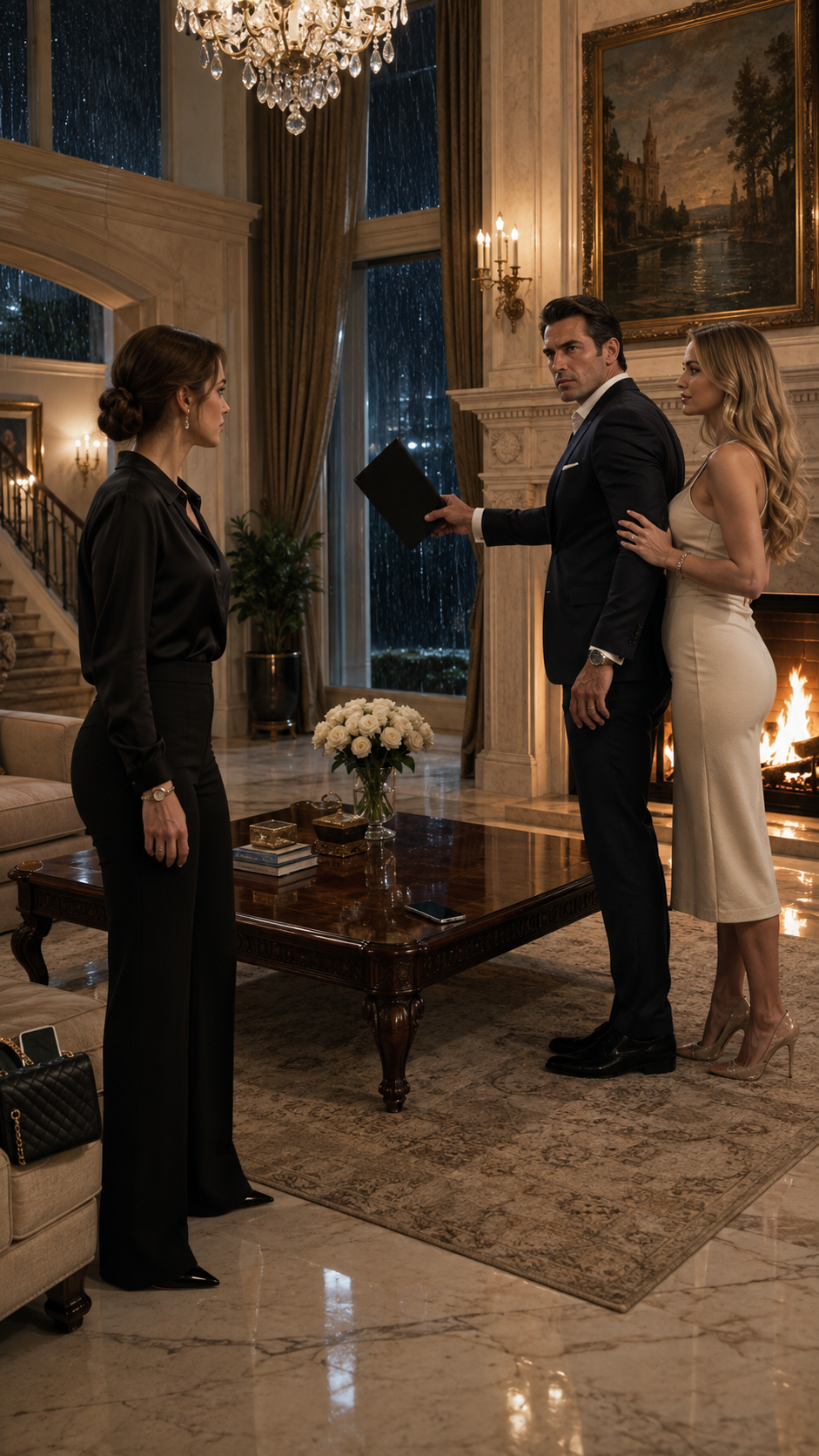
My Husband Chose His Pregnant Mistress and Told Me I’d Leave With Nothing—He Had No Idea My Father Had Been Keeping His Company Alive for Years
The night my husband chose his mistress over me, he thought he was ending my life.
He stood in the living room of the mansion we had shared for five years, surrounded by Italian marble, original paintings, and furniture selected by designers whose names he enjoyed mentioning at dinner parties. Everything around him reflected the success Adrian Reynolds believed he had built with his own hands.
I stood near the fireplace in a black wool dress I had worn to a board dinner earlier that evening.
Vanessa Mitchell stood beside my husband.
His executive assistant.
His confidante.
His mistress.
And, as I was about to learn, the mother of his unborn child.
She wore a cream-colored designer dress with a narrow belt at the waist and diamond studs that caught the firelight whenever she moved. I recognized the dress because I had seen the charge two months earlier while reviewing expenses connected to one of Adrian’s corporate accounts.
He had classified the purchase as client relations.
At the time, I had stared at the name of the luxury boutique on the statement and wondered what kind of client relations required a $4,800 women’s dress.
Then I had closed the spreadsheet.
That was one of the many silences I would regret.
Rain struck the tall windows behind them, turning Chicago’s evening lights into blurred streaks of gold.
The grandfather clock in the hallway ticked steadily.
Adrian stood with his hands clasped behind his back.
“You embarrassed Vanessa in front of the board,” he said.
For a moment, I honestly thought I had misunderstood him.
“Are you serious?”
His jaw tightened.
“You accused her of being unprofessional.”
“She told twelve directors that I married you for your money.”
Vanessa gave a careless little shrug.
“I only repeated what people were already thinking.”
I stared at her.
She said it while standing inside my home.
A home purchased before my marriage through a trust established by my family.
She was wearing a dress paid through a company account tied to a business my father had quietly supported for years.
And she stood beside a man whose confidence I had rebuilt so many times that I had stopped noticing how much of my own energy disappeared in the process.
I had attended charity dinners with a fever because Adrian insisted one of his investors would notice my absence.
I had spent Christmas Eve memorizing the names of board members’ spouses because he forgot them.
I had hosted clients on Sundays.
I had calmed him after panic attacks before television interviews.
I had talked two senior executives out of resigning after Adrian insulted them during a failed merger negotiation.
I had read investor profiles in bed while he slept because he wanted to know exactly what mattered to each person at breakfast.
When Reynolds Technologies came within six weeks of running out of cash three years earlier, I made one phone call.
To my father.
Adrian never knew what I asked for.
He only knew that a new investment consortium appeared at exactly the right moment.
A credit facility was extended.
Three introductions followed.
An institutional investor that had ignored Adrian’s calls for four months suddenly invited him to lunch.
He accepted the timing as proof that the market had finally recognized his brilliance.
Every opportunity afterward became another reason for him to admire himself.
My father had warned me.
“Some men become blinded by blessings they did not earn,” Marcus Vale told me before my wedding. “Once they mistake grace for greatness, they start resenting the person who reminds them how much help they received.”
I had accused him of being cynical.
“Adrian isn’t like that.”
Dad looked at me for a long time.
“I hope I’m wrong.”
Standing in that living room five years later, I finally understood my father had not been condemning the man I loved.
He had been recognizing a pattern he had seen before.
Vanessa moved closer to Adrian.
Her fingers brushed his sleeve with the easy intimacy of somebody who had touched him many times without me watching.
“You should accept reality,” she said. “After the divorce, maybe Adrian will be generous enough to leave you something.”
The word stopped me.
“Divorce?”
Adrian reached toward the mantel and picked up a black leather folder.
He tossed it onto the coffee table.
The papers slid across polished walnut.
A law firm’s name appeared at the top.
Then:
PETITION FOR DISSOLUTION OF MARRIAGE.
I stared at it.
“I’m done,” Adrian said.
He sounded as if he were canceling a vendor contract.
Not ending a marriage.
Not five years of promises.
Not Sunday mornings when he made coffee too strong and complained that mine tasted like “warm anxiety.”
Not our first apartment near Lincoln Park where the radiator banged all winter and we ate takeout on moving boxes.
Not the years I had watched him build Reynolds Technologies from a small software company into a business employing more than two thousand people.
I looked down at the papers.
My hands were remarkably steady.
“How long?”
Adrian frowned.
“How long what?”
“How long have you been sleeping with her?”
Vanessa’s mouth curved.
Adrian did not answer immediately.
That hesitation told me more than denial would have.
Then he said:
“Vanessa is pregnant.”
The room seemed to contract.
No grandfather clock.
No rain.
No fire.
Only Vanessa’s hand moving toward her stomach.
There was no visible curve beneath the cream dress yet, but the gesture was deliberate.
Possessive.
Triumphant.
A baby.
Three months earlier, I had asked Adrian whether we should finally stop postponing children.
He said the western expansion required all of his attention.
“We have time.”
Six weeks earlier, he had kissed my forehead and told me we would talk about starting a family after the next funding round.
Two weeks earlier, he missed our anniversary dinner because Vanessa supposedly needed help preparing an investor presentation.
Every memory rearranged itself.
Late meetings.
Hotel receipts.
His phone turned facedown.
The new password.
Showers immediately after he came home.
Vanessa appearing at strategy meetings where no executive assistant had any reason to sit.
Her confidence around our board.
The way she once corrected me about Adrian’s travel schedule.
I had not failed to notice the evidence.
I had failed to accept what it meant.
“Say something,” Adrian demanded.
There had been a time when the possibility of losing him would have terrified me.
I would have asked what I did wrong.
Maybe I would have promised to change.
I would have searched his face for the man who stood with me under white roses five years earlier and said he had never felt safer with anybody.
But beneath the shock, something quieter appeared.
Clarity.
It arrived slowly.
Like snow settling across a street.
I reached into my purse.
Adrian laughed.
The sound was almost relieved.
“What are you going to do?”
Vanessa giggled.
“Call someone to rescue you?”
I looked directly at my husband.
Then smiled.
A real smile.
The first thing all evening that felt entirely mine.
“No.”
I unlocked my phone.
“I’m calling my father.”
Vanessa’s expression stayed amused.
Adrian’s did not.
He knew who my father was.
Everyone in certain financial circles knew Marcus Vale.
Most ordinary Americans did not.
Dad had no interest in celebrity.
He did not post photographs from yachts or give speeches about waking at four in the morning.
His companies held pieces of regional banks, logistics networks, medical manufacturers, energy businesses, commercial property groups, software funds, and private-credit vehicles across the United States and Europe.
His influence worked best when nobody talked about it.
Adrian knew another fact.
Vale Capital had introduced him to almost every institutional investor that mattered during the most fragile years of Reynolds Technologies.
He knew my father’s recommendation had opened doors Adrian could not get through alone.
He simply assumed those doors would remain open after he threw me away.
“Claire.”
His voice changed.
The authority disappeared.
“Wait.”
I pressed the call button.
He stepped toward me.
“Claire, don’t be emotional.”
I almost laughed.
Men like Adrian always seem to discover a woman’s emotions at exactly the moment consequences become possible.
Dad answered on the first ring.
“Sweetheart?”
His voice was calm.
I heard concern beneath it.
He already knew something was wrong.
For years, my father had told me that if Adrian ever crossed certain lines, I should call before trying to protect him again.
I had promised I would never need to.
Now the words came out more easily than they should have.
“Dad.”
I kept my eyes on Adrian.
“Just like you predicted.”
My throat tightened.
“Destroy his life.”
Silence.
Vanessa stopped smiling.
Adrian stared.
Then my father answered:
“It’s already happening.”
At that exact moment, Adrian’s phone began ringing.
The sound cut through the room.
He looked at the screen.
I watched fear move across his face before he could hide it.
“Who is it?” Vanessa asked.
Adrian did not answer.
I could see the caller’s name reflected faintly in the glass over the painting behind him.
Richard Halpern.
Chairman of the Reynolds Technologies board.
The phone stopped.
Then rang again.
“Answer it,” I said.
Adrian glared at me.
“What did you do?”
“I made one phone call.”
“You planned this.”
“No.”
I held his eyes.
“You did.”
He answered.
“Richard.”
I could not hear what Richard said.
I watched Adrian.
Confusion first.
Then disbelief.
“What do you mean, suspended?”
Vanessa turned sharply.
“What?”
Adrian raised a hand toward her.
“No, Richard. You cannot freeze the credit facility tonight. We have payroll transfers going tomorrow morning.”
My chest tightened.
Whatever my father had done, I did not want two thousand employees discovering on Monday that my divorce had interrupted their paychecks.
Another pause.
Adrian looked at me.
“What review?”
He listened.
“Richard, we have contracts closing next week. If word gets out that Vale Capital is reconsidering its support…”
He stopped.
His face became hard.
The call ended.
“What did your father say to them?”
“I don’t know.”
“You expect me to believe that?”
“I expect nothing from you now.”
He moved around the coffee table.
“You’re not leaving until you fix this.”
That sentence revealed more about our marriage than the divorce papers.
He had announced his mistress’s pregnancy.
He had ended our marriage.
And still he believed I was responsible for protecting him from the cost.
I picked up the divorce folder.
Then placed it neatly back on the table.
“You wanted me out of your life.”
I looked at him.
“I’m giving you what you asked for.”
Vanessa stepped toward me.
“This is childish. You cannot interfere with a company because your marriage failed.”
“My marriage didn’t fail by itself.”
I looked at her.
“Two people betrayed it.”
“And I haven’t interfered with anything. My family is reconsidering whether it wants to keep supporting someone who has made his opinion of us very clear.”
“This is my company,” Adrian snapped.
“Then you should have no trouble running it without us.”
His eyes flashed.
“You think your father can take everything from me?”
“No.”
I shook my head.
“I think you forgot how much of what you call yours depended on people trusting you.”
I walked toward the hallway.
Adrian grabbed my wrist.
The pressure shocked me.
Not enough to injure.
Enough.
“Call him back.”
I looked down at his hand.
Then into his eyes.
“Let go.”
Something in my voice reached him.
His grip loosened.
I pulled away.
Vanessa called after me.
“Where are you going?”
At the doorway, I stopped.
For the first time, I really looked at the mansion.
The marble staircase.
The chandelier.
The artwork.
The photographs lining the hallway.
Adrian and me in Paris.
Adrian and me at the Reynolds Technologies IPO readiness dinner that never became an IPO.
Adrian receiving an entrepreneurship award.
Me smiling beside him.
We looked happy.
Some of those smiles had been real.
That almost made leaving harder.
I faced Vanessa.
“I’m going home.”
She glanced around.
“This is your home.”
“No.”
I looked at Adrian.
“It became a stage.”
Then back to her.
“You can have the performance.”
I went upstairs.
Packed one suitcase.
The house was legally mine through the Vale Family Residence Trust.
Adrian knew the structure existed because it had been listed in our prenuptial agreement.
He had never paid enough attention to understand what it meant.
He referred to the property as “my house” in interviews because he considered legal details boring when they interfered with a good story.
While I packed, my phone vibrated repeatedly.
Adrian.
Then Vanessa.
Then Adrian again.
By the time I came downstairs, they were in the kitchen arguing.
I heard Vanessa say:
“You told me the house was yours.”
Adrian answered:
“It’s complicated.”
There was that word.
Complicated.
A useful shelter for people who had done something simple and did not like the description.
I left through the front door.
Rain had softened into mist.
My driver, Thomas, pulled the car beneath the awning.
Adrian came outside.
“Claire.”
I did not stop.
“Call your father.”
I opened the rear door.
“Now.”
I looked at him.
“You have no idea what you’re doing.”
For the first time in years, I did.
I got into the car.
As the gates closed behind us, I received another message.
CALL HIM.
Then:
THOUSANDS OF PEOPLE ARE AT RISK.
I read it twice.
Then called my father again.
Not to save Adrian.
To make sure Dad was not harming employees because of me.
He answered.
“Where are you?”
“On my way to you.”
“Good.”
“Dad, payroll.”
“Protected.”
Relief moved through me.
“What did you do?”
“Nothing you asked for.”
I frowned.
“You said it was already happening.”
“It was.”
“What does that mean?”
“Come home.”
Dad ended the call.
For twenty minutes, I watched wet Chicago streets pass the window.
And for the first time since I saw the divorce petition, I allowed myself to cry.
Quietly.
Not because I wanted Adrian back.
Because losing trust changes the shape of every memory it touches.
The Vale estate sat behind iron gates on nearly forty wooded acres north of the city.
Calling it a house would have been dishonest.
My grandparents bought the original property in the 1970s.
Dad expanded it after building Vale Capital.
My mother spent years trying to make it feel like somewhere people lived rather than a private university campus.
She succeeded in some rooms.
Failed completely in others.
I had avoided sleeping there since she died.
Too many memories.
That night, every light along the drive was on.
My father stood at the bottom of the front steps in a dark sweater.
He did not send staff.
He came to the car himself.
When I stepped out, his expression softened.
“Dad.”
That was all I managed.
He opened his arms.
I crossed the distance and collapsed against him.
Marcus Vale could negotiate a billion-dollar financing without raising his voice.
His hands shook while I cried against his chest.
“I’m sorry.”
“For what?”
“For not listening.”
He pulled back.
“You loved your husband.”
His eyes were wet.
“That is not a failure.”
“I made you help him.”
“You asked me to give him opportunities.”
“He decided what to do with them.”
We went inside.
Dad brought me to his study.
Cedar shelves.
Leather chairs.
My mother’s photograph on his desk.
The same crystal paperweight that had been there since I was twelve.
I sat.
“What is happening to Reynolds?”
Dad poured water.
“First, tell me exactly what Adrian said.”
I did.
Vanessa.
Board insult.
Divorce.
Pregnancy.
The call.
Dad listened without interruption.
The only moment his face changed significantly was when I told him Adrian grabbed my wrist.
“Did he hurt you?”
“No.”
“Did you feel threatened?”
“No.”
Dad nodded.
He did not inflate it.
Good.
Then he opened a folder.
“I need you to understand something.”
“What?”
“I did not begin reviewing Reynolds tonight.”
I stared.
“Three months ago, our representative on the board raised concerns.”
“What concerns?”
“Expansion.”
Dad slid a page across the desk.
Reynolds Technologies had grown aggressively.
Cloud infrastructure.
Enterprise software.
Automation platforms.
Its core business was strong.
Its western data-services expansion was not.
Adrian had committed hundreds of millions in future obligations based on financing that had not yet closed.
He had assumed the next funding round would happen.
The board’s risk committee repeatedly asked for contingencies.
Adrian dismissed them as timid.
“He told me they were trying to sabotage growth.”
“They were trying to avoid insolvency.”
I thought of late nights.
Adrian pacing our bedroom.
Calling directors cowards.
I had told him visionary founders always face resistance.
My stomach tightened.
I had helped reinforce his certainty.
Dad continued.
“Vale Capital guaranteed part of a revolving credit facility three years ago.”
“I remember the financing.”
“You do not know the guarantee came from us.”
No.
“Why?”
“You asked me to help.”
I stared.
The call.
Three years earlier.
Adrian came home pale after a bank pulled back during a product delay.
He said Reynolds might miss payroll in six weeks.
I called Dad.
“I need you to look.”
Dad said:
“Does Adrian know?”
“No.”
“Why not?”
“He’ll be humiliated.”
Dad went silent.
Then:
“That is already a problem.”
Still, he looked.
Vale Capital arranged a guarantee.
An affiliated investment fund joined a financing round.
The company survived.
Adrian believed investor confidence had returned naturally.
“I should have told him.”
“Yes.”
Dad did not soften it.
“You should have.”
That hurt.
“But my failure to tell him does not excuse his later decisions.”
“No.”
“Both things can exist.”
I nodded.
Dad opened another document.
“Two weeks ago, I ordered a review of every form of Vale support.”
“Before tonight.”
“Yes.”
“Why?”
“Because I heard about Vanessa.”
My face went hot.
“You knew.”
“I knew there was an inappropriate relationship.”
“How?”
“Board reports.”
Vanessa had begun attending meetings beyond her role.
Speaking for Adrian.
Calling directors directly.
Promising investor access.
One director complained.
Another documented it.
My father noticed.
“Why didn’t you tell me?”
He looked at me.
“Would you have believed me?”
I opened my mouth.
Then closed it.
Three months earlier?
No.
I would have defended Adrian.
Maybe accused Dad of trying to control my marriage.
Worse, I might have warned Adrian.
“I wanted proof.”
“So did I.”
Dad continued.
“Tonight’s credit change was not me freezing his company.”
“The bank?”
“The bank initiated a review after Vale indicated it would not renew the guarantee automatically.”
“Payroll?”
“Operating cash remains available.”
“Employees will be paid.”
“Yes.”
Relief.
“Will Reynolds collapse?”
“No.”
Dad’s answer came quickly.
“Not if the board acts rationally.”
“And Vale funding?”
“We will not participate in the next round under Adrian’s current plan.”
“Because he cheated on me?”
“No.”
My father looked almost offended.
“Because the plan is reckless.”
That distinction mattered.
“What if he changes the plan?”
“Then the fund will evaluate it like any investment.”
I leaned back.
Dad had not launched revenge.
He had stopped subsidizing confidence.
“Why did Richard suspend him?”
“He is not suspended from employment.”
“What?”
“His unilateral authority over several financing decisions was temporarily restricted pending an emergency board meeting.”
I almost laughed.
“Adrian heard ‘suspended.’”
“Adrian hears what makes him the victim.”
Dad’s tone was colder than usual.
Then he stopped.
“Sorry.”
“No.”
“You’re allowed.”
He closed the folder.
“Reynolds Technologies employs 2,143 people.”
“I know.”
“I will not damage them because Adrian hurt you.”
“Thank you.”
“But neither will I continue using Vale money to protect a chief executive who ignores risk.”
I nodded.
Dad studied me.
“You asked me to destroy his life.”
My face burned.
“I know.”
“Did you mean it?”
“At the time?”
“Yes.”
I thought.
“I wanted him to feel something.”
“That is not the same as wanting thousands of employees harmed.”
“No.”
“Good.”
He stood.
“Then we agree.”
I looked toward Mom’s photograph.
“Did you know this would happen?”
“With Adrian?”
“No.”
“But you warned me.”
“I warned you marriage does not erase human weakness.”
Dad sat again.
“I liked Adrian.”
That surprised me.
“I know.”
“No.”
He smiled sadly.
“I actually liked him.”
“He was hungry.”
“Smart.”
“Had more courage than caution.”
“Sometimes that works.”
Then:
“I worried he needed admiration too much.”
I understood.
Vanessa admired him without history.
I knew where the bodies were buried, metaphorically.
I had watched him fail.
Cry.
Panic.
Need help.
Maybe my love reminded him of dependency.
Her admiration allowed him to feel self-created.
Dad opened another folder.
Prenuptial agreement.
Adrian had hated it.
I almost refused to insist.
Dad did.
The agreement protected Vale trusts.
The mansion.
My investment assets.
Adrian’s Reynolds shares.
His premarital property.
Neither spouse would access the other’s protected assets through divorce.
“I don’t want his shares.”
“I know.”
“I don’t want his company.”
“I know.”
“I don’t even want him ruined.”
Dad’s eyebrows rose.
“Already?”
“No.”
I laughed bitterly.
“I still want him miserable.”
“Human.”
“But I don’t want misery to become the objective.”
“Good.”
My phone rang.
Adrian.
Dad looked at it.
“Answer.”
“Why?”
“Because avoiding him will not make you calmer.”
I put it on speaker.
“Claire.”
His voice was breathless.
“Finally.”
“What do you want?”
“Tell Marcus to reverse the review.”
“No.”
“This is not only about me.”
“My father is protecting the company.”
“By panicking investors?”
“Then reassure them.”
Silence.
“You know they will not listen without Vale Capital.”
There.
Admission.
“They invested in you because the company is strong,” I said.
“It is.”
“Then you don’t need Dad.”
“You are twisting this.”
“I’m listening.”
His breathing changed.
“Come home.”
That surprised me.
“Why?”
“We need to talk privately.”
“You handed me divorce papers beside your pregnant mistress.”
“I was angry.”
“Did anger make her pregnant?”
Dad looked toward the window.
I saw pain in his face.
Adrian said:
“Vanessa and I made mistakes.”
“An affair lasting long enough to produce a pregnancy is not one mistake.”
“She was there.”
“So was I.”
“You stopped being available.”
There.
The beginning of justification.
“I wasn’t at the office every night.”
“I was at home.”
“I supported you.”
“You judged me.”
“I questioned you.”
“That’s the same thing with you.”
No.
It was not.
Then Adrian said something that told me more than he intended.
“I haven’t decided what happens with Vanessa.”
There was silence.
From somewhere behind him, Vanessa’s voice rose.
“What does that mean?”
Adrian covered the phone too late.
I closed my eyes.
Even now, he wanted options.
His mistress.
His wife’s family capital.
His company.
His reputation.
Maybe his marriage if everything else collapsed.
“I have decided what happens with me.”
He became quiet.
“It doesn’t include you.”
“Claire.”
“Good night.”
I ended the call.
Dad leaned back.
“There is something you need to understand before tomorrow.”
“What?”
“You’ve spent five years thinking protecting Adrian was love.”
My throat tightened.
“It was love.”
“Partly.”
“What was the other part?”
“Fear.”
I stared.
“Fear of what?”
“That if Adrian failed, you would have chosen the wrong man.”
I hated him for seeing that.
“You are very irritating.”
“Your mother said the same thing.”
That broke me.
I cried again.
Dad moved around the desk and sat beside me.
“Justice will not return the marriage.”
“I know.”
“Money will not make humiliation disappear.”
“I know.”
“And watching Adrian lose will not automatically make you feel whole.”
I looked at him.
“Then what does?”
“I don’t know.”
Good answer.
The next morning, Adrian’s attorneys formally served the divorce petition.
That afternoon, Reynolds Technologies requested my attendance at an emergency board session.
Ten minutes later, Vanessa texted.
YOU THINK YOU WON.
Then:
ADRIAN WILL NEVER CHOOSE YOU AGAIN.
I stared.
Typed:
He already made his choice.
Then turned off my phone.
The Reynolds emergency board meeting took place forty-eight hours after I left the mansion.
I entered through the main lobby.
For years, I used side entrances.
Not literally because Adrian ordered me to.
Because I did not want employees thinking I exercised influence.
I told myself discretion was generous.
That morning, I wondered how much of my discretion had become disappearance.
The lobby screens displayed Reynolds Technologies above the slogan:
BUILDING THE FUTURE.
Employees moved quietly.
Rumors about Vale support had spread.
The receptionist recognized me.
“Mrs. Reynolds.”
“Claire is fine.”
“The board is upstairs.”
I crossed the lobby.
I remembered the first time Adrian brought me there.
Reynolds occupied two floors then.
Half-furnished offices.
Bare concrete.
Adrian stood in the middle of an open workspace with something shining in his eyes.
“One day this changes everything.”
I believed him.
That was why betrayal hurt.
I had not married Adrian because he was powerful.
I married the man before power.
Hungry.
Funny.
Brilliant.
Uncertain.
Success did not prove those qualities had been false.
It showed what they became when admiration stopped having limits.
The boardroom contained twelve directors.
Richard Halpern at the head.
Helen Carver, retired banking executive.
Three representatives of outside investors.
Two technology executives.
A cybersecurity specialist.
Several independent directors.
One Vale-affiliated fund representative.
My father was not there.
Good.
This needed to be more than Marcus Vale versus his daughter’s husband.
Adrian sat opposite me.
Immaculate suit.
Bloodshot eyes.
Vanessa sat behind him even though she was not a director.
When she saw me, she smiled.
Less confidently.
Richard opened.
“Mrs. Reynolds.”
“Claire.”
“Thank you.”
Adrian immediately leaned forward.
“I object to this meeting.”
Richard did not look at him.
“Noted.”
“My divorce has nothing to do with Reynolds.”
Helen folded her hands.
“Your divorce is not the purpose.”
“Then why is my wife here?”
“Because Ms. Vale Reynolds is beneficiary of a family investment structure that has provided material financing support.”
Adrian looked at me.
“You’re enjoying this.”
The accusation hurt because a small part of me wanted to.
I wanted revenge to feel clean.
It didn’t.
“I’m not enjoying anything.”
“Then tell your father to stop.”
Richard placed a document on the table.
“Marcus Vale has given no instruction concerning your employment.”
“Don’t insult me.”
“Fact.”
Richard continued.
“Vale Capital has decided not to participate automatically in the next funding round under the current western expansion model.”
“Because Claire asked him to destroy me.”
The room went still.
Vanessa shifted.
Richard removed his glasses.
“Did Claire force you to authorize expansion commitments before financing closed?”
No answer.
“Did she force you to dismiss risk-committee warnings?”
Silence.
“Did she tell investors Vale participation was effectively guaranteed when no binding commitment existed?”
“I had every reason to believe it would continue.”
“Based on?”
“My relationship with the family.”
There.
Adrian heard it too late.
His relationship with my family had always been connected to our relationship.
Yet he believed its benefits had somehow become permanent property.
Helen opened a report.
“At current burn, Reynolds has approximately eleven weeks of unrestricted liquidity under the expansion schedule.”
Vanessa’s face changed.
Apparently Adrian had not told her.
Helen continued.
“That becomes materially longer if the board delays the western expansion and reduces discretionary spending.”
“We can raise elsewhere.”
“Then provide a plan.”
“I need time.”
“You rejected three requests for contingencies.”
“Because panic would weaken negotiations.”
“You mistook preparation for panic.”
Adrian looked at me.
“Say something.”
“What?”
“Tell them Vale comes back.”
“It won’t under this plan.”
Vanessa stood.
“This is blackmail.”
Richard’s eyes hardened.
“Ms. Mitchell, you are not on this board.”
“I am the chief executive’s senior assistant.”
“You were invited as note-taker.”
Her face reddened.
Adrian said:
“She stays.”
Richard nodded.
“Then perhaps we address the governance concern involving her participation.”
The screen illuminated.
A calendar timeline.
Investor meetings.
Strategy sessions.
Product discussions.
Board preparation.
Meetings Vanessa attended despite having no formal role beyond executive support and communications coordination.
Adrian said:
“She advises me.”
“She lacks authority for several functions you delegated.”
“That is my decision.”
“Not when it creates risk.”
Vanessa leaned toward him.
“Don’t let them talk about me like that.”
Soft.
Intimate.
The room heard.
Adrian’s shoulders tightened.
“My leadership created this company.”
“No one disputes your contribution,” Helen said.
“We are examining judgment.”
Something snapped.
“You’re all here because of me.”
He pointed toward Richard.
“You were retired when I brought you in.”
“Marcus Vale recommended me.”
Helen:
“Your bank begged for our business.”
“After Vale provided a guarantee.”
One by one, the invisible structure beneath Adrian’s self-image surfaced.
Not to erase his work.
He had built technology.
Hired teams.
Made brilliant decisions.
But he had converted contribution into authorship over everything.
Then he looked at me.
“And you.”
“What exactly have you ever done?”
Silence.
Vanessa watched.
I could have exploded.
Instead, I opened the folder I brought.
“I reviewed investor profiles before every major funding dinner.”
Adrian stared.
“I identified the family office that led your second round.”
“I persuaded my father to consider the emergency facility when your first enterprise launch slipped.”
“I arranged the introduction to NorthBridge Health, which became your largest client.”
“I persuaded two directors not to resign after the merger meeting where you called them cowards.”
His expression changed.
“I drafted the foundation partnership that repaired public trust after your layoffs.”
“I hosted executives in our home.”
“I remembered their families.”
“I sat beside you before interviews while you told me you couldn’t breathe.”
“I spent years making people feel safe around you after you made them feel small.”
Nobody spoke.
“I did not create your original product.”
“I did not write the code.”
“I did not build your first engineering team.”
“I never wanted credit for what belonged to you.”
I looked at him.
“But I will no longer help you erase what belonged to me.”
Vanessa laughed sharply.
“So you admit revenge.”
“No.”
I looked at her.
“This is the end of a favor.”
“A favor?”
Adrian repeated.
“My father never promised to finance you forever.”
“Investors never promised to ignore weak decisions.”
“And I never promised to protect you after you stopped treating me like a partner.”
Richard called a recess.
Adrian approached immediately.
“You rehearsed that.”
“No.”
“You came here to humiliate me.”
“You did that yourself.”
Vanessa stepped between us.
“You think these people respect you? They’re using you because of your father.”
“Maybe.”
That surprised her.
“At least I know where my influence comes from.”
Her face tightened.
Adrian lowered his voice.
“Call off the review. I’ll renegotiate the divorce.”
“There’s nothing to renegotiate.”
“You can keep the house.”
“The house is mine.”
Vanessa looked at him.
“What?”
Adrian closed his eyes.
“You told me the mansion was yours.”
“It was our home.”
“That is not what you said.”
“Not now.”
A crack.
No satisfaction.
Vanessa was pregnant.
An innocent child would inherit whatever chaos adults created.
I refused to make that baby a symbol.
The board reconvened.
Richard announced a temporary oversight committee.
All major expenditures and financing decisions required additional approval.
Adrian would remain CEO for the moment.
Not because the board trusted him.
Because replacing a founder during a liquidity issue requires process.
Adrian stared.
“You’re taking my company.”
“The board is exercising governance.”
“And if I refuse?”
“Then we consider your position.”
He looked toward me.
“You won’t let them.”
For five years, I would have.
I would have called Dad.
Richard.
Helen.
Softened.
Explained.
Asked everyone to give Adrian another chance because visionaries are difficult.
That role died with my marriage.
“I am not doing this to you,” I said.
“I’m simply no longer stopping it.”
I left.
Adrian followed into the corridor.
“Claire.”
He caught up near the elevators.
“The press will destroy me if the board removes me.”
“You were willing to destroy me privately.”
“That’s different.”
“Because nobody was watching?”
He stopped in front of the elevator.
“I was going to give you a generous settlement.”
“With what?”
His face tightened.
“Marital assets.”
“Protected by our prenup.”
“I would have found a way.”
“You thought I needed you financially.”
“I never said that.”
“You let Vanessa believe you were leaving me with nothing.”
“She doesn’t understand the finances.”
“No.”
I looked toward the boardroom.
“She doesn’t understand you.”
The elevator opened.
Adrian reached toward my hand.
Stopped before touching.
“I loved you.”
That hurt.
Maybe because I believed some version of it.
“Maybe you did.”
His face fell.
“But you loved the man you became beside me more.”
The doors began closing.
“What am I supposed to do?”
For five years, I had answered that question.
That day, I let the elevator close.
Adrian’s fall did not happen overnight.
It happened quietly.
A banker requesting another document.
A meeting canceled.
An investor refusing to make a verbal commitment.
A director no longer laughing at his anger.
A client asking whether financing risk affected delivery.
A luxury retreat canceled by the oversight committee.
Three expansion leases postponed.
Reynolds announced the western expansion delay as “capital discipline.”
Reporters called it a liquidity problem.
Employees worried.
Payroll continued.
Dad kept his promise.
He did not destroy Reynolds.
He allowed the company to experience the actual cost of Adrian’s strategy.
My divorce moved in parallel.
At first, Adrian wanted speed.
Once he understood the prenup, he delayed.
He challenged the mansion ownership.
His lawyer showed him documents he had signed.
He questioned Vale trust assets.
His counsel reminded him he had waived deeper valuation diligence before marriage despite being advised to request it.
He accused me of hiding wealth.
That accusation was not completely empty.
I had disclosed legally.
I had not disclosed emotionally.
That would take me years to understand.
Vanessa remained publicly beside him for several weeks.
Restaurants.
Company entrances.
Photographers.
She wore expensive coats.
Carried handbags I suspected Adrian purchased.
I stopped reading.
My father began inviting me into Vale Capital meetings.
Not because he wanted to turn me into an heiress-warrior.
Because I had spent too long treating my own financial life like something slightly embarrassing.
At first I listened.
Then asked questions.
Found I was good at reading founders.
Not because betrayal gave me a superpower.
Because I had spent years observing how confidence changes when it receives no resistance.
One evening, Dad asked:
“What do you want from Reynolds?”
“Nothing.”
“Wrong answer.”
“I don’t want the company.”
“Different question.”
I thought.
“I want the employees protected.”
“Good.”
“I want Vale guarantees reduced responsibly.”
“Good.”
“I want Adrian to stop pretending we caused the consequences.”
Dad smiled.
“That one is not fully within our control.”
True.
Adrian began calling.
Angry first.
YOU’RE TURNING EVERYONE AGAINST ME.
Then defensive.
REYNOLDS WAS ALREADY UNDER PRESSURE.
Then nostalgic.
REMEMBER OUR FIRST APARTMENT?
Then:
PLEASE TALK TO ME.
I ignored them until he appeared outside my father’s gates during rain.
Security called.
“Mr. Reynolds says he will remain outside until you speak.”
Dad looked up from a report.
“You owe him nothing.”
“I know.”
“Then?”
“I owe myself an ending.”
I put on a coat.
Adrian stood beneath the security light.
No umbrella.
For a second I saw a younger man outside my old apartment after our first argument carrying ruined flowers in a thunderstorm.
Back then, he apologized without turning the apology into negotiation.
I stepped outside the pedestrian gate.
Did not invite him in.
“You look well,” he said.
“You look cold.”
“I deserve that.”
He attempted a smile.
Failed.
“The board votes next week.”
“On removal?”
“So you know.”
“Vale has a financial interest.”
“Vale has everyone’s throat.”
I almost left.
“Wait.”
He swallowed.
“I’m sorry.”
I faced him.
“Which part?”
“All.”
“Specific.”
Rain moved across his face.
“Vanessa.”
“The divorce papers.”
“Humiliating you.”
“You didn’t just humiliate me.”
“I know.”
“Do you?”
He looked toward the gates.
“I got lost.”
“No.”
My voice remained calm.
“You made choices.”
“She was at the office all the time.”
“So were two thousand other people.”
“That isn’t what I mean.”
“What do you mean?”
He said nothing.
I waited.
Finally:
“She made things easy.”
Of course.
“She admired me.”
“I admired you.”
“Not anymore.”
“I questioned you.”
“That’s different.”
“No.”
I looked at him.
“That is what adults who know you do.”
His expression twisted.
“I always felt your father was watching.”
“He was an investor.”
“He made me feel indebted.”
“You were.”
Anger flashed.
There.
The real Adrian.
“I built Reynolds before you.”
“Yes.”
“I had the product.”
“Yes.”
“I would’ve succeeded anyway.”
“Maybe.”
That wounded him more than no.
Maybe.
We could never know.
The actual company had grown with help.
That was not shame.
Only reality.
“I hated how people changed after they learned who Marcus Vale was,” he said.
“They thought I married you for access.”
“So you punished me for their suspicion?”
“Vanessa looked at me like I was enough on my own.”
There.
The heart of it.
With me, Adrian saw the help.
The frightened founder.
The credit facility.
Introductions.
Failures.
With Vanessa, he saw the finished man.
“She believed in me.”
“I believed before there was anything to admire.”
He looked down.
“I know.”
That sounded true.
Then:
“I left Vanessa.”
I stared.
“What?”
“We’re done.”
“She is pregnant.”
“I’ll support the child.”
“That wasn’t my question.”
“She lied.”
“About?”
He hesitated.
“About wanting a life with me.”
I understood.
Vanessa had wanted the version of Adrian attached to a mansion, company, private flights, influence.
When those things became uncertain, so did love.
I felt no joy.
“You chose her.”
“I was wrong.”
“You’re not asking because you suddenly discovered our marriage was sacred.”
“That’s unfair.”
“No.”
I stepped closer to the gate.
“You are asking because the life you chose cost more than expected.”
His face crumpled.
“I can change.”
“Maybe.”
“Give me a chance.”
“No.”
Small word.
Final.
“Claire.”
“I hope you become a good father.”
“I hope you take responsibility for your child.”
“I hope you learn from this.”
“You sound like goodbye.”
“Yes.”
“I’ll lose everything.”
“No.”
I shook my head.
“You will lose things that depended on people you treated as permanent sources of rescue.”
“You destroyed my life.”
I looked through the iron bars.
“No.”
“I stopped carrying it.”
I walked back toward the house.
Five days later, Reynolds Technologies removed Adrian as CEO.
Nine directors voted for removal.
Three opposed.
He retained vested shares.
He was not expelled from the company’s history.
Richard became interim chief executive.
The board canceled or delayed projects until cash stabilized.
A careful press statement thanked Adrian for his vision and announced a transition toward sustainable growth.
Corporate language.
Clean.
Behind it, the man who believed himself inseparable from Reynolds lost operational authority.
That evening, Vanessa sent:
THIS IS YOUR FAULT.
I looked at it.
Then replied:
Your child is innocent. Take care of yourself and let Adrian take responsibility.
No answer.
I blocked her.
The following week, Adrian agreed to proceed under the prenuptial framework.
I should have felt triumphant.
Instead, I sat on the floor of my childhood bedroom and cried.
Dad found me.
He lowered himself beside me.
“I thought justice would feel better.”
“Justice doesn’t return what was taken.”
“Then what does it do?”
He thought.
“It stops the taking.”
I rested my head against his shoulder.
Healing, I learned, is not the absence of grief.
It is grief eventually losing authority over the future.
The divorce became final six months after the night in our living room.
Tuesday morning.
Clear sky.
No rain.
No dramatic phone call.
An email from counsel:
Judgment entered.
I sat at my desk.
Read it.
Then removed my wedding ring from the velvet box where I had kept it since leaving Adrian.
I did not throw it away.
My marriage had been real to me.
I refused to let his betrayal retroactively make my love stupid.
Reynolds Technologies survived.
Its valuation fell.
Then stabilized.
Western expansion was scaled back.
The company renegotiated debt.
Focused on profitable products.
Sold one noncore division.
Two thousand employees did not lose their jobs so I could enjoy a revenge ending.
That mattered.
Adrian’s vested shares were worth less than at the height.
Still substantial.
He was not penniless.
Not homeless.
Dad never sent men to destroy him.
He simply stopped making Vale support unconditional.
Adrian lost illusion before wealth.
That may have been harder.
Vanessa gave birth to a boy in spring.
I learned accidentally through counsel because an insurance issue remained.
Healthy.
I was glad.
I never asked for pictures.
Whatever his parents had done, the child had no responsibility for it.
Vanessa and Adrian did not reconcile.
She moved into an apartment before delivery.
Adrian established support and later parenting time.
I did not ask why they ended.
Some relationships are held together by forbidden excitement and collapse under ordinary bills.
My life moved more slowly.
I joined Vale Foundation’s advisory council.
Then sat in on investment meetings.
At first, people deferred because I was Marcus Vale’s daughter.
I hated that.
Dad said:
“Then earn a reason for them to keep listening.”
Fair.
I studied.
Asked questions.
Made mistakes.
Recommended one terrible retail investment that lost us money.
Dad never let me forget it.
Good.
Privilege opened the room.
Competence determined whether I deserved authority inside it.
I became especially interested in founder-led companies.
Not because I believed ambitious men were dangerous.
Because ambition plus unchecked admiration can become expensive.
I learned to ask:
Who disagrees with the founder?
What happens when they do?
Does bad news travel upward?
Who has veto rights?
Which assumptions depend on one relationship?
Does the company have real contingency planning?
How much of leadership’s confidence is supported by cash?
Those questions came from Reynolds.
Pain can create insight.
That does not make pain a gift.
I would have preferred to learn through a textbook.
The mansion sold.
I could have kept it.
Did not want it.
I donated some furniture.
Sold other pieces.
Kept exactly four things.
A walnut writing desk my mother chose.
Two paintings I loved before Adrian cared about art.
And the old grandfather clock.
Why the clock?
I don’t know.
Maybe because it had continued ticking through the night my marriage ended.
Evidence that time remained uninterested in drama.
I moved to a smaller house overlooking the river.
Three bedrooms.
A kitchen designed for actual cooking.
No marble foyer.
On the first night, I opened every window.
Cold air moved through the rooms.
No one told me the heating bill was ridiculous.
Beautiful.
Nearly a year after the divorce, I attended Reynolds Technologies’ annual shareholder meeting as a representative of one Vale-affiliated fund.
First time back.
The building felt different.
Adrian’s photograph had disappeared from the lobby screens.
Not erased from history.
Just no longer used as branding.
A woman named Margaret Sloan had become permanent CEO after serving fifteen years in operations.
She had no lifestyle profile.
No podcast.
She did understand cash flow.
Reynolds was growing again.
Slower.
Stronger.
After the meeting, I stayed in the boardroom reviewing documents.
When I entered the corridor later, Adrian was waiting.
For a moment, neither spoke.
He looked different.
Not ruined.
Human-sized.
His suit was still good.
Less theatrical.
Gray beginning near the temples.
“Hello, Claire.”
“Adrian.”
“I heard the vote went well.”
“Yes.”
“You’re on Vale’s investment committee.”
“Yes.”
A faint smile.
“You always understood business better than I wanted to admit.”
“That sounds like an apology.”
“It is.”
The corridor was empty.
Chicago spread beyond the windows.
Once we had stood there imagining the future together.
“How is your son?”
He looked surprised.
“Healthy.”
“I’m glad.”
“He has my eyes.”
His voice softened.
Good.
Maybe fatherhood had taught him something.
Not my responsibility anymore.
“Vanessa and I couldn’t make it work.”
“I heard.”
“I blamed you.”
“I know.”
“For months.”
“I know.”
“I thought you and Marcus planned everything.”
“We planned protections.”
I looked at him.
“You created the need.”
He nodded.
“I understand now.”
That did not repair anything.
Still, it settled something.
“Why are you here?”
“I own shares.”
“That isn’t what I meant.”
He looked into the old boardroom.
“I wanted to see what the company became without me.”
“And?”
“It became what everyone had been asking me to let it become.”
Silence.
Then:
“I loved you.”
I had heard the sentence in anger.
At the gate.
In messages.
This time, it asked nothing.
“I know you loved me in the way you knew how.”
His eyes filled.
“It wasn’t enough.”
“No.”
“If I had understood everything you did…”
“You understood pieces.”
“I chose not to connect them.”
There.
Truth.
“I’m sorry.”
“I believe you.”
Hope flickered.
I ended it gently.
“Forgiveness is not a door back into my life.”
He nodded.
Accepted.
New.
“Are you happy?”
I thought.
Once, happiness meant standing beside Adrian while rooms applauded him.
Then I imagined it would mean watching him fail.
Now?
Sleeping without dread.
Speaking without rehearsing.
Making decisions because I wanted them.
Walking through main entrances.
“Yes.”
He smiled sadly.
“Good.”
I passed him.
After several steps:
“Claire.”
I turned.
“Did your father really begin pulling support before you called?”
“Yes.”
“How did he know?”
“He didn’t know what you would do.”
I thought of Dad’s warning.
“He knew who you were becoming.”
Adrian absorbed that.
“And you still defended me.”
“For as long as I could.”
His eyes lowered.
“That might be the worst part.”
“No.”
I shook my head.
“The worst part was that you believed my loyalty meant I had nowhere else to go.”
Outside, Dad’s car waited.
He sat reading.
When I entered, he closed the report.
“How did it go?”
“Adrian apologized.”
“Did it help?”
“A little.”
Traffic moved.
Then:
“Dad?”
“Yes?”
“That night when I said destroy his life…”
“I remember.”
“You didn’t.”
“No.”
“You stopped guarantees.”
“Allowed the board to see the actual risks.”
“Yes.”
“Why did you say it was already happening?”
Dad looked out the window.
“Because his downfall didn’t begin when you called.”
“When?”
“The first time he mistook your love for weakness.”
I let the words settle.
For months, I had treated the phone call as the moment everything changed.
It was not.
The call ended my participation in a system already failing.
Adrian’s decline started with every decision made under the assumption that there would be no real cost.
Every warning dismissed.
Every relationship treated as permanent support.
Every person made smaller so he could remain large.
Years later, that distinction became even more important.
Because Adrian’s story did not end at Reynolds.
Neither did mine.
Three years after the divorce, I received an invitation to speak at a Vale Foundation entrepreneurship dinner.
I almost declined.
Dad said:
“You keep criticizing founders from the audience. Try the microphone.”
“I don’t criticize.”
“You make faces.”
“That’s different.”
He was right.
I spoke.
Badly.
Too many notes.
I talked too fast.
Afterward, a twenty-six-year-old founder named Maya Patel approached.
“My boyfriend is also my co-founder.”
I almost laughed.
“Dangerous opening.”
“He handles investors.”
“And you?”
“Product.”
“What’s wrong?”
She lowered her voice.
“He keeps saying investors respond better if there’s one clear leader.”
There it was.
Not Adrian yet.
Potential.
“What do the governance documents say?”
She blinked.
“About leadership?”
“About voting rights.”
“IP.”
“Founder departures.”
“Related-party decisions.”
“We haven’t finished them.”
“Finish them.”
She laughed nervously.
“That romantic?”
“No.”
I thought about Dad.
“Paperwork is what gives love a chance to remain love when money gets ugly.”
That became something I said often.
My marriage taught me that legal clarity does not create emotional honesty.
But lack of legal clarity can make emotional failure much more destructive.
Adrian and I had a strong prenup.
That protected assets.
We did not have strong communication.
That protected nothing.
I began therapy two years after the divorce.
Late.
I had spent the first eighteen months pretending work, committees, and a new house counted.
Dr. Rachel Kim was forty-eight and had a gift for making wealthy people’s defenses sound embarrassingly ordinary.
In our third session, she asked:
“Why didn’t Adrian know the full extent of your family support?”
“I wanted him to succeed independently.”
“That’s an answer.”
She waited.
“Not the answer?”
“No.”
I stared at the rug.
“Because I was afraid.”
“Of?”
“If he knew how much help came from Dad, I worried he’d feel small.”
“Did he?”
“Eventually.”
“Without knowing everything.”
“Yes.”
“So you tried to manage his feelings using secrecy.”
That hurt.
“I was protecting him.”
“Those are not opposites.”
I hated her.
She continued.
“You also wanted to know he loved you without the Vale name.”
“Yes.”
“Did he know enough about your wealth to make informed marital decisions?”
“Legally.”
“That wasn’t my question.”
I closed my eyes.
“No.”
There.
For years, I had narrated my silence as humility.
Some of it was.
Some was control.
I wanted information about Adrian’s motives while restricting information he had about my circumstances.
Did that justify adultery?
No.
His arrogance?
No.
His bad business decisions?
No.
But healing required me to stop using his larger failures as permission to ignore my smaller ones.
Dr. Kim said:
“Responsibility is not a contest.”
I wrote that down.
Adrian’s choices remained his.
Mine remained mine.
That distinction saved me from two bad futures.
One where I blamed myself for his betrayal.
Another where I learned nothing from the marriage because he was “worse.”
Dad died six years after the divorce.
Heart failure.
Sudden enough to feel cruel.
He was seventy-two.
I had spoken to him that morning about a manufacturing investment.
He told me my assumptions were “optimistic to the point of fiction.”
I told him he was old.
At four that afternoon, he was gone.
I sat beside his hospital bed remembering the night I called.
Destroy his life.
Dad had spent years afterward teasing me.
“You turned into your mother for three seconds.”
Mom had been theatrical when angry.
I cried.
Then laughed.
At his memorial, Reynolds Technologies sent flowers.
Margaret Sloan attended.
Adrian did not.
Appropriate.
Dad’s will shifted more responsibility to me.
Vale Capital had professional leadership.
I did not become CEO.
I became chair of the family investment committee after a formal trustee process.
Not automatically.
That mattered.
In my first year, I made two good decisions and one spectacularly poor one.
The poor decision lost $11 million.
I expected people to treat me carefully because of my name.
Instead, an eighty-year-old trustee named George Feld told me:
“Marcus would call that expensive tuition.”
I laughed.
He was right.
Power became less magical once it became responsibility.
That helped me understand Adrian differently too.
The more people deferred to him, the harder it became for him to distinguish confidence from competence.
Not because he was uniquely evil.
Because human beings are vulnerable to environments built around agreement.
At Vale, I insisted on something Dad had practiced informally.
Every major investment needed a named dissenter.
Not somebody assigned to be negative.
Someone whose job was to articulate the strongest argument against us.
People hated it.
Good.
A company where nobody can say no is simply waiting for the expensive version of reality.
Reynolds remained part of Vale’s portfolio for years.
Not controlled.
Minority influence.
I occasionally saw Adrian at shareholder meetings.
Our relationship became polite.
No intimacy.
No hostility.
Then five years after the divorce, he asked for a private conversation.
We met at a coffee shop in River North.
Not his office.
Not mine.
“I need to tell you something.”
I waited.
“I’m leaving Reynolds completely.”
“What?”
“Selling most of my remaining shares over time.”
I was surprised.
“Why?”
He smiled faintly.
“Every time I walk into the building, I become the person who thinks it should still be mine.”
That was self-awareness I had never expected.
“What will you do?”
“Consulting.”
“Startups.”
“Mentoring founders.”
I almost laughed.
“Warn them about leverage?”
“Yes.”
“And mistresses?”
He laughed.
Then became serious.
“My son is four.”
I knew.
His name was Noah.
“I want to be somewhere I can pick him up from school.”
“That sounds good.”
Adrian looked at me.
“I used to think you were trying to control me when you asked for balance.”
“I was sometimes.”
He raised an eyebrow.
“Therapy?”
“Expensive.”
We both smiled.
Then he said:
“Vanessa and I were cruel to you.”
The sentence came without qualification.
“Yes.”
“I’m sorry.”
“I know.”
No need for more.
He later moved to Milwaukee.
Joined a venture studio.
Reynolds became smaller in his identity.
Good.
Vanessa’s life took another route.
After leaving Adrian, she spent several years in public relations.
Then disappeared from business media.
A decade later, she contacted me.
Email.
Subject:
An apology that asks nothing.
I stared at the subject for a day before opening.
Claire,
I have spent years wanting to explain myself and finally understand explanation is not what you were owed.
I knew Adrian was married.
I knew you loved him.
I told myself your marriage was cold because that made my choices easier to tolerate.
I repeated things he said about you because if you were controlling, privileged, and emotionally distant, I could call myself his escape instead of his affair.
I’m sorry.
Then:
The board meeting where I insulted you is what I remember most.
Not because Adrian left me later.
Because I knew exactly where to hurt you.
I wanted the directors to laugh.
Some did.
I understand now how ugly that was.
No request.
No claim that pregnancy made her vulnerable.
No attempt to turn herself into victim.
I answered:
Thank you for taking responsibility. I hope you and your son are well.
She replied once.
We are.
That was all.
No friendship.
No public reconciliation.
Some wounds close better without converting into relationships.
I learned Vanessa eventually became communications director for a nonprofit pediatric organization.
Maybe motherhood changed her.
Maybe consequences.
Maybe age.
I hoped she became kinder.
Her growth did not erase my pain.
My pain did not require her permanent failure.
That took me years to understand.
The mansion became somebody else’s home.
A surgeon and his husband bought it.
They renovated the kitchen.
Removed one of Adrian’s favorite sculptures.
I knew because the real-estate magazine published photographs.
For a moment, I felt offended.
Then laughed.
The house was not mine anymore.
Good.
Objects should not become hostages to memory.
I kept the grandfather clock.
It sits in my river house.
Still loses three minutes a month.
I refuse to repair it.
Maybe stubbornness is hereditary.
I never remarried.
That was not a tragedy.
I had relationships.
One important one with a man named David Chen, an architect whose first serious act of affection was telling me the lighting in my living room was terrible.
We dated eight years.
Never married.
He had grown children.
I had become comfortable with a life that did not require legal merging.
Eventually he accepted a project in Vancouver that became permanent.
I did not want to move.
He did.
We ended.
Painfully.
Honestly.
That relationship taught me something Adrian had not.
A relationship can end without someone needing to be wrong.
That was strangely healing.
Years later, David sent a holiday card.
I smiled.
No bitterness.
No documents.
No board emergency.
Just two adults whose futures diverged.
I wish I had understood that possibility at thirty.
Reynolds Technologies celebrated its twentieth anniversary when I was fifty-one.
Margaret invited me.
I almost declined.
Then she said:
“You were there before half the current executives.”
Fair.
The event took place in the company auditorium.
No gala ballroom.
No lifestyle press.
Former employees.
Customers.
Founders.
Adrian attended too.
We sat far apart.
The company played a video about its history.
There he was young.
Standing inside the unfinished first office.
Talking about changing everything.
I saw myself in the background of one photograph.
Twenty-eight.
Holding coffee.
Looking at him like he could do anything.
The image hurt.
Not because I wanted him.
Because that woman’s faith had been genuine.
I had spent years embarrassed by her.
That evening, I finally forgave her.
She did not know the future.
People do not become foolish simply because somebody else later betrays their trust.
Margaret spoke about the liquidity crisis.
Not naming the divorce.
She said:
“Reynolds survived a period when growth began outrunning governance.”
Good.
Boring.
Accurate.
Adrian spoke for five minutes.
I did not expect him to mention me.
He did.
“Many people helped this company before their help was visible.”
I became still.
“Some of those people did not receive appropriate recognition from me.”
He looked toward my section.
“I’m grateful they helped anyway.”
No name.
Fine.
I did not need one.
After the event, he found me.
“Too much?”
“No.”
“Too little?”
“No.”
He smiled.
“Growth.”
“Allegedly.”
He laughed.
Then:
“I’m glad you came.”
“Me too.”
We hugged.
Briefly.
Not romantic.
History acknowledging itself.
Dad would have had opinions.
He always did.
The Vale Foundation later created a program for spouses and partners involved in founder-led businesses.
Not marital counseling.
Financial and governance education.
Why?
Because I discovered how many couples build companies, family offices, practices, farms, or real-estate portfolios without understanding where marriage stops and ownership begins.
A founder’s spouse hosts investors.
Works unpaid.
Provides capital.
Signs guarantees.
Introduces clients.
Raises children while the other travels.
Then a marriage ends and everyone asks:
But what did you actually contribute?
Sometimes the answer is legally easy.
Sometimes emotionally impossible.
The program offered independent attorneys.
Financial education.
Governance workshops.
No assumption that couples would divorce.
The point was informed partnership.
At the first session, one woman asked:
“Isn’t talking about this unromantic?”
I almost smiled.
“My father believed paperwork could protect romance from becoming accounting later.”
“Was he right?”
“Partly.”
“What protects the rest?”
I thought.
“Honesty before you need it.”
That became the harder lesson.
Because Dad’s prenup protected my assets.
His influence protected Reynolds employees.
His investment network prevented Adrian’s recklessness from becoming a company collapse.
But no structure could fix the fact that Adrian and I stopped telling each other uncomfortable truths.
I did not tell him the full scale of Dad’s support.
He did not tell me he resented it.
I made myself smaller to protect his pride.
He mistook the smaller version for reality.
He sought admiration elsewhere.
Then used betrayal instead of honesty.
Those choices were not equivalent.
But they interacted.
Marriages often fail inside the gap between what each person thinks should have been obvious.
At sixty, I returned to Reynolds headquarters for the last time as a Vale investment representative.
We had decided to sell the remaining meaningful Vale position over several years.
The company no longer needed our support.
That mattered.
The current CEO was forty-six and had never worked with Adrian.
Good.
Institutions become healthy when founders become history rather than weather.
After the board meeting, I walked alone through the lobby.
The old slogan was gone.
No BUILDING THE FUTURE.
Just the company name.
I liked it.
A young employee held the elevator.
“Going down?”
“Yes.”
She had no idea who I was.
Perfect.
At the ground floor, I paused near a display case containing early company artifacts.
First prototype.
Old employee badges.
Photographs.
One small note described Vale Capital’s role in stabilizing Reynolds during its 2021 financing crisis.
I stared.
For years, that support had been secret.
Now it was simply history.
No shame.
No magical rescue.
Capital.
Risk.
A business decision motivated partly by a daughter asking her father to help her husband.
Messy.
Real.
The young employee noticed me.
“Interesting stuff.”
“Yes.”
“Were you around back then?”
I smiled.
“A little.”
She walked away.
I stood there longer.
Then left.
Dad’s warning followed me for decades.
Some men become blinded by blessings they didn’t earn.
As I aged, I changed the sentence.
Not only men.
Not only blessings.
Human beings become dangerous when we forget the difference between help and entitlement.
Adrian did.
For a while.
So did I.
I began assuming Dad would always be there to repair what I could not face.
That night, I called him and said:
Destroy his life.
He could have done something ugly.
A less responsible man might have.
Dad did not.
He asked:
What protects employees?
What belongs to investors?
What decisions should the board make?
What is actually ours to withdraw?
That is why I eventually stopped telling the story as the night my billionaire father destroyed my cheating husband.
He did not.
He withdrew favors.
Enforced boundaries.
Allowed institutions to see risk without the cushion we had quietly provided.
Adrian’s career changed because people evaluated his decisions differently once rescue was no longer assumed.
That is not destruction.
That is exposure to consequence.
The distinction matters.
I once asked Dad why he did not simply force Adrian out.
This was before Dad died.
We were sitting at his kitchen table.
He looked offended.
“Because I don’t own Reynolds.”
“You could have pressured the board.”
“I could pressure you to eat vegetables too.”
“Doesn’t make it right.”
Then:
“If Adrian should be removed, the board should be able to reach that conclusion without Marcus Vale behaving like a king.”
That sentence became central to how I used power later.
Wealth creates dangerous shortcuts.
People listen because they fear consequences.
They agree because access matters.
You begin mistaking obedience for wisdom.
That was Adrian’s mistake.
I refused to make it mine.
Years after Dad died, I reread the note he sent me the morning after my wedding.
I had forgotten it.
Claire,
Marriage will tempt both of you to assume love fills in missing information.
It doesn’t.
Ask.
Explain.
Sign clearly.
Apologize early.
And never use money to win an argument your character should handle.
Love,
Dad.
I laughed.
Then cried.
He had been warning me too.
Not only about Adrian.
Me.
I had used money silently.
Not as revenge during the marriage.
As insulation.
I knew I could leave any time.
Adrian did not know how completely.
Maybe that imbalance made me less willing to confront problems early.
Why risk a fight if I could simply endure?
Endurance becomes easier when you know there is always another house, another account, another safety net.
That does not make endurance wise.
Eventually I learned to speak earlier.
With David.
Friends.
Business partners.
If I was angry:
Say angry.
If I disagreed:
Disagree.
No collecting evidence in silence until a relationship collapses beneath the weight of things nobody discussed.
That was growth.
Late.
Still useful.
At seventy, I live in a smaller house than any my younger self imagined.
Two bedrooms.
River view.
A garden I am bad at maintaining.
The grandfather clock in the hallway.
My mother’s recipe books.
Dad’s old fountain pen.
No staff except a woman named Rosa who comes twice a week to help with cleaning because arthritis has made my left hand unreliable.
I pay her well.
More importantly, I do not treat wages as kindness.
Work is work.
One afternoon, Rosa asked why I had never married again.
“I almost did.”
“What happened?”
“Geography.”
She laughed.
“That’s boring.”
“Best breakup of my life.”
She shook her head.
People often want dramatic endings because drama makes life feel organized.
Adrian and Vanessa.
Betrayal.
Father.
Company.
Downfall.
Good story.
But my favorite ending involved a man moving to Vancouver and two adults saying:
I love you.
I’m not going.
I understand.
Goodbye.
Painful.
Clean.
No villain.
That taught me more about healthy love than any wedding vow.
Adrian died before me.
Cancer.
He was sixty-eight.
His son Noah called.
We had met only twice.
He was twenty-seven.
“Ms. Vale?”
“Claire.”
“My dad died this morning.”
For a moment, I could not speak.
A person can stop being your husband and still occupy thousands of memories.
“I’m sorry.”
Noah’s voice broke.
“He left something for you.”
A letter arrived two weeks later.
I waited a month before opening it.
Claire,
You once told me I loved the man I became beside you more than I loved you.
I hated that sentence for years because I knew it was true before I understood why.
He wrote about Reynolds.
Dad.
Vanessa.
Then:
I spent my youth believing success meant not needing anybody.
Every time your family helped, I experienced gratitude first and shame second.
Eventually shame won.
Instead of admitting I felt indebted, I rewrote the story so I had done everything myself.
Once I believed the rewritten version, your presence became threatening because you remembered the truth.
I stopped.
That was exactly it.
He continued.
Vanessa admired the version of me I wanted to believe.
That does not make what I did her fault.
I chose the affair.
I chose the lies.
I chose to serve you divorce papers in a way designed to hurt you because I wanted you wounded enough not to challenge the story I had built.
I am sorry.
Then:
You were wrong about one thing.
You said I loved the man beside you more.
At the end, I think I loved you too.
I simply did not know how to love someone who knew I was not self-made.
That is not your fault.
My eyes filled.
Last paragraph:
Thank Marcus for me if there is somewhere dead fathers receive corrections. He saved my company twice.
The first time with money.
The second by refusing to keep saving me from consequences.
Adrian.
I laughed through tears.
Dad would have enjoyed that.
I kept the letter.
Not evidence.
History.
No need to forgive again.
I already had.
Adrian’s funeral was private.
I did not attend.
Noah later sent me a photograph.
Young Adrian inside the original Reynolds office.
No suit.
Jeans.
Paint roller in one hand.
Smiling.
On the back:
Dad said you took this.
I had.
Twenty-eight years old.
Hopeful.
In love.
That memory belonged to me too.
I put the photograph inside an album.
Not on the wall.
Enough.
People sometimes ask whether I regret making the phone call.
No.
I regret the words.
Destroy his life.
I was hurt.
I wanted impact.
I am glad Dad knew me well enough not to obey literally.
What I actually needed was:
Stop protecting him.
Stop assuming the guarantee.
Stop shielding the company from questions.
Stop using my loyalty to extend somebody else’s illusion.
That is what Dad did.
The rest came from Adrian’s own decisions.
If Reynolds had been healthy and Adrian’s leadership sound, Vale withdrawing support would have been inconvenient.
Not catastrophic.
If the board trusted him, it would have kept him.
If investors believed his plan, they could have funded it.
If the marriage had been the only thing broken, his career would have survived.
That is why the revenge story is false.
The affair exposed a pattern.
It did not create every business problem.
And if I am being completely accurate, my father’s support had hidden some of those problems too long.
Our family money did not only help Adrian.
It delayed accountability.
That is why, years later, Vale Capital changed policy.
No investment tied to a family member’s spouse could receive informal support outside documented committee process.
No personal guarantees from Dad.
No “just look at this company for Claire.”
Everything disclosed.
Reviewed.
Voted.
Boring.
Healthy.
I helped write the policy.
Dad complained it meant he could no longer help grandchildren impulsively.
“Correct.”
“Terrible.”
“Governance.”
He smiled.
Proud.
The night Adrian chose Vanessa, he believed he was removing the least valuable person from his life.
That was how he saw me by then.
Quiet wife.
Social support.
Some family connections he assumed had already become his own.
He thought I would leave with a settlement and a wounded ego.
Vanessa thought he controlled the mansion.
His company.
His future.
I thought my father could erase consequences on command.
All of us misunderstood something.
The mansion was a trust asset.
The company belonged to shareholders, employees, customers, lenders, and years of collective effort.
The capital had conditions.
Love had conditions too, though I had once thought saying that made love sound transactional.
Not conditions like wealth.
Status.
Obedience.
Conditions like honesty.
Respect.
Consent.
The willingness to hear no without treating it as betrayal.
Those are the conditions that make intimacy safe.
Adrian broke them.
For a while, so did I in quieter ways.
The marriage ended.
The world kept moving.
Reynolds continued producing software.
Employees collected paychecks.
Noah grew up.
Vanessa built another life.
I sat beside Dad as he got older.
Then buried him.
I invested.
Failed.
Learned.
Loved again.
Lost again without betrayal.
Grew old.
That is the proportion people forget.
One terrible evening feels like the entire story while you are living it.
It is not.
The living room confrontation lasted perhaps forty minutes.
My life afterward lasted decades.
That matters.
If I could walk back into that mansion now, I would find my younger self standing across from Adrian and Vanessa.
I would tell her several things.
First:
Do not call your father and ask him to destroy anybody.
Call him because you need your father.
That is enough.
Second:
When Adrian says Vanessa is pregnant, do not turn the child into evidence that you were inadequate.
A baby is a person, not a verdict.
Third:
Do not try to make Adrian admit the entire marriage was false.
It wasn’t.
You will hurt yourself trying to simplify history into something easier to hate.
He loved you.
Then resented you.
Then betrayed you.
Human beings can do all three.
Fourth:
Your father’s money did not create Adrian’s success.
It accelerated and protected a talented man’s company.
Do not erase his work because he erased yours.
Accuracy will free you more than revenge.
Fifth:
When the board reviews him, stay out of employment decisions where your conflict is obvious.
Let independent directors decide.
You will be grateful later.
Sixth:
Go to therapy sooner.
Much sooner.
Stop treating competence as emotional care.
Seventh:
Tell the next person you love the whole shape of your life.
Not every account number.
Not every trust schedule.
But enough that intimacy is real.
Privacy is not the same as secrecy.
And finally:
When Adrian asks what he is supposed to do now, do not answer.
That part you got right.
People we love often train us to become the answer to every crisis.
At some point, love becomes rescue.
Rescue becomes infrastructure.
Then they forget the infrastructure exists.
When it disappears, they call the collapse betrayal.
It is not.
Sometimes it is simply gravity returning.
The mansion no longer stands as it did then.
The buyers remodeled heavily.
The old living room became brighter.
The fireplace stayed.
The chandelier is gone.
I know because years ago a design magazine featured the house.
I looked at the photographs once.
No ghosts.
Just rooms.
That pleased me.
Reynolds Technologies was eventually acquired by a larger software company.
Not failure.
Good exit.
Many employees made money on shares.
The Reynolds name disappeared from the building.
Adrian lived long enough to see the acquisition.
No bitterness, according to Noah.
He was proud.
Good.
Companies are allowed to outgrow founders.
Vale Capital continued after Dad.
Then changed too.
We sold stakes.
Closed divisions.
Expanded others.
No empire is permanent.
Thank God.
Permanence is often another word wealthy families use when they mean fear.
My mother once said:
“If you love something, don’t make it carry your immortality.”
I did not understand as a teenager.
I do now.
The only object from the old mansion still in my house is the grandfather clock.
It continues losing three minutes each month.
A repairman once offered to correct the mechanism.
“No.”
He stared.
“You know it’s wrong.”
“Yes.”
“That doesn’t bother you?”
“No.”
I like it.
For five years in the mansion, the clock measured time while I organized my life around Adrian’s ambitions.
Now it measures imperfectly.
Still moves.
Maybe that is why I kept it.
One Sunday recently, I found one of our old wedding photographs inside a drawer.
Adrian looking at me.
Me laughing.
Dad behind us.
I sat on the floor.
No anger.
That surprised me.
Only tenderness for people who did not know what would happen.
I returned the photograph to the drawer.
Did not destroy it.
Memory is allowed to exist without governing the present.
That took me a lifetime.
When people hear the story, they usually stop at the phone call.
Billionaire father.
Cheating husband.
Pregnant mistress.
Corporate collapse.
They imagine Dad pressing one button and making Adrian’s world disappear.
Nothing about real power works that cleanly.
Banks have committees.
Boards vote.
Investors decide.
Employees matter.
Contracts matter.
Fiduciary duties matter.
A father’s anger does not legally become corporate strategy.
Thank God.
What Dad could do was stop pretending Vale support was guaranteed.
He could ask the questions our relationship had discouraged others from asking.
He could insist that decisions be documented.
Then Adrian had to stand on his own record.
That was enough.
My father did not destroy his life.
He stopped lending him ours.
That distinction changed how I understood everything.
Money.
Marriage.
Support.
Even love.
Helping someone does not mean assuming responsibility for every future version of them.
Believing in someone does not require protecting them from information.
Loyalty does not require silence when silence becomes permission.
And generosity ceases to be generous when it makes another adult dependent on never hearing no.
I had spent years thinking the highest form of love was helping Adrian become everything he dreamed.
Later, I understood a healthier love would have required enough honesty to let him know exactly which parts were his.
Exactly which parts came from others.
Exactly which risks belonged to the company.
Exactly what I needed.
Exactly what I resented.
We never had those conversations early enough.
By the time we did, they were taking place through lawyers and board minutes.
I regret that.
I do not regret leaving.
Both.
Always both.
On the last afternoon Dad and I spent together before he died, we sat on the terrace at the Vale house.
He was complaining about the cold.
I told him to go inside.
He ignored me.
“Do you ever think about that call?”
“What call?”
He gave me a look.
“Destroy his life.”
I groaned.
“Please die without reminding anyone.”
He laughed.
Then became serious.
“You know I was scared.”
“Of what?”
“That if I actually did what you asked, you would spend the rest of your life believing power could heal humiliation.”
I stared.
“I knew you didn’t mean it literally.”
“Didn’t I?”
“Not after ten minutes.”
He smiled.
“Good.”
Then:
“Power can stop damage.”
“Sometimes recover money.”
“Remove access.”
“Change incentives.”
He looked toward the trees.
“But it cannot make somebody regret hurting you.”
“No.”
“You learned that.”
“Yes.”
“Expensive lesson.”
“Your favorite kind.”
He laughed.
Two weeks later, he was gone.
I think about that conversation more than the night Adrian left.
Maybe because Dad understood what I spent decades learning.
The opposite of humiliation is not domination.
It is dignity.
The opposite of betrayal is not revenge.
It is truth.
And the opposite of being abandoned is not being powerful enough that no one can leave.
It is having a life solid enough that somebody leaving does not take your entire self with them.
Adrian thought he was destroying my life when he chose Vanessa.
For a short while, I believed him.
Then I discovered he had only destroyed the future I expected to share with him.
Painful.
Not the same.
My future still existed.
My father.
My work.
My intelligence.
My money.
My mistakes.
My capacity to love.
My right to build something no one else needed to applaud.
Those remained.
And when Adrian’s phone began ringing in that living room, the thing he feared was not really losing Vale Capital.
It was discovering that the support he had mistaken for his own strength could end.
Years later, I know there was something sad in that.
I had helped create the illusion too.
The difference was that once the illusion broke, I chose to learn from it.
Eventually Adrian did too.
Maybe that is the most generous ending available.
Not that he lost.
Not that I won.
That the truth finally became larger than either of our stories about ourselves.
He was not entirely self-made.
I was not merely the woman behind him.
My father was not an all-powerful king.
Vanessa was not the woman who stole my life.
Reynolds was not Adrian.
Vale was not me.
We were all human beings moving through systems, relationships, and choices that had consequences.
Some generous.
Some selfish.
Some forgivable.
Some not.
The night my marriage ended, I walked away believing I had lost everything that mattered.
I was wrong.
I had lost a husband.
A house I no longer wanted.
A role I had outgrown.
And a version of myself built around keeping another person comfortable.
What remained was quieter.
Harder.
Much more durable.
My name.
My voice.
My judgment.
My future.
And the freedom to stop using love as an excuse to disappear.









