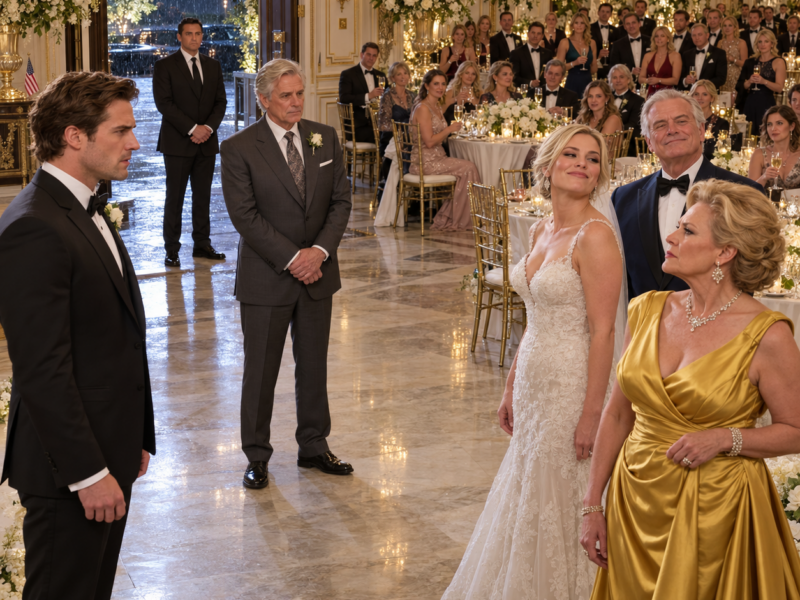
“That’s trash someone forgot to take out,” Beverly said about my father in front of five hundred wedding guests. My bride, Fiona, laughed. I took off my ring, left it beside my untouched plate, and walked my dad out into the rain. Then a black car stopped at the steps, and the man who got out addressed my father with a respect nobody inside had shown him.
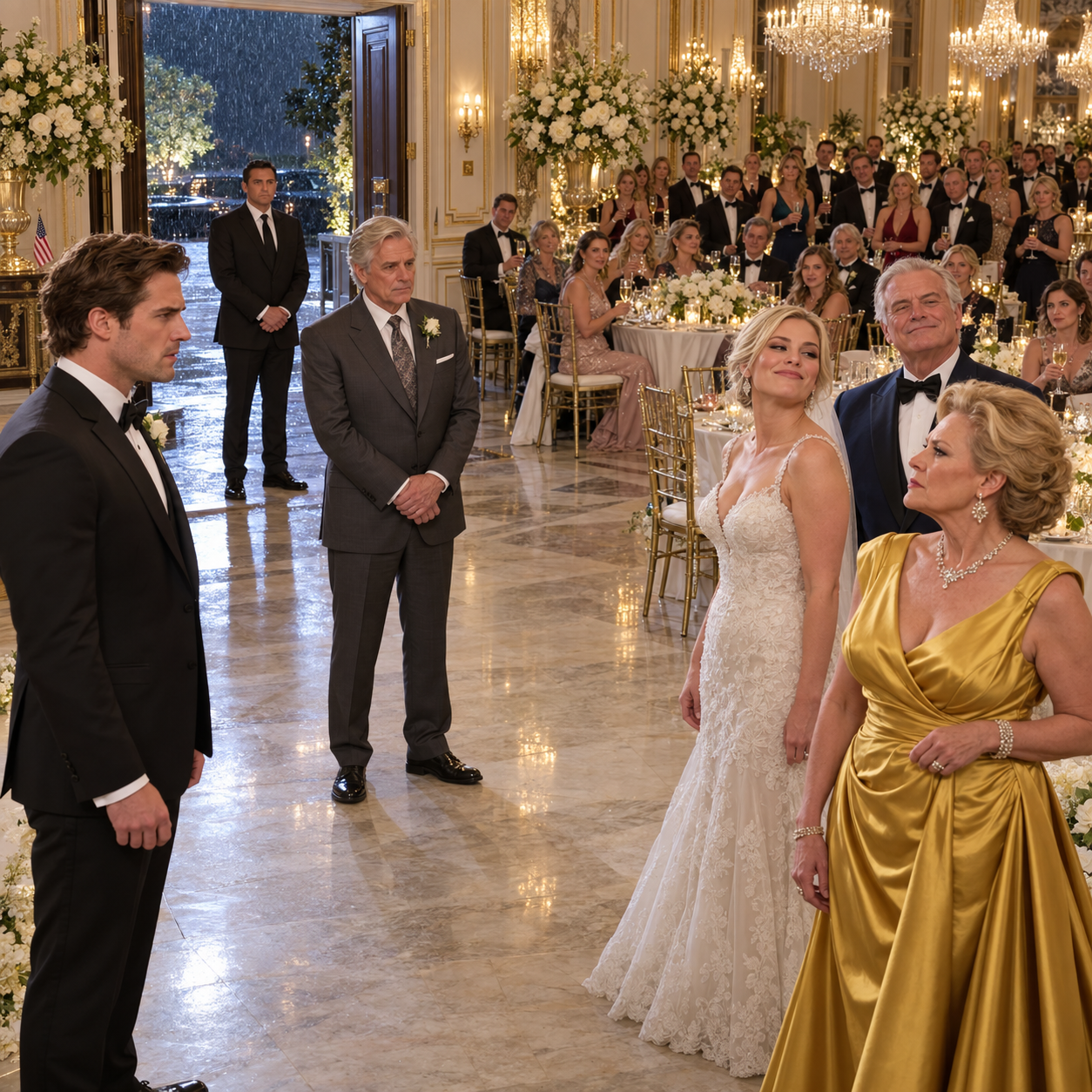
The instant my future mother-in-law pointed at my father and called him trash, I knew I had made a mistake.
Not a small mistake. Not the kind that could be repaired with an awkward apology after the guests went home.
I had married the wrong woman.
Beverly Martinez stood beside the head table in a pale satin gown, holding a champagne flute with the same careful fingers she used to rearrange flowers, place cards, and people she considered beneath her.
“That isn’t a father,” she said.
She paused long enough to make sure the room was listening.
“That’s trash someone forgot to take out.”
The laughter came unevenly.
A burst near the front. A nervous chuckle from a table of George Martinez’s business associates. Two women covering their mouths as though that made what they were doing less cruel.
Five hundred guests filled the ballroom.
Not all of them laughed.
Enough did.
My father stood near the back, his hands folded in front of him, wearing the charcoal suit he had bought for my college graduation. His shoes were polished. His tie had belonged to his father.
He lowered his eyes.
Then Fiona laughed.
That was the sound that ended it.
She lifted one hand toward her mouth, diamonds flashing beneath the chandeliers.
“Mom,” she giggled, “stop. You’re going to embarrass him.”
Him.
She meant my father.
She did not mean her mother.
She did not mean herself.
I looked at the woman I had married less than two hours earlier, and something inside me became very still.
For months, I had explained things away.
Her mother was particular.
Her father was blunt.
Fiona was overwhelmed by wedding planning.
The seating arrangement was complicated.
The photographs needed to look balanced.
The investors needed the front tables.
There was always an explanation.
There was never a moment when the explanation protected my father.
I stood.
The orchestra continued for three uncertain notes before someone signaled the musicians to stop.
“Blake?” Fiona said.
I took off my wedding ring.
It resisted slightly at the knuckle. My hands had swollen during the afternoon.
I worked it free and placed it beside my untouched plate.
“The wedding is over.”
For a moment, nobody moved.
Then Fiona grabbed my wrist.
“Have you completely lost your mind?”
Her nails pressed into my skin.
George shoved his chair back.
“Sit down.”
I looked at him.
He was accustomed to people obeying that tone.
I had obeyed it more often than I wanted to admit.
“Do you have any idea what this wedding cost?” he demanded.
I looked around.
The chandeliers. The white roses. The champagne fountain. The cameras. The guests waiting to see whether I would become reasonable and let my father remain the evening’s joke.
“Yes,” I said.
My voice sounded quiet enough that the nearest microphone picked it up clearly.
“I know exactly what it cost.”
Beverly folded her arms.
“You’re making an emotional mistake. A man like you doesn’t get many opportunities to marry up.”
That finished whatever doubt remained.
I removed Fiona’s hand from my wrist.
I walked past the head table, past the flowers, past a photographer who lowered his camera too late.
My father watched me approach.
He looked almost apologetic.
That expression hurt more than Beverly’s words.
He was preparing to tell me not to ruin anything on his account.
I knew him well enough to see it forming.
I put my hand on his shoulder.
“Dad,” I said. “Let’s go.”
He looked at the ringless hand resting against his suit.
Then he looked at my face.
“Are you sure?”
“Yes.”
He nodded.
Together, we walked through the ballroom.
Behind us, Fiona called my name.
George said something about consequences.
Beverly told a relative that I had always been unstable.
We kept walking.
Outside, rain struck the marble steps hard enough to splash against our shoes.
I had no coat.
Dad had left his at the checkroom.
Neither of us went back.
We stood beneath the entrance canopy while the valet hurried toward us.
Then three black sedans rolled through the gate.
Dad recognized them before I did.
The first stopped at the curb.
A man in a dark suit stepped out, opened an umbrella, and walked directly toward him.
He did not look at the photographers gathering behind the glass.
He did not ask what had happened.
He stopped in front of my father and lowered his head slightly.
“Mr. Henderson,” he said. “They’re waiting for you.”
Behind the doors, George Martinez went pale.
I saw it through the glass.
The man who had ruled the ballroom five minutes earlier suddenly looked as though he had realized he was standing on a floor he did not own.
I turned toward Dad.
“Who’s waiting?”
He looked tired.
More tired than I had ever seen him after a night repairing a furnace or a twelve-hour shift on a jobsite.
“Some people I need to speak with,” he said.
The man with the umbrella glanced at me.
“Mr. Henderson, is this your son?”
“Yes.”
“Then he should come out of the rain too.”
He opened the rear door.
Dad rested his hand briefly against my back.
“Come on, Blake.”
I got into the car because he asked me.
For the first time that evening, I was willing to go somewhere without knowing what it would look like when I arrived.
My father’s name was Thomas Henderson.
Most people called him Tom.
He was sixty-seven that spring, with broad hands, a knee that bothered him when the weather changed, and a habit of checking the latch on every door he closed.
He had spent his life working around things that could fail dangerously if someone pretended they were fine.
Engines.
Furnaces.
Commercial ventilation systems.
Steel supports.
Construction equipment.
He did not speak grandly about work.
He spoke about whether something would hold.
When I was nine, my mother died after an illness that moved too quickly for either of us to understand.
Her name was Elaine.
For years afterward, Dad would say her name in ordinary conversations as though she might walk in and correct him.
Your mother liked those.
Your mother would know.
Your mother never trusted that road when it froze.
He worked constantly after she died.
Some days he repaired equipment at a construction yard. Some nights he answered emergency heating calls. On weekends, he helped a friend restore old engines in exchange for cash and parts he could use on our truck.
I remembered his hands most clearly.
Cracked skin.
Dark lines around the nails.
Bandages wrapped tightly enough that he could still hold a wrench.
Those hands packed my lunch, checked my homework, tied my skates, and once spent an entire evening assembling a model bridge after I cried because I had broken the first one.
He never called it sacrifice.
He called it Thursday.
We were not secretly wealthy.
That matters.
Later, when people learned who had come to meet him outside the wedding, they invented a version of my childhood in which Dad had been testing me with hardship while millions sat untouched somewhere.
That was not what happened.
The overdue bills were real.
The old truck was real.
The years when groceries required careful calculation were real.
He gave me the last helping of chicken because there was no more chicken.
He worked extra nights because the mortgage did not care that he was tired.
Whatever came later grew out of those years.
It did not erase them.
By the time I reached college, life had become steadier.
Dad had joined a group of tradesmen who were trying to save a small mechanical services company after its owner retired without a succession plan.
They pooled savings.
They negotiated financing.
They kept the company operating.
Dad called it the cooperative.
I knew he attended meetings.
I knew he sometimes traveled to inspect equipment at another facility.
I knew his phone rang at odd hours with questions about people I had never met.
I did not ask enough.
That sentence would become one of the hardest facts of my life.
I did not ask enough.
I was busy.
College. Work. A first apartment. A promotion. A business of my own. Then Fiona.
Dad said things were going well.
I accepted that.
When he helped with my final year’s tuition, I assumed the cooperative had become profitable.
It had.
I simply failed to understand how far it had grown.
Fiona and I met at a fundraiser hosted by a professional association.
I had designed an energy management system for mid-sized commercial buildings. It was not glamorous work, but the software was useful, and my company had begun attracting clients beyond the Midwest.
She worked in brand strategy for one of her father’s businesses.
She was funny that first night.
Not the brittle, performative kind of funny I would later recognize around her mother.
She asked good questions.
She laughed when I described a client who believed software could repair a boiler without replacing the broken pump.
She listened when I spoke about Dad.
“My father knows everyone,” she said. “He’d probably like yours.”
I believed her.
For the first six months, there was very little reason not to.
We cooked together.
We took walks.
She remembered details from conversations.
When I became sick during a winter storm, she brought soup and stayed until the roads improved.
When Dad visited, she asked him about an old engine he was restoring.
He seemed to like her.
I mistook those early moments for a permanent character.
People can be kind in a quiet apartment and cruel when a room rewards them for it.
I learned that too late.
The trouble began after George took an interest in my business.
He owned Martinez Development Group and held interests in several other companies. Newspapers described him as a billionaire. I had never examined whether the description referred to cash, assets, borrowed money, or the optimistic value of ventures bearing his name.
I simply understood that he was rich.
George liked the idea of adding my software to buildings his companies managed.
He offered introductions.
Then contracts.
Then advice.
Some of the advice was useful.
Some carried obligations I did not notice until they had already attached themselves.
A vendor he recommended.
An accountant he preferred.
A dinner I needed to attend.
A presentation he wanted adjusted.
He never said he was taking over my life.
He said he was helping me grow.
Fiona liked that her father liked me.
I liked that she was proud.
Dad was more cautious.
“Keep your own books,” he told me.
“I do.”
“Have your attorney read anything you sign.”
“I always do.”
“And remember a favor can turn into an invoice without a number on it.”
I laughed.
He did not.
I should have listened more carefully.
The first dinner with both families took place at the Martinez house.
Dad arrived in his charcoal suit.
It was clean and pressed.
Beverly looked at his cuffs.
Then she smiled.
“Tom. How nice that you could come.”
There was nothing wrong with the words.
The tone made them feel like an accommodation.
George asked whether Dad still worked with his hands.
“Some,” Dad said.
“At your age?”
“I know what I’m doing.”
George smiled.
“Well, that’s useful.”
Later, he explained the dinner schedule to Dad as though Dad had wandered into a foreign country.
“We’ll have the main course after the first presentation.”
Dad nodded.
“I’ve eaten dinner before, George.”
I smiled.
Fiona pressed her foot against mine beneath the table.
I stopped smiling.
That was how it began.
A small correction.
A small surrender.
When Beverly asked whether Dad needed help choosing clothes for the engagement party, I said she was trying to be considerate.
When George suggested Dad might find the business conversations boring, I said he probably did.
When Fiona wanted Dad seated farther back at the wedding reception, I told myself she was managing a difficult guest list.
The words were polished.
The effect was always the same.
My father occupied less space.
The Martinez family occupied more.
Three weeks before the wedding, Dad asked whether I was happy.
We were in his garage.
He had an old carburetor spread across a towel on the workbench.
I said yes.
He kept cleaning a part.
“Happy,” he repeated, “or pleased things are moving forward?”
I felt irritated.
“What’s that supposed to mean?”
“Only what I asked.”
“I love her.”
“I know.”
“Then why are you asking?”
He set down the cloth.
“Because you seem tired every time you talk about the wedding.”
“Everyone’s tired planning a wedding.”
“Maybe.”
I wanted him to argue.
That would have made it easier to dismiss him as worried, old-fashioned, or unwilling to accept change.
He did not.
He asked whether I wanted coffee.
I said no.
I left earlier than planned.
The morning of the wedding, I sent him a message reminding him when transportation would arrive.
He replied with a photograph of his tie laid carefully on the bed.
Grandpa’s, he wrote.
I sent back a thumbs-up.
I have thought about that response more times than I can count.
He had offered me a piece of his heart.
I had answered with a symbol because I was being fitted into a tuxedo while someone adjusted the angle of my cufflinks.
At the ceremony, Dad sat three rows behind the Martinez family.
I saw him when I turned from the altar.
He smiled.
I knew he was proud.
I also knew the seat was wrong.
I did nothing.
The ceremony itself was beautiful.
Fiona looked happy.
I thought I was happy too.
We spoke our vows.
We exchanged rings.
We signed the documents the officiant placed before us.
That part would matter later.
Walking out of a reception did not undo a legal marriage.
I learned that the next morning.
But at the time, the paperwork seemed like an ordinary detail after the important promise.
The promise had already become less ordinary by dinner.
Inside the black sedan, Dad and I sat beside each other while the man with the umbrella took the front passenger seat.
The driver pulled away from the entrance.
I looked back once.
Fiona stood behind the glass doors.
Her hand was pressed against her mouth.
George had come outside beneath the canopy.
He looked toward the cars.
Then he lifted his phone.
The man in front glanced at the mirror.
“Mr. Henderson, Mr. Martinez is calling.”
Dad closed his eyes.
“Let it go.”
The phone stopped vibrating.
I looked at him.
“Why is George calling him?”
Dad opened his eyes.
“We have business with his company.”
“We?”
“The trust.”
“The cooperative?”
He nodded.
The man in front turned slightly.
“My name is Marcus Caldwell, Blake. I’m general counsel for Henderson Industrial Stewardship.”
I stared at him.
“Henderson?”
“Yes.”
I looked at Dad again.
He rubbed his knee.
“The name came later.”
“What is Henderson Industrial Stewardship?”
“A holding and stewardship organization,” Marcus said. “It manages several employee-owned operating companies and long-term industrial investments.”
“How several?”
Marcus hesitated.
Dad answered.
“Twenty-seven businesses. Some small. Some not.”
I looked out the window.
Rain ran across the glass.
For a moment, I thought I had misunderstood a word.
Then I looked back.
“You never told me that.”
“I told you we were growing.”
“Growing isn’t twenty-seven businesses.”
“No,” he said. “It isn’t.”
There was no defensiveness in his voice.
That made my anger feel suddenly complicated.
“How much is it worth?”
Marcus said, “That depends on the measure. The consolidated enterprise valuation is approximately one point four billion dollars.”
I felt the number move through me without settling.
Dad looked at Marcus.
“That’s not personal money.”
Marcus nodded.
“No. It isn’t.”
Dad turned toward me.
“The employees own through the structure. There are lenders, obligations, reserves, and pension commitments. Don’t hear that number and decide I had a billion dollars under the mattress.”
“I wasn’t—”
“Yes, you were.”
I stopped.
He knew me.
He also knew the question I had not yet asked.
“Why didn’t you tell me?”
Dad looked at his hands.
“We’ll talk about that.”
The car turned into a hotel entrance less than ten minutes from the wedding venue.
Not another ballroom.
A quiet business hotel with covered parking and a conference center.
Marcus stepped out.
A woman in a dark coat approached the car.
She looked at Dad, then at me.
“Tom,” she said. “Are you all right?”
Dad nodded.
“Rachel, this is Blake.”
She held out her hand.
“Rachel Monroe. Chief operating officer.”
Her expression softened.
“I’m sorry about the circumstances.”
I realized she knew.
I did not know how much.
Inside, Marcus led us to a private lounge adjoining a conference room.
Someone had put coffee, tea, sandwiches, and towels on a side table.
The towels nearly broke me.
Everything at the wedding had been designed to impress.
Here, someone had noticed we were wet.
Rachel handed Dad a towel.
He thanked her.
Then he sat.
I remained standing.
“Why were you coming to the wedding?”
Marcus answered carefully.
“We weren’t coming into the reception. Mr. Henderson had a meeting scheduled after it.”
“Tonight?”
Dad nodded.
“People flew in.”
“On my wedding day?”
“It was a short committee meeting. I expected to be done with the reception late. We were meeting here afterward.”
“Then why did the cars arrive early?”
Rachel looked at Dad.
He answered.
“I sent Marcus a message.”
“When?”
“After Beverly spoke.”
I stared at him.
“So you called them because—”
“Because I didn’t want to ask you to drive me anywhere. I thought I might leave quietly.”
The words settled between us.
He had been preparing to remove himself from my wedding so my marriage could continue.
Even then.
Even after that.
I sat beside him.
“Dad.”
He shook his head.
“We’ll talk.”
Marcus checked his phone.
“George is asking to attend.”
Rachel’s expression hardened.
“Not tonight.”
Dad looked at her.
“What’s the status of the records?”
“Ready.”
“Then we should proceed.”
I stared at him.
“What records?”
He turned toward me.
“Business records. Separate from what happened in that ballroom.”
That distinction became important too.
My father did not possess a button that could destroy a billionaire because his wife had insulted him.
The business matter already existed.
The wedding merely revealed how little George understood about the man he was dealing with.
The committee had been reviewing financing connected to three Martinez properties.
Henderson Industrial Stewardship held a substantial secured loan through one of its investment entities.
It also had a services agreement through an operating company responsible for certain mechanical installations.
The relationship went back years.
George knew the organization.
He did not know my father was the Tom Henderson who chaired its stewardship council.
Or perhaps he knew the name and assumed the aging man at his daughter’s wedding could not be the same person.
Either explanation told me something about him.
The review concerned eighty-six million dollars in outstanding financing.
It also concerned inspection records, delayed repairs, and representations made to lenders about building systems.
Rachel explained only what she could.
My marriage did not give me a right to confidential documents.
My father’s position did not give me one either.
I waited in the lounge while the committee met.
For forty minutes, I stared at a cup of coffee I never drank.
My phone vibrated constantly.
Fiona.
Beverly.
George.
My best man, Aaron.
Several friends.
An unknown number.
Then Fiona again.
I turned it off.
A television on the wall showed a weather report.
I watched rain move across a map.
The ordinary world continued.
Flights were delayed.
Roads were flooded.
Someone was explaining the temperature.
I had ended a wedding reception and discovered a large part of my father’s life in less than an hour.
Neither event made the weather stop.
When Dad returned, he looked exhausted.
Marcus and Rachel followed.
“The committee has completed the immediate review,” Marcus said.
I stood.
“What happens now?”
“To the business matter?”
“Yes.”
“Written notices. Requests for records. A hold on further advances while specified concerns are addressed.”
“Because of tonight?”
“No,” Rachel said.
Her answer was immediate.
“The concerns predate tonight.”
Dad looked at me.
“Listen carefully to that, Blake.”
“I am.”
“We don’t use employee money to settle personal anger.”
I nodded.
He held my gaze until he believed me.
Then he sat down.
Marcus arranged for the driver to take us wherever we wanted.
Dad said home.
I said I would go with him.
For the first time in years, I did not mean a brief visit.
Dad’s house looked exactly as it always had.
A brick ranch.
A narrow porch.
A garage with a light he kept forgetting to replace until it failed completely.
There was no hidden mansion.
No iron gate.
No staff waiting inside.
He unlocked the door, stepped in, and checked the latch after I followed.
I stood in the entryway.
The living room smelled faintly of furniture polish and coffee.
My mother’s photograph stood beside the lamp.
A stack of trade journals rested on the side table.
Beside them was a thick binder marked with the stewardship organization’s name.
I had seen binders like that before.
I had never opened one.
Dad hung his suit jacket over a chair.
The lining near one pocket had been repaired.
I looked at it.
Then at him.
“Why are you still wearing that?”
He glanced at the jacket.
“It fits.”
“Beverly said the sleeves—”
“I know what Beverly said.”
“I don’t mean—”
“I know what you mean too.”
He walked to the kitchen.
“Do you want tea?”
I followed.
“No. I want answers.”
He filled the kettle anyway.
“Then you can have answers with tea.”
For some reason, that was when I began crying.
Not dramatically.
Not the way I had imagined I might if the night finally caught up with me.
I stood beside the kitchen counter and could not make my breathing work normally.
Dad turned off the water.
He came toward me.
I said, “I’m sorry.”
He put his hand on my shoulder.
“For what?”
“All of it.”
“That’s a big thing.”
“I let them do it.”
He waited.
“The seat. The comments. The dinners. I kept telling you it was nothing.”
His hand stayed where it was.
“Yes,” he said.
I looked at him.
He did not rescue me from the truth.
That was one of the reasons I loved him.
“I thought you were just uncomfortable around them.”
“I was.”
“Because they treated you badly.”
“Yes.”
“And I acted like you were the problem.”
He nodded once.
I covered my face.
Dad pulled out a chair.
“Sit down.”
There was no command in it.
Only concern.
I sat.
He made tea.
Then he sat opposite me at the table where overdue bills had once gathered in stacks.
The laminate had worn near the edge.
He had never replaced it.
“I should have told you more about the trust,” he said.
I shook my head.
“That’s not the same.”
“No. It’s something I’m responsible for.”
I looked up.
“I didn’t want money changing how you made your life. Then I got used to keeping work conversations short. You asked about the garage. I asked about your company. We talked around the rest.”
“You let me think—”
“I let you assume. That’s different, but it still mattered.”
He took a sip.
“I also thought you would ask.”
I looked at the binders visible through the doorway.
“I should have.”
“Yes.”
There was no dramatic revelation after that.
No secret vault.
No account statement proving every childhood struggle had been unnecessary.
He told me how the cooperative had grown.
The first acquisition was small.
Then another owner wanted to retire.
Then an employee group needed financing.
The organization developed a model that allowed workers to participate in ownership while preserving reserves and professional management.
Dad had been good at identifying companies whose equipment, people, and customer relationships were worth saving.
He had been better at asking practical questions than speaking at investor dinners.
Other people handled the language.
He checked whether the machinery had been maintained.
He asked whether the people doing the work had been paid.
He wanted to know why a promising company had lost three supervisors in six months.
Over time, he became the person people trusted to recognize what the numbers did not explain.
The council elected him chair.
He received a salary and held certain interests through the original cooperative.
He had savings.
He had security.
He was not personally worth one point four billion dollars.
He was responsible for an organization whose value belonged to many people.
That responsibility frightened George more than personal wealth would have.
A rich man could be flattered.
A steward with documented concerns had obligations.
“Why did they name it after you?” I asked.
Dad looked embarrassed.
“The first company already had Henderson in the legal name. People kept using it for the larger structure.”
“You didn’t want it?”
“I didn’t care for it.”
“Why didn’t you change it?”
“People had other things to do.”
I laughed weakly.
It sounded exactly like him.
He looked at his tea.
“Your grandfather would have thought it was funny.”
I glanced at the tie he had laid beside the sugar bowl.
The tie had survived dinner.
I was glad.
At two in the morning, Aaron arrived with my coat and a small bag of belongings from the wedding suite.
He looked worried.
“Are you all right?”
“No.”
He nodded.
“Fair.”
Dad offered him tea.
Aaron declined.
He had already spent hours dealing with relatives, venue staff, and people trying to decide which version of the story would be most useful.
“The hotel has separated your personal things,” he said. “I got what I could.”
“Thank you.”
He hesitated.
“The marriage license was signed.”
“I know.”
“I didn’t know whether you were thinking—”
“That leaving ended it legally?”
He nodded.
“I wasn’t thinking much beyond getting Dad out.”
“Then call your lawyer in the morning.”
“I will.”
Aaron looked toward Dad.
“I’m sorry I didn’t get there sooner.”
Dad said, “You got here.”
Aaron shook his head.
“That isn’t what I mean.”
Dad held his gaze.
“I know.”
For a moment, the room was quiet.
Then Aaron told us several guests had approached him afterward claiming they had not laughed.
He had not asked.
They needed to say it anyway.
“That’s going to keep happening,” he warned me.
I nodded.
The night had produced a roomful of people eager to establish where they had stood after the consequences became visible.
I was not ready to sort them.
I slept in my childhood bedroom.
Dad had kept the bed, though he had replaced the mattress.
The shelves held a few books and a model airplane.
There was a framed photograph from my college graduation.
Dad stood beside me in the charcoal suit.
My mother was absent.
I had always looked at that photograph and thought about her absence.
That night, I saw what was present.
Dad’s hand on my shoulder.
His smile.
His pride.
At eight the next morning, he knocked.
“Coffee’s ready.”
I stared at the ceiling.
For a second, I expected to wake in a hotel beside my wife.
Then the ballroom returned.
I got dressed.
In the kitchen, Dad had made eggs and toast.
His phone was on the table.
Mine remained off.
“Marcus called,” he said.
“What did he want?”
“To see how we were.”
“George?”
“Still calling.”
“What are you going to do?”
“Let counsel handle the notices.”
“And personally?”
Dad looked at me.
“I don’t need to speak with him personally.”
I nodded.
That seemed impossible and sensible at once.
I had spent months believing every problem involving George required a conversation designed to preserve his opinion of me.
Dad was willing to let his opinion exist without supervision.
I called my attorney after breakfast.
Her name was Nina Patel.
She had reviewed the prenuptial agreement before the wedding.
That agreement was one of the few boundaries I had maintained.
George had wanted his attorneys to prepare it.
I insisted on independent counsel.
Nina had negotiated protections for my business, premarital assets, and future interests.
At the time, Fiona called the process unromantic.
I told her marriage was serious enough to require clear terms.
I wished I had applied the same clarity to how her family treated mine.
Nina listened to what happened.
Then she asked precise questions.
Had the ceremony been completed?
Yes.
Had we signed the marriage documents?
Yes.
Had there been violence?
No.
Had I returned to the shared home?
No.
Did I want to reconcile?
“No.”
She did not ask me to reconsider for appearances.
She explained the legal options, timelines, and steps needed to protect records and establish separate living arrangements.
An annulment was not automatically available because the reception ended badly.
We would examine the circumstances, but I should prepare for a dissolution.
There were contracts.
There were deposits.
There were wedding gifts to return.
There were accounts to separate.
There was a marriage to end through a process rather than a sentence.
I wrote everything down.
“The statement you made at the reception expressed your decision,” Nina said. “Now we make the legal situation match it.”
I was grateful for the distinction.
It kept me from pretending a dramatic moment had finished the work.
Fiona called from an unfamiliar number that afternoon.
I answered because Nina had advised me not to disappear entirely while practical matters remained.
“Blake.”
Her voice was hoarse.
“I’m sorry,” she said.
I waited.
“I laughed because I was nervous.”
“You laughed before anything became tense for you.”
“I didn’t mean it the way you’re taking it.”
“How did you mean it?”
She hesitated.
“Mom was joking.”
I looked across Dad’s living room.
The charcoal jacket still hung over the chair.
“No.”
“You know she has a sharp sense of humor.”
“She called my father trash.”
“I know. It was wrong.”
“And you laughed.”
“I said I’m sorry.”
“Yes.”
“Then why are you talking like this is permanent?”
“Because it is.”
She began crying.
I had loved that voice.
Hearing pain in it still hurt.
That did not change the decision.
“Come home,” she said. “We can talk without everyone involved.”
“We can talk about practical matters through our attorneys.”
“You’re ending our marriage over one comment?”
“No.”
“Then what?”
“Over the fact that I finally stopped ignoring the other comments.”
She was quiet.
I thought she might understand.
Then she said, “If we’d known who your father was, none of this would have happened.”
I closed my eyes.
There it was.
The same calculation, spoken plainly.
“You knew who he was,” I said.
“No, we didn’t.”
“He was my father.”
“That’s not what I mean.”
“I know.”
She did not hear the finality until several seconds later.
“Blake—”
“Nina will contact your attorney.”
I ended the call.
Dad stood in the doorway.
He had heard only my side.
He did not ask for the other.
“Do you want to take a walk?” he said.
I said yes.
We walked through the neighborhood in light rain.
Dad greeted a neighbor repairing a fence.
He asked after another man’s surgery.
He stopped to inspect a loose storm drain cover and called the city number saved in his phone.
I watched him.
Nothing about him had changed overnight.
My understanding had.
That was an uncomfortable kind of revelation because it gave me no one else to blame for how little I had seen.
At the corner, he said, “You don’t have to stay with me forever.”
“I know.”
“Good. Because I like watching the early news, and you complain about it.”
I laughed.
He smiled.
Then he said, “Stay as long as you need.”
That was Dad.
Room offered without a speech.
The first video appeared two days later.
It showed Beverly’s insult, Fiona laughing, and my announcement.
Then it showed the cars.
The caption claimed my father owned the wedding venue, George’s company, and several banks.
None of that was true.
People preferred the story in which a wealthy man had been disguised as a poor man and then punished everyone.
They were less interested in the story of a father who deserved dignity before anyone knew his business position.
Nina advised against arguing online.
Marcus issued a short statement confirming my father’s role and correcting the false claims about ownership.
It said the business review involving Martinez entities had begun before the wedding.
It did not discuss confidential terms.
My own statement was shorter.
I said I would not discuss a private separation publicly.
I asked people not to harass guests or circulate my father’s personal information.
Some listened.
Some did not.
Reporters called.
I declined interviews.
Dad refused them too.
“I’m not telling a stranger what I ate after my wife died so they can make people cry,” he said.
I understood.
The story of his sacrifice belonged to us.
It did not need to become content merely because someone had filmed the worst evening of our lives.
Still, people contacted him.
Former workers.
Owners whose businesses the trust had helped preserve.
A retired dispatcher.
An apprentice he had trained.
A woman whose husband had worked beside him.
They did not all mention the wedding.
Some simply said they hoped he was well.
Those messages mattered more than the headlines.
George requested a meeting through Marcus.
The committee agreed to one regarding the financing review.
Dad attended in his official capacity.
I did not.
I spent the morning at Nina’s office separating wedding facts from legal facts.
When Dad returned, he looked tired but calm.
“What happened?” I asked.
“He answered some questions. He needs to answer others in writing.”
“Did he apologize?”
Dad put down his keys.
“Yes.”
“What did he say?”
“That he hadn’t realized who I was.”
I stared at him.
Dad gave a small, sad smile.
“Seems to be the family’s main concern.”
“What did you tell him?”
“That the loan documents didn’t depend on whether he liked my suit.”
I laughed.
Then I stopped.
“Did he ask you to stop the review?”
“He asked whether we could approach it as family.”
“And?”
“We’re not family in that meeting.”
Dad went to wash his hands.
The water ran.
I sat at the kitchen table.
For years, George had used relationships to make business obligations seem negotiable.
Now he was encountering someone who believed relationships made clarity more important.
I wished I had learned that before signing my marriage license.
The financial review became complicated.
The Martinez properties had value.
They also had debt, maintenance requirements, and conditions attached to future financing.
There were legitimate disputes.
Some records had been submitted late.
Some inspection concerns had been addressed.
Others had not.
A third-party engineering firm was appointed to examine certain systems.
The trust did not seize everything overnight.
It did not empty George’s accounts.
It did not make him disappear from business by morning.
Those fantasies circulated online anyway.
The reality involved notices, deadlines, repairs, amended terms, and a reduction in the freedom George had enjoyed when people accepted his assurances without enough documentation.
He had to bring in additional capital.
He had to sell one nonessential holding.
He had to accept oversight he disliked.
The trust’s employees and investors were protected according to the agreements.
Dad insisted on keeping the wedding out of every official decision.
I asked whether that was difficult.
“Yes,” he said.
“Then why are you so calm about it?”
“Because being angry doesn’t make me the only person affected.”
I thought about the employees behind the trust.
Their retirement savings.
Their ownership interests.
Their families.
Dad’s responsibilities extended far beyond the man Beverly had insulted.
That was why the cars had frightened George.
They represented people who could ask questions he could not dismiss as emotional.
My own business required attention too.
Several Martinez-related buildings were clients.
I could not terminate every agreement simply because I wanted distance.
Employees depended on payroll.
Customers depended on service.
Nina worked with my company counsel.
We reviewed contracts.
We honored existing obligations.
We stopped accepting new related work while conflicts were addressed.
I asked Aaron, who was also my operations director, to oversee communications involving Martinez entities.
I stayed out where possible.
The first week was difficult.
I wanted to read every email.
I wanted to know whether George was insulting me to clients.
I wanted to correct every implication that I had acted impulsively.
Aaron finally said, “You can run the company or monitor what they think of you. You’re having trouble doing both.”
I looked at him.
He was right.
I returned to work.
There was comfort in a technical problem that did not care who my in-laws were.
A pump failed.
A sensor reported bad data.
A client needed the system adjusted.
We could identify the problem, explain it, and fix it.
People were harder.
I moved into a small furnished apartment six weeks after the wedding.
Dad helped carry boxes.
He complained that the elevator doors closed too quickly.
I told him he could let the movers do it.
He said he was carrying one box, not rebuilding the place.
Inside, he checked the windows, the smoke detector, and the water pressure.
I watched him inspect the kitchen faucet.
“Do you do this everywhere?”
“Yes.”
“Hotels?”
“Especially hotels.”
I smiled.
He turned off the water.
“This one’s all right.”
We ordered sandwiches.
There were only two chairs.
Dad took the less comfortable one.
I noticed immediately.
“Switch.”
He looked at me.
“What?”
“I know what you’re doing.”
He smiled.
“I was nearest this one.”
“Switch.”
He did.
It was such a small thing.
I had missed thousands of small things.
Now I wanted to see them while there was still time.
Fiona and I met once in person with our attorneys present.
She looked beautiful.
That was difficult in a way I had not anticipated.
I had spent weeks making myself remember the laughter.
Then she entered wearing a sweater I recognized, and my mind offered me quieter memories.
Soup during a storm.
Her head on my shoulder.
The way she used to call when she saw something she thought I would find funny.
Those memories were real.
So was the ballroom.
One truth did not erase the other.
She asked whether we could speak privately for five minutes.
Nina looked at me.
I agreed.
We sat in a smaller room with the door partly open.
Fiona folded her hands.
“I’ve been thinking.”
I waited.
“About what you said. That Dad being your father should have been enough.”
“Yes.”
“I understand that.”
I looked at her carefully.
“I’m not asking you to change your mind today.”
“Good.”
She swallowed.
“I was ashamed of the way my parents treated people sometimes. Then I did the same thing because it was easier than confronting them.”
That was the first honest explanation she had given me.
It did not begin with who Dad turned out to be.
It began with what she had chosen.
“I wanted them to approve of us,” she said.
“They approved of the version of me that made you easier to display.”
Her eyes filled.
“I know.”
“Did you?”
“Not then.”
We were quiet.
Then she said, “I don’t think I knew how much I was giving them.”
I believed her.
I also knew I had done something similar.
I had given them my silence because I wanted their acceptance and Fiona’s happiness.
The difference was not that I had been perfect until the toast.
The difference was that I finally stopped.
“I’m sorry,” she said.
This time, I accepted that she meant the actual harm.
“I hear you.”
“Can you forgive me?”
“I don’t know yet.”
She nodded.
Then she asked whether I still loved her.
That question hurt.
“I loved you,” I said. “And I’m still grieving what I thought we had.”
She covered her mouth.
I looked away long enough to give her some privacy.
We returned to the larger room.
The practical work continued.
Wedding gifts were returned.
Certain deposits were unrecoverable.
The Martinez family had signed most of the major event contracts.
I had contributed twenty thousand dollars toward agreed expenses.
There were attempts to assign additional costs to me.
Nina reviewed each claim.
We paid what I had actually obligated myself to pay.
We rejected what I had not.
George sent one message suggesting my father could easily cover the rest.
Nina advised me not to answer.
I forwarded it.
That was enough.
Dad asked about the costs.
I told him.
He offered help.
I said no.
He did not argue.
“I’ve got this,” I told him.
“I believe you.”
It felt different from the way George used to say he believed in me.
Dad did not attach an instruction.
In the months after the wedding, Dad and I began having dinner every Thursday.
At first, I treated it like repayment.
I arrived early.
I brought groceries.
I tried to fix things he had not asked me to fix.
He tolerated it for three weeks.
Then he said, “I’m not a debt, Blake.”
I stopped unloading a bag.
“I know.”
“You’re acting like I am.”
I looked at him.
“I don’t know how else to make up for it.”
“You can’t redo the wedding.”
“I know.”
“And I don’t need you turning every visit into penance.”
“Then what do you need?”
He thought about it.
“Ask me things.”
So I did.
Not only about the trust.
About the first house he worked on.
About my mother.
About his father.
About the year I was born.
About whether he had wanted to leave town when he was young.
The answers surprised me.
Dad had wanted to study mechanical engineering.
His father became ill.
He stayed.
He never described staying as the end of his life.
He learned differently.
He took classes at night when he could.
He read constantly.
He had worked with engineers who respected him and engineers who assumed a degree made observation unnecessary.
He had learned to tell the difference.
My mother had been the one who encouraged the cooperative.
“She said you spent too much time fixing other people’s mistakes without owning anything,” I told him.
He laughed.
“She did say that.”
“Did she know it would grow?”
“No.”
“Would she have liked it?”
“She would have liked what it did for people. She would have hated the name.”
We laughed together.
Then he showed me a letter she had written before she died.
I had never seen it.
Not because he had hidden it.
Because I had never asked about the box of papers in his closet.
The letter mentioned me.
Homework.
A school play.
Her fear that she would not be there when I became a man.
Dad watched me read.
I cried again.
This time, he did too.
We sat at the kitchen table until the tea went cold.
The trust’s annual meeting took place in June.
Dad invited me.
“As my guest,” he said. “You don’t have a role.”
“I understand.”
“I’m serious.”
“So am I.”
It was held at a training center near one of the operating companies.
No convoy.
No marble staircase.
There were workers in company shirts, managers carrying laptops, retired employees, and people who had brought photographs of projects they were proud of.
Dad wore a different suit.
It was new.
I noticed.
He noticed me noticing.
“The old one needed a repair,” he said.
I smiled.
“Of course.”
The meeting included financial reports, safety results, workforce issues, and questions that were not always comfortable.
People challenged management.
Management answered.
Dad listened more than he spoke.
When he did speak, the room paid attention.
Not because he intimidated them.
Because he had earned the expectation that he would say something useful.
A young technician asked about training funds.
An older employee asked about retirement distributions.
Someone raised a concern about maintenance delays at a recently acquired company.
Dad wrote it down.
He did not treat criticism as disrespect.
I thought about George’s toast.
Before we welcome Blake into our family, everyone should remember where he came from.
George had intended that sentence as an insult.
Sitting in the training center, I finally heard it as something else.
I had come from a man who knew how to share responsibility.
I had spent months acting as though that background needed refinement.
After the meeting, employees approached Dad.
Some shook his hand.
Some called him Tom.
One woman hugged him.
He introduced me.
“My son, Blake.”
There was pride in his voice.
I had not lost that.
I was grateful beyond words.
A retired welder named Frank stood beside us near the coffee table.
“I remember you when you were little,” he told me.
“Really?”
“Your dad brought you to the shop one Saturday because the sitter canceled.”
Dad looked embarrassed.
“You made him a stool,” he said.
Frank smiled.
“You kept sliding off the big chair.”
I looked at Dad.
He shrugged.
“Forgot about that.”
Frank touched my arm.
“You’ve got a good father.”
“I know.”
This time, I meant more than I had ever meant before.
Beverly sent a letter in July.
It arrived through Nina.
The letter apologized for unfortunate wording.
It said emotions had been high.
It said she regretted the public misunderstanding.
It did not say the words she used.
It did not mention Dad’s dignity.
It did mention the harm done to the family’s reputation.
I read it.
Then I put it down.
Nina asked whether I wanted to respond.
“No.”
She nodded.
An apology could be a door.
It could also be another attempt to control the room.
I was learning to distinguish them.
Dad did not want to read the letter.
“That’s between you and your attorney,” he said.
“She insulted you.”
“I heard her.”
“Don’t you want to know what she says now?”
“No.”
I stared at him.
He looked back calmly.
“Some people don’t get more space in your life just because they were cruel in it.”
I thought about that for a long time.
The legal separation took months.
There were delays.
There were disagreements.
There were days when I felt foolish for making the decision publicly and days when I knew I could not have remained seated without losing something important inside myself.
Nina kept the process moving.
Fiona eventually stopped asking me to reconsider.
She found an apartment separate from her parents.
I heard that through counsel.
I wished her well.
That did not mean I wanted to return.
The dissolution became final in the fall.
I left the courthouse alone.
There was no dramatic feeling of freedom.
I felt tired.
Then hungry.
Then unexpectedly sad when I saw a couple holding hands near the steps.
I called Dad.
“It’s done.”
He was quiet.
Then he said, “Come over if you want.”
“I will.”
“What do you want for dinner?”
I laughed softly.
“I don’t know.”
“Then we’ll figure it out.”
We made pasta.
He overcooked it slightly.
I did not complain.
After dinner, he took out the old suit.
It had been repaired.
“I was going to donate it,” he said.
“Why?”
“I have another.”
I looked at the jacket.
My graduation.
My engagement party.
The wedding.
It had carried more of our life than any expensive thing in George’s house.
“Keep it,” I said.
Dad studied me.
“You don’t have to make it a symbol.”
“I know.”
“What do you want me to keep it for?”
“Because you like it.”
He smiled.
“That’s a reasonable answer.”
He hung it back in the closet.
I felt relieved.
The financing matter with Martinez Development continued independently.
George complied with certain requirements.
He contested others.
There were negotiations.
There were engineers.
There were repairs.
The trust protected its position without treating the borrowers’ employees as collateral damage.
Dad insisted that payment delays affecting contractors be addressed quickly.
He knew what delayed payments could do to a small business.
I remembered overdue bills on our kitchen table.
He had not forgotten either.
By winter, the major issues had been resolved under revised terms.
George remained wealthy.
He remained influential.
He also had less room to make promises nobody verified.
People online found that ending unsatisfying.
They wanted him ruined.
They wanted Beverly publicly disgraced.
They wanted Fiona to spend the rest of her life regretting everything.
I did not want those things as much as they assumed.
I wanted distance.
I wanted my company healthy.
I wanted my father able to attend a family dinner without somebody evaluating his cuffs.
I wanted to trust my own judgment again.
Those goals were quieter.
They also required more work.
I began seeing a therapist.
At first, I spoke mostly about Fiona.
Then about George.
Eventually, I spoke about myself.
The therapist asked why their approval had mattered so much.
I said I loved Fiona.
He accepted that.
Then he asked what else.
I thought about school events.
The old truck.
The way I had sometimes wished Dad would wear different clothes.
The shame I hated remembering.
I had wanted to prove I belonged in rooms where money made everything look effortless.
George offered access.
Fiona offered affection.
Together, they made me believe acceptance would repair old insecurities.
Instead, it taught those insecurities to speak in better manners.
That was difficult to admit.
It was also necessary.
I had not merely failed to protect Dad because I was distracted.
Part of me had been afraid that defending him too strongly would make the Martinez family see me as belonging to the life they looked down on.
I told Dad that one Thursday.
The kitchen was quiet.
He listened.
Then he nodded slowly.
“That probably hurt to say.”
“Yes.”
“I’m glad you said it.”
“Are you angry?”
He considered the question.
“I was hurt.”
“Are you still?”
“Sometimes.”
I looked down.
He reached across the table.
“Blake. You don’t have to be perfect for us to have a relationship. You do have to be honest.”
I nodded.
We kept eating.
Forgiveness did not arrive as a speech.
It arrived as dinner continuing.
That spring, I helped Dad organize the garage.
Not because he could not do it.
Because he asked.
We sorted tools, parts, old receipts, and boxes whose purpose had become mysterious even to him.
In one drawer, I found the model bridge we had repaired when I was a child.
The glue had yellowed.
A support was crooked.
I held it up.
“You kept this?”
Dad looked over.
“You worked hard on it.”
“You did half of it.”
“You were nine.”
I set it carefully on the bench.
In another box, I found the tie from the wedding.
Grandpa’s tie.
Dad had put it away after the rain.
I unfolded it.
There was no stain.
Only a crease near one end.
“Can I have this?” I asked.
He looked surprised.
“What for?”
“To wear.”
He smiled.
“It’s a little old.”
“I know.”
“It doesn’t match much.”
“I know.”
He nodded.
“All right.”
I took it home.
A month later, I wore it to a professional dinner.
Nobody commented on it.
That pleased me.
It did not need recognition to matter.
At the dinner, a junior employee from another company was seated alone near the back.
He looked uncomfortable.
I remembered Dad standing at the wedding.
I asked whether the seat beside him was taken.
He said no.
I sat.
We talked about work.
He knew more about an installation problem than several senior people I had spoken with earlier.
I listened.
It was a small act.
I did not congratulate myself.
It was simply something I should have known to do long before a ballroom taught me.
Life did not become entirely wise afterward.
I still made mistakes.
I still stayed too late at the office.
I still felt the old impulse to impress someone whose opinion did not deserve so much power.
But I recognized it sooner.
Recognition gave me a choice.
Dad and I grew closer in ways that had nothing to do with the trust.
We went fishing twice.
We caught almost nothing.
He said the lake had become lazy.
I said perhaps the fish had read his business biography.
He laughed so hard he had to sit down.
We visited my mother’s grave on her birthday.
We planted flowers.
Dad talked to her quietly while I stood a few feet away.
Then he called me over.
“Tell her what you’re doing,” he said.
I felt foolish.
Then I did.
Work.
The apartment.
The divorce.
The dinners with Dad.
The fact that I was finally learning to ask questions.
Dad stood beside me.
When we left, he put his hand against my back.
The same gesture he had made outside the wedding.
This time, there was no rain.
Nearly a year after the reception, Fiona sent one final message through Nina.
It concerned no money.
No property.
No legal term.
She asked that an enclosed letter be given to my father if he wanted it.
I told Dad.
He surprised me by saying yes.
The letter was brief.
Fiona apologized for laughing.
She said she had understood, too late, that her mother’s words were cruel regardless of his position or resources.
She did not ask him to persuade me to return.
She did not ask for forgiveness.
She said she hoped she would learn to act differently when approval and decency pointed in opposite directions.
Dad read it twice.
Then he folded it.
“What do you think?” I asked.
“I think she means it.”
“Does that change anything?”
“It changes how I understand the letter.”
I nodded.
He put it in a drawer.
That was enough.
I did not need to know whether she would become a different person.
I hoped she would.
I had work of my own.
The first anniversary of the wedding passed quietly.
I had expected to dread it.
Instead, I forgot the date until Aaron mentioned it while reviewing a project schedule.
He stopped immediately.
“Sorry.”
“It’s all right.”
He looked at me.
“Really?”
“Mostly.”
We had work to do.
We did it.
That evening, I went to Dad’s.
He was in the garage, wearing an old work shirt.
A small engine sat on the bench.
He had taken it apart for a neighbor.
“Still working?” I asked.
“Only because people keep breaking things.”
I smiled.
“Dinner?”
“In a minute.”
I stood beside him.
He showed me the damaged part.
I asked what caused it.
He explained.
For twenty minutes, I listened.
No one interrupted us.
No one decided the conversation was too ordinary for the room.
When he finished, I handed him the cloth.
He cleaned his hands.
Then we went inside.
There were two plates on the table.
Nothing elaborate.
Chicken.
Potatoes.
Green beans.
He had made enough.
I looked at the food and remembered the nights when he said he was not hungry.
“Dad?”
He looked up.
“Were you really not hungry back then?”
He knew what I meant.
For a moment, he considered avoiding the answer.
Then he said, “Sometimes I was.”
I swallowed.
“Why didn’t you tell me?”
“You were a child.”
“I would have shared.”
“I know.”
He sat.
“I wanted you to eat without worrying.”
I looked at him.
The trust.
The businesses.
The cars.
The committee.
None of those things explained him as completely as that answer.
He had wanted me to eat without worrying.
That was the man Beverly called trash.
That was the man I nearly allowed to stand alone so my wedding could remain beautiful.
I reached across the table.
Dad let me take his hand.
His skin was still rough.
There was a small cut near his thumb.
He looked embarrassed by the attention.
“You can eat before it gets cold,” he said.
I laughed.
Then I let go.
We ate.
Later, I washed the dishes while he dried.
He insisted I was using too much soap.
I told him he was folding the towel into a shape that could not possibly help.
We argued mildly.
The radio played in the next room.
It was an ordinary evening.
I had nearly lost my ability to recognize how valuable ordinary evenings could be.
When I left, Dad walked me to the porch.
The street was quiet.
His old pickup stood in the driveway beside a newer sedan the trust had persuaded him to use for longer trips.
He still preferred the truck.
“Drive carefully,” he said.
“I will.”
“Call when you get home.”
“I will.”
He nodded.
Then he started inside.
“Dad.”
He turned.
“I’m proud of you.”
For a second, he looked unsure what to do with the words.
Then he smiled.
“About time.”
We both laughed.
I watched him close the door and check the latch.
On the drive home, I thought about the ballroom.
For months, I had remembered the moment the cars arrived.
The umbrella.
Marcus lowering his head.
George’s face changing behind the glass.
That was the part other people wanted me to tell.
Now another moment had become more important.
The moment before any car reached the gate.
The moment when Dad stood in his old suit, believing he had ruined my wedding, and I finally walked across the room to him.
I had not known his title.
I had not known the organization’s valuation.
I had not known George would have reason to be afraid.
I knew only that he was my father.
For once, that had been enough to make me act.
I wished I had acted sooner.
I was grateful I acted then.
At home, I hung Grandpa’s tie carefully inside the closet.
Then I called Dad.
He answered on the second ring.
“You home?”
“Yes.”
“Good.”
There was a pause.
I could hear his television in the background.
“Thanks for dinner,” I said.
“Anytime.”
I smiled.
He meant it.
We said good night.
I set down the phone.
The room was quiet.
No chandeliers.
No champagne.
No audience waiting to decide whether I belonged.
Just a home I could afford, a life I was rebuilding, and a father who would answer when I called.
I had come close to trading that steadiness for approval from people who thought a person’s dignity depended on the price of his suit.
I would not make that trade again.









