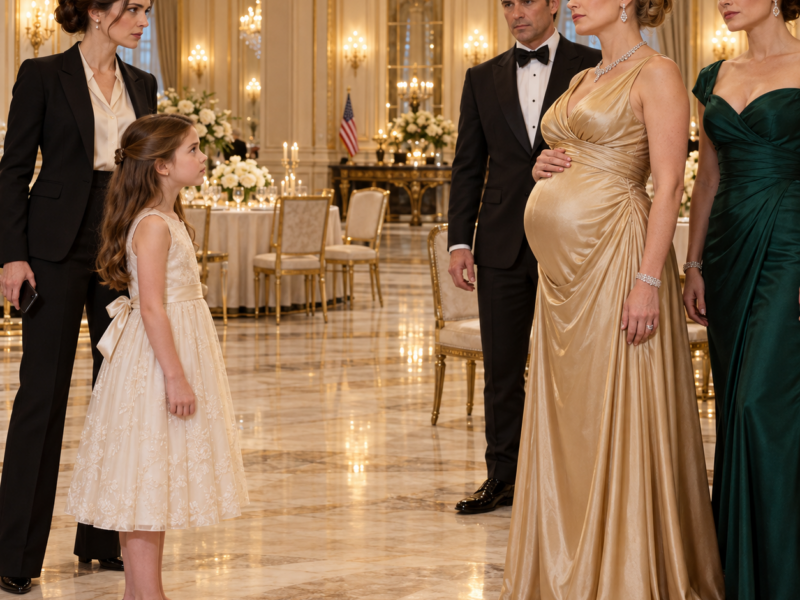
“That woman isn’t pregnant. She has a pillow under her dress,” my eight-year-old daughter announced in front of more than three hundred guests. Vanessa Whitmore’s sister immediately ordered security to remove her. I stepped between them and said, “No one is touching my daughter.” Then I opened the hotel’s hallway footage on my phone, and Cynthia stopped asking me to do my job.
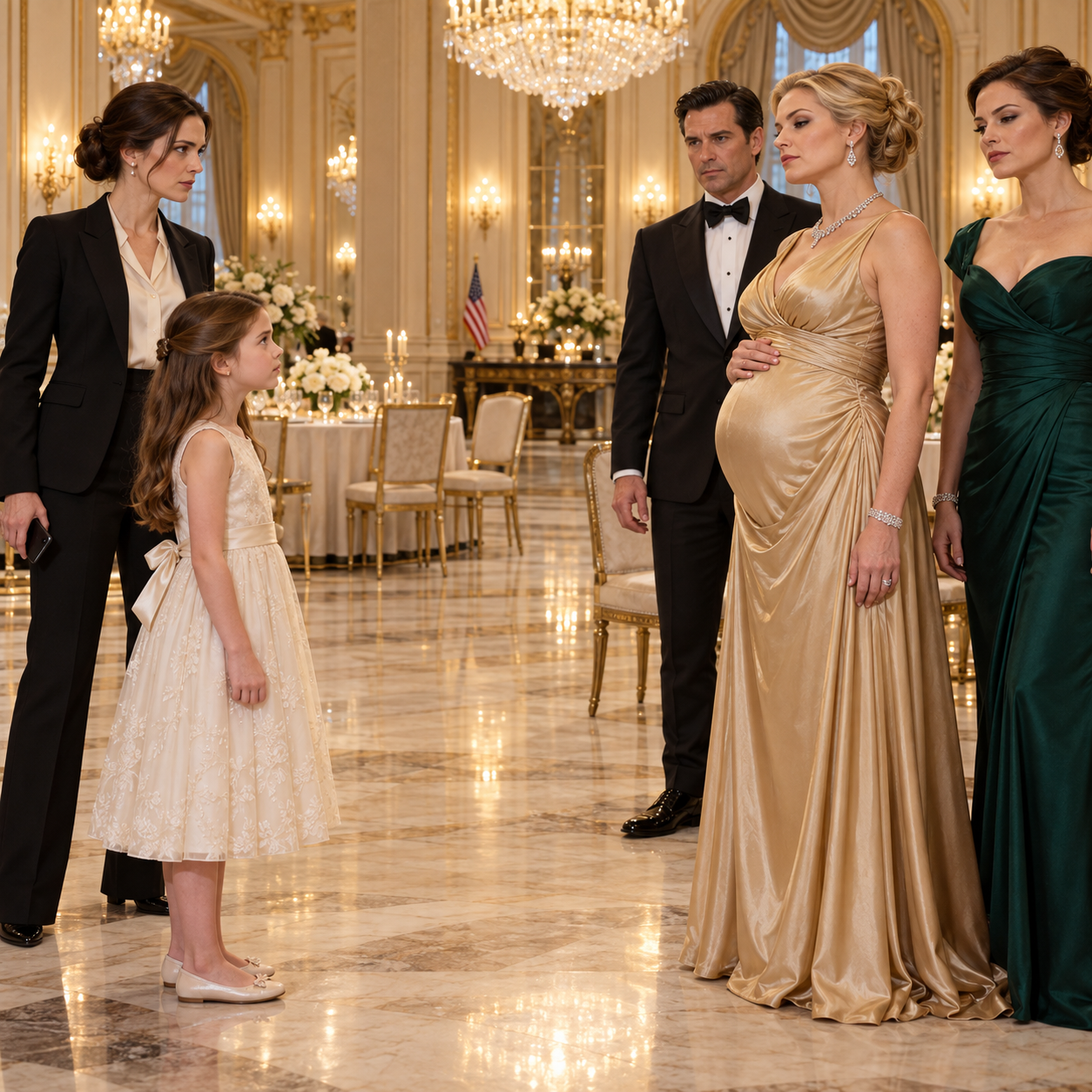
“That woman isn’t pregnant. She has a sofa pillow under her dress.”
My daughter’s voice carried across the ballroom before I could stop her.
More than three hundred guests turned toward Vanessa Whitmore.
She stood beneath the crystal chandeliers of the Grand Regent Hotel, one hand resting on the enormous curve beneath her gold silk gown. Only moments earlier, her husband had announced that their unborn son would become the next heir to the Whitmore family empire.
Now the applause had stopped.
Alexander Whitmore slowly rose from the center table.
“What did you say?”
Lily tightened her grip on my hand.
“I saw her take the belly off.”
Vanessa stared at us.
Her older sister, Cynthia Langford, came forward so quickly that the hem of her dark blue gown caught beneath one shoe.
“That child is lying,” she said. “Security, remove her immediately.”
Under ordinary circumstances, requests concerning security came to me.
My name is Claire Bennett. I was the Grand Regent’s director of security, and I had worked at the hotel for eleven years. I knew the entrances, electronic locks, cameras, emergency systems, and service corridors better than I knew some streets in my own neighborhood.
Lily was eight.
She was at the hotel because her babysitter had become ill two hours before my shift began. The gala required me on-site, and my sister couldn’t collect her until later. With management’s permission, I had settled her in my office with a film, sandwiches, and a promise that this would be a boring evening.
I was wrong about that.
When Cynthia pointed at my daughter, I stepped between them.
“No one is touching her.”
Cynthia looked at the identification badge clipped to my jacket.
“You work for this hotel. Do your job.”
“I am.”
Behind me, Lily pressed against my back.
Alexander looked from his wife to my daughter.
Then he asked, more quietly, “What exactly did she see?”
That question changed the night.
Not the accusation.
Not the pillow.
The decision to ask before dismissing a child because a wealthy adult wanted her gone.
Twenty minutes earlier, the most serious problem on my list had been a delivery van blocking the loading dock.
The gala was the kind of event the Grand Regent hosted several times a year. There were elaborate flowers, a private guest list, photographers near the entrance, and people who expected their preferences to become instructions.
The Whitmores had reserved the ballroom, a dressing suite, several guest rooms, and an adjoining lounge. Alexander’s attorney had asked for a private meeting area before the dinner. Cynthia had changed the room arrangement twice.
I noticed her because she wanted control of details that were not usually handled by a guest.
Which employees had access to the dressing suite?
Could certain doors be kept locked?
Could deliveries go through a side corridor without being logged at the main desk?
The answer to the last question was no.
Our staff recorded deliveries whether they were flowers, medical equipment, or somebody’s favorite brand of bottled water.
Cynthia had smiled as though I was being difficult for sport.
“Surely you understand discretion.”
“I do,” I said. “Discretion doesn’t mean no records.”
She stopped asking me directly after that.
At seven-thirty, Lily needed the restroom.
My office was near the staff corridor, but the closest suitable restroom was beside the private event lounge. I called the event coordinator, Leah, who was passing my door.
“Would you walk her there and bring her back?”
“Of course.”
Lily took her rabbit-shaped key ring and followed Leah.
I returned to the loading-dock issue.
A few minutes later, Leah brought her back.
Lily looked thoughtful.
“Mom, can a belly come off?”
I looked up.
“What?”
“A pregnant belly.”
Leah frowned.
“We passed the dressing suite. Someone opened the door while we were outside.”
I put down my pen.
“What did you see?”
“A lady took something off from under her dress. Then the blue lady put it in a bag.”
Leah looked at me.
“I was speaking to a server for a moment. Lily was beside me, but I didn’t see inside.”
The suite had a reception vestibule and a separate changing area. A partly open interior door had given Lily a brief view while she waited near the restroom.
She hadn’t gone into the room.
She hadn’t been wandering alone.
She had seen something an adult nearby missed.
“Which lady?” I asked.
“The shiny gold one.”
Vanessa Whitmore.
I had seen her arrive.
Her pregnancy was one of the evening’s main attractions. Every event briefing referred to her comfort, her appointments, and the announcement Alexander planned to make.
There were also very specific instructions about photographs.
I did not immediately conclude she was lying.
People use supports, pads, braces, and medical devices beneath clothing. A child might misunderstand what she saw.
But I didn’t tell Lily she had imagined it.
“Thank you for telling me,” I said. “Stay here with Leah for a few minutes.”
Leah remained in my office while I checked the corridor recordings.
There were no cameras inside the dressing suite or restroom.
There were cameras covering the hallway entrances.
Vanessa had entered wearing the fitted gold gown, its fabric stretched over a large belly. Cynthia followed carrying a garment bag.
Eleven minutes later, Cynthia came out with the same bag.
One corner of a crescent-shaped, flesh-colored object was visible near the zipper.
Then Vanessa entered the corridor again.
She wore a looser gold gown, and the shape beneath it looked smaller and higher.
The footage did not prove everything.
It did make Lily’s observation worth examining.
I preserved the relevant files according to our procedures and notified the general manager that there might be a concern requiring a private conversation with the event host.
Then I returned to my office.
My sister was delayed in traffic.
Lily had finished the film and wanted to know whether she could see the ballroom flowers.
I would have said no on an ordinary night.
Instead, I decided to take her with me to the corridor outside the ballroom while I spoke to the event manager. I wanted her close, not sent through the hotel again while something felt wrong.
We arrived as Alexander stood.
He thanked the guests for attending.
He spoke about family, responsibility, and the future.
Then he placed a hand near Vanessa’s shoulder and announced the coming birth of their son.
People applauded.
Vanessa smiled.
Lily looked up at me.
“That’s the lady.”
“I know. We’ll talk quietly.”
But she was eight.
She had just heard hundreds of adults applauding a fact she believed wasn’t true.
Before I could move us away from the doorway, she said the sentence that stopped the room.
Now I was standing between my daughter and Cynthia, with Alexander asking what she had seen.
I crouched beside Lily.
“You don’t have to answer anybody else right now.”
She looked frightened.
“Am I in trouble?”
“No.”
Then I stood.
“Mr. Whitmore, I’d like to discuss this privately.”
Vanessa laughed.
“Discuss what? A child embarrassing me?”
“I’m asking for a private conversation.”
Cynthia looked toward my officers.
“You heard me. Remove them.”
Neither officer moved.
They knew who gave their instructions.
Alexander turned toward Vanessa.
“Let’s step into the lounge.”
“No.”
“Vanessa.”
“I am eight months pregnant, and you’re going to let a stranger interrogate me?”
I kept my voice level.
“No one is asking to examine you or interrogate you in a ballroom.”
Alexander looked at me.
“Is there something besides what she said?”
“Yes. There is hallway footage relevant to her observation.”
Cynthia’s expression tightened.
“She changed because the first dress was uncomfortable.”
“That may be true.”
“Then this is ridiculous.”
“It still deserves a private discussion.”
For several seconds, nobody moved.
Then Alexander nodded.
“Benjamin.”
A man near the center table stood and picked up a leather folder.
Benjamin Cole was the family attorney.
Cynthia immediately turned toward him.
“This is not a legal matter.”
Benjamin looked at Alexander.
“It may be.”
That was the first indication the concern went beyond a false pregnancy announcement.
I asked Leah to take Lily back to my office.
My daughter held my hand tighter.
“I don’t want to go with the blue lady.”
“You aren’t.”
“With Leah?”
“Yes. And Aunt Sarah will be here soon.”
Lily nodded.
I kissed her forehead.
“You did nothing wrong by telling me what you saw.”
She left with Leah.
Then I walked into the adjoining lounge with Alexander, Vanessa, Cynthia, Benjamin, the general manager, and one officer.
The ballroom doors closed behind us.
Guests could continue eating.
Staff would tell them there was a delay in the program.
The room did not need to become a public hearing.
Vanessa stood near the window.
Cynthia stayed beside her.
Alexander asked again.
“Is the pregnancy real?”
Vanessa looked at him.
“I cannot believe you’re asking me that.”
“I’m asking because I need an answer.”
“We have medical reports.”
Benjamin put the folder on the table.
“Reports Dr. Reed provided.”
Alexander turned.
The Whitmore family physician, Dr. Malcolm Reed, had been at the gala.
He signed the ultrasound summaries, laboratory reports, and letters explaining why Vanessa needed private care. He had also discouraged Alexander from arranging independent appointments, saying stress and publicity could harm her.
The general manager asked a staff member to invite him into the lounge.
A few minutes later, the employee returned.
“He’s leaving.”
I went to the service corridor.
Dr. Reed was near the side exit, speaking into his phone.
“Doctor,” I said, “Mr. Whitmore would like to speak with you.”
“I have an urgent call.”
“This concerns the medical documents you provided.”
He looked toward the door.
“I’m not discussing a patient with hotel staff.”
“I understand. You can speak with your patient and her husband privately.”
“I’m leaving.”
I did not order my officer to detain him.
We were hotel security, not police.
I noted the time, preserved the relevant access records, and told him we would cooperate with any lawful request for information.
He left.
His departure made the people in the lounge more anxious.
It was not proof.
But it was something they would later need to explain.
When I returned, Benjamin was reading a document with his glasses low on his nose.
Alexander watched him.
“What?”
“This isn’t the version I approved.”
Cynthia spoke quickly.
“There were minor revisions.”
Benjamin looked up.
“Not minor.”
Three months earlier, Alexander had placed eighteen percent of Whitmore Holdings into a trust arrangement connected to the expected child.
The stated purpose was protection after birth.
The structure gave certain powers to Alexander and Vanessa, with provisions for incapacity and alternate administration.
Benjamin had reviewed a draft.
The executed version contained a clause he had not approved.
If the pregnancy ended without a live birth, the shares would not automatically return to Alexander.
They would pass into a private family foundation administered by Vanessa and Cynthia.
I understood enough about contracts to recognize the significance.
I also understood that a lawyer needed to review the full chain of signatures before declaring what was valid.
Benjamin said exactly that.
He would contact the custodian and seek an immediate hold pending review.
Alexander looked at Cynthia.
“I never approved that.”
“It’s continuity planning.”
“Who requested it?”
She folded her arms.
“You wanted the child protected.”
“I wanted my child protected. Not shares transferred to you if there was no child.”
Vanessa began crying.
The sound changed the room.
Alexander took one step toward her.
Then stopped.
“Tell me what happened.”
She covered her mouth.
“I lost the pregnancy.”
Nobody spoke.
“At nine weeks.”
Cynthia closed her eyes.
Alexander stared at his wife.
“You lost it months ago?”
Vanessa nodded.
“Why didn’t you tell me?”
“I wanted to.”
“Then why didn’t you?”
Her answer came in pieces.
Fear.
The family’s expectations.
The announcement already made.
The new trust.
Cynthia telling her to wait until the right moment.
Dr. Reed saying he could help manage things.
Each explanation moved the decision slightly farther away from Vanessa.
Alexander listened.
Then he said, “None of that required you to let me believe I was still becoming a father.”
She looked at him.
“I thought we could fix it.”
“How?”
Vanessa glanced toward Cynthia.
Cynthia’s voice sharpened.
“Stop talking until we have proper advice.”
Benjamin closed the folder.
“We need police.”
Vanessa shook her head.
“No. This is private.”
Alexander looked at the garment bag Cynthia had placed beside her chair.
“What is in there?”
“Clothes.”
“Show me.”
“You don’t get to search my belongings.”
She was correct that being frightened did not give everyone in the room unlimited authority over her possessions.
I said, “No one is going to grab the bag.”
Alexander stepped back.
But Cynthia reached for it so quickly that the partly closed zipper opened farther.
The edge of the cushion appeared.
Beside it was an envelope.
Several sheets slipped out when she lifted the bag.
An ultrasound print landed face-up on the carpet.
Benjamin bent to pick it up.
Then he stopped.
The patient’s name was visible.
Eleanor Hale.
The date was five weeks earlier.
Alexander looked at the page.
“What is that?”
Benjamin handed it to him.
I watched Alexander’s face change.
Not anger.
Something much more difficult to name.
“Eleanor,” he whispered.
Eleanor Hale Whitmore was his first wife.
Three years earlier, her car had gone off a mountain road during a storm. The vehicle burned before rescue workers arrived.
Dr. Reed provided information used in the identification process.
There had been a sealed casket.
Alexander believed he had buried her.
He had spent a long time grieving before beginning a relationship with Vanessa.
Now a current ultrasound carried Eleanor’s name.
He looked at the sisters.
“Why do you have this?”
Neither answered.
Benjamin called the police.
I contacted our management team and arranged for the room to remain private.
The file that followed the ultrasound out of the envelope included a copy of a missing-person report.
It concerned a woman who had appeared at a shelter in northern California six months earlier.
She used the name Eleanor Hale.
She said she was being held against her will.
Two days later, she disappeared.
The photograph was poor.
Alexander recognized her immediately.
“That’s my wife.”
Vanessa reached toward him.
He moved away.
“Did you know?”
She was silent.
The answer was not legally complete.
Emotionally, it was devastating.
Detective Maya Torres arrived with two officers.
She began by separating the people who might influence one another’s accounts.
She did not announce guilt in the ballroom.
She did not order three hundred guests held indefinitely because they had attended a dinner.
People whose observations mattered were asked to remain long enough to provide contact details and initial statements. Others were allowed to leave. Staff managed the exits calmly.
Torres spoke with me in a small office.
I gave her the preserved corridor footage and access records.
I described Lily’s words without adding conclusions.
Then she asked about Julian Whitmore.
Alexander’s younger brother was at the gala.
He was forty, executive vice president of Whitmore Holdings, and widely described as his brother’s most trusted adviser.
He had stayed remarkably calm.
He offered to take Alexander home.
“The police can deal with this,” he said.
Alexander stared at him.
“My wife may be alive.”
“I know.”
“Do you?”
Julian’s expression changed for half a second.
I noticed.
So did Lily, who had returned to my office with my sister.
When I stepped in to check on her, she said, “Mom, that man was in the hallway too.”
“Which man?”
“The one who looks like the sad man.”
She meant Julian.
“What did you see?”
“He gave the doctor a card.”
I wrote down her exact words.
Then I checked the access records.
At 7:42, Julian’s event guest credential opened the private suite.
A temporary credential assigned to Dr. Reed entered three minutes later.
Vanessa and Cynthia arrived afterward.
Again, the records did not tell us what happened inside.
They gave investigators a sequence worth checking.
Torres asked Julian why he had arranged access for Reed before Vanessa arrived.
He said the doctor needed a private place.
That might have been true.
He could explain it.
But when his phone rang, his composure shifted.
He rejected the first call.
Then the second.
Torres did not seize it because he looked nervous.
She asked whether the calls concerned the clinic named on the documents.
Julian declined to answer.
The detective noted that.
Later, through the appropriate legal process, investigators obtained the voicemail that became one of the most significant early pieces of evidence.
A nurse at North Valley Care Center said the patient in Room 214 was awake and asking for Alexander.
She said the patient recognized Julian.
And she said the patient accused him of trying to kill her.
I did not hear the voicemail broadcast to the ballroom.
I learned its contents after investigators had secured it.
That was how much of the truth arrived.
Not as one spectacular revelation.
As records, statements, contradictions, and details somebody had tried to make unimportant.
A medical transport bracelet was found in the dressing suite after staff secured the room.
It named North Valley.
On the reverse was the number 214.
Torres contacted officers in the jurisdiction where the facility stood.
They moved quickly because there was reason to believe a woman was being unlawfully confined and could be in immediate danger.
Local officers reached the property first.
Torres coordinated from the hotel, then traveled when the situation allowed.
I did not accompany armed officers through a locked clinic because I managed hotel cameras.
I had a daughter to take home and a hotel incident to document.
But I stayed awake most of that night, waiting for news.
North Valley’s website described it as a private recovery facility for patients requiring discretion.
There was no public sign near the road.
The director initially refused to allow officers inside.
The circumstances changed when a staff member confirmed that a woman matching Eleanor’s description was held in a locked medical wing and could not leave.
Room 214 opened from the corridor.
Inside was a woman with shorter hair and a thin face, lying beneath a white blanket.
She was pregnant.
She was Eleanor Whitmore.
Alive.
Alexander saw her after emergency personnel had begun assessing her.
He stopped in the doorway.
“Eleanor?”
Her eyes opened.
She stared at him as though he might be another thing she could not trust.
Then she whispered, “Alex?”
He moved closer.
The account of that meeting came to me later, in pieces, from both of them.
“You’re alive,” he said.
She tried to sit.
When a member of staff approached, she recoiled.
“Don’t let them give me anything.”
The paramedics took over.
Medication records were secured.
Eleanor would be transferred to an independent hospital.
Alexander stayed beside her.
“I buried you.”
“I know.”
“Why didn’t you come home?”
“I tried.”
He looked at her stomach.
He could not make the facts fit together.
Eleanor saw the question before he asked it.
“Don’t let Vanessa take the baby.”
Alexander sat down.
“What baby?”
“This baby.”
“Is she mine?”
Eleanor closed her eyes.
“Yes.”
Four years before, they had undergone fertility treatment.
Several embryos remained stored after unsuccessful attempts.
Alexander believed the remaining embryos had been destroyed according to Eleanor’s instructions before her apparent death.
They had not.
Dr. Reed controlled relationships with the storage and treatment facilities.
Records obtained later showed that Eleanor’s consent had been forged.
A transfer had taken place without her lawful permission.
The timing had been obscured through altered records, including attempts to make the pregnancy appear at different stages depending on which person was receiving information.
Independent clinicians would establish the correct dates.
The plan, however, was clear.
Eleanor would carry a child genetically related to both her and Alexander.
Vanessa would pretend to be pregnant.
After the birth, forged documents would identify Vanessa as the mother.
A test of Alexander’s paternity would confirm something true while concealing everything else.
I remember sitting at my kitchen table when Torres gave me the broad outline.
My sister was asleep in the guest room.
Lily had finally stopped asking whether the gold lady would come to our house.
I held the phone tightly.
“Eleanor knew they wanted to take the baby?”
“Yes.”
“Has she been moved?”
“Yes. She’s under independent care.”
I looked toward Lily’s bedroom.
The relief I felt was inseparable from horror.
A cushion beneath a dress was a small thing.
The meaning attached to it was not.
Eleanor told investigators that the scheme began long before Vanessa’s gala announcement.
Three years earlier, she found irregular payments in the Whitmore Family Foundation.
The money went to supposed research clinics and maternal-health programs.
Some did not exist.
Others had no connection to the services listed.
Julian approved the transfers.
Cynthia organized entities receiving the funds.
Dr. Reed supplied medical invoices.
Vanessa helped with donor and event records before she became Alexander’s wife.
Eleanor copied what she could.
She planned to show Alexander and the family attorney.
An email was intercepted.
Julian confronted her at the mountain house.
According to Eleanor, he told her Alexander would not believe accusations against his own brother.
By then, Julian had already described her as anxious and suspicious.
Dr. Reed agreed.
Alexander remembered those conversations.
He remembered encouraging Eleanor to rest.
He remembered telling her to take the medication Reed recommended.
He had wanted the explanation that made the conflict smaller.
Now he understood that his willingness to accept it had made her world smaller instead.
On the night of the crash, Eleanor left the mountain house carrying copied records.
She said Julian followed.
The collision occurred before the fire.
Instead of being taken to a public hospital, she was transported through a private medical service connected to Reed.
The identification afterward relied on falsified information.
The remains buried under her name belonged to another woman.
That woman would later be identified as Mara Jennings.
She had a family too.
The investigation could not become only the story of a wealthy wife found alive.
Someone else had been erased to make the false death believable.
Eleanor was moved between private facilities under different names.
Medical labels were used to discredit her.
Restrictions were described as treatment.
Sedating medication made it difficult to argue, plan, or remember clearly.
Julian wanted the financial records she had copied.
She refused to tell him where they were.
Six months before the gala, she escaped during a transfer.
A delivery driver found her beside a road and took her to a shelter.
She gave her maiden name.
She called the Whitmore legal office.
The message never reached Alexander.
An assistant, Denise Carter, later admitted that Cynthia paid her twenty thousand dollars to erase it.
Denise retained a copy because she feared being left responsible if the arrangement collapsed.
In the recording, Eleanor said her husband believed she was dead.
She named Julian and Reed.
She gave an approximate location.
She also referred to a pregnancy she was beginning to understand, though the records around it were still being hidden from her.
That helped resolve the timeline investigators initially found contradictory.
The procedure had occurred before her escape.
After she was returned to North Valley, Reed manipulated records to make it appear later.
He wanted different people believing different dates.
Official-looking paperwork had become part of the confinement.
A doctor came to the shelter with records describing Eleanor as a vulnerable psychiatric patient.
Staff did not simply hand her over.
They sought outside assistance.
But the false records and Reed’s professional standing prevailed.
She was returned.
Eleanor would later say that this was one of the hardest parts to describe.
She had reached a place that wanted to help.
The people there were not all cruel.
Yet the document carried more weight than the woman speaking.
By the time she was back at North Valley, she understood the danger to the baby.
She began memorizing names, schedules, and details.
A nurse named Marissa Cole worked there for four months.
She suspected Eleanor was being held improperly.
At first, she was afraid to act.
Then she copied evidence and sought outside advice.
The voicemail to Julian was part of a complicated effort to keep her position believable while arranging help.
She did not become innocent merely because she eventually spoke.
But speaking changed what could be stopped.
Among the records she preserved was a video showing Julian beside Eleanor’s bed.
“You will give birth,” he told her. “Vanessa will take the child, and Alexander will finally become useful.”
Eleanor asked why he hated his brother.
“I don’t hate him,” Julian said. “I hate standing behind him.”
That sentence explained less than Julian thought it did.
Resentment was not a business plan.
It became one only because people with access, credentials, and ambition agreed to turn other people into tools.
Investigators also found a medication plan bearing Alexander’s name.
He had recently been given a nightly supplement by Vanessa.
Independent tests and analysis raised concerns about substances he had not knowingly agreed to take.
The plan appeared designed to impair his functioning after the baby’s birth.
Julian would lead the company.
Vanessa would direct the child’s trust.
Cynthia would administer the foundation named in the disputed clause.
It was not necessary for any one person to control everything.
Together, they would control enough.
Alexander entered independent medical care.
He stepped back from company leadership while the findings were assessed.
I respected that decision.
He could have announced he was perfectly capable because pride made anything else unbearable.
Instead, he allowed uncertainty to be examined.
It was a small beginning.
He had much more to account for.
The first time I saw Eleanor was at the hospital several days later.
She asked to meet me.
I agreed after confirming that a visit would not interfere with her rest.
Lily stayed with my sister.
Eleanor sat beside a window wearing a soft cardigan.
She looked tired in a way sleep alone could not repair.
“Claire Bennett?”
“Yes.”
She smiled faintly.
“Thank you.”
I sat where she indicated.
“You don’t need to thank me before we talk.”
“I wanted to.”
“All right.”
For a moment, we were quiet.
Then she asked about Lily.
“Is she frightened?”
“A little.”
“I’m sorry.”
“You didn’t frighten her.”
Eleanor looked out the window.
“People keep saying your daughter saved us.”
I took a breath.
“She noticed something. Other people did the work that followed.”
Eleanor nodded.
“That matters.”
“It does.”
“I tried to tell adults for years.”
I looked at her.
“I’m sorry they didn’t listen.”
She lowered her eyes.
“I don’t need everyone to apologize. I need them to change what they do next.”
That became the sentence I carried back to the hotel.
We had already begun reviewing our procedures.
Not because an eight-year-old should become responsible for fraud detection.
Because no staff member should assume a child’s observation can be dismissed simply because the adult being described is influential.
We also reviewed private-event requests, access privileges, and how concerns involving medical equipment or unusual room use were escalated.
I was careful not to make the hotel invent powers it did not have.
Security could observe, preserve records, protect people, and contact appropriate authorities.
It could not compel medical examinations.
It could not treat every guest’s refusal as guilt.
It could not search private possessions merely because a story sounded suspicious.
Those limits mattered.
What saved the night was not unlimited authority.
It was using the authority we had properly, then asking people with the necessary authority to act.
Eleanor and Alexander’s reunion was not a romantic scene that erased three years.
They were both alive.
They still loved parts of the life they had shared.
They had also been changed.
Alexander believed he had buried her.
He had married another woman.
Eleanor had spent years confined and told that her memories were wrong.
Her pregnancy came from a violation of choice.
Finding one another did not return them to the day before the crash.
At their first longer conversation, Alexander apologized.
Not for grieving.
Not for wanting companionship after believing his wife had died.
He apologized for accepting Julian’s description of her instead of asking more questions.
For letting Reed become the only medical voice.
For treating family trust as a reason to stop checking.
Eleanor listened.
Then she said, “I need you to understand that being alive does not mean I am ready to return to the old life.”
He nodded.
“What do you need?”
“People keep asking that.”
“I’m sorry.”
“I need time without having to give you the right answer.”
He accepted it.
That was important.
He could not repair years of lost autonomy by offering care with a hidden deadline attached.
Independent doctors monitored the pregnancy.
Eleanor chose who could receive information.
Alexander was included with her permission.
Paternity and parentage questions were addressed through proper legal procedures.
The trust arrangements were held pending review.
Vanessa and Cynthia did not get access simply because documents called them family.
Julian’s corporate authority was suspended.
The board appointed independent leadership.
Benjamin acknowledged that his office needed its own investigation.
He had reviewed a draft and assumed later versions were unchanged.
His staff had systems that allowed an assistant to intercept a desperate call without immediate detection.
Being deceived did not erase those failures.
The legal office preserved records and cooperated.
Denise eventually testified.
Each participant tried, at some point, to reduce their responsibility to a smaller act.
One altered clause.
One message erased.
One appointment arranged.
One false report signed.
One drink prepared.
Taken together, those acts built a prison around a woman and a financial structure around an unborn child.
I thought about that often.
Large harm usually requires ordinary decisions.
That means ordinary decisions can also interrupt it.
A question.
A record kept.
A refusal to delete a file.
A person listening before deciding.
Lily returned to school the Monday after the gala.
I wanted everything to feel normal.
It didn’t.
She asked whether the blue lady knew where we lived.
Whether I could lose my job.
Whether the gold lady had a baby somewhere else.
I answered only what she needed to know.
The police were handling the adults.
She was safe.
I was working.
She had not caused the trouble.
At bedtime, she asked, “Was it bad that I said it loud?”
I sat beside her.
“It surprised people.”
“Were you mad?”
“No.”
“Could I have told you instead?”
“Yes. And you did.”
She thought about that.
“But the man was saying it was his baby.”
“I know.”
“I didn’t want everybody to believe the pillow.”
I brushed hair away from her face.
“You were trying to tell the truth.”
She nodded.
Then she asked whether we could have pancakes for breakfast.
We could.
A child should not have to remain inside a serious conversation because adults find her courage impressive.
She could be worried.
She could also be eight.
I spoke with her school counselor.
Not to turn the gala into a story for the class.
To make sure she had support if questions came up.
We kept publicity away from her.
The hotel did not release her name.
Alexander wanted to thank her publicly.
I declined.
He offered a scholarship.
I declined that too.
Not because education funding was wrong.
Because my daughter did not need to become a permanent part of the Whitmore family’s recovery story.
He understood eventually.
A private thank-you was enough.
One afternoon, he came to my office after a legal meeting.
Lily was drawing while my sister parked outside.
He crouched at a respectful distance.
“Thank you for telling your mother what you saw.”
She looked at him.
“I just saw the pillow.”
“I know.”
“Is the real pregnant lady okay?”
“She’s getting better.”
“And the baby?”
“The doctors are taking care of her.”
Lily nodded.
“Good.”
Then she returned to her drawing.
Alexander stood.
That was the right size for the moment.
He did not promise her a grand future.
He did not call her his family’s savior.
He let her go back to the horse she was drawing, which looked more like a dog.
A week after Eleanor’s rescue, another part of the history surfaced.
She told investigators the financial evidence was still safe.
Alexander asked where.
“In our daughter’s room.”
He looked confused.
They did not have a living daughter.
Eleanor meant Rose.
Their first child.
Rose Eleanor Whitmore had lived for eleven hours five years earlier.
Reed told them she died because of an undetected heart condition.
Eleanor had later found discrepancies in the records.
Those discrepancies led her toward the foundation transfers and the people involved.
Before the mountain crash, she hid a waterproof drive in a maintenance compartment beneath Rose’s memorial stone.
It was not inside the grave.
Investigators obtained permission and the necessary authority to retrieve it without disturbing the burial.
Alexander went with Benjamin and Torres.
He sat beneath an oak tree while technicians worked.
“I haven’t been here in two years,” he said.
Nobody offered commentary.
Grief did not require a stranger to decide whether he had visited often enough.
The drive contained copied accounts, correspondence, and records related to Rose’s care.
The first findings raised serious questions about the cause of her death.
Later, independent specialists reviewed the original chart, medication entries, witness statements, and other evidence.
The conclusion did not come from Alexander reading one page beside a grave.
It came from careful examination.
Rose had not been born with the fatal condition described on the certificate.
A medication had been administered without a documented medical need.
It caused the emergency that killed her.
Reed falsified the explanation.
Financial records connected the timing to a descendants’ trust.
Rose’s birth would have changed voting rights after a specified survival period under the family’s old arrangement.
Because she died before the condition was satisfied, assets remained in a central holding structure Julian could use.
The charter did not make murder inevitable.
People made choices.
But it created an incentive that should never have existed around a newborn’s survival.
Julian used the retained authority to begin moving money through the foundation.
Alexander learned this slowly.
Each verified fact was another loss.
He had mourned a medical tragedy.
Now he had to understand that someone he loved participated in causing it.
Eleanor’s recordings explained why she had not told him immediately after finding discrepancies.
She feared he would confront Julian before evidence was secure.
She also feared he would believe his brother.
“That fear wasn’t entirely fair to him,” she said in one recording. “But it didn’t come from nowhere.”
I respected that she could say both.
She did not need to make Alexander blameless to love him.
She did not need to make him guilty of Julian’s crimes to acknowledge his failures.
The drive also contained messages about arranging Alexander’s introduction to Vanessa.
He had believed they met at a charity retreat.
Julian helped organize it.
Vanessa coordinated part of the event.
She had been given details about Alexander’s grief, his habits, and what he might find comforting.
That did not mean every moment between them was false.
It meant the relationship began inside a plan he did not know existed.
At times, Vanessa may have cared.
She still used information taken from his private life to gain access.
After the pregnancy loss, she faced a choice.
Tell him.
Or continue.
She continued.
Later, she cooperated with investigators.
Her statement established details about the cushion, fabricated appointments, medical documents, and substances she gave Alexander.
She admitted knowing Eleanor was alive.
She admitted knowing the baby would be presented as hers.
She said she had been told Eleanor would be moved elsewhere after the birth.
When asked whether she believed that, she eventually said no.
The answer mattered.
Fear of losing a marriage could explain the first lie.
It could not explain away knowingly participating in confinement and the planned removal of another woman’s child.
Vanessa’s cooperation helped locate original fertility records.
It did not make her innocent.
Cynthia remained defiant.
She described altered documents as continuity planning.
Payments through shell organizations as legitimate services.
An introduction arranged to target a grieving man as an ordinary event.
Words can make wrongdoing sound tidy if everyone agrees not to examine the facts underneath.
Torres did not agree.
Neither did the prosecutors.
Julian claimed Eleanor entered care voluntarily.
Clinic records and videos contradicted him.
He claimed the pregnancy was part of a confidential surrogacy arrangement.
The forged consent and Eleanor’s account contradicted him.
He claimed financial transfers were approved.
Messages directing people to keep Alexander away from the numbers contradicted him.
Reed relied on professional authority.
Independent professionals examined the work.
That was the pattern that finally broke the conspiracy.
No one person was allowed to define the truth without review.
Six months after the gala, the major charges were filed.
Some proceedings began earlier.
Others required more evidence.
There were charges concerning unlawful confinement, fraud, falsified records, medical crimes, the plan affecting Alexander, and Rose’s death.
I gave a formal statement.
The hotel provided authenticated records.
Lily’s initial observation was documented through child-appropriate procedures. The case did not require her to sit in a courtroom reliving the evening while adults argued over what she meant by a pillow.
There was independent evidence.
That protected her.
It also made the case stronger.
Whitmore Holdings could not wait years for every legal matter to finish.
Employees still needed salaries.
Projects still required decisions.
Pension funds and suppliers had interests that were not identical to the family’s reputation.
Alexander returned for an emergency meeting after independent medical specialists confirmed he could safely participate.
The meeting took place at the Grand Regent.
No flowers.
No orchestra.
No announcement about an heir.
Directors, lawyers, auditors, and employee representatives sat at plain tables.
I supervised the security arrangements.
Alexander stood at the front.
“For generations, my family treated control as though it were the same as leadership.”
He did not blame only Julian.
He acknowledged signing documents without reading the final versions.
Allowing family relationships to replace oversight.
Accepting one medical opinion as the only opinion.
Ignoring Eleanor’s concerns because listening would have required him to question a brother he loved.
“I was deceived,” he said. “But being deceived does not erase every decision I made while it was convenient not to look closely.”
Several people shifted in their chairs.
That was probably a good sign.
He proposed professional management, independent administration of family-beneficiary interests, stronger review of conflicts, and protected reporting channels.
The foundation would undergo a full independent audit.
No family member would automatically inherit an executive position.
No child’s trust would be used to provide an adult with unchecked corporate power.
A director objected.
“You’re surrendering family authority because of a private scandal.”
Alexander looked at him.
“My daughter’s life was treated as a condition in a financial document. My wife was confined behind medical records. There is nothing private about a system that makes those things possible.”
The proposal passed.
Eleanor did not attend.
She had no interest in entering a ballroom while pregnant so strangers could study her.
She sent a statement.
*The child I am carrying is not a symbol of corporate continuity. She is not a solution to the Whitmore family’s problems. She is a child. Any arrangements created for her must protect her choices and safety before they protect anyone’s voting power.*
Benjamin read it.
The room stayed quiet afterward.
The baby was a girl.
Eleanor planned to name her Hope Rose.
Rose for the daughter they lost.
Hope for a future no one had the right to claim in advance.
The birth came seven weeks later.
Eleanor chose an independent public hospital.
The medical team was not selected by the Whitmore family.
Security was arranged appropriately, without making the maternity floor feel like an armed stage.
Alexander waited in a nearby family area.
Eleanor invited him to meet the baby after delivery.
Not during it.
He respected that.
For three years, people had taken decisions about her body away from her.
He could not demonstrate care by ignoring the first difficult boundary she set.
Hope was born healthy.
The records named Eleanor as her mother.
Independent testing confirmed the biological relationships.
Nobody tried to hide the circumstances.
Nobody allowed those circumstances to become the child’s entire identity.
Newspapers called her the Whitmore miracle baby.
Eleanor released one brief statement asking them to stop.
Her daughter was a child who deserved privacy.
She was not evidence of family triumph.
Some outlets listened.
Others needed firmer legal reminders.
Alexander did not take her to shareholder events.
He did not place her photograph on foundation materials.
He did not announce that she had saved the family.
The family’s adults had work to do.
Hope did not owe them redemption.
I met her when she was a few weeks old.
Eleanor asked whether Lily wanted to come.
I spoke with my daughter first.
“You don’t have to.”
“I want to see the baby.”
“Then we’ll go.”
At Eleanor’s temporary home near the coast, Lily stood beside the cradle and looked down.
“She’s small.”
“Yes,” Eleanor said.
“Does she know about the pillow?”
“No.”
“Good.”
I smiled.
Eleanor did too.
Lily gave her a card.
There was a drawing of a baby beneath a large sun.
Inside, she had written, I HOPE YOU LIKE YOUR REAL MOM.
I almost corrected the wording.
Eleanor stopped me with a glance.
She read it carefully.
Then she said, “I’m glad I get to be here.”
That was the right answer.
Lily did not need a lecture about complex parenthood.
She needed to know the woman found in the clinic was with her baby.
After the visit, she asked whether she had done enough.
I looked at her.
“What do you mean?”
“Everybody keeps saying thank you.”
“You don’t have a job to finish.”
“Oh.”
“You told me something you saw. The adults are responsible for what happened afterward.”
She nodded.
Then she asked whether we could stop for ice cream.
We did.
That was also part of protecting her.
The first year after Hope’s birth was difficult for Eleanor.
There were nights she could not sleep unless a light stayed on.
She disliked people standing between her and a doorway.
Medical appointments frightened her even when the clinicians were careful.
She worked with specialists.
She made progress.
Then sometimes she felt worse again.
Recovery was not a line she crossed and left behind.
Alexander visited according to an arrangement they developed with professional support.
They attended counseling separately.
Later, they attended some sessions together.
People expected a reunion.
They wanted the story of the wife found alive to end with a restored marriage.
Eleanor wanted a life in which she could decide what happened next without disappointing the audience.
Eventually, she asked for a divorce.
Their legal status required review because the declaration of death had been based on fraud and Alexander had entered another marriage believing she was dead.
Lawyers handled the questions.
Courts corrected records.
The second marriage was resolved separately.
None of it was as simple as announcing that one wife had returned and the other never counted.
Eleanor looked at the divorce papers for a long time.
Then she said yes.
Alexander signed without trying to turn her decision into another proof that she had stopped loving him.
The divorce did not erase what they had shared.
It gave her room to build an identity not automatically tied to the years before captivity.
They became co-parents.
Not perfectly.
But with more honesty than they had managed before.
Hope had two homes.
A predictable schedule.
Adults who asked rather than assumed.
Independent administration protected her financial interests.
Neither parent could make major changes alone.
Alexander did not treat those limits as insults.
“They protect her from everyone,” he said. “That includes me.”
I remembered the man at the gala announcing an heir.
He was becoming a different kind of father.
One who understood that providing for a child did not entitle him to define her future.
The trial began eighteen months after the gala.
Several related proceedings occurred separately.
The courtroom was not one event that settled every crime at once.
But the principal case brought together enough evidence that the pattern became unmistakable.
Eleanor testified with measures designed to protect her health and privacy.
She described the crash.
The facilities.
The false medical labels.
The pregnancy procedure she had not authorized.
She also described Rose.
The evidence concerning Rose came from independent medical review, original records, witnesses, and financial documents.
It was not enough for one grieving parent to accuse someone.
The prosecution had to show what happened.
Three specialists explained why the medication recorded in Rose’s chart did not fit the condition later claimed.
A former nurse testified about Reed’s instructions.
She said she had remained silent because she feared losing her career.
“What changed?” the prosecutor asked.
“I realized silence wasn’t something that happened to me. It was something I kept choosing.”
That answer stayed with me.
Cynthia testified in her own defense.
She described herself as a sister trying to protect Vanessa after a pregnancy loss.
Documents showed that parts of the financial plan existed before that loss.
The miscarriage did not create the conspiracy.
It gave them a new problem to solve inside it.
Vanessa identified the people involved and admitted her own actions.
She did not get to call herself only frightened.
She had been frightened.
She had also continued.
Julian’s recordings were played.
His messages were read.
The clinic voicemail was admitted through the appropriate witnesses and records.
Reed’s lawyers argued that everything had been legitimate treatment.
The actual treatment records, absence of valid consent, and contradictory documentation defeated that argument.
The verdicts came after days of deliberation.
Julian was convicted on the major counts.
Reed was convicted of the medical crimes and offenses connected to the confinement and Rose’s death.
Cynthia was convicted of conspiracy and financial crimes, along with her role in the unlawful confinement.
Vanessa received a substantial sentence, reduced in part because her cooperation helped establish evidence.
The exact lengths mattered to the people involved.
They did not become the only measure of justice.
Licenses were revoked.
Facilities closed.
Records corrected.
Other patients’ cases reviewed.
People who had been described as confused or unreliable received independent evaluation.
More investigations followed.
Mara Jennings was identified through the reopened death investigation.
Her family had spent three years searching.
Alexander paid expenses connected to the corrected burial and memorial.
He did not ask them to forgive the Whitmores.
Money could address costs.
It could not restore a person to a family.
I was grateful the investigation remembered her.
Stories about wealthy people can pull every other victim into the background.
Mara had a life.
Someone knew her laugh.
Someone remembered the last thing she said.
Her identity deserved correction for its own sake.
At sentencing, Alexander addressed Julian.
He did not say they had never been brothers.
That would have been easier.
“I loved you,” he said. “That is why you had access.”
Julian stared at the table.
“You treated trust as permission. Eleanor’s trust gave you information. My grief gave you signatures. Vanessa’s fear gave you cooperation. Cynthia’s ambition gave you a structure.”
Alexander paused.
“Other people made choices too. You did not do this alone. But you kept telling everyone that somebody else carried the responsibility.”
Eleanor’s statement was read separately.
She asked the court to recognize that confinement could be built from respected names and official documents as effectively as from locked doors.
*Every time I asked for help,* she wrote, *someone looked at the records and sent me back to the people who created them.*
I thought about my daughter in my office.
Can a belly come off?
A question that sounded impossible.
I could have said she misunderstood.
I could have told her to finish the film.
It frightened me to understand how small the difference was.
The hotel’s review became permanent policy.
Concerns raised by children would be documented appropriately and assessed without assuming they were true or false merely because of age.
Adults making accusations would receive the same care.
Staff would look for facts.
They would protect the person while checking.
There was no plaque bearing Lily’s name.
No annual ceremony where she had to retell the night.
The policy belonged to the hotel.
Her childhood belonged to her.
She grew.
At nine, she wanted to be a veterinarian.
At ten, she announced animals bit people and perhaps architecture was better.
At eleven, she became interested in books about space.
Sometimes she remembered the gala.
Sometimes months passed without mentioning it.
I was glad.
The event was important.
It did not need to become the center of every year that followed.
Three years after Hope’s birth, the Grand Regent hosted a gathering focused on practical support for people affected by financial and medical coercion.
Eleanor agreed to attend because it was not a celebration of her suffering.
There were patient advocates, legal organizations, clinicians, and people working on independent review.
Alexander came as a foundation board member.
Not chief executive.
He had stepped down from permanent executive leadership.
A professional team ran Whitmore Holdings.
The family’s authority was more limited and more accountable.
The change cost him status.
It gave him time with Hope.
It also gave the company more stability than one family’s private loyalties ever could.
Lily was eleven.
Before the event, she asked whether Eleanor might be angry with her.
“Why?”
“Because everybody saw her private ultrasound.”
I looked at my daughter.
She understood something many adults had missed.
The image was medical information.
It had been stolen and misused.
Its exposure was not harmless simply because it helped uncover a crime.
“You didn’t take the picture,” I said.
“I told you about it.”
“Yes.”
“Still.”
I asked Eleanor whether Lily could speak with her.
She agreed.
When they met, Lily said, “I’m sorry your picture was used in the ballroom.”
Eleanor bent so their faces were level.
“You didn’t steal it.”
“No.”
“You told your mother what you saw.”
“Yes.”
“That helped the people looking for me. The adults who used the picture without permission are responsible for that.”
Lily looked relieved.
“Did the room look like a hospital?”
“Yes.”
“But you couldn’t leave?”
“No.”
“Then it wasn’t really helping you.”
“No,” Eleanor said. “It wasn’t.”
Lily thought about that.
Then Hope arrived carrying a stuffed rabbit.
Within minutes, the girls were making it drink from an empty cup.
We stood back.
No speech was needed.
The event announced funding for independent patient advocates, support for people challenging inaccurate records, and legal services connected to coercive financial arrangements.
The foundation could not create national laws by declaration.
It could fund programs, require independent review within its own activities, and support people trying to change systems.
That was enough work to begin with.
Eleanor served as an adviser.
She refused an executive title.
“I want someone to listen to the person before deciding what the file means,” she said.
Alexander nodded.
He had learned what it cost to reverse that order.
Their relationship became easier with time.
Not romantic.
Not a performance of unity.
They could attend the same event.
Discuss Hope’s school.
Disagree over a schedule without treating disagreement as betrayal.
They visited Rose’s grave.
Sometimes together.
Often separately.
Grief did not need to be shared in exactly the same way to remain real.
Vanessa sent Eleanor a letter from prison.
She apologized for using the ultrasound images and participating in the plan concerning Hope.
Eleanor read it.
Then placed it in a sealed legal file.
She did not respond.
She would decide later what Hope should know and when.
Vanessa’s remorse belonged to Vanessa.
Eleanor did not have to relieve it.
Cynthia never gave a meaningful apology.
Julian continued arguing that he had acted to protect the company.
His appeals did not undo the findings.
Reed died years later while serving his sentence.
The reviews of other patients continued.
Accountability did not end because one person could no longer see it.
Five years after the gala, I stood in the same ballroom while volunteers arranged donated books for a children’s literacy fundraiser.
Lily was thirteen.
She had become very particular about sorting books by age group.
The chandeliers remained.
The center table was gone.
No one was announcing an heir.
No one was displaying a medical image.
There were folding tables, cardboard boxes, and children arguing cheerfully over which stories were funniest.
Alexander arrived carrying two boxes.
Hope followed.
Eleanor came later.
Hope was five now, with her mother’s eyes and a habit of asking questions until someone gave her a useful answer.
She ran toward Lily.
“Dad says you’re the girl who saw the pillow.”
Lily looked embarrassed.
“I was eight.”
“He says you saved us.”
I saw Alexander stop.
He knew he had made the story too simple.
Lily answered carefully.
“I noticed something. Then my mom checked. Then police and doctors and other people helped.”
Hope hugged the rabbit.
“So everybody did it?”
“Your mom helped too.”
“How?”
Lily looked toward Eleanor.
“She kept trying.”
Eleanor’s eyes filled.
Alexander came closer.
“I should have said it that way.”
Lily shrugged.
“My mom says grown-ups like stories with one hero because they’re easier.”
I smiled.
She had been listening.
Eleanor spoke briefly to the volunteers.
Not about the details of the clinic.
Not about procedures or evidence.
About the moment before someone chooses whether to listen.
“When a child tells you something that doesn’t fit what you expect,” she said, “you don’t have to accept every word immediately. But you do have to keep the child safe while you find out.”
She looked at Lily.
“The same is true when an adult tells you a respected person is hurting them. A title should not make a question disappear.”
Then she thanked the volunteers for the work they were doing that afternoon.
She did not turn a literacy event into another hearing about her life.
The books mattered too.
Hope found one about rabbits.
She brought it to Alexander.
He sat on a chair and read.
Eleanor stood nearby speaking with another volunteer.
They did not look like the family people expected on the night of the gala.
They were divorced.
They lived separately.
They had schedules, lawyers, difficult memories, and a child who did not need to hold them together.
That made the arrangement more honest than the marriage built around Vanessa’s false pregnancy.
When the event ended, Lily helped switch off the side lights.
She found me near the security desk.
“Do you remember exactly what I said?”
“Yes.”
“Was I rude?”
“You pointed at a woman and said she had a pillow under her dress.”
“That sounds rude.”
“It was loud.”
She thought.
“Could I have told you more quietly?”
“You did tell me quietly first.”
“Then nobody did anything yet.”
“We were checking.”
She nodded.
“Would anyone have listened if I hadn’t shouted?”
I looked toward the empty ballroom.
Cynthia had wanted her removed.
Vanessa called her a liar.
Reed left.
Julian looked calm until the records connected him to the suite.
I could not honestly promise that a quiet statement would have led to the same outcome as quickly.
“I don’t know,” I said.
Lily accepted that.
Then she said, “I’m glad I told you.”
“So am I.”
Before leaving, Hope stood beneath the chandelier where Vanessa once rested a hand on the false belly.
She knew an age-appropriate account of her history.
A woman pretended to be pregnant.
Her mother was kept somewhere unsafe.
People learned the truth.
Adults helped them leave.
The rest would be explained gradually, with care, as she grew and chose what she wanted to know.
Her history would not be hidden.
It also would not be poured into her childhood all at once.
Alexander watched her turn beneath the lights.
“I stood here and announced an empire,” he said quietly.
Eleanor looked at him.
“What do you see now?”
He smiled sadly.
“A little girl who likes rabbits.”
“That’s a much better place to start.”
Hope ran toward them.
She took one hand from each parent.
Then she asked whether they could get dinner.
They could.
The adults gathered their coats.
Lily closed the last box of books.
I checked the doors.
The ballroom became quiet.
Not the terrible quiet after an accusation.
An ordinary quiet after useful work.
For years, I had managed security by paying attention to what didn’t fit.
A door opened at the wrong time.
A credential used where it didn’t belong.
A request to stop recording something that should have a record.
That night, my daughter noticed a different kind of mismatch.
A belly that could be removed.
A roomful of adults prepared to applaud.
And a woman who became furious when a child named what she saw.
The observation mattered.
What followed mattered more.
People checked.
Records were preserved.
Authority was questioned.
A patient was heard.
A child was protected from becoming responsible for the case she helped begin.
Hope grew knowing she was not born to solve a company’s future.
She was not a trust condition.
Not proof of a marriage.
Not an heir before she was a person.
She was Eleanor’s daughter.
Alexander’s daughter.
A child with a laugh, a favorite rabbit, and the right to decide who she would become.
When we walked out of the hotel, Lily slipped her hand into mine.
It had been years since she did that automatically.
I held it without commenting.
Outside, Hope was asking her parents which restaurant had the best fries.
The question was ordinary.
The adults listened.
And for once, that was the whole story.









