Sixteen days before our wedding, my fiancé ended our engagement in a crowded café and asked for his grandmother’s ring back. Jason slid the velvet box toward me and said he was leaving me for Megan Langley, a woman whose family could open doors I never could. Then he looked at me and added, “You deserve someone simpler.” I took off the ring, placed it on the table, and walked away. When I reached the apartment we shared, my clothes were already packed into labeled suitcases by the door. I had less than $100 left, no apartment of my own, and a wedding dress hanging in a closet I suddenly couldn’t bear to open. Three days later, a nurse at my hospital handed me a phone number and said, “There’s a live-in job nobody can keep. One patient. Triple the pay. But apparently he scares everyone off.” I took it. Five nights after moving into a mansion in the California hills, I opened a door I wasn’t supposed to open—and saw the man everyone believed could barely stand on his feet.
The engagement ring was already sitting on the café table before I had finished taking off my coat.
That was the first thing I remember clearly.
Not the jazz coming through the ceiling speakers. Not the smell of espresso and warm chocolate from the pastry case. Not the couple sharing tiramisu at the next table or the rain streaking the windows along Elm Street.
The ring.
Jason had placed the little velvet box between his untouched cappuccino and the folded napkin beside his plate, as if he were returning merchandise.
“We need to talk,” he said.
I looked at him.
Sixteen days earlier, we had stood in our apartment arguing over whether the florist should use cream roses or white ones.
Sixteen days from then, I was supposed to become Mrs. Jason Miller.
I pulled out the chair and sat because my knees suddenly felt unreliable.
“What happened?”
He did not answer immediately.
His suit jacket was buttoned despite the café being warm. His hair was combed more carefully than usual. There was something deliberate about all of him.
I forced a smile.
“Is this about the caterer?”
“No.”
“Your mother?”
“No.”
“Then what?”
Jason took a breath.
“I can’t marry you, Emily.”
Seven words.
I had spent five years working as a registered nurse. I had watched physicians tell people that a biopsy was malignant. I had stood beside a mother when her husband did not survive surgery. I had learned how words could change the architecture of a life before the person hearing them fully understood the sentence.
Still, I was not prepared for those seven.
“What?”
“I’ve been thinking about this for weeks.”
My fingers tightened around the edge of the table.
“We mailed invitations.”
“I know.”
“My dress is hanging in our closet.”
“I know.”
“My foster mother booked a hotel.”
“I know.”
“You bought your suit.”
“Emily.”
“No.”
I heard my own voice become strangely controlled.
“You don’t get to say my name like I’m the one making this uncomfortable. Explain.”
His expression hardened slightly.
“We’re moving in different directions.”
“What directions?”
“You don’t understand the business world I’m moving into.”
I stared at him.
Jason worked in corporate strategy for a mid-sized software company outside Helena, Montana. He had spent much of the previous year trying to move into venture-backed technology, which he described as “where things actually happen.”
I worked twelve-hour shifts at St. Anne’s Medical Center and thought things happened there too.
“What does that have to do with marrying me?”
He looked toward the window.
“I’ve made connections.”
“Congratulations.”
“Important connections.”
There it was.
I already knew the name before he said it.
“Megan Langley.”
His eyes came back to me.
I felt my stomach drop.
Megan Langley was thirty, beautiful in the polished way magazines liked to call effortless, and the daughter of Gregory Langley, founder of Langley Capital, a private investment firm with stakes in technology companies from Seattle to San Jose.
Jason had met her at a venture conference in San Francisco three months earlier.
He had mentioned her often enough for me to notice and casually enough that I had told myself not to.
“Megan and I are aligned in ways I didn’t see before.”
I almost laughed.
“Aligned?”
“Don’t do that.”
“Do what?”
“Make it sound cheap.”
“You’re leaving your fiancée sixteen days before the wedding for a venture capitalist’s daughter, and you’re worried I might use an inelegant word?”
“It isn’t about her money.”
“I didn’t say it was.”
His jaw tightened.
That told me more than I wanted.
“Are you sleeping with her?”
“No.”
The answer came quickly enough that I believed him.
“Have you kissed her?”
A pause.
There.
I closed my eyes.
“One time?”
He said nothing.
“How long ago?”
“Emily.”
“How long?”
“Two weeks.”
I leaned back.
Two weeks.
While I was finalizing catering numbers.
While Margaret and I were discussing whether she should wear navy or green.
While Jason’s mother was texting me about table cards.
“Did she know you were engaged?”
“Yes.”
“Did she know the wedding was in sixteen days?”
“Yes.”
He rubbed both hands together.
“I know how this sounds.”
“That might be the only thing you understand correctly.”
The couple at the next table had become very interested in their dessert.
I lowered my voice.
“So this is done.”
Jason looked relieved.
That relief hurt more than hesitation would have.
“Yes.”
Then he glanced toward the ring.
“And the ring.”
Of course.
He cleared his throat.
“It belonged to my grandmother.”
I looked down at my left hand.
The stone was modest by wealthy-family standards, an old European-cut diamond in a platinum setting Jason had told me belonged to his father’s mother.
“She wanted it to stay in the family.”
I almost smiled.
“I thought I was becoming family.”
He flinched.
Good.
For one second, I considered refusing.
Not because I wanted the ring.
Because I wanted him to experience inconvenience.
Then I realized I did not want one more thing from the Miller family attached to my hand.
I slid it off.
My fingers shook.
I placed the ring inside the velvet box.
Closed it.
Then pushed it toward him.
Jason looked at me.
“I’m sorry.”
I believed that too.
People can be sorry and selfish at the same time.
“Thank you for being honest before I married you.”
His face changed.
Maybe he heard the insult.
Maybe it wasn’t one.
I stood.
“Emily.”
I looked down.
“What?”
“I didn’t plan for this to happen.”
“No one ever does.”
Then I walked out.
I held myself together through the glass doors.
Past the hostess.
Past the couple pretending not to watch.
Past a delivery driver carrying pastries through the side entrance.
I made it half a block before I started crying.
Not movie tears.
No graceful single line down the cheek.
I cried so hard I had to stand under the awning of a closed stationery store until I could see well enough to cross the street.
Then I drove to the apartment Jason and I had shared for eighteen months.
My key still worked.
That surprised me.
I opened the door.
My suitcases were waiting in the foyer.
Four of them.
Labels taped to the handles.
CLOTHES.
BOOKS.
BATHROOM.
WORK.
A fifth cardboard box held shoes.
For several seconds, I could not process what I was seeing.
Then I understood.
Jason’s mother.
Judith Miller.
No one else would have labeled toiletries.
She had packed my belongings while I was at the café.
That meant Jason’s family had known before I did.
That humiliation arrived quietly.
Not in the breakup.
After it.
A whole group of people had apparently been preparing for the end of my engagement while I was still confirming the rehearsal dinner.
I walked through the apartment.
My nursing books gone from the shelf.
My blue mug missing from the kitchen cabinet.
The picture of Jason and me at Glacier National Park removed from the hallway.
Our bedroom closet half empty.
My wedding dress remained hanging inside its garment bag.
That was the one thing Judith apparently would not touch.
I sat on the floor beside the suitcases.
The studio apartment I had lived in before Jason had already been rented to a nursing student from St. Anne’s.
I had given up the lease three weeks earlier because keeping two places until the wedding seemed wasteful.
My savings were almost gone.
Wedding deposits.
Dress alterations.
Travel.
I had paid my share because I never wanted anyone saying Jason’s family financed our marriage.
After covering the final florist installment, I had ninety-three dollars in checking until payday.
Ninety-three dollars.
A job.
A car.
A wedding dress.
No home.
People later called that period of my life “starting over.”
At the time it felt much less inspirational.
It felt like being returned to sender.
I sat there until the light outside faded.
Then I did something I had not done in more than a year.
I called Margaret Temple.
She answered on the third ring.
“Emily?”
I opened my mouth.
No words came.
Only a sob.
Margaret did not ask what happened.
She said:
“Where are you?”
“Jason’s.”
“Are you safe?”
“Yes.”
“Do you have your car?”
“Yes.”
“Come here.”
That was all.
Forty-five minutes later, I was curled on the faded plaid sofa in the living room of the woman who had become my foster mother when I was thirteen.
Margaret draped a knitted blanket across my legs.
She put peppermint tea on the coffee table.
She did not say:
I never liked him.
Even though she hadn’t.
She did not say:
I knew something was wrong.
Even though she probably had.
She sat beside me and smoothed my hair the way she used to when I was a teenager coming home from school after pretending foster care did not make me feel different from everyone else.
“Stay as long as you need.”
“I can pay you when—”
“No.”
“Margaret.”
“You have nothing to prove in this house.”
That sentence broke me harder than the café.
I had spent most of my life proving I was not a burden.
The child-welfare system teaches some children that lesson without anyone ever putting it into words.
Do not require too much.
Be grateful.
Pack easily.
Adapt.
If a placement doesn’t work, move.
If adults disappoint you, try not to make the next adults nervous about your disappointment.
My biological mother struggled with addiction and untreated mental illness.
My father drifted in and out of my life until he drifted out entirely.
Between nine and thirteen, I lived in three temporary placements.
Nothing horrific.
That matters.
Not every foster-care story requires villains.
One family had another child whose needs became too great.
One moved out of state.
One simply decided fostering was not right for them.
Each transition was reasonable on paper.
Each taught my body that belonging could expire.
Then Margaret Temple took me in.
She was forty-seven, divorced, an elementary-school secretary with a small house in Helena and absolutely no idea what to do with a thirteen-year-old girl who apologized before opening the refrigerator.
The first week, I asked:
“Can I have cereal?”
Margaret stared.
“Do you live here?”
“I think so.”
“Then unless the cereal has a name written on it, eat it.”
No inspirational speech.
Just cereal.
I stayed.
She became Mom in every way except paperwork.
At eighteen, I aged out of foster care but did not move out.
At twenty, when I entered nursing school, she helped me fill out financial-aid forms.
At twenty-three, she sat in the front row at graduation.
When I met Jason at twenty-five, she was polite.
Later she said:
“He looks at rooms before he looks at people.”
I told her that was unfair.
Maybe it was.
Now, at twenty-eight, I was back on her sofa.
My shame felt enormous.
“I’m sorry.”
Margaret looked over.
“For what?”
“This.”
She actually laughed.
“Getting dumped?”
“For coming back.”
Her expression changed.
“Emily.”
“I’m almost thirty.”
“And?”
“I should have somewhere else to go.”
“You do.”
She pointed at the floor.
“This is somewhere.”
I started crying again.
That night, I slept on the pullout sofa.
Not well.
Every time I closed my eyes, Jason pushed the ring box across the table again.
Megan and I are aligned.
You deserve someone simpler.
The phrase simpler kept returning.
What did that mean?
Less ambitious?
Less connected?
Less wealthy?
Less useful to where he wanted to go?
By sunrise, heartbreak had become shame.
I was supposed to be sixteen days from a wedding.
Instead, I was sleeping beneath the ceiling I had stared at as a teenager after my third placement ended.
Life felt circular in the cruelest way.
At noon, I showered and went to work.
Not because I was brave.
Because rent, even Margaret’s nonexistent rent, did not eliminate health insurance and car payments.
St. Anne’s was a mid-sized hospital serving Helena and the surrounding communities.
I worked on a progressive-care floor where patients were too sick for a general medical unit and stable enough not to need intensive care.
The first nurse who saw me was Carmen at the desk.
“Wedding countdown!”
I smiled.
“Yep.”
I hated myself immediately.
Not because I lied maliciously.
Because truth felt physically impossible.
The next person asked about flowers.
I said:
“Still working on it.”
By lunch, I had told three different versions.
Wedding postponed.
Jason had business travel.
Scheduling problem.
I finally hid in the medication room until Rachel Cooper, our charge nurse, came looking for me.
Rachel was forty-three, blunt, divorced, and incapable of pretending she had not noticed something.
“You look like somebody ran over your dog.”
“I don’t have a dog.”
“Then fiancé?”
My face changed.
Rachel’s expression softened.
“Oh.”
I looked away.
“He left.”
“When?”
“Three days ago.”
“Wedding?”
“Canceled.”
Rachel swore quietly.
Then:
“You need time off?”
“No.”
“That was not a test.”
“I need money.”
“Fair.”
She leaned against the counter.
“You still looking for an escape?”
“What?”
“You complain about Helena every winter.”
“That is weather.”
“No. I mean work.”
I stared.
Rachel lowered her voice.
“Remember Lily from neuro?”
“Yes.”
“She took one of those private-duty jobs in California.”
“Rich patient.”
“Something like that.”
“I thought she loved it.”
“She quit.”
“Why?”
“Patient is difficult.”
I laughed.
“Excellent sales pitch.”
“Pay is more than double.”
That got my attention.
Rachel continued.
“Live-in suite near Woodside.”
“Private estate.”
“Meals.”
“Benefits through the nursing service.”
“Primary client is a thirty-six-year-old man with an incomplete spinal-cord injury.”
That was more specific.
“Why did Lily leave?”
“Apparently he hates everyone.”
“Medical needs?”
“Complicated rehab.”
“Some neurogenic pain.”
“Mobility assistance.”
“Medication management.”
“Coordinate with PT, physiatry, home-care physician.”
“So I’m not doing therapy.”
“No.”
“You’re not a physical therapist.”
“Good.”
“Schedule?”
“Five days on site, two relief days. On-call overnight only for actual medical needs, not twenty-four-hour labor.”
Better.
“How much?”
Rachel smiled.
“Roughly twelve a month depending on experience.”
I stared.
“Twelve thousand?”
“Plus housing while assigned.”
“That’s insane.”
“It’s Silicon Valley.”
“Same thing.”
She handed me a card.
The name was handwritten.
EVELYN PRICE
ESTATE OPERATIONS
Then a phone number.
“Call.”
I looked at it.
“Why me?”
“Because you’re good.”
“That’s not enough.”
“You’re hard to scare.”
“I just got dumped over a venture capitalist’s daughter.”
“Exactly.”
“I have been fully humbled.”
Rachel smiled.
“You don’t pity patients.”
“That matters.”
She walked away.
I kept the card in my scrub pocket until almost midnight.
Then I stood behind Margaret’s house in the cold because calling inside made the decision feel too real.
Evelyn Price answered on the second ring.
“Yes?”
“My name is Emily Carter.”
“I’m calling about the private-duty nursing position.”
A pause.
“Who referred you?”
“Rachel Cooper at St. Anne’s. She knows Lily Grant.”
Another pause.
Then:
“Are you currently licensed in Montana?”
“Yes.”
“California endorsement?”
“No.”
“We can expedite temporary practice eligibility through the staffing agency if your credentials clear. Permanent licensure paperwork would follow.”
Practical.
Real.
“Are you available for a video interview tomorrow?”
“Yes.”
“Nine Pacific.”
“Ten Mountain.”
“Correct.”
“Have your résumé, license information, references, and background authorization ready.”
“Okay.”
She hung up.
Margaret opened the back door.
“You done planning your escape?”
I jumped.
“How long were you listening?”
“Long enough.”
I walked inside.
“I might go to California.”
She nodded.
“Good.”
“That’s it?”
“What do you want me to say?”
“You’ll miss me?”
“I missed you while you lived ten minutes away.”
Fair.
“Do not run because Jason hurt you.”
she said.
I became defensive.
“I’m not.”
“You are.”
Then:
“That doesn’t mean running somewhere better is automatically wrong.”
Margaret had an infuriating talent for allowing two truths at once.
The next morning, I interviewed by video.
Evelyn appeared on screen in a dark navy suit with silver hair pulled into a twist.
She asked four clinical questions.
One about autonomic dysreflexia.
One about medication reconciliation.
One about pressure-injury prevention.
One about what I would do if a client refused a recommended intervention.
I answered.
“Document capacity.”
“Explain risk.”
“Notify the supervising physician if indicated.”
“Respect a competent adult’s refusal unless there is an immediate emergency or another legal issue.”
Her face did not change.
Then:
“Why do you want the position?”
I almost gave the correct answer.
Professional growth.
Private care.
New environment.
Instead:
“My wedding was canceled this week, I no longer have a lease, and I need a reason not to spend the next six months walking past people who know exactly why I’m not married.”
Evelyn stared.
Then:
“Honest.”
“Possibly too honest.”
“No.”
“Can you start once the licensing clearance is complete?”
“Yes.”
I received the formal offer that afternoon.
The salary was high but not magical.
Twelve thousand dollars a month gross for a demanding private-duty assignment in one of the most expensive regions in the country, room included while I worked, medical insurance through the agency, defined relief coverage, and a six-month initial contract.
No performance bonus tied to Ryan’s recovery.
That would have been unethical.
No two days off per month.
That would have been unsustainable.
I signed only after Margaret made me read the entire contract and after a nurse I knew in California explained the licensure process.
Five days later, I flew west.
Not at 4:30 in the morning in a cinematic rush.
Reality required paperwork.
License verification.
References.
Background check.
Packing.
Returning hospital property.
Formal notice to St. Anne’s.
Rachel hugged me on my last shift.
“Send me pictures of rich people’s medicine cabinets.”
“No.”
“HIPAA.”
“Exactly.”
“Rude.”
Margaret drove me to the Helena airport.
At security, she hugged me.
“You can come back.”
I rolled my eyes.
“I know.”
“No.”
She held my shoulders.
“I want you to hear it before you go.”
“You can come back because you want to.”
“Not only because something fails.”
My throat tightened.
“Okay.”
That was how she loved.
Always correcting the old lesson.
I landed in San Francisco, then took a car south toward Woodside.
The Bay Area looked unreal after Montana winter.
Wet hills.
Redwoods.
Gray sky.
Expensive houses hidden behind fences.
The Hail estate sat on several acres beyond a black gate along a wooded road in the hills above town.
The house was modern but not a glass fortress from a movie.
Concrete.
Cedar.
Long windows.
Low rooflines.
An older guesthouse near the main drive.
A rehabilitation wing added after Ryan’s accident.
It was still the largest private home I had ever entered.
Evelyn met me at the front door.
In person, she looked more formidable.
“Emily Carter.”
“Yes.”
“You’re early.”
“Seven minutes.”
“Good.”
She walked.
I followed.
She gave me the practical tour.
Kitchen.
Laundry.
Staff entrance.
My room on the second floor.
Private bath.
Call system.
Medication storage.
Emergency equipment.
Ryan’s suite.
Home gym.
Lift.
Accessible shower.
Generator.
Fire exits.
Everything had been modified with money and speed after the accident.
“What happened?”
I asked.
“Skiing accident.”
“I know broad history.”
“What injury level?”
“Incomplete spinal cord injury around T11-T12, plus pelvic fractures and nerve damage.”
“Prognosis?”
“Uncertain.”
“He has regained some motor function.”
“How much?”
“You discuss that with him and his rehabilitation team.”
Good answer.
“Who’s the physiatrist?”
She gave the name.
“PT?”
Twice weekly on site plus outpatient sessions.
Occupational therapy once weekly.
I was not being hired to reinvent his medical plan.
I was there to coordinate daily care, medication, mobility safety, skin checks, bowel and bladder routines he preferred to manage as independently as possible, and communication with the rehabilitation team.
“He has fired two nurses.”
Evelyn said.
“Why?”
“One hovered.”
“One spoke about him as if he weren’t in the room.”
“And Lily?”
“She quit.”
“Why?”
Evelyn’s mouth almost moved.
“Ryan can be unpleasant.”
“Good to know.”
We reached his door.
She knocked twice.
Then waited.
A male voice:
“Come in.”
Important.
Privacy.
Evelyn opened.
The room was large but lived in.
Books.
Two computer monitors.
Architectural models.
A wheelchair near the window.
Another lighter chair beside the desk.
Ryan Hail sat facing the trees.
He turned when we entered.
I had expected older.
I had expected frail.
Instead, he was thirty-six, lean from months of lost muscle, dark hair slightly too long, jaw sharp, eyes watchful.
Attractive.
I noticed because I was alive.
Then I stopped noticing because he looked at me as though I had already disappointed him.
“So.”
His voice was low.
“They sent another one.”
Evelyn did not react.
“Emily Carter.”
“Registered nurse.”
“Five years progressive and neuro step-down experience.”
Ryan looked at me.
“What’s the betting pool now?”
“I don’t know.”
He looked toward Evelyn.
“Seven days?”
She said:
“I don’t gamble with staffing.”
Then left.
The door closed.
Ryan and I stared at each other.
“I’m not here to place bets.”
I said.
“Good.”
“What are you here for?”
“My job.”
“What do you think that is?”
“Medication reconciliation.”
“Vital monitoring.”
“Coordinate care.”
“Assist with mobility when requested and clinically appropriate.”
“Watch for complications.”
“Help you stay independent enough that you eventually need less of me.”
Ryan’s expression changed slightly.
“Better answer than the last one.”
“What did she say?”
“That she was here to help me heal.”
“You didn’t like that?”
“I don’t need another inspirational poster.”
Fair.
He rolled toward his desk.
“Don’t cheer when I stand.”
“I won’t.”
“Don’t tell me I’m brave.”
“Fine.”
“Don’t ask every hour how I feel.”
“Excellent.”
He looked back.
“You’re very agreeable.”
“No.”
“I’m choosing my battles.”
That earned the smallest hint of a smile.
Our first week was not romantic.
Thank God.
Ryan was difficult.
Sometimes deliberately.
He refused medications if they made him foggy.
I documented and contacted the physician rather than arguing.
He resented physical therapy.
Then did every repetition.
He hated needing help transferring into the shower but became furious if anyone moved too quickly.
He snapped at Evelyn.
Apologized to the physical therapist.
Ignored most personal calls.
Spent hours on business emails until pain increased.
I said:
“You have been staring at that screen for four hours.”
“So?”
“So you’re leaning right because your lower back is spasming.”
“You’re not my mother.”
“Excellent. Then you can hear medical advice without childhood baggage.”
He stared.
Then closed laptop.
Progress.
The accident had happened eight months earlier at a ski resort in Utah.
Ryan had been alone on a steep run after weather shifted.
He lost control near a ridge, struck trees, and sustained fractures plus an incomplete spinal cord injury.
Surgery stabilized the spine.
Months of inpatient rehabilitation followed.
At first, he had almost no useful movement below the injury.
Then small returns.
Hip flexion.
Some quadriceps activation.
Better trunk control.
Sensory changes.
No neurologist promised he would walk normally.
That uncertainty had become the center of everyone else’s conversation.
Ryan hated it.
“How much will you get back?”
“Will you walk?”
“When?”
“Will you run?”
“Will you be who you were?”
As if the person in the wheelchair had become a waiting room for a better version.
The fifth night, I discovered he had been practicing standing after the official therapy sessions.
Not secretly because he was lying to his doctors.
Secretly because he did not want the household staff tracking every attempt.
I was awake because wind kept tapping branches against the glass.
At 1:10 a.m., I noticed light under the rehabilitation-room door.
Ryan was scheduled to be asleep.
I knocked.
No answer.
I opened far enough to see inside.
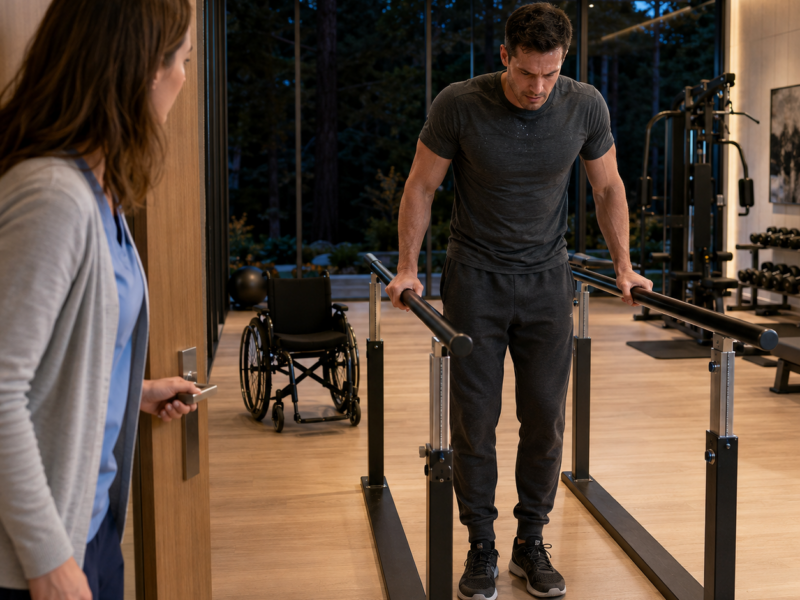
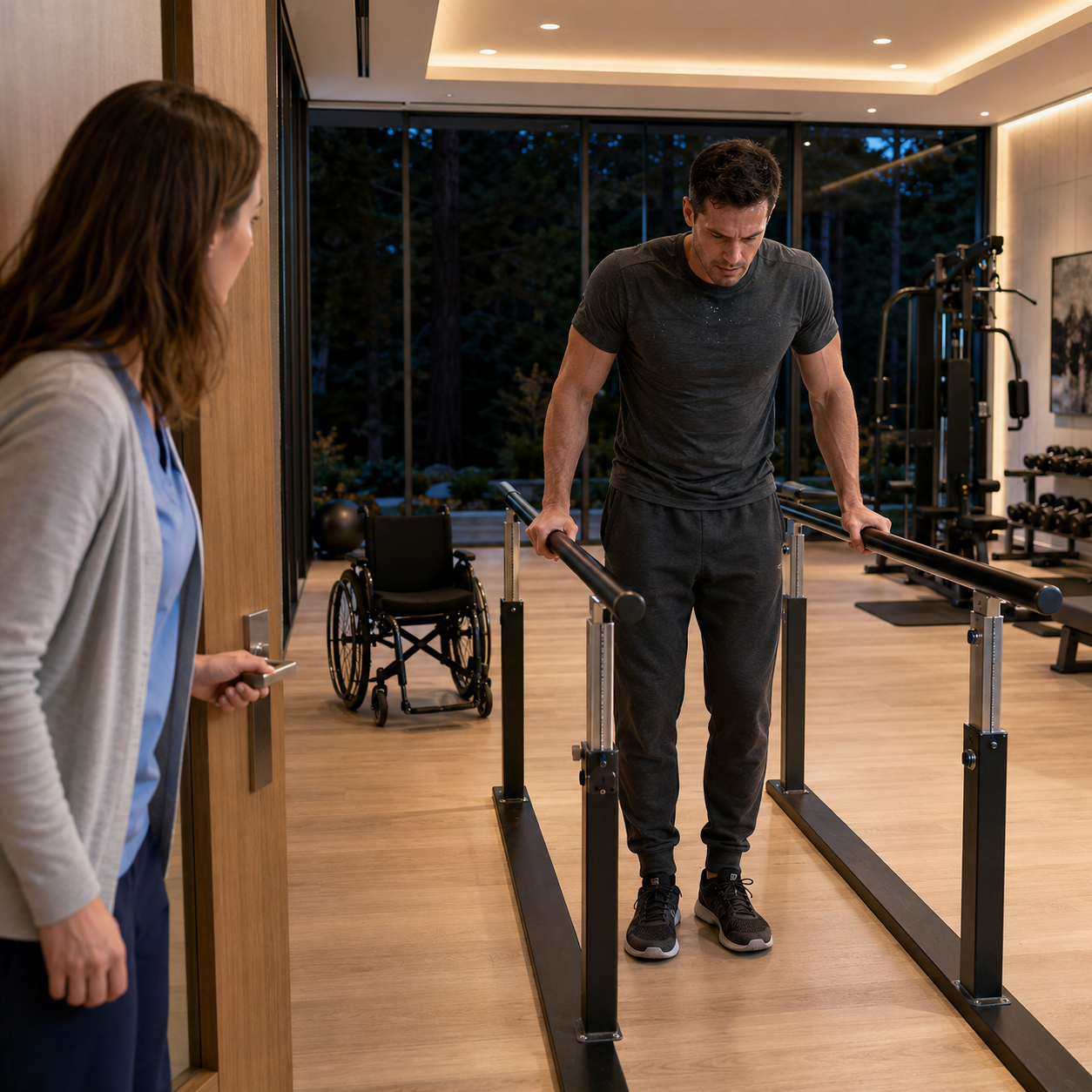
He was between the parallel bars.
Standing.
Barely.
Hands gripping the rails.
Knees shaking.
A gait belt hanging nearby but no one holding it.
My nurse brain fired before emotion.
“Sit down.”
Ryan snapped his head toward me.
The movement destabilized him.
I moved forward.
“Don’t touch me.”
“Then lower yourself.”
“I’m fine.”
“You’re alone.”
His arms trembled.
“Ryan.”
He swore.
Then slowly lowered into the chair behind him.
Once seated, he glared.
“What the hell are you doing?”
“My job.”
“This is not your scheduled time.”
“You are attempting unsupported mobility at one in the morning.”
“I was safe.”
“You were alone.”
“I’ve done it before.”
“That does not improve the sentence.”
His face hardened.
“Get out.”
I stayed near the door.
“Did your PT clear unsupervised standing?”
Silence.
“Ryan.”
“No.”
“Then tomorrow we call her.”
“No.”
“Then I document what happened tonight, and the physician gets informed through normal reporting.”
“You said you weren’t here to control me.”
“I’m not.”
“You’re a competent adult.”
“You can ignore the plan.”
“I’m still required to document safety issues.”
He looked furious.
Then tired.
He rubbed both hands over his face.
“The minute everyone sees progress, they start measuring it.”
I stayed quiet.
He continued.
“My brother asks if I can walk yet.”
“Investors ask through people they think I don’t hear.”
“Every therapist says nobody knows, then looks happy if I move another inch.”
“I stand once and everybody wants ten steps.”
He looked toward the bars.
“I fail in public all day.”
“I want one thing that belongs to me.”
That changed my response.
Not the safety part.
The understanding.
“You need privacy.”
“Yes.”
“Not medical secrecy.”
He looked at me.
“Different.”
“Yes.”
I sat on the bench across the room.
“We can ask your PT to design a private independent practice plan.”
“With specific safe exercises.”
“No household audience.”
“No staff updates beyond what you authorize medically.”
He frowned.
“You’d do that?”
“Yes.”
“Why?”
“Because privacy is not the same thing as risking a fall alone at one in the morning.”
He looked away.
Then:
“Fine.”
The next morning, I told his PT, Natalie Chen, with Ryan present.
He looked annoyed.
But he participated.
Natalie did not scold.
She tested.
Adjusted.
Approved limited standing practice with specific safety setup and a second person nearby, not hands-on unless needed.
Ryan hated the second person.
Then chose me.
Not because I was special.
Because I had already seen.
Those early sessions changed our relationship.
I did not cheer.
He had asked me not to.
When he stood ten seconds longer, I wrote it down.
When his knee buckled, I helped safely lower him.
When he cursed, I waited.
When he needed encouragement, he usually said something insulting like:
“You can say the motivational thing now.”
I would reply:
“Your socks are ugly.”
He laughed once.
That became enough.
On day twelve, he asked why I took the job.
Not salary.
Why this job.
We were on the back terrace.
He had finished exercises and looked exhausted.
I considered the professional answer.
Then gave him part of the truth.
“My fiancé left sixteen days before our wedding.”
Ryan looked over.
“Dead?”
“No.”
“Worse?”
“Different.”
He waited.
“For a venture capitalist’s daughter.”
His eyebrow rose.
“That sounds annoyingly specific.”
“Megan Langley.”
Ryan stopped.
“What?”
“You know her?”
He looked toward the trees.
“I know her father.”
“Most tech people do.”
“Not personally?”
“Unfortunately, personally.”
I felt something tighten.
“Why?”
“Langley Capital has been trying to invest in my company.”
There.
Coincidence.
Not conspiracy.
Still enough to make my stomach shift.
“What’s the company?”
Ryan looked at me as though I had admitted not knowing Taylor Swift.
“Hail Nexus.”
I blinked.
Then laughed.
“What?”
“I’ve heard of it.”
“Comforting.”
Hail Nexus Technologies built network-security and infrastructure-management software used by large corporations and several government contractors.
Ryan had co-founded it at twenty-six with his college friend Eric Thorne.
The company grew quickly.
Not mythical billions overnight.
A real enterprise with employees, institutional investors, a board, and the kind of valuation business magazines liked to argue about.
Ryan still held a significant founder stake through super-voting shares and served as executive chair before the accident.
Eric became interim chief executive while Ryan recovered.
I had not connected the name because I was not a technology person.
Ryan looked amused.
“You didn’t Google me?”
“No.”
“Why?”
“I read your medical file.”
“That’s disturbingly healthy.”
Then:
“What happened with your fiancé?”
I told him enough.
Café.
Ring.
Megan.
No dramatic speech.
Ryan did not say Jason was an idiot.
He said:
“That’s brutal.”
Much better.
Then:
“Did you love him?”
“Yes.”
“Still?”
I looked at him.
“Sometimes love doesn’t disappear on the same schedule as trust.”
Ryan became quiet.
“That sounds familiar.”
I did not ask.
That was one difference between nursing and curiosity.
Patients do not owe you every wound because you know their medication list.
Eric Thorne arrived three days later.
I met him carrying a tray of coffee into the west sitting room.
He was forty-one, handsome in a polished corporate way, wearing a watch that probably cost more than my car.
He saw me.
Looked.
Not inappropriate enough to complain about.
Long enough to notice.
“This the new nurse?”
“My name is Emily Carter.”
“Eric Thorne.”
“I know.”
He smiled.
“Then you’ve been warned.”
Ryan sat across from him.
“Emily isn’t here to entertain you.”
“Relax.”
Eric’s tone changed as they moved into business.
I was supposed to give Ryan medication with food.
I set down the tray.
He motioned for me to stay long enough to confirm he took it.
The conversation continued around me because wealthy men often forget service workers have ears.
Eric discussed a financing package.
Board concerns.
A potential acquisition.
Then:
“Langley is ready.”
My hand paused over the medication log.
Gregory Langley.
Probably.
Eric continued.
“We just need your founder consent.”
Ryan’s voice became flat.
“I told you I’m reading it.”
“You’ve had three weeks.”
“Then another day won’t kill you.”
“The market window closes.”
“What market window?”
Eric smiled.
“Ryan.”
“No.”
“What changes tomorrow?”
Eric looked irritated.
“Their investment committee meets Monday.”
“Then say that.”
I liked Ryan.
Eric continued.
“Langley Capital funds the recap.”
“They get the preferred block.”
“We roll certain founder voting rights into the new vehicle.”
Ryan looked at him.
“Certain.”
“Temporary.”
“For governance efficiency.”
Ryan’s jaw tightened.
“I’m not signing anything described as governance efficiency unless counsel explains every comma.”
Eric laughed.
“Still you.”
Then another name.
Jason Miller.
I almost dropped the water glass.
Eric did not notice.
“Jason has been coordinating some of the diligence with Langley’s team.”
Ryan’s eyes shifted toward me.
Barely.
He had noticed.
Eric continued.
“Smart kid.”
“Megan brought him in.”
“Good relationships.”
There it was.
Not a grand scheme targeting me.
Jason had left me for access to a world he wanted.
Now he was inside Ryan’s corporate orbit as a strategy consultant attached to Langley’s diligence team.
That hurt.
Also clarified.
He had not simply chosen another woman.
He had chosen an identity.
I left once Ryan took the medication.
That evening, during stretching, Ryan said:
“You looked like you wanted to throw the coffee.”
“I’m a professional.”
“So yes.”
“Yes.”
“Jason Miller?”
“Yes.”
He was quiet.
Then:
“That’s awkward.”
“Understatement.”
“What did you hear?”
I repeated only what I remembered.
No speculation.
Langley recap.
Preferred block.
Founder voting rights.
New vehicle.
Jason coordinating diligence.
Ryan listened.
Then:
“I know the structure generally.”
“Do you know which vehicle?”
“No.”
“Eric said new.”
He looked toward me.
“Anything else?”
“Governance efficiency.”
Ryan made a face.
“That phrase should be illegal.”
I smiled.
Then:
“You don’t think something’s wrong?”
“I think financing documents are designed to be unreadable until lawyers charge enough to explain them.”
Not panic.
Good.
He emailed outside counsel that night.
The next morning, Ryan knocked on my door.
He never knocked.
I opened.
He sat in his chair with a folder.
“You noticed something.”
I stepped aside.
“What?”
“The governance vehicle.”
He put the folder on my desk.
“I had my personal counsel compare the draft I received three weeks ago with the current version Eric sent yesterday.”
“And?”
“There are changes.”
“How bad?”
He almost smiled.
“You want corporate law before coffee?”
“No.”
“Yes.”
He explained.
Not a secret shell company stealing everything.
Reality was more sophisticated.
Langley Capital proposed a significant preferred investment that could stabilize Hail Nexus after a volatile year.
The original term sheet gave Langley board representation and standard investor protections.
The later draft routed Ryan’s super-voting founder shares through a special-purpose governance entity as part of the recapitalization.
That alone was not necessarily improper.
The problem lay in the control provisions.
If Ryan remained “medically unavailable” for certain defined business functions, voting authority over the founder block could shift temporarily to a committee dominated by Eric and two Langley designees.
The definition of unavailable was vague.
Worse, Ryan’s counsel discovered a side letter referenced in metadata but not included in the packet delivered to Ryan.
The side letter provided Eric with a retention package and expanded CEO authority if the transaction closed.
Not automatically illegal.
Potentially a serious conflict requiring full board disclosure.
“Did the board know?”
Ryan asked.
“My attorney doesn’t think the full side letter went to every director.”
“That’s bad.”
“Yes.”
“Can they do it without you?”
“No.”
“That’s why Eric needs signature.”
“Yes.”
I looked at him.
“What are you going to do?”
“Nothing dramatic.”
Good.
“I’m calling general counsel.”
“Then two independent directors.”
“Then we review.”
That was how the real battle began.
No midnight war room with the nurse reading securities contracts she did not understand.
Ryan had lawyers.
A board.
An audit committee.
I had observations.
That was enough.
He did ask me for help with one thing.
“Keep my medical updates private.”
“They already are.”
“I mean staff gossip.”
“I can’t control everyone.”
“You can tell Evelyn I want only necessary functional information circulated.”
“I can.”
“Eric keeps asking how much I can stand.”
I felt anger.
“That is not his business unless it affects your job capacity.”
“Exactly.”
Ryan had been allowing people to equate mobility with competence.
That was partly his own fault.
After the accident, he disappeared almost entirely from corporate life.
He skipped board meetings.
Delegated email.
Refused video calls because he did not want anyone seeing him struggle.
Eric filled the vacuum.
Now Ryan understood hiding had a business cost too.
“I don’t want them seeing me walk until I choose.”
he said.
“Fine.”
“But I also don’t want the board thinking I’m incapable because I use a chair.”
“Then show up in the chair.”
He looked at me.
Simple.
“You don’t need to walk into a boardroom to prove your brain works.”
Ryan was silent.
Then:
“You’re annoying.”
“Occupational strength.”
Two days later, he attended a board meeting by secure video.
First time since the accident.
He did not announce recovery.
He asked questions.
A lot.
His outside counsel joined.
General counsel, Priya Desai, requested a formal review of the Langley transaction and related-party disclosures.
Eric was furious.
He called Ryan privately afterward.
I did not hear most.
Only:
“You’re letting paranoia kill a good deal.”
Ryan replied:
“I’m letting counsel read the deal.”
Excellent sentence.
The special board review uncovered more.
Eric had not forged Ryan’s signature.
No cartoon crime.
He had, however, allowed Langley’s team to draft governance provisions that materially increased his authority while failing to disclose the full economic benefit he would receive under the transaction.
Jason’s role was smaller.
He was a consultant working with Langley’s strategic team and had participated in preparing market analyses supporting the deal.
He had no authority over Ryan’s company.
No master villain.
Just an ambitious man standing near ambitious people.
Megan was not secretly orchestrating everything either.
Her father’s firm wanted the investment.
She had helped connect Jason to people at Langley.
That hurt me personally.
It was not the same as corporate wrongdoing.
Ryan’s lawyers forced me to keep those distinctions clear.
That was good.
A week later, the board called a special in-person meeting.
Ryan wanted to attend.
His physician cleared travel by car with precautions.
Natalie cleared a short assisted walk using a forearm cane but recommended the chair for distance.
Ryan ignored the emotional part of that recommendation until I said:
“You are not turning this meeting into a rehabilitation stunt.”
He looked offended.
“I want them to see I’m recovering.”
“Fine.”
“They can see you transfer.”
“Stand.”
“Walk twenty feet if that is what you safely do.”
“But if you exhaust yourself before discussion because you want Eric shocked, I will personally tell the entire board you’re an idiot.”
He laughed.
“Would you?”
“Yes.”
“I believe you.”
On the morning of the meeting, Ryan wore a midnight-blue suit.
First suit since the accident.
Evelyn helped arrange tailoring around his changed posture.
He looked at himself in the mirror for a long time.
“What?”
I asked.
“I look smaller.”
“You lost muscle.”
“Thank you, Florence Nightingale.”
“You asked.”
He adjusted cuff.
“Before, people moved when I walked into rooms.”
“They probably still will.”
“Why?”
“Because you own thirty percent of the voting power.”
That made him laugh.
He used the chair through the building lobby.
Important.
No hiding.
Employees noticed.
Some stared.
One woman cried.
Ryan looked uncomfortable.
He stopped beside her.
“Please don’t.”
She laughed through tears.
“Sorry.”
“I’m still here.”
That sentence traveled through the company faster than any dramatic walking reveal could have.
At the conference room, Ryan chose to stand with the cane and take several careful steps to his chair.
Not because walking validated him.
Because he wanted to.
Eric’s face changed.
“You’re walking.”
Ryan sat.
“Some.”
Then:
“Can we discuss the company now?”
Perfect.
The board meeting lasted three hours.
I was not inside for most of it.
I waited in a private lounge with Evelyn because I was still responsible for medical monitoring during a demanding day.
That is less cinematic than standing behind Ryan while he dismantled villains.
More believable.
Later, Priya summarized what became public enough for employees.
The independent directors had reviewed the transaction.
Langley’s proposal would not proceed under the current terms.
The board opened a formal investigation into Eric’s conflict disclosures and interim-management decisions.
Eric was placed on administrative leave pending review.
Two weeks later, he resigned.
His retention side agreement never became effective.
No handcuffs.
No instant ruin.
A governance failure addressed through governance.
Ryan resumed executive-chair responsibilities gradually, subject to workload accommodations and board oversight.
An interim operating executive was brought in from outside rather than Ryan pretending he could return to a seventy-hour workweek because he could stand with a cane.
That was the smarter victory.
Jason’s consulting assignment with Langley ended after the deal failed.
Whether he was fired, reassigned, or simply no longer needed, I never knew.
He texted me once.
Hope you’re okay. I heard you’re in California.
I stared at it.
Then deleted it.
No clever answer.
No:
I’m better than ever.
Silence.
Jason had already received all the space in my life he was going to get.
Ryan returned from the board meeting exhausted.
His leg spasms were worse.
Pain high.
He sat in the back of the car with his eyes closed.
“No celebration?”
I asked.
“Pain medication first.”
“Good answer.”
At home, after medication and rest, he asked Evelyn for a whiskey.
She looked at me.
I said:
“Check interaction timing.”
Ryan groaned.
“This house is tyranny.”
Later, one approved drink appeared.
He raised the glass.
“To lawyers.”
“Never say that again.”
He laughed.
Then:
“To nurses who eavesdrop.”
“I did not eavesdrop.”
“You were carrying tea for eight minutes.”
“Occupational hazard.”
He became serious.
“You could have ignored it.”
“Yes.”
“Why didn’t you?”
“I heard a name tied to my own life.”
“I paid attention.”
“Also because you were about to sign something you hadn’t read.”
“Fair.”
He looked toward the windows.
“Eric was my best friend.”
There.
The business story disappeared.
A friendship remained.
Ryan and Eric had built Hail Nexus from two laptops and borrowed office space.
Eric had visited Ryan in inpatient rehab.
Handled investors.
Called doctors? No. He handled company.
Told employees Ryan would return.
Then somewhere between carrying responsibility and enjoying authority, he started building a future where Ryan did not fully come back.
Maybe he told himself it was necessary.
Maybe some of it was.
The board investigation later concluded Eric had failed to disclose conflicts and had acted outside delegated authority in aspects of the proposed recapitalization, but there was no criminal prosecution.
That complexity hurt Ryan more than a simple betrayal would have.
“If he had just stolen from me, I could hate him.”
he said.
“What did he do?”
“Decided my absence was permanent enough to build around.”
I understood.
Jason had done something smaller to me.
Decided my place was temporary once a better opportunity appeared.
Different scale.
Same bruise.
I stayed at the Hail estate six months.
Longer than the original contract because Ryan’s care needs continued and the agency renewed with my agreement.
But the relationship between us changed, and that created a problem neither of us wanted to name.
I noticed first.
Not because he flirted.
Ryan rarely did.
Because I began caring what he thought of me outside clinical decisions.
I started changing shirts before dinner.
That was ridiculous.
Then I caught myself wondering whether he liked my hair down.
Worse.
Professional boundaries are easier in nursing lectures than in a house where you share five days a week with one person.
I called Margaret.
“I have a problem.”
“Pregnant?”
“No!”
“Then probably manageable.”
“I think I like him.”
Silence.
Then:
“The patient?”
“Yes.”
Margaret swore.
“Helpful.”
“You asked.”
“What do I do?”
“You know.”
I did.
I spoke to the agency supervisor.
No dramatic confession to Ryan.
I requested transition out of his primary assignment once replacement coverage could be arranged.
The supervisor asked whether anything inappropriate had occurred.
“No.”
“Has Mr. Hail crossed boundaries?”
“No.”
“Have you?”
“No.”
“Then this is preventive.”
“Yes.”
Good.
Two weeks later, I told Ryan.
He was furious.
“You’re quitting.”
“I’m transitioning off the case.”
“Same thing.”
“No.”
“A new nurse will take primary duty.”
“Why?”
I could have lied.
Career goals.
Burnout.
Montana.
Instead:
“Because I care about you in a way that is making the nurse-patient line less clean than I’m comfortable with.”
Ryan stared.
I wanted the floor to open.
Finally:
“Oh.”
“Excellent response.”
He looked away.
“So you’re leaving because you like me.”
“I’m leaving the clinical role because I respect both of us.”
He rolled toward the window.
“You don’t know if I like you.”
“Correct.”
That stung.
He turned back.
“I do.”
My heart did something stupid.
Then he continued:
“Which is why you’re right.”
There.
Adult.
No:
Stay anyway.
No:
Rules don’t matter because feelings.
“I hate this.”
he said.
“Me too.”
“When do you go?”
“Three weeks.”
“Who replaces you?”
“Agency is sending two candidates.”
“I get veto.”
“Within reason.”
“I’m impossible.”
“I know.”
We spent the final three weeks being almost aggressively professional.
It was miserable.
Then I moved out.
Not back to Montana.
During my assignment, I had completed California licensure and started working on a certification in nurse case management.
I accepted a position with a rehabilitation-care coordination firm in Palo Alto.
Regular salary.
No mansion.
I rented a small apartment.
My own key.
My own grocery bill.
Margaret came to visit.
She stood in the middle of the living room.
“You own three forks.”
“I live alone.”
“You need six.”
“Why?”
“Company.”
“Are you planning to stay?”
“No.”
“Then three.”
She bought three more anyway.
Ryan and I did not date immediately.
That mattered.
For three months, we barely communicated beyond a few messages about the transition and one thank-you note from him after my last day.
Emily,
You were the first person in this house who helped without making me feel managed. I hated you for approximately eleven days. Then slightly less.
Thank you.
Ryan.
I framed? No. I kept it in drawer.
Three months later, he called.
Not text.
“Are you still my nurse?”
“No.”
“Any clinical authority over me?”
“No.”
“Financial dependency?”
“No.”
“Do you still know too much about my bowel program?”
I almost dropped phone.
“Ryan.”
“Legitimate question.”
“What do you want?”
“Dinner.”
I sat on my sofa.
“Is this a date?”
“Yes.”
“What happened to subtlety?”
“Rehab took it.”
I laughed.
Then:
“Yes.”
Our first date was terrible.
Restaurant too formal.
Ryan hated the accessible entrance because staff made a production out of guiding him.
I was nervous.
He was nervous.
We both tried to behave like we had not seen each other during some of the least glamorous moments two adults can share.
Halfway through dinner, I said:
“This is ridiculous.”
He looked relieved.
“Thank God.”
We left.
Got tacos from a food truck.
Sat in his car overlooking the bay.
Much better.
Ryan still used a wheelchair for long distances then.
A cane inside some places.
Sometimes no device for a few steps.
Recovery was not linear.
One week he progressed.
Next pain worsened.
Sometimes fatigue returned him to the chair all day.
I learned to stop treating mobility as narrative.
He was Ryan sitting.
Ryan standing.
Ryan hurting.
Ryan sarcastic.
Ryan happy.
Not a man becoming complete.
A man living in a changing body.
That mattered to our relationship.
He learned something similar about me.
I was not the abandoned fiancée waiting for rescue.
I had a job.
A foster mother.
Friends.
Professional plans.
A frightening amount of student loan? Maybe nursing. Keep perhaps paid off? Not necessary.
I had opinions.
He could be rich and still annoy me.
That was healthy.
One evening, months into dating, Ryan said:
“I want to give you equity.”
I stared.
“No.”
He blinked.
“You don’t even know how much.”
“That makes it worse.”
“It’s not romantic.”
“Good.”
“I’m creating an advisory and employee equity pool as part of governance reform.”
“And?”
“You identified the issue.”
“I overheard one conversation.”
“You made me look.”
“That is not the same as performing corporate work.”
He became quiet.
“Fair.”
“Do not pay me for being emotionally important to you.”
That sentence surprised both of us.
Then he smiled.
“Therapy?”
“Margaret.”
“More expensive?”
“Emotionally.”
Ryan did establish a charitable rehabilitation foundation later, focused on home-care access for people with spinal injuries who did not have Silicon Valley money.
He asked me to advise on clinical design.
I agreed only through my employer at first.
Then later joined the advisory board with formal conflict rules.
No romantic gifts disguised as governance.
We had learned.
Ryan’s relationship with Hail Nexus stabilized.
The board separated chair and CEO functions.
An experienced executive, Priya? General counsel can’t be CEO. Let’s introduce Dana Kim as new CEO. Good. Dana Kim, an operations executive from enterprise software, became CEO after search.
Ryan remained executive chair, focused on product and strategy with a defined schedule.
He no longer let the company treat his body as a quarterly metric.
At an all-hands meeting, someone asked publicly:
“When will you be back full-time?”
Ryan answered:
“I am back.”
Then:
“If you mean when will I work exactly the way I worked before my injury, hopefully never.”
Employees laughed.
He continued.
“I nearly broke myself before I broke my spine.”
That line became one of his own lessons.
Recovery changed ambition.
Not eliminated.
Edited.
Eric eventually settled civil claims with the company relating to contractual breaches and governance issues.
No prison.
No dramatic disappearance.
Years later, Ryan told me Eric had written him a letter.
“Do you want to read it?”
“No.”
“Why?”
“It’s yours.”
He did.
Then put it away.
Months later, he said:
“He apologized.”
“Do you believe him?”
“Some.”
“Enough?”
“For what?”
“Friendship?”
“No.”
“That answer changed over time?”
“Maybe someday.”
It didn’t, as far as I know.
Some betrayals end relationships even after understanding.
That is not failure.
Jason’s life crossed mine once more.
Two years after the café, I attended a healthcare technology fundraiser in San Francisco with colleagues.
Megan was there.
So was Jason.
Not married.
Not engaged from what I could see.
They stood across the room beside a Langley Capital banner.
Jason saw me.
His face changed.
He walked over.
“Emily.”
“Jason.”
“You look good.”
“So do you.”
Meaningless.
“How are you?”
“Good.”
“California?”
“Yes.”
“I heard you worked for Ryan Hail.”
“Past tense.”
“Oh.”
He looked awkward.
“I wanted to apologize.”
I almost laughed.
“For which part?”
“The timing.”
Only the timing?
He corrected himself.
“For everything.”
I waited.
“I was obsessed with getting into that world.”
“I know.”
“I thought Megan and Langley were the future.”
“Were they?”
He looked toward the banner.
“For a while.”
There.
No revenge required.
He had made a choice.
Lived it.
Maybe regretted parts.
“Did you love me?”
I surprised myself asking.
Jason looked directly at me.
“Yes.”
“Then why?”
He swallowed.
“Because I thought love and ambition were supposed to point in the same direction.”
“And I decided you were standing still.”
That hurt.
Still.
Even after years.
Then he said:
“I was wrong about you.”
“No.”
I smiled faintly.
“You were wrong about what standing still looks like.”
He nodded.
“Fair.”
“Are you happy?”
He thought.
“Sometimes.”
Good answer.
Megan approached then.
Beautiful.
Poised.
She looked at me.
Then Jason.
“Emily?”
“Yes.”
She extended a hand.
“Megan.”
“I know.”
Awkward.
She said:
“I owe you an apology too.”
I raised an eyebrow.
“I knew he was engaged.”
There.
No excuses.
“I told myself your relationship must already be over if he was willing to leave.”
“It wasn’t.”
“I know now.”
“Thank you for saying that.”
That was it.
No fight.
No public humiliation.
I walked away.
My hands shook afterward.
Healing does not make old wounds fictional.
It means the wound no longer gets to choose what happens next.
Ryan found me near the terrace.
“You okay?”
“Yes.”
He looked over my shoulder.
Then saw Jason.
“Oh.”
“Do not.”
“What?”
“I know that face.”
“What face?”
“The billionaire planning inconvenience.”
He smiled.
“I’m not a billionaire.”
“Near enough to be annoying.”
He handed me water.
“Want to leave?”
I thought.
“No.”
Good.
We stayed.
That evening, Ryan asked:
“Do you still love him?”
I laughed.
“No.”
“Did you when we met?”
“Probably part of me.”
He nodded.
No jealousy.
“Do you still love Eric?”
I asked.
His expression changed.
“Different question.”
“Same principle.”
He looked at the city lights.
“I think I love the person he was in my life.”
“That person may not exist anymore.”
“Maybe.”
We sat with that.
Love can survive a relationship’s death.
Not all love needs reunion.
A year after I left his care team, Ryan proposed.
Not in the kitchen with company stock.
Not while I was still his nurse.
At Point Reyes, after a weekend where he had walked more than usual and then used his chair the entire next morning because his leg spasms were bad.
We sat near the coast wrapped in jackets.
Wind loud.
No sunset perfection.
Fog.
He reached into his coat.
I groaned.
“What?”
“You have a box.”
“You hate boxes?”
“I have history.”
“Fair.”
He opened it.
Simple gold ring.
Small sapphire.
No heirloom.
No family claim.
“I bought this myself.”
he said quickly.
I laughed.
“Very reassuring.”
Then he became serious.
“I don’t need you to save me.”
“I know.”
“I don’t want you because you were the person who stayed when I was broken.”
“I know.”
“I want you because you left when staying would have crossed a line.”
That silenced me.
He continued.
“You saw me as a person when I was sick.”
“Then you insisted I learn to see you as a person outside what happened to you.”
I started crying.
Damn him.
“Will you marry me?”
I looked at the ring.
Then him.
“I need one condition.”
“Only one?”
“Margaret approves the catering.”
Ryan laughed so hard he nearly fell sideways.
“Absolutely not.”
“Then no.”
“Emily.”
“Yes.”
He stopped.
“What?”
“Yes.”
Simple.
We did not marry quickly.
A year-long engagement.
Therapy.
Prenup.
Yes.
Ryan suggested it.
His lawyers expected one.
I had my own attorney.
No shame.
Separate premarital property.
Clear spousal rights.
No Hail Nexus control for me.
No one enters marriage more lovingly by pretending property law doesn’t exist.
Margaret read none of it because she was not my lawyer.
She did, however, interrogate Ryan at Thanksgiving.
“Do you expect her to stop working?”
“No.”
“Children?”
“We don’t know.”
“Where will you live?”
“We have options.”
“Do you think because you have money you get the final say?”
“No.”
“Do you chew loudly?”
Ryan looked at me.
“Is this legally relevant?”
“Yes.”
He passed.
Margaret cried at the wedding.
So did I.
It was small.
Forty people.
No technology press.
No castle.
A redwood grove followed by dinner at a restaurant in Half Moon Bay.
Ryan walked the short aisle with a cane.
Used the chair later when tired.
No one applauded the walk.
I had warned them.
Our vows did not mention saving each other.
That was deliberate.
I said:
“I promise to tell you the truth before I decide what I think you need.”
Ryan said:
“I promise not to confuse being loved with being rescued.”
Margaret cried harder.
Rachel flew in from Montana.
She whispered:
“This is better than the first guy.”
“High bar.”
We laughed.
Marriage was not magically easier because we had suffered first.
Ryan still became impossible when pain flared.
I still shut down when I feared abandonment.
He sometimes tried to solve my anxiety with money.
I hated that.
Once, our washing machine broke.
I said:
“I’ll call repair.”
Ryan ordered a new one.
I became furious.
“We can afford it.”
“That’s not the point.”
“What is?”
“You made the decision because paying is easier than discussing.”
He stared.
Then canceled delivery.
We repaired.
Six months later it broke again.
I said:
“Fine. Buy the stupid washer.”
Marriage.
At work, I moved from care coordination into a small nurse-led consulting practice focused on complex home-care transitions.
Not a medical practice pretending I was a physician.
We helped families coordinate discharge planning, private-duty nursing, rehabilitation appointments, medication systems, and accessibility.
The Hail Foundation became one client among several.
Not my only income.
Important.
I did not want my professional identity dependent on my husband.
Ryan respected that, after learning not to say:
“You don’t need to work.”
I replied the first time:
“I don’t need to marry you either.”
He never used that sentence again.
Our lives became ordinary in expensive surroundings.
The Hail estate eventually felt less like a corporate retreat and more like a home.
We did not live there full-time forever.
After three years, we bought a smaller accessible house closer to town.
Still very nice.
Not a fortress.
Ryan wanted neighbors.
I wanted a grocery store within ten minutes.
Evelyn remained at the estate until it became primarily a corporate retreat and foundation site, then retired.
At her retirement dinner, she looked at me.
“You lasted longer than Lily.”
“I cheated.”
“You married the patient.”
I nearly choked.
Ryan laughed.
Evelyn smiled.
Rare event.
She had known.
Of course she had.
“You did the right thing leaving the clinical role.”
she said.
That mattered.
Then:
“Most people think boundaries ruin romance.”
“They usually save it from becoming dishonest.”
I remembered that.
Ryan’s mobility continued improving.
Not into a miracle.
He eventually walked most indoor distances with a cane and some short stretches without one.
For long outings, airports, large conferences, and bad pain days, he used a chair.
At first, he hated people asking.
Later, he became blunt.
“Today my legs are unreliable.”
Done.
He stopped measuring worth through steps.
That might have been his greatest rehabilitation achievement.
At forty, he spoke at a spinal-cord injury conference.
The moderator introduced him as:
“The tech founder who learned to walk again.”
Ryan corrected publicly.
“I learned to live again.”
Then:
“Walking was one piece.”
The room applauded.
He rolled his eyes afterward.
“You hate applause.”
“I hate slogans.”
I smiled.
He was still Ryan.
We had one child eventually.
Not immediately.
A daughter, Nora.
Pregnancy surprised us.
I was thirty-seven.
High enough risk for extra monitoring but ultimately uncomplicated.
Ryan panicked about whether he could physically care for an infant.
Reasonable.
We planned.
Accessible changing station.
Night nurse two nights a week for the first month because we could afford help and because sleep deprivation is not a moral achievement.
Margaret came.
Not to take over.
To hold the baby and criticize our swaddling.
Ryan adapted.
He could feed from chair.
Transfer.
Carry Nora in a supported carrier on good days.
On bad days, he asked.
No shame.
That mattered.
One night, Nora screamed for ninety minutes.
Ryan looked exhausted.
“I can’t stand long enough tonight.”
“Sit.”
“I feel useless.”
“You have arms.”
“True.”
He held her.
She vomited on his shirt.
I laughed.
He said:
“This is equality.”
Parenthood did something to both of us.
It made the foster-care part of my history louder for a while.
When Nora was three, I had an irrational fear that if I became difficult, somehow someone could remove family from me.
Old body memory.
Therapy helped.
Margaret said:
“You know permanence better now.”
I said:
“Do I?”
She looked at Ryan struggling to assemble a toy kitchen while Nora supervised.
“Yes.”
“Not because nobody can leave.”
“Because you know you survive if they do.”
That was even better.
Margaret lived long enough to see Nora start kindergarten.
She died at seventy-nine after a short illness.
Not fair.
Never is.
I sat beside her bed in Helena.
She looked around at the hospice room.
“Not my décor.”
I laughed through tears.
“You have terrible taste.”
“Exactly.”
Then:
“You came back.”
I squeezed her hand.
“Of course.”
She shook her head.
“No.”
“Not because you failed.”
There.
Even dying, she corrected the old lesson.
“I came because I wanted you.”
“Good.”
She died the next morning.
I inherited very little.
A house sold and divided partly to me, partly to another foster daughter she had helped later.
Some savings.
Her recipe box.
The knitted blanket from the night Jason left.
That blanket became worth more to me than the heirloom engagement ring ever had.
Not financially.
Obviously.
Meaning has terrible resale value and enormous living value.
Jason disappeared from my story almost entirely.
I heard eventually he left Langley’s orbit.
Started a consulting firm in Seattle.
Married someone else.
Not Megan.
Good for him.
I did not follow.
The temptation to track people who hurt you feels like control.
Mostly it keeps a door open.
I closed it.
Megan eventually became a managing partner in her father’s firm.
She was good at it by public accounts.
That did not make what she did to me kind.
Again:
Whole people.
Not permanent villains.
Hail Nexus changed too.
The company went public years later? Could. Let’s say partial public offering. But governance realism. It completed a public offering five years after board crisis, with independent controls. Ryan stepped down as executive chair by fifty, remained non-executive founder director then retired.
When Ryan eventually stepped down as executive chair, reporters asked whether health forced him out.
He said:
“No.”
“Time did.”
He wanted to spend more time with Nora.
The same man who once believed losing daily control meant disappearing voluntarily surrendered authority.
That was growth.
Dana Kim remained CEO.
Company survived him.
Good.
Eric’s name faded.
One year, Ryan received an invitation to an industry dinner where Eric would be present.
He asked:
“Should I go?”
“What do you want?”
He smiled.
“Your question.”
“Yes.”
“I don’t know.”
“Then don’t go until you do.”
He eventually went.
Saw Eric.
They spoke fifteen minutes.
No hug.
No reconciliation.
Eric apologized again.
Ryan accepted the apology without restoring friendship.
On drive home:
“How do you feel?”
“Lighter.”
“Good.”
“Also sad.”
“Both.”
He laughed.
“You and your both.”
I learned from Margaret.
At fifty, I began teaching workshops for nurses entering private-duty care.
Not glamorous talks about billionaires.
Boundaries.
Consent.
Professional scope.
Living in an employer’s home.
How quickly isolation can blur roles.
I told them:
“If you become emotionally attached, do not congratulate yourself for being human and keep going.”
“Get supervision.”
“Transition care.”
“Protect the patient.”
“Protect yourself.”
Someone always asked:
“But you married yours.”
“Yes.”
“After I stopped being his nurse.”
“That distinction is the whole reason I am willing to tell the story.”
I did not romanticize the boundary crossing that did not happen.
Stories like ours can become dangerous if people hear:
Love blooms through caregiving, rules don’t matter.
No.
Rules mattered.
They gave love a clean place to begin later.
At fifty-five, Nora asked how Ryan and I met.
We had told the simple version.
“Mom was Dad’s nurse.”
She looked horrified.
“That’s weird.”
“Correct.”
Ryan said:
“She quit.”
“Then we dated.”
“Less weird.”
She approved.
Then:
“Why was Mom your nurse?”
“Ski accident.”
“Were you bad?”
“What?”
“As a patient.”
I laughed so hard I spilled coffee.
Ryan stared.
“No.”
Nora looked at me.
“He was terrible.”
“Mom.”
“She needs truth.”
Nora laughed.
Family.
Later, when she was older, we told more.
Jason.
California.
Eric.
Not every board detail.
Enough.
Nora said:
“So if Jason hadn’t dumped you, I wouldn’t exist.”
The philosophical trap.
“Probably not.”
“Then are you glad?”
“No.”
She frowned.
“I’m glad you exist.”
“I’m glad I met Dad.”
“That doesn’t mean betrayal was good.”
“Good things can grow after bad things without making the bad thing necessary.”
She stared.
“That’s complicated.”
“Yes.”
“Can I go?”
“Please.”
Important.
I refused turning pain into destiny.
Jason did not “have to” betray me so I could find Ryan.
The universe did not arrange humiliation as a gift.
I survived one thing.
Then made choices.
That is different.
At sixty, Ryan had another surgery related to spinal degeneration above the old fusion.
The old fear returned.
Hospital.
Mobility.
Loss.
This time, I was his wife, not nurse.
I had to learn that too.
The morning after surgery, I started checking his IV pump.
He opened one eye.
“Emily.”
“What?”
“Not your patient.”
I removed my hand.
“Right.”
His nurse came in.
I apologized.
She smiled.
“Retired?”
“Emotionally.”
Ryan recovered.
Slower.
Used chair more again.
He was angry.
Then adjusted.
Bodies change with age.
Not every regression is defeat.
That lesson held.
Nora graduated college.
Margaret absent.
We wore a small pin from her old jewelry box on Nora’s dress.
Not because every object needed symbolism.
Because Nora wanted it.
Ryan cried.
I cried.
No surprise.
When Nora moved to Boston for work, our house became too quiet.
I understood Margaret’s old sentence differently.
You can come back because you want to.
I told Nora the same thing.
Not:
This is always your home so never leave.
Not:
You owe us visits.
Just:
“There is a bed if you need one.”
She said:
“I know.”
Good.
At sixty-five, Ryan and I took the coastal trip he had wanted during early rehab.
Not the same beach as source? Could be Big Sur. We drove to Mendocino, walked a cold beach.
Ryan used a cane.
Then chair later because sand was exhausting.
At sunset, we sat above the water.
He said:
“Do you ever think about who we were before?”
“Yes.”
“Want to go back?”
I looked.
“No.”
He smiled.
“Same.”
Then:
“Why?”
I thought of the café.
The ring.
Margaret’s sofa.
The hospital corridor.
The Hail estate.
Parallel bars.
Boardroom.
Boundaries.
Nora.
Losses.
Years.
“Because before isn’t where we live.”
He took my hand.
No grand line.
That was enough.
When I was younger, I thought transformation looked dramatic.
A man standing from a wheelchair.
A boardroom confrontation.
A discarded woman arriving in a mansion.
A billionaire discovering the nurse who saved him.
Those are story shapes.
Real transformation was quieter.
Ryan letting himself use the chair without shame.
Me asking Margaret for help.
A lawyer explaining a corporate document before anybody signed it.
An RN leaving a job before attraction became unethical.
A man apologizing without demanding friendship back.
A foster child learning that going home is not the same as failing.
Those were the steps.
The board meeting mattered.
But Ryan did not become powerful because he walked into it with a cane.
He was powerful because he read the documents, used counsel, and stopped letting physical vulnerability make other people’s decisions easier.
My heartbreak mattered.
But I did not become worthy because a wealthy man later loved me.
I was worthy while sitting on Margaret’s plaid sofa with ninety-three dollars in checking.
That took me longer to understand.
Jason had said I deserved someone simpler.
For years I heard insult.
Later I wondered whether he was trying clumsily to describe his own hunger.
He wanted a life built around status and access.
I wanted something else.
Maybe we really were moving in different directions.
He still owed me honesty before sixteen days.
He still behaved cowardly.
But incompatibility had been inside the cruelty.
Understanding that released some anger.
The ring he took back belonged to his family.
Fine.
The gold sapphire ring Ryan gave me belonged to no dynasty.
I wore it until arthritis made my fingers swell.
Then strung it on a chain.
Objects move.
Meaning adapts.
When Ryan died—years later, peacefully, at seventy-eight after a sudden cardiac event—I found myself holding that ring and thinking about another velvet box in a café.
Two men.
Two rings.
Dangerous comparison.
Ryan was not valuable because he stayed while Jason left.
He was valuable because the life we built became mutual.
And Jason’s leaving did not make my early love foolish.
It made it finished.
At Ryan’s memorial, Dana Kim spoke about Hail Nexus.
Nora spoke about burnt rice.
I spoke last.
“I met Ryan when he was in a wheelchair and furious at everybody.”
People laughed.
“He hated being praised for effort.”
“He hated sympathy.”
“He hated motivational quotes.”
More laughter.
“He eventually learned to tolerate all three badly.”
Then:
“The thing I admired most was not that he learned to walk farther.”
“It was that he learned he could need people without surrendering himself.”
My voice broke.
“And he taught me the same.”
That was the marriage.
Afterward, an old Hail Nexus employee approached.
“I remember the board meeting.”
“So do I.”
“He walked in.”
“Some.”
“It changed everything.”
I smiled.
“No.”
“He had already changed things before he entered the room.”
“Paperwork is less memorable.”
The man laughed.
Good.
Stories polish scenes.
I preferred the actual lesson.
I kept living after Ryan too.
That mattered.
Widowhood hurt.
Margaret gone.
Ryan gone.
Nora across the country.
For a few months, the house felt too large.
I considered moving immediately.
Then waited.
No panic decisions.
Eventually sold.
Moved into a smaller home near Nora and her family after she had children.
Not into their house.
Close.
I worked part-time with the foundation until seventy.
Then stepped off the board.
Governance should outlive founders and their spouses.
Another lesson from Eric.
The rehabilitation foundation funded home modifications, caregiver respite, and care-coordination services for people whose insurance did not cover what private wealth had given Ryan.
That felt right.
Not charity born from guilt.
Infrastructure.
I liked boring helpful things.
Ramp grants.
Transportation.
Respite hours.
Medication organizers.
The stuff nobody makes movies about.
At seventy-two, I spoke with a young woman whose fiancé had left weeks before their wedding.
She was the daughter of a foundation staff member.
She knew my story in broad outline.
She asked:
“How did you know everything would work out?”
I laughed.
“I didn’t.”
“But it did.”
“Some things did.”
“Some didn’t.”
“What do I do?”
I thought of Margaret.
“Find somewhere safe to sleep.”
“Eat.”
“Go to work if work helps.”
“Take time off if it doesn’t.”
“Call people who love you.”
“Do not make a life decision because you need the pain to mean something.”
She cried.
“What if I never find someone else?”
“Then you still have a life.”
That was the answer I wish I had heard at twenty-eight.
Not:
You’ll meet someone better.
Maybe you will.
Maybe not.
Worth cannot depend on sequel.
At seventy-five, I found the old knitted blanket in a box.
Margaret’s plaid sofa blanket.
Faded.
One corner unraveling.
Nora said:
“Throw it out.”
“Absolutely not.”
“What is it?”
I told her.
She took it.
Wrapped around shoulders.
“So this is the breakup blanket.”
“No.”
“The home blanket.”
That stopped me.
“Yes.”
Better name.
She kept it after I died? Well we can’t narrate after. Keep present.
I think of the first night under it.
I had believed I was back where I started.
Twenty-eight.
Foster mother’s house.
No fiancé.
No lease.
No money.
But returning to a safe place is not regression.
That may be the most important thing Margaret taught me.
Sometimes life circles back to show you what remained available while you were busy trying to outgrow needing it.
I had wanted marriage partly because I wanted permanent family.
Jason’s family looked polished.
Stable.
Important.
I imagined marrying into something I had never had.
Then, when they packed my suitcases before I returned from the café, I realized permanence does not come from being absorbed into someone else’s last name.
Margaret had given me permanence years earlier without a ceremony.
She answered the phone.
That was family.
Ryan later became family too.
Nora.
Rachel from St. Anne’s.
Evelyn in her severe navy suits.
Natalie, who taught Ryan how to stand safely instead of secretly.
Dana, who helped the company survive founder mythology.
Different people.
Different roles.
No one needed the same blood.
At seventy-six, I visited Helena one last time before Margaret’s old house was sold by the family who bought it after her death.
They had renovated.
New siding.
Different porch.
The current owner let me walk through because I explained.
The plaid sofa gone.
Of course.
The room smaller than memory.
I stood where the pullout bed had been.
No revelation.
Just gratitude.
On the way out, the owner said:
“Did you grow up here?”
I thought.
“Partly.”
That was enough.
On the flight home, I imagined the café again.
Jason.
Ring box.
You deserve someone simpler.
For decades, I wanted a better final sentence.
Something I should have said.
A devastating line.
The truth is, my actual answer was good.
Thank you for your honesty.
It was not weak.
It was not agreement.
It was the first boundary of the next life.
I did not beg.
Did not bargain.
Did not ask Megan to step aside.
I handed back what belonged to his family.
Then I walked.
Everything after came from walking.
Not toward Ryan.
Not toward wealth.
Away from a future that had already stopped choosing me.
That distinction matters.
If I could go back and sit across from twenty-eight-year-old Emily before she gives back the ring, I would tell her:
Take a breath.
Ask whether there are shared bills, deposits, and housing details you need resolved in writing.
Do not let heartbreak make you financially careless.
Call the vendors tomorrow.
Document who paid what.
Get your belongings with another person present if you feel unsafe.
Do not assume the suitcases mean you are homeless in the absolute sense.
You have Margaret.
Call sooner.
At the hospital, tell Rachel the truth before day three.
You do not get extra dignity for bleeding privately.
When the private nursing job appears, do not romanticize it as destiny.
Read the contract.
Check the license.
Know the clinical scope.
Make sure there is relief coverage.
Do not become a twenty-four-hour employee because wealthy people call it commitment.
When Ryan is cruel, hold boundaries.
Do not interpret pain as permission.
When he practices standing alone, protect safety without taking away autonomy.
Get PT involved.
When Eric talks business, report only what you heard.
Do not become detective.
Ryan has lawyers.
When Jason’s name appears, remember coincidence is not proof.
Let evidence lead.
When attraction begins, leave the clinical role.
Yes, it will hurt.
Do it anyway.
If Ryan truly cares, ethics will not frighten him away.
If they do, good information.
When you date, let him use the wheelchair.
Do not make recovery the romance.
When he offers money, say no if the gift blurs roles.
When he proposes, have your own lawyer.
Prenup is not distrust.
Clarity.
When Margaret dies, go home.
You are not backsliding.
When Ryan dies, keep living.
Loving him does not require stopping with him.
Most of all:
Do not make Jason’s rejection the opening argument in a case proving you were secretly extraordinary.
You do not need to become rich-adjacent, married, successful, or chosen by someone more impressive to defeat what happened in the café.
The breakup was cruel because you were a person who deserved honest treatment.
That was already enough.
This is the version of the story I trust now.
Not:
My fiancé dumped me for a venture-capital heiress, then I helped a billionaire expose her family and became his wife.
Too neat.
Too small, strangely.
The real story was wider.
A nurse lost a wedding.
A foster mother opened a door.
A man with a spinal injury learned privacy did not require isolation.
A corporate founder learned delegated trust still needs governance.
A nurse learned compassion without boundaries becomes dangerous.
Two adults waited until their professional relationship ended before beginning a personal one.
A company survived a conflict.
A marriage grew from ordinary years rather than one rescue.
A daughter was born.
Parents aged.
People died.
Life kept expanding until the café became one afternoon instead of the title.
That is what I wish heartbreak stories told more often.
The worst day can remain terrible without remaining central.
You do not have to thank it.
You do not have to call it destiny.
You do not have to say everything happens for a reason.
Sometimes something happens because someone was selfish.
Then you respond.
That response creates options.
I did not become stronger because Jason left.
I discovered strength I had already practiced for years.
Foster placements.
Nursing school.
Night shifts.
Margaret’s rules.
Patients who needed calm.
I had been carrying it long before anyone called me resilient.
Ryan did not become stronger because Eric betrayed him.
He had built a company from nothing.
Survived surgery.
Endured rehabilitation.
The betrayal forced him to use strength differently.
Less alone.
Maybe that was what drew us together.
Not shared abandonment.
Shared correction.
We both had to learn that self-protection can become isolation if you let it.
I protected myself by expecting people to leave.
Ryan protected himself by hiding progress and refusing help.
Different walls.
Same loneliness.
The relationship worked because neither of us was allowed to keep the wall and call it personality.
Ryan once said in therapy:
“If I need her, she can hurt me.”
I answered:
“If I don’t need anyone, I can’t be abandoned.”
Our counselor looked at us.
“So you’ve both built excellent systems for being miserable.”
We laughed.
She was right.
Marriage became letting need exist without turning it into ownership.
He needed help some days.
I needed reassurance some days.
Neither became debt.
That is why Margaret’s sentence stayed.
You’ve got nothing to prove.
For most of my life, I did not believe her.
I thought love had to be earned through usefulness.
Jason liked that I was low maintenance.
Ryan initially liked that I did not pity him.
Both qualities can become traps if they mean you never ask for anything.
Eventually, I asked.
I need you at my appointment.
I need tonight alone.
I need you to tell me before changing plans.
I need you not to fix this.
I need help.
Normal sentences.
No catastrophe.
That was adulthood I had missed.
Ryan learned his own.
I need the chair today.
I need privacy.
I need company.
I need to cancel.
I need pain medication before we discuss anything.
I need you to stop looking at me like I’m fragile.
I need you to hold my hand.
Human.
At eighty, if I am lucky enough to reach it, perhaps Nora will sit beside me and ask whether I remember Jason.
I will.
Memory is stubborn.
But I suspect the detail I remember first will not be his face.
It will be the ring box.
Then Margaret’s blanket.
Then Ryan between parallel bars.
Then Nora asleep on his chest while he sat in his wheelchair complaining his arm was numb and refusing to move because he did not want to wake her.
Life adds images.
Eventually one no longer controls the gallery.
That is healing.
The ring Jason asked for back probably belongs to someone else now.
Maybe Megan never wore it.
Maybe another woman did.
Doesn’t matter.
The sapphire Ryan gave me remains on its chain.
Margaret’s blanket remains folded over a chair.
Ryan’s cane? Nora kept one? We didn’t decide. Perhaps he donated devices? Better not symbolic. No need.
The objects that stayed are not proof I was loved more the second time.
Love cannot be measured by what survives in drawers.
The proof was the years.
The ordinary days.
The arguments we repaired.
The boundaries we respected.
The moments nobody photographed.
That is why, when I think about Ryan asking on the coast whether we could ever go back to who we were before, my answer remains the same.
I hope not.
Not because the people we were deserved pain.
Because we had learned things they did not yet know.
Ryan had learned he could be helped without being diminished.
I had learned I could be left without becoming disposable.
We had both learned that being chosen once is not the same as being safe forever.
Safety is built repeatedly.
Truth.
Consent.
Boundaries.
Repair.
Choice.
Again.
Again.
Again.
And when I reached for his hand that day on the cold California coast, I understood something that would have sounded impossible to the woman crying beneath a stationery-store awning years earlier.
I was not grateful Jason left me.
I was grateful I eventually stopped treating his leaving as evidence that something valuable had been taken from me.
He took back a ring.
He withdrew a promise he had no business making if he could not keep it.
That hurt.
What came next was still mine.
My career.
My judgment.
Margaret’s home.
The airplane west.
The job.
The choice to leave that job ethically.
The man I later loved.
The daughter we raised.
Every piece of the life beyond the café belonged to decisions Jason had no role in making.
That was freedom.
Not replacing one fiancé with a wealthier one.
Not watching Langley Capital lose a deal.
Not seeing Jason uncomfortable across a fundraiser.
Simply reaching the point where the future he denied me no longer looked like the future I would have chosen.
Years later, on one of Ryan’s birthdays, we walked along a beach north of San Francisco.
He used his cane for part of it and my arm for another part.
The wind was cold.
The sand made each step harder than pavement.
After a while, he stopped.
“Chair?”
I asked.
He nodded.
No shame.
We had left it near the boardwalk.
I brought it.
He sat.
We continued along the packed sand where the wheels moved more easily.
Halfway down the beach, Ryan looked toward the water.
“Do you think we ever became the people we were supposed to be?”
I laughed.
“Who decided who we were supposed to be?”
“Fair.”
Then he said:
“I used to think recovery meant getting back.”
“To what?”
“Before.”
I looked at him.
“Do you still?”
“No.”
“Good.”
He reached for my hand.
“What do you think it means?”
I watched the Pacific rolling toward us.
“Having enough of yourself back to decide what happens next.”
Ryan smiled.
“That sounds like something Margaret would say.”
“She’d say it better.”
“Probably with cereal.”
I laughed.
Then we kept moving.
Not back.
Forward was never as straight as people promised.
It didn’t need to be.
It only needed to remain ours.









