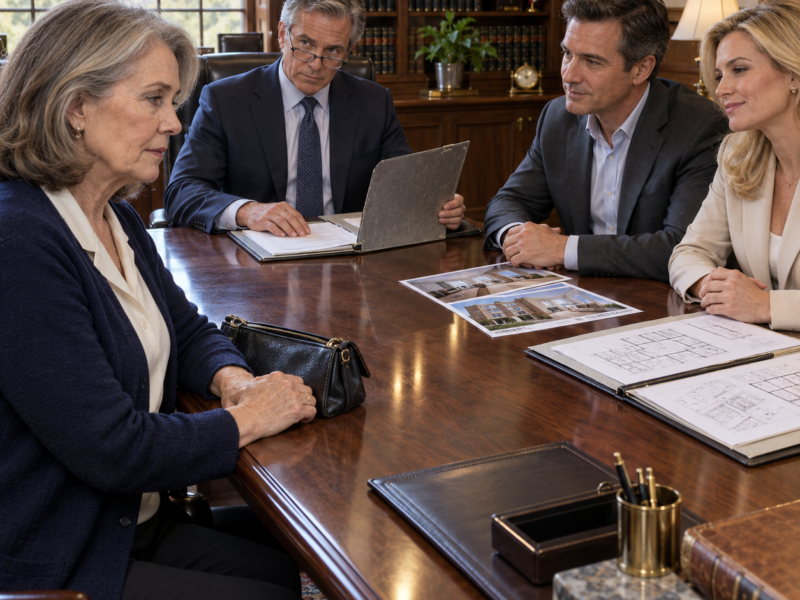
“She’s one person occupying a whole family home,” my daughter-in-law said, spreading apartment listings across my coffee table. My son nodded. They had chosen new cabinets for my kitchen and a smaller place for me to live. “We’re not throwing you out, Mom. You just need to sign.” I agreed to meet them at my attorney’s office the next morning. His wife smiled and closed her folder. Then the attorney opened my late husband’s will. As she began reading, my daughter-in-law stopped smiling. My son turned toward me. I kept my hands on my purse and let her finish.
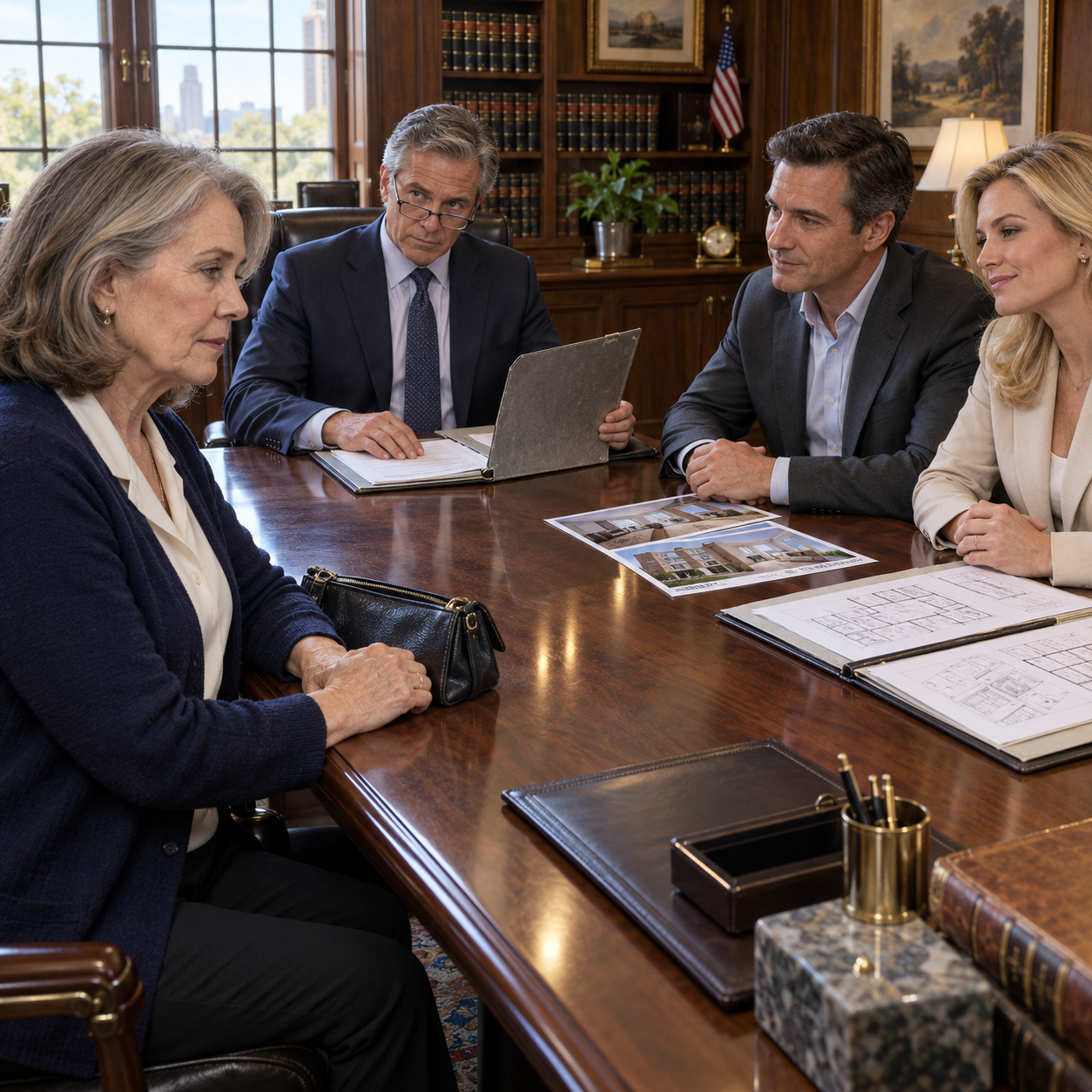
My daughter-in-law wore the smile of a woman who had already decided where to put her furniture in someone else’s house.
She sat across from me in an estate attorney’s office outside Albany, New York, smoothing the sleeve of her cream coat while my son spoke in the low, confident voice he used whenever he wanted to sound like the person in charge.
Then Margaret Ellis, the attorney handling my late husband’s estate, looked up from the gray folder in front of her.
“Under Nicholas’s will, his interest in the house, the one-acre property, the detached garage, and the primary investment accounts passes entirely to his surviving spouse, Anna.”
Not to my son.
Not to his new wife.
To me.
Marina’s smile did not disappear immediately. First it stiffened. Then one corner of her mouth trembled. Sergei turned toward me as if I had betrayed him, not by lying, but by daring to possess legal protection he had not known about.
Outside the office window, wet April snow brushed the glass. Inside, nobody moved.
For the first time in many months, I looked at them without pain, triumph, or the need to defend myself. Greed had finally spoken in its own voice, without being disguised as concern for my age, my comfort, or the family’s future.
That meeting did not create the truth about my son and daughter-in-law.
It revealed it.
The truth had begun taking shape the day after my husband’s funeral, when I found a gray folder in the top drawer of our bedroom dresser.
Nicholas Petrov died in early spring at seventy-one. We had been married forty-six years and lived in the same two-story house in Delmar for thirty-two of them. It was not a mansion. It had pale siding, a deep front porch, three old maples, an apple tree in the backyard, and a detached brick garage Nicholas built with his brother.
After he died, the house did not feel empty.
Empty would have been easier.
It remained crowded with him.
His brown winter coat hung in the entry closet. His reading glasses rested beside the kitchen calendar. An old radio sat near the coffee maker, still tuned to the public station he listened to every morning. The rooms smelled faintly of black tea, rye bread, sawdust from the basement workbench, and the menthol ointment he rubbed into his hands at night.
I moved quietly, as though a loud sound might disturb the place where his voice had been.
The day after the funeral, I opened the top dresser drawer looking for his veteran benefits papers. Instead, I found a gray accordion folder held closed by a tired elastic band.
Nicholas had called it the boring folder.
“Everything you need when words are no longer useful,” he once told me.
Inside were the deed, property survey, insurance records, account statements, beneficiary forms, his will, and a letter from Margaret Ellis. Every section had a handwritten label. Nicholas had highlighted phone numbers and written instructions in the margins.
I sat on the edge of our bed in my black funeral dress and read words through numbness.
My husband had continued taking care of me from a silence he could not return from.
The deed showed that we owned the house together with survivorship rights. His will left his remaining interest in the garage property, investments, and personal assets to me. Sergei would eventually receive family keepsakes and a separate account, but nothing gave him control over my home, money, or decisions while I lived.
One week later, I met Margaret.
Her small office smelled of paper, coffee, and wet coats. Beyond the windows, commuters hurried beneath umbrellas. I held my handbag so tightly that red marks appeared across my palm.
Margaret explained every provision. She showed me what passed automatically, what required probate, and what Nicholas had arranged through beneficiary designations. She repeated that I owned the home outright now. Nobody could make me sell, transfer, mortgage, or share it.
“Your signature is required for any change,” she said. “Do not sign something you do not understand, even if the request comes from family.”
As I listened, I understood that Nicholas had left me more than property.
He had left a wall between my old age and someone else’s appetite.
I decided not to tell Sergei the details.
I did not want to deceive or punish him. I still hoped he would visit as a son rather than arrive as an heir. I wanted to know whether the woman he married would enter my home as family or inspect it like an appraiser.
Silence was not a trap.
It was the removal of an answer they had no right to demand.
I returned the gray folder to the dresser, ran my hand across Nicholas’s empty side of the bed, and spoke aloud for the first time since his death.
“We will see, Nick. We will simply see.”
Sergei married Marina eight months later.
I did not resent the timing. Life does not owe a grave more waiting than a human heart can bear. Sergei was thirty-nine and had spent too many years drifting through relationships, jobs, and plans that always seemed about to become permanent.
On the morning of the wedding, I ironed his white shirt. I straightened his collar and tried to see the boy who once fell asleep on our couch holding a wooden truck.
The boy was difficult to find.
Before me stood a man in a new suit, already turning toward the woman for whom he wanted to appear stronger, wealthier, and more decisive than he felt.
The reception was held at Golden Harbor, a banquet hall overlooking the Hudson River. Cream roses filled the centerpieces. Soft jazz played during dinner, and servers carried trays of salmon, steak, and little pastries nobody knew how to eat neatly.
Marina was beautiful in a polished way that demanded evaluation rather than affection. Her dark hair lay smooth against her shoulders. Pearl earrings framed her face. Her smile appeared and disappeared with precision.
She kissed my cheek without warmth.
Whenever conversation turned to my house, however, her eyes became interested.
At first, the questions sounded innocent.
“Is it hard living there alone?”
“The yard must be a lot to manage.”
“Is the garage heated?”
“Did the title transfer after Nicholas died?”
She asked softly, as if discussing my health rather than real estate.
Sergei laughed and wrapped an arm around her waist.
“Marina is practical. She likes understanding things in advance.”
Guests smiled.
Nobody heard the first cold key turning inside those words.
I sat with a glass of champagne I barely touched. Bubbles rose and broke at the surface while something simple inside me did the same.
“The house is old but solid,” I said. “The lot is manageable. The garage is useful. The paperwork is in order.”
Marina listened like an accountant reviewing an unfamiliar ledger.
Then she leaned closer.
“Have you ever considered moving somewhere smaller later? A condo, perhaps? No stairs, no yard, no snow to shovel. It could be much easier at your age.”
The word later landed heavier than her fork.
My life had become a waiting period before useful space opened.
I looked at my hands. Nicholas’s wedding ring still rested on my finger, dull with age and scratched along one edge.
He once told me, “Protect more than the walls, Anna. Protect your right to decide who enters them.”
At the time, I accused him of being severe.
At the wedding, I understood.
The music grew louder. Guests tapped glasses and asked us to smile for photographs. Sergei looked happy. Marina accepted congratulations like someone who had received more than the bouquet in her hands.
I noticed a hairline crack near the rim of my crystal glass.
Something in our family had cracked too. The break made no sound, but it had started.
After the wedding, my house stopped being quiet.
Not immediately. At first, Sergei and Marina visited on Sundays. They brought a cake from the grocery store, a bag of oranges, or coffee purchased on sale. Marina removed her coat, surveyed the entryway, and said the house felt charmingly old-fashioned.
She made old-fashioned sound affectionate, but the word settled like dust.
Sergei kissed my temple and asked about my blood pressure, furnace, roof, and gutters. I tried to believe this was concern.
Then concern became practical.
One Sunday, Marina moved my cups from the china cabinet into a kitchen cupboard because she said it was more efficient. Another time, she removed the embroidered crane picture from the hallway and announced that traditional pieces made a space look older.
I returned both to their places after she left.
She walked from room to room, touching the back of Nicholas’s chair, lifting the heavy curtains, and examining the worn burgundy rug.
“This house is begging for renovation,” she said. “Nothing extravagant. Light walls, hardwood-look flooring, a modern kitchen without all these brown cabinets.”
Sergei initially laughed.
“She loves design, Mom.”
Soon he stopped laughing and began agreeing.
I made tea in my old stainless kettle, sliced lemon, and set out shortbread cookies. From the outside, I looked like an older woman grateful for visitors.
Inside, I placed every phrase into its own drawer of memory.
Renovation.
Convenience.
Modernization.
Future children.
Easier for Mom.
The words stayed soft while their meaning hardened with every visit.
A month later, Marina mentioned changing their official address.
She said a young family needed stability and that being connected to a large home in a good school district created opportunities. Sergei looked at me with the cautious expression of someone repeating a request rehearsed elsewhere.
“It is only an address, Mom. We are family.”
I stirred my tea and listened to the spoon touch porcelain.
We are family.
It is strange how often unfamiliar behavior begins with those words.
I told them no.
Marina blinked as if she had not heard correctly.
“No?”
“You have an apartment. Use that address.”
“Our lease may not last.”
“Then update your address when you move.”
Sergei frowned.
“You are making a simple thing complicated.”
“A simple thing should be easy to accept when the answer is no.”
They left early.
For two weeks, Sergei called less. Then the visits resumed, and so did the plans.
They discussed the yard. Too much land for one woman.
They discussed the garage. Sergei’s car sat outside while a perfectly good space stood half empty.
They discussed the shed. It could be removed and replaced by a patio kitchen.
They discussed Nicholas’s bedroom. I should clear it because keeping old things prevented healing.
Marina erased the past lightly, as if wiping chalk from a board.
Each time, I felt someone inside me cover Nicholas’s photograph with a protective hand.
Sergei changed more slowly, which made the change more frightening.
At first, he said, “Could we?”
Then, “We should.”
Eventually, “Mom, this is the right thing.”
One afternoon, without noticing, he said, “You need to understand.”
I looked up.
He turned toward the window.
Marina smiled almost imperceptibly, like a musician hearing the note she had waited for.
After they left, the house smelled of her perfume and cold tea. I washed the cups, wiped the table, and returned the crane picture to its hook.
Then I stood before the dresser that held Nicholas’s gray folder.
I did not open it.
Not yet.
They were trying keys, but they had not yet admitted they believed the door was theirs.
Marina spoke openly at the dinner marking the first anniversary of Nicholas’s death.
I set the dining table with dishes our Russian American family still made on important days: potatoes with dill, beet salad, pickled cucumbers, dark bread, and baked fish. A small glass sat beside Nicholas’s photograph.
Relatives shared stories about him fixing a neighbor’s wiring, clearing snow from the sidewalk, and refusing to make promises he could not keep.
The house was filled with quiet memory.
Marina waited for the right moment.
She wore a beige dress and a delicate necklace. After listening for nearly an hour, she surveyed the room: the bookcases, heavy cabinet, old sofa, broad window, and dark backyard.
“It must be difficult for Anna to manage such a large house alone,” she said. “So much space goes unused. Young families have it much harder now. Rents are high, mortgages are impossible, and this whole house is nearly empty.”
Someone lowered his eyes. An aunt lifted her fork and did not bring it to her mouth.
The words were not shouted. That made them worse. They were wrapped in concern like a knife in a napkin.
I looked at Sergei.
I waited for one sentence.
Marina, not now.
Or, That is my mother’s home.
He cleared his throat, adjusted his sleeve, and said Marina had a point. The family needed to think about the future.
Their future already contained a place for me. Small, convenient, and away from the house, garden, memories, and authority over my own life.
I rose, collected empty plates, and carried them to the kitchen.
Water struck porcelain too loudly.
Conversation resumed behind the wall, easier now that the most unpleasant thing had been said.
Three days later, Sergei came alone.
He brought no cake or oranges and did not kiss my temple. He removed his jacket, sat in the kitchen, and stared at the table.
I placed tea in front of him. He did not thank me.
“Marina is right,” he said. “Family should help family. I am not a child. We need somewhere permanent. You are alone, and the house needs a man’s hands.”
“It had your father’s hands for thirty-two years.”
“Dad is gone.”
The sentence was factual. The way he used it was cruel.
I stood at the stove, wiping a clean burner with a damp cloth. Circle after circle, the black surface became darker and colder.
“Mom, you have to help us. Otherwise, what is family for?”
Something inside me did not break. Breaking makes noise.
It closed.
For months, I had held a door on its chain, hoping the person outside still belonged to me. Now I saw not weakness or marital pressure, but participation.
Sergei continued speaking about fairness, hard times, and what Nicholas would have wanted.
“Dad would understand.”
My hand stopped.
Nicholas, who had prepared the gray folder like a shield.
Nicholas, who distrusted promises unsupported by action.
Nicholas, whose photograph still stood beside the little glass from his memorial dinner.
I turned off the faucet, dried my hands, and asked whether Sergei wanted more tea.
He stared.
“You are avoiding the conversation again.”
I looked at him gently.
No, son, I thought. I have finally entered it. You simply will not hear the door close behind you.
The following morning, I removed the gray folder from the dresser.
The elastic had dried. One corner had softened with age. Inside were stamped documents, account summaries, tax receipts, and pages carrying Nicholas’s careful signature.
I spread everything across the kitchen table beside the sugar bowl and bread box.
For the first time since the wedding, I felt something firm beneath my ribs.
Not anger.
Support.
I drove to Margaret’s office in the dark blue coat Nicholas had called my serious coat. Cold rain moved across the windshield. The city looked ordinary around me, but the handbag on the passenger seat carried the last boundary between my life and people already rearranging it.
Margaret reviewed every document again. She checked the deed, account designations, dates, signatures, and probate filings.
“The house is yours,” she said. “The lot and garage are yours. The primary accounts belong to you. Sergei cannot take or control them. Marina has no claim.”
“Can anyone pressure me into selling?”
“They can pressure you. They cannot make the decision lawful without your voluntary signature.”
“What if they pay for renovations?”
“Do not accept major work without a written agreement. Improvements can create disputes, especially when expectations are left deliberately vague.”
Margaret referred me to an elder-law attorney named Rachel Kim.
Rachel was younger than I expected, dressed in a gray jacket, and spoke quickly but clearly.
“Do not sign documents at home. Do not hand over originals. Do not attend financial discussions alone if you feel pressured. Do not add anyone to the deed, accounts, or power of attorney because they call it a formality.”
She leaned forward.
“Control sometimes begins with flowers and ends with a contract that removes someone’s right to her own old age.”
Each sentence settled like a brick in a wall.
On my way home, I remembered something Nicholas said during his final year.
He tired easily then. One evening, he sat on the bed fastening his shirt with stiff fingers.
“Sergei is not a bad man,” he said. “He is soft where he needs a spine. Today it is friends. Tomorrow it may be a wife, then resentment. This house should never become the prize for whoever asks loudest.”
I became angry.
“Do not speak that way about our son.”
Nicholas sighed.
“I am not speaking about our son. I am speaking about human weakness.”
Now those words stood alive before me.
Nicholas had not denied Sergei love. He had protected me from the moment love became a key someone else intended to use.
The most dangerous pressure does not always shout. It sits nearby, pours tea, and speaks about children, fatigue, convenience, and what is best for everyone.
Then one morning, a person wakes as a guest in the home where she spent half her life.
That evening, Sergei called.
His voice was deliberately calm. He and Marina wanted a family meeting Sunday to discuss how everyone would move forward. My sister Val would attend, along with Sergei’s cousin Daniel. Marina’s mother might come.
“No arguments,” he said. “Just a normal conversation about the renovation, your comfort, and our future. Marina and I will have children someday.”
I stood by the window watching rain collect on the bare apple branches.
I understood the plan.
This was not a conversation. It was a council. They intended to place me in the center, surround me with reasonable words, and make me ashamed of owning my walls.
They believed public pressure would make an older mother surrender rather than appear selfish.
“Come Sunday,” I said.
I returned the gray folder to the lower dresser drawer, not far back this time.
The cards were on the table. Nobody else yet understood that the game no longer belonged to them.
They arrived on Sunday with the solemnity of a formal delegation.
Marina carried a folder of printouts. Sergei brought a bakery box. Aunt Val looked uncomfortable. Cousin Daniel remained near the doorway. Marina’s mother, Linda, entered the living room and sat as if she had been appointed to a committee.
I made tea and arranged cups.
Everything looked familiar. The air felt dense as weather before a storm.
They began gently.
The electrical wiring was old. The windows leaked heat. The furnace would not last forever. The floors needed refinishing.
Some of this was true.
Truth became the handle they used to carry something dishonest into the room.
Marina opened her folder. She displayed contractor estimates, renovation plans, photographs of bright kitchens, and listings for small condos near a pharmacy and grocery store.
“This would be ideal for you, Anna. An elevator, everything nearby, no maintenance. We could renovate the house for a young family.”
Sergei sat beside her and said nothing.
That meant every sentence had already been approved elsewhere.
I listened with my hands folded in my lap.
Aunt Val cleared her throat.
“Perhaps this is moving too quickly.”
Marina smiled without warmth.
“Quickly? We have spoken carefully for a year. Anna simply refuses to hear the obvious. One person occupies a house that could serve the whole family.”
She said family louder, as if it were a government seal capable of stamping over my will.
Sergei finally looked at me.
“Mom, stop being stubborn. Nobody is putting you on the street. We will handle everything properly. We should put the title in order now so there are no disputes later. Dad would not want us fighting over walls.”
I placed my cup on its saucer.
The porcelain made one dry sound.
The performance ended inside that sound.
“All right,” I said. “Since this concerns legal papers, let us meet at Margaret Ellis’s office tomorrow. She can explain who owns what.”
Marina smiled first.
The expression was quick, victorious, and hungry.
Sergei exhaled as if someone had removed a heavy bag from his shoulders.
They believed the pressure had worked. They thought the old woman feared becoming a bad mother and had finally surrendered.
Nobody noticed that when I cleared the table, I did not offer anyone more cake.
The next afternoon, Marina arrived at Margaret’s office in a cream coat with perfect hair. Sergei stood straight and spoke with patient condescension. He was ready to look like the responsible man assuming control of a difficult family situation.
Margaret checked identification, opened the estate file, and reviewed the ownership documents.
Her voice remained even.
“The residence passes to Anna through survivorship rights and Nicholas’s estate plan. The acre lot and detached garage remain with Anna. The primary savings and investments name Anna as beneficiary. Sergei’s inheritance is limited to the separate personal bequest described here. It grants no ownership or authority over the home.”
Each sentence landed on Marina with more weight than the last.
She went pale, then red.
“That is impossible. This is manipulation. You all knew. You stayed silent on purpose. You were testing us.”
I looked at her.
“Yes, I stayed silent. I needed to learn whether you were dividing family memories or dividing a living person.”
Sergei clenched his fists against his knees.
“Mom, you destroyed this family.”
His voice sounded younger than he was.
He was not grieving the loss of a mother. He was grieving authority he had already felt in his hands.
“A will does not destroy a family,” I said. “A family is damaged when a mother disappears behind her property, when a living person becomes the obstacle between someone and a house.”
The room became so quiet that Marina stopped breathing loudly.
Nicholas’s gray folder rested on the table, calm as the final signature of a man who had understood sooner than the rest of us.
We left the office together but walked separately.
Marina descended the steps first, moving quickly across the wet pavement. Sergei caught her near the parking lot and spoke in the cautious voice of a man trying to preserve not love, but the familiar picture of his life.
She turned on him.
Her careful concern had vanished. Only irritation remained.
“You said everything would be fine. You said the house was basically yours. You said she would sign.”
Sergei flinched as if her words had struck him.
For the first time, he heard his greed spoken in another person’s unsoftened voice.
He had believed he was fighting for his family. Now he understood that Marina had also evaluated him as access to a house, land, garage, and money that were suddenly unavailable.
I did not remain to hear more.
I buttoned my coat, held my bag against my side, and walked toward my car.
The afternoon was gray and ordinary. A woman bought bread at a corner market. A teenager dragged a heavy backpack toward a bus stop. Tires hissed over wet pavement.
The world did not notice that a beautiful family lie had collapsed.
The most important collapses often happen silently inside people.
At home, I opened a window.
Cold air entered carrying the smell of wet soil and wood smoke from a neighboring chimney. I removed my scarf, put the kettle on, and set out one cup.
Not three.
There was no satisfaction in that number. Victory did not warm me. It felt heavy, like a wet coat across my shoulders.
Beneath the heaviness, however, was freedom.
Not cheerful freedom.
Real freedom.
For the next two weeks, Sergei did not call.
Relatives did.
Aunt Val apologized for attending the Sunday meeting. She said Sergei had described it as a discussion about necessary repairs, not an attempt to pressure me into transferring ownership.
“I should have left when I understood,” she said.
“Yes.”
She waited for me to make the answer easier.
I did not.
“I am sorry, Anna.”
“Thank you.”
Cousin Daniel wrote that Marina had misrepresented the plan. Linda left a message accusing me of humiliating her daughter. I saved the message and did not answer.
Rachel Kim helped me take practical steps. I updated emergency contacts, secured original documents in a bank box, reviewed beneficiary designations, and executed a carefully limited power of attorney naming my sister as first agent and an independent professional as backup.
I installed a doorbell camera and changed the lock code on the garage.
These actions did not mean I expected violence. Protection should not require catastrophe before it becomes reasonable.
Two weeks after the attorney meeting, Sergei came alone.
He looked older, rumpled, and tired. He stood in the entryway without stepping farther until I invited him.
That was the first correct movement he had made in a long time.
“Mom, I am sorry,” he said. “I should not have done this. I became confused.”
I looked at him for a long time.
Pain remained. A mother does not stop being a mother when a lock clicks. But the old door did not reopen.
“I am not rejecting you,” I said. “But the house is no longer a topic. The documents are not open for discussion. Help is possible only without pressure. Respect is required.”
He lowered his eyes.
“If you come as my son, I will make tea. If you come as an heir, the door remains closed.”
He nodded.
In that moment, I understood why he had gone pale in Margaret’s office. It was not only the house or money. He realized I had seen everything: his weakness, strategic silence, convenient justifications, and desire to hide greed behind the word family.
I had still waited until the end for the son in him to defeat the heir.
He had failed.
Failure did not have to be permanent, but repair would belong to him.
Sergei sat at the kitchen table. Not in Nicholas’s chair, but across from it.
I made tea.
For several minutes, we spoke about nothing important. Weather. His job. A noisy pipe in his apartment building. Ordinary conversation felt strange after months in which every sentence concealed a request.
Then he said, “Marina and I are having problems.”
I waited.
“She says I misled her.”
“Did you?”
“I thought the house would eventually come to me.”
“Eventually is not now.”
“I know that.”
“You know it today.”
He looked toward Nicholas’s empty chair.
“Dad told me once that he was leaving you protected. I assumed he meant protected until you were ready to make decisions.”
“I have always been ready to make my own decisions.”
“I see that.”
“Do you?”
He did not answer.
An apology is not evidence by itself. It is a proposal for different behavior.
I gave Sergei the opportunity to make that proposal real without giving him access to the things he had tried to control.
He began visiting every other Sunday. He called first. He brought no contractor plans or real estate listings. When he noticed a loose porch board, he asked whether I wanted help.
The first time, I said no and hired a carpenter.
He looked hurt.
“I know how to fix that.”
“I know. I am not ready to owe you work on the house.”
“You would not owe me.”
“That was not the understanding before.”
He accepted the answer.
Months later, when the back gate sagged, I asked him to help. We wrote down that the work was a gift with no ownership interest, reimbursement claim, or expectation attached.
He stared at the single-page agreement.
“You need this for a gate?”
“I need clarity for us.”
He signed.
We repaired the gate together.
Marina did not return for nearly six months.
During that time, her marriage to Sergei moved through anger, separation, and counseling. I did not ask for details. Their relationship was not a courtroom in which I needed to win.
When she finally called, her voice had lost its smooth confidence.
“May I speak with you?”
“About what?”
“About what happened.”
“You may come Saturday at three. Sergei must be present.”
“Why?”
“Because I will not participate in separate versions.”
She agreed.
They arrived together and sat in the living room. Marina wore jeans and a plain sweater. She looked around but did not evaluate the curtains or furniture.
“I believed Sergei would inherit the house,” she said. “He spoke as if that were settled.”
“That does not explain pressuring me while I was alive.”
She looked down.
“No.”
“Did you think I wanted to leave?”
“I thought a condo would be easier.”
“For whom?”
The question remained between us.
“For everyone,” she said finally.
“That answer means for you.”
She swallowed.
“Yes.”
It was the first honest word she gave me.
Marina apologized without asking me to call the attempt concern. I accepted the apology without offering trust.
“You are welcome here by invitation,” I said. “You do not move objects, inspect rooms, recommend sales, or discuss ownership. If that feels hostile, you do not need to visit.”
“I understand.”
“Understanding will be measured by behavior.”
The visits that followed were brief and careful. Marina brought flowers once. I thanked her and placed them in water. She did not photograph the room, comment on the cabinets, or suggest paint colors.
Sergei and Marina remained married. Whether love or financial difficulty kept them together was not my question to solve.
My question was how I wanted to live.
The answer became clearer after the estate meeting.
For a year, I had moved through the house as if grief had turned it into a memorial. I preserved Nicholas’s coat, radio, chair, tools, and papers exactly where he left them. Marina’s intrusion made me defend everything, including objects I no longer wanted.
Protection can become another form of captivity if a person guards the past so completely that she cannot inhabit the present.
I began making changes of my own.
I donated Nicholas’s coat to a veterans’ shelter after keeping one scarf. I gave his tools to Sergei, except the small wooden plane he loved. I moved the radio to the living room and replaced the kitchen curtains with lighter ones.
I refinished the floors.
I painted the kitchen a warm cream.
I kept the brown cabinets.
Every decision was mine.
That made all the difference.
When the electrician said the wiring needed updates, I approved the work and paid from my savings. When the furnace failed, I selected the replacement. When a real estate agent mailed an unsolicited offer, I threw it away.
The house was no longer an inheritance people waited to receive.
It was my current life.
I joined a widow’s walking group at a local community center. At first, I disliked the word widow attached to an activity, as if the absence of husbands were our shared hobby. The women turned out to be funny, practical, and uninterested in tragedy competitions.
One woman, Margaret Doyle, had transferred her house to her oldest son after he promised to care for her. Within two years, he refinanced it, moved out of state, and told her she needed to contribute rent.
She now lived with her sister while pursuing a legal claim.
“He said signing early would avoid probate,” she told me. “I thought I was helping.”
“You trusted your child.”
“I trusted the person he had been when he was ten.”
Her sentence stayed with me.
Parents carry many versions of a child. The toddler reaching upward. The teenager slamming a door. The adult asking for a signature. Love can select the version most convenient to forgive.
I did not want to stop loving the boy with the wooden truck.
I needed to see the man sitting at my table.
Rachel invited me to speak at a community workshop on inheritance pressure and elder financial safety. I resisted. My story felt private, and I did not want strangers turning Sergei into a monster or me into a heroine.
Rachel said, “Then tell it without either role.”
I spoke to twenty-three people in a library meeting room. I described the gray folder, the address request, the family meeting, and the attorney’s office. I did not use Sergei or Marina’s names.
Afterward, people lined up with questions.
A man asked whether adding his daughter to a deed was safe. A woman admitted her son kept her debit card. Another said her children had begun arguing over furniture while she was recovering from surgery.
I repeated Rachel’s advice.
Do not sign at home.
Keep originals secure.
Use independent counsel.
Define gifts and loans in writing.
Do not mistake urgency for necessity.
Most important, do not let shame make a decision for you.
Older parents are often told that boundaries prove selfishness. Adult children may call oversight distrust, questions humiliation, and refusal abandonment.
But a loving request can survive an informed no.
A plan that requires silence, speed, or guilt deserves examination.
On the second anniversary of Nicholas’s death, I held a smaller dinner.
Sergei attended. Marina did not, by her own choice. Aunt Val came, along with two of Nicholas’s friends. We ate, shared memories, and listened to his radio after dinner.
Sergei told a story about his father teaching him to change a tire in a snowstorm. He cried near the end.
I cried too.
Grief had room again because property no longer occupied every conversation.
After the guests left, Sergei helped wash dishes.
“I am sorry about last year,” he said.
“You have said that.”
“I know. I wanted to say it here.”
I handed him a plate to dry.
“Then say what you are sorry for.”
He thought.
“I treated your grief like a delay in my plans. I let Marina speak about your home because I wanted what she wanted. I used Dad’s memory against you. I believed being your son gave me a greater claim to your decisions than you had.”
The specificity mattered.
“Thank you,” I said.
“Do you trust me now?”
“More than I did. Not as much as before.”
He nodded.
“Fair.”
Trust did not return because he wanted the discomfort to end. It returned each time he accepted a limit without punishment.
The following spring, Sergei and Marina announced that they were expecting a baby.
My first feeling was joy. My second was fear that the house conversation would return disguised as a nursery.
It did, but not in the way I expected.
Marina asked whether I would consider watching the child one day a week after she returned to work.
“At your apartment or here?” I asked.
“Whichever you prefer.”
“Here, one day a week, if my health allows. That does not involve moving in or changing ownership.”
Her face reddened.
“I was not asking that.”
“Good. Then clarity harms nothing.”
“You are right.”
The answer surprised both of us.
Their daughter, Claire, was born in November. When I held her, I felt the old danger of promising everything because a baby’s hand had closed around my finger.
I promised love instead.
Love was not the same as everything.
I cared for Claire on Thursdays. Sergei brought her at eight and picked her up at five. They supplied diapers, formula, and a car seat. If the schedule changed, they asked.
The arrangement remained ordinary because its limits were visible.
One afternoon, Marina arrived early and found me rocking Claire in Nicholas’s chair.
She stood in the doorway.
“She looks peaceful here,” she said.
“She is peaceful almost anywhere after eating.”
Marina smiled.
“I used to imagine that chair gone.”
“I know.”
“Now I am glad it is here.”
I did not turn the sentence into redemption. I let it be one true moment.
Three years after Nicholas’s death, I updated my own estate plan.
Margaret asked what I wanted, not what was customary.
I left Sergei a meaningful inheritance, but the house would not pass to him immediately. My plan allowed me to remain fully protected during life, directed a portion to Claire’s education, and gave Sergei options only after specific obligations and expenses were resolved.
I also included charitable gifts to the veterans’ shelter and the community legal program.
I did not tell Sergei the amounts.
I told him the documents existed, where the attorney’s contact information was stored, and that my choices were complete.
“Do you want me to know more?” he asked.
“No.”
“All right.”
That answer showed more growth than any promise.
Parents are not obligated to distribute a preview of their estate so adult children can organize expectations. Transparency can be useful when relationships are healthy, but disclosure is not a debt.
The person who owns a home is allowed privacy while living in it.
The person who earned savings is allowed to decide their purpose.
No child becomes the owner of a parent’s future simply by waiting.
I kept Nicholas’s gray folder. I replaced the cracked elastic with a new band and added my updated documents in a separate section. The folder lives in a locked cabinet now, not because fear rules my life, but because order protects choice.
Sometimes I sit by the window where Nicholas repaired his radio. The house is quiet again.
This quiet is different from the first weeks after his death. It is not orphaned quiet. It is protected quiet.
The apple tree still blooms. The garage still shelters my car. Claire’s toys occupy one basket in the living room, not every room. Sergei has a key only when caring for the house during my travel, and he returns it afterward.
Marina no longer moves my cups.
These facts may sound small. A life is often secured by small facts.
One cup on the table when I want solitude.
Three cups when I invite family.
A signature given only after independent advice.
A door opened by choice.
Nicholas understood before I did that an inheritance can test more than ownership. It can expose whether people see a parent or merely the property surrounding her.
His will did not save our family by giving me a victory.
It forced us to face what we had become.
Sergei had to decide whether he wanted a mother or an asset. Marina had to decide whether she could enter my home without measuring it. I had to decide whether love required me to disappear from my own life.
The answers were not delivered once in Margaret’s office.
They were delivered through years of behavior afterward.
The first test came three days after the meeting.
Sergei called shortly after eight on a rainy Thursday evening. I was sitting at the kitchen table with a bowl of soup and the Albany newspaper folded beside me. His name appeared on my screen, and for a moment I considered letting the call go to voicemail. Then I remembered the boundary I had set. He could call as my son. I simply would not answer as his future inheritance.
“Mom,” he said when I picked up. “Can I come over alone?”
I noticed the last word.
“For what?”
“To talk. Not about the house.”
“Then you may come tomorrow at six.”
He arrived carrying a paper bag from the bakery where Nicholas used to buy rye bread. He had chosen the wrong kind, a seeded loaf his father never liked, but the gesture still touched me. Sergei stood on the porch until I invited him inside. In the past, he had used his key without knocking. That evening, he waited.
We sat in the kitchen. He looked around, but not with Marina’s calculating gaze. He seemed to be remembering. His eyes rested on the pencil marks inside the pantry door where Nicholas had measured his height every birthday until he was sixteen.
“I forgot those were there,” he said.
“I didn’t.”
He rubbed his hands together. “Margaret said Dad changed the estate plan six years before he died.”
“Yes.”
“Was that because of me?”
I could have protected him with a comforting lie. Mothers become skilled at softening truth until it no longer has edges. But softness had helped bring us to that conference room.
“It was partly because your father loved me,” I said. “It was partly because he knew I trusted you too easily. And it was partly because he had begun to notice how often you spoke about this property as if it were already yours.”
Sergei looked wounded. “I never wanted you dead.”
“I know. But you were arranging the life that would begin after I was gone, and eventually you became impatient for it to begin.”
He stared at the table.
Rain tapped against the window above the sink. I wanted to reach for his hand, but I did not. Comfort offered too quickly can become another way of preventing accountability.
“Marina says you hate her,” he said.
“I do not hate her. I do not trust her.”
“Is there a difference now?”
“There can be, if her behavior changes.”
He nodded slowly. Before leaving, he asked whether he could take a photograph of the height marks. I said yes. He stood in the pantry doorway for several minutes, tracing one faded line with his finger. It was marked SERGEI, AGE NINE. Underneath, Nicholas had written in tiny letters, STILL CLAIMS HE WILL BE TALLER THAN ME.
Sergei laughed, then covered his mouth as tears filled his eyes.
That was the first honest sound I had heard from him in months.
It did not repair us. It opened a door no wider than a hand. That was enough for one evening.
The second test involved the spare key.
Two weeks later, I hired a locksmith from a family business in Delmar. He replaced the front and back locks, reset the garage keypad, and installed a doorbell camera. I felt foolish watching him work. This was my son, not a stranger. Yet Sergei had given Marina access to my home without asking me. Love did not make that violation imaginary.
The locksmith handed me four new keys.
“Want me to label the extras?” he asked.
“No extras,” I said. “Not yet.”
That afternoon Sergei discovered his old key no longer worked. He did not confront me. He rang the bell and waited with two containers of chicken soup. When I opened the door, his gaze moved to the new lock.
“You changed it.”
“I did.”
His face tightened, but he nodded. “I brought dinner.”
I let him in.
It was a small moment, but small moments reveal whether apologies are real. The old Sergei would have demanded a new key. This Sergei accepted that access was no longer automatic.
Marina did not visit for nearly four months.
During that time, I learned how thoroughly fear had shaped my days. I had stopped leaving mail on the hall table because she glanced at bank envelopes. I avoided talking about repairs because every loose railing became evidence that I could not manage the property. I had even begun apologizing whenever I bought something for myself, as though spending my own money were a withdrawal from Sergei’s future.
Once I recognized those habits, I began removing them.
I hired a carpenter to repair the porch steps. I replaced the unreliable water heater. I paid a local company to trim the maple limbs hanging above the garage. Each expense came from my account, approved by no one. Every signed invoice felt like a vote for my continued existence.
Then I did something Nicholas and I had postponed for years. I converted the small downstairs den into a bright sewing room.
Marina had once described that room as wasted space. She had suggested knocking down the wall to make a larger dining area for future family holidays. Instead, I painted it pale blue, added shelves for fabric, and placed my mother’s old sewing machine beneath the window. The room was not designed to increase resale value. It was designed for Tuesday afternoons when sunlight crossed the floor and I wanted to make something with my hands.
My friend Ruth helped me choose curtains. When we finished hanging them, she stood back and smiled.
Ruth said the room looked like me. Her comment stayed with me. That winter, Margaret invited us to an estate planning seminar at the Bethlehem Public Library, where residents asked questions about powers of attorney, accounts, and pressure from children. Afterward, several women exchanged phone numbers. We began meeting monthly for coffee, comparing notes before signing documents and reminding one another that gratitude, dependence, and love never required the surrender of rights or personal dignity.
My relationship with Sergei continued in cautious increments.
He called on Sundays. Some weeks we spoke for ten minutes. Some weeks the conversation lasted an hour. He told me about work, his aching shoulder, and a neighbor who played drums after midnight. He did not ask about my accounts. He did not mention square footage. He learned to ask, “Would you like help?” instead of announcing, “I’ll take care of that.”
One March morning, my car battery died in the driveway. Sergei came with jumper cables. After the engine started, he stood beside the hood and waited.
“Do you want me to follow you to the repair shop?” he asked.
“Yes,” I said.
The word felt safe because no demand was hidden inside it.
At the shop, he bought coffee and sat beside me on a plastic chair. We talked about Nicholas. Not the idealized father Sergei had invoked to pressure me, but the complicated man we had both loved. I told him about the time Nicholas lost an entire paycheck envelope at a gas station and drove back in a panic. Sergei told me his father once admitted being terrified during Sergei’s first driving lesson.
“He always seemed fearless,” Sergei said.
“Your father worried about everything. He simply believed worry was private.”
Sergei smiled. “That sounds familiar.”
I knew he meant me.
In May, Marina sent a handwritten letter. The envelope sat unopened on my counter for two days. I recognized her elegant script and felt my stomach tighten the way it had before the lawyer’s meeting.
Her letter did not ask forgiveness directly. It began with explanations. Her parents had lost their apartment when she was fourteen. Her mother had moved the family between relatives for nearly a year. Marina had promised herself that she would someday own a beautiful, permanent home. When she married Sergei, she allowed that old fear to attach itself to my property.
Then, halfway down the second page, the explanations stopped.
I treated your security as the answer to my insecurity, she wrote. I spoke about your home as if your right to it were temporary. I encouraged Sergei to see your independence as selfishness. No childhood fear excuses that.
She said she did not expect an invitation. She only wanted to acknowledge what she had done.
I read the letter three times.
An apology does not erase a pattern. It does, however, show whether a person can name the pattern without hiding it beneath good intentions.
I called her the following week.
“Thank you for writing,” I said.
Her breath caught. “I didn’t know if you would read it.”
“I read it.”
“Can we start over?”
“No.”
The silence that followed was heavy, but I continued.
“We cannot return to the beginning and pretend nothing happened. We can start from where we are, if we are honest about where that is.”
“What would that look like?”
“Coffee in a public place. One hour. No discussion of my property.”
She agreed.
We met at a cafe on Delaware Avenue. Marina arrived early and chose a table where I could see the door. She did not wear the expensive perfume that used to linger in my hallway. Perhaps that detail meant nothing, but I noticed it.
For the first twenty minutes, we discussed safe subjects. Her work at the dental office. My sewing room. A restaurant Sergei liked. Then she put down her cup.
“I was angry when the attorney read the documents,” she said. “Not only because I was embarrassed. I had already built a whole life in my head.”
“In my house.”
“Yes.”
“While I was alive.”
Her eyes filled. “Yes.”
I appreciated that she did not look away.
“The worst part,” she continued, “is that I convinced myself it was practical. I called it planning because greed sounded ugly.”
“Greed often dresses like efficiency.”
She nodded. “I know that now.”
I did not embrace her when we left. I did not invite her home. But when she asked whether we could meet again the next month, I said yes.
Trust returned more slowly than affection. That was appropriate. Affection can rise from nostalgia, loneliness, or hope. Trust must be built from repeated evidence.
By the second anniversary of Nicholas’s death, I was ready to host a small memorial supper again. I invited Sergei, Marina, Ruth, and two of Nicholas’s old coworkers. I cooked the mushroom dish he loved and bought the rye bread myself.
Before dinner, Marina entered the kitchen and stopped near the doorway.
“May I help?” she asked.
Not “Where do you keep the serving dishes?” Not “I moved the chairs because this arrangement works better.” Just a question.
I handed her a bowl of potatoes to carry to the table.
During the meal, no one discussed the house. We told stories about Nicholas. Sergei described his father’s habit of saving screws in labeled jars. One coworker remembered how Nicholas once repaired a furnace at midnight during a blizzard. Marina listened.
After dessert, Sergei approached the pantry door. The height marks were still there.
“Would you mind if we never paint over these?” he asked.
“While I live here, they stay.”
He caught the distinction. He did not ask what would happen later.
“Good,” he said. “I like knowing they’re here.”
That night, after everyone left, I walked through the quiet rooms. The dinner had not recreated the family we had before. Nothing could. Nicholas was gone. My innocence about Sergei and Marina was gone too. Yet the evening had been warm without requiring me to pretend.
That became my new definition of peace.
Peace was not the absence of difficult history. It was the absence of pressure to deny it.
The following summer brought another decision. Property taxes rose, and the detached garage needed a new roof. Years earlier, such news would have frightened me into wondering whether Marina was right and the house had become too much. Now I gathered information.
I requested three roofing estimates. I met with a tax adviser. I reviewed my retirement income with Rachel Kim, the elder-law attorney. We discussed aging in place, long-term care insurance, home modifications, and what it would cost to hire seasonal help.
The numbers showed I could remain safely for many years if I planned carefully.
Rachel also asked a question no one in the family had bothered to ask.
“Do you still want to live there?”
“Yes.”
“Then that preference belongs in the plan.”
I hired a roofer, arranged automatic snow removal, and installed a second handrail along the basement stairs. None of those choices guaranteed I would stay forever. They guaranteed that any future move would be mine to consider, not someone else’s project to complete.
Sergei offered to pay half the garage roof. I declined.
“I’m not trying to buy a claim,” he said quickly.
“I know. But I can afford it.”
“Then let me help with the cleanup.”
That I accepted.
He spent a Saturday hauling old shingles and sweeping the driveway. Marina brought sandwiches. Neither asked for reimbursement or praised themselves for helping. At four, we sat beneath the maple tree with lemonade. For a brief moment, we looked like an ordinary family.
I had once believed ordinary families did not wound one another. Age taught me otherwise. Ordinary families fail, apologize badly, repeat mistakes, and sometimes learn. What distinguishes a safe family is not perfection. It is whether the people with more power can hear no without turning love into punishment.
Two years later, Sergei and Marina had a daughter. They named her Claire, after Nicholas’s mother. When Sergei placed the baby in my arms, I felt joy and caution arrive together.
“We want you involved as much as you want,” Marina said.
The phrase mattered. As much as I wanted, not as much as they needed.
At first, I babysat one afternoon a week. I kept a crib in the sewing room only on those days, then folded it away so the room remained mine. When they asked for an occasional Saturday, they gave me notice and accepted no without sulking. These ordinary courtesies repaired more than dramatic declarations could.
One evening, while Claire slept against my shoulder, Sergei looked through the window toward the garage.
“I need to say something,” he said.
I waited.
“When Marina first got pregnant, I caught myself imagining Claire running through this yard. Then I realized I was doing it again. Building a future in a place that isn’t mine.”
“Memories may happen here,” I said. “Ownership is a different matter.”
“I understand.”
“Do you?”
He looked at me. “I’m trying to.”
That answer was more trustworthy than certainty.
On Claire’s third birthday, she found the pantry marks. She pressed her small palm against the door and asked why names were written there. Sergei crouched beside her.
“Grandpa measured me when I was little,” he explained.
“Can Grandma measure me?”
He glanced at me before answering.
“Ask her. It’s her door.”
I found a pencil and wrote CLAIRE, AGE THREE beside a new line. Sergei watched silently. I knew what the moment meant to him. I also knew what it did not mean. A child’s height mark was a memory, not a deed.
That distinction allowed me to enjoy it completely.
Every few years, I returned to Margaret’s office to review my documents. I changed charities, updated alternate agents, and added precise instructions about personal belongings. Sergei would receive family photographs and Nicholas’s tools. Claire would receive my mother’s sewing machine if she wanted it when she was older. The house would be handled according to circumstances that could not be predicted decades in advance.
I did not disclose every provision.
Transparency can be healthy, but older parents are sometimes told they owe adult children a full map of every dollar. We do not. Responsible planning requires clear documents and trustworthy professionals. It does not require turning family dinners into shareholder meetings.
Sergei knew Margaret remained my attorney. He knew Rachel held copies of the relevant health directives. He knew whom to call in an emergency. That was enough.
Once, he asked whether I had forgiven him.
We were shelling peas on the porch while Claire drew circles with sidewalk chalk.
“Forgiveness is not one decision,” I said. “Some mornings I remember your face in that lawyer’s office and feel the anger again. Other days, I see the work you have done since then.”
“So the answer is no?”
“The answer is that I love you, and I no longer organize my safety around the assumption that love will make you wise.”
He considered that.
“Fair,” he said.
“It is not punishment.”
“I know.”
I believed him.
My life expanded beyond the conflict that had once consumed it. I joined a quilting circle. I traveled with Ruth to Maine and spent five days watching fog lift from the coast. I took a community college course in American history, though I was older than the professor’s mother. I volunteered twice a month at the food pantry.
Each activity answered the question Marina had once asked without words: What use was a large house to one older woman?
The house was not required to justify itself through maximum occupancy. It was shelter for my body, storage for my history, a meeting place for friends, a workshop for my hands, and a starting point from which I entered the rest of my life.
One person was enough.
Years later, Patricia from the library seminar sold her home and moved into a smaller apartment near her sister. Her daughter complained at first because Patricia used part of the proceeds to fund her own travel and care.
“I felt guilty,” Patricia told me over coffee. “Then I remembered what you said.”
“What did I say?”
“That my life is not the waiting room for someone else’s inheritance.”
I had forgotten saying it. Hearing the words returned to me was like receiving a letter from the woman I had become.
At seventy-five, I finally chose to leave the Albany house.
The decision arrived quietly. Winter had begun to feel long. My closest friends lived farther away, and I wanted a one-level home nearer to Sergei, though not with him. I found a small townhouse outside Saratoga Springs with a sunroom, a manageable garden, and enough wall space for photographs.
I toured it alone first. Then I invited Sergei and Marina to see it.
Marina walked through every room without making a single suggestion. In the sunroom, she turned to me.
“Do you love it?”
“I think I do.”
“Then it’s right.”
Sergei asked whether I wanted help listing the old house. I told him Margaret had recommended an agent and I would interview two others. He nodded.
There was no family meeting, no glossy renovation plan, and no assumption that the sale proceeds would move toward them. I sold the house at a fair market price. Part of the money purchased the townhouse. The remainder strengthened my retirement and long-term care plan.
On my final day in the old house, Sergei came to help load boxes. We stood at the pantry door, looking at the lines made across three generations.
“Can we take it?” he asked.
The buyer had already agreed that we could remove the narrow trim board containing the marks if we replaced it professionally. Sergei had arranged a carpenter after asking my permission.
“Yes,” I said. “That can go with us.”
He carefully removed the board and wrapped it in a moving blanket. Not everything tied to a house must be abandoned. Not everything worth keeping requires keeping the property itself.
At the townhouse, we mounted the board in the hallway. Claire, now old enough to understand, read each name aloud. When she reached her father’s nine-year-old line, she laughed at Nicholas’s note about being taller.
Sergei laughed with her.
I watched them and thought about how close greed had come to poisoning all of this. The legal documents had protected my property, but boundaries had protected the possibility of relationship. Without both, one of us would have owned a house and none of us would have had a home.
The gray folder now rests in a fireproof box, along with my revised documents. I no longer touch it with fear. It is simply evidence that Nicholas understood a truth before I did.
Love deserves structure.
Promises deserve paper.
And a person should never have to prove affection by giving away the ground beneath her feet.
When I remember Marina’s smile disappearing across that conference table, I do not feel revenge. I remember how certain she had been that my silence meant surrender.
She was wrong.
Silence had given me time to see who came for tea and who came to try on my future.
The house remains mine.
More importantly, so does my life, in every way that mattered.









