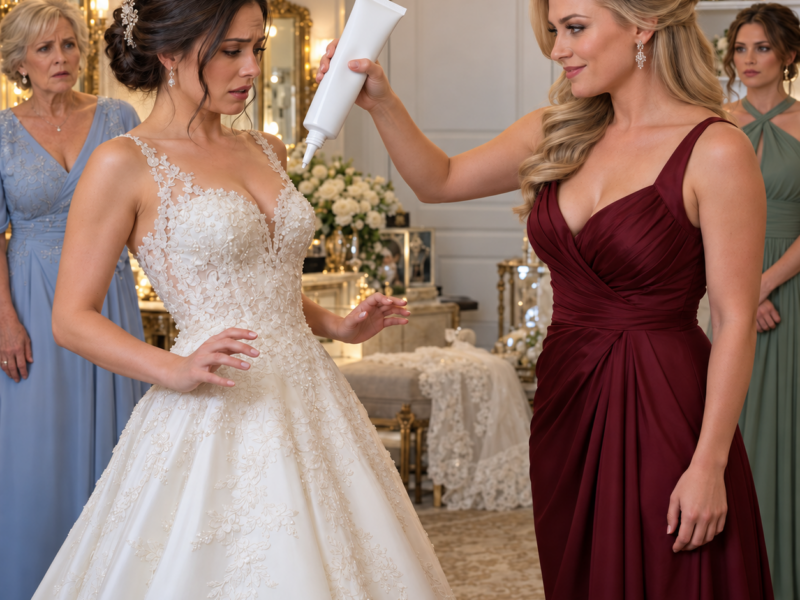
On my wedding day, my sister poured instant glue down my $18,000 silk gown and said, “Oops.” While my mother stared at the ruined lace, Vanessa laughed and told me to consider it “character building.” I looked at the camera above the bridal-suite door, then asked my maid of honor to delay the ceremony by one hour.
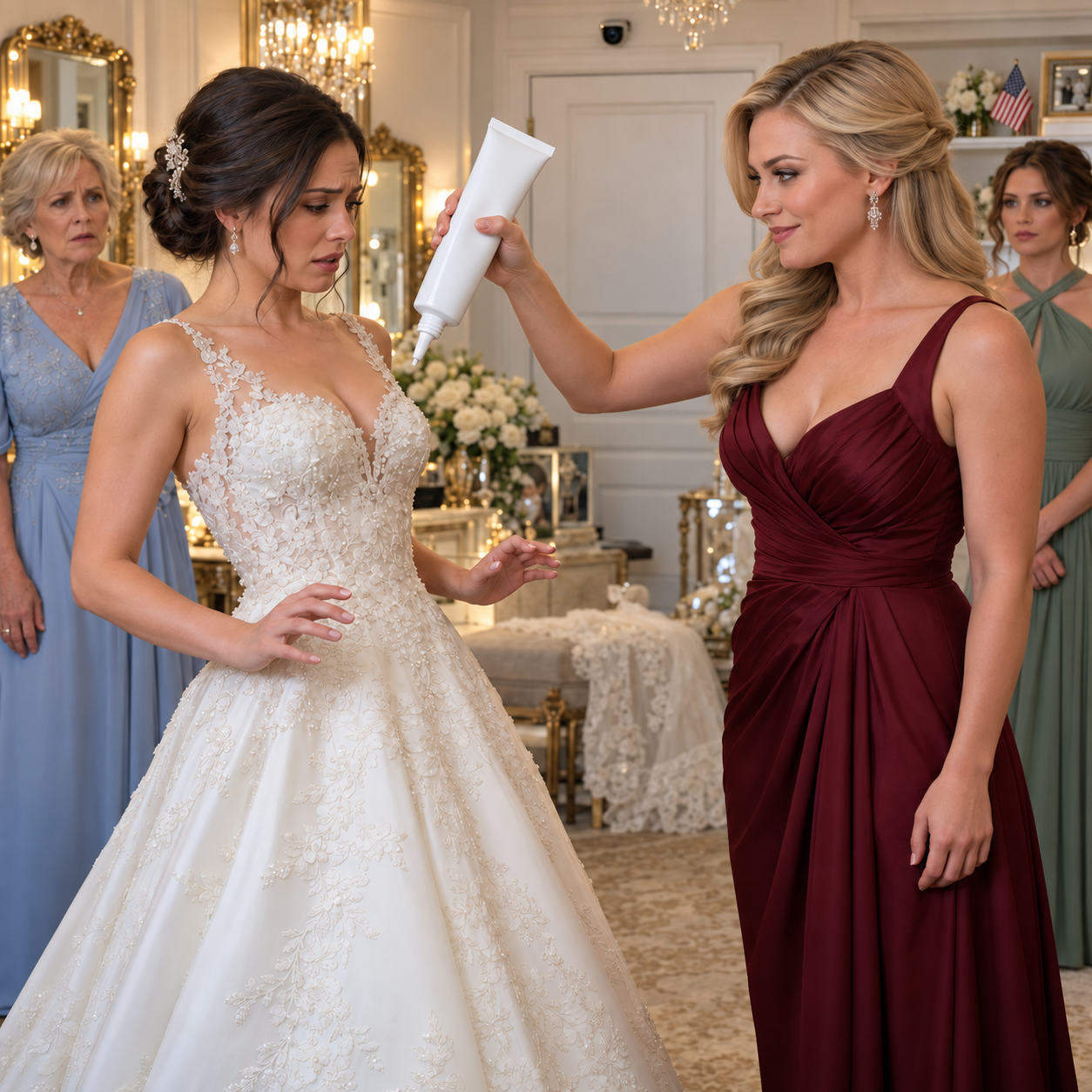
The glue hit my wedding dress before I understood what Vanessa was doing.
One second, I was standing beneath the crystal lights of the bridal suite, trying to fasten an earring while Lena adjusted my veil. The next, a clear stream was sliding down the silk at my waist.
For an instant, I thought it was water.
Then I smelled it.
I looked down as the liquid darkened the bodice and settled into the hand-beaded lace.
My sister held the empty tube above me.
“Oops,” she said.
Nobody moved.
My mother’s hand flew to her mouth. Lena stepped back, still holding the edge of my veil. In the mirror, I could see my own face becoming unfamiliar—white around the mouth, eyes wide, the earring trembling between my fingers.
Vanessa smiled.
Then she laughed.
“You always needed everything perfect, Claire. Consider this character building.”
My hands began to shake.
It wasn’t only the dress.
It was the smile.
I had seen it when we were teenagers and she cut the straps off the dress I was supposed to wear to prom. I had seen it when she told my first serious boyfriend I was cheating on him. Six months earlier, she had worn the same expression after my engagement photographs appeared online before Daniel and I had announced anything.
Every time, there had been an explanation.
A misunderstanding. A joke. An accident.
Every time, I had been expected to forgive quickly enough that nobody else had to sit with what she had done.
But this time, Vanessa had made one mistake she couldn’t laugh away.
I looked past her shoulder.
Above the door to the suite’s reception area was a small black camera lens.
Three weeks earlier, after cash disappeared from gift envelopes during another event, I had asked the owner to upgrade the cameras covering the private hallway and the entrance vestibule. The actual dressing room was behind a separate door, with no camera inside it. But I was fully dressed now, standing in the reception area beside the mirror.
Vanessa had mocked me for being paranoid.
Now the lens was pointed toward both of us.
She stepped closer.
“What? No comeback?”
My mother whispered, “Vanessa, what have you done?”
“Oh, relax. She can buy another dress.”
That sentence told me she still didn’t understand.
Vanessa thought I had bought the gown.
She didn’t know it belonged to the designer until midnight.
It was a custom bridal sample being loaned to me for the day. A similar gown could be commissioned for $18,000, but this particular piece contained archival silk and lace that could not simply be ordered again. The designer’s paperwork valued it at $60,000 for insurance purposes.
Those numbers did not tell us what an insurer would pay or what a court might eventually decide.
But they did tell us one thing.
My sister had deliberately damaged something that was not mine to forgive her for destroying.
And she had done it in front of witnesses, beneath a camera she had forgotten existed.
I turned to Lena.
“Call Daniel. Tell him we’re delaying the ceremony by one hour.”
Vanessa’s eyebrows rose.
“You’re still getting married?”
“Yes.”
“In what?”
I looked at the glue tube in her hand.
“Something better.”
She snorted, turned toward the door, and began typing on her phone before she had even left the room.
The door closed behind her.
Lena locked it.
Then she looked at me.
“You’re too calm.”
I wasn’t calm.
I was holding myself together because, for the first time in my life, I knew exactly what I needed to do next.
I took my phone from the vanity drawer and opened a secure folder.
Bank transfers. Company invoices. Disputed signatures. Statements from vendors. Notes from eight months of meetings I had never told Vanessa about.
I pressed a contact.
“Mr. Hale,” I said when he answered. “It happened exactly the way you predicted.”
There was a pause.
“Is anyone hurt?”
“I don’t know yet. She poured instant glue on the gown.”
“Don’t pull it away from your skin. Get help with that first.”
“She’s on camera.”
“Have the venue preserve the recording. The original file, not a phone recording of a screen.”
I looked at Lena.
She already had her phone in her hand.
“Do I call the police?” I asked.
“Yes. Report what happened. I’ll come to the venue.”
His voice stayed steady.
“And Claire?”
“Yes?”
“You do not have to cancel your wedding to deal with your sister.”
Until then, I had been concentrating on evidence, the dress, and the strange chemical warmth against my waist.
That sentence nearly made me cry.
Because underneath everything else was a terrible, familiar belief.
Vanessa had done something cruel.
Therefore, everybody else’s plans would have to bend around her.
For once, I was going to let that belief be wrong.
My sister was three years older than I was, and for most of my life that small difference had felt like a position of authority.
She knew things first. She went places first. She had opinions about what I wore, who I dated, and whether something I achieved was worth celebrating.
When we were little, I thought that was what older sisters did.
Vanessa could be funny and charming. She remembered names, made strangers feel included, and knew how to tell a story so everybody listened. At family gatherings, she was the person people watched when they wanted to know whether something was amusing.
I was quieter.
I liked lists. I liked knowing what time we were leaving. I preferred finishing a task to discussing how impressive the task would be once it was finished.
Our mother called us opposites.
She said it fondly, as though the word explained everything.
When Vanessa took something of mine, it was because she was impulsive.
When I objected, it was because I was particular.
When she humiliated me, she had gone too far with a joke.
When I cried, I was sensitive.
By the time we were teenagers, the family had developed an efficient system. Vanessa did something. I reacted. Our mother asked both of us to apologize.
It didn’t matter who had started it.
What mattered was getting the house quiet again.
The prom dress should have taught me more than it did.
I had saved money from a summer job and bought a pale green dress from a department store. It wasn’t expensive by anybody else’s standards, but it was the first beautiful thing I had paid for myself.
The night before prom, I found it hanging in my closet with both straps cut.
Vanessa said she had borrowed it to see whether it would fit.
Then she claimed the straps were already weak.
Finally, when I refused to accept either explanation, she laughed and said, “You weren’t seriously going to wear that color, were you?”
My mother took us to a seamstress.
The woman stayed late and repaired the straps with ribbon.
At home, my mother told Vanessa she had been thoughtless.
Then she told me not to let a dress ruin an important night.
I went to prom.
Everybody said I looked lovely.
Nobody understood that I spent the evening checking the repaired straps because I no longer trusted something I had chosen for myself.
Years later, when Vanessa lied to my boyfriend, she claimed she was trying to protect him from getting hurt.
He believed her long enough to break up with me.
When the truth came out, he apologized.
We never got back together.
Vanessa said she had misread something.
My mother said there was no point reopening an old wound.
I learned to keep good news quiet until it was finished.
Then I met Daniel.
He wasn’t loud, and he didn’t mistake loudness for confidence. He asked questions and listened to the answers. When I told him something mattered to me, he didn’t immediately explain why it shouldn’t.
On our fourth date, he noticed that I apologized to a waiter because the restaurant had brought me the wrong meal.
“What are you apologizing for?” he asked afterward.
“I didn’t want to make a fuss.”
“You asked for what you ordered.”
“That can still feel like a fuss.”
He looked at me for a moment.
“Who taught you that?”
I laughed because I didn’t know what else to do.
Eventually, I told him.
Not everything at once.
People who have grown up inside a family pattern often feel embarrassed describing it. Without the years around it, each incident sounds too small to explain the damage.
A cut strap.
A rumor.
A photograph posted early.
It can sound petty until you understand that the person doing it knows exactly what matters to you and keeps choosing that thing.
Daniel understood gradually.
The engagement photographs were the first incident he saw for himself.
We had taken them on a cold Saturday morning, laughing beneath bare trees while our photographer tried to persuade Daniel to stop making me laugh long enough for a serious picture.
We planned to tell our parents in person, then share the photographs.
Vanessa asked to see them.
I sent three.
Within an hour, she had posted them with a caption announcing our engagement as though the news belonged to her.
When I called, she sounded surprised.
“I thought you’d want people to know.”
“I told you we hadn’t announced it.”
“You’re really upset because people are happy for you?”
Daniel sat beside me while I tried to explain.
After I hung up, he said, “She knows why you’re upset.”
I looked at him.
“She isn’t confused, Claire.”
That was harder to hear than I expected.
For years, I had preferred believing Vanessa misunderstood.
Misunderstanding could be fixed with a better explanation.
Knowing meant she had made a choice.
The financial trouble began eight months before the wedding.
I ran a small commercial design and project-management company. We helped independent businesses turn empty spaces into places people could actually use—cafés, medical offices, bookstores, small restaurants.
It wasn’t a glamorous business most days.
There were permit delays, materials arriving late, and clients who changed their minds after approving drawings. But I loved the work. I liked taking something complicated and making it manageable.
Vanessa handled administrative support for us on a contract basis.
That had been my idea.
She had lost a position at another company and needed work. She was organized when she wanted to be, good on the phone, and familiar with billing software.
I gave her defined access.
She could prepare invoices, collect vendor paperwork, and submit expenses for review.
She could not approve payments alone.
At least, that was how the system was supposed to work.
The first warning came from a cabinetmaker named Luis.
He called because his account showed an invoice as paid, but he had never received the money.
I thought it was a bank delay.
Then he read out the account details on the payment confirmation.
They weren’t his.
I checked the original vendor record.
The banking instructions had been changed.
Vanessa said Luis must have sent an update.
He hadn’t.
She said maybe somebody else at the shop had.
Nobody had.
Then another vendor called about a deposit.
Then a client asked why an invoice included a service fee we had never discussed.
At first, I spent more time trying to find an explanation that wasn’t Vanessa than examining the explanations she offered.
I wanted an error.
I wanted a careless employee.
I did not want my sister.
Our accountant, Marisol, eventually closed the office door and said, “Claire, we need an outside review.”
I remember looking at the wall behind her because I couldn’t quite look at her face.
“How bad?”
“We don’t know yet.”
“Could it be a mistake?”
“Some of it could. That’s why we review the records.”
She was careful.
She didn’t tell me my sister was guilty.
She told me the questions were serious enough that affection could no longer be the method we used to answer them.
That was how I met Adrian Hale.
He was an attorney who worked with businesses dealing with internal financial misconduct. He brought in a forensic accountant named Priya Shah.
They didn’t arrive with dramatic accusations.
They asked for contracts, bank statements, system logs, invoices, and the records showing who had changed what.
It was slow work.
Sometimes, an alarming transaction had an ordinary explanation.
Sometimes, it didn’t.
The more we reviewed, the clearer the pattern became.
Invoices had been duplicated.
Vendor details had been altered.
A consulting company I had never authorized appeared in the records.
Payments to that company led to an account associated with Vanessa.
Two documents carried signatures presented as mine.
I had never signed them.
There were also messages she had sent to vendors using language that suggested she had authority I had never given her.
When I asked her about individual items before the outside review began, she answered confidently.
When I asked for documents, she became irritated.
“You don’t trust me?”
“I’m asking for the invoice.”
“That’s the same thing.”
It wasn’t.
But she had learned that, with me, turning a practical question into a test of loyalty often worked.
Mr. Hale helped me stop answering the loyalty test.
We suspended Vanessa’s access while the review continued.
I told her the decision in writing.
She called my mother.
Within an hour, my mother called me.
“She says you’re treating her like a criminal.”
“I’m treating the records like records.”
“She’s your sister.”
“And the vendors are people who need to be paid.”
My mother sighed.
“Can’t you handle this privately?”
“We are handling it privately.”
What she meant was quietly enough that Vanessa would not face consequences.
I didn’t say that then.
I wasn’t ready.
The review lasted months because the accounts were mixed with legitimate work, explanations changed, and records had to be verified with people outside the company.
I paid vendors who had been left waiting. My business needed to meet its obligations while the investigation continued. We separated the disputed transactions from ordinary operating expenses, corrected client accounts, and strengthened our controls.
It cost money.
It cost sleep.
It also taught me something I should have learned earlier.
Trust is not strengthened by removing every check.
Sometimes, checks are what allow decent people to work together without confusion.
By the wedding week, Mr. Hale and Priya had enough verified information to prepare a formal claim and refer certain matters to investigators. Vanessa knew an accounting review was underway. She knew her contract had ended. She knew I was no longer accepting her explanations without supporting records.
She did not know every document we had.
I was not saving them to spring on her at my wedding.
I wanted the wedding to be separate.
Mr. Hale wanted that too.
Three days before the ceremony, he asked whether Vanessa would attend.
“Yes.”
“Has she made threats?”
“Not exactly.”
“What has she said?”
I read him a message.
*Enjoy playing princess. People like you always find out eventually that they don’t control everything.*
He was quiet.
Then he said, “She may try to provoke you. If something happens, don’t let embarrassment make the decision for you. Keep yourself safe. Preserve what matters. Let other people help.”
That was what I meant when I told him it had happened the way he predicted.
He had predicted retaliation.
Not a glue tube.
Not a ruined gown.
There had been no trap.
I had invited my sister because, despite everything, some stubborn part of me still wanted a wedding where she behaved like my sister.
I had also told the venue coordinator that she was not permitted into staff offices, gift storage, or the business areas of the property.
We planned carefully around known concerns.
Then I let her into the bridal reception area because my mother asked whether we could have one family moment before the ceremony.
That was the opening Vanessa used.
The gown had come into my life through a designer named Celeste Armand.
We had worked together on the renovation of her showroom. I had helped solve a series of problems involving a late permit, damaged flooring, and a contractor who abandoned the job.
Months later, when she heard I was getting married, she asked whether I had found a dress.
“Not yet.”
“Come in.”
I resisted at first.
Her work was beautiful, and her prices were beyond what I had planned to spend.
She said I could look without buying.
Then she brought out the gown.
The silk had a soft ivory warmth. The lace looked almost weightless until you saw the work inside it. Tiny beads caught the light without making the dress glitter.
When I put it on, I stood very still.
Not because I looked like a princess.
Because I looked like myself on a day I wanted to remember.
Celeste watched my face.
“This one,” she said.
“I can’t afford this one.”
“It’s not for sale at the moment.”
She explained that it was a sample she had made for an archival collection. She wanted photographs of it worn in a real wedding setting. We discussed a formal loan, insurance, handling requirements, and the alterations that could safely be reversed.
I did not accept until I understood the agreement.
After the trouble at my company, I had become much better at reading paperwork.
Celeste loaned it to me through midnight.
A fitter would help me into it and collect it afterward.
The contract’s insurance value was $60,000. The equivalent commissioned style started at $18,000, but the specific fabric and original handwork made the sample different.
My mother knew it was expensive.
Vanessa heard only the number somebody mentioned during a fitting.
“Eighteen thousand dollars?” she said. “For one day?”
“It’s a loan.”
She waved a hand.
“Whatever arrangement you’ve made.”
She wasn’t listening.
Vanessa rarely listened carefully when she thought she already knew what made someone else vulnerable.
On the wedding morning, the fitter had finished adjusting the gown and gone downstairs to collect a garment case.
Lena stayed with me.
My mother arrived with Vanessa.
I noticed the way my sister looked around the room.
At the flowers.
At the champagne.
At the gown.
She was wearing a pale rose dress and the earrings my mother had given her the Christmas before.
“You look expensive,” she said.
Lena answered before I could.
“She looks beautiful.”
Vanessa smiled at her.
“That too.”
I should have asked her to leave then.
I know that.
But knowing it afterward does not mean I had known exactly what was coming.
I had spent months learning to protect my business from her.
Protecting my wedding still felt like admitting something terrible about my family.
So I stayed beside the mirror.
I picked up my earring.
And Vanessa reached into her handbag.
After she left, the room changed quickly.
Lena called the venue coordinator, Nora, while I spoke with Mr. Hale.
Then she called Daniel.
She didn’t tell him the whole story over the phone.
“She needs you. Come to the suite. We’re delaying the ceremony.”
The fitter, Elise, returned before he did.
She took one look at the gown and stopped.
“Oh, Claire.”
“I’m sorry.”
She looked up immediately.
“You didn’t do this.”
That sentence became one of the anchors of the morning.
Elise asked me not to move.
Some of the adhesive had hardened against lace. A small patch had reached the lining near my waist. She checked carefully without pulling anything loose.
Lena called a nearby urgent-care service for advice while Nora brought in the venue’s first-aid supplies.
We were told to avoid forcing glued fabric away from skin and to get medical help if there was pain, heat, or a larger affected area.
There was a stinging spot near my waist, but the lining had kept most of the liquid off me.
Elise worked slowly, freeing the dress where it could be freed and leaving the damaged sections alone. She did not pour remover over a borrowed silk gown or try some internet trick in a panic.
The dress could wait.
My skin couldn’t.
Daniel arrived while I was standing in a robe, with Lena holding a towel around my shoulders.
He looked at the gown on the table.
Then at me.
“Are you hurt?”
“A little. I’m all right.”
“Who did this?”
“Vanessa.”
His face became still.
For a moment, I worried he would storm into the ballroom.
I took his hand.
“Stay with me.”
He looked at our hands.
Then he nodded.
“What do you need?”
I started crying.
Not because he asked the wrong thing.
Because he asked the right thing, and I no longer had to hold every piece of the morning by myself.
“I still want to marry you,” I said.
His eyes filled.
“Then we’re getting married.”
“In something else.”
“In anything.”
Lena wiped her cheeks.
“Preferably something with clothes involved.”
We laughed once.
It was shaky and brief.
But it reminded me Vanessa had not managed to destroy every feeling in the room.
Nora moved quietly through the practical work.
The ceremony would be delayed one hour.
Guests would be offered refreshments.
The officiant would adjust the schedule.
The kitchen would be told not to begin the next service.
Staff would not discuss details with guests.
The venue owner, Martin, preserved the security footage and recorded who handled it. He confirmed the camera had captured Vanessa entering with her handbag, approaching me, lifting the tube, and directing its contents onto the gown.
The audio in that area was limited.
The picture was clear.
We had witnesses for what she said.
Nora also asked staff not to let Vanessa return to the suite.
No announcement was made.
No video was sent to a group chat.
My sister had tried to make me a spectacle.
I wasn’t going to help her.
Celeste answered on the second ring.
I apologized before she could say hello properly.
“Claire, slow down.”
“My sister poured glue on the dress.”
There was silence.
Then, “Are you burned?”
“No. A small patch got through the lining. We’re handling it.”
“Good. Where is Elise?”
I gave her the phone.
They spoke for a minute.
Then Celeste asked to talk to me again.
“The gown is not your first responsibility right now.”
“It belongs to you.”
“Yes. And we will deal with it.”
“I don’t know what I’ll wear.”
“You told me you wanted a simple dress before you fell in love with this one.”
I remembered a silk crepe gown I had tried during the first appointment.
Clean lines. A soft neckline. No beading.
“It’s still in the showroom,” she said.
“It won’t fit.”
“It was close. Elise knows what needs adjusting.”
“Celeste—”
“I’m sending it.”
Her assistant was already at the showroom, less than twenty minutes from the venue.
That mattered.
There was no impossible overnight miracle.
No designer appearing with a perfect dress summoned from nowhere.
There was a woman with stock, a fitter who knew my measurements, and enough time to make a simple gown wearable.
I asked about the cost.
“We’ll discuss that tomorrow.”
“I need to know.”
She paused.
Then she gave me a price for the sample and the work required.
It was within what Daniel and I could manage from our wedding contingency fund.
“I’ll pay it,” I said.
“All right.”
I could accept kindness.
I also needed clarity.
Celeste understood both.
While Elise prepared the second gown, I called the police nonemergency number and reported the deliberate damage.
The dispatcher asked whether anyone was in immediate danger.
“No.”
Was the person still at the venue?
“Yes.”
Were there witnesses?
“Yes.”
Was there video?
“Yes.”
I answered carefully.
I didn’t tell the dispatcher my sister had committed a particular offense or that the insured value guaranteed an arrest.
I described what happened.
That was enough to begin.
Mr. Hale arrived shortly afterward.
He wore a dark suit but carried an ordinary leather briefcase, not a dramatic folder meant to be waved in a ballroom.
He asked again whether I was hurt.
Then he spoke with Martin and Nora.
The financial review would remain separate from the wedding incident, he told me. The new event might be relevant to how other matters were handled, but nobody would pretend a glue tube proved every disputed transaction.
I appreciated that.
Vanessa’s behavior had been damaging enough without exaggeration.
Mr. Hale asked whether I wanted her to remain as a guest.
“No.”
I said it without hesitation.
For years, I had rehearsed that word and then swallowed it.
This time, it came easily.
“She can collect what she needs through staff,” I added. “I don’t want her near me or Daniel.”
He nodded.
“Then tell the venue.”
I did.
My mother had been standing near the window.
She turned.
“Claire, perhaps she should apologize first.”
“No.”
“She needs to understand—”
“She understands that she poured glue on my dress.”
My mother looked at the damaged gown.
“I don’t know why she would do this.”
“Then ask her somewhere else.”
She flinched.
I softened my voice, but not the decision.
“Mom, I need you to stay here only if you can help me get married. I can’t manage Vanessa through you today.”
Tears rose in her eyes.
“I’m your mother.”
“Yes.”
“I should have stopped her.”
That was true.
It was also too late to make the sentence useful by itself.
“Then stop helping her avoid what happens next.”
My mother sat down.
She did not answer.
In the ballroom, Vanessa was apparently telling a different story.
I learned most of it later.
She said there had been a wardrobe emergency.
Then she said I was being dramatic.
Then she told a cousin there had been a “tiny spill” and that, naturally, I had found a way to delay an entire wedding.
At one point, she posted a photograph of herself near the floral arch.
*Some people can’t handle an imperfect day.*
Lena saw it.
She showed me, then asked whether I wanted to respond.
“No.”
She put the phone away.
That was another small victory.
I did not need to defend myself to the internet while a woman adjusted the hem of the dress in front of me.
Vanessa’s attention was still on appearances.
Mine had finally moved to what actually mattered.
The second gown was beautiful.
Not in the same way.
There was no archival lace, no intricate beadwork, no reason for guests to lean close and ask who designed it.
The crepe moved softly when I walked.
Elise made a careful temporary adjustment at the waist, changed the bustle arrangement, and checked every fastening.
Lena helped me into it.
Then she stood back.
“Oh.”
I looked in the mirror.
There I was.
Not restored to the exact bride I had imagined that morning.
A different bride.
One with swollen eyes, a small dressing beneath the fabric at her waist, and a steadiness she hadn’t possessed an hour earlier.
Daniel waited outside while we finished.
When I opened the door, he smiled.
“You’re still you.”
I took a breath.
“Yes.”
He kissed my forehead.
“The dress is lovely.”
“Thank you.”
“But I wasn’t worried about the dress.”
“I know.”
Nora came down the corridor.
“The officers have arrived.”
It had been almost exactly one hour.
I looked toward the ballroom doors.
Then I looked at Daniel.
For once, I didn’t need to see Vanessa’s reaction myself.
I asked Nora to handle it.
I would find out later from people who were there.
The main doors opened quietly.
Two officers entered with Martin and a member of the venue staff.
There was no shouted accusation.
No interruption from a loudspeaker.
But Vanessa saw them.
She stopped speaking in the middle of a sentence.
Then she saw Mr. Hale.
Her smile disappeared.
That was the moment she understood the morning had left the category of family drama.
She looked toward my mother, who had stepped out to speak with Nora.
“Mom?”
My mother did not immediately go to her.
An officer asked Vanessa to come into a side room so they could discuss a report.
“About what?”
“An incident involving damage to a gown.”
She laughed.
“It was an accident.”
“We’ll speak in private.”
“I’m supposed to be at my sister’s wedding.”
Martin answered.
“Your invitation to remain at the venue has been withdrawn.”
Vanessa stared at him.
“Claire can’t do that.”
“It’s her event.”
The officers did not drag her through a ballroom.
They asked her to step aside.
Eventually, she did.
But enough people had seen her expression change that the story she had been telling no longer sounded convincing.
In the side room, Vanessa repeated that the spill was accidental.
One of the officers asked what she had been holding.
She called it a cosmetic product.
Then adhesive for a loose accessory.
Then she said she didn’t remember.
The tube had been found in a waste bin by staff and preserved without anyone trying to clean it.
Its label did not describe a cosmetic product.
Martin told the officers video was available.
Vanessa asked to see it.
They did not hold a screening for her benefit in the hallway.
They continued taking information.
She could make a statement.
She could decline to answer questions.
She could contact an attorney.
Those choices belonged to her.
The consequences of the morning were no longer mine to organize.
My mother came back to the suite looking older.
“She wants to talk to you.”
“No.”
“She says she didn’t know it would—”
“Mom.”
My mother stopped.
I was standing in the simpler gown with my bouquet in my hands.
Lena was fastening my veil again.
Daniel waited beside the door.
The ceremony could begin.
“I don’t want one more explanation from her before I get married.”
My mother’s face trembled.
Then she nodded.
“All right.”
It was the first time all morning she accepted my answer without trying to move it.
Nora escorted Vanessa out through a side entrance after the officers finished their initial conversation with her. They took her contact information, the witness details, and the evidence arrangements. The incident would be investigated.
There was no instant sentence.
There was no guarantee of charges based on a price somebody mentioned in a bridal suite.
But there was a report.
There was preserved footage.
There were people who had heard her words.
And there was a damaged gown whose owner had not agreed to excuse its destruction.
Vanessa left without returning to the ballroom.
My mother watched from the corridor.
Then she came to me.
“May I walk with you?”
I looked at her.
We had planned for her to walk beside me down the aisle. My father had died years earlier, and the decision had meant something to both of us.
For a moment, I thought about changing it.
Not to punish her.
Because I needed to know whether she could stand beside me without carrying Vanessa into the moment.
“Are you staying?” I asked.
“Yes.”
“Not because you think you can persuade me afterward?”
She shook her head.
“Because you’re getting married.”
I studied her face.
Then I nodded.
“Yes. You may.”
The music began.
I had imagined that walk hundreds of times.
I thought I would notice the flowers, the candles, the faces.
Mostly, I saw Daniel.
He stood beneath the arch with his hands clasped in front of him.
When he saw me, he smiled in a way that made the rest of the room feel less important.
My mother’s hand was warm against my arm.
Halfway down the aisle, I realized I was no longer thinking about Vanessa.
The realization felt almost shocking.
She had occupied so much of the day.
Now she was not in the room.
And the day continued.
Our officiant paused when we reached the front.
She knew there had been an incident but did not refer to it.
This was not a ceremony about surviving my sister.
It was a ceremony about marrying Daniel.
He took my hands.
They were still trembling slightly.
He held them without trying to stop the tremor.
When it was time for our vows, I read the words I had written before the wedding.
I had considered changing them in the suite.
Then I decided Vanessa didn’t deserve to become part of promises we had made before she arrived.
I told Daniel I loved the way he listened.
I loved that he made room for truth, even when truth was inconvenient.
I promised to tell him when I was afraid instead of pretending I was fine.
He looked at me and smiled through tears.
Then he read his vows.
There was one line I remembered most clearly.
“I will never ask you to disappear so a room can stay comfortable.”
He had written it weeks earlier.
He had not known how much I would need it that afternoon.
When we were pronounced married, the applause rose around us.
Lena cried openly.
My mother wiped her eyes.
I kissed my husband.
And for several seconds, nothing else existed.
Afterward, we stepped into the garden with the photographer.
She asked whether I wanted a break.
“Yes. Five minutes.”
Daniel and I sat on a stone bench behind a row of hydrangeas.
I set my bouquet beside me.
“We’re married,” I said.
“We are.”
“I almost let her take this.”
He looked at me.
“She tried.”
“Yes.”
“But you’re here.”
I leaned against him.
For the first time that day, I let myself feel how tired I was.
Not defeated.
Tired.
There is a difference, and I had spent years confusing them.
The reception was smaller in spirit than I had expected, though the guest count had barely changed.
People were careful at first.
They knew something had happened. Some knew more than others.
Nora had asked staff to say only that there had been a delay and the celebration was continuing.
Nobody announced a family scandal.
I didn’t make a speech about revenge.
During dinner, my aunt touched my hand and said, “You look lovely.”
“Thank you.”
My cousin asked whether I was all right.
“I will be.”
That answer felt more honest than “fine.”
Lena’s toast was about friendship.
Daniel’s brother told a story about him trying to repair a bicycle with the wrong tools.
People laughed.
I laughed too.
By the time the music began, the room had loosened.
We danced.
We cut the cake.
We took photographs I would later love because, in them, I looked happy rather than perfectly untouched by life.
Near the end of the evening, Celeste arrived.
She had come to collect the damaged gown and check on the replacement.
I met her in the corridor.
“I don’t know how to thank you.”
“You can send me a photograph where you’re smiling.”
I laughed.
“You’ll get several.”
She looked at my waist.
“Still sore?”
“A little.”
“Have it checked again if it worsens.”
“I will.”
Then we discussed the gown.
The damaged sample would go to a textile conservator for assessment. The insurance process would take time. Police would need documentation of ownership, condition, value, and damage.
Celeste had already begun gathering it.
I felt my stomach tighten.
“I brought this into your life.”
She shook her head.
“Your sister brought it.”
“I invited her.”
“That is not the same thing.”
I knew that intellectually.
Believing it would take longer.
Celeste squeezed my hand.
“Tomorrow, we deal with tomorrow.”
Then she left with Elise and the garment case.
I went back to the ballroom.
Daniel was waiting with two glasses of water.
Not champagne.
Water.
I loved him for noticing.
Our wedding night ended in a quiet hotel room with room service and bare feet.
I took off the borrowed veil.
Daniel helped me remove the temporary dressing at my waist so I could check the skin.
The irritation was small and settling, but we photographed it for the medical record and arranged a follow-up if needed.
Then I sat on the edge of the bed.
My phone was full of messages.
Some from guests.
Some from relatives who hadn’t attended.
Several from Vanessa.
I didn’t open hers.
Daniel sat beside me.
“Do you want me to hold the phone for tonight?”
“Yes.”
He placed it in the drawer.
We ate fries from a room-service tray.
At some point, I started laughing.
“What?” he asked.
“I spent six months planning a seating chart, and the best part of the day might be eating fries in a hotel bathrobe.”
“That’s excellent information for our anniversary.”
I leaned against him.
The laughter turned into tears.
He held me.
Neither of us tried to name the feeling too quickly.
It was grief for the sister I had wanted.
Relief that the wedding had happened.
Anger.
Love.
Exhaustion.
All of it belonged there.
The next morning, I spoke with Mr. Hale.
He asked whether I wanted to postpone business for a day.
“Yes.”
“Good.”
We had planned a short honeymoon later, after Daniel finished a work commitment. For the next two days, we would stay at the hotel and rest.
Mr. Hale would handle urgent communication through my office.
I would not spend the first day of my marriage answering Vanessa.
Before we ended the call, I asked whether the wedding incident would affect the financial matter.
“It may affect how we assess risk and communications,” he said. “But the financial evidence stands on its own. We’ll keep it that way.”
That mattered.
I wanted accountability that could survive being examined.
Not a pile of accusations made believable because my sister had done something outrageous in front of people.
The records had to remain accurate.
The process had to remain fair.
I was done with confusion.
Vanessa’s first message said she was sorry I had misunderstood.
The second said she had never intended to ruin anything.
The third said I had humiliated her by involving strangers.
Then she accused me of planning the camera situation to make her look bad.
I read those messages three days later, with Daniel beside me.
Mr. Hale had advised me to preserve them and not engage.
I did.
But the old instinct still moved through me.
I wanted to explain.
I wanted to tell her that a camera did not cause her to lift the tube.
I wanted to ask how she could call my reaction humiliating when she had laughed at mine.
Then I understood that none of those questions would create the conversation I wanted.
Vanessa knew what she had done.
She wanted me back inside the argument.
So I stayed outside it.
My mother called that afternoon.
I answered because I wanted to speak to her separately.
“Claire?”
“Yes.”
“I saw the recording.”
My breath caught.
“Who showed you?”
“Vanessa’s attorney described it. Then Martin allowed me to see it after you gave permission through Mr. Hale.”
I remembered the request and agreeing that she could view the footage privately. I had not wanted it circulated, but I was tired of being asked whether the action had been deliberate.
My mother began crying.
“She looked at you.”
“Yes.”
“Before she did it.”
“Yes.”
“She wasn’t clumsy.”
“No.”
There was a long silence.
Then my mother said, “I kept hoping there was something I hadn’t understood.”
I closed my eyes.
“I know.”
“I think I’ve done that for years.”
I didn’t answer.
She continued.
“The prom dress. Your boyfriend. The photographs.”
I pressed my fingers against the edge of the table.
She knew the list.
I had not imagined it.
“I made you responsible for moving on,” she said. “Because I didn’t know how to make her stop.”
The truth hurt.
But it was a truth I could work with.
“Yes,” I said.
“I’m sorry.”
I let the apology remain between us.
No reassurance.
No quick forgiveness to reward her for finally seeing it.
After a while, she asked what she could do.
“Stop carrying messages from her.”
“All right.”
“Stop asking me to settle things quietly so she won’t face consequences.”
My mother cried harder.
“I’ll try.”
“I need more than trying when she calls.”
She took a breath.
“Then I won’t.”
We ended the call gently.
It was not reconciliation.
It was the beginning of a conversation my childhood had never allowed.
Over the next month, the practical consequences developed slowly.
Celeste’s conservator assessed the damaged gown.
Some lace could be saved.
The silk beneath the bodice had hardened unevenly. Several sections could not be restored without replacing original material, which would change the piece’s character and archival value.
The insurer requested documents.
Celeste provided the loan agreement, construction records, photographs taken before the wedding, and the conservator’s report.
I gave a statement about what happened.
Elise described the gown’s condition before and after.
Lena and my mother provided witness accounts.
The police obtained the preserved footage through the proper process.
It was not a simple matter of reading $60,000 from a contract and writing a check.
There were questions about repair, diminution in value, replacement, policy terms, and responsibility.
I learned more about damaged property than I ever wanted to know.
But I also learned patience.
Consequences that are real often move more slowly than consequences in a person’s imagination.
That did not make them less real.
The financial investigation continued separately.
Priya’s report identified a series of transactions that could not be supported by legitimate invoices or authorized services.
There were also transactions she excluded because they had adequate explanations.
I remember appreciating those exclusions almost as much as the findings.
A report that treated every unusual item as theft would have been easier for Vanessa to attack.
A careful report was harder.
The total verified loss was substantial for my company.
Not enough to ruin a multinational corporation.
Enough to threaten payroll, delay projects, and make a small business owner lie awake calculating what could be covered without borrowing.
For months, I had been quietly filling gaps.
Now there was a clear record of the gaps and how they had been created.
Mr. Hale filed the civil claim.
Investigators reviewed the material relevant to possible criminal conduct.
Vanessa retained her own attorney.
Communication came through counsel.
I stopped expecting one devastating revelation to make her confess everything.
There were denials.
Alternative explanations.
Claims that I had authorized more than I remembered.
That was why the records mattered.
The disputed signatures were compared with authenticated documents. Vendor communications were verified. Banking details were traced through lawful requests. System access logs were reviewed in context.
Nobody relied on a dramatic speech from me.
That was a relief.
I had spent my life being told I explained things badly.
Now the truth did not depend entirely on how steady my voice sounded.
At work, I had to address the damage without making my employees responsible for my family’s conflict.
I met with the small team.
I told them the review had found serious problems involving a former contractor and that corrective steps were underway.
I did not give them details they didn’t need.
I apologized for delays caused by my reluctance to question someone close to me.
Marisol looked at me across the table.
“Thank you.”
I nodded.
We changed approval procedures.
Banking changes required independent verification.
New vendors needed documentation.
Payment authority was separated from preparation.
Shared passwords ended.
I also stopped using the phrase “like family” to describe the company.
My employees had families.
At work, they deserved clear roles, reliable pay, and a supervisor who did not turn personal loyalty into an operating procedure.
That was one of the changes I was proudest of.
Daniel and I took our honeymoon six weeks after the wedding.
A small coastal town.
A room with a balcony.
No elaborate itinerary.
The first morning, I woke early and reached for my phone.
Daniel was still asleep.
I looked at the sea through the open curtains.
Then I set the phone down.
For ten minutes, I did nothing useful.
It was surprisingly difficult.
I had spent months expecting another problem.
Another message.
Another invoice that didn’t make sense.
Another person telling me Vanessa needed help.
Quiet had begun to feel like the moment before something went wrong.
On the third day, we walked along the shore.
Daniel asked whether I wanted to talk about her.
“No.”
“All right.”
After a while, I said, “Actually, yes.”
He smiled.
“Also all right.”
I told him I was afraid of becoming hard.
That protecting myself would mean losing the part of me that had wanted to give my sister work, invite her to the wedding, and believe she could behave differently.
He listened.
Then he said, “You can be generous without handing somebody the same opportunity to hurt you again.”
“I know.”
“But knowing and doing are different.”
“Yes.”
He picked up a flat stone and turned it over in his palm.
“You’re not required to make every boundary temporary to prove you’re kind.”
I stood looking at the water.
That was exactly what I had been doing.
Every no came with a future maybe attached.
Every closed door had a note explaining where the spare key was hidden.
I had confused kindness with continued access.
When we returned home, I began seeing a counselor.
Her name was Miriam Cole.
At our first appointment, I told her the wedding story quickly, almost apologetically.
She asked me to slow down.
Not for more dramatic detail.
So I could notice what happened inside me as I described it.
“I keep thinking about the moment before,” I said.
“What about it?”
“If I’d asked her to leave. If I hadn’t invited her. If I’d listened to Daniel.”
Dr. Cole nodded.
“It’s understandable to look for the moment you could have prevented it.”
“I could have.”
“Perhaps. But that is not the same as causing it.”
I looked at her.
“Your sister made a choice. Reviewing your decisions can help you protect yourself. Taking responsibility for her choice will not.”
I needed to hear that more than once.
For weeks, we talked about the family pattern.
How forgiveness had become a task assigned to me.
How my mother’s distress made me feel responsible.
How Vanessa used uncertainty, charm, and accusation to move attention away from her actions.
We also talked about my own choices.
Not because I deserved the harm.
Because I wanted to stop arranging my life around the hope that a sufficiently clear explanation would finally change her.
“You can understand someone,” Dr. Cole said, “without giving them access.”
I wrote that down.
It was not a sentence for my sister.
It was a sentence for me.
My mother began coming over occasionally.
At first, for coffee.
Short visits.
No Vanessa updates.
The first time she mentioned that my sister was struggling, I set down my cup.
“Mom.”
She stopped.
Then she nodded.
“I’m sorry. I said I wouldn’t.”
We changed the subject.
I did not ask her to choose which daughter she loved.
I asked her to stop making one daughter responsible for the other.
There was a difference.
Eventually, she understood it.
One Sunday, she brought a small envelope.
Inside was an old photograph of me in the green prom dress.
The repaired ribbon straps were visible.
“I found this,” she said.
I held the photograph.
“You looked beautiful.”
“Thank you.”
She sat down.
“I remember telling you not to let the dress ruin the night.”
“Yes.”
“I should have said she had no right to do that.”
I looked at her.
“Yes.”
She cried.
I did too.
But this time, the tears didn’t become a demand that I end the conversation.
We stayed with it.
Afterward, we made lunch.
That was what repair began to look like.
Not a speech.
Not the erasure of years.
An adult acknowledging something specific, then behaving differently the next time it mattered.
The criminal damage matter progressed before the financial case reached any resolution.
The footage and witness accounts gave investigators a clear view of what had happened to the gown.
Vanessa’s lawyer argued over valuation and the circumstances.
That was his job.
The case did not become less deliberate because the final amount was disputed.
Eventually, Vanessa accepted responsibility for the property damage through a negotiated resolution approved in court. The terms included restitution based on documented losses, along with other conditions set through the legal process.
I was not present to watch her be embarrassed.
Celeste attended with counsel because the property was hers.
I provided what was requested.
That was enough.
When Mr. Hale called to explain the outcome, I listened.
Then I asked, “Does this mean I have to speak to her?”
“No.”
I felt my shoulders lower.
Legal resolution and personal reconciliation were different things.
For years, my family had treated any apology, any payment, any official ending as a reason I should reopen the door.
I wasn’t doing that anymore.
The financial case took longer.
There were months of document exchanges, interviews, and arguments over what had been authorized.
Vanessa’s attorney eventually proposed a civil settlement.
Mr. Hale reviewed it with me carefully.
The agreement needed to address repayment, responsibility for certain costs, the disputed records, and restrictions on future contact related to my business.
I did not want a settlement that described everything as a misunderstanding.
I also did not want to spend years in litigation solely because anger made compromise feel disloyal to myself.
Mr. Hale helped me distinguish those concerns.
“We can protect the record,” he said, “and still make a practical decision.”
The final civil agreement required a structured repayment and resolved specified claims. It did not control decisions made by criminal investigators or promise silence about matters I was legally required to address.
Some money came back quickly.
Some would take longer.
Some costs could not be neatly recovered.
The damage had been real.
So was the work of moving forward.
I didn’t tell guests at the wedding what the final terms were.
I didn’t post a victory announcement.
I told my employees what they needed to know about the company’s stability.
I told Daniel.
Then I went to work.
Vanessa sent one letter through her attorney after the damage matter resolved.
Mr. Hale asked whether I wanted to read it.
I thought about that for two days.
Then I said yes.
The letter began differently from her messages.
She wrote that she had deliberately poured the adhesive.
She wrote that she was angry about the business investigation and wanted to make me feel powerless.
She said she had told herself she was only ruining a dress.
Then she acknowledged that she had intended to ruin my day.
I read that paragraph twice.
It was the first time she named the intention.
The rest of the letter was more complicated.
There were references to childhood, comparisons, and feeling overlooked.
Some of them may have been true.
Some were explanations I had heard before.
But near the end, she wrote, *I don’t expect you to forgive me now.*
I appreciated the word “now” less than she probably intended.
It still suggested a future deadline.
I gave the letter to Dr. Cole.
We talked about it.
“Does recognizing what she did mean you want contact?” she asked.
“No.”
“Then you have your answer.”
I kept the letter.
I did not reply.
That was not revenge.
It was a decision.
About seven months after the wedding, Celeste invited me to her showroom.
The damaged gown stood on a form behind a curtain.
I hadn’t seen it since the wedding night.
When she pulled the curtain aside, I felt my stomach tighten.
The conservator had saved what could be saved. The damaged sections had been stabilized, and some materials were removed for documentation and assessment.
It was no longer the gown I had worn that morning.
I touched none of it.
“I’m sorry,” I said.
Celeste looked at me.
“We’ve discussed that.”
“I know.”
“It was beautiful.”
“Yes.”
“Something can be beautiful and still be damaged by another person. That doesn’t make the beauty foolish.”
I looked at her.
She smiled slightly.
“I’m talking about the dress. You may apply it elsewhere if useful.”
I laughed through tears.
Then she showed me a smaller piece she was developing using salvaged lace from a section that had not been touched by the adhesive.
Not to pretend the original was restored.
To let some of the work continue.
She asked whether she could display a wedding photograph of me in the second gown.
“Of course.”
“The one in the garden.”
I knew the photograph.
Daniel and I were sitting on the bench, laughing at something Lena had said from behind the photographer.
My eyes were puffy.
My hair had loosened.
I loved it.
“That one,” I said.
Before I left, Celeste handed me a garment bag.
Inside was the simple gown I had worn to the ceremony.
I had paid for it.
She had cleaned it and completed the permanent alterations.
“It’s yours,” she said.
I took the bag carefully.
For months, I had thought of the first gown as the dress Vanessa destroyed.
Now I wanted to remember that I had another one.
The dress I got married in.
The dress that belonged to the life after I said no.
Daniel and I hung the garden photograph in our hallway.
Not the formal portrait.
Not the image that looked most expensive.
The photograph where I appeared relieved to be beside him.
Sometimes, when I passed it, I remembered the glue.
More often, I remembered the fries in the hotel room.
The vows.
The way he had asked what I needed instead of telling me what I should feel.
That was how the day began to change in memory.
Vanessa’s act remained part of it.
It stopped being the center.
At our first anniversary, Daniel asked whether I wanted a party.
“No.”
“A dinner?”
“Yes.”
“Just us?”
“Just us.”
We went to a small restaurant where nobody knew anything about the wedding.
I wore a blue dress and the earrings I had never finished fastening that morning.
At dinner, Daniel gave me a card.
Inside, he had written, *One year of choosing the life we actually want.*
I smiled.
“That sounds very serious.”
“It is. There are also terrible jokes on the back.”
There were.
I laughed.
Then I took his hand.
“I’m glad we didn’t postpone.”
“So am I.”
I thought about how easily I could have let Vanessa decide the day.
I could have canceled.
I could have spent the afternoon pleading with my mother.
I could have watched the security recording repeatedly, gathering anger instead of getting dressed.
Instead, other people had helped carry what needed carrying.
And I had married the person I wanted to marry.
That remained the most important thing that happened.
Later that evening, my mother called to wish us a happy anniversary.
She did not mention Vanessa.
She asked whether we had enjoyed dinner.
“Yes.”
“Good.”
There was a pause.
Then she said, “I’m glad I stayed.”
I leaned against the kitchen counter.
“So am I.”
“I wish I’d understood sooner.”
“I know.”
She didn’t ask me to say the past no longer mattered.
I didn’t need to.
We could love one another without rewriting it.
After the call, I went upstairs and opened the wardrobe.
The simple wedding gown hung inside its garment bag.
I unzipped it.
The fabric was soft beneath my fingers.
For so long, I had thought strength would feel dramatic.
A devastating speech.
A room falling silent.
A person who hurt me finally looking afraid.
Those moments existed.
The venue doors had opened.
Vanessa’s smile had vanished.
There had been footage, witnesses, and consequences she could not charm her way around.
But the strength that changed my life had been quieter.
Calling for help.
Letting the professionals handle the dress.
Telling my mother no.
Refusing to answer messages that only invited another argument.
Allowing the legal process to take time.
Walking down the aisle in a gown I hadn’t planned to wear.
I closed the garment bag.
Downstairs, Daniel was making tea.
He called my name.
I went to him.
The house was warm. Our anniversary cards stood on the shelf. There were two cups on the counter and a piece of cake we had brought home from dinner.
Nothing in that room belonged to Vanessa.
Not the silence.
Not the celebration.
Not the version of myself who sat down beside my husband.
My sister had believed ruining the dress would give her control of the day.
The camera recorded the moment she made that choice.
What it didn’t record was everything that came afterward.
The ordinary work.
The boundaries.
The marriage.
The life that kept going when I stopped handing her the power to interrupt it.
Daniel passed me a cup.
“Happy anniversary, Claire.”
I smiled.
“Happy anniversary.”
And for the rest of the evening, we talked about our future.









