On my sixtieth birthday, my daughter-in-law called me “free labor” at a dinner I had spent all afternoon cooking. My son heard her and asked me to pour the wine. Neither of them had wished me a happy birthday. Then Megan’s mother mentioned the cake she had offered to bring—and I learned what Megan had told everyone about me.
At five o’clock on the morning of my sixtieth birthday, I stood in the dark kitchen making three different breakfasts.
Ryan liked pancakes with crisp edges. His wife, Megan, wanted a freshly blended green smoothie. Their son Leo would eat scrambled eggs if I cut his toast into triangles and put the eggs on the other side of the plate.
I had been making those breakfasts for so long that I could reach for the right pan without turning on the overhead light. I measured batter, washed spinach, and set a little bowl beside Leo’s chair. Outside, a streetlamp lit one corner of the yard. The rest of the house was quiet.
I was wearing an old fleece robe Arthur had bought me shortly before he died. Its blue had faded, and a grease mark on the chest had survived every wash. I had other robes, but I still reached for that one when I got up early. It felt familiar in a way the house had not for a while.
The first pancake had barely begun to brown when Megan called down from upstairs.
“Helen, could you keep the noise down? I have a meeting at nine.”
I turned the burner lower. Her slippers came quickly down the stairs anyway.
She appeared in the kitchen doorway wearing a sheet mask and carrying a garment bag over one arm. “The smell is going to get on my suit.”
“I can open the back window.”
“It’s freezing outside.”
I slid a spatula beneath the pancake. “Today is my—”
“I also need you here for the plumber,” she said. “He’s supposed to arrive around noon. For lunch, can you make the salmon you bought? Very little salt. I’ve been eating too much lately.”
“Megan, today is my sixtieth birthday.”
She lowered the garment bag.
“So?” she said. “I know you don’t like people making a fuss.”
“I didn’t say that.”
“I have to get ready.” She started toward the stairs, then turned back. “My parents are coming to dinner. Please make a few extra dishes.”
She was gone before I could answer.
I stood with the spatula in my hand while the pancake darkened. Perhaps she had not heard the second half of what I said. I knew she had heard the first. I took the pan off the heat and began again.
Ryan came down a few minutes later, knotting his tie with one hand and reading his phone with the other.
“Mom, where’s my coffee?”
“It’s almost ready.”
“I have an early call.” He took his mug from the counter, tasted it, and looked around. “Have you seen my blue cuff links?”
“Check the drawer by the front door. You put them there Sunday.”
He went to look. On his way back through the kitchen, he said, “Could you get seafood for tonight? Megan’s dad likes lobster.”
“I was going to the market.”
“Great. Thanks.”
I thought he might notice the date circled on the calendar behind him. I had written *Helen’s 60th birthday* under it weeks earlier so I would remember a lunch Ruth wanted to take me to. I had canceled the lunch when Megan told me about the plumber.
Ryan found his cuff links and left with his coffee. He did not look at the calendar.
I finished breakfast. Megan drank the smoothie while checking emails. Ryan ate two pancakes standing at the counter. Leo wanted to tell his parents about a drawing he had made at school, but both of them were in a hurry. I promised he could show it to me after he came home.
Once the school bus picked him up and the cars pulled out of the driveway, I washed the pans.
The house belonged to Ryan and Megan. I had moved in five years earlier, after Arthur’s death, because they asked me to. At first I had been grateful. Grief made my old apartment feel impossibly empty, and helping with Leo gave shape to my days. Ryan said I could take my time deciding what came next.
I had taken my time. Then everyone had become accustomed to the arrangement.
I paid toward the household bills from my pension and savings. I bought much of the food because I knew what everyone liked. I had my own room and a small sitting area upstairs, though I rarely used it during the day. There was always a meal to prepare, a delivery to receive, or a child to collect.
None of that had happened overnight. I had volunteered for the first school pickup. I offered to cook when Megan returned to work after having Leo. I told Ryan not to worry about hiring help while his schedule was demanding. Each offer had been sincere. After a while, the work continued without anyone asking whether I still wanted to do it.
On birthdays when Arthur was alive, he took over breakfast. He made the pancakes too thick and got flour on the cabinet handles. He would put a card next to my plate and insist that whatever else happened that day, I was not washing dishes.
I turned off the tap and looked at the bare space beside my plate.
A daytime talk show was playing in the living room. Someone was speaking about adult children who took their parents for granted. I switched it off. The quiet that followed felt larger than the room.
I found Arthur’s photograph in the back of my closet. In it, he was fifty-five, smiling with his head tilted slightly toward me. The last years of his life had been dominated by heart failure. In the hospital, when we knew he would not come home again, he held my hand and told me, “Helen, after I’m gone, live for yourself too.”
At the time I thought he meant I should be willing to survive without him. I had been doing that for five years. I was no longer certain I had done the other part.
The plumber arrived late in the morning. He saw the birthday date written on the kitchen calendar and wished me a happy birthday.
“Thank you,” I said.
He went to work beneath the sink, and I made myself noodles for lunch. While he tested the pipe, I sat at the table with Arthur’s photograph beside my bowl. I could not remember the last time I had made something simply because I wanted to eat it.
The plumber finished, showed me what he had repaired, and left. I put the photograph away, picked up my basket, and walked toward the market.
At the park, a line-dancing group was practicing near the community center. Several people were older than I was. One woman missed a step and laughed at herself; the others turned to help her find the rhythm. I stopped long enough to watch them begin again.
My phone buzzed.
*My in-laws will be there at seven,* Ryan wrote. *Please make extra. Megan wants shrimp scampi, no spicy peppers.*
I read it twice. He had texted me about dinner on my birthday without saying happy birthday.
I put the phone away and kept walking.
Ruth found me in the produce section staring at two bags of potatoes. We had worked together years ago at a textile mill. She was five years older than I was and had been enjoying retirement so thoroughly that every time I saw her, she had news of another class, another outing, or a new friend.
“Helen! I was going to call you.”
“It’s good to see you.”
“Happy birthday.” She hugged me before I could put down the potatoes. “Why are you shopping? I thought we were having lunch.”
“The plumber came, and I’m cooking tonight.”
“For your birthday?”
“Megan’s parents are coming.”
Ruth looked into my basket, already holding salmon, vegetables, and ingredients for soup.
“Did they ask you to make your own birthday dinner?”
“I don’t think they remembered.”
She said nothing for a moment.
I began selecting tomatoes. “They’ve had a busy week.”
“You’re allowed to be disappointed.”
“I know.”
Ruth was living at Willow Creek, a senior community not far from my old neighborhood. She had moved there the year before and had described its gardens, classes, and shared kitchen often enough that I could picture them.
“Come visit tomorrow,” she said. “You can have lunch with me. If you don’t like it, I’ll stop talking about it for a whole month.”
I smiled. “That would be a remarkable sacrifice.”
“Think it over.”
I promised I would. Then I went home with the groceries.
For most of the afternoon, I cooked. The salmon needed careful timing. I prepared shrimp scampi the way Megan liked it, without hot peppers. I made soup because the evening was cold, roasted vegetables, warmed bread, and set aside a small portion for Leo before adding ingredients he usually picked out.
I had planned to make a lemon cake for myself. At four, I looked at the covered counter and the clock, and decided I did not have time.
That disappointed me more than I expected. I had spent the day waiting for someone else to make room for it. Even after Megan’s answer that morning, I had thought Ryan might remember on his way home. I had cooked as if finishing everything perfectly would leave time for my birthday afterward.
At six thirty, I heard Ryan’s car. Megan’s parents arrived shortly after seven. Voices filled the living room while I plated the last dish.
“Mom, is dinner ready?” Ryan called. “I’m starving.”
“Almost.”
Megan came to the kitchen door. She looked at the spread of food, then at me.
“Why haven’t you brought it out? Are you planning to let the whole family go hungry?”
“The salmon just finished.”
Ryan appeared behind her. “Mom, if you can still do it, hurry up.”
I looked at them. The apron strings were tied tightly around my waist. I had been on my feet for hours, and Ryan was speaking as though I were late for a job he had assigned me.
“I’m bringing it,” I said.
He went back to the living room.
In a kitchen drawer lay Arthur’s little digital recorder. He had used it when illness made him afraid he would forget instructions or leave me with unanswered questions. I kept it because his voice was on it. I had not listened to the files for years.
I took it out, pressed record, and slipped it into my apron pocket.
I wanted to hear later whether dinner had sounded the way it felt to me. Even as I did it, I was uncomfortable with the idea that I needed a recording to trust my own memory.
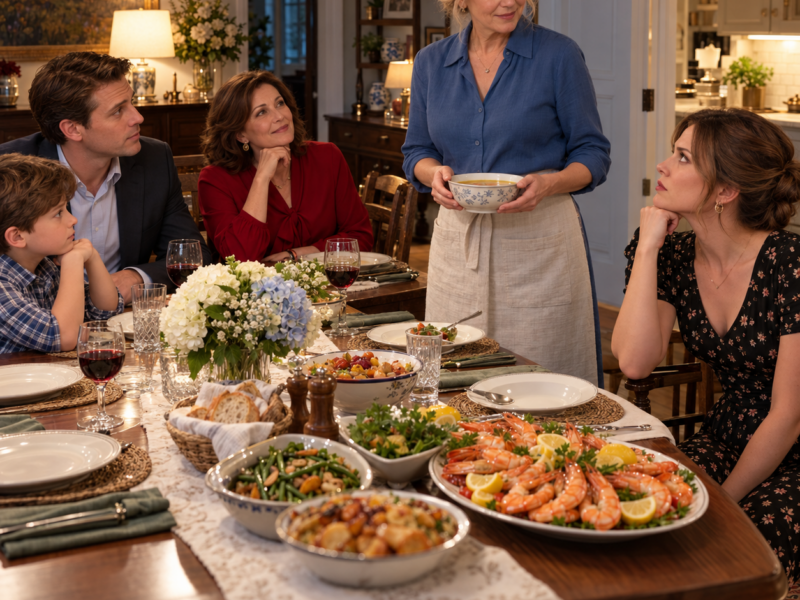
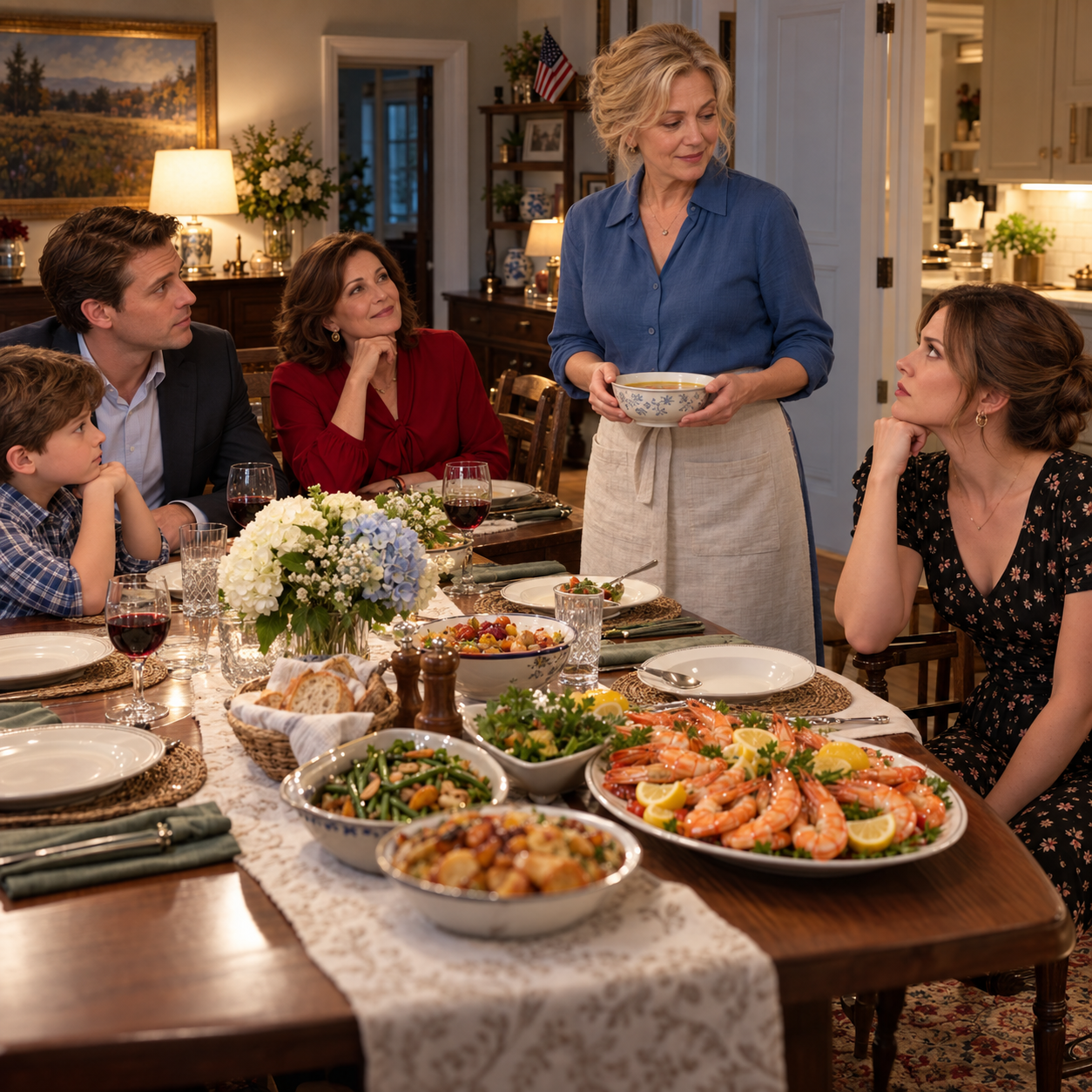
Six people were already at the dining table when I carried in the salmon: Ryan, Megan, Leo, and Megan’s parents, with one chair left for me near the kitchen door. Megan’s father, Walter, thanked me for the meal. Her mother, Elaine, admired the vegetables and asked if she could help carry anything else.
“I’ve got it,” I said, as I had said to people in that house hundreds of times.
Ryan wanted the chilled red wine. I had forgotten to bring it from the refrigerator.
As I went to fetch it, Megan said, “She’s getting forgetful. One simple thing, and we have to remind her. I told Ryan it might be easier to hire someone than keep relying on free labor.”
I stopped with my hand on the refrigerator door.
I had tried to tell myself that Megan’s sharpness came from stress. I could no longer find a gentler meaning in those words.
When I returned, Ryan pushed his glass toward me without looking up from his conversation with Walter. I poured wine for the adults, leaving a little for myself. Before I sat down, Megan noticed the soup was missing. I went back for it, aware that my food was cooling on the plate.
Leo asked for shrimp. When I offered to help him, he pulled his plate away.
“I don’t want you to touch it. Your hands are dirty.”
“Leo,” Ryan said mildly, “don’t talk to Grandma like that.”
Megan put on the disposable gloves she used when handling shrimp. “He means older people ought to be careful with food. I’ll help him.”
Leo watched her. I looked down at my hands. I had washed them throughout the afternoon. They had made his breakfast that morning and tied his shoes before the school bus came.
Elaine set down her fork.
“Helen,” she said, “isn’t today your birthday?”
For one moment I was so relieved that someone had remembered that I forgot the rest of the table was listening.
“Yes. I’m sixty today.”
Walter looked at Ryan. Ryan looked at Megan.
“I thought Helen didn’t like people making a fuss,” Elaine said.
“That’s right,” Megan answered quickly. “She hates birthdays.”
“I asked you this afternoon whether we should bring a cake,” Elaine said. “You told me she would find it embarrassing.”
I looked at Megan. “I would have liked a cake.”
She pulled one glove loose at the wrist. “You never said that.”
“I said this morning that it was my sixtieth birthday.”
Ryan put his phone face down. “I was there?”
“You were in the kitchen. You asked for coffee.”
He looked at the calendar in the next room, visible through the doorway. The red circle stood out from where we sat.
Megan’s father quietly said, “We should have wished you a happy birthday when we arrived. I’m sorry, Helen.”
“Thank you.”
I could have stopped there. Elaine had remembered; Walter had apologized. Yet I knew that after the guests left, Megan would tell Ryan I had made dinner uncomfortable by speaking up. By morning, I might be persuading myself that the evening had been no worse than usual.
I took the recorder from my pocket and set it beside my plate.
Megan stared at it. “What is that?”
“Arthur’s recorder. I turned it on before I served dinner.”
“You recorded us?”
“Yes.”
I saw Walter sit back in his chair. I was suddenly aware that they were guests in Ryan and Megan’s home, listening to a family conflict they had not expected. I had not planned what to do with the recording. Now I wished I had found another way to trust my own account.
“I don’t need to play it,” I said.
Megan’s gaze remained on the little gray device. “Then why bring it out?”
“Because I’ve spent years being told I misunderstood how people spoke to me. I wanted to be certain.”
Ryan reached for his water, then set it down untouched.
Megan folded the loose glove in her hand. “You’re making ordinary conversation sound terrible.”
“You called me free labor. You said I was forgetful because I didn’t bring the wine.”
“I was joking.”
“I’m telling you I was hurt by it.”
She looked to Ryan. He did not rush to answer for her. I decided to let the recording speak for the few minutes I had saved. I pressed play.
At first we heard dishes being set down, Walter thanking me for the salmon, Ryan asking for wine. Then Megan’s laugh and the words about hiring help instead of relying on free labor. Ryan’s voice asked me to pour for him. Later came Leo’s complaint about my hands and Megan’s answer.
I stopped it there.
The room was still. Walter took off his glasses. Elaine looked toward her daughter.
Leo’s tablet lay face down beside his plate. He looked frightened.
“Leo,” I said, keeping my voice gentle, “my hands were clean when I offered to help you. Getting older doesn’t make someone dirty.”
“I’m sorry, Grandma,” he whispered.
“Thank you.”
I would not ask him to account for what he had heard adults say. The rest of the conversation belonged to us.
I turned to Ryan.
“I got up at five to make breakfast for all three of you,” I said. “I waited for the plumber. I bought the groceries you requested. I cooked this dinner. Not one of you wished me a happy birthday until Elaine remembered.”
Ryan looked down. “I forgot.”
“Yes.”
“I’m sorry.”
I believed he was sorry in that moment. I also knew there had been hundreds of days like it without a birthday to make the neglect visible.
Megan spoke sharply. “You could have told us you wanted a party.”
“I did tell you it was my birthday. You answered, ‘So?’”
She remembered. I could see it.
“I had a meeting,” she said.
“I know.”
Elaine pushed her chair back slightly. “Megan, I offered to bring a cake.”
“I thought Helen wouldn’t want one.”
“You told me she had said so.”
Megan looked from her mother to me. “She never complains. How was I supposed to know?”
“I am telling you now,” I said.
It took effort to keep my voice even. I was hurt, and I wanted to be heard. Shouting would not help me say what I needed to.
For five years I had cooked, cleaned, and cared for Leo. I loved much of that work, especially the hours with my grandson. I had also become tired. I wanted a day off sometimes. I wanted to visit Ruth and take a class, go somewhere without checking whether anyone needed a pickup, and eat a meal I had not made myself. I wanted my son to notice when I was exhausted.
“I don’t want to keep living this way,” I said.
Ryan lifted his head. “Mom, we can change things.”
“I hope you do. Tomorrow I’m visiting Willow Creek with Ruth.”
“What’s Willow Creek?”
“A senior living community. Ruth lives there.”
Megan spoke before anyone else. “But who will get Leo after school?”
The question hung over the table. She heard it herself a moment later.
“I mean, we need to talk about a move,” she said. “You can’t decide in the middle of dinner.”
“I’m going to visit,” I said. “If I like it, I’ll decide whether I want to move. I’ll give you time to make other arrangements for Leo.”
Ryan came around the table toward me.
“Mom, please don’t go because I forgot a birthday.”
I stood and untied my apron. The knot had pulled tight over the afternoon, and my fingers struggled with it. I folded the apron and laid it across the back of my chair.
“I’m considering it because I want to know how I’d live if I wasn’t responsible for this house every day.”
He stopped close enough that I could see the tears in his eyes.
“We don’t think of you as responsible for everything,” he said.
“I know you haven’t thought about it much. That’s part of the problem.”
I picked up the recorder. Arthur’s photograph stood on the sideboard near the dining room entrance. Megan had asked me to move it there months before because the kitchen counters looked cluttered. I took it with me as I went upstairs.
No one followed me for several minutes.
I packed one suitcase. I had no plan to leave in the middle of the night; I wanted to see that I had enough of my own life to put in a bag. I folded Arthur’s robe, three blouses, two pairs of pants, my medication, and my favorite book. I put his photograph between soft clothes so the frame would not break.
At the back of the closet sat my wooden recipe box. When I opened it, the pancake card slipped out. Ryan had drawn a crooked blue heart in its corner when he was seven. For years, I kept making the recipe partly because I remembered him standing on a chair beside me, declaring that every Saturday ought to be pancake day.
I sat on the bed with the card in my hand.
Three quiet taps came at the door.
“Mom?”
“Come in.”
Ryan saw the suitcase. He stopped.
“I’m sorry,” he said.
I waited.
“I forgot your birthday. I hear how I talk to you when I’m in a hurry, and I’m sorry for that too.” He looked at the recipe card. “I let Megan say things I wouldn’t want Leo to say to anyone.”
“Leo is learning from all of us.”
“I know.” Ryan sat in the chair by the window. “I kept telling myself you liked being busy with him.”
“I do like being with him.”
“And then I let that answer cover everything else.”
He wiped his face with the heel of his hand. “I asked for coffee before I even looked at you this morning.”
That detail nearly undid me. I had wanted him to notice all day. Now he had.
“I don’t know when I became so thoughtless,” he said.
“Slowly.”
He nodded. “That’s what frightens me.”
From downstairs came voices. Megan was talking with her parents. I could not make out the words.
“What do you need from me?” Ryan asked.
“For a while, I need you to arrange your life without depending on me. School pickup, meals, the house.”
“We can do that.”
“I need to see it, Ryan. I don’t need a promise tonight.”
He glanced at the suitcase. “Will you come back after you see Willow Creek?”
“I don’t know yet.”
He looked disappointed but did not ask me to decide for his comfort. Before he left, I told him the food was still downstairs and the soup would need refrigerating. He gave a small, rueful smile.
“I can manage the leftovers, Mom.”
I hoped he would.
The next morning, Ruth arrived at nine. I was waiting on the porch with my suitcase. I had told her I wanted to stay a night or two if Willow Creek had a guest room. I wanted enough time to see an ordinary day there, beyond a guided tour.
Ryan opened the door while I was waiting. He did not reach for my bag until I asked him to carry it down the steps.
Leo came out behind him in pajamas. He stared at my hands.
“I’m sorry I said they were dirty,” he told me.
I crouched. “Thank you for saying so.”
“Are you leaving because of me?”
“No.” I held his shoulders so he would look at me. “I love being your grandma. I’m going to visit a place where I might live, because I need to take care of Grandma too.”
“Will you still come see me?”
“Yes. We’ll make plans together.”
He hugged me hard. Then Ruth drove me away.
Willow Creek was a senior living community with private apartments and shared spaces. Sunlight filled its front lobby. Two women were arguing cheerfully over a crossword puzzle near the fireplace, and someone farther down the hall had put on Motown music.
Ruth watched my face.
“You can hear people laughing,” I said.
“They do that here.”
She showed me the courtyard, the library, and the small apartment that was available. It had enough room for my furniture, a window looking toward trees, and a kitchen where I could make pancakes if I wanted them.
The shared kitchen was where I stayed longest. Several residents were rolling biscuit dough around a table. A white-haired man held up one uneven biscuit and said it looked like Florida. Everyone offered an opinion about which part of Florida he had made.
I laughed with them.
A woman named June asked whether I wanted to help. I washed my hands and took a place at the table. Nobody told me to hurry. When the biscuits went into the oven, June poured coffee and asked about my old work at the textile mill. We talked until the timer rang.
I stayed two nights in the guest room. Ruth and I ate breakfast together. I attended a class she liked, met people in the courtyard, and sat alone in the available apartment after the tour ended. Its quiet did not frighten me. I could imagine bringing Arthur’s chair, my books, and the recipe box.
Ryan called the first evening.
“How is it?”
“I like it.”
He was silent for a moment. “Leo wants you to know he finished the drawing he was telling you about.”
“I’d love to see it.”
“I can send a picture.”
“Please.”
He did. After we hung up, I sat looking at the bright crooked house Leo had drawn. I would miss picking him up from school. I could still be part of his life without being the only person who could collect him.
On the second night, I called my bank and reviewed what an apartment at Willow Creek would cost. I had saved more than Ryan realized. I had not needed him to house me; I had moved in because we all thought it would be good for us. The monthly payment was within my means. I would have my own place and a chance to decide how to spend my days.
When I returned to Ryan’s house, Megan was at work. I told him I intended to move in three weeks.
He nodded, though it hurt him.
“We’ve already started looking at after-school care,” he said. “I can adjust my schedule some days.”
“I’m glad.”
“I told Megan this isn’t your problem to solve.”
“How did she take it?”
“We’re talking.”
I did not ask for more. His marriage was his to understand. I needed to put my energy into my move.
Over the next three weeks, I packed a little each day. Ruth came with boxes. Elaine called to apologize for accepting Megan’s account of me without asking me directly what I wanted.
“You remembered my birthday,” I told her.
“I wish I’d brought the cake anyway.”
“We can have cake another time.”
Megan and I had one conversation alone before I left. She found me wrapping plates that had belonged to Arthur and me.
“I never expected you to move,” she said.
“Neither did I, until I went to look.”
“I know I’ve been impatient with you.”
“Yes.”
She stood near the doorway. “I was embarrassed when you played that recording in front of my parents.”
“I was embarrassed to need it.”
“I told them you liked cooking. I thought you did.”
“I do. I don’t like being expected to do it every day.”
Megan looked at the stack of plates. “I should have asked.”
“I would have liked that.”
She started to say something else, then stopped. We had spent five years making assumptions about each other. One conversation could not undo them. I kept packing.
Two days after I moved into Willow Creek, Megan left Ryan’s house. I learned about it from Ryan when he brought a box I had forgotten.
“She’s staying with her parents while we figure things out,” he said.
“I’m sorry it’s difficult.”
“It was difficult before your birthday.” He set the box by my chair. “I don’t want you thinking you caused this.”
I thanked him. Then I asked him to let me stay outside the details of their arguments. I loved him and Leo, but I could not become the person who settled their marriage.
Ryan and Megan tried counseling. By spring, they decided to separate permanently. They worked out how to care for Leo, and Ryan learned to cook several dinners his son would actually eat. Megan remained Leo’s mother. I wanted them both to speak respectfully of each other when he was listening.
My relationship with Megan’s parents changed too. Elaine called now and then, and Walter asked Ruth for Willow Creek’s calendar because he wanted to attend one of our public concerts. We did not pretend the birthday dinner had been pleasant. We found things to discuss besides it.
Ryan visited on a Sunday and brought two cups of coffee. He had no laundry, no grocery list, and no appliance for me to advise him about. We sat near the courtyard window and talked about Arthur.
Ryan remembered his father teaching him to change a tire in the rain. I told him Arthur had cried at his high school graduation, then pretended allergies were to blame. We laughed. Ryan’s eyes filled, and he laughed at himself for that too.
I went back to my apartment afterward feeling as though I had spent an hour with my son, rather than waiting to learn what he needed next.
Healing was uneven. Ryan called too often at first, nervous whenever I did not answer. Some days I needed him to give me room. Other days I called because I wanted to hear his voice. He apologized more than once, and eventually I told him I had heard him.
“What should I do now?” he asked.
“Keep making your own arrangements. Ask how I am when we speak. Let me ask how you are.”
He tried. The first few times he asked, “How are you, Mom?” I gave him the same automatic answer I gave everyone.
“Fine.”
Then I started telling him the truth. I told him when I was tired from a long walk with Ruth, when I was proud of the biscuits I had taught June to make, and when I missed Arthur so much that a song on the radio made me stop what I was doing.
Ryan learned to listen without turning every answer into a problem he had to solve.
In early summer, Ruth found me in the shared kitchen showing four residents how to fold dumplings. A small cardboard box with my name on it sat on the counter.
Ryan had sent Arthur’s recorder. I thought I had packed it, but it had been left in a drawer. A note inside the box said, *I copied the dinner file you asked me to keep. I also found something else. Listen when you’re alone. Love, Ryan.*
That evening, I sat beside my open window. The courtyard smelled of rain on cut grass. I turned on the recorder and moved through the old files.
There were Arthur’s medical notes, reminders about important papers, and a few recordings too short to be intentional. Then I found a file labeled *H60.*
I pressed play.
Static whispered. Arthur drew a breath.
I knew that breath before he said my name.
“Helen,” he began. His voice was weaker than I remembered, but warm. “If you found this before you turned sixty, turn it off. You always were nosy.”
I laughed, then cried at the sound of his own small chuckle.
“If you’re hearing it when you’re sixty, happy birthday, sweetheart.”
He paused to catch his breath.
“I don’t know if I’ll be there. I hope I am. But I know you. If people let you, you’ll spend the whole day feeding them and tell yourself that’s enough.”
I held the recorder in both hands.
“Sometimes feeding people is love,” he said. “You taught me that. Just remember that love ought to leave a chair for you at the table.”
I closed my eyes. For five years, I had carried his words from the hospital—*live for yourself*—as a difficult instruction I kept postponing. He had left me another way to understand them.
“So, on your sixtieth,” Arthur said, “sit down before the food gets cold.”
The recording ended.
I stayed by the window for a long time. Below me, someone crossed the courtyard and called goodnight to a friend. The kitchen light in my apartment was off. Nothing waited on the stove. I wished Arthur had lived to celebrate with me. I was grateful he had thought to leave that message when he could.
My sixty-first birthday fell on a Sunday. I woke at seven without an alarm. I made tea and read for a while before Ruth appeared at my door.
“Come to the kitchen,” she said.
“What have you done?”
“Come and see.”
The shared kitchen was full. Ryan stood by the counter wearing an apron. Leo was beside him with a plate of pancakes. June, Ruth, and several other friends from Willow Creek were gathered around the table. Elaine and Walter had come too.
“Happy birthday!” they called.
Leo carried the plate toward a chair Ryan had pulled out for me. One pancake was nearly burned. Another had spread into a shape none of us could identify.
“Grandma, sit,” Leo said. Then he caught himself. “Please sit.”
I did.
Ryan brought me coffee. Nobody asked me to pour it for anyone else. Leo set down the plate and watched as I cut into the darkest pancake.
“You don’t have to eat that one,” Ryan said.
“I want to try it.”
Leo leaned against my shoulder while I took a bite. It was a little burned on one side and soft in the middle.
“How is it?” he asked.
“Made with care,” I said. “And next time, we can turn it sooner.”
He nodded seriously, as if I had given him an important cooking lesson.
From my chair I could see Arthur’s photograph on a shelf near the door. Ryan had brought it from my apartment. Beside it sat the old recorder.
We ate breakfast slowly. Ruth told a story that made Walter laugh. June asked Leo whether he could help shape biscuits another day. Ryan stayed beside me and ate one of the misshapen pancakes himself.
I loved the people in that kitchen. For years, I had shown it by getting up whenever someone needed something. That morning they had made breakfast for me, pulled out a chair, and asked me to stay in it. I did.









