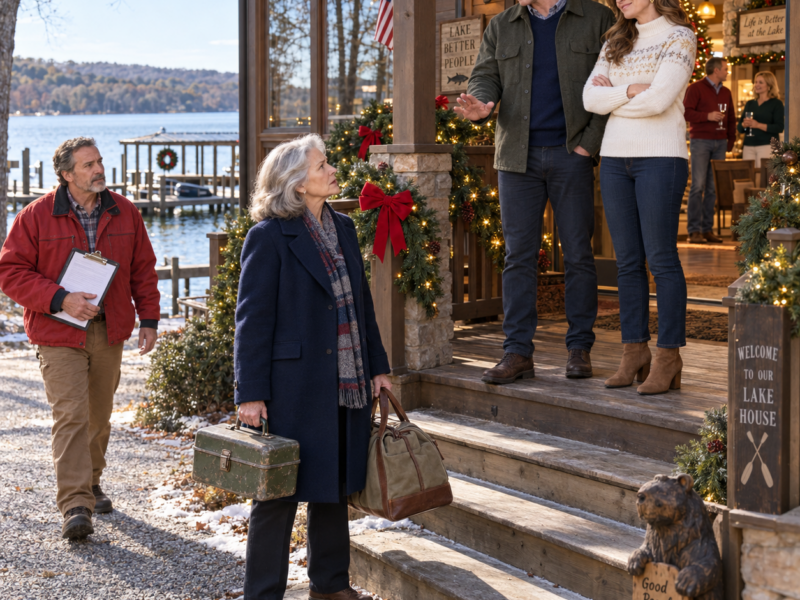
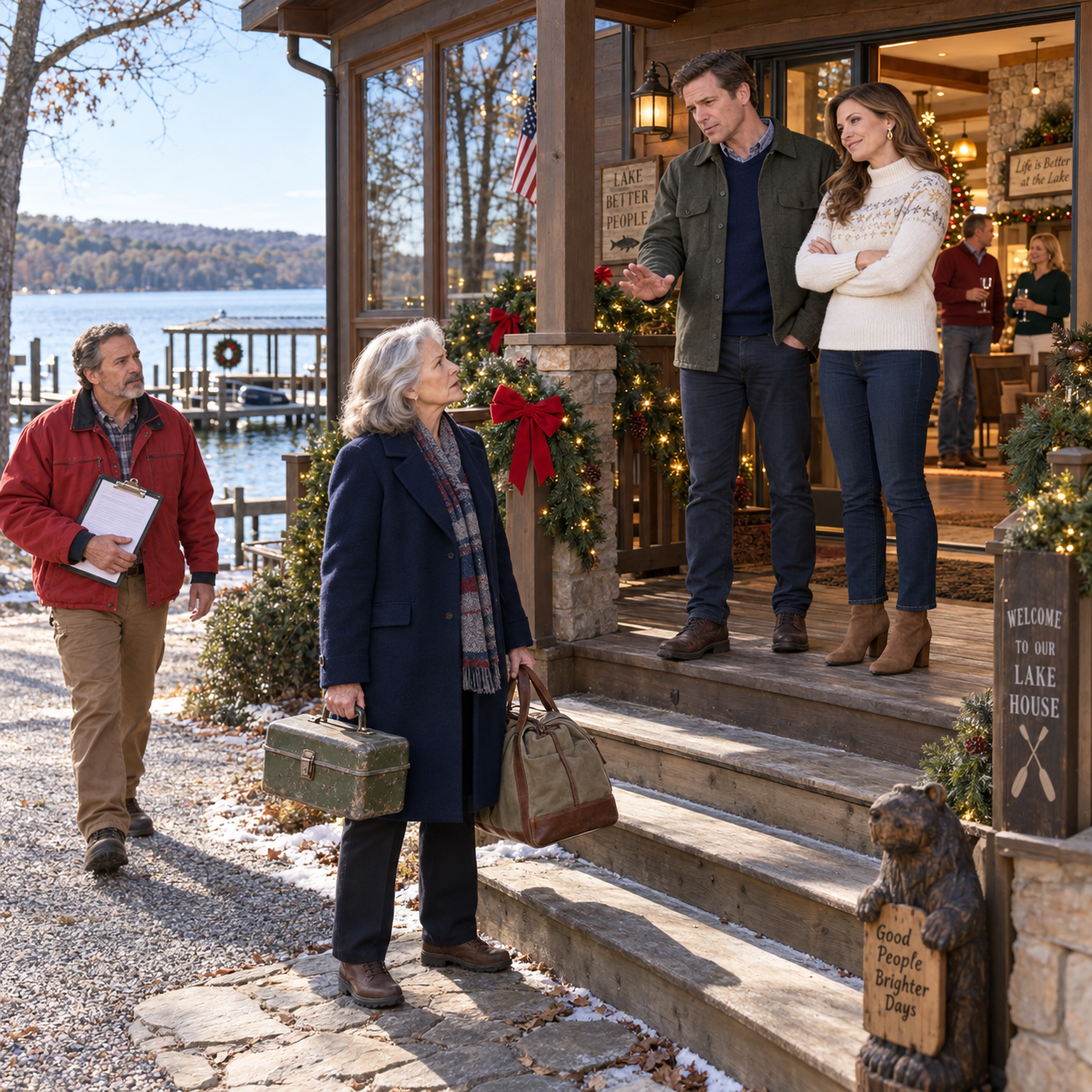
My son told me there was “no room” for me at Christmas and suggested I spend the weekend at a motel. His wife smiled and said the Lakeside Motor Inn was “actually very nice.” There was only one problem: everyone was standing on the porch of my lake cabin. My name was on the deed. I paid the taxes, insurance, dock fees, and repairs. Yet strangers were drinking wine in my kitchen while I stood outside with an overnight bag and my late husband’s tackle box. Then the marina manager pulled into the driveway, looked at my son, and asked why someone had already tried to change the ownership records on my property.
The handle of the cooler broke halfway up the porch steps.
I caught it against my knee before it hit the wood, but the corner struck hard enough to make me draw a breath. Through the open screen door, someone laughed. Christmas music drifted over the sound of dishes being carried into the dining room.
My son stood on the top step and watched me adjust my grip.
“Mom,” he said. “Before you bring all that inside, we need to talk.”
Behind him, my living room glowed with the little white lights I had bought at the hardware store the year Frank retired. A man I didn’t recognize was standing beside the fireplace with a wineglass in one hand. Another man had opened the cabinet where I kept the good coffee mugs.
I set the cooler down.
“Would you mind taking my bag first?”
Eric looked at the canvas bag hanging from my shoulder, then toward the doorway.
He didn’t reach for it.
That was when I noticed how carefully he was standing. One foot against the doorframe, one hand on the railing. He wasn’t greeting me. He was keeping me on the steps.
“What’s wrong?” I asked.
“Nothing’s wrong. We just had a little mix-up with the rooms.”
I glanced toward the driveway. His SUV was parked beside Jessica’s parents’ sedan. Two more vehicles stood near the shed, and somebody had pulled halfway onto the grass Frank used to reseed every spring.
“How many people are here?”
Before Eric answered, Jessica appeared behind him.
She wore a cream sweater and the gold earrings her mother had given her for her fortieth birthday. Her hair was pinned back neatly. In one hand she carried a dish towel that had belonged to me for at least fifteen years.
“Linda,” she said brightly. “You made good time.”
“You told me to come around four.”
“Yes. Well.”
She folded the towel.
Eric rubbed the back of his neck.
With those two movements, I understood that whatever they were about to say had already been discussed without me.
“There just isn’t room this year,” Jessica said.
I waited for the rest.
A suggestion about moving a suitcase. A joke about Eric sleeping on the porch. Some explanation that would make her sentence belong to the world I thought I lived in.
Instead, she added, “We thought you’d be more comfortable at the Lakeside Motor Inn.”
Wind moved through the bare oak trees behind me.
“The motel?”
“It’s been renovated.”
I looked at my son.
“Eric?”
“Mom, the house is packed.”
“This is my house.”
He glanced toward the living room, where someone had begun listening.
“Please don’t start like that.”
For a moment, all I could hear was the rattle of the cooler’s broken handle against its plastic side.
I was sixty-nine years old. I had driven down from Springfield with clean sheets, a peach cobbler, wrapped Christmas presents, and my late husband’s tackle box because my grandson wanted to learn his grandfather’s favorite fishing knot.
I had not expected to arrive at my own front door and discover that ownership had become an impolite subject.
Jessica shifted her weight.
“It’s twenty minutes away, Linda. They serve breakfast.”
I looked past her.
A red stocking embroidered with her mother’s name hung from my fireplace mantel.
Mine was gone.
Frank and I bought the cabin twenty-eight years earlier, when Eric was fifteen and believed every family outing was a deliberate attack on his social life.
It wasn’t the sort of property people bought to impress anyone.
Brown siding. Four small bedrooms, though the fourth was really a converted office with a narrow bed and a window that stuck every July. A kitchen with honey-colored cabinets. A screened porch facing the lake. A sloping path down to a small private dock that looked sturdier from a distance than it felt under your feet.
The first time we walked through it, rainwater had collected in a mixing bowl beneath a leak in the ceiling.
The real estate agent kept talking about potential.
Frank looked at the bowl.
“Well,” he said, “at least it comes with dishes.”
I laughed so hard the agent stopped trying to sell us anything for a minute.
We bought it with money accumulated in small, unremarkable ways. Frank worked maintenance at a food-processing plant. I handled payroll and invoices for a plumbing supply company. We drove our cars until the repair bills became insulting. We packed lunches. We spent six years depositing what we called our lake money into an account neither of us touched.
People sometimes spoke of the cabin later as if it had appeared naturally in our lives, like gray hair or an old dog.
I remembered every canceled vacation that helped buy it.
The first summer, Eric complained there was nothing to do.
By August, he had worn a path between the kitchen and the dock.
He learned to clean fish at the outdoor table beside the shed. He brought friends who arrived with coolers and left with sunburned shoulders. Frank taught him how to back a trailer down the marina ramp, which required three attempts, considerable hand signaling, and a temporary suspension of their affection for each other.
At seventeen, Eric spent an entire Saturday sanding the porch railing.
For years afterward, he pointed to that railing whenever we discussed work that needed doing.
“I built half this place.”
“You sanded twelve feet of it,” Frank would say.
“The important twelve feet.”
It was a family joke then.
I had no reason to imagine he would eventually begin treating it as a claim.
We added the stone fireplace after saving for three more years. Frank wanted one big enough to heat the living room during a power outage. I wanted a mantel wide enough for Christmas stockings and the little wooden church my father had made.
We got both.
Every December, I wrapped evergreen garland around the porch railing and checked each strand of lights on the kitchen table. Frank ran another strand down toward the dock, insisting the reflection on the lake was worth the trouble.
It always took him twice as long as he predicted.
He always needed one more extension cord.
Every year, I told him nobody except the fish could see the bottom half of those lights.
Every Christmas morning, I found him at the water with his coffee, admiring them.
When Eric married Jessica, she said the cabin looked like a Christmas card.
I liked her for saying it.
I liked a great many things about her in the beginning. She was organized, quick, and good at remembering birthdays. She sent thank-you notes. She made Eric buy proper curtains for his first house instead of covering the bedroom window with a blanket.
When Mason was born, she placed him in my arms and said, “You’ve done this before. Tell me I’m not already messing it up.”
I told her every good mother asked that question.
For a long time, we were kind to one another without having to think about it.
Then Frank died.
He had been ill through most of that final summer, although he continued describing himself as tired until the word no longer covered what was happening.
The last project he finished at the cabin was repairing a loose board near the dock gate. Eric offered to do it. Frank thanked him, then went down with his drill when nobody was watching.
“He needs something he can still finish,” I told Eric.
My son stood beside the kitchen window and watched his father kneeling slowly on the boards.
For once, he had nothing to say.
Frank died in November, four years before the Christmas on the porch.
At the gathering afterward, people filled the cabin with casseroles and careful voices. Eric kept one arm around my shoulders. Jessica cried openly. Mason, who was ten then, sat in the recliner and held his grandfather’s fishing cap against his chest.
We promised we would keep coming.
We would keep the holidays.
We would keep the place in the family.
I understood those promises to mean we would continue loving one another here.
I learned later that my son had heard something more specific.
After the funeral, everybody returned to ordinary life.
Eric had his job managing a regional sales team for a building-products distributor. Jessica worked in a dental office. Mason had school, basketball, and the complicated social obligations of being a boy who was no longer little but not yet grown.
I had my townhouse in Springfield, my part-time bookkeeping work, and a cabin that continued needing things whether Frank was alive to repair them or not.
Property taxes came due.
The insurance premium rose.
A storm lifted shingles above the back bedroom.
The refrigerator began making a sound like a shopping cart with a bad wheel.
None of that was tragic. It was ownership.
I paid the bills because the property belonged to me, because I could afford it if I paid attention, and because I still loved being there.
What wore me down was not the maintenance.
It was the way everyone gradually stopped noticing that maintenance required a person.
Jessica began helping with the holiday arrangements.
At first, it felt like relief.
She ordered groceries before we arrived. She assigned people dishes to bring. She created a group message so nobody could claim they hadn’t known what time dinner started.
The first year, she asked if her parents could join us.
“Of course,” I said.
The next year, her sister came with her husband and children.
“We can make it work,” I said.
After that, the asking became informing.
Then even the informing grew irregular.
I would open my phone and find thirty messages about a weekend at the cabin that had somehow been planned around everybody’s schedule except mine.
Once, I asked why dinner had moved from six to four-thirty.
Jessica replied that her sister’s youngest needed an early bedtime.
That made sense.
What didn’t make sense was why nobody had thought to tell the woman cooking the turkey.
I let it go.
The following summer, I arrived with groceries and discovered Jessica had moved my clothes from the large bedroom to the converted office.
“Mom and Dad struggle with the smaller bed,” she explained.
I stood in the hallway holding a package of paper towels.
“Where did you put my things?”
“In the little room. It’s quieter back there.”
The little room had a bed narrow enough that I had to think before turning over.
I slept there anyway.
Eric thanked me afterward.
“You’re easier than everybody else, Mom.”
At the time, I let myself hear it as praise.
That was one of the ways the trouble grew. Not through a single demand I could point to, but through compliments attached to my disappearance.
Easy.
Flexible.
Independent.
Fine on my own.
Whenever I objected, even gently, those same qualities became obligations.
“You’ve always been so understanding.”
“You know how Jessica gets when she’s hosting.”
“Can’t we just have a nice weekend?”
By the Christmas in question, I had learned to arrive carrying what people needed and to set my own expectations down quietly beside the door.
Still, I had never imagined they would refuse me a bed.
I looked at the stocking over the fireplace.
“Where are you sleeping?” I asked Eric.
“In our usual room.”
“Our usual room,” I repeated.
Jessica’s lips pressed together.
“Linda, everybody’s already unpacked.”
“Who is in my room?”
“My parents.”
“And the twin room?”
“Beth and the younger kids.”
“The little room?”
“Friends of ours. They drove in from Kansas.”
I looked through the doorway again. The teenager on my couch had his shoes on the cushion where Frank used to rest his hand.
“And Mason?”
“He’s sleeping downstairs with the boys,” Eric said.
There was no finished basement, only a lower den with a foldout sofa. It was where the children watched movies when the adults wanted to talk.
“So every room was assigned.”
Jessica glanced at my bag.
“We honestly thought you’d appreciate some quiet.”
“Then why didn’t you call and ask?”
Neither answered.
The kitchen timer began beeping inside.
Jessica turned her head automatically, and for one strange second I thought she might leave me on the steps to check a casserole.
Eric lowered his voice.
“Mom, it’s one weekend.”
I looked at him carefully.
At forty-three, he had developed the little crease between his eyebrows that Frank used to get when he was concentrating. His shoulders were broader than his father’s had been. His voice was different. But sometimes, with his head turned, I could still see the boy who had stood in this driveway holding a fish he refused to touch.
That boy had asked permission to take an extra cookie.
The man in front of me was asking me not to inconvenience his guests by entering my own home.
“It’s Christmas,” I said.
“I know.”
“Do you?”
Jessica made a small impatient movement with the towel.
“We can discuss this inside tomorrow. Right now, there are children listening.”
A voice came from behind her.
“I’m listening.”
Mason stepped into the doorway.
He had grown nearly three inches since summer. His hair needed cutting, and his sweatshirt sleeves stopped short of his wrists. He looked from my bag to the cooler on the steps.
“Grandma, why aren’t you coming in?”
“Mason,” Jessica said. “Go help your cousins.”
He didn’t move.
I tried to soften my face for him.
“Apparently there’s been a problem with the sleeping arrangements.”
His eyes went to his father.
“You said she was coming tomorrow.”
Eric looked down.
There it was.
The small, plain fact that changed the shape of everything.
Nobody had accidentally forgotten a bed.
They had told Mason I would not be there.
I remembered our telephone conversation three days earlier.
“Can you bring Grandpa’s old tackle box?” he had asked.
“The green one?”
“The metal one with the dent.”
“What do you need it for?”
“I found that picture of him holding the fish by the dock. Dad says the knot he used was different.”
“Your dad never liked practicing.”
“Will you show me?”
“In December?”
“Grandpa fished in December.”
“Yes, he did.”
“So?”
“So bring gloves.”
Now Mason looked at the tackle box by my feet.
“You brought it.”
“I promised.”
He started down a step.
Jessica caught his sleeve.
“Not now.”
He looked at her hand, then at me. His face had gone red in the way a child’s face does when the adults are making something wrong sound normal.
“I didn’t know,” he said.
“I know you didn’t.”
Eric reached toward the cooler at last.
“I’ll take the food in.”
I put my hand on the lid.
“No.”
He stopped.
“Mom.”
“If I’m staying at a motel, I may want dessert.”
Somebody inside laughed once, then fell silent.
That was when Eric shifted his arm, and I saw the blue band around his wrist.
White lettering ran across it.
Cedar Bend Marina.
I looked at it long enough that he pulled his sleeve down.
“What is that?”
“What?”
“On your wrist.”
“Oh. Just a marina thing.”
The marina sat farther along the same private access road, around the bend from our cove. We leased a covered slip there for the pontoon during parts of the year and used their service department. Our little dock at the cabin was separate, although Frank had always talked about both places as if the entire shoreline were his personal workshop.
I knew the marina staff.
I knew their winter procedures.
And I knew Eric did not have current authorization to take out my boat.
“Why did they give you a band?”
Jessica answered.
“They’re doing those for the holiday weekend.”
“For what?”
“Access.”
“To whose boat?”
Eric exhaled.
“We thought we might take everybody around the cove tomorrow if the weather holds.”
“The pontoon is laid up.”
“They can get it ready.”
“Who told them to?”
“Mom, can we not do this right now?”
I glanced past him at the crowded kitchen.
It was remarkable how many things apparently could not be discussed at my cabin while strangers were allowed to discuss where I should sleep.
Before I answered, tires crunched on the gravel.
A white utility cart came around the bend and stopped behind my car.
Tom Alvarez climbed out carrying a clipboard in a clear weatherproof sleeve.
His red marina jacket was zipped to his chin. Gray hair stuck out beneath his cap, and he walked with the slightly stiff stride of a man whose knees had spent too many years climbing in and out of boats.
He lifted a hand.
“Linda. Glad I caught you.”
“Hello, Tom.”
“I tried your cell.”
“It’s in my bag.”
His eyes moved from the luggage on the steps to Eric’s face.
Then he looked back at me.
“We need to straighten out an authorization before the service crew does anything with the pontoon.”
Eric came down one step.
“I told the office I’d handle that.”
Tom nodded.
“And the office told you we needed to hear from your mother.”
“The request was already submitted.”
“That’s why I’m here.”
Tom said it without irritation. He was not a man who wasted energy performing authority. He simply used it when his job required him to.
I picked up my bag and took out my phone.
Two missed calls from the marina.
“What authorization?”
Tom opened the clear cover over his papers.
“There was a request to prepare the boat for tomorrow and add Eric as an operator. The desk issued a temporary gate pass while they were waiting on the approval.”
“Without talking to me?”
His expression tightened.
“They shouldn’t have. The boat hasn’t been released, and nobody’s taken it out.”
I looked at Eric.
“Did you tell them I approved it?”
He spread his hands.
“I said we were family.”
“That wasn’t my question.”
Jessica stepped closer to him.
“Linda, nobody’s stealing a boat. They were trying to arrange something nice for Christmas.”
Tom’s eyes stayed on mine.
“Would you like us to proceed with any part of the request?”
“No.”
He wrote something on the page.
“And Eric’s access?”
“Cancel the temporary pass.”
Eric’s jaw tightened.
“Seriously?”
“Yes.”
“It’s a wristband.”
“Then taking it off shouldn’t trouble you.”
He looked toward the open door.
I had spent so many years protecting him from embarrassment that I recognized the expectation on his face. He was waiting for me to lower my voice, soften my wording, make it possible for him to return to the living room with his dignity untouched.
I could have done it.
I knew exactly how.
But there was my bag on the steps.
There was Mason trying not to look upset.
There was my stocking missing from the mantel.
And there was my son, wearing access to something I had never agreed to give him.
Tom turned a page.
“There’s another issue,” he said.
Eric went still.
It was a small change, but unmistakable. His hands stopped moving. His face lost the restless annoyance he had worn since I arrived.
“What issue?” I asked.
Tom glanced toward the doorway.
“Perhaps we should speak somewhere private.”
“About my boat?”
“About the account, initially.”
“Initially?”
He took a breath.
“We received a request to change the ownership information associated with your cabin address. The boat service account and slip lease were included in the message.”
My fingers tightened around my phone.
“What change?”
“A company was listed as the new family owner.”
Jessica looked at Eric.
“What company?”
He stared at Tom.
“That wasn’t supposed to be processed yet.”
Tom didn’t answer him.
I heard the words perfectly.
Not, I didn’t send that.
Not, someone made a mistake.
That wasn’t supposed to be processed yet.
“Show me,” I said.
Tom handed me the top page.
It was an email printed from the marina office account. My address appeared beneath my name. Below it was a line identifying a company.
Dawson Family Lake Holdings LLC.
I read the name twice.
It sounded respectable.
That was what frightened me about it.
A clean, ordinary business name. The sort of thing a person might see on a form and accept without thinking about the woman whose porch they were standing on.
“Who owns this company?”
Eric swallowed.
“Mom, it’s not what you think.”
“I’m asking because I don’t know what to think.”
“It was for planning.”
“What planning?”
“The cabin.”
Jessica’s voice sharpened.
“You formed a company for the cabin?”
He turned toward her.
“We talked about keeping things in the family.”
“We talked about helping with expenses.”
“That was part of it.”
I looked down at the email.
My son’s full name appeared at the bottom.
There was an attachment listed beneath his signature.
“Tom, what’s this document?”
“That’s the other reason I came. The message says a transfer document had been submitted. There’s a reference number, but we don’t have confirmation of any completed change, and the attachment doesn’t establish authority for what he’s asking us to do.”
Eric stepped forward.
“It was preliminary.”
Tom looked at him.
“Then it should have been described that way.”
“What kind of transfer document?” I asked.
Tom’s expression became more careful.
“I’d rather have your attorney answer that. I manage boats and leases, Linda. I don’t want to tell you something wrong about a deed.”
A deed.
The word seemed to remove the warmth from the light shining through the doorway.
I looked at my son.
“What did you do?”
“Nothing has happened.”
“That’s different from what I asked.”
“Mom, please.”
“Did you send a document about my property to the marina?”
“Yes, but—”
“Did you tell them ownership was changing?”
“I said it would be.”
“When?”
He said nothing.
Jessica had folded the dish towel into a small hard square.
“Eric.”
He looked at her with something like anger.
“It was supposed to make things easier.”
“For whom?” I asked.
Tom lowered his voice.
“Linda, did you sign a deed or authorize someone to prepare one on your behalf?”
I answered immediately.
“No.”
Mason stood behind his mother, looking at his father as though he had become someone difficult to recognize.
Tom waited another second.
“No property transfer?”
“No.”
“No permission to change the marina account?”
“No.”
He closed the cover over his clipboard.
“All right. I’ll freeze the requested changes and preserve what we received.”
Eric’s face changed.
Not when I canceled the boat outing.
Not when Jessica questioned the company.
When Tom said preserve.
That was the moment my son understood this conversation would leave something behind.
I had spent most of my working life dealing with paperwork.
Payroll reports. Supplier invoices. Credit memos. Accounts that didn’t balance because someone had entered a number wrong or because someone hoped nobody would notice they had entered it wrong.
People mistook bookkeeping for arithmetic.
The important part was usually attention.
I looked again at the printed email.
“When did you form the company?”
Eric rubbed his hands together.
“October.”
Two months.
While I was arranging the furnace service and replacing a cracked window latch, my son had been creating a business with the cabin’s future tucked inside its name.
“Who’s in it?”
“Me.”
“Only you?”
He hesitated.
Jessica turned toward him fully.
“Eric.”
“I put you in the planning paperwork too.”
She stared.
“You what?”
“As a minority owner. It was supposed to be ours.”
“I haven’t agreed to any company.”
“We can fix that.”
She took a step away from him.
I believed her surprise.
I also remembered her telling me the motel served breakfast.
Both things could be true.
She might not have known about a false document, and she could still have decided there was no reason to ask whether I wanted to sleep in the house I owned.
“What did he tell you?” I asked her.
She looked at me.
“About what?”
“About the cabin.”
She swallowed.
“That you were tired of taking care of everything.”
“I’ve said I don’t enjoy hiring roofers. That isn’t the same thing.”
“He said you wanted us to start handling more.”
“Did he say I wanted to leave?”
“No.”
“Did he say you could give away my bedroom?”
Her eyes dropped.
“No.”
Eric interrupted.
“Mom, this isn’t helping.”
I looked at him.
“I’m not trying to help you explain it away.”
Jessica’s father appeared behind Mason.
Gordon had the solid, worried expression of a man who could hear enough from the living room to know he needed to stop pretending he couldn’t.
“What’s going on?”
Jessica didn’t answer.
I took a photograph of the email with my phone.
Eric moved toward me.
“Who are you sending that to?”
“Daniel Price.”
His shoulders fell slightly.
Daniel had handled our wills for years and helped me with Frank’s estate. His office was in Branson, above a small insurance agency, in a building whose stairwell always smelled faintly of coffee.
“Mom, it’s two days before Christmas.”
“Yes.”
“He’s probably with his family.”
“Then he can decide whether to answer.”
I stepped off the porch and called.
Daniel answered on the fourth ring.
“Linda?”
“I’m sorry to bother you.”
“What’s happened?”
I looked at the cabin while I told him.
I owned it.
I had signed nothing.
The marina had received a message from Eric claiming an ownership change involving a company I had never heard of.
Daniel’s voice lost its ordinary warmth and became precise.
“Are you safe?”
“Yes.”
“Do you have the paperwork?”
“Some of it.”
“Send me photographs. Don’t sign anything, and don’t hand over original records.”
“I won’t.”
“Is anybody claiming they currently live there?”
“No. They’re Christmas guests.”
“Then keep this calm. Secure your papers. If anyone refuses to leave or threatens you, call for help. Don’t get into a physical confrontation over a key.”
I glanced toward Eric.
He was watching me with the fixed attention he used to give a principal’s office door.
“I understand.”
“I’ll look at what you send and call you back. Some things may need to wait for offices to reopen. That does not mean you need to leave this unaddressed tonight.”
“Thank you.”
I ended the call.
Jessica stood at the top of the steps.
“You’re bringing a lawyer into Christmas?”
I looked at the towel in her hands.
“No. I’m calling my lawyer because someone used my property in paperwork I didn’t authorize.”
She opened her mouth, then closed it.
Tom handed me the copies he had brought.
“I’ll email the full chain,” he said. “Directly to you. If you want me to send it to Daniel too, just reply with that instruction.”
“Please do.”
“I’ll also have the manager review how that temporary pass was issued.”
“Thank you.”
He looked at Eric.
“Until this is resolved, any request on Linda’s accounts comes from Linda.”
Eric nodded once.
His face had become strangely blank.
I picked up my overnight bag.
“Everyone needs to gather their things.”
Jessica stared at me.
“Tonight?”
“Yes.”
“Linda, there are families here.”
“There was a family here when you told me to go to a motel.”
Gordon looked from her to me.
“You told her what?”
Nobody answered him.
I lifted the tackle box with my free hand.
Eric stepped into my path.
“Everybody can stay tonight,” he said quickly. “We’ll work the rooms out.”
I stopped.
Even then, after the email and the phone call, he was offering me a solution as though he still had authority to distribute the beds.
“No.”
“Mom.”
“I’m going inside.”
He moved.
I passed him without touching his arm.
That cost me more than I expected.
For forty-three years, when I passed my son in a narrow space, I had touched him. A hand on his back. Fingers against his sleeve. A small, ordinary acknowledgment that he belonged to me in the only way one person can belong to another.
That evening, I carried my bag through the doorway and kept both hands occupied.
The cabin smelled like ham, cinnamon, and the pine branches Jessica had arranged along the mantel.
A tray of appetizers stood on my grandmother’s dining table. Someone had moved the wooden church to make room for a tall silver decoration I didn’t recognize.
Conversation stopped when I entered.
I set the tackle box beside Frank’s recliner and placed my bag on the chair beneath the window.
Then I looked at the people in my living room.
Jessica’s sister, Beth, held a paper plate. Her husband stood behind her with their youngest child. The unfamiliar couples watched with the embarrassed stillness of people who had arrived for a holiday and discovered they had been made part of something else.
Jessica’s mother, Carol, stood near the fireplace.
She looked at my coat.
“Linda, I thought you weren’t staying here.”
“That appears to have been the plan.”
“We were told you wanted quiet.”
“I wanted my bedroom.”
Color rose in her face.
“I didn’t know.”
“I believe you.”
I did. Carol could be oblivious, but she was not usually cruel.
I looked around the room.
“I’m sorry this is uncomfortable. There’s a serious issue involving paperwork about the property, and I need the house cleared tonight. Please gather your belongings.”
Beth lowered her plate.
“Are you serious?”
Gordon came through the door behind me.
“Yes, Beth.”
“But the kids have already—”
“This isn’t our house.”
His voice was not loud.
It didn’t need to be.
One of the unfamiliar men set his wineglass on the table.
“We’ll get our bags.”
“Thank you.”
Jessica stood near the kitchen doorway, motionless.
I turned toward the mantel.
My stocking was still missing.
“Where is it?” I asked.
She followed my gaze.
“I put some of the extra things away.”
“My stocking isn’t an extra thing.”
“I was making room.”
“Where?”
“In the basket by the hallway.”
I went to the basket.
Beneath a folded throw blanket and two decorative pillows lay the stocking Frank had bought during our first Christmas at the cabin. The white cuff had yellowed slightly. My name leaned to one side because the woman at the craft fair had misjudged the spacing.
Frank said that made it easier to recognize.
I lifted it from the basket.
The hurt was so immediate that I had to stand still.
Not because of the stocking itself.
Because someone had held my name in her hands and decided it could be put away to improve the room.
When I returned to the fireplace, Carol had already removed hers.
She held it against her coat.
“Here,” she said quietly.
I hung mine on the hook.
Nobody commented.
The cabin filled with the practical noises of leaving. Zippers. Closet doors. Children asking questions adults answered too softly. A suitcase wheel caught on the hallway rug, and its owner lifted it carefully instead of dragging it.
I did not hurry them.
I did not stand with my arms folded and watch every movement.
I went into the kitchen, found a screwdriver in the utility drawer, and tightened the loose handle on a cabinet door because I needed my hands to do something that made sense.
Through the window, I could see Tom speaking on his phone beside the cart.
Eric came into the kitchen.
“Can we talk?”
“Not alone tonight.”
His face tightened.
“You think I’m going to hurt you?”
“I think I don’t know what you’re going to say, and I don’t want to spend the evening sorting out which parts are true.”
He looked toward the living room.
“You’re making everybody think—”
“What should they think?”
“That I tried to take your house.”
I set the screwdriver down.
“Then explain the paperwork to the attorney.”
He pressed his lips together.
For a moment, I thought he might finally tell me.
Instead, he said, “Dad wanted this kept in the family.”
The kitchen seemed to shrink around us.
“Your father wanted a lot of things,” I said. “One of them was for me to be treated decently.”
Eric looked away.
Outside, the first car started.
Carol came to say goodbye with two coats over her arm.
“I should have called you,” she said.
“Yes.”
“I’m sorry.”
I nodded.
She didn’t ask me to make her feel better.
That helped.
Gordon carried the last of their bags out, then returned for a casserole dish.
“Would you like us to leave the food?”
“You’re welcome to take what you brought.”
He paused.
“I meant so you’d have dinner.”
I looked at him, and some of the tightness in my chest eased.
“Thank you. There’s plenty here.”
He put the dish back on the counter.
When they left, the driveway looked twice its size.
Mason remained beside the Christmas tree.
He had his coat on and his backpack at his feet.
I could see how hard he was trying not to ask.
Jessica stood near him.
“Get your bag, honey.”
He looked at me.
“What about the knot?”
The room went quiet.
I set the screwdriver in the drawer.
“You and I can still do that another time.”
His face fell, and I realized I had answered the wrong question.
I looked at his parents.
“If you both agree, he’s welcome to stay with me tonight. I’ll bring him wherever you want tomorrow.”
Jessica’s eyes filled unexpectedly.
“He shouldn’t be in the middle.”
“No,” I said. “He shouldn’t.”
Eric looked at Mason, then at me.
“Do you want to stay?” he asked.
Mason nodded.
“Yes.”
Jessica took a breath.
“All right. Call me before bed.”
“I will.”
She went to collect his overnight things.
Eric remained near the fireplace.
He looked at my stocking.
Then at the tackle box.
“The company was supposed to protect the cabin,” he said.
“From what?”
He didn’t answer.
I waited.
Finally, he picked up his keys.
When he reached the door, I held out my hand.
“The cabin key, please.”
He stared at my palm.
“Mom.”
“I’m having the locks changed. I’d still like the key.”
He worked it off the ring.
Frank had put a little blue rubber cover on it years before.
Eric placed it in my hand.
Jessica returned a second key without being asked.
They left together, though they did not walk close.
I locked the door.
For several seconds, neither Mason nor I moved.
Then he looked toward the kitchen.
“Are we allowed to eat the cobbler?”
I laughed.
It came out crooked and surprised, but it was a laugh.
“Yes, sweetheart. We are absolutely allowed to eat the cobbler.”
We ate dinner before dessert because there were still a few rules worth keeping.
Mason warmed slices of ham in the microwave while I put green beans into a saucepan. He found two plates and set the table without being asked. When he reached for the good glasses, he glanced at me first.
“Those are fine,” I said.
He nodded.
The kitchen clock ticked above the pantry. Without the music and the crowd, the cabin sounded larger.
We ate for several minutes before Mason spoke.
“Did Dad do something illegal?”
I put down my fork.
“I don’t know all the facts yet.”
“But you think he did something bad.”
“I know he did something I didn’t agree to. A lawyer is helping me understand the rest.”
Mason pushed a bean through a little puddle of butter.
“He said he was going to take care of the cabin.”
I waited.
“He showed me a picture on his computer with new doors and a deck.”
“When?”
“A couple weeks ago.”
I felt the old instinct rise: ask everything, find out what else Eric had said, use the one person in the room who might still answer me honestly.
I stopped myself.
Mason was fourteen.
He was eating dinner in his grandmother’s kitchen.
He was not a witness I needed to interview.
“Grown-ups sometimes make plans they haven’t earned the right to make,” I said. “That’s something your dad and I will have to discuss.”
“Are you mad at me?”
I reached across the table.
“No.”
He let me take his hand.
“Not even a little?”
“Not even a little.”
His shoulders dropped.
After dinner, he carried the dishes to the sink. We heated the cobbler and found vanilla ice cream behind a bag of frozen peas.
He took the first bite and closed his eyes.
“Okay. This is really good.”
“Your grandfather used to say that as if it surprised him every time.”
“Did he ever cook?”
“Breakfast.”
“Was he good?”
“He believed turning the burner higher made things finish sooner.”
Mason grinned.
“So no.”
“His toast had a distinctive personality.”
He laughed, and for a few minutes the cabin belonged to ordinary things again.
Later, he called Jessica from the little bedroom. I could hear the low murmur of his voice through the partly open door, but not the words.
I put the leftover food away.
Then I went to the closet in my bedroom and took down the metal document box Frank and I had used for years.
The key was in the pocket of an old sewing kit.
The box contained insurance policies, copies of deeds, boat registration papers, and the folder from Daniel’s office.
Everything appeared to be there.
That did not reassure me as much as it would have a day earlier.
A person did not have to remove a document to use it.
I remembered Eric sitting at my dining table in Springfield the previous fall, helping me scan records after my printer stopped connecting properly.
He had been patient.
He had made coffee.
When I thanked him, he kissed the top of my head and said, “What else are sons for?”
I sat on the edge of the bed with the box in my lap.
From the hallway, Mason asked whether he could use the extra blanket.
“Yes.”
“Where is it?”
“Top shelf of the linen closet.”
A pause.
“Found it.”
His bedroom door clicked softly.
I looked down at the papers.
There were versions of loss nobody brought casseroles for.
Daniel called shortly after nine.
“I’ve reviewed the marina email and the attachments,” he said.
I moved into the living room and sat in Frank’s recliner.
“Tell me.”
“First, what Eric sent does not show that your cabin has changed hands.”
I leaned back.
For the first time since the porch, I took a full breath.
“All right.”
“But there is a serious document in that packet.”
I closed my eyes.
“What kind?”
“It’s labeled a beneficiary deed. It names the company.”
Frank and I had discussed that sort of planning with Daniel years earlier. I remembered enough to understand that it concerned what happened after an owner died.
“I didn’t sign one.”
“I understand.”
“Does it have my signature?”
“It has a signature presented as yours.”
The fire had burned low. A small log shifted behind the screen, sending sparks up the chimney.
“Can you send it to me?”
“I will.”
“What about the number Tom saw?”
“It appears to be a submission reference, not proof of a completed recording. There’s a returned-item notice included in the email chain. The packet was sent back for a problem with the acknowledgment.”
I pressed my fingers against my forehead.
“So it was rejected?”
“That’s what these materials indicate. I’ll verify the official record when the office reopens. I don’t want to promise more tonight than the documents support.”
I appreciated that.
It was the first conversation all evening in which someone had admitted the limits of what they knew.
“Even a properly completed beneficiary deed would not have made Eric the current owner,” Daniel continued. “It would not authorize him to change your boat accounts now. Those requests are a separate problem.”
“Then why send it?”
“I can’t tell you why he thought it would work.”
Neither could I.
Or perhaps I could, and I did not want to say it.
My son had taken a paper about my eventual death and begun using it to organize my living world.
“Linda?”
“I’m here.”
“Have you secured the originals?”
“Yes.”
“Good. Keep the emails. Don’t delete anything because it’s upsetting. We’ll make a careful record.”
“Should I call Eric?”
“Not tonight.”
He explained what he could do next and what would require other offices, other professionals, and time.
There would be no magical cancellation delivered before midnight.
There would be questions.
There would be records to confirm.
There might be a report to make.
I wrote notes on the back of a grocery list because that was the paper nearest me.
After we hung up, his email arrived.
I opened the attachment.
At the bottom of the page was my name.
The capital L was close.
The D was wrong.
I had been signing Linda Dawson for forty-seven years. I knew the way my hand joined the letters. I knew the small hesitation after the first name, a habit left over from learning to write a new surname at twenty-two.
The signature on the screen belonged to someone who had looked at mine.
It did not belong to me.
I put the phone facedown on the arm of the chair.
Then I cried as quietly as I could so my grandson would not hear.
At seven the next morning, Mason appeared beside the recliner wearing Frank’s fishing cap.
I had fallen asleep under the plaid throw with my glasses still on.
“Grandma?”
I opened my eyes.
He held two mugs.
“I made coffee. I think.”
I sat up.
“What does that mean?”
“The machine made noises.”
“That’s promising.”
He handed me a mug.
It was strong enough to make me reconsider several life choices, but it was hot.
“Thank you.”
He looked toward the window.
“It’s not raining.”
“No.”
“And the dock isn’t icy. I looked.”
“From where?”
“The porch.”
“Good.”
He waited.
I took another sip.
“You want to learn that knot.”
“You said bring gloves.”
There was no accusation in his voice.
Only faith that a promise could still be a simple thing.
“Let me find my boots.”
We bundled up and took the tackle box down the path.
The lake was steel gray beneath a pale sky. Across the cove, a house stood dark behind bare branches. Somewhere farther out, a motor ran briefly and stopped.
Frank’s old lights followed the railing toward the dock. Three bulbs near the bottom had gone out.
Mason noticed.
“We should fix those.”
“Eventually.”
He sat on the bench while I put the tackle box between us.
It had been in the hall closet at my townhouse since shortly after Frank’s death. I had brought it home with several things I could not quite leave behind and had not quite known what to do with.
There were other boxes at the cabin, plastic ones full of usable gear. This one held older lures, a dented tin of weights, and things Frank refused to throw away.
I opened the lid.
The familiar smell rose out of it: metal, old line, a trace of lake water that existed mostly in my memory.
Mason leaned closer.
“Did he use all these?”
“He claimed he needed all of them.”
I lifted the top tray.
An envelope lay beneath a folded cloth.
My name was written across it.
I stopped.
“What is it?” Mason asked.
“I’m not sure.”
The flap was tucked in rather than sealed.
I remembered Frank moving small things around during his final months. Giving instructions I only half heard because hearing them fully meant accepting why he was giving them.
At one point he had said, “There’s something in the old tackle box for you.”
I thought he meant the little pocketknife his father had carried.
Then there had been appointments, a hospital bag, medication schedules, and the terrible administrative efficiency that follows a death.
I had forgotten.
Now I unfolded a sheet torn from the yellow pad he kept beside the telephone.
Linda,
If you’re cleaning this thing out, the silver lure with the red spot is the one Mason likes. Don’t give him the hooks until somebody shows him what to do.
About the cabin—we bought it because we wanted to be here. Remember that.
You don’t have to keep it just because we were happy in it. You don’t have to sell it because other people think they know what would be easier.
If it gets to be too much work, let it go. If you still like your coffee on the porch, keep drinking it there.
The family will have to choose to stay a family. A house can’t do that job for them.
And leave the dock lights up. I was right about those.
Love,
Frank
For a while, I could not see the last lines clearly.
Mason leaned against my shoulder.
“Is it from Grandpa?”
“Yes.”
“Is it sad?”
“A little.”
“What does it say?”
I wiped beneath one eye with my glove, which was not a sensible choice.
“It says I’m allowed to decide what I want.”
Mason considered that.
“You already are.”
I laughed softly.
“Yes. I suppose I am.”
“And the lights?”
“He says he was right.”
Mason looked down the railing.
“He was.”
“Please don’t encourage him.”
He smiled.
I folded the letter carefully and put it inside my coat.
There was no hidden deed in the box.
No revelation that solved the paperwork.
Frank had not predicted what Eric would do. He had known me, which was different and, in that moment, more useful.
He knew I could turn a place I loved into a duty so large there was no room left for myself inside it.
I sat beside our grandson and let the wind dry my face.
Then I took out a length of cord and a practice ring.
“All right,” I said. “Watch my hands.”
Mason leaned forward.
He got the first step wrong.
I showed him again.
The lake moved quietly beneath us.
Daniel came to the cabin late that morning with a laptop and a folder.
He was on his way to his daughter’s house, he explained, and had brought his wife along. She waited in the car with a book after insisting she was perfectly happy and did not need to be entertained.
Jessica had arranged to pick Mason up at eleven-thirty.
I had told Eric he could come at the same time if he was willing to discuss the documents calmly. Daniel warned me that he represented me, not my son, and that Eric might choose to get his own attorney before saying anything further.
“That would be sensible,” he said. “It would not be an insult to you.”
“I understand.”
Tom arrived first.
He brought a written account of the marina requests and a copy of the temporary pass record. He apologized again for the gate access.
“We’ve addressed that with the desk,” he said. “Nobody should have treated a family relationship as permission.”
“Thank you.”
He stayed only long enough to review what he had personally seen and received.
There was no dramatic speech.
He distinguished between what Eric had written, what the desk employee remembered, and what Tom himself had said on the porch.
I found that precision comforting.
It was a way of keeping the floor beneath us from shifting.
When Jessica arrived, Mason went outside with her to put his bag in the car.
Eric came in behind them.
He wore the same coat as the evening before. He looked as if he had not slept.
Daniel stood.
“Eric, before we begin, I need to be clear that I represent your mother. You don’t have to answer questions here without getting advice of your own.”
Eric glanced at me.
“I want to explain.”
“All right. But if this moves into matters where you need separate counsel, we’ll stop.”
Jessica returned.
“Where’s Mason?” I asked.
“In the car. He’s on his phone. I told him we’d be a few minutes.”
“Let’s keep it that way.”
We sat at the dining table.
The red Christmas runner was still there. A faint ring marked the place someone had set a hot serving dish without a trivet.
Daniel laid out the email, the company information Eric had sent the marina, and the document with the false signature.
Eric stared at the tabletop.
I waited for him to look at the paper.
He didn’t.
“Did you receive these copies?” Daniel asked.
“Yes.”
“And do you understand your mother disputes having signed or authorized this document?”
Eric nodded.
Jessica sat rigidly beside him.
I looked at my son.
“Why is my name on it?”
He pressed his hands between his knees.
“I thought we were all on the same page.”
“About what?”
“The cabin staying in the family.”
“We are discussing my signature.”
He closed his eyes.
“I signed it.”
Jessica made a small sound.
For one second, I felt nothing.
The words had arrived too cleanly. They needed time to become what they meant.
Then I saw him at eight, writing his name on the inside of a new school jacket.
At nineteen, signing the paperwork for his first car while Frank stood behind him pretending not to worry.
At twenty-eight, filling out the marriage license form and asking Jessica whether he had spelled her middle name correctly.
His hand had written my name on a document I had never agreed to.
“You signed my name,” I said.
He nodded.
Daniel moved one hand onto the folder.
“We’re going to stop detailed questions about how that document was produced. Eric, you need your own attorney.”
“I wasn’t trying to take it while she was alive.”
Jessica turned toward him.
“Oh, Eric.”
He looked at me urgently.
“I wasn’t. It was just to make sure nobody could change everything later.”
I stared at him.
“Nobody?”
He swallowed.
“I meant if you got bad advice. Or someone convinced you to sell. Or if something happened and—”
“Something happened to whom?”
He said nothing.
The little kitchen clock ticked.
Outside, a car door closed. Daniel’s wife had stepped out to stretch her legs.
Ordinary sounds continued arriving from a world in which my son had not just explained that protecting my future required removing my decisions from it.
“I know how this looks,” he said.
“Do you?”
“I knew Dad wanted me to have it eventually.”
“No.”
He looked up.
“You knew you wanted it eventually.”
His face crumpled.
“Mom, after Dad died—”
“Your father died.”
My voice broke.
I waited until I could finish.
“I did not.”
Jessica covered her mouth.
I put one hand flat on the table.
“I have been paying for this place. Sleeping here. Buying coffee filters and hiring repairmen and watching the lake freeze at the edges. I am not a period of inconvenience between your father’s life and your inheritance.”
Eric began to cry.
I had seen my son cry over grief, fear, pain, and once over a dog we could not save.
This was different.
He was crying because the story he had told himself no longer protected him.
“I wanted to keep it safe,” he said.
“Then you should have asked what I needed.”
“I thought you’d say no.”
The room became very still.
There it was.
Not confusion.
Not shared planning expressed badly.
He had known there was a decision to make, and he had known it belonged to me.
Daniel closed the folder.
“Linda, we have enough for today.”
I nodded.
Eric wiped his face.
“What happens now?”
“We verify the records,” Daniel said. “Your mother’s accounts and documents are secured. You preserve every related message and file. You obtain counsel. Further communication about the paperwork should go through the attorneys.”
“Are you calling the police?”
Daniel looked at me, but he did not make the decision mine alone in the way families sometimes try to do.
“We will address the false document through the appropriate channels,” he said. “Nobody here can promise you there will be no legal consequences.”
Eric looked at me.
“Mom?”
I recognized the appeal.
I had answered it through fevers, broken windows, failed classes, and bills he could not pay when he was young.
But this was not a thing I could fix by standing between him and what had happened.
“I won’t lie about it,” I said.
He lowered his head.
Jessica pushed her chair back.
“I need to take Mason to my parents’.”
Eric turned.
“I thought we were going home.”
“I’m taking him to my parents’.”
“Jess.”
She looked at him.
“You told me your mother wanted us to handle the cabin.”
“She did want help.”
“Help is not this.”
“I did it for us.”
“No.”
Her voice was quiet enough that he had to stop moving to hear it.
“You don’t get to put me inside that sentence.”
He stared at her.
Then she turned to me.
“I sent you away from your own house.”
I waited.
“I knew it belonged to you. Whatever he told me about the future, I knew that.”
“Yes.”
“I wanted everybody to be impressed. I wanted to host Christmas, and I treated you like the one person who would make it easy.”
She wiped at one eye impatiently.
“I’m sorry.”
For the first time in years, there was no explanation following her apology that required me to comfort her.
“Thank you for saying it,” I said.
It was all I could offer.
She nodded.
Then she went outside to her son.
After they left, Daniel remained at the table while I gathered the cups.
“You don’t have to clean right now,” he said.
“I know.”
I carried two mugs to the sink.
He let me.
When I returned, he asked whether I wanted to stay at the cabin alone.
“Yes.”
“Is there someone nearby you can call?”
“Ruth Bell. Across the cove.”
“Does she know what happened?”
“Not yet.”
“Tell her enough that she knows you may need company.”
I nodded.
Daniel gathered his papers.
“One more thing.”
I looked at him.
“You don’t have to make your final estate decisions this week.”
“I’d like Eric removed from anything that gives him authority.”
“That we can address promptly. The ultimate distribution of everything you own can wait until you’ve had time to think.”
I sat down again.
“I don’t want to punish Mason.”
“Protecting your decisions does not punish your grandson.”
“He’ll feel it.”
“He may feel changes in the family. That isn’t the same as you doing something wrong.”
I looked toward the window.
Mason had left a faint handprint on the glass near the back door.
I could not remember when he had put it there.
“I keep wondering what I should have noticed.”
Daniel didn’t answer quickly.
Then he said, “You noticed when there was something concrete to notice. You acted. You’re still acting.”
After he left, I stood on the porch until his car disappeared around the bend.
Christmas Eve afternoon lay quiet over the lake.
I had imagined this day full of kitchen noise, children arguing over a board game, somebody asking when dinner would be ready.
Instead, I carried a box into the living room and began removing decorations I had never chosen.
Not all of them.
Only the ones I didn’t like.
I put the wooden church back where it belonged.
Then I took Frank’s note from my pocket and read it again.
Ruth arrived at five with chicken soup and no questions until she had put the pot on the stove.
She was seventy-one, a retired school librarian, and had lived year-round across the cove since her divorce. Frank used to say she could make a man admit he had overdue books even if he had never entered a library.
She looked around the cabin.
“Quieter than expected.”
“Yes.”
“Want to tell me?”
I did.
Not every word.
Enough.
She listened without interrupting. When I reached the signature, she set down her spoon.
“Oh, Linda.”
That was all.
No speech about what she would have done.
No suggestion that there must have been a misunderstanding.
No immediate instruction to cut off my son forever.
She understood that I was hurt before she tried to decide what should happen to the person who hurt me.
We ate soup at the kitchen table.
“Are you selling?” she asked eventually.
“I don’t know.”
“You don’t have to.”
“I know.”
“Do you?”
I looked at her.
She buttered a piece of bread.
“You’ve spent four years keeping the place ready for other people. You might try living in it the way you want before deciding whether you still like it.”
That seemed almost extravagant.
“What would that look like?”
“Well, for a start, sleeping in your own bedroom.”
I laughed.
“There is that.”
“And taking down those enormous silver things.”
“They’re already in a box.”
“Good. They look like plumbing fixtures.”
After dinner, we washed the dishes and watched part of an old Christmas movie. Neither of us followed it closely.
At eight, Jessica called.
“Mason would like to come tomorrow for a few hours, if that’s all right.”
I leaned back in the chair.
“Yes.”
“I can bring him at ten and pick him up at two.”
“Would you like to stay for lunch?”
She was quiet.
“You don’t have to ask me out of politeness.”
“I’m not.”
Another pause.
“Yes. Thank you.”
“Just you and Mason.”
“I understand.”
After the call, Ruth looked at me over her glasses.
“Was that what you wanted?”
“Yes.”
“All right, then.”
She didn’t confuse a boundary with a locked door that could never open again.
I was grateful for that too.
Christmas morning, I woke in my own bed.
The cabin was cold enough that I pulled on a sweater before going to the kitchen. I made coffee properly this time and carried it onto the porch.
The dock lights were still on.
Across the water, their reflection broke and joined with the small movements of the lake.
I thought about Frank.
Then, for the first time in several days, I thought about nothing at all.
Mason arrived carrying a paper bag.
“Mom said not to bring anything big.”
“What have you got?”
“Rolls.”
“Very sensible.”
“And a present.”
“Less practical, but acceptable.”
Jessica stood behind him with a small container of cranberry salad.
“Where would you like this?”
“In the refrigerator.”
She opened it, found a space, and put the container down.
She did not rearrange the shelves.
I noticed that I noticed.
We ate lunch at noon. Mason told me about a teacher who claimed she could tell when students used their phones under their desks because they smiled at their laps.
“She sounds observant,” I said.
“She’s terrifying.”
Jessica laughed.
For a while, it was possible to sit together without discussing the thing that had brought us there.
After lunch, Mason opened his gifts.
A new winter jacket. A bookstore card. A beginner’s fishing tool kit I had bought before everything happened.
He picked up the pliers.
“Can we use these next time?”
“Yes.”
Jessica looked down at her plate.
I could see relief move across her face.
She had been afraid there might not be a next time.
When Mason went to try on the jacket, she spoke quietly.
“I’m not asking you to forgive me.”
“All right.”
“I wanted you to know I told my family the truth about the motel. Not the paperwork. That’s yours to discuss. But what I did.”
“What did you say?”
“That you hadn’t chosen to stay elsewhere. That I filled the house and expected you to accept it.”
I folded my napkin.
“Thank you.”
“My mother asked me why.”
“What did you tell her?”
Jessica stared at the table.
“That I thought you’d let me.”
The answer hurt because it was true.
“I probably would have, once.”
“I know.”
We sat in silence.
Then she said, “I don’t want Mason learning that kindness means a person has no limits.”
“Neither do I.”
When they left, she asked if there was anything I wanted help cleaning.
“The serving dishes.”
She washed them.
Then she dried the counter and went home.
It was a small thing.
That was where we began.
The week after Christmas was full of appointments that made the holiday feel farther away than it was.
The locks were changed.
I moved the original property records into secure storage and gave Daniel copies of what he needed. Passwords changed. Contact permissions were reviewed. The marina confirmed in writing that Eric had no authority to request service, use the pontoon, or alter the slip account.
A proper search confirmed what Daniel had cautiously expected: the attempted beneficiary filing had not become the recorded transfer Eric had implied it was.
The relief was real.
So was the knowledge that luck and an incomplete document had played a part in it.
The problem with the acknowledgment had stopped that submission. It had not changed what Eric had intended to do.
There was no reason to build my future around the hope that another office would catch the next thing.
Daniel helped me arrange a formal report and preserve the records.
I sat with an investigator in a plain room and answered questions about my own son.
His full name.
His date of birth.
Whether he had permission.
Whether I recognized the signature.
I had signed forms for Eric when he was too young to hold a pen properly. School enrollment. Camp permission. A library card.
Now I signed a statement explaining that he had written my name without my consent.
I drove home afterward and sat in my garage for twenty minutes before going inside.
Nobody had told me doing the right thing would feel so much like being disloyal.
But I knew the difference, even when I could not feel it.
Disloyalty had happened when my consent became an obstacle someone chose to work around.
Telling the truth about it was something else.
My sister called in early January.
She lived in Kansas City and had heard a softened version from a cousin.
“Eric says there’s a legal misunderstanding.”
“There isn’t.”
She was quiet.
“What happened?”
I told her enough.
“Oh, Linda.”
“Yes.”
“Wouldn’t it be better to settle it within the family?”
I looked at the kitchen calendar.
There was a dental appointment written in blue ink, a lunch with Ruth in black, and a note reminding me to renew my car registration.
My life had continued requiring ordinary attention while everybody else debated whether protecting it was excessive.
“I tried handling things within the family,” I said. “That’s how I ended up on the porch.”
“He’s your only child.”
“I know exactly who he is.”
“I just don’t want you to regret this.”
“I already regret something. It isn’t calling Daniel.”
She sighed.
“I’m sorry. That came out wrong.”
“Then say it differently.”
A pause.
“What do you need?”
I closed my eyes.
“For people to stop asking me to make what he did smaller.”
“All right.”
She kept that promise.
Not everyone did.
There were messages about Christmas spirit and family unity. One relative reminded me that the cabin would probably have gone to Eric anyway.
I stared at that sentence for a long time.
Probably.
Anyway.
As though the future could reach backward and erase the person still living in the present.
I did not answer every message.
I learned that silence could serve me too, if I chose it instead of being assigned it.
Eric hired an attorney.
He stopped calling about the documents, which Daniel said was appropriate. Necessary information moved through the people equipped to handle it.
The investigation did not unfold like television.
Nobody arrived at the cabin in the middle of dinner.
There were no handcuffs under the Christmas tree.
There were requests for records, long stretches of waiting, and conversations I wished I did not have to remember.
The company had never acquired the cabin.
It had no claim to my boat.
The paperwork Eric had prepared for Jessica did not turn her confusion into permission on my behalf.
His attorney helped him unwind the business arrangements. My attorney made sure that cleaning them up did not mean pretending they had never existed.
The false signature remained part of the record.
By late summer, Eric had accepted responsibility in court through an agreement handled by his lawyer. The outcome included supervision and financial obligations. It also left him with consequences that would not disappear when the paperwork was filed away.
I did not ask the court to make him suffer.
I did not ask it to pretend he had done nothing.
When I was asked what I wanted understood, I said that he had not needed my cabin to have a relationship with me.
He had needed to ask.
The money I spent protecting the property mattered. I had worked too many years balancing household accounts to pretend otherwise. Arrangements were made for repayment of the expenses attributable to what he had done.
I refused to turn those payments into family favors.
When he sent the first one, I deposited it.
I did not return half because he sounded tired.
I did not call to apologize for accepting money he owed.
That took practice.
There were evenings when I still reached for my phone because I had seen something funny and wanted to tell him.
Then I remembered.
Sometimes I sent the message anyway, if it had nothing to do with the case and I was prepared for the feelings afterward.
Sometimes I didn’t.
There was no single clean line between loving him and protecting myself.
There were daily choices.
I began making them deliberately.
In February, I returned to Daniel’s office to review my estate plan.
He asked what I wanted the cabin to accomplish.
I looked at him.
“It’s a house.”
He smiled slightly.
“Yes.”
“I’d like it to be a house again.”
“That seems reasonable.”
We reviewed who could act for me if I ever needed help and how those responsibilities should be documented. We discussed my savings, the townhouse, and the possibility that I might eventually sell the lake property.
For years, every conversation about my estate had begun with what Eric would receive.
This one began with what I might need.
That difference changed the whole meeting.
I wanted enough flexibility to hire help.
To travel.
To move if I chose.
To stay if I chose.
I wanted Mason remembered without making a boy responsible for preserving the emotional meaning of a building.
Daniel wrote notes.
“Do you want Eric to know the new provisions?”
“No.”
“You’re not required to explain your decisions to him.”
“I understand.”
It felt good to say that and mean it.
Outside his office, I stood on the sidewalk and called Ruth.
“Do you still want to take that trip in April?”
“The garden tour?”
“Yes.”
“I thought you said spring was too busy with the cabin.”
“I can pay somebody to open the cabin.”
“Well,” she said. “Look at you.”
We went for four days.
I bought a ridiculous hat because it shaded my face and because Frank would have enjoyed making fun of it.
The cabin survived without me.
That was useful information.
Jessica and I did not become close simply because she apologized.
Trust did not return with the serving dishes.
But she began doing things differently, and she kept doing them when there was no audience.
In March, she asked whether Mason could spend a Saturday with me.
She gave me the date.
She asked what time worked.
When I said I had plans that morning, she did not describe how difficult another time would be.
“No problem,” she said. “Would the following week be better?”
I stood in the grocery store beside a display of oranges and almost laughed.
It was such an ordinary exchange.
I had forgotten how restful ordinary respect could feel.
Later, she told me she and Eric were living apart while they worked through what had happened.
I listened.
I did not tell her to leave him.
I did not tell her to stay.
Their marriage was not another property I needed to maintain.
“I knew he worried about money,” she said one afternoon while Mason was down by the dock with Ruth’s visiting nephew. “I knew he talked about the cabin as something we’d have someday. I didn’t realize how often I talked that way too.”
“How?”
“After the kitchen’s redone. When we replace the furniture. Once it’s ours.”
She rubbed a finger along the edge of her mug.
“I can hear it now.”
“I heard it then.”
She looked at me.
“Why didn’t you say more?”
The question was gentle, but it still made me sit back.
“I did say things. You and Eric usually explained why I shouldn’t mind.”
She closed her eyes.
“You’re right.”
I watched the boys carrying a bucket toward the dock.
“And sometimes I didn’t say enough,” I continued. “That’s something I’m working on. But my silence didn’t give you ownership.”
“I know.”
She did not make me repeat it.
We talked about other things after that. Her mother’s knee surgery. Mason’s school project. A recipe she had tried that looked nothing like the photograph.
It was the first time in months we had spent an hour together without either of us trying to finish the difficult part.
That helped more than another apology would have.
Eric asked to see me in May.
His message was short.
Would you be willing to have coffee with me somewhere in Springfield? Just us. I understand if you’re not ready.
I read it twice.
He had not mentioned the cabin.
He had not said we needed to talk.
He had asked.
I waited until the next morning, then sent the name of a diner near my townhouse.
He arrived before I did.
Through the window, I saw him sitting in a booth with his hands around a mug.
He stood when I reached the table.
“Hi, Mom.”
“Hello, Eric.”
For an awkward second, neither of us knew whether to hug.
I sat down.
He sat too.
The waitress brought coffee and asked whether I wanted my usual toast.
“Yes, please.”
Eric looked surprised.
“You come here a lot?”
“Sometimes.”
It occurred to me that he knew where I kept the cabin key but did not know where I ate breakfast.
We talked about work first.
Then Mason.
Then the weather, which had been unusually wet and deserved more attention than either of us gave it.
Finally, Eric put his mug down.
“I’ve been trying to understand how I got there.”
I waited.
“I kept saying I was protecting what Dad built.”
“What we built.”
He nodded immediately.
“What you and Dad built.”
A year earlier, I would have let the omission pass.
He looked toward the window.
“After he died, I couldn’t stand the thought of anything else changing.”
I said nothing.
“The cabin was the one place I could walk into and still expect him to be there. In the shed. By the water. Complaining about the thermostat.”
My throat tightened.
“Yes.”
“And then every time you mentioned a repair, or said you were tired, I started thinking you might sell.”
“I might have.”
“I know.”
“You could have talked to me.”
“I did, in a way. But not honestly. I talked about keeping it in the family because that sounded better than saying I was scared you’d make a decision I didn’t like.”
The waitress set down my toast.
We thanked her.
Eric waited until she moved away.
“I started treating the cabin as the part of Dad I could keep,” he said. “And then I started treating you as the person who might take it away.”
I looked at him.
He was crying quietly.
“It was ugly,” he said. “I know that.”
“Yes.”
“I also liked what it made me look like.”
That surprised me.
He wiped his face.
“Having a lake place. Bringing people down. Being the one who could say, sure, come for the weekend.”
“It wasn’t yours to offer.”
“I know.”
“And I was still paying for the weekends.”
“I know.”
For once, he did not say the same words to end the conversation.
He said them as if he had begun understanding what each admission cost.
“I kept telling myself Dad would have wanted me to protect it.”
I held his gaze.
“Your father would have wanted you to protect me.”
Eric looked down.
A tear fell onto the back of his hand.
I cried too.
There was no satisfaction in it.
No victory.
Just a mother and son sitting in a diner booth with the truth between them, finally large enough that neither could move around it.
After a while, he asked, “Do you think you can forgive me?”
“Not today.”
He nodded.
“Okay.”
I watched his face.
He did not argue.
He did not ask how long I intended to punish him.
He did not mention everything he had done for me over the years.
The waitress returned with the coffee pot.
I let her refill my cup.
That was what I could give him that morning.
I stayed.
Summer came.
I hired a local man to stain the porch and repair two dock boards. When he asked whether my son would be helping, I said no and we moved on.
I bought cushions I liked.
I replaced the shower curtain in the small bathroom.
I took the heavy silver decorations to a donation center after asking Jessica if she wanted them back.
She laughed when I showed her the box.
“No. I think I was trying too hard.”
“Yes,” I said.
We both smiled.
Mason spent a week with me in July.
We fished in the mornings and stayed inside during the hottest part of the afternoon. He read on the couch with his shoes off without being reminded.
One evening, he asked if I thought his father was a bad person.
I put down the dish I was drying.
“Why do you ask?”
“People at home keep saying he made a mistake.”
I waited.
“A mistake is like forgetting something. He did a bunch of things.”
I looked at my grandson.
He was old enough to notice when language was being used to soften reality.
“Yes,” I said. “He made choices.”
“Does that mean he’s bad?”
“It means he did something seriously wrong. What he does with that truth matters.”
Mason leaned against the counter.
“Do I have to be mad at him?”
“No.”
“Do I have to forgive him for you?”
“No.”
He looked relieved.
“Can I still like being with him?”
“Of course.”
He picked at a loose thread on his shirt.
“I don’t want you to think I picked him.”
I crossed the kitchen and put my arms around him.
“You are not choosing teams.”
He held on longer than he usually did at fourteen.
When he stepped back, I handed him a towel.
“Now dry that bowl.”
He rolled his eyes.
There he was again.
A boy.
Not a messenger.
Not proof that one adult had won.
Just my grandson, helping badly enough that I had to ask him to check the bottom of the bowl.
Eric’s repayments arrived regularly.
So did occasional messages.
A photograph of Mason at a school event.
A question about my garden.
A note on Frank’s birthday that said, I miss him. I know you do too.
I answered that one.
Yes. Every day in different ways.
He did not use it to ask for a visit.
In August, he called to tell me about the resolution of the legal matter before I heard it elsewhere. He kept the explanation factual. He did not ask me to say the consequences were too harsh.
“I wanted you to know I’ve signed what my attorney told me I needed to sign,” he said. “And I’m following the conditions.”
“Good.”
“I’m sorry you had to go through this.”
“I wish you had thought about that sooner.”
“I do too.”
There was a time when I would have softened that exchange.
I would have said we all made mistakes or told him he was still my boy.
He was still my boy.
That did not need to erase the rest.
In September, he asked whether he could come to my townhouse for lunch.
I said yes.
He arrived with sandwiches and knocked.
We ate on the little patio.
He noticed a new pot of rosemary near the door.
“Dad always killed those.”
“Your father watered everything as if it were a tomato plant.”
Eric smiled.
“He did.”
For a moment, talking about Frank did not feel like a contest over who had lost more or who had the greater right to preserve him.
It felt like remembering someone together.
When Eric left, he paused by the door.
“Thank you for lunch.”
“You brought lunch.”
“You know what I mean.”
“Yes.”
He looked as though he wanted to ask for a hug.
I stepped forward.
It was brief.
It did not fix anything.
It was still real.
By November, I knew I wanted Christmas at the cabin.
Not because we had always done it.
Not because Frank would have expected it.
I wanted the fireplace and the cold lake and coffee on the porch.
I wanted Mason there for part of the holiday.
I wanted to see whether a smaller Christmas could feel like something chosen rather than something managed.
I invited Jessica and Mason for two nights.
Jessica asked what she could bring.
“Breakfast things,” I said. “And whatever Mason insists is essential to his survival.”
“Mostly snacks.”
“That sounds right.”
She did not add guests.
She did not start a new group message assigning rooms.
A week later, Eric called.
“Jessica said you’re having them at the cabin.”
“Yes.”
“I’m glad.”
I waited.
He took a breath.
“I won’t come unless you invite me.”
“Thank you.”
“That wasn’t meant to make you feel bad.”
“I know.”
And I did know.
His voice sounded sad, but sadness was not always a demand.
A few days before Christmas, I noticed the box of spare bulbs in my garage. Half the old dock strand had become unreliable, and I had bought a replacement that turned out to be the wrong color.
I thought about calling the handyman.
Then I sat at the kitchen table for a while.
Eventually, I called Eric.
“I’m replacing the dock lights.”
“All right.”
“Would you be willing to pick up a strand? The warm white ones. Outdoor rated. I can send a picture of the box.”
“Yes.”
“You can bring them on the afternoon of the twenty-third. Mason can help you put them up.”
There was silence.
“Mom?”
“Yes?”
“Are you sure?”
“I’m sure about the lights.”
He understood.
“All right.”
“It’s a visit, Eric. We’re not pretending last year didn’t happen.”
“I know.”
“And if either of us needs to stop, we stop.”
“Yes.”
I sent the picture.
He replied with a photograph from the store to make sure he had the right kind.
That small act of checking stayed with me.
I arrived at the cabin three days before Christmas.
The gravel crunched beneath my tires. The porch looked freshly stained. The little wooden church waited inside on the mantel where I had left it after Thanksgiving.
I carried in one bag.
Then I returned for the groceries.
There was room in the driveway.
Room in the refrigerator.
Room in the house for the person who owned it.
Jessica and Mason arrived an hour later.
Mason got out before the engine had fully stopped, then remembered himself and waited while his mother took the keys.
He had turned fifteen in the fall. His voice was deeper, and he had developed the solemn belief that carrying every grocery bag in one trip was a measure of character.
Jessica stood beside the car.
“Are we too early?”
“You’re exactly when I told you to come.”
She smiled.
“Good.”
Mason lifted a paper bakery box.
“Peach pie.”
“I see.”
“They were out of cobbler.”
“A national emergency.”
“That’s what I said.”
Jessica laughed.
At the porch, she paused.
“Can we come in?”
For years, people had walked through that door speaking about what they needed before they had finished saying hello.
The question was small.
I heard all of it.
“Yes,” I said. “Come in.”
She carried one overnight bag.
Mason carried his backpack and the pie.
Nobody followed behind them with a family I had never met.
Inside, he spotted his stocking beside mine.
“You found the old one.”
“I never lost it.”
He touched the cuff.
“I thought it was too small now.”
“For you or for presents?”
“Presents.”
“An important distinction.”
Jessica put the breakfast things away where I asked her to put them.
Then she looked at the stove.
“Would you like me to heat dinner later?”
“Yes. Thank you.”
She nodded.
No performance.
No claim.
Just help, offered and accepted.
Eric arrived shortly before four.
I was down near the dock with Mason, showing him where the old strand had failed. Jessica stood at the kitchen window, filling a pot with water.
My son parked near the edge of the driveway.
He took a box from the passenger seat and walked to the bottom of the porch steps.
Then he stopped.
“Mom?”
I looked up.
“Hello, Eric.”
“I’ve got the lights.”
“We’re down here.”
He did not start toward us immediately.
“Is it all right if I come around?”
“Yes.”
Mason turned.
“Dad, Grandma says you never learned the knot.”
Eric looked at me.
“She says a lot of things.”
“Mostly accurate.”
He smiled faintly.
The smile hurt in the old place.
It warmed something there too.
He set the box on the bench and opened it.
“Same color,” he said. “I checked.”
“Good.”
Mason reached for the old strand.
“Can we just pull this off?”
“No,” Eric and I said together.
He looked between us.
“All right, apparently not.”
“Your grandfather used enough ties to secure a bridge,” I said.
Eric laughed.
“He did like a permanent temporary fix.”
For one second, the sound was so much like Frank’s that I had to turn toward the water.
When I looked back, Eric was watching me.
He knew what I had heard.
Neither of us explained it.
We worked slowly.
Eric unplugged the old strand while Mason held the loose end. I collected the brittle ties in a paper bag so they wouldn’t fall into the lake.
At one post, Eric reached for his pocketknife, then stopped.
“Where would you like this run?”
“Along the inside of the rail.”
“Same as before?”
“Yes.”
He nodded and did it that way.
The task took longer than it should have.
Frank would have approved.
Halfway through, Jessica came down with coffee and hot chocolate.
“Where can I put these?”
“Bench is dry,” I said.
She set the tray down.
Eric thanked her.
They spoke carefully but kindly. Their marriage was still something they were working on. I did not ask for a report.
Mason complained that his gloves made the ties impossible.
“Take them off for the fiddly part,” Eric said.
“Then my hands get cold.”
“That’s winter.”
“Very helpful, Dad.”
I laughed into my coffee.
There had been a time when I thought keeping the family together meant preventing every uncomfortable silence, every disappointment, every consequence.
Now I stood beside them while the work went awkwardly and nobody required me to make it easier than it was.
That felt closer to peace.
At the final post, Eric fastened the strand and stepped back.
“Ready?”
Mason hurried up to the switch near the porch.
“Go ahead,” I called.
The lights came on.
Warm white points followed the railing down toward the water. Their reflection trembled beneath the dock, breaking into little gold pieces whenever the lake moved.
We stood looking at them.
Jessica held her mug in both hands.
Mason came down the path, pleased with himself.
Eric stayed near the last post.
He did not make a speech.
After a while, he said, “They look good.”
“They do.”
“I can take the old ones with me.”
“I’ve got a place for them.”
“All right.”
He looked toward the cabin.
“I should probably get going.”
I had not decided before he arrived whether I would ask him to stay for dinner.
I had allowed myself not to know.
Now I looked at the window, at the warm square of kitchen light, at my grandson standing between his parents without watching their faces for danger.
“There’s enough soup,” I said.
Eric turned toward me.
“If you’d like to stay.”
His eyes filled.
“I would.”
“Dinner,” I added gently.
He nodded.
“Dinner.”
That was what I could offer.
He accepted it without trying to turn it into more.
We ate at the old dining table.
Four places.
No one at the head by right of personality.
No hidden guests expected later.
Jessica passed the bread. Mason told a story about a basketball game in which nobody, including Mason, appeared to have known what the coach wanted them to do.
Eric listened.
I ate my soup while it was hot.
That sounds like a small thing.
For years, I had spent family dinners getting up to fetch what other people had forgotten.
That evening, when the butter dish emptied, Mason noticed and went to the kitchen.
When Jessica wanted another spoon, she asked where to find one and brought it herself.
When Eric offered to clear the table, I said yes.
No one congratulated me for being easy.
After dinner, Mason brought out the practice cord.
“Grandma says I have to show you.”
“I said you could,” I corrected.
He ignored that.
Eric sat beside him.
“All right. Teach me.”
Mason demonstrated carefully, then pulled the knot tight.
It was wrong.
I raised an eyebrow.
He sighed.
“I knew that.”
“Of course.”
He tried again.
Eric waited without reaching in.
On the third attempt, Mason got it.
He held it up.
“There.”
I checked the loop.
“That will hold.”
Eric took the cord when his son offered it.
His first attempt was worse.
Mason laughed so hard Jessica had to move her mug.
I sat back and watched my son accept correction from his own child.
No defensiveness.
No performance.
Just a man trying again because he had not yet learned how.
Later, while Eric put on his coat, he noticed Frank’s note inside the open kitchen cabinet.
I had protected it in a clear sleeve and attached it where I could read it when I reached for coffee.
He looked at me.
“May I?”
“Yes.”
He read slowly.
When he finished, he stood with one hand against the cabinet door.
“I wish I’d understood that before.”
“So do I.”
He nodded.
Then he closed the cabinet gently.
At the front door, he hugged Mason and thanked Jessica for dinner.
He turned to me.
“Thank you for letting me come.”
“Thank you for asking.”
He took a breath.
“Merry Christmas, Mom.”
“Merry Christmas, Eric.”
I hugged him.
Longer this time.
When he stepped back, there were tears in his eyes, but he did not ask me what the hug meant.
He let it be what it was.
After his car disappeared around the bend, Mason and I walked down to the dock.
Jessica stayed inside, putting the leftover soup into containers.
The night was clear and cold. Across the cove, a few houses glowed between the trees.
Mason leaned against the railing.
“Grandpa really liked these lights, huh?”
“He really did.”
“Was it because they looked like Christmas?”
I considered that.
“Maybe. I think he liked knowing there was something warm waiting when he looked back toward the house.”
Mason turned.
The cabin stood above us, brown siding softened by the porch light, windows bright against the dark.
“It does look good,” he said.
“Yes.”
He slipped his hand into mine for a moment, an old habit returning before he remembered how grown he was.
I held it without comment.
Behind us, the new lights moved in the water.
The cabin was still mine.
Not because a piece of paper had finally taught my family to say so, and not because I had made the right people leave one Christmas.
It was mine because Frank and I had bought it, cared for it, and built a life there, and because I was still living that life.
I could keep it.
I could sell it.
I could invite my son for dinner and still lock the door afterward.
Those choices no longer seemed contradictory.
Mason shivered.
“Ready to go in?” I asked.
“Yeah.”
He started up the path, then turned.
“Are we fishing tomorrow?”
“If the weather holds.”
“Even though it’s December?”
I smiled.
“Bring gloves.”
He ran ahead.
I stayed another moment, watching the reflection stretch across the dark water.
Then I turned toward the cabin.
Through the kitchen window, Jessica looked up and lifted a hand. Mason had already opened the door and was holding it for me.
I walked up the steps, carrying my own keys.
“Close that behind Grandma,” Jessica told him. “You’re letting all the warm air out.”
The screen door gave its familiar little slam.
For once, I was exactly where I wanted to be.









