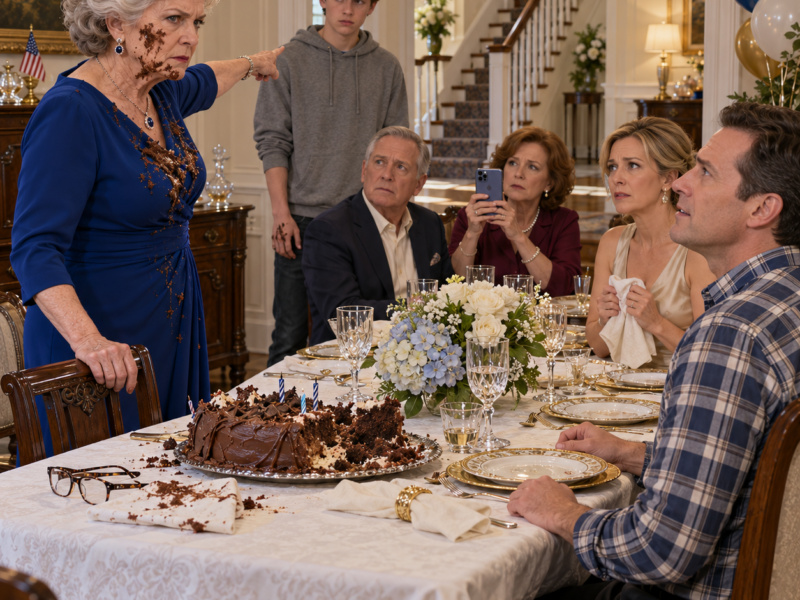
My sixteen-year-old grandson shoved my birthday cake into my face, and my son laughed. “It was just a joke, Mom. He apologized.” I wiped the frosting off my glasses and told them to start packing. Then Tyler looked at his father, turned back to me, and began explaining what had happened before the cake ever reached the table.
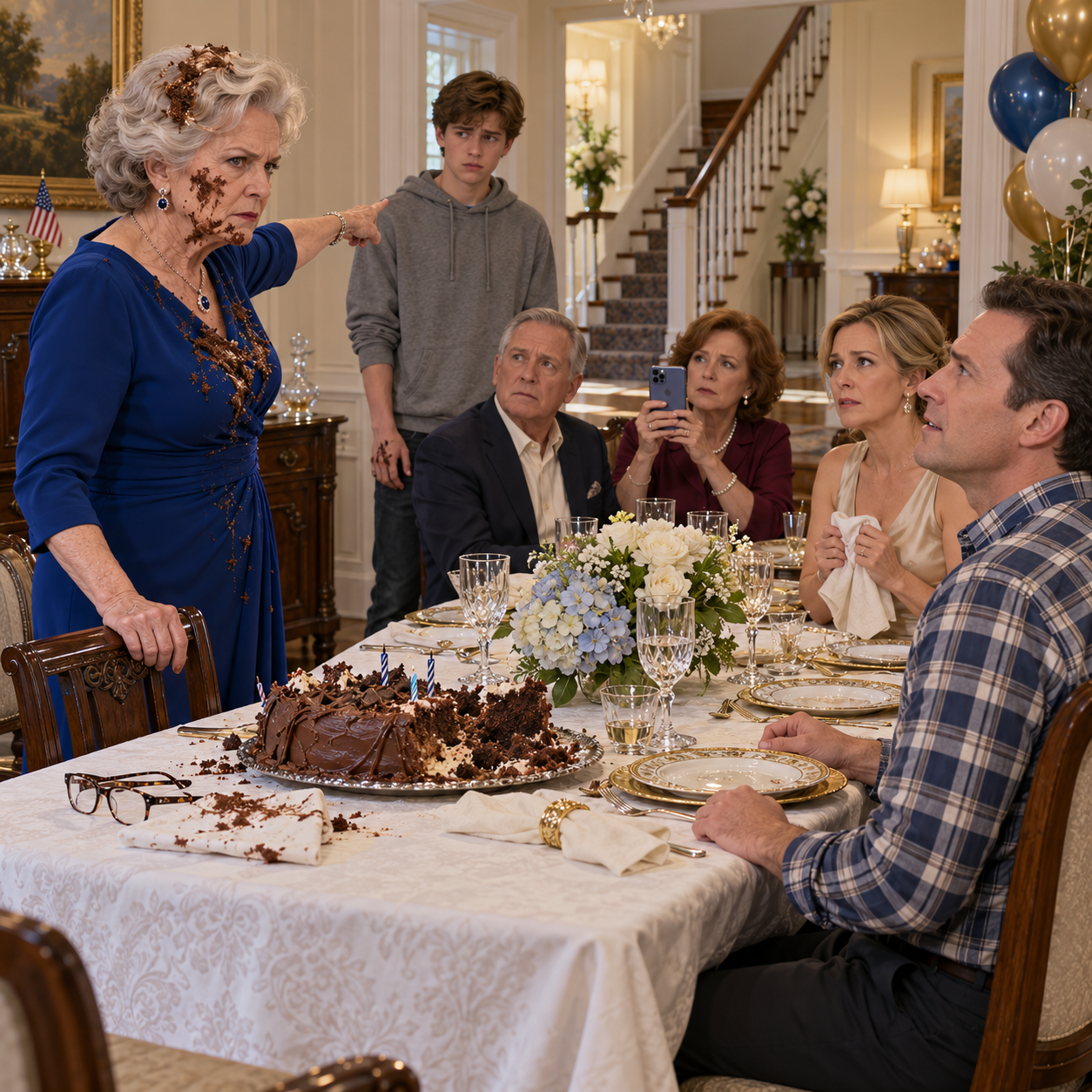
The cake hit me hard enough to knock my glasses sideways.
For a moment, I couldn’t see anything except chocolate frosting. It covered one lens, caught in my eyelashes, and slid beneath the collar of the blue blouse I had bought especially for my birthday.
Then my grandson began to laugh.
Tyler was sixteen. He stood beside my chair with both hands still hovering over the crushed cake, laughing so hard he had to bend at the waist.
My son, Mark, laughed next.
“Mom,” he said, “you should see what you look like.”
His wife, Lisa, pressed her fingers against her mouth. Across the table, my sister Carol had lifted her phone. I heard another small laugh, the scrape of a chair, and the refrigerator humming in the kitchen.
I sat perfectly still.
There are moments when your mind refuses to accept what your body already understands. I could feel the pressure against my nose. I could feel icing dripping down my cheek. Yet some part of me was still waiting for someone to say this wasn’t what it looked like.
It was my seventy-second birthday.
We were sitting in my dining room, at the table my husband and I had bought when Mark was seven. The cake had come from the little bakery where I ordered something for every family celebration.
And the people laughing were the people I had welcomed into my home when they needed somewhere to live.
I took off my glasses.
Tyler saw my face then.
His laughter stopped almost instantly. His shoulders dropped, his eyes widened, and his mouth settled into the same small, uncertain shape I had seen so many times before.
“Grandma,” he said softly, “I’m sorry.”
That expression should have comforted me.
For years, it had.
This time, all I could think was that I knew exactly what would happen next.
Mark would tell me Tyler hadn’t meant any harm. Someone would remind me he was only a kid. I would clean myself up, accept the apology, and make everybody feel better about what they had done to me.
Then we would cut whatever remained of the cake.
Later, when I was alone, I would wonder why my own birthday had left me feeling so small.
Three months earlier, Tyler had put a rubber snake beside the upstairs landing.
I had been carrying a basket of clean laundry when I turned the corner and saw it near my foot. I jumped backward before I had time to think.
My heel missed the edge of the step.
The basket tipped. Towels scattered down the stairs. I fell against the wall, and a sharp pain shot through my ankle.
Tyler reached me first.
“Oh my God. Grandma, I’m sorry. I swear I didn’t think you were going to fall.”
He looked genuinely frightened. His face had gone pale, and his hands shook as he tried to decide whether to help me up or run for someone else.
Mark appeared a few seconds later.
“He was only trying to scare you, Mom,” he said. “He never meant for you to get hurt.”
At urgent care, they told me nothing was broken. My ankle was badly sprained, and I spent nearly two weeks hobbling around my own house with an elastic brace and a cane.
Tyler apologized again that evening.
I put a hand on his shoulder.
“All right. I know you didn’t mean for this to happen. Just don’t ever do something like that near the stairs again.”
He nodded quickly.
“I won’t.”
I let it go.
A few weeks later, my reading glasses disappeared.
I searched beneath the cushions, beside my chair, across the kitchen counter, and in the bathroom. Tyler watched television while I moved from room to room.
After nearly twenty minutes, he began to laugh.
He pulled my glasses from behind his back.
“Seriously?” I asked.
His smile vanished.
“Sorry, Grandma. I was only messing with you.”
“You know I need those.”
“I know. I’m sorry.”
Again, I accepted the apology.
Then my keys disappeared from the bowl by the back door. Someone made a sudden loud noise behind my chair. A television channel changed while I was watching a program, and Tyler insisted the remote must be acting up.
Each incident was small enough to dismiss if I looked at it by itself.
Together, they had begun to change the way I moved through my house.
I checked the stairs before carrying anything. I kept my glasses in my pocket. I counted my keys before leaving the kitchen.
I was becoming cautious in the place where I was supposed to feel safest.
Yet whenever I objected, the same sentences followed.
“He’s just a kid.”
“He didn’t mean anything by it.”
“He apologized.”
Now chocolate frosting was drying in my hair, and Mark was passing me a napkin as though the problem had already been solved.
“Come on, Mom. He apologized. It was just a joke.”
I wiped my glasses first. Then my eyes. Then the icing along my cheek.
Nobody offered to get a clean towel.
Nobody asked whether my nose hurt.
They were watching me, waiting for the familiar ending.
I looked at Tyler.
“You always apologize afterward.”
He shifted his weight.
“I said I’m sorry.”
“I know.”
Then I turned toward Mark.
“And after that, every one of you looks at me.”
“What is that supposed to mean?”
“It means Tyler does something, then he apologizes, and everybody waits for me to forgive him so nobody else has to do anything about it.”
Lisa lowered her eyes.
Mark leaned back in his chair.
“Mom, this is becoming ridiculous.”
I looked around the room.
My table. My chairs. The brass lamp my husband had repaired twice because I loved it. The photographs on the sideboard. The house we had spent thirty-eight years paying for.
For almost two years, I had treated ownership as an embarrassing detail. I never wanted Mark or Lisa to feel like guests. I wanted them to feel welcome.
Somewhere along the way, welcome had become permission to dismiss me.
“You’re really going to ruin the entire evening because of a cake?” Mark asked.
I folded the stained napkin and put it beside my plate.
“No. I think I’ve ruined enough evenings by acting like things didn’t bother me.”
I stood.
“Go upstairs. Start packing.”
Mark blinked.
“Packing what?”
“Your things.”
He gave a short laugh.
“Mom, we live here.”
“You live here because I allowed you to.”
His smile disappeared.
I looked at Tyler, then Lisa, then back at my son.
“And tonight, that permission ends.”
For several seconds, nobody moved.
Then Mark shoved his chair backward.
“You’re throwing your own family out because a sixteen-year-old pushed cake into your face?”
“No.”
He opened his mouth, but I raised my hand.
“You asked me a question. Let me finish answering it.”
Perhaps he stopped because I wasn’t shouting. Mark knew how to handle anger. He could call it dramatic, wait it out, or turn it into a joke.
He didn’t seem to know what to do with certainty.
“I’m asking you to leave because, for two years, I have watched this house become a place where making me uncomfortable is entertainment. And the only rule seems to be that I have to accept an apology quickly enough for everyone else to feel comfortable again.”
“That’s insane.”
“No,” Lisa said.
Mark turned toward her.
She was staring at the ruined cake.
“She isn’t wrong.”
“Lisa.”
“I laughed.” Her voice trembled. “I shouldn’t have.”
“You’re seriously doing this right now?”
“I’m saying I should not have laughed.”
Tyler pushed his chair back.
“Can everybody stop?”
Mark looked at me again.
“Fine. You want an apology? He apologized. Lisa apologized. I’ll apologize too. Sorry. There. Are you happy now?”
“No.”
His eyebrows lifted.
“Because you still believe the problem is that I need to hear one word.”
At the far end of the table, Carol set down her phone. Her husband, Dennis, had stopped eating. Their daughter, Rachel, sat with her hands folded in her lap.
Mark looked around and realized nobody was coming to his defense.
“Can we please not turn this into a public trial?”
Carol’s voice was quiet.
“You made it public when people started filming.”
“I wasn’t filming.”
“No. You were laughing.”
Tyler stood suddenly.
“I’m going upstairs.”
“Sit down,” Mark snapped.
Tyler froze.
Then Mark softened his voice.
“Just sit down, buddy. We’ll work this out.”
My grandson remained standing.
He looked at me, and for the first time that night, I saw something other than the practiced apology.
There was shame in his face. Fear, too.
And anger.
“Grandma.”
He glanced at his father.
“The cake was Dad’s idea.”
The room seemed to lose all its air.
Mark turned his head slowly.
“Tyler.”
“You said it would be funny.”
“Don’t start.”
“You did.”
“Tyler.”
“You told me to do it.”
Mark got to his feet.
Lisa whispered his name.
Tyler continued anyway.
“You said everyone would laugh, and Grandma would pretend to be mad for a minute, and then she would laugh too.”
“Enough.”
“No.”
Even Tyler seemed surprised by how loudly he said it.
“No, because she thinks this was all my idea.”
Mark gave a dry laugh.
“You’re sixteen years old. I didn’t control your hands.”
My grandson recoiled.
And I recognized what my son had just done.
The moment consequences appeared, he had moved aside and left somebody else standing in his place.
Tyler turned toward his mother.
“Mom.”
Lisa had gone pale.
“What else?”
“Don’t,” Mark warned.
She kept looking at Tyler.
“What else?”
He rubbed both hands over his face.
“The glasses thing.”
My fingers tightened against the chair.
“What about my glasses?”
“Dad bet me twenty dollars you wouldn’t notice they were gone for ten minutes.”
Mark scoffed.
“Oh, for God’s sake.”
“And the keys,” Tyler added.
“The keys too?”
He nodded.
“He told me where you always leave them.”
Mark struck the table with his palm. Plates jumped.
“Stop making me responsible for every stupid thing you’ve ever done!”
Tyler jerked backward.
Lisa stood.
“Do not yell at him.”
“What exactly is happening here?” Mark demanded. “Everybody suddenly gets to blame me?”
Carol reached for her phone.
“What are you doing?” he asked.
“Stopping the recording.”
“What recording?”
“I started recording when you stood up.”
He took a step toward her.
Dennis moved between them.
“Don’t.”
Mark stopped.
The candles had burned down to smoking wicks. Chocolate streaked the tablecloth, and a silver birthday balloon tapped the ceiling whenever the heat came on.
Lisa turned back to Tyler.
“The snake?”
He went quiet.
“Tyler,” I said.
He looked at me with wet eyes.
“That one was me.”
Mark released a loud breath.
“See?”
Tyler faced him.
“But you laughed when Grandma fell.”
“That is not true.”
“I heard you.”
“Tyler—”
“You were in the kitchen. I was freaking out, and you said, ‘Bet she won’t scare that easy again.’”
I remembered the stairs.
The towel lying halfway down. The pain in my ankle. Tyler kneeling beside me, terrified.
Then Mark arriving.
He hadn’t looked frightened.
He had looked irritated.
I sat down because my knees needed the chair.
Tyler started toward me automatically.
Then he stopped.
That hesitation hurt more than the cake.
My grandson didn’t know whether he was allowed to help me anymore.
“Get a clean washcloth,” I told him. “Warm water.”
He nodded and hurried into the kitchen.
Mark watched him go.
“So now he gets to play the good guy?”
I looked at my son.
“He gets to bring me a washcloth.”
Nobody spoke.
For the first time that evening, I was grateful for the silence.
When Tyler returned, he held the cloth with both hands. He placed it beside my plate rather than touching my face.
“Thank you,” I said.
His chin trembled.
I wiped frosting from my forehead. My nose was tender, and my scalp hurt where the cake had caught my glasses.
Lisa stepped closer.
“Are you hurt?”
“I don’t know yet.”
“I can get ice.”
“Please.”
Mark exhaled sharply, as though those ordinary questions were another accusation.
“I cannot believe this.”
Carol looked at him.
“You might try believing what happened instead of believing how unfair it is that we noticed.”
“Stay out of this.”
“This is my sister.”
“And she’s my mother.”
I set the cloth down.
“Then speak to me like you remember that.”
His face changed.
For a moment, I thought I saw the little boy who had once stood in my kitchen with a broken cookie jar at his feet. Then his jaw tightened, and the resemblance disappeared.
“You’re making a huge mistake, Mom.”
“Perhaps. But I’m done making the same one.”
Lisa brought a bag of ice wrapped in a clean towel. I held it against my nose.
Rachel quietly collected the dishes nearest me. Dennis moved the cake platter away.
Small acts of care began happening around the table, and I realized how long I had been waiting for them.
Mark remained standing.
“Where exactly are we supposed to go?”
“You and Lisa will have to decide that.”
“We can’t just move tonight.”
“You can stay somewhere else tonight. We will discuss the practical arrangements tomorrow.”
He seized on that immediately.
“So we’re not actually being thrown out.”
I lowered the towel.
“You are being told that this living arrangement is over. I am not putting your belongings on the lawn. I am not abandoning Tyler in the street. But you are not sleeping here tonight and pretending this was another argument that will disappear by breakfast.”
Lisa nodded once.
“We can go to my sister’s.”
Mark looked at her.
“You’ve already decided?”
“I’m deciding now.”
“What a performance.”
She flinched, then straightened.
“Tyler needs to get out of this room.”
My grandson stood by the kitchen doorway, watching us.
I hated that he had become the center of an argument between adults.
But I hated even more that we had spent months making him responsible for the behavior his father encouraged.
“Tyler,” I said, “you did something wrong tonight.”
He nodded without looking up.
“Your father encouraging it does not make it harmless. But telling the truth was the right thing to do.”
Mark started to speak.
I continued.
“And you do not have to stand here while we argue about housing. Go upstairs with your mother. Pack what you need for a few days.”
“Grandma?”
“Yes?”
“Do you hate me?”
The question came out so softly that I almost didn’t hear it.
“No.”
He looked up.
“I love you. And I am hurt. Both things are true.”
He pressed his lips together, nodded, and followed Lisa upstairs.
Mark watched them leave.
“You’ve scared him half to death.”
I was tired enough to stop choosing every word gently.
“He watched his father laugh at hurting his grandmother. He is allowed to be upset about that.”
Mark looked toward Carol and Dennis.
“You all enjoying this?”
Dennis shook his head.
“Nothing about this has been enjoyable.”
For several seconds, my son stood as though he might find one final sentence that would return the evening to his control.
Then he went upstairs.
The house was quiet except for drawers opening overhead.
Carol moved to the chair beside mine.
“Oh, honey.”
I didn’t want pity. I didn’t want her to wrap the night in a softer explanation.
But when she put her hand over mine, I let her.
“I laughed too,” she said.
I looked at her.
“Only for a second. I thought—” She stopped. “It doesn’t matter what I thought. I saw your face, and I should have stopped sooner.”
“You were holding your phone.”
“I was recording the candles. I put it down when I realized. Then I started again when Mark stood up because I was worried.”
“Please don’t send any of it around.”
“I won’t.”
“Not to cousins. Not to anybody who wants to know what happened.”
She nodded.
“It stays private.”
I had already been made into entertainment once that evening.
I wasn’t going to become a family video afterward.
Rachel finished clearing the table. She wrapped the untouched food and put it in the refrigerator.
Then she came to me.
“Aunt Helen, would you like me to stay?”
Hearing my name spoken kindly nearly undid me.
“I think your mother will stay tonight.”
“I will,” Carol said.
Rachel kissed my cheek carefully, avoiding the frosting.
“I’m sorry your birthday ended like this.”
I looked at the ruined cake.
For years, I had tried to judge an occasion by how it ended. A laugh, a hug, a photograph in which everyone appeared happy.
That night, I couldn’t make the photograph happen.
“I’m sorry it took this long,” I said.
Mark came downstairs carrying two duffel bags. Lisa followed with a small suitcase, and Tyler held his school backpack.
My son put the bags near the front door.
“We’ll talk when you calm down.”
“I am calm.”
“No, you’re not.”
Carol stood.
“Mark, leave that alone.”
He ignored her.
“You’re seventy-two years old. You live alone without us. You really want to go back to that?”
There it was.
Not an apology.
A reminder of what he believed I should fear.
My husband, Robert, had died three years earlier. For the first year afterward, the house had felt enormous. I had sometimes turned on the kitchen radio just to hear another voice.
When Mark lost his job and their rent increased, inviting them to stay had seemed like an answer to everybody’s problems.
They needed breathing room.
I needed life in the house.
I had never understood that my grief would eventually be used as an argument against my right to be treated kindly.
“Yes,” I said.
Mark stared at me.
“If the choice is living alone or living like this, I choose alone.”
Lisa picked up her suitcase.
“Come on.”
Tyler stopped in front of me.
His face was blotchy.
“I really am sorry.”
“I heard you.”
He swallowed.
“I’ll clean everything.”
“Rachel has already helped.”
“I mean tomorrow. Whatever—”
“You don’t need to solve it tonight.”
He nodded.
At the door, Mark turned back.
“You’ll regret this.”
I didn’t answer.
The door closed behind them.
I listened to the car start, then watched its headlights move across the curtains.
Only when they were gone did I begin to cry.
It wasn’t a dramatic collapse. I didn’t fall to the floor or sob into the ruined tablecloth.
I sat in my chair with a cold towel against my face while tears ran down my neck.
Carol brought a clean cardigan.
Then she sat beside me without trying to turn the evening into something that happened for a reason.
For that, I loved her.
Later, upstairs, I washed chocolate out of my hair.
The water in the sink turned brown. I found icing inside one ear and along the hinge of my glasses. My blouse went into a basin to soak.
In the mirror, my nose was pink and slightly swollen.
I looked like a woman who had been hurt.
That simple fact seemed strangely difficult to accept.
I had spent the whole evening being told I was a woman who didn’t understand a joke.
The next morning, Carol drove me to a walk-in clinic.
I almost refused.
“It’s probably nothing.”
She was standing in my bedroom doorway holding her car keys.
“Then let someone qualified tell you that.”
The clinician asked what had happened.
“My grandson pushed a cake into my face.”
She paused.
“Was it accidental?”
“No.”
Saying that word aloud made my stomach tighten.
She examined my nose, checked my eyes, and asked about headache, dizziness, and nausea. There was bruising and tenderness, but she didn’t find signs of a serious injury. She explained what changes would mean I needed further care.
Then she asked whether I felt safe going home.
I looked at Carol.
“Yes,” I said. “The people involved are staying elsewhere.”
The clinician nodded.
She didn’t laugh. She didn’t tell me boys could be thoughtless.
She treated my answer as information that mattered.
On the drive home, my phone began vibrating.
Mark had called four times.
There were three messages.
The first said we needed to discuss things like adults.
The second said Lisa was upset and Tyler hadn’t slept.
The third said he hoped I was satisfied.
I put the phone in my purse.
Carol glanced over.
“You don’t have to answer while you’re in the car.”
“I know.”
“You don’t have to answer today.”
That, I wasn’t sure I knew.
For most of Mark’s life, a call from him had created an immediate task for me. Pick him up. Lend him money. Watch Tyler. Listen while he explained why somebody at work was unreasonable.
Even when the task was only reassurance, I had learned to respond quickly.
Ignoring the phone felt like leaving a pot boiling on the stove.
But nothing terrible happened.
We drove home.
I made tea.
The phone stayed in my purse.
After lunch, I called an attorney named Susan Fletcher.
Robert and I had used her years earlier when we updated our wills. She still had an office above the pharmacy downtown.
Her assistant offered an appointment the following morning.
I explained that family members had been living in my home and that I wanted the arrangement to end.
“Bring whatever paperwork you have,” the assistant said.
There was very little.
That was one of the problems.
Nearly two years earlier, Mark had arrived at my door with the stunned expression of a man who had spent too long pretending everything was fine.
His employer had eliminated several management positions. Their lease renewal came with an increase they couldn’t afford. Lisa was working part-time at a dental office, and Tyler was starting high school.
“Just a few months,” Mark had said. “Until I get back on my feet.”
I offered them the upstairs bedrooms.
They could save money, help with groceries, and contribute to utilities when they were able.
I didn’t ask for rent.
I told myself there was no reason to turn kindness into a contract.
At first, it worked.
Lisa cooked on the evenings she got home early. Tyler carried groceries and shoveled the walkway. Mark repaired a loose stair rail and drove me to an eye appointment.
We ate dinner together.
I heard footsteps upstairs.
I no longer had to decide whether making a whole pot of soup was foolish for one person.
Then Mark found another job.
The few months stretched into a year.
When I asked about their plans, he said housing prices were absurd and it would be wasteful to rush into something unsuitable.
They were saving, he assured me.
I believed him.
Meanwhile, their furniture filled my basement. Mark took over Robert’s small study as his office. A large television appeared in the upstairs sitting room.
Lisa’s contributions to groceries became less regular. Mark said his car needed work. Tyler needed sports equipment. There was always something.
I could manage the bills, so I did.
It was easier than a conversation.
That had become the guiding principle of my life.
At Susan’s office, I told the story slowly.
She didn’t interrupt.
When I finished, she asked practical questions. How long had they lived there? Did they receive mail? Had they ever paid rent? Were there written promises about how long they could stay? Did they still have keys?
Then she leaned back.
“Your decision can be firm, Helen. The process still needs to be handled properly.”
“I’m not trying to put their things outside.”
“Good.”
“I just want my home back.”
She nodded.
“We’ll work toward that.”
She explained that asking someone to leave and lawfully ending an established living arrangement were not always the same step. She would review the circumstances and prepare the appropriate written notice. I should not change locks while their right to occupy the house remained unresolved or remove their belongings.
I felt a sharp disappointment.
Not because I wanted a shortcut.
Because some part of me had hoped one sentence at the birthday table could fix two years of silence.
Susan seemed to understand.
“You’re allowed to mean what you said even if it takes time to carry it out.”
“What if he comes back?”
“We’ll establish written arrangements. If you feel threatened, that is a separate concern. Don’t try to manage it by yourself.”
She asked whether I had someone who could stay with me.
“Carol.”
“Good.”
Then she looked at the notebook I had brought.
“Tell me about the financial side.”
That took longer.
I had covered groceries, utilities, property expenses, and several smaller emergencies. I had paid for Tyler’s school trip and new tires for Lisa’s car. Six months earlier, Mark had asked for money toward a certification course.
I didn’t regret helping my grandson.
I did regret never distinguishing between a gift, a loan, and a recurring obligation.
Susan made notes.
“We don’t have to turn every family expense into a dispute. But going forward, you should know exactly what you are agreeing to.”
On the way home, I stopped at my bank.
I didn’t freeze anyone’s accounts. I didn’t discover a secret fortune or summon an executive who owed me a favor.
I sat with a patient employee named Angela and reviewed my own arrangements.
Mark had an additional credit card on an account I paid. I had given it to him for groceries and household errands when they moved in.
Lately, I hadn’t looked closely at the statements.
Angela printed the recent transactions.
Restaurants. Gas. A sporting-goods store. A subscription I didn’t recognize.
Some purchases were ordinary household spending.
Others plainly weren’t.
I removed the additional card authorization and arranged new access credentials for my own banking. We reviewed the people listed on my accounts and the ways I received alerts.
Nothing about it was theatrical.
Yet when I walked out, I felt as though I had closed a door that had been standing open for years.
Mark called an hour later.
“The card isn’t working.”
“I ended your authorization.”
“You did what?”
“It was for shared household expenses. That arrangement is ending.”
“I was buying lunch.”
“Then you’ll need to pay for your lunch.”
There was a long silence.
“You’re really going all the way with this.”
“I’m making my finances clear.”
“After everything I’ve done for you?”
I sat at my kitchen table.
“What are you referring to?”
“Living there. Helping you. Keeping you company.”
I looked at the empty chair across from me.
“I invited you because you needed help.”
“And because you were lonely.”
“Yes,” I said. “I was lonely.”
He sounded almost relieved, as though he had finally found the point that would unravel everything.
“So you admit—”
“That doesn’t mean I agreed to be mistreated.”
His breathing changed.
“Tyler’s a wreck.”
“I’m sorry he’s upset.”
“You should call him.”
“I will speak to him separately. I am not going to use a conversation with him to settle this with you.”
“You’re punishing everybody.”
“I’m changing something that is no longer working.”
He hung up.
I stayed at the table for several minutes.
My hands were shaking again.
I wished firmness felt as simple inside as it sounded outside.
That evening, Lisa called.
Unlike Mark, she asked whether it was a good time.
“Yes.”
“We’re at my sister’s. Tyler’s doing his homework.”
“How is he?”
“Quiet.”
She paused.
“How are you?”
“My nose is sore. I had it checked.”
“Oh, Helen.”
“I’m all right.”
“I should have asked last night.”
“Yes.”
She accepted that without explaining.
For a moment, neither of us spoke.
Then she said, “I’m not calling to ask you to change your mind.”
I relaxed slightly.
“Thank you.”
“I’m calling because I need to say something without Mark talking over it.”
I waited.
“I knew about the glasses.”
My stomach tightened.
“He told me after. He said it was harmless, that you were laughing by the end.”
“I wasn’t.”
“I know that now.”
“Did you know about the keys?”
“No. Not until last night.”
“And the cake?”
Her answer took a moment.
“I heard him telling Tyler you’d love it. I thought he meant putting a little frosting on your nose.”
I closed my eyes.
“He said you used to do silly things at parties. I should have asked you. I should have told Tyler not to do it.”
“You should have.”
“I know.”
There was no relief in hearing it.
But there was something steady about an apology that didn’t immediately request forgiveness.
Lisa continued.
“I’ve let Mark tell me what you meant too many times.”
“What do you mean?”
“When you said you were tired, he said you liked to complain. When you asked about moving, he said you were only worried we’d leave. When you stopped laughing at Tyler’s jokes, he said you were getting sensitive.”
I stared at the window above the sink.
My son had not simply dismissed what I said.
He had translated it for the rest of his family until my words meant the opposite.
Lisa began to cry.
“I’m not saying that to make myself innocent. I went along with it.”
“I understand.”
“No, I need you to know I understand. I lived in your house. You made room for us. And I acted as though your comfort was the thing we could always spend.”
I pressed my palm against the table.
That was exactly how it had felt.
“What are your plans?” I asked.
“We’re looking at apartments.”
“Mark said you couldn’t.”
“We can’t afford what he wants. We can afford something smaller.”
I almost asked how much they had saved.
Then I stopped.
Their budget no longer needed to become my assignment.
“Let me know when you have a practical proposal for moving your things.”
“I will.”
Before we ended the call, she asked whether Tyler could write to me.
“Yes.”
“No pressure to answer.”
“Thank you.”
That night, Carol and I ate leftover chicken at the kitchen counter.
She had been staying in the guest room. Every evening, she asked whether I still wanted company, and every evening I said yes.
She didn’t move things without asking. She didn’t tell me which lamp should be replaced or complain that my house was too warm.
It was startling how restful courtesy could be.
After dinner, she asked whether I wanted to talk about Mark.
“I don’t know.”
“We don’t have to.”
“I keep wondering when he became like this.”
Carol rinsed her plate.
“Maybe that isn’t one moment.”
“He wasn’t a cruel child.”
“I remember.”
“He used to bring Robert his slippers.”
“I remember that too.”
I looked toward the darkened dining room.
“How does somebody become the person who tells his son to do that?”
Carol dried her hands.
“I don’t know. But you don’t have to answer that before you protect yourself.”
I had been treating understanding as a condition of action.
If I could find the exact reason Mark behaved this way, perhaps I could repair it. If I could remember the right childhood incident or identify the right disappointment, maybe I could say the sentence that would return my son to me.
But I had already spent months explaining the obvious.
Don’t hide my glasses.
Don’t startle me near the stairs.
Don’t laugh when I’m hurt.
Those requests didn’t require a complete theory of his life.
They required respect.
Two days later, Tyler’s letter arrived by email.
The subject line was simply, “Grandma.”
I waited until after breakfast to open it.
He wrote that he had tried three times because everything sounded like an excuse.
He admitted he had thought the cake would be funny. His father’s encouragement had made it easier, but he had wanted people to laugh too.
Then he wrote a sentence that made me put the phone down.
*I thought you would forgive me before I had to feel bad for very long.*
I read it again.
He remembered the glasses. He remembered hearing me say that I needed them, then feeling annoyed because the joke had lasted longer than my patience.
He wrote about the snake.
*That one really was my idea. I was scared when you fell. I meant it when I said sorry. But after everybody said it was okay, I started acting like being scared for a minute meant I had learned enough.*
At the end, he said he would pay for my blouse to be cleaned and replace the cake with money he earned.
He didn’t ask to move back.
He didn’t ask whether I loved him.
He wrote, *You don’t have to make me feel better about this.*
I cried then.
Not because the letter repaired everything.
Because my grandson had finally left enough room for me to have my own feelings.
I answered the next day.
I told him I loved him. I thanked him for naming what he had done without making someone else responsible for all of it.
I said the blouse could be cleaned, but trust would take longer.
Then I wrote something I wished somebody had said to Mark years earlier.
*When you hurt someone, the apology is yours to offer. Their forgiveness is theirs to decide. You do not get to hurry them because waiting is uncomfortable.*
I read that line several times before sending it.
It applied to me too.
I had hurried my own forgiveness because everybody else’s discomfort made me uncomfortable.
Perhaps Tyler and I both had something to learn.
The written notice Susan prepared was delivered later that week.
It was careful, specific, and nothing like the speech I had given at the birthday table.
Mark called it cold.
I thought it was clear.
There was a proposed move-out agreement as well. It addressed dates, collecting belongings, household access, keys, and what would happen if the terms were not met.
Susan handled the correspondence.
I no longer had to sit through Mark’s attempts to turn every practical detail into a judgment on my love.
He left a voicemail saying Robert would never have approved.
That one nearly broke me.
For two hours, I walked around the house hearing my husband’s name in my son’s angry voice.
Then I sat in Robert’s study.
His old desk was still there beneath Mark’s monitor and stacks of paper. I opened the bottom drawer, where Robert had kept small things he thought might be useful.
A tape measure. Spare batteries. A photograph of us at a county fair.
I held the picture.
Robert had never been perfect. He could be stubborn about directions and overconfident about repairing plumbing. He sometimes left his coffee cup in places no coffee cup belonged.
But he had never needed me to become smaller so he could feel comfortable.
I tried to imagine him seeing frosting covering my face while Mark laughed.
The answer came easily.
I saved the voicemail for Susan, then stopped replaying it.
My husband’s memory was not another room Mark could take over.
That weekend, my friend Evelyn came by with soup.
We had worked together at an insurance office for almost twenty-five years. Since retiring, we mostly saw each other at library events or over lunch.
She knew there had been trouble because Carol had asked whether she could check in after she returned home.
I told Evelyn the basic facts.
She listened without interrupting.
Then she said, “I’ve wondered whether you were happy with them there.”
“Why didn’t you ask?”
“I did.”
I looked at her.
“At lunch in May. You said you were tired because Tyler kept playing tricks. I asked whether you wanted them to move. You said, ‘Don’t be silly. They’re family.’”
I remembered.
I had laughed when I said it.
I had used the same laughter that hurt me now.
“I didn’t know what else to say.”
“I know.”
She put the soup in the refrigerator.
“You can tell me the truth next time.”
That sounded like a small invitation.
It felt enormous.
I began noticing how often I answered questions in ways designed to keep people from worrying.
How are you?
Fine.
Do you need help?
No, no.
Did that upset you?
Of course not.
Those answers had once seemed generous. Now I saw how they could leave me alone with things other people might willingly help carry.
A few days later, I called a counselor recommended by my doctor.
Her name was Judith.
At our first appointment, I told her I didn’t want to spend the hour blaming my son.
“What would you like to understand?” she asked.
“Why I kept allowing it.”
She nodded.
We talked about Robert’s death, the empty house, and the relief I had felt when Mark moved in.
We talked about my childhood, when being easy to care for was considered one of the best things a girl could be.
We talked about motherhood, how the first years train you to respond whenever your child cries, and how difficult it can be to stop treating every distress signal as an emergency you must fix.
Then Judith asked what I believed would happen if Mark stayed angry.
“I might lose him.”
“And what was happening while you kept him happy?”
I looked at the tissue in my hands.
“I was losing myself.”
She didn’t turn that into a slogan.
She let me sit with it.
By the end of the appointment, I understood that setting a boundary had not made me stop loving my son.
It had made loving him more complicated.
Perhaps honest love had always been more complicated than I wanted to admit.
Mark and Lisa signed the move-out agreement after Susan spoke with their attorney.
There would be several scheduled trips for belongings, followed by a final move on an agreed date.
Until then, they were staying with Lisa’s sister. The arrangement was inconvenient, and Mark complained about it repeatedly.
I didn’t take responsibility for making it comfortable.
Dennis came for the first collection.
I asked him because I didn’t want to be alone with Mark, and he agreed without making me justify the request.
Lisa arrived in her own car.
Mark came later with a rented van.
For the first hour, everything was ordinary.
Boxes came downstairs. The television went out. Tyler’s sports equipment was carried to the driveway.
Then Mark entered the kitchen while I was pouring coffee.
“So this is what we are now? Lawyers and appointments?”
“Yes,” I said. “For the move.”
“You can’t even talk to your own son?”
“We’re talking.”
“You know what I mean.”
I put the pot down.
“I know you want a conversation that changes the agreement. I’m not having that conversation today.”
He looked toward Dennis in the hall.
“You need a bodyguard now?”
“I need support.”
“From your own family.”
“Yes.”
His face reddened.
For a moment, I thought he would shout.
Then he looked down at the floor.
“I didn’t know it would hit that hard.”
I waited.
“The cake. I told him to make it funny. I didn’t tell him to hurt you.”
“What did you tell him to do?”
He rubbed the back of his neck.
“You heard him.”
“I’m asking you.”
“Push the cake toward your face when you leaned in.”
I felt the ache return beneath my nose, although the bruise had nearly faded.
“And did you ask whether I wanted that?”
“It was supposed to be a surprise.”
“That isn’t an answer.”
He looked away.
“No.”
“Did you tell him I would pretend to be mad and then laugh?”
“Yes.”
“Why?”
“Because that’s what you always do.”
The words came out impatiently.
Then he seemed to hear them.
I looked at my son.
“That is what I always did.”
He swallowed.
I could see a possible opening between us, but I didn’t rush to fill it.
For once, he had to stay inside the silence he created.
Finally, he said, “I guess I misjudged it.”
That was smaller than the truth.
But it was the first sentence he had offered that pointed toward it.
“Yes,” I said. “You did.”
He waited.
I didn’t tell him it was all right.
After a moment, he returned upstairs.
When the van left, I felt exhausted.
I had imagined that confronting him would feel powerful.
Mostly, it felt like doing something difficult without abandoning myself halfway through.
That afternoon, I went into the study.
Mark’s monitor was gone.
The desk was visible again.
There was a pale rectangle on the wall where he had hung a framed certificate. I dusted the surface, opened the curtains, and found one of Robert’s pencils beneath the radiator.
I placed it in the cup on the desk.
Then I sat there for nearly an hour.
I wasn’t deciding what the room would become.
I was simply letting it belong to me again.
Tyler asked to visit two weeks after the party.
Lisa sent the message.
He wanted to talk, she said. She could bring him and remain nearby if that made me more comfortable.
I thought about it overnight.
Then I agreed to a short visit on Saturday afternoon.
No dinner.
No family gathering.
Just Tyler and me at the kitchen table while Lisa waited in the living room.
When he arrived, he carried a small paper bag.
Inside was a replacement tablecloth.
“I know it isn’t the same one,” he said. “Mom helped me check the size.”
I thanked him.
He sat down without opening the refrigerator or reaching for the cookie tin, things he had always done when he lived there.
The carefulness between us hurt.
But I reminded myself that discomfort wasn’t always damage. Sometimes it was the space where a person learned to behave differently.
“Would you like tea?” I asked.
“Sure.”
I made two cups.
He watched me put the kettle away.
“Your ankle still hurts sometimes, doesn’t it?”
“Yes. Mostly when I’ve been on my feet too long.”
He looked at the table.
“I didn’t know.”
“I didn’t tell you every time.”
“You said it was okay.”
“I said I knew you didn’t mean for me to fall.”
He frowned slightly.
“I thought that meant it was over.”
“I know.”
We sat quietly.
Then he said, “Dad was mad that I told everybody.”
“What did he say?”
“That I made him look bad.”
I kept my voice even.
“You told us what happened.”
“He said I should have talked to him first.”
“How did that feel?”
Tyler stirred his tea although he hadn’t added anything.
“Like I was supposed to protect him from something he did.”
I looked at my grandson’s face.
He was old enough to understand more than the adults had allowed him to say.
“You are responsible for telling the truth about your own actions,” I said. “You don’t have to lie about someone else’s involvement to make them comfortable.”
“I know.”
He paused.
“I still wanted people to laugh.”
“Yes.”
“And I thought you wouldn’t mind that much.”
“Yes.”
His eyes filled.
“I don’t know why I kept choosing you.”
The question sounded genuine.
I didn’t answer too quickly.
“Maybe because you believed I would keep forgiving you.”
He nodded.
“And because I didn’t really act mad.”
“I was trying to keep things peaceful.”
He wiped his cheek with his sleeve.
“I made you feel stupid.”
“Sometimes.”
That hurt him.
I could see it.
For years, I would have rushed to soften the answer.
Instead, I let him hear it.
He put both palms on the table.
“I don’t want to be that kind of person.”
“Then you will have to practice being a different kind.”
“How?”
“Start by asking yourself whether the other person is enjoying the joke. If they need something, don’t take it. If they say stop, stop. And when someone gets hurt, help them before you explain yourself.”
He nodded slowly.
“That sounds obvious.”
“It is obvious. That doesn’t mean everybody does it.”
After a while, he asked whether he could help me replace a light bulb in the pantry.
I said yes.
He got the step stool, checked that it was steady, and asked me to stand clear.
It was an ordinary task.
No great redemption.
But when he finished, he put the stool away.
He didn’t ask whether doing that meant everything was fixed.
Before leaving, he hugged me carefully.
I hugged him back.
Then he said, “Thanks for letting me come.”
“You’re welcome.”
I stood at the window and watched him get into Lisa’s car.
I missed the little boy who used to run down my hallway with a toy airplane.
I loved the young man who had just left.
Those were not exactly the same feeling.
The final move took place three weeks later.
Susan had reviewed the agreement, and everything was scheduled in writing. Mark and Lisa had rented a two-bedroom apartment across town.
It was smaller than the house they once occupied.
It was also theirs to manage.
Tyler’s new room was narrow. Mark complained that there was no space for an office.
I listened without offering my study.
The movers arrived at nine.
Carol and Dennis came over. Lisa had labeled the boxes, and most of the work went smoothly.
At noon, Mark found a carton of Robert’s tools in the basement.
“I’ll take these,” he said.
“No.”
He looked up.
“Dad would want me to have them.”
“Some of them, perhaps. But we haven’t discussed it, and today is for your belongings.”
“They’ve just been sitting here.”
“That doesn’t make them yours.”
He set the carton down hard.
Carol looked toward us.
I stayed where I was.
For once, a disagreement did not require me to surrender something to make the room quiet.
Later, Lisa handed me the keys.
“All of them,” she said. “We checked.”
I counted them against the list.
That felt painfully formal.
It also prevented another difficult conversation later.
Tyler walked through the upstairs rooms before leaving. He stopped at the doorway of the room he had used.
“I’ll miss this.”
“I know.”
He looked at me.
“Will you miss us?”
“Yes.”
“Even after—”
“Yes,” I said again. “But missing someone doesn’t always mean living together is right.”
He thought about that.
Then he nodded.
Mark lingered at the front door.
His car was packed, and Lisa was waiting in the driveway.
“Well,” he said.
“Well.”
“I still think this could have been handled differently.”
“I wish many things had been handled differently.”
He looked tired.
For the first time since my birthday, I could see how much energy he had spent resisting the move instead of simply doing it.
“Are you going to invite us over?”
“When I’m ready.”
“How long?”
“I don’t know.”
He gave a frustrated sigh.
I didn’t change my answer.
Finally, he stepped outside.
The door closed.
I stood in the entryway for a long time.
The house seemed unfamiliar without their coats on the hooks.
Then I realized it wasn’t unfamiliar.
It was quiet.
That was different.
The first week alone was harder than I expected.
I had made the right decision, but right decisions still leave empty rooms.
I set out too many plates once. I bought more milk than I needed. At night, I listened for footsteps and heard only the furnace.
One evening, I nearly called Mark just to ask what he was doing.
Then I asked myself whether I wanted a conversation or relief from loneliness.
It was relief.
I called Evelyn instead.
She came over the next day, and we ate lunch in the sunroom.
I began going back to the library’s Wednesday discussion group. I invited Carol for dinner. I walked with a neighbor when my ankle allowed it.
None of those things replaced family.
They reminded me family wasn’t the only place companionship could come from.
I also started making small changes to the house.
I put my reading chair back beside the window. I moved the television remote to the side table without worrying that it would disappear.
In the study, I replaced the harsh overhead bulb with a warmer lamp.
Then I opened the closet where I had stored my sewing machine.
For years, I had mended clothes and hemmed curtains for other people. I couldn’t remember the last time I had made something because I wanted it.
I bought fabric for a simple quilt.
The first afternoon, I measured badly and cut one strip too short.
I laughed.
Alone.
It was a small, surprised laugh, and nobody needed to be humiliated for it to happen.
Lisa and I began meeting for coffee occasionally.
The first time, she seemed nervous.
“I don’t want this to feel like I’m reporting on Mark.”
“Then don’t report on him.”
She smiled faintly.
“All right.”
We talked about her job.
She had asked for more hours and was considering training for an administrative role at the dental practice.
I asked about the course.
She told me without asking me to pay for it.
That mattered more than she probably knew.
Later, she admitted she had become used to treating me as a source of solutions.
“If we were short, you covered it. If Tyler needed a ride, you went. If Mark was upset, you calmed him down.”
“I offered often.”
“You did. But we stopped noticing that you could say no.”
“I stopped saying it.”
She nodded.
We were both telling the truth.
Neither truth erased the other.
She said she and Mark had begun counseling.
I wished them well.
I didn’t ask for details.
Their marriage was another room I no longer needed to manage.
Mark stayed distant.
He sent short messages on holidays and sometimes asked about my health. When I answered, he occasionally tried to turn the conversation back toward what he called “the birthday situation.”
I corrected the phrase once.
“It was a pattern, Mark.”
He didn’t respond.
For a while, that silence hurt more than his anger.
At least anger meant he was reaching toward me, even if it was in the wrong way.
Judith helped me recognize that I had begun treating every quiet day as a deadline for reconciliation.
“You can want a relationship,” she said, “without doing both people’s work.”
“What if he never changes?”
“Then you will make decisions based on how he behaves.”
I didn’t like that answer.
It gave me nothing to fix.
But it was honest.
About four months after my birthday, Mark asked whether he could meet me at a coffee shop.
His message said he wasn’t coming to discuss moving back or money.
I agreed.
I chose a table near the window.
When he arrived, he looked older than he had in the dining room. There were shadows beneath his eyes, and he didn’t begin with a joke.
He ordered coffee, then sat with both hands around the cup.
“I’ve been trying to figure out how to say this.”
I waited.
“I keep starting with what I meant.”
“Yes.”
“And Lisa keeps telling me that isn’t where I should start.”
I said nothing.
He stared into his coffee.
“I told Tyler to push your face into the cake. I told him you’d get over it. I laughed when he did.”
My throat tightened.
“I paid him to hide your glasses. I helped with the keys. And when you fell, I made that comment in the kitchen.”
He looked up.
“I told myself I wasn’t laughing at you being hurt. But I was treating your fear like it was funny. There isn’t much difference.”
I breathed slowly.
For months, I had imagined hearing those words.
Now that I was hearing them, I didn’t feel triumphant.
I felt sad.
“You made me feel unsafe in my own home,” I said.
He nodded.
“I know.”
“I don’t think you knew then.”
“No. I didn’t let myself know.”
He wiped a hand across his mouth.
“I kept thinking you were overreacting because otherwise I had to look at what I’d done.”
“Yes.”
“I’m sorry.”
The sentence stood alone.
No explanation followed it.
I looked out the window at a woman helping a little boy zip his coat.
For a moment, I remembered doing the same thing for Mark.
That memory didn’t disappear because he had hurt me.
It also didn’t make the hurt disappear.
“I’m glad you said that,” I told him.
He nodded again.
After a while, he asked, “Can we start over?”
“No.”
His face fell.
I let a moment pass.
“We can begin from here. Starting over would mean pretending we don’t know what happened.”
He looked down.
“Okay.”
“I’m not ready for family dinners at my house.”
“Okay.”
“I don’t want to hear that Tyler was the real problem.”
“He wasn’t.”
“He was responsible for his choices. You were responsible for yours.”
“I know.”
“And I need you to accept that an apology does not give you a deadline for my trust.”
He swallowed.
“That’s hard.”
“Yes.”
“But fair.”
We stayed for another twenty minutes.
We talked about his job. I told him about the quilt, and he asked whether I had found all the sewing supplies.
When we left, he didn’t reach for a hug immediately.
“Would that be okay?”
I nodded.
The hug was brief.
It didn’t restore the years before my birthday.
But it was the first contact between us in months that didn’t require me to betray my own feelings.
Tyler continued visiting.
At first, once every few weeks. Then more regularly.
We cooked simple meals and worked on a jigsaw puzzle. He helped me carry heavy things, but I made sure every visit wasn’t a sentence of chores.
I wanted accountability.
I also wanted a grandson.
One afternoon, he told me somebody at school had circulated a video of another student slipping in the cafeteria.
“Everybody was laughing,” he said.
“What did you do?”
“I didn’t send it.”
I nodded.
Then he added, “I asked if the kid was okay.”
“What happened?”
“He said he hurt his wrist. I went with him to the office.”
“That was kind.”
Tyler shrugged.
“It felt weird.”
“Why?”
“Because my friends were still laughing. I thought they’d say I was being dramatic.”
I recognized that word.
“What did they say?”
“One of them did.”
“And?”
“I told him the guy was hurt.”
He looked down at the puzzle.
“It wasn’t some big thing.”
“No,” I said. “Most good choices aren’t.”
I didn’t turn the story into proof that he was fixed.
He was sixteen. Then seventeen. He would make other mistakes.
But he was learning to notice the person inside the joke.
That was worth encouraging.
Carol kept the birthday recording private, as promised.
Months later, she asked what I wanted her to do with it.
“Delete the party footage,” I said. “Keep the part we gave Susan until she says we no longer need it.”
“Are you sure?”
“Yes.”
I didn’t want to watch myself being humiliated.
I didn’t need the recording to remember.
And I didn’t want Tyler’s worst choice to become something the family passed around forever.
Carol nodded.
Then she told me something I hadn’t known.
After the party, Rachel had called her and said she wished she had spoken up sooner.
“She kept thinking someone older would say something,” Carol said.
I looked at her.
“That’s what we all did.”
“Yes.”
We had waited for a person with more authority, more certainty, or a better sentence.
Meanwhile, I had sat there covered in frosting.
The next time Carol saw a relative make an ugly joke at someone else’s expense, she told me, she didn’t wait.
I was glad.
But I didn’t need my birthday to become a lesson everyone praised themselves for learning.
I just wanted the learning to show up when it mattered.
As summer approached, I reviewed my plans with Susan.
We updated contact information and made sure my documents reflected what I actually wanted. I considered carefully who should help if I became unable to manage certain matters.
I didn’t make changes in a burst of anger.
I took time.
Mark remained my son. Tyler remained my grandson. My affection for them was not measured by whether they had access to my credit card or an unlimited invitation to my house.
Susan asked what had changed most since our first meeting.
“I read things before I agree,” I said.
She smiled.
“That’s useful.”
“And I don’t assume a practical question is an accusation.”
“What do you mean?”
“I can ask when someone plans to move. I can ask what a payment is for. I can ask who has a key.”
“Yes,” she said. “You can.”
Those questions had once felt unfriendly.
Now they felt like part of caring for a life I had spent decades building.
I also stopped telling people Robert had handled everything.
He hadn’t.
We had built the household together.
I knew the bills, the insurance, the repairs, and the taxes. I had worked for years, raised a child, cared for aging parents, and sat beside my husband through the illness that took him.
Somehow, after his death, I had begun describing myself as a woman who needed help with ordinary life.
I did need help sometimes.
Everybody did.
That didn’t mean I needed to surrender authority over my home.
One afternoon, Mark came over to help move a bookcase.
It was the first time he had been inside for more than a brief visit since moving out.
He paused in the study.
“You changed it.”
“I did.”
The sewing machine sat near the window. The desk held a lamp, a notebook, and Robert’s pencil cup.
“It looks good.”
“Thank you.”
He ran a hand over the bookcase.
Then he asked, “Where would you like it?”
The question was so ordinary that I almost missed its significance.
He wasn’t announcing where it would work best.
He was asking.
I showed him.
He moved it with Dennis’s help, then checked whether I liked the position.
Later, while we drank lemonade, Mark noticed my glasses on the side table.
He looked at them, then away.
“I hate that I made you worry about those.”
I didn’t rescue him from the sentence.
“So do I.”
He nodded.
Then we talked about something else.
That was what progress began to look like.
A difficult truth acknowledged without taking over the entire afternoon.
By autumn, I had allowed a few small family visits.
Not every week. Not whenever Mark appeared.
We arranged them.
Sometimes I said no because I was busy or tired.
At first, he asked what I had planned.
Then he learned that I didn’t need a competing obligation to justify declining.
“I’m staying in,” became an acceptable answer.
Tyler was less troubled by the new arrangements than I expected.
“I know when I’m coming,” he said. “That’s kind of easier.”
For years, we had confused constant availability with closeness.
Scheduled time could be warm too.
At one visit, Lisa brought a dessert and asked whether she could use a platter.
“Yes. The white one in the cupboard.”
She took it out and put it back after washing it.
Nobody would have written a story about that.
I noticed anyway.
Respect returned in details too small for photographs.
A cupboard closed gently. A request answered without sarcasm. A joke abandoned when the other person didn’t smile.
Mark’s changes were uneven.
Once, when I declined to cover an unexpected expense, he began, “Come on, Mom, it’s not like you—”
Then he stopped.
I waited.
“It’s not your responsibility,” he finished.
“No,” I said. “It isn’t.”
He looked embarrassed.
“Sorry.”
We moved on.
I didn’t pretend the first words had never happened.
I also didn’t treat every stumble as proof that no progress was possible.
What mattered was whether he noticed, corrected himself, and changed what he did next.
As my next birthday approached, I felt anxious.
I hadn’t expected that.
The calendar turned to the same month, and I began waking early with the memory of icing against my eyes.
Judith suggested I think about what kind of day I actually wanted.
At first, all I could think about was preventing a repeat.
Then I asked myself a different question.
What would make me happy?
The answer was simple.
A quiet lunch. A walk if the weather was good. People who wanted to be with me rather than perform a celebration around me.
I invited Carol and Dennis, Evelyn, Lisa, Tyler, and Mark.
At a restaurant.
Seven guests and me.
No surprise party.
No speeches unless I wanted them.
I made the reservation myself.
When I told Mark, he said, “Whatever you’re comfortable with.”
Tyler asked one question.
“Would you rather there wasn’t a cake?”
I thought about it.
For a moment, I saw the crushed chocolate icing on my tablecloth.
Then I remembered all the birthdays before that one. Robert cutting uneven slices. Mark licking frosting from a spoon when he was small. Tyler at five, singing too loudly and blowing out my candles before I could.
I didn’t want to hand over every good memory to one cruel night.
“I would like cake,” I said.
“What kind?”
“Lemon.”
He smiled faintly.
“Okay.”
On my birthday morning, I woke in a quiet house.
Sunlight crossed the quilt I had finished in August.
I made coffee and opened the kitchen window a little, although the air was cool.
There was a card from Carol on the counter and a bunch of flowers Evelyn had left the previous evening.
My glasses were exactly where I had put them.
My keys were in the bowl by the door.
Those things shouldn’t have felt like gifts.
That morning, they did.
At lunch, Tyler sat beside me.
He had grown taller over the year. His shoulders had broadened, and he no longer tried to fill every silence with a joke.
Mark sat across the table.
When the food arrived, he asked whether I wanted him to pass the bread basket.
Lisa told a story about a patient at the dental office who had brought homemade jam for the entire staff.
Carol teased Dennis about getting lost on the way to a restaurant he had visited for twenty years.
Dennis laughed.
So did the rest of us.
Nobody’s fear or confusion was the price of the laughter.
After the plates were cleared, the server brought a small lemon cake.
There were candles.
Tyler waited until she set it down.
Then he looked at me.
“Is this okay?”
“Yes.”
He nodded.
Everybody sang.
I closed my eyes for a moment before blowing out the candles.
I didn’t wish for my family to become perfect.
I wished for the courage to keep seeing them clearly.
When I opened my eyes, Mark was watching me.
“Happy birthday, Mom.”
“Thank you.”
Tyler picked up the cake knife, then paused.
“Would you like to cut it?”
“I would.”
He handed it to me.
I cut the first slice.
It was crooked.
“Your grandfather would approve,” I said.
Mark smiled.
“He never cut a straight piece in his life.”
We laughed together.
The sound startled me with its gentleness.
After lunch, Tyler gave me a card.
Inside, he had written only a few sentences.
*I’m glad I still get to be your grandson.*
*I know loving me didn’t mean you had to let me keep hurting you.*
*Thank you for not giving up on me, and for not giving up on yourself either.*
I folded the card carefully.
Then I reached for his hand.
“I’m glad you’re my grandson too.”
His eyes filled, but he smiled.
Mark didn’t try to explain the message or turn it into a speech about everything being better.
He let the moment belong to us.
Later, he walked me to my car.
“Thank you for inviting me.”
“You’re welcome.”
He stood beside the door.
“I know things aren’t the way they were.”
“No,” I said.
He nodded.
“I’m trying.”
“I can see that.”
That was all I could honestly give him.
It was also more than I had been able to give a year earlier.
When I got home, I put the leftover cake in the refrigerator.
The house was quiet again.
I took off my shoes, set my glasses beside my chair, and opened Tyler’s card one more time.
There was still sadness in my family. There were things we had lost and things we might never fully recover.
I would always remember the shock of that cake striking my face.
I would remember my son laughing.
I would remember how quickly my grandson had reached for the expression that used to make every consequence disappear.
But I would also remember the first time he told the truth without asking me to make it painless.
The first apology my son offered without attaching a demand.
The day my daughter-in-law asked rather than assumed.
And the morning I woke in my own house without preparing to defend my comfort.
That evening, I made tea.
I cut myself a small piece of lemon cake and carried it to the study.
Outside the window, leaves moved in the fading light. Robert’s old pencil cup stood beside my sewing machine. The room smelled faintly of fabric and furniture polish.
I ate slowly.
Nobody was filming.
Nobody was waiting for me to laugh.
For once, there was nothing I needed to forgive before I could enjoy my birthday.









