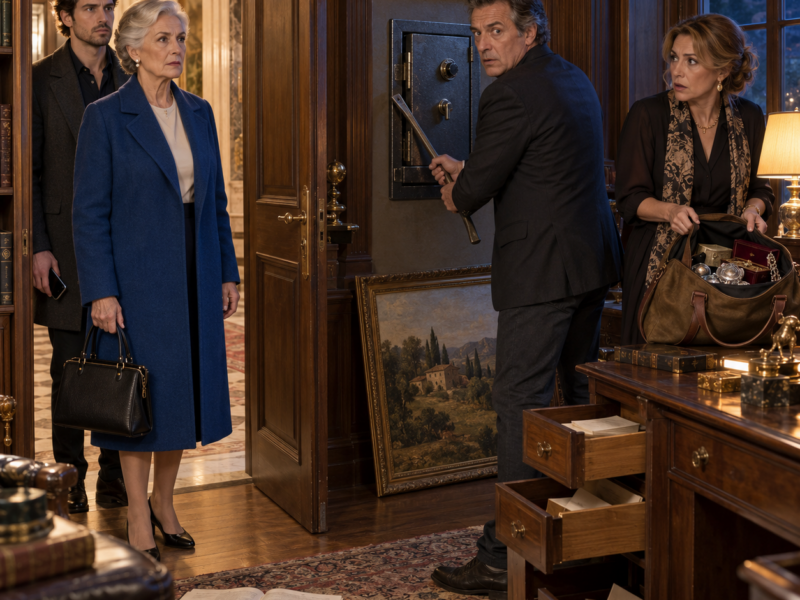
My parents told my seventy-eight-year-old grandmother they were taking her out to lunch. Three hours later, a nursing home called me. They had left her with a suitcase and her medication, promising to be right back. They never returned. When I picked her up, Grandma stopped me from calling my father. “Take me to my attorney first,” she said, pulling a folded bank statement from her purse. Three transfers were circled in red.
The call came at 1:42 on a Wednesday afternoon.
I was standing in the kitchen of my apartment in Milan, looking at a cup of coffee that had gone cold while I answered work emails, when an unfamiliar number from Emilia-Romagna appeared on my phone.
“Am I speaking with Ivano Serra?”
“Yes.”
“My name is Marisa Conti. I am calling from Residenza Il Glicine. Your grandmother, Eleonora Serra, listed you as her emergency contact.”
My stomach tightened.
“Is she all right?”
“Physically, yes. But there is a problem with her admission.”
“What problem?”
Marisa paused. I could hear voices and the soft roll of a cart in the background.
“A man and a woman brought her here approximately three hours ago. They identified themselves as her son and daughter-in-law.”
My parents.
Arturo and Wanda Serra.
“They told our receptionist they would return immediately from the car with additional documents,” Marisa continued. “They have not returned.”
For several seconds, I could not speak.
“Your grandmother’s suitcase is here. There is also a grocery bag filled with medication. We have no signed admission contract, no medical file authorizing residential placement, and no payment arrangement. Your grandmother is very upset, although she is trying not to show it.”
That last detail frightened me more than if Marisa had said she was crying.
Eleonora was not a woman who displayed agitation. She never shouted. When she became truly angry, she grew still, formal, and exact. Her silence made everyone around her check their own behavior.
“May I speak with her?” I asked.
“I offered her the phone. She asked me to call you instead.”
Something changed inside me then.
My grandmother adored my father. Arturo was her only son. After my grandfather Carlo died, she trusted him with utility bills, insurance renewals, and tax forms. Following knee surgery, she signed a power of attorney that he called temporary. The document gave him broad authority over banking and administrative matters while she recovered.
Temporary slowly became permanent.
I called my father. Voicemail.
I called my mother. Voicemail.
I sent the same message to both.
Where are you?
Neither answered.
Five minutes later, I was in my car. Nearly three hundred kilometers separated Milan from Residenza Il Glicine, and afternoon traffic was already building.
For the first hour, I invented explanations.
Maybe my father had returned home for documents. Maybe my mother’s phone had died. Maybe there had been an accident or a medical emergency. Families become skilled at manufacturing reasonable explanations for people they love.
My father had been “under pressure” when he forgot Grandmother’s cardiology appointment. My mother was “tired” when she suggested that bringing Eleonora to Christmas lunch would be too difficult. Arturo was only “helping with paperwork” when he began opening all her mail.
Helping with mail became paying bills. Paying bills became controlling accounts. Controlling accounts became telling Eleonora which transactions she no longer needed to understand.
I had watched every step.
I had not given it the right name.
The highway unrolled beneath a pale sky while I called Marisa twice for updates. Grandmother remained physically stable. Staff had offered lunch, water, and a private room to rest, but she refused to move beyond the lobby until somebody explained what authority had brought her there.
That sounded exactly like her.
Shortly after five, I reached the care home. Residenza Il Glicine occupied a renovated villa outside a small town, with pale yellow walls, green shutters, and a garden that probably looked beautiful in spring. The lobby smelled of floor polish, soup, and lavender air freshener.
Eleonora sat beside a brown suitcase. She still wore her good blue coat, the one reserved for Sunday Mass, medical appointments, and lunches where she expected proper tablecloths. Her gray hair was pinned neatly at the back of her head. Her lipstick remained perfect. A shopping bag filled with medicine rested beside her shoes, and she gripped her handbag with both hands.
She looked less like an abandoned elderly woman than a traveler waiting for a train she had no intention of boarding.
“Nonna.”
She raised her eyes.
“Did they hurt you?”
“No.”
“What happened?”
“Help me stand.”
Marisa brought a voluntary departure form because no admission had been completed. Eleonora read it line by line. She corrected the spelling of her street name, asked why a witness signature was required, and signed only after receiving an answer.
Outside, I opened the passenger door and placed her suitcase in the trunk.
“I am calling Dad,” I said.
She covered my phone with one gloved hand.
“No.”
“Nonna, they left you there.”
“Ivano, drive.”
“Where?”
“To the notary who prepared the power of attorney.”
Once we were moving, she opened her handbag and handed me a bank statement folded into quarters. Three transactions had been circled in red pen.
Twelve thousand euros.
Eighteen thousand euros.
Twenty-five thousand euros.
“Fifty-five thousand euros?” I said.
“Yes.”
“Where did it go?”
“That is one of the questions your father refused to answer.”
That morning, Wanda had arrived at Eleonora’s house and announced they were taking her to lunch. My father drove. After the meal, they said they wanted to show her a residence with a beautiful garden where she could spend a few weeks recovering her strength.
The suitcase was already in the car.
So were her medications.
“You did not pack them?” I asked.
“No.”
I tightened both hands on the steering wheel.
The notary, Lorenzo Bassi, stayed after office hours when Eleonora explained the situation. He confirmed her identity, reviewed the original power of attorney, and asked questions to ensure she understood the consequences of revocation. He did not assume incapacity because she was seventy-eight. He did not assume competence merely because she spoke confidently. He followed a process.
Eleonora answered every question.
She revoked Arturo’s authority in writing.
Then we went to the bank, where a branch director and compliance officer reviewed the revocation and placed additional protections on her accounts. They could not magically reverse every completed transfer. They could stop transactions that had not settled, disable Arturo’s online access, change contact details, and begin tracing the funds.
Another transfer was pending.
Nineteen thousand five hundred euros.
The bank stopped it before completion.
I believed the worst had passed.
I was wrong.
When we reached Eleonora’s home, my father’s car was parked crookedly on the lawn. The front door stood open.
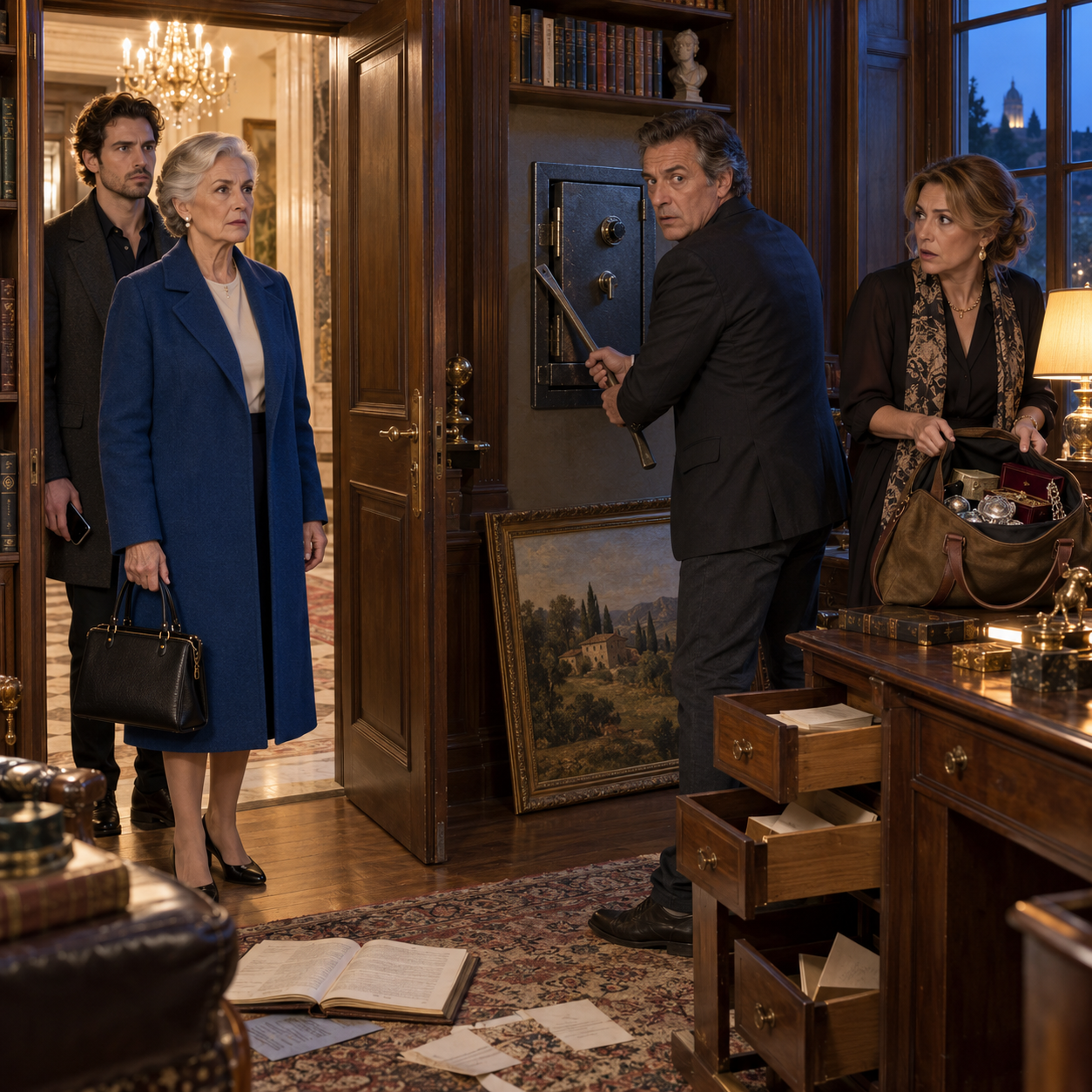
Inside, drawers had been pulled out, cushions lay on the floor, and Grandfather Carlo’s old filing cabinet had been opened. Papers covered the living-room rug.
Then a metallic sound came from the study.
Clang.
A pause.
Clang.
“Arturo, hurry,” my mother whispered.
Eleonora raised one hand, warning me to remain quiet.
We approached the partly open door.
Wanda held a canvas bag filled with silver pieces, jewelry boxes, and envelopes. My father stood before the wall where Carlo’s painted landscape usually hung. The picture had been placed on the floor.
Behind it was a safe I had never seen.
Arturo had wedged a crowbar between the safe and the wall.
Eleonora entered before I could stop her.
The crowbar struck the parquet floor.
My mother froze with a velvet jewelry box in her hand. My father’s face turned pale.
“Mamma?”
Then he made the mistake I remember more clearly than anything else.
“What are you doing here?”
Not are you safe.
Not how did you get home.
What are you doing here?
Eleonora removed her gloves slowly and placed them on the desk.
“Are you searching for something, Arturo?”
He looked at me, then at her. “We were securing valuables. After what happened today, we could not leave the house unattended.”
“What happened today?” she asked.
Wanda stepped forward. “Eleonora, do not make a scene. You are tired. You need rest.”
Her tone brought back a Christmas dinner several years earlier. Eleonora had asked why two antique silver plates were missing from the cabinet. Wanda smiled and said perhaps she had forgotten where she put them.
We laughed.
I laughed too.
The memory burned.
Eleonora looked toward the safe.
“If you are searching for what Carlo left there before he died, you are already too late.”
My father stopped breathing for a second.
“What does that mean?”
“I moved it two months ago.”
Silence filled the study.
Arturo stepped closer. “Moved it where?”
Eleonora tilted her head. “Strange. A moment ago, you said you were only securing household objects.”
Wanda placed the jewelry box on the desk as if it had become hot.
I took out my phone.
My father pointed at it. “Put that away. This is a family matter.”
“Was leaving your mother at a care home without signing admission papers also a family matter?”
His expression changed.
“You know nothing.”
“I know about fifty-five thousand euros.”
Wanda closed her eyes.
That was the first visible break.
Arturo tried to smile. “The money was used for her.”
“For what?”
“Expenses. Care. The house. Medication.”
Eleonora spoke without raising her voice. “Did you pay for a caregiver I never employed? Did you buy medicine that I receive through the health system? Did you repair a roof that has not been repaired? Tell me which one of my expenses required a single transfer of twenty-five thousand euros.”
My father opened his mouth and closed it again.
A car arrived outside.
Wanda turned sharply toward the window. “Who is that?”
Eleonora adjusted the cuff of her coat. “Someone I called from the bank.”
Paola Bernardi entered carrying a thin file. She was an attorney and old family friend who had handled Carlo’s estate. During the drive from the bank, Eleonora called her while I concentrated on traffic.
“Mr. Serra,” Paola said to my father, “before anyone moves another item, I suggest everyone stop.”
Arturo exhaled loudly. “There is no need for lawyers.”
“Perhaps not. There is certainly a need to document the condition of this house.”
Paola asked me to photograph each room exactly as we found it. Open drawers. The canvas bag. Silver. Jewelry. Envelopes. The painting on the floor. Fresh damage around the safe. The crowbar.
Wanda watched me, growing paler.
“Ivano, stop.”
I continued.
My father finally lost his temper.
“Mamma, I will say this clearly. You are no longer capable of managing these things.”
Eleonora turned toward him.
“Why?”
“Because you forget.”
“What do I forget?”
“At Easter, you could not remember the name of Wanda’s cousin.”
“I saw him twice in twenty years.”
“You paid the electricity bill twice.”
“Because the website froze. You were sitting beside me.”
Paola said nothing, but I saw the way she studied Arturo. He was not describing a woman who lacked capacity. He was assembling a story that would justify actions he had already taken.
That evening, Eleonora did not remain alone. Paola called the carabinieri so the unauthorized entry and the collected property could be documented. There were no handcuffs or dramatic arrests. Officers recorded names, times, statements, photographs, and the visible condition of the rooms.
The lack of spectacle made the facts feel heavier.
With every answer, my father’s version weakened.
He claimed Eleonora gave permission to enter.
She said she did not.
He claimed the canvas bag contained his belongings.
He could not identify one item he had purchased.
He claimed the safe had already been damaged.
Fresh wood and plaster dust remained on the floor, and the crowbar carried white residue.
Paola asked a simple question.
“Signora Eleonora, what was inside the safe?”
My grandmother looked at my father.
“Documents.”
Arturo laughed nervously. “Only documents?”
“The ones that matter.”
After my parents left, Eleonora asked us to sit at the kitchen table. From the linen drawer, she removed a transparent plastic envelope containing a bank key and receipt.
She had not moved cash or jewelry.
She had moved the papers Carlo told her to protect.
Old property deeds. Certificates of deposit. Letters from an accountant. Most important, a copy of a private agreement signed years earlier by my father.
Carlo had lent Arturo a substantial amount to save his small company. The debt was never fully repaid. The agreement stated that any outstanding balance would be considered in the eventual estate settlement.
I finally understood why my father wanted the safe.
He was not merely searching for valuables.
He wanted a document proving he had already received far more than he admitted to the family.
“Why did you never tell me?” I asked.
Eleonora remained silent for several seconds.
“Because he is my son.”
It was the saddest sentence she spoke that week.
The following day, the bank provided transaction details to Paola under Eleonora’s authorization. Two transfers went to an account owned by a property company connected to my father’s business associate. The third covered an overdue loan payment for Arturo’s company.
The stopped transfer of 19,500 euros was destined for another creditor.
Eleonora read the report twice.
“While I sat in that residence, he was trying to move more money?”
Paola nodded.
My grandmother removed her glasses and placed them on the table.
She did not cry.
Watching her remain still was worse.
Over the following days, Arturo changed his explanation four times.
First, the transfers were reimbursements.
Then advances.
Then loans.
Finally, he claimed Eleonora gave verbal permission.
Wanda sent me messages.
You do not understand the pressure we are under.
We only wanted to protect her.
The residence was temporary.
You are destroying the family.
I did not reply.
Facts replied for me.
Marisa provided a written statement. She remembered Arturo describing Eleonora as confused and no longer independent. She also remembered asking for medical documentation. Arturo said it was in the car and never returned.
Another employee added a detail we did not know.
Before leaving, Wanda removed Eleonora’s phone from her handbag, saying it made her agitated.
Police found the phone two days later in my father’s car.
That changed how everyone understood the case.
This was no longer merely a family argument about money. Evidence suggested an organized attempt to isolate an older woman, portray her as incapable, and control her life while she remained in a residence she had not chosen.
Paola recommended an independent geriatric assessment. Not because she doubted Eleonora, but because she anticipated Arturo’s next move.
Three days later, my father formally alleged that his mother could no longer manage her interests.
The assessment dismantled that claim.
Eleonora remembered dates, medications, amounts, appointments, and physician names. She explained the duplicate electricity payment and produced emails from the utility confirming its website failure.
The doctor asked her to name Italy’s president.
She answered, then added, “If you wish, I can also name the person who took twenty-five thousand euros from me last month.”
The doctor lowered his eyes to hide a smile.
It was the first time I saw Eleonora become fully herself again.
She did not want revenge.
That frustrated me more than I admitted.
I wanted to call every relative. I wanted to expose every transaction and repeat the care-home story until nobody could hear Arturo describe himself as the son who handled everything.
Eleonora refused.
“I am not interested in humiliating him,” she said. “I am interested in making sure he cannot do it again.”
She proceeded in the only way she trusted: slowly, methodically, and with documentation.
She revoked every delegation. Changed the locks. Inventoried jewelry and silver. Updated estate instructions with the notary. Added bank alerts to her phone and mine. Delivered copies of the safe-deposit records to Paola.
Then she summoned my father.
Not to her house.
To Paola’s office.
Arturo arrived with Wanda and his own attorney. He looked ten years older.
The first half hour consisted of familiar statements.
“I did everything for her.”
“I kept nothing.”
“I was stopping her from wasting money.”
“It was for her safety.”
Paola placed copies of the transfers on the table.
My father’s attorney stopped taking notes.
Then she produced Carlo’s agreement.
Arturo turned red.
“That document is worthless.”
“Perhaps,” Paola said. “But it explains why you were breaking into the safe.”
“I was not looking for that.”
“What were you looking for?”
Silence.
The room changed.
Until then, Arturo spoke as the most competent person in the family, the man who understood reality and made decisions for everyone. Suddenly he was the person required to answer.
Wanda touched his arm.
“Tell them.”
He looked at her as if she had betrayed him.
“Tell the truth,” she repeated.
That broke the structure holding the deception together.
My father’s small company was failing again. He had accumulated debt, personally guaranteed loans, and lost money on a property investment that was supposed to fix everything. He began by using Eleonora’s power of attorney for small transfers.
Then larger ones.
When she asked questions, he feared she would revoke access.
His solution was to place her in a care residence for a few weeks, establish that she was confused, and buy time.
“I was not going to leave her there forever,” he said.
Eleonora looked at him for a long time.
“How long must a mother sit alone before she understands she has been abandoned?”
Nobody answered.
Arturo lowered his eyes.
Wanda cried.
Eleonora did not.
The meeting did not produce an instant ending. Lawyers negotiated immediate recovery, asset sales, accounting, and Arturo’s permanent surrender of access to Eleonora’s accounts. Authorities and counsel handled the conduct already completed. The bank investigated its own controls and reporting duties.
I stopped requesting daily updates.
Not because I stopped caring.
Because the most important change had already occurred.
My father lost the protection he had relied upon for years: his mother’s silence.
That silence had protected more than the transfers. It had protected a whole family arrangement in which Arturo was permitted to be reckless because someone else always absorbed the cost. When his first shop failed, Carlo had refinanced part of the house. When Arturo fell behind on taxes, Eleonora had called it a temporary problem. When he borrowed money and missed the date he had promised to repay it, everyone agreed not to mention the debt at Christmas.
I had participated in that arrangement too.
I had not taken her money, but I had accepted convenient versions of my father. Whenever Eleonora hinted that he was pressing her about finances, I told myself that parents and adult children often argued about money. Whenever Arturo complained that his mother was stubborn, I assumed the truth sat somewhere safely between them. Neutrality had allowed me to feel fair without requiring me to look closely.
There was nothing neutral about what had happened at Il Glicine.
In the weeks after the meeting, Paola created a timetable that made the situation less overwhelming. Every Friday afternoon, she sent Eleonora a one-page summary. It listed money recovered, property traced, deadlines met, and decisions still requiring her approval. The language was plain. If a term could not be understood on the first reading, Paola rewrote it.
My grandmother insisted on receiving the summaries directly.
“Not through you,” she told me. “You can have a copy, but I am not becoming a package passed from your father to you.”
I understood.
We went to the bank together, but I sat away from the desk while she spoke with the branch manager. A new account was opened for household expenses. Her savings remained in accounts that required extra verification for unusual transfers. The bank placed alerts on changes to contact details, new beneficiaries, withdrawals over an amount Eleonora chose, and requests made under any future authorization.
She did not give me power of attorney.
Instead, she named Paola as the professional contact for financial emergencies and gave me limited authority concerning medical decisions only if two physicians found that she could not decide for herself. Even that authority was shared with an independent person she trusted.
“Does that offend you?” she asked after signing.
“No.”
“Good. Love should survive a safeguard.”
It was one of the clearest things anyone had said during the entire crisis.
Families often treat safeguards as accusations. We imagine that asking for statements, separate advice, or written limits means we distrust one another. Yet honest people are not harmed by clear boundaries. The people most threatened by accountability are usually the ones benefiting from its absence.
Eleonora had learned that lesson at seventy-eight. I was learning it in middle age.
The first €12,000 was recovered from an account belonging to the property company. It had not yet been spent, and the company’s other director agreed to return it after receiving formal notice of the dispute. The second transfer was more difficult. Part of it had gone toward a deposit that could not be released immediately. Paola negotiated a secured repayment agreement rather than gamble on a long civil fight that might consume much of the money in fees.
The €25,000 used against the company loan became part of Arturo’s personal debt to his mother. His business sold a delivery van and a small parcel of equipment. He also surrendered a life insurance policy with a cash value. The proceeds did not make Eleonora whole at once, but they established something Arturo had avoided for years: a debt recorded in writing, with dates, security, and consequences.
The attempted €19,500 transfer never left the account.
That mattered not only because of the amount. It proved the movement of money was still active on the day Arturo left his mother at the residence. He could no longer claim the three completed transfers were old misunderstandings that had nothing to do with his decision to remove her from the house.
The bank’s internal review did not produce the dramatic confession people expect in stories about financial misconduct. Institutions rarely speak in emotional language. It produced transaction logs, recorded verification calls, notes attached to the authority on file, and an acknowledgment that warning signs should have prompted additional review.
One note was especially painful.
During the €25,000 transfer, an employee had asked Arturo whether the funds were for Eleonora’s benefit. He had answered that the money would be invested in a project providing her with steady income. No such agreement existed. No income had ever been paid to her.
When Paola read that sentence aloud, Eleonora removed her glasses and cleaned them slowly.
“He always did like to make a loan sound like a favor,” she said.
The bank agreed to reimburse certain fees, strengthen the account restrictions, and cooperate with the authorities. The larger question of liability remained with the lawyers. Eleonora chose not to build her life around waiting for an institution to admit every failure.
“They can investigate,” she said. “I have groceries to buy.”
Her insistence on ordinary life surprised me. I had assumed that after such a betrayal she would want me beside her constantly. For the first week, I slept in the guest room. On the eighth morning, she placed coffee in front of me and said I should go home.
“Are you asking me to leave?”
“I am telling you that you have a flat in Milan, a job, and shirts that cannot all remain in that little suitcase.”
“I can work from here.”
“And I can live from here.”
She let the words settle.
“Come on Wednesday. Call in the evening. If I need more, I will ask.”
I wanted to argue. The frightened part of me saw danger in every closed door and unanswered call. But protecting someone can become another way of taking control if we never listen to what that person actually wants.
So I returned to Milan.
We established a routine that respected both safety and independence. A neighbor named Giulia kept a spare key in a sealed envelope. Eleonora wore a small emergency button when she worked in the garden. A home-care nurse visited once a month to review medication, not because Eleonora was incapable, but because the new system meant nobody could quietly remove pills or change instructions again. The pharmacy delivered repeat prescriptions and called her directly about substitutions.
On Wednesday evenings, I took the train and brought dinner. Sometimes we discussed Paola’s summary. Sometimes Eleonora refused to let the case enter the kitchen.
“There are only so many meals I will give your father,” she said. “He is not eating this one too.”
Then she would ask about my work, complain about the price of olive oil, or tell me that a television presenter had become unbearably vain.
The house slowly stopped looking like a crime scene.
For several days, numbered evidence seals remained on drawers and cabinet doors. The mark on the wall where Carlo’s landscape had hung seemed brighter than the surrounding paint. The damaged safe gaped behind it, its metal edge bent where Arturo had forced the tool beneath the door.
A locksmith offered to install a newer, stronger model.
Eleonora declined.
“Repair the wall,” she said. “I do not want another hole.”
The important documents remained in the safe-deposit box. Copies went to Paola. A complete inventory of jewelry, silver, and household items was photographed and signed. The canvas bag Arturo and Wanda had filled was returned after the carabinieri finished documenting it. Eleonora examined every object at the dining table.
There were Carlo’s cuff links, two silver serving spoons, her mother’s bracelet, several commemorative coins, and envelopes containing household cash. Wanda had also packed Eleonora’s marriage certificate and the deed to a small piece of land outside Parma.
That deed destroyed another of their explanations.
Arturo had claimed they were only gathering valuables for safekeeping while Eleonora adjusted to residential care. But the land was not a portable valuable vulnerable to theft. The original deed was useful only to someone planning a sale, a loan, or a transfer.
Paola asked Eleonora whether she wished to pursue every possible claim concerning the break-in.
“I want an accurate record,” she replied. “I want the money returned. I want them unable to do this again. I do not need revenge dressed as justice.”
That distinction guided every decision afterward.
The authorities continued their work. Statements were taken. Documents were compared. No one promised a swift prosecution, and Paola refused to predict outcomes. She reminded us that family cases are often complicated by overlapping permissions, informal loans, disputed intent, and years of conduct that was never properly recorded.
But some facts were simple.
Eleonora had not consented to being left at Il Glicine.
She had not authorized the transfers for Arturo’s business.
She had not given anyone permission to enter her home, remove her belongings, or force her safe.
She was competent.
And once those facts were placed side by side, the family story my parents had relied upon became much harder to maintain.
Wanda tried anyway.
She called relatives before Paola’s letter asking them not to contact Eleonora about money. She said my grandmother was fragile and that stress could harm her. She described Arturo as a devoted son facing a temporary business problem. She called me vindictive and accused Paola of turning a private misunderstanding into a public scandal.
Two cousins telephoned me to say family matters should remain inside the family.
“It did remain inside the family,” I told the first. “That is how it continued.”
The second cousin said Arturo had always helped his mother.
“Then he can document the help,” I replied. “We have documented what he took.”
I learned not to debate people committed to comforting explanations. I sent them the same short response: Eleonora was safe, independently assessed, represented by her own lawyer, and making her own decisions. Anyone who wished to speak with her could call her directly, provided they did not pressure her about the case.
Some called.
Most did not.
Their silence hurt her, though she pretended otherwise. One afternoon I found her standing beside the telephone, looking at a list of numbers she had written years earlier.
“They are afraid of choosing sides,” she said.
“There should not be sides.”
“There are always sides when the truth costs someone an invitation to lunch.”
She folded the list and put it in a drawer.
Marisa Conti called a week after the incident. She wanted to know how Eleonora was doing and to apologize again for allowing Arturo to leave.
Eleonora invited her for coffee.
Marisa arrived on a Saturday carrying pastries and a folder. She had written a full incident report and asked the residence to revise its intake procedure. From then on, no prospective resident would be left in a common area while admission documents remained incomplete. Staff would confirm the resident’s consent privately where possible, record who retained the person’s telephone and identification, and escalate any unexplained departure immediately.
“We should have done those things already,” Marisa said.
Eleonora looked at her over the rim of her cup.
“You called my grandson.”
“Too late.”
“But you called.”
Marisa’s eyes filled.
“I keep thinking about you sitting with that suitcase.”
“Then think about the next woman with a suitcase,” Eleonora said. “Make sure she is asked what she wants.”
It was not absolution. It was more useful than absolution.
Before Marisa left, Eleonora returned the folded grocery bag that had held her medication.
“You can throw this away for me,” she said.
Marisa accepted it with both hands.
Afterward, I asked why she had kept the bag.
“Evidence,” she said.
“It was empty.”
“Not to me.”
For weeks it had sat inside the hall cupboard, a common paper bag transformed into proof of how little preparation my parents had made for the life they claimed to be arranging. No medical file. No admission agreement. No payment plan. No favorite clothes, photographs, or proper luggage. Only medication thrown into a grocery bag, as if the problem could be deposited at a desk and forgotten.
Giving it away was the first time I understood that Eleonora’s recovery would not be measured only in euros.
It appeared in smaller acts.
She went back to the market alone.
She had the locks changed and chose the keys herself.
She replaced the telephone Arturo had taken, then learned how to use video calls. She disliked them because, she said, people spent the entire conversation staring at their own faces. Still, she practiced until she could answer without accidentally pointing the camera at the ceiling.
She reorganized the desk where Arturo had kept the financial papers. Each bill went into a labeled folder. Each payment appeared on a calendar. The red pen with which she had circled the three transfers remained beside the bank statements.
At first, I hated that pen.
It made the kitchen table look permanently accused.
Then one Wednesday I noticed she was using it to mark a recipe in the newspaper. The same pen that had identified the theft was now circling a pear cake she wanted to try.
Life had reclaimed an object from the evidence.
Arturo did not visit.
Under the temporary agreement, he communicated through counsel about money and through me only if Eleonora requested it. He sent three letters during the first month. The first explained. The second blamed. The third apologized.
Eleonora read all three.
In the first, he described the pressure of payroll, creditors, and personal guarantees. He wrote that he had always intended to replace the money. In the second, he said I had exaggerated the situation and turned mother against son. In the third, after Paola produced the banking records and Marisa’s statement, he said he had panicked.
Eleonora placed the letters in separate envelopes.
“Will you answer?” I asked.
“Not yet.”
“Do you believe the apology?”
“I believe he is sorry that the plan failed. I do not yet know whether he is sorry that the plan existed.”
That was the central question, and time answered it slowly.
Arturo complied with the first repayment deadlines. He provided business records after Paola threatened to seek them formally. He signed an acknowledgment of debt covering the disputed transfers and the older amount recorded in Carlo’s agreement. He surrendered every key and certified that he held no copies of Eleonora’s identification or account records.
Then, during the third month, he missed a payment.
His lawyer called it a cash-flow interruption. Paola called it a default and enforced the security exactly as the agreement allowed. A small investment property Arturo owned was listed for sale. He protested that the reaction was disproportionate.
Eleonora did not bend.
“Every exception becomes a new custom with him,” she said.
The property sold below what Arturo believed it was worth but above the minimum required by the agreement. The proceeds repaid most of the remaining recent transfers. Another portion was placed in reserve against the old family loan. For the first time, my father experienced a boundary that did not disappear when he complained about it.
He blamed Paola.
Then he blamed me.
Finally, in a conversation with Wanda that she later described to Eleonora, he admitted he had expected his mother to forgive the debt because she always had.
That admission was uglier than the polished excuses, but it was honest.
Wanda’s role was harder to understand.
She had not initiated the transfers. She had not held the power of attorney. Yet she had helped take Eleonora to the residence, removed her telephone, packed the canvas bag, and searched the house. Her defense was that Arturo told her everything was temporary and legal.
“Did he tell you to take my phone?” Eleonora asked when Wanda finally came to Paola’s office alone.
Wanda looked down.
“He said you would call Ivano and make the transition impossible.”
“That was the purpose of the phone.”
“I know.”
“Did you believe I wanted to live there?”
Wanda began to cry.
Eleonora waited.
“No,” Wanda said.
It was the first answer she gave without wrapping it in Arturo’s intentions.
She admitted that the plan had been discussed for eleven days. Arturo said the residence would keep Eleonora safe while he resolved the accounts. Wanda had objected at first, then allowed him to redefine every objection as nervousness. They would bring the correct documents later. They would tell Ivano when everything was settled. They would return the money before anyone noticed. Eleonora would calm down once she understood the advantages.
Each sentence moved responsibility into the future.
“When did you plan to give back my telephone?” Eleonora asked.
Wanda whispered, “I don’t know.”
“When did you plan to tell me where my money went?”
“I don’t know.”
“Then stop calling it temporary. Temporary has an ending.”
Wanda signed her own statement concerning the events at the residence and the house. She returned a set of photographs and documents she had taken earlier from Eleonora’s desk. She agreed not to enter the property without written invitation.
Eleonora did not forgive her that day.
She did something more measured. She said Wanda could write once a month if the letters contained no request, excuse, or message from Arturo. For half a year, the letters arrived. Some were clumsy. Some were self-pitying. Eleonora returned two unopened after Paola saw that they discussed the case.
The seventh letter contained only three paragraphs.
Wanda wrote that she had spent years making Arturo’s crises sound reasonable because admitting the truth would require her to change her life. She wrote that taking the phone had frightened her even while she was doing it. She wrote that she understood she had abandoned Eleonora before the car ever left Il Glicine because she had stopped treating her as a person entitled to say no.
Eleonora read that letter twice.
“Is that enough?” I asked.
“Enough for what?”
“To forgive her.”
“Forgiveness is not a door with one lock, Ivano.”
She placed the letter in the drawer with the others.
Months later, she allowed Wanda to visit for thirty minutes while Paola’s assistant was present. They drank coffee in the sitting room. No one raised a voice. Wanda apologized without asking Eleonora to reassure her.
When the visit ended, Eleonora did not offer a key.
That mattered.
In our family, reconciliation had always meant restoring access. An apology reopened the house, erased the debt, and returned everyone to the same dangerous positions. Eleonora chose another form. She could recognize regret without surrendering protection. She could speak with Wanda without pretending trust had returned.
Arturo took much longer.
He resisted the independent accounting until a court deadline made resistance expensive. The final review found no secret fortune and no elaborate international scheme. It found something more ordinary: a failing business, personal debts concealed from his wife, repeated borrowing, and the steady conversion of his mother’s assets into a private emergency fund.
Ordinary did not mean harmless.
Financial abuse often arrives without masks or forged passports. It may begin with a real authorization given to a trusted child for a legitimate purpose. The child pays bills, learns the balances, and becomes accustomed to acting without explanation. A small loan is taken and returned. A second is delayed. Eventually access feels like ownership, and the parent’s questions are treated as evidence of confusion rather than a right.
That was what Arturo had done.
The legal resolution reflected the evidence rather than our anger. The recovered assets and secured repayment addressed the money. Restrictions and court orders addressed future contact and access. The authorities determined how to proceed on the reported conduct. Some parts concluded with formal agreements; others remained in the system longer than any of us wanted.
There was no single morning when justice arrived with music behind it.
There were appointments, signatures, registered letters, corrected statements, and months of waiting.
For Eleonora, the most important judgment had already occurred at her own table. She had looked at the transactions, believed what she saw, and refused to let her son explain the evidence out of existence.
I returned to Il Glicine once to collect a copy of the visitor log. The entrance smelled the same: coffee, floor polish, and cooked vegetables. An older man sat by the window folding and unfolding a newspaper.
For a moment I saw my grandmother in the chair again, coat buttoned, suitcase beside her, watching the door each time it opened.
Marisa met me at reception.
“The new procedure is in place,” she said. “We used it last week. A daughter tried to leave her father before the financial forms were complete. He told us privately that he did not wish to stay. We stopped the admission.”
“What happened?”
“They went home together. Social services followed up.”
It was a small result. No headline would ever mention it. But another person had been asked the question Eleonora had not been asked soon enough.
What do you want?
I thanked Marisa and walked back to my car.
On the drive home, I thought about the call she had made to me. If she had decided the situation was none of her business, Arturo might have had several days to finish moving money, manufacture a story of incapacity, and remove documents from the house. One person’s willingness to make an uncomfortable call had changed the balance.
That did not erase the residence’s mistakes. It showed why accountability and gratitude can exist together.
Eleonora understood that better than I did.
She understood many things better after the crisis, though she rejected the idea that suffering had made her wise.
“Pain is not a school I enrolled in,” she told me. “Do not give it credit for my work.”
Her work was visible in the new life she assembled.
She met twice with a geriatric care planner, not because anyone intended to place her somewhere, but because she wanted choices documented before a crisis. The plan listed services she would accept at home, the conditions under which she would consider assisted living, the facilities she wished to visit, and the people who could participate in decisions.
We toured two residences together at her request.
At the first, the director spoke mostly to me. Eleonora ended the tour after twelve minutes.
At the second, the director asked Eleonora about her routine, food, privacy, and preferred way of receiving help. She stayed for lunch and asked to see the smallest available room as well as the largest.
“Are you thinking of moving?” I asked afterward.
“Not today.”
“Then why visit?”
“Because choosing before necessity is freedom.”
She added the second residence to her plan as an acceptable option if home became unsafe. The decision did not weaken her independence. It strengthened it. Arturo’s betrayal had not made residential care itself shameful. It had shown that care without consent is not care.
My own habits changed too.
I began visiting not only when documents required attention. I learned which tomatoes she preferred and where she stored the spare lightbulbs. I asked before opening drawers. If she said she could manage a task, I let her manage it, even when watching took longer than doing it myself.
Once, while she stood on a small step to reach a serving bowl, I moved toward her automatically.
“Ivano.”
I stopped.
“Ask.”
“Would you like help?”
“Yes, please.”
It seemed absurd that such a minor exchange could matter. Yet it contained everything my parents had ignored: the difference between offering help and taking authority.
I also examined my relationship with Arturo.
For years, I had sought his approval while pretending I no longer needed it. He praised decisiveness, business instinct, and loyalty. In practice, loyalty meant protecting his image and decisiveness meant agreeing before all the facts were known. When I challenged him, he accused me of being cold. When I remained silent, he called me sensible.
After the truth emerged, he sent messages alternating between rage and nostalgia. One included a photograph of us fishing when I was nine. Another said Carlo would be ashamed of me. A third asked whether I intended to destroy the company and put its employees out of work.
I answered only through the channels Paola approved.
The employees were not responsible for Arturo’s conduct, but neither was Eleonora responsible for saving their jobs with stolen savings. A restructuring adviser took control of the company’s finances. Payroll and legitimate creditors were separated from Arturo’s personal obligations. The business survived in a smaller form under outside oversight.
That outcome denied him one of his favorite arguments. He had claimed that exposing him would destroy everything. In fact, secrecy had brought the company closest to collapse. Accurate books, asset sales, and limits did what another hidden transfer could never have done.
About ten months after Il Glicine, Arturo asked to meet his mother.
The request came through Paola. He had made the required payments, completed the accounting, and begun counseling recommended by his lawyer. None of that entitled him to a visit. Paola made that clear.
Eleonora considered the request for three days.
She agreed to forty-five minutes in Paola’s conference room. I waited in another office because she did not want me between them.
When the door opened, Arturo looked older than he had the year before. His shoulders had narrowed. He carried no briefcase and wore no expensive watch. Eleonora walked behind him, steady and composed.
In the car, I did not ask what happened.
She told me anyway.
“He apologized.”
“For everything?”
“For specific things. That is a beginning.”
Arturo had admitted that he knew she did not want to stay at the residence. He admitted taking the phone was meant to prevent her from stopping him. He admitted he searched for Carlo’s agreement because he feared it would increase what he owed. He did not claim stress had made the decisions for him.
Then he asked whether she could ever consider him her son again.
“What did you say?” I asked.
Eleonora looked through the car window at the passing fields.
“I said biology was never in dispute. Trust was.”
She did not schedule another meeting.
Over the following year, he continued repayments and sent brief letters on holidays. Eleonora answered two. Their relationship did not return to what it had been, partly because what it had been depended upon her absorbing harm quietly. Something more limited and truthful took its place.
They eventually met for coffee in public. Arturo arrived on time and left when she asked. He did not discuss money. The event would have seemed painfully small to anyone expecting a grand reunion. To Eleonora, its smallness made it possible.
“He behaved like a guest,” she said afterward.
“Was that good?”
“It was accurate.”
Wanda separated from him for several months. I do not know whether the separation was caused by guilt, fear, or the discovery of debts he had hidden from her. Probably all three. She rented a modest apartment and found part-time administrative work. For the first time in decades, she opened an account in her own name and reviewed every statement.
Eleonora noticed the irony.
“Perhaps boundaries are contagious,” she said.
Wanda later returned to the marriage under conditions she did not share with us. Eleonora neither approved nor objected. She had stopped treating other adults’ choices as obligations she must finance or repair.
The settlement of Carlo’s old loan required another difficult decision. The agreement stated that unpaid amounts should be considered when Eleonora’s estate was divided. Arturo argued that the recent repayments and losses he had suffered should close the matter.
Eleonora refused to mix consequences with punishment.
Paola calculated the balance based on the written terms, payments that could be proved, and legally appropriate adjustments. Eleonora updated her will accordingly. Arturo was not disinherited in a burst of anger, nor was the debt magically forgiven. The estate plan accounted for what each person had already received and established gifts to two organizations Eleonora and Carlo had supported.
She told no one the exact shares.
“A will is not a menu for living relatives,” she said.
She also left written instructions about the house, personal possessions, medical care, and funeral. The silver serving spoons were promised to a cousin who had admired them as a child. Carlo’s cuff links were designated for me. The landscape painting would go to a local library meeting room if they wanted it.
“Why not keep it in the family?” I asked.
“The library is full of families.”
That answer sounded like her.
The new documents were signed with independent witnesses and stored in three places. Paola retained the originals. Eleonora kept a plain-language summary at home. I knew where to find instructions in an emergency but did not control them.
This time, planning did not mean someone else deciding her future.
It meant making her own decisions difficult to erase.
On the first anniversary of the afternoon at Il Glicine, I arrived expecting her to be sad. She was in the garden arguing with a rosebush.
“Do you know what day it is?” I asked.
“Wednesday.”
“I mean the date.”
She clipped a dead bloom.
“I know.”
“Do you want to do anything?”
“We are doing something. You are taking me to lunch.”
We drove to a small restaurant she and Carlo had liked outside town. The owner recognized her and brought tagliatelle with ragù, warm bread, and a carafe of water. A television murmured above the bar. Sunlight lay across the table.
There was no speech about survival.
Eleonora complained that the pasta was not as good as it had been under the previous owner. Then she finished every bite.
Over coffee, she asked whether I still carried Marisa’s number.
“Yes.”
“Good. Send her flowers tomorrow. Not today.”
“Why tomorrow?”
“Today belongs to me.”
On the drive back, she asked me to stop at the bank. She withdrew a modest amount of cash for household expenses and checked the balance herself. The clerk looked at me while explaining a new security feature.
Eleonora tapped the desk.
“Tell me,” she said. “He is only the driver.”
The clerk apologized and began again.
I smiled because the correction was gentle, immediate, and complete.
At home, Carlo’s landscape had returned to the wall. The damaged safe behind it was gone. The plaster had been repaired, and the painting hung a few centimeters lower to cover the faint difference in color.
We sat in the kitchen while the evening news played quietly in the next room. Eleonora placed the latest bank statement on the table. Every transaction was familiar to her. No red circles were needed.
“Do you miss him?” I asked.
She knew I meant Arturo.
“I miss the son I believed I had,” she said. “That is not the same as missing what he did.”
“Do you think you will ever trust him again?”
“Not with a key.”
She did not sound bitter. She sounded exact.
That was another lesson I had needed. Healing did not require her to become available to the people who hurt her. Peace did not require amnesia. A person could release the daily heat of anger and still remember which door needed a lock.
Two years after the incident, the final secured payment arrived. Paola called Eleonora first, as instructed. My grandmother waited until Wednesday to tell me in person.
“It is finished,” she said, sliding the statement across the table.
The recovered total did not erase legal costs, lost interest, or the distress of that afternoon. Money can be counted precisely, but violation cannot. Still, the funds were back under her control, the old loan had been accounted for, and no one could again use the original power of attorney.
“What will you do with it?” I asked.
“Some will stay where it is. Some will repair the roof next spring. And I am going to the sea.”
She booked a week in Liguria with Giulia, the neighbor who held the emergency key. She selected the hotel, paid from her own account, and mailed me the itinerary only after everything was confirmed.
“Do you want me to drive you?”
“No. We are taking the train.”
“Should I at least carry the luggage to the station?”
“You may carry it if you remember it remains my luggage.”
At the station, she had one blue suitcase, properly packed. No grocery bag. No one held her telephone but her.
I watched her and Giulia find their carriage. Before boarding, Eleonora turned and lifted one hand. She did not look fragile. She looked busy.
The image stayed with me because it replaced the one that had haunted me: the same woman waiting beside an abandoned suitcase for a son who had promised to return.
We often believe the opposite of abandonment is rescue. I no longer think that is true. Rescue can still place one person in control and another in debt. The opposite of abandonment is reliable respect: answering the call, telling the truth, asking what is wanted, and remaining present without taking ownership of someone else’s life.
Eleonora never asked me to become the son Arturo had failed to be. She asked me to be her grandson.
That role was smaller, clearer, and more demanding.
It meant driving when invited and leaving when asked. It meant reading a document without taking the pen from her hand. It meant accepting that she might make choices I would not make. It meant refusing secrecy even when openness embarrassed people I loved.
The family did not return to normal.
Normal had been the problem.
There was one final change that none of us expected. Eleonora began speaking to other older people about what had happened.
She did not use Arturo’s name, and she never presented herself as an expert. A community center near the parish had scheduled a talk about telephone scams and online fraud. Eleonora attended, listened to advice about suspicious links and strangers requesting bank codes, then raised her hand.
“What if the person asking for the money is not a stranger?” she asked.
The room became quiet.
The presenter gave a careful answer about undue pressure and trusted contacts, but several people approached Eleonora afterward. One woman said her daughter controlled her pension and became angry whenever she requested a statement. A widower admitted that his nephew kept his bank card because using the cash machine was supposedly too difficult for him. Another woman had signed papers she did not understand after her son told her the documents were merely for household bills.
Eleonora came home disturbed.
“They teach us to fear voices on the telephone,” she told me, “but not the voice that calls us Mama.”
With Paola’s guidance, the community center organized a second meeting. A bank representative explained account alerts and limited authorizations. A social worker described how to report concerns without immediately giving up control of one’s life. Paola explained why independent advice mattered before signing a power of attorney. Marisa spoke about consent in care admissions.
Eleonora sat in the front row and corrected anyone who spoke about older adults as though none were present.
“Say ‘you,’” she told the bank representative. “Not ‘they.’ We are sitting here.”
The representative changed her language.
After the meeting, the widower asked for help replacing his card and reviewing recent withdrawals. The woman whose daughter controlled her pension arranged a private appointment. We never learned the outcomes, nor were we entitled to them. What mattered was that questions had become possible.
Eleonora refused to let the center call the event a seminar on protecting the elderly.
“Protection is what Arturo said he was doing,” she explained. “Call it control of your own money.”
The flyer was changed.
I watched her become more comfortable telling the story in pieces. She described the warning signs without turning her life into entertainment: unexplained urgency, requests for secrecy, a relative who answers every question on someone else’s behalf, sudden claims that an independent person is confused, missing phones or documents, and financial decisions tied to threats about care.
She also warned people against a mistake I had nearly made after bringing her home.
“Do not replace one controlling person with a kinder controlling person,” she said. “Ask what help is wanted. Put limits in writing. Review them. A good helper will not be insulted.”
I sat at the back and felt the words land exactly where she intended.
The meetings gave meaning to the experience without pretending the experience had been necessary. Eleonora remained clear about that. When a local volunteer said perhaps everything happened for a reason, my grandmother’s expression sharpened.
“It happened because people made choices,” she replied. “The reason to discuss it is so other people can make better ones.”
That sentence ended the conversation.
Over time, my fear softened into attention. They are not the same thing. Fear made me call three times if Eleonora did not answer. Attention taught me to remember she went to the market on Friday mornings and might not hear the telephone in her bag. Fear wanted cameras in every room. Attention noticed when a bill arrived twice or when a medication label had changed. Fear imagined safety as the absence of risk. Attention understood that a life without chosen risk is another kind of institution.
Eleonora still made mistakes. She left a pot on the stove once and burned the sauce. She misplaced her glasses, complained about passwords, and nearly paid the same electricity invoice twice. None of those ordinary lapses proved she could not direct her affairs. Paola had warned us about using perfection as the standard for independence. Younger people forget appointments, lose keys, and misunderstand bills without being declared incapable.
We added practical supports without converting each error into a verdict. A timer sat beside the stove. Bills were paid from a dedicated account with a low balance. Passwords were stored in a secure system she could access. Every arrangement could be explained to her, changed by her, and ended by her.
That was the test.
At one of her medical reviews, a new physician directed questions to me. Before I could respond, Eleonora answered each one. The physician then asked whether I managed her medication.
“I manage it,” she said. “He worries about it.”
The physician smiled and wrote that down.
On the train afterward, she teased me for the rest of the journey.
“Profession: worrier,” she said. “Very demanding work in Milan.”
I accepted the joke because it was true.
The worry never disappeared completely. It became proportionate. I learned that vigilance could coexist with trust, just as forgiveness could coexist with a locked door. Our family had once treated these ideas as opposites because absolutes were convenient. Either Arturo was a loving son or a thief. Either Eleonora was independent or helpless. Either we reconciled completely or remained enemies forever.
Real life was less tidy.
Arturo had loved his mother and exploited her. Wanda had been frightened and complicit. I had cared and failed to pay attention. Eleonora was wounded, capable, angry, affectionate, cautious, and still willing to laugh. None of those truths canceled the others.
Accepting that complexity did not weaken accountability. It prevented us from using one good quality to excuse a damaging act.
When Arturo behaved respectfully, Eleonora acknowledged it. When he crossed a boundary, Paola responded. Progress was measured by repeated conduct, not declarations made under pressure. That standard felt almost severe at first. Eventually it felt merciful because everyone knew where the line stood.
The community meetings continued twice a year. Eleonora brought the bank statement with the three red circles, after removing all account numbers. She held it up and told the audience that the first proof had been sitting in her own purse.
“I knew something was wrong,” she said. “What I needed was not someone to tell me I was too old to handle it. I needed time, information, and one person willing to believe me.”
Afterward, she always folded the copy carefully and returned it to her bag.
She never let anyone keep it.
We built something different from the pieces that remained. Holiday meals became smaller. Some relatives drifted away. Others returned after they understood that no public performance of loyalty was required. Wanda visited occasionally. Arturo came only by agreement and never handled a bill, key, or document.
At one Christmas lunch, he asked Eleonora whether she needed help renewing her home insurance.
She answered, “Thank you, but it is handled.”
He nodded.
No argument followed.
To an outsider, the exchange would have seemed unimportant. I heard the years inside it. Arturo had offered. Eleonora had declined. Her answer had survived.
After dessert, she brought out the pear cake whose recipe she had circled with the red pen. It leaned slightly to one side and was better than any of us expected.
“Do not look so surprised,” she said.
For a few minutes, everyone laughed without pretending the past had vanished.
Later, while I washed plates, I saw Eleonora at the dining-room window. Her keys rested in her hand. They were attached to a bright blue ribbon she had bought so they would be easy to find in her bag.
Those keys had become a symbol in the family, though she disliked symbols. They opened the front door, the garden shed, and the small cabinet where she kept household records. Copies existed only where she had chosen to place them.
Arturo noticed them too.
He looked away.
Eleonora did not hide the keys to spare him discomfort.
She also did not display them to punish him.
She simply carried what belonged to her.
That night, before I left, she handed me a container of leftover cake.
“Call when you reach Milan,” she said.
“I will.”
“And do not drive too fast.”
“I won’t.”
At the door, I glanced toward Carlo’s landscape. For decades, the family’s most important papers had been hidden behind it. The wall was solid now. The safe was gone.
Eleonora followed my gaze.
“The important things should not have to live behind a painting,” she said.
She meant the documents, but not only the documents.
The truth about Arturo’s borrowing had been hidden. Wanda’s fear had been hidden. My habit of looking away had been hidden beneath the pleasant language of family privacy. Even Eleonora’s anger had been concealed because she believed a good mother should protect her adult son from the consequences of his choices.
Once exposed, those truths did not destroy the family. They destroyed the arrangement that required one woman to pay for everyone else’s comfort.
I kissed her cheek and stepped outside.
Through the window, I watched her return to the kitchen table. She picked up the bank statement, checked one figure, and placed it in the correct folder. Then she opened the drawer and put the red pen away.
The gesture was ordinary.
That was why it moved me.
My parents had tried to reduce her life to a suitcase, a bag of medicine, and a story about confusion. They expected her home, money, and voice to become available once she was placed somewhere other people could describe as safe.
Instead, Eleonora returned home and made safety answerable to her.
She did not win because I arrived like a hero. I arrived late, after Marisa made the call and after Eleonora had already circled the evidence herself. My useful act was not saving her. It was believing her quickly enough to help place her choices back in her own hands.
When I drove away, her porch light remained visible in the mirror.
For the first time since the call from Il Glicine, I did not see it as a light I was responsible for keeping on.
It was her light.
Her house.
Her money.
Her decision.
And, finally, her life under her own control.









