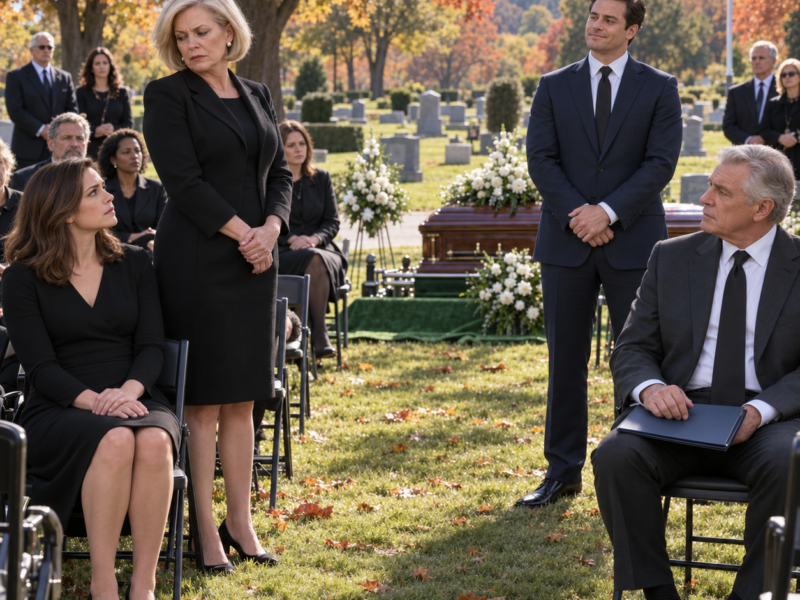
My mother waited until my father’s funeral to announce that I was losing the house he had spent his life building. My brother Liam had created a financial disaster, and apparently my future was going to pay for it. Mom stood beside Dad’s casket and said, “You have your own career. You can live anywhere. Liam needs help.” Nearly forty people heard her. Nobody defended me. Liam actually looked relieved, because this was how our family had always worked: he made the mistake, I made the sacrifice. Then our family attorney pushed back his chair and stood. “I’m afraid you’ve both misunderstood Mr. Finch’s final instructions.”
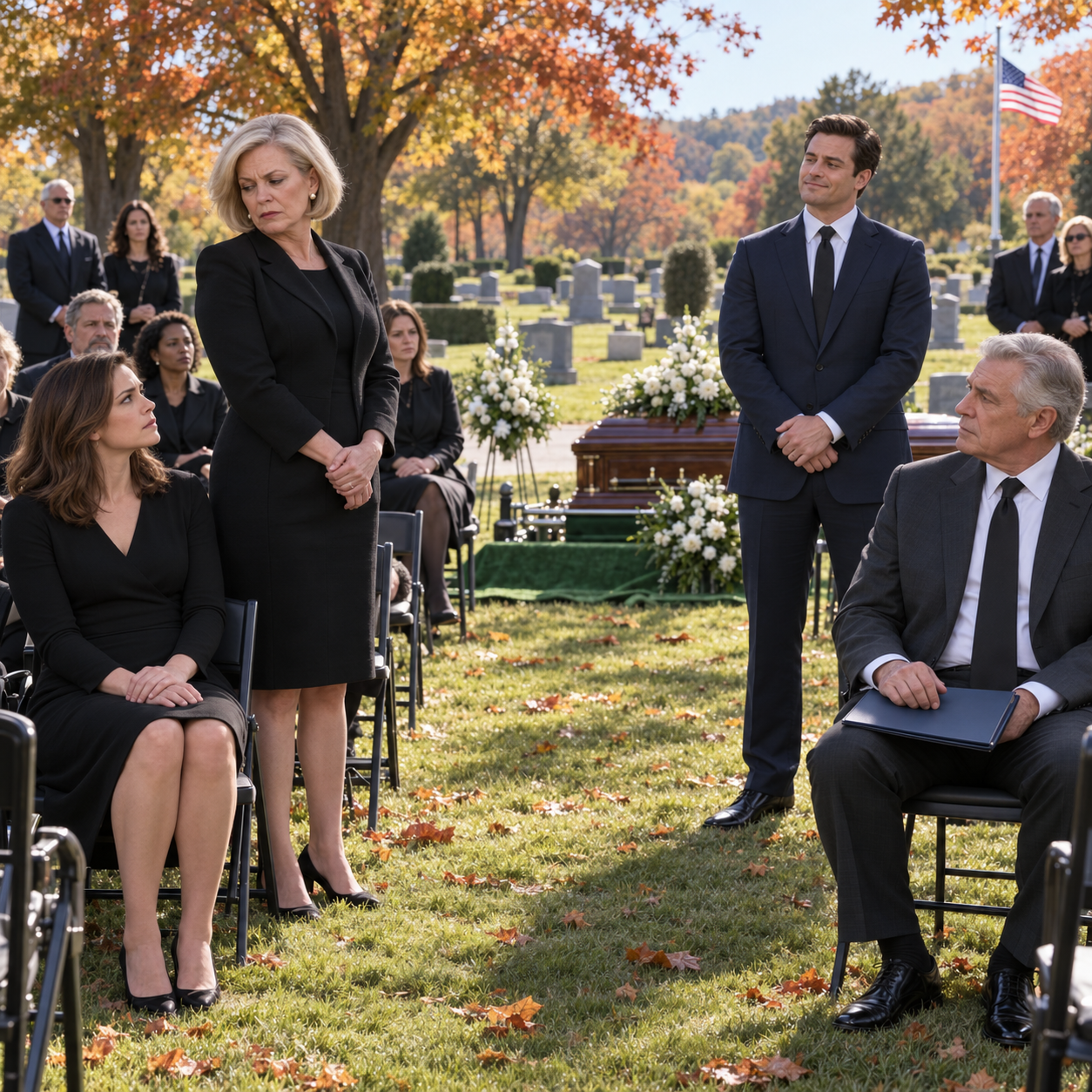
The morning of my father’s funeral should have been about saying goodbye.
Instead, it became the day my family tried to erase my future in front of forty people.
I was sitting in the third row of Kensington Memorial Chapel when my older brother, Liam Finch, stepped behind the lectern and adjusted the microphone.
He looked exactly the way grief was supposed to look in a family photograph.
Dark suit.
White shirt.
Muted tie.
Eyes slightly red.
One hand resting on the polished wood as if he needed the support.
If you did not know Liam, you would have thought he had spent the previous week sitting beside our father’s bed instead of making phone calls behind closed doors and telling creditors to wait until after the funeral.
“My father believed family was the most important thing a man could leave behind,” he began.
People nodded.
My mother, Penelope, sat in the front pew with her back perfectly straight.
Even at sixty-seven, she had a way of making black wool look ceremonial rather than ordinary. Her silver-blond hair had been professionally arranged that morning. A pearl pin rested at her collar. Beside her, my aunt Elaine held a folded tissue she had not used once.
Liam continued.
He talked about fishing trips.
Our father teaching him to change a tire.
The summer Liam broke his wrist.
The first job Dad helped him get.
The guests smiled at appropriate moments.
I listened.
Not because Liam’s stories were false.
That was the complicated part.
They were true.
Our father, Richard Finch, had loved his son.
He had loved me too, although for most of my life his love had been quieter than his fear of conflict.
Liam reached the end of the childhood stories.
Then his tone changed.
Not dramatically.
Just enough that I felt it before I understood it.
“As most of you know, Dad’s passing has left us with some difficult family obligations.”
My fingers tightened around the funeral program.
My mother did not move.
Liam continued.
“Dad was always practical. He understood that sometimes a family has to make sacrifices to protect the people who need help most.”
A small warning bell went off inside me.
No one else seemed to hear it.
“There are financial matters that have to be addressed quickly,” Liam said.
He looked toward my mother.
She gave him the faintest nod.
Then he said it.
“We’ve decided to sell the house on Willow Creek Drive.”
I stopped breathing.
Not because the idea was entirely new.
Because he had announced it.
At our father’s funeral.
In front of everyone.
As though it had already been decided.
Liam went on.
“The proceeds will help settle some urgent obligations and give Mom a more manageable situation going forward.”
Urgent obligations.
That was the family phrase for Liam’s gambling debt.
Three hundred forty thousand dollars, at least by the last number I had been able to verify.
Sports betting.
Casino credit.
Personal loans.
Credit cards.
A home-equity advance from an earlier property he had already lost.
Money borrowed from two friends.
One loan from our uncle Steven that nobody discussed at Thanksgiving anymore.
Three hundred forty thousand was only the debt we knew existed.
Liam looked toward me then.
For one second, his face was almost apologetic.
Then it hardened.
“Katherine has her career in Chicago and can make other arrangements.”
Katherine.
My full name.
He only used it when he wanted me to sound distant.
I lived in Chicago during the week, yes.
I also spent more than half my time at Willow Creek Drive during Dad’s final year because someone had needed to manage doctors, medications, insurance, home care, the furnace repair, food deliveries, and the thousand ordinary tasks that illness creates faster than anyone can finish them.
My old room was still there.
Or had been until Liam filled it with golf bags, designer luggage, boxes from luxury retailers, and three cases of wine he said he was “holding for a friend.”
The house had been my home since I was six.
Dad bought the land when I was five.
Built the house the following year with a contractor friend.
Four bedrooms.
Brick.
Wide front porch.
Oak staircase.
A backyard sloping toward a line of old maples.
Willow Creek Drive was not a mansion.
It was simply the one place in my life that had always existed.
And my brother had just told forty people I was being removed from it.
My mother rose from the first pew.
No hesitation.
No whisper to Liam.
This had been planned.
She turned.
Not toward the casket.
Toward me.
“Your father would understand.”
The room grew quieter.
I looked at her.
“Understand what?”
“Liam needs help.”
There was no shame in her voice.
Only certainty.
“You have your career. You can live anywhere.”
I stared.
Mom continued.
“You’ll need to move your things out before the property is listed.”
A woman two rows behind me inhaled sharply.
Someone else shifted.
Still nobody intervened.
I stood.
Not fully.
Just enough to lean toward the aisle.
“Mom.”
She lifted one hand.
“Please don’t do this here.”
I almost laughed.
She had just announced my eviction beside my father’s coffin.
But I was the one threatening to make a scene.
Liam stepped down from the lectern.
“Katherine, not today.”
“Then why did you announce it today?”
His jaw tightened.
“This is about Dad.”
“No.”
I looked at him.
“This is about your debt.”
A murmur moved through the chapel.
Mom’s face changed.
For the first time that morning, real emotion appeared.
Anger.
“You don’t need to humiliate your brother.”
I stared at her.
Then I understood something so clearly that I almost became calm.
Liam announcing the sale of my home at our father’s funeral was practical.
Me saying why was humiliation.
That was how our family had always worked.
Liam’s need was a fact.
My reaction was a problem.
Before I could answer, a chair scraped behind me.
Slowly.
Deliberately.
The sound carried through the chapel.
I turned.
Irving Scott was standing.
He had been our family attorney for twenty-seven years.
Seventy-three years old.
Tall.
Thin.
Silver hair combed straight back.
He had handled my parents’ wills, the sale of my father’s electrical contracting business, two property disputes, and Liam’s first divorce.
Irving rarely attended social gatherings.
Dad respected him because, according to Dad, Irving could make a sentence sound expensive.
He buttoned his jacket.
Then looked directly at my mother.
“Penelope.”
Mom’s face tightened.
“Irving, this is not the time.”
“I agree.”
His voice was soft.
That made the entire room listen harder.
“That is precisely why I’m concerned about what was just announced.”
Liam stepped forward.
“What does that mean?”
Irving looked at him.
“It means you have misunderstood your father’s final instructions.”
Everything stopped.
Even Mom.
Liam’s confidence vanished so quickly I saw the boy underneath.
“What instructions?”
Irving looked toward me.
Then back at the two of them.
“The property on Willow Creek Drive cannot be sold by either of you.”
Silence.
Mom laughed once.
Not because she found anything funny.
“I’m Richard’s wife.”
“Yes.”
“And that is my home.”
“You have a right of occupancy under the trust.”
Her expression changed.
“What trust?”
That was when I realized I knew no more than they did.
Irving took a breath.
“Richard transferred Willow Creek Drive into the Richard A. Finch Living Trust eleven months ago.”
Liam stared.
“No.”
“Yes.”
“That’s impossible.”
“It is recorded.”
Mom said:
“He would have told me.”
Irving looked at her.
“He did not.”
That sentence hurt her.
I saw it.
Then Irving turned toward me.
“Katherine is the successor trustee.”
My stomach dropped.
“What?”
He continued.
“And upon Richard’s death, subject to the occupancy provisions for Penelope, the residence passes to Katherine.”
The room felt too small.
Liam stared at me.
Then at Irving.
“That house is hers?”
Irving’s answer was immediate.
“Eventually, yes.”
My mother gripped the back of the pew.
“What do you mean eventually?”
“You have the right to reside there for up to eighteen months, provided you pay ordinary utilities and do not encumber, lease, or attempt to sell the property.”
She blinked.
“And after eighteen months?”
“The trust directs that the property be distributed to Katherine.”
Mom’s face went white.
Liam stepped closer.
“This is ridiculous.”
Irving did not move.
“Your father was quite specific.”
“Why would he do that?”
Irving paused.
“That is a conversation for another room.”
Liam laughed bitterly.
“No. You’re going to explain it now.”
“Liam.”
Mom’s voice sharpened.
He ignored her.
“This is Katherine.”
He pointed at me.
“She already has money.”
I almost smiled at the argument.
Not:
Dad wanted me to have it.
Not:
There must be a mistake.
Katherine already has money.
Therefore she required less.
My entire childhood in one sentence.
Irving looked at him.
“Your father’s estate plan was not based on which child could survive receiving less.”
Liam flinched.
Mom said:
“This must have been done when Richard was ill.”
I felt my stomach tighten.
There it was.
Capacity.
The first line of attack.
Irving’s face cooled.
“The trust was executed eleven months ago, before the stroke that ultimately contributed to his decline.”
“He was sick.”
“He was receiving treatment for hypertension and atrial fibrillation.”
“That affects judgment.”
“No physician said so.”
“He was under pressure.”
Irving looked at me.
Then at her.
“Not from Katherine.”
Mom’s head snapped toward me.
I had said nothing.
That did not matter.
I had already become the suspect.
The service resumed twenty minutes later.
Barely.
The pastor spoke.
People sang.
Dad’s casket was carried out.
Rain had begun.
At the cemetery, Mom did not look at me once.
Neither did Liam.
I stood under a black umbrella beside Aunt Elaine.
She whispered:
“Did you know?”
“No.”
“None of it?”
“No.”
She stared toward Mom.
“That’s going to be ugly.”
“Yes.”
Dad was lowered into the ground.
I watched dirt darken in the rain.
There is something obscene about beginning a property fight before the burial ends.
I wanted to be angry at all of them.
Instead, all I could think was:
Dad, what did you do?
My father had spent most of my childhood not doing enough.
That was the truth I carried.
Richard Finch was not cruel.
Cruel men are easier to understand.
Dad was kind in individual moments.
Weak in structural ones.
When Liam took my bike and damaged it, Dad bought me another rather than make Liam pay.
When Mom insisted Liam needed the larger bedroom because “boys need more space,” Dad helped move my furniture.
When I was admitted to Northwestern with partial scholarship, Mom asked why anyone should spend that much educating a daughter who would “eventually have a husband.”
Dad looked uncomfortable.
Then said nothing.
I found my own grants.
Worked.
Borrowed.
Paid.
When Liam wanted to attend a private college he was barely prepared for academically, my parents co-signed everything.
He dropped out sophomore year.
No one discussed it.
At twenty-four, I qualified as a CPA.
At twenty-eight, I moved into forensic accounting.
At thirty-three, I became a director at a financial investigations firm in Chicago.
Eventually, I made enough money that Mom’s old argument became retroactively convenient.
See?
Katherine never needed help.
Family memory is generous to people who denied you things that turned out not to destroy you.
The problem is survival gets interpreted as proof the denial was harmless.
It was not.
I survived.
Different statement.
Liam was always “the future.”
Mom said it so often it became weather.
“He’ll carry the Finch name.”
“He’ll take care of the family.”
“He’ll manage Dad’s business one day.”
He did none of those things.
Dad sold the electrical company when Liam was thirty because Liam could not keep a job there without fighting with supervisors.
The Finch name required no carrying.
Mom remained determined.
Liam married twice.
Divorced once.
Had no children.
Every financial disaster became temporary.
Bad timing.
Bad market.
Wrong partner.
Temporary cash problem.
Then gambling entered.
At first, nobody called it gambling.
Football pools.
Casino weekends.
Sports apps.
Then larger.
He borrowed from Mom.
Dad.
Friends.
Took an advance from a business partner.
Lost a rental property.
Then another.
By the time Dad’s health deteriorated, Liam’s life looked expensive from the outside and hollow underneath.
Designer luggage.
Golf clubs.
Watch.
Leased SUV.
No equity.
No savings.
Debt.
And still my mother called him the future.
I had stopped fighting that years ago.
I built my own future.
The irony was that I returned when Dad became ill.
His first stroke happened in April.
Minor.
At least according to the first neurologist.
Speech slurred briefly.
Weakness.
Then improvement.
Mom called me.
Not Liam.
“Katherine, can you come home?”
I did.
I was on a flight the next morning.
Willow Creek Drive had changed.
Dad moved slower.
Mom looked exhausted.
Liam’s belongings were everywhere because he had moved back “temporarily” after losing his condo.
My bedroom became storage.
I stood in the doorway looking at garment bags.
Golf clubs.
Wine.
Boxes.
Mom came behind me.
“You can use the guest room.”
“My room is the guest room.”
“Katherine.”
“No.”
She sighed.
“Liam’s going through a hard time.”
The family anthem.
I moved his belongings into the hallway.
He complained.
I did not care.
For the next six months, I split time between Chicago and Willow Creek Drive.
I arranged home-health visits.
Reviewed Medicare statements.
Managed Dad’s medication list.
Caught a duplicate charge from a therapy provider.
Reorganized insurance documents.
Set up fall-risk equipment.
Took Dad to cardiology appointments when Mom said she could not handle hospital parking.
Liam visited Dad’s bedroom for fifteen minutes at a time.
Then disappeared.
He knew how to perform concern in public.
He did not know how to sit with weakness privately.
One evening in October, Dad asked me to sit on the porch.
Cold.
He wore a blanket over his knees.
“You’re angry.”
It was not a question.
“At whom?”
“Me.”
I almost denied it.
Then:
“Sometimes.”
He nodded.
“For what?”
I looked at him.
“You really want the list?”
“Yes.”
So I gave him pieces.
College.
Bedroom.
Money.
Liam.
Mom.
Silence.
Dad listened.
No defense.
Then:
“I thought keeping peace was my job.”
I laughed bitterly.
“You kept peace for everyone except me.”
He closed his eyes.
“I know.”
That was the first time my father admitted it.
Not apologized.
Admitted.
It mattered more than I expected.
Then:
“I was proud of you.”
I looked away.
“You were proud quietly.”
“Yes.”
“That was convenient.”
“I know.”
He touched the blanket.
“Liam needed so much.”
“Yes.”
“You didn’t.”
That sentence nearly ruined the moment.
I turned.
“I needed parents.”
Dad’s face collapsed.
Not dramatic.
He looked older.
“You’re right.”
Silence.
Then:
“I’m sorry.”
That was all.
No speech.
No explanation.
I accepted nothing aloud.
But something shifted.
I did not know he had already seen Irving.
At the funeral luncheon, nobody spoke about the trust.
People ate sandwiches.
Coffee.
Pie.
Mom remained near a group of relatives.
Liam left early.
I saw him in the parking lot on his phone.
Angry.
Fast gestures.
I walked past.
He turned away.
That evening, back at Willow Creek Drive, I entered Dad’s office.
The room smelled like paper and aftershave.
His glasses were still beside the keyboard.
A yellow legal pad held three numbers in his handwriting.
One had a line through it.
I sat in his chair.
Cried for the first time since his death.
Not because of the house.
Because Dad had changed something at the end and I did not know whether it had been love, guilt, fear, or all three.
Irving called at seven.
“Can you come tomorrow?”
“Yes.”
“Alone.”
“Why?”
“Because your father left materials for you.”
I barely slept.
At ten the next morning, I sat in Irving Scott’s office.
Same dark furniture since the 1990s.
His assistant brought coffee.
I did not drink it.
Irving placed a thick envelope in front of me.
Then a binder.
“Katherine.”
“What exactly did Dad do?”
“He revised the estate plan in several stages.”
“When?”
“Beginning fourteen months ago.”
“Before the stroke.”
“Yes.”
“Why?”
Irving looked at me carefully.
“Because he learned about Liam’s gambling.”
My stomach tightened.
“How much did he know?”
“Enough.”
Irving opened the binder.
Bank statements.
Loan documents.
Text messages.
Notes.
My father had been documenting.
Not like me.
Messier.
Still.
He had discovered a $47,000 personal loan he guaranteed without understanding it would be used partly to cover Liam’s gambling losses.
Then another $22,000 transferred from their joint savings.
Mom knew about some.
Not all.
Dad eventually contacted Liam’s former business partner.
The real debt estimate was closer to $340,000.
My father panicked.
“Did Mom know?”
“By the end.”
“And she still wanted to sell the house.”
Irving nodded.
“Yes.”
I looked down.
“Dad?”
“He refused.”
“So Mom planned to do it after he died.”
“I believe she assumed she could.”
That explained the funeral announcement.
Speed.
Public narrative.
If everyone heard sale first, then the trust became obstruction.
I opened the envelope.
Dad’s handwriting.
Katherine.
I stopped.
Irving waited.
I read.
If you are reading this, then I failed to explain while I was alive.
That would be like him.
I continued.
I spent too much of your life calling silence peace. It was not peace. It was fear. Your mother was stronger in argument, Liam was louder in need, and you were capable enough that I kept telling myself you would be fine.
You were fine.
That does not make what I did right.
My eyes blurred.
I stopped.
Irving looked toward the window.
Gave me privacy without leaving.
I continued.
The house is not payment for being the good child. It is not punishment for Liam. It is the one place where I can still correct something practical.
Your mother has eighteen months because it has been her home too. I do not want her displaced while grieving. After that, Willow Creek belongs to you.
Do what you want with it.
Keep it.
Sell it.
Burn the curtains your mother chose.
But do not use it to rescue Liam.
The sentence was underlined.
Do not use it to rescue Liam.
Then:
If you help him, let it be with treatment, not debt.
If I had understood that sooner, maybe we would all be somewhere else.
I love your brother.
That is part of the problem.
I loved him in ways that removed consequences.
I loved you in ways that assumed you did not need protection.
Neither was fair.
I am sorry for both.
Dad.
I put the letter down.
For several minutes, I could not speak.
Then I asked:
“What else?”
Irving hesitated.
“There is a second provision.”
Of course.
“The trust contains a separate recovery account.”
“What is that?”
“Your father placed approximately $210,000 in liquid assets into a restricted trust reserve.”
“For Mom?”
“Partly.”
“He instructed that the reserve first cover Penelope’s basic housing transition and medical expenses during the eighteen-month occupancy period.”
“That sounds reasonable.”
“Yes.”
“And then?”
“Any remaining funds may not be distributed to Liam.”
I looked at him.
“Explicitly?”
“Yes.”
“Dad disinherited him?”
“Not entirely.”
Irving turned a page.
“Liam receives a $25,000 bequest, conditioned on completing a licensed gambling treatment program and providing no false information to the trustee.”
I stared.
“If he refuses treatment?”
“The bequest passes to a problem-gambling recovery charity.”
Despite everything, I almost smiled.
“That sounds like Dad trying to be funny.”
“It was not framed humorously.”
“No.”
But it was Dad.
Awkwardly practical.
“What about his debt?”
“Not an estate obligation.”
“Mom thinks it is.”
“Your mother may choose to use her own assets.”
“But not the house.”
“Correct.”
Then Irving looked at me.
“There is more you should know.”
I was beginning to hate that sentence.
“What?”
“Liam attempted to arrange a private sale before Richard died.”
My stomach tightened.
“What?”
“He contacted a real-estate broker.”
“When?”
“Six weeks ago.”
“Dad was alive.”
“Yes.”
“Did Dad sign anything?”
“No.”
“Mom?”
“Not a listing agreement.”
“Then how?”
“Liam represented that the property would be available immediately upon your father’s death.”
I stared.
Irving continued.
“The broker contacted me because he had handled an older transaction for your father and wanted confirmation.”
“That’s how Dad found out?”
“Partly.”
Dad had been dying while Liam prepared the house sale.
The grief inside me hardened.
“Who was the buyer?”
“An investment company.”
“For how much?”
Irving gave me the number.
Well below fair market value.
Fast close.
Cash.
Enough to wipe out a significant portion of Liam’s debt.
“Why so low?”
“Speed.”
Of course.
Distressed-family pricing.
I closed my eyes.
Then remembered something.
The phone call.
Give me until the end of the week. The house is as good as sold.
He had not been speaking metaphorically.
I told Irving.
His face tightened.
“Document that.”
“I already remember it.”
“Write it.”
Forensic accounting teaches a rule families hate:
Memory is not documentation.
I wrote date.
Approximate time.
Words.
Context.
Then Irving said:
“You should also know your role as successor trustee begins immediately.”
My stomach tightened.
“What does that require?”
“Preserve trust assets.”
“Which means?”
“House.”
“Reserve accounts.”
“Records.”
“Do not distribute anything casually.”
I laughed without humor.
“Excellent.”
“What?”
“Dad turned the daughter who spent her life managing crises into trustee.”
Irving almost smiled.
“He chose you because you understand fiduciary duty.”
“He also knew I’d do the work.”
“That may also be true.”
I appreciated the honesty.
That afternoon, Mom called.
“You saw Irving.”
“Yes.”
“What did he give you?”
“Dad’s letter.”
Silence.
“He wrote you?”
“Yes.”
“What did he say?”
“That is private.”
She became cold.
“We were married forty-one years.”
“Yes.”
“He should not have hidden things from me.”
The irony was almost too large.
“Mom.”
“No.”
Her voice shook.
“That house is mine.”
“It belongs to the trust.”
“I lived there.”
“You have eighteen months.”
“I do not need permission to live in my home.”
“No one said you do.”
“You did.”
I closed my eyes.
“Did you know Liam contacted a broker?”
Silence.
There.
“Mom.”
“He was exploring options.”
“Before Dad died.”
“We knew what was coming.”
My stomach turned.
“You were planning the sale while he was alive.”
“We were trying to solve a crisis.”
“Liam’s crisis.”
“He is our son.”
“So am I.”
“You have a life.”
There it was again.
A life as disqualification.
“You always land.”
Mom continued.
“You always figure things out.”
I laughed.
“Do you hear yourself?”
“What?”
“You’re saying my competence makes me the safe person to rob.”
“Do not use that word.”
“Then choose another.”
“We are not robbing you.”
“You announced selling a house Dad had already placed in trust for me.”
“We didn’t know.”
“You knew he opposed paying Liam’s debt with it.”
Silence.
Then:
“Your father became rigid at the end.”
I sat straight.
“Do not do that.”
“What?”
“Do not turn disagreement into incapacity.”
“I didn’t say incapacity.”
“You are about to.”
Mom went quiet.
I continued.
“If you challenge the trust, get independent counsel.”
She gasped.
“You are threatening me.”
“No.”
I had never sounded more like Irving.
“I am telling you how this works now.”
She hung up.
Liam appeared at Willow Creek Drive the next day.
I was sorting Dad’s paperwork.
He entered without knocking.
“You knew.”
“No.”
“Bull.”
“I didn’t.”
He threw a copy of the trust summary onto the desk.
“You expect me to believe Dad secretly gave you everything and you had no idea?”
“He did not give me everything.”
“The house.”
“Yes.”
“That is everything.”
“No.”
“For you maybe.”
He laughed bitterly.
“You already make what, two hundred grand?”
I ignored the number.
“You tried to sell it before he died.”
His face changed.
“Irving told you.”
“Yes.”
“It was exploratory.”
“You told someone it was as good as sold.”
“So you were spying.”
“I was standing in the hallway.”
He paced.
“I owe people.”
“I know.”
“You don’t know what that means.”
“Yes, I do.”
“No.”
He turned.
“You have never been underwater.”
He was right.
Not financially.
“I don’t sleep.”
He rubbed his face.
“I don’t answer unknown numbers.”
“I’ve got guys showing up at places I go.”
That worried me.
Not because I believed cinematic loan sharks were waiting outside.
Because pressure changes behavior.
“How much do you actually owe?”
He hesitated.
“Three-forty.”
“To whom?”
“Different.”
“Legal lenders?”
“Mostly.”
“Mostly.”
He looked away.
“Liam.”
“Don’t.”
“Dad left you treatment money.”
His face hardened.
“Of course.”
“Twenty-five thousand if you complete a licensed program.”
“Twenty-five?”
He laughed.
“My debt is three hundred forty.”
“It is not designed to pay debt.”
“That old man—”
I stood.
“Careful.”
Liam stared.
For one second, shame crossed his face.
Then anger returned.
“You know why he did this?”
“Yes.”
“Because you got into his head.”
“No.”
“You came home and started auditing everybody.”
“I managed his care.”
“You asked questions.”
“That is usually how facts appear.”
He kicked the leg of the desk.
Not hard.
Still.
“Mom says you can make the trust sell.”
“Mom is wrong.”
“You’re trustee.”
“Yes.”
“So sell.”
“No.”
“Why?”
“Dad prohibited using the house or reserve to satisfy your debts.”
“He’s dead.”
The sentence hung there.
Liam heard himself.
His face collapsed slightly.
I looked at him.
“That is exactly why trusts exist.”
He sat.
For the first time since the funeral, he looked tired rather than angry.
“What am I supposed to do?”
I wanted to say:
Grow up.
Pay it.
Suffer.
You did this.
Instead, Dad’s letter came back.
Treatment, not debt.
“Give me the full list.”
“What?”
“Every creditor.”
He stared.
“Why?”
“I will not pay them.”
His expression closed.
“Then forget it.”
“I can help you understand the structure.”
“I understand the structure.”
“No.”
I looked at him.
“You understand panic.”
Silence.
“If you want help, I’ll help you build a complete debt map.”
“Interest rates.”
“Secured.”
“Unsecured.”
“Legal exposure.”
“Collections.”
“Potential settlements.”
“Treatment.”
His eyes filled despite himself.
“You’d do that?”
“Yes.”
“Why?”
“Because you’re my brother.”
He stared.
“And you’re not paying?”
“No.”
His face hardened again.
Then:
“Never mind.”
He left.
That was the difference between help and rescue.
I was finally learning it.
Mom hired counsel.
Not Irving.
A woman named Denise Callahan.
Probate litigator.
Good reputation.
That was a relief.
If Mom was going to challenge, I wanted competent people.
Denise sent formal questions.
Capacity.
Trust execution.
Asset transfers.
Undue influence.
Whether I had participated.
I answered through Irving.
Dates.
Travel records.
Emails.
I had not been in the state when Dad executed the trust.
That fact mattered.
Irving had insisted on independent medical confirmation of capacity because Dad had already expressed concern there might be a challenge.
A geriatric physician met with him.
No cognitive impairment.
Dad signed in Irving’s office.
Two witnesses.
Not me.
Mom’s challenge weakened before it formally began.
Then something unexpected happened.
Dad had recorded a video.
Not a dramatic deathbed message.
A capacity memorandum.
Irving’s practice occasionally recorded estate-plan explanations in high-conflict families.
Dad sat in a conference room.
Blue shirt.
Thin.
Alive.
The video lasted twenty-two minutes.
Denise reviewed it.
So did Mom.
I did not watch until later.
Dad explained:
The house goes to Katherine because Penelope and Liam have repeatedly discussed using it to cover Liam’s debts over my objection.
Katherine did not request this.
She does not know I am doing it.
I have failed to protect her interests in this family because I assumed she could protect herself.
That was wrong.
He paused.
Then:
I love my son. Paying his debt will not help him.
I have already paid too much.
I will not fund gambling again through my estate.
Capacity challenge effectively ended there.
Mom withdrew.
No courtroom.
No dramatic judge.
Good.
Real disputes should end before consuming assets if facts are clear.
But the emotional case continued.
Relatives called.
Aunt Elaine.
Uncle Steven.
Cousins.
“Couldn’t you sell and keep some?”
“No.”
“Couldn’t you loan Liam enough to settle?”
“No.”
“You can afford it.”
Maybe.
Irrelevant.
“Family is family.”
Yes.
Still irrelevant.
One cousin said:
“It just looks bad.”
That sentence fascinated me.
What looked bad?
A woman following her father’s estate plan?
Or a family’s favorite son losing access to property everyone assumed would rescue him?
Appearance had protected Liam for years.
I was done managing it.
Two months after the funeral, Liam disappeared from family gatherings.
Mom blamed me.
Then his SUV was repossessed.
That made the debt visible.
He moved into Mom’s house.
Willow Creek Drive.
My future property.
Under Mom’s occupancy right.
Trust documents allowed her guests.
Fine.
He filled the garage with his belongings.
Again.
I did nothing.
Then he tried to list the property on a rental platform for a summer weekend.
That crossed a line.
The trust prohibited leasing.
I sent formal notice.
Mom called screaming.
“He’s trying to make money.”
“Not with trust property.”
“It’s my home for eighteen months.”
“Occupancy is not ownership.”
“You sound like a banker.”
“I am trustee.”
“You enjoy this.”
That accusation stayed with me.
Did I?
Partly.
That was uncomfortable.
After a childhood of being minimized, having paper finally support me felt satisfying.
Power can feel righteous when you have waited long enough.
That does not make every use of it right.
So I became careful.
I asked Irving:
“Am I being punitive?”
He thought.
“Sometimes.”
I stared.
“Thanks.”
“You asked.”
“Where?”
“The rental-platform issue was proper.”
“And?”
“You could have called before formal notice.”
“Would that change compliance?”
“Maybe.”
“So?”
“It might change relationship.”
I hated lawyers when they became therapists.
I called Mom next time.
Not always.
Enough.
The eighteen months mattered.
Dad had chosen that period because Mom needed transition.
She also needed to understand the house would not remain hers indefinitely.
At first, she refused to look for alternatives.
Month three:
“I’m not leaving.”
Month six:
“My lawyer says you can’t force me.”
Her lawyer did not say that.
Month nine:
“I’ll challenge distribution.”
No basis.
Month eleven:
Dad’s life insurance proceeds were lower than Mom expected because of an old policy loan.
Reality arrived.
By month twelve, she began touring condos.
Not because I pushed.
Because taxes, yard maintenance, and utilities on Willow Creek Drive were more than she wanted alone.
The house had been manageable while Dad handled details.
Without him, it felt too large.
She called:
“Katherine.”
“Yes?”
“Can you recommend a realtor?”
That was the first practical conversation we had in months.
“Why?”
“I’m looking.”
I became quiet.
“Okay.”
She snapped:
“Don’t sound so surprised.”
“I am surprised.”
“I don’t need this much space.”
That was not surrender.
It was truth.
I gave her three names.
She chose one herself.
Good.
Liam’s situation worsened before it improved.
His creditors sued.
One obtained judgment.
His checking account was levied.
He called Mom.
Mom called me.
I said:
“No.”
She cried.
“Katherine.”
“No.”
“It’s five thousand.”
“No.”
“He needs to pay an attorney.”
“He has the treatment bequest.”
“That doesn’t cover legal fees.”
“It is not supposed to.”
“What if he goes to jail?”
“For owing consumer debt?”
“No.”
She paused.
“I don’t know.”
Fear thrives on legal vagueness.
I told her:
“He needs his own attorney.”
“Not our money.”
She hung up.
Two weeks later, Liam called me.
“I need the spreadsheet.”
“What?”
“The debt map.”
I sat up.
“You still offering?”
“Yes.”
We met at a library conference room.
Neutral.
He brought envelopes in a grocery bag.
I stared.
“This is your filing system?”
“Shut up.”
Progress.
We spent six hours.
Not pleasant.
$347,820.
Higher than stated.
Secured vehicle deficiency.
Credit cards.
Personal loans.
Tax debt from gambling winnings that had later been lost.
Unpaid markers converted to collection accounts.
Two loans from friends.
One from Uncle Steven.
No illegal lender.
Thank God.
We categorized.
Interest.
Default.
Judgments.
Potential bankruptcy implications.
Tax obligations.
Assets.
Income.
Liam had some employment.
Commission-based commercial real-estate sales.
Inconsistent.
Gambling made it worse.
“Treatment.”
I said.
He looked away.
“Katherine.”
“No.”
“I’m not doing the whole addiction thing.”
“What whole thing?”
“I made bad decisions.”
“Yes.”
“Doesn’t mean I’m sick.”
“Fine.”
I closed the spreadsheet.
“What are you doing?”
“No treatment, no more financial analysis from me.”
He stared.
“You’re blackmailing me.”
“No.”
“Dad’s bequest already has that condition.”
“Yes.”
“And now you.”
“Yes.”
“Why?”
“Because debt restructuring without stopping the behavior is furniture rearrangement in a burning house.”
He laughed bitterly.
“You think you know everything.”
“No.”
“I know enough.”
He stood.
Then sat.
“Thirty days?”
“Program decides.”
“I can’t disappear.”
“You have barely any active clients.”
That hurt him.
Truth.
He looked out the window.
Then:
“I hate you.”
“I know.”
“Do you?”
“No.”
“I’m guessing.”
He laughed despite himself.
A week later, he entered an outpatient gambling treatment program approved under Dad’s trust terms.
Not inpatient.
Clinical assessment supported intensive outpatient.
He attended.
Reluctantly.
Then less reluctantly.
The $25,000 bequest was not released immediately.
Irving required proof of completion.
Liam cursed him.
Irving survived.
Treatment forced Liam to list gambling activity.
Not just debt.
Behavior.
Sports apps.
Casino trips.
Credit.
Chasing losses.
The language changed.
From:
I owe $340,000.
To:
I gambled until I owed $347,820.
The first sentence made debt an external object.
The second included actor.
That mattered.
He stopped betting.
At least according to program monitoring and later bank behavior.
No sudden miracle.
No speech.
He found salaried work with a property-management company.
Lower status.
Steady.
The luxury watch disappeared.
Sold.
Golf membership gone.
SUV already gone.
He moved into a small apartment after Mom’s occupancy period neared its end.
That was harder for her than for him.
Her golden son in a one-bedroom rental.
She called it humiliating.
I called it housing.
Willow Creek Drive transferred to me seventeen months after Dad’s death because Mom moved early.
She bought a two-bedroom condo seven miles away.
Her life fit.
She took Dad’s dining set.
Her bedroom furniture.
Family photographs.
Half the kitchen.
I encouraged it.
The trust allowed reasonable personal property distributions.
She left things she associated with me.
My old desk.
Books.
Dad’s tool chest.
The blue chair in his office.
Then she handed me the keys.
Front porch.
Cold afternoon.
No audience.
She looked at the house.
“So you got what you wanted.”
The sentence hurt.
“I never asked for it.”
“But you have it.”
“Yes.”
She looked at me.
Then:
“Are you selling?”
“I don’t know.”
“If you do…”
She stopped.
“What?”
“Nothing.”
I knew.
Liam.
Always.
“No sale proceeds are going to Liam’s debt.”
Her face hardened.
“I didn’t ask.”
“You almost did.”
She looked away.
For a moment, I saw how tired she was.
Not evil.
Not defeated.
Widowed.
Disoriented.
A woman whose entire family structure had stopped obeying the roles she understood.
“I loved him.”
She whispered.
“Dad?”
“Liam.”
I became still.
“I know.”
“I know I did it wrong.”
That was more than she had ever said.
Then:
“When he was little, he needed me.”
“So did I.”
She flinched.
“I know.”
“No.”
I looked at her.
“You know now.”
She nodded.
Tears filled her eyes.
“I thought you liked not needing anyone.”
There it was.
The misunderstanding beneath my life.
“I learned not to ask.”
Mom looked at me.
That sentence aged her.
“I’m sorry.”
I did not say it was okay.
I hugged her.
Then she left.
I stood inside Willow Creek Drive alone.
The house sounded different without Dad.
Every house has its language.
Furnace.
Floorboards.
Refrigerator.
Wind near the west windows.
Dad’s absence was the loudest sound.
I walked through rooms.
Liam’s storage gone.
My old bedroom empty.
One rectangle on the wall where a dresser had protected paint from sunlight.
I sat on the floor.
No plan.
For months, I believed Dad gave me the house as correction.
Eventually, I realized he had also given me a problem.
What did I want?
Keep?
Sell?
Return it to Mom?
Use it?
A house can become an argument even after everyone stops arguing.
I stayed weekends.
Worked remotely.
Repainted my old room.
Fixed the porch.
Not because needed.
Hands.
Dad had built parts of the house.
I wanted to touch what he touched.
In his office, I found a small locked file cabinet.
Irving had the key.
Inside:
Old financial records.
Photos.
Then a folder labeled Katherine.
I almost laughed.
Of course.
Report cards.
College acceptance letter.
Newspaper clipping from when my forensic team helped uncover procurement fraud.
A printed article about a conference where I spoke.
Dad had collected my career.
Quietly.
Again.
Pride silently.
I sat at his desk.
Cried.
Then became angry.
“You could have told me.”
Empty room.
No answer.
That became the true shape of grief with my father.
Love proven too late.
Evidence after the witness is gone.
Useful.
Insufficient.
I kept the folder.
Not as absolution.
As complexity.
Dad had failed me.
Dad loved me.
Both.
The house eventually became mine emotionally too.
Not immediately.
I did not sell.
At first because market conditions were poor.
Then because I liked mornings there.
Chicago remained my work base.
I moved to a hybrid schedule.
Spent longer stretches at Willow Creek.
I converted one bedroom into an office.
Kept Dad’s.
Not preserved like museum.
Used.
His tool chest went to the garage.
I learned basic repairs badly.
Liam came once to fix a leaking faucet.
That requires explanation.
Two years after Dad died, he completed treatment.
Received the $25,000 bequest.
Every dollar went toward negotiated debt settlements and tax obligations under advice from his attorney.
Not enough.
Symbolic.
He filed Chapter 13 bankruptcy after consulting counsel.
I want the legal reality clear.
Bankruptcy was not a magic eraser.
Certain taxes remained.
Secured obligations handled separately.
He entered a repayment plan based on income.
It was humiliating for him.
Also practical.
He worked.
Paid.
No gambling.
One year.
Then two.
Mom began trusting him too quickly.
I did not.
At eighteen months gamble-free, he asked:
“Can I come see the house?”
I stared.
“Why?”
“Because Dad.”
Good enough.
He came Saturday morning.
Older.
Thinner.
No expensive watch.
We walked.
At his old bedroom:
“Smaller than I remember.”
“It always was.”
He smiled.
In Dad’s office, he saw the folder.
“What is that?”
I told him.
Dad collected articles about me.
Liam’s face changed.
“He kept things about me too.”
I did not know.
“What?”
“Sales awards.”
“Photos.”
“Stupid golf thing.”
We looked at each other.
Dad had loved quietly enough that both children believed the other received more.
Not equally.
Mom’s favoritism was real.
Dad’s passivity unequal.
Still, grief showed us missing data.
Liam sat in Dad’s chair.
“I’m sorry about the funeral.”
I waited.
“For?”
He looked at me.
“You really do that now.”
“Yes.”
He sighed.
“For announcing the sale.”
“Yes.”
“For acting like you didn’t live here.”
“Yes.”
“For making the debt everybody’s problem.”
“Yes.”
“For thinking because you were doing well, losing something mattered less.”
That one.
“Yes.”
He looked at the floor.
“And for letting Mom do that our whole lives.”
I became quiet.
“You were a kid too.”
“Not all of it.”
No.
Not all.
“What about the house?”
He asked.
“What about it?”
“Do you think I deserve any part?”
Truth.
He asked.
“No.”
His face tightened.
Then he nodded.
“Fair.”
I expected an argument.
None.
That was evidence of change.
Then:
“I wish Dad told me himself.”
“Me too.”
We sat.
He asked if I wanted help with the faucet.
I said yes.
He fixed it.
No symbolic reconciliation.
A faucet.
Sometimes families rebuild through plumbing because emotion has already exhausted itself.
Mom and I took longer.
For nearly three years, she referred to the trust as:
“Your father’s decision.”
Never:
“Your house.”
Then one Christmas, she brought a pie to Willow Creek.
Entered.
Looked around.
“You changed the curtains.”
“Yes.”
“I liked the old ones.”
“I know.”
She smiled.
Then:
“It looks nice.”
Progress.
At dinner, Liam attended.
Uncle Steven.
Aunt Elaine.
No one discussed debt.
Mom watched Liam wash dishes.
Later she whispered:
“He looks tired.”
“He works.”
“You could—”
I looked at her.
She stopped.
Then laughed softly.
“I almost did it.”
“Yes.”
“Sorry.”
That moment mattered more than a speech.
Patterns becoming visible before action.
Mom asked me privately:
“Do you think he’ll ever be okay?”
“I don’t know.”
“That scares me.”
“Me too.”
“What if he relapses?”
“Then he deals with relapse.”
“You wouldn’t help?”
“Treatment?”
“Yes.”
“Debt?”
“No.”
She nodded.
Hard for her.
Possible.
Liam did relapse once.
Small compared with the original collapse.
Sports bet during a business trip.
Then several more over two weeks.
He disclosed it to his counselor before anyone found out.
That was change.
Not never failing.
Interrupting the old pattern sooner.
He called me.
“Katherine.”
“Yes?”
“I screwed up.”
My chest tightened.
“How much?”
“Six hundred.”
I almost laughed from relief.
Then stopped.
Amount was not point.
“Treatment team know?”
“Yes.”
“Mom?”
“No.”
“Tell her.”
He groaned.
“I know.”
“Good.”
He told her.
Mom did not pay anything.
There was nothing to pay beyond his own loss.
She cried.
Then listened.
That may have been the strongest thing she ever did for him.
No rescue.
No shame.
Presence.
He reset.
Years passed.
Debt reduced.
Not vanished.
His bankruptcy plan eventually completed.
Tax balance paid.
He built savings.
Small.
Real.
At forty-eight, Liam drove a six-year-old Toyota.
If twenty-nine-year-old Liam could see it, he might die of embarrassment.
Current Liam liked that it was paid off.
That is growth too.
My forensic accounting career changed after Dad.
I moved from investigations into senior advisory work.
Less travel.
Mentored younger accountants.
One of them, Nina, once complained that a sibling always borrowed money.
I almost launched into a speech.
Stopped.
“What do you want?”
She stared.
“What?”
“Do you want to keep lending?”
“No.”
“Then stop.”
“It’s not that easy.”
“No.”
I smiled.
“It rarely is.”
Then told her:
“Make categories.”
Gift.
Loan.
Emergency.
Habit.
“Never call habit emergency.”
She wrote it down.
I sounded like Irving.
Terrifying.
Willow Creek became the place family gatherings happened again eventually.
Not because everyone forgot.
Because houses are patient.
Thanksgiving five years after the funeral.
Same dining room.
Different table arrangement.
Mom seated near window.
Liam across from me.
Aunt Elaine.
Uncle Steven.
Cousins.
No Dad.
His absence permanent.
Before dinner, Mom pulled me aside.
“I want to say something at the table.”
My whole body tightened.
“No.”
She blinked.
“No?”
“Whatever it is, tell me now.”
That was a boundary learned.
She smiled sadly.
“Fair.”
Then:
“I wanted to apologize publicly.”
“No.”
“Why?”
“Because the harm happened publicly?”
“Yes.”
I thought.
“No speech.”
“What then?”
“If it comes naturally, correct something when it matters.”
She nodded.
Dinner began.
Halfway through, Uncle Steven said:
“Richard always knew Liam would take over eventually.”
Old family myth.
The future.
I saw Mom’s face.
She placed down her fork.
“No.”
Everyone looked.
Steven blinked.
“What?”
“Richard did not think that.”
Mom’s voice was calm.
“I did.”
Silence.
She looked at Liam.
“And I made too much of Liam’s future and too little of Katherine’s present.”
My throat tightened.
No performance.
No apology speech.
Correction.
She continued.
“I was wrong.”
Then picked up her fork.
“Pass the beans.”
That was Mom.
I passed the beans.
No one applauded.
Good.
After dinner, she helped me wrap leftovers.
“I did okay?”
I smiled.
“Yes.”
“Beans?”
“Excellent transition.”
She laughed.
Dad’s secret stopped being secret over time.
Relatives knew.
The trust.
Letter.
Video.
Not every detail.
Enough.
Some family members treated it as revenge from beyond the grave.
I did not.
Dad was correcting an asset distribution because he believed one child had been consistently required to yield to another.
He did it imperfectly.
Late.
Still.
I became grateful.
Not because the house made things fair.
Nothing can retroactively make a childhood fair.
A deed does not heal a sentence spoken at fifteen.
Money does not repair silence.
But Dad’s decision created a boundary at exactly the moment our family would otherwise have sacrificed another asset to Liam’s addiction.
That mattered.
Without the trust, Mom probably would have sold.
Debt reduced.
Liam might have continued gambling because consequences disappeared again.
Then another crisis.
Another asset.
The house was not reward.
It was interruption.
That was Dad’s final useful act.
I wrote that in a journal once.
Then felt guilty.
Useful act.
He was my father, not estate engineer.
Grief is allowed to be impolite.
I eventually watched the full estate video.
Years later.
Alone.
Dad looked at the camera awkwardly.
He hated being recorded.
At one point, Irving asked:
“Richard, why not divide the house equally between your children?”
Dad took a long time.
Then:
“Because equal is not what happened while I was alive.”
I stopped the video.
Cried.
Then restarted.
“Katherine paid for herself.”
“Liam spent what we gave him.”
“We called that fairness because he needed more.”
Dad looked down.
“It was not fairness.”
Then:
“If I divide it equally now, I’m pretending the past did not happen.”
I sat in his office.
Same chair.
That sentence gave me something.
Not justice.
Witness.
Someone inside the family had finally seen the arithmetic.
Late.
Still.
I do not believe parents owe adult children equal inheritance under every circumstance.
Nor do I believe unequal inheritance is automatically wise.
Families are not formulas.
But if money has been distributed unequally for decades while one child is repeatedly rescued, then “equal at death” can sometimes preserve the very pattern everyone refuses to name.
Dad decided differently.
His right.
My responsibility was what came after.
I could have used the house as proof I won.
I did not want that.
So I stopped telling the story that way.
At fifty, I began considering what would happen to Willow Creek after me.
I had never married.
Not because family damaged me beyond love.
Life simply developed another shape.
I had relationships.
One long-term partner, Julian, for six years.
We eventually parted kindly.
No children.
That old family category.
No children.
Therefore where does property go?
I asked myself without Mom’s judgment attached.
The house did not need to become Liam’s just because he shared blood.
Nor did it need to avoid him to prove anything.
I created my own estate plan.
Part to charity.
Part to nieces and nephews from extended family.
A modest trust for Liam only if he remained financially stable, not because I distrusted him forever but because gambling history makes direct large inheritance risky.
He knew.
I told him.
“This isn’t punishment.”
“I know.”
“Do you?”
“Yes.”
He smiled.
“I would do the same.”
That answer told me how far he had come.
Willow Creek itself goes to a foundation that provides transitional housing and financial counseling for women rebuilding after economic abuse or family financial exploitation.
Why?
Because homes become bargaining chips too easily in families.
I wanted this one to become shelter without debt attached.
Mom cried when I told her.
Not from anger.
“Your father would like that.”
“Maybe.”
“He would.”
She touched the counter.
“So none of us keep it.”
“No.”
She smiled.
“Probably safest.”
I laughed.
Liam asked:
“Can I keep Dad’s tool chest?”
“Yes.”
That is how inheritance should sometimes work.
Not largest asset.
Object.
Memory.
Tool chest.
Mom died at eighty-four.
I was with her.
Liam too.
Hospital room.
No dramatic reconciliation needed.
We had done most of it already.
Near the end, she looked at me.
“You know I loved you.”
“Yes.”
“I was terrible at it.”
“Sometimes.”
She almost smiled.
Then:
“I thought Liam was fragile.”
“He was.”
“And you were strong.”
“I was.”
“I punished you for being strong.”
My eyes filled.
“Yes.”
“I’m sorry.”
“I know.”
She looked toward Liam sleeping in the chair.
“He finally grew up.”
“Mostly.”
She smiled.
“Don’t tell him I said that.”
“I absolutely will.”
Her last day was quiet.
No property conversation.
Thank God.
After her funeral, Liam and I returned to Willow Creek.
Same chapel had held Dad’s funeral years earlier.
No betrayal speech this time.
Liam stood at the front and spoke about Mom.
He did not perform.
Short.
Honest.
“She loved through worry.”
That was accurate.
Then:
“Sometimes her worry made her hold too tightly to me.”
He looked toward me.
“And sometimes that meant somebody else had to stand outside.”
Silence.
“I’m sorry for the years I accepted that.”
He did not name me.
Did not need to.
After the service, Aunt Elaine hugged us.
Said:
“Your parents would be proud.”
Liam looked at me.
I said:
“Let’s not overstate things.”
He laughed.
Good.
The gambling debt that once threatened the house eventually became history.
Not vanished magically.
Paid through bankruptcy plan.
Settlements.
Work.
Losses.
Years.
Liam said once:
“I think I needed to lose the house before I understood I never owned it.”
“You didn’t lose it.”
“I know.”
He looked at me.
“That’s the point.”
Exactly.
People can feel entitled to things never legally or morally theirs if family expectation treats future access like current ownership.
Dad’s house.
Future inheritance.
Mom’s money.
Sister will help.
Somebody will fix it.
Addiction feeds on future rescue.
The trust removed one future.
Reality entered.
Painful.
Necessary.
I have spent my career investigating fraud.
Corporate fraud mostly.
Procurement schemes.
Expense manipulation.
Embezzlement.
Financial statement irregularities.
The work teaches one principle:
People rarely begin with the largest act.
They begin with the act they can explain.
Then explanation becomes permission.
Liam’s gambling followed that pattern.
One football weekend.
One credit card.
One loan.
One promise.
One refinance.
Then $347,820.
Mom’s favoritism did too.
One larger bedroom.
One school payment.
One second chance.
One rescue.
Eventually:
Sell Katherine’s home.
Not because she woke up cruel.
Because the family had practiced the same direction of sacrifice for decades.
Patterns become invisible when repeated long enough.
Dad’s trust made the pattern visible.
That was the secret.
Not merely:
House goes to Katherine.
The real secret was:
Dad had finally recognized the structure.
I wish he did it sooner.
I also know many people never do.
I got a letter.
A deed.
A video.
Some daughters get silence to the end.
I do not romanticize what arrived late.
I am grateful anyway.
Willow Creek changed over years.
Kitchen renovated.
Not fancy.
I kept Dad’s oak cabinets but replaced counters.
My childhood room became library.
Dad’s office remained office.
No shrine.
His folder sits in a drawer.
The funeral program too.
Liam visits.
Knocks.
He once asked for a key.
Not because he wanted access.
Because he was feeding my cat while I traveled.
I hesitated.
He saw.
Then:
“Never mind.”
I looked at him.
“No.”
I handed him a temporary smart-lock code.
“Expires Sunday.”
He laughed.
“That feels pointed.”
“It is practical.”
He used it.
Fed cat.
Sent picture.
Code expired.
Trust rebuilt with architecture appropriate to history.
No one needs symbolic full access.
That is one thing recovery culture taught Liam and, indirectly, me.
Trust is not a switch.
Specific.
I trust Liam to show up.
I trust him with Dad’s tools.
I trust him to tell me if he gambles.
I do not trust him with unrestricted access to large money.
He agrees.
That is not punishment.
It is information.
Mom never understood categories until late.
Dad avoided them.
I live by them now.
Love.
Money.
Property.
Help.
Loan.
Gift.
Trust.
Privacy.
Each word needs edges.
Family trouble often begins when categories blur.
Help becomes obligation.
Need becomes entitlement.
Silence becomes consent.
Capability becomes endless availability.
Future inheritance becomes present credit.
Forgiveness becomes restoration.
No.
Different.
At Dad’s funeral, Liam thought the house was an account he could liquidate because family had always liquidated something for him.
My future.
My college support.
My room.
Mom’s savings.
Dad’s guarantees.
Another loan.
The house was simply the largest version.
Irving stood up.
Stopped it.
But the legal document was only paper.
The real interruption came from Dad finally saying:
No more.
Years later, Liam told me:
“I hated him for that.”
“I know.”
“I thought he chose you.”
I looked at him.
“He did.”
His face tightened.
Then I continued.
“For the house.”
“Yes.”
“Not against you as a son.”
He thought.
“I know now.”
That distinction took him years.
Favoring one child and setting a boundary with another are not the same.
Dad had failed to learn that while raising us.
He learned near death.
Liam learned through losing access.
Mom learned through grief.
I learned through receiving something I never requested.
No one gets the lesson cheaply.
One winter evening, I found Dad’s old fishing rod in the garage.
Liam’s name scratched near the reel from a childhood trip.
I called.
“Want it?”
Silence.
“Dad’s?”
“Yes.”
He came over.
Held it.
Cried.
Then:
“You sure?”
“Yes.”
“You could sell it.”
I laughed.
“There’s the forensic accountant in the family.”
He smiled.
He took the rod.
Some inheritances should ignore percentages.
A year later, he sent a photograph.
Fishing at a small lake.
No bets.
No debt.
Just water.
He wrote:
I finally use this for what it was made for.
I kept the message.
That is the brother I have now.
Not the future of the family.
Not the ruin.
Brother.
Ordinary enough to be loved accurately.
If I have anything useful to say after all of this, it is not that parents should secretly change wills.
Please do not reduce the story to that.
Secret estate planning can create its own damage.
Dad had reasons to keep his revision private because he feared pressure and had legal counsel documenting capacity.
But secrecy still left grief tangled with surprise.
If you can communicate safely, communicate.
Say:
This property is not available for your debt.
This money is not rescue money.
I love you, but no.
Dad waited.
Understandable.
Still costly.
Second:
Being the capable child can become a family trap.
You need less.
So you receive less.
Then because you receive less successfully, the family concludes they were right.
You can handle it.
Again.
Again.
Again.
Eventually, people stop seeing sacrifice because competence hides injury.
If that is you, speak before resentment turns your independence into exile.
Third:
Do not confuse another person’s crisis with your obligation.
Liam’s debt was real.
Terrifying.
Gambling addiction is real.
Treatment mattered.
But selling the house would not have cured the behavior.
It would have purchased another interval before consequence.
Dad finally understood.
Treatment, not debt.
That sentence saved more than the house.
Fourth:
Public humiliation often hides a power play already settled privately.
My funeral eviction was not spontaneous.
Mom and Liam had created a story.
Necessary sacrifice.
Independent daughter.
Struggling son.
Once the story existed, the public announcement was meant to make reversal feel cruel.
People do this in families.
They announce a decision before asking because witnesses create pressure.
Do not confuse an audience with consent.
No matter how many relatives heard Liam say the house would be sold, he did not gain title.
Paper remained paper.
Fifth:
Legal clarity matters.
If property, loans, trusts, or large family transfers are involved, use lawyers.
Real ones.
Not internet comments.
Not Uncle Steven’s friend.
Dad’s recorded trust and independent capacity review prevented years of litigation.
Irving was not dramatic.
That was the point.
Good legal planning should reduce drama.
Sixth:
Forgiveness does not require reversing consequences.
I forgave Liam.
He did not receive the house.
Mom apologized.
The trust still distributed to me.
Love continued.
The property outcome did not change.
Consequences are not proof of hatred.
Sometimes they are what makes relationship possible after harm.
And finally:
A late apology is still late.
Do not pretend otherwise.
Dad’s letter did not repair my childhood.
Mom’s final apology did not erase Thanksgiving tables where Liam’s future mattered more.
Liam’s recovery did not give back the funeral.
But late truth can still change the remaining years.
We have a strange habit of rejecting imperfect repair because it does not restore the original object.
Forensic accountants do this less.
Recovered funds are rarely one hundred percent.
You still recover what can be recovered.
Family can be similar.
Not everything returns.
Some does.
Take it honestly.
Willow Creek is quiet tonight as I write this.
Snow along the porch.
Dad’s old office lamp on.
The oak staircase still creaks at the fifth step.
The room Liam once filled with golf clubs is lined with books.
His expensive luggage is gone.
So is Mom’s certainty about who our family needed most.
On the dining table sits the funeral program from Kensington Memorial Chapel.
I keep thinking I should throw it away.
Then I don’t.
Not because I enjoy the memory.
Because that morning marked two endings.
Dad’s life.
And the family arrangement that had defined mine.
My brother stepped behind a podium believing the house would save him.
My mother turned toward me believing I would yield because I always had.
Forty people watched.
Then one old lawyer stood.
“I’m afraid you’ve misunderstood Mr. Finch’s final instructions.”
He was talking about a trust.
But sometimes I think Dad’s final instruction was simpler.
Stop disappearing.
It took him almost my entire life to say it.
I intend to spend the rest of mine listening.









