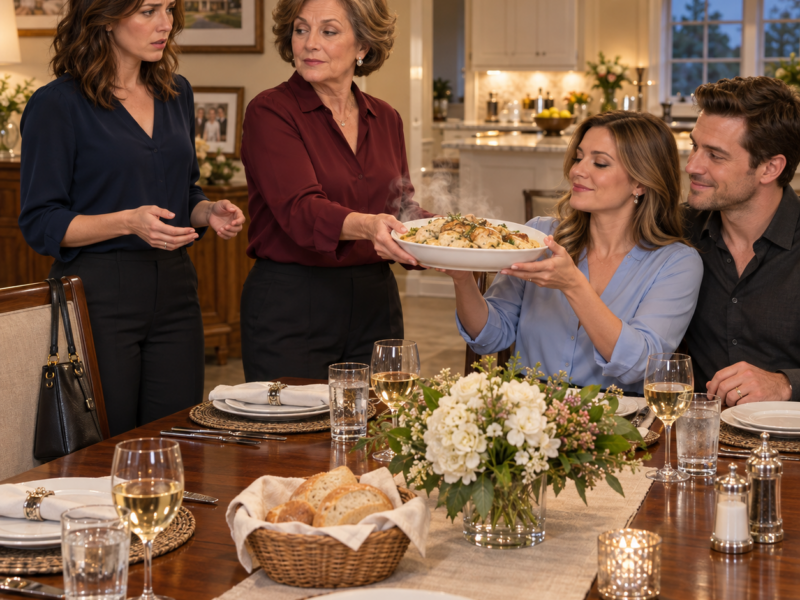
My mother took the dinner I’d spent two hours cooking for my husband, handed it to my sister, and watched her say, “I made this for you.” Daniel took one bite and smiled. “That’s exactly how I like it.” I didn’t accuse anyone. I asked Lauren one question about the sauce. She couldn’t answer it. Then, as I picked up my purse to leave, my sister said six words that made my husband go completely still: “He was going to tell you.”
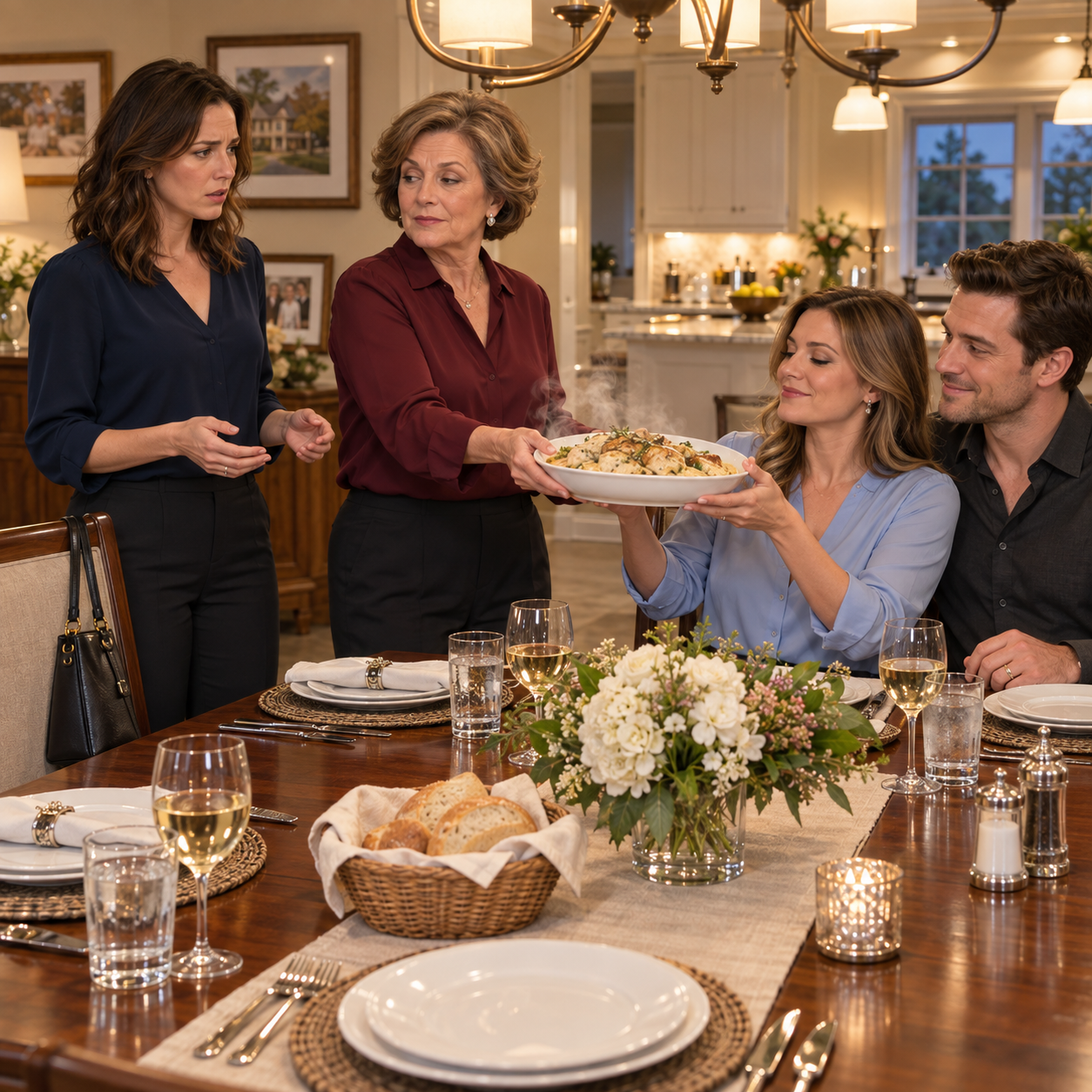
The first thing I noticed was my mother’s hand closing around the serving dish before I had finished lowering it to the table.
For one stupid second, I thought she was helping.
The ceramic casserole was hot enough that I had wrapped the handles in folded kitchen towels. Steam curled from the chicken in a roasted-garlic cream sauce, carrying thyme, black pepper, lemon, and the faint sharpness of Dijon mustard through my parents’ dining room. I had spent most of the afternoon making it because it was Daniel’s favorite meal, and because I had reached a point in my marriage where I was still trying to solve emotional distance with things I knew how to do well.
Cooking was one of them.
My mother, Marilyn, took the dish from me, turned away, and said, “Lauren.”
My older sister looked up from her phone.
She was sitting three chairs away in a pale blue blouse I recognized.
Not because she had worn it around me before.
I had seen that blouse reflected in the dark window of a photograph on Daniel’s phone three weeks earlier, just before he swiped the image away and told me it had been taken at a client dinner.
I had wanted to believe him.
That had become a full-time job.
Lauren smiled when Mom held out the chicken.
Not confused.
Not embarrassed.
Pleased.
The kind of smile someone gives when an object is being returned to its proper owner.
“Take this to Daniel,” Mom said.
Nobody moved for a second.
My father, Paul, looked down at the bread basket. Daniel was studying his wineglass. Lauren rose with an ease that told me she already understood the assignment.
I stared at my mother.
“Are you serious?”
Her mouth tightened.
There it was.
The expression I had known since childhood.
Don’t embarrass me.
Don’t make a scene.
Don’t force everyone to acknowledge what we have all agreed to pretend isn’t happening.
“Claire.”
Just my name.
She had been using it as a warning since I was twelve.
Lauren took the casserole from her.
“I’ve got it.”
She carried the meal I had spent two hours making around the long walnut table and set it directly in front of my husband.
My seat was beside him.
Or it had been.
At every family dinner since we married four years earlier, I sat on Daniel’s right. That evening, while I had been in the kitchen finishing the sauce, Lauren had taken my chair.
I saw it when I came in carrying the bread.
I had paused.
Lauren had looked at me and said, “Oh, did you want this one?”
Mom had immediately answered for me.
“Claire can sit anywhere.”
So I had.
Because that was what the previous six months of my life had become.
A thousand tiny things that did not seem large enough to fight over individually.
A chair.
A text message.
A restaurant receipt.
A glance.
A joke that landed too intimately.
A phone turned face down.
A bottle of bourbon Lauren suddenly knew Daniel liked even though she had once told me whiskey smelled “like varnish.”
The fact that Daniel now knew her coffee order.
The fact that Lauren had started saying his full name instead of Dan the way our family always had.
The fact that my mother kept telling me I was imagining patterns because I had “always been competitive with Lauren.”
Competitive.
That word would have been funny if it had not been so insulting.
Lauren was three years older than me and had spent our childhood being protected from competition.
When she lost, Mom changed the rules.
When Lauren got a C, the teacher was unfair.
When I got an A, I was “naturally academic.”
When Lauren forgot Grandma’s birthday, she had a lot going on.
When I forgot to bring rolls to Thanksgiving one year, Mom spoke about it for months.
When Lauren borrowed my clothes without asking, I needed to learn to share.
When I locked my bedroom door, I was being hostile.
There had never been a contest.
There had been Lauren, and there had been the rest of us learning how much space to give her.
Now my sister sat in my chair beside my husband while my mother handed her my dinner.
Lauren put one hand lightly beside Daniel’s plate.
“I made this for you.”
My fingers went cold.
Daniel’s expression changed.
Only slightly.
That was the worst thing about living with a man who had become practiced at dishonesty.
He did not gasp.
Did not look surprised.
He blinked once.
The corner of his mouth tightened.
Then he looked down at the food.
Small changes.
A year earlier I would have called them tiredness.
Now I knew better.
He cut into the chicken.
Took a bite.
Chewed.
Then looked at Lauren.
“That’s exactly how I like it.”
She smiled.
Something inside me became very still.
Not broken.
Still.
For months I had felt as though I were drowning while everyone around me criticized the way I was breathing.
Every question made me jealous.
Every contradiction had an explanation.
Every attempt to discuss Lauren became an interrogation of my personality.
Why had I checked the credit card statement?
Because the charge was on our card.
Why had I asked why Lauren texted him at 12:18 in the morning?
Because my sister was texting my husband at 12:18 in the morning.
Why did I care that he had eaten at the same Hartford restaurant twice on nights he claimed he was working late?
Because he had told me he had never been there.
Why did I make everything suspicious?
Why couldn’t I trust him?
Why was I letting insecurity destroy a good marriage?
The questions had come from Daniel.
Then Mom.
Then, eventually, Lauren herself.
That was the strangest part.
My sister had begun advising me about how to save my marriage while apparently sleeping with my husband.
I looked across the table.
“You made it?”
Lauren’s fork stopped.
“What?”
“The chicken.”
I nodded toward Daniel’s plate.
“You said you made it.”
My mother exhaled sharply.
“Claire, stop.”
I ignored her.
Lauren laughed lightly.
“Why are you being weird?”
“I’m asking a question.”
Daniel put down his fork.
“Claire.”
His tone made my skin burn.
He had learned my mother’s technique.
My name as discipline.
I looked directly at him.
“She said she cooked your favorite dinner.”
“So?”
“So I’m interested.”
Lauren leaned back.
“You don’t own chicken, Claire.”
“No.”
I smiled.
“I don’t.”
She should have stopped.
She should have admitted Mom handed her the dish.
Instead, because Lauren had spent thirty-five years learning that confidence could substitute for accuracy, she reached for her wine.
“It’s a family recipe.”
I stared.
Then I laughed.
Quietly first.
My father’s eyebrows drew together.
Mom went pale.
Daniel looked irritated.
Lauren’s smile slipped.
“What’s funny?”
I rested both hands on the back of the empty chair in front of me.
“No. The original recipe was a family recipe.”
Lauren frowned.
“Yes, it was.”
I looked at Mom.
She looked away.
That was when the last of my uncertainty vanished.
Not because Mom knew the recipe.
Because she knew what Lauren was doing and did not want me asking questions.
I turned back.
“I changed it last month.”
Daniel looked at Lauren.
There.
The first crack.
Lauren recovered.
“So?”
“So tell me what you put in the sauce.”
Her lips parted.
Nothing.
“What?”
“You made it, right?”
“Claire,” Mom whispered.
The warning.
I did not obey.
“What did you put in the sauce?”
“The normal things.”
“Which are?”
“Garlic.”
“Obviously.”
“Cream.”
“How much?”
Her eyes hardened.
“Why does that matter?”
“Because you said you made it.”
Daniel shifted beside her.
Lauren raised her wineglass.
“This is ridiculous. You’re testing me over dinner.”
“I’m asking you about something you claim you cooked.”
“Claire, enough.”
My mother’s voice was sharp now.
I turned.
“No.”
The word landed strangely.
Mom blinked.
I had almost never said no to her that calmly.
As a child, I argued.
As a teenager, I slammed doors.
As an adult, I became easier.
I learned to explain.
Soften.
Leave room for people to save face.
No was different.
No gave nobody a place to hide.
I looked at Lauren again.
“Did you add the Dijon before or after the cream?”
Her face changed.
Very little.
Enough.
There was no Dijon in my mother’s recipe.
I had added it accidentally one night a month earlier when Daniel came into the kitchen while I was cooking and distracted me with a story from work. I grabbed the wrong jar, realized what I had done, and decided to keep going.
Daniel took the first bite and said:
“Whatever you did, don’t ever change it back.”
So I didn’t.
It became ours.
Or I thought it had.
Lauren looked at Daniel.
Then Mom.
Then me.
“It’s a family recipe.”
she repeated.
For half a second, I almost felt sorry for her.
“No.”
I said.
“It’s mine now.”
Nobody moved.
“I cooked the chicken.”
“I roasted the garlic.”
“I changed the sauce.”
“I added the mustard.”
“I carried it into this room.”
My voice began shaking, but I did not stop.
“And Mom took it out of my hands and gave it to you.”
Lauren’s cheeks reddened.
Daniel stared at his plate.
He was not confused.
Not surprised.
He was embarrassed that Lauren had been caught.
That distinction told me everything.
I looked from him to my sister.
Then I finally said what I had been swallowing for weeks.
“You’ve apparently learned how to take someone else’s husband.”
Lauren froze.
Mom gasped.
Dad looked sharply at Daniel.
I gave my sister a smile that held no warmth.
“But you didn’t have time to learn the recipe.”
My mother stood so fast her chair scraped the floor.
“That’s enough.”
Of course.
Not when Lauren lied.
Not when she took my seat.
Not when Daniel praised food she had not cooked.
My reaction was the emergency.
“You will not speak to your sister that way at my table.”
I stared.
“Your table?”
“Yes.”
“That’s what you’re worried about?”
“Claire.”
“Not my marriage.”
“Not the fact that Lauren lied to my face.”
“Your table.”
Lauren pushed her chair back.
“This is insane.”
I looked at her.
“Is it?”
She shook her head.
“You’ve been acting crazy for months.”
Daniel closed his eyes.
“Lauren.”
One word.
A warning.
Not:
What are you talking about?
Not:
My wife isn’t crazy.
Not:
Nothing is happening.
He was warning my sister she had said too much.
Dad heard it too.
His eyes moved between them.
“What does she mean, months?”
Nobody answered.
Mom began clearing plates.
Actually clearing plates.
She reached for the salad bowl like domestic activity might rescue everyone.
I stared.
“Mom.”
“Not now.”
“When?”
“You’re upset.”
“You’re right.”
“This isn’t the time for serious conversation while emotions are high.”
I laughed again.
“That’s convenient.”
Daniel finally looked at me.
“Can we go home and talk?”
Home.
The word landed wrong.
Daniel and I had bought our house in West Hartford four years earlier, nine months before our wedding.
A gray colonial with a small fenced yard and a kitchen we remodeled together because Daniel hated the original dark cabinets.
I picked the curtains.
He picked the couch.
We painted the guest bedroom twice because what looked like gray in the store became lavender under our evening lights.
I planted lavender along the back fence because Daniel said it reminded him of a trip we took to California while dating.
For years, home had meant the two of us.
Now it sounded like another room where he could close the door and explain why my eyes were lying to me.
“No.”
His jaw tightened.
“Claire.”
“I’ve talked to you at home.”
“I asked why Lauren called you after midnight.”
“She needed advice.”
“About what?”
“Work.”
“My sister works in event planning.”
“You work in commercial banking.”
“Apparently it was interdisciplinary.”
Dad almost smiled.
Daniel did not.
I continued.
“I asked about the Bellmore Hotel restaurant charges.”
“Client meetings.”
“Twice.”
“Yes.”
“Same client?”
He said nothing.
Lauren stood.
“This is none of my business.”
I looked at her.
“That is the first true thing you’ve said all night.”
Her eyes flashed.
She picked up her purse.
“I’m leaving.”
Mom immediately moved toward her.
“Lauren, sweetheart.”
Sweetheart.
My sister had just been accused of having an affair with my husband and my mother was comforting her.
That old childhood rage rose in me.
Not because Mom loved Lauren.
I had accepted that years ago.
Because Mom needed Lauren innocent even when innocence required me guilty.
“You knew.”
Mom stopped.
She did not turn around.
The room went quiet.
“You knew something.”
Her hand remained on Lauren’s shoulder.
“Claire, you’re making accusations.”
“Look at me.”
Nothing.
“Mom.”
She turned.
I expected anger.
Instead, exhaustion.
That frightened me.
“How much did you know?”
“Nothing.”
Too fast.
Dad said:
“Marilyn.”
She glared at him.
“Don’t.”
For most of my life, that was enough to make Dad retreat.
Not tonight.
I turned to Daniel.
“How long?”
He rubbed both hands over his face.
“I’m not discussing this here.”
“That’s not a denial.”
“I shouldn’t have to defend myself against something ridiculous.”
A month earlier, I might have wanted that answer to be enough.
Now I heard the space where the denial should have been.
Lauren reached the hallway.
“Daniel, don’t bother. She’s already decided what she believes.”
I turned.
Daniel.
Soft.
Private.
She had said his name that way once in my parents’ kitchen when I walked in and found them standing very close by the sink.
I had dismissed it.
Now it sounded like a key entering a familiar lock.
“How long?”
I asked again.
Daniel stood.
“We’re going home.”
“You can go anywhere you want.”
“Claire.”
“But I’m not getting into a car with you so you can spend twenty minutes telling me I’m imagining what everybody in this room can see.”
Something like fear entered his face.
Not fear of losing me.
Fear of losing control of the narrative.
He lowered his voice.
“You’re humiliating yourself.”
The sentence struck cleanly.
For a second, I stopped breathing.
Then something inside me hardened.
He needed me ashamed.
If I was ashamed, I would stop asking.
If I stopped asking, he could keep deciding when truth became convenient.
I reached for my purse.
Daniel frowned.
“Where are you going?”
“Not home with you.”
“What?”
“I’m staying somewhere else.”
Mom stepped forward.
“Don’t be dramatic.”
That nearly made me smile.
“My sister is sitting in my chair, eating my food with my husband, and you’re worried about drama?”
“Nothing has been proven.”
I looked at Lauren.
“Then give me your phone.”
Her face blanked.
Mom stiffened.
Daniel swore under his breath.
Dad heard him.
So did I.
Lauren laughed.
“No.”
“Exactly.”
“You don’t get to search my phone.”
“You’re right.”
I nodded.
“I don’t.”
For months, I had believed evidence would free me.
One message.
One photograph.
A receipt.
Proof solid enough that no one could call me insecure again.
Standing there, I realized I did not need a courtroom standard of evidence to decide what I would live with.
I did not need to catch them naked.
I needed to trust what I had already seen.
I turned toward the door.
Daniel called my name.
I kept moving.
Then Lauren said quietly:
“He was going to tell you.”
My hand froze on the doorframe.
Nobody moved.
I looked over my shoulder.
Daniel had gone completely still.
Lauren’s face drained.
Mom closed her eyes.
And just like that, the question was no longer whether I imagined the affair.
Only how long everyone expected me to keep pretending.
I turned around.
“He was going to tell me what?”
Lauren swallowed.
“Claire.”
“No.”
I walked back into the dining room.
“Finish.”
Daniel stepped between us.
“She doesn’t know what she’s talking about.”
Lauren laughed bitterly.
“Oh, now I don’t know?”
He turned.
“Stop talking.”
Not denial.
Coordination.
I looked at Lauren.
“Tell me.”
She lifted her chin.
My sister had never handled humiliation well.
If she thought she was losing, she usually burned the game board.
“You two have been miserable for months.”
I stared.
“We have?”
Daniel said:
“Lauren.”
“No.”
She looked at me.
“He told me you barely talk.”
I looked at my husband.
He looked away.
“He said you’re always angry.”
“About what?”
“He said you criticize everything.”
“That you don’t trust him.”
“Interesting.”
“He felt trapped.”
“Did he?”
Lauren’s confidence grew.
Maybe Daniel had told her the story enough that it felt true.
Maybe affairs require stories.
People do not like thinking of themselves as cruel.
They turn betrayal into rescue.
“He came to me because he needed someone to talk to.”
“And you slept with him because you are an exceptional listener?”
Mom flinched.
Lauren reddened.
Daniel snapped:
“Enough.”
I rounded on him.
“No.”
“You do not get to decide when there has been enough truth.”
“Claire, lower your voice.”
“I haven’t raised it.”
That unsettled him.
He had prepared for hysteria.
Not questions.
I looked directly at my husband.
“Did you sleep with my sister?”
Seconds passed.
Dad said:
“Daniel.”
Daniel exhaled.
He looked at Lauren.
Then at me.
“Yes.”
One syllable.
Four years of marriage.
One word.
My legs weakened.
I grabbed a chair.
No one came toward me.
I was grateful.
“How long?”
Silence.
“How long?”
“A few months.”
Lauren’s head turned sharply.
My stomach dropped.
“A few?”
Daniel’s jaw tightened.
“Does the exact timeline matter?”
I laughed softly.
“That means yes.”
“Claire.”
“Three months?”
Nothing.
“Four?”
Lauren crossed her arms.
Mom whispered:
“Please.”
I looked at her.
“Please what?”
She had no answer.
I turned back.
“Six?”
Daniel’s eyes flicked toward Lauren.
That was enough.
Six months.
Half a year.
Our anniversary had been five months earlier.
Daniel bought me tulips because he remembered I hated roses when they came wrapped in plastic.
He wrote:
To my best friend, my wife, my home.
The card was in my bedside drawer.
My knees weakened again.
“Six months.”
He stepped toward me.
“I’m sorry.”
I backed away.
“Don’t.”
“I never wanted to hurt you.”
“Then you chose an unusually complicated method of avoiding it.”
“It wasn’t planned.”
Lauren looked offended.
Even then.
She needed the relationship meaningful.
Daniel needed it accidental.
Mom needed it manageable.
Three different stories.
One betrayal.
I looked at Marilyn.
“How long have you known?”
“Claire.”
“How long?”
She pressed her lips together.
Dad turned.
“You knew?”
“I knew they were close.”
Close.
I laughed.
“I told them it was inappropriate.”
Lauren rolled her eyes.
“You told me to be careful.”
Mom’s head snapped toward her.
“That is not what I said.”
“It was exactly what you said.”
I stepped closer.
“You told her to be careful.”
“I was trying to keep things from getting worse.”
“By hiding it?”
“I didn’t know everything.”
“You knew enough.”
“I knew your marriage had problems.”
“My marriage had problems because my husband was sleeping with my sister.”
Mom’s face hardened.
“Problems don’t begin from nowhere.”
There are cruel sentences.
Then there are sentences that confirm an old wound was never imagined.
My whole life, if Lauren hurt me, Mom searched for my contribution.
Lauren ruined my prom dress?
Why had I left it where she could reach it?
Lauren borrowed two hundred dollars and never repaid it?
Why had I given money without writing it down?
Lauren flirted with my college boyfriend?
Why did I feel threatened?
Now my husband cheated with her.
And Mom was looking for what I had done to create the climate.
Dad pushed back from the table.
“Marilyn, what the hell is wrong with you?”
Everyone looked at him.
My father rarely swore.
He almost never challenged her publicly.
He pointed toward Daniel.
“He cheated on our daughter.”
Then Lauren.
“With her sister.”
“And you knew enough to warn Lauren?”
“I was trying to protect both girls.”
Both.
That word nearly broke me.
I was the wife.
Lauren was sleeping with my husband.
Somehow Mom had found a way to make us equally vulnerable parties in need of protection.
I nodded.
“Okay.”
Daniel looked nervous.
“Claire.”
“Don’t.”
I walked toward the table.
The chicken had cooled.
Sauce thickening.
I stared at it.
Two hours earlier, I stood in my kitchen whisking that sauce while convincing myself dinner might help.
Daniel had been distant.
Mom insisted we all come.
“We need to feel like a family again.”
Now I understood.
She had not invited us to fix anything.
She had invited us to normalize it.
Put Daniel and Lauren at the same table with me.
Smile.
Eat.
See how much disrespect I would swallow if everyone used indoor voices.
I picked up the serving dish.
Lauren frowned.
“What are you doing?”
“My dinner.”
I carried it into the kitchen and scraped it into the trash.
Not because food was contaminated.
Because I could not stand watching them eat it.
The sauce slid into the bag.
I set the ceramic dish in the sink.
Washed my hands.
Returned.
“I want one answer from each of you.”
Daniel stared.
Lauren folded her arms.
Mom remained standing.
I looked at Daniel.
“Were you ever going to tell me?”
His face changed.
That was the answer.
Still he tried.
“I was deciding what I wanted.”
I nodded.
“Meaning you wanted both options until you chose.”
“No.”
“That is exactly what it means.”
I looked at Lauren.
“Did you expect me to forgive you?”
She stared.
“I expected you to admit the marriage was already broken.”
Of course.
If the marriage was already dead, she could not have killed anything.
“Okay.”
Then Mom.
“Did you really think handing Lauren my food tonight was helping?”
Her eyes filled.
“I wanted things to feel normal.”
There.
Finally.
Not good.
Not honest.
Normal.
My mother’s highest family value had always been appearance.
I picked up my purse.
“This is your normal.”
I looked around.
“My husband sleeping with my sister.”
At Mom:
“You protecting her.”
At Daniel:
“You telling me I’m crazy for noticing.”
At Lauren:
“You taking things I made and calling them yours.”
I walked toward the door.
Daniel said:
“Where are you going?”
“Somewhere nobody expects me to call this normal.”
I left.
I drove to my friend Megan’s apartment in West Hartford.
It was almost midnight.
She opened the door wearing flannel pajama pants and an old UConn sweatshirt.
She looked at my face.
“Guest room is made.”
That was all.
No:
I knew it.
No:
Why didn’t you see sooner?
No:
I never liked him.
She gave me water.
Sat on the floor beside the guest bed while I talked.
When I ran out of words around two in the morning, she asked:
“What do you need tomorrow?”
The first question all evening centered on me.
“My things.”
I said.
Then I stared at the ceiling until morning.
At seven-thirty, Megan made eggs.
I could not eat.
At eight-fifteen, she said:
“I can come with you.”
I almost said yes.
Then no.
“Thank you.”
“You sure?”
“No.”
“Good answer.”
I smiled weakly.
“I need to do it myself.”
She nodded.
No argument.
That was what support felt like when it did not need control.
Daniel’s car was in our driveway when I arrived.
He opened the door before I reached it.
“You stayed with Megan?”
“Yes.”
“You could’ve answered my calls.”
“You could have answered my questions six months ago.”
He closed the door.
“Can we talk like adults?”
That phrase.
Adults.
Mature people.
Calm people.
People who do not make scenes.
My whole life I had been taught maturity meant absorbing pain quietly enough that everyone else remained comfortable.
“No.”
I said.
“We can talk honestly.”
I went upstairs.
Daniel followed.
“What are you doing?”
“Packing.”
“That’s not necessary.”
“For whom?”
“Either of us.”
I pulled my suitcase from the closet.
“You cheated with my sister.”
“I know.”
“For six months.”
“I know.”
“You lied to me every day.”
“I know.”
“And packing is too dramatic?”
He leaned against the doorframe.
“It wasn’t supposed to happen.”
“Nothing happens for six months accidentally.”
“We were both in a bad place.”
I stopped folding.
“We?”
“You and me.”
“No.”
I looked at him.
“You and Lauren.”
He rubbed his forehead.
“You don’t want my side.”
“I have heard your side in fragments for months.”
“I wasn’t happy.”
There.
The line.
Not:
I was selfish.
Not:
I betrayed you.
I wasn’t happy.
As though unhappiness issued permits.
“You could have told me.”
“I tried.”
“When?”
He looked away.
“When did you say, ‘Claire, I’m unhappy in our marriage’?”
“I didn’t know how.”
“But you knew how to tell Lauren.”
“She listened.”
The sentence escaped.
He regretted it instantly.
I stared.
“I listened to you for four years.”
“That isn’t what I meant.”
“Then what did you mean?”
He sat on the edge of the bed.
He looked exhausted.
Human.
I hated that.
I wanted a villain because villains make decisions easier.
Daniel was not a villain.
He was a man who had done something cruel and still had normal skin and tired eyes and the same scar on his chin from college.
“I felt like I disappointed you.”
“By what?”
He struggled.
I worked too much sometimes.
So did he.
I worried about finances.
We had stopped going out often.
I complained when he forgot plans.
Real marriage problems.
None explained Lauren.
They explained only why Daniel needed a story that made his betrayal feel like a symptom instead of a choice.
“Marriage can be unhappy.”
I said.
“You tell the truth.”
“Ask for counseling.”
“Fight.”
“Leave.”
“You do not sleep with your wife’s sister and then use the marriage to explain why.”
He looked down.
“I know.”
I zipped the suitcase.
Then he said:
“I was going to tell you.”
“When?”
“After this weekend.”
My hand stopped.
“Why after this weekend?”
Silence.
“Daniel.”
“It doesn’t matter now.”
“Why?”
He rubbed his jaw.
“Lauren and I talked.”
Cold spread through me.
“About being together?”
His eyes met mine.
“Possibly.”
Possibly.
As if my marriage was under review.
“Where?”
“What?”
“If you left me, where were you going to live?”
He hesitated.
Too long.
I looked around our bedroom.
“No.”
“Claire.”
“You thought I would leave.”
“I never said that.”
“You didn’t need to.”
“The house is in both names.”
“Yes.”
“I thought we’d work something out.”
“You thought I’d be devastated and leave.”
“That’s not fair.”
“Was Lauren going to move in?”
Silence.
My eyes filled.
Not because Daniel loved her.
Maybe he did.
Maybe he loved how she made him feel.
The replacement hurt.
Lauren in my kitchen.
My sister using the coffee mugs I bought.
Sleeping in the bed we chose.
Planting something over my lavender.
Cooking a recipe she could not explain.
My life reassigned.
Like the plate.
I pressed my palms against the dresser.
Daniel stepped closer.
“Claire.”
“Don’t touch me.”
He stopped.
I wiped my face.
“You know what’s funny?”
Nothing.
“Last night Mom took something I made and handed it to Lauren.”
His jaw tightened.
“And Lauren put it in front of you like it belonged to her.”
“Claire.”
“That’s what all of you thought would happen with my life too.”
House.
Marriage.
Family.
Slide everything down the table.
Give it to Lauren.
“That is not what this is.”
“It is exactly what this is.”
I closed my suitcase.
“But there is one difference.”
He looked at me.
“I’m not giving it away.”
I decided not to leave the house that morning.
Not permanently.
Daniel assumed I would.
I saw the surprise when I carried the suitcase downstairs and placed it beside the couch instead of outside.
“What are you doing?”
“I’m staying until we talk to attorneys.”
“Claire.”
“This house is jointly owned.”
“I’m not abandoning it because you expected me to make your transition convenient.”
He stared.
“You want me to leave?”
“Yes.”
“This is my house too.”
“Yes.”
“I’m asking you to leave voluntarily for now.”
He laughed bitterly.
“Where am I supposed to go?”
I looked at him.
That question.
As if the affair had not included a second adult with a residence.
“You have options.”
He knew.
His face reddened.
“Don’t.”
“What?”
“Make it ugly.”
“You did that.”
Eventually Daniel packed a duffel.
At the front door, he turned.
“I don’t know what happens now.”
“I do.”
His eyes changed.
“I get a lawyer.”
He left.
At noon, I called one.
Her name was Rachel Singer, a family-law attorney Megan’s cousin had used.
Rachel’s office was in a converted brick house near Farmington Avenue.
I expected rage.
Strategy.
She gave me neither.
She gave me a legal pad.
“Start with assets.”
The calmness was almost offensive.
Then useful.
House.
Joint checking.
Separate retirement accounts.
Daniel’s 401(k).
My 403(b).
Two cars.
No children.
No prenup.
Four-year marriage.
The house purchased jointly before wedding, both contributing.
No dramatic adultery jackpot.
Connecticut divorce law was not going to hand me everything because my husband had slept with my sister.
That was fine.
I did not want everything.
I wanted separation from the lie.
Rachel asked:
“Do you feel unsafe?”
“No.”
“Has he threatened you?”
“No.”
“Then we do not create a story that is not there.”
Good.
“Do not empty joint accounts.”
“I wasn’t going to.”
“Do not change locks without agreement or court order.”
“Fine.”
“Document balances.”
“Save records.”
“Communicate in writing about major financial matters.”
“Do not post online.”
“I would rather die.”
She almost smiled.
“And Claire?”
“Yes?”
“Do not negotiate with your mother.”
I laughed.
“That’s legal advice?”
“Life advice.”
I liked her.
The financial review uncovered nothing criminal.
No secret second home.
No stolen retirement.
No enormous conspiracy.
The affair had hotel charges and restaurant expenses.
Daniel had used personal discretionary funds for some and one joint card twice.
Rachel told me we could account for marital spending during settlement.
I did not turn it into a forensic war.
The amount was not the point.
Three days after I met Rachel, Dad texted.
Your mother wants everyone here Sunday. She says we need to fix this as a family.
Then:
I told her nothing gets fixed until people tell the truth.
Then:
Lauren says you destroyed the family.
For the first time that week, I smiled.
Not because it was funny.
Because I knew what I needed.
I would return to the table.
Without dinner.
Sunday afternoon, I walked into my parents’ house empty-handed.
Mom’s eyes went straight to my hands.
“You didn’t bring anything?”
It was almost impressive.
Four days after discovering one daughter had been sleeping with the other daughter’s husband, she was tracking side dishes.
“No.”
“I thought we might have a normal dinner.”
“We tried that.”
Dad was in the dining room.
He stood when he saw me.
For half a second, uncertain.
Then he hugged me.
My father was not affectionate casually.
I leaned against him.
“I’m sorry.”
he whispered.
I nodded.
Lauren stood by the window.
She looked tired.
I probably did too.
Daniel was not there.
Mom noticed me glance at the empty chair.
“He thought coming might not be helpful.”
“Best decision he’s made lately.”
Lauren rolled her eyes.
Some patterns survived disaster.
Mom set down potatoes.
“I asked you here because this cannot continue.”
“What?”
“This hostility.”
Lauren stared at her plate.
I looked at Mom.
“My husband had an affair with my sister.”
“I know.”
“You say it like weather.”
“I’m trying to move forward.”
“To what?”
“Healing.”
I studied her.
Mom thought reconciliation, forgiveness, and silence were all versions of the same virtue.
If nobody mentioned the wound, she could call it healed.
“Do you want healing?”
I asked.
“Or do you want everyone to stop making you uncomfortable?”
Her face stiffened.
“That’s unfair.”
“Probably.”
Lauren laughed.
“Of course Claire is the victim again.”
I turned.
“Again?”
“Everything has always been about Claire’s feelings.”
I stared.
Then realized she meant it.
“Tell me.”
She blinked.
“What?”
“Tell me.”
“You were perfect.”
I frowned.
“You got good grades.”
“You were responsible.”
“You never needed anything.”
“Mom compared me to you constantly.”
I looked at Mom.
She went pale.
Lauren continued.
“You were always the one who had everything together.”
I laughed softly.
“Lauren, Mom protected you from consequences our entire childhood.”
“That is not the same thing.”
“No.”
I said.
“It isn’t.”
She seemed surprised by my agreement.
“And if Mom compared you to me, that was wrong.”
Lauren’s mouth opened.
“She should not have made you feel lesser because I did well in school.”
The room went quiet.
Then:
“But my husband was not compensation.”
Her face hardened.
“I didn’t steal him.”
“Then why did you need him secretly?”
“He came to me.”
“You could have sent him home.”
“He wasn’t happy.”
“You could have told him to talk to his wife.”
“He loved me.”
The words stopped everything.
Mom closed her eyes.
Dad looked at Lauren.
I felt no jealousy.
Mostly sadness.
“You believe that.”
Her eyes filled.
“He said it.”
I believed her.
Daniel had probably said it in hotel rooms.
In late-night messages.
People rename desire as destiny when they need to feel moral.
“Maybe he meant it when he said it.”
Lauren’s expression shifted.
“But?”
“He told me something else.”
She froze.
I did not need messages.
Daniel had already admitted uncertainty.
“He said he was figuring out what he wanted.”
Lauren searched my face.
“He told me you talked about being together.”
Her lips parted.
“He said ‘possibly.’”
The word landed.
I watched it hurt.
I did not enjoy the pain.
But I did not shield her from it.
“He was going to leave you.”
“Maybe.”
“He told me—”
“I know what he told you.”
I leaned back.
“And you don’t know everything he told me.”
For the first time, Lauren was not defending the affair.
She was examining it.
Daniel had not chosen her.
Not completely.
He had not chosen me either.
He had chosen delay.
Options.
Secrecy.
Lauren mistook being desired for being chosen.
I mistook marriage for safety.
Mom mistook silence for peace.
Every one of us had believed something convenient.
I turned to my mother.
“Your turn.”
She stiffened.
“For what?”
“The truth.”
“I’ve told you truth.”
“No.”
“You explained.”
“Justified.”
“Minimized.”
Her lips thinned.
“What do you want?”
“I want to know why you handed Lauren my dinner.”
“Claire, for God’s sake.”
“Yes.”
“It was food.”
“No.”
I leaned forward.
“It was never food.”
Mom looked at Dad.
He did not rescue her.
Finally:
“I thought if Lauren did something kind for Daniel, maybe the atmosphere would improve.”
“She did not do anything kind.”
“I know.”
“Do you?”
Mom looked at her hands.
Then:
“Lauren told me Daniel was planning to leave you.”
There.
The room changed.
Lauren turned.
“Mom.”
My hands became cold.
“When?”
“Two weeks ago.”
“And what did you say?”
“I told her to think carefully.”
“Did you tell her to stop seeing my husband?”
Silence.
“Did you tell me?”
Nothing.
I nodded.
“You chose.”
“No.”
“Yes.”
My voice cracked.
“Maybe you didn’t choose the affair.”
“But when you knew enough to understand what was happening, you decided Lauren’s feelings mattered more than my right to know.”
Mom’s eyes filled.
“I thought your marriage was ending.”
“You did not know that.”
“Lauren said—”
“Lauren was sleeping with my husband.”
She flinched.
“Why was her version the one you trusted?”
No answer.
We already knew.
Because it had always been easier for Mom to rearrange reality around Lauren than hold Lauren responsible inside it.
I looked down at my hands.
I had imagined yelling.
A dramatic apology.
Maybe Mom suddenly understanding everything.
Real endings are rarely clean.
People do not transform because truth becomes undeniable.
Sometimes all you can do is stop participating in the lie.
I stood.
Mom looked alarmed.
“You’re leaving?”
“Yes.”
“We haven’t fixed anything.”
“Some things are not fixed at dinner.”
Lauren looked at me.
“What happens now?”
The question surprised me.
“I’m divorcing Daniel.”
Her face changed.
Relief.
Fear.
Both.
“And us?”
I took a breath.
“You and I do not have a relationship right now.”
Her eyes filled.
That hurt.
She was my sister.
The same girl who slept beside me during thunderstorms.
Who taught me to braid hair.
Who once punched a middle-school girl for calling me ugly.
People are not one thing.
That is why betrayal hurts.
Monsters would be easier.
“I don’t know if we ever will again.”
Lauren looked down.
I turned to Mom.
“The same goes for us.”
Her face crumpled.
“Claire.”
“I’m not punishing you.”
“Then what is it?”
“A consequence.”
She looked like I slapped her.
Dad stood.
“I’ll walk you out.”
Outside, cold air hit my face.
For a moment, silence.
Then Dad said:
“I should’ve seen more.”
“Maybe.”
“I should’ve spoken sooner.”
“Yes.”
He nodded.
No excuse.
No request for comfort.
Just yes.
That nearly broke me.
He hugged me.
This time I cried.
Not only Daniel.
Not only Lauren.
For myself.
For the years I had learned being easy to love meant being easy to disappoint.
For every apology I made merely to end conflict.
Every instinct I doubted because someone else disliked my suspicion.
For the woman who spent two hours making her husband’s favorite meal while he was deciding whether to replace her with her sister.
When we separated, Dad wiped his eyes.
“What will you do?”
I looked toward my car.
“I don’t know.”
For once, not knowing did not frighten me.
Whatever came next would be mine.
The divorce took seven months.
No courtroom showdown.
No judge pounding a gavel over adultery.
No humiliating discovery hearing where Lauren’s texts were read aloud.
Daniel hired counsel.
We negotiated.
The house became the hardest practical issue.
He initially wanted to keep it.
That reopened everything.
Rachel asked me:
“Do you want it?”
I thought about the lavender.
The gray guest room.
The kitchen.
The couch.
Then the image of Lauren moving in.
“No.”
“Good.”
I looked at her.
“Why good?”
“Because that is an answer.”
We sold.
Neither of us kept the house.
Neither got to turn it into a monument.
At closing, Daniel sat across from me at a conference table.
He looked thinner.
More gray at the temples.
We signed.
No tears.
Then he said:
“I am sorry.”
I looked up.
“For what part?”
He flinched.
That was not meant cruelly.
There were simply too many parts.
“All.”
I nodded.
“I believe you’re sorry.”
He swallowed.
“Is that forgiveness?”
“No.”
He looked down.
“But it is something.”
He nodded.
That was the last intimate conversation we had as husband and wife.
My share of the sale went toward a smaller townhouse near Farmington.
Two bedrooms.
Tiny patio.
No lavender initially.
I planted some later.
The first night, I slept on a mattress while furniture delivery was delayed.
The house was quiet.
Different quiet from Megan’s guest room.
Mine.
I ate takeout noodles from the carton.
No one asked where I had been.
No phone facedown across the table.
No sister in my chair.
No mother correcting my tone.
I cried.
Then slept nine hours.
Daniel and Lauren did not last.
Dad told me months later.
I did not ask.
Apparently, once secrecy disappeared, so did part of whatever made them irresistible.
Lauren wanted commitment.
Daniel remained uncertain.
She resented his uncertainty.
He resented her pressure.
Predictable.
I felt no satisfaction.
Fine.
A little.
I was human.
But not enough to build anything around.
Mom called often at first.
I did not answer.
Then less.
Dad and I met for coffee.
Once every few weeks.
He never pressured me.
That mattered.
One afternoon he said:
“Your mother thinks you are trying to make her suffer.”
“I’m not.”
“I know.”
“Do you?”
“Yes.”
He stirred coffee.
“She doesn’t understand the difference between someone withdrawing and someone attacking.”
I stared.
“That is the smartest thing you have said in years.”
He smiled sadly.
“I had a lot of quiet time to think.”
Dad also began confronting his own history.
How often he let Mom set family reality because disagreement was exhausting.
He apologized to Lauren too.
Not for the affair.
For allowing a family system where she learned discomfort could be redirected instead of handled.
Interesting.
Healing makes room for uncomfortable nuance.
Lauren sent me a long message six months after the divorce.
I left it unread for two weeks.
Then one evening, I opened it.
She apologized.
Not perfectly.
Explanations mixed with remorse.
Old resentments.
Childhood comparisons.
Loneliness.
Her belief Daniel and I were already finished.
One sentence felt true:
I kept telling myself you had already lost him so I wouldn’t have to admit I was helping take him from you.
I read it three times.
Then saved it.
I did not reply.
Not then.
Maybe silence was not always avoidance.
Sometimes it was time.
Mom’s apology came later.
Almost a year.
Dad had surgery on his knee and I went to visit at their house while she was out.
Then Mom came home early.
We stood in the kitchen.
The same kitchen where decades of family dramas had been turned into casseroles and coffee.
She looked older.
Not dramatically.
Just human.
“Claire.”
“Mom.”
She sat.
I remained standing.
“I owe you an apology.”
I waited.
She started with Lauren’s childhood.
I nearly left.
Then she stopped herself.
“No.”
She said.
“I’m doing it again.”
That got my attention.
“I keep trying to explain why I did it.”
She looked at me.
“You asked why Lauren’s version mattered more than yours.”
“Yes.”
“I have thought about that for months.”
“And?”
“I think I spent her whole life protecting her from feeling like she was less than you.”
I stared.
“By making me less?”
Mom looked down.
“Yes.”
That word mattered.
No but.
She continued.
“You were easier.”
I almost laughed.
“Meaning?”
“You could handle disappointment.”
“Lauren couldn’t.”
“So you got less attention because I thought you needed less.”
“There it is.”
Mom nodded.
“Then it became habit.”
“When Lauren did something wrong, I looked for what she was feeling.”
“When you were hurt, I looked for what you could handle.”
“That was unfair.”
“Yes.”
Her eyes filled.
“And when she told me about Daniel, I thought if their relationship was real, then maybe yours had already failed.”
“That let you protect her.”
“Yes.”
“And I was wrong.”
The apology did not erase the dinner.
But it was the first time my mother had described the pattern without making me responsible for it.
“Thank you.”
I said.
She looked almost relieved.
“Can we start over?”
“No.”
Her face fell.
I softened.
“We can start from here.”
Different.
Starting over asks everyone to forget.
Starting from here asks everyone to remember and behave differently.
Mom nodded.
That was enough for that day.
Lauren took longer.
Two years after the dinner, she asked to meet.
Public place.
Coffee shop in Glastonbury.
I agreed.
She arrived early.
No makeup except mascara.
Hands around coffee.
We sat.
For several minutes, neither spoke.
Then:
“I’m sorry.”
“I know.”
“I need to say it anyway.”
So I let her.
She apologized for the affair.
For lying about dinner.
For letting Mom protect her.
For acting as though Daniel’s unhappiness made him available.
For the house plans.
That part surprised me.
“What house plans?”
Her face changed.
“You didn’t know?”
Cold.
“What?”
She looked down.
“Daniel and I looked at furniture online.”
I laughed once.
Not amusement.
Of course.
“You really thought you were moving in.”
“Yes.”
“Before he told me.”
“Yes.”
That hurt even years later.
Lauren continued:
“I thought once he told you, you’d leave.”
“Everyone thought I would.”
“I know.”
I looked at her.
“What did you expect our parents to do?”
She swallowed.
“Mom said eventually everyone would adjust.”
Of course.
Normalize again.
Lauren wiped one eye.
“I see now how cruel that was.”
“Good.”
She looked at me.
“Do you hate me?”
“No.”
That surprised her.
“I did for a while.”
“Maybe part of me still does in moments.”
“But hate is not all I feel.”
“What else?”
I looked at my sister.
Grief.
History.
Love.
Disappointment.
Recognition.
“Too much to summarize over coffee.”
She laughed weakly.
Fair.
We did not hug.
Not then.
We met again six months later.
Then a family birthday.
Then Dad’s retirement dinner.
Our relationship did not return.
It became something new.
Narrower.
Careful.
Eventually warmer.
Trust returned in inches.
Daniel disappeared from family gatherings entirely.
That was best.
Years later, I saw him once at a grocery store.
He was with a woman I did not know.
We said hello.
He asked:
“How are you?”
“Good.”
And I meant it.
He looked relieved.
Maybe he needed to know I survived.
Maybe he wanted absolution.
Not my job.
I wished him well.
Then bought lemons.
The chicken returned too.
For months I refused to make it.
Garlic reminded me of the dining room.
Dijon made my stomach tighten.
Then one rainy October evening, two years after the divorce, I wanted it.
Not Daniel.
The food.
Mine.
I went to Whole Foods after work.
Chicken.
Garlic.
Cream.
Thyme.
Lemon.
Mustard.
At home, I turned on music.
Cooked.
The smell filled my townhouse.
For a moment, memory pulled me backward.
Mom’s hand.
Lauren’s smile.
Daniel saying:
Exactly how I like it.
I kept stirring.
Then sat at my little kitchen table.
One plate.
Glass of wine.
I took a bite.
Exactly right.
I laughed.
Because the recipe had never belonged to Daniel.
That was another assumption.
I thought his preference gave the meal meaning.
No.
I had made it.
Changed it.
Remembered it.
It belonged to me too.
That realization widened.
Our house had not made me a wife.
Daniel’s choice did not determine my worth.
Lauren’s betrayal did not erase every sister-memory before it.
Mom’s favoritism did not make me inherently less lovable.
People take credit for things when you forget who made them.
Recipes.
Homes.
Peace.
Identity.
I began remembering.
I was thirty-five by then.
Promoted at work.
Operations director for a regional healthcare group.
I had spent years hiding stress from family because competent Claire was my assigned role.
After the divorce, I got better at saying:
I don’t know.
I need help.
No.
Not tonight.
I’m angry.
That hurt.
This isn’t okay.
My therapist said:
“You speak like someone who has spent her whole life making emotional presentations defensible.”
I hated her immediately.
Then returned every Thursday for two years.
She was right.
I did not need cross-examination quality evidence for every feeling.
That lesson changed my work too.
I stopped rescuing coworkers who repeatedly dumped emergencies into my schedule.
I delegated.
Took vacations.
Ignored emails after seven unless actual patient care was involved.
Life did not collapse.
Mom learned different habits.
At Thanksgiving three years after the dinner, she served Lauren and me the same dessert portions.
That sounds ridiculous.
But family systems show change in tiny places.
Lauren said:
“Claire gets more because she likes pecan.”
Mom froze.
Then looked at me.
“Do you want more?”
I smiled.
“Yes.”
She gave me more.
Asked.
No invisible ranking.
Dad watched.
He knew.
Lauren knew.
No one said anything.
We were learning.
The funniest part is that eventually Lauren asked me for the chicken recipe.
Five years after everything.
We were at Dad’s birthday dinner.
She waited until Mom was in another room.
“Can I ask something weird?”
“You usually do.”
She smiled.
“The chicken.”
I stared.
“The one.”
“Yes.”
“I never learned it.”
“Clearly.”
She laughed.
Then grew serious.
“I want to make it.”
“For who?”
“Me.”
That answer changed everything.
Not boyfriend.
Not Daniel.
Not performance.
Her.
I could have refused.
Part of me wanted to.
Instead:
“Write this down.”
She pulled out phone.
“Roast the garlic first.”
“How much?”
“More than you think.”
“Helpful.”
“Six cloves.”
“Cream?”
“Half cup.”
“Dijon?”
“One tablespoon.”
Her eyes lifted.
“The mustard.”
“Yes.”
“After garlic, before cream?”
“After stock, before cream.”
She typed.
“Lemon?”
“At the end.”
“Why?”
“So it stays bright.”
She looked at me.
Then:
“I really am sorry.”
I nodded.
“I know.”
That evening, driving home, I realized I had given my sister the recipe and felt nothing was stolen.
Because I chose.
That is the difference consent makes.
Someone can receive the exact same thing that once felt like theft and the meaning changes completely when you hand it freely.
Mom’s health declined later.
Nothing dramatic.
Arthritis.
Blood pressure.
Then breast cancer caught early.
During chemotherapy, Lauren and I alternated appointments.
That season could have reopened everything.
Instead, it taught us family could function without pretending the past disappeared.
One afternoon Mom was asleep during infusion.
Lauren and I sat beside her.
She whispered:
“Do you think she knew we’d eventually sit together again?”
“No.”
“I don’t think she believed consequences lasted.”
Lauren smiled sadly.
“She really didn’t.”
“No.”
Then:
“Do you think she’s proud?”
“Probably.”
“Should she be?”
I looked at sleeping mother.
“Yes.”
“Not because she caused it.”
“Because she changed too.”
Lauren nodded.
Mom woke.
“What are you whispering about?”
“You.”
“Good things?”
“No.”
She smiled.
Progress.
Dad died first.
Heart attack at seventy-one.
Unexpected.
The call came from Mom.
Lauren picked me up.
At hospital, we held opposite hands.
No old hierarchy.
No one deciding whose grief mattered more.
At the funeral, Daniel sent flowers.
I did not know how to feel.
So I felt nothing about it that day.
There was enough.
Dad’s death brought one final conversation with Mom.
Weeks later, I was helping her sort his papers.
She found a photograph of Lauren and me as children.
Lauren maybe ten.
Me seven.
Both wearing matching dresses we hated.
Mom sat at kitchen table.
“I failed both of you in different ways.”
I looked.
“Mom.”
“No.”
She touched photo.
“I made Lauren believe being upset would get her protected.”
“I made you believe being capable meant you needed less.”
She looked at me.
“Then I wondered why you both grew into women who didn’t know how to ask cleanly for what you needed.”
That was probably the most honest thing she ever said.
I sat beside her.
“We figured some of it out.”
“Yes.”
She smiled.
“Expensively.”
“Emotionally.”
“Same thing in this family.”
I laughed.
When Mom died years later, Lauren and I cleaned the house together.
In the back of a kitchen cabinet, we found the old ceramic casserole dish.
The one from that dinner.
I had forgotten it existed.
Lauren pulled it out.
Chipped on one edge.
She stared.
“Oh, God.”
I laughed.
“What?”
“This thing.”
She held it like evidence.
“Do you want it?”
I thought.
“No.”
“Me neither.”
We almost donated it.
Then I said:
“Wait.”
Lauren looked.
“What?”
“I think I want to break it.”
Her eyes widened.
“That sounds therapeutic.”
We took it into backyard.
Put it inside a cardboard box because we were adults and did not want ceramic shards in grass.
Then dropped a brick.
The dish cracked.
We looked at each other.
Nothing profound happened.
No lightning.
No childhood pain evaporated.
Lauren said:
“That was anticlimactic.”
“Very.”
We laughed until we cried.
Then cleaned it up.
That may be the truest ending.
Not the affair.
Not divorce.
Not the recipe.
Two sisters in their mother’s backyard laughing over a broken dish after finally learning not every object has to be preserved simply because something painful happened around it.
I remarried eventually.
Much later.
His name is Aaron.
Widower.
Two grown daughters.
He knows the story.
Not every detail.
Enough.
The first time I made the chicken for him, he took a bite.
“This is excellent.”
I froze.
He noticed.
“What?”
“Nothing.”
“Bad memory?”
I looked at him.
“Yes.”
“Want to talk?”
“Not tonight.”
“Okay.”
That was all.
No demand.
No correction.
No fear.
A year later, after we married, he asked for recipe.
“Why?”
“So I can cook it for you.”
I stared.
Then laughed.
“Fine.”
He makes it badly.
Too much mustard.
Lemon too early.
But I eat it.
Because perfection is overrated.
The recipe survived all of us.
My marriage did not.
My childhood family changed.
Lauren and I changed.
Mom changed.
Even Daniel probably changed somewhere outside my sight.
That is what lives do.
The dinner was not important because mustard exposed an affair.
The affair was already there.
The mustard exposed something I had been trained not to trust.
My own perception.
Lauren could not answer because she had not made the food.
Daniel could not defend her without exposing himself.
Mom could not stop me without showing how invested she was in silence.
One simple question cracked the performance.
What did you put in the sauce?
I spent months before that night believing truth had to arrive dramatically.
A caught text.
A hotel-room door.
A photograph.
A confession.
Instead, truth arrived through a tablespoon of Dijon mustard.
Small detail.
Impossible to fake if you did not know.
That taught me something I carry still.
When people repeatedly tell you not to trust what you see, pay attention to the details they cannot explain.
Not because every suspicion is correct.
Mine was not always.
But reality leaves fingerprints.
A tone.
A date.
A receipt.
A recipe.
A chair someone takes without asking.
The glance between two people who think you are looking elsewhere.
The mother who comforts the person who hurt you before checking whether you are okay.
None alone may prove a case.
Life is not court.
But together, patterns matter.
I no longer need every feeling notarized.
That is probably the greatest thing I gained from losing my marriage.
Not freedom from Daniel.
Freedom from the belief that other people had to agree with my reality before I was allowed to act on it.
At thirty-two, I thought being a good wife meant asking one more question.
Giving one more benefit of doubt.
Having one more calm conversation.
At thirty-five, I learned there is also such a thing as leaving too late because you are waiting for somebody who benefits from confusion to finally give you clarity.
Daniel was never going to do that.
Lauren was not.
Mom could not.
So I did.
I stopped asking them whether I was allowed to believe myself.
I left the table.
I hired the attorney.
Sold the house.
Cooked my own dinner.
Built a life in which nobody got to hand what I made to someone else and then ask me to smile.
Years later, Aaron once asked me if I regretted not confronting Daniel sooner.
I thought.
“No.”
He looked surprised.
“Really?”
“I regret doubting myself.”
“That’s different.”
“Yes.”
It is.
If I had confronted him three months earlier, perhaps he denied.
Maybe I stayed.
Maybe the marriage ended sooner.
Who knows.
Regret is arrogant sometimes.
It assumes the past would have cooperated if we had been smarter.
I prefer what I know.
I acted when I could finally see enough.
Then I did not look away.
Lauren once told me she was grateful too.
That surprised me.
We were sitting on my patio one summer.
She said:
“If you hadn’t confronted us, I think Daniel would’ve kept me waiting.”
I looked at her.
“Probably.”
“I thought he was choosing me.”
“I know.”
“He was choosing not to choose.”
“Yes.”
She stared at her iced tea.
“I hate that I needed to hurt you to learn that.”
I did not say:
You didn’t need to.
She knew.
Instead:
“What did you learn?”
Lauren thought.
“That being desired is not the same as being loved.”
“That secrecy makes ordinary attention feel more intense than it is.”
“And that if a man wants you only in the spaces where nobody can see him choosing you, he isn’t choosing you.”
I looked at her.
“That’s a decent list.”
She smiled.
“Expensive lesson.”
“Runs in the family.”
We laughed.
That is where we are now.
Not best friends.
Sisters.
Real ones.
We can talk.
Disagree.
Leave rooms without threatening abandonment.
We know where the scars are.
We do not press them for entertainment.
Mom would probably call that healing.
I would call it work.
Either way, it is real.
I still have the recipe written on a card in my kitchen.
Not the original family version.
Mine.
Chicken with roasted garlic, thyme, Dijon cream, and lemon.
The card has stains along the edge.
Aaron once offered to rewrite it.
I said no.
Some things earn their marks.
At the bottom I eventually added a note.
Not sentimental.
Just practical.
Lemon last.
Keep it bright.
Every time I read it, I smile.
Maybe because it is good cooking advice.
Maybe because it became something else too.
When truth finally enters a room, do not bury it beneath everything that came before.
Let it stay bright.
Let it be sharp enough to taste.
Then decide what belongs to you.
The marriage did not.
The house eventually did not.
My mother’s version of peace did not.
My sister’s excuses did not.
But my life did.
And the first time I understood that was standing at my parents’ dinner table with my hands empty after my mother took something I had made and tried to give someone else the credit.
For years, I thought that was the moment everything fell apart.
It wasn’t.
It was the first moment I stopped handing myself away with the plate.









