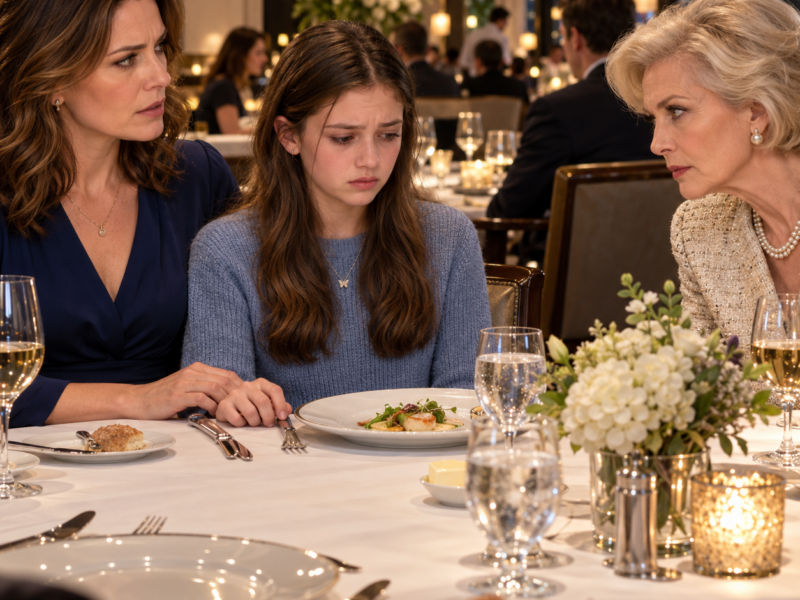
My mother looked across a restaurant table at my thirteen-year-old daughter and whispered, “We don’t sit with mistakes.” Sole’s hand started shaking beside her untouched plate. I stood, took her hand, and walked out while my mother called me dramatic, my brother told me to calm down, and my father said nothing. What I didn’t know was that dinner wasn’t the first time Grandma had been saying things to Sole when I wasn’t there.
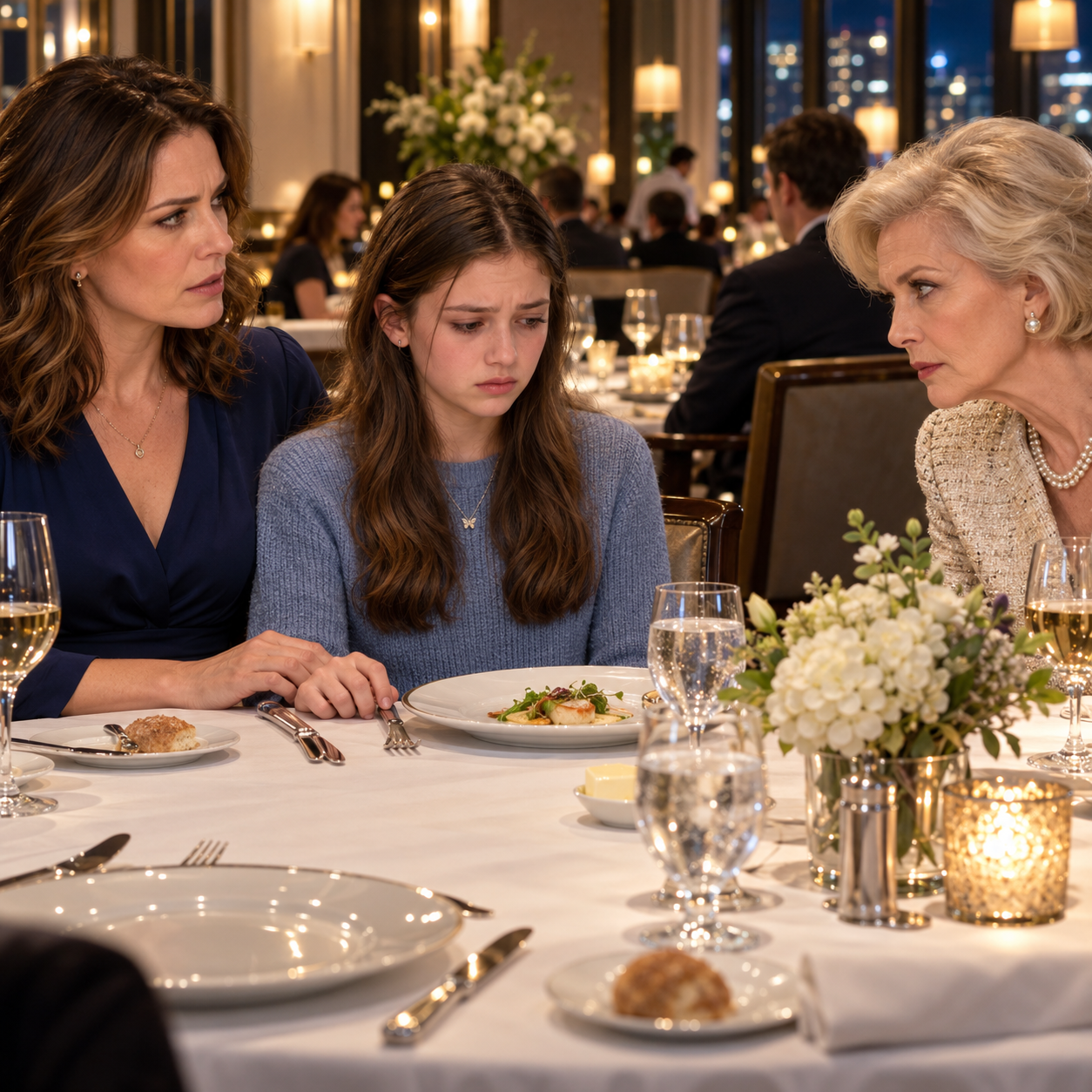
My mother looked across a restaurant table at my thirteen-year-old daughter and said, in the same pleasant voice she used to order coffee after church, “We don’t sit with mistakes.”
For one second, nobody moved.
Not my father.
Not my brother Chris.
Not Chris’s wife, Dana.
Not even the waiter who had been approaching with a tray and suddenly changed direction with the smooth instincts of someone who had spent years working around families in public.
Sole stared at her plate.
Her right hand rested beside her fork, trembling so slightly that I might have missed it if I had not spent six years learning every way she tried to hide pain.
I set down my water glass.
Then I stood.
“Sole, get your coat.”
My mother blinked.
“Oh, Marlo. Don’t be dramatic.”
The restaurant was one she loved because everything about it made ordinary people feel temporarily important. Amber pendant lights. Dark wood booths. White tablecloths. Wine glasses thin enough to make you nervous. A handwritten specials board near the bar with no prices on it.
My mother liked places where a hostess said her name before she gave it.
She liked being remembered.
My daughter had spent six years learning what it felt like not to be.
“You just called my daughter a mistake.”
My mother sighed and leaned back.
“She knows what I meant.”
“No. You know what you meant.”
My father kept looking at his napkin.
That was his skill.
Silence so consistent he had convinced himself it was neutrality.
Chris rubbed one hand across his forehead.
“Marlo, come on.”
That was all.
Not, Mom, that was too far.
Not, Sole, don’t listen to her.
Not even my daughter’s name.
Come on.
As if I were the embarrassing part.
I slipped my hand into Sole’s.
Her fingers were cold.
“Coat.”
She stood immediately.
That hurt too.
She did not argue about dessert.
Did not ask whether we could stay another ten minutes.
Did not roll her eyes like a normal thirteen-year-old whose mother had abruptly decided dinner was over.
She moved quickly and quietly, the way children move when they have learned that adult anger is easier to survive if they make themselves simple to remove.
We walked away from the table.
Behind me, my mother said, “I was talking about choices, Marlo. You twist everything.”
I kept walking.
Past the hostess stand.
Past an older couple pretending not to look at us.
Past the bar where someone shook a cocktail hard enough that ice rattled against steel.
Outside, the November cold hit us.
Our car was half a block away.
Sole walked beside me without speaking.
She wore an oversized denim jacket over a black sweater and had spent twenty minutes before dinner deciding whether her sneakers looked “too school.”
They did not.
She had asked me twice.
I had told her twice.
Now she walked with her head down, dragging one thumb along the cuff of her sleeve.
Once.
Twice.
Again.
One of her tells.
She did that when she was trying not to ask a question she feared might change something.
I unlocked the passenger door.
She climbed inside.
Carefully.
Almost apologetically.
Even in my car, she sometimes made herself look like a guest.
I got behind the wheel.
Started the engine.
Did not put it in gear.
The restaurant glowed through the windshield behind us. Warm windows. Moving silhouettes. Everyone inside continuing dinner as though nothing had happened.
Beside me, Sole kept rubbing her sleeve.
“Sole.”
“What?”
“You can say it.”
“I’m fine.”
I waited.
Six years of being her mother had taught me silence was not always a hole that needed filling.
Sometimes it was space a child needed before courage could fit inside.
Finally she whispered, “Am I?”
I turned toward her.
“Are you what?”
Her mouth tightened.
“A mistake.”
Something inside me became very still.
Not because the question surprised me.
Because some part of her believed the answer might be yes.
“Look at me.”
She kept looking forward.
“Sole.”
Slowly, she turned.
Her eyes were wet.
“You are not a mistake.”
“Grandma said—”
“I don’t care what Grandma said.”
“But maybe she meant—”
“No.”
My voice stayed gentle, but there could be no softness in the answer itself.
“No maybe. No hidden meaning. No interpretation. You have never been a mistake.”
A tear slipped down her cheek.
I reached across the center console.
“You are the best decision I ever made.”
That was when she broke.
Sole rarely cried loudly.
Even at seven, before the adoption was final, she had tried to cry quietly.
She folded inward, face turned toward the window as if she were still responsible for keeping her sadness from inconveniencing me.
I unbuckled my seat belt and leaned across.
She came into my arms.
At thirteen she was nearly as tall as I was.
Long legs.
Sharp elbows.
Shampoo that smelled like coconut because she had chosen it herself and considered my unscented products “depressing.”
But grief made her feel seven again.
And I remembered the first night she slept in my house.
She had arrived carrying one black trash bag of clothing, a grocery sack filled with school papers, and a purple backpack she refused to let anyone touch.
She was seven years old.
The county social worker told me the placement might be temporary.
“Could be a week. Could be months.”
I nodded as though that did not matter.
Everything mattered.
I had gone through foster-parent training.
Background checks.
Home inspection.
Classes about trauma.
Attachment.
Food insecurity.
Behavior.
Reunification.
Loss.
The practical vocabulary was clean.
Children were not.
They arrived carrying histories too large for backpacks.
Sole stood in my entryway that first night looking at the staircase.
“Where do I sleep?”
“Upstairs.”
“By myself?”
“If you want.”
She frowned.
“Where do you sleep?”
“Across the hall.”
“Door open?”
“If you want.”
That first week she slept with the hall light on.
The first month, she hid crackers inside the bottom drawer of her dresser.
I found them while putting away laundry.
I did not remove them.
The next grocery trip, I bought three boxes of crackers and put a basket in her room.
“You don’t need to hide food here,” I told her.
She stared.
“Can I keep these?”
“They’re yours.”
“All?”
“Yes.”
She did not believe me.
Trust did not arrive because adults announced safety.
It arrived in boring repetitions.
Breakfast was there again.
School pickup happened again.
The same towels remained in the bathroom.
I came back when I said I would.
She broke a lamp and I did not send her away.
She had a nightmare and I did not complain about being tired the next morning.
She yelled that she hated me and, an hour later, dinner still happened.
Eleven months after she arrived, adoption became possible.
The paperwork took longer than love.
When we sat in county court and the judge asked whether I understood the adoption was permanent, I looked at Sole.
She had both hands wrapped around the straps of that same purple backpack.
“Yes.”
The judge smiled.
Sole’s last name changed.
I became her mother legally.
But by then the legal word felt like a certificate recognizing something we had already been practicing every morning.
My parents never understood that.
Or maybe my mother understood and resented it.
At first, I blamed ignorance.
She came from a generation that had almost no language for adoption trauma, disrupted attachment, or foster care beyond television stories.
The first Christmas after Sole moved in, my mother bought my nephews personalized backpacks.
Chris’s boys had their names stitched in red thread.
Sole got a bath set.
Lavender body wash.
Two candles.
She was eight.
I stared at it beneath the tree.
My mother said, “I wasn’t sure what she likes yet.”
“She’s lived with me nine months.”
“I’m still getting used to all this.”
All this.
My daughter.
Sole thanked her.
Of course she did.
At home she wrote a thank-you note in purple marker.
Thank you for thinking of me. I hope you had a good Christmas. Love, Sole.
She struggled with the spelling of Christmas.
I sat beside her pretending not to cry.
The next year my mother forgot Sole’s birthday entirely.
My nephews each received twenty-five dollars on theirs.
When I confronted her, she laughed.
“I told you. I’m still adjusting.”
“To what?”
“This situation.”
“What situation?”
She stared at me like I was being difficult on purpose.
My father was quieter.
That made him easier to excuse.
He never asked the same grotesque questions my mother did.
He simply rarely used Sole’s name.
“That girl like soccer?”
“That girl still having trouble sleeping?”
“Is that girl coming Sunday?”
Once, after lunch, nine-year-old Sole came into the kitchen while I was washing dishes.
She stood beside me for almost a minute.
Then asked, “Does Grandpa know my name?”
I stopped.
“Of course.”
She nodded.
“Okay.”
That lie lived inside me for years.
I wish I had said:
He should use it more.
I wish I had said:
You noticed something real.
Instead, I protected my father from my daughter’s perception.
Adults call that keeping peace.
Children experience it differently.
My mother’s questions came when Sole was out of the room.
“Do children from backgrounds like hers ever attach normally?”
“Are you worried about genetics?”
“What happens when she finds her real family?”
That phrase.
Real family.
The first time she used it, I said, “I’m her real family.”
“You know what I mean.”
“No, I don’t.”
She rolled her eyes.
Another time:
“Have you ever thought about what you gave up?”
“What did I give up?”
She looked almost embarrassed for me.
“A normal marriage.”
I had been single when I adopted Sole.
I dated afterward.
One relationship lasted eighteen months.
We ended because he wanted to relocate and I did not.
Another man told me parenthood had “changed my availability.”
He was right.
We stopped seeing each other.
Neither relationship represented a life Sole stole.
But my mother treated every unmarried year as evidence of sacrifice.
I kept returning.
That was my mistake.
Not Sole.
Me.
I kept believing patience might eventually teach compassion.
I kept confusing endurance with hope.
Worse, I kept financing the same people who made my daughter feel like an unwanted guest.
My father’s car payment.
A portion of my parents’ utilities.
My mother’s prescription gap.
Chris’s phone plan after his divorce.
Occasional groceries.
A property-tax shortage one year.
None of it was enormous separately.
Together, over years, it became a system.
My parents had retirement income, but Dad had leased a car more expensive than they needed. Mom’s supplemental insurance had increased. Chris had child-support obligations and a messy divorce.
I earned well.
I was a senior operations director for a regional healthcare company outside Philadelphia.
Not wealthy.
Comfortable.
Organized.
Good with numbers.
The family fixer.
If something was due, I paid it.
If someone forgot, I remembered.
If Mom’s pharmacy rejected a coupon, she called me.
If Dad’s insurance paperwork confused him, he forwarded it.
If Chris needed to change phone plans, he said, “You’re better at this.”
I told myself family helped family.
What I did not understand was that my family’s definition of family had become one-directional.
Family meant I owed them help.
It did not mean they owed my child dignity.
A month before the restaurant dinner, I had finally warned my mother.
We were at her kitchen table.
Sunday.
Coffee.
Sole was upstairs with my nephews playing a video game.
My mother had just asked whether I worried Sole would “turn on me once she was older.”
I put down my mug.
“One more.”
She frowned.
“One more what?”
“One more cruel thing about Sole.”
“Marlo.”
“No.”
I kept my voice low.
“Listen.”
For once, she did.
“One more question about whether she’s really attached to me.”
“One more comment about genetics.”
“One more missed birthday followed by some explanation that you’re still adjusting.”
“One more time you call her ‘that child.’”
“One more gift meant to remind her she ranks below Chris’s boys.”
“One more.”
My mother stared.
“And what?”
“And we’re done.”
A tiny smile appeared.
“What does done mean?”
“It means no weeklong break. No apology followed by the same thing next month. No family dinner after everybody calms down.”
“Done.”
She leaned back.
“You would cut off your parents?”
“I would protect my daughter.”
“She isn’t—”
I stood so quickly my chair scraped the tile.
My mother stopped.
The unfinished word sat between us.
She corrected.
“Fine.”
“Your daughter.”
I leaned toward her.
“One more.”
Then I went upstairs.
Sole was laughing with her cousins.
I remember standing in the doorway thinking:
Maybe I got through.
I had not.
That night after the restaurant, Sole did not want to sleep upstairs.
She said the living-room television was better.
I let her have the excuse.
We watched half a movie.
She leaned against me beneath two blankets.
Around ten, she fell asleep.
I stayed still until my shoulder hurt.
At 10:14, my phone vibrated.
Dad.
I expected something clumsy.
Your mother went too far.
Is Sole okay?
Call when you can.
Instead:
You’re still making the car payment tomorrow, right?
I stared.
Read it again.
Then looked down at Sole.
Her eyelids were swollen from crying.
One hand rested beneath her cheek.
My father had watched his granddaughter leave a restaurant after being called a mistake.
Three hours later, his concern was whether my money would arrive before the auto lender pulled payment.
Something changed.
No explosion.
No screaming.
No revenge speech.
I simply became tired.
Tired of financing adults who treated my daughter like a defect.
I carefully moved Sole’s head onto a pillow.
Went to the kitchen.
Opened my laptop and banking apps.
Dad’s car payment was scheduled for morning.
Canceled.
Parents’ utility transfer.
Canceled.
Mom’s pharmacy card.
Removed.
Chris’s phone plan.
Canceled my autopay.
I checked every recurring transaction.
Every stored payment method.
Every shared login.
I changed passwords.
My parents still had their own accounts.
I did not take their money.
I stopped giving mine.
That difference mattered.
By midnight, I had blocked Mom, Dad, and Chris on my personal phone.
Then I remembered something Sole had mentioned a few weeks earlier.
“Grandma’s been texting me.”
I had been making spaghetti.
Work phone ringing.
Water boiling over.
I asked, “Everything okay?”
Sole shrugged.
“She asks weird stuff.”
I said, “Tell me if anything bothers you.”
Then went back to dinner.
Sitting in the dark kitchen after midnight, I realized how badly I had underestimated weird stuff.
Sole’s phone rested on the coffee table.
I hated the idea of opening it.
She was thirteen.
Privacy mattered.
But an adult who had just called her a mistake had been privately contacting her.
Protection mattered more.
I knew her passcode.
She knew mine.
The message thread sat near the top.
Grandma.
I opened it.
Three messages within one month.
The first:
Do you ever feel different from the other kids because you don’t know where you really come from? You can always tell Grandma things you might not want to tell Marlo.
My jaw tightened.
The second arrived ten days later:
Your mom loves you, of course, but sometimes adults make choices because they feel sorry for children. That can get confusing later. If you ever wonder whether you were chosen for the right reasons, you can ask me.
Sole had answered:
My mom chose me because she loves me.
My mother replied:
I’m sure that’s what she tells you.
I stopped.
Read it twice.
Then the third.
Three days before dinner.
Families can be complicated. Sometimes one choice changes what everyone else gets to have. Your mom could have had a very different life. Don’t ever blame yourself, sweetheart. Children aren’t responsible for adult sacrifices.
Sacrifices.
My mother had not lost control at dinner.
This was not one bad sentence after wine.
She had been planting the idea.
Different.
Pity.
Chosen for the right reasons.
Different life.
Sacrifices.
Then:
We don’t sit with mistakes.
I took screenshots.
Every date.
Every message.
Every answer.
Forwarded them to my email.
Saved them to a private cloud folder.
Not because I planned to expose my mother online.
Because families rewrite history when the original is inconvenient.
I wanted the original.
I sat at the kitchen table until nearly dawn.
By six-thirty, my own phone showed twenty-nine blocked calls.
Mom.
Dad.
Chris.
I did not listen to voicemail.
Then Sole’s phone lit up.
Grandma.
A new message preview.
See what happened last night? Your mother is fighting with her whole family because of you. If you really love her, maybe you should stop making her choose.
For the first time in six years, I did not feel hurt.
I felt certain.
My mother had crossed from prejudice into deliberate emotional manipulation of a child.
And she had done it privately because she knew I would stop her.
At 7:05, I searched for a number I had not used in years.
Dr. Lena Morris.
Sole’s former therapist.
Lena worked with children who had experienced foster care, adoption, and early instability.
Sole saw her for almost two years during placement and after adoption.
I had liked Lena immediately because she did not talk about adopted children like damaged objects.
At our first appointment, she told me:
“Children with disrupted attachments often notice rejection before adults do.”
“Sometimes before the person rejecting them admits it.”
I had remembered that sentence.
Not enough.
I texted:
This is Marlo Bennett. You worked with my daughter Sole several years ago. Something happened with a family member and I need advice. Could you call when possible?
She called twenty minutes later.
“Marlo?”
Hearing her voice nearly broke me.
“Hi.”
“What happened?”
I told her everything.
Restaurant.
Comment.
Texts.
I read them aloud.
After the final message, Lena was silent.
Then:
“Has Sole seen that last one?”
“No.”
“Good.”
“Was I wrong to look at her phone?”
“In ordinary circumstances, that’s a parenting question.”
“In this circumstance, an adult was privately undermining your child’s security in her primary attachment relationship.”
My fingers tightened.
“Say that another way.”
“Your mother was trying to make Sole doubt whether your love was real.”
Clinical language can sometimes hurt more because it removes the fog.
I sat on the edge of my bed.
“I kept thinking she didn’t understand adoption.”
“That might have been true years ago.”
“And now?”
“Now you have a behavioral pattern.”
“What do I do?”
“First, Sole cannot leave this believing she caused a family rupture.”
“She needs to know the adults are responsible for adult behavior.”
“Second, give her age-appropriate truth.”
“Do not make promises about permanent estrangement if you are not certain, but do not minimize what happened.”
“Third, private contact from your mother should stop.”
“I agree.”
“And Marlo?”
“Yes?”
“Do not turn Sole into evidence against your family.”
That surprised me.
“What does that mean?”
“Don’t ask her to prove how hurt she is so other adults believe you.”
“Don’t make her repeat messages to relatives.”
“Don’t let the conflict become her identity.”
“She needs to return to being thirteen.”
That sentence stayed.
At 8:30, Sole walked into the kitchen wearing mismatched socks and the gray sweatshirt she stole from me whenever she was upset.
Her hair looked like she had slept in a wind tunnel.
She opened the refrigerator.
“Do we have waffles?”
“Yes.”
She put two in the toaster.
I waited until she had eaten half of one.
Then:
“Sole.”
She looked up.
“I saw Grandma’s messages.”
Her fork stopped.
Fear crossed her face.
Not anger.
Fear.
“You looked at my phone?”
“Yes.”
She dropped her eyes.
“I’m sorry.”
“For what?”
“I didn’t tell you.”
I moved my chair closer.
“You are not in trouble.”
Her eyes filled immediately.
“I thought if I told you, you’d fight with her.”
“You were protecting me?”
She shrugged.
“I knew you’d get mad.”
“At you?”
“No.”
“And if I got angry at Grandma, you thought that would be your fault.”
Another shrug.
Smaller.
I had spent six years trying to teach this child she was not responsible for adult emotions.
My mother had spent a month teaching the opposite.
“Grandma sent you another message this morning.”
Sole’s face changed.
“What?”
I chose the truth she could carry.
“She said the family fight happened because of you.”
Her face went pale.
I grabbed her hand.
“And that is a lie.”
“But you left because of me.”
“I left because of Grandma’s behavior.”
“She said it because I was there.”
“She chose the words.”
Sole looked at the table.
“If I wasn’t here, you wouldn’t be fighting.”
I leaned closer.
“If someone insulted me and you defended me, would that mean I caused the fight?”
“No.”
“Why?”
“Because they shouldn’t insult you.”
“Exactly.”
She was quiet.
Then:
“I didn’t like when Grandma texted.”
“Why didn’t you tell me?”
“She said you would be sad if I made things worse.”
Of course.
“What else did she say?”
Sole’s hands folded.
“She called once.”
“When?”
“Couple weeks ago.”
“What did she say?”
“That maybe I should think about my first mom.”
I breathed slowly.
Sole knew her biological mother’s first name.
We had some records.
One photograph.
A few medical details.
I had always told her curiosity was welcome.
Her first family was not competition.
“What exactly?”
“She said maybe I’d feel more normal if I knew where I really belonged.”
My chest tightened.
“She said you gave up a lot for me.”
“What?”
“She said maybe you would’ve gotten married if you didn’t adopt me.”
I stood and walked to the sink.
Three seconds.
That was all I allowed myself with my back turned.
Then I came back.
“None of that is true.”
Sole watched.
“I did not lose a husband because of you.”
“I did not give up a family because of you.”
“I did not lose some secret better life because of you.”
“But you—”
“No.”
I crouched beside her.
“The life I have with you is my life.”
Her face crumpled.
“I chose adoption.”
A tear rolled down.
“I chose you.”
Another.
“And I would choose you again.”
She came into my arms.
After a while:
“Are we going to Grandma’s again?”
“No.”
She pulled back.
“Ever?”
I had warned my mother.
One more.
She gave me several.
“I don’t know what the rest of our lives will look like.”
I said.
“But you will not see her now.”
“And you will never be required to see her simply because she is related to me.”
Sole nodded.
Relief moved through her face before sadness did.
That told me how heavy the relationship had already become.
My phone buzzed with an unknown number.
Then again.
Voicemail.
Chris.
“Marlo, I know you blocked us. Mom and Dad are losing their minds. Dad’s car payment didn’t go through. Mom’s pharmacy card got declined. My phone company says autopay was removed. What the hell?”
I deleted it.
Another voicemail.
“Seriously? You’re punishing everyone because Mom said one stupid thing?”
I saved that one.
One stupid thing.
That was how families like mine survived themselves.
Patterns became incidents.
Cruelty became misunderstandings.
Silence became neutrality.
Dependence became generosity.
Consequences became punishment.
By noon, someone knocked hard on my front door.
Three knocks.
Pause.
Three.
Doorbell.
I checked camera.
Dad.
Sole stood at top of stairs.
I looked at her.
“You okay?”
She nodded, but one hand wrapped around the banister.
“Stay up there.”
Dad knocked again.
“Marlo!”
I answered through the door.
“No.”
“I want to talk.”
“No.”
“You canceled the car payment.”
“Yes.”
“You cannot just do that.”
“It is your lease.”
“You said you would help.”
“I did.”
“For years.”
“Yes.”
“What am I supposed to do now?”
“Pay for your car.”
His voice lowered.
“Open the door.”
“No.”
“We are your parents.”
“And Sole is my daughter.”
“That has nothing to do with the car.”
“It has everything to do with why I’m done paying it.”
Silence.
Then:
“This is because of your mother.”
“No.”
“It is because of me.”
“What does that mean?”
“It means I kept funding people who accepted my money while allowing my daughter to be treated as less than family.”
“I never treated her badly.”
“You never stopped it.”
“That is between you and your mother.”
“No.”
“If a thirteen-year-old is called a mistake at your dinner table and you stare at your napkin, you are part of what happened.”
“She didn’t mean it.”
I opened the door.
Security chain remained latched.
Dad stood in yesterday’s jacket.
Tired.
Angry.
Confused.
“Did you know Mom was privately texting Sole?”
His expression shifted.
Tiny.
Enough.
“You knew they texted.”
“Yes.”
“What did she say?”
“I don’t know.”
I pulled out my phone.
Showed the screenshots through the opening.
He read the first.
Then second.
His mouth tightened.
At the last one, he looked away.
“That was unnecessary.”
I laughed.
“Unnecessary?”
“I’m saying she shouldn’t have sent it.”
“Call it what it was.”
“Marlo.”
“Say what she did.”
His eyes hardened.
“What do you want me to say? My wife is a monster?”
“I want you to call cruelty cruelty.”
“She loves you.”
“This is not about whether Mom loves me.”
“She feels like you’ve been pulling away for years.”
“I have been pulling away because she hurts Sole.”
“She doesn’t understand.”
“She understood enough to contact Sole privately so I wouldn’t hear what she was doing.”
No answer.
A floorboard creaked behind me.
Sole stood halfway down the stairs.
Dad saw her.
Everyone froze.
Then she asked:
“Grandpa?”
His face softened.
“Yes?”
“Do you know my name?”
The color left his face.
“Of course.”
“Then why don’t you use it?”
Dad opened his mouth.
Nothing.
Sole nodded once.
Went upstairs.
My father stared after her.
I closed my eyes.
“Go home.”
“Marlo.”
“Please.”
For once, he listened.
Chris contacted me through another number that afternoon.
Mom says you’re threatening to show people private messages.
I had threatened nothing.
Interesting.
My mother feared the screenshots before I had shown them to anyone beyond Dad.
That meant she understood exactly how they looked.
The family story began changing by the second day.
According to Chris, Mom had been “trying to help Sole understand adoption.”
According to Dad, I had “misinterpreted clumsy wording.”
An aunt texted that my mother had “concerns about identity.”
Nobody mentioned the restaurant.
Nobody mentioned mistake.
Nobody mentioned the morning message blaming Sole.
So I stopped debating interpretation.
I sent Chris the screenshots.
No explanation.
Five minutes later he called.
“Did Mom really send these?”
“You see the number.”
“Maybe there’s context.”
“There is.”
“What?”
“She sent them privately to a thirteen-year-old after I explicitly told her to stop treating Sole as less than my daughter.”
Chris sighed.
“Okay.”
I waited.
“She shouldn’t have done that.”
“No.”
“But canceling everything overnight was extreme.”
There.
“How much is your phone bill?”
“What?”
“Monthly.”
“About a hundred forty.”
“How long have I paid it?”
Silence.
“Two years?”
“Almost three.”
“I paid Dad’s car for twenty-six months.”
“Mom’s pharmacy gap for three years.”
“Their utilities for nearly four.”
“I know.”
“No.”
“You know money appeared.”
“That is different.”
“Marlo.”
“When Mom forgot Sole’s birthday, what did you do?”
Nothing.
“When your boys opened personalized gifts and Sole opened soap, what did you do?”
“That wasn’t my decision.”
“When Dad called her ‘that girl,’ what did you do?”
“I didn’t hear that.”
“At dinner?”
He exhaled.
“I told you to calm down.”
“Yes.”
“That doesn’t mean I agreed with Mom.”
“It means you preferred Sole hurt quietly over the adults being uncomfortable loudly.”
“That’s unfair.”
“So was the table.”
He went silent.
I lowered my voice because Sole sat in living room doing homework with headphones.
“I’m not asking you to choose between me and Mom.”
“It feels like you are.”
“I am choosing between protecting the family I came from from consequences and protecting the child I am responsible for.”
“That choice was made six years ago.”
He did not answer.
“You’re an adult.”
“Dad is an adult.”
“Mom is an adult.”
“If losing my financial help creates a crisis, perhaps all of you became too comfortable expecting money from the person whose daughter you treated worst.”
“That’s harsh.”
“So was calling her a mistake.”
“One sentence.”
“No.”
“That is the point.”
“It was not one sentence.”
I hung up.
The next week, the house became quieter.
Not peaceful yet.
Quiet.
Sole watched me whenever the phone rang.
Whenever a car slowed near the driveway.
I made one rule.
“We don’t organize our days around them.”
She looked up from cereal.
“What does that mean?”
“If they call while we eat, we keep eating.”
“If they knock while we watch a movie, we keep watching unless we choose otherwise.”
“If they are angry, we do not rearrange ourselves to make their anger easier.”
She smiled.
“That sounds like Dr. Morris.”
“She’s smarter than I am.”
“Definitely.”
“Rude.”
She grinned.
There.
My daughter.
Not adoption.
Not family conflict.
Not mistake.
Just thirteen.
Three days after dinner, she told me something else.
We were folding laundry.
Technically I was folding.
She was arguing that frequently worn shirts did not need folding because they would be used again.
“Grandma asked me if I wanted to meet my birth mom.”
I stopped.
“When?”
“Before Christmas.”
Earlier than the messages.
“What did she say?”
“That if you really loved me, you wouldn’t be scared of me knowing my real family.”
I sat.
Sole immediately said:
“I know you’re real family.”
“I know.”
“What if I want to know things later?”
“We find out what we safely can.”
“What if it makes you sad?”
“It might.”
She looked surprised.
I smiled.
“I can be sad and still help you.”
“You don’t have to protect me from every feeling.”
She looked down.
“Grandma said you’d be scared I’d leave.”
“Maybe I would be.”
Her head lifted.
“But fear is my responsibility.”
“Not yours.”
I took her hand.
“You never have to make yourself smaller so I feel secure.”
She swallowed.
“Okay.”
“And you do not have to hate Grandma because I’m angry.”
“I don’t.”
“I just don’t want to see her.”
“That is enough.”
Dad left a voicemail that evening.
Different tone.
“The bank called about the car. I’ll figure it out.”
Pause.
“I think we should talk eventually.”
Eventually.
Not today.
Mom chose another route.
Relatives.
Your mother is devastated.
She only wanted to help.
You’re keeping Sole from grandparents who love her.
Your father may have to return the car.
I answered none.
Until Aunt Renee called.
Mom’s younger sister.
Renee had always treated Sole more normally.
Not perfectly.
But birthday cards.
Same-dollar gifts.
Asked about school.
Used her name.
I answered.
“Your mother says you cut them off because she used the word mistake.”
“That’s part.”
“She says there’s context.”
“There is.”
“What?”
I texted screenshots.
Stayed on phone.
Silence grew with each.
Finally:
“Oh.”
That one word held more accountability than my parents had managed.
“She sent these directly to Sole?”
“Yes.”
“Without telling you?”
“Yes.”
“And the last one after dinner?”
“Yes.”
Renee breathed slowly.
“Marlo, I’m sorry.”
I closed my eyes.
“Thank you.”
“She told me you were turning Sole against the family.”
“I have not asked Sole to turn against anyone.”
“I know.”
Then Renee said:
“Your mother has always been good at making the person who reacts look like the problem.”
I sat very still.
“You know?”
“She did it when we were kids.”
Memory shifted.
Mom insulting my clothes, then accusing me of ruining dinner when I cried.
Mom criticizing Dad until he left the room, then saying he abandoned her.
Mom humiliating Chris in front of cousins, then calling him disrespectful when he snapped.
It had always been there.
Sole did not create the pattern.
She simply gave me a reason strong enough to stop participating.
Renee said:
“She thinks you’ll come back.”
“I know.”
“She keeps saying you always do.”
I looked at Sole’s backpack by the door.
Not this time.
My mother arrived the following Sunday.
Paper shopping bag.
Doorbell.
I ignored.
Another knock.
“Marlo.”
Nothing.
Then:
“I need to see my granddaughter.”
I walked to the door.
Opened it with chain latched.
“She does not want to see you.”
Mom’s face tightened.
“You told her not to.”
“No.”
“She is thirteen.”
“Yes.”
“She is not old enough to make decisions like this.”
“About who she feels safe around?”
“She is.”
Mom shook her head.
“You poisoned her against me.”
I almost admired how efficiently Sole’s emotions were erased.
“You sent messages telling her I adopted her out of pity.”
“That is not what I said.”
“You implied she cost me a real life.”
“I said adults sacrifice for children.”
“You told her she may be why I never married.”
“I never said why.”
“You told her she caused the family conflict.”
My mother looked away.
“I was emotional.”
“She’s thirteen.”
“So?”
The word landed between us.
Mom heard it too late.
“So?”
I repeated.
She recovered.
“I mean teenagers understand consequences.”
“Whose?”
“Marlo, you walked out.”
“You canceled accounts.”
“Your father had to restructure his car loan.”
“Chris’s phone was disconnected for a day.”
“You think those things affect no one?”
“Adult problems.”
“They happened because you overreacted.”
“They happened because I stopped paying.”
“Because of her.”
There.
Not Sole.
Her.
The interruption.
The inconvenience.
The child who had changed the family arrangement.
I felt sad more than angry.
“Say her name.”
My mother frowned.
“What?”
“My daughter has a name.”
“Say it.”
She stared.
“Sole.”
“Good.”
I unlatched chain.
Stepped onto porch.
Closed door behind me.
“You will not contact Sole privately again.”
“I’m her grandmother.”
“No.”
“You cannot erase that.”
“I do not need to erase anything.”
“I need to protect her.”
“You’ve always been too emotional about this adoption.”
“And you have always used the word adoption as permission to treat my child like she is temporary.”
“I treated her as family.”
“No.”
“You treated her as someone I brought with me.”
My mother’s eyes filled.
Years earlier, tears would have ended the conversation.
I would soften.
Apologize for my tone.
Make coffee.
Find a compromise that let her avoid responsibility.
Not now.
“I love you.”
I believed her.
That was the painful part.
People can love you and still be unsafe.
“I love you too.”
Hope flashed across her face.
Then:
“But loving you does not give you access to Sole.”
Hope vanished.
“After everything I’ve done for you.”
The ledger.
Invisible.
Permanent.
Every meal.
School uniform.
Christmas.
Motherhood as debt.
“What happens when Sole grows up and leaves you?”
The question was meant to wound.
It did not.
“If I do my job right, she will grow up knowing she never has to stay somewhere because someone made her feel guilty for leaving.”
Mom stared.
No answer.
I went inside.
Locked the door.
For almost two weeks, she disappeared.
Dad paid his car.
Mom found another prescription discount and adjusted insurance during open enrollment.
Chris paid his phone.
Nobody became homeless.
Nobody starved.
The “crises” I had been preventing turned out to be inconveniences once I stopped solving them.
That realization changed me almost as much as anything.
They could survive.
They preferred being helped.
Different.
Sole changed too.
Not dramatically.
Healing inside a home rarely does.
She started singing in the bathroom again.
Left her bedroom door open.
Stopped looking at my face every time my phone buzzed.
One Saturday, I found flour across the kitchen.
Counter.
Floor.
Possibly refrigerator handle.
Sole held a whisk.
“What happened?”
“Pancakes.”
“This looks like evidence.”
“It’s creative.”
“Why is there flour on the fridge?”
She stared.
“I don’t know.”
Then laughed.
Careless.
Loud.
Thirteen.
Exactly right.
That afternoon, she asked if we could rename Grandma’s contact.
“To what?”
“Blocked.”
We blocked it together.
No ceremony.
A week later, she saw Lena Morris.
I waited in lobby.
Did not demand details afterward.
Privacy had returned now that danger was known.
In the car, Sole stared ahead.
Then:
“She said guilt and love aren’t the same thing.”
“That sounds like Lena.”
“I think Grandma made me feel guilty a lot.”
“I think so.”
“Did she do that to you?”
I hesitated.
“Yes.”
“For how long?”
“Long enough that I didn’t always recognize it.”
Sole looked out the window.
“You recognized it for me.”
I had to look away for a second.
“Yes.”
The larger family confrontation never happened in one scene.
Truth came out because people compared stories.
Renee knew screenshots.
Chris knew.
Dad had seen.
Mom gave different explanations.
To Renee:
She was encouraging identity exploration.
To Chris:
Messages taken out of context.
To Dad:
She wanted Sole to become less emotionally dependent on me.
Chris called.
“I talked to Mom.”
“Okay.”
“She said something weird.”
“What?”
“She says Sole is too attached to you.”
Cold moved through me.
“What does that mean?”
“She said kids with abandonment history can get possessive.”
My mother had taken psychological vocabulary she barely understood and turned it into a weapon.
Chris continued.
“She says she was trying to help Sole realize you might want a life beyond being her mother.”
Then it clicked.
The messages.
Different.
Pity.
Sacrifice.
Marriage.
Stop making her choose.
Mom was not only trying to make Sole doubt my love.
She was trying to make Sole withdraw from me.
Why?
Because every time Mom pushed, I chose Sole.
Mom had decided Sole caused the distance.
Instead of changing her behavior, she tried to change my daughter.
“Chris.”
“Yeah?”
“Did I ever tell you Sole was too attached?”
“No.”
“Did I ever say I regretted adopting?”
“No.”
“Did I ever say she kept me from marriage?”
“No.”
“Then where did Mom get this?”
Silence.
Then Chris said:
“I should’ve said something at dinner.”
I waited.
“I knew Mom was being cruel.”
“I wanted everybody to stop.”
“I wanted dinner not to blow up.”
“That was cowardly.”
My throat tightened.
“Yes.”
“I’m sorry.”
No but.
No explanation.
Two words.
Useful.
“Thank you.”
“Can I apologize to Sole?”
“That is her choice.”
“Can you tell her I want to?”
“Yes.”
The next morning, I told her.
She considered it while eating cereal.
“Does he want me to say it’s okay?”
“I don’t know.”
“What if I don’t?”
“Then you don’t.”
“Can he text?”
“Yes.”
Chris wrote:
I should have defended you at dinner. What Grandma said was wrong, and telling your mom to calm down was wrong too. You did not cause the fight. You don’t have to answer. I just wanted to tell you I’m sorry.
Sole read twice.
Did not answer that day.
Did not block him either.
Her choice.
Dad took longer.
Three weeks after dinner, a handwritten letter arrived.
The first page worried me.
Financial stress.
Mom devastated.
Family forgiveness.
I almost stopped.
Second page:
When Sole asked whether I knew her name, I didn’t sleep that night.
I sat down.
I kept telling myself I never treated her badly because I never said the things your mother said. Then I remembered the birthdays. The Christmas gifts. Calling her “that girl.” Hearing things and leaving the room. I thought staying out of it meant I wasn’t part of it.
I was wrong.
Then:
I texted you about the car before I asked whether Sole was okay. I have tried to find a good explanation and I don’t have one.
I read that three times.
He ended:
I am not asking you to bring Sole here. I am not asking you to pay anything. I want you to know I understand why you left.
I cried.
Not because everything was fixed.
Because accountability had finally entered.
Late that evening, Sole saw my face.
“You okay?”
“Yes.”
“You’re crying.”
“Observant.”
She sat.
I gave her the letter.
“You do not have to read.”
She did.
Slowly.
At the end, she traced her finger across one line.
“He used my name.”
“Yes.”
“Twice.”
I had not counted.
She had.
Children notice rejection early.
Perhaps they notice effort too.
“What do you want to do?”
“Nothing yet.”
“Okay.”
She leaned against me.
We sat.
That could have been an ending.
Dad accountable.
Chris apologized.
Mom cut off.
Sole healing.
But Mom was not finished.
A month after dinner, Renee called.
“You should know before someone else tells you.”
“What?”
“Your mother is telling people Sole manipulated you.”
For a second, I could not understand.
“Sole manipulated me?”
“She says Sole has abandonment issues.”
“That she wants you to herself.”
“That she deliberately turned you against family.”
My mother had gone from attacking a child privately to blaming the child publicly for reacting.
Renee said:
“I told her to stop.”
“Did she?”
“No.”
I felt something settle.
If I stayed completely silent now, my silence would become the blank paper Mom used to write her version.
I did not post screenshots publicly.
I did not send them to church friends.
I did not put Mom on Facebook.
I created one group message.
Dad.
Chris.
Renee.
A few relatives who had contacted me directly.
Mom.
Then:
Since Sole is now being blamed, I am clarifying this once. Sole did not cause the conflict. She did not ask me to leave the restaurant. She did not ask me to cancel anyone’s bills. She did not ask me to cut contact.
Screenshots attached.
Including:
Your mother is fighting with her whole family because of you.
Then:
These messages were sent privately by an adult to a thirteen-year-old. Sole will not be discussed as the cause of adult choices again. I will not debate this.
Send.
My hands did not shake.
Renee:
Understood.
Chris:
She’s right.
Dad, fifteen minutes later:
Leave Sole out of this.
Mom stayed silent three hours.
Then:
I was only trying to protect my daughter.
There were a hundred things I wanted to say.
That I was her daughter.
That Sole was mine.
That hurting my child could not protect me.
That control had dressed itself as concern for so many years she might no longer know the difference.
Instead:
Then you should have listened to me.
I blocked her.
Months passed.
The restaurant remained in small ways.
Sole stopped ordering pasta because that was what she had been eating.
The phrase real parents at school could make her quiet.
First family birthday after cutoff made her anxious.
Healing does not erase wounds.
It teaches you to stop reopening them.
Dad paid his own car.
Mom changed pharmacies.
Chris handled phone.
Nobody collapsed.
Chris and I rebuilt slowly.
Not old relationship.
Old relationship required me to swallow things.
New one had rules.
He could visit.
Invite us.
But if he minimized, conversation ended.
If Mom appeared, we left.
If Sole wanted home, home.
His boys adapted faster than adults.
They asked why Grandma was not around.
Chris said:
“She and Aunt Marlo are taking space because Grandma made some hurtful choices.”
That was enough.
No villain recruitment.
Dad took longer.
Sole eventually wrote him back:
I read your letter. Thank you for saying my name. I am not ready to visit yet.
Dad:
Okay. I’ll wait until you are.
No guilt.
I saved that message.
Not because trust returned.
Because learning had started.
Mom sent Sole a birthday card.
First one I returned unopened.
Second had no guilt.
No accusation.
No request.
I gave it to Sole.
She put it in a drawer unopened.
I did not force.
Forgiveness and access are different.
I learned that.
You can stop rehearsing anger without reopening your door.
On the first anniversary of the restaurant dinner, Sole asked me in the car:
“Remember what you said?”
“What?”
“That night.”
“Unfortunately.”
“In the car.”
I frowned.
“You said I was the best decision you ever made.”
“I remember.”
She looked out window.
“Did you mean it?”
After everything, an echo remained.
I pulled into an empty shopping-center lot.
“What are you doing?”
“Answering properly.”
Park.
Turned toward her.
“Yes.”
She smiled.
“But I want to correct something.”
Her smile faded.
“What?”
“You were not one decision.”
She frowned.
“I don’t get it.”
“Becoming your mom was thousands of decisions.”
I took her hand.
“I chose you when I signed foster paperwork.”
“When you screamed because you thought I would send you away after you broke the bathroom mirror.”
“I did not scream.”
“You threatened Canada.”
“I was seven.”
“You had twelve dollars.”
“That was a lot.”
I laughed.
“I chose you when you got flu and threw up on me.”
“Three times.”
“Thank you.”
“I chose you on adoption day.”
“Through bad report cards.”
“Good ones.”
“Nightmares.”
“Birthdays.”
“Every argument about bedtime.”
She groaned.
“Bedtime was years ago.”
“It remains on your permanent record.”
“That’s abuse.”
“Nice try.”
She smiled.
Then I squeezed her hand.
“And I chose you when Grandma tried to make me choose.”
Her smile disappeared.
“That was Grandma’s biggest mistake.”
Sole waited.
“She thought loving you was one decision I might regret if she made the cost high enough.”
I shook my head.
“She did not understand.”
“What?”
“You were not standing between me and family.”
“You are my family.”
A tear slipped down.
This time Sole did not turn toward window.
Did not apologize.
She cried.
I held her.
After:
“Dr. Morris says sometimes people repeat things because they’re trying to believe them.”
“That sounds right.”
“I kept saying I didn’t care what Grandma thought.”
“But you did.”
“Yeah.”
“That is okay.”
She nodded.
“Now I think I actually don’t.”
I smiled.
“That is different.”
Then:
“Do you?”
“Do I what?”
“Care what Grandma thinks?”
I considered lying.
No more comforting lies.
“Sometimes.”
Sole nodded.
“That is okay too.”
I laughed.
“When did you get wise?”
“Trauma.”
I stared.
She grinned.
“Too dark?”
“A little.”
We sat.
Then:
“Fries?”
“That’s why you engineered this emotional conversation?”
“Maybe.”
“You manipulated me.”
Her face changed.
Instant.
The word landed wrong.
I saw it.
She saw I saw.
“Bad joke.”
I said.
She exhaled.
“Yeah.”
“I’m sorry.”
“Okay.”
That mattered.
Not building a house where nobody ever hurt each other.
Building one where harm was named and repaired.
We got fries.
Ordinary life continued.
Ordinary was what I had always wanted for Sole.
A home where breakfast did not need earning.
A mother whose love survived arguments.
A bedroom she could paint without wondering how temporary it was.
Birthdays where every child received something chosen with care.
Dinners where she did not prove belonging.
For years I thought keeping my parents in our life helped give her family.
I was wrong.
Family is not number of occupied chairs.
It is whether people in those chairs let a child take up space.
After cutoff, Sole began taking up more.
She laughed louder.
Argued more.
Left shoes everywhere.
Invited friends without asking me six times.
Used good blankets instead of preserving them for guests.
Stopped thanking me every time I bought toothpaste.
At first, that last one bothered me absurdly.
Then I realized gratitude had been part of survival.
Children who fear losing care thank adults for necessities.
Children who feel secure complain you bought the wrong cereal.
I celebrated the wrong cereal complaint.
Quietly.
Do not tell her.
Lena returned for periodic therapy.
Not because Sole was broken.
Because Grandma had poked exactly where early instability had once lived.
One session, Lena asked me to join the final fifteen minutes.
She told Sole:
“Your grandmother’s behavior does not mean adoption made you vulnerable to being less loved.”
Sole said:
“I know.”
Lena smiled.
“Knowing in your head and trusting in your body can take different lengths of time.”
I wrote that down later.
My body learned too.
For months, a call from unknown number made my chest tighten.
Mom appearing in grocery-store aisle once made my hands shake.
We did not speak.
She saw me.
I saw her.
She turned down another aisle.
I cried in car afterward.
That did not mean boundary wrong.
Sometimes sadness is simply price of accepting reality.
Renee remained connected to both of us.
I told her I did not want reports about Mom unless there was illness or emergency.
Important.
Estrangement can become another form of obsession if every cousin becomes an intelligence source.
I did not need weekly updates.
Mom joined a new book club.
Dad stayed.
Chris visited.
Fine.
Their life could continue outside mine.
I wanted ours.
Dad and Sole eventually met again.
Eight months after letter.
Sole asked.
Not me.
“Could Grandpa come to Chris’s baseball game?”
“You mean your cousin’s?”
“Yes.”
“He’ll probably be there.”
“I know.”
“Do you want to talk to him?”
“Maybe.”
We planned nothing.
At game, Dad sat three rows away.
Did not approach.
At seventh inning, Sole went to concession stand.
Returned with two lemonades.
One for herself.
One she carried toward him.
I watched from distance.
She handed it.
They spoke five minutes.
No hug.
Then she came back.
“What did he say?”
“Stuff.”
I stared.
“Private?”
“Yes.”
Fair.
Later, Dad texted:
Thank you for letting her decide.
I responded:
She is learning that people can repair things without pretending they never broke them.
He wrote:
So am I.
Trust returned by installments.
Dad’s birthdays.
Neutral lunches.
One Christmas coffee.
Never at Mom’s house.
He stopped asking.
That mattered.
Chris became one of Sole’s safer adults.
Not because biology.
Because behavior.
When she got her learner’s permit, he let her practice in a huge church parking lot.
She nearly hit one cone.
Chris shouted.
Sole said:
“You’re supposed to remain calm.”
He said:
“I apologized for one dinner, not for my nervous system.”
She laughed.
I watched from curb.
Family can regrow in strange shapes.
Mom remained outside.
For two years.
She sent letters occasionally.
The early ones still defended herself.
I was trying to help.
You have always misunderstood me.
I never meant Sole harm.
I stopped reading after first page.
Then, near the third year, a different letter came.
No justification.
Marlo,
I have spent a long time trying to explain myself because explaining felt easier than admitting what I did.
I was jealous of Sole.
I have hated writing that sentence.
I was jealous that you built a life where being her mother mattered more than being my daughter.
I treated her as the reason you moved away from me instead of asking why you needed distance.
I tried to make her feel uncertain because I thought uncertainty would make her need you less.
That was cruel.
She was a child.
I knew better.
I am sorry.
I do not expect access.
Mom.
I sat at kitchen table for a long time.
Sole was sixteen by then.
Driving.
Applying to summer programs.
Completely capable of reading the letter.
I did not hide it.
“Do you want to see?”
She read.
Then:
“Do you believe her?”
“I believe she finally named what she did.”
“That’s not what I asked.”
Smart child.
“I don’t know if I trust change yet.”
Sole nodded.
“Me neither.”
“What do you want?”
She folded letter.
“Nothing right now.”
So nothing.
Six months later, Sole asked whether she could write.
Her letter was short.
I’m glad you understand what happened. I am not ready to see you. Please don’t send messages through other people. I will contact you if I want to.
Mom respected it.
That was first evidence.
One year.
No pressure.
No surprise gifts.
No visits.
On Sole’s seventeenth birthday, Mom sent a card to me first.
Would Sole be comfortable receiving this? If not, please discard.
I asked.
Sole said yes.
Inside:
Happy birthday, Sole. I hope seventeen is kind to you. No reply needed. Grandma.
Twenty-five-dollar bookstore card.
Same amount she sent nephews.
Sole smiled.
“She finally learned equal gift value.”
I laughed.
Healing has strange milestones.
They met again when Sole was eighteen.
Public café.
Sole asked me to come.
We sat three people at small table.
Mom looked older.
Not frail.
Just human.
No armor.
She said:
“Sole.”
Name first.
Good.
“I’m sorry.”
Sole nodded.
“Okay.”
Mom did not demand more.
She asked about school.
College applications.
Art.
Sole answered cautiously.
Thirty minutes.
Then we left.
No hug.
Outside, I asked:
“How do you feel?”
“Hungry.”
“Emotionally?”
“Also hungry.”
We got tacos.
That was enough.
Their relationship never became grandmother-granddaughter fantasy.
Occasional cards.
One lunch a year.
Then two.
Mom behaved.
Sole decided.
That was repair scaled to reality.
My relationship with Mom stayed more distant.
That surprised relatives.
They thought if Sole could see her, I should return to normal.
No.
Sole’s forgiveness was hers.
Mine was mine.
I loved my mother.
Visited eventually.
But no financial dependence resumed.
Dad’s car remained his.
Utilities theirs.
Pharmacy theirs.
Chris’s phone his.
Once boundaries made adults solve their own expenses, nobody needed rescuing again.
Interesting.
My mother complained once:
“You could afford to help.”
I answered:
“Yes.”
That was all.
Ability is not obligation.
I did help in genuine emergency later.
Dad needed dental surgery not fully covered.
I offered a one-time amount after they showed me estimate.
Gift.
Clear.
No recurring payment.
Mom thanked me.
No entitlement.
Healthy help.
Different.
Chris remarried.
His wife, Mallory, met Sole when Sole was seventeen.
She knew family history only generally.
Good.
No recruitment.
At wedding, Mom attended.
Sole too.
Seated at different tables by Chris’s choice.
No drama.
Mom came to us during reception.
“May I say hello?”
Sole looked at me.
Then:
“Sure.”
Thirty seconds.
Fine.
The world did not require perfect reunion.
Sole graduated high school with honors.
Not because trauma made her exceptional.
I dislike stories that make wounded children earn value through achievement.
She was smart.
Worked.
Also got one C in chemistry and nearly celebrated because she hated chemistry.
At graduation, Dad came.
Chris.
Renee.
Mom asked Sole beforehand.
Sole said yes.
Mom sat quietly.
After ceremony, photos.
At one point, photographer said:
“Grandparents?”
Sole looked around.
Then nodded.
Dad and Mom stepped in.
I stood beside Sole.
Mom did not center herself.
No dramatic hug.
Photo.
Later, Sole told me:
“I’m glad they came.”
“Good.”
“That doesn’t mean everything’s fixed.”
“I know.”
“You’re doing the therapist voice.”
“I paid enough for it.”
She laughed.
College took her two states away.
First semester destroyed me in ordinary ways.
Her room empty.
No shoes.
No cereal bowls.
No music through walls.
I had spent years promising her she could grow and leave.
Then she did.
My mother’s old question returned:
What happens when Sole grows up and leaves you?
Answer:
I miss her.
I call too often at first.
I learn.
I build life.
I do not make her feel guilty for leaving.
That was the test.
First month, I texted every morning.
Sole finally wrote:
Mom, I love you. I am not dead. Please stop weather-reporting me.
I laughed.
Reduced to every other day.
Then less.
She called because she wanted.
Success hurt.
I took a pottery class.
Terrible.
Joined a hiking group.
Better.
Went to dinner with friends.
My identity widened.
That mattered because Mom had weaponized one truth badly:
Motherhood had become central.
True.
But central did not mean exclusive.
I could love Sole and build other parts.
No need to make her responsible for my fullness.
That is one way you keep a child from feeling like a sacrifice.
You live.
Mom and I eventually talked about that.
Years after original dinner, we sat on my porch.
Sole was in graduate school.
Mom asked:
“Did you ever resent me?”
“For what?”
“For making your life about me when you were younger.”
Interesting.
“Yes.”
She nodded.
“I think I did that.”
“Probably.”
“I thought closeness meant access.”
I looked at her.
“You did.”
“And when Sole came, I felt replaced.”
“Children don’t replace parents.”
“I know now.”
She sighed.
“I didn’t then.”
We sat.
No grand forgiveness scene.
Just older women examining old damage.
Mom said:
“I wish I could redo that dinner.”
“You can’t.”
“I know.”
“That’s why behavior after matters.”
She looked at me.
“You sound like Sole.”
I smiled.
“She’s smart.”
That relationship remained guarded but real.
Dad died first.
Heart failure.
Not sudden.
He had time.
Hospital.
Hospice.
Family.
Sole visited once.
Sat beside bed.
Dad looked at her.
“Sole.”
She smiled.
“Yes, Grandpa.”
“I’m glad I learned your name.”
She cried.
So did I.
He died two days later.
At funeral, Mom held my hand.
I let her.
Grief temporarily rearranges distance, but we did not confuse grief for erased history afterward.
Boundaries stayed.
Chris handled estate practicalities with me.
No fighting.
No hidden debts beyond normal.
Car was long gone.
Mom’s finances were more stable because, ironically, stopping my subsidies forced them to live within income years earlier.
That may have been the best financial help I ever gave.
Mom lived another nine years.
Relationship with Sole became warmer late.
Not magically.
Sole was an adult with choices.
Sometimes they had coffee.
Mom apologized again only once.
Sole said:
“You don’t have to keep saying it.”
Mom asked:
“Why?”
“Because if you keep behaving differently, I’ll know.”
That was wiser than anything I could have said.
When Mom died, Sole helped me clear her house.
We found a box labeled GRANDCHILDREN.
Inside:
Cards.
Photos.
Three folders.
Chris’s older son.
Younger son.
Sole.
Equal thickness.
Sole opened hers.
The first items were copies of old birthday cards Mom had forgotten to send years ago.
Or purchased late.
Then later cards.
Her graduation program.
Photo from Chris’s wedding.
The short letter Sole had sent asking for no contact.
Mom had kept it.
Sole sat on floor.
“Do you think she loved me?”
I answered carefully.
“Yes.”
“Even then?”
“I think she loved badly then.”
Sole nodded.
“That makes sense.”
Love badly.
That phrase.
Some people have love inside them and still behave in ways that make receiving it unsafe.
We do not have to deny love to acknowledge harm.
That helped both of us.
Sole became a social worker.
I had worried she might choose a helping profession because of her history.
Then realized that was patronizing.
She chose because she wanted it.
She worked with adolescents aging out of foster care.
First year, she called me.
“Mom.”
“What?”
“I think I understand why you were always tired.”
“You have one caseload.”
“I had one child.”
“She was a lot.”
“Still am.”
“Yes.”
She laughed.
Then got serious.
“One of my kids thinks she’s a burden everywhere.”
My throat tightened.
“What are you doing?”
“Trying not to tell her she isn’t.”
I understood.
Because sometimes telling a child “you’re not a burden” is not enough.
You have to build environments where they experience being wanted without performing gratitude.
“What do you tell her?”
“That adults are responsible for the places they create.”
Good.
She had learned.
I became a grandmother much later.
Sole and her partner adopted a little boy at five.
The day she told me:
“We got matched.”
I sat.
“Are you okay?”
“I’m terrified.”
“Good sign.”
She laughed.
“What if I mess him up?”
“You will.”
“Mom.”
“All parents do something badly.”
“Goal is repairable damage.”
She groaned.
“Very inspiring.”
When he arrived, his name was Mateo.
He carried a blue backpack.
Not purple.
Still.
Seeing it almost broke me.
I did not reach.
Waited.
He stared.
Sole introduced:
“This is Grandma Marlo.”
Mateo said:
“Do you have snacks?”
I laughed.
“Yes.”
He nodded.
“Okay.”
Later, alone, Sole asked:
“Are you going to overcompensate because of Grandma?”
“Absolutely.”
She stared.
“Kidding.”
“Mostly.”
We made rules.
Equal treatment.
No secret gifts.
Ask parents.
No using money to buy closeness.
No jokes about “real” family.
Obvious.
Necessary.
I became the grandmother I had wished Sole had from beginning.
Not perfect.
I once forgot Mateo’s school concert.
Sole called afterward.
“You missed it.”
My stomach dropped.
“I did.”
“Yeah.”
“I am so sorry.”
No excuses.
Calendar error.
My fault.
I called Mateo.
“I forgot.”
He said:
“Mom said you did.”
“I’m sorry.”
“Can you come next time?”
“Yes.”
Then I went.
Repair.
Simple.
Missing one event did not make me my mother.
Refusing accountability would have.
That distinction gave me compassion for myself.
Years after the restaurant, family stories changed.
Chris would sometimes mention:
“That dinner.”
Sole rolled eyes.
“Do we have to?”
No.
We did not turn trauma into entertainment.
But once, at Thanksgiving, Mateo asked why Grandma Sole—his name for her before he understood family titles—did not talk much about her grandmother.
Children find hidden doors.
Sole said:
“She hurt my feelings when I was a kid.”
“Did she say sorry?”
“Eventually.”
“Then fixed?”
Sole looked at me.
Then him.
“Some things get better but still have a scar.”
Mateo inspected his knee.
“I have scar.”
“Exactly.”
Then ate pie.
Good enough.
I am older now.
Not ancient.
Old enough that thirteen-year-old Sole feels like another lifetime.
But I still remember the restaurant.
Warm lights.
Water glass.
Her trembling hand.
My mother’s voice.
We don’t sit with mistakes.
Sometimes people ask whether I regret cutting financial help immediately.
No.
I regret not doing it earlier.
Not as revenge.
Because money had hidden the real structure of the relationships.
While I paid, everyone could pretend we were close.
Dad could avoid conflict because I handled practical needs.
Chris could tell me to calm down because he still depended on my account.
Mom could insult my daughter and assume I would return because I always had before.
Stopping money removed camouflage.
Dad found a way to pay.
Chris found a phone plan.
Mom found insurance assistance.
Then we discovered which relationships had something underneath.
Chris did.
Dad did.
Even Mom, eventually, built a smaller, harder, more honest path back.
Money had not created love.
It had postponed truth.
I also regret every time I made Sole doubt her own perception.
When she asked whether Grandpa knew her name.
I should have said:
He should use it.
When she noticed gifts were different.
I should have said:
You are right.
That was unfair.
Instead, I kept telling her:
They love you.
As though love made unfairness disappear.
Children do not need adults to make every relative look good.
They need adults to help them interpret reality safely.
Your grandmother loves you and is treating you unfairly.
Both.
Your grandfather is quiet and should speak.
Both.
Your uncle is uncomfortable and that is not your responsibility.
Both.
Nuance is not cruelty.
Gaslighting children in the name of family harmony is.
The best thing I ever did that night was not cancel payments.
Not block numbers.
Not take screenshots.
It was stand.
I stood.
Then I took Sole with me.
Movement changed the lesson.
For six years, she had seen me challenge comments and still stay.
Argue and return.
Explain and continue dinners.
That night, my body told her something my words had failed to teach.
You do not have to remain at a table where someone denies your belonging.
You can leave.
That became part of her.
Years later, during college, she ended a friendship that had become cruel.
She called.
“I feel guilty.”
“Why?”
“She says I abandoned her.”
“Did you?”
“I told her for months I couldn’t keep being insulted.”
“And?”
“She kept doing it.”
I waited.
Sole laughed softly.
“Right.”
“What?”
“I know this one.”
She left.
No dramatic revenge.
No campaign.
Boundary.
I cried after call because pain can become inheritance too, but so can skill.
My mother passed down guilt.
I tried to interrupt it.
Sole passed down something different to Mateo.
One afternoon when he was eight, I heard her tell him:
“You do not have to hug anybody because they bought you a gift.”
I stood in hallway smiling.
Family pattern changed.
Not perfectly.
Enough.
That first restaurant no longer exists.
Closed during a renovation dispute.
Another business occupies the space.
I drove past once.
Nothing.
No emotional collapse.
A storefront.
The table gone.
Good.
Pain does not deserve eternal property rights.
I kept one artifact from that night.
The restaurant receipt?
No.
The screenshots?
Stored, rarely seen.
Dad’s letter.
Folded in my desk.
The line:
I thought staying out of it meant I wasn’t part of it. I was wrong.
That sentence taught me something beyond family.
Silence is behavior.
At work.
At school.
At dinner.
In systems.
Not every quiet person is neutral.
Sometimes quiet is self-protection.
Sometimes fear.
Sometimes complicity.
Dad eventually learned to speak.
Chris too.
I learned to stop treating composure as moral superiority.
Mom learned later than everyone.
Still learned some.
Sole learned she was not responsible for teaching adults at all.
That was most important.
On Sole’s thirtieth birthday, I gave her a small box.
Inside was the purple backpack.
Yes.
I had kept it.
Not on purpose at first.
It survived moves.
Closets.
Storage bins.
The zipper still worked.
One strap frayed.
She stared.
“Oh my God.”
“You remember?”
“Of course.”
She touched fabric.
“I hated this thing.”
“You wouldn’t let anyone touch it.”
“Because all my stuff was in it.”
“I know.”
She opened front pocket.
Inside I had put a card.
Not sentimental.
Just:
You never had to earn your place here.
She read.
Cried.
Then laughed.
“Mom.”
“What?”
“You know I have a mortgage now.”
“Yes.”
“I am emotionally stable.”
“Questionable.”
She hugged me.
Then said:
“I’m keeping backpack for Mateo.”
“Why?”
“To show him.”
“What?”
“That sometimes you arrive somewhere with one bag and still end up belonging.”
That was better than my card.
Of course.
When I look back, I no longer think the restaurant dinner was the night our family broke.
The family had fractures before Sole.
Mom’s cruelty.
Dad’s silence.
Chris’s avoidance.
My overfunctioning.
Money.
Guilt.
Sole did not break anything.
She revealed what required repair.
That is different.
Some pieces repaired.
Some stayed scarred.
Some relationships changed shape.
That is what adult families do if they are lucky enough to become honest before everyone dies.
The last conversation I had with my mother before her health declined was surprisingly simple.
We sat on her porch.
She was eighty.
I was older than she had been the night of the restaurant.
She said:
“I thought you chose Sole over me.”
I looked at her.
“I did.”
She winced.
I continued.
“But you made it a competition.”
She nodded.
“Yes.”
“I kept thinking a daughter should choose her mother.”
“And I was thinking a mother should protect her child.”
Mom looked toward yard.
Then:
“I wish I had understood sooner that those two things did not have to be enemies.”
“Me too.”
She reached for my hand.
I let her.
That was forgiveness for me.
Not erasure.
Not pretending Sole had always been welcomed.
Not restoring the old hierarchy.
Two older women acknowledging what had happened without needing to win.
When Mom died, Sole came to funeral.
Her choice.
She stood beside me.
Not behind.
Not apart.
During service, pastor said Mom had been devoted to family.
I felt Sole’s hand slip into mine.
For one second, the old instinct rose:
That is not the whole truth.
Then I breathed.
Funerals are not court transcripts.
A person can be devoted and harmful.
Loving and controlling.
Capable of change and too late in places.
We let sentence pass.
At cemetery, Sole placed one white flower.
Nothing more.
In car afterward:
“You okay?”
“Yeah.”
Then:
“I think I forgave her a long time ago.”
I looked.
“That doesn’t mean I wanted more relationship.”
“I know.”
“Just saying.”
“Thank you.”
She smiled.
“Food?”
Of course.
We got sandwiches.
Ordinary.
Always ordinary.
That is the life we built after leaving those warm restaurant lights.
No dramatic fortune.
No revenge plot.
No public humiliation.
Bills stopped.
Screenshots existed.
Therapy.
Letters.
Years.
Birthdays.
Boundaries.
Repair.
A child slowly learning she could lie across the whole couch without asking whether anyone needed the space.
That was victory.
Not my parents suffering.
My daughter expanding.
I noticed it one night months after cutoff.
Sole asleep diagonally across our couch.
One sock off.
Three pillows on floor.
Popcorn bowl balanced dangerously close to carpet.
Phone beside her.
I stood in doorway.
She was not curled into one corner.
Not careful.
Not ready to be removed.
She looked like she owned the place.
Because she did.
Her phone lit.
For one second, my body remembered another night.
Blue screen.
Grandma.
Messages designed to make her doubt the safest relationship in her life.
Then the new message appeared.
Chris.
Tell your mom Uncle Chris says she still owes us for losing at bowling.
Another:
Also you left your hoodie here.
Sole stirred.
“Mom?”
“Go back to sleep.”
“What time?”
“Late.”
“Uncle Chris text?”
“Yes.”
“What’d he say?”
“Bowling nonsense.”
“He cheated.”
“I’m sure.”
“And hoodie?”
“Yes.”
She closed her eyes.
“Love you.”
Casual.
Sleepy.
No fear.
Not:
Do you still love me?
Not:
Are you mad?
Not:
Am I too much?
Just:
Love you.
I pulled a blanket over her legs.
“Love you too.”
She was already asleep.
For years, my parents treated my endurance as proof I would never leave.
They were wrong.
I could tolerate disrespect toward myself for far too long.
I could explain it.
Excuse it.
Budget around it.
Pay through it.
But the moment my mother taught my daughter to wonder whether she was a burden in her own home, something became simple.
I did not need revenge.
I did not need my mother publicly destroyed.
I did not need my father begging.
I did not need Chris choosing sides.
I needed Sole to know one thing so completely that no missed birthday, cheap gift, quiet insult, private message, or family whisper could take it away.
She had been chosen.
Not from pity.
Not because I had no other life.
Not because I needed someone to save.
Chosen at seven.
Chosen at thirteen.
Chosen when dinner got quiet and everyone else stayed seated.
Chosen when I stood.
Chosen when I stopped paying.
Chosen when I opened those messages.
Chosen every ordinary morning afterward.
Years later, when Sole became a mother, she told Mateo something I wish someone had told her before she ever had to ask.
“You don’t owe us for taking care of you.”
He was six.
He frowned.
“What?”
She laughed.
“Nothing.”
Then kissed his head.
I watched from the kitchen.
Pattern broken in one small sentence.
That is how family changes.
Not through speeches alone.
Through bills you stop paying.
Names you start using.
Doors you close.
Letters you write.
Apologies without excuses.
Children allowed to choose.
Adults allowed consequences.
And ordinary mornings where nobody has to prove they belong.
My mother once said:
“We don’t sit with mistakes.”
She was wrong about my daughter.
But years later, I realized there was one meaning worth keeping.
We stopped sitting with cruelty and calling it honesty.
Stopped sitting with silence and calling it peace.
Stopped sitting with guilt and calling it love.
Stopped sitting at tables where belonging came with conditions.
And once we left that table, I built another one at home.
Nothing expensive.
Oak.
Four chairs at first.
Then more over the years.
Chris sat there sometimes.
Dad eventually.
Mom once, much later, after Sole invited her.
Friends.
Sole’s partner.
Mateo.
People who understood the rule.
Nobody was required to be perfect.
Everyone was required to be kind enough that repair remained possible.
At that table, Sole never sat like a guest.
She reached across people.
Stole fries.
Left glasses in the wrong place.
Argued.
Laughed.
Took the last dinner roll without asking.
Normal.
Safe.
Mine.
Hers.
Ours.
And if there is one thing I would tell the version of myself standing inside that restaurant years ago, water glass still in hand, heart pounding while my mother’s words settled over my child, it would be this:
Stand sooner.
Not because leaving is always the answer.
Because children learn what love permits by watching what the adults who love them tolerate.
That night, I finally showed Sole the limit.
Everything after grew from there.









