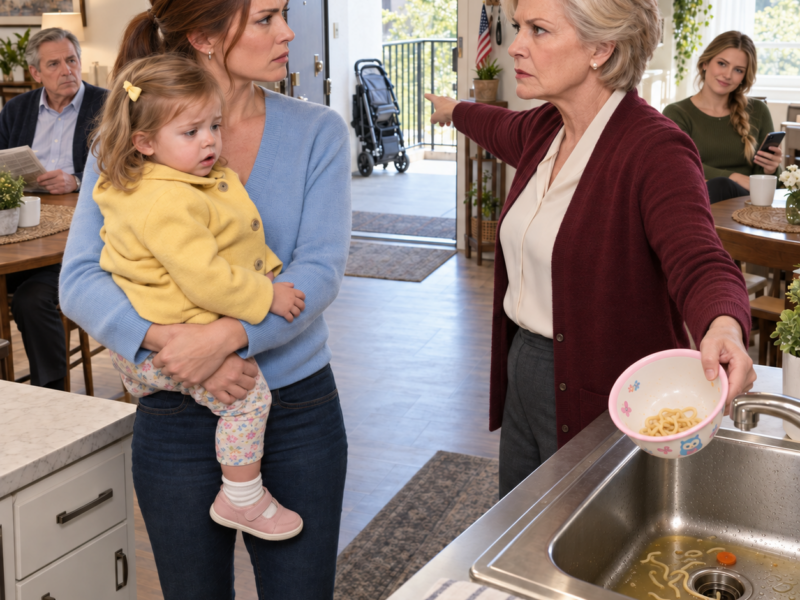
My mother dumped my daughter’s soup into the sink and pointed at the door. “Get out. When you can’t afford rent, you’ll come crawling back.” My father watched without a word. My sister smiled. I picked up my little girl and left. The next morning, I handed my lawyer a property deed my parents had signed five years earlier. Before I explained anything, I asked him to look at their signatures.
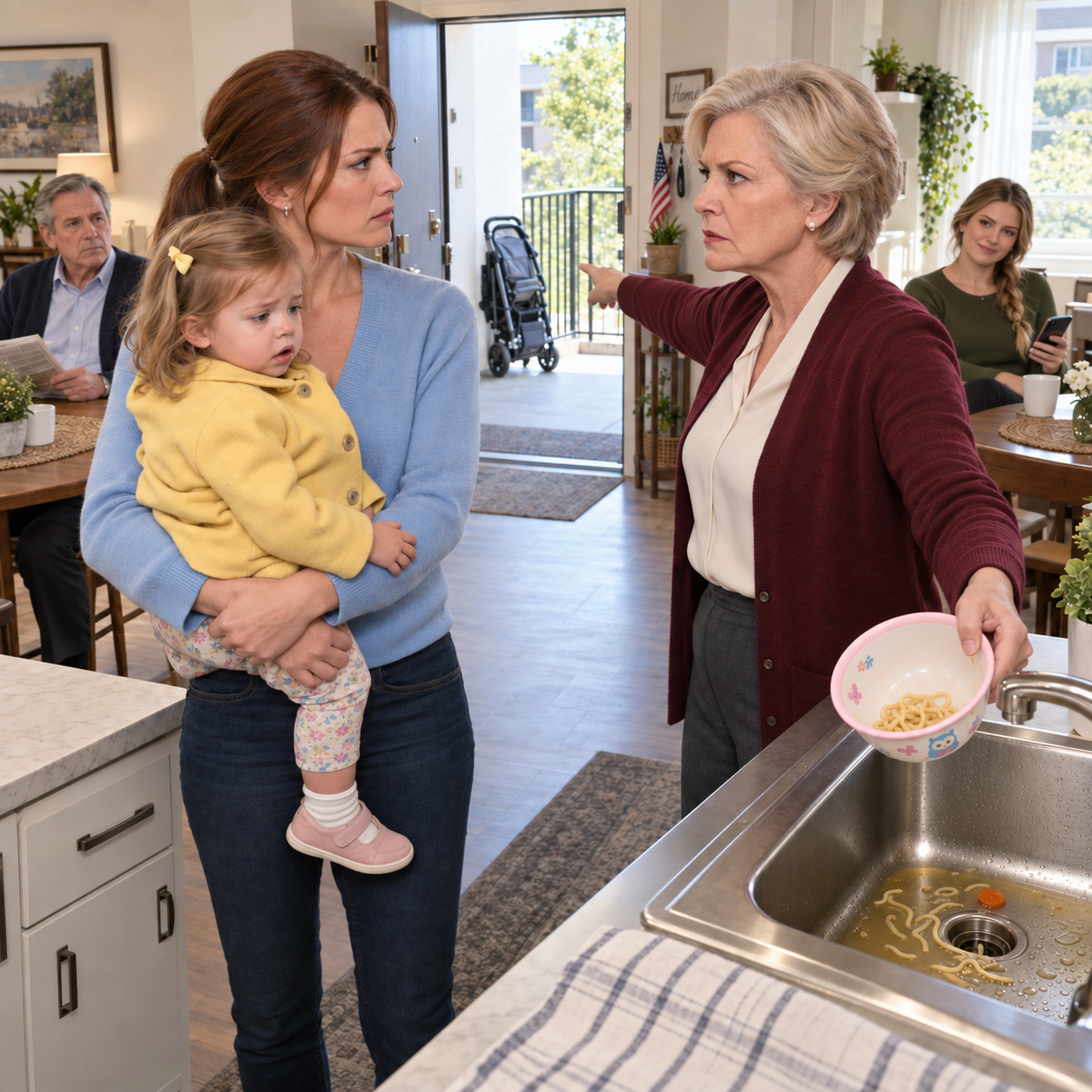
My mother dumped my two-year-old daughter’s chicken soup into the kitchen sink and pointed toward the front door.
“Get out,” she said. “When you can’t afford rent, you’ll come crawling back.”
My father watched without saying a word. My younger sister, Karla, sat near the dining-room window with her phone in one hand and a satisfied little smile on her face.
They were so certain I needed them that none of them stopped to wonder what would happen if I actually left.
Sophia stared at the empty yellow bowl in my mother’s hand. A few noodles clung to the rim. Warm broth ran down the stainless-steel sink, carrying a slice of carrot into the drain.
“Grandma,” she whispered. “My soup.”
That small, confused voice hurt more than anything my mother had said to me.
Her name was Diane Morgan, and she had always possessed the remarkable ability to make cruelty sound practical. She never said she was punishing you. She said she was teaching you. She never admitted that she wanted control. She called it concern. If you objected, she shook her head with weary disappointment, as though your pain proved how much work you still required.
That Sunday evening, in the three-bedroom condominium outside Columbus where I had grown up, her lesson was apparently that my daughter and I should understand our place.
Karla did not look up from her phone.
“Mom’s right,” she said. “You’re thirty-four. You can’t keep treating this place like a free hotel. The rest of us actually work.”
I stared at her.
Karla was twenty-nine. She worked four days a week at a dental office and lived in a condo fifteen minutes away. For almost four years, I had quietly sent $850 every month to her mortgage lender. Karla called it temporary help when she first asked. She had just broken up with a boyfriend, she said, and needed six months to stabilize.
Six months became forty-six.
Nobody at the table mentioned that. They also did not mention that I paid the high-speed internet in my parents’ home, bought most of the groceries, covered my father’s heart medication, and had replaced the water heater the previous winter.
My mother called those things “helping out.” The roof over my daughter’s head, however, was presented as charity so generous that I was expected to accept any humiliation attached to it.
My father, Arthur, slowly folded the Sunday newspaper. For half a second, I believed he might intervene.
He had always been the gentler parent. When I was a child, he repaired my bicycle tires and packed orange slices for soccer practice. He taught me how to balance a checkbook and how to drive in snow. Yet gentleness without courage has sharp limits. Whenever my mother targeted one of us, Dad retreated into silence and later offered private explanations.
She’s under pressure.
You know how your mother gets.
It will be easier if you let it go.
That evening, he stood, picked up Sophia’s folded stroller, opened the front door, and placed it on the concrete landing.
Then he returned to his chair.
He did not meet my eyes.
Something inside me became very still.
Six months earlier, my husband, Eric, had ended our marriage after announcing he was in love with a woman from his office. He had already signed a lease with her by the time he told me. The divorce consumed our savings, disrupted my freelance editing work, and left Sophia confused about why Daddy no longer came home.
My parents had insisted we move in temporarily.
“This will always be your home,” my mother told me on the phone. “You’re not facing this alone.”
I believed her because I wanted to. I packed our clothes, Sophia’s crib, my computer, and three boxes of books into a rented van. For the first two weeks, my mother made casseroles, praised my courage, and told relatives she was rescuing her abandoned daughter.
Then the price began to appear.
At first, it was small. She criticized how late I worked, even though my clients were in different time zones. She opened my mail and said she thought it belonged to her. She told Sophia that Mommy made poor choices in men. If I bought milk, she complained that I had forgotten eggs. If I paid the electric bill, she asked why I had not covered the gas.
Karla stopped by most nights, ate dinner, and carried leftovers home in my mother’s plastic containers. She never washed a dish. When Sophia became attached to a strawberry yogurt Karla liked, my sister took the last four cups and said children needed to learn disappointment.
I told myself the arrangement was temporary. I told myself family stress made people unkind. I told myself that keeping peace was more important than proving a point.
Then my mother threw away a hungry toddler’s dinner to make sure I understood who controlled the house.
Sophia began crying.
I did not yell. I did not deliver the speech that had lived in my head for months. Arguments had always been my mother’s preferred territory. She could deny, redirect, and reopen injuries from twenty years earlier until nobody remembered how the conversation began.
I wiped Sophia’s cheeks and buttoned her yellow coat. I filled her sippy cup, slipped it into the diaper bag, and lifted her into my arms.
“Thank you for the meal, Mom,” I said.
My mother gave a dry laugh. “Don’t act superior, Laura. When you find out what it costs to survive without us, you’ll beg to come back.”
I picked up the stroller from the landing.
“You have nowhere to go,” Karla called after me.
I looked at the three of them one final time. My mother stood beside the sink with her arms folded. Karla smiled because she mistook humiliation for victory. My father watched the floor.
“Good night,” I said.
As I carried Sophia down the stairs, a small American flag hanging from our neighbor’s balcony moved in the March wind. Sophia kept asking why Grandma had taken her soup.
I had no way to explain cruelty to a two-year-old, so I told her the simplest truth I could.
“Grandma made a bad choice. You did nothing wrong.”
I repeated it until she stopped crying.
Mrs. Gable, an elderly woman whose memoir I had edited the previous year, rented furnished rooms in a converted house near downtown. I called her from the parking lot. She did not ask for the whole story. She said one room was empty and I could pay by the week until I found something permanent.
We arrived after dark. The room contained a double bed, a wooden dresser, two lamps, and a narrow desk beneath the window. The bathroom was across the hall. It was not the life I wanted for Sophia, but it was warm, clean, and safe.
Mrs. Gable brought up toast, apple slices, and scrambled eggs. Sophia ate on my lap, still wearing her coat.
“No one throws this away,” Mrs. Gable said gently.
After Sophia fell asleep, I sat at the little desk and listened to the pipes knocking inside the wall. Fear arrived once the practical work ended. I had left without most of our clothes. My current editing contracts covered ordinary expenses, but not easily a new lease, deposits, daycare, legal bills from the divorce, and all the money I sent my family every month.
Then I remembered that the money was mine.
I opened a secure note on my phone titled PLAN B. I had created it three years earlier after my mother threatened to stop speaking to me because I refused to cosign a personal loan for Karla. At the time, I did nothing. Still, some sensible part of me began recording account numbers, recurring payments, property records, and copies of family documents.
Under the title, I typed one line.
Sunday: Activated.
Then I opened my banking app.
The first recurring transfer was Karla’s $850 mortgage payment. It would leave my account on the fifteenth, three days away. I canceled it.
Next came my parents’ internet, streaming packages, cell-phone family plan, grocery delivery membership, and utility autopayments. I did not cancel services that night because some accounts were in my name and required careful transfer or formal notice. I made a list for the morning.
I left my father’s prescriptions alone.
Then I opened a cloud folder containing a document my parents seemed to have forgotten.
Five years earlier, they had signed a deed transferring their condominium to me.
The decision had not been sentimental. My father was involved in an ugly dispute with his sister over my grandparents’ estate. His lawyer had warned that the litigation might expand and that any asset transfer made to hinder legitimate creditors could be challenged. The lawyer specifically refused to arrange anything improper.
Months later, after the estate case settled, my parents returned to the idea for different reasons. They wanted to simplify inheritance, avoid probate complications, and ensure that the more responsible daughter ultimately owned the home. Their independent attorney prepared a survivorship-free general warranty deed conveying the condo to me as an outright gift. My parents retained no life estate. No written lease followed. I allowed them to remain without rent because they were my parents and I never imagined doing otherwise.
I had questioned the arrangement.
“This is your home,” I told them at the closing office.
“And one day it will be yours anyway,” Dad said. “This keeps Karla from fighting you over it.”
My mother signed in front of a notary and pushed the papers toward me.
“Don’t become dramatic,” she said. “Nothing changes while we’re alive.”
Legally, quite a lot had changed. Emotionally, she behaved as if nothing had.
I never used the ownership against them. I paid property taxes from a separate account they reimbursed only when convenient. I approved association notices and arranged repairs. My name appeared on the county auditor’s website, the insurance policy, and every annual tax statement.
Yet my parents continued saying “our condo,” and I let them. Peace seemed worth the imprecision.
In Mrs. Gable’s spare room, I studied the signatures at the bottom of the recorded deed. Arthur Morgan. Diane Morgan. Laura Morgan Bennett, grantee.
My mother had thrown me out of a home she had legally given me.
I did not smile. I did not imagine police removing her that night. Ownership did not permit me to change locks on occupants without due process, and I had no desire to frighten my father or create a spectacle for Sophia.
I forwarded the document to myself and turned off the lamp.
Throwing away that bowl of soup was not going to make my mother homeless by morning. It was going to force all of us to stop pretending that generosity flowed in only one direction.
At eight the next morning, I called the utility companies. I removed my payment information where permitted and gave formal notice on accounts held in my name. I paid balances through that date. I emailed my parents a clear list stating which services would require transfer and when.
My mother replied within eleven minutes.
How dare you threaten two retired people over an argument.
I wrote back once.
I am not threatening you. I am ending voluntary payments from my personal account. The attached list includes contact information and deadlines.
She called six times. I let the calls go to voicemail.
The first message said I was ungrateful. The second said I was unstable from the divorce. By the fifth, she said I was financially abusing my father.
That accusation almost made me call back. Instead, I saved every voicemail.
Monday was devoted to practical survival. I told Sophia’s daycare about our temporary address and removed my parents from the pickup list. I updated her pediatrician, checked my credit reports, and changed passwords my mother might know. I asked the post office to hold our mail until I secured a permanent address.
At noon, my freelance client, North Star Publishing, offered me a larger developmental-editing project. The timing felt like a rope lowered into a pit. I accepted, calculated the deposit, and began calling landlords.
On Tuesday morning at exactly ten, my mother reached me from a number I did not recognize.
“Stop this tantrum and bring Sophia home,” she said.
“We are not coming back.”
“Where are you keeping my granddaughter?”
“Somewhere safe.”
“If you’re dragging her between filthy motels, I will call Children Services.”
A cold feeling passed through me. Not fear. Clarity.
“Sophia is safe, current on medical care, and attending daycare. You may contact any agency you believe is appropriate. Do not threaten me again.”
“Is that how you speak to your mother?”
“You threw away my child’s dinner and ordered us out. I listened.”
I ended the call.
Ten minutes later, Karla texted.
Did something go wrong with your bank account? My mortgage didn’t process.
I ignored it.
Another message arrived.
Laura, don’t play games. My credit will be ruined if this is late.
I replied with one sentence.
It is your credit and your mortgage.
Her call came immediately.
“You can’t just cancel it without warning.”
“You received the lender’s notice when the scheduled transfer failed. That is warning.”
“You promised to help me.”
“I promised temporary help four years ago.”
“Mom said you have plenty saved.”
The absurdity of it took my breath away. I was sharing a bathroom in a boarding house with my toddler, while Karla believed my finances were communal property.
“What I have saved is not relevant.”
“You’re doing this because I agreed with Mom.”
“I’m doing this because I need to support my daughter and myself.”
“So you’ll let me lose my home?”
“Call your lender. Adjust your budget. Sell if necessary. Those are adult decisions.”
“You’re punishing everyone.”
“No. I’ve stopped protecting everyone from the cost of their own decisions.”
I blocked her number for the rest of the day.
A senior editor at North Star referred me to Adrian Vance, a real-estate attorney with an office near the Franklin County courthouse. I met him Thursday morning carrying a banker’s box of documents.
Adrian was in his late fifties and wore reading glasses on a blue cord. He did not react dramatically when I explained the soup, the lockout, or the family history. He sorted records by date, asked short questions, and checked the county recorder’s online index.
“This deed was recorded five years ago,” he said. “Your parents conveyed the unit to you outright. There is no reserved life estate in the recorded instrument.”
“Can I make them leave?”
“As owner, you can terminate a permissive occupancy, subject to state and local requirements. But we do this correctly. No self-help lockout, no utility shutoff designed to force them out, no removal of belongings. We serve proper notice. If they remain, we file an eviction action and let the court decide possession.”
“I already stopped paying several bills.”
He reviewed my email and the account list. “Ending voluntary support is different from shutting off essential services to pressure occupants, especially when the services are in their names or can be transferred. We’ll document everything. Do not cancel water, heat, or electricity if doing so would violate your duties as owner. Let me review each account.”
That advice slowed me down, which was exactly what good legal advice should do. Anger wants movement. Law requires sequence.
I told Adrian my mother might claim the deed was a temporary paper arrangement.
“The writing controls,” he said, “but facts surrounding execution can still be litigated. Were they represented?”
“Yes. By their own attorney.”
“Was the deed notarized?”
“Yes.”
“Any written promise that you would reconvey it?”
“No.”
“Did you pay them?”
“No. The deed states it was a gift.”
“Then we begin from a strong position. Strong is not the same as instant.”
Before I left, he asked why I wanted possession. Revenge was not a legal requirement, but his question forced me to confront my motive.
“My daughter needs a stable home,” I said. “I am paying to rent a room while people who threw us out occupy property in my name. I also no longer trust them to maintain it or pay the association fees.”
“Would you consider a formal lease allowing them to stay?”
The question hurt because six months earlier I would have said yes.
“Not after my mother threatened to make a false child-welfare report.”
Adrian nodded. “Then we proceed toward possession, not punishment.”
That afternoon, I returned to the condo building with my friend Melissa and my phone recording openly. My remaining possessions had been piled in the hallway: cardboard boxes of clothes, Sophia’s books, a bag of diapers, framed photographs, and the small lamp from my desk. One box was damp where someone had set it near melting snow tracked in from the stairs.
My laptop was not there. I had taken it with me Sunday. My passport, tax files, and Sophia’s birth certificate were inside a locked document case that was missing.
I photographed the boxes and knocked.
“Take your junk and go,” my mother shouted through the door.
“Did you change the deadbolt?”
“Of course. This is my house.”
“I need the locked gray document case from the bedroom.”
“I don’t know what you’re talking about.”
“It contains identification and legal records. Please place it in the hallway.”
She opened the door against the chain, leaving a one-inch gap.
“What are you trying to do, Laura?”
I could see only part of her face.
“Nothing you and Dad did not authorize five years ago.”
The color changed in her cheek.
“That deed was for convenience.”
“Then you remember it.”
She closed the door hard enough to rattle the frame.
Melissa helped me carry the boxes to her car. We filed a nonemergency police report about the missing document case. An officer explained that ownership of personal property could become a civil dispute, but the report established what I claimed was missing and when.
That evening, Dad left a voicemail.
“Laura, your mother found the gray case behind some boxes. I put it in the building office. You can collect it tomorrow.”
His voice sounded tired. He did not apologize.
I retrieved the case intact.
Adrian obtained a certified copy of the deed and prepared a formal notice terminating my parents’ permission to occupy the unit. Before it was served, my mother hired counsel and announced that she intended to have the gift rescinded. She claimed Dad had shown early cognitive decline when he signed and that I had exploited his condition.
The accusation was not merely insulting. If believed, it could turn a clear property dispute into months or years of litigation.
The notary who witnessed the deed had recently suffered a heart attack. The law office that prepared it had merged with another firm, and archived files would take time to retrieve.
“Your father’s testimony matters,” Adrian told me. “If he confirms that he understood and voluntarily signed, her claim becomes much weaker. If he supports her account, we prepare for a longer case.”
I knew exactly what asking would cost him.
For most of his marriage, Dad survived by agreeing with my mother or becoming invisible. She chose their friends, managed the bank accounts, answered questions directed at him, and interpreted every independent thought as betrayal. He had enabled her cruelty, but he also lived beneath it.
Understanding that did not excuse what he did on Sunday.
I called his friend George, who owned an auto-repair shop on the west side. Dad helped there several afternoons a week, mostly ordering parts and restoring an old pickup in the back bay.
I found him on Saturday beside the truck, sanding a patch of primer. A small radio carried a college basketball game. He switched it off when he saw me.
“Your mother said you hired a lawyer.”
“I did.”
I placed a manila folder on the workbench. On top were five years of pharmacy receipts for blood-pressure medication, insulin supplies, cardiac appointments, and insurance copays. Every payment came from my account.
Dad put on his glasses.
“You paid these?”
“Yes.”
“Diane told me she used pension money.”
“I never asked her to tell you that.”
He turned through the pages slowly. The total was just over $18,000, not including groceries or home repairs.
“Why didn’t you say something?”
“Because I didn’t want you to feel indebted to me. I’m not showing you now to collect gratitude.”
I placed the certified deed beneath the receipts.
“I need the truth. Did you understand this when you signed it?”
He stared at his own signature.
“Yes.”
“Were you cognitively impaired?”
“No.”
“Did I pressure you?”
“No.”
“Then I need you to sign an affidavit saying that.”
His shoulders lowered as if the request had physical weight.
“Your mother will never forgive me.”
“That is between you and Mom.”
“You know what she’s like.”
“Yes. I also know what you are like when she hurts someone. You become quiet and call it peace.”
He removed his glasses.
“That’s not fair.”
“Last Sunday, she threw away Sophia’s dinner. You carried her stroller into the hall. You helped put a toddler out in the cold because disagreeing with your wife felt harder.”
His eyes filled, but I continued.
“I love you. I have paid for medicine because I want you alive and healthy. But I will not buy your courage. I am asking you to tell the truth under oath.”
For thirty seconds, the compressor in the next room hummed and clicked. Dad touched the deed, then the receipts.
“Where is the notary?” he asked.
Adrian arranged an independent notary at a nearby office that afternoon. Dad signed an affidavit confirming that both he and my mother knowingly conveyed the property as an unconditional gift, had independent legal advice, and understood they retained no ownership interest.
When he finished, he folded his copy into his coat.
“Is Sophia all right?”
“She is safe.”
“Can I see her?”
I wanted to say yes. Sophia loved him. Before the divorce, he took her to feed ducks and read the same picture book until he knew every page.
But love did not erase the image of her stroller on the landing.
“Not yet,” I said. “I need to know you will protect her even when Mom is angry.”
He nodded without arguing.
Three days later, Dad packed two suitcases and moved into his brother Raymond’s spare room. My mother called that evening.
“You destroyed this family.”
“No, Mom.”
“Your father walked out because you manipulated him.”
“Dad signed a truthful affidavit and made his own decision.”
“You waved money in front of him.”
“I showed him receipts for medicine I already paid for.”
“When you steal this condo, you’ll sit in those empty rooms and realize you gained four walls but lost a mother.”
Sophia was sleeping on Mrs. Gable’s bed behind me, one sock on and one kicked beneath the blanket.
“The day you threw away my child’s food, you chose what kind of mother and grandmother you wanted to be. I did not make that choice for you.”
I ended the call.
For the next week, grief moved through me in inconvenient waves. I cried while filling out a rental application. I cried in the grocery store because chicken broth was on sale. I cried after Sophia pointed to a gray-haired woman in a parking lot and called her Grandma.
People imagine boundaries as doors slammed in anger. Mine felt more like surgery performed while awake. Necessary did not mean painless.
The formal notice was served forty-eight hours later. My mother refused to accept the envelope, so the process server followed the legally required alternative procedure and documented each step. She remained in the condo beyond the deadline. Adrian filed an eviction action for possession.
There was no dramatic hearing the next morning. Real property cases move through calendars, notices, answers, continuances, and rules that do not care how urgently a family wants closure.
My mother’s attorney filed a counterclaim seeking rescission of the deed. He alleged undue influence, mistake, and an oral promise that I would never remove my parents. We answered with the recorded instrument, Dad’s affidavit, proof of independent counsel, tax records, and years of emails in which my mother referred to me as the owner when she wanted me to pay for repairs.
One email concerned the water heater.
Since the unit is legally yours, you need to handle this immediately.
Another concerned a special assessment from the condominium association.
As owner, this is Laura’s responsibility, not ours.
My mother had remembered my ownership whenever a bill arrived.
While the case proceeded, Sophia and I moved from Mrs. Gable’s house into a modest one-bedroom apartment near daycare. The living room had beige carpet, a view of a pharmacy parking lot, and a heater that clicked every twenty minutes. It felt luxurious because the key belonged only to me.
On our first night, Sophia ran from the bathroom to the bedroom and back again.
“Mommy, nobody else uses our potty!”
I laughed. “That’s right.”
She selected the bottom kitchen cabinet for her plastic bowls. I bought a secondhand table, two chairs, and a blue rug from a neighborhood marketplace. Melissa brought a Crock-Pot. Mrs. Gable gave Sophia a quilt covered with yellow stars.
We owned very little, but nothing in that apartment carried a hidden invoice for obedience.
I took on two additional manuscripts and worked after Sophia fell asleep. Developmental editing requires a strange intimacy with other people’s imaginary lives. I spent nights repairing fictional families while my own argued through attorneys.
Money was tight. The new deposit and legal retainer reduced my savings. I cut subscriptions, cooked in batches, and bought Sophia’s spring clothes at a church resale event. None of that shamed me. What shamed me was remembering how long I had funded adults at the expense of my own security.
For the first time, I stopped sending money to everyone in the family.
Everyone except Dad.
I continued paying his essential prescriptions directly to the pharmacy. He never asked for cash. He sent receipts and short thank-you messages. Respect began with structure because trust had not yet returned.
Without my support, the financial arrangement my family called normal began to collapse.
Karla missed her first mortgage payment. Then her second. The lender sent a delinquency notice and offered a meeting about repayment options.
She called from a new number.
“They’re threatening foreclosure.”
“Have you spoken to the loan officer?”
“I can’t make the payment on my salary.”
“Then you need a second job, a roommate, or a sale.”
“You say that like it’s easy.”
“It isn’t easy. It is still your responsibility.”
“You have money.”
“I have rent, daycare, legal fees, and a child.”
“So you’re going to watch your sister lose everything?”
“When Mom put my daughter’s stroller outside, you said the rest of you worked. I believed you.”
She began crying. In the past, that sound would have opened my banking app before the call ended. This time, I listened without rescuing her.
“I was angry,” she said.
“You were comfortable.”
“What’s that supposed to mean?”
“You were comfortable insulting the person paying your largest bill because you believed the money would continue no matter how you behaved.”
She hung up.
Karla’s boyfriend, Daniel, believed she had made every mortgage payment herself. She had told him she bought the condo through disciplined saving. When delinquency notices appeared, she first claimed a bank error. Then she said I had promised the property as a gift.
Daniel contacted me politely and asked one question: Had I actually paid $850 a month for almost four years?
I told him I would answer only if Karla consented to disclosure or if legal necessity required it. He showed me a message from Karla in which she demanded I “prove the payments” because she believed I was exaggerating.
I sent a limited statement listing dates and amounts, with unrelated account details redacted.
Two weeks later, he ended their relationship.
Karla arrived at my apartment on Saturday wearing an oversized sweatshirt and no makeup. Her eyes were swollen.
“Daniel left me.”
“I’m sorry.”
“You sent him records.”
“You asked me to prove the payments.”
She looked around the room: the folding table, cardboard toy boxes, drying rack beside the window, and stack of library books near Sophia’s bed.
“You’re really living like this?”
“Like what?”
“I thought you had another account. I thought this was temporary to scare Mom.”
The admission saddened me more than her accusation.
“You all believed I had a secret fortune?”
“You always found money when people needed it.”
“Because I worked nights. Because I used savings. Because I delayed replacing my car and never took vacations. The money did not appear. I removed it from my own life.”
Karla sat at the folding table.
“Why did you keep paying?”
I considered the question. Blaming her alone would have been easy, but not honest.
“At first, because I loved you and you were struggling. Later, because helping made me feel safe in the family. If everyone needed me, I believed nobody would abandon me.”
She looked down.
“Then Eric left.”
“Yes. And when I came home, Mom turned my help into rent I could never finish paying.”
Sophia woke from her nap and came into the room holding her stuffed rabbit. When she saw Karla, she stopped.
“Hi, Aunt Karla.”
Karla’s face crumpled.
“Hi, sweetheart.”
She opened her arms, but Sophia remained beside me. Children do not understand mortgage payments or property deeds. They understand who made them feel safe.
Karla left an hour later. I did not offer money. I gave her the number for a nonprofit housing counselor and information about renting her second bedroom. She accepted both with visible disappointment.
The next month, she found a roommate and weekend work at an urgent-care reception desk. It did not solve everything, but the lender approved a repayment plan.
My mother chose a different strategy: public opinion.
She posted online that her “heartless daughter was evicting two elderly retirees after using them for free childcare.” Dad had already moved out, and my mother had watched Sophia alone fewer than ten times. Facts did not improve the story she wanted to tell.
Relatives messaged me.
How can you do this to your parents?
Your mother says she has nowhere to go.
Family homes should not become weapons.
I did not litigate on social media. Adrian advised me to preserve posts and avoid public argument. I sent close relatives one statement: The property had been legally deeded to me five years earlier; Dad confirmed the transfer; the dispute was before a court; Sophia and I were safe. I would not discuss further details.
Some people respected that. Others interpreted silence as guilt.
Then my mother called Sophia’s daycare.
She claimed I was moving my child between unsafe locations, working all night, and leaving her with strangers. The director, Ms. Patel, knew me well. She documented the call, confirmed that Sophia attended regularly in clean clothes with packed meals, and informed my mother that she could not receive information because she was not an authorized contact.
My mother called again pretending to be a child-welfare investigator.
Ms. Patel recognized her voice and contacted me immediately.
That crossed a line even Karla could see. She sent me screenshots of messages in which Mom asked for Sophia’s pediatrician and social-security number. I forwarded everything to Adrian and my family-law attorney. We sent a cease-and-desist letter and updated security instructions at daycare and the pediatrician’s office.
Children Services did receive an anonymous report. A caseworker visited my apartment. I was frightened even though I knew the allegations were false. Fear does not wait for reason when someone has threatened your child.
The caseworker saw food in the refrigerator, a secured medicine cabinet, Sophia’s bed, daycare records, and pediatric reports. She spoke with Ms. Patel and closed the inquiry as unsubstantiated.
“You handled this appropriately,” she told me. “Keep documenting unwanted contact.”
After she left, I sat on the kitchen floor and shook.
That evening, Dad called.
“Diane says you are trying to have her arrested.”
“She made a false report about Sophia.”
Silence.
“Did you hear me?” I asked.
“Yes.”
“This is the moment when you normally explain her behavior. I will not listen to that anymore.”
“I wasn’t going to.”
“Then what are you going to do?”
He exhaled. “Tell the truth if anyone asks me.”
It was not enough to repair everything. It was more than he would have said a month earlier.
The first court conference occurred eleven weeks after we left. My mother wore a tailored beige suit reserved for weddings, funerals, and occasions when she wanted strangers to trust her. She sat beside her attorney and never looked at me.
Her lawyer argued that the deed memorialized an estate plan, not a present gift, and that my parents relied on my oral promise to let them live there forever. Adrian pointed to the plain language conveying present title, the recording, tax history, independent legal representation, and messages acknowledging my ownership.
The magistrate did not decide the case that day. She set deadlines for document exchange, ordered both sides to preserve communications, and encouraged settlement.
My mother offered to leave if I paid her $120,000 and allowed her to take the appliances.
The number had no basis. It was roughly the amount of equity she believed remained in Karla’s condo.
I offered a reasonable relocation payment equal to three months of modest rent, moving costs paid directly to a company, and sixty days to move, conditioned on dismissal of her ownership claims and no contact with Sophia’s school or doctors.
She rejected it.
“She believes you will surrender before trial,” Adrian said.
“Why?”
“Because historically, you have paid to end family conflict.”
He was right. My mother was not irrational. She was relying on a pattern I had spent years establishing.
Breaking that pattern required enduring discomfort without purchasing relief.
Discovery produced the closed file from the law firm that prepared the deed. It contained letters sent separately to both parents, confirming that the transfer was an unconditional present gift and advising them about the consequences of giving up title. My mother had signed an acknowledgment stating that no one promised her continued occupancy.
The file also included handwritten notes from the attorney’s meeting.
Diane asks whether Laura can later be required to pay condo expenses. Explained ownership obligations; family contribution arrangements separate.
That single note captured the arrangement perfectly. My mother understood that ownership made expenses mine. She simply refused to believe it could also give me rights.
The notary recovered from his heart attack and gave a short deposition. He remembered my parents because my mother corrected the spelling of her middle name three times. He testified that both appeared alert, asked questions, and signed voluntarily.
Dad’s medical records from that year showed no cognitive diagnosis. His primary-care physician had documented normal orientation and decision-making during visits before and after the deed.
My mother’s claim weakened, but she did not withdraw it.
In the months before trial, my father began earning the chance to see Sophia again. He attended counseling through a community center. He did not ask me to forgive Mom or carry messages from her. He accepted supervised visits at a public library without complaint.
At the first visit, Sophia hid behind my leg.
Dad crouched several feet away and placed a picture book on the carpet.
“I brought the duck story,” he said.
She watched him open it. By the third page, she sat beside him. He read slowly, making the ridiculous duck voice she remembered.
When the hour ended, he did not ask her for a hug. She gave him one anyway.
In the parking lot, he cried.
“I’m sorry,” he said. “I should have picked up the stroller and brought it back inside.”
“You should have stopped Mom before that.”
“Yes.”
It was the first apology he gave without attaching an explanation.
We increased visits gradually. Trust returned in teaspoons, not buckets.
Karla also began changing, though resentment traveled beside progress. She kept the weekend job and learned how much of her paycheck disappeared into housing. Her roommate was a nursing student named Beth who labeled every shelf in the refrigerator. Karla complained constantly, then admitted the rent saved her condo.
One evening she called to ask how to compare refinancing offers.
“I can show you what the terms mean,” I said. “I won’t choose for you or cosign.”
“I know.”
We spent forty minutes reviewing interest rates, fees, and payment schedules. For the first time in years, helping her did not require funding her.
Before hanging up, she said, “I was awful that night.”
“Yes.”
“I thought you would always take it.”
“I know.”
“I’m sorry about Sophia’s soup.”
It was not full repair. It was a truthful beginning.
My mother’s behavior escalated as her legal options narrowed. She sent letters to my clients accusing me of fraud. North Star’s managing editor forwarded the letter and asked whether I needed support. Because I had warned the company about the family dispute, the accusation did not achieve its intended effect.
Adrian added the letters to our evidence. My separate attorney sought a limited protective order prohibiting contact with my workplace, daycare, and medical providers. The court granted it after reviewing the false report and impersonation attempt.
For the first time, my mother faced a boundary she could not redefine through argument.
She obeyed it.
The final hearing occurred seven months after the soup went down the drain. By then, spring had become early fall. Sophia had turned three. I had finished six manuscripts, paid thousands in legal fees, and learned more about civil procedure than I ever wanted to know.
The courtroom was smaller than television suggests. There was no jury, no dramatic gallery, and no last-minute witness rushing through the door. Fluorescent lights hummed above wooden benches. A county flag stood beside the judge.
My mother sat across the aisle. Karla sat behind her but gave me a brief nod. Dad waited outside until called.
Adrian presented the recorded deed and attorney file. The former notary testified by video. The condominium manager confirmed that my mother had repeatedly directed bills to me as owner. Ms. Patel described the daycare calls only because they related to credibility and retaliatory conduct; the judge limited that testimony carefully.
Then Dad took the stand.
He did not attack his wife. He did not describe their marriage. He looked at the judge and answered what was asked.
“Did you sign the deed?”
“Yes.”
“Did you know it transferred ownership to Laura?”
“Yes.”
“Was she forcing you?”
“No.”
“Were you confused?”
“No.”
My mother’s attorney asked whether the pharmacy receipts influenced his affidavit.
“They influenced my decision to stop ignoring what was happening in my family,” Dad said. “They did not change what I knew five years ago.”
“Your daughter benefits financially if your wife is removed, correct?”
“My daughter already owns the unit. She benefits by being allowed to use what we gave her.”
The attorney asked whether I had threatened to stop paying his medicine unless he cooperated.
“No. She still pays the pharmacy. She told me gratitude was not what she wanted.”
Then he looked toward me.
“She wanted me to tell the truth. I should have done that much earlier.”
My mother testified last. She said she never understood the deed, despite letters bearing her signature. She said I had promised the home would remain hers forever. She described every payment I made as repayment for childhood expenses.
Adrian asked whether she believed adult children owed parents reimbursement for being raised.
Her lawyer objected. The judge sustained it.
Adrian changed direction.
“When the water heater failed, did you write that replacement was Laura’s responsibility because she was legal owner?”
“I may have used those words casually.”
“When the special assessment came due, did you again call her owner?”
“She handled finances.”
“Did you sign the acknowledgment stating no promise of lifetime occupancy had been made?”
“The lawyer rushed us.”
“Both consultations lasted more than an hour, according to billing records. Were those records fabricated?”
“I don’t remember.”
Her memory failed only where documents contradicted her.
The judge issued a written decision two weeks later. She found the deed valid, rejected rescission, confirmed my right to possession, and entered judgment terminating my mother’s occupancy. Because of her age and the length of residence, the court allowed thirty days for voluntary departure before enforcement.
The decision did not call my mother evil. It did not congratulate me. It applied property law to evidence.
That restraint made it feel real.
My mother left on the twentieth day.
A neighbor called to say a moving truck was outside. Karla helped carry boxes, though they argued most of the afternoon. Dad did not return. Through her attorney, Mom provided an address for a rental duplex on the other side of town.
On a clear October morning, I climbed the stairs to collect the keys. A small flag near the building entrance moved in the breeze, the same way it had the night we left.
My mother stood on the landing with two suitcases. She looked smaller than I remembered. Her hair was neatly styled, and she wore the beige coat she used for church.
For a moment, I expected fury. Another part of me hoped for an apology so complete that it might repair every lost year.
She offered neither.
She handed the keys to Adrian, who had come as a witness, and walked past me. Her heels struck each concrete step until the lobby door closed.
I did not ask where she was going. I already knew she had safe housing. I had verified that through counsel before declining to pay her demand.
Inside, the condo smelled stale. Pale rectangles marked places where pictures and mirrors had hung. The refrigerator was empty. Dust outlined furniture on the floor.
In the kitchen, the stainless-steel sink looked exactly the same.
I sat at the table where my mother had called me a parasite.
There was no rush of victory. I had imagined vindication as warmth, but the room felt cold and hollow. I owned four walls and had legal proof that I was right. Neither fact gave Sophia back the trust she once placed in her grandmother.
Melissa arrived with coffee and a legal pad. Together we made a repair list. The condo needed paint, new locks, a furnace inspection, and professional cleaning. One bedroom wall had water damage. My mother had removed a bathroom mirror that belonged to the unit and left several bags of trash in storage.
Ordinary problems were a relief. Paint did not accuse me. A locksmith did not invoke childhood.
We moved in ten days later.
Sophia ran down the hallway holding her stuffed rabbit.
“Do I get my own bedroom?”
“You do.”
I had painted it pale yellow. The star quilt from Mrs. Gable covered a small bed. Her books sat on low shelves, and the window looked toward a maple tree turning orange.
That evening, I made chicken noodle soup. I did not plan it as a symbol. It was cold outside, and soup was easy after carrying boxes.
When I placed the bowl in front of Sophia, she blew on a spoonful.
“It’s hot.”
“Give it a minute.”
Her eyes moved toward the sink.
“Grandma isn’t coming?”
“No, sweetheart.”
“Is she still mad?”
I sat beside her.
“Grandma is responsible for her feelings. You are responsible for eating dinner and choosing a bedtime book.”
Sophia considered that division of labor.
“Two books.”
“One long book or two short ones.”
“Two long ones.”
I laughed for the first time that day.
My phone chimed on the counter. Dad needed a prescription refill and offered to repay me when his check arrived. I sent the money directly to the pharmacy.
Handled. Take care of yourself.
His reply came a minute later.
Thank you, sweetheart. May I visit Sophia soon?
I watched her eat.
Soon, Dad. I’ll call you.
He respected the answer.
Over the next year, our life settled into routines that belonged to us. I worked at the dining table after daycare drop-off. Sophia learned to sleep without asking whether we would move again. We planted basil in a pot beside the window. On Saturdays, we walked to the library and shared pancakes at a diner where the server always gave her too many blueberries.
Stability was not dramatic. It was knowing which drawer held the socks.
Dad rented a small apartment near Raymond. He began therapy and attended a support group for people leaving controlling relationships. I had complicated feelings about that language. He had been controlled, but he had also allowed that fear to make him complicit in harm.
His counselor apparently helped him hold both truths.
He apologized again one afternoon while repairing the loose wheel on Sophia’s toy stroller.
“I kept thinking that if I didn’t choose a side, I was neutral,” he said. “But the person doing the hurting always counted my silence as support.”
“So did the person being hurt.”
“I know.”
He did not ask me to make him feel better.
That mattered.
Karla sold her condo eighteen months later. The market had improved enough for her to pay the loan and retain a small amount of equity. She moved into a less expensive apartment with Beth and began taking evening courses in medical billing.
At first, she described the sale as something I forced on her. Later, she admitted the mortgage had been too large from the beginning.
“I wanted people to think I was successful,” she told me over coffee. “You made it possible for me to pretend.”
“I helped you avoid the truth.”
“Why?”
“Probably for the same reason Dad avoided confronting Mom. Immediate peace felt easier than honest conflict.”
Karla rubbed the edge of her cup.
“Are we like her?”
It was the question both of us feared.
“We learned things from her,” I said. “What we do after recognizing them is our responsibility.”
She began seeing Sophia in short, planned visits. She never arrived empty-handed at first, as though gifts could rebuild trust. I asked her to stop bringing toys and start bringing time. She took Sophia to the park, colored at the kitchen table, and learned which stories required funny voices.
Their relationship grew around actions rather than apologies.
My mother never apologized.
For six months, she communicated only through relatives. She said I stole her retirement, turned Dad against her, and poisoned Karla. When nobody produced the response she wanted, she mailed me a birthday card containing a three-page letter.
The first two pages explained her suffering. The third said she was willing to forgive me if I restored monthly financial support and allowed unsupervised access to Sophia.
I gave the letter to my therapist.
“What do you feel when you read it?” she asked.
“Tired.”
“Not angry?”
“A little. Mostly tired.”
That exhaustion was information. My mother still viewed reconciliation as the restoration of access: to my money, my child, my attention, and my willingness to absorb blame.
I did not reply.
The following Christmas, she left gifts outside the condo despite the protective order’s contact restrictions having expired. There was a doll for Sophia and an envelope for me. I returned both through Karla without comment.
Some relatives called that heartless. They saw a grandmother buying a doll. I saw a woman testing whether a boundary still existed.
Forgiveness, I learned, did not require renewed access.
I worked hard to keep Sophia outside the adult conflict. I never told her Grandma was bad. When she asked why we did not visit, I said Grandma had made choices that were not safe or kind, and adults needed to show change before relationships could resume.
“Can she choose better later?” Sophia asked.
“Yes.”
“Will she?”
“I don’t know.”
Children deserve hope without false promises.
The legal victory also brought responsibilities my anger had not anticipated. I became solely responsible for property taxes, association dues, insurance, and repairs. The furnace failed the second winter. A pipe leaked into the unit below. The association approved a roof assessment that made me sit in the kitchen with a calculator and a cup of cold coffee.
My mother had always pointed to those expenses as evidence that she and Dad supported me. Now I could see the actual numbers. Their previous contributions had covered some costs, but my payments had covered more. The truth was neither that they gave me everything nor that I carried them completely. Families often turn accounting into mythology.
I created a real budget. I refinanced nothing, borrowed carefully, and built an emergency fund before replacing our aging car. North Star eventually hired me as a salaried senior editor with health insurance. On my first day, I packed Sophia’s lunch before dawn and stood for a moment in the quiet kitchen.
The countertop held a pharmacy bag for Dad, a daycare form, and a county tax bill. It was not glamorous. It was mine.
Mrs. Gable remained part of our life. Every few weeks, we brought her groceries and stayed for tea. She insisted I had saved myself. I insisted her spare room gave me somewhere safe enough to remember that I could.
“Everyone needs a landing place,” she said.
When she turned eighty, I edited a collection of her essays without charging her. This time, generosity felt different. It was freely chosen, clearly bounded, and met with gratitude instead of entitlement.
That distinction changed how I understood help.
Helping is not unhealthy merely because someone benefits. It becomes destructive when assistance replaces another adult’s responsibility, when fear prevents the giver from saying no, or when the receiver treats generosity as debt already owed.
For years, I had confused being needed with being loved.
The difference became obvious when I stopped paying. Dad remained, accepted limits, and did difficult work. Karla became angry, struggled, and eventually changed. My mother escalated because the relationship she wanted depended on control.
Money did not create those truths. It revealed them.
Two years after the court decision, my mother requested mediation through a family therapist. I agreed to one preliminary session without Sophia. We met in a neutral office furnished with gray chairs and a box of tissues placed so prominently that it felt like a warning.
My mother had aged. Her hair was shorter, and her hands trembled slightly when she set down her purse.
The therapist asked what outcome she wanted.
“I want my family back,” Mom said.
“What does that mean in specific terms?”
“I want to see my granddaughter. I want Laura to stop punishing me. I want Arthur to come home.”
The therapist turned to me.
“What would you need to consider rebuilding contact?”
“Acknowledgment of what happened, no interference with Sophia’s care, no requests for money, and a relationship that develops slowly.”
Mom’s mouth tightened.
“She wants me to crawl.”
“No,” I said. “I want you to name what you did without making my reaction the offense.”
“I was trying to teach you independence.”
“You threw away a toddler’s food.”
“It was one bowl of soup.”
“It was an act designed to humiliate both of us.”
“You took my home over one bowl of soup.”
“You gave me the home five years earlier. The soup made me stop subsidizing a relationship that was harming my child.”
The therapist asked Mom whether she regretted the daycare calls.
“I was worried.”
“Did you pretend to be an investigator?”
“They refused to tell me anything.”
“That is not an answer,” the therapist said.
My mother stood, collected her purse, and announced that the session was biased.
She left after twenty-three minutes.
I sat in the quiet office, surprised by how little I wanted to chase her.
“You cannot complete both sides of reconciliation,” the therapist said.
That sentence released something I had carried since childhood. I had spent decades translating Mom’s anger, smoothing her relationships, and finding explanations generous enough to keep the family together. I could invite honesty. I could not supply it for her.
There was no second session.
Dad finalized a legal separation and later a divorce. I did not encourage or discourage either choice. His marriage belonged to him, including the consequences of remaining in it for so long. He downsized his belongings, volunteered twice a week at George’s shop, and learned to cook more than eggs.
The first Thanksgiving in his apartment, he burned the rolls and overcooked the turkey. Karla brought mashed potatoes. I brought pie. Sophia placed a tiny paper flag she had made at preschool in the centerpiece.
Nobody shouted. Nobody kept score of who paid for which dish. When Sophia said she was full, her plate remained on the table.
Dad looked at it for a long moment.
“What?” I asked.
“Nothing,” he said, then corrected himself. “I was thinking about that Sunday.”
Karla put down her fork.
“Me too.”
The room became uncomfortable. In the old family, one of us would have changed the subject. This time, we let the discomfort remain.
“I’m sorry,” Karla told Sophia, though she was still too young to understand the full context. “I should have been kind to your mom.”
Sophia offered her half a roll.
It was not absolution. It was a child responding to honesty with generosity.
Dad washed the dishes. Karla packed only the leftovers he offered. I drove home through streets bright with porch lights, feeling something gentler than victory.
We had not restored the old family. We were building a smaller, more honest one.
By the time Sophia started kindergarten, the yellow bedroom had become crowded with drawings, library certificates, and stuffed animals. She remembered very little about the boarding house. Occasionally she mentioned Grandma throwing away soup, but the memory sounded like a story she had heard rather than a wound she was reliving.
I remembered enough for both of us.
On the first morning of school, Dad arrived early and waited outside because he knew I did not want extra commotion indoors. Karla brought a box of tissues for me and did not tease when I used them. We watched Sophia walk toward the entrance with a purple backpack almost as large as she was.
“You did all right,” Dad said.
“She did all right,” I replied.
At home, the silence felt enormous. I sat at the kitchen table with coffee and opened the secure note titled PLAN B. Beneath “Sunday: Activated,” I had added dates over the years: lawyer retained, apartment leased, deed upheld, moved home, salaried job, emergency fund complete.
I did not need the note anymore.
I considered deleting it, then renamed it PROOF OF RETURN.
Not proof that I had defeated my mother. Proof that I had returned to myself.
My mother moved twice and eventually settled in a small senior community. Karla saw her occasionally. Dad did not. I received updates only when necessary.
One winter, she was hospitalized with pneumonia. Karla called from the emergency room.
“She’s asking for you.”
I stood in my kitchen while snow collected along the window.
“Is she in danger?”
“The doctor says she should recover.”
“Does she need medical consent or practical help?”
“No. She wants to talk.”
I thought about going. Boundaries are not punishments, and illness can change perspective. I also thought about the mediation session and every attempt to use urgency as a doorway.
“Tell her I hope she recovers,” I said. “If she wants to write, she can send a letter through the therapist.”
Karla was quiet. “Okay.”
No letter came.
My choice was not easy, but ease had stopped being my measure of correctness.
People who heard fragments of our story often reduced it to the property. Some believed I should have let my mother remain because parents deserve unconditional loyalty. Others celebrated the eviction as satisfying revenge. Both interpretations missed the center.
The condo was never the real prize. The real change was that I stopped allowing fear, money, and family titles to erase reality.
My mother did not lose the unit because she discarded one bowl of soup. She lost permission to occupy it after years of control, a deliberate lockout, false legal claims, harassment, and refusal to accept a reasonable transition. The soup was simply the moment the pattern became visible enough that I could no longer explain it away.
I did not become powerful by owning property. I became responsible for using what I owned to provide safety for my child.
Nor did Dad become brave by signing one affidavit. Courage appeared in the smaller choices afterward: telling the truth in court, accepting supervised visits, apologizing without excuses, and building a life outside my mother’s direction.
Karla’s accountability was not foreclosure or heartbreak. It was learning that adulthood meant making decisions before consequences made them for her.
As for me, I had to admit that generosity can become a form of control in both directions. My family controlled me through guilt, but I also used money to secure a role I feared losing. When I paid every bill, I could believe I was indispensable. Indispensability looked like belonging until the night my mother proved it was not.
Love that survives only while payments continue is not love. It is an arrangement nobody has named honestly.
Five years after we returned to the condo, I renovated the kitchen. The old sink had begun to leak around the faucet. The contractor asked whether I wanted another stainless-steel model.
I chose a deep white farmhouse sink instead.
Not because stainless steel frightened me. It did not. I simply wanted the room to reflect our life rather than preserve the stage of its worst evening.
Sophia, now eight, helped choose blue cabinet handles. Dad installed a shelf beneath the window. Karla arrived with pizza and paid for it herself.
When the work was finished, we ate at the same table where everything had broken open years earlier. The walls were warm cream. Basil grew beside the window. Sophia’s latest spelling test hung on the refrigerator.
I served chicken noodle soup.
Karla noticed first. She looked at the bowls and then at me.
“Was this intentional?”
“A little.”
Dad lowered his eyes.
Sophia knew the broad story by then. She lifted a spoonful, blew on it, and said, “No one is throwing mine away.”
“No one,” I agreed.
We ate.
There was no toast, no speech, and no grand declaration of healing. The soup cooled. Outside, a neighbor lowered an American flag before evening rain. Dad asked Sophia about school. Karla complained about a customer at work, then caught herself and asked about my new manuscript.
Ordinary conversation filled the room that had once held silence and contempt.
After they left, Sophia carried her empty bowl to the new sink.
“More next time,” she said.
“Definitely.”
I washed the dishes while she read at the table. The water ran clear over the bowls. For years, I had imagined closure as an apology from my mother. I finally understood that closure could be a life no longer organized around whether that apology arrived.
My mother never gave me one.
I stopped waiting.
What the experience taught me was quieter and more useful than revenge.
Forgiving someone does not require giving that person endless opportunities to harm you.
Helping relatives does not mean financing adults who treat your labor as an entitlement.
Owning a home does not make a person safe if everyone inside is permitted to disrespect her.
And setting a boundary does not make a daughter cruel.
Sometimes it is simply how a mother protects her child.
That Sunday, my family believed they were showing me the door. In truth, they were showing me the pattern I needed to leave.
I walked out carrying Sophia because I thought I had lost my home.
By the time I returned, I understood that home was never the deed, the walls, or the key in my hand.
Home was the place where my daughter could sit at the table without fear that love would be taken away with her dinner.
And this time, I knew exactly who was responsible for protecting it.









