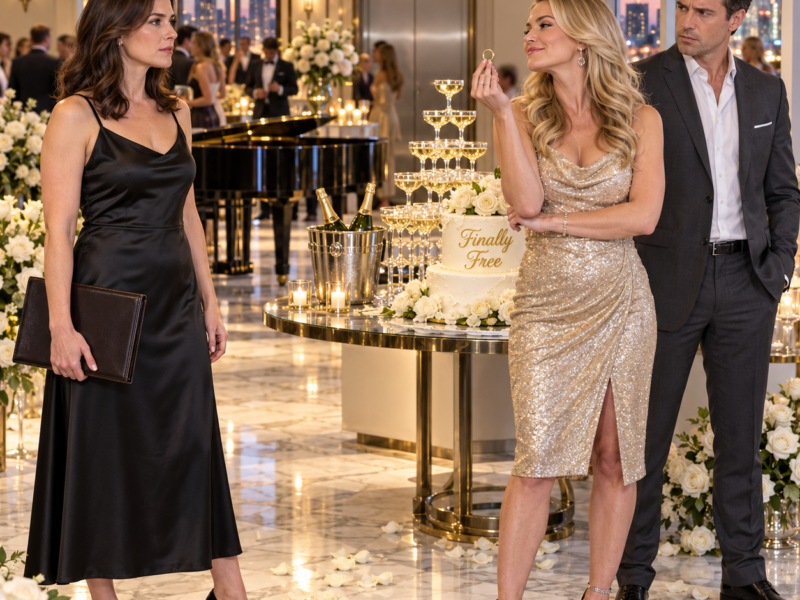
My husband’s mistress booked my bridal suite for a divorce party before I had signed a single paper. White roses covered the floor. Champagne waited by the windows. The cake said “FINALLY FREE.” Daniel had told her I was already beaten. So I walked in wearing black silk, without my wedding ring, carrying one folder. Vanessa smiled and said, “Daniel said you were signing today.” I looked at the room where I had spent my wedding night seven years earlier and replied, “He told you a lot of things.”
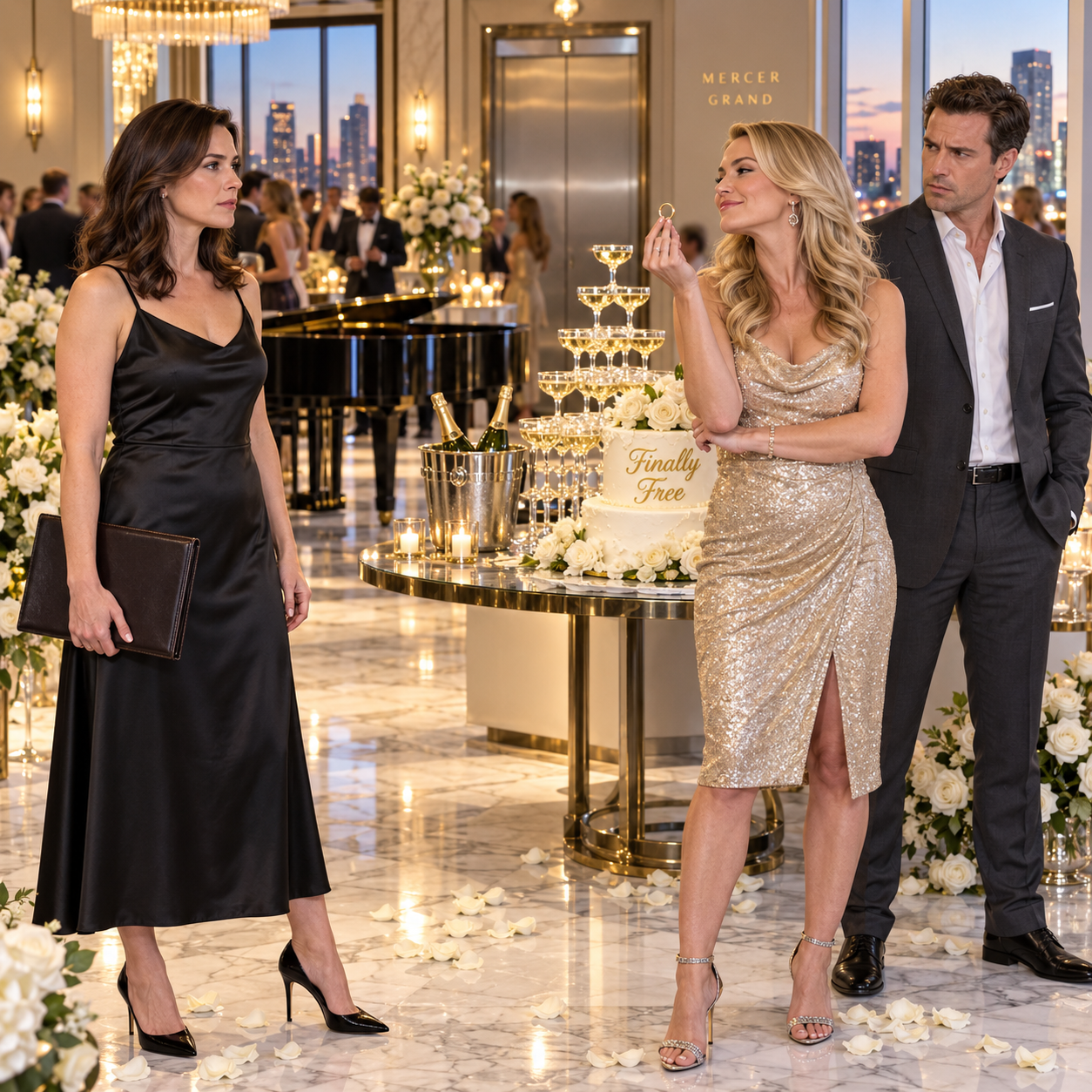
My heels crushed the first white rose before anyone noticed I had entered the room.
By the third one, the music had stopped.
Thirty people turned toward me inside the bridal penthouse of the Mercer Grand, champagne glasses suspended halfway to their mouths beneath the soft gold light of the chandeliers. Someone near the balcony lowered a phone. Someone else kept recording. A woman I recognized from Daniel’s corporate holiday parties whispered something behind one hand.
I kept walking.
Black silk.
No wedding ring.
One leather folder tucked beneath my arm.
The room smelled like roses, expensive champagne, and vanilla frosting.
Across the marble floor stood a three-tier white cake with gold lettering.
FINALLY FREE.
That was what Vanessa Vale had ordered for a divorce party celebrating the end of my marriage before I had signed a single page.
She had scattered white rose petals from the elevator to the piano. She had built a champagne tower beside the fireplace. She had hired a string trio for the first hour and a DJ for later. On the balcony, the same balcony where I had stood seven years earlier in my wedding dress while Daniel held my waist and promised we would never become one of those couples who stopped liking each other, she had arranged a row of white lounge chairs facing Boston Harbor.
It was April.
Cold enough that nobody sensible would sit outside for long.
But Vanessa did not seem interested in practical details.
She was interested in symbolism.
White roses.
White cake.
My bridal suite.
My husband’s ring between her fingers.
Vanessa stood beneath a gold banner that read NEW BEGINNINGS and smiled as if she had already moved into my life.
“You came.”
Her voice carried farther than it needed to.
Several of her friends exchanged glances.
Daniel Callahan stood ten feet away beside the grand piano, holding a bourbon.
He did not look guilty.
He looked irritated.
That hurt more than guilt would have.
Guilt would have meant some part of him still recognized me as the person he had betrayed.
Irritation meant I had become a scheduling problem.
“You shouldn’t be here, Eleanor.”
The room waited.
Daniel was forty-four, handsome in the polished East Coast way that had once seemed effortless to me. Dark suit. White shirt open at the collar. Salt just beginning at his temples. A watch my father had given him after our fifth anniversary because Dad believed expensive watches should be earned by surviving difficult years.
We had not survived our seventh.
Vanessa twirled Daniel’s wedding ring lightly between her fingers.
“Daniel said you were signing today.”
A few people laughed softly.
Not cruelly enough to call it open mockery.
The cautious laughter of people waiting to see which side of the room would have power after the next five minutes.
I looked at the cake.
Then the champagne.
Then the balcony.
That suite had once been the first place I slept as Daniel’s wife.
I remembered the morning after our wedding. The room smelled like coffee and lilies. My veil was draped over a chair. Daniel had ordered pancakes, bacon, grapefruit, and a bottle of champagne because he said marriage deserved breakfast that made no nutritional sense.
He stood on that balcony in his tuxedo pants and no shirt and told me he could see our whole future from there.
Two children, he said.
I laughed.
“One.”
“Two.”
“One.”
“We’ll negotiate.”
We had one.
Lily.
Nine years old now.
The only reason I had not walked away from Daniel the morning he served me divorce papers over breakfast.
Not because I wanted to save the marriage.
By then, the marriage had already been hollowed out from the inside.
I stayed because the papers asked for primary custody of our daughter.
Daniel called it stability.
I called it the first honest threat he had made.
He set the divorce petition beside my coffee cup three weeks earlier while Lily was upstairs looking for a missing sneaker.
“I think we both know this is overdue.”
I looked at the envelope.
He kept talking.
The house should remain with him because Lily’s school was nearby.
His schedule was more predictable.
My work and family responsibilities were “complicated.”
The shares in Callahan Development Group needed to remain under his control to preserve continuity.
We could negotiate personal property later.
He thought I should move into the Beacon Street apartment owned by my family trust.
And Lily should live primarily with him.
I remember staring at his hand.
No wedding ring.
He had removed it before breakfast.
“Why should Lily live primarily with you?”
Daniel sighed as though I had asked why water was wet.
“Because she needs stability.”
“She has stability.”
“Eleanor.”
“No. Explain it.”
He rubbed his forehead.
“You travel.”
“Twice a month.”
“You have the hotel interests.”
“I don’t manage hotels day to day.”
“You’re involved enough.”
“So are you with Callahan.”
“This isn’t a competition.”
“No.”
I looked at the papers.
“It’s apparently an application.”
His face tightened.
“I’m trying not to make this ugly.”
That sentence.
I would hear versions of it constantly over the next three weeks.
Don’t make this ugly.
Don’t make it harder than necessary.
Think about Lily.
Be reasonable.
Be calm.
Don’t turn private matters into warfare.
Every sentence carried the same hidden instruction.
Sign quickly.
Disappear gracefully.
Let Daniel define what counted as reasonable.
So I did the one thing he did not expect.
I did not argue.
I folded the papers.
I put them into my work bag.
I took Lily to school.
Then I started reading.
Every page.
Every attached financial disclosure.
Every proposed parenting schedule.
Every corporate reference.
Every footnote.
Daniel had spent ten years assuming that because I did not enjoy conflict, I did not understand it.
He forgot who my father was.
Thomas Mercer did not raise me to be loud.
He raised me to read.
Contracts.
Numbers.
People.
Especially people who hoped politeness would make you stop looking.
My father had built Mercer Harbor Holdings from one waterfront hotel and two distressed commercial properties into a private real estate and hospitality company with assets across New England, New York, and coastal Maine.
He had also spent my childhood making sure I understood that inherited wealth without competence turns adults into children with lawyers.
At sixteen, I filed invoices in the basement office of the Mercer Grand.
At nineteen, I worked one summer in housekeeping because Dad said nobody should inherit a hotel without understanding what twelve checkouts on one hallway meant.
At twenty-three, after business school, I worked for an outside development company for four years because he refused to make me an executive simply for having his last name.
At thirty-one, I returned to the family office.
At thirty-six, when Dad’s health began to fail, I became a trustee of Magnolia Harbor Trust.
That trust owned the controlling interest in Mercer Harbor Holdings.
Mercer Harbor Holdings owned several entities.
One of them owned the Mercer Grand.
Daniel knew my family had money.
He knew there were trusts.
He knew I had governance rights.
What he did not know was how directly the control worked.
I had not hidden it to trap him.
The structure existed before our marriage.
Dad designed it that way because he believed spouses should not need to understand every layer of inherited assets in order to love one another.
I agreed.
That now seemed naïve.
Daniel assumed I was a wealthy beneficiary.
He never fully understood that I was also a controlling trustee.
Vanessa understood even less.
Which was why she had booked my bridal penthouse for a party celebrating her victory over me.
Daniel took one step closer.
“This is not a good look for you.”
I looked at the guests.
Several were connected to Callahan Development Group.
Board member Robert Hastings.
General counsel’s wife.
A senior lender from New Commonwealth Bank.
Two executives Daniel had spent years trying to impress.
And Vanessa’s friends.
Her sister.
Her cousin.
A woman from some charity committee.
I looked back at my husband.
“Neither is adultery on hotel cameras.”
Vanessa’s fingers stopped moving.
Daniel went still.
Robert Hastings slowly lowered his champagne glass.
The room changed.
Not dramatically.
Power rarely moves with thunder.
It moves when people realize the version of events they accepted may have been built by the wrong person.
Vanessa laughed first.
Small.
Sharp.
“You’re really going to do this?”
I crossed the room.
My heels clicked against marble.
The rose petals shifted beneath them.
I placed the leather folder on the grand piano.
“Yes.”
I looked at her.
“Carefully.”
The private elevator opened behind me.
Two hotel security officers stepped out.
Behind them came Judith Pike, general manager of the Mercer Grand.
Judith had worked for my father for twenty-two years.
She had started in banquet operations, survived three ownership restructurings, one flood, two kitchen fires, six general managers, and a Patriots victory parade that nearly destroyed every restroom on the first floor.
She was sixty-three, five foot three, and capable of making a ballroom full of bankers feel as though they had personally disappointed her.
Judith walked past Daniel and Vanessa without hesitation.
“Mrs. Callahan.”
“We’re ready when you are.”
Daniel turned toward her.
“What the hell is going on?”
Judith did not flinch.
“This event was booked under fraudulent authorization.”
Vanessa’s head snapped toward her.
“That’s ridiculous.”
Daniel moved forward.
“This room was paid for.”
“The payment is not the issue.”
“The bridal penthouse requires written authorization from the owner’s representative for private events unrelated to weddings or hotel operations.”
Vanessa laughed.
“Owner?”
She looked at me.
“Honey, you mean the hotel?”
“No.”
I opened the folder.
“I mean this suite.”
Silence.
Daniel gave a short laugh.
It sounded wrong.
Scared.
I placed the first document on the piano.
“This penthouse is held through Magnolia Harbor Trust.”
Daniel’s eyes dropped to the page.
I continued.
“I am the managing trustee of Magnolia Harbor Trust.”
Vanessa’s expression changed.
Not confusion.
Calculation failing in real time.
She turned toward Daniel.
He did not look back.
For the first time that evening, she understood he had not told her everything.
Daniel tried to recover.
“You don’t own the Mercer.”
“Correct.”
That caught him.
I nodded.
“I control the trust that owns the holding company that owns the entity that controls the Mercer.”
A woman near the champagne tower whispered:
“Oh my God.”
Someone lowered a phone while continuing to record.
Vanessa’s sister backed away from the cake as though proximity to the frosting might become discoverable evidence.
I took out another page.
“The authorization attached to this booking contains my electronic signature.”
Daniel’s jaw tightened.
“It is forged.”
Vanessa shook her head immediately.
“I didn’t forge anything.”
I looked at her.
“No.”
Her shoulders loosened slightly.
“You forwarded Daniel the blank authorization form.”
The relief disappeared.
Daniel’s face went pale.
“Eleanor.”
A warning.
I lifted my phone instead of answering.
Then I tapped the screen.
His voice filled the bridal suite.
“She’ll sign whatever I put in front of her once she understands she’s alone.”
Nobody moved.
The recording continued.
Vanessa laughed.
“Can we still use the bridal suite?”
Daniel answered.
“She won’t have the spine to walk in.”
The room heard every word.
Vanessa looked like she wanted the roses to swallow her.
Daniel stared at me as if I had become a stranger.
Maybe for the first time he saw me without the version of me he needed.
I stopped the recording.
“That was only the booking issue.”
Then the private elevator opened again.
Patricia Callahan stepped into the room.
Daniel’s mother wore a navy suit, pearl earrings, and the same expression she had worn at our wedding when the florist delivered cream roses instead of white.
Patricia was seventy-one.
She had spent most of her adult life believing self-control was a moral virtue and emotion should be dealt with privately, preferably somewhere with a closing door.
She looked at the cake.
Then Vanessa.
Then me.
Then her son.
“What is this?”
No one answered.
Patricia’s eyes settled on the security officers.
“Daniel?”
I removed the next document.
“This is a custody affidavit documenting Daniel’s attempt to question Lily’s paternity.”
Patricia’s face went white.
Daniel lunged verbally before he moved physically.
“That was attorney strategy.”
“Was it?”
His voice hardened.
“Do not drag Lily into this.”
The irony was almost elegant.
I opened the affidavit.
“You signed a sworn statement claiming you had ‘new reason to question whether you are Lily’s biological father’ and asked the court to consider genetic testing in connection with custody.”
Vanessa stared at him.
“You never told me that.”
Daniel ignored her.
Patricia whispered:
“What reason?”
I looked at my husband.
“Yes, Daniel.”
“Tell your mother.”
He stared.
Then:
“It wasn’t about paternity.”
“You signed an affidavit questioning it.”
“My attorney said it created leverage.”
Robert Hastings quietly set down his glass.
That small sound carried across the room.
Patricia looked at her son.
“Leverage?”
Daniel finally lost some polish.
“You don’t understand the custody situation.”
“I understand that Lily is nine years old.”
Patricia’s voice went cold.
“And you put in writing that you might not be her father.”
“I never intended for her to see it.”
I laughed once.
Not because it was funny.
“Court filings have a way of existing even after children grow up.”
“Eleanor, stop.”
“No.”
I looked around the room.
“I have been told to stop for three weeks.”
“Stop asking questions.”
“Stop reading.”
“Stop making this difficult.”
“Stop being emotional.”
“Stop embarrassing Daniel.”
I rested one hand on the folder.
“I’m finished stopping.”
Vanessa looked at the guests.
The humiliation was beginning to register.
“Can everybody just leave?”
Judith spoke.
“They were already going to.”
Vanessa turned.
“What?”
Judith nodded toward security.
“This event has been terminated.”
“You can’t terminate a paid event in the middle.”
“The booking authorization is invalid.”
Daniel stepped forward.
“I’ll personally authorize the charges.”
Judith looked at him.
“You don’t have authority.”
“I’m the husband of the owner.”
I looked at him.
“No.”
That single word changed his face.
I removed my ringless hand from the piano.
“You are the estranged husband of a trustee.”
Silence.
Judith continued.
“Guests will be given fifteen minutes to collect personal belongings. Alcohol service is ending immediately. No one will be permitted to remove hotel property or décor owned by the hotel.”
Vanessa stared at the champagne tower.
“What about the cake?”
Judith looked at it.
“You paid for the cake.”
For the first time all evening, I almost laughed.
Vanessa’s sister whispered:
“Take the cake.”
Nobody moved.
Patricia walked toward me.
“Eleanor.”
Her voice softened.
“Outside. Please.”
I shook my head.
“No.”
She looked hurt.
“I did not know about this.”
“I believe you.”
“Then let us speak privately.”
“Later.”
The room continued emptying.
Some guests avoided me.
Some avoided Daniel.
One woman squeezed my arm on her way out and said:
“I’m sorry.”
I had no idea which part she meant.
Maybe she had known about the affair.
Maybe not.
Robert Hastings paused near Daniel.
“I’ll call you tomorrow.”
Daniel looked up sharply.
“Robert.”
“Tomorrow.”
Then he left.
Daniel understood what I did.
The party was no longer merely personal.
Board members had heard a recording of their CEO discussing pressuring his wife into signing documents.
They had heard him admit using a paternity question as leverage in a custody dispute.
And now they knew the event itself involved a forged hotel authorization.
Callahan Development Group was not a public company, but it had outside investors, lenders, and a five-person board.
Reputation mattered.
So did judgment.
Vanessa moved toward me.
Her voice dropped.
“You planned this.”
“I prepared for it.”
“You came here to humiliate me.”
“No.”
“You could have canceled the room before the party.”
“Yes.”
“Then why didn’t you?”
That was fair.
I had asked myself the same question.
Because I wanted them caught?
Partly.
Because I wanted witnesses?
Yes.
Because after three weeks of being told I was weak, unstable, overly emotional, and unlikely to fight, some part of me wanted to walk into the exact room Daniel said I lacked the spine to enter.
That was not noble.
It was human.
“I wanted Daniel to see that silence is not consent.”
Vanessa laughed bitterly.
“You think this makes you strong?”
“No.”
I looked at her.
“I think reading before signing made me strong.”
Her face tightened.
Then she held up Daniel’s wedding ring.
“This is what he wanted.”
“Then give it to him.”
She hesitated.
Interesting.
Daniel looked at her.
For the first time, their confidence with each other seemed less certain.
Vanessa placed the ring on the piano.
Beside my folder.
Then she walked toward the elevator.
Judith stepped aside.
Vanessa stopped.
“Daniel?”
He looked at me.
Not her.
That told Vanessa something too.
She gave him three seconds.
Then entered the elevator alone.
The doors closed.
Patricia remained.
Daniel.
Me.
Judith.
Two security officers.
The cake.
The roses.
My husband’s wedding ring.
Patricia spoke first.
“Daniel, tell me there is an explanation.”
He laughed without humor.
“For which part?”
“The affidavit.”
“My attorney suggested it.”
Patricia’s jaw tightened.
“Your attorney made you question your daughter’s paternity?”
“I did not question it personally.”
“You signed it.”
“Yes.”
“That is personal.”
Daniel turned toward me.
“Eleanor knows Lily is mine.”
“Yes.”
I said.
“I do.”
Patricia looked between us.
“Then why?”
Daniel rubbed his face.
“Because Eleanor’s family has more resources.”
I stared.
“What does that have to do with biology?”
“My attorney said if there was any reason to question paternity, the custody timetable could be slowed while financial and parental issues were reviewed.”
Patricia closed her eyes.
“So you manufactured uncertainty.”
“No.”
“It came from something Eleanor told me years ago.”
My stomach tightened.
“What?”
He looked at me.
“You said before we married you once thought there was a chance you couldn’t have children.”
“That has nothing to do with paternity.”
“I know.”
“Then what are you talking about?”
He was cornered now.
Not by me.
By his own paper.
Finally:
“There was a fertility clinic.”
My hands went cold.
Seven years earlier, before Lily, Daniel and I had undergone fertility treatment.
Not donor conception.
Not anything secret.
We had struggled for almost two years.
I had surgery for endometriosis.
Then intrauterine insemination using Daniel’s sperm.
Lily was conceived during our third attempt.
Daniel had attended every appointment.
Patricia knew we had fertility issues but not details.
I stared at him.
“You used our fertility treatment to imply you might not be Lily’s father.”
Daniel said nothing.
Patricia’s face changed.
For the first time, disgust entered.
“Daniel.”
His voice rose.
“I was trying to protect custody.”
“From her mother?”
“I was trying to make sure Eleanor couldn’t use money to take Lily.”
I laughed.
“By asking for primary custody before I had asked for anything.”
“You would have.”
“Would I?”
“You always use your father’s resources when things get difficult.”
That sentence landed.
Not because it was completely false.
Because Daniel believed it.
In the story he had built about our marriage, my family money was a weapon simply because it existed.
I looked at Judith.
“Thank you.”
She nodded.
“We’ll handle the room.”
I picked up my folder.
Then my husband’s ring.
I held it out to Daniel.
He stared.
“Take it.”
He did.
For one second, our fingers almost touched.
I stepped back.
“Your lawyer can speak to mine.”
Then I walked toward the elevator.
Daniel followed.
“Eleanor.”
I kept going.
“Eleanor, you cannot turn this into corporate warfare.”
I stopped.
Turned.
“I haven’t.”
“You brought Robert Hastings into this.”
“He came to a party you invited him to.”
“I did not invite him.”
Vanessa did.
“You allowed it.”
“That’s not the same thing.”
“No.”
I nodded.
“It seems you and I disagree often about what counts as the same thing.”
The elevator opened.
I stepped inside.
Patricia followed.
I looked at her.
“I need to speak to you.”
“Not tonight.”
“I’m not asking you to forgive him.”
“That’s good.”
The doors began closing.
She put one hand between them.
“Eleanor, Lily is my granddaughter.”
That stopped me.
Not Daniel.
Not family reputation.
Lily.
“What do you want?”
“To know she is okay.”
“She’s with my mother.”
Patricia nodded.
“I won’t call her.”
“Thank you.”
Then:
“Tomorrow?”
I hesitated.
“Tomorrow.”
She stepped back.
The doors closed.
Only when the elevator started moving did my hands begin shaking.
Judith had reserved a small executive suite for me on the eighth floor.
Not the bridal penthouse.
I could not sleep there.
I entered the room, locked the door, sat on the edge of the bed, and stared at my hands.
Black silk dress.
No ring.
Folder beside me.
The whole thing should have felt triumphant.
Instead, grief arrived.
Not because I wanted Daniel back.
Because seven years earlier, I had walked through the same hotel in white silk thinking I knew the man I was marrying.
There is a specific grief in discovering a marriage did not fail only at the end.
You begin revisiting memories.
Was he already lying then?
Did he mean that?
When did contempt begin?
Was I happy, or merely uninformed?
I hated those questions.
They make the past unstable.
At midnight, my phone lit up.
Lily.
Mom?
I answered immediately.
“Hi, baby.”
“Grandma says you’re at the hotel.”
“I am.”
“Are you working?”
“Sort of.”
“Dad didn’t call.”
My chest tightened.
“He had a difficult evening.”
“Are you fighting?”
Children always know.
Adults think closed doors contain sound better than they do.
“We’re having an adult disagreement.”
“That means yes.”
I smiled despite everything.
“Yes.”
“Are you getting divorced?”
There it was.
Daniel and I had agreed not to tell her until we had a plan.
Then he served papers.
Then the paternity affidavit.
Then the party.
And somehow the least informed person was the one most affected.
“Yes.”
Silence.
My throat tightened.
“I’m sorry.”
“Do I have to move?”
“No.”
“Do I have to change schools?”
“I don’t know yet, but probably not.”
“Do I stay with you or Dad?”
“We’re going to work that out.”
She started crying.
Quietly.
“Did I do something?”
My heart broke.
“No.”
“Lily, no.”
“Then why?”
How do you explain betrayal to a nine-year-old without recruiting her into adult pain?
“You know how sometimes two people can love the same child very much and still stop being good at being married?”
“Yes.”
“That’s what happened.”
“Did Dad cheat on you?”
I closed my eyes.
Where had she heard that?
Maybe kids talk.
Maybe Vanessa’s name had appeared on a screen.
Maybe Daniel had been less careful than he thought.
“This is not something you need to carry tonight.”
“That means yes.”
Nine-year-old logic is brutal.
“I love you.”
“I love you too.”
“Dad loves you.”
She was quiet.
“Then why is he making you leave?”
I pressed my lips together.
“I am not leaving you.”
“That’s not what I said.”
She sounded more like me than ever.
I took a breath.
“Nobody gets to decide tonight where I live.”
“Okay.”
“Okay?”
“No.”
She sniffed.
“But Grandma says I’m supposed to sleep.”
“Grandma is right.”
“Don’t tell her.”
I smiled.
“Never.”
When we hung up, I cried for the first time.
Not the controlled tears I had shed in my attorney’s office.
Not the angry tears after finding Daniel’s emails.
I folded over on the bed and cried until I could barely breathe.
Because my daughter had already heard the language.
Dad is making you leave.
That was the story Daniel had started building.
He was stable.
I was emotional.
He kept the house.
He kept Lily.
I moved into family property.
The marriage ended.
Everything stayed neatly in place except me.
Three weeks earlier, that might have happened.
The divorce papers landed at a vulnerable moment.
My father had died eleven months earlier.
Not suddenly.
Pancreatic cancer.
Four months from diagnosis to funeral.
Dad’s death had left me grieving and administratively buried.
Trust documents.
Board meetings.
Tax planning.
Property reviews.
A hundred adult tasks attached to losing the person who taught you how to be an adult.
Daniel had been supportive at first.
He attended the funeral.
Held my hand.
Took Lily home early when I stayed at the family office with lawyers.
Then, somewhere inside those months, he began sleeping with Vanessa.
I eventually traced the affair back to at least six months before the divorce filing.
Maybe longer.
Vanessa Vale was thirty-eight.
She had worked with Daniel on several luxury residential projects through a design consultancy.
She was divorced.
No children.
Smart.
Socially effortless.
The kind of woman who remembered the names of waiters and investors with equal precision.
I had met her many times.
At one charity dinner, she complimented my earrings and asked whether they were vintage.
They belonged to my grandmother.
I remember liking her.
That memory annoyed me later.
People prefer betrayal from someone who always seemed awful.
Vanessa had not.
She had seemed warm.
Then came a restaurant receipt.
Two dinners in one month at Brio Harbor, a place Daniel told me he had not visited in years.
An apartment lease paid through a Callahan Development affiliate.
A hotel charge.
An email thread with the subject line NEW BEGINNING.
Then a booking confirmation for Mercer Grand.
Private event.
Bridal penthouse.
Vanessa Vale.
Thirty-two guests.
Theme: Finally Free.
I stared at the booking when my assistant forwarded it.
“Do you know this woman?” she asked.
“Yes.”
“Should I alert hotel management?”
“Not yet.”
Then came the authorization form.
My electronic signature.
Except I had not signed.
That was when personal betrayal became something else.
I called Rebecca Shaw, my divorce attorney.
Not related to Vanessa.
Unfortunate name overlap.
Rebecca Shaw was fifty-six, a family-law attorney with an office in a brownstone near Government Center and a habit of removing her glasses when somebody said something she considered stupid.
She reviewed the divorce filing.
Then the hotel authorization.
Then the financial records I had started collecting.
Her first question:
“Do you want to preserve the marriage?”
“No.”
“Good.”
The speed of her answer surprised me.
“Why good?”
“Because I don’t have to waste a meeting asking whether reconciliation is your objective.”
She put the papers in separate stacks.
“Next question. What do you want?”
“Lily safe.”
“Specific.”
“I want shared custody if Daniel behaves like a normal father.”
She looked up.
“Despite his request for primary?”
“Yes.”
“You’re not asking to cut him out?”
“No.”
“Good.”
“I want the house handled fairly.”
“The shares handled accurately.”
“And I want him to stop using my father’s death as evidence that I’m unstable.”
Rebecca nodded.
Then:
“Do you want revenge?”
I thought.
“Yes.”
“Useful answer.”
She wrote something down.
“Do you want me to pursue revenge?”
“No.”
“Even better.”
That became our rule.
Feel anything.
File carefully.
The house was jointly titled.
The Callahan Development shares were complicated.
Before marriage, Daniel had owned 31 percent of the company he started with two partners.
During our marriage, Magnolia Harbor Trust invested in one expansion round through a separate vehicle.
I also acquired a small personal economic interest under a spousal investment arrangement.
Daniel’s filing characterized those shares as though the entire company should remain with him and any marital component offset elsewhere.
Maybe that would be reasonable.
Maybe not.
We would value it.
No magic.
No dramatic seizure.
Just accounting.
The affair apartment mattered differently.
One of Callahan Development’s subsidiaries had paid several months of rent on a Back Bay apartment described in the books as “executive housing.”
Daniel and Vanessa used it.
That raised governance concerns.
Not because adultery is a corporate crime.
Because company funds may have subsidized a personal relationship.
I asked our forensic accountant, Mark Levin, to trace the payments.
He found rent.
Utilities.
Furniture.
Car-service charges.
Restaurant expenses.
Some legitimately business-related.
Some not.
Enough that Callahan’s board would eventually need to review.
But the paternity affidavit was the thing that broke something in me.
Rebecca found it attached to a supplemental custody filing.
She removed her glasses.
“Did you see this?”
“No.”
I read.
My vision blurred.
“Is Daniel Lily’s biological father?”
“Yes.”
“Any question?”
“No.”
“Donor conception?”
“No.”
“Affair?”
“No.”
“Why did he file this?”
“I don’t know.”
Rebecca kept reading.
“This is ugly.”
My first instinct was not anger.
It was fear.
What if Lily found out?
What if she searched court records years later?
What if someone at school heard?
A child’s identity had become a litigation tactic.
That afternoon, I met Daniel outside Lily’s school.
He was waiting in his SUV.
I stood beside the driver’s window.
“Did you sign this?”
I held up the affidavit.
His face changed.
“Where did you get that?”
“Answer.”
“Eleanor.”
“Did you sign it?”
“Yes.”
“Do you believe Lily is yours?”
He exhaled.
“Of course.”
“Then why?”
“My attorney said it could be relevant.”
“To what?”
“Medical history.”
“That’s a lie.”
“Lower your voice.”
“I am standing in a parking lot asking why my husband swore in court that our daughter may not be biologically his.”
A mother loading groceries into her trunk looked over.
Daniel closed his eyes.
“This is exactly what I mean.”
“What?”
“You go from zero to ten.”
I laughed.
“No.”
“I went from breakfast to affidavit.”
He looked away.
That evening, I called the fertility clinic.
Not because I doubted biology.
Because I wanted records.
The clinic still had archived documentation.
Daniel’s participation.
Specimen identification.
Treatment records.
Everything.
Rebecca arranged for the affidavit to be challenged through proper filings.
No dramatic public paternity test.
No humiliating courtroom spectacle.
We would answer a reckless allegation with records and, if necessary, genetic testing through a proper process.
Then I found the recording.
Daniel and Vanessa had been talking in the Back Bay apartment.
The apartment had a smart speaker linked to one of Daniel’s old devices.
I did not hack anything.
During financial discovery, Daniel produced a shared cloud archive containing voice memos generated by the device.
Most were meaningless.
Music commands.
Shopping lists.
A few accidentally captured conversations.
One contained my name.
My attorney advised preserving it and evaluating admissibility later.
I listened.
“She’ll sign whatever I put in front of her once she understands she’s alone.”
Vanessa laughed.
“Can we still use the bridal suite?”
“She won’t have the spine to walk in.”
I listened again.
Then once more.
After the third time, I stopped feeling hurt.
I started planning.
I did not create the divorce party.
Vanessa did.
I did not invite Daniel’s board member.
She did.
I did not forge the room authorization.
Someone on their side did.
I simply refused to stop them before they revealed themselves.
Rebecca Shaw did not love the idea.
“A public confrontation can backfire.”
“I know.”
“Especially in custody.”
“I know.”
“Do not yell.”
“I won’t.”
“Do not threaten Vanessa.”
“I won’t.”
“Do not touch Daniel.”
“I have no interest.”
“Do not announce confidential financial information.”
“I won’t.”
“What exactly are you planning to say?”
“The truth.”
Rebecca put her glasses back on.
“That is often broader than lawyers prefer.”
So we narrowed it.
Hotel authorization.
Ownership.
Recording.
Paternity affidavit.
Nothing else.
No bedroom details.
No medical insults.
No public demand for money.
No calling Vanessa names.
No dragging Lily into the room.
That was how I entered the bridal suite in black silk.
Not because black made me look powerful.
Because it was the only dress I could wear without remembering my wedding.
The next morning, I met Patricia at a quiet breakfast room on the second floor of the Mercer Grand.
No Daniel.
No lawyers.
Just two women who had shared seven years of holidays, school plays, birthdays, and enough polite disagreement to know exactly how dangerous the conversation could become.
Patricia had coffee waiting.
Black for her.
Tea for me.
She looked exhausted.
“I didn’t sleep.”
“Neither did I.”
She folded her hands.
“Daniel told me the divorce was mutual.”
“It isn’t.”
“He said you were moving into the Beacon Street apartment.”
“I was not.”
“He said Lily would stay with him because you were overwhelmed after your father.”
I stared.
“He said what?”
Patricia looked embarrassed now.
“That you agreed it was better temporarily.”
“No.”
She closed her eyes.
“I should have called you.”
“Yes.”
“I thought you were avoiding me.”
“I thought you were supporting him.”
“I was supporting my son.”
“There is a difference?”
“There should be.”
That answer earned some of my attention back.
Patricia took a breath.
“I knew about Vanessa.”
My hand tightened.
“For how long?”
“Seven weeks.”
I laughed softly.
Not amusement.
“Seven weeks.”
“I told him to end it.”
“But you didn’t tell me.”
“No.”
“Why?”
“Because he said the marriage was already over and he planned to tell you.”
“Everyone planned to tell me later.”
Patricia’s face fell.
“I was wrong.”
“You were.”
No explanation changed that.
She looked down.
“I did not know about the custody affidavit.”
“I believe you.”
“Or the party.”
“I believe that too.”
“I did know he wanted the house.”
I said nothing.
“He told me Lily needed continuity.”
“That is his favorite word.”
Patricia’s mouth tightened.
“Stability.”
“Yes.”
“He has been saying it for months.”
“Did he mention that I am the one who takes Lily to the pediatrician, parent conferences, dance, dentist, and most school pickups?”
Patricia looked away.
“No.”
“Did he mention his four overnight business trips in February?”
“No.”
“Or that my mother stayed with Lily because Daniel was in Chicago with Vanessa?”
Patricia’s eyes closed.
There.
Another piece.
“Chicago?”
“Yes.”
“He told me it was a lender meeting.”
“There was a lender meeting.”
“And Vanessa.”
Patricia pressed one finger against the coffee cup.
“I raised him better than this.”
I almost said:
Did you?
Cruel.
Unnecessary.
So I did not.
“Daniel is forty-four.”
I said instead.
“Whatever you raised, he is responsible for what he does with it now.”
Patricia nodded slowly.
Then she looked at me.
“What are you going to ask for?”
“In the divorce?”
“Yes.”
“Fair division.”
“Shared custody if the court agrees it is healthy.”
“The house can be sold or one of us can buy the other out at a proper valuation.”
“Callahan Development gets valued.”
“My family trust stays separate.”
Patricia stared.
“You’re not trying to ruin him.”
“No.”
“Why?”
The question angered me.
“Because he is Lily’s father.”
“That isn’t what I meant.”
“Then what?”
She hesitated.
“After last night, you could.”
There it was.
The family assumption.
My money.
My power.
A bigger weapon.
I pushed the tea away.
“I could create a lot of expensive problems.”
“Yes.”
“I could also teach my daughter that the person with more resources gets to destroy the person who hurt them.”
Patricia looked at me.
“I won’t do that.”
Something softened in her expression.
“Thank you.”
I stood.
“Don’t thank me yet.”
She gave a tired half-smile.
“Fair.”
The board of Callahan Development met two days later.
Not because I demanded it.
Robert Hastings did.
Daniel owned a large stake and served as CEO, but the company had outside investors and debt covenants requiring governance standards.
The board hired independent counsel to review personal expenses charged through the company, the apartment lease, and whether any corporate resources had been used improperly in connection with Vanessa.
Daniel called me that night.
“Are you behind this?”
“No.”
“Robert doesn’t move without pressure.”
“Robert heard you at a party.”
“You brought him into a private dispute.”
“Vanessa invited him to a private dispute with champagne.”
“You could have stopped it.”
“Yes.”
“You wanted him there.”
“I didn’t invite him.”
“Don’t play semantics.”
I sat at my kitchen table.
Lily was asleep upstairs at my mother’s.
I had returned to our marital home because Rebecca advised me not to create unnecessary residence arguments.
Daniel was staying in the Back Bay apartment.
Irony has a sense of humor.
“Did Callahan Development pay rent on the apartment?”
Silence.
“That is a board question now.”
“It was executive housing.”
“You used it with your mistress.”
“That doesn’t mean the lease was improper.”
“Then the review will clear you.”
He went quiet.
“You’re enjoying this.”
“No.”
I surprised myself with how true that was.
“I hate this.”
“Then stop.”
“Stop what?”
“Fighting.”
I laughed.
“Sign.”
There it was.
“Give me the house.”
“Let you define custody.”
“Give you the company shares you want.”
“And disappear.”
“That would feel peaceful to you?”
His voice softened.
“I can make sure you’re comfortable.”
For one second, I wondered whether he heard himself.
Comfortable.
As if seven years of marriage had become a retirement package.
“No.”
“Eleanor.”
“My lawyer will talk to yours.”
He hung up first.
Lily came home the next day.
We told her together.
That mattered.
Rebecca arranged for our attorneys to agree on language before we spoke to her.
No Vanessa details.
No paternity allegation.
No money.
No blame.
Daniel sat on one end of the living-room sofa.
I sat on the other.
Lily stood in front of us.
She hated when adults told her to sit for serious conversations.
I understood.
Daniel began.
“Your mom and I have decided we’re going to live separately.”
Lily looked at me.
“You already said divorce.”
Daniel glanced at me.
I did not apologize.
She deserved truth.
“Yes.”
I said.
“We’re getting divorced.”
Lily’s eyes filled.
“Why?”
Daniel looked down.
I answered.
“Because some things happened between us that made it unhealthy to stay married.”
“What things?”
“Adult things.”
“That’s annoying.”
“I know.”
“Did Dad cheat?”
Daniel closed his eyes.
He looked at me.
I could have protected him.
For years, wives do that without naming it protection.
They soften.
Translate.
Make explanations age-appropriate until the person who caused harm almost disappears from the sentence.
I did not recruit Lily.
I also did not lie.
“Yes.”
Her face changed.
She looked at Daniel.
“With Vanessa?”
Silence.
Then:
“Yes.”
He said it himself.
Lily started crying.
“I hate her.”
“No.”
I moved closer.
“You’re angry.”
“I hate her.”
“You can feel angry.”
“I hate Dad too.”
Daniel flinched.
I saw it.
So did Lily.
He did not defend himself.
Good.
“I understand.”
he said.
“Are you going to marry her?”
“I don’t know.”
That answer was honest.
Lily looked at me.
“Do I have to live with them?”
“No one is making that decision today.”
Daniel opened his mouth.
Then closed it.
We had agreed.
“We’re working out a schedule.”
I said.
“You will have a room with me and a room with Dad.”
“Can I stay here?”
“This house may be sold.”
“Why?”
“Because it belongs to both of us and divorce sometimes changes things.”
She looked furious.
“I hate divorce.”
“So do I.”
Daniel looked at her.
“I’m sorry.”
She turned.
“Did you do it?”
He swallowed.
“Yes.”
“Then don’t say sorry like it happened to you.”
Nine years old.
I looked down before she saw my expression.
Daniel took it.
“I understand.”
Later, after he left, Lily asked:
“Was I not enough?”
That question nearly broke me more than the affair.
“What?”
“For Dad.”
I sat on the floor beside her bed.
“No.”
“That is not how cheating works.”
“Then why?”
“Because adults can make selfish choices even when they love their children.”
She looked at me.
“Did he stop loving you?”
“I don’t know.”
That was the most honest answer.
“And you still love him?”
I hated the question.
Because some part of me did.
Love does not always die when trust does.
Sometimes it remains as a useless organ after the body has learned to live without it.
“Part of me probably always will.”
She seemed relieved.
Interesting.
Children do not always want parents to hate each other, even when they are angry at both.
Then she whispered:
“Do you love Vanessa?”
I laughed through tears.
“No.”
That got the smallest smile.
The temporary custody hearing came three weeks later.
No cinematic surprise.
No judge discovering a secret folder at the last second.
Family court is paperwork, schedules, affidavits, reports, and adults trying to describe domestic life in legally useful sentences.
Daniel’s paternity allegation did not help him.
His own fertility records showed he had participated in treatment and had no genuine prior dispute about parentage. Once challenged, his counsel withdrew the request for genetic testing.
Rebecca Shaw made sure the record reflected that withdrawal and our objection to using paternity as leverage.
Daniel’s attorney argued that he remained deeply involved in Lily’s life and that the affidavit should not overshadow his actual parenting.
That was fair.
He had been involved.
Not equally.
But genuinely.
He attended school events when he could.
Coached two soccer seasons.
Took Lily skiing.
Made Saturday pancakes.
Helped with science projects badly.
He was not an absent father simply because he had been a terrible husband.
I told Rebecca that before court.
“Do not turn him into a monster to win custody.”
She looked at me.
“I wasn’t planning to.”
“Good.”
“You understand I still have to use facts that support your position.”
“Yes.”
“His affair matters only where it affects parenting or judgment.”
“Yes.”
“Corporate expenses only if relevant to financial disclosures.”
“Yes.”
“You are annoyingly reasonable.”
“My father paid for good schools.”
She rolled her eyes.
The temporary schedule gave us shared legal custody and roughly equal parenting time adjusted around work travel.
Lily’s primary school-week residence remained the marital home temporarily because both of us agreed not to disrupt school.
Daniel stayed in the Back Bay apartment during his parenting periods at first, then rented a two-bedroom unit closer to Lily’s school once his attorney explained that sharing a romantic apartment with Vanessa during an active custody dispute would create unnecessary complications.
Vanessa hated that.
I learned from an email included in discovery.
This was supposed to be our place.
Daniel replied:
Not now.
She wrote:
Everything is always “not now” with you.
That sentence told me more about their relationship than I wanted.
The Mercer Grand investigation was separate.
Hotel security reviewed the booking.
Vanessa had accessed a blank owner-authorization form through a vendor contact.
She forwarded it to Daniel.
A PDF had been returned with an electronic image of my signature attached.
Metadata showed the file had been modified on a laptop assigned to a Callahan Development executive assistant.
The assistant later said Daniel told her I had verbally approved the party but “couldn’t be bothered with forms.”
She believed him.
That mattered.
She was not fired by Callahan’s board.
She cooperated.
Daniel admitted instructing her to place my signature image onto the authorization.
He called it administrative convenience.
Independent counsel called it a serious judgment failure.
The hotel did not pursue criminal charges.
Neither did I.
Instead, Mercer Harbor issued a formal demand for reimbursement of certain costs and barred Daniel and Vanessa from private booking privileges pending resolution.
That was enough for me.
Not every wrong needs to become a prosecution.
Sometimes documentation and consequences are sufficient.
Callahan Development’s board review was more damaging.
The Back Bay apartment had cost the company nearly $9,800 a month.
Rent, furniture, parking, utilities.
Some legitimate executive use could be justified.
But records showed it was overwhelmingly personal.
Vanessa had also charged design purchases to a Callahan subsidiary for “showroom staging” that appeared inside the apartment.
A wine refrigerator.
Custom sectional.
Lighting.
Art.
None of it catastrophic by corporate standards.
Together, it looked like the CEO had begun treating company money as part of his private life.
Daniel repaid the disputed personal expenses.
The board did not remove him immediately.
They imposed tighter expense controls, required an independent CFO signoff above certain thresholds, and suspended part of his discretionary bonus pending completion of review.
Robert Hastings called me afterward.
Not to thank me.
Not to gossip.
“I’m sorry you were put in this position.”
“So am I.”
“We should have had stronger controls before.”
“That is a board issue.”
“Yes.”
He hesitated.
“Daniel believes you engineered the review.”
“I didn’t.”
“I know.”
“Does the board?”
“Yes.”
“Good.”
Then:
“Eleanor, do you intend to use Magnolia Harbor’s investment position to pressure Callahan?”
“No.”
“Our investment vehicle votes through its designated manager. I’ve recused myself from any discretionary decision directly affecting the divorce.”
He sounded relieved.
That was important.
Power used cleanly matters.
I did not want Daniel telling Lily ten years later that her mother destroyed his company because he cheated.
He might tell that story anyway.
I did not want it to be true.
Vanessa came to see me in May.
Unannounced.
I opened the front door and found her standing beneath the porch light wearing jeans, a trench coat, and no makeup.
For a second, neither of us spoke.
“Can I come in?”
“No.”
She blinked.
Fair boundary.
“Okay.”
We stood on the porch.
She shoved her hands into her coat pockets.
“I need to ask you something.”
“What?”
“Did Daniel tell you he was going to marry me?”
I stared.
“No.”
Her face tightened.
“He told me you knew.”
“That would be difficult because I learned about you through expense records.”
She looked away.
“He said he told you in January.”
“No.”
“He said you had agreed the marriage was finished.”
“No.”
“He said the custody request was because you threatened to take Lily to Maine.”
I laughed.
“No.”
Vanessa closed her eyes.
“Of course.”
There was no triumph in being right.
Only exhaustion.
She looked toward the street.
“He told me you were controlling.”
“Maybe I am sometimes.”
“He said your father paid for everything and you never knew how to be independent.”
I almost smiled.
“My father made me work housekeeping at nineteen.”
She looked at me.
“What?”
“Nothing.”
“He said the Mercer stuff was all passive inheritance.”
“It isn’t.”
“I know that now.”
Wind moved through the trees.
Vanessa finally looked at me.
“I am sorry.”
I did not answer.
“For the party.”
“Good starting point.”
“For the affair.”
I folded my arms.
“For believing him when he said you were already gone.”
“You met me repeatedly.”
“I know.”
“You sat next to me at the Boston Arts Foundation dinner in December.”
Her face reddened.
“I know.”
“You asked about Lily.”
“I know.”
“You complimented my earrings.”
Tears appeared.
“I know.”
“Then you went to an apartment he was paying for through his company and slept with my husband.”
Her eyes filled.
“Yes.”
No excuse.
That mattered.
Not enough.
But mattered.
“Why the bridal suite?”
She looked embarrassed.
“I wanted to feel like I had won.”
The honesty stopped me.
“Won what?”
She laughed weakly.
“You.”
I stared.
“I know how that sounds.”
“Bad.”
“Yes.”
“Daniel always talked about your family.”
“The Mercer name.”
“The hotels.”
“How impossible it was to be married to someone whose father was bigger in every room even when he wasn’t there.”
“My father was dead for most of the affair.”
“I know.”
She rubbed her arms.
“I think Daniel felt like he was competing with a ghost.”
“That was his marriage problem to bring to me.”
“Yes.”
“I turned you into the obstacle.”
She looked toward the front door.
“So the suite felt symbolic.”
“Very.”
“I wanted something that had been yours.”
There it was.
Not love.
Competition.
Vanessa had not merely wanted Daniel.
She wanted proof that Daniel chose her over the life he built with me.
I understood that kind of insecurity.
I did not forgive what she did with it.
“Did Daniel forge the authorization himself?”
She hesitated.
“Yes.”
“He told me not to worry.”
“He said you had signed forms for him before.”
“I have never authorized my signature on hotel documents for him.”
“I know.”
“Did you know about the paternity affidavit?”
“No.”
“I swear.”
I believed her.
Her reaction at the party had been too immediate.
That also explained why she was on my porch.
Daniel had used different stories for different women.
To me:
Stability.
To Vanessa:
Freedom.
To Patricia:
Mutual divorce.
To the court:
Possible paternity uncertainty.
To his board:
Executive housing.
To the hotel:
Owner approval.
He had spent months turning people into separate audiences.
Eventually audiences compare notes.
Vanessa asked:
“Are you going to destroy him?”
“No.”
She seemed surprised.
“Why?”
“Because Lily loves him.”
“So?”
I looked at her.
“That matters more to me than whether you understand it.”
Vanessa nodded.
Then:
“Daniel and I are not together.”
I felt nothing.
Or almost nothing.
“What happened?”
“He said he needed space until the divorce was final.”
She laughed bitterly.
“Apparently I’m not patient enough to celebrate freedom and then wait indefinitely for it.”
“Probably not.”
She almost smiled.
Then her face became serious.
“He blamed me for the party.”
“Did he?”
“He said I made everything public.”
“He participated.”
“I know.”
“He says if I hadn’t planned it, the board wouldn’t have gotten involved.”
I looked at her.
“Daniel is very attached to events that do not begin with Daniel.”
She nodded.
“I noticed.”
For a strange second, we almost understood each other.
I did not want that.
It felt disloyal to myself.
Then I realized empathy is not reconciliation.
You can understand someone and still keep the door closed.
“Goodbye, Vanessa.”
She nodded.
“Goodbye.”
She walked away.
Daniel learned she had visited me within forty-eight hours.
He called furious.
“What did you say to her?”
“The truth.”
“You’re turning her against me.”
“She arrived already halfway there.”
“What does that mean?”
“Ask her.”
“You had no right to discuss our relationship.”
I laughed.
“Daniel.”
He stopped.
“Listen to yourself.”
Silence.
Then:
“She was vulnerable.”
The absurdity was almost art.
“So was I.”
“That’s different.”
“No.”
I hung up.
The house became the next major fight.
Daniel wanted to keep it.
So did I at first.
We had bought it five years earlier in Wellesley.
Four bedrooms.
Slate roof.
Mudroom built for New England winters.
Kitchen with pale oak cabinets and a stone island Daniel insisted was too large until he discovered how useful it was during parties.
Lily’s room overlooked the backyard.
Her height marks were inside the pantry door.
We had planted a Japanese maple the spring after moving in.
Selling felt like admitting everything had been temporary.
Then Rebecca asked:
“Do you want the house?”
“Yes.”
“Why?”
“Because it’s my home.”
“That is an answer.”
She waited.
“Is it the only one?”
I hated her.
“No.”
“What else?”
“I don’t want Vanessa in it.”
There.
Ugly.
True.
Rebecca leaned back.
“Would you still want it if Daniel moved to another state tomorrow?”
I looked around my memory.
The kitchen.
The hallway.
The bedroom where I had lain beside a man who was texting my sister? no sister here. Mistress. The breakfast table where he served papers.
The answer became less obvious.
Eventually, we agreed to list the house after the school year unless one of us exercised a buyout at independent appraisal.
Neither did.
We sold in August.
The closing was not dramatic.
Daniel sat across a conference table.
I signed.
He signed.
No wedding rings.
At the end, he said:
“I’m sorry.”
I looked up.
“For what?”
“All of it.”
There were too many parts.
Affair.
Lies.
Paternity affidavit.
Forged authorization.
Company apartment.
Custody threat.
Party.
No sentence could carry all of it.
“I believe you regret it.”
He winced.
“That’s not forgiveness.”
“No.”
“Will you ever forgive me?”
“I don’t know.”
That was honest.
He looked down.
“I loved you.”
“I know.”
“Do you believe that?”
“Yes.”
That surprised him.
It surprised me too.
Love is not a guarantee against betrayal.
Sometimes people love and still choose cowardice, vanity, resentment, desire, or self-protection.
“I loved you too.”
He swallowed.
“Past tense?”
“Mostly.”
That was the closest we came to crying together.
Then we signed the last page.
The proceeds were divided under the agreement.
No winner.
No loser.
Just a house turning back into money.
Lily and I moved into a townhouse in Brookline near her school.
Not the Beacon Street apartment Daniel assumed I would use.
I wanted something chosen during my own life, not a place preselected by men.
Two bedrooms plus a small office.
Tiny patio.
One parking space.
The first night, boxes everywhere.
Lily sat on the kitchen floor eating pizza from a paper plate.
“This kitchen is smaller.”
“Yes.”
“I like the old one.”
“So do I.”
“Can we move back?”
“No.”
“That’s annoying.”
“I agree.”
She looked around.
Then:
“Can I paint my room green?”
“Probably.”
“Dad said no.”
I laughed.
“This is not Dad’s house.”
Her face changed.
I regretted the edge immediately.
“Sorry.”
She shrugged.
“Can I?”
“Yes.”
We painted the room green.
Too green.
The paint chip had looked soft in the store.
On four walls it looked like a tennis ball had exploded.
Lily loved it.
Good.
Daniel rented a condo fifteen minutes away.
He furnished Lily’s room himself.
Badly.
She came home after the first overnight and said:
“Dad bought white sheets.”
I looked at her.
“Okay.”
“I’m nine.”
“Apparently he thinks you’re a boutique hotel.”
She laughed.
Co-parenting became a sequence of awkward handoffs, school calendars, forgotten sweaters, doctor appointments, and conversations that would have been ordinary if not for the history beneath them.
Daniel did better than I expected.
Not perfectly.
He showed up.
He learned the dance schedule.
He started using the shared parenting app instead of texting me emotional arguments.
When Lily left a science project at my house during his week, he drove over and waited on the porch rather than entering with the code he still remembered.
That mattered.
The first time, I handed him the project.
“Thank you.”
“You’re welcome.”
Then he hesitated.
“Can I ask something?”
“What?”
“How’s she sleeping?”
“Better.”
“She wakes up here sometimes.”
“Same.”
He looked down.
“She asked me why I questioned paternity.”
My stomach dropped.
“How did she know?”
He closed his eyes.
“Patricia.”
My anger flared.
“What?”
“Mom said something about court papers when Lily overheard.”
“Daniel.”
“I know.”
“What did you tell her?”
“The truth.”
I waited.
“I told her I never doubted she was mine.”
“And?”
“That I let my lawyer put something in writing because I was trying to make custody harder.”
I stared.
“You told a nine-year-old that?”
“Not in those words.”
“Then what words?”
“That I made a bad legal choice because I was scared of losing time with her.”
I thought.
Fair enough.
“What did she say?”
“That it was stupid.”
I almost smiled.
“It was.”
“I know.”
He looked at me.
“She asked if I thought you cheated.”
I froze.
“What did you say?”
“No.”
Good.
“That was something.”
“Yes.”
He rubbed his hands together.
“She’s angry at me.”
“She gets to be.”
“I know.”
That became Daniel’s hardest lesson.
Apology does not control the speed of forgiveness.
Not from me.
Not from Lily.
Not from his board.
The Callahan Development review concluded in October.
Daniel kept his position but under stronger oversight and a reduced discretionary role for one year.
He repaid the personal portion of the apartment costs and other improperly allocated expenses.
One outside director resigned because he believed governance had been too weak.
A new independent director joined.
Callahan Development survived.
It did not collapse because my husband cheated.
Businesses rarely work that way.
But the fantasy of Daniel as sole unquestioned authority ended.
That was healthy.
He hated it.
Then learned from it.
Robert Hastings told me months later that Daniel had become more careful in meetings.
“He reads the conflict policy now.”
I smiled.
“Character development through compliance.”
Robert laughed.
“Expensive method.”
“Most are.”
My own family structure changed too.
Dad’s death had left Magnolia Harbor Trust with me, my mother, and an independent fiduciary adviser in designated roles.
Mom had stepped back from most matters.
I had become the working trustee.
After the divorce crisis, I insisted on governance updates.
Not because Daniel could access the trust.
He could not.
Because I understood how dangerous assumptions become when family, marriage, and inherited assets overlap.
We tightened signature protocols.
No scanned signatures accepted for owner authorizations.
Two-factor verification for property-use approvals.
Independent review for related-party transactions.
Judith called it “the Vanessa Rule.”
I told her not to.
She called it that anyway in private.
The Mercer Grand bridal penthouse also changed.
Not physically.
I did not redecorate it out of spite.
That would have given the party too much power.
But I stopped treating it as some sacred room attached to my marriage.
For years after our wedding, I could not enter without remembering white lilies, champagne, Daniel barefoot on the balcony.
After the divorce party, I thought those memories were contaminated.
Then Judith asked me to inspect a renovation proposal.
I almost refused.
Instead, I went.
The roses were gone.
The cake gone.
The marble had been polished.
No gold banner.
No phones.
Just a beautiful hotel suite in morning light.
Judith stood by the window.
“You okay?”
“Yes.”
“Real answer.”
I looked around.
“Yes.”
The room did not belong to my wedding.
Or Vanessa’s party.
It belonged to the hotel.
That was strangely freeing.
We updated the furnishings the next spring.
New sofa.
Warmer lamps.
The balcony rail restored.
Nothing symbolic.
Just maintenance.
Life does not always need to become a monument.
Patricia’s relationship with me survived differently.
We were no longer mother-in-law and daughter-in-law in the practical sense, but she remained Lily’s grandmother.
She visited.
Asked before coming.
Never used Lily as a messenger.
At first, every conversation felt formal.
Then one afternoon, while watching Lily’s dance rehearsal, Patricia said:
“I failed you.”
I looked at her.
“You were not married to me.”
“No.”
“I mean I knew enough.”
She folded her hands over her purse.
“I knew about Vanessa.”
“I believed Daniel when he said he would tell you.”
“You wanted to protect your son.”
“Yes.”
“And I taught him that being protected from consequences was part of being loved.”
That was not a sentence I expected from Patricia.
She continued.
“His father did that too.”
Daniel’s father had died when Daniel was twenty-six.
Lawyer.
Brilliant.
Demanding.
Publicly charming.
Patricia said he had rescued Daniel repeatedly.
A drunken college incident.
A failed business deal.
A lawsuit with a former partner.
Always handled quietly.
Connections.
Money.
Lawyers.
“Daniel learned that if something became uncomfortable enough, someone who loved him would make it disappear.”
I stared toward the dance floor.
Lily spun badly, laughed, tried again.
“Then we should stop disappearing things for him.”
Patricia smiled sadly.
“I have.”
That mattered.
A year after the divorce filing, Daniel asked me to dinner.
Not a reconciliation dinner.
He was clear.
“One conversation.”
We met at a small restaurant in Cambridge.
No investor crowd.
No Mercer property.
No hotel cameras.
Just a neighborhood place with brick walls, paper menus, and a server who did not know us.
Daniel looked older.
Not dramatically.
Less polished.
He ordered bourbon.
I ordered wine.
For a while, we talked about Lily.
School.
Her green room.
A science competition.
Then:
“I need to tell you something about Vanessa.”
I tensed.
“I don’t want details.”
“Not that.”
He looked down.
“She ended it before the divorce was final.”
“I know.”
His eyebrows lifted.
“She came to my house.”
“Of course she did.”
I smiled faintly.
“What do you need me to know?”
“That I blamed her.”
“For what?”
“Everything becoming public.”
“Board review.”
“The hotel.”
“Patricia.”
He rubbed his glass.
“For months I told myself if Vanessa hadn’t planned that party, none of this would’ve happened.”
I said nothing.
“But I authorized the form.”
“Yes.”
“I filed the affidavit.”
“Yes.”
“I charged company expenses.”
“Yes.”
“I lied to Mom.”
“Yes.”
He almost laughed.
“You’ve been waiting to say all that.”
“No.”
“You made it easy.”
He nodded.
“I told Vanessa you were impossible.”
“I probably was sometimes.”
He looked up.
“No.”
I waited.
“You were difficult when I was lying.”
“That’s not the same thing.”
Interesting.
“I made your reaction the problem because I needed my behavior to stay negotiable.”
That sounded like therapy.
“Are you seeing someone?”
“Yes.”
“Good.”
He smiled.
“I deserve that.”
Then:
“I loved her.”
I was surprised by the small pain.
Not jealousy.
The ghost of what marriage once made me think I was entitled to.
“I know.”
“I thought I was in love in a way I hadn’t been with you for years.”
“Maybe you were.”
He looked startled.
“You don’t have to make it fake to make what you did wrong.”
He stared at me.
That sentence became one of the few gifts I gave him after our marriage.
Daniel took a breath.
“I loved the way I felt with her.”
“Which was?”
“Uncomplicated.”
I almost laughed.
“Affairs are famous for that.”
“I know now.”
“She didn’t know about Lily’s homework or my mother or company debt or the roof leak.”
“She knew the version of me that arrived after all the boring parts were handled.”
There.
Adultery often thrives in curated time.
No dentist appointments.
No laundry.
No school forms.
No Thursday fatigue.
Just restaurants.
Hotel rooms.
Compliments.
Desire.
Then, when real life arrives, the relationship discovers gravity.
“Do you hate me?”
Daniel asked.
“No.”
He looked almost disappointed.
“Why not?”
“I did.”
“For a while.”
“And now?”
“Now I mostly don’t want to spend enough energy to hate you.”
He nodded.
“That’s probably worse.”
“It isn’t about you.”
That was the point.
Then he said:
“I’m sorry about the party.”
“I know.”
“Not just for being there.”
“For telling her you wouldn’t come.”
I looked at him.
He continued.
“I needed you weak.”
I felt my throat tighten.
“If you were weak, then leaving you felt less cruel.”
There it was.
The same mechanism again.
People often shrink the person they hurt so they can survive their own reflection.
“I’m sorry.”
I believed him.
Not enough to return.
Enough to hear.
The divorce finalized fourteen months after the breakfast papers.
Not three weeks.
Not a dramatic courtroom ending.
Fourteen months of appraisals, tax review, custody plans, corporate valuation, mediation, and two adults discovering how expensive it is to legally separate a life built under the assumption it would remain shared.
Daniel retained his pre-marital core stake in Callahan Development.
The marital increase in value was accounted for through negotiated settlement.
My separate trust interests remained separate.
We divided other marital property.
No one received everything they asked for.
Lily’s parenting plan remained shared, with school-year logistics favoring continuity rather than either parent “winning.”
The final decree did not mention Vanessa.
It did not mention the bridal suite.
It did not mention white roses.
Law has no interest in symbolism unless symbolism affects money, custody, or evidence.
That was probably healthy.
After signing the final papers, Rebecca Shaw looked at me.
“How do you feel?”
I expected relief.
Instead:
“Hungry.”
She laughed.
“Excellent.”
We got sandwiches.
I ate the whole thing.
Then went home and picked Lily up from school.
She opened the car door.
“Did it happen?”
“Yes.”
“You’re divorced?”
“Yes.”
She climbed in.
“How do you feel?”
I looked at her.
“Apparently hungry.”
She rolled her eyes.
“Mom.”
“Sad.”
“Relieved.”
“Angry.”
“Fine.”
“All of those.”
She nodded.
“That sounds annoying.”
“It is.”
Then:
“Can we get fries?”
“Yes.”
That was the end of my marriage.
French fries in a paper bag while my daughter complained about math.
Ordinary life refusing to become cinematic just because the paperwork was final.
A few months later, the Mercer Grand hosted a spring charity gala.
The first major event I attended after the divorce.
I almost wore black.
Then changed my mind.
Blue.
Not wedding blue.
Not mourning.
Just a dress I liked.
Judith met me in the lobby.
“No security team?”
“Should I be worried?”
“Only about donors.”
I laughed.
As we crossed the marble floor, I saw the private elevator to the bridal penthouse.
For one second, I remembered rose petals under my heels.
Then the memory moved on.
That was when I understood something important.
Walking into that party had not been the victory.
It felt like one because the room went silent.
Because Vanessa stopped smiling.
Because Daniel was exposed.
Because people who expected me to break watched me remain calm.
But public reversals are temporary.
The real victory took longer.
Reading the documents.
Protecting Lily without turning her father into an enemy.
Refusing to use Magnolia Harbor as a weapon.
Letting Callahan’s board do its own work.
Selling the house instead of fighting over who deserved the walls.
Admitting the marriage had contained real love and real betrayal at the same time.
Learning to let rooms become rooms again.
That took strength I did not know I had.
Two years after the divorce, Lily asked if she could have her thirteenth birthday at the Mercer Grand.
I stared.
“Where?”
She grinned.
“Not the bridal suite.”
“Excellent.”
“We want the ballroom with the skylight.”
“Who is we?”
“My friends.”
“I assume they are paying.”
She stared.
“You’re hilarious.”
“Thank you.”
We held the party in a smaller event room.
Pizza.
Music.
Photo booth.
No champagne tower.
No white roses.
Daniel came.
Patricia.
My mother.
Vanessa did not, obviously.
Daniel brought Lily a camera.
I gave her a trip to New York with two friends and a chaperone.
At one point, he and I stood beside the coffee station while a dozen thirteen-year-olds screamed at a song.
“Remember when we thought one baby would be easier than two?”
I laughed.
“We were idiots.”
“Yes.”
No pain.
Or very little.
That was progress.
Then Daniel looked toward the private elevator.
“Do you still use that suite?”
“Guests do.”
“You know what I mean.”
“Yes.”
“And?”
“It’s a hotel room.”
He nodded.
“Good.”
A year after that, Lily asked me about the “Finally Free” cake.
I nearly dropped a glass.
“Who told you?”
“Internet.”
Of course.
Somebody had posted a blurry video from the party years earlier.
It never went widely viral, thank God, but nothing disappears entirely.
She had found it.
We sat in the kitchen.
“Did Vanessa really throw a party before you were divorced?”
“Yes.”
“That is insane.”
“It was not her best decision.”
“Why were you wearing black?”
“I liked the dress.”
“Mom.”
“Fine.”
“I was making a point.”
She smiled.
“I knew it.”
Then:
“Were you trying to embarrass Dad?”
I thought.
“Yes.”
She looked surprised by the honesty.
“Partly.”
“Do you regret it?”
This was harder.
“I regret that some things became public.”
“I do not regret stopping them.”
Lily traced a finger along the counter.
“Dad says he deserved it.”
“That sounds like Dad now.”
“He says you could’ve destroyed his company and didn’t.”
I stared.
“Did he say that?”
“Yes.”
Then she looked at me.
“Why didn’t you?”
Because you love him?
Because you still love him?
Because he’s my father?
I answered carefully.
“Because Callahan Development employs people who had nothing to do with our marriage.”
“Because his partners had money invested.”
“Because revenge can spread farther than the person you aim it at.”
“And because he is your father.”
Lily nodded.
“Grandma Patricia says that was classy.”
I laughed.
“Grandma Patricia says ‘classy’ when she means legally restrained.”
“Probably.”
Then Lily asked:
“Did Dad really say you didn’t have the spine to walk in?”
“Yes.”
She smiled slightly.
“He really didn’t know you.”
I thought about it.
“No.”
“That was the problem.”
Not that Daniel never loved me.
Not that he did not know my habits.
He knew how I took coffee.
What books I liked.
How I cried during old movies.
That I hated wet socks.
That I always packed too early.
That I needed silence after arguments before I could talk.
He knew me intimately.
But over time, he had stopped allowing new information to update the woman in his head.
He thought because I avoided shouting, I would avoid confrontation.
Because I loved Lily, I would surrender custody to spare her conflict.
Because I was grieving Dad, I was fragile.
Because my family had wealth, I was dependent on it rather than capable inside it.
Because I had forgiven things in our marriage before, I would forgive anything.
He confused familiarity with permanent knowledge.
Maybe I did the same.
I thought Daniel’s early devotion guaranteed later character.
It did not.
People change.
Sometimes in good ways.
Sometimes not.
Marriage fails when we stop noticing.
Vanessa eventually married someone else.
I learned through Judith, who heard through someone in hospitality design.
I did not investigate.
I hope she is happy.
That surprises people when I tell them.
Why?
Because happiness is not a limited resource.
Her misery would not repair my marriage.
Daniel dated occasionally.
For years, nothing serious.
Then he met a pediatric oncologist named Rachel.
Different Rachel than my lawyer.
Life apparently enjoys duplicate names.
He introduced her to Lily after nearly a year.
Then, because our parenting agreement required reasonable notice, he told me.
“I’m serious about someone.”
“Okay.”
“I wanted you to hear from me.”
“Thank you.”
“Her name is Rachel.”
I stared.
He laughed.
“I know.”
“Unacceptable.”
That was one of the first jokes we shared comfortably after the divorce.
Rachel turned out to be kind.
Practical.
Not interested in replacing me.
She and Daniel eventually married.
I did not attend.
Lily wanted me to.
I said no gently.
“That is Dad’s day.”
“You can handle it.”
“I can.”
“That doesn’t mean I need to.”
She accepted that.
I sent flowers.
Not white roses.
Never white roses.
Blue hydrangeas.
Patricia called afterward.
“Your flowers were beautiful.”
“Good.”
“Daniel cried.”
“That sounds inconvenient.”
She laughed.
We had become friends, in a strange post-divorce way.
Not close enough for every week.
Close enough for honesty.
My own life changed more quietly.
I did not remarry quickly.
I did not start dating to prove I had won.
For a while, I did not date at all.
I worked.
Raised Lily.
Traveled.
Learned how to occupy Friday nights without treating them as evidence of failure.
I joined a rowing club because a friend insisted I needed a hobby unrelated to property, law, children, or men.
I hated the first three mornings.
Then loved it.
There is something useful about being on cold water at six-thirty when the only problem in front of you is whether you are pulling evenly.
I started leaving my phone in the car.
No one died.
Eventually, I dated a man named Owen Mercer.
No relation.
The surname almost prevented the first date.
He was a landscape architect.
Widowed.
Two adult sons.
Funny in a dry way.
He knew about my family name before dinner.
I did not test him.
That was another thing I learned.
Hiding power to test someone’s character is still a form of control.
I told him the truth.
My family owns hotels.
I manage a trust.
My divorce was ugly.
I have a daughter.
I dislike grand gestures involving roses.
He listened.
Then asked:
“What kind of roses?”
I stared.
“White.”
“Good. I prefer peonies.”
I laughed.
We dated slowly.
No urgency.
No competition with Daniel.
No need to prove I had been desirable all along.
That mattered.
The year Lily left for college, I returned to the bridal penthouse alone.
Not for symbolism.
We were reviewing a renovation budget.
Judith had retired by then.
Her successor, Mia Santos, walked through lighting plans with me.
When the meeting ended, I stayed.
The balcony doors were open.
Boston Harbor moved gray-blue beneath a September sky.
I walked outside.
Years earlier, I stood there in a wedding dress believing forever was a promise two people could secure by saying it publicly.
Then I stood inside the same room in black silk, watching the marriage become public failure.
Now I wore trousers and a sweater.
No cameras.
No party.
No husband.
No mistress.
No security.
Just air.
I rested my hands against the railing.
I thought about the cake.
Finally Free.
At the time, I hated those words.
Vanessa meant free of me.
Daniel thought he was becoming free of a marriage he had decided was restrictive.
I thought freedom meant surviving the humiliation.
We were all using the word wrong.
Freedom was not winning the room.
It was no longer needing the room to mean anything.
It was being able to remember Daniel’s pancakes the morning after our wedding without pretending the whole marriage had been a lie.
It was remembering the white roses on the floor without feeling my heart race.
It was letting Lily love her father without asking her to defend me.
It was accepting that Patricia’s silence hurt me and still allowing her to become a good grandmother.
It was allowing Daniel’s company to survive because innocent employees mattered more than my appetite for revenge.
It was knowing that Vanessa once tried to celebrate taking my place and realizing there had never been one place to take.
She could have Daniel.
She could not become Lily’s mother.
She could not become Thomas Mercer’s daughter.
She could not become trustee because she stood in a hotel suite.
She could not inherit my history by touching my husband’s ring.
And I did not need to remain Daniel’s wife to remain myself.
That was freedom.
The final piece came years after the divorce when Lily was twenty-one.
She was home from college for Thanksgiving.
Daniel and Rachel came for dessert because our family had eventually become strange enough to tolerate overlap in controlled doses.
Patricia came.
My mother.
Owen.
Lily made pie.
Badly.
She had inherited my father’s inability to bake.
At one point, after everyone had eaten, Daniel and I ended up alone in the kitchen.
He was stacking plates.
I dried.
The same boring domestic rhythm we once performed nightly.
He said:
“Do you still have the recording?”
I knew immediately.
“She’ll sign whatever I put in front of her.”
“She won’t have the spine to walk in.”
“Yes.”
I thought.
“No.”
His hands stopped.
“You deleted it?”
“Years ago.”
“Why?”
“It was no longer evidence I needed.”
He stared at the sink.
“I think about that sentence.”
“Which one?”
“The spine.”
I said nothing.
“I said it because Vanessa asked if you might come.”
“I know.”
“I told her you wouldn’t.”
“Yes.”
“I think I needed to believe you wouldn’t.”
“Probably.”
He looked at me.
“If you walked in, then I had to admit I didn’t control the ending.”
That sounded true.
I set down the dish towel.
“You never did.”
He nodded.
“I know.”
Then:
“Thank you.”
I frowned.
“For what?”
“For not doing what you could have done.”
I thought of the board.
The trust.
The hotels.
The lawyers.
The money.
“I did what I needed.”
“You could’ve done more.”
“Yes.”
“Why didn’t you?”
I smiled slightly.
“Because power is not impressive when it can’t stop itself.”
Daniel looked at me for a long moment.
Then laughed softly.
“Your father?”
“No.”
“Me.”
He nodded.
“Good answer.”
From the dining room, Lily shouted:
“Are you two fighting?”
Daniel called back:
“No.”
Lily:
“That’s suspicious.”
We laughed.
Then carried dishes out.
That is where our marriage ended for me, years after the legal decree.
Not in the bridal suite.
Not at the closing table.
Not at the custody hearing.
In a kitchen after Thanksgiving, when Daniel and I could stand side by side without either of us needing the other to lose.
The affair became history.
The divorce became paperwork in a file.
The bridal penthouse became a hotel suite again.
The ring disappeared somewhere in Daniel’s belongings.
Vanessa became a person I rarely thought about.
And Lily grew up knowing that her parents had failed each other without requiring her to decide which parent deserved her love.
That matters more to me than the party.
People who hear the story like the reveal.
They like the black dress.
The roses.
The owner documents.
The security officers.
The recording.
They like the moment Vanessa’s smile disappeared when she learned who controlled the hotel.
I understand.
Reversals are satisfying.
But the real story was never that a wealthy woman humiliated her husband’s mistress.
If I had been broke, Vanessa’s party would still have been cruel.
If I had owned no hotel, Daniel’s forged signature would still have been wrong.
If I had no family trust, questioning Lily’s paternity for legal leverage would still have been contemptible.
Money gave me options.
It did not create my dignity.
The thing Daniel forgot was not that I owned the Mercer Grand.
He forgot that quiet women still read.
Quiet women still notice.
Quiet women still call lawyers.
Quiet women still collect documents.
Quiet women still walk through doors.
And sometimes the person you are trying hardest to convince is already beaten is simply deciding which key to use.
I had one.
Not the metal kind.
Not a hotel key card.
Not a trust document.
It was the ability to stop believing Daniel’s version of me.
Once I did that, everything else became possible.
I walked into the room.
I said what was true.
Then, over the next fourteen months, I did the harder work of leaving without becoming the person the betrayal invited me to become.
I did not destroy him.
I did not disappear.
I did not give him Lily.
I did not take Lily from him.
I did not surrender my property.
I did not weaponize my family’s wealth.
I did not preserve a marriage that had become unsafe simply because seven years earlier I had worn white silk in the same room.
I read.
I chose.
I signed only what I understood.
And when I finally did sign the papers, they were not the papers Daniel placed beside my coffee.
They were the ones I had negotiated with my eyes open.
That difference was everything.
Years later, I asked Lily what she remembered most from that period.
I expected her to say the house.
Or Vanessa.
Or court.
She surprised me.
“You painted my room green.”
I laughed.
“That paint was horrible.”
“I loved it.”
“It looked radioactive.”
“It was mine.”
There it was.
A child’s version of the entire story.
It was mine.
The room.
The choice.
The life.
Maybe that is what freedom actually means.
Not getting everything.
Not winning every fight.
Knowing what is yours to decide.
The last time I stood in the Mercer Grand bridal penthouse, I did not wear black.
I wore a navy sweater, jeans, and sneakers.
Mia was showing me a new soundproofing upgrade.
A young couple touring for their wedding entered with a coordinator.
The bride looked around.
“Oh, this room is incredible.”
Her fiancé walked toward the balcony.
“We should book it.”
She laughed.
“You haven’t even seen the ballroom.”
“I don’t need to.”
I smiled.
Young love is beautifully certain.
The coordinator saw me and said:
“Mrs. Callahan, would you mind if we continue the tour?”
I looked at the room.
White walls.
New sofa.
Harbor light.
No roses.
No cake.
No ghosts requiring attention.
“Not at all.”
I stepped aside.
The couple moved toward the balcony.
The bride ran one hand over the piano.
For one second, I remembered my leather folder sitting there beside Daniel’s wedding ring.
Then the memory passed.
I walked toward the elevator.
At the door, the young bride turned.
“Do you work here?”
I smiled.
“Something like that.”
The elevator opened.
I stepped inside.
No security.
No witnesses.
No one waiting for me to break.
The doors began to close.
And for the first time, leaving that suite felt just as powerful as walking into it had once seemed.









