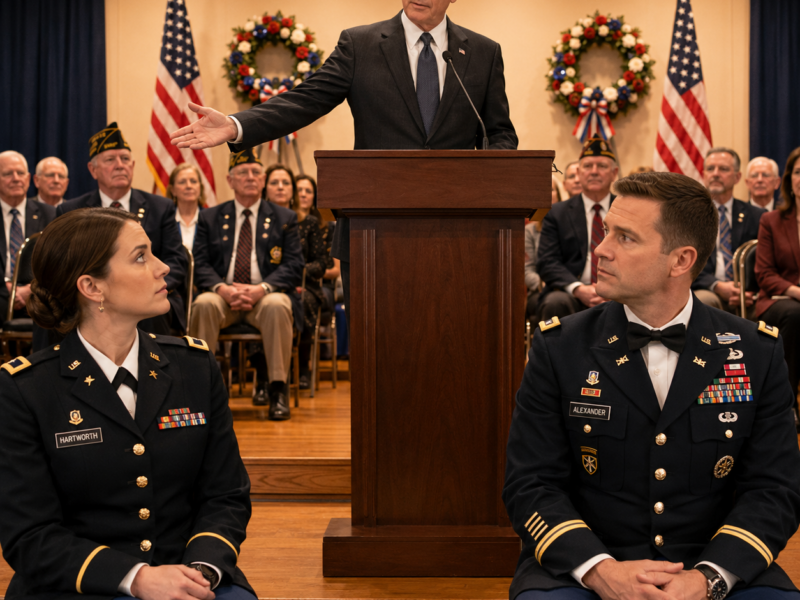
My father stood at a Veterans of Foreign Wars ceremony in front of half our town, pointed toward me, and said, “My daughter joined the Army. I’m sure she’s done her best.” Then his entire face changed when he turned toward my brother-in-law. “But Alexander is a real warrior. That’s what genuine military achievement looks like.” The room applauded. I sat there in uniform while my father reduced years of deployments and sacrifice to a polite footnote. Alexander didn’t look proud. He looked uncomfortable. Twenty minutes later, he pulled me aside, asked one quiet question about where I had served in Afghanistan, and went completely pale when I answered.
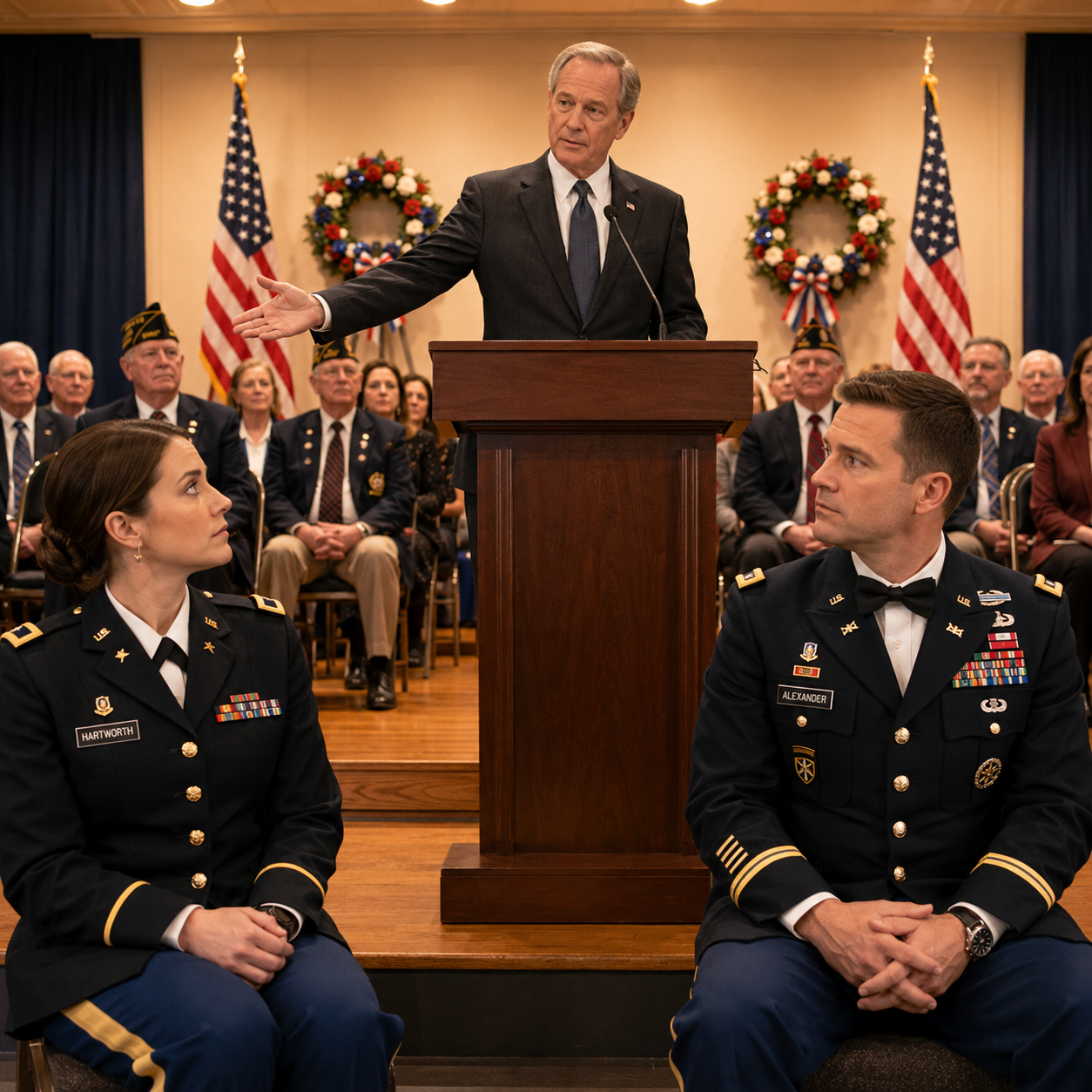
My father had already been speaking for twelve minutes when he finally said my name.
The high-school auditorium was full enough that late arrivals had been directed to folding chairs along the side walls. Small American flags stood in brass holders beside the stage. The local VFW post had placed memorial wreaths beneath a projection screen showing photographs of service members from our county, some young and smiling in old black-and-white portraits, others in modern uniforms taken only months earlier.
Dad stood at the podium like he had been born behind one.
Richard Hartworth owned one of the largest construction companies in our part of Virginia, had coached youth baseball for fifteen years, and served two terms on the county board. Public speaking came naturally to him. He understood pauses. Eye contact. The exact amount of humility that made people trust a confident man.
“As a father,” he said, “I’ve been fortunate to watch people in my own family choose service.”
My mother turned toward me with a small smile.
I sat beside my younger sister, Rebecca, in the third row.
On Rebecca’s other side sat her husband, Lieutenant Colonel Alexander Reed, an Army Special Forces officer whose career Dad had spent the last seven years discussing with anybody willing to stand still long enough to hear it.
Dad looked toward us.
“My daughter Juliet joined the Army when she was eighteen.”
There was polite applause.
I smiled because everyone was looking at me.
“She’s served overseas a number of times. She’s worked hard. I’m sure she’s done her best.”
Done her best.
The words landed strangely.
Not openly cruel.
That was what made them effective.
I had been in uniform for sixteen years by then. I had enlisted straight out of high school, later earned a commission through Green to Gold, completed multiple deployments, and spent much of my career in military intelligence supporting units whose missions rarely made family newsletters.
Done her best.
It sounded like what a teacher wrote on the report card of a child who had not quite passed.
Dad barely paused.
“But if you want to understand what real dedication looks like, I want you to look at my son-in-law, Alexander.”
His whole voice changed.
Warmth.
Energy.
Pride.
Alexander went still beside Rebecca.
Dad continued.
“Alexander has commanded Special Forces soldiers. He has led men overseas under conditions most of us can’t imagine. He has earned decorations, responsibility, and the respect of the people who serve beside him.”
The applause was louder.
Alexander stood because staying seated would have looked awkward, acknowledged the room, and sat again quickly.
Dad smiled at him from the stage.
“When young people ask me what service means, I tell them to look at men like Alexander. That is what sacrifice looks like. That is what makes a family and a community proud.”
I heard my mother inhale.
Rebecca’s shoulder tightened beside mine.
Alexander did not look at Dad.
He looked at me.
I kept my face neutral.
Years in the Army had taught me how to do that.
People imagine military bearing means not feeling things.
Usually it means feeling them without allowing those feelings to become everybody else’s problem.
Dad’s speech continued.
Patriotism.
Community.
Veterans.
Responsibility.
I stopped listening.
The strange part was that he had not called me a failure.
Not literally.
He did not need to.
He had placed my sixteen years beside Alexander’s and explained which one counted.
The room understood the hierarchy.
So did I.
When the ceremony ended, people gathered in the lobby beneath fluorescent lights that made everyone look slightly tired. A photographer from the county paper moved between veterans. Several people approached Alexander.
“Thank you for what you’ve done.”
“My nephew wants to go Special Forces.”
“What’s the pipeline really like?”
He answered politely.
He was good at that.
A retired Marine shook my hand too.
“Thank you for serving.”
“Thank you, sir.”
Nice.
Ordinary.
Then he moved toward Alexander.
I stepped back against the wall and adjusted the cuff of my dress uniform.
I had spent years telling myself my father’s approval no longer mattered.
The pain in my chest suggested I had exaggerated.
“Juliet.”
Alexander stood in front of me.
Rebecca was several feet away talking to Mom.
“What?”
He looked uncomfortable.
“Can we talk somewhere quieter?”
“I’m fine.”
“I didn’t ask if you were fine.”
That was annoyingly professional of him.
I started toward the exit.
He followed.
We stopped in a side corridor near the auditorium’s music rooms.
The building smelled faintly of floor wax and old stage curtains.
Alexander lowered his voice.
“What your dad said in there was wrong.”
“You didn’t write the speech.”
“I know.”
“Then don’t apologize for him.”
“I’m not.”
He studied me.
Then:
“I need to ask you something.”
I almost laughed.
“Apparently tonight is question night.”
“What did you actually do in Afghanistan?”
My expression changed before I could stop it.
Alexander noticed.
I answered carefully.
“Military intelligence.”
“I know the branch.”
“Then you know enough.”
“No.”
His face had gone serious.
“I don’t think I do.”
I looked toward the lobby.
“Alexander.”
“What unit were you attached to in 2012?”
My heart gave one hard beat.
“Why?”
“Because something you said to Rebecca last Christmas has been bothering me for months.”
“What did I say?”
“You complained about dust getting into a server rack at Kandahar.”
“That narrows it down to half the war.”
“Then tonight your dad mentioned you were deployed there during the same window.”
I said nothing.
Alexander watched.
“Were you working out of the joint fusion cell near the airfield?”
“That’s not a family conversation.”
His face changed.
Not because I confirmed anything.
Because I had not denied enough.
“Jesus.”
“Lower your voice.”
He stepped closer.
“There was an intelligence shop operating down there that people in our community used to call the Ghost Cell.”
I closed my eyes.
Not official.
Not a codename.
Soldier folklore.
The kind of nickname that forms around useful work nobody can discuss outside particular circles.
“Alexander.”
“You were with them.”
“I’m not discussing operations in a high-school hallway.”
He stared at me.
Then whispered:
“Were you the officer they called Hart?”
I looked at him.
That was answer enough.
The color drained from his face.
For several seconds, neither of us moved.
Finally:
“Juliet…”
“No.”
“Do you understand how many teams knew that shop?”
“That’s enough.”
“Do you know how often your reporting—”
“Alexander.”
My voice sharpened.
He stopped.
I took a breath.
“We are standing forty feet from my father and a county newspaper photographer.”
“Right.”
“You know how this works.”
“Right.”
“Then act like it.”
He rubbed one hand across his face.
“Sorry.”
Silence.
Then:
“Your dad has no idea.”
“No.”
“And he stood up there and…”
“Yes.”
Alexander looked toward the lobby.
His jaw tightened.
“I can’t let him do that again.”
“You can.”
“No.”
“You can because my career is not your family argument.”
“He made my career your family argument.”
“That does not give you permission to correct him with information he doesn’t need.”
Alexander looked furious.
Not with me.
“Juliet.”
“I know what he said.”
“I was there.”
“You think I’m defending him?”
“No.”
“Then what?”
“I’m asking you not to turn my work into a weapon.”
He stared at me.
That landed.
I continued.
“If Dad can only respect me after learning something secret enough to impress him, then he still doesn’t respect me.”
Alexander went quiet.
Good man.
He understood.
Eventually he nodded.
“You’re right.”
“I know.”
“Still irritating.”
“I know that too.”
He almost smiled.
Then:
“For whatever it’s worth, I am sorry he did that.”
That one I accepted.
“Thank you.”
I walked out before my father could ask why I looked upset.
I was thirty-four years old that night.
Major Juliet Hartworth, United States Army.
My father still had the ability to make me feel seventeen.
That power had been built slowly.
Richard Hartworth was not an unloving father in the simple way people prefer for stories.
He coached my softball team until he realized I was faster than I was coordinated.
He taught me to read blueprints at twelve.
He paid for braces.
He sat beside me in an urgent-care clinic after I sprained my ankle badly enough to require crutches.
When I got my driver’s license, he handed me the keys to an old company pickup and said:
“If you put one dent in it, make sure it’s a dent worth the story.”
I loved him.
He loved me.
Love was not the problem.
The conditions around his approval were.
Dad had grown up believing achievement was evidence of character.
His father had been a brick mason who started before sunrise and distrusted people who wore clean shoes to work. Dad built Hartworth Construction from one pickup and three employees into a regional commercial contractor with crews across central Virginia.
He worked.
Saved.
Expanded.
He believed effort created results because effort had created many of his.
That belief becomes dangerous when luck cooperates for too long.
Dad began assuming results proved effort.
If you won, you had worked.
If you struggled, perhaps you had not.
If somebody impressed him, their achievement became moral evidence.
If they did not, he searched for what they could have done differently.
I learned young.
Track.
Grades.
Volleyball.
Summer construction work.
At fifteen, I spent July mornings on his job sites checking material deliveries because he said there was no reason his daughter should spend summer sleeping until ten.
I liked the work.
The smell of cut lumber.
The order of plans.
The way a building began as marks on paper and slowly became something you could walk through.
When I made varsity track sophomore year, Dad said:
“Good. Now win something.”
I won two regional meets.
He asked about state.
When I finished high school with a 3.8 GPA, Mom baked a cake.
Dad said:
“Lucy Stanton was valedictorian.”
Lucy was my cousin.
I remember staring at him.
Not because I needed a parade.
Because no achievement seemed capable of landing.
My mother, Elaine, explained him.
“You know your father.”
“He wants you to reach your potential.”
“How does he know where my potential ends?”
“He doesn’t.”
“Exactly.”
Mom smiled sadly.
“He thinks pushing is love.”
Maybe.
The person being pushed still feels the pressure.
When I was seventeen, a neighbor’s son received an appointment to West Point.
Dad talked about it for weeks.
“Discipline.”
“Service.”
“Prestige.”
“Leadership.”
Something in me listened.
By March of senior year, I walked into an Army recruiting office.
Sergeant Rosa Martinez sat behind a desk with a bowl of peppermints and asked:
“What do you want out of the Army?”
I gave the noble answer first.
“Serve.”
She nodded.
“What else?”
“Education.”
“Good.”
“What else?”
I looked toward the posters.
“Something difficult.”
She smiled.
“That I can offer.”
I enlisted in military intelligence.
Dad’s reaction surprised me.
“You’re not going to college?”
“Later.”
“You have grades.”
“I know.”
“Then why enlist?”
“Because I want to.”
He looked almost offended by the concept.
Mom asked:
“Is this because of Trevor Stanton?”
“No.”
It was partly because of everything.
Dad’s admiration for West Point.
My own desire to leave.
Money.
Purpose.
A test with rules Dad did not write.
Basic training was miserable.
Also clarifying.
Nobody cared who Richard Hartworth was.
Nobody knew my GPA.
Nobody knew my sister had been prettier at thirteen or my cousin had been valedictorian.
Standards were posted.
Run.
Shoot.
Learn.
Show up.
Do not quit because you are tired.
I was good at that world.
Maybe because Dad had trained me for it without meaning to.
After initial training, I became an intelligence analyst.
Germany first.
Then deployment.
Then another.
I learned fast.
Not movie intelligence.
Most work was long hours, pattern analysis, reports, briefings, translation support, source evaluation, cross-checking information that contradicted itself.
People imagine intelligence as secrets whispered in dark rooms.
Often it is three exhausted people arguing over whether two nearly identical place names refer to the same valley.
Accuracy matters because people move based on what you tell them.
That responsibility suited me.
During my first deployment, Dad’s company hit a recession-era cash-flow problem.
He never asked me directly.
Mom mentioned:
“Payroll is tight.”
I had savings.
I sent home $1,500.
Then another thousand months later.
Dad called.
“You don’t need to do this.”
“I know.”
“I’ll pay you back.”
“You paid for eighteen years.”
“That’s not a loan.”
“Neither is this.”
He accepted.
No thank-you speech.
Fine.
Family.
I sent money home several more times over the years.
Not enough to save a failing company.
Enough to help.
Insurance.
A tax payment.
Mom’s dental surgery.
I did not keep a resentment ledger then.
I was proud to help.
At twenty-four, I applied for Green to Gold.
College.
ROTC.
Commission.
The Army had shown me a path I had not imagined at eighteen.
Dad came to the commissioning ceremony.
Second lieutenant bars.
He shook my hand.
“You clean up well.”
“High praise.”
He smiled.
I waited.
He added:
“Your mother’s proud.”
Not:
I am.
That absence still registered.
Then I went back to work.
As an officer, I moved deeper into intelligence planning.
More deployments.
Team leadership.
Joint assignments.
By thirty, I had worked beside conventional Army units, aviation, special operations support elements, and coalition partners.
I stopped talking about details at home because details were either classified, boring to outsiders, or both.
Dad interpreted silence as insignificance.
I did not realize that until much later.
Then Rebecca married Alexander.
Rebecca was four years younger than me.
Warm.
Social.
More willing than I had ever been to tell Dad when he was annoying.
She met Alexander at a friend’s wedding while he was between assignments.
He was already Special Forces.
Green Beret.
Smart.
Quiet.
Not the swaggering stereotype Dad apparently expected.
Dad loved him immediately.
Not personally at first.
Symbolically.
Alexander represented an achievement Dad understood.
Special Forces.
Combat.
Command.
Simple labels with impressive weight.
At the first family barbecue after their engagement, Dad told three separate people:
“My future son-in-law is a Green Beret.”
Alexander looked embarrassed.
Later he found me beside the grill.
“Does he always do that?”
“Yes.”
“Can I stop it?”
“No.”
“Damn.”
I liked him.
He treated me professionally from the beginning without demanding classified details.
“What branch?”
“MI.”
“Current level?”
“Joint support.”
He nodded.
Enough.
Dad began comparing us without recognizing he was doing it.
“Alexander’s unit is going somewhere rough.”
Then:
“You still working staff?”
I would say:
“Among other things.”
Dad heard:
desk.
At Christmas:
“Alexander just completed another deployment.”
I had returned from one nine weeks earlier.
Mom tried:
“Juliet has too.”
Dad nodded.
“Yes, yes.”
Then back to Alexander.
The irony became almost funny.
Almost.
Alexander noticed.
He tried redirecting.
“What Juliet’s doing is important.”
Dad would say:
“I’m sure.”
That phrase.
I’m sure.
Belief without curiosity.
At one family dinner, Dad explained military leadership to me using Alexander as an example.
I stared.
Alexander interrupted.
“Richard, Juliet outranked me earlier in our careers.”
Dad laughed.
“Well, rank doesn’t always mean experience.”
Alexander looked at me.
I looked down before I laughed inappropriately.
The deepest wound was not that Dad admired Alexander.
Alexander deserved admiration.
He had done difficult work.
Led well.
Carried losses he rarely discussed.
The wound was that Dad seemed capable of spontaneous pride.
Just not for me.
I kept serving.
Promotions.
Assignments.
People trusted my judgment.
That should have been enough.
Most days it was.
Then some night at 2:00 a.m., sitting in a temporary operations center half a world away, I would imagine calling Dad with one piece of news large enough to finally change his voice.
Embarrassing.
Human.
We can outgrow childhood houses and still carry a room inside them.
The Kandahar deployment became the closest thing to such an achievement, though Dad never knew.
I will not turn classified work into a dramatic legend because that would be both unrealistic and disrespectful to people who actually did the work beside me.
What I can say is that I was part of a joint intelligence cell supporting coalition and special operations activities.
Our job involved assembling fragments.
Patterns.
Networks.
Routes.
Relationships.
Information from multiple sources that rarely agreed neatly.
My team developed analysis that helped commanders understand where risk was changing and where local dynamics made previous assumptions obsolete.
Useful intelligence is often invisible precisely because bad things do not happen after somebody adjusts.
A patrol takes another route.
A meeting moves.
An operation gets delayed.
A unit prepares differently.
People come home.
No newspaper.
No parade.
Among some special operations soldiers, our small cell acquired a nickname.
The Ghost Cell.
Not official.
Not mine.
I was one officer among several.
Somehow my surname shortened to Hart in reports and briefings, and later soldiers who did not know me personally occasionally referred to “the Ghost of Kandahar” as though one mysterious analyst lived in a cave producing perfect answers.
That was nonsense.
My work had depended on interpreters, analysts, collection teams, liaison officers, local sources, soldiers, airmen, civilians, and people whose names I could not discuss.
I hated the nickname.
I also knew why Alexander recognized it.
He had operated in the same ecosystem.
Back home, Dad knew none of that.
He knew I sent a Mother’s Day card late.
He knew I missed Rebecca’s thirtieth birthday.
He knew I said I could not discuss work.
Then Dad stood on the VFW stage and told the county I had “done my best.”
The next morning, I woke in my childhood bedroom at 5:40 after sleeping badly.
My phone showed three calls from Alexander.
I ignored them.
Ran four miles.
Came back sweating into the cold October morning.
Mom was making eggs.
Dad sat at the kitchen table reading the Sunday paper.
“Morning.”
He said it as if nothing had happened.
“Morning.”
Mom turned.
“The ceremony was lovely.”
I poured coffee.
“Mrs. Henderson called before eight.”
Dad smiled.
“She liked the speech.”
“Apparently.”
He looked up.
“Something wrong?”
I almost said yes.
Then Alexander called again.
Dad glanced at the phone.
“He really wants you.”
“Seems so.”
I answered.
“What?”
“Coffee.”
“I’m standing in my parents’ kitchen.”
“One hour.”
“Alexander.”
“Please.”
That word from a man like Alexander meant enough.
“Fine.”
We met at a diner near the interstate.
He looked worse than I did.
“You didn’t sleep.”
“No.”
“That seems excessive.”
He ignored me.
“I reviewed what I’m allowed to remember without crossing any lines.”
I stared.
“That is a strange opening.”
“I’m not asking you to confirm anything.”
“Good.”
“I just need to say this.”
I waited.
“Products from your cell moved through our channels.”
I said nothing.
“Some of that analysis changed how teams operated.”
Silence.
“I know at least one operation where a shift in reporting from your shop changed timing enough to matter.”
“Alexander.”
“No details.”
He held up both hands.
“I’m staying general.”
He leaned closer.
“The point is your work had impact.”
“I know.”
“Do you?”
I almost became angry.
Then realized what he meant.
Not professionally.
Emotionally.
“Yes.”
“Then why did you let him say that?”
I looked toward the waitress refilling another table’s coffee.
“Because correcting Dad with classified credibility would be pathetic.”
“You could correct him without details.”
“I’ve tried.”
“You’ve never said it directly.”
That irritated me because it was true.
“You know my father now?”
“I know men who think silence means agreement.”
Fair.
Alexander continued.
“I also know what it feels like to get praised for somebody else’s work.”
I looked at him.
“Last night felt awful.”
“Why?”
“Because he used me to diminish you.”
There.
“You didn’t ask him to.”
“No.”
“But I stood.”
“You were introduced.”
“I know.”
He rubbed his face.
“Rebecca asked why I looked sick.”
“What did you tell her?”
“That her father had put me in a position I didn’t like.”
“Good.”
“Not the classified part.”
“Better.”
He stared.
“I won’t tell him.”
“Thank you.”
“But I’m not letting him use me like that again.”
“How?”
“Next time he makes a comparison, I’m stopping the comparison.”
That was fair.
“General terms.”
“Yes.”
“No Ghost.”
“Yes.”
“No Kandahar.”
“Yes.”
“No dramatic reveal.”
He sighed.
“You really destroy all fun.”
“National security.”
We finished coffee.
Before leaving, Alexander said:
“You know this isn’t really about military service.”
“I know.”
“What is it?”
I answered before thinking.
“He likes me more when I’m useful than when I’m impressive.”
Alexander frowned.
“That sounds backwards.”
“Not in our house.”
I drove home.
Dad was still at the table.
Paper folded now.
“Good coffee?”
“Terrible.”
He smiled.
Then:
“Your mother says you seemed upset last night.”
I looked at Mom.
Betrayal.
She shrugged.
“I have eyes.”
Dad waited.
I could have spoken.
I did not.
Not yet.
Three days later, Alexander called.
“Your dad is speaking at the American Legion event Saturday.”
“I know.”
“He wants all of us there.”
“I know.”
“I don’t want to do last week again.”
“Neither do I.”
“What are you going to do?”
“Leave early.”
Silence.
“Seriously?”
“Yes.”
“Juliet.”
“I’m not asking you to fix it.”
“I’m not.”
“Good.”
That Friday, I told my parents.
Dinner.
Meatloaf.
Mashed potatoes.
Rebecca and Alexander had not arrived yet.
“I’m heading back tomorrow morning.”
Mom looked surprised.
“Your leave goes through Monday.”
“I know.”
Dad put down his fork.
“What about the Legion event?”
“I won’t be there.”
“Why?”
“I need to get back.”
“That’s not an answer.”
I stared at him.
“Then I don’t think my presence adds much.”
“What does that mean?”
“You have Alexander.”
Dad frowned.
“What does Alexander have to do with it?”
“He represents the military side of the family better for you.”
Mom stopped eating.
Dad’s face tightened.
“That’s ridiculous.”
“Is it?”
“Yes.”
“Last weekend you introduced me as your daughter who joined the Army and has done her best.”
Dad opened his mouth.
I continued.
“Then you introduced Alexander as what real dedication looks like.”
“That wasn’t…”
“You said those words.”
“I was trying to honor him.”
“You honored him by making me smaller.”
“No.”
“Yes.”
Dad looked genuinely shocked.
Not guilty.
That mattered.
“I’m proud of both of you.”
“No.”
My voice remained quiet.
“You are proud of Alexander.”
“You tolerate me.”
“That is different.”
Mom whispered:
“Juliet.”
“No, Mom.”
Years of swallowed sentences arrived.
“I am thirty-four years old.”
“I have been serving since I was eighteen.”
“I’ve missed Christmas.”
“Birthdays.”
“Family weddings.”
“I sent money home when the company was struggling.”
“I have done work I cannot explain at this table.”
“And every time I come home, Dad talks to me like I joined the Army because I couldn’t think of anything better.”
Dad stood.
“That is not fair.”
“There.”
“What?”
“Fair.”
“You get angry when the description is ugly.”
“That doesn’t make it inaccurate.”
Dad’s face reddened.
“If you have something to say, say it directly.”
“I just did.”
I pushed back from the table.
“I’m leaving tomorrow.”
He said:
“Don’t storm away like a teenager.”
I stopped.
Turned.
“Then stop talking to me like one.”
Silence.
Mom’s face went white.
I went upstairs.
My hands shook for an hour.
I left before sunrise.
No dramatic goodbye.
Mom came down in her robe while I loaded my bag.
“Call me.”
“I will.”
She hugged me.
Then:
“Your father loves you.”
“I know.”
That had never been the question.
The Legion event happened without me.
Alexander called afterward.
“He changed the speech.”
“What?”
“Less family stuff.”
“Did you say anything?”
“No.”
“Good.”
“He seemed distracted.”
“That sounds like Dad.”
Then:
“Rebecca knows there’s more.”
“How much?”
“She knows her father humiliated you.”
“Fine.”
“She wants to call.”
“I’m not ready.”
“I’ll tell her.”
Good brother-in-law.
For six weeks, Dad and I barely spoke.
Mom called.
Handed him the phone.
Weather.
Business.
Nothing.
I returned to Fort Liberty for a new assignment involving intelligence planning and training.
Work had structure.
Family did not.
I liked structure too much.
That winter, I volunteered for three extra projects.
My executive officer noticed.
“You hate working groups.”
“I’m evolving.”
“You’re hiding.”
Military people can be annoyingly perceptive.
I stopped volunteering for the fourth.
December brought Dad’s call.
Sunday evening.
Direct.
No Mom.
“I’ve been thinking.”
Dangerous opening.
“Okay.”
“About what you said.”
I waited.
He continued.
“I talked to Mike Daley.”
Dad’s friend.
Vietnam veteran.
Then two men from the VFW.
“Why?”
“Because I realized I don’t actually understand Army jobs.”
That startled me.
Dad had spent years speaking confidently about Army service.
“Okay.”
“I know what Special Forces means because TV knows what Special Forces means.”
I almost laughed.
He continued.
“When you say military intelligence, I picture offices.”
“Sometimes.”
“Reports.”
“Yes.”
“Computers.”
“Yes.”
“Then I fill in the rest.”
There.
“I assumed support.”
“There’s nothing wrong with support.”
“I know.”
“That isn’t what you’re saying.”
“No.”
Dad became quiet.
“I made support mean lesser.”
“Yes.”
“And I didn’t ask.”
“No.”
“Why didn’t you tell me?”
That one hurt.
“I tried.”
“When?”
“When I was twenty-two.”
“Twenty-five.”
“Twenty-nine.”
“You changed the subject.”
Dad went silent.
“I did?”
“Yes.”
“Why?”
“I don’t know.”
Then:
“You liked stories you understood.”
Alexander kicking doors.
Commanding teams.
Things that fit Dad’s construction-company model of leadership.
Visible.
Physical.
Clear.
Dad whispered:
“We really screwed this up.”
We.
I almost rejected the shared responsibility.
Then considered.
“I stopped trying to explain.”
“Because you weren’t listening.”
“Yes.”
“That part’s mine.”
“But eventually I decided you were incapable of listening.”
“That part became mine.”
He took a breath.
“Can we try again?”
I closed my eyes.
“What do you want to know?”
“What can you tell me?”
Good question.
Not:
What did you secretly do?
What can you tell me?
So I explained military intelligence without compromising anything.
Collection disciplines.
Analysis.
Briefings.
Operational planning.
The difference between tactical and strategic intelligence.
How incomplete information becomes decisions.
How leaders must know confidence levels, not just answers.
Dad listened.
Actually listened.
Then:
“You were doing that overseas?”
“In broad terms.”
“Dangerous?”
“Sometimes.”
“Important?”
“Yes.”
“Were you good?”
I almost laughed.
“Yes, Dad.”
He became quiet.
“I’m sorry.”
The first one.
Not complete.
Enough to start.
Months later, I went home on leave.
Dad hugged me at the door.
A real hug.
Dinner felt careful.
He asked about my current assignment.
Too many questions at first.
Trying.
I answered enough.
Then Alexander and Rebecca arrived.
I watched Dad.
He asked Alexander about training.
Then me about my team.
Balanced enough to look deliberate.
That bothered me.
After dinner, Alexander found me on the back porch.
“How’s it feel?”
“Artificial.”
“Change is artificial until practiced.”
“I hate when you sound wise.”
“It’s rare.”
He leaned against the railing.
“He’s trying.”
“I know.”
“Is that enough?”
“I don’t know.”
It wasn’t yet.
The breakthrough came in Dad’s office.
Not military.
Not emotional.
Hartworth Construction was bidding a municipal redevelopment project.
Three subcontractors.
Material delays.
One bridge inspection schedule intersecting with utility relocation.
Dad was complaining about sequencing.
I looked at his wall chart.
“What if you stop treating the steel delivery as fixed?”
He frowned.
“It is fixed.”
“No.”
“It’s currently scheduled.”
“Different.”
He looked at me.
“Supplier says Tuesday.”
“Supplier says Tuesday because you asked for Tuesday.”
“I need Tuesday.”
“Do you?”
I took a marker.
For twenty minutes, we moved tasks.
Adjusted crews.
Identified a dependency he had treated as sequential when it could run parallel.
Dad argued.
I argued.
Then stopped.
He stared at the board.
“Hell.”
“What?”
“That works.”
“Yes.”
“Where’d you learn this?”
I shrugged.
“Operational planning.”
He looked at me differently.
Not impressed by mystery.
Respecting competence he could see.
“That’s exactly what we need.”
Something in my chest released.
Small.
The approval I had wanted for sixteen years arrived over a whiteboard covered in construction scheduling.
Not a classified operation.
Not a medal.
A project plan.
Maybe because Dad finally saw my expertise in a language he understood.
Maybe because I finally offered it without begging him to admire the source.
The visit changed after that.
His questions became more natural.
“Does your team plan like this?”
“Sometimes.”
“How do you deal with bad information?”
“Build branches.”
“What’s a branch?”
I explained decision points.
He took notes.
Later, I heard him tell his superintendent:
“Juliet taught me that.”
Not:
The Army.
Not:
My daughter happens to know.
Juliet.
A person with expertise.
When I left, Dad stood beside my car.
“Be safe.”
“Always.”
“That’s not true.”
I looked at him.
“No.”
He swallowed.
“Then be as safe as you can.”
Better.
My next deployment took me overseas again.
Before departure, Dad asked:
“Should I worry?”
“Yes.”
That honesty surprised him.
Then:
“But you should also know I’m trained.”
“I know.”
“I have good people.”
“I know.”
“The work matters.”
Dad nodded.
“I’ll worry and be proud at the same time.”
That sentence became ours.
During deployment, he emailed.
Not intrusive.
Weather.
Mom.
Company.
Then:
Anything you can tell me?
Sometimes I answered:
Long week. Team good. Tired.
He replied:
Proud.
No explanation needed.
Alexander became useful in a different way.
Dad occasionally asked him general military-culture questions that I could not answer without context.
Alexander never disclosed my work.
Never used Ghost again.
That nickname disappeared back where it belonged.
Within professional circles.
Not family mythology.
Rebecca finally confronted me too.
We were home during Christmas after my return.
She found me wrapping gifts.
“Were you angry at me?”
“For what?”
“Dad.”
“No.”
“I let him do it.”
“You didn’t write the speech.”
“I knew he compared you.”
“So did Mom.”
Rebecca sat on the floor.
“I liked being married to the person he bragged about.”
There.
Honesty.
“Alexander made me look accomplished by association.”
“That sounds like Dad.”
“I know.”
She began crying.
“I’m sorry.”
I put down the tape.
“You don’t need to take responsibility for his favoritism.”
“I need to take responsibility for enjoying it.”
Fair.
I hugged her.
Sister.
Not enemy.
The family dynamic shifted because people stopped pretending.
Three years after the first VFW ceremony, Dad was invited to speak at another county veterans event.
I attended.
Nervous.
Alexander too.
Dad stood at the podium.
Same posture.
Older.
He began:
“Military service takes many forms.”
I looked at Mom.
She squeezed my hand.
Dad continued.
“Some service is visible.”
“Some is understood easily by civilians.”
“Some happens in places, specialties, and responsibilities most families never fully see.”
Then:
“I once made the mistake of assuming what I understood was more valuable than what I didn’t.”
The room became quiet.
He did not publicly confess to humiliating me.
Good.
This was not a family therapy session with microphones.
He said:
“I have two Army officers in my family whose careers look very different.”
“My son-in-law Alexander has served in Special Forces.”
“My daughter Juliet has spent much of her career in military intelligence.”
“I cannot tell you exactly what either has done.”
“Some things are not mine to tell.”
That sentence.
Respect.
“But I know this now.”
“Service does not need my understanding to become worthy.”
I cried.
Quietly.
Dad spoke about veterans broadly after.
No ranking.
When the ceremony ended, he found me near the exit.
“I’m proud of you.”
I had imagined those words thousands of times.
In imagination, they healed childhood.
In reality, they felt warm.
Important.
Smaller than I expected.
“Thanks, Dad.”
“I should’ve said it sooner.”
“Yes.”
He smiled sadly.
“I’m saying it now.”
That mattered because I no longer needed it to define me.
Approval becomes healthier when it stops being oxygen.
Two years later, Dad was diagnosed with prostate cancer.
He was sixty-nine.
Mom called Tuesday evening.
I took leave and drove home.
Dad sat at the kitchen table with medical paperwork spread across the same surface where he used to quiz me on algebra.
“Don’t look at me like that.”
“Like what?”
“Like I’m dying.”
“I’m looking at you like you have cancer.”
“Same face.”
I sat.
“What did the doctor say?”
We reviewed.
Localized.
Treatment options.
Good prognosis relative to many cancers.
Still cancer.
Dad approached it like construction.
Schedule.
Decision matrix.
I let him.
Then after an hour, he stopped.
“This makes you think.”
“Dangerous.”
“I’m serious.”
“So am I.”
He looked toward the backyard.
“There’s something about that VFW speech I never told you.”
“We handled that.”
“I know.”
“I need to tell it.”
I waited.
Dad rubbed his hands together.
“The truth is Alexander intimidated me.”
I blinked.
“What?”
“Green Beret.”
“Decorated.”
“Command.”
“He married Rebecca and suddenly I felt like I had this man in the family who had done things I couldn’t measure myself against.”
I stared.
“So you tried to impress him.”
“Yes.”
“How?”
“By showing him I understood military service.”
The irony was almost painful.
“So I made him the centerpiece.”
“And made me small.”
“Yes.”
Dad’s eyes filled.
“I wasn’t thinking about you as competition.”
“I wasn’t thinking about you enough at all.”
That was worse and better.
“I was performing.”
There.
Social performance.
Dad, the public man.
County board.
Contractor.
Community leader.
“I wanted Alexander to think I respected him.”
“And you used me to do it.”
“Yes.”
“I’m sorry.”
I sat quietly.
Then:
“Thank you for telling me.”
He continued.
“After our phone call, I started asking people questions.”
My stomach tightened.
“Dad.”
“I didn’t use your name.”
“Good.”
“I asked old veterans about intelligence work.”
“Special operations support.”
“Things people could explain generally.”
He looked at me.
“I learned enough.”
“What does that mean?”
“Enough to know I was more wrong than I understood.”
I did not answer.
Dad’s voice dropped.
“I know there are things you cannot tell me.”
“I’m not asking.”
“But I know enough to understand that when I called Alexander the real military achievement in our family…”
He stopped.
“I was embarrassingly ignorant.”
No victory.
I cried.
Dad too.
Not because secret hero status finally earned his respect.
Because he had learned the larger lesson.
He did not need details.
He needed humility about what he did not know.
Cancer treatment succeeded.
Dad entered remission.
The scare changed him.
He became more direct.
Less performative.
At community events, he spoke about military families with nuance.
“Ask what you can.”
“Respect what cannot be shared.”
“Do not assume the job you recognize matters more than the one you don’t.”
He never used my story for applause.
Good.
I kept advancing.
Lieutenant colonel.
Then colonel after years of assignments and command responsibility.
No magical leap.
Military careers are built from timing, performance, professional education, mentors, selection boards, luck, and years when one mistake can change trajectory.
I had all of that.
At forty-four, I received an Army-level commendation for cumulative work across multiple assignments.
The ceremony at the Pentagon was small.
Sanitized citation.
No Ghost.
No Kandahar legend.
Dad attended.
Mom too.
Alexander and Rebecca.
Afterward, one of my former commanders shook Dad’s hand.
“Your daughter has had impact in places that won’t make dinner conversation.”
Dad smiled.
“I’m learning that.”
Then:
“Better late than never.”
No claiming credit.
That mattered.
On the flight home, Dad and I barely discussed the award.
Back at his kitchen table:
“Today wasn’t about me finally seeing what you did.”
I looked at him.
“What?”
“It was about me being present for recognition you already earned.”
My eyes filled.
Dad continued.
“You didn’t become more valuable because I finally understood.”
There.
That sentence healed more than proud ever could.
“Thanks.”
“I am proud.”
“I know.”
Good.
Years passed.
Mom died first.
Stroke.
Quick.
I was forty-eight.
Dad and I stood beside her hospital bed.
Rebecca too.
Mom had spent much of our childhood smoothing Dad’s sharp edges.
Later, she admitted that had sometimes meant asking me to tolerate things she should have challenged.
A year before she died, she told me:
“I protected his intentions more than your feelings.”
Accurate.
“I’m sorry.”
I forgave her.
Not because intentions did not matter.
Because she changed.
After Mom’s death, Dad softened in ways grief sometimes forces.
He sold part of Hartworth Construction to his longtime superintendent.
Then retired fully.
Alexander eventually retired from the Army.
Rebecca built a career in education administration that Dad had once barely discussed because military stories occupied more social space.
He learned to ask about her work too.
Family hierarchy had hurt her differently.
She was the spouse of the impressive man.
People asked what Alexander did before asking what she did.
One Thanksgiving she said:
“I think Dad finally understands how annoying that is.”
Alexander replied:
“I understood immediately.”
She threw a roll at him.
Healthy.
I had therapy too.
Important.
It is easy to tell a story where the father learns and the daughter simply waits nobly.
No.
I carried damage.
Hypervigilance around praise.
Suspicion whenever Dad complimented me.
Need to outperform.
I had spent so long seeking his approval that even after he gave it, part of me wanted more evidence.
Dr. Naomi Wells told me:
“You are trying to make him pay retroactively by never allowing current behavior to count.”
That angered me.
Then I realized she was right.
Boundaries require updating too.
If someone changes consistently, refusing to notice can become another form of living in the past.
Not everyone should restore contact.
But mine was safe enough.
Dad was changing.
I let him.
My military career continued.
At fifty-one, I was selected for brigadier general.
One star.
Not because of the Ghost story.
Not because family drama creates rank.
Years.
Command.
Strategic intelligence roles.
Joint assignments.
Professional military education.
Performance.
Senate confirmation.
Dad was seventy-six.
He sat in the front row at the pinning.
Alexander sat beside him in a civilian suit.
When my stars were pinned, Dad cried openly.
No embarrassment.
Afterward:
“General.”
“Don’t.”
“I have waited decades.”
“You spent decades not caring about rank.”
“Growth.”
We laughed.
Then he asked:
“What does this assignment actually mean?”
Of course.
Substance now.
I explained.
Broadly.
He listened.
At dinner:
“I used to think proud meant telling other people what my children accomplished.”
“What do you think now?”
“Knowing enough about their lives that I don’t have to perform it.”
That sounded like Dad after years of work.
Good.
He aged.
Arthritis.
Heart disease.
Construction hands becoming stiff.
I visited.
Not from obligation.
Choice.
He sometimes needed help reading insurance paperwork.
I helped.
Not because reliable daughter must.
Because I could.
If I could not, Rebecca handled.
Distributed.
No one child became default infrastructure.
Dad noticed.
“I did that to you when you were young.”
“What?”
“Assumed you could handle things.”
“Yes.”
“You seemed strong.”
“I was.”
“That’s not the same as not needing help.”
There.
Late lessons.
At eighty-one, Dad had a second cancer scare.
Benign this time.
Still frightening.
In the hospital waiting area, he said:
“You know what I regret?”
“Your VFW speech?”
He smiled.
“Predictable.”
“Good.”
“Anything else?”
“Teaching you achievement was how to get love.”
That one hit.
“You didn’t teach that intentionally.”
“Still taught it.”
Yes.
“I’m sorry.”
I took his hand.
“I know.”
“Did you ever stop trying to impress me?”
I thought.
“Yes.”
“When?”
“Before you started being impressed.”
Dad laughed.
“Fair.”
By fifty-eight, I was a major general.
Two stars.
No family spectacle.
Dad came.
Rebecca.
Alexander.
Friends.
Mara, long retired from active duty by then.
She found me afterward.
“You know you’re still annoying.”
“Rank has no effect?”
“Negative effect.”
Good.
At sixty-one, I was nominated for lieutenant general.
Three stars.
The process took time.
Confirmation.
Assignment.
No guarantees.
When public announcement came, Dad called.
His voice was thin with age.
“Three?”
“Yes.”
“That seems irresponsible.”
“I agree.”
He laughed.
“Your mom would lose her mind.”
“Yes.”
Then:
“I’m proud.”
“I know.”
The ceremony took place in the Washington area.
Dad attended in a wheelchair because airports and long corridors had finally beaten his pride.
Alexander pushed him.
Dad complained.
“You’re enjoying this.”
“Immense.”
At the reception, people shook my hand.
Young officers.
Senior civilians.
Old colleagues.
No one knew the nickname my family once treated as revelation.
Good.
It no longer mattered.
Dad sat near a window watching.
I went over.
“Tired?”
“Old.”
“Same.”
Then a young major approached.
“Ma’am, may I ask you something?”
“Yes.”
“How did you know when you’d done enough?”
I laughed.
“Wrong person.”
Dad said:
“She never knows.”
True.
I told the major:
“You decide whether the work still aligns with who you want to be.”
“Rank is not an answer.”
Dad listened.
After the major left:
“You should’ve told thirty-year-old you that.”
“I would’ve ignored me.”
“Also true.”
Dad died the following year.
Eighty-four.
Pneumonia.
I reached the hospital.
Rebecca too.
Alexander.
Dad drifted in and out.
At one point, his eyes opened.
“Juliet?”
“Here.”
“Rank?”
I laughed through tears.
“Lieutenant general.”
“Too many stars.”
“Yes.”
He squeezed my hand weakly.
“Proud.”
“I know.”
Then:
“Should’ve said it sooner.”
I bent down.
“You said it enough later.”
His eyes closed.
Dad died that night.
At the funeral, I stood behind the lectern in the same church where he had once praised Alexander so easily and struggled to praise me.
I did not tell that story.
I talked about blueprints.
Dad believed buildings fail long before walls collapse.
A hairline crack.
A measurement off.
A foundation not square.
He taught crews to check early.
I said:
“My father was better at that with buildings than relationships.”
People laughed softly.
Then:
“But he learned.”
I told them about him taking notes while I solved a sequencing problem.
About emails during deployments.
About worry and proud at the same time.
About a man who had been wrong and eventually cared more about truth than defending his pride.
That was the father I wanted remembered.
Not sanitized.
Whole.
After the funeral, Alexander found me outside.
“You okay?”
“No.”
“Good answer.”
We stood.
Then he said:
“You know, I almost told him.”
I looked.
“The Kandahar thing.”
My stomach tightened.
“When?”
“After the first VFW ceremony.”
“I know.”
“I mean later too.”
“Why didn’t you?”
“Because you were right.”
He looked toward the cemetery.
“If he needed Ghost to respect you, then the respect would still be shallow.”
I nodded.
“He learned without it.”
“Yes.”
That mattered.
The nickname had once felt like a potential weapon.
Proof.
Years later, I was grateful we never used it.
Dad’s respect grew from curiosity.
Not classified awe.
That made it real.
I retired at sixty-four.
Not as a four-star general.
Three was enough.
More than enough.
My retirement ceremony was smaller than people expect from senior rank.
I wanted colleagues.
Family.
No huge production.
Rebecca.
Alexander.
Mara.
Young officers I had mentored.
Civilians who had taught me difficult lessons.
Dad absent.
That empty chair mattered.
I spoke briefly.
No Ghost.
No father humiliation.
I said:
“I spent much of my early life believing competence would eventually make me impossible to dismiss.”
The room became quiet.
“I was wrong.”
“People can dismiss evidence when dismissal serves something they need.”
“Your job is not to become so impressive nobody can misunderstand you.”
“Your job is to know your values well enough that misunderstanding does not become command authority over your life.”
Then:
“And when people you love misunderstand you, give them the chance to learn if the relationship is safe enough.”
“Some will.”
“Some won’t.”
“Build accordingly.”
Alexander clapped first.
Of course.
After retirement, I taught.
Mentored.
Worked with military-family programs.
One of the most common complaints from younger service members surprised me.
“My parents don’t understand what I do.”
I understood.
I told them:
“Do not violate security to satisfy family curiosity.”
“But don’t use classification as a wall for everything either.”
“Explain what you can.”
“Hours.”
“Responsibility.”
“Leadership.”
“What the job asks of you.”
“Families often fill silence with assumptions.”
That was partly what Dad had done.
Still his responsibility to ask.
Also mine eventually to communicate.
Both.
A young captain once said:
“My father only respects combat arms.”
I asked:
“Does he need to respect your branch?”
“Yes.”
“Why?”
She stared.
Then:
“I don’t know.”
“Would it be nice?”
“Yes.”
“Then ask for respect.”
“Not worship.”
“Tell him what his comments do.”
“If he refuses to change, distance.”
“But do not spend ten years turning your career into a courtroom exhibit.”
She laughed.
I wish I had understood that earlier.
At seventy, I met a retired intelligence professional at a conference.
He looked at my name badge.
“Hartworth.”
“Yes.”
“Kandahar?”
I froze.
Old reflex.
He smiled.
“Different world now.”
Some details had been declassified over decades.
Not everything.
Enough.
“You were with that joint cell.”
“Yes.”
He grinned.
“Ghost.”
I rolled my eyes.
“Please don’t.”
He laughed.
“Fair.”
Then:
“Good work.”
“Team work.”
“I know.”
That exchange lasted twenty seconds.
No thunder.
No family reveal.
The nickname had become an old artifact.
Like a unit patch in a drawer.
It had once felt capable of changing my father’s perception.
Now it barely changed mine.
Good.
That is maturity.
The most dangerous hidden-status stories end with everybody discovering the underestimated person was secretly extraordinary.
Then respect appears.
The crowd gasps.
The bully regrets.
The father turns pale.
Satisfying.
Incomplete.
Suppose I had never been attached to that Kandahar cell.
Suppose I had spent sixteen years doing administrative intelligence work at comfortable installations.
Would Dad’s public dismissal have been acceptable?
No.
Suppose Alexander really had been far more decorated and operationally experienced.
Could Dad praise him?
Of course.
Could he use that praise to make his daughter sound like a disappointing amateur?
No.
Respect is not an award distributed according to relative résumé strength.
Dad was wrong before Alexander recognized anything.
That became the moral correction I needed.
For years, part of me thought:
If Dad only knew.
Then he would be ashamed.
But Dad eventually became ashamed for a better reason.
He learned he had judged what he did not understand.
That lesson did not require discovering I was secretly legendary.
It required humility.
When I told military families my story later, I omitted the nickname entirely unless the context specifically concerned secrecy.
Why?
Because it distracted.
People wanted the reveal.
I wanted the relationship.
The better story was a father calling his daughter in December and saying:
“I realized I don’t know what you do.”
Then listening.
Less cinematic.
More useful.
At seventy-five, Rebecca and I cleaned out old family boxes.
Mom’s letters.
Dad’s construction awards.
High-school trophies.
There was a newspaper clipping from that first VFW ceremony.
Photograph.
Dad at podium.
Alexander seated in dress uniform.
Me beside Rebecca.
Caption:
County honors local veterans and military families.
I stared.
Rebecca touched my arm.
“Want me to throw it away?”
“No.”
“You sure?”
“Yes.”
It was a bad night.
Still history.
She sat beside me.
“I hated that speech.”
“I know.”
“I should’ve said something sooner.”
“You did eventually.”
“I liked Dad bragging about Alexander.”
“I know.”
She smiled sadly.
“I was shallow.”
“You were human.”
“Don’t let me off.”
“I’m not.”
I looked at her.
“You got better.”
That was enough.
We kept the clipping.
Not displayed.
Archive.
I found another thing.
A note in Dad’s handwriting.
Probably from late in life.
Things I was wrong about:
Juliet did not need pushing. She needed listening.
Support work is still service.
Silence is not humility.
Pride said late still matters, but late has a cost.
Ask before assuming.
I read it twice.
Then handed it to Rebecca.
She cried.
So did I.
Dad had continued thinking after he stopped needing to convince anyone.
That mattered.
At eighty, Alexander developed Parkinson’s.
Slow.
He had been physically formidable most of his adult life.
Watching his hands tremble changed him.
One afternoon he said:
“I used to think physical capability was more central to identity than I admitted.”
I nodded.
“Dad did too.”
“Your dad loved visible things.”
“Yes.”
Alexander looked at his hands.
“Special Forces gave him a visible story.”
“Your work didn’t.”
“No.”
He smiled.
“Until I got dramatic in a hallway.”
“You almost caused a security incident at a VFW.”
“History would’ve remembered me.”
We laughed.
Then he became serious.
“I’m glad you stopped me.”
“Me too.”
He had carried respect for classified work into our family without turning it into social capital.
That was professionalism.
Rebecca cared for him with help.
Home health.
Friends.
Not alone.
I watched.
Family had changed.
No one person became responsible because they were strongest.
Distributed.
Ask.
Accept.
Good.
At eighty-three, a granddaughter of Rebecca asked me:
“Were you really a spy?”
I laughed.
“No.”
“But Grandpa Alexander said you did intelligence.”
“That is not the same.”
“What did you do?”
“Worked with information.”
“That’s boring.”
“Often.”
She looked disappointed.
“Did you ever save anyone?”
Dangerous question.
I thought.
“Probably my teams contributed to decisions that helped people.”
“Did you know?”
“Not always.”
She frowned.
“That’s unsatisfying.”
“Yes.”
Real service often is.
No cinematic certainty.
No lone hero.
I liked telling her that.
Elias? No medal story here. Just work.
At eighty-five, I began forgetting names.
Not badly.
Enough to annoy.
I still remembered Dad’s speech word for word.
Funny what memory keeps.
Done her best.
Real dedication.
Family proud.
For years, those phrases made my body tighten.
By then, they sounded like a young father—because seventy is young from eighty-five—trying to perform certainty in a room where he did not understand his own daughter.
Still wrong.
Less powerful.
Healing is often not forgetting.
It is memory losing command authority.
That is how the speech ended for me.
Not erased.
Demoted.
One memory among thousands.
Dad teaching me to read plans.
Dad refusing to let me quit track after one bad meet.
Dad missing what I needed.
Dad borrowing money during recession and later paying me back despite my refusal.
Yes.
He did.
Years after rebuilding, he wrote checks until the amount was returned.
I said:
“You don’t owe me.”
He replied:
“I know.”
“Then why?”
“Because I want to.”
I accepted.
Not because money repaired respect.
Because declining would have denied his agency.
Dad attending my commission.
Dad humiliating me.
Dad learning.
Dad asking whether he should worry.
Dad pinning a star.
Dad dying.
Whole life.
I want to be remembered whole too.
Not Ghost.
Not lieutenant general.
Not dismissed daughter.
All of it.
At ninety, if I make it there, I imagine the old VFW building will be gone or renovated.
The high school already replaced its auditorium seats.
The diner where Alexander and I met closed after the pandemic.
Hartworth Construction belongs to another family now.
Names change.
Buildings change.
The thing that remains is what family members teach the next generation about seeing people.
I taught nieces and nephews:
“Ask.”
What do you do?
Do you like it?
What is hard?
What can you talk about?
Do you want advice?
Simple.
Dad’s failure began partly in the absence of curiosity.
He filled the blank space with hierarchy.
Alexander is Special Forces, therefore significant.
Juliet will not explain, therefore ordinary.
Human brains do this constantly.
Good families interrupt.
“I don’t understand your work.”
“Tell me what you can.”
That sentence would have saved us years.
I wish we had learned sooner.
But late learning is still learning.
I do not use my story to tell people every difficult parent can change.
That would be irresponsible.
Some do not.
Some become more controlling when challenged.
Some relationships remain unsafe.
Mine changed because Dad eventually preferred truth to pride.
If he had doubled down, I would have maintained distance.
Love would not have required self-erasure.
That boundary became permanent inside me even after it became less necessary with him.
I learned the same with rank.
Senior leaders sometimes receive deference that looks like respect.
Not always.
Authority can produce silence.
Dad taught me how dangerous that is.
As a general officer, I would tell staff:
“I need disagreement before I need comfort.”
Some laughed.
I meant it.
If everyone around a leader protects the leader from embarrassment, the leader becomes ignorant.
Families.
Commands.
Same risk.
Dad had people around him protecting his certainty.
Mom smoothed.
I stayed quiet.
Rebecca avoided.
Community applauded.
Alexander nearly overcorrected with secret knowledge.
Eventually, truth arrived through conversation.
That is a better model.
Speak early.
General enough to protect what must stay protected.
Specific enough to protect dignity.
When people ask what I would change, the answer is not:
I would tell Dad I was the Ghost of Kandahar.
Absolutely not.
I would tell him at twenty-five:
“When you change the subject every time I talk about work, it makes me think you don’t care.”
At thirty:
“Do not compare me with Alexander.”
At the first barbecue:
“Praise him without ranking us.”
At the VFW:
I might still leave.
Then next morning:
“We need to talk.”
No years.
No guessing.
Direct.
That is what maturity would have looked like.
I did not have it yet.
I had competence.
Different.
The Army taught me operational courage before I learned emotional courage.
Many people are like that.
Can brief generals.
Cannot tell father:
You hurt me.
Can work eighteen hours.
Cannot say:
I need help.
Can deploy.
Cannot ask:
Are you proud of me?
No shame.
Just work left to do.
I did it eventually.
So did Dad.
If I could sit beside thirty-four-year-old Juliet in that school corridor after Alexander whispered Ghost, I would tell her several things.
First:
Do not let the nickname seduce you.
Recognition feels good because Dad just humiliated you.
That does not make it the right weapon.
Second:
Alexander is trying to defend you.
Thank him.
Then stop him from using protected history.
You do.
Good.
Third:
Your father’s speech was cruel in effect even if he did not intend cruelty.
You are allowed to name effect.
Fourth:
Leave the next event.
Not to punish.
Because repeated public comparison is not required family duty.
Fifth:
Tell Dad directly before you leave.
You do.
It shakes you.
Fine.
Sixth:
Do not interpret his first defensiveness as final evidence.
Watch what he does later.
Seventh:
When he calls in December, listen.
He finally asks.
Eighth:
Explain what you can.
Classification is not permission to make every part of yourself inaccessible.
Ninth:
When he uses your planning idea at work, let that small moment matter.
Respect often grows through ordinary competence, not dramatic revelations.
Tenth:
When he later speaks publicly with humility, do not accuse him of performing simply because he had to practice change.
All new behavior looks practiced at first.
Eleventh:
Let Rebecca apologize for benefiting from the hierarchy.
Do not make her carry Dad’s part.
Twelfth:
Let Alexander remain Alexander, not the witness who proves your worth.
Thirteenth:
When Dad gets cancer, show up because you choose.
Not because you need to earn daughterhood.
Fourteenth:
Let Dad repay money if he wants.
No symbolic interpretations.
Fifteen:
Therapy.
Earlier.
Please.
Sixteen:
Do not make brigadier general into the finish line.
There will always be another rank.
Another award.
Another person more impressive.
Seventeen:
Retire when the work is done for you.
Not when the stars finally answer childhood.
And finally:
You do not need your father to understand your most important work before you are allowed to believe it mattered.
That is the sentence I needed.
I had spent years imagining recognition as a mirror.
Dad would see me.
Then I could see myself.
Wrong direction.
Professional identity has to survive private misunderstanding.
Not because relationships do not matter.
Because no relationship should become sole custodian of your worth.
Dad’s eventual pride became a gift instead of a verdict once I learned that.
That is why receiving it felt quieter than I imagined.
Not explosion.
Not vindication.
Warmth.
Dad beside me after a community event.
Arm around my shoulder.
“I’m proud.”
“Thanks.”
Then we drive home.
No audience needed.
The Ghost story faded.
Good.
The public dismissal faded slower.
Then too.
What remained was a father and daughter who learned curiosity after years of assumption.
A sister who stopped benefiting silently.
A brother-in-law who understood that honor does not require disclosure.
A mother who admitted smoothing conflict sometimes meant abandoning truth.
A soldier who learned that boundaries are another form of discipline.
That is the story I prefer.
Not that my father underestimated a legend.
That would make his mistake too easy.
His real mistake was more ordinary and therefore more useful.
He believed what he understood mattered more than what he did not.
People do that every day.
With jobs.
Marriages.
Disability.
Money.
Education.
Parenting.
Military service.
Quiet people.
Invisible labor.
We rank what is legible.
Then call the ranking common sense.
Dad eventually stopped.
So did I.
In retirement, I once stood at a VFW luncheon listening to a father introduce his daughter.
“She works in cyber something.”
He laughed.
“I don’t understand any of it.”
The daughter smiled tightly.
I recognized the face.
Afterward, I spoke to him.
“What does she do?”
He laughed.
“No idea.”
“Ask her.”
He looked surprised.
Then did.
She explained network defense in broad terms.
He listened.
Ten minutes.
At the end:
“That sounds important.”
She laughed.
“It is.”
I walked away.
No lecture.
No autobiography.
One question.
Ask.
Maybe that father would have learned anyway.
Maybe not.
Good.
The story did something useful without needing my name attached.
At the end of my life, I suspect that will matter more than medals, rank, or old nicknames.
Did I reduce unnecessary shame?
Did I listen?
Did I correct myself?
Did I allow people to be larger than the category I first gave them?
Dad failed that test with me.
Then retook it.
Passed eventually.
So did I.
That is enough.
The newspaper clipping from the first VFW ceremony remains in a box.
I do not look often.
In the photograph, Dad stands at the podium.
Alexander sits tall.
Rebecca is smiling.
I am looking toward the stage.
Nobody seeing the photograph would know what was happening underneath.
That is true of most family photographs.
Images preserve arrangement.
Not truth.
Truth requires voices later.
Mine:
That hurt.
Dad’s:
I was wrong.
Alexander’s:
I knew more than I could say.
Rebecca’s:
I benefited and stayed quiet.
Mom’s:
I protected his intentions.
All necessary.
No single narrator.
That is another reason I am glad Alexander did not make a dramatic public correction.
Public humiliation would have replaced one false narrative with another.
Dad as fool.
Juliet as secret hero.
Crowd gasps.
Family hierarchy reversed.
Still hierarchy.
We needed something harder.
A relationship without ranking.
That took years.
Worth it.
The last conversation Dad and I had about military service happened months before his death.
He was sitting in his recliner with a blanket over his knees.
I was making coffee.
“Juliet?”
“Yeah?”
“Was Alexander better at soldiering than you?”
I laughed.
“What kind of question is that?”
“Answer.”
“Different jobs.”
“Exactly.”
I turned.
He smiled.
“Took me sixty years.”
“More.”
“Rude.”
Then:
“You know what I wish I’d said at that first ceremony?”
“What?”
“I have two people in my family who serve.”
“I don’t understand everything they do.”
“I’m grateful for both.”
I stared.
“That would’ve been a short speech.”
“People would’ve thanked me.”
We laughed.
Then he said:
“Simple truth usually is.”
That became one of his final gifts.
Simple truth.
No Ghost.
No real warrior.
No done her best.
No ranking.
Two people serve.
I love them.
Enough.
I wish we had started there.
We ended there.
That counts too.









