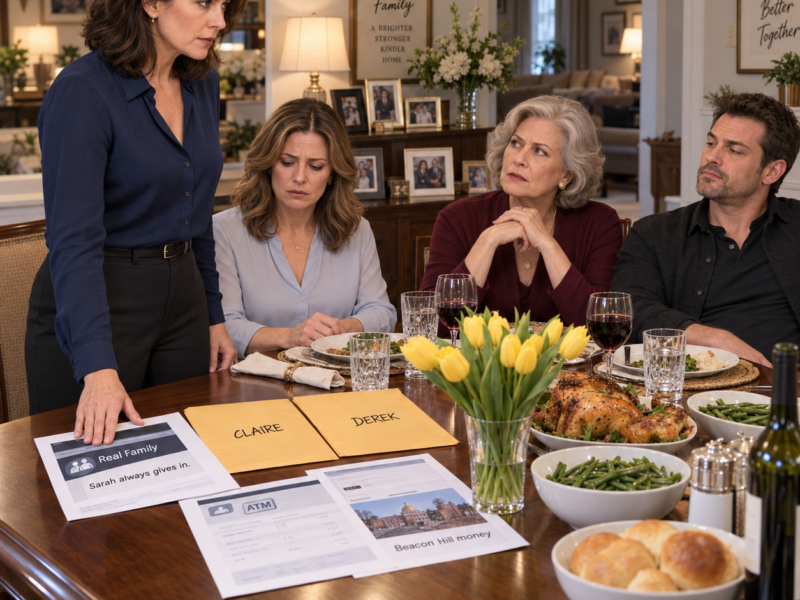
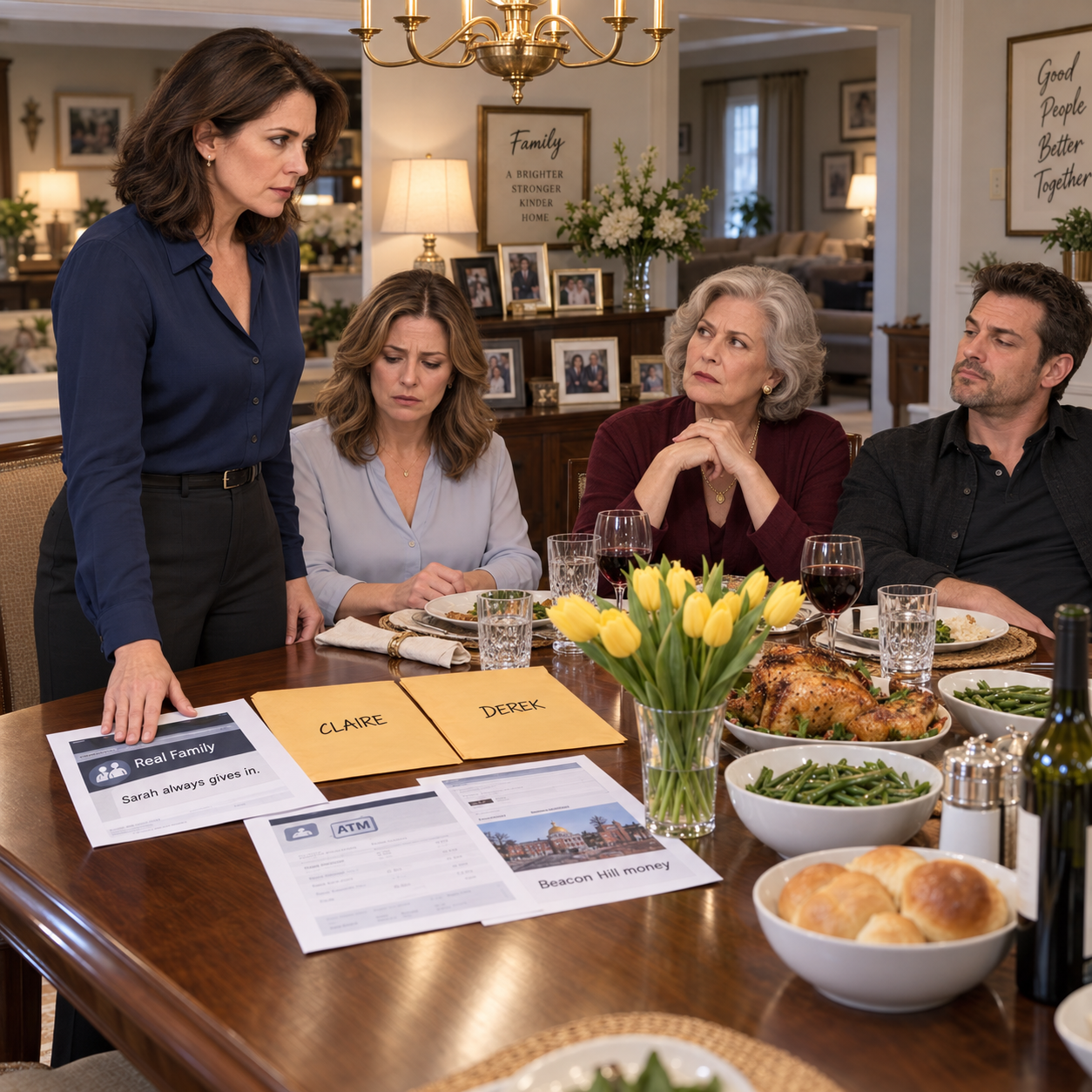
My family had a group chat called “Real Family.” I wasn’t in it. My money was. I found it open on my sister’s tablet. Mom had written, “Sarah always gives in. Just make her feel needed.” My brother called me “an ATM with abandonment issues.” Then I found screenshots of bills I had paid, jokes about how to manipulate me, and proof that some of their “emergencies” had never been emergencies at all. By the time I drove home that night, I understood something I should have learned years earlier: I had been paying for a seat at a table where everyone laughed after I left.
Claire’s tablet had been vibrating on the kitchen island for almost five minutes before I picked it up.
Rain tapped steadily against the windows over the sink. A pot of macaroni bubbled on the stove, and my seven-year-old nephew had left a red plastic dinosaur beside the fruit bowl with one leg sticking straight up between two bananas. Claire was upstairs helping her younger son shower after soccer practice. Her husband, Mark, was still at a job site outside Cambridge and had texted that he would be late.
I was only there because Claire had called me at four-thirty.
“Sarah, I hate asking, but could you pick the boys up? The after-school program closes at six and Mark’s stuck at work.”
I had moved a meeting, driven across town in rush-hour traffic, picked up both boys, stopped at the grocery store because Claire said there was “nothing in the house,” and started dinner.
That was normal for us.
My family called me when something went wrong.
I answered.
The tablet vibrated again.
I assumed it was a message from the boys’ school, so I picked it up.
The screen was already unlocked.
At the top of a messaging window were two words.
Real Family.
I almost smiled.
Claire had always created ridiculous group-chat names. One Christmas she named a chat “People Mom Can’t Guilt Into Hosting” and then somehow convinced me to host anyway.
I glanced at the names beneath this one.
Barbara.
My mother.
Claire.
My sister.
Derek.
My brother.
There was no Sarah.
I stared at the screen for a second, not yet hurt. Mostly puzzled.
Then a new message appeared.
It was from my mother.
Don’t worry. Sarah always gives in. Just make her feel needed.
I read it once.
Then again.
A reply from Derek appeared almost immediately.
She’s an ATM with abandonment issues.
A laughing emoji followed.
Then another.
Then a voice message.
I should have put the tablet down.
I did not.
I tapped the recording.
Derek’s voice came quietly through the tablet speaker.
“She’s an idiot with a savior complex. As long as we smile at her, she’ll keep paying.”
Someone laughed in the background.
Claire.
I recognized my sister’s laugh the way you recognize your own front door in the dark.
My thumb went numb against the edge of the tablet.
For several seconds, I heard nothing except the macaroni bubbling behind me.
Then Claire typed.
Don’t push her too hard this week. She already paid Mom’s electric bill and my car payment. If we ask for more she might get suspicious.
My mother replied.
If she starts asking questions, cry. She hates seeing people upset.
Claire:
Works every time.
I stopped breathing normally.
There are moments when the mind tries to rescue the heart by refusing to understand what the eyes have already seen.
Mine began inventing explanations.
They were angry.
They were joking.
Maybe I had missed some family argument.
Maybe someone was exaggerating.
Maybe the group name meant nothing.
Maybe those messages looked worse without context.
So I scrolled upward looking for context.
That was the point at which the evening stopped being a misunderstanding.
The chat went back months.
There were screenshots of bank transfers I had made.
Screenshots of texts I had sent asking if everyone was okay.
Jokes about how fast I responded when somebody mentioned a shutoff notice, a school bill, a repair, or an insurance deadline.
Three months earlier, Claire had called me from her car crying so hard I had to ask her to repeat herself.
“The dentist says it can’t wait.”
“What happened?”
“Tyler’s tooth. They found an infection under the old filling. He needs treatment and insurance barely covers anything.”
I remembered standing beside my office window while she cried.
“How much?”
“Fourteen hundred.”
I transferred $1,400 before we hung up.
Now, in Real Family, I found the message she had sent that night.
Dentist was $620. Keeping the rest for the credit card.
Derek had replied with three laughing emojis.
Mom wrote:
You owe Sarah a very convincing thank-you call.
I remembered the call.
Claire phoned me around eight.
She sounded exhausted but relieved.
“I don’t know what I’d do without you.”
I had felt warm afterward.
Useful.
Loved.
Standing in her kitchen three months later, I felt something turn over in my stomach.
I kept scrolling.
Derek had told me his auto insurance would lapse unless he paid immediately.
I let him charge the premium to my credit card.
In the chat he wrote:
Insurance was covered already. Used the money I saved for Nashville.
Claire replied:
Did you at least have fun?
Derek:
Worth every penny. Especially Sarah’s.
There were photographs from his Nashville weekend.
I had liked three of them online.
There were jokes about my clothes.
My job.
The sensible black shoes I wore because I spent half my workday walking through warehouses.
The fact that I still lived alone at forty-seven.
One message from Derek said:
She owns four cardigans in the same depressing color.
Claire answered:
Five. I bought her one for Christmas.
My mother wrote:
At least she won’t waste money on a man.
Derek:
She prefers wasting it on us.
More laughing emojis.
I stared at them.
Then I found the sentence that hurt more than Derek’s jokes.
It was from my mother.
Pretending to be affectionate with her is exhausting, but she’s the only one with a steady income.
I read it three times.
Barbara Bennett.
My mother.
The woman whose pharmacy pickups I made.
The woman I called every Sunday morning because she complained that none of her children checked on her often enough.
The woman whose gutters I had paid to replace.
The woman whose electricity bill I had covered four days earlier after she told me she was afraid of sitting in a dark house.
Affection was exhausting.
My money was not.
The macaroni boiled over.
Foamy water spilled across the stovetop and hissed against the burner.
I jumped, nearly dropping the tablet.
At the same moment, footsteps came down the stairs.
I pulled out my own phone.
I don’t know why.
Instinct, maybe.
At work, if a shipment discrepancy appeared or a vendor denied authorizing something, I documented first and asked questions second.
For once, I applied that instinct to my family.
I took photographs of the chat.
Names.
Dates.
Transfers.
Messages.
I recorded a slow video while scrolling through several months.
Near the end, one message caught my eye.
Derek:
If Sarah ever stops paying, at least we still have the Beacon Hill money.
My mother answered:
She doesn’t know about that. Keep it that way.
Beacon Hill.
I assumed they meant one of Mom’s accounts or perhaps some old investment Dad had left.
I barely had time to think about it.
Claire walked into the kitchen drying her hands on a dish towel.
“Who keeps messaging?”
I locked the tablet.
“Something from the school, I think.”
She turned off the burner and moved the pot.
Then she looked at me.
Her expression changed.
“You look pale.”
“I’m tired.”
“Are you okay?”
The question almost broke me.
Not because it sounded false.
Because fifteen minutes earlier I would have believed it was real.
“I’m fine.”
Claire studied me.
I knew my sister well enough to recognize suspicion beneath concern.
Then she picked up the tablet.
I turned toward the sink before she could see my face.
“What did the school say?”
“I didn’t really read it.”
She tapped the screen.
Silence.
I dried my hands on a towel even though they were not wet.
Her youngest son came running into the kitchen in dinosaur pajamas, hair still damp.
“Aunt Sarah!”
He threw both arms around my waist.
I stiffened for half a second.
Then hugged him.
He held up a drawing.
It was the two of us at the zoo, or at least I assumed so because one stick figure had curly hair and the other stood beside an animal with a neck extending nearly to the top of the page.
“That’s us with the giraffe,” he explained.
“I guessed.”
“You’re staying for dinner, right?”
For one ugly second, I wondered whether anything in my family was genuine.
Then he smiled up at me.
He was seven.
He was not part of this.
“Of course.”
So I stayed.
I drained the macaroni.
I browned ground beef because Claire’s boys refused tomato sauce unless meat was involved.
I sliced cucumbers.
I sat across the table from my sister while she acted as though nothing had changed.
At one point she smiled.
“You’re a lifesaver, you know that?”
My fork stopped.
Two hours earlier, the sentence would have pleased me.
Now I heard the machinery behind it.
Make Sarah feel needed.
I looked at Claire.
“I’m beginning to wonder.”
Her fork paused.
“What’s that supposed to mean?”
“Nothing.”
She watched me more closely after that.
I kissed the boys goodnight.
The younger one asked if I would come to his soccer game Saturday.
“If I can.”
“You always come.”
I smiled.
“I know.”
Then I hugged Claire.
That was harder than I expected.
Her arms closed around me in the familiar way they had since we were teenagers.
For a second, muscle memory almost defeated knowledge.
Then I remembered her message about my nephew’s dental bill.
Claire stepped back.
“Drive safe.”
“You too.”
She laughed.
“I’m not going anywhere.”
I looked at her.
“No. I guess you’re not.”
I drove home through the rain.
I expected to cry.
I thought I might pull into a gas station or grocery-store parking lot and collapse over the steering wheel.
Instead, I felt strangely calm.
Windshield wipers moved back and forth.
Traffic crawled along wet streets.
A radio host argued with someone I could barely hear because the volume was low.
At a red light, my phone lit up.
Barbara Bennett.
Mom:
Can you call tomorrow? Electric company says I’m still short $287.40. I hate bothering you.
I stared until the driver behind me tapped his horn.
Then I drove home.
My name is Sarah Bennett.
I was forty-seven years old that night.
I worked as an operations manager for a medical supply company outside Boston.
There was nothing glamorous about what I did.
No corner office.
No magazine profile.
No company car.
But I earned a good living because I was organized, careful, patient, and difficult to rattle.
People at work brought me problems.
A missing shipment.
A warehouse shortage.
A vendor invoice that did not match a contract.
A department budget that was suddenly $60,000 off.
I liked finding the point where facts stopped matching the story people were telling.
Somehow, I had never done that with my family.
At 10:06 that night, I opened my laptop.
I started with Mom.
Electric bill.
Cell phone.
Prescription copays.
Grocery deliveries.
The supplemental credit card I had issued in her name “for emergencies.”
Then Claire.
Several car payments.
School supplies.
Dental bill.
Soccer fees.
A hotel deposit when one of the boys had a tournament.
A plumber.
Groceries.
Then Derek.
Insurance.
Storage unit.
A security deposit.
Credit card payments.
Two “loans” I had converted to gifts because I did not want him to feel humiliated.
Streaming services I had forgotten were on my account.
A gym membership.
A phone line.
I pulled bank statements for three years.
The requests looked different when separated by months.
$250.
$87.
$400.
$600.
$1,400.
$310.
$950.
Every request had come with a story.
Every story had sounded temporary.
Together, they became something else.
A budget.
Their budget.
Built around me.
I sat staring at the spreadsheet.
Dad would have seen it immediately.
My father, Robert Bennett, had been an accountant.
Not the exciting sort who appeared in movies uncovering international conspiracies.
He prepared financial statements for a regional manufacturing company, did tax returns for friends every spring, and could spend fifteen minutes explaining why keeping receipts mattered.
He died six years earlier after a long illness.
Dad had understood me better than anyone.
After he died, something changed in me.
I became terrified of losing everyone else too.
I never said that aloud.
Instead, I became useful.
If Mom needed groceries, I bought groceries.
If Claire needed a babysitter, I rearranged my weekend.
If Derek needed money, I transferred it.
I thought generosity kept people close.
My family had apparently noticed.
At 11:30, I opened an account at a different bank.
Then I began changing passwords.
Banking.
Credit cards.
Email.
Cloud storage.
Phone account.
Anything containing financial information.
I froze Mom’s supplemental credit card.
I removed my checking account as the payment source from Claire’s car loan.
I removed my credit card from Derek’s insurance account.
I canceled the automatic storage-unit payment.
Then I reached the final confirmation page.
My hand hovered over the button.
A voice in my head said I was being cruel.
What if Mom’s lights were shut off?
What if Claire lost the car?
What if Derek could not get to work?
That voice sounded remarkably like Barbara.
I clicked Confirm.
Then I went to bed.
I slept maybe two hours.
The next morning, I expected chaos.
Nothing happened.
At lunch, still nothing.
At 2:14, Claire texted a photograph of my nephew holding up a spelling test.
A in red ink.
At 4:03, Derek sent a football joke.
At 6:20, Mom texted:
Don’t forget Sunday dinner. Claire says you’re making chicken.
They were behaving normally because they did not know anything had changed.
That gave me an idea.
Our family ate together on the first Sunday of every month.
Usually at my house because, according to everyone else, I was “the good host.”
That meant I bought the groceries, cleaned beforehand, cooked, set the table, served dinner, and usually washed most of the dishes because Mom’s knees hurt, Derek had somewhere to be, and Claire needed to get the boys home for bedtime.
For years, I considered that privilege.
That week, I almost canceled.
Instead, I bought a whole chicken.
Fresh green beans.
Rice.
Yellow tulips.
And three large mailing envelopes.
At an office-supply store, I printed screenshots from Real Family.
I did not print every insult.
I did not need to prove they had hurt my feelings.
I printed what showed the system.
The fake dental emergency.
The Nashville trip.
The instructions about crying.
The bank transfers.
The discussion of timing requests so I would not “get suspicious.”
The messages calling me an ATM.
The jokes about keeping me useful.
I highlighted dates and dollar amounts.
I made three copies.
MOM.
CLAIRE.
DEREK.
Sunday arrived.
At six-thirty, Claire came with Mark and the boys.
Mark hugged me.
“Smells great.”
“Thanks.”
He worked construction management and spent long hours traveling between job sites.
Claire often complained that he knew almost nothing about their household finances.
I had always thought that explained why she came to me instead of him when money was tight.
I would soon learn it explained something else.
Derek arrived ten minutes later wearing a new jacket.
“Nice.”
He glanced down.
“Clearance rack.”
I almost laughed.
Mom came last carrying grocery-store carnations.
She kissed my cheek.
“Everything looks beautiful. I hope you didn’t spend too much.”
“Don’t worry.”
I took the flowers.
“Tonight, everything is paid for.”
She smiled.
Nobody noticed the envelopes on the sideboard.
Dinner began exactly the way a hundred family dinners had begun.
The boys argued about dinner rolls.
Mark asked Derek about work.
Mom told Claire the green beans needed salt.
Derek complained about parking.
Claire suggested I replace my dining-room rug.
“It’s looking dated.”
I almost admired the normality of it.
It felt like sitting through a play after someone had accidentally handed me the script.
I knew when Mom’s request was coming.
She lowered her fork.
Sighed lightly.
“My electricity is terrible again.”
Claire glanced toward me.
Mom continued.
“I don’t understand how one person uses so much power. I’m about three hundred dollars short.”
“Two hundred eighty-seven dollars and forty cents.”
Her eyebrows lifted.
“What?”
“That’s what you texted.”
“Oh.”
She smiled.
“Right.”
Derek took a drink.
“My insurance is coming up too. I’ll send you the amount.”
Claire gave me her apologetic smile.
“And the boys have school fees. I was going to talk to you after dessert.”
The monthly collection.
I set down my fork.
Then I stood and went to the sideboard.
I put the first envelope in front of Mom.
The second in front of Claire.
The third in front of Derek.
“What’s this?” Derek asked.
“Open it.”
Claire looked at Mark.
“Sarah?”
“Please.”
Something in my voice changed the room.
Before anyone opened anything, I looked at the boys.
“Guys, I rented that superhero movie you wanted.”
Two heads turned.
“There’s chocolate cake in the living room.”
“Cake now?” the oldest asked.
“Tonight, yes.”
Claire frowned.
“Sarah.”
“They’re fine.”
The boys disappeared toward the television.
I turned the volume high enough that they would not hear us clearly.
Then I returned to my seat.
“Go ahead.”
Mom opened her envelope first.
I watched her face.
First confusion.
Then recognition.
Then color draining away.
Claire opened hers.
She stopped breathing for a second.
Derek made it through half a page before looking at me.
Silence.
I had imagined this scene all week.
In several versions, Mom apologized.
In one, Claire crossed the table and hugged me.
Sometimes Derek looked ashamed.
None of that happened.
Mom’s first words were:
“That conversation was private.”
I laughed.
It came out sharper than I expected.
“You called me an idiot and discussed how to manipulate me for money, and your concern is privacy?”
Derek pushed his pages away.
“We were joking.”
“Were you?”
“Families say stupid things in group chats.”
“Do families invent dental bills?”
Claire’s face changed.
Mark turned.
“What?”
“Sarah, don’t.”
I looked at Mark.
“Three months ago, Claire told me Tyler needed $1,400 in emergency dental work. The bill was $620.”
Mark stared at his wife.
“You told me your mother covered it.”
Claire closed her eyes.
“Mark, this is not the time.”
“This feels exactly like the time.”
He took the pages from her envelope.
She reached for them.
He pulled them away.
His expression hardened as he read.
“What does this mean? Sarah paid the car payment?”
Claire said nothing.
Mark looked at me.
“Have you been making our car payments?”
“Some.”
“How many?”
“I’d have to check.”
He turned back to Claire.
“You told me you were paying them from freelance income.”
“I was trying to.”
“With Sarah’s money?”
“I was going to pay her back.”
I answered before I could stop myself.
“You have never once called it a loan.”
Claire’s eyes filled.
“I was embarrassed.”
That sounded real.
For a moment I saw my sister instead of the messages.
Then I remembered the laughing emojis beneath my transfer.
“You were embarrassed to tell your husband you couldn’t afford the car, but you weren’t embarrassed to call me crying?”
She looked down.
Mom tapped one finger against the table.
“This has gone far enough.”
“No.”
I looked at her.
“It hasn’t started.”
I took another page from the folder beside my chair.
Additional credit card: canceled.
Mom’s electric autopay: removed.
Mom’s phone: removed.
Claire’s car payment: removed.
Derek’s insurance: removed.
Storage unit: removed.
Streaming services: removed.
Derek snatched it.
“You took your card off my insurance?”
“Yes.”
“My payment is Wednesday.”
“Then call your insurer before Wednesday.”
“You know I can’t pay it.”
“I know you went to Nashville after telling me the money was for insurance.”
His face reddened.
Mom leaned toward me.
“You’re overreacting.”
“I don’t think I’ve reacted before. That may be why this feels unusual.”
She drew herself up.
“I carried you for nine months.”
I almost smiled.
The speed with which motherhood became an invoice was impressive.
“You also called me an ATM.”
“I never called you an ATM.”
“You told Derek how to manipulate me.”
“Do not twist things.”
“I printed them.”
“This is humiliating.”
“Interesting.”
“What?”
“I didn’t realize humiliation was the emergency.”
My mother stared at me.
Then her voice changed.
Softer.
The voice I had answered all my life.
“Sarah, honey.”
I felt my chest tighten.
“You’ve always been sensitive. Sometimes people joke because life is hard. Derek has struggled. Claire has two children. I’m retired. You’ve been blessed with steady work and fewer responsibilities.”
There it was.
The philosophy under everything.
I had more.
Therefore they deserved access.
“You think because I’m single, my money belongs to the family?”
“Nobody said that.”
“You didn’t need to.”
Derek shoved his chair back.
“This is insane. So we made jokes, and now you’re going to wreck everybody financially?”
“I’m not wrecking anyone.”
“My insurance can lapse.”
“Then pay it.”
“My credit is already bad.”
“Then arrange something.”
“You’re my sister.”
“And apparently that means I pay your bills while you make fun of me for paying them.”
Claire began crying.
Quietly.
The old reflex fired immediately.
Stand.
Go to her.
Touch her shoulder.
End the conflict.
Make her feel better.
Then I heard Mom’s message in my head.
If she starts asking questions, cry. She hates seeing people upset.
I stayed in my chair.
Claire noticed.
Something in her face changed.
“You’re destroying everything,” she whispered.
Mark looked at her.
“No.”
She turned.
“Please.”
He held up the screenshots.
“This is months of you lying to me.”
“I was trying to protect us.”
“From what?”
“Losing things.”
“What things?”
She said nothing.
“The car?”
Claire looked down.
Mark stared.
“You insisted on that car.”
“You liked it.”
“I said we could buy a cheaper one.”
“You said I needed something reliable for the boys.”
“I meant reliable, Claire. I didn’t mean forty-eight thousand dollars.”
“I needed it for work.”
“You work from home three days a week.”
“Mark.”
He stood.
“Is there more debt?”
Claire started crying harder.
He stared at her.
“Is there?”
Silence answered.
Mark’s face went still.
“How much?”
“I don’t know exactly.”
“You don’t know?”
“I know approximately.”
He looked toward the living room.
The boys were laughing at something on television.
Then back at Claire.
“I’m taking them to my mother’s tonight.”
“Mark.”
“I need to look at every account.”
“You’re embarrassing me.”
He stared at her.
“You’re worried about embarrassment?”
Then he left the table.
I felt sick.
That mattered.
I had not exposed the chat to destroy Claire’s marriage.
I did not even know she was hiding debt from Mark.
The truth simply had consequences beyond the lies she told me.
Derek pointed toward the living room.
“Look what you did.”
I stared.
“What I did?”
“You couldn’t talk to us privately?”
I glanced at the papers.
“You had a private place to talk about me for months.”
“That’s different.”
“Yes.”
I nodded.
“I wasn’t allowed in that room.”
Mom stood.
She picked up her purse.
“When this tantrum is over, call me.”
Something inside me hurt at the word Mom.
The title.
The role.
The lifetime of automatic obedience.
I took out my phone.
Opened contacts.
Found Mom.
Edited.
Barbara Bennett.
She saw.
Her expression cracked.
“What are you doing?”
“Calling things by their real names.”
For the first time that evening, she looked genuinely hurt.
Not guilty.
Hurt.
I almost apologized.
That frightened me.
Derek grabbed his jacket.
“You’ll regret this when you’re alone.”
I walked to the front door.
Opened it.
“I was always alone, Derek.”
He stopped.
“It simply used to cost me more.”
He left.
Claire followed Mark and the boys several minutes later.
She said nothing to me.
Mom was last.
She paused on my porch.
“You don’t know how to live without us.”
I looked at the woman who raised me.
I still loved her.
That was the inconvenient truth beneath every other truth.
“No.”
I shook my head.
“You don’t know how to live without my money.”
Then I closed the door.
The house became silent.
Half-eaten chicken on plates.
A napkin on the floor.
One full water glass.
Two pieces of chocolate cake abandoned beside the television.
I stood in my kitchen waiting to feel devastated.
Instead I felt tired.
Deeply tired.
Like I had carried grocery bags for miles and only now noticed the handles cutting into my fingers.
I cleaned the kitchen because I did not know what else to do.
At 11:47, my phone vibrated.
Susan Miller.
For a second, I could not place the name.
Then I remembered.
Mom’s neighbor.
Susan and her husband had lived next door to my parents for almost twenty years.
We exchanged Christmas cards and said hello at neighborhood cookouts, but we were not close.
Her message read:
Sarah, I’m sorry to contact you so late. Your father gave me your number years ago and asked me to call if I ever thought you needed to know something.
Another message appeared before I replied.
Tonight I heard your mother arguing with Derek. She said if you stopped paying she would move him into your father’s Beacon Hill apartment and make sure you never took control of it.
I sat down.
Beacon Hill.
The message in Real Family.
If Sarah stops paying, we still have the Beacon Hill money.
She doesn’t know. Keep it that way.
I called Susan.
She answered on the second ring.
“Sarah?”
“What apartment?”
Silence.
Then:
“You don’t know.”
“Know what?”
“Oh, honey.”
My stomach tightened.
“What apartment?”
“Your father’s place on Beacon Hill.”
“My father didn’t have an apartment.”
Another pause.
“Yes, he did.”
I stood again.
“No. He had a small place years ago, before he got sick. Mom told me they sold it.”
“I don’t think it was your mother’s to sell.”
“What are you talking about?”
Susan spoke slowly.
“Your father told my husband and me several times that he had arranged for that apartment to go to you.”
“That can’t be right.”
“I thought you knew.”
“How would I know? Nobody ever said anything.”
“That’s why I called. Barbara told Derek tonight that you still don’t know the property is yours.”
My fingers went cold.
“Does she still have it?”
“As far as I know.”
“How?”
“There’s a tenant.”
I closed my eyes.
“An older gentleman. Retired teacher, I think. I’ve seen him at your mother’s house before. Your mother once told me she handles the rent because you live out of state.”
“I live twenty-five minutes away.”
“I know.”
“How long has he been there?”
“I’m not sure. Years.”
Dad had been dead six years.
I thought about Mom crying over electricity.
The groceries.
The pharmacy receipts.
The property-tax increase she complained about.
The times she said retirement frightened her because she had almost no cushion.
“Why didn’t Dad tell me?”
“I don’t know.”
Susan’s voice softened.
“He may have thought the paperwork would.”
I barely slept.
At eight the next morning, I called the local registry office and asked how to check property records.
By ten-thirty, I was downtown.
I expected a misunderstanding.
My mind needed one.
Maybe Dad intended to leave me the apartment but never completed anything.
Maybe Mom owned half.
Maybe Susan misunderstood a conversation.
Maybe Beacon Hill referred to some account and not property.
The clerk took the address Susan had sent.
She searched.
Then turned the monitor toward me.
A one-bedroom condominium in an older brick building.
Beacon Hill.
My father’s name appeared in the property history.
Then another recorded instrument.
A beneficiary transfer document.
I leaned closer.
“What does that mean?”
The clerk explained the document in neutral terms.
My father had put in place a recorded transfer arrangement naming who would succeed to his interest.
“Who?”
She printed the record.
My hands shook before she handed it to me.
Beneficiary: Sarah Anne Bennett.
I stared.
“That’s me.”
She nodded politely.
“I assumed so.”
I read it again.
Sarah Anne Bennett.
Dad had arranged for the apartment to become mine.
Not Mom’s.
Not Derek’s.
Mine.
The correspondence address connected to the property records was my parents’ house.
Tax notices and building correspondence had gone there.
I asked so many questions that eventually the clerk said:
“You should probably talk to a real-estate attorney.”
I walked outside carrying copies.
Boston moved around me like nothing had happened.
Delivery truck.
Bicycle messenger.
A woman pushing a stroller.
Two men arguing beside a construction van.
I sat on a bench and stared at Dad’s name.
My father loved paperwork.
He labeled tax folders by year.
Saved appliance warranties long after the appliances died.
Once drove forty minutes back toward home during a vacation because he could not remember whether he had mailed an insurance payment.
If Dad put my name on that document, he meant it.
I called an attorney that afternoon.
Jessica Hayes.
A colleague recommended her.
Jessica was in her early fifties with a quiet voice and an office containing more paper than decoration.
She read before speaking.
I liked that.
I told her everything.
Dad.
The apartment.
Mom saying it had been sold.
Susan’s call.
Real Family.
Years of support.
When I finished, Jessica folded her hands.
“First, do not confront your mother about the property yet.”
“I already confronted her about money.”
“But not this?”
“No.”
“Good.”
She tapped the records.
“We need the complete file. Ownership documents, association records, rental history, any communications showing how your mother represented her authority, property expenses, rent collected, and whatever happened administratively after your father died.”
“Is it mine?”
Jessica reread the document.
“Based on what you’ve brought me, you appear to have a significant ownership claim. I’m not going to tell you more until I’ve verified everything.”
That answer made me trust her.
“What if Mom spent the rent?”
“Separate question.”
“Could I get in trouble with taxes for rental income I didn’t report?”
“You didn’t know you owned a rental property and didn’t receive the income.”
She made a note.
“We document facts. We don’t panic ahead of them.”
I almost smiled.
At work, I told people the same thing.
Then I asked the question no attorney could answer.
“Why would my mother do this?”
Jessica closed the folder.
“That part isn’t legal.”
Over the next two weeks, my life divided.
At work, I remained Sarah Bennett, operations manager.
Conference calls.
Warehouse reports.
Medical-device back orders.
Quarterly budgets.
At night, I became Sarah Bennett, daughter trying to understand how completely her mother had inserted herself between her and something her father intended her to have.
The condominium association listed Barbara as contact.
She had verbally described herself as handling matters on my behalf.
There was no signed power of attorney from me.
No management agreement.
No authorization.
The tenant was Arthur Pendleton.
Seventy-two.
Retired high-school history teacher.
When Jessica first contacted him, he was confused.
When I met him at the apartment, he was horrified.
He opened the door wearing wire-framed glasses and a navy sweater.
“You’re Sarah.”
“Yes.”
“Your mother told me you lived in Texas.”
“I have never lived in Texas.”
“Not even for work?”
“No.”
Arthur removed his glasses.
“Well.”
He looked toward the ceiling.
“That is disturbing.”
The apartment was modest.
One bedroom.
Small kitchen.
Old hardwood.
A narrow decorative fireplace.
Windows looking toward the street.
Nothing about it screamed fortune.
That did not matter.
It was a home.
A piece of Boston real estate my father had deliberately chosen to leave me.
Arthur made coffee.
“I’m sorry,” he said. “I truly believed your mother was authorized.”
“I believe you.”
“She handled everything.”
“How long have you been here?”
“Seven years.”
“So you knew Dad.”
Arthur smiled.
“I did.”
Something in my chest tightened.
“He used to come by before he got very sick. He checked the smoke detectors himself even though the association did inspections.”
I laughed before I could stop myself.
“That sounds exactly like Dad.”
“He talked about you.”
I looked down at my coffee.
“What did he say?”
Arthur thought.
“He told me he bought this place long before your parents moved into their house. Said he kept it because property in the city was one of the safest things he could leave behind.”
He paused.
“Once he said he wanted you to have a home nobody could push you out of.”
My throat tightened.
“Why would he say that?”
Arthur leaned back.
“He said you were the child who would give away your last dollar if someone you loved asked.”
I stared.
“He worried about it.”
Arthur’s voice softened.
“He said, ‘Sarah will always make sure everyone else has somewhere to land. I want to make sure she does too.’”
I looked toward the window.
For six years, I thought Dad died leaving almost nothing.
Mom said medical costs and debt consumed what remained.
I never questioned her.
Why would I?
She was my mother.
Arthur went to his desk.
“I have something.”
He pulled out a repair receipt.
“Your mother gave this to me years ago. Your father wrote on the back. I kept it because I keep everything.”
He handed it over.
Dad’s handwriting.
Check Sarah deed packet.
Four words.
They did more than any speech.
Dad had not forgotten.
Somewhere, there had been a packet.
Jessica eventually located the firm that prepared his documents.
The attorney had retired.
The firm still had digital records.
The file contained instructions, recorded documents, correspondence, and a scanned letter Dad wrote to me.
The mailing log showed a final packet had been sent after his death to his home address.
Mom’s home.
The packet included my letter.
Barbara received it.
Barbara never gave it to me.
When Jessica called and said she had a copy, I left work early.
She placed one page in front of me.
Dad’s handwriting was steady at the top and slightly shaky toward the bottom.
My dear Sarah,
I am leaving the apartment to you because I know you carry more than you admit.
I read the sentence twice.
Do not let anyone convince you that love requires you to end up with nothing.
My eyes filled.
Helping someone should not destroy you.
This home should always be yours.
Your peace should belong to you too.
Love,
Dad
I covered my mouth.
For the first time since I found the group chat, I cried without trying to stop.
Jessica pushed a box of tissues across the desk.
My father had seen something I had not.
Or maybe something I had refused to see.
I remembered Thanksgiving years earlier.
Claire needed money.
Derek was between jobs.
Mom’s furnace needed repairs.
I used most of my year-end bonus solving everyone’s problems.
Dad and I washed dishes.
He asked:
“How much did you save for yourself?”
I laughed.
“Dad, I’m fine.”
“That wasn’t my question.”
“I’ll save next month.”
He dried a plate.
“You say that often.”
I kissed his cheek.
“Stop worrying.”
Now I understood.
He had never worried whether I could make enough money.
He worried I would never believe I deserved to keep any.
Jessica’s accounting work began revealing where some of the apartment rent had gone.
Real Family contained references to Beacon Hill attached to Derek’s debts, Mom’s credit cards, and a family vacation I had been told Barbara paid for from savings.
All while Mom asked me for electricity money.
That changed something fundamental.
Until then, a small part of me still searched for fear as an excuse.
Maybe Mom panicked after retirement.
Maybe she was overwhelmed.
Maybe she believed the rental money should support the whole family.
Maybe she had convinced herself she was managing what Dad left.
But Barbara had been receiving rent while telling me she was nearly broke.
She did not need me to pay her electric bill.
She preferred it.
Every dollar I provided freed one of hers for something else.
Jessica prepared a civil complaint.
She did not file immediately.
Instead, she drafted an agreement.
Mom would acknowledge my ownership.
Return keys and records.
Stop representing herself as my agent.
Provide a full accounting.
Negotiate repayment of money improperly retained after expenses.
“Do you want to offer resolution before filing?” Jessica asked.
A month earlier, I would have said yes because she was my mother.
That day I said yes because I wanted to know what she did when pretending not to understand was no longer possible.
We scheduled Thursday.
Mom brought Derek.
Claire came separately.
She looked exhausted.
Hair tied back.
Dark circles.
Mark and the boys were still staying partly with his mother.
Claire sat beside me in the reception area.
For a minute, neither of us spoke.
Then:
“I didn’t know about the apartment.”
I believed her.
“But you knew about the chat.”
“Yes.”
“You knew Mom lied to me for money.”
“Yes.”
“You participated.”
“Yes.”
No explanation.
That somehow made it harder to hate her.
“I’m sorry.”
I looked at her.
“I don’t know what that means from you yet.”
She nodded.
“I understand.”
Inside the conference room, Jessica arranged the documents.
Recorded ownership paperwork.
Association records.
Rent receipts.
Arthur’s records.
Susan’s statement.
The old law firm’s file.
Mailing record.
Dad’s letter.
Mom folded her arms.
“What exactly is this?”
Jessica explained.
Barbara interrupted twice.
Then stopped.
When Jessica finished, Mom looked at me.
“I managed the property because you weren’t ready.”
“Ready for what?”
“Responsibility.”
I stared.
“I manage thirty-two employees.”
“This is different.”
“You let me pay your electric bill while collecting rent from my property.”
“I used it for the family.”
“The family?”
“Derek needed help.”
He looked away.
“Claire needed things.”
Claire shook her head.
“Don’t put this on me.”
Barbara’s eyes flashed.
“Oh, now you’re innocent?”
“No. But I didn’t know Dad’s apartment belonged to Sarah.”
“You benefited too.”
“I’m not pretending otherwise.”
Mom turned back to me.
“Your father knew you were weak with money.”
A month earlier, that would have gone straight through me.
Weak.
Sensitive.
Lonely.
Too generous.
I looked at her.
“I wasn’t weak.”
She scoffed.
“I was loyal.”
She laughed dismissively.
“Your father spoiled you. That was always his problem. He made you think you deserved special treatment.”
“Special?”
“He left you property.”
“He left me his property.”
“What about Derek? What about Claire?”
Derek finally spoke.
“Exactly.”
I turned toward him.
“You knew.”
His silence was enough.
Claire stared.
“You knew about this?”
Derek shifted.
“Mom mentioned something.”
“When?”
“A while ago.”
“How long?”
He said nothing.
Mom snapped.
“That is irrelevant.”
Claire leaned forward.
“No. It isn’t.”
They began arguing.
For once, I did not mediate.
I opened Dad’s letter.
The room quieted.
“My dear Sarah, I am leaving the apartment to you because I know you carry more than you admit.”
My voice shook.
“Do not let anyone convince you that love requires you to end up with nothing. Helping someone should not destroy you. This home should always be yours. Your peace should belong to you too.”
I had to pause.
“Love, Dad.”
Claire cried.
Derek stared at the table.
Mom’s face became rigid.
Not tears.
Anger.
A dead man had left words she could not revise.
I folded the letter.
“Dad knew me.”
Then I looked at the three of them.
“The rest of you knew my bank balance.”
Mom stood.
“I will not sit here and be insulted by my daughter.”
Jessica answered calmly.
“You’re free to leave, Mrs. Bennett. If you do, my client has authorized me to proceed with filing.”
Barbara stopped.
For the first time, I saw fear.
Not fear of losing me.
Fear of losing control.
Jessica slid the agreement toward her.
Acknowledge ownership.
Return keys.
Provide records.
Full accounting.
No further representation as my agent.
Negotiation over repayment.
If she refused, we would pursue the civil claim using the records we had.
Mom stared at me.
“You would take your mother to court?”
The old guilt rose.
I felt it physically.
Tightness beneath my ribs.
A pull toward surrender.
But guilt was no longer an instruction.
“Because you’re my mother, I’m giving you the chance to sign before that happens.”
Derek slammed his palm down.
“You’re taking everything from her.”
“I’m taking back what was mine.”
“She used the money for us.”
“You mean you.”
He stood.
“You think you’re better than everybody because you have a good job?”
“No.”
“You always have.”
“No, Derek.”
I looked at him.
“I thought being useful was the only thing that made me worth keeping.”
He stopped.
“That was my mistake.”
Jessica placed the prepared filing beside the agreement.
Mom picked up the pen.
Her hand shook with rage.
She signed.
Outside, Derek walked past without speaking.
Then turned.
“Enjoy your apartment.”
I said nothing.
“Seriously. Enjoy it. And never ask me for anything.”
Something almost made me laugh.
“I never relied on you, Derek.”
He glared.
“You relied on me.”
He left.
Claire came out later.
We stood near the curb.
Traffic passed.
She looked smaller than I remembered.
“Mark found another credit card.”
I waited.
“One he didn’t know about.”
“How much?”
“Enough.”
“He says he doesn’t know if he can trust me.”
“I’m sorry for the boys.”
“So am I.”
She stared at the building across the street.
“I wanted him to think I could afford our life.”
I said nothing.
“When we married, I was better with money. Then the boys came. I cut back my hours. Everything got more expensive. Mark started earning more, and I felt like I was becoming the person who always needed something.”
“So you asked me.”
“At first, only when we really needed it.”
I believed her.
“And then?”
“It got easier.”
“To lie?”
“Yes.”
“Why did you make fun of me?”
Claire closed her eyes.
“I don’t know.”
“Yes, you do.”
She took a long breath.
“Because if I admitted you were generous, then I had to admit what I was doing.”
That hurt because it made sense.
“So you made me pathetic.”
Her face crumpled.
“Yes.”
“If I was pathetic, you didn’t have to feel guilty for using me.”
“Yes.”
I looked away.
“I’m sorry.”
“You already said that.”
“I know.”
“I don’t need apologies right now.”
“What do you need?”
“Distance.”
She nodded.
“I can do that.”
“Don’t ask me to forgive you quickly.”
“I won’t.”
I started toward my car.
“Sarah?”
I turned.
“You deserved a sister.”
Her voice broke.
“I treated you like an account.”
I did not tell her it was okay.
It wasn’t.
Mom came out while I was opening my car door.
“You’re going to end up alone.”
A month earlier, that sentence could have cost me almost anything.
That afternoon, it sounded different.
Being surrounded by people who charged admission was not the opposite of loneliness.
“No, Barbara.”
She flinched at her name.
“I’m going to end up at peace.”
Then I drove away.
Taking control of Beacon Hill involved very little drama.
Mostly paperwork.
Insurance.
Banking changes.
Condominium association forms.
An accountant.
A separate rental account.
Arthur signed a proper lease with me.
I did not raise his rent.
He had paid faithfully and done nothing wrong.
The first rent payment arrived on the first of the following month.
I stared at the deposit.
The amount mattered less than the fact of it.
Dad had left me something solid.
It had existed all those years while everyone told me I should keep giving because I was the fortunate one.
The accounting of Mom’s six years controlling the unit was ugly.
Not every dollar was misused.
Taxes had been paid.
Association fees.
Repairs.
Insurance.
A new water heater.
Legitimate expenses mattered, and I insisted they be credited properly.
I did not want revenge disguised as accounting.
But a substantial amount remained unexplained or had clearly been used elsewhere.
We negotiated repayment.
Slowly.
I was not interested in bankrupting my mother.
I wanted truth documented.
Authority returned.
Financial connections closed.
For the first time, that was enough.
I changed beneficiaries on accounts that still listed Mom because I had never updated them after Dad’s death.
I changed my emergency contact.
I removed Barbara’s name from records where habit had kept it long after trust was gone.
Then came the strangest part.
Nobody needed anything.
The first evening my phone did not bring an emergency, I made tomato soup.
Grilled cheese.
Coffee afterward.
For years, eating alone felt like evidence my life was incomplete.
That night, it felt quiet.
My phone remained facedown.
No shutoff notice.
No insurance crisis.
No school expense.
No one waiting for Sarah to fix something.
At first the silence made me nervous.
Then I realized I had never learned the difference between being needed and being loved.
My family benefited from that confusion.
So did I.
Need gave me a role.
It kept me from asking harder questions.
Would they call if I stopped solving things?
Would they invite me if I stopped paying?
Would Mom say she missed me if I started saying no?
I was so frightened of the answers that I spent years paying not to hear them.
Now I had.
I survived.
Claire texted several days later.
I started therapy.
Then:
Not asking you for anything. Just wanted you to know.
I waited until the next day.
Do it for yourself and the boys.
She replied:
I am.
That became our relationship for several months.
Small messages.
Pictures of the boys.
No requests.
No fake emergencies.
No pretending the past had vanished.
She and Mark entered marriage counseling.
I did not ask details.
Their marriage belonged to them.
Derek blocked me.
Then unblocked me long enough to say I had turned Claire against “the family.”
I did not answer.
He blocked me again.
Barbara sent voice messages.
I stopped listening after three.
The first was crying.
The second was anger.
The third began:
“After everything I sacrificed for you…”
I deleted the rest unopened.
For several days, I wondered whether that made me cruel.
Then I remembered how often people call a boundary cruel when they benefited from the absence of one.
A month after I formally took control of the apartment, Arthur called.
“I found something.”
“What?”
“A box.”
He had been cleaning the top shelf of the bedroom closet.
Behind blankets was an old banker’s box.
I drove over Saturday.
Arthur had placed it on the dining table.
Repair invoices.
Condo documents.
Photographs.
And one of Dad’s black notebooks.
My father carried those everywhere.
Mileage.
Appointments.
Grocery totals.
Questions for doctors.
Reminders.
Phone numbers.
I sat at the table and turned pages.
Replace kitchen faucet.
Call insurance.
Arthur paid May rent.
Sarah birthday. Reservations 6:30.
Then, near the back, beneath a list of expenses:
Sarah helps everyone. I hope one day she learns to help herself.
I stopped.
Arthur was in the kitchen.
He pretended not to notice when I started crying.
I pressed the notebook against my chest.
For weeks, relatives had told me I had become hard.
Mom said money changed me.
Derek told an aunt I destroyed the family over “a few private jokes.”
That aunt called.
“You only get one mother.”
I said:
“Then she should have treated having one daughter named Sarah as something valuable too.”
The call ended quickly.
But in Dad’s apartment, holding his notebook, I understood I had not become hard.
I had become responsible for myself.
Those things are not the same.
I still helped people.
I bought my nephews birthday gifts.
I covered dinner when a friend went through a bad month.
I donated to the food pantry Dad supported.
Generosity had never been the problem.
The problem was treating generosity as admission money for love.
Months later, Claire asked for coffee.
I nearly said no.
Then yes.
We met Saturday morning at a neighborhood café.
She looked healthier.
Not happy exactly.
Awake.
When the barista rang us up, Claire paid for her own coffee.
I noticed.
She noticed me noticing.
“I almost offered to buy yours.”
“I’d have let you.”
“I know.”
We sat near the window.
For a while we talked about the boys.
Soccer.
School.
The older one’s obsession with building model airplanes.
Then Claire said:
“Mom still says you ruined the family.”
“What do you say?”
“That there was already something wrong if the family depended on lying to one person.”
I looked at her.
“Therapy must be expensive.”
She laughed.
The first time we laughed together since Real Family.
Then she became serious.
“I deleted the group chat.”
“That doesn’t matter to me.”
“I know.”
She stirred her coffee.
“I’m not saying it for credit.”
“Okay.”
“I read the whole thing before I deleted it.”
“I did too.”
“No.”
She looked ashamed.
“I mean I really read it.”
I waited.
“There were things I didn’t even remember writing.”
Her eyes filled.
“I kept thinking that if someone talked about one of my boys the way we talked about you, I would never forgive them.”
My throat tightened.
“I don’t know if I’ll forgive you.”
“I know.”
“But I’m willing to find out who you are when you aren’t getting anything from me.”
Claire nodded.
“That’s fair.”
It was not reconciliation.
Not yet.
But it was real.
I preferred real.
Mark eventually moved home.
I learned that from Claire, not because I asked.
They sold the expensive car.
That made me laugh when she told me.
“What?”
“Nothing.”
“You’re enjoying this.”
“A little.”
“Fair.”
She took more freelance work.
Mark became more involved in their finances.
They created a household budget.
For the first time in years, Claire knew exactly what they could and could not afford without converting the difference into a crisis for someone else.
One afternoon she called.
My body reacted before my mind did.
Phone ringing.
Claire’s name.
Instant adrenaline.
What happened?
How much?
What needs fixing?
I answered carefully.
“Hello?”
“Nothing is wrong.”
I laughed.
“How did you know?”
“Because I know you.”
The sentence carried pain.
Then:
“Tyler’s school concert is Thursday. He asked if Aunt Sarah is coming.”
“I’ll be there.”
“That’s all.”
“Okay.”
“Okay.”
I went.
The boys ran to me afterward.
No money changed hands.
Nobody asked for dinner.
Nobody asked me to pay parking.
It was one of the nicest evenings I had with my family in years.
Derek took longer.
For months, nothing.
Then I received a text on Dad’s birthday.
I almost deleted it without reading.
Thinking about Dad today.
A second message.
I know you probably don’t want to hear from me.
I waited.
Nothing else came.
The next afternoon:
I’m sorry.
Then:
I don’t expect an answer.
I did not answer.
Not because apologies had no value.
Because people are allowed to hear an apology without immediately becoming responsible for comforting the person who gives it.
Derek eventually paid his own insurance.
He moved out of the storage unit because it turned out most of the furniture inside was not important enough to justify monthly rent when he had to pay it himself.
He took a second weekend job for several months.
That information reached me through Claire.
I did not celebrate.
I did not feel vindicated.
Mostly, I felt sad.
There were so many things my family had been capable of doing all along.
They simply had not needed to do them while I kept stepping in first.
Barbara was different.
Our legal arrangement required cooperation, but outside that, we had almost no relationship.
She continued telling people I had chosen money over family.
At first, I wanted to correct everyone.
Then I realized adults who wanted the truth could ask.
Some did.
Susan remained kind.
One cousin called after hearing Mom’s version.
“She says you took her rental property.”
“It was Dad’s property and was transferred to me.”
“Oh.”
“She collected rent for six years without telling me.”
Long silence.
“That part wasn’t mentioned.”
“I assumed.”
Another aunt started:
“Family money is complicated.”
“No.”
I said.
“Math can be complicated. Ownership was clearly documented.”
She changed the subject.
Eventually, I stopped explaining.
Nearly a year after I found Real Family, Arthur visited his daughter for a week.
The hallway needed repainting, so I met a contractor there.
After he left, I sat by the front window with Dad’s notebook.
The apartment was not large.
No sweeping city view.
Kitchen counters dated.
Bathroom tile older than I was.
But I finally understood why Dad chose it.
It was not a prize.
It was a boundary made from brick and paperwork.
A place that belonged to me whether anybody approved of me or not.
A place no one could make me earn by being useful.
I thought about the chat name.
Real Family.
For months those words bothered me.
I treated them like a verdict.
They were real family.
I was outside.
Then I understood something simpler.
People can name things whatever they want.
A dishonest group chat can be called Real Family.
Manipulation can be called concern.
Dependence can be called closeness.
Guilt can be called love.
And a woman saying no can be called selfish by people who were comfortable with her saying yes.
Names do not make things true.
Behavior does.
My family told people money changed me.
That was never true.
The money had been changing them for years.
The truth changed me.
And if Dad were sitting beside me at that window, I think he would have asked the same question he asked while drying Thanksgiving dishes.
How much did you save for yourself?
This time, I would have an answer.
Enough.
Not only money.
Enough time.
Enough energy.
Enough dignity.
Enough peace.
Enough of myself left at the end of the day that I no longer had to wonder whether anyone would stay if I stopped paying them to need me.
A few weeks after that afternoon, Claire invited me to Sunday dinner.
At her house.
The invitation arrived Wednesday.
Sunday at six if you want. No emergency. No hidden invoice. Mark is cooking.
I laughed so hard at my desk that the woman in the next cubicle looked over.
I went.
Mark made pot roast.
Claire bought flowers.
The boys argued about rolls.
Some traditions deserved to survive.
After dinner, I automatically stood to clear the table.
Claire touched my wrist.
“Sit.”
“I can help.”
“I know.”
She took my plate.
“Tonight you’re a guest.”
The words hit harder than she intended.
I sat.
Claire carried the dishes away.
No performance.
No grand apology.
Just a sister doing dishes in her own kitchen.
I watched her.
And for the first time in years, I did not feel useful.
I felt welcome.
There is a difference.
I wish I had learned it sooner.
But I learned it.
That is enough too.
I still own the Beacon Hill apartment.
Arthur still lives there.
The rent goes into a separate account that pays the property expenses first.
The rest stays mine.
Occasionally I use some of it for something Dad would approve of.
Last year, I took myself to Maine for four days.
Alone.
Oceanfront room.
Lobster roll that cost far too much.
I paid without guilt.
On the second evening, I sat on a hotel balcony while the sky turned pink over the water.
My phone rang.
Claire.
I answered.
“Everything okay?”
“Yes.”
“Then why are you calling?”
She laughed.
“To talk.”
I looked out at the ocean.
For years, that would have sounded like an ordinary thing.
Now I knew exactly how valuable it was.
So we talked.
No bill.
No emergency.
No amount.
Just my sister asking how Maine was.
When we hung up, I stayed on the balcony until the light disappeared.
Dad had been right.
Helping people should not destroy you.
But there was one thing his letter could not teach me because I had to learn it for myself.
Love that survives only while you are useful is not safety.
Love that becomes angry when you establish a boundary is not proof the boundary is wrong.
And family is not made more real because somebody names a private chat after it.
A year earlier, I thought being excluded from Real Family meant I had lost my place.
Now I think it may have been the first time I finally found one.
Not in their chat.
Not in their emergencies.
Not in their monthly bills.
In my own life.
A life where I can still be generous without disappearing inside generosity.
A life where Claire can call because she misses me.
Where my nephews can ask me to come to a soccer game instead of their mother calling with a fee.
Where Derek can apologize without receiving immediate access to everything he had before.
Where Barbara can be my mother without being allowed to control my money, my property, or my fear of abandonment.
Whether she ever accepts that is hers to decide.
I no longer pay to influence the answer.
Sometimes, when I visit the Beacon Hill apartment, I sit at Arthur’s dining table and read Dad’s old notebook.
I always stop at the same sentence.
Sarah helps everyone. I hope one day she learns to help herself.
For most of my life, I would have thought helping myself meant becoming selfish.
Keeping more.
Giving less.
Turning hard.
Now I understand what he meant.
Helping myself meant finally believing that my own peace counted as one of the things worth saving.
And once I understood that, the people who truly wanted me in their lives learned something too.
They could still have Sarah.
They just could not have her bank account as the price of admission.









