My daughter-in-law walked into the four-bedroom house I had spent five years saving for and asked why I had bought it without consulting her. Then she told me what I had supposedly ruined: she had already promised my home to six members of her family. I said no. A week later, she tried to shame me in front of our relatives, and her own uncle stood up with a document she begged him to keep hidden.
The first thing I noticed about my new house was the sound of the front door closing.
It had a solid, reassuring weight. When the latch caught, the whole house seemed to settle around me. I stood in the entryway with my keys in my hand, listening to the quiet, and felt something I had not felt in years: I belonged exactly where I was.
I was sixty-eight years old. I had been a wife for thirty-six years, a mother for thirty-two, and a widow for seven. For most of my life, I had measured a good day by how comfortable I could make someone else. This house was the first substantial thing I had chosen entirely for myself.
It had four bedrooms, hardwood floors, a wraparound porch, and a garden that had been loved by somebody before me. The peonies were finished for the season, but their leaves filled the beds along the front walk. There was rosemary near the kitchen steps and an old lilac by the back fence. The previous owner had left a note on the counter explaining which window stuck in humid weather and which rosebush needed extra water.
I read that note twice. It felt like a welcome.
I had plans for every room. The largest would be my bedroom. The room with north-facing windows would become a painting studio. The small room at the end of the hall would hold my books and my late husband’s desk. The fourth would be a guest room, for my friend Helen when she visited from Ohio, for my sister when she could get away, or for anyone I actually invited.
I had saved for five years to buy it.
My husband, Robert, had left me a life insurance policy. I kept the money untouched through the first years after his death, when every financial decision felt too large and every ordinary decision felt strangely pointless. I lived on my pension, stayed in our smaller house, repaired what broke, and waited until I could tell the difference between what I wanted and what I thought I was supposed to want.
Then I found the house with the porch.
I expected my son David to come over, look around, and tell me his father would have liked it. I expected his wife, Sarah, to ask where I planned to put the dining table. I did not expect Sarah to walk through the front door, take one sharp look at the staircase, and say, “How could you buy this place without consulting me?”
I thought I had misunderstood her.
David stood behind her carrying a bottle of sparkling cider. He had brought it to celebrate, or so I believed until I saw his face. He set the bottle down on a moving box and avoided my eyes.
“I’m sorry,” I said. “Consult you about what?”
Sarah took two steps into the living room. There were still paint swatches taped near the windows, and the sofa sat in the center of the floor because I had not decided where it belonged.
“Do you have any idea what you’ve ruined?” she asked.
That was when I understood she had arrived angry. I still had no idea why.
“My first afternoon here,” I said, “if you’re going to keep talking to me like that.”
She crossed her arms. “My parents’ landlord is selling their rental. They have to leave next month. My sister and her three kids have been staying with them. We finally had a plan, and then you went and made everything difficult.”
I looked at David. He was studying a loose thread on his jacket cuff.
“What plan?” I asked.
Sarah gestured toward the staircase. “This one. Four bedrooms. Plenty of room for everyone.”
For a moment, my mind refused to put the pieces together.
Sarah’s parents were Brenda and Tom. I saw them at holiday dinners. I knew Brenda preferred white wine and that Tom liked to explain the best way to grill meat while somebody else was grilling it. Sarah’s sister, Michelle, had three children. I had met the children a handful of times. The youngest called me “David’s mom” because she did not know my name.
Those were the six people Sarah meant.
“You planned for them to move into my house?” I asked.
“We were going to talk to you.”
“When?”
“Before they moved in, obviously.” She said it as though I were asking a foolish question.
I turned to David. “Did you know about this?”
He glanced at Sarah and then at me. “Mom, they’re in a difficult spot.”
“That wasn’t my question.”
He rubbed the back of his neck. Robert had done the same thing when he was struggling to admit he had forgotten an errand. Seeing that familiar gesture on David hurt more than I expected.
“Sarah thought,” he said, “that if you found the right place, we could work something out.”
“I found this place in March. I closed on it yesterday.”
“We knew you were looking for something larger,” Sarah said. “You knew they needed somewhere to go.”
I had known their rental might be sold. Sarah had mentioned it over lunch, between a story about a bad haircut and a complaint about a school fundraiser. She had not said they expected to move in with me. She had not asked.
“I didn’t know you had connected those two things,” I said.
Sarah made an impatient sound. “You’re sixty-eight. Why do you need four bedrooms?”
“Because I bought four bedrooms.”
David looked up. “Mom, maybe they could stay temporarily.”
“How temporarily?”
He hesitated. “A year?”
“A year is temporary when you’re thirty-two,” I told him. “At my age, it’s a year.”
Sarah stepped closer. “Three children could end up without a place to sleep.”
That frightened me, as she intended it to. Children should not be caught in the middle of adults’ poor decisions. I wanted to know whether they had somewhere safe to go. I also knew that concern for those children did not give Sarah the right to offer away my home.
“Where are they now?” I asked.
“With my parents.”
“And when does their lease end?”
“Next month.”
“Then you still have time to find a place.”
“It isn’t that simple.”
“Perhaps it would have been simpler if someone had spoken to me before promising them rooms.”
Sarah’s face changed. “So that’s your answer? You’re going to let children become homeless because you want a room for your paints?”
I had not yet moved a single paintbrush into that room. Even so, the way she said *your paints* made me feel small for wanting it. I had spent most of my life making practical use of every square foot I occupied. A room set aside for painting had felt almost too generous when I first imagined it.
I held on to that thought.
“My answer is no,” I said. “Your parents, Michelle, and the children are not moving in.”
David lifted both hands slightly. “Can we just take a breath?”
“We can,” I said. “The answer will still be no.”
Sarah turned toward him. “Are you going to say anything?”
He looked miserable, but he did not correct her. He did not say that their plan had been wrong. He asked me whether we could discuss it after I had “had a chance to settle in.”
“I’m settled enough to answer,” I said.
Sarah picked up her purse. “You’re going to regret this.”
I opened the front door. “I think I’d regret giving away my home because someone else made plans for it.”
She walked out without another word. David lingered on the threshold. For one second, I thought he might turn back and apologize.
“Mom,” he said instead, “they really are counting on this.”
“I know.”
I waited for him to realize what he had just told me. His face remained drawn and pleading.
After he left, I locked the door. I stood in the entryway with my hand on the deadbolt until I heard their car pull away.
The sparkling cider was still on the moving box. I took it into the kitchen and put it in the refrigerator because I could not bear to throw it out. Then I sat on the floor beside an unopened box of dishes and cried. I cried because my son had been in my house for less than fifteen minutes and had made me feel like a trespasser in it.
The next morning, I called a locksmith.
When I told him I had just moved in, he said changing the locks was sensible. Previous owners might have given keys to neighbors or contractors. I let him believe that was my only reason. By lunchtime, every exterior lock was new.
Two days later, I installed a doorbell camera.
The installer showed me how to see the front walk on my phone. I tested it by stepping outside, waving at myself, and watching the recording from my kitchen table. I felt a little foolish. Then, on Tuesday morning, a gray sedan pulled into my driveway.
Brenda got out carrying a clipboard. Tom took a tape measure from the back seat.
I watched them on the camera for several seconds before I opened the door.
“Elizabeth!” Brenda said brightly. “We came to measure.”
“Measure what?”
“The bedrooms. We need to see whether our king bed fits.” She held up the clipboard. “I’ve already made a list of the furniture we’ll bring.”
Tom gave me an apologetic smile. “We can come back if you’re busy.”
I gripped the edge of the door. “There’s no need to come back. You aren’t moving in.”
Brenda’s smile disappeared. “Sarah said it was settled.”
“Sarah doesn’t own this house.”
“She said you’d be happy to help the family.”
“I told Sarah and David no when they came here.”
Brenda looked over her shoulder at Tom. He looked genuinely surprised. For the first time, I considered that Sarah might have told them I had agreed.
“We’ve already given notice on our rental,” Brenda said.
I stared at her. “You did that without speaking to me?”
“Sarah assured us.”
“Then Sarah made a promise she had no authority to make.”
Tom slid the tape measure into his coat pocket. “Brenda, let’s go.”
But Brenda stayed where she was. “We don’t have another house lined up. Michelle has been trying to find one she can afford, and the schools start soon. What are we supposed to do?”
It was a real question. I could hear fear underneath her anger.
“I’m sorry you’re facing that,” I said. “I didn’t know you had given notice. I would have told you earlier if anyone had told me what Sarah was saying.”
“We thought you knew.”
“I found out on Saturday. I said no on Saturday.”
Brenda’s eyes went to the hall behind me. I knew she could see the stairs and the boxes waiting to be unpacked. For a moment, I worried that she might try to walk past me. Instead, she drew herself up.
“Sarah wouldn’t have promised us this unless she believed you’d come around.”
“She was mistaken.”
Tom touched his wife’s elbow. “We have time to call the landlord.”
Brenda looked at him. “He may have someone lined up.”
“Then we’ll find out,” he said.
I did not invite them inside. After they drove away, I saved the camera recording, sat at my kitchen table, and wrote down what each of them had said while I could still remember it clearly.
That evening, my phone began to buzz.
Sarah had posted a photograph of my house on social media. I had sent her the picture when I closed, pleased with how the porch looked in the late afternoon light. Beneath it, she wrote that her parents and three young children were facing homelessness while I kept four bedrooms to myself. She said I had changed my locks to keep them out.
Technically, the last part was true. It was the only part of the post that was.
I read comments from people I had never met, calling me selfish. Then my cousin Ellen sent a private message asking whether Sarah’s family was safe. A former neighbor wrote that she was disappointed in me. Somebody asked whether I had always been like this, or whether grief had changed me.
That one stayed with me.
I started typing a response three times. Each attempt came out angrier than I wanted. I put my phone face down and went outside to water the rosemary. The evening air smelled of cut grass. Across the street, a woman was walking a little white dog that stopped to inspect every mailbox. Ordinary life was going on all around me, while strangers argued about what I owed people they did not know.
Back inside, I called David.
“I saw Sarah’s post,” I said when he answered.
He sighed. “She’s upset.”
“She used a picture I sent her and told people I’m making children homeless.”
“She’s worried about her family.”
“I can understand worry. I can’t understand saying I agreed to something I refused.”
“She didn’t say you agreed.”
“She sent her parents here to measure my bedrooms.”
He was quiet.
“Did you know she’d told them they could move in?” I asked.
“We thought you’d help once you understood.”
“You could have asked me.”
“I knew you might say no.”
He said it so plainly that I sat down.
“Then you knew it wasn’t your decision to make.”
I heard him breathe out. “I have to go. Sarah’s waiting.”
When the call ended, I looked around my kitchen. The ceiling light needed warmer bulbs. One cabinet door hung slightly crooked. My dishes were still wrapped in newspaper. It was a perfectly ordinary kitchen, and I had worked so hard to reach it.
I thought about the money I had given David and Sarah over the years. Some of it had been for emergencies: a medical bill when their insurance changed, a furnace repair during a cold spell. Other payments had started small and simply continued.
I opened my bank statements.
For three years, I had paid the lease on David’s truck. He needed reliable transportation for work when his old car failed. At the time, he had said he would take over the payments after six months. Whenever I brought it up, something else was happening: a roof repair, a raise that had been delayed, an expensive month with the children. Eventually, I stopped asking.
I paid for Sarah’s premium gym membership, too. She had told me that exercise helped her manage stress after her second child was born. I had offered to cover a few months. The charge was still leaving my account years later.
There were school fees, summer camp deposits, a dental bill, and a stretch of grocery deliveries when everyone in their house had the flu. I did not regret helping my grandchildren. I loved them. I wanted them to have what they needed.
Still, there was a difference between helping when asked and paying bills everyone else had stopped remembering were mine.
I made tea and went through the statements a second time. I wrote down recurring payments on the back of an envelope. The amount startled me. Not because I could not afford it, but because I had no memory of agreeing to keep paying most of it.
The next morning, I canceled the automatic payment for the truck lease and Sarah’s gym membership. I checked that the account for my grandchildren’s education was separate, and left it alone. That money was a gift I had chosen deliberately. I did not want the children to lose something because I was angry with their parents.
Then I sent David a message: *I’ve stopped the recurring payments for your truck and Sarah’s gym. The truck payment is due Friday. Please make arrangements with the leasing company.*
He did not respond.
On Friday afternoon, he called.
“Mom, something’s wrong with the truck payment.”
“Nothing’s wrong.”
“It bounced.”
“I stopped paying it. I sent you a message on Wednesday.”
“I saw it. I thought you were upset and we’d talk before it was due.”
“We’re talking now.”
He was silent for a moment. “You really expect us to come up with it this month?”
“I expect you to pay the lease on your truck.”
“But Sarah’s gym—”
“I stopped paying that too.”
“Why?”
I looked at the clean stretch of counter where I hoped to put a bowl of lemons. “Because those are expenses you and Sarah chose. You’ve had notice to make other arrangements.”
He lowered his voice. “Is this because of the house?”
“The house made me look at what I’ve been doing. I should have looked sooner.”
“Sarah says you’re punishing us.”
“I’m telling you which bills I will no longer pay. You can decide what to do about them.”
“You know I can’t just return the truck.”
“I know you have decisions to make.”
He made a small, frustrated sound. “I don’t know who you are lately.”
That hurt. I almost apologized for the discomfort I was causing him. The words rose to my lips out of habit.
“I’m still your mother,” I said instead.
After we hung up, I sat at the kitchen table for a long time. I remembered David at nine, standing in our driveway in an oversized baseball cap, waiting for Robert to show him how to check the oil in a car. He had grown into a man who worked hard, loved his children, and could make me laugh until I cried. I held those things in my mind alongside what he had done. It would have been easier if one version of him erased the other.
Over the next week, Sarah’s post traveled farther than I expected. People I had not seen in years seemed to know about my house. Some sent supportive messages. Others asked questions disguised as advice. One woman suggested I could rent rooms to Sarah’s relatives and “make everyone happy.” A man I barely remembered wrote that older people needed to think about the next generation.
I stopped reading comments.
Meanwhile, the practical parts of moving continued. A painter came to fix the scuffed wall in the studio. Helen helped me choose curtains. I bought a secondhand bookcase for the study and found Robert’s fountain pen in a drawer of his old desk. I held it between my fingers for a while, remembering how he used to leave it uncapped and complain when the ink dried out.
Helen was the first person I told everything.
We sat on the porch with iced tea while the painter worked upstairs. She listened without interrupting, except to ask once whether Brenda and Tom had found another place.
“I don’t know,” I admitted.
“You could call and ask them,” she said.
“I thought you were going to tell me to stay away from them.”
“I think you can care what happens to them and still keep your door closed.”
I watched a bee work its way along the lavender. “I’m afraid any kindness will be taken as an invitation.”
“Then be clear,” Helen said. “You’re good at that when you remember you’re allowed to be.”
The next day, I called Brenda. She answered warily.
“I wanted to know whether you’ve found somewhere to live,” I said.
“We’re looking.”
“Have you spoken with your landlord?”
“He’s selling. We asked whether we could stay until the sale closes, but he doesn’t want to promise anything.”
“I’m sorry. Is Michelle looking separately?”
Brenda hesitated. “She has applied for two places. Neither has answered yet.”
“If you need a number for a local rental agent, I can send you one. A friend used her last year.”
“That’s kind of you,” Brenda said, sounding surprised.
“I’m offering a phone number, Brenda. I want to be clear about that.”
“I know.”
I sent it after we hung up. Brenda replied with a thank-you. It was the first calm exchange either of us had managed since she arrived with her clipboard.
A few days later, Michelle called me herself. Her voice was tired, and I could hear children in the background.
“I hope I’m not bothering you,” she said. “Mom gave me your number. I wanted to apologize for showing up in the middle of all this.”
“You didn’t come to my house.”
“No, but I assumed Sarah had talked to you. I should have checked.”
I appreciated that she said it plainly. “How are the children?”
“They’re all right. They know we’re looking for a place.” A child called for her, and she answered softly that she would be there in a minute. “I didn’t ask Sarah to promise us your house.”
“I believe you.”
“I don’t want the kids thinking we’re entitled to take something from someone just because we need help.”
I moved to the window and looked out at my garden. “Then you’re teaching them something useful during a hard time.”
Michelle laughed once, without much humor. “I hope so.”
Before we ended the call, I gave her the rental agent’s name directly. She thanked me and asked me not to tell Sarah she had called. I told her I had no reason to.
That conversation changed the shape of things for me. Until then, Sarah had talked about six people as though they were a single, desperate argument I had to answer. They were not. Brenda was frightened and proud. Tom wanted to solve the immediate problem. Michelle was trying to keep her children steady while searching for a home. Their needs were real. Their choices were their own. None of them had to be turned into villains for my answer to remain no.
A week after Sarah first entered my new house, we gathered for Aunt Martha’s eighty-fifth birthday.
Martha was my mother’s younger sister. She had a cane with a carved wooden handle, a sharp memory, and a habit of keeping birthday cards long after their senders had forgotten what they wrote. Her daughter hosted the party in a church hall because Martha wanted room for every branch of the family.
I considered staying home. Then Martha called and said she had saved me a seat beside her.
“I hear you’ve moved,” she said.
“Yes.”
“Good. Tell me about the garden when you get here.”
That settled it.
I wore a blue blouse Robert had always liked and brought Martha a framed photograph of the two of us at my wedding. In the picture, she was laughing, with one hand pressed against the brim of a hat the wind was trying to steal.
David and Sarah arrived shortly after me with the children. My grandchildren ran over for hugs. I held them close and asked about school, then sent them toward the table where someone had set out colored pencils.
David hugged me, too. He looked tired.
“I made the truck payment,” he said quietly.
“I’m glad.”
“Can we talk later?”
“Yes.”
Sarah stood a few feet away. She gave me a nod that was technically polite.
Dinner went well. There was baked chicken, too many kinds of salad, and a sheet cake decorated with eighty-five pink icing roses. Martha told a story about taking a train across the country when she was nineteen. My cousin Ellen asked about my new studio, and I described the light in the upstairs room. For an hour, I let myself believe the day would be about Martha.
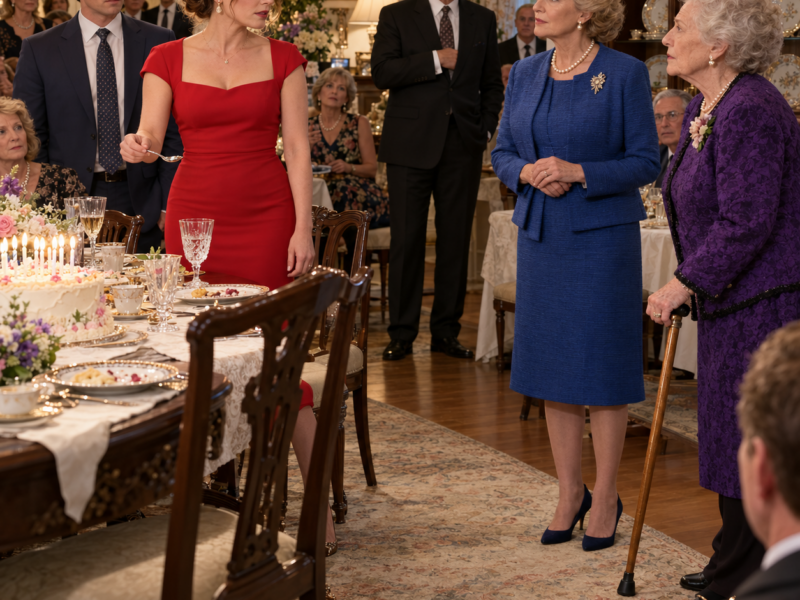
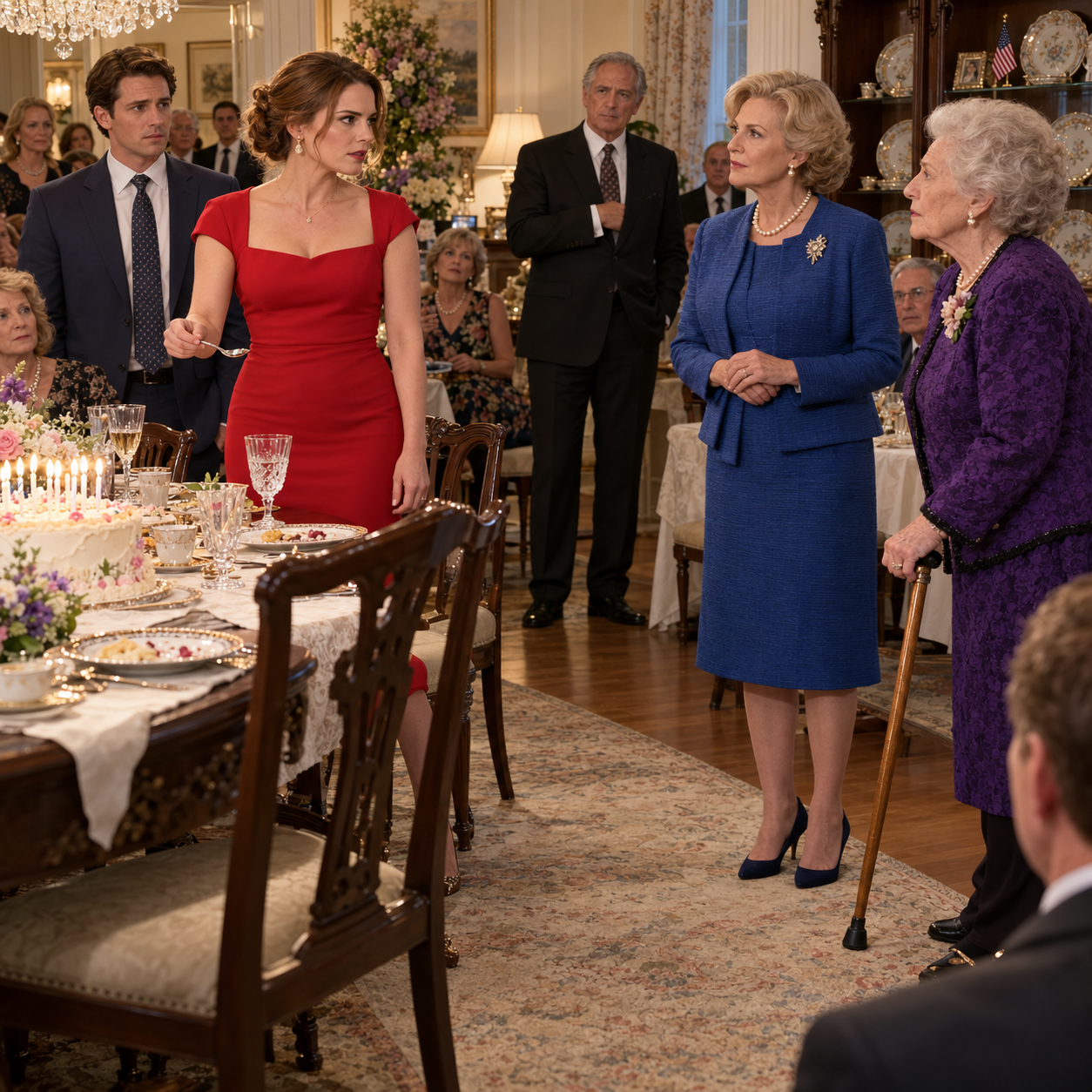
After cake, Sarah stood and tapped a spoon against her glass.
The sound drew people’s attention. Martha, who had been talking to my grandson, lowered her fork.
“I know we’re all here to celebrate Aunt Martha,” Sarah said, “but my family is facing a crisis, and I need people to understand what’s happening.”
A few people looked at me. Sarah noticed. I could see from her expression that she had expected them to.
She said her parents were losing their home. She said her sister and three children might have nowhere to go. Then she told the room that I had a four-bedroom house with two empty rooms and had refused to take them in. She added that I had changed my locks and suddenly cut off financial support to David.
There was a long silence when she finished.
I could feel heat rising into my face. I had been raised to avoid making a scene at somebody else’s celebration. Sarah had chosen the moment carefully. If I said nothing, people would leave with her account of what happened. If I answered, I would be the woman arguing at an eighty-fifth birthday party.
Martha set down her fork.
“Elizabeth,” she said, “do you want to say something?”
I stood. My hands were shaking, so I rested one against the back of my chair.
“First, I’m sorry this has interrupted your party.”
Martha waved away the apology.
I looked at Sarah. “Since you’ve chosen to discuss my finances publicly, let’s discuss them accurately.”
David lowered his gaze. Sarah folded her arms.
“I paid David’s truck lease for three years,” I said. “I paid for Sarah’s gym membership after offering to cover a few months. I’ve helped with other bills when they asked. I stopped those two recurring payments this week and gave David notice before the truck payment was due.”
Ellen, seated near the cake, looked from me to David.
“I also have a savings account for the children’s education,” I continued. “That hasn’t changed.”
Sarah opened her mouth, but I kept going.
“As for the house, I bought it with money I saved from Robert’s life insurance while living on my pension. I chose it because I want a bedroom, a painting studio, a study, and a guest room. Sarah promised it to her parents, her sister, and three children without asking me. David knew about the plan. I learned of it after I moved in.”
“That isn’t fair,” Sarah said. “You knew we needed help.”
“I knew your parents might have to move. I did not know you had told them they could move into my home.”
“We thought you’d understand.”
“I would have understood a question. You made a promise.”
David stood slowly. For a second, I thought he would speak. He stayed quiet.
“And your husband is thirty-two years old,” I said to Sarah. “I love him. I’ve helped him when I could. He can pay his own truck lease.”
Martha struck the floor once with her cane. The sound carried across the room.
“That’s enough of Elizabeth’s bank statements,” she said. “And enough of her house. It’s my birthday, and I’d like another piece of cake.”
Somebody laughed nervously. Then chairs moved, conversations started, and Martha’s daughter went to get her the cake. The moment was over in public. It was far from over for me.
I walked out to the hall and stood beside a bulletin board covered with announcements for choir practice and a fall clothing drive. A minute later, David came out.
“I didn’t know she was going to do that,” he said.
“I believe you.”
“I should have stopped her.”
“Yes.”
He leaned against the wall. “I did know she had told her parents they could stay. She said we’d explain it to you, and I kept putting that conversation off.”
“I know.”
“I figured once you saw how serious it was, you’d agree.”
“That was easier than asking and hearing my answer.”
He nodded. The movement was so small I almost missed it.
“I’m sorry,” he said.
I wanted to hold on to those words. I also wanted him to understand that saying them did not undo the afternoon in my living room or his silence while Brenda and Tom planned to measure my bedrooms.
“Thank you,” I said. “I need time to trust what you say about this.”
“I get that.”
We stood quietly for a while. Then he asked whether I wanted him to talk to Sarah.
“You should talk to her because she’s your wife and this is your marriage,” I said. “What you say to her is up to you.”
When I went back inside, Martha had her second piece of cake. She took my hand as I sat down and asked whether I had planted anything in the new garden yet. I told her about the rosemary. She told me not to water it too much.
By the following morning, I had messages from relatives who had been at the party. A few apologized for believing Sarah’s post. Others asked whether there was anything they could do for Michelle and the children. I passed along the rental agent’s number to those who offered practical help, with Michelle’s permission.
Sarah did not call.
Brenda did. She and Tom had secured another month in their rental after speaking directly with the landlord. Michelle had been approved for a three-bedroom apartment. It was smaller than the place she had hoped for, but it was near the children’s school, and she could afford it.
“We’ll be all right,” Brenda said.
“I’m glad.”
There was a pause. “I owe you an apology. I came to your house with a tape measure.”
“You thought you’d been invited.”
“I should have called you first.”
“Yes,” I said. “You should have.”
She accepted that. We talked for another minute about moving dates and boxes. When we hung up, I felt relieved for them. I also felt grateful that no one else would have to fit a king bed into my house.
David came by alone two days later. I had invited him for coffee after he asked to see me. I watched him through the doorbell camera as he climbed the porch steps. He stood with his hands in his pockets, looking at the garden while he waited for me to answer.
I let him in.
He stopped in the living room. I had finally put the sofa against the wall. There was a blue rug under the coffee table and a vase of cut flowers near the window.
“It looks good,” he said.
“Thank you.”
We carried our coffee outside. For a little while we talked about the children. Then David set down his cup.
“I’ve been thinking about something you said,” he told me. “That I knew you might say no.”
I waited.
“I did. I knew you might say no, and I let Sarah tell her parents it would work anyway.” He looked down at his hands. “I told myself it was because they were scared and I wanted to help. But I was scared of being the one to tell them we couldn’t solve it.”
“I wish you’d told them the truth.”
“I do too.”
He told me he had gone over his and Sarah’s expenses. They could manage the truck payment if they changed some other spending. He was embarrassed that he had waited until a payment failed to find out.
“Is Sarah angry?” I asked.
“Yes. She’s also worried about her parents. We’ve been arguing about a lot of things.”
I nodded. I had no interest in being drawn into another decision for their household.
“I’m not asking you to talk to her for me,” he said. “I wanted you to know I understand why you changed the locks.”
I looked at him. “I changed them because Brenda and Tom arrived expecting to move in. I didn’t know who had a key or what anyone might do next. It was frightening.”
His expression tightened. “I didn’t think of it that way.”
“I know.”
“I’m sorry I made you feel unsafe in your own house.”
That apology reached a place the earlier one had not.
We finished our coffee. Before he left, I showed him the study. Robert’s desk stood beneath the window, with the fountain pen in a little wooden tray. David picked it up, turned it over in his hands, and smiled.
“He used to look for this every morning,” he said.
“He usually found it wherever he’d left it the night before.”
David laughed. Then he put it carefully back.
At the front door, he asked whether he could bring the children over one afternoon to see the garden.
“I’d like that,” I said. “Call me first, and we’ll choose a day.”
“I will.”
He did call. The following Saturday, the children came with him and helped me plant marigolds along the front walk. My youngest grandson spilled half a watering can on his shoes and insisted the flowers would grow faster because he had given them extra. David cleaned the dirt from the porch steps before he left.
Sarah was not with them. I did not ask why.
She and I spoke a month later, after her parents had moved and Michelle had settled into her apartment. Sarah called one evening while I was cleaning my brushes in the upstairs studio.
“I heard the kids had a good time at your house,” she said.
“They did.”
“I’m glad.”
There was a long pause. I could hear traffic through her phone, as though she were sitting in a parked car.
“I shouldn’t have posted about you,” she said.
“No,” I replied. “You shouldn’t have.”
“I was scared for my family. I kept thinking there had to be a way to make it work.”
“I understand why you wanted a place for them.”
“I should have asked you.”
“Yes.”
She breathed out slowly. “When you bought a big house, I assumed you wanted us all around you.”
“I do want family around me. I want visits. I want the children in the garden and people at the dinner table. I also want to decide who lives here.”
“I know that now.”
I hoped she did. I could not tell from one phone call. I thanked her for apologizing, and we said goodnight.
The weeks passed. I unpacked the last moving box. Helen came to stay in the guest room and pronounced the mattress comfortable. Martha visited for lunch and sat on the porch long enough to tell me which flower beds I had planted too close together. David and the children came back to paint small clay pots, which dried in a bright row on the kitchen windowsill.
One afternoon, I found the sparkling cider still in the back of the refrigerator. I had forgotten it was there. I opened it while Helen was visiting, and we drank it on the porch in ordinary glasses. It had lost some of its fizz. Neither of us minded.
Later that evening, after Helen went upstairs, I walked through the house turning off lights. In the guest room I could hear her moving about. My books filled the shelves in the study. A painting I had begun that morning rested on the easel, unfinished and entirely mine. The fourth bedroom no longer felt empty simply because nobody slept there every night.
At the front door, I paused to check the lock. The latch caught with that same solid sound I had noticed on my first day.
I thought about how close I had come to believing I needed a better reason for wanting my own rooms. I had one all along. I had bought a home, made plans for it, and meant to live in it.
In the morning, I would make coffee, go upstairs, and paint until the light moved across the studio floor.









