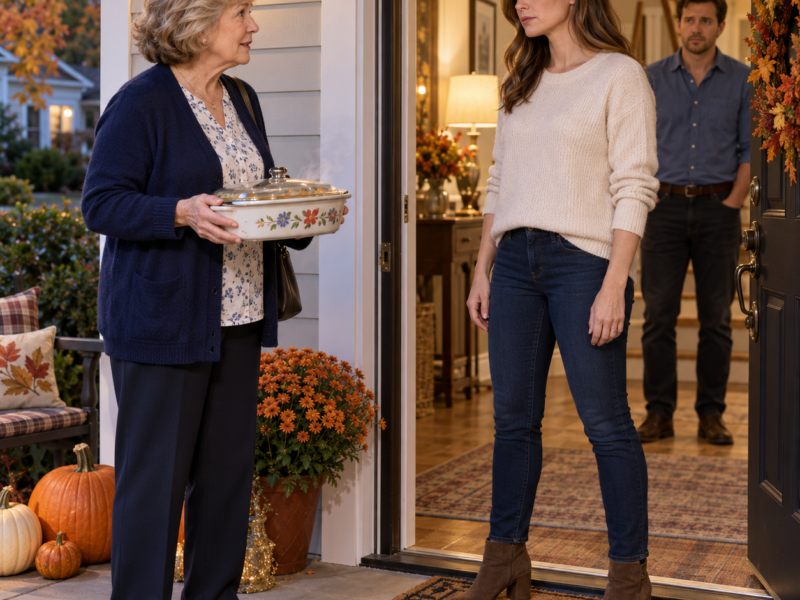
My daughter-in-law stopped me at the door with dinner still warm in my hands and said, “Patricia, you’re here too often. We need space as a family.” My son stood behind her and said nothing. For nearly two years, I had rearranged my life around their three-year-old daughter—three mornings a week, emergency pickups, meals, repairmen. Forty-eight hours later, Cassandra texted: “Can you take Lily Monday morning?” I looked at the watercolor class I had postponed twice because of their schedule and typed back: “No. I have plans.” That was the first time I stopped treating their schedule like it mattered more than mine.
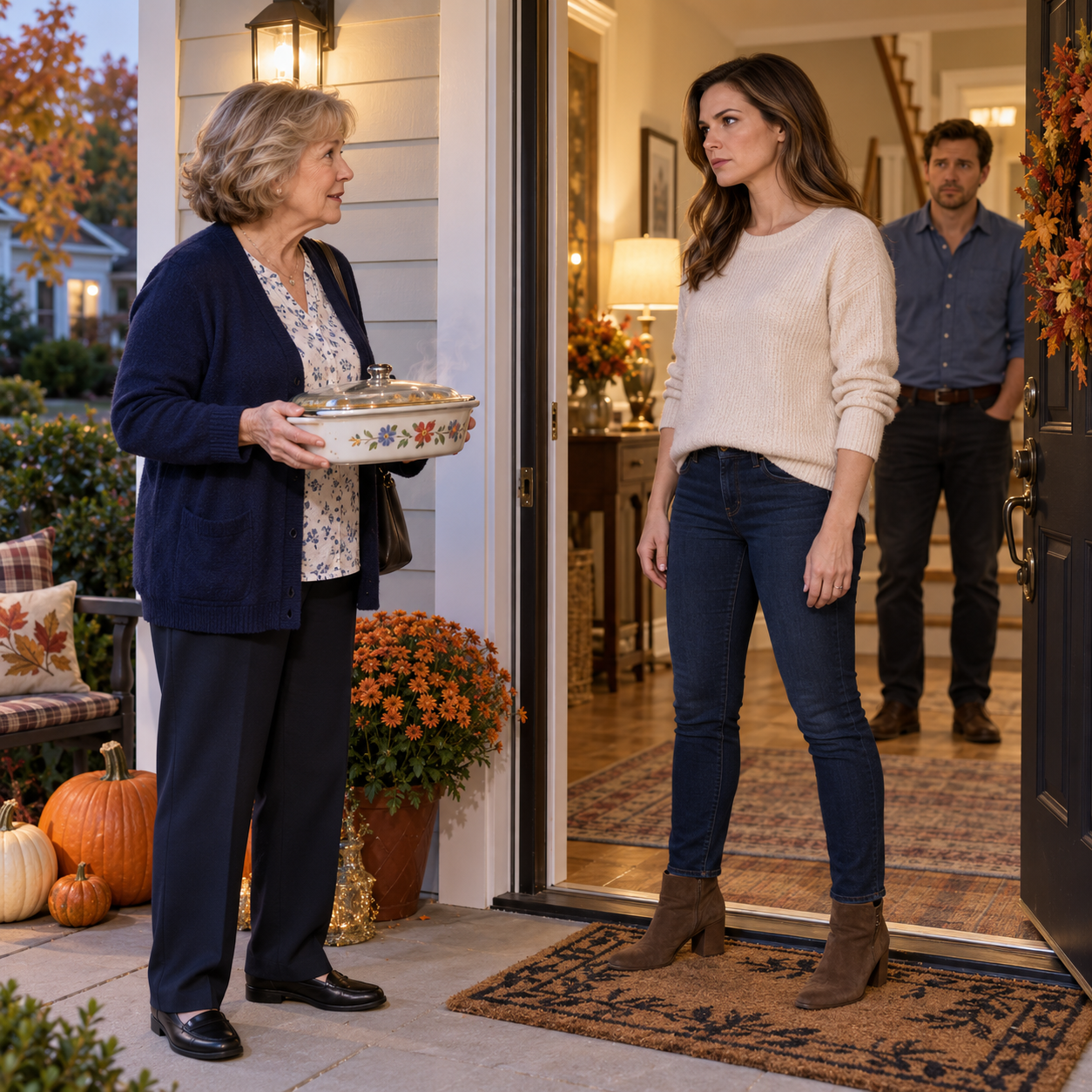
My daughter-in-law told me I was showing up too often—so I stopped rearranging my life around the family that had mistaken my help for an obligation
The casserole dish was still warm when Cassandra told me I needed to stop coming over so much.
It was a Thursday evening in October, one of those cold, clear evenings outside Philadelphia when the last light catches in the tops of the maples and makes suburban streets look prettier than they have any right to after five o’clock traffic.
I had made chicken and wild rice with the crisp herb topping Derek used to ask for on birthdays when he was a boy.
My granddaughter Lily had a mild cold.
Nothing serious.
A runny nose, a little cough, the kind of thing three-year-olds carry around like an accessory from October through March.
Cassandra had mentioned it in a family text that morning.
Lily slept badly.
I have a late meeting.
Derek’s home by six.
That was all.
I read it and thought what I always thought.
They’ll be tired.
I can make something.
At sixty-one, after thirty-two years teaching fifth grade at Millbrook Elementary and four years into retirement, cooking for people was nearly automatic.
You spend that long around children and families, you learn that half the crises in ordinary life are less dramatic after somebody has eaten.
So I browned chicken.
Cooked mushrooms and onions.
Added wild rice.
Made enough for dinner and leftovers.
I even packed some apple slices separately for Lily because she had entered a phase where food was either “crunchy enough” or personally insulting.
I texted Cassandra before leaving.
Bringing over some dinner for you three. I’ll just drop it off.
No response.
That was not unusual.
Cassandra kept her phone on silent during what she called her “wind-down hour” between work and bedtime.
She was a project manager for a healthcare software company and spent enough of her day in video meetings that by six she sometimes looked physically offended by screens.
I drove the fifteen minutes from my little stone Cape Cod in Havertown to their newer development near Wynnewood.
The porch light was on.
Through the front window, I saw movement.
A carry-on suitcase near the stairs.
Shoes lined by the mudroom bench.
A lamp burning in the hallway.
I assumed Cassandra was packing for a girls’ weekend she had mentioned.
I rang the bell.
She opened the door holding a folded sweater.
Dark jeans.
Ankle boots.
Hair pulled into a low knot.
She always looked polished in a way I never managed even when I was working full time.
I had spent thirty-two years wearing cardigans, practical shoes, and dry-erase marker somewhere on my hand.
Cassandra could unload groceries and somehow still look like she was about to moderate a panel discussion.
“Patricia.”
She stepped onto the porch.
Not away from me exactly.
But she did not open the door wider.
I held up the casserole.
“I heard Lily’s fighting that cold.”
“I brought dinner.”
“Enough for tomorrow too.”
Cassandra glanced at the dish.
“That’s thoughtful.”
Her voice was pleasant.
Not warm.
I remember that distinction.
Then she tucked the sweater under one arm.
“But Patricia…”
There was the pause people use when they have rehearsed something and are now hoping the other person behaves according to script.
“I’ve actually been meaning to talk to you.”
I smiled automatically.
Teacher reflex.
Make uncomfortable people comfortable.
“All right.”
“Derek and I really need our family evenings.”
I waited.
“Just us.”
She gestured lightly toward the house.
“You showing up unannounced, even when you mean well, changes the whole rhythm.”
“We end up restructuring dinner.”
“Bedtime.”
“Everything.”
I looked at the casserole in my hands.
“I texted.”
“I know.”
“But a text right before coming over isn’t really the same as asking.”
That was fair.
Painfully fair.
I said nothing.
The porch light buzzed faintly over our heads.
Cassandra continued.
“I leave tomorrow morning for Jenna’s bachelorette weekend in Scottsdale.”
“Derek will be home with Lily.”
“They could really use some daddy-daughter time.”
She hesitated again.
“Without extra company.”
Extra company.
It should not have hurt as much as it did.
Maybe if all I had been was a mother-in-law dropping by too often, I could have heard the sentence cleanly.
But for almost two years, I had been in that house three mornings a week before eight.
Mondays.
Wednesdays.
Fridays.
I arrived while Derek was still drinking his first coffee and Cassandra was checking work messages.
I packed Lily’s snacks.
Changed diapers when she was younger.
Walked her to the park.
Took her to library story hour.
Made grilled cheese cut into triangles because she had once decided squares tasted wrong.
At noon, I put her down for a nap.
Some days I stayed until three.
Some days five.
If Derek had a site emergency or Cassandra’s meeting ran long, I stayed longer.
I had cleaned spilled milk from that kitchen floor.
Waited for an HVAC technician there.
Folded towels while Lily slept because they were sitting in the dryer.
Driven across town when a drop-in childcare center called because Cassandra was stuck in a client presentation and Derek’s phone had died on a construction site.
I had become so accustomed to entering through the side door that I sometimes forgot to knock.
That part mattered.
Cassandra was not inventing everything.
There are ways love becomes intrusive when nobody pauses to renegotiate the arrangement.
I knew that even while standing there hurt.
Then I looked past her shoulder.
Derek was in the kitchen doorway.
My son.
Thirty-five.
Tall like Gerald.
Same narrow shoulders.
Same habit of bracing one hand against a doorframe when he did not know whether to enter a conversation.
He had heard us.
Our eyes met.
For maybe two seconds.
I waited.
Not for him to choose me over his wife.
That was not what I wanted.
I wanted him to say something true.
Mom does help us a lot.
Or:
Cass, maybe this is not the best moment.
Or even:
Mom, can we talk tomorrow?
Instead, he looked toward the refrigerator.
Then walked away.
That was the moment.
Not Cassandra’s words.
Derek’s retreat.
I looked at her.
“I understand.”
She seemed relieved.
“Thank you.”
“I knew you would.”
Of course she did.
I carried the casserole back to my car.
The ceramic dish was hot through the towel.
I set it on the passenger seat and drove home.
No radio.
No tears.
No angry phone call to my friend.
No speech rehearsed at traffic lights.
Just thought.
I had become good at thinking quietly after Gerald died.
When your husband dies suddenly, people imagine grief as crying in empty rooms.
There is some of that.
There is also administration.
Death certificate.
Insurance.
Funeral home.
Canceling his dental appointment.
Finding out he had a subscription to a woodworking magazine you did not know existed.
Calling the electric company because both names are on the bill.
Discovering which passwords he stored and which he assumed he would remember forever.
Gerald died five years earlier on a Tuesday afternoon.
Cardiac arrest in our backyard.
He had been repainting the fence.
I found him near the hydrangeas with one hand still inside an old work glove.
The paint can remained open beside him.
For months afterward, I could not look at that side of the yard.
The fence stayed half painted.
Fresh cedar-brown stain from the gate to the maple.
Weathered gray from the maple to the shed.
A line where life had stopped.
Derek wanted to finish it.
I would not let him.
“Later.”
I kept saying.
One year.
Two.
Five.
Later can become a very long time.
After Gerald’s death, Derek became more attentive.
Calls every morning.
Groceries.
Lightbulbs.
Gutter cleanout.
He was my only child.
I let him help.
Then Lily was born.
That gave my days shape again.
Not immediately.
I was careful at first.
Cassandra’s mother, Helen, had heart problems and could only manage shorter visits.
Derek and Cassandra were paying for a childcare center near their house.
When Lily was almost one, the center raised rates.
Derek called.
“Mom.”
I knew that tone.
“What?”
“Can I ask you something without you saying yes immediately?”
“That sounds suspicious.”
He laughed.
Then explained.
Would I be willing to watch Lily two or three mornings a week?
Not forever.
Just until preschool.
“Cass feels weird asking.”
“Why?”
“She doesn’t want you feeling used.”
That detail would return to me later.
I said yes.
Not immediately.
I waited at least seven seconds.
We started Mondays and Wednesdays.
Then Friday became necessary because Cassandra’s company changed schedules.
I volunteered.
At the time, I loved it.
I still did.
Lily brought noise into rooms that had gone too quiet after Gerald.
She called me Grammy Pat before she could pronounce Patricia.
She loved the big wooden spoons in my kitchen more than half the toys I bought.
When she was two, she spent twenty minutes putting clothespins into a mixing bowl and laughed so hard she fell backward.
I went home from their house tired.
Happy.
Needed.
That last word is dangerous if you do not watch it carefully.
Needed.
I told myself the arrangement was for them.
Part of it was.
I never asked what it had become for me.
By the second year, my own schedule had organized itself around Lily.
I declined a weekday trip to Longwood Gardens with retired teachers because it was Wednesday.
I postponed dental cleaning because the only appointment they had was Monday morning.
I stopped considering a painting class because the session met Mondays and Wednesdays from nine to noon.
When Francine Burke, a retired pediatric nurse from my old church, asked whether I wanted to join a walking group in the Wissahickon, I said weekends were better because weekdays were “my granddaughter days.”
She smiled.
“That’s sweet.”
It was.
It was also a life narrowing quietly around someone else’s calendar.
Nobody forced me.
That is important.
No one handcuffed me to a diaper bag.
I volunteered.
Again.
Again.
Again.
That was why Cassandra’s porch speech hurt in a strange way.
She was setting a boundary around family evenings.
Reasonable in principle.
But she was doing it inside a system where my availability had become so reliable that the help no longer looked like help.
It looked like background infrastructure.
Electricity.
Water.
Grammy Pat.
Turn the switch.
It is there.
At home, I put the casserole in my refrigerator.
Sat at the kitchen table.
The house was quiet.
Gerald’s chair remained near the front window.
I had never moved it.
A reading lamp beside it.
Scratched wooden arm.
He used to put coffee on the little table even though I told him a hundred times the mug would leave rings.
There were rings.
I looked at his empty chair.
“You would have something obnoxious to say.”
Silence.
Then, in my head, Gerald:
Pat, you gave them an inch and they built a highway.
That was exactly the kind of sentence he would have enjoyed.
Not subtle.
Usually accurate.
I smiled.
Then I pulled out a yellow legal pad.
Teacher habits never leave.
I made two columns.
WHAT I WANT.
WHAT I DO.
The second was easier.
Lily Monday.
Lily Wednesday.
Lily Friday.
Tuesday dinner drop-off often.
Thursday errands.
Sunday family lunch twice a month.
Emergency availability.
House access.
Tool lending.
Dog sitting when they traveled.
Waiting for repairmen.
I stopped.
No one had asked me to do all of that simultaneously.
It had accumulated.
One favor at a time.
Then I wrote under WHAT I WANT.
Watercolor.
Travel.
Walk more.
Finish fence.
Read.
See Francine.
Volunteer?
Nothing else came.
That frightened me.
At sixty-one, I had spent thirty-two years teaching.
Five years grieving.
Two years becoming useful to my son’s household.
And when I asked what I wanted, the list fit on half a line.
Friday morning, I enrolled in watercolor.
The Haverford Art Center occupied part of a converted textile building not far from the old Main Line.
Tall windows.
Exposed brick.
Polished concrete.
I had driven past it for years.
The class I wanted was called Watercolor and Mixed Media for Returning Artists.
Returning artists.
Generous description.
I had not painted seriously since a community education class the winter before Gerald died.
But I liked the word returning.
Monday and Wednesday.
Nine to noon.
Twelve weeks.
Two hundred forty dollars.
I paid before coffee.
The confirmation email arrived at 7:18.
I printed it.
Not necessary.
Satisfying.
Saturday morning, Cassandra texted.
7:48.
Patricia, can you do Monday morning? I’m not back until late Sunday and Derek has an early site walk. Lily needs gymnastics drop-off at 9 and pickup at 10:30. Snack bag is in blue tote.
I read it.
Set the phone face down.
Made scrambled eggs.
Toast.
Sat at the kitchen table.
A small unreasonable part of me expected a second message.
Also sorry about Thursday.
Nothing.
At noon, I replied.
I have a class Monday from 9 to noon, so I won’t be available. You’ll need to make another arrangement. Hope Lily is feeling better.
Eleven minutes.
A class? Since when?
I looked at the screen.
Then typed:
I enrolled yesterday.
Three dots.
Gone.
Three dots again.
Then nothing.
Derek called Sunday evening.
“Hey, Mom.”
“Hi.”
“How are you?”
“Fine.”
“Cass said you’re taking a class.”
“Watercolor.”
“Oh.”
Pause.
“At Haverford.”
“That’s…”
Another pause.
“That’s great.”
I smiled despite myself.
“You sound terrified of art.”
“No.”
“I’m just trying to figure out Monday.”
“There it is.”
He sighed.
“Mom.”
“What?”
“Nothing.”
I waited.
He tried again.
“Monday’s kind of a key morning.”
“We’ve had this system a while.”
“Two years.”
“I know.”
“I thought…”
He stopped.
“What?”
“That you liked it.”
“I do.”
“Then why change now?”
I almost said:
Ask your wife.
But that would have made Cassandra the villain and Derek the messenger.
Too easy.
Instead:
“Because I’m retired.”
“I want to take a class.”
“It happens to meet Monday and Wednesday.”
“You have four days to arrange care.”
Derek became quiet.
Then:
“Cass thinks you’re upset about Thursday.”
“I’m not making a scene about Thursday.”
“That is not what I asked.”
Smart.
My son was not stupid.
I breathed.
“I listened to what Cassandra said.”
“You need family evenings.”
“That’s fair.”
“I also listened to what it made me realize.”
“What?”
“I have built too much of my life around being available to you.”
He did not speak.
“I’m correcting that.”
“Not punishing anyone.”
“Mom.”
“Yes?”
“Did Cass hurt your feelings?”
I looked toward Gerald’s chair.
“Yes.”
Finally.
There it was.
“Yes.”
“But more than that, I was hurt that you stood there and said nothing.”
Derek exhaled.
“I didn’t know what to say.”
“You usually know how to say, ‘Mom, can you help Friday?’”
He almost laughed.
Did not.
“I’m sorry.”
“I don’t need an apology tonight.”
“I need you to find childcare Monday.”
That was our first boundary.
Small.
Almost embarrassingly small.
I would not be available Monday.
It felt enormous.
Monday morning, I drove to Haverford Art Center with an old plastic supply box on the passenger seat.
Brushes.
Half-used tube paints.
New paper.
Masking tape.
Pencil.
Two jars because the class email said “bring water containers,” and I did not know whether one was insufficient.
The instructor, Dolores Mendez, was seventy, maybe.
Hard to tell.
Silver hair cut at her jaw.
Long linen shirt.
Paint on one sleeve.
She had studied in Santa Fe for years, someone whispered.
Dolores did not discuss her credentials.
She looked at my supplies.
“You keep your brushes well.”
“They’ve been in a box five years.”
“Then the box did.”
Fair.
There were nine students.
Mostly women.
Francine from church was there, to my surprise.
“You finally came.”
“You knew?”
“I’ve been taking Fridays.”
She pointed toward another woman.
“This is Joyce.”
Joyce wore a red scarf and had painted birds for fifteen years.
Only birds.
“I don’t apologize for specialization.”
she said.
Good.
My first painting was terrible.
A pear.
Supposedly.
Looked like a bruised lightbulb.
I tried to control the water.
The pigment dried in hard edges.
I added more paint.
Worse.
Dolores came behind me.
“You’re arguing with it.”
“I’m losing.”
She smiled.
“Watercolor always wins if you fight.”
Then she took my spare sheet.
Wet a section.
Touched ultramarine to the water.
The color moved by itself.
“You guide.”
“You don’t shove.”
“I taught fifth grade.”
“I shoved.”
“Children aren’t paper.”
“Some days.”
She laughed and moved on.
Three hours passed faster than a Lily morning.
That surprised me.
When class ended, I walked to my car with blue paint on my left thumb and a feeling I had not expected.
Not triumph.
Recognition.
I had done something that belonged to nobody else’s needs.
The childcare arrangement changed quickly.
Monday became paid care.
Wednesday too.
Friday remained flexible for a few weeks because I had no class.
Then Cassandra began using a Montessori drop-in center near Bryn Mawr.
One hundred seventy dollars per session.
I knew because Cassandra mentioned it in a family text.
“Lily loves the new center.”
“Expensive but worth it.”
My mind immediately calculated.
Three mornings.
Five hundred ten per week.
Roughly two thousand per month.
I stopped myself.
Not my business.
That sentence became practice.
Not my business.
At first, I missed Lily terribly.
Monday at ten, I would think:
She would be having snack.
Wednesday at eleven:
Nap soon.
Friday:
Library day.
I almost texted Cassandra three times the first week.
Then I asked myself why.
Love?
Or the old reflex to remain inserted into the schedule?
Sometimes both.
I waited.
Derek began sending photographs.
Lily painting at the center.
Lily wearing a ridiculous paper crown.
Lily asleep in the car.
I responded with hearts.
No commentary about whether her coat looked warm enough.
Growth.
Cassandra sent almost nothing directly.
That was fine.
Three weeks into the course, I came home after Monday class and saw tire tracks on the gravel beside my driveway.
Not unusual.
Delivery driver maybe.
Then I noticed the side gate.
Open.
Gerald built that gate himself because he hated the original aluminum latch.
The new one had lasted seventeen years.
I always closed it.
Inside the backyard, my shed door stood slightly ajar.
I stopped.
The shed was small.
Ten by twelve.
Gerald built it from a kit in 2003 and complained for three weekends that the instructions had been “written by enemies of carpentry.”
Inside, tools hung on pegboard.
Garden equipment.
Snow shovels.
Leaf blower.
A pressure washer Gerald bought in 2011 after becoming convinced our front walk was “embarrassing.”
The pressure washer was gone.
In its place:
A torn white envelope.
Borrowed the pressure washer for the back deck. Back by Thursday. – C.
I stared.
The handwriting belonged to Cassandra.
For several seconds, I honestly felt nothing.
That is how anger sometimes arrives after sixty.
Not heat.
Clarity.
The machine itself mattered.
It had cost close to eight hundred dollars and still worked.
But if Cassandra had texted:
Patricia, could we borrow your pressure washer?
I almost certainly would have said yes.
That was exactly why the note felt worse.
She had used the emergency key.
Entered my property.
Opened the shed.
Removed equipment.
Then informed me afterward.
The same woman who told me I had been altering the energy of her home by arriving after a text had entered mine without one.
I walked inside.
Went to the kitchen drawer.
The duplicate key Derek had for emergencies was not physically there, of course.
Mine was.
I still had the little cardboard tag from when I gave him his copy two Christmases earlier.
FOR EMERGENCIES ONLY.
Gerald would have enjoyed the irony.
I called Derek.
No answer.
I did not call Cassandra.
I called a locksmith.
“Can you come today?”
By four, every exterior deadbolt was changed.
Front.
Side.
Back.
Shed.
Not because I feared my son.
Because the meaning of emergency access had changed without my consent.
The locksmith, a patient man named Samir, recommended reinforced strike plates while he was there.
I said yes.
Practical.
The old locks were placed in a box.
The new keys went on my ring.
I did not give a copy to anyone.
At 5:12, Derek texted.
Mom, Cass says she borrowed the pressure washer. She’ll bring it back this week.
I wrote:
Thank you. Please have her call before coming. The locks have been changed. The shed was entered and equipment taken without permission. If you want to borrow tools, ask first and collect them when I’m home.
Phone rang thirty seconds later.
Derek.
I let it ring.
Not punishment.
I did not want to argue while angry.
He left voicemail.
“Mom, call me.”
I waited until seven.
Then called.
He answered immediately.
“You changed the locks.”
“Yes.”
“Because Cass borrowed the pressure washer?”
“Because someone entered my home property with an emergency key without asking.”
“It was the shed.”
“It is on my property.”
“Mom.”
“No.”
I sat at kitchen table.
“I’m not yelling.”
“I’m telling you what happened.”
“She thought you wouldn’t care.”
“She was wrong.”
“She left a note.”
“After taking it.”
Derek became quiet.
Then:
“I gave her my key.”
“Yes.”
“I told her it was probably fine.”
That changed something.
“Thank you for telling me.”
“You’re mad at me.”
“I am disappointed in both of you.”
“Mom, we’ve borrowed things before.”
“You’ve asked before.”
He sighed.
“I don’t want every interaction to turn into some giant boundary issue.”
I understood the frustration.
Once one person changes a system, everybody else suddenly has to notice things previously automatic.
“That’s fair.”
I said.
“But this one is simple.”
“Call first.”
“Ask.”
“If I say yes, take the tool.”
“That’s not giant.”
Derek went silent.
Then:
“Okay.”
“Thank you.”
“Can I still have an emergency key?”
“Not right now.”
That hurt him.
I heard it.
“What if something happens?”
“Call 911.”
“Mom.”
“If I’m hospitalized and you need access, I can make arrangements.”
“You live alone.”
“Yes.”
“Dad would want me to have one.”
There it was.
Gerald.
The dead husband subpoenaed into a living disagreement.
“Your father would want you to respect my house.”
Derek breathed out.
“You’re right.”
Good.
No more.
The pressure washer appeared on my back porch Wednesday.
Cassandra did not knock.
My car was in the driveway.
No note.
I checked the machine.
Fine.
I rolled it back into the shed.
Locked the door.
Then drove to class.
That day we painted creek water.
Dolores placed a photograph of Wissahickon Creek on the center table.
Gray-brown stones.
Cold water.
Trees beginning to lose leaves.
I started too carefully.
Again.
Dolores stood beside me.
“Still keeping the whites too tight.”
“I’m learning.”
“You’re frightened of losing them.”
“I am.”
“In watercolor, untouched paper is the light.”
“You don’t need to paint everything.”
I thought about that all week.
You don’t need to fill everything.
White space.
It seemed almost irresponsible.
My whole adult life had been filling.
Classroom.
Marriage.
Parenting.
Widowhood.
Grandmotherhood.
Empty afternoon?
Fill it with Derek.
Unused freezer container?
Make dinner.
Friday morning?
Childcare.
Spare key?
Emergency access.
My instinct was always:
Something can go here.
Maybe not.
Two weeks later, Derek called Saturday morning.
Not Sunday.
“What are you doing?”
I looked at the clock.
“Coffee.”
“That’s it?”
“For now.”
“How’s painting?”
I smiled.
“Well.”
“What are you working on?”
“Creek series.”
“Where?”
“Wissahickon.”
“You’re hiking down there?”
“Yes.”
“Alone?”
“Sometimes.”
He paused.
I could almost hear the son instinct rising.
Be careful.
Text me.
Maybe don’t.
Then he said:
“Dad would like that.”
“He would have criticized my colors.”
Derek laughed.
Real.
For a moment, we were not negotiating access.
Just mother and son.
Then he became quiet.
“Mom.”
“Yes?”
“I should’ve said something that night.”
I knew.
I sat.
He continued.
“When Cass said you were coming around too much.”
“I was standing there.”
“Yes.”
“I heard it.”
“Yes.”
“I didn’t say anything because she was leaving for Scottsdale the next morning.”
“I thought if I took your side, we’d fight all night.”
That sentence was honest.
Not flattering.
Good.
“So you let me carry the discomfort home instead.”
He went quiet.
“Yes.”
“That is what happened.”
“I told myself you’d understand.”
“I did understand.”
“That doesn’t mean it didn’t hurt.”
“I know.”
He sounded ashamed.
“Cass knows she went too far.”
“Does she?”
“Yes.”
“She’s not good at…”
“Saying sorry?”
He laughed once.
“Apparently not.”
“That’s her work.”
Another pause.
Then:
“I want you to know I know what you’ve done for us.”
“The childcare.”
“Dinner.”
“Everything.”
“I probably stopped seeing it.”
That sentence mattered more than a speech.
I looked out the kitchen window.
The maple behind the shed had turned deep orange.
“I did too much.”
I said.
He sounded surprised.
“What?”
“Not because you forced me.”
“I kept volunteering.”
“I organized my life around you.”
“I think I was afraid that if I stopped being useful after your father died, I wouldn’t know what to do with myself.”
“Mom.”
“I’m not blaming you.”
“I’m explaining me.”
Derek was quiet.
Then:
“I didn’t know.”
“Neither did I.”
We talked twenty minutes.
His work.
Lily’s new favorite picture book.
A documentary about old railroads Gerald would have loved.
Normal.
When we hung up, I realized something.
This was the conversation I had wanted on the porch.
Not Derek attacking his wife.
Not choosing me.
Simply acknowledging reality.
It came weeks late.
Still useful.
Cassandra called the following Tuesday.
“Patricia.”
“Hi.”
“I wanted to talk about Lily’s birthday.”
“Of course.”
“She’ll be four in December.”
“I know.”
“She changes the number daily.”
Cassandra laughed lightly.
The first relaxed sound between us in weeks.
“We’re doing a party at the house.”
“Nothing huge.”
“Family.”
“A few kids from the center.”
Then:
“Last year you made those lemon shortbread cookies.”
“She keeps talking about them.”
“I was hoping you might make them again.”
“Yes.”
I said.
Happy to.
Cassandra sounded relieved.
“And maybe come early to help set up?”
There it was.
Old arrangement testing the new border.
I had my planner open.
Saturday morning:
Wissahickon walking group.
I had joined two weeks earlier.
Five miles most Saturdays.
Six women.
One retired civil engineer named Raymond who identified every tree by genus and seemed personally offended when people called sycamores “those white trees.”
“I’ll bring the cookies.”
I said.
“And a gift.”
“But I won’t be able to help set up.”
Pause.
“It’s going to be a lot.”
“I believe you.”
“We’re expecting eleven kids.”
“That is a lot.”
“I was thinking you could help with the food table and decorations before everyone arrives.”
“I’m going to come as Lily’s grandmother.”
“Not as setup help.”
Another pause.
Then Cassandra’s professional voice.
“Okay.”
I softened.
“I can send you the number for the party rental place Francine’s daughter used.”
“They do balloon setups and children’s tables.”
“That’s all right.”
“We’ll figure it out.”
“Good.”
I almost added:
You always do.
But it might have sounded like a point.
I left it.
Lily’s birthday fell on a cold bright Saturday.
I arrived at eleven.
Not ten.
Not nine.
No bags of ice.
No extra tape.
No emergency serving spoons.
One tin of lemon shortbread.
One wrapped gift.
The gift was a dollhouse.
Not new.
I found it at an estate sale for thirty dollars.
Solid wood.
Heavy.
Ugly pink paint.
For three weeks, I worked on it in my garage.
Strip old paint.
Sand.
Prime.
Cream exterior.
Sage-green shutters.
Tiny white window frames.
Wallpaper remnants inside.
I found miniature brass drawer pulls online.
Gerald would have mocked me for paying eleven dollars to ship six pieces of metal smaller than thumbnails.
Then helped install them.
The dollhouse was mine before it became Lily’s.
That mattered.
A project done from desire rather than obligation.
Lily was outside when I arrived.
Pink party dress.
Light-up sneakers.
Two children running around her.
She saw my car.
“GRAMMY PAT!”
She broke away and ran across frozen grass.
I barely had time to set down the cookie tin.
She hit me at knee height.
I caught her.
“Four?”
I crouched.
“How did that happen?”
She held up four fingers.
“Like this.”
“Of course.”
She grabbed my hand.
“Come see my cake.”
Inside, the house was chaotic.
Balloon arch slightly crooked.
Sheet cake on kitchen island.
Juice boxes.
Paper crowns.
Someone’s coat on the floor.
Cassandra was carrying paper plates.
She stopped when she saw me.
“Patricia.”
“Happy party day.”
She looked at the tin.
“Thank you for making those.”
“My pleasure.”
She saw the dollhouse.
Her face changed.
“You made that?”
“Refinished.”
Derek came in from backyard carrying extension cord.
“What did Mom make?”
He lifted the package after Lily tore the paper.
Then stared.
“Mom.”
“What?”
“You did all this?”
“I have time for projects now.”
He looked at me.
Something passed across his face.
Not guilt exactly.
Recognition.
Lily screamed because the tiny doors opened.
Perfect review.
I spent the afternoon in a camp chair beside a propane heater.
Cake.
Coffee.
Lily climbing onto my lap to explain drawings on paper plates.
I talked to Derek’s sister Maureen about Asheville.
Watched children run between kitchen and yard.
I did not refill juice boxes.
I did not collect wrapping paper.
Once Cassandra carried a trash bag past me.
Old reflex:
Stand.
Help.
I stayed seated.
Not because I wanted her to suffer.
Because I was a guest.
At three, I kissed Lily.
“Love you.”
“Stay.”
“I’m going home.”
“No.”
“Grammy has plans.”
“What plans?”
“Tea.”
She considered.
“Okay.”
Good.
I said goodbye.
Walked to car.
The house behind me remained noisy.
Functional.
No collapse because Patricia left before cleanup.
On the drive home, I felt almost giddy.
That embarrassed me.
What had I done?
Attended a birthday.
Sat down.
Went home.
At sixty-one, apparently that qualified as revolution.
By spring, my life had shape.
Not a busy schedule for the sake of proving independence.
Actual shape.
Monday and Wednesday mornings:
Art.
Friday afternoons sometimes assisting Dolores with beginners.
Saturday:
Walking group.
Sunday:
Often free.
Free became a real word.
I painted the Wissahickon repeatedly.
Same bend near Forbidden Drive.
Winter.
Spring thaw.
Rain.
Morning.
Dolores nominated two pieces for a juried show.
I nearly withdrew.
“What if they’re not good enough?”
She stared.
“Then jury says no.”
“That seems humiliating.”
“No.”
“Humiliating is painting nothing because strangers might not applaud.”
Joyce, the bird painter, said from across the room:
“She talks like this all day.”
My paintings were accepted.
One sold for four hundred dollars to a couple from Bala Cynwyd.
I stared at the sales slip.
“Are they sure?”
Dolores looked offended.
“Do you normally insult buyers?”
“I’m adjusting.”
Four hundred dollars.
After paper, framing, paint, class fee, gas, and perhaps forty hours, I was nowhere near profitability.
That was not the point.
Someone wanted something I had made.
Not because they were my son.
My granddaughter.
My student.
My neighbor.
Because the painting moved them.
I drove home with the receipt in my purse and cried in the driveway.
Gerald would have framed the four hundred dollars.
I knew him.
The walking group became another surprise.
Francine.
Joyce sometimes.
Raymond.
A retired librarian named Ellen.
Nadine, who had worked in pharmaceutical sales and refused to hike uphill without complaining loudly.
We walked five miles.
Sometimes six.
Then ended at a diner on Germantown Avenue.
Coffee.
Eggs.
Too much toast.
Nobody needed me to supervise anything.
Nobody asked me to bring wipes.
Nobody cared whether I had a casserole.
I was Patricia.
Not Derek’s mom.
Not Lily’s grandmother.
Not Mrs. Whitaker from fifth grade.
Patricia.
That identity had been sitting somewhere waiting.
Derek called Sundays.
At first, part of me expected the request hidden inside.
Can you take Lily Tuesday?
Can you wait for plumber?
Can we borrow truck?
It did not come.
Sometimes:
“Mom, I need a favor.”
Fine.
But he asked.
Not assumed.
I said yes when I could.
No when I couldn’t.
Once he asked me to pick Lily up because her center closed early for a staff emergency.
I had nothing scheduled.
“Yes.”
I loved it.
That was the surprising part.
Boundary did not make time with Lily colder.
It made it sweeter.
Because it had become chosen again.
Once a month, Derek brought Lily to my house on Saturday mornings.
He stayed sometimes.
Sometimes left for errands.
But we planned it.
Lily had a cheap watercolor set at my kitchen table.
Her technique:
Maximum water.
Every color.
No respect for drying time.
Dolores would have admired the confidence.
“Grammy, mine is better.”
“Yes.”
“Yours is boring.”
“Also yes.”
She painted purple people.
Blue cats.
A green circle she said was Philadelphia.
Good.
Cassandra and I remained cordial.
Not warm.
That was okay.
I had spent too much of my adult life believing every relationship should be repaired into closeness.
Some relationships work better when expectations are narrower.
Family dinner:
Hello.
How are you?
Pass potatoes.
Lily’s recital:
We sit in same row.
Clap.
Christmas:
Exchange gifts.
No interrogation.
No forced coffee date where we pretend we secretly adore each other.
Cassandra stopped asking me to cook.
At first, that hurt too.
I had wanted her to recognize that losing my help was a loss.
Instead, she adapted.
Meal service some weeks.
Slow cooker.
Derek cooked more.
Good.
I did not need them to fail without me to prove my value.
That would only replace one unhealthy need with another.
The real test came in May.
Derek called Wednesday afternoon.
“Mom.”
“What happened?”
“You always answer like somebody is bleeding.”
“Old habits.”
He laughed.
Then:
“Cass’s mom is in hospital.”
“Helen?”
“Yes.”
“Heart rhythm issue.”
“She’s stable.”
“But Cass has to stay there tonight.”
“I have a client dinner.”
“Can Lily stay with you?”
I looked at calendar.
Thursday morning art-center volunteer shift.
Nothing that evening.
“Yes.”
“Overnight?”
“Yes.”
“Thank you.”
“Bring pajamas.”
Normal.
Lily stayed.
We made grilled cheese.
She spilled milk.
I bathed her.
Read three books because two was “not enough for sad Mom.”
At bedtime, she asked:
“Are you mad at Mommy?”
The question surprised me.
“No.”
“Mommy says you have lots of plans now.”
“That’s true.”
“She says Grammy has her own life.”
Something in my chest shifted.
“How does she say that?”
Lily shrugged.
“Just like that.”
Children report tone poorly.
Still, no villain story.
Good.
The next morning, Cassandra arrived early.
Tired.
No polish.
Hair loose.
Face pale.
“How is Helen?”
“Better.”
“Possible medication adjustment.”
“She hates hospital.”
“Who doesn’t.”
Cassandra looked at Lily eating cereal.
Then at me.
“Thank you.”
“You’re welcome.”
Not:
This is what family does.
Not:
After all I’ve done.
Just:
You’re welcome.
She hesitated.
“Patricia.”
“Yes?”
“I know things have been…”
I waited.
She looked toward her daughter.
“Different.”
“Yes.”
“I didn’t handle that conversation well.”
There it was.
Not quite apology yet.
I said nothing.
Cassandra continued.
“I was feeling crowded.”
“I should’ve talked to you earlier.”
“And not on the porch.”
“Yes.”
“And Derek should’ve been part of it.”
“Yes.”
“And I shouldn’t have used the key for the pressure washer.”
Definitely.
She almost smiled.
“I know.”
“I was irritated after you changed the locks.”
“I assumed.”
“I thought you were being dramatic.”
“What changed?”
“Helen.”
I looked at her.
“My mom’s heart problems are getting worse.”
“She’s started needing more help.”
“I’ve been handling everything.”
“Appointments.”
“Prescriptions.”
“Groceries.”
“She calls if I don’t answer right away.”
Cassandra looked exhausted.
“I realized this week I was doing the same thing I accused you of.”
That was not exactly the same.
Still, I understood.
“She depends on you.”
“Too much.”
“Maybe.”
Cassandra looked at me.
“You never acted like I owed you because you watched Lily.”
I thought about that.
“I probably acted like being needed gave me permission to be present more than you wanted.”
She blinked.
That was not the response she expected.
“I did come over without asking properly.”
“Sometimes.”
“Yes.”
“You were still helping us an enormous amount.”
“Both can be true.”
That sentence became a bridge.
Cassandra nodded.
“I’m sorry I made you feel like help was expected and your presence was inconvenient.”
There.
Specific.
I accepted it.
“Thank you.”
Then:
“I’m sorry I did not respect your privacy enough.”
Her eyes softened.
“Thank you.”
No hug.
Perfect.
We packed Lily’s backpack.
Cassandra left.
The relationship did not transform.
That was healthier.
A real apology should clarify history.
Not require people to become best friends.
That summer, I traveled.
Three days in Lancaster with Joyce and Francine for an art workshop.
Then Maine in September.
My first trip alone since Gerald died.
Not completely alone.
A small group through the art center.
Still.
I booked my own room.
Packed too much.
Forgot charger.
Bought another.
Survived.
At a harbor in Rockland, I sat on a bench painting boats badly while wind fought the paper.
A man walking by looked over.
“Nice.”
I laughed.
“From far away.”
He said:
“That’s where most paintings are viewed.”
Fair.
I sent Derek a photograph.
He replied:
Dad would be proud.
Then:
So am I.
I looked at the message for a long time.
Being proud of your mother.
Roles shift when children become adults.
Parents do not stop needing recognition.
We simply become embarrassed to admit it.
The fence remained.
Half old.
Half newer.
Five years.
Every spring I looked.
Every spring:
Later.
Then one evening in late May after Maine had become a plan but before the trip, I sat on back porch with sweet tea and sketchbook.
Light behind maple.
The unfinished fence line below.
I drew it.
Gray boards.
Brown boards.
The invisible point where Gerald died.
I realized I did not want to preserve it anymore.
Not because I wanted to erase him.
Because the fence was becoming a monument to the worst afternoon of our marriage instead of the thirty-one years around it.
Saturday, I bought paint.
Not same color Gerald used.
That surprised me.
A softer cedar.
I started at gate.
After twenty minutes, Derek’s truck pulled in.
Unplanned.
Old anxiety flickered.
Then he came around back carrying coffee.
“You painting?”
“The fence.”
“I can see that.”
He looked at line where old and new met.
His face changed.
“You sure?”
“Yes.”
He set coffee down.
“Want help?”
I almost said yes automatically.
Then considered.
“No.”
Derek nodded.
“Okay.”
He sat on steps.
Watched.
After a few minutes:
“Dad hated painting fences.”
“He hated paying people.”
“True.”
We talked.
Lily.
Work.
Cassandra’s mother.
Then Derek said:
“I think I’ve been mad at you.”
I stopped brushing.
“About?”
“The locks.”
“Still?”
“A little.”
“Why?”
“Because it felt like you stopped trusting me.”
I set brush against tray.
“I did.”
He looked down.
“Fair.”
“Trust can be restored.”
“I know.”
“Would you ever give me a key again?”
I looked at my son.
Not the child who needed access.
The adult who wanted proof he was trusted.
“Maybe.”
His face softened.
“That’s enough.”
I painted.
He sat.
At noon, he left.
No key.
Still loved.
That distinction mattered.
A year later, he did receive one again.
Not because he asked.
Because I had cataract surgery.
Francine drove me.
Derek picked me up afterward.
I gave him a key for the week in case I needed help.
When I recovered, he handed it back.
“I made a copy.”
My head snapped.
He laughed.
“Kidding.”
I almost threw a pillow at him.
Then he put the key on table.
“You tell me if you want me to keep it.”
I thought.
“You can.”
He nodded.
“No tag?”
“I trust you know what emergency means now.”
“Pressure washing not emergency.”
“Excellent.”
Repair.
Slow.
Ordinary.
The art show grew into something larger in my life.
Dolores encouraged me to submit to a community exhibit.
Then another.
I sold enough paintings to open a separate checking account for art income because Gerald’s old accountant would have appeared as a ghost if I mixed everything casually.
I named the little side business Whitaker Watercolors.
Terrible name.
Straightforward.
I never became famous.
Thank heaven.
I sold creek scenes.
Garden studies.
One painting of the half-finished fence.
That one I kept.
Dolores asked:
“Why not sell?”
“It belongs to me.”
She nodded.
Artists understand.
Francine began bringing shortbread every Friday.
Joyce still painted only birds.
Raymond started watercolor after pretending hiking was intellectually sufficient.
His first tree was botanically accurate and artistically tragic.
We mocked him.
He improved.
Community arrived where usefulness was not the entry fee.
That became my favorite part.
Nobody in that room cared whether I could babysit.
They noticed whether I had softened an edge.
Whether the ultramarine was too dark.
Whether I wanted diner coffee after class.
At sixty-three, I learned a person can build new friendships without replacing old ones.
That sounds obvious.
It did not feel obvious.
Widowhood creates a strange belief that the major cast has already been chosen.
Husband.
Child.
Grandchild.
Old school friends.
Everybody else is background.
Then you walk into an art center and someone named Joyce says:
“Your pear looks ill.”
And three years later she is the person you call when the water heater fails because Derek is traveling and Joyce knows a plumber.
Life keeps casting people.
If you let it.
Cassandra changed too.
Not toward me mainly.
Toward her own mother.
Helen’s health worsened gradually.
For several months, Cassandra tried to manage everything personally.
I watched from a respectful distance.
Then one Sunday dinner, she said:
“We hired a home health aide twice a week.”
Derek said:
“Good.”
Cassandra looked at me.
“I kept thinking if I loved her enough, I should do all of it.”
I smiled.
“That is a common disease.”
She laughed.
“I know.”
Then:
“I think watching you back away from us made me realize something.”
I waited.
“Sometimes the person who keeps helping becomes invisible.”
That was close enough to apology’s echo.
I nodded.
“Yes.”
She continued.
“And sometimes the person being helped starts feeling controlled even when they were the one asking.”
I thought.
“Yes.”
There it was.
Both directions.
Helen did not want Cassandra reorganizing her medicine drawer.
Cassandra did it anyway.
Why?
Because she loved her.
Why had I walked into Derek’s house carrying dinner without confirmation?
Same.
Love can cross lines while convinced it is being useful.
Boundaries are not always punishment for selfish people.
Sometimes they protect relationships from loving people who have stopped asking.
I appreciated that nuance.
It allowed me to forgive Cassandra without pretending she had been entirely wrong.
I had been showing up too often.
She had been depending on me too much.
Both.
The arrangement needed correction.
The cruelty was in how invisible the imbalance had become.
Years passed.
Lily went to kindergarten.
I stopped being emergency default.
If school closed:
Derek and Cassandra checked their schedules.
Sometimes asked me.
Sometimes Helen, once stable.
Sometimes paid sitter.
Sometimes one parent worked from home.
Good.
Grandparents are not public utilities.
When Lily started first grade, she called one Tuesday.
Not Derek.
Her.
“Grammy.”
“Yes?”
“Can you come to school Friday?”
“What for?”
“Grandparents Day.”
My heart tightened.
“I’d love to.”
That Friday, I sat on a tiny classroom chair while Lily showed me a drawing.
She wrote:
MY GRANDMA PAINTS WATER.
I said:
“Creeks.”
She said:
“That’s water.”
Fair.
On the wall, family photographs.
One included me.
Not because childcare required it.
Because I was her grandmother.
That was enough.
Derek and I became closer once we stopped using help as the primary language of our relationship.
He called to talk.
Visited.
Asked about paintings.
Once bought one.
I refused his money.
Dolores scolded me.
“If you sell professionally, family pays professionally.”
So Derek paid.
Full price.
He hung the creek painting in his office.
“Dad would’ve negotiated.”
I said.
“Dad was cheap.”
“Dad was efficient.”
“Dad reused screws.”
“He respected materials.”
We laughed.
Missing Gerald became easier when Derek and I remembered him as a whole man instead of only a dead one.
That was another gift of getting my life back.
For years, I had associated Gerald with loss.
The fence.
His chair.
The hospital.
The funeral.
Then art brought back:
His opinions.
Bad jokes.
Work gloves.
The way he whistled while fixing gutters.
How he called every shade of beige “tan.”
How he always sharpened pencils with a pocketknife even though we owned sharpeners.
Memory became broader.
Grief changed shape.
The fence looked beautiful once finished.
Not memorial beautiful.
Just neat.
At sunset, the cedar color warmed.
I painted it again.
This time no unfinished line.
I called the second painting After.
Dolores said:
“Too obvious.”
“I am retired.”
“I can be obvious.”
She laughed.
At sixty-five, I had my first small solo exhibition at a library.
Twelve paintings.
Creek.
Maple.
Fence.
Winter field.
One of Lily at the kitchen table, head bent over her own colors.
No face detail.
Just posture.
Derek and Cassandra came.
Lily wore a dress and complained the cheese cubes were “fancy and weird.”
Francine cried.
Joyce claimed allergies.
Raymond explained the grain of watercolor paper to a stranger who had not asked.
Cassandra stood in front of After.
She looked a long time.
“What was this?”
“The fence.”
“Gerald?”
“Yes.”
She turned.
“You finally finished it.”
“Yes.”
Then:
“That was hard?”
“Yes.”
Cassandra nodded.
“I didn’t know.”
That sentence once would have bothered me.
She should have known.
But how?
I had not told her.
We cannot ask people to honor grief we hide and then resent them for failing.
“I didn’t talk about it.”
I said.
She looked at the painting.
“It’s beautiful.”
“Thank you.”
That was all.
Later, Derek pulled me aside.
“I’m really proud of you.”
I smiled.
“People keep saying that.”
“Because you did this.”
“Yes.”
“I should have seen sooner that you needed things of your own.”
I shook my head.
“No.”
He looked confused.
“That wasn’t your job.”
He opened his mouth.
I continued.
“I’m your mother.”
“You’re my son.”
“You were not responsible for building my retirement.”
“Or repairing my widowhood.”
“I had to do that.”
He looked relieved.
Maybe he had been carrying guilt I never intended to give him.
Good to return it.
“Still proud.”
he said.
“I’ll take that.”
When Lily turned ten, the dollhouse came back to me.
Not because she rejected it.
Because she had outgrown it and Cassandra was decluttering.
“Do you want it?”
she asked.
I almost said:
Keep it.
Then:
“Yes.”
It came home with marker on one roof panel.
A missing tiny drawer.
One sage shutter loose.
Loved.
I put it in my art room.
Later, I donated it to the community center after repairing the shutter.
The volunteer said:
“This is beautiful.”
“It’s been through a lot.”
“So have most good things.”
Maybe too poetic.
Still true.
My relationship with Cassandra became easier after Helen died.
Not because death bonded us magically.
It gave us one honest conversation.
Helen died at seventy-one after years of heart problems.
Cassandra called me from hospital.
Not for childcare.
Just:
“She’s gone.”
I drove over.
Asked first.
Cassandra sat at kitchen table.
Same kitchen from the porch night years earlier.
No makeup.
Hands wrapped around a mug.
Derek upstairs putting Lily to bed.
I sat across from her.
For twenty minutes, neither of us said much.
Then she said:
“I understand why you were so available after Gerald.”
I looked at her.
“I keep thinking if I stay busy enough, I won’t have to go home and realize she’s not there.”
I knew.
“Yes.”
She wiped her eyes.
“I’m sorry.”
“For?”
“The way I treated your help.”
“You already apologized.”
“No.”
She shook her head.
“I’m apologizing differently now.”
I waited.
“I thought because you seemed happy helping us, it wasn’t costing you anything.”
That was the sentence.
Not money.
Cost.
Time.
Identity.
Choice.
“I didn’t know either.”
I said.
She looked up.
“Does that make it better?”
“No.”
“Just more accurate.”
She laughed through tears.
“That sounds like Derek.”
“Unfortunately.”
We sat.
I told her something I wish someone had told me after Gerald died.
“Do not make every major decision this year because you’re afraid of empty time.”
“What does that mean?”
“It means grief will try to make usefulness feel like oxygen.”
“Let people help.”
“But don’t build your whole life around being necessary.”
She stared.
Then nodded.
Years later, Cassandra told me that sentence had saved her from taking over her father’s household completely after Helen’s death.
Good.
Advice asked for.
Best kind.
Retirement became full.
Not packed.
Full.
Difference.
I traveled.
Painted.
Walked.
Volunteered at the art center.
Taught one beginner class after Dolores finally retired.
I hated teaching adults at first.
Fifth-graders will tell you immediately when they are bored.
Adults pretend.
I learned.
Joyce died before any of us expected.
Stroke.
Her daughter gave me one of her bird paintings.
A wren.
I hung it near Gerald’s chair.
Friends become part of a home if they stay long enough.
Francine moved to North Carolina near her son.
Raymond developed a knee problem and became less insufferable about trail mileage.
People changed.
Left.
Died.
New people arrived.
This is what life does if you keep participating.
My biggest fear at sixty-one had been that stepping back from Derek’s family would leave me lonely.
Instead, it made room.
White space.
Dolores was right.
At seventy, I still watched Lily sometimes.
Not babysitting exactly.
She was twelve.
Mostly she came over to avoid her parents.
Normal adolescence.
She sat at my kitchen table doing homework.
I painted.
One afternoon, she asked:
“Did Mom really tell you to stop coming over?”
I nearly dropped brush.
“Where did you hear that?”
“Dad.”
“Why?”
“We were talking about boundaries.”
Of course.
Schools taught better words now.
I wiped my brush.
“Yes.”
“She said we needed more family time.”
“Were you mad?”
“Yes.”
“Did you hate her?”
“No.”
“Mom said you did.”
“She said that?”
Lily grinned.
“Kidding.”
I stared.
“Your grandfather lives in you.”
“What?”
“Nothing.”
She laughed.
Then:
“Why did you stop babysitting?”
“I didn’t stop because I was angry.”
“I changed how often I was available.”
“Why?”
I thought.
“Because I had made taking care of you part of almost every week of my life.”
“That was good for a while.”
“Then I realized I wanted other things too.”
Lily frowned.
“Like painting.”
“Yes.”
“Was I a burden?”
There it was.
Children hear adult stories and place themselves at center.
“No.”
Immediate.
“You were a joy.”
“You still are, some days.”
She rolled her eyes.
“But loving you did not mean every open hour belonged to you.”
She thought.
“Mom says parents need boundaries with grandparents.”
“Yes.”
“Grandparents need boundaries too?”
“Everybody does.”
“That seems annoying.”
“It is.”
She returned to homework.
Good enough.
Derek turned fifty while I was in my seventies.
We had dinner.
Just family.
He gave a toast.
I groaned.
“Sit down.”
“No.”
“Short.”
He looked at me.
“When I was thirty-five, my mother changed her locks because my wife took a pressure washer.”
Cassandra covered her face.
Lily stared.
“You stole Grammy’s pressure washer?”
“I borrowed it badly.”
Cassandra said.
Everyone laughed.
Derek continued.
“At the time, I thought Mom was overreacting.”
“You told me.”
“Yes.”
“I was wrong.”
He looked around.
“What I didn’t understand then was that we had turned her love into a system.”
“We loved her.”
“But we also organized our life around the assumption that she would always say yes.”
“Then when she stopped, I took it personally.”
He looked at me.
“Mom, I’m glad you stopped.”
That moved me more than I expected.
“Thank you.”
He sat.
Cassandra lifted her glass.
“I’m glad she changed the locks.”
Everyone stared.
“Really?”
She smiled.
“No.”
“But it makes a better story now.”
Fair.
We laughed.
That was how the old hurt finally became family history rather than active injury.
Not erased.
Integrated.
I never became the grandmother who moved away and punished everyone with absence.
That was never the point.
I was there.
Birthdays.
Graduations.
Hospital waiting rooms.
Christmas.
Ordinary Sunday dinners.
When Derek had surgery in his forties, I brought soup.
After asking.
When Cassandra broke her wrist, I drove her to physical therapy twice.
After she asked.
When Lily needed a ride home from college years later because her car died, she called me.
“Grammy, are you busy?”
I looked at calendar.
Art show opening.
I said:
“Yes.”
Then:
“But I can come after six.”
“Okay.”
No crisis.
No guilt.
No:
If you loved me.
Adults arranging lives around one another without assuming ownership of time.
That became family to me.
The house changed too.
Gerald’s chair eventually needed reupholstering.
I did it.
For years, I refused because the fabric was “his.”
Then one afternoon, I looked at the worn arm and thought:
Gerald sat in this chair.
He did not marry the upholstery.
I chose deep blue.
Beautiful.
The paint tin with the old fence color finally went to hazardous-waste collection.
The tea tin containing old keys?
I found it while cleaning linen closet.
Front-door key from before lock change.
Shed key.
An old garage key that opened nothing.
I held them.
Then put them in trash.
No ceremony.
Not every symbol deserves a frame.
I kept one thing.
The cardboard tag:
FOR EMERGENCIES ONLY.
I taped it inside my sketchbook.
Not because it represented betrayal.
Because it reminded me how often people use words they have not defined together.
Emergency.
Help.
Family.
Available.
Drop by.
Borrow.
Need.
Love.
We think everybody knows what those mean.
Then conflict arrives and reveals each person had a different dictionary.
The solution is often boring.
Ask.
Clarify.
Listen.
Say no earlier.
Say yes honestly.
Do not turn resentment into a surprise invoice.
I learned late.
Still learned.
When Dolores died in her eighties, the art center held a retrospective.
Students contributed paintings made under her instruction.
I brought my first creek painting.
Not the good one.
The early one.
Too dark.
Hard edges.
Overworked.
Francine mailed shortbread from North Carolina for reception.
Raymond brought a walking stick because his knee had gotten worse.
At the memorial, someone quoted Dolores:
Watercolor does not respond to force. It responds to trust.
I cried.
That sentence had followed me for years.
At first, I applied it to painting.
Then family.
Then grief.
Trust does not mean no boundaries.
Watercolor needs boundaries.
Paper edge.
Pigment.
Water amount.
Timing.
Trust is not abandonment of structure.
It is the willingness to let something breathe inside structure without forcing every inch.
That was what I had not done with my life after Gerald.
I had filled every white place with usefulness.
Derek’s schedule.
Lily.
Meals.
Errands.
I thought emptiness meant loneliness.
It turned out emptiness can be capacity.
The Thursday evening Cassandra told me to step back felt humiliating at the time.
For years, I remembered porch light.
Her sweater.
The casserole.
Derek turning away.
Eventually, memory changed.
Not softened exactly.
Expanded.
Cassandra had needed privacy.
I had needed a life.
Derek had needed courage.
None of us knew how to say those things cleanly yet.
So they arrived badly.
That happens.
People sometimes deliver necessary truth in painful packaging.
Our responsibility is to separate the truth from the cruelty.
The truth:
I was showing up too much without clear invitation.
The cruelty:
My help had become expected while my presence felt negotiable.
The correction required both sides.
I stopped showing up automatically.
They stopped assuming I was available.
We asked.
We answered.
The relationship survived.
Better than survived.
It became more honest.
If I had responded differently, I could have destroyed it.
I could have sent Cassandra an invoice for two years of childcare.
At roughly fourteen hundred dollars a month, the number would have been dramatic.
I did calculate it once.
Of course.
Former teacher.
Widow with a legal pad.
I stopped after seeing the total.
Not because the math was wrong.
Because the meaning would have been.
They asked for help.
I gave it freely.
Retroactively pricing love would have turned my own generosity into debt.
I did not want that.
I could recognize economic value without pretending I had been secretly operating a daycare.
I could stop the arrangement without rewriting the past as exploitation.
That distinction saved me from bitterness.
Cassandra could recognize she had treated my availability casually without pretending every boundary she wanted was wrong.
Derek could acknowledge his silence without becoming the son who must forever prove loyalty to Mom over wife.
Everyone kept their lane.
Family got healthier.
When people hear this story, they often say:
I would’ve stopped helping them completely.
Or:
I would’ve changed the locks that night.
Or:
I would’ve told her to pay every dollar of childcare.
Maybe.
I understand the fantasy.
Sharp consequences feel satisfying.
But my goal was never to make Cassandra regret losing me.
My goal was to stop losing myself.
Different.
If my life had become fuller only because their life became harder, I would still have been emotionally centered around them.
Revenge is another form of attachment.
I wanted freedom.
Freedom looked like class on Monday.
Coffee after walking.
Blue paint on my hand.
Saying:
I’m not available.
Without explaining six paragraphs.
Going to a granddaughter’s birthday and sitting down.
Helping when I wanted.
Leaving when I was ready.
Letting Derek solve his own childcare problem.
Letting Cassandra organize her own party.
Letting Lily love me without making love proof that I should rearrange every week.
That was harder than anger.
Much better.
In my late seventies, I moved.
Not because Derek asked.
Not because house was too much.
Because I wanted one-story living and less yard.
I sold the Cape Cod after forty-six years.
That decision hurt.
Gerald everywhere.
Kitchen.
Fence.
Shed.
Maple.
Chair.
But by then, I knew a house can hold history without becoming its jailer.
Derek offered:
“You can move in with us for a while.”
I laughed so hard he looked offended.
“What?”
“Nothing.”
“No.”
“Absolutely not.”
Cassandra laughed too.
“Fair.”
I bought a small condo near Haverford.
Second bedroom became studio.
Balcony.
No lawn.
No pressure washer.
I sold it.
Actually gave it to Derek.
He came to pick it up.
“Can I borrow this?”
I stared.
Then we both laughed.
“It’s yours.”
He loaded it into truck.
“Do you want my key?”
“No.”
“Just checking.”
Good.
The old house sold to a young couple with a baby.
At closing, I handed over keys.
The woman said:
“We love the backyard.”
I almost told her about Gerald.
Stopped.
Their backyard now.
She did not need my ghost.
I drove to the condo.
Unpacked paint.
Hung After near studio door.
The half-finished fence painting went beside it.
Two versions.
Before.
After.
Not because one was broken and one fixed.
Because both were true.
Life is often two paintings of the same place under different conditions.
At eighty, I still painted.
Hands stiffer.
Brush grip changed.
Dolores would have corrected me.
Lily was in graduate school.
Derek had gray hair.
Cassandra wore reading glasses she hated.
One Sunday, all three came for dinner.
I cooked chicken and wild rice.
Same casserole.
Lily smelled it.
“Is this Dad’s birthday food?”
“Yes.”
Derek said:
“Best meal she makes.”
Cassandra looked at me.
For a second, I remembered porch.
Warm dish in my hands.
Her saying:
We weren’t expecting you.
Then she said:
“Can I take some home?”
I smiled.
“If there’s enough.”
“There better be.”
We ate.
Afterward, Cassandra stood and began gathering plates.
I said:
“Sit.”
She stared.
“I invited you.”
“You’re a guest.”
She laughed.
“All these years and you finally weaponized my own rule.”
“Absolutely.”
Derek groaned.
Lily asked:
“What rule?”
“Ancient history.”
Cassandra said.
I looked at her.
She looked at me.
Warmth.
Real warmth this time.
Not because we had become alike.
Because we had lived long enough to stop needing one another to be wrong about everything.
That is peace.
Not agreement.
Not closeness without edges.
A relationship with enough structure that affection can move inside it without erasing anybody.
The casserole went home with Derek.
After he asked.
Obviously.
That night, I stood on my condo balcony.
City glow farther east.
Traffic.
A cool wind.
My studio light behind me.
I thought about Gerald.
Not sadly.
Not only.
He would have hated the condo association rules.
Loved the elevator.
Complained about parking.
Praised my paintings while pretending he understood technique.
He would have told Derek to call his mother.
Told Cassandra to knock.
Told me to stop acting indispensable.
Then gone outside to fix something nobody asked him to fix.
None of us are consistent.
That is why boundaries matter more than good intentions.
Good intentions are private.
Other people live with behavior.
I had loved my son.
Loved Lily.
Wanted to help.
All true.
I had also allowed my usefulness to become my identity.
Cassandra had wanted privacy.
Wanted a household rhythm.
All true.
She had also accepted a system that saved them thousands of dollars while treating my access as a nuisance when it was not convenient.
Derek loved both of us.
Wanted peace.
All true.
His silence protected him and left us to absorb the cost.
Once we could say those things, nobody had to become a villain.
That was the mature version of the story.
Less satisfying for people who want somebody destroyed.
More satisfying to live.
I still have the first pear I painted.
The bruised lightbulb.
It is inside a portfolio under better work.
Every few years I look.
I had been fighting the paper.
Trying to force every wash into place.
Afraid to let the water move because movement felt like loss of control.
Dolores said:
Guide.
Don’t shove.
Families too.
You cannot paint another person into the place you need them to occupy.
Mother.
Son.
Daughter-in-law.
Grandmother.
Caregiver.
Guest.
Each role changes.
Children grow.
Parents age.
Spouses die.
Schedules shift.
Need changes.
If you grip too tightly, the shape becomes hard.
Sometimes ugly.
Sometimes all you need is more water.
More room.
White space.
At sixty-one, standing on a porch with a warm casserole, I thought I had been pushed out.
I had not.
I had been handed an opening.
Painfully.
Awkwardly.
Imperfectly.
The family did not need less Patricia because I had become unimportant.
They needed less automatic access to Patricia so I could become a person again beyond what I provided.
I needed that even more than they did.
By Monday morning, I was holding a brush.
By spring, I had friends who knew me through paint instead of family.
By the next year, I understood that being available and being loving are not synonyms.
By the time Lily was old enough to understand any of it, the wound had become a family lesson instead of a family war.
Ask.
Do not assume.
Thank people before their help becomes invisible.
And if someone you love sets a boundary, do not immediately ask what you are losing.
Ask what the relationship might gain.
Mine gained a mother and son who actually talked.
A grandmother who showed up because she wanted to.
A daughter-in-law who learned to ask.
A widow who learned she still had decades of self left after usefulness stopped filling every square.
Most of all, it gave me back time.
Not empty time.
Mine.
I had earned the white space.
And once I stopped filling every inch of it for other people, I finally saw what had been waiting there all along.









