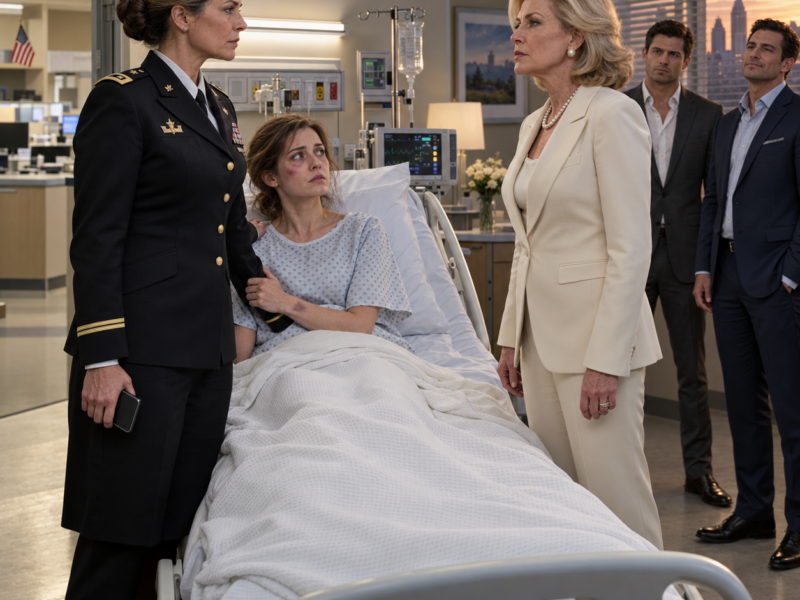
“Mom, come get me. My husband’s family beat me.” At the hospital, my daughter clung to my uniform while her mother-in-law insisted she had fallen. “Our family has friends in the courts,” Margaret Prescott told me. “Your military rank doesn’t impress us.” I hadn’t mentioned my rank. I was still trying to hear what my daughter was saying without her husband answering for her.

“Mom, come get me. My husband’s family hurt me.”
Those words turned my blood cold in a way no battlefield ever had.
I was still wearing my Army dress uniform when I left Fort Liberty that evening. My jacket was perfectly pressed, and the ribbons above my pocket caught the last orange light as I drove toward Mercy General Hospital in Charlotte, North Carolina.
The nameplate above my pocket read COLONEL VICTORIA HART.
That night, I was not a colonel.
I was a mother.
The emergency department was crowded when I arrived. A nurse at the secured doors lifted one hand and told me I could not go back without authorization.
“My daughter,” I said. “Emily Hart Prescott. She called me from this hospital.”
The nurse studied my face, then checked a screen. Whatever she saw changed her expression. She asked for identification, made a call, and led me through two sets of doors.
I found Emily curled beneath a thin blanket in an observation room. One eye was swollen. Her lip was cut. Dark marks circled her arms, and the white dress she had worn to a charity dinner was torn at the shoulder.
For one terrible second, I could not breathe.
This was the little girl who used to call me during deployments just to describe the sunset. She had drawn pictures for soldiers she had never met and taped them proudly to our refrigerator whenever I came home.
“Mom.”
I crossed the room and held her carefully. Her whole body shook like the frightened child who had once climbed into my bed during thunderstorms.
Then someone laughed behind me.
“She has always been dramatic.”
I turned.
Her husband, Ethan Prescott, stood beside his mother, Margaret, and his older brother, Brandon. Their clothes were expensive, their watches gleamed beneath the fluorescent lights, and none of them looked concerned about Emily.
Margaret offered me a polished smile. “Colonel Hart, your daughter had an emotional episode. She fell. Nobody touched her.”
Emily’s fingers tightened around my sleeve.
“No, Mom,” she whispered. “They locked me in the guesthouse. They took my phone. They said if I left Ethan, they would destroy my reputation.”
Ethan sighed. “She is exaggerating. She has always been sensitive.”
Brandon gave a short laugh. “Some women marry into families they are not prepared to handle.”
My pulse hammered beneath my collar, but command had taught me something useful. The angrier I became, the quieter my voice became.
Margaret stepped closer. “Let us not make this unpleasant. Our family has friends in the courts, the media, and state government.”
Then she leaned toward me.
“Your military rank does not impress us.”
“Take your daughter home,” Brandon said, “and be grateful we are not suing her for defamation.”
I looked at Ethan, then Brandon, then Margaret. I said nothing.
Their smiles widened because they mistook silence for intimidation. They believed money, influence, and the Prescott name had already decided what would happen next.
What they did not know was that I had noticed the hospital security camera above the doorway.
What they did not know was that Emily had whispered one more detail while I held her.
The emergency physician had interviewed her before the Prescotts arrived.
I removed my phone.
Margaret’s smile disappeared. “Who are you calling?”
I looked directly into her eyes. “The first person who is going to make sure none of you can make tonight disappear.”
Then someone answered.
“Major Reeves,” a tired voice said. “Are you all right, Colonel?”
“I am physically safe,” I replied. “I need the number for the civilian victim advocate who briefed our command team last month. I am at Mercy General with my daughter.”
I did not ask the Army to arrest anyone. I did not suggest my rank gave me authority in a civilian hospital. It did not. I asked for a professional contact because panic makes people reach for power, while training teaches them to reach for procedure.
Major Daniel Reeves understood at once.
“Stay where you are,” he said. “I will text it now. Do you need me to come?”
“Not yet. Thank you.”
I ended the call and found a new message on my screen. The advocate’s name was Tasha Green. Beneath it was a twenty-four-hour number for Safe Harbor Charlotte.
Margaret watched every movement. “Calling your soldiers will only embarrass Emily.”
“I called a victim advocate.”
For the first time, Ethan looked uncertain.
The nurse who had escorted me in reappeared with a hospital security officer and a woman in navy scrubs. The woman introduced herself as Dr. Priya Shah, the emergency physician treating Emily.
“Mrs. Prescott has asked that only her mother remain in the room,” Dr. Shah said.
“I am her husband,” Ethan replied.
“She is an adult patient and has made her preference clear.”
Margaret lifted her chin. “You do not understand the situation.”
“I understand patient privacy,” Dr. Shah said. “Please leave.”
Brandon started to object, but the security officer moved between him and the bed. He did not touch Brandon or raise his voice. He simply indicated the hallway.
The Prescotts had expected resistance they could call emotional. What they met instead was policy.
Ethan pointed at Emily. “If you do this, do not come home.”
Emily flinched.
I took one step toward him, but Dr. Shah spoke first.
“Sir, leave now.”
He looked at my uniform and seemed to reconsider whatever he had planned to say. Margaret gathered the family with a cold glance and walked out as if departure had been her decision.
The moment the door closed, Emily began to cry.
I sat beside her and held her hand. “You are safe for this minute. We will deal with the next minute when it comes.”
“They will ruin you too.”
“No one is discussing me right now. Tell the doctor what you need.”
Dr. Shah drew the curtain and lowered her voice. She explained that she had documented Emily’s injuries, ordered imaging, and contacted a forensic nurse with Emily’s consent. She had also asked hospital security to preserve footage from the entrance, waiting room, and corridor.
That last detail mattered. The camera above the doorway had captured Margaret saying nobody touched Emily. It had also captured Ethan threatening that she could not return home.
Neither statement proved everything. Both preserved the beginning of a timeline.
Tasha Green arrived twenty-five minutes later wearing gray slacks and carrying a canvas bag. She did not rush to hug Emily or tell her what to do. She introduced herself, asked permission to sit, and explained each option in ordinary language.
Emily could speak to police. She could request a hospital advocate. She could arrange emergency shelter at a confidential location. She could seek a domestic violence protective order through Mecklenburg County. She could decline any of those steps tonight and still receive care.
“You control the decisions,” Tasha said. “Not your husband. Not his family. Not your mother.”
I appreciated that she included me.
Emily looked at me. “Will you be angry if I am not ready for everything?”
“No.”
“Even after what they did?”
“I am angry at them. I will not turn that anger into another order for you.”
She closed her eyes for a moment. Then she asked to speak with police.
Two officers from the Charlotte-Mecklenburg Police Department arrived. One remained in the hallway while Detective Lena Brooks entered with a small notebook and body camera. She told Emily that the interview could pause whenever Emily needed it to pause.
Emily began with the dinner at the Prescott estate that afternoon.
Ethan had announced that he wanted her to sign papers authorizing him to manage an investment account left by my late husband, David. Emily refused. The account was hers, and David had established it years before she met Ethan.
Margaret called the refusal disloyal. Brandon blocked the library door. Ethan took Emily’s phone after she tried to call me.
“Who first used physical force?” Detective Brooks asked.
Emily stared at the blanket. “Ethan grabbed me. Brandon held the door. Margaret told them not to let me leave until I signed.”
Her breathing quickened. Tasha reminded her that the room was secure.
Emily continued. She said Ethan pushed her when she reached for the door. She struck a side table. Margaret told a housekeeper to clean the broken glass, then ordered Emily taken to the guesthouse until she calmed down.
“How did you leave?” the detective asked.
“Maria. The housekeeper. She brought towels and left the service door unlatched. She slipped me an old phone. I called 911 from the laundry room.”
That was the detail Emily had whispered to me.
There was a witness.
Detective Brooks asked for Maria’s last name. Emily thought it was Alvarez. She knew Maria lived somewhere near Matthews and had worked for the family for six years.
“Did she see what happened?”
“Some of it. She saw Brandon at the library door. She saw Ethan take my phone. She heard Margaret tell them to move me.”
The detective wrote carefully. She did not promise arrests, convictions, or justice by morning. She promised to preserve evidence and find Maria.
That restraint reassured me more than a dramatic promise would have.
Outside the room, voices rose.
Margaret had returned with a man in a tailored charcoal suit. He introduced himself loudly as the Prescott family’s attorney and demanded access to Emily.
The security officer refused.
“My client is concerned for his wife’s mental condition,” the attorney said.
Detective Brooks stepped into the hallway. “Your client may communicate through counsel. He may not enter a patient’s room against her wishes.”
The attorney saw her body camera and adjusted his tone immediately.
“Of course,” he said. “We only want everyone protected.”
“Then preserve every security recording from the Prescott residence, including the main house, guesthouse, gate, and service corridor. Preserve door access logs, phone records, and smart-home data. A formal request will follow.”
The lawyer did not answer.
Margaret did.
“Our cameras have been unreliable for weeks.”
Detective Brooks looked at her. “Thank you. I will note that.”
The family left again, this time without laughter.
Near midnight, Dr. Shah returned with the imaging results. Emily had no life-threatening injuries, but she needed observation, follow-up care, and rest. The words should have comforted me. Instead, I had to grip the edge of the chair to keep my hands still.
Emily watched me.
“You can take off the jacket, Mom.”
Only then did I realize I was still in full uniform. I removed the jacket, folded it over the back of a chair, and sat in my white shirt with the sleeves buttoned at my wrists.
Without the jacket, I felt less armored.
“I should have known,” I said.
Emily shook her head. “I made sure you did not.”
“Why?”
“Because you warned me about him before the wedding.”
I remembered the conversation. I had not forbidden the marriage or called Ethan dangerous. I had said he seemed to treat disagreement as disrespect. Emily, deeply in love, heard judgment.
“I thought if I told you things were bad, you would say you were right,” she continued.
“I am sorry I ever made being right seem more important than being available.”
Her face crumpled. “He was not like this at first.”
Tasha, who had been quiet near the window, spoke gently. “They rarely are.”
Emily described a marriage that had narrowed one inch at a time. Ethan criticized friends who did not respect their relationship. Then he objected when she met them. He offered to handle household accounts because finance made him happy. Then her card began declining unless he approved a purchase.
He called constantly when she visited me. He framed it as affection. He persuaded her to leave her marketing job because Prescott charitable events required a flexible schedule. He corrected her stories at dinner and laughed when she protested.
No single moment had seemed large enough to name.
Together, those moments had built a locked room long before Brandon stood outside the library.
At 1:15 in the morning, Detective Brooks returned. Patrol officers had located Maria Alvarez at her apartment. She was frightened but safe. She agreed to give a statement and had something on her phone that investigators needed to see.
“What?” Emily asked.
“I do not know yet,” the detective said. “Another team is interviewing her.”
I noticed the care in her answer. She would not contaminate Emily’s memory with details from another witness.
The detective also said officers had gone to the Prescott estate. The family declined a voluntary search and referred all questions to counsel. Police would seek appropriate legal process.
“Is Ethan being arrested?” I asked.
“I cannot discuss steps that have not happened. We are investigating allegations that include assault and unlawful restraint.”
Emily squeezed my hand. “They will call everyone they know.”
Detective Brooks met her eyes. “They are allowed to call people. They are not allowed to alter evidence or intimidate witnesses. Save every contact. Do not respond.”
That became our first rule.
By sunrise, Emily had received twenty-three messages from unknown numbers. Some sounded concerned. Others warned her not to destroy Ethan’s life over a misunderstanding. One offered to arrange a private wellness retreat if she avoided the police.
Tasha photographed the screen, exported the messages, and helped Emily change the password on her cloud account. We learned that Ethan had access to her email, calendar, and location history.
We turned off location sharing. We removed his devices. We changed recovery questions he could guess.
These were small acts, but I watched Emily sit straighter with each one.
At seven, a hospital administrator moved us to a different room and placed Emily under a privacy restriction. Callers would not receive confirmation that she was there.
Major Reeves arrived in civilian clothes carrying coffee and my overnight bag. He did not bring soldiers, make demands, or salute in the hallway. He greeted Emily, set the bag down, and asked whether I needed leave.
“I need several days,” I said.
“You have them. The chief of staff has been informed only that you have a family emergency. No details.”
That was leadership. Not influence. Not spectacle. Just protected time.
When he left, Emily looked surprised. “He did not ask what happened.”
“Because I did not offer.”
“The Prescotts would have demanded every detail.”
“Privacy feels strange after control. You will get used to it again.”
Later that morning, an attorney named Rachel Monroe met us in a hospital consultation room. Tasha had recommended three family-law attorneys with domestic violence experience. Emily chose Rachel after brief phone conversations with all three.
Rachel wore a plain navy suit and carried one legal pad. She spoke directly to Emily, not to me.
She explained that criminal charges belonged to the state, while divorce, property, and a protective order followed separate paths. She could seek an emergency order that day based on Emily’s sworn account. A judge could temporarily prohibit contact and address access to the residence, but a later hearing would allow both sides to present evidence.
“Will his family’s lawyer be there?” Emily asked.
“Eventually, yes.”
“He will make me sound unstable.”
“Then we prepare facts. Dates, messages, records, witnesses. You do not have to perform perfect calm to deserve protection.”
Emily looked toward me. “I want the order.”
Rachel nodded. “Then we begin.”
Before discharge, a forensic nurse photographed Emily’s visible injuries with consent, documented her account, and sealed her torn dress as evidence. Dr. Shah gave written instructions and scheduled follow-up care.
Hospital security escorted us to a side exit. We did not go to my house. Ethan knew the address, the alarm code, and the position of every downstairs window.
Safe Harbor arranged a confidential apartment used for short-term placement. It was modest, with a blue couch, two bedrooms, and a kitchen stocked with donated groceries. To me, it looked like a defensive position. To Emily, it looked like permission to breathe.
She stood in the living room and asked, “Is it terrible that I miss my house?”
“No.”
“Even after what happened there?”
“You are allowed to miss the life you believed you had.”
That afternoon, Rachel filed the request for an emergency protective order. A judge reviewed Emily’s sworn statement and granted temporary no-contact provisions pending a hearing.
The order did not solve everything. It created a boundary backed by law.
Ethan was served at his parents’ estate before dinner.
At 6:42, my phone rang from a blocked number.
I answered without speaking.
Margaret’s voice was smooth. “Victoria, this has gone far enough.”
I activated the call-recording notice required by my phone service and said, “You are contacting the wrong person. Communicate through counsel.”
“Emily is confused. You are exploiting her condition.”
“Do not call again.”
“You have a career to protect. So do I.”
“That sounds like a threat.”
She paused.
“It is advice between mothers.”
“No. It is evidence.”
I ended the call and forwarded the recording details to Detective Brooks and Rachel.
Silence, I had learned, was useful only when paired with documentation.
The first public story appeared the next morning on a local society website. It described Emily as an emotionally fragile military daughter who had suffered a private medical crisis after a family dispute. It praised Ethan for respecting her need for space.
The article cited an unnamed family friend.
Emily read the first paragraph and became physically ill.
I closed the laptop. “You do not have to read what they publish.”
“People will believe it.”
“Some will.”
“How can you be so calm?”
“I am not calm. I am choosing which actions deserve my energy.”
Rachel sent a preservation letter to the publisher and a concise statement that Emily was safe, represented by counsel, and cooperating with law enforcement. She did not provide medical details or argue online.
The statement was only three sentences.
Margaret’s campaign had paragraphs. We had records.
That afternoon, Detective Brooks called. Maria’s phone contained a thirty-eight-second audio recording made from the service hallway. Maria had started recording after hearing raised voices because similar arguments had occurred before.
In the recording, Ethan ordered Emily to unlock her investment account. Emily refused. Brandon said the doors would stay closed until she became reasonable. Then Margaret said, clearly, “Take the phone and put her in the guesthouse. We will say she fell if anyone asks.”
No one in the apartment spoke when the detective finished describing it.
Emily covered her mouth.
I felt anger move through me like heat beneath ice.
“Is Maria protected?” I asked.
“She has an advocate and counsel. Do not contact her directly.”
“Understood.”
The detective also said the Prescott security system was hosted by a third-party company. Investigators had obtained legal authorization to preserve relevant data before anyone could delete it.
Gate records showed Emily’s car entered at 2:08 p.m. and never left. A 911 call from the property was logged at 7:31. Door sensors recorded the guesthouse opening from the outside three minutes before that call.
Evidence did not arrive like lightning. It accumulated like rain.
The next four days taught me that leaving can be more complicated than surviving the moment that forces you to leave.
Emily had no independent phone plan. Her health insurance came through Ethan. Her personal mail went to the estate. Her passport, birth certificate, laptop, medication, and grandmother’s jewelry remained inside the house.
Rachel arranged for law enforcement to accompany Emily during a limited property retrieval. Ethan could not be present. His attorney provided a list of items the family claimed were Prescott property, including the laptop Emily had purchased before marriage.
“They listed my grandmother’s ring,” Emily said.
“Do you have proof it was yours?” Rachel asked.
I found a photograph of David’s mother placing it on Emily’s hand at her college graduation. The date stamp was eight years before the wedding.
“That helps,” Rachel said. “Bring it.”
We entered the estate on a gray Thursday morning with two officers and a neutral property clerk. The house looked exactly as it had during holiday dinners: limestone floors, enormous windows, white flowers replaced before they wilted.
Luxury can make danger difficult for outsiders to recognize. People expect fear to live behind broken screens and peeling paint. It can also live behind iron gates, monitored by cameras paid for with money that later funds the denial.
Emily stopped inside the foyer.
“I cannot go upstairs.”
“Then I will,” I said.
The officer shook his head gently. “Only the person named in the order may collect listed belongings unless counsel agrees.”
My first instinct was irritation. My second was gratitude. Rules protected the process from becoming another family contest.
Emily inhaled slowly. Tasha stood beside her without touching her.
“I can do it,” Emily said.
We moved room by room. She collected clothes, documents, medication, family photographs, and a box of letters from her father. Her passport was missing. So was the old phone she had used before Ethan moved her onto his plan.
In the study, every drawer had been emptied.
“He kept tax files here,” Emily said.
The property clerk recorded the condition of the room.
Upstairs, Emily found a small camera pointed toward her dressing area. Ethan had told her it was part of the alarm system. An officer photographed it and called Detective Brooks.
We did not touch it.
On the way out, Margaret appeared beyond the gate despite instructions from counsel that no family member be present. She remained on the public side of the property line, wearing dark glasses and speaking into a reporter’s camera.
“We love Emily,” she said. “We pray she accepts the help she needs.”
Emily stumbled.
I placed myself between her and the camera, not to hide her but to give her a choice. She straightened and continued to the car without responding.
That ten-second walk became the first image in the evening news report.
The station identified me as an Army colonel. By morning, strangers online were arguing about whether I had used military influence to target a prominent civilian family.
Fort Liberty’s public affairs office called me.
Lieutenant Colonel Samuel Grant spoke carefully. “Ma’am, reporters are asking whether the Army is involved.”
“It is not.”
“May we say you are on personal leave and the matter is civilian?”
“Yes. Do not discuss Emily.”
“We will not.”
I issued no personal statement. The Army did not defend me, attack the Prescotts, or lend its seal to a family dispute. That separation frustrated Margaret because she wanted a powerful institution to fight publicly. A public fight would let her change the subject.
Instead, the subject remained what happened to Emily.
On Friday, Ethan was arrested after investigators consulted prosecutors and reviewed the hospital records, witness statement, audio, and available electronic data. Brandon was arrested later that day. The allegations included assault and unlawful restraint. Charges were accusations, not convictions, and their attorneys emphasized that distinction in every interview.
Margaret was not arrested then. Investigators continued examining her role and her contacts with potential witnesses.
Emily saw Ethan’s booking photograph on television and began sobbing.
“I thought I wanted this,” she said. “Why do I feel guilty?”
Tasha answered before I could. “Because care and fear can exist in the same memory. Because he trained you to believe consequences were your fault. Feeling grief does not mean your decision was wrong.”
I made soup while they talked. It was the first useful thing my hands had done all day.
Ethan was released under conditions that prohibited contact with Emily. That night, flowers arrived at the apartment building with no sender’s name. The card said, I am sorry you forced this.
We did not bring them upstairs.
Building management preserved the delivery information. Rachel notified the court and Ethan’s lawyer. Detective Brooks documented it as a possible third-party contact.
The next bouquet was refused at the door.
Recovery, I discovered, often looked less like triumph than administration.
It was passwords, pharmacy transfers, credit reports, and replacement identification. It was a new checking account at a bank Ethan had never used. It was removing his mother from emergency contacts and telling the dentist not to confirm appointments.
It was Emily waking at 3:00 a.m. because the refrigerator clicked.
It was her apologizing for using too many towels in an apartment stocked for her.
It was me learning not to say, “You do not need to apologize,” as if a command could erase a reflex. Instead, I said, “You are allowed to use what you need.”
On the sixth night, she stood at the kitchen counter while I washed two mugs.
“Did you ever think I was weak?” she asked.
I turned off the water. “No.”
“Not even when I stayed?”
“Especially not then. I think you survived inside the information you had. Now you have different information.”
“That sounds like something from an operations briefing.”
“It probably is.”
She smiled for the first time since the hospital.
The protective-order hearing was scheduled for the following week. Rachel prepared Emily without coaching her to sound polished. They reviewed likely questions, including the ones designed to make ordinary compromises appear like consent.
Why had Emily stayed after Ethan first grabbed her arm?
Why had she attended parties and smiled in photographs?
Why had she sent him loving messages?
Why had she not told her mother?
“The answer can be complicated,” Rachel said. “Complicated is not dishonest.”
Emily practiced saying, “I loved him and believed the apologies. I was also afraid of what leaving would cost.”
The night before the hearing, she asked me to tell her about the worst decision I had made in uniform.
I did not choose a dramatic battlefield story. I told her about a young captain whose exhaustion I had mistaken for poor discipline. I had corrected him sharply in front of others. Later, I learned his mother was dying and he had been driving home every weekend.
“What did you do?” Emily asked.
“I apologized in front of the same people who heard the correction. Then I changed the schedule.”
“Did that fix it?”
“It fixed the schedule. It did not erase the humiliation. Accountability is not a time machine.”
She considered that.
“Ethan keeps saying he is sorry.”
“An apology that demands escape from consequences is a negotiation.”
The courthouse was less dramatic than television. Fluorescent lights hummed above rows of wooden benches. Lawyers carried thick files. Families waited with paper cups of coffee and faces shaped by sleepless nights.
The Prescotts arrived through the main entrance with three attorneys. Margaret wore pearl earrings and a cream suit. She greeted two people near security by name, making certain we saw that she was known.
No one bowed. No judge appeared to welcome her. She emptied her purse into a plastic tray like everyone else.
Inside the courtroom, Ethan sat at counsel table and stared at Emily until his lawyer whispered to him. He looked away.
Emily testified first. Her voice shook during the opening questions, then steadied as she described the argument, the blocked door, the missing phone, and the guesthouse.
Ethan’s attorney asked why she had not screamed when the housekeeper entered.
“I did not know whether Maria would lose her job if she helped me,” Emily said.
“But you trusted her enough to take a phone.”
“I trusted the chance she gave me.”
He asked about a smiling photograph taken with Ethan at a gala three days earlier.
“Were you frightened in this photograph?”
“Yes.”
“You appear happy.”
“I had learned what happened after I embarrassed him in public.”
The courtroom became still.
Maria testified by secured video arrangement because she feared retaliation. She described hearing the argument and seeing Brandon remain at the library door. She authenticated the audio recording and explained why she made it.
“Mrs. Prescott told me before that if I repeated family business, immigration officers would take an interest in my relatives,” Maria said.
Margaret’s attorney objected. The judge considered the issue, limited part of the testimony, and instructed everyone to proceed carefully.
There was no cinematic gasp. There was simply another fact entered into a record.
Ethan testified that Emily had been distraught and he had tried to prevent her from driving. He said the guesthouse was a peaceful place where she often rested.
Rachel asked why her phone had been taken.
“She was using it recklessly.”
“Calling her mother is reckless?”
“She was threatening to create a scene.”
“Why did your mother say on the recording that the family would claim Emily fell?”
His attorney objected before he answered.
After arguments, the judge found that Emily had presented sufficient evidence for a longer protective order. The order prohibited Ethan from contacting her, approaching her temporary residence or workplace, and using others to deliver messages.
It also established a process for remaining property and preserved the parties’ rights for later family-court proceedings.
The judge warned both sides not to litigate the case through the media.
Outside, reporters gathered behind barriers. Margaret walked toward them anyway. Her attorney caught her elbow and steered her to a waiting car.
Emily and I left through another exit.
In the parking garage, she leaned against a concrete pillar.
“Is that it?” she asked.
“For today.”
“I thought I would feel different.”
“How do you feel?”
“Tired.”
“Then tired is honest.”
We stopped for hamburgers on the way back. Emily ate half of hers and slept for fourteen hours.
The Prescotts changed tactics after the hearing.
They stopped calling Emily unstable and began calling the marriage mutually toxic. A public relations consultant released a statement asking for compassion for both sides. Anonymous accounts posted old photographs of Emily holding wine at parties and suggested she had a substance problem.
Emily barely drank.
Rachel advised against answering every lie. She documented the posts, sent notices where necessary, and focused on the legal cases.
“A rumor wants your attention more than it wants your denial,” she said.
My own temptation was harder to manage. I had commanded thousands of people, briefed generals, and negotiated in rooms where mistakes carried consequences. I wanted to stand before a camera and dismantle every claim sentence by sentence.
Emily asked me not to.
“I do not want this to become Colonel Hart against the Prescotts,” she said. “I want it to remain about what Ethan did.”
So I stayed quiet.
This time, my silence was not shock. It was respect.
Three weeks after the hospital, Detective Brooks asked Emily about the investment account. The attempted transfer could help establish motive, though the financial dispute remained separate from proof of physical abuse.
David had funded the account with life-insurance proceeds and investments accumulated during twenty-seven years of marriage. It was worth just over $640,000. Emily received income from it, but she could not transfer principal without additional verification from the trustee.
Ethan apparently did not know that last part.
He had prepared a document that would have appointed him as investment adviser and directed funds into a Prescott development company.
The company was struggling.
Public filings showed cost overruns on a luxury condominium project near Lake Norman. Contractors had filed liens. A lender had demanded additional collateral.
The revelation made headlines, but I refused to celebrate. Financial pressure explained urgency. It did not excuse cruelty.
Investigators later found a draft email on a synced tablet recovered from the estate. It instructed a family employee to describe Emily as intoxicated if police asked questions. The draft was created before the 911 call.
That timing damaged the story that the family had invented an explanation only after a confusing accident.
Margaret was questioned again. Her attorney released a statement saying she had merely prepared for possible misunderstandings during a medical crisis.
Maria resigned from the Prescott household. Safe Harbor connected her with employment resources, but she refused money from me.
“I helped Emily because it was right,” she told Tasha. “I do not want them saying your mother bought me.”
I respected her decision. Through counsel, Emily later wrote a letter thanking her without discussing testimony.
Months passed.
The criminal case moved slowly, as criminal cases often do. Hearings were continued. Attorneys exchanged evidence. Experts reviewed digital records. Each delay felt personal to Emily until Rachel helped her build a life that did not depend on the next court date.
She found a therapist who specialized in trauma and coercive control. She rented a small apartment under enhanced privacy protections. She bought a used blue Honda with her own money.
The first time she drove alone, she called me from a grocery-store parking lot.
“I bought strawberries,” she said.
“All right.”
“I know that sounds ridiculous. Ethan hated strawberries. He said the seeds got stuck in his teeth, so we never had them.”
I understood then that freedom often announces itself through groceries.
“Buy two cartons,” I said.
She laughed. “I already did.”
Emily returned to work part time with a nonprofit communications agency. On her first morning, she changed outfits four times because Ethan used to criticize colors he considered loud.
She chose a red blouse.
No one commented except her supervisor, who said it looked nice.
I returned to Fort Liberty after ten days. Before I left Charlotte, I stood in Emily’s new kitchen and reviewed emergency contacts, alarm settings, and transportation plans.
She listened patiently.
Then she put both hands on my shoulders. “Mom, you are turning my apartment into a command post.”
I looked at the printed checklist taped beside her refrigerator.
“Perhaps a little.”
“I need a home.”
I removed the checklist.
“Understood.”
That was part of my learning. Protection can become control when it refuses to make room for the protected person’s judgment. My intentions did not make me immune from that mistake.
We agreed on one daily text and a code word for emergencies. If she missed a text, I would wait thirty minutes and call. I would not drive to Charlotte because she took a nap.
At Fort Liberty, work seemed both familiar and strangely distant. Meetings continued. Training schedules changed. Young officers brought me decisions that felt urgent because they had not spent a night watching a child tremble beneath a hospital blanket.
I did not tell them their concerns were small. Leadership requires attention to the matter in front of you, not constant comparison with your private pain.
Major Reeves closed my office door one afternoon.
“How is your daughter?”
“Rebuilding.”
“And you?”
I almost gave the standard answer.
“I am angry most of the time.”
He nodded. “The chaplain has coffee that could qualify as punishment, but she listens well.”
I met Chaplain Denise Walker the next morning.
For the first twenty minutes, I talked about Emily. The chaplain finally asked what I had done with my own fear.
“I do not have time for fear.”
“That was not the question.”
I stared at the untouched coffee.
My fear was not only that Ethan might hurt Emily again. I feared I had failed her by spending a lifetime being competent everywhere except in the moments she needed to disclose weakness. I feared she had hidden the truth because my uniform made vulnerability look like defeat.
The chaplain let me speak until the anger cracked.
I cried quietly in a plain office while morning formation calls sounded outside.
No one saluted. No one offered a strategy. It helped.
In December, prosecutors met with Emily to discuss a proposed resolution. Ethan would plead guilty to assault and unlawful restraint, accept supervised probation, complete a certified intervention program, surrender firearms as required, and comply with strict no-contact terms. The agreement would not include the most serious theory investigators had initially considered.
Brandon would face a separate charge related to preventing Emily from leaving. His attorney was negotiating independently.
Emily listened, asked careful questions, and requested time.
Outside the meeting, she said, “If I agree, people will say he got away with it.”
“Some will.”
“If I refuse and a trial goes badly, they will say I was greedy or vindictive.”
“Some will say that too.”
“That is not helpful, Mom.”
“No. But perhaps the decision cannot be built around people committed to misunderstanding you.”
She spoke with Rachel, Tasha, and the prosecutor. She asked what a trial would require, what could be admitted, and how long it might take. She asked about Maria’s safety and whether the plea would create a public record of responsibility.
In the end, Emily supported the agreement.
At the plea hearing, Ethan stood before a judge and admitted he had used unlawful force and prevented his wife from leaving. He did not deliver a moving apology. He read answers in a flat voice and looked at his attorney before responding.
It was not catharsis.
It was accountability in the limited language the system could provide.
Brandon later entered his own plea to a lesser offense and received probation, community service, and no-contact conditions. Margaret was charged with attempting to influence a witness after investigators documented messages sent through an employee to Maria. That case ended with a negotiated disposition, a fine, probation, and an order prohibiting contact.
None of them went from a mansion to a dramatic lifetime behind bars. Money bought experienced lawyers and time. It did not erase the recordings, the records, or the findings entered by courts.
The Prescott development company lost a major financing partner after its financial problems became public. I took no pleasure in employees worrying about their jobs. Consequences spread beyond the people who create them, one reason revenge is a poor compass.
Emily filed for divorce.
Ethan’s attorney fought over furniture, jewelry, and language in the proposed settlement. He demanded a confidentiality clause broad enough to prevent Emily from discussing her own experience.
She refused.
The dispute lasted months. Eventually, they reached an agreement that preserved her separate investment account, divided marital property, and barred both parties from making knowingly false public statements. Emily did not receive a fortune from the Prescotts. She received what mattered more to her: legal independence and the right to tell the truth.
The divorce became final eleven months after the hospital.
We did not throw a party.
Emily invited me, Tasha, Rachel, and two old friends to dinner at a small restaurant in Charlotte. She wore the red blouse from her first day back at work.
Maria joined us for dessert.
No one gave a speech. We ate lemon cake and talked about a beach trip Emily wanted to take in spring.
Halfway through dessert, she looked around the table and said, “I thought leaving would be one brave moment.”
Tasha smiled. “It is usually a thousand ordinary ones.”
Emily nodded. “Changing a password. Answering a lawyer. Going to sleep. Waking up. Buying strawberries.”
Maria raised her coffee cup. “Then we celebrate strawberries.”
We did.
A year after the call, Mercy General invited Emily to speak privately with nurses about what had helped her disclose the abuse. She agreed on the condition that no media attend and no one use her story for fundraising without permission.
I sat in the back row wearing civilian clothes.
Emily told the staff that Dr. Shah had helped by addressing her directly even when wealthy relatives crowded the room. She praised the nurse who asked questions alone and the security officer who enforced boundaries without escalating the scene.
“The most important sentence I heard was, ‘You control the decisions,'” Emily said. “I had forgotten what that felt like.”
Afterward, a young nurse approached her with tears in her eyes. She did not share details. She simply said, “Thank you. I needed to hear that too.”
Emily gave her Tasha’s card.
The Prescott family never apologized publicly. Margaret withdrew from two charitable boards and later returned to society events in another city. Photographs showed her smiling beside people who either did not know or did not care.
For a while, that enraged me.
I wanted the world to arrange itself into a clear moral picture: good people welcomed, harmful people excluded, truth permanently visible.
The world rarely cooperates.
Justice did not mean Margaret vanished. It meant she no longer controlled Emily’s home, money, phone, or story.
Ethan completed court-ordered programs and remained barred from contact. Whether he changed was no longer Emily’s responsibility to determine.
Brandon sent one apology through counsel after his probation ended. It focused mostly on the damage to his career. Emily read the first page, handed it to Rachel, and declined to respond.
“Do you think that is cruel?” she asked me.
“No.”
“What if he meant it?”
“Meaning it does not create an obligation for you to receive it.”
She placed the letter in a file and went to work.
My retirement ceremony took place eighteen months later at Fort Liberty. Emily stood in the front row in a bright green dress. When the narrator mentioned my deployments and commands, I saw pride in her face, but I also saw something more important.
She was not there because she needed rescue.
She was there because she wanted to be.
After the ceremony, Major Reeves presented her with a bouquet. She laughed and checked the card before accepting it.
“No mysterious sender,” he assured her.
“Good answer,” she said.
We drove to Charlotte the next day in my packed SUV. Retirement had once seemed like an empty horizon. Now I planned to teach leadership seminars, volunteer with a veterans’ legal clinic, and learn how to have breakfast without checking three phones.
Emily had plans of her own.
She was promoted at the communications agency. She moved to a sunny apartment with a balcony and grew herbs in mismatched pots. She adopted an elderly beagle named Scout, who distrusted men in hats and loved strawberries almost as much as she did.
Some nights remained difficult. A slammed door could pull her back into fear. An unknown number could make her hands shake. Healing did not move in a straight line, and no courtroom order could make it do so.
But the difficult nights no longer defined every morning.
One Sunday, Emily and I drove past the hospital on our way to lunch. The emergency entrance looked ordinary, full of cars arriving and leaving beneath the same covered driveway.
“I used to think that was the worst night of my life,” she said.
“And now?”
“It was the night the worst part stopped being secret.”
I considered the distinction.
“That sounds true.”
At lunch, she told me she had begun volunteering with Safe Harbor twice a month. She did not counsel clients or investigate cases. She helped assemble welcome bags with toiletries, chargers, notebooks, and grocery cards.
“Tasha says practical things matter,” she said.
“Tasha is right.”
“I put strawberries on the grocery cards.”
“Of course you did.”
During the second year after the hospital, Emily asked if I would attend a community workshop with her. Safe Harbor was training volunteers to recognize the less visible signs of coercive control. She had already completed the orientation, but this session invited family members who wanted to understand how to help without taking over.
I almost said I did not need a workshop.
That reflex embarrassed me. I had spent a career requiring trained people to refresh their knowledge, yet part of me believed motherhood should make understanding automatic.
It does not.
The workshop took place in a public library meeting room on a rainy Saturday. Twelve people sat in a circle with paper name tags. No one used last names. A retired teacher had come because her sister kept returning to a controlling partner. A college student worried about a roommate. A gray-haired man admitted that his adult son monitored his wife’s spending.
The facilitator wrote two words on a board: help and control.
“They can look similar from the outside,” she said. “Both may involve advice, transportation, money, or safety planning. The difference is who retains choice.”
I thought about the checklist I had taped to Emily’s refrigerator.
During an exercise, we were given a fictional situation and asked what we would say. A woman had left home with no coat, no identification, and no plan. My first response was a list of tasks: call police, freeze credit, change locks, hire counsel.
The facilitator listened. “What would you ask first?”
I looked at my notes.
Emily answered from across the circle. “What does she want right now?”
That question became another rule between us.
When Emily wanted advice, she asked for it. When she wanted company, she said so. When she wanted to complain about a broken dishwasher without receiving a five-step repair plan, she warned me before beginning.
I learned to ask, “Do you want ideas, action, or listening?”
Most days, she chose listening.
The change improved more than our conversations about Ethan. It altered our entire relationship. I stopped treating every disappointment as a threat to be neutralized. Emily stopped editing ordinary problems out of her calls because she feared I would mobilize.
She told me about a bad date, an unfair supervisor, and a parking ticket. I told her when retirement felt lonely. Neither of us rushed to turn the other person’s discomfort into a mission.
For the first time since she was a child, we were not commander and dependent. We were two adults learning each other again.
The legal aftermath continued to test that progress.
Ethan petitioned the court to modify one administrative term related to property transfer. The request did not accuse Emily of wrongdoing, but seeing his name on a fresh filing sent her back to the night in the guesthouse.
She called me from Rachel’s office.
“I cannot do this again,” she said.
Every part of me wanted to say I would handle it.
Instead, I asked, “Ideas, action, or listening?”
There was a long pause.
“Listening first. Then maybe ideas.”
I listened while she described the pressure in her chest and the anger she felt at needing legal help for something so minor. When she finished, we discussed options Rachel had already explained. Emily chose to let Rachel respond without attending a routine hearing.
The court denied most of Ethan’s request and clarified the rest. Nothing catastrophic happened.
That ordinary outcome became evidence of its own. A document could arrive without destroying her life. His name could appear without summoning him into the room. Fear predicted disaster, and reality sometimes answered with paperwork.
Emily kept a notebook of those moments. Her therapist called it a record of corrected predictions.
An unknown sedan parked outside her building. She expected a Prescott investigator. It belonged to a new tenant.
A society reporter emailed her. She expected an ambush. The reporter accepted no as an answer.
She made a mistake in a presentation. She expected her supervisor to humiliate her. Her supervisor asked for one revision and thanked her for the work.
Safety became believable through repetition.
My own corrected predictions were different.
If I did not check on Emily every evening, I feared I would miss another warning. She called the next morning, rested and cheerful.
If I did not challenge every false statement online, I feared the lie would become permanent. The news cycle moved on.
If I admitted uncertainty, I feared I would be useless. Emily trusted me more.
We were both unlearning systems that had once protected us. Her vigilance had helped her read Ethan’s moods. Mine had helped people survive dangerous assignments. Useful habits can become heavy when carried into every room.
Safe Harbor later asked whether I would speak to a group of relatives. I agreed only after Emily said the choice belonged to me and did not require her participation.
I began by telling them I had no perfect formula.
“When my daughter called, I wanted to solve everything before sunrise,” I said. “I believed speed was the same as safety. Sometimes it was. Sometimes it made her feel that one controlling household had been replaced by a loving command center.”
Several people laughed softly because they recognized themselves.
I told them to believe disclosures without demanding a complete timeline. Trauma can make memory arrive in pieces. I told them to preserve messages, respect medical privacy, and involve qualified advocates. I warned them not to confront an alleged abuser in ways that could increase danger.
Most importantly, I told them not to make support conditional on the decision they preferred.
“A person may return,” I said. “A person may delay reporting. A person may miss someone who caused harm. None of that makes the harm unreal, and shame will not create safety.”
Afterward, the gray-haired man from the library approached me. His daughter-in-law had declined help twice. He wanted to know whether to stop asking.
“I cannot decide for your family,” I said. “But perhaps you can keep one door open without standing in it.”
He wrote the sentence on the back of a brochure.
I carried his question home with me. It reminded me that our outcome had depended on circumstances many families never receive. Emily reached a hospital. A doctor listened. Maria preserved evidence. A detective had time to investigate. Emily could obtain counsel and temporary housing.
Not everyone has those advantages.
Money had helped the Prescotts create pressure, but money also helped Emily escape it. Pretending otherwise would turn our story into a comforting myth about courage conquering every obstacle. Courage matters. So do available beds, paid leave, transportation, legal representation, child care, and professionals who believe safety is part of their job.
Emily and I created a small fund through Safe Harbor in David’s memory. We did not put our names on a wall. The fund paid practical expenses that often trap people during the first week away: replacement identification, medication, rides, pet boarding, and prepaid phones.
The first annual report listed forty-seven grants.
Emily studied the numbers quietly.
“Dad would like the pet boarding,” she said.
I knew she was right, and that made me smile.
One evening, she received an email from a woman who had attended several Prescott charity events. The woman apologized for believing the first public story. She had watched Ethan correct Emily at dinner and had interpreted the behavior as a demanding husband’s concern.
“I should have said something,” the woman wrote.
Emily asked whether she should respond.
“What do you want?” I asked.
“I want her to notice next time.”
She wrote back with three lines: Thank you for reconsidering. If you see someone being diminished, speak to her privately rather than confronting the person controlling her. Give her information without demanding a decision.
The woman replied that she would.
We never knew whether she did. Not every act produces a visible ending.
Maria’s life changed too. She found work managing housekeeping at a small hotel and began taking evening classes in business administration. Emily attended her graduation two years later.
I stayed home because Maria wanted the occasion centered on her family, not the case. That boundary pleased me.
Emily sent a photograph afterward. Maria stood in a blue gown between her sons, smiling so broadly that the months of fear seemed far away.
They were not erased. They simply no longer occupied the entire frame.
Detective Brooks retired the following spring. She invited Emily to a modest gathering at a barbecue restaurant. When Emily thanked her for saving her, the detective shook her head.
“I handled a case,” she said. “You made a call. Maria opened a door. The doctor documented what she saw. Your mother kept her temper when losing it would have felt wonderful. Do not flatten all of that into one hero.”
Emily later told me it was the most honest thing anyone had said about the case.
Popular stories like one powerful rescuer and one decisive victory. Real safety is usually built by a chain of people, any one of whom could fail to act. The nurse checks the chart. The advocate answers at midnight. The clerk preserves a file. The neighbor reports a sound. The friend keeps a spare key.
Ordinary competence can become extraordinary when someone is counting on it.
I thought often about the nurse who first blocked my path. In my panic, I had seen her as an obstacle. In fact, she was protecting a secured department and verifying my identity before allowing access to a vulnerable patient.
Months later, I found her during one of Emily’s follow-up visits and apologized for the sharpness in my voice.
“You were scared,” she said.
“That explains it. It does not excuse treating you like a barrier.”
She accepted the apology and told me her name was Jordan Lee. Emily sent a note to her supervisor praising her care.
Accountability, I remembered, was not a time machine. It was still worth practicing.
I also thought about the hospital camera I had noticed above the doorway. For weeks, I treated it as the silent witness that defeated the Prescotts. In truth, its footage captured only a fraction of what mattered. It showed threats after the harm, not the room where it began.
Technology preserved words. People gave them context.
The most important evidence was not dramatic. It was the consistency among separate sources: Emily’s statement before her family arrived, Dr. Shah’s observations, Maria’s recording, access logs, messages, financial documents, and later attempts at contact.
Truth became durable because no single piece had to carry all of it.
That lesson changed the way I taught leadership after retirement. In seminars, I asked managers what systems allowed quiet reports to survive pressure from influential people. Did employees have more than one reporting path? Who controlled the records? Could a complaint be altered by the supervisor it concerned? Did policy work the same way for a donor, executive, or celebrated employee?
Ethics, I told them, lives in architecture as much as character.
Good people placed inside weak systems may hesitate. Self-interested people inside strong systems find fewer shadows.
I never used Emily’s name in those seminars. Her experience was not mine to convert into a professional lesson without permission. When she later agreed that I could discuss general principles, we wrote boundaries together.
No photographs. No medical details. No recordings. No identifying dates. No surprise questions about her marriage.
The first event organizer complained that those limits reduced the promotional value.
I declined the event.
That choice would once have seemed wasteful. I had spent years accepting imperfect opportunities because influence could be used for good. Now I understood that good intentions do not entitle an audience to another person’s pain.
Emily eventually told her story in her own way. She wrote an essay for a professional journal about reputation management and the language institutions use when protecting powerful people. She focused on phrases that sounded neutral while shifting blame: private misunderstanding, emotional episode, mutual conflict, concern for her well-being.
“Passive language hides active choices,” she wrote.
The essay never named the Prescotts. It did not need to.
Thousands of readers shared it because they recognized the pattern in workplaces, schools, churches, and families. Emily received messages from people who had lacked words for what happened to them.
She answered none personally. The journal added links to professional resources beneath the article.
“I cannot become everybody’s emergency contact,” she told me.
“No,” I said. “You cannot.”
I was proud that she understood compassion required limits.
Three years after the hospital, Emily bought a small townhouse in Charlotte. The closing took place on a clear October morning. Rachel attended only because she had become a friend, not because a court required her presence.
Emily signed each page slowly. No one stood over her. No one redirected her money. No one told her where to place her initials.
When the agent handed her the keys, she held them in her palm and began to cry.
“Happy tears?” I asked.
“Mostly.”
The townhouse had two bedrooms, a narrow patio, and a kitchen with green cabinets the seller apologized for. Emily loved them. Scout explored every room, then chose a patch of sunlight near the back door.
We spent the afternoon assembling a dining table. I read the instructions. Emily ignored them. By evening, one leg was backward and both of us were laughing too hard to fix it.
“The colonel has lost command of the furniture,” she announced.
“The colonel advised following the diagram.”
“The homeowner overruled her.”
That sentence was worth every crooked screw.
We ordered pizza and ate on the floor. Through the open patio door, I heard neighbors talking and a lawn mower starting somewhere beyond the fence.
Ordinary sounds.
Emily lifted her paper cup. “To the homeowner.”
I touched mine to hers. “To the homeowner.”
Later, while she unpacked, I found the battered notebook from her first months away. The opening pages contained phone numbers, court dates, and lists of items missing from the estate. The later pages recorded corrected predictions and fragments from therapy.
On the final written page, she had copied three sentences.
I believe you.
You decide.
I am here.
I closed the notebook without reading anything else and returned it to the box.
The phone call that began with “Mom, come get me” will always live inside me. Sometimes I still hear Emily’s voice when I wake before dawn. I still remember the Prescotts standing beneath hospital lights, perfectly dressed and certain that confidence could substitute for truth.
They believed my silence meant I was afraid.
They were partly right. I was terrified.
Courage is not the absence of fear, and discipline is not the absence of rage. That night, both lived in me at once. The difference was that I did not let either one choose our next step alone.
I called an advocate. A doctor documented facts. A nurse protected privacy. Security preserved video. A detective listened without promising miracles. An attorney built a case one record at a time. A housekeeper risked her livelihood to leave a door unlocked.
No single person rescued Emily.
Most importantly, Emily rescued herself again and again by making choices after others had spent years teaching her that choice was selfish.
People sometimes ask whether my rank frightened the Prescotts. It did not. At first, it made them more eager to challenge me. They imagined authority as a contest between their connections and my uniform.
They misunderstood the source of our strength.
The uniform could not obtain a civilian warrant. My medals could not sign Emily’s protective order. No command I had held could make a judge believe her.
What mattered was the truth preserved before it could be rewritten.
What mattered was Emily’s voice.
What mattered was a system of ordinary people who did their jobs carefully when a powerful family expected exceptions.
I spent much of my career teaching young leaders that silence has several meanings. Sometimes it is fear. Sometimes it is shock. Sometimes it is the pause in which a person decides whether to react or respond.
In that hospital room, mine was all three.
Then it became a promise.
I would not shout louder than the Prescotts. I would not threaten more powerful friends. I would not turn my daughter’s pain into a public performance of my strength.
I would stand beside her while the truth became difficult to erase.
That promise carried us farther than anger could have.
It carried us through hospital corridors, court benches, locked accounts, sleepless nights, and the quiet shock of ordinary freedom.
It carried Emily to a kitchen where she chose her own food, a job where she wore bright colors, and a balcony where basil grew beside an old dog sleeping in the sun.
And it taught me that a mother’s strongest words are not always an order or a warning.
Sometimes they are the words I finally learned to say without adding a plan afterward.
I believe you.
You decide.
I am here.









