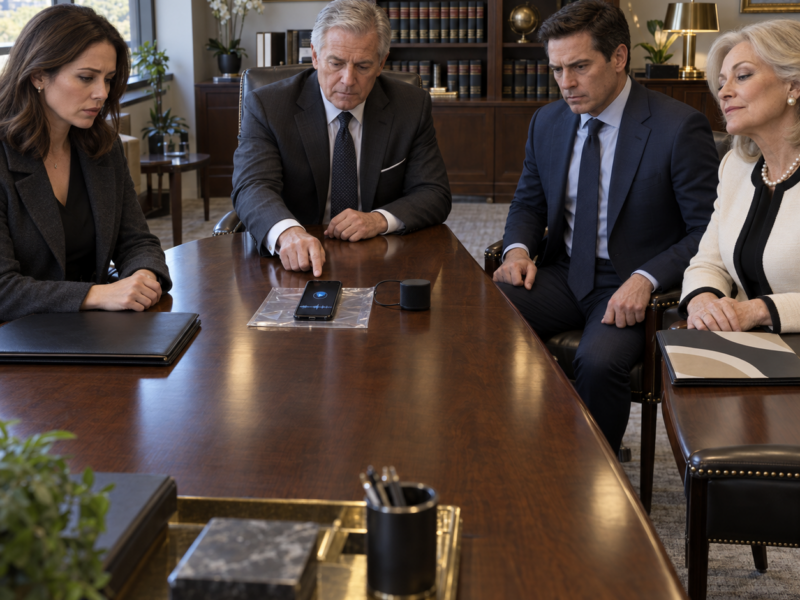
“Her inheritance will finally pay off my family’s debts,” my husband announced at my father’s funeral reception. His mother had already toured a $600,000 house while I was choosing Dad’s burial clothes. Three days later, we sat down with his attorney, who placed Dad’s old phone on the table instead of opening the will. The moment my husband heard the recording, he stood so abruptly his chair fell backward. “Turn that off!”

My father’s funeral reception was underway when my husband stood in the church hall and announced that my inheritance would finally erase his family’s debts.
For three seconds, nobody moved.
Then his mother, Patricia, squeezed his arm.
“And once probate clears,” she said, almost proudly, “we can finally close on the house.”
The house.
The $600,000 four-bedroom place she had toured two days after my father died.
I stared at Ethan across the crowded hall. My father’s coworkers, neighbors, cousins, and old friends still held paper cups of coffee. His photograph, surrounded by white lilies, stood ten feet behind my husband.
“You told them?” I asked.
Ethan smiled as if I were being difficult.
“Claire, everyone knows your dad left you everything. There is no reason to pretend we are struggling anymore.”
Something inside me turned cold.
Ethan had spent the previous year telling me his consulting firm was temporarily tight. He had borrowed from our joint savings twice. He insisted his mother’s debts were not our responsibility.
Now, before my father was buried, he spoke as though my inheritance already belonged to him.
I said nothing.
That frightened him more than anger would have.
Three days later, we sat in the conference room of my father’s attorney, Martin Hale, for an estate meeting. People call such meetings will readings, though real estate administration rarely resembles a movie. Martin had asked me to come because my father left specific instructions concerning several documents and a recording.
Patricia came too, wearing pearls and carrying a glossy folder from a luxury real-estate agency. Ethan checked his phone every few seconds. His knee bounced beneath the table.
Martin did not open the will immediately.
Instead, he locked the conference-room door.
Ethan’s knee stopped moving.
Martin placed a sealed evidence bag on the table. Inside was my father’s old black phone, the one I had seen beside his hospital bed during his final week.
“What is that?” Ethan asked.
Martin looked at me, not him.
“Your father left specific instructions. Before we discuss the estate, Claire needs to hear something.”
Patricia leaned forward. “This is highly inappropriate.”
“You may leave,” Martin said. “Claire may remain.”
Patricia stayed.
Martin removed the phone, connected it to a small speaker, and played a recording dated eleven days before Dad died.
There was static.
A chair scraped.
Then my father’s voice filled the room.
“You understand that money is Claire’s, Ethan. Not yours.”
My husband’s face lost color.
A second voice answered.
His.
“She is my wife. What belongs to her belongs to me.”
I looked at Ethan.
He would not look back.
The recording continued.
Dad said, “Not if she knows what you did.”
Ethan shot to his feet so violently that his chair tipped backward.
“Turn that off.”
Martin did not move.
Patricia grabbed Ethan’s sleeve.
“Ethan, do not.” Her voice was no longer smug. It was terrified.
That was when I understood she already knew.
My own voice sounded thin.
“What did you do?”
Ethan reached toward the phone. Martin pulled it away.
From the speaker, Dad said one final sentence that stopped Ethan with his hand still extended.
“I have the documents proving you forged Claire’s signature.”
His hand dropped.
For the first time in twelve years of marriage, I saw fear on Ethan’s face that had nothing to do with losing money.
It was the fear of being caught.
“That recording proves nothing,” he said.
Martin calmly raised the volume.
Dad’s voice returned.
“I compared the signature on the home-equity application with Claire’s verified records. You copied it.”
I turned toward Ethan. “Home-equity application?”
He said nothing.
Martin opened a folder and slid three pages toward me. The first carried my name. The second showed a $185,000 home-equity line secured against the house Ethan and I owned. The third showed a transfer to Mercer Ridge Consulting LLC.
Ethan owned Mercer Ridge.
I had never signed the application.
My stomach tightened.
Patricia stood. “This is a family misunderstanding. Richard hated Ethan. Everyone knows that.”
“No,” Martin said. “Richard hired a forensic accountant.”
The words silenced her.
The accountant had traced more than $260,000 in business losses, personal loans, and credit-card debt connected to Ethan. Several accounts appeared to have been opened using my personal information.
According to Martin, Dad discovered the problem after a bank verification letter was mailed to his house, where I had lived before marriage and which still appeared on an old credit profile.
Ethan finally spoke.
“I was fixing it.”
“With my inheritance?” I asked.
“With our future.”
Martin pushed another document across the table.
It was a purchase agreement for Patricia’s $600,000 house.
The buyer was not Patricia.
It was me.
My name appeared on the contract, along with a signature that looked almost perfect.
I had never seen the document.
Patricia’s expression changed.
“I thought Claire agreed,” she said quickly.
Ethan stared at her with such fury that I knew she had betrayed him.
My father had learned about the house before he died. The real-estate agent called him because Ethan listed Dad as the source of funds and claimed a large inheritance distribution was imminent. The agent wanted proof that money would be available at closing.
Dad became suspicious and arranged the recorded meeting with Ethan.
Martin had not yet played the most important part.
He tapped the phone again.
Dad asked, “What happens if Claire refuses after I am gone?”
Ethan laughed softly on the recording.
“She will not refuse. If she does, I have enough to make her look unstable.”
My skin went cold.
Ethan lunged for the speaker.
Martin stood and blocked him.
Patricia shouted for Ethan to stop. He shoved the chair aside and knocked a glass of water to the floor.
I backed toward the wall.
“What does that mean?”
Martin removed a sealed envelope bearing my name.
“Your father believed Ethan was preparing more than forged financial documents.”
Ethan stopped moving.
“He believed your husband was building a file to argue that you could not control your own finances.”
I remembered the therapist Ethan insisted I see after Dad’s cancer diagnosis. The sleeping medication he kept asking whether I had taken. The nights he photographed me crying.
Then Patricia whispered something I was not supposed to hear.
“You said those records were already enough.”
The room went silent.
Martin turned toward her.
Ethan’s face hardened.
I realized the plan had never been only about stealing an inheritance after my father died.
They had been preparing to control me while he was still alive.
Martin did not open the envelope. He placed it beside the phone and told me Dad required two witnesses before certain contents were disclosed. One was in the room. The other waited outside.
Ethan looked toward the locked door.
Someone knocked three times.
Patricia went pale.
“Claire,” Martin said, “whatever happens next, do not leave with your husband.”
He unlocked the door and admitted a woman I recognized from the funeral. Her name was Sophia Grant. I had assumed she was one of Dad’s former business clients.
She introduced herself as the forensic accountant Dad hired six weeks before his death.
Behind her stood Detective Lena Morales.
Ethan stepped backward.
“This is insane. Claire, tell them this is a family matter.”
I looked at the forged purchase agreement.
“It stopped being a family matter when you signed my name.”
Detective Morales explained that Martin had given investigators copies of the suspected forged credit application, purchase contract, and Sophia’s preliminary report. A judge had authorized warrants for specific financial records and electronic devices connected to Mercer Ridge.
The detective was not there to stage an arrest during an estate meeting. Her team was executing related warrants at the company office and another location. The phone in Ethan’s hand was identified in the warrant materials.
Ethan reached for it.
Morales told him to place it on the table.
He turned toward the door instead.
Sophia and Martin moved aside. Morales positioned herself between Ethan and the exit and repeated the instruction.
For several seconds, he stared at her, breathing hard. Then he put the phone on the table so forcefully that the screen cracked.
Patricia began crying.
“Ethan handled the paperwork,” she said. “I never signed Claire’s name.”
Ethan spun toward her.
“You knew exactly what we were doing.”
That sentence destroyed the last possibility that I had misunderstood.
Morales cautioned everyone not to touch the device. Another detective entered, documented its condition, and secured it according to the warrant.
Ethan was not handcuffed in the conference room. Morales told him investigators would contact his attorney and that he should not destroy, alter, or direct anyone to destroy records.
“Am I free to leave?” he asked.
“At this moment, yes.”
He looked at me. “Claire, come with me.”
“No.”
“You are in shock. You should not stay with these people.”
“These people did not forge my name.”
Patricia gathered her real-estate folder. “We need a lawyer.”
“You need your own lawyer,” Ethan snapped.
The distinction was revealing. Their shared plan had reached the point where each person wanted separate protection.
They left without me.
When the door closed, my knees gave way. I sat in the nearest chair and stared at the water spreading across the floor.
Martin handed me tissues. Sophia sat across from me without speaking.
Detective Morales asked whether I wanted an advocate present before answering questions. I said yes.
An hour earlier, I believed I was attending an estate meeting.
Now I needed a criminal-investigation advocate, a divorce lawyer, and someone to tell me whether my home still belonged to me.
Martin opened Dad’s sealed envelope only after a victim advocate named Tasha Reed arrived. Dad’s instructions did not have legal power to control a police investigation, but Martin had arranged the meeting carefully because the material involved both estate planning and suspected fraud.
Inside were copies of letters, a written timeline, and a note addressed to me.
Claire,
If you are reading this, I did not have enough time to finish protecting you. I am sorry I kept the investigation from you. I believed warning Ethan too early might make the records disappear. Martin will help you find independent counsel. Trust documents, not promises. None of this is your fault.
Love, Dad.
I read it twice.
Then I became angry with him.
Grief does not protect the dead from our honest feelings.
Dad had uncovered danger and chosen secrecy, even if he believed secrecy kept me safe. He had spent his final weeks carrying information that concerned my life without giving me a chance to act.
“He should have told me,” I said.
Martin nodded. “I advised him to involve you sooner. He feared Ethan would isolate you or accelerate the transfers.”
“So he decided for me.”
“Yes.”
Martin did not defend him. That helped.
Sophia explained her findings as preliminary, not proven conclusions. She found loan applications using personal identifiers associated with me, electronic signatures that required authentication, and transfers between our home-equity line, Mercer Ridge, and accounts paying Ethan’s business creditors.
She also found draft applications for additional credit and the real-estate purchase.
“Did Patricia receive money?” I asked.
“I traced payments toward some of her debts,” Sophia said. “I cannot tell you what she knew without evidence beyond transactions.”
“She just admitted she knew what they were doing.”
Detective Morales raised one hand gently.
“Tell me exactly what you heard. Do not expand it. Her statement may mean different things, and the recording in this room will be reviewed if lawfully available.”
Martin’s conference room used a disclosed security system. The meeting itself had also been recorded with notice because Dad’s phone evidence was being played. A small sign near the door stated audio and video recording could occur. Ethan and Patricia had seen it when they entered.
Details mattered.
I gave a statement limited to what I knew. I identified signatures I did not make and explained that I never authorized the home-equity line or house purchase. I provided consent for investigators to obtain relevant records directly where my authorization was legally sufficient.
I did not guess how Ethan created them.
Morales warned me not to confront him, enter his accounts, or attempt to gather evidence on my own.
“Preserve messages. Change credentials on accounts and devices that are yours. Contact the credit bureaus and lenders with counsel. Do not erase shared devices.”
Tasha gave me a written safety plan.
Financial fraud does not always come with physical danger. Exposure can make controlling people unpredictable. Ethan had lunged for evidence and tried to direct me out of the room.
I agreed not to return home alone.
My first call was to my friend Dana. She lived fifteen minutes away and came without asking me to explain over the phone.
My second call was to attorney Rachel Kim, whose name Martin provided. She handled divorce cases involving business ownership and financial misconduct.
Rachel met us that afternoon.
She explained the boundaries among the investigations. Police and prosecutors would decide whether criminal charges were supported. The lender would investigate account fraud. Probate would administer Dad’s estate. Divorce court would address the marriage, property, support, and any dissipation of marital assets.
One dramatic recording would not resolve all four systems.
“What happens to Dad’s money?” I asked.
“First, we read the estate documents. Then we identify whether assets pass through probate, through a trust, or by beneficiary designation. An inheritance received by one spouse is often treated as separate property in Illinois, but commingling and later use matter. Do not deposit anything into a joint account.”
“Ethan said what belongs to me belongs to him.”
“That is not a legal rule.”
The sentence loosened something in my chest.
Rachel prepared an emergency divorce filing and requested temporary financial protections. She did not promise to freeze every asset. Courts require evidence and proportionate relief.
We also contacted the home-equity lender’s fraud department. The representative flagged the account, stopped further advances, and began reviewing the application. Existing obligations did not disappear automatically, but collection activity connected to disputed funds could be addressed through formal channels.
I placed fraud alerts with the three major credit bureaus and froze new credit in my name.
By evening, exhaustion made every password look unfamiliar.
Dana wrote each completed step on a yellow pad.
Credit freeze.
Bank notified.
Attorney retained.
Safe place tonight.
The list kept panic from turning everything into one impossible problem.
Ethan sent forty-three messages before midnight.
At first, he denied everything.
Your father fabricated this because he hated me.
Then he minimized it.
The signatures were administrative. You agreed in principle.
Then he appealed to love.
I did this so we could survive. Please come home.
Finally, he threatened consequences.
If you accuse me publicly, you will destroy the company and lose the house.
I saved every message and replied once, using language Rachel approved.
I am represented by Rachel Kim. Communicate through counsel regarding finances or the marriage. Do not access accounts in my name.
Ethan responded that I sounded like my father.
For the first time, I considered that a compliment.
The next morning, Rachel obtained a temporary court order restricting extraordinary transfers and addressing use of the marital residence. Ethan could collect personal belongings at an agreed time with a neutral third party present. Neither of us could destroy records or incur unusual debt in the other’s name.
I returned home with Dana while Ethan was elsewhere.
The house looked ordinary.
His coffee cup sat in the sink. A suit jacket hung over a dining chair. The mail on the counter included a furniture catalog Patricia had marked with yellow tabs.
I stood in the kitchen where I had planned meals, paid bills, and listened to Ethan explain why cash was tight.
Nothing in the room announced that my identity had been used as collateral.
Financial abuse often hides inside normal paperwork.
I packed clothes, medication, family photographs, Dad’s letters, my laptop, and documents Rachel told me to preserve. I did not empty drawers belonging to Ethan or open his locked office.
A locksmith changed access according to the temporary order. Our security company removed Ethan’s ability to control the alarm remotely while preserving existing logs.
I stayed with Dana for three nights, then returned home after reviewing the safety plan.
The funeral flowers had begun to wilt.
I threw them away and cried harder than I had at the service.
Until that week, grief had been crowded by crisis. Once the immediate steps were complete, Dad’s absence returned with full force.
I wanted to call him and demand why he had kept the truth from me.
I wanted him to tell me what to do.
His letter had instructed me to trust documents, not promises.
It had not told me how to mourn a father while uncovering the choices he made at the end of his life.
Martin postponed the detailed estate review until I was ready. When we met again, only Rachel and I attended.
Dad’s estate plan was less spectacular than Ethan imagined. Dad had assets, but not an unlimited fortune. His home, investment accounts, and ownership interest in a small manufacturing business had significant value. Taxes, expenses, charitable gifts, and business obligations reduced what would ultimately pass.
Most assets were held in a revocable trust that became irrevocable at his death. I was the primary beneficiary, but distributions were structured rather than immediate. An independent corporate trustee would manage major transactions during estate administration.
Dad had amended the trust after discovering Ethan’s conduct. The amendment did not punish me or declare me incompetent. It gave me withdrawal rights under defined procedures and expressly excluded Ethan from any fiduciary role.
Patricia was not buying a house with a quick probate check.
No large distribution was imminent.
Ethan had built his plan around money he did not understand.
“Did Dad change this because he thought I could not protect myself?” I asked.
Martin shook his head. “He changed trustee provisions so Ethan could not control administration through you. Your rights remain substantial.”
“I wish he had trusted me with the truth.”
“So do I.”
The estate documents also authorized payment of reasonable legal and forensic expenses connected to protecting trust assets from fraud. That support mattered, but Rachel reminded me that divorce expenses and personal credit restoration still required careful allocation.
No magical inheritance would solve everything.
It gave me resources and options. It did not replace judgment.
The criminal investigation moved slowly. Detectives imaged devices, obtained records through legal process, and interviewed lenders, the real-estate agent, business employees, and medical professionals.
Ethan retained a criminal-defense attorney. Patricia hired separate counsel.
Neither was arrested immediately.
Relatives interpreted the delay as proof that nothing serious happened. A cousin called to say Ethan claimed Dad created fake documents to break up our marriage.
“Did Dad forge my signature too?” I asked.
The cousin had no answer.
I stopped discussing the case with family.
Rachel filed for dissolution of marriage. The petition itself used neutral legal language. It did not need to narrate every betrayal.
Ethan responded by denying financial misconduct and requesting temporary maintenance from me if trust distributions increased my income.
The request felt outrageous.
Rachel treated it as paperwork.
“Do not let a claim become a prophecy,” she said. “We provide financial affidavits and legal arguments.”
Ethan also alleged I suffered emotional instability after Dad’s illness and could not manage complex assets without outside influence.
There it was.
The plan from the recording had entered a court filing in softened language.
His attorney attached selected photographs of me crying, pharmacy records showing a short-term sleep prescription, and appointment confirmations from therapist Dr. Elaine Porter.
None proved incapacity.
They proved I grieved.
Rachel obtained my permission to speak with Dr. Porter. The therapist confirmed I sought help coping with Dad’s terminal diagnosis. She had never found me unable to manage my affairs.
More troubling, Dr. Porter produced messages from Ethan asking whether she could document my emotional outbursts and medication compliance. She had declined and noted the contact in my file.
“Why did she not tell me?”
“She says the message appeared controlling but not an immediate safety threat. She planned to discuss it at your next session, which you canceled during Dad’s final hospitalization.”
I remembered Ethan encouraging me to cancel because family needed me.
Every isolated moment acquired a different meaning.
The pharmacy records showed he repeatedly collected my sleep medication, though I used only a few tablets. An inventory of the medicine cabinet found several pills missing.
I did not accuse him of drugging me. There was no evidence of that.
I told police exactly what I knew: he asked whether I took them, collected refills, and photographed me asleep or crying. Investigators would determine relevance.
Resisting dramatic conclusions became essential. Ethan had done enough that could be documented. Speculation would only weaken truth.
Sophia completed her forensic report after reviewing records obtained by consent, subpoena, and warrant. The report traced the $185,000 home-equity line through Mercer Ridge.
About $96,000 paid business creditors. Nearly $41,000 paid Patricia’s credit cards, auto loan, and tax debt. Additional funds covered household expenses Ethan had told me came from consulting revenue. The remainder moved among accounts, with fees and cash withdrawals requiring further explanation.
The $260,000 figure included older business losses financed through other loans and joint savings.
The investigation uncovered five credit accounts associated with my information. Two carried electronic applications that lenders were still authenticating. Three included contact details controlled by Ethan.
My credit report had been diverted to an email address resembling mine by one letter.
I felt violated in a way that was difficult to explain.
An affair would have invaded our marriage. This invaded my name.
Every form I signed afterward made me pause. I examined letters, dates, and digital confirmations. I no longer trusted the shape of my own signature because Ethan had reproduced it so well.
A credit-restoration specialist helped me create an identity-theft report, dispute unauthorized accounts, and organize lender correspondence. Removal did not happen overnight. Each creditor had its own review process.
I kept a binder divided by account.
Evidence.
Dispute filed.
Response due.
Status.
Administrative work became a form of recovery.
Patricia contacted me through her attorney two months after the funeral. She offered to provide information in the criminal and civil matters and claimed Ethan misled her about my consent.
Rachel and the prosecutor handled the proposal separately. Patricia’s willingness to cooperate did not guarantee immunity or determine truth.
During a formal interview, she admitted knowing Ethan intended to use my expected inheritance to cover the house purchase and family debts. She said he showed her a signed authorization and assured her I wanted the arrangement kept secret as a surprise.
That explanation might have been believable until her words in Martin’s conference room.
You said those records were already enough.
When questioned, Patricia acknowledged that Ethan had discussed documenting my grief and medication. She claimed she believed he was preparing to protect me if I became ill.
She also admitted paying the real-estate deposit from an account funded by Mercer Ridge.
The $25,000 deposit was at risk when the purchase failed.
Patricia cried during the interview. Tears did not answer whether she knowingly participated in fraud. They showed she understood the situation had consequences.
The $600,000 house returned to the market.
The real-estate agent provided emails in which Ethan instructed her to communicate with him, not me, because I was overwhelmed by bereavement. He attached the forged purchase agreement and cited Dad’s estate as the source of funds.
The agent had never spoken with me.
She followed routine proof-of-funds procedures, and that routine led her to Dad.
An ordinary verification call exposed the plan.
Systems matter because individual intuition is unreliable. The agent did not need to sense evil. She needed to verify money.
Dad answered the phone.
By autumn, prosecutors approved charges against Ethan related to forgery, identity theft, and financial offenses. The exact counts reflected specific documents and transactions, not every suspicious act.
Patricia faced charges tied to her role in the house contract and funds she received. Her lawyer continued negotiating cooperation.
At Ethan’s first court appearance, he entered not-guilty pleas. Conditions prohibited him from opening accounts in my name, contacting me outside approved channels, or destroying financial records.
He was not sent to prison that day.
The process would take time.
News of the charges reached clients. Mercer Ridge lost contracts and eventually ceased operating. Employees who had nothing to do with Ethan’s choices lost jobs or scrambled for new work.
I took no satisfaction in that.
Consequences spread beyond their intended target. That is one reason revenge is a poor guide.
Ethan used the business collapse in divorce court, arguing that his income had fallen and marital assets had lost value.
Rachel argued that deliberate misconduct and hidden debt should not shift unfairly onto me. Experts valued what remained and traced dissipation.
The divorce did not pause for the criminal case, but each court respected the other’s boundaries. Ethan could invoke rights against self-incrimination. Civil discovery required careful handling.
Rachel coordinated with criminal counsel and the estate team rather than assuming one case would solve another.
My daily life continued around legal calendars.
I returned to work as a communications director for a regional hospital foundation. I attended donor meetings, wrote annual-report copy, and smiled through lunches where nobody knew my name appeared on fraudulent loans.
At home, silence felt enormous.
Ethan and I had no children. For years, I told myself that made separation simpler. It did not make betrayal less intimate.
The house held twelve years of ordinary marriage: paint samples, vacation photographs, chipped mugs, and the dining table Dad helped us carry inside.
I moved into the guest room because the primary bedroom felt staged.
Dana visited every Thursday with dinner. She never called the situation a blessing. She never said I was lucky to discover the truth.
“It is terrible,” she said once. “You will still build a life after it. Both statements can be true.”
That became one of the few comforting things anyone said.
My grief for Dad remained tangled with the investigation. I resented him for delaying the truth and loved him for spending his final energy trying to document it.
Martin gave me access to Dad’s remaining notes after police copied what they needed.
The first entries were financial observations. The later ones became personal.
Claire apologizes too quickly when Ethan is angry.
She thinks peace means nobody else is upset.
I should have asked more questions years ago.
One line stopped me.
I raised her to be independent, then criticized her whenever independence made family uncomfortable.
Dad had seen our pattern.
He had not known how to interrupt it until time was nearly gone.
I began therapy with Dr. Porter again. In the first session, I asked whether she believed I was unstable.
“I believe you are grieving and responding to betrayal,” she said. “Those are not diagnoses of incapacity.”
“Ethan photographed me crying.”
“Crying is behavior, not proof that someone cannot make decisions.”
“What if a judge believes him?”
“Then your attorney presents evidence. Your fear does not become fact because he predicted it.”
Therapy helped me separate vulnerability from incompetence. Ethan had relied on my shame about emotion. If I treated every tear as dangerous, I would continue building his case inside my own mind.
I cried when I needed to.
Then I reviewed documents.
Both actions belonged to a capable person.
The divorce mediation began nine months after Dad’s death. Ethan participated from a separate room with counsel. Criminal charges remained pending, and settlement language required careful drafting.
The marital estate was not large enough to absorb every debt and still leave both of us whole. The home-equity line remained disputed with the lender, but provisional accounting was necessary.
I wanted the house at first because losing it felt like allowing Ethan’s scheme to remove me from my own life.
Rachel asked me to examine costs rather than symbolism.
Property taxes were high. Repairs were coming. Keeping the house could tie me to litigation and memories while consuming liquid assets needed for security.
“Walking away from a building is not surrender,” she said.
We considered sale, refinance, and offsets. An independent appraisal gave us a realistic value.
Ethan proposed that I accept the house and all debt in exchange for waiving claims against his retirement account and business interests.
The proposal looked generous on one page.
Sophia’s analysis showed it was not.
The home-equity line, mortgage, deferred maintenance, and tax obligations would leave me with risk while Ethan retained more stable assets.
We declined.
Mediation ended without agreement.
For months, I believed a trial was inevitable. I prepared to testify about signatures, account access, and the estate recording. Rachel practiced questions with me but refused to script emotion.
“Tell the truth you know,” she said. “Do not fill gaps.”
Meanwhile, Ethan’s criminal attorney negotiated with prosecutors. Additional device analysis showed templates containing scanned versions of my signature and identification. Emails connected him to the altered contact address. Metadata tied purchase documents to his laptop.
The evidence did not need Dad’s recording to stand alone.
That mattered because defense counsel challenged the recording’s context and admissibility. Dad’s voice could not be cross-examined. Legal arguments would determine how much a jury could hear.
Documents spoke in a different way.
They carried dates, creators, revisions, and destinations.
Ethan eventually accepted a negotiated plea covering selected felony counts. Other allegations were dismissed as part of the agreement. He admitted using my identifying information and executing documents without authorization.
The judge reviewed the terms, victim-impact information, restitution questions, and sentencing factors.
I attended but did not ask for the maximum possible punishment.
I asked for accountability, enforceable financial restrictions, restitution where supported, and protection from future misuse of my identity.
Ethan received a sentence that included a period of incarceration, probation conditions, financial monitoring, and restitution obligations. The exact structure reflected his lack of prior convictions, the scale of documented loss, acceptance of responsibility, and other legal factors.
It was neither nothing nor the dramatic lifetime sentence gossip websites predicted.
Patricia entered a separate agreement involving a lesser offense, probation, repayment, and cooperation. She sold her condominium to address debts and legal costs. The luxury house she selected belonged to someone else.
At sentencing, Ethan apologized.
“I convinced myself I was protecting our future,” he said. “I was protecting my pride. I treated Claire’s identity, grief, and inheritance as tools.”
I believed he understood the sentence he read.
I did not know whether he had changed.
That was no longer my responsibility to decide.
The plea resolved issues that had blocked divorce settlement. With admissions and financial findings established, the parties returned to mediation.
This time, we reached an agreement.
The house would be sold. Net proceeds would be allocated after legitimate secured obligations and disputed-account adjustments were addressed. I received a larger share of certain remaining marital assets to account for documented dissipation and debts created without my authorization. Each party retained specified retirement interests under negotiated terms.
My inheritance remained separate under the trust structure, subject to its own administration.
I did not use Dad’s estate to pay Patricia’s debts.
I did not buy her house.
I did not assume Mercer Ridge’s losses beyond amounts legally assigned through the settlement and lender resolutions.
The divorce became final sixteen months after the funeral.
The judge asked whether the agreement was voluntary.
“Yes,” I said.
My voice did not shake.
Outside court, Rachel handed me a certified copy and reminded me of remaining tasks: deed transfer through the sale, beneficiary changes, insurance updates, tax coordination, and enforcement of credit corrections.
Divorce ended the marriage.
It did not complete the administration.
That realism felt almost comforting. There was no single day required to carry every emotion.
The house sold in early spring. I walked through it alone after the movers left.
Sunlight crossed the living-room floor where Ethan once proposed renewing our vows. The wall behind the dining table showed a lighter rectangle where Dad’s painting had hung.
I touched the kitchen counter and remembered mornings that were genuinely happy.
Fraud did not make every memory false.
It changed what followed.
I left the keys for the closing agent and drove to a two-bedroom townhome I bought in my own name after careful review. It was smaller, quieter, and within my budget without trust distributions.
Dana helped unpack. Martin delivered Dad’s painting. Rachel sent flowers with a card that said only: Your name. Your home.
I hung the painting above the sofa.
For the first time in years, no one else knew the alarm code unless I chose to give it.
Credit repair took nearly two years.
The first year taught me how little most people understand about identity theft inside a marriage.
When a stranger opens an account, the betrayal is conceptually simple. When a spouse does it, every institution asks questions that carry emotional weight.
Did he have permission to handle finances?
Had I ever signed similar documents?
Did we share passwords?
Why had I not noticed the statements sooner?
The questions were legitimate parts of verification. They still sounded like accusations when I was exhausted.
Rachel helped me answer without defending the entire marriage.
“Authority for one account is not authority for every account,” she reminded me. “Trusting a spouse to pay bills is not consent to sign your name.”
One lender initially rejected my dispute because payments had been made from a joint checking account. Sophia reconstructed the source of those payments and showed that Ethan transferred money into the account from Mercer Ridge immediately before each withdrawal. The pattern supported my claim that he kept the debt current to prevent alerts.
Another creditor sent documents to the fraudulent email address even after receiving my report. Rachel demanded correction and preservation of the communication history.
The process was tedious rather than cinematic.
I spent lunch hours on hold. I learned the difference between a fraud affidavit and an identity-theft report. I requested written confirmation instead of trusting a representative’s verbal assurance.
Each corrected account felt like reclaiming one square inch of my name.
At the hospital foundation, I began noticing how financial control affected patients and families. A social worker described women who delayed treatment because spouses controlled insurance cards, transportation, or bank access. An older man could not pay for medication because his adult child had redirected his pension.
I did not tell their stories or compare them with mine.
I asked our leadership whether the foundation could support a small emergency fund for patients facing documented financial abuse.
The proposal required safeguards. We partnered with the hospital’s social-work department and a local nonprofit. Trained staff, not donors, assessed need. Grants paid pharmacies, transportation providers, and temporary lodging directly. No recipient had to perform gratitude at an event.
Dad’s trust made the first contribution anonymously.
I wanted the program to offer what I needed during the first week: time, information, and the ability to act without asking the person causing harm for money.
Within a year, the fund helped thirty-one households.
One grant paid for replacement identification after a spouse destroyed documents. Another covered three nights near the hospital for a mother whose partner canceled her credit card during a child’s surgery.
The amounts were modest.
Their timing mattered.
Sophia joined the nonprofit’s advisory committee. She created a plain-language checklist explaining how to secure credit reports, preserve records, and separate suspicion from proven fact.
“We cannot turn every relationship problem into an audit,” she said. “We can help people recognize when financial access becomes financial control.”
Martin reviewed the estate-planning sections. Rachel reviewed family-law language. Detective Morales asked that the guide avoid promising criminal outcomes and direct readers to local authorities when appropriate.
The collaboration showed me what my own rescue had actually been.
Not one brilliant professional.
A chain of people staying within their roles and sharing reliable information.
The fund’s first anniversary event was held in a modest hospital conference room. There were no chandeliers or photographers. Social workers presented anonymous data and explained remaining gaps.
Afterward, a woman waited until the room emptied.
“My husband used my credit during his business failure,” she said. “I kept thinking it did not count because we were married.”
I gave her the nonprofit’s contact card.
“Marriage does not make your identity communal property,” I said.
The sentence was for both of us.
I never became a counselor or investigator. Experience did not qualify me to direct someone else’s case. My contribution was funding systems, improving communication, and making sure the people with training had resources.
That boundary protected me from turning recovery into another form of constant crisis.
Dr. Porter warned that helping others could become a way to avoid my own grief.
“You are allowed to have a life unrelated to what Ethan did,” she said.
So I took a pottery class.
I was terrible at it.
My first bowl leaned to one side and could not hold soup without spilling. Dana placed it on her desk and filled it with paper clips.
“It is evidence of growth,” she said.
“It is evidence that clay has limits.”
We laughed.
The class gave me two hours each Thursday when nobody mentioned probate, fraud, restitution, or recovery. My hands stayed busy with material that responded honestly to pressure. Push too hard, and the wall collapsed. Support it properly, and the shape held.
I made better bowls.
Eventually, I made a small black dish for the wooden box containing Dad’s phone. It held the charging cable and nothing else.
The object connected the worst discovery of my life with a skill chosen entirely for pleasure.
That felt right.
My relationship with extended family changed too. Some relatives apologized after court records established what happened. Others continued saying the situation should have remained private.
At Aunt Marjorie’s birthday dinner, a cousin suggested Dad’s investigation had provoked Ethan.
“If Richard had talked to him man to man, maybe this would not have become criminal,” he said.
I set down my fork.
“The forged documents made it criminal. Discovering them did not.”
The cousin muttered that he meant no offense.
“Then do not repeat the idea.”
I did not leave the dinner. I changed the subject and ate cake.
Boundaries no longer required dramatic exits every time. Sometimes they were one sentence followed by dessert.
Mom had died when I was in college, so Dad had been my remaining parent for most of adulthood. After his death, relatives expected me to preserve family harmony because he once did.
They forgot that Dad’s final act had disrupted harmony to expose truth.
I did not make conflict my purpose. I stopped treating peace as my obligation when peace required dishonesty.
The manufacturing business Dad partly owned presented another lesson. I inherited an economic interest through the trust, but I knew little about operations. Ethan had told people I would sell immediately and use the proceeds for his debts.
Instead, the trustee arranged an independent valuation and met with Dad’s partners. Employees worried that a grieving heir would destabilize the company.
I listened.
The business employed forty-three people. It had equipment loans, customer contracts, and a succession agreement Dad had helped draft years earlier. My interest could be purchased by the remaining partners under defined terms.
I hired separate counsel to review the agreement. After negotiation over valuation and payment timing, the partners bought the interest through an installment plan secured according to the contract.
The outcome produced less immediate cash than Ethan had imagined and more long-term stability than a rushed sale.
Employees kept their jobs.
I received fair value over time.
At the final meeting, Dad’s longtime partner, Harold Price, handed me a metal toolbox with Dad’s initials scratched into the lid.
“He kept this under his first workbench,” Harold said.
Inside were ordinary tools worn smooth at the handles.
I knew almost nothing about using them.
Michael later taught me how to hang shelves with Dad’s level and repair a loose cabinet hinge with his screwdriver.
Inheritance became practical in ways no bank statement measured.
Patricia’s repayment arrangement lasted several years. Payments were small and arrived through counsel. I never built my budget around them.
One December, she missed a payment and sent a request for additional time. Her attorney attached documentation of medical expenses.
Rachel asked what position I wanted to take within the agreement’s terms.
My first reaction was anger. Patricia had once selected a $600,000 house using money she expected from my father’s death. Why should I accommodate her hardship?
Then I reviewed the purpose of repayment.
It was accountability, not a device for recreating control in reverse.
We approved a three-month modification with interest and written terms. When the period ended, payments resumed.
Mercy did not require pretending the debt never existed.
Structure made mercy safer.
Ethan’s restitution was less complete. His income after release was limited, and legal obligations followed statutory priorities. I received periodic payments but never the full emotional value people imagine restitution provides.
Money could reimburse parts of documented loss.
It could not repay the funeral reception, the photographs, or the moment I saw my signature on Patricia’s purchase contract.
I stopped asking dollars to perform that work.
The criminal record acknowledged conduct. The divorce allocated assets. Therapy addressed trauma. Time created distance.
Each system had a job.
None could make the marriage unhappen.
My promotion at the hospital foundation came during the final year of credit repair. The board appointed me vice president of communications and community partnerships.
During salary negotiations, I nearly accepted the first offer. Then I remembered Dad’s note about apologizing whenever independence made people uncomfortable.
I presented market data and asked for more.
The board increased the offer.
No one called me unstable.
No one photographed the meeting as evidence of aggression.
Professional disagreement remained ordinary.
That experience showed how distorted my marriage had become. Ethan treated questions as disloyalty and certainty as hostility. Healthy people could hear no without building a file.
With the raise, I increased retirement savings and created a donor-advised charitable fund separate from Dad’s trust. I wanted some generosity to come from money I earned after the divorce.
The distinction mattered to me.
Dad’s assets reflected his labor and choices. My salary reflected mine.
Both could support good work without becoming interchangeable.
When Michael and I discussed living together, I showed him a complete picture of my finances without giving him control. He did the same. We talked about household contributions, property ownership, emergency expenses, and what would happen if the relationship ended.
The conversation was not romantic.
It was respectful.
“I do not want you to think I expect fraud,” I told him.
“Planning for clarity is not an accusation,” he said.
That sentence helped heal a part of me grand gestures never could.
We signed the cohabitation agreement in separate attorneys’ offices. Each lawyer confirmed informed consent. Nobody rushed. Nobody copied a signature. Nobody described review as evidence of mistrust.
Afterward, Michael and I ate tacos from a food truck beside the lake.
“That was the least romantic milestone of my life,” he said.
“Wait until we update beneficiary forms.”
He laughed.
Ordinary paperwork became safe again because every person named on it knew it existed.
The hospital fund eventually expanded into a regional partnership. We trained intake staff to recognize financial-control warning signs without assuming abuse from one unpaid bill. We provided interpreters and accessible materials. We built referral lists for legal aid, elder services, credit counseling, and domestic-violence programs.
I insisted the program report limitations as clearly as successes.
Some people did not qualify.
Some returned to controlling households.
Some disputes involved mutual confusion rather than deliberate abuse.
Helping responsibly required humility.
At an annual review, a board member suggested using my personal story in fundraising materials.
“A forged signature and deathbed recording would attract attention,” he said.
He was not wrong.
I declined.
“The program should not depend on turning my worst week into promotional property.”
We used composite scenarios reviewed for privacy instead.
The campaign raised less than a sensational story might have raised.
It respected the people it served.
Attention and impact are not always the same.
Dad understood attention. He created a recording because he feared private warnings could be denied. Yet I think he would have appreciated the quieter work afterward.
He spent his career repairing systems that failed under pressure. My life had become another system requiring honest diagnosis, proper tools, and patience.
At home, Dad’s toolbox sat in a closet beneath clean towels. I used it often enough that the tools no longer felt ceremonial.
The level helped hang wedding photographs after Michael and I married. The screwdriver tightened the wooden box hinge. A small measuring tape lived in my kitchen drawer.
The old phone remained silent.
The tools kept working.
That balance felt like a better inheritance than money alone.
Some lenders removed accounts quickly after receiving police reports and plea records. Others required repeated disputes. One error reappeared after a debt buyer acquired a portfolio and failed to carry forward the fraud notation.
I learned to send certified letters, preserve delivery receipts, and check all three reports.
The home-equity lender eventually released claims against me under a settlement addressing the forged application and recovery from available sources. The process involved lawyers and did not erase every cost, but the lien issues were resolved before sale.
Sophia continued helping with tax amendments and loss documentation. She never became a dramatic avenger. She remained what Dad hired her to be: a careful accountant.
“Numbers do not care who is charming,” she told me once.
I wrote that sentence inside the cover of my financial binder.
The trust distributed assets gradually after estate obligations were satisfied. I used part of the money to establish a conservative investment plan, fund retirement, and support a scholarship at the community college Dad attended.
I did not buy a mansion.
I did not quit work.
I did not announce the final amount to relatives.
Inheritance was not a prize for surviving grief. It was the residue of Dad’s life, carrying both opportunity and responsibility.
I kept it separate and transparent.
Martin introduced me to the corporate trustee team. At first, every layer of review felt like another person doubting my ability. Over time, I saw the value of controls that no single emotional relationship could override.
I retained final rights defined by the trust and built my own advisory team.
Dad’s protection became useful only when it supported my agency rather than replacing it.
I eventually wrote him a letter I could never send.
You should have told me.
You were right to investigate.
You were wrong to decide I could not handle the warning.
I love you.
I am angry.
I am safe now.
I placed the letter beside his note in a wooden box.
Both truths belonged there.
Patricia wrote to me after completing probation. Her letter began with explanations about fear, debt, and Ethan’s influence. Halfway through, she stopped explaining.
“I knew enough to ask questions,” she wrote. “I chose not to because the house benefited me. When I heard you were seeing a therapist, I allowed Ethan to describe grief as weakness. I participated.”
She offered repayment beyond the court-ordered amount when financially able.
I forwarded the letter to Rachel, who handled any formal arrangement.
I did not meet Patricia.
Forgiveness is not access.
Three years after Dad’s funeral, I attended the annual memorial service at the church. The hall looked unchanged. Folding tables lined the walls, and coffee came from the same dented urns.
I stood near the place where Ethan announced plans for my inheritance.
No one else remembered the exact spot.
I did.
Dana joined me with two paper cups.
“Do you want to leave?” she asked.
“Not yet.”
We stayed through the service. I spoke with Dad’s former coworkers and heard stories unrelated to fraud, illness, or legal strategy. One man remembered Dad fixing a machine at midnight. A woman remembered him bringing soup after her surgery.
Dad became a whole person again, not only the dying man who left evidence.
That restoration mattered.
Ethan served his sentence and later worked under financial restrictions in a job unrelated to client funds. I learned this through required restitution reports, not personal contact.
He sent one letter through counsel asking whether I would consider a conversation.
Dr. Porter helped me decide.
“What would the conversation give you?” she asked.
“I want to know when he stopped seeing me as a person.”
“Do you believe he can provide an answer that heals that question?”
I thought about it.
“No.”
I declined.
Years later, I changed my mind for a different reason. A final restitution issue required clarification, and Ethan offered information that could resolve it. We met in Rachel’s conference room with counsel present.
He looked older and thinner. He wore no expensive watch.
The financial discussion lasted twenty minutes. His records allowed the parties to correct an allocation and close the matter.
When the lawyers finished, Ethan asked whether he could say one personal thing.
I agreed.
“Your father asked me why I thought being your husband entitled me to become you on paper,” he said. “I laughed at him in the recording because I had no answer. I still do not have one that makes sense.”
“You believed my identity was available to you.”
“Yes.”
“And my grief?”
“I believed any vulnerability could be used if it protected the plan.”
The honesty was brutal and late.
“Why did you announce the inheritance at the funeral?”
He looked down.
“I needed everyone to hear the plan before you did. If it sounded decided, I thought you would be embarrassed to object.”
That matched what I had always suspected.
“You mistook my silence for consent.”
“I did.”
“It was shock.”
“I know that now.”
I did not ask whether he loved me. Love had become the least useful measure of what happened.
We ended the meeting.
I never saw him again.
The old black phone remained evidence until the criminal case and appeals deadlines concluded. When it was finally released, Martin asked whether I wanted it.
I almost said no.
Then I remembered Dad holding it beside his hospital bed. The device contained ordinary photographs, voice notes, calendar reminders, and the recording that changed everything.
Investigators returned it after authorized data retention. Martin helped transfer Dad’s personal photographs to an encrypted drive.
I kept the phone in the wooden box with our letters.
I did not replay the recording.
I no longer needed Ethan’s fear or Dad’s warning repeated through a speaker.
The proof had completed its work.
What remained was a father’s imperfect attempt to protect his daughter, a daughter’s decision to reclaim her name, and the long administrative labor required to turn discovery into safety.
People who heard the simplified story often imagined the will contained a trap that left Ethan penniless while making me instantly wealthy.
The truth was less theatrical.
Dad’s will did not punish Ethan because Ethan was never a beneficiary. The trust protected estate administration, but it did not prosecute crimes or decide divorce. The recording did not automatically prove forgery. The phone did not make police appear through magic.
People did careful work.
The real-estate agent verified funds.
Dad asked questions.
Sophia traced transactions.
Martin preserved documents.
Detective Morales obtained judicial authorization.
Rachel separated legal issues.
Lenders reviewed applications.
Courts required evidence.
I signed my own name hundreds of times while undoing places where someone else used it.
That was justice as I experienced it.
Not a single shocking reveal, but a chain of ordinary professionals refusing to treat fraud as a family misunderstanding.
The funeral announcement remained painful because it exposed the belief beneath Ethan’s plan. He did not see my inheritance as something Dad left to support my future. He saw it as a solution to obligations he created and a source of status for his mother.
Patricia’s chosen house was not merely expensive. It represented the life they believed my loss should finance.
Their mistake was not only assuming Dad left me money.
It was assuming bereavement made me easier to control.
For a time, grief did make me slower. I forgot appointments. I cried without warning. I stared at grocery shelves unable to remember what I needed.
None of that made me incapable.
Capacity is not the absence of sorrow.
Strength is not the absence of help.
I protected myself because I accepted assistance from people who respected my decisions.
That difference became the central lesson of my recovery.
Ethan offered help that removed my choices. Rachel offered information that expanded them.
Patricia described control as family planning. Dana washed dishes and waited for me to say what I needed.
Dad created safeguards but delayed disclosure. Martin acknowledged both the value and the flaw in that choice.
Real support does not require surrender.
On the fifth anniversary of Dad’s death, I visited his grave with white lilies. I sat on the grass and read the letter I had written him.
The cemetery was quiet except for traffic beyond the trees.
“You were right about Ethan,” I said aloud. “You were wrong about what I could handle.”
Wind moved through the grass.
There was no answer.
I did not need one.
I told him about the scholarship, my townhome, and a promotion at work. I told him my credit was clean. I told him the last restitution payment had arrived and the case files were closed.
Then I told him I missed him.
Before leaving, I placed one lily beside the marker and took the others home.
Grief no longer required me to abandon beauty at a grave.
The flowers lasted a week on my kitchen table.
My life after Ethan was not a revenge story. I did not become suspicious of every person or vow never to love again.
I became more precise.
I read documents before signing. I kept independent access to financial information. I asked difficult questions before politeness could silence them. I understood that marriage joins lives but does not erase legal identity.
Several years later, I began dating a civil engineer named Michael. Before our relationship became serious, I told him the essential history.
He did not promise he would never hurt me. Grand promises sounded less comforting than they once had.
He said, “You will always have direct access to any decision that affects you.”
Then he behaved consistently with the statement.
We maintained separate credit files and clear shared expenses. When we eventually moved in together, an attorney prepared a cohabitation agreement. Romance did not weaken because paperwork existed.
Clarity made room for trust.
Michael never asked to manage Dad’s trust. He never described boundaries as evidence that I had not healed.
On the day we became engaged, he proposed privately on a walking trail beside Lake Michigan. There was no crowd and no hidden financial plan.
I said yes because I wanted to, not because silence had been interpreted for me.
We married at the courthouse with Dana and Martin as witnesses. Sophia attended dinner afterward. Rachel sent a card.
I carried Dad’s old phone in my purse, turned off.
Not as evidence.
As something that had belonged to him.
During dinner, Martin raised his glass.
“To names signed by the people who own them.”
Everyone laughed, including me.
The joke would once have hurt. By then, it felt like language reclaimed.
I kept my last name.
Michael kept his.
No one interpreted that choice as distance.
My father’s funeral began the worst chapter of my adult life because Ethan chose a room full of mourners to announce ownership over a future that was not his.
The estate meeting exposed the documents. The recording exposed his intent. The investigation exposed the structure beneath the lie.
But exposure was only the beginning.
Safety required hundreds of less visible choices.
Calling the fraud department.
Freezing credit.
Hiring counsel.
Following court orders.
Refusing speculation.
Selling a house I could have kept.
Attending therapy.
Reading every statement.
Allowing grief without calling it weakness.
The dramatic moment lasted seconds.
Recovery took years.
If Dad’s recording taught me anything, it was not that the dead can rescue the living with one perfect secret.
Dad could not finish the work for me.
He could preserve a warning, hire an accountant, and place documents with an attorney. He could create time and evidence.
I still had to decide what happened next.
I chose not to leave with Ethan.
I chose not to let Patricia redefine participation as confusion.
I chose not to place inherited money into accounts shaped by fraud.
I chose to trust evidence without allowing evidence to become my entire life.
Those choices returned my future one piece at a time.
The last time I opened the wooden box, Dad’s phone needed charging. I connected it to a cable and watched the screen come alive.
His background image was a photograph of us taken years before his illness. We stood beside a lake, squinting into the sun. Ethan had taken the picture.
For a moment, I considered deleting it because his presence existed beyond the frame.
Then I stopped.
The photograph showed Dad and me.
Ethan did not own its meaning simply because he pressed the shutter.
I turned the phone off and returned it to the box.
My name was mine again.
So was my grief.
So was the inheritance, managed with care rather than fear.
On quiet mornings, I sometimes thought about the six seconds between Dad’s warning and Ethan’s demand that Martin stop the recording.
Six seconds seemed impossibly small compared with the years that followed.
Yet those seconds contained the collapse of a story Ethan had spent months constructing. He believed signatures could replace permission, photographs could replace medical judgment, and public confidence could replace truth. When Dad’s voice named the forgery, the performance failed.
What saved me afterward was not surprise. It was verification.
Every professional who helped asked for something concrete. A statement. An account number. A timestamp. A signed order. A document showing who created, received, or changed information.
At first, those requests felt cold. I wanted someone to hear the whole story and declare immediately that I was safe.
Eventually, I understood that careful procedure was a form of respect. It did not require me to be perfectly composed or persuasive. It required evidence to withstand pressure from whoever spoke most confidently.
That mattered because Ethan had always been confident.
I had often been quiet.
The law did not work perfectly, quickly, or without cost. Institutions made errors. Letters had to be resent. Hearings were delayed. Some losses remained unrecovered.
Still, the process gave my quiet voice a durable form.
My statement entered a file. My signature could be compared. My refusal could be documented. My ownership did not disappear because a husband, a mother-in-law, or an expensive folder said otherwise.
That was the freedom I carried into my second marriage and every financial decision afterward.
I no longer needed to dominate a room.
I needed to know that my yes was informed, my no was recorded, and neither could be supplied by someone who claimed to love me.
The phone had carried my father’s warning, but it was never the source of my authority. That authority existed before Ethan copied my signature, survived every lie he attached to my grief, and remained mine when the final case closed forever.
Most importantly, so was the right to decide what my life would become after the truth played through that small speaker.









