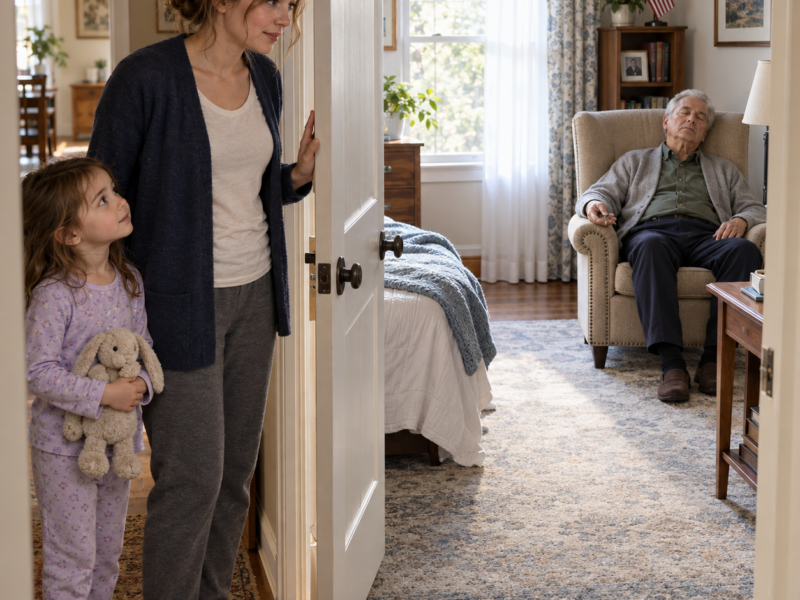
For weeks, my five-year-old daughter screamed every time the lights went out. Then she spent one night beside her grandfather and, for the first time, slept straight through until morning. At seven, she woke me holding her stuffed rabbit and whispered, “Mommy, Grandpa’s still sleeping.” I went downstairs, gently pushed open the guest-room door, and said, “Walter, we’re awake.” He never answered. Hours later, after the paramedics had gone, I remembered the little brass key I had found in his hand. It opened a metal file case beneath his bed. Inside was an envelope addressed to my husband and me with five words written underneath: PLEASE LISTEN BEFORE YOU ASK HER ANYTHING.
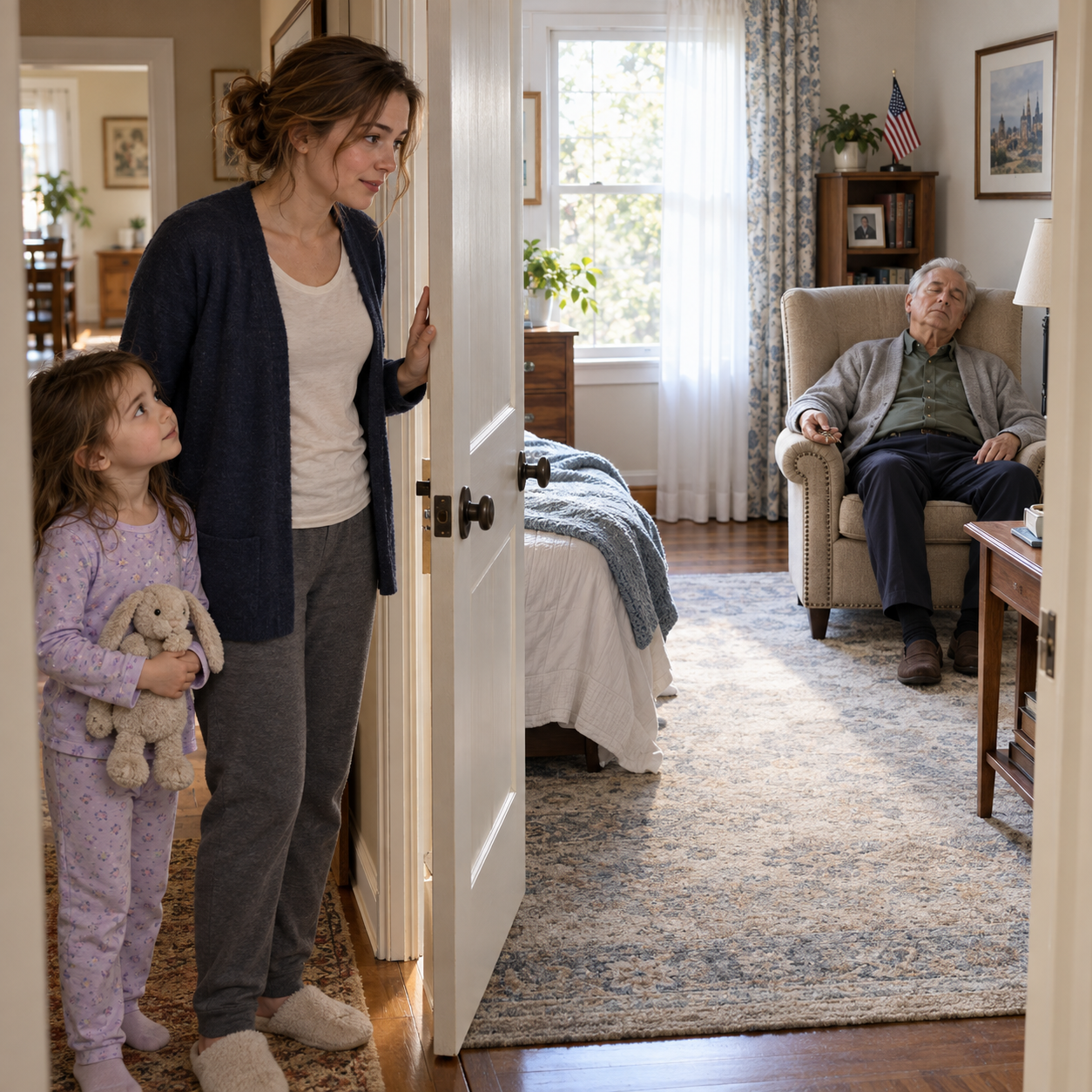
“If your daughter wakes up the whole house again tonight, you and she can both get out, Madison.”
My mother-in-law said it across the dinner table while my five-year-old daughter stood pressed against my side with swollen eyes.
Natasha had cried so hard the night before that one eyelid was still slightly puffy.
She was wearing the purple sweatshirt she loved, the one with a silver star on the front, and clutching my shirt near my waist as though I might disappear if she loosened her fingers.
Shelby did not lower her voice for the child.
She did not wait until Natasha left the room.
She simply cut another piece of chicken, placed it in her mouth, and chewed.
We lived in a three-story house in the Maplewood neighborhood of Columbus, Ohio.
Technically, the house belonged to my in-laws, Walter and Shelby Carter.
They occupied most of the first floor.
My husband, Chandler, Natasha, and I lived upstairs on the second.
The third floor had two rooms but was so crowded with old furniture, Christmas decorations, suitcases, framed photographs, boxes of dishes, and furniture Walter kept promising he would repair that nobody could reasonably live there.
The arrangement was supposed to be temporary.
Almost every bad family housing arrangement begins with that word.
Temporary.
When Chandler’s engineering firm transferred him from Cincinnati to Columbus, the plan was for us to stay six months while we sold our condo and found something nearby.
Then interest rates rose.
The condo buyer walked away.
My freelance bookkeeping work became irregular.
Natasha started kindergarten close to Shelby and Walter’s neighborhood, and somehow six months turned into eighteen.
Then two years.
By the night Shelby threatened to throw us out, we had been there nearly three.
We were not living free.
Chandler gave his parents $1,400 a month.
We paid most of the groceries.
I handled the internet, household streaming services, and a portion of the utilities.
Chandler had replaced the upstairs water heater himself after Walter refused to call a plumber.
We contributed.
Still, Shelby always called the house hers whenever she was angry.
“My roof.”
“My kitchen.”
“My electric bill.”
“My rules.”
The possessive words came out strongest when she wanted us to feel temporary again.
Natasha seemed to understand that before I did.
During the day, my daughter was exactly the child strangers described as delightful.
Talkative.
Curious.
Polite.
The kind of kindergarten student who came home with stories not only about what the teacher said but what every child at her table thought about it.
She asked why squirrels never seemed cold.
Why old people’s hands had spots.
Why stop signs were red instead of purple.
Why Grandpa Walter knew how to fix everything but could never find his glasses.
She sang while brushing her teeth.
Named the neighborhood rabbits.
Insisted every grocery cart had a personality.
But once the lights went out, Natasha became somebody else.
Her entire body tightened.
She did not simply resist bedtime.
She panicked.
The first time it happened, I assumed she had a nightmare.
She woke just after midnight screaming my name.
I ran to her room.
Her body was rigid beneath the blanket.
“What happened?”
“I don’t know.”
“Bad dream?”
She shook her head.
“What did you dream?”
“I don’t know.”
I lay beside her.
Eventually she slept.
The next night, same thing.
Then again.
Within two weeks, bedtime itself became the trigger.
“Leave the hall light on.”
“I will.”
“All night.”
“Yes.”
“Don’t go downstairs.”
“I’m only going to get water.”
“No.”
Her breathing sped up.
“Please.”
I began reading parenting articles at two in the morning.
Childhood sleep anxiety.
Night terrors.
Separation anxiety.
Sleep associations.
Most of the advice sounded reasonable when read in daylight.
Predictable routine.
Comfort without reinforcing fear.
Gradually help the child tolerate separation.
Teach confidence.
So I tried.
Bath.
Pajamas.
Book.
Night-light.
Kiss.
Door cracked.
“I’m right nearby.”
Then leave.
Natasha would last three minutes.
Sometimes ten.
Then the crying began.
Chandler had less patience at first.
Not because he was unkind.
Because he was exhausted.
He worked as a mechanical systems engineer for an industrial equipment company outside Dublin and often left before seven.
After three weeks of broken sleep, he began sleeping through alarms.
One night, around one-thirty, Natasha appeared in our doorway.
“Daddy.”
Chandler sat up.
“No, pumpkin.”
She cried.
“You have to sleep in your own bed.”
“No.”
“Yes.”
“No!”
Shelby shouted from downstairs.
“Some of us are trying to sleep!”
Natasha flinched.
Chandler closed his eyes.
Then picked her up.
He carried her through the upstairs hallway for twenty minutes.
She had her face buried against his shoulder.
He sat down in the hallway chair.
The next thing I knew, it was four-thirty.
They were both asleep.
Chandler upright.
Natasha curled across his chest.
I covered them with a blanket.
Then stood there crying quietly because we were all failing and nobody knew why.
Morning brought apologies.
Bedtime brought another fight.
I started dreading sunset.
The only person in the house who never complained about Natasha was Walter.
My father-in-law was sixty-nine.
Tall once, though age and a bad lower back had begun folding him forward.
White hair.
Rough hands.
Hands that belonged to a man who spent forty years repairing industrial equipment and then somehow found retirement unsatisfying unless at least one household object was partly disassembled on his workbench.
He fixed lamps.
Toasters.
Toys.
Cabinet hinges.
One of Natasha’s dolls lost an arm, and Walter spent two hours engineering a tiny replacement pin when any reasonable person would have bought a new doll.
Natasha adored him.
He picked her up from kindergarten on an electric bicycle when weather allowed, with her bright helmet visible behind him.
They stopped at the little neighborhood market sometimes.
Shelby pretended to disapprove of the cookies he bought.
Then ate one.
Walter had a patient way of answering questions.
“Grandpa, why do leaves fall?”
“Even trees need to rest.”
“Why does your hand shake?”
“It has too many stories in it.”
“Why is Grandma mad?”
That one he usually redirected.
“Ask me another.”
Shelby loved Natasha too.
I need that said.
She was not a woman who woke up every morning planning cruelty.
She was contradictory.
She scolded Natasha for crumbs, then hid a cinnamon pastry for her after school.
She complained her knees hurt too badly to chase a child, yet every school morning Natasha’s uniform was ironed before I came downstairs.
She insisted she did not spoil grandchildren, then bought them absurd amounts of socks because “children never have enough socks.”
Love existed.
So did harm.
Those facts are not mutually exclusive.
The problem was that Shelby’s love had conditions attached to order.
Quiet.
Cleanliness.
Respect.
Adults controlling the room.
A child who cried at midnight threatened the structure.
Walter noticed something else.
Every time adults argued, Natasha grabbed somebody.
A wrist.
Sleeve.
Forearm.
Sometimes mine.
Sometimes Chandler’s.
Once Walter’s.
Her knuckles would turn white.
“Little bird.”
He said one evening.
“You’re going to squeeze my hand flat.”
Natasha released him immediately.
“Sorry.”
“I didn’t say stop.”
Walter smiled.
“You can hold. Just don’t steal all my fingers.”
She laughed.
That became their joke.
I saw the grip.
I did not understand it.
Then Chandler’s younger brother moved in.
Kenneth arrived with his wife Naomi and their seven-year-old daughter Paisley after their small electronics repair business failed.
The business had been on the east side.
Phones.
Tablets.
Small computers.
Screen replacements.
For a while, it did well.
Then a large chain opened nearby.
Two commercial accounts disappeared.
They borrowed to stay open.
Borrowed more.
Eventually they closed.
Sold their condo to clear as much debt as possible.
Kenneth called Chandler.
“We need three months.”
Chandler looked at me.
I laughed without humor.
“Of course.”
Because what else could we say?
It was not our house.
Shelby agreed.
Three months.
They arrived with enough property to colonize a small nation.
Mattresses.
Boxes.
Folding shelves.
Their washing machine.
A second refrigerator.
Paisley’s bicycle.
A microwave.
Three plastic bins labeled CABLES.
Shelby stood in the driveway.
“I thought you said temporary.”
Kenneth looked at the moving truck.
“This is temporary.”
Walter whispered to me:
“They brought a washing machine.”
I bit my lip.
Within days, household tension doubled.
Shelby counted lights.
“Who left this on?”
She checked the thermostat.
“Seventy-one? Are we heating Franklin County?”
Milk disappeared too quickly.
Toilet paper became an economic indicator.
Naomi began leaving grocery money in an envelope near the coffee maker.
Shelby still complained.
“You used the dryer twice yesterday.”
“We have a child.”
“So do they.”
She pointed upstairs toward us.
“And Madison hangs half the clothes.”
It was perhaps the nicest thing she had said about me all week.
The strangest part was how differently she treated her own daughter.
Stephanie lived about thirty minutes away with her husband, Brandon.
She was forty.
Two years older than Chandler.
Shelby called her “my girl” even though Stephanie had been married nearly fifteen years.
Stephanie did not ask for favors in front of people.
She arrived crying.
That was more effective.
One Saturday afternoon, while Shelby was lecturing Naomi about using too many paper towels, Stephanie walked in.
Face pale.
Eyes wet.
Mom.
One word.
Shelby’s entire body changed.
“What happened?”
“Brandon has a contract problem.”
Brandon followed ten minutes later.
Construction project.
Supplier.
Deposit.
Customer withholding payment.
The details shifted depending on who told them.
What mattered was money.
Shelby went to her bedroom.
Opened a drawer.
Returned with an envelope.
She counted bills.
Naomi watched from the stove.
“You’re giving her cash?”
Shelby’s head snapped up.
“Excuse me?”
Naomi turned down the burner.
“I’m asking.”
“She’s my daughter.”
Kenneth immediately said:
“Naomi.”
“No.”
Naomi had lived with us six weeks by then.
Her patience was gone.
“You count every glass of milk Paisley drinks.”
“This has nothing to do with you.”
“It has everything to do with the rule.”
“What rule?”
“Everyone contributes.”
Shelby’s face hardened.
“That is different.”
“How?”
Stephanie said:
“Naomi, please.”
Naomi laughed.
“Of course.”
Then Shelby slammed her palm against the dining table.
“Blood is blood.”
The room went quiet.
“A daughter will always be a daughter.”
Her eyes moved toward Naomi.
Then me.
“Daughters-in-law, no matter how good they seem, are outsiders.”
My face burned.
Chandler stared down.
That hurt more than Shelby.
Not because I expected him to fight every battle.
Because I needed him to say one sentence.
He did not.
Kenneth stepped beside Naomi.
“Mom.”
“I said what I said.”
Brandon, standing near the counter, spoke softly.
“Money can always be divided.”
Everyone looked at him.
“But dignity can’t.”
For several seconds, I almost respected him.
Later, that memory would become ugly.
At the time, I thought he was the only person besides Walter who understood.
Naomi left the table.
Kenneth followed.
Chandler stayed seated.
I went upstairs.
That night, we fought.
“You sat there.”
“I know.”
“She called me an outsider.”
“I know.”
“And Naomi.”
“I know.”
“You said nothing.”
“What was I supposed to do?”
“Something.”
He rubbed his face.
“Madison, every fight in this house becomes a week.”
“Then maybe stop living like avoiding a week of discomfort is more important than your wife.”
He looked hurt.
I meant it.
We slept badly.
Natasha woke at one.
Again at three.
Shelby banged something downstairs the second time.
The house felt like a machine with too many loose parts.
Then Thursday morning came.
The scream began downstairs.
Not Natasha.
Shelby.
Every adult ran.
I reached her bedroom behind Chandler.
The closet doors were open.
Clothes on floor.
Drawers pulled out.
Shelby stood beside the dresser holding a large cream-colored envelope.
Empty.
Walter entered slowly behind us.
“What happened?”
Shelby looked at him.
“Gone.”
“What?”
“The money.”
Her voice rose.
“One hundred eighty thousand dollars.”
I thought I misunderstood.
“One hundred eighty thousand?”
“Yes.”
Kenneth came through the door.
Naomi behind him.
Shelby saw her.
The change happened instantly.
“You.”
Naomi froze.
“What?”
“You were in here yesterday.”
Paisley had developed a fever the afternoon before.
Shelby kept children’s acetaminophen in a cabinet attached to her bathroom because she distrusted medicine stored in kitchens.
She had told Naomi where to find it.
Now that detail disappeared.
“You came into my room.”
“For Paisley’s medicine.”
Shelby pointed.
“Open your bags.”
Naomi’s face emptied.
“What?”
“You heard me.”
“Mom.”
Kenneth stepped forward.
“Stop.”
Shelby grabbed one of Naomi’s sweaters from a laundry basket near the wall and threw it onto the bed.
“Open everything.”
Naomi became pale.
“You think I stole from you?”
“You need money.”
There it was.
The entire accusation.
Need equals guilt.
Kenneth moved between them.
“Do not touch her things.”
Shelby shouted:
“One hundred eighty thousand dollars is gone.”
Walter said:
“Shelby.”
“No.”
“I trusted people in my own house.”
She stared at Naomi.
“And look what happens.”
Naomi started crying.
Not loudly.
She wiped her face.
Then said:
“Call the police.”
Shelby stopped.
“Then call them.”
Naomi’s voice became steadier.
“If you think I stole from you, call them.”
“Naomi.”
Kenneth turned.
“No.”
She looked at him.
“Let her.”
Then Shelby.
“I want someone to ask questions before deciding I’m guilty.”
Shelby laughed sharply.
“You think boldness proves innocence?”
“No.”
Naomi wiped her face.
“But being poor doesn’t make me a thief.”
From the staircase, there was a small sound.
Natasha.
I had forgotten she was there.
She stood halfway down.
Hands pressed over her ears.
Eyes fixed on the empty envelope.
“Baby.”
I started toward her.
Walter reached her first.
He lowered himself onto the step below her.
Did not touch her.
“Little bird.”
Natasha looked at him.
“Come help me water the plants.”
She shook her head.
Walter followed her eyes toward Shelby.
Then the envelope.
He did not ask a question.
He simply held out his hand.
After several seconds, Natasha took it.
They went toward the porch.
I watched.
Something about Walter’s face bothered me.
Not suspicion exactly.
Recognition.
The police arrived forty minutes later.
Two officers.
One older.
One younger.
Shelby met them at the door and began before names.
“The money was here.”
“She was in my bedroom.”
“They lost their business.”
“She has debt.”
Naomi sat beside Kenneth at the dining table.
Her face was white.
Paisley was upstairs.
Chandler had taken Natasha into the second-floor play area.
Walter stood near the porch door.
The older officer asked:
“When did you last see the money?”
“Sunday.”
“What day is today?”
“Thursday.”
“Did you count it Sunday?”
“Yes.”
“Who knew it was there?”
Shelby hesitated.
“My husband.”
“Anyone else?”
“My children.”
“All?”
“Yes.”
“Spouses?”
“I don’t know what they tell each other.”
The officer wrote.
“Why keep that amount in cash?”
Shelby stiffened.
The explanation was complicated.
Walter had sold a small parcel of inherited farmland outside Newark the previous year.
Part of the proceeds had been earmarked for a distressed-property auction he wanted to attend with an old friend.
The purchase fell through.
Walter, who had grown distrustful of bank transfer delays after a previous closing problem, had withdrawn far more cash than anyone sensible would keep at home.
Shelby had insisted they would redeposit it.
They did not.
Walter hated being told what to do.
Shelby hated admitting she had lost an argument.
So the money stayed.
Bad decision.
Very bad.
The officer asked everyone who had entered the bedroom.
Shelby.
Walter.
Chandler once to fix a window.
Stephanie.
Brandon occasionally.
Kenneth.
Naomi yesterday.
Me, maybe months earlier.
The list became longer than Shelby’s accusation.
Then Stephanie and Brandon arrived.
Shelby had called them.
Stephanie came in crying.
“Mom.”
Brandon touched her shoulder.
“Let’s not make this worse by accusing everybody.”
The officer looked at him.
“We’re going to ask everyone the same questions.”
For the first time, Brandon’s calm shifted.
Very small.
I noticed only because I later replayed the morning so many times.
No money was found in Naomi’s belongings.
No arrest.
Officers photographed.
Statements.
Asked Shelby not to disturb the room further.
She looked offended that a police call had not produced a thief.
After they left, Shelby turned on Naomi.
“You humiliated this family.”
Kenneth stood.
“You were throwing her clothes across a room.”
“If she hadn’t gone in there—”
Walter spoke.
“You told her to.”
Everyone looked.
“Paisley had a fever.”
Walter’s voice was calm.
“You told Naomi where the medicine was.”
Shelby stared.
“That doesn’t mean she didn’t—”
“It means you left that out.”
His voice never rose.
Walter’s calm was not like mine.
Mine often hid avoidance.
His calm made people account for themselves.
Naomi bent and gathered clothing.
Kenneth helped.
Nobody else moved.
That image stayed with me too.
Adults watching a woman put her dignity back into a suitcase after being falsely accused.
Silence pretending to be neutrality.
That night, Natasha cried before the bedroom light was even off.
“Leave it open.”
“I will.”
“All the way.”
“Yes.”
“And don’t go downstairs.”
“I need to get tea.”
“No!”
Her breathing changed.
“Sweetheart.”
“No, Mommy.”
Chandler stood in doorway.
“We’ve been through this.”
“Don’t.”
“Natasha.”
From downstairs:
“Not again!”
Shelby.
Natasha flinched as though somebody had slapped the air beside her.
Walter appeared behind Chandler.
“Let her sleep with me.”
We looked.
“Dad.”
Chandler sighed.
“You need sleep.”
“So does she.”
Walter had been using the small first-floor guest room for months because Shelby claimed his snoring rattled the windows.
There was a twin bed.
Old armchair.
Reading lamp.
Natasha loved that lamp.
Walter crouched.
“What do you think, little bird?”
She looked at me.
“You take the bed.”
He continued.
“I’ll sit in the chair.”
“Mommy won’t leave?”
“I’ll be upstairs.”
Walter waited.
Finally, she nodded.
I carried her blanket and stuffed rabbit down.
Walter began telling her why the moon sometimes appeared during daytime.
When I left, Natasha did not call after me.
At ten-thirty, I walked past the guest room.
Door open.
Natasha asleep.
Really asleep.
Hands loose.
Forehead smooth.
Rabbit resting beneath one arm instead of crushed against her chest.
Walter sat in the armchair.
He lifted a finger.
I whispered:
“How?”
He looked at her.
Then at me.
“Tomorrow.”
“What?”
“We need to talk.”
My stomach tightened.
“About what?”
“What she’s afraid of.”
I stepped closer.
“Did she tell you?”
“A little.”
“What?”
Walter shook his head.
“She needs sleep.”
“Walter.”
“And when we talk to her, we listen.”
His eyes held mine.
“We don’t put words in her mouth.”
I nodded slowly.
“Okay.”
He looked tired.
Very.
“Are you all right?”
“Just worn out.”
Beside him, on the small table:
Glasses.
Water.
Brass key.
Nothing unusual.
I wish I could tell you I knew that night mattered.
I did not.
I went upstairs believing tomorrow was guaranteed because almost every ordinary night teaches us that lie.
Natasha woke me just after seven.
She stood beside the bed.
Rabbit under one arm.
“Grandpa’s still sleeping.”
I smiled.
“Did you sleep all night?”
She nodded.
“Really?”
“Yes.”
Relief washed through me.
We walked downstairs.
I pushed guest-room door.
“Dad?”
No answer.
Walter sat with his head resting against the chair.
Glasses folded on his lap.
Peaceful.
Too peaceful.
“Walter?”
I touched his shoulder.
Nothing.
My body knew before mind.
“Natasha.”
My voice changed.
“Go get Daddy.”
She obeyed.
I called 911.
Dispatcher guided me.
The rest happened with the unreal efficiency of emergencies.
Chandler.
Shelby.
Kenneth.
Paramedics.
Equipment.
Questions.
Someone took Natasha upstairs.
At some point, I noticed Walter’s hand.
Closed loosely.
Something inside.
The brass key.
I removed it so it would not fall.
Set it on the table.
The paramedics could not bring Walter back.
A sudden cardiac event, we learned later.
Probably while sleeping.
No long suffering.
People call that a blessing.
Maybe.
Blessings can still destroy a morning.
Shelby stood in hallway wearing her robe.
“No.”
Nobody answered.
“He was talking yesterday.”
As if death had violated scheduling.
When they moved Walter, Shelby reached for his sleeve.
Not hand.
Sweater sleeve.
“You’ll be cold.”
Chandler broke.
He folded against the wall.
Covered his face.
Natasha asked me:
“Why did Grandpa leave without shoes?”
There is no parenting book for that sentence.
I held her.
“Because he didn’t need them where he was going.”
I do not know if I believed that.
She needed something.
Almost noon, I remembered the key.
Guest room had one locked object.
Walter’s old metal filing case beneath bed table.
Appliance warranties.
Receipts.
Retirement papers.
Old letters.
Chandler came.
I showed him.
“He said Natasha told him something.”
Chandler looked hollow.
“What?”
“Last night.”
We knelt.
Key turned.
On top was a large envelope.
Walter’s handwriting:
Madison and Chandler.
Underneath:
Please listen before you ask her anything.
My hands shook.
Inside:
Note.
Small digital recorder.
Chandler stared.
I unfolded the note.
Natasha told me something this afternoon while we watered the plants. I asked if she wanted help telling her parents. She said yes but was afraid she would forget the words.
I recorded what she wanted you to hear.
Do not question her over and over. Listen first.
There are papers underneath. I should have spoken sooner about those.
Walter.
I sat on the floor.
Chandler pressed play.
Walter’s voice filled the room.
Soft.
“Whenever you’re ready, little bird.”
Pause.
Then Natasha.
“If I tell Mommy, does she have to go away?”
I stopped breathing.
Walter:
“You haven’t done anything wrong.”
“Aunt Stephanie said she would.”
Chandler looked at me.
The recording continued.
Pieces.
Five-year-old chronology.
Hallway.
Night.
Bathroom.
Light beneath Shelby’s door.
Natasha had left her bed because she needed to use bathroom.
She saw Stephanie.
“Aunt Stephanie had Grandma’s big envelope.”
Walter asked:
“When?”
“Before Paisley’s medicine day.”
“How long before?”
“I don’t know.”
Good.
He did not supply.
Then:
“She saw me.”
“What happened?”
“She said Mommy and me would have to leave if I told.”
My hand went to mouth.
“And Daddy?”
“He could stay.”
Chandler made a sound.
Then Natasha:
“Uncle Brandon said Grandma wouldn’t want us here anymore.”
Walter’s breathing on recorder became audible.
“He said I should stay in bed when it’s dark.”
There it was.
Darkness.
The hallway.
The panic every time I left.
We had spent weeks teaching our child there was nothing to fear while she was protecting a secret built around losing her mother.
Walter:
“Did anyone hurt you?”
“No.”
“Did anyone touch you?”
“No.”
Important.
“Did they tell you anything else?”
“No.”
Then Natasha’s little voice:
“Will Mommy stay?”
“I’m going to help you tell Mommy and Daddy tomorrow.”
“Promise?”
“I promise.”
The recording ended not long afterward.
No dramatic confession.
No perfect certainty.
A child telling what she remembered.
Chandler put the recorder down.
“I told her there was nothing to be afraid of.”
His forehead touched his knees.
“Every night.”
“So did I.”
I whispered.
We sat on the floor beside the bed of a dead man who had listened better than either parent had.
The guilt was unbearable.
Then I remembered his note.
Listen before you ask.
That was his final instruction to us.
We followed it.
We did not run upstairs.
Did not drag Stephanie into house.
Did not make Natasha repeat.
We called the detective.
She told us to preserve recording.
Do not edit.
Do not copy unnecessarily.
A trained child interviewer would speak with Natasha.
Then we looked at rest of Walter’s file.
That changed everything again.
For eighteen months, he had been tracking money Shelby gave Stephanie and Brandon.
Not because he hated his daughter.
Because amounts stopped making sense.
$8,000.
$14,000.
$6,500.
$22,000.
Each tied to some business emergency.
Supplier deposit.
Equipment purchase.
Payroll gap.
Permit.
Contract performance bond.
Client delay.
Walter asked for invoices.
None.
He wrote notes.
Brandon says paperwork at office.
Stephanie says trust her.
Shelby says daughters don’t lie to mothers about money.
Then:
Asked again.
No records.
Another page.
Shelby gave $15,000 without telling me.
Argument.
She says I’m humiliating Stephanie.
Then message printouts.
Stephanie to Walter:
Please don’t tell Mom about the other money. She’ll never forgive me.
Walter:
Bring statements tomorrow morning. We are done doing this without records.
Tomorrow.
He died before it came.
My hands went cold.
The detective arrived that afternoon.
We gave her original recorder and files.
Chain of custody.
Evidence.
Words I hated in family context.
Then told Shelby.
At first:
“No.”
She stared.
“Natasha misunderstood.”
Chandler’s head lifted.
“She described Stephanie with the envelope.”
“She is five.”
“Yes.”
He stood.
“She’s five.”
His voice broke.
“And somebody told her she would lose her mother.”
Shelby looked away.
“I can’t.”
I put Walter’s note before her.
She recognized writing.
Her finger traced his W.
Then stopped.
Stephanie was interviewed.
Brandon too.
The case did not rest on Natasha.
That mattered.
Her statement directed investigation.
Adults’ records built proof.
Bank deposits appeared after missing cash.
Payments.
Debts.
Messages.
Phone records.
One message:
She was in hall.
Answer:
Make sure she keeps quiet.
Another:
Mom thinks Naomi took it.
Reply:
Don’t say anything. Let it settle.
That one nearly destroyed Shelby.
The people who had stolen from her had not merely stayed silent while Naomi was accused.
They had used the accusation as cover.
Stephanie came to the house once before charges were filed.
Chandler met her on porch.
I stood behind.
She looked smaller.
“Where’s Mom?”
“What do you want?”
“To explain.”
“Explain why my daughter couldn’t sleep.”
Stephanie cried.
“I never thought she’d take it that seriously.”
I stepped forward.
“She was five.”
“I panicked.”
“You told a five-year-old her mother would be thrown out.”
“I wasn’t thinking.”
“No.”
I said.
“You were thinking about yourself.”
She wiped tears.
“I was going to put it back.”
Every thief’s favorite future tense.
Chandler gripped railing.
“And Naomi?”
Stephanie looked down.
“You watched Mom throw her clothes.”
“I didn’t know what to do.”
“You tell truth.”
He spoke quietly.
“That is what you do.”
No shouting.
No reconciliation.
She left.
The funeral came before case resolution.
Walter’s electric bicycle stayed in garage.
Helmet on hook.
Tools.
A broken music box belonging to Natasha sat on his bench.
Tiny screws in a saucer.
Replacement part packet unopened.
He had planned to fix it Saturday.
Grief is most brutal around unfinished errands.
At funeral, Natasha held an oak leaf.
“Can I give this to Grandpa?”
“Yes.”
“Trees need rest.”
Walter’s line.
“Yes.”
She looked at me.
“Did he die because I told?”
My whole body went cold.
“No.”
I knelt.
“Nothing you said made Grandpa die.”
She watched.
“His heart stopped working.”
“Because he was worried?”
“No.”
I held both hands.
“You did not cause Grandpa’s death.”
Again.
“Not even a little.”
She cried.
I held her on chapel floor.
Adults walked around.
I did not care.
Shelby apologized to Naomi after funeral.
Not beautifully.
Truth rarely comes polished first.
Naomi was washing coffee cups in kitchen.
Shelby stood behind.
“Naomi.”
Naomi turned off water.
“I accused you because you were in my room.”
Naomi stared.
Shelby corrected herself.
“No.”
She swallowed.
“I accused you because you needed help.”
Silence.
“I thought that made it possible you’d take from me.”
Naomi looked at her.
“It made me someone who needed somewhere to live.”
“I know.”
“No.”
Naomi dried hands.
“You know now.”
Shelby nodded.
No hug.
Good.
Some apologies need space.
The next morning Shelby began calling relatives.
Every person she had told Naomi stole money.
“I was wrong.”
Not:
There was a misunderstanding.
Not:
Police cleared her.
“I accused Naomi falsely.”
That mattered.
Stephanie and Brandon eventually faced legal consequences.
I will not turn courtroom into entertainment.
There were negotiated outcomes.
Restitution.
Supervision.
Financial counseling.
Other conditions.
Some money recovered.
Not all.
Money spent is easier to order returned than to magically recreate.
Shelby had to live with that.
The $180,000 became numbers on restitution paperwork rather than cash in envelope.
More painful was the betrayal.
Her own daughter had allowed her prejudice against daughters-in-law to become a weapon.
One evening, Shelby sat at table with Walter’s file.
“I gave Stephanie money because she was mine.”
Chandler stood nearby.
“And Madison?”
Shelby looked at me.
“Naomi?”
Silence.
“You made them audition for family every day.”
Shelby closed eyes.
“I know.”
“Dad knew.”
“Yes.”
“He was trying to stop it.”
She touched Walter’s handwriting.
“I know.”
The house changed after Walter’s death.
The loudest person had not been him.
Still, his absence removed the only quiet counterweight to Shelby.
Every small conflict became sharper.
Chandler and I decided to move.
Six weeks after funeral.
Not revenge.
Necessity.
Small rental twenty minutes away.
Two bedrooms plus tiny office.
Kitchen so narrow that opening dishwasher blocked half room.
I loved it.
First night, Natasha asked:
“Grandma can’t make us leave?”
I sat.
“No.”
“This is ours?”
“We rent it.”
She frowned.
“But can Grandma say?”
“No.”
Her shoulders dropped.
Housing security is emotional long before legal.
Chandler packed nights after work.
We argued.
A lot.
He felt guilty leaving Shelby alone after Walter.
I felt furious that guilt existed after what happened.
“You can visit.”
“She lost Dad.”
“I know.”
“She lost Stephanie too.”
“I know.”
“She’s alone.”
“She threatened our child with homelessness.”
“Not directly.”
That sentence stopped room.
“What?”
Chandler closed eyes.
“I didn’t mean—”
“Yes, you did.”
“She said it to you.”
“In front of Natasha.”
He sat.
“I’m doing it again.”
“What?”
“Making it smaller because it’s Mom.”
There.
We went to couples counseling.
No divorce threat.
But because love does not automatically correct family conditioning.
Chandler learned how often he had translated Shelby.
She’s stressed.
She didn’t mean it.
That’s just how she talks.
Mom’s generation.
Dad handles her.
Each translation moved cost to me.
To Natasha.
He apologized.
Specific.
“I’m sorry I let you become the person who always had to react.”
“Yes.”
“I’m sorry I acted like being neutral between you and Mom was possible.”
“Yes.”
“I’m sorry Natasha learned I might not stop Grandma.”
That one broke him.
We rebuilt.
Slow.
Our marriage got better after leaving the house because every disagreement no longer had audience downstairs.
Natasha began child therapy.
Bedtime changed.
Predictable routine.
No “be brave.”
No “big girls sleep alone.”
No forced door closing.
We let lamp stay.
We told her where we would be.
If she came to our room, no shame.
Therapist explained fear needs safety before independence.
Obvious once said.
Hard to practice at three in morning.
Week one:
Still wakeups.
Week three:
Four nights through.
Then setback after police follow-up.
Then better.
Recovery refuses straight lines.
One evening, she asked:
“Mommy?”
“Yes?”
“Can door be halfway?”
“Yes.”
Not all way.
Half.
Progress.
A month later:
“You can close it after I sleep.”
Then:
“Leave it cracked.”
Then, one night, she closed it herself.
I cried in hallway.
Quietly.
Kenneth and Naomi found apartment.
Paisley visited Sundays.
Naomi did not forgive Shelby quickly.
Good.
Kenneth pressured once.
“Mom is trying.”
Naomi answered:
“So am I.”
“What does that mean?”
“I’m trying not to hate her.”
Enough.
Shelby asked to see Natasha.
We said no initially.
She mailed cards.
No guilt language.
Then requested therapist-guided visit.
We considered.
Natasha decided.
Neutral park.
Thirty minutes.
Shelby arrived with no gifts.
Good.
She knelt awkwardly.
“I said something wrong.”
Natasha watched.
“I said you and your mom might have to leave.”
My stomach tightened.
Shelby continued.
“I should never have said that.”
“You scared me.”
“I know.”
“You yelled at night.”
“Yes.”
“I’m sorry.”
Natasha looked toward me.
Then:
“Grandpa didn’t yell.”
Shelby’s face collapsed.
“No.”
She whispered.
“He didn’t.”
No competition.
Truth.
Visit ended.
Months later another.
Shelby had to earn ordinary.
She learned to ask before touching Natasha’s things.
No surprise comments about sleep.
No “big girl.”
Once Natasha spilled juice.
Shelby inhaled.
I saw old reflex.
Then she reached for towel.
“Accidents happen.”
That small sentence felt monumental.
Walter’s music box became center of one evening.
Chandler repaired from notes.
He had inherited father’s workbench tools.
The repair required tiny spring.
When wound, tune filled kitchen.
Natasha stared.
“Grandpa fixed it?”
“Grandpa started.”
Chandler swallowed.
“I finished.”
She carried music box to bedroom.
Placed beside lamp.
At bedtime:
“Grandpa believed me.”
“Yes.”
“He didn’t say I was difficult.”
“No.”
Then:
“Do you believe me now?”
Nothing in parenting prepares you for your child asking whether you believe her after evidence proves you did not understand soon enough.
I held her hand.
“Yes.”
Then:
“And I’m sorry I didn’t understand earlier.”
She nodded.
No forgiveness ceremony.
Children often accept repair more directly than adults.
Just before sleep:
“You can go make tea.”
I sat there crying.
Then left door open and boiled water.
A year passed.
Stephanie and Brandon’s legal case resolved.
Their marriage nearly collapsed.
Not my story to control.
Stephanie wrote Shelby from treatment and financial counseling.
Shelby read.
Sometimes answered.
Sometimes not.
Mother love did not disappear.
Trust did.
Important.
Shelby once told Chandler:
“I still want to fix her.”
He answered:
“That’s part of problem.”
She became quiet.
“Yes.”
Good.
Walter’s financial file revealed another story.
He had not been passive only.
He had been planning.
Attorney appointment calendar.
Notes.
Draft plan to separate his share of certain savings.
Not to punish Shelby.
To protect retirement from repeated emergency transfers.
He never finished.
Death interrupted.
That hurt Shelby.
“He didn’t trust me.”
Chandler said:
“He didn’t trust the pattern.”
She cried.
There is difference.
Over time, Shelby changed how she handled money.
No secret envelopes.
No cash rescues.
If adult child asked:
“What for?”
“Show document.”
Stephanie hated initially.
Then understood.
Naomi noticed.
At Thanksgiving two years later, Shelby hosted in smaller apartment after eventually selling Maplewood house.
Yes.
She sold.
Walter’s death made three-story place unbearable.
Too much maintenance.
Too many empty rooms.
Kenneth and Naomi had moved.
We had moved.
Stephanie gone.
Shelby said:
“The house sounds like every argument we ever had.”
She listed with realtor.
No family fight.
Proceeds became retirement account under professional management.
Good.
At Thanksgiving, everyone paid attention to something different.
Who cleared dishes.
Shelby started.
Naomi joined.
I did too.
Natasha stood.
Shelby immediately said:
“No.”
Everyone froze.
Then Shelby smiled.
“You’re a guest.”
Natasha looked suspicious.
“I can help.”
“If you want.”
That phrase.
If you want.
Natasha picked up two cups.
Choice turned service back into kindness.
Walter’s absence never stopped being present.
We created annual tradition.
Leaves.
Every fall, Natasha collected one leaf.
Placed near his photograph for week.
Not mystical.
Memory.
At ten, she still remembered his tree line.
“Trees need rest.”
She also remembered night.
Less sharply.
Therapy worked.
Time.
Safety.
No one told her forget.
Samuel? Wait, wrong story—no. In this story, only Natasha and Paisley. I nearly wrote another family into mine because large households blur after years. What mattered was that Natasha grew.
At eight, she asked why Aunt Stephanie stole.
I said:
“She made choices because she was scared of money problems.”
“Was she bad?”
“She did something bad.”
“Same?”
“No.”
That distinction mattered.
We did not make Stephanie monster.
Nor did we excuse.
At nine, Natasha asked:
“Did Grandma really think Aunt Naomi stole because she was poor?”
“Yes.”
“That’s mean.”
“Yes.”
“Does Grandma know?”
“Yes.”
People deserve age-appropriate truth.
Family secrets had already hurt her enough.
Chandler and I stopped using “protect children” as excuse for false stories.
We simplified.
Not lied.
Naomi and I became closer after moving out.
Shared experience.
Daughters-in-law.
Outsiders.
One coffee, she said:
“I hated you at first.”
I laughed.
“What?”
“You seemed comfortable here.”
“In Shelby’s house?”
“Yes.”
“You knew rules.”
I stared.
“I was surviving longer.”
She smiled.
“Exactly.”
We compared notes.
Shelby had told Naomi I was better with money.
Told me Naomi was careless.
Told Naomi I was more respectful.
Told me Naomi had no manners.
Triangulation.
Not always malicious.
A method for maintaining control.
Separate people, compare them, stay center.
Once we talked directly, system weakened.
Chandler and Kenneth learned same.
Brothers had been competing for mother’s approval.
Kenneth thought Chandler got more help.
Chandler thought Kenneth was favorite because Shelby rescued him after business failure.
Reality:
Both were being managed through guilt differently.
Walter had seen.
Maybe not all.
Enough.
His file contained one note:
My sons think they are fighting each other. Mostly they are fighting for Shelby to say they are good sons.
That note made them both quiet.
Kenneth kept a copy.
Years later, he said:
“Dad’s still annoying.”
Chandler laughed.
Dead people get final word unfairly.
Shelby began therapy herself after selling house.
At seventy-two.
People love saying older generations don’t do therapy.
Some do when consequences become louder than pride.
Her therapist apparently made her write a family map.
She hated it.
Then brought one insight to me.
“I treated biological connection like moral rank.”
I stared.
“Therapist language?”
“Yes.”
“Keep going.”
She smiled weakly.
“I thought daughters could fail and remain inside.”
“Daughters-in-law had to prove they belonged.”
“Yes.”
“And granddaughters?”
She looked toward Natasha drawing.
“I didn’t know.”
That answer was honest.
“I think I put her in your category whenever I was angry at you.”
There.
Intergenerational punishment.
“She is not me.”
“I know.”
“Now.”
“Yes.”
We sat.
Shelby said:
“I’m sorry.”
No need specifics this time.
She had opened envelope enough over years.
I accepted.
Not erase.
Accept.
Stephanie returned to family gatherings much later.
Three years.
Legal obligations underway.
Restitution payments consistent.
Therapy.
She apologized to Naomi first.
Not family event.
Coffee.
Naomi told me later.
“What did you say?”
“I told her I don’t know if we can be close.”
“Good.”
“She said she understands.”
“Do you believe her?”
“I believe she said it.”
Fair.
Stephanie’s apology to Natasha came only after therapist agreed.
She wrote.
Not visit.
Dear Natasha,
I scared you because I was afraid of being caught. That was wrong. You did the right thing by telling Grandpa. Adults should never ask children to keep secrets about things that make them afraid.
I am sorry.
No:
Please forgive.
No:
I love you.
No pressure.
Natasha kept letter in drawer.
Never responded.
Her choice.
Brandon remained distant.
He and Stephanie divorced eventually.
Not solely because theft.
Trust gone.
Business problems.
Other issues.
He moved out of state.
I hope he built better.
No need relationship.
Paisley grew up hearing her mother was once accused of stealing.
Naomi worried that bitterness would become inheritance.
So she told Paisley:
“Grandma was wrong.”
“Aunt Stephanie did wrong.”
“Police found truth.”
“No one needs to hate forever.”
That was wise.
Paisley and Natasha stayed close.
Almost sisters.
Shared the kind of childhood secret only family chaos creates.
One summer they built a blanket fort and made a sign:
NO GRANDMAS ALLOWED WITHOUT PERMISSION.
Shelby saw.
Stopped.
Then laughed.
Good.
Some wounds can become jokes only when person responsible can laugh without demanding absolution.
Chandler’s relationship with Shelby changed permanently.
He no longer rushed every time she called.
At first, guilt.
Then balance.
If she needed ride:
“Can you ask Stephanie or Kenneth first? I’m working.”
If true emergency:
He went.
If loneliness disguised as emergency:
He still went sometimes.
Love.
Not automatic.
One evening Shelby called:
“The television won’t work.”
Chandler looked at me.
Old him would drive twenty minutes.
New him:
“Did you check input?”
She had not.
Problem solved.
He grinned after hanging up.
“Dad would be proud.”
“Dad would drive over anyway.”
“True.”
Walter was boundary-aware with money, less with fixing things.
Humans inconsistent.
That makes them real.
I returned to work more steadily.
My bookkeeping clients grew.
I eventually opened small remote accounting practice specializing in small businesses.
Maybe watching Kenneth and Naomi’s business fail taught me how many owners need better cash forecasting.
Maybe family chaos needed useful outlet.
I hired one assistant.
Then another.
Chandler received promotion.
We bought a modest house in Worthington.
Our names.
Mortgage.
No parents.
Closing day, Natasha walked through front door.
“Grandma can’t kick us out?”
My heart broke in an older way.
“No.”
“Bank can.”
Chandler said.
I glared.
He smiled.
“Technically.”
Natasha rolled eyes.
At ten, she understood mortgages.
We laughed.
Then I knelt.
“This is our home.”
She nodded.
That night she slept with door closed.
Not because house magically cured fear.
Because years had.
Safety accumulated.
Walter would have liked the backyard.
We planted maple.
Natasha chose spot.
“Trees need somewhere to rest.”
I let that sentence stay.
Shelby visited new house after asking.
She stood on porch.
“Can I come in?”
Simple.
Maybe unnecessary.
Still.
“Yes.”
She entered.
Did not critique.
That probably required supernatural effort.
At dinner, Natasha spilled water.
Everyone froze from memory for half second.
Then laughed.
Shelby passed towel.
No lecture.
Boring change.
Best kind.
When Natasha was twelve, school assigned essay about person who changed her life.
She wrote about Walter.
Title:
The Grandpa Who Listened.
I could not read without crying.
She described electric bicycle.
Leaves.
Music box.
Then one sentence:
When everyone thought my fear was the problem, Grandpa asked what the fear was trying to say.
I asked:
“Did therapist help?”
“No.”
“Too good for twelve.”
She rolled eyes.
She inherited attitude from me.
Chandler said:
“Dad would frame this.”
“He would laminate.”
We laughed.
She read essay at school.
Shelby attended.
After, she cried in car.
“I wish he had told me.”
“What?”
“What Natasha told him.”
“He planned to.”
“I know.”
Then:
“I wish I had been someone he could tell immediately.”
That was deeper.
Walter had delayed partly because child needed sleep.
Maybe also because family atmosphere made confrontation dangerous.
Shelby understood that.
“I made this house impossible for truth.”
Her old house gone.
Still.
Metaphor.
“Yes.”
I said.
She nodded.
No defense.
The $180,000 never fully returned.
Over years, restitution restored substantial portion.
Some went to Shelby.
Some to Walter’s estate depending legal accounting.
The exact number stopped mattering emotionally.
Shelby used part recovered funds to establish education accounts for grandchildren.
Not apology money.
She asked first.
Naomi said yes for Paisley.
We said yes for Natasha.
Written.
Clear.
No control.
Trust administered independently.
Growth can show up in paperwork.
Walter’s estate itself was uncomplicated.
He left Shelby protected.
Children equal.
No punitive disinheritance.
But his handwritten financial notes became more valuable than money because they exposed patterns everyone denied.
One note for Chandler:
You are not responsible for keeping your mother calm.
One for Kenneth:
Failure of a business is not failure of a man.
One for Stephanie:
If you need help, tell truth before amount.
No note for me individually.
I was hurt at first.
Then found something on back of Natasha’s music-box repair instructions.
Madison is watching everything. Someone should ask how she’s doing.
That became mine.
Walter saw people.
That was his gift.
Not perfect.
He had tolerated Shelby too long too.
I learned later he regretted not correcting “outsider” comment more directly.
He spoke at money accusation.
Not previous dinner.
Even good people delay.
His death turned him into saint for a while.
We eventually allowed him to become human again.
Shelby said once:
“Walter avoided me too.”
“What?”
“He would go to garage.”
I smiled.
“Yes.”
“I thought he was patient.”
“He was.”
“And conflict avoidant.”
“Also.”
She laughed sadly.
“We all ruined each other in very specific ways.”
Not ruin.
Shape.
We shape each other.
Then can reshape.
At sixteen, Natasha began having ordinary teenage conflict.
Curfew.
Phone.
School.
One night she shouted:
“You’re controlling!”
I nearly laughed.
Then remembered every adult who dismissed a child by comparing pain.
I asked:
“What feels controlling?”
She explained.
Some fair.
Some teenage.
We adjusted one rule.
Kept another.
Listening did not mean agreement.
Walter’s lesson evolved.
Listen before deciding.
Not:
Child always right.
That distinction helped.
At seventeen, Natasha wanted to visit Stephanie.
Her choice.
I was uneasy.
Chandler more.
Therapist no longer involved regularly.
We asked:
“Why?”
“I want to hear her.”
That sounded mature.
They met café.
I waited nearby but not table.
After:
“How?”
Natasha shrugged.
“She cried.”
“And?”
“She said sorry.”
“And?”
“I believe she’s sorry.”
“Do you forgive?”
She looked annoyed.
“Why does everyone ask that like it’s a switch?”
Good question.
“I don’t know.”
She said.
“I don’t hate her.”
Enough.
Stephanie never became close aunt.
But no longer shadow villain.
People can move from danger to distance without becoming intimacy.
That is allowed.
Shelby lived to eighty-one.
Her final years included real relationships with Naomi and me.
Not mother-daughter fantasy.
Respect.
She asked.
We answered.
She sometimes slipped.
We corrected.
At Christmas:
“Daughters-in-law always…”
She stopped herself.
Naomi raised eyebrow.
Shelby:
“Adults who married my sons.”
We laughed.
Language matters.
When Shelby’s mobility declined, family discussed care.
Old system threatened to return.
Who handles?
Madison is organized.
Of course.
I stopped.
“No.”
Everyone stared.
“What?”
“We divide.”
Spreadsheet.
Kenneth doctors.
Chandler insurance.
Stephanie groceries.
I managed one financial portal, not all.
Naomi scheduling backup.
Professional home aide paid by Shelby’s funds.
No one person infrastructure.
Shelby watched meeting.
“You learned.”
“Yes.”
“From me?”
“Unfortunately.”
She laughed.
This time family dependency became visible.
Shared.
Named.
No resentment.
Shelby died after pneumonia complications.
Natasha was twenty.
At hospital, Shelby took her hand.
“Little bird.”
Walter’s name.
Natasha smiled.
“He called me that.”
“I know.”
Shelby whispered:
“I’m sorry I made you scared in your own home.”
Natasha cried.
“I know.”
“I loved you.”
“I know.”
No demand for more.
Shelby died next morning.
At funeral, Naomi spoke.
That surprised everyone.
She said:
“Shelby taught me two things. First, that belonging should never have to be auditioned for. Second, that people can learn this late and still make the learning matter.”
That was perfect.
Stephanie cried.
Kenneth.
Chandler.
Me.
Paisley.
Natasha.
Afterward, we gathered.
Not old Maplewood house.
Gone.
At our home.
Food.
Noise.
No hierarchy.
Someone spilled gravy.
Nobody got evicted.
Walter’s recorder still exists.
Locked in my filing cabinet.
I considered destroying it.
Natasha asked me not to.
“Why?”
“Because Grandpa’s voice.”
The recording contains fear.
Also Walter.
We copied one harmless section where he talks to her.
The original remains sealed.
Not replayed.
No reason.
Trauma should not become family entertainment.
The music box sits in Natasha’s college apartment now.
Chandler repaired it twice more.
She says tune is annoying.
Still keeps it.
Walter’s electric bicycle went to Kenneth.
He rides Paisley? Paisley is grown now, but he rides himself and once said battery has grandfather ghost.
No.
Just old wiring.
Walter would agree.
Looking back, the missing money appeared to be center.
It wasn’t.
The money exposed structure.
Shelby’s belief:
Blood daughters inside.
Daughters-in-law outside.
Need equals suspicion for outsiders.
Need equals rescue for blood.
Stephanie understood that structure well enough to hide inside it.
Naomi got accused because she occupied category Shelby already distrusted.
Natasha was silenced because Stephanie knew house insecurity was real language in our family.
Walter noticed because he watched grip.
The actual problem was not a stolen envelope.
It was a household where truth traveled according to rank.
Walter’s last gift disrupted rank.
Listen.
Ask.
Document.
Do not assume.
Those practices changed us.
If I could return to beginning, I would change earlier things.
When Shelby first said:
“My roof.”
I would respond:
“We contribute here. If this arrangement can end at any time, we need written terms.”
When she called Naomi outsider:
“Not acceptable.”
When Natasha developed sudden night fear:
I would ask:
“Did something happen that made nighttime feel unsafe?”
Not assume independence problem.
I would tell Chandler:
“Your silence is a choice.”
Earlier.
I would not let respect for elders become immunity from correction.
I would also be gentler with myself.
Parents miss things.
Not because indifferent.
Because explanations offered by familiar categories feel convincing.
Night terror.
Developmental phase.
House stress.
Too many people.
We saw pieces.
Wrong picture.
Guilt is useful only until it changes behavior.
After that, it becomes self-centered.
Natasha did not need me forever crying about missing signs.
She needed better bedtime.
Therapy.
Safe house.
Truth.
So we did that.
Chandler carried own guilt too.
He said once:
“If Dad hadn’t been there…”
I stopped.
“He was.”
“But what if—”
“He was.”
No imaginary tragedy.
Grief already enough.
Walter was there.
He listened.
Natasha told.
We acted.
Hold reality.
Another lesson:
Do not make the dead responsible for saving everyone forever.
For months, every family argument ended:
“What would Walter say?”
Eventually Naomi snapped:
“He’d tell us to think ourselves.”
She was right.
We stopped using him as invisible judge.
His values remained.
Not voice controlling room.
That is healthier mourning.
Our marriage survived.
More than survived.
It became less triangulated.
No Shelby downstairs.
No Walter mediating.
No family audience.
Just us.
That exposed our own problems.
Chandler overworked.
I micromanaged.
He avoided conflict.
I stored resentment.
We learned.
Not every issue belonged to his mother.
Convenient scapegoats can delay marriage growth too.
We fought about dishes in rental.
Normal.
Money.
Parenting.
Sex.
Exhaustion.
Normal.
Then repaired.
No one threatened house.
That alone felt luxurious.
We eventually bought home with three bedrooms.
One for Natasha.
One office.
One guest.
No third floor filled with old furniture.
Chandler wanted basement workshop.
He got.
I wanted kitchen window.
I got.
Mutual.
When signing mortgage documents, I laughed.
“What?”
He asked.
“Nobody can say their roof.”
He smiled.
“Bank can.”
Same joke years earlier.
Still not funny.
A little.
Financial independence gave emotional safety.
Not because homeownership superior.
Because our particular history.
For another family, secure lease can do same.
The important part:
Predictable right to stay.
Children feel housing uncertainty.
Even when adults pretend conversations are above them.
Shelby’s threat lodged in Natasha because it activated real vulnerability.
We were living at grandparents’ discretion.
Never again without written clarity.
I became evangelical about that.
Kenneth laughed.
“You want family lease for couch?”
“If more than two weeks.”
He rolled eyes.
Then when Paisley moved home after college:
They wrote end date.
He texted me:
Happy?
Very.
Generosity and documentation can coexist.
My older self understands that more.
Warmth with edges.
People behave better when roles are clear.
Not because everyone bad.
Because ambiguity invites fear and projection.
Shelby believed help entitled her to authority.
We believed contribution entitled us to stability.
Neither written.
Conflict.
Kenneth believed three months.
Shelby heard indefinite dependence threatening resources.
No household agreement.
Conflict.
Stephanie knew cash location but no accountability.
Conflict.
Walter used notes because family memory unreliable.
Truth.
Paper sometimes kinder than promises.
At fifty, I found Walter’s old note:
Madison is watching everything. Someone should ask how she’s doing.
I framed it in my office.
Not because flattering.
Reminder.
Ask person carrying logistics.
Ask quiet daughter-in-law.
Ask child gripping sleeve.
Ask husband translating mother.
Ask accused woman gathering clothes.
Where truth sits may not be head of table.
We learned.
Too slowly.
Still.
Natasha is twenty-two now.
Graduate school.
Studying child development.
Of course.
I asked whether our family influenced.
She said:
“Maybe a little.”
Then:
“Don’t make everything about you.”
Healthy.
She sleeps fine.
Mostly.
Stress occasionally brings night anxiety.
She knows tools.
Lamp.
Breathing.
Call someone.
No shame.
She still prefers doors slightly open when sleeping at unfamiliar places.
That is fine.
Independence is not absence of preference.
She has a boyfriend who knows story in broad terms.
First time staying with his family, she texted me:
They have normal doors 😂
I laughed.
Then cried because trauma humor survives.
She visits Shelby’s grave sometimes.
Walter more.
No contradiction.
She loved Grandma after rebuilding.
Not before.
Both.
At Walter’s grave, she leaves leaves.
Of course.
The metal filing case belongs to Chandler.
Inside now:
Important documents.
Not secrets.
We joke that if Chandler starts keeping mysterious envelopes, divorce.
Dark humor.
Earned.
Naomi runs another business now.
Not electronics.
Mobile notary and admin services.
Small.
Stable.
She keeps emergency fund.
She says failure taught more than success.
Kenneth works operations for distributor.
Paisley in college.
Stephanie works regular office job after years rebuilding.
No business.
No borrowing from family.
Relationship with Shelby before death was cautious but present.
Restitution eventually completed.
That day Stephanie called Chandler.
“Done.”
He said:
“Good.”
No celebration.
Debt repaid does not purchase forgiveness.
But completion matters.
Brandon lives elsewhere.
No contact.
Fine.
Chandler became director at engineering firm.
Still carries children through hall emotionally.
Not literally.
When Natasha calls, he answers.
When I worry, he says:
“Listen first.”
Walter’s phrase.
We use.
Sometimes too much.
“Do you want solution or listening?”
Therapy culture.
Useful.
I often think about Thursday morning when Shelby pointed at Naomi.
How fast humans create suspect.
She was poor.
Recent arrival.
Outsider.
Therefore.
We all do versions.
We see category before evidence.
Walter interrupted with one fact:
You told her to go into room.
That single correction widened story.
Good thinking often looks like one missing fact.
My bookkeeping career taught same.
Numbers reconcile or not.
Family accusations should too.
Who had access?
When last counted?
What records?
Not:
Who looks guilty?
That is why I tell people, when family money disappears, do not conduct amateur trial at kitchen table.
Preserve.
Ask.
Professionals.
And if children may know something, do not repeatedly interrogate.
We were lucky Walter instinctively understood.
Memory can be influenced.
Fear.
Adults can accidentally feed answers.
He asked open.
Recorded with permission to help tell.
Then professionals handled.
That protected Natasha and truth.
I am grateful.
Another hard truth:
Shelby’s harshness toward daughters-in-law did not begin with theft.
It created environment where thief could predict scapegoat.
Prejudice is not only hurtful in abstract.
It can determine who gets believed.
Who gets searched.
Who gets protected.
Naomi’s failed business became evidence against her.
Stephanie’s biological status became shield.
That is why rules must apply before crisis.
Same standards.
Need is not guilt.
Blood is not innocence.
Love does not authenticate story.
Shelby learned.
After case, any financial request from children followed same rule.
Documents.
Discussion.
No favorites.
At first Stephanie called that cruel.
Later:
Fair.
Fair can feel cruel when privilege ends.
Important.
The line Shelby said at dinner—
“Daughters-in-law will always be outsiders.”
Years later she apologized publicly.
Not dramatic.
Family dinner.
She said:
“I said something once I want corrected.”
Everyone listened.
“I told Madison and Naomi they were outsiders.”
She looked at us.
“I was wrong.”
Then:
“You both became family by showing up when people who shared my blood did not.”
Stephanie flinched.
Shelby saw.
Added:
“That is not a punishment for Stephanie.”
Good.
“I am correcting me.”
That nuance mattered.
No triangulation.
No using apology to attack another child.
Growth.
Naomi nodded.
I cried.
Then Shelby served pie.
Life.
If story ended with arrests, it would be satisfying and false.
Legal accountability was one chapter.
Harder chapters:
Moving.
Marriage repair.
Therapy.
Grandmother apology.
Naomi deciding whether to remain.
Stephanie facing self.
Shelby living without Walter.
Child sleeping.
Those took years.
That is where consequences become character.
Walter died before seeing.
That grief remains.
Sometimes I get angry.
He did the right thing and never saw fruit.
Then I remember right actions do not need witness to matter.
He listened one afternoon.
That altered generations.
Natasha studies children.
Shelby changed.
Chandler changed.
I changed.
Naomi’s daughter learned boundaries.
One old man sitting by plants.
Enough.
There is a photograph of Walter and Natasha on electric bike.
He wears orange safety vest because Shelby insisted.
Natasha behind, mouth open laughing.
I keep near kitchen.
When I am impatient, I see.
Listen.
Not every fear needs correction.
Some need translation.
When children act differently suddenly, behavior is message.
Not always trauma.
Could be development.
School.
Illness.
Imagination.
But ask.
“What happened?”
“What are you worried might happen?”
“Did somebody tell you something?”
No leading.
No pressure.
Curiosity.
Adults do same.
Naomi’s defensiveness was message:
I am being judged before evidence.
Shelby’s counting milk was message:
I am scared resources disappearing.
Chandler’s silence:
I am afraid conflict will make me choose.
My anger:
I do not feel secure.
Walter saw messages.
Maybe retirement gave time.
We all can.
I do not believe every family must reconcile.
Important.
If Shelby had refused responsibility, Natasha would not have been required access.
If Stephanie kept lying, no visit.
If Naomi never forgave, valid.
Our outcome was not moral requirement.
Reconciliation was earned through changed behavior.
Slow.
Specific.
No entitlement.
That is why it worked.
I still keep distance with Stephanie.
Friendly.
Not intimate.
At holidays:
Hello.
How are you.
She asks about Natasha.
I answer broad.
Trust categories.
Fine.
Naomi and Stephanie can sit same room.
No friendship.
Fine.
Families do not need total closeness.
Peace is enough.
Walter’s old bike rusted eventually.
Kenneth wanted restore.
Chandler said no.
Argument.
Then Natasha:
“Can we donate it?”
To community bike project.
They refurbished.
Sold to support children bikes.
Perfect.
No shrine.
Things move.
Music box stays.
Leaves decompose.
Money returned slowly.
House sold.
People change.
Nothing remains fixed.
That is comforting.
The Maplewood house became another family’s home.
We drove past once.
New shutters.
Kids bikes.
Natasha said:
“Looks smaller.”
Childhood buildings do when memory moves out.
“Do you miss it?”
I asked.
“No.”
Then:
“Grandpa’s room.”
I understood.
Places contain people until we can carry them elsewhere.
Now she carries.
So do we.
When I think back to Shelby’s threat—
“If your daughter wakes the whole house again tonight, you and she can both get out.”
I no longer hear only cruelty.
I hear the sentence that revealed a system.
Housing insecurity used as control.
Grandmother frustration.
Child already afraid of exactly that.
We did not know.
Stephanie knew.
She used system.
That is what made threat powerful.
Families need to be careful with casual threats around children.
“I’ll leave you here.”
“Mommy will go.”
“You won’t live here.”
“We’ll send you away.”
Adults know exaggeration.
Children hear logistics.
Natasha heard eviction.
Then a trusted aunt confirmed.
Night became dangerous.
Words build rooms in children’s minds.
We are responsible for architecture.
Shelby eventually understood.
At seventy-eight, she once heard another grandmother joke to child:
“Keep that up and your mom can leave you with me forever.”
Shelby immediately said:
“Don’t say that.”
The woman laughed.
“It’s a joke.”
Shelby answered:
“Not to child.”
I saw.
Growth.
No applause.
Just interruption.
Walter would have smiled.
Maybe said:
“Trees need rest.”
He used metaphor for everything.
I miss him.
The $180,000 had once seemed enormous.
Years later, the number is less important than five-year-old voice on recorder.
Will Mommy stay?
That was cost.
Not cash.
A child reorganized her nights around protecting her mother.
That is why legal case never felt like center.
The money could be repaid.
Lost sleep eventually recovered.
Trust took longer.
That was real account.
We all made deposits after.
Apologies.
Predictability.
Doors.
Visits.
No threats.
Therapy.
Years.
Account rebuilt.
Not original balance.
Enough.
Chandler once asked Natasha, when she was eighteen:
“Do you remember much?”
She said:
“Some.”
“Are you angry at us?”
She thought.
“No.”
Then:
“I was when I was little.”
He nodded.
“We deserved some.”
She smiled.
“You were trying.”
“That doesn’t fix.”
“No.”
“But you listened eventually.”
There.
Late listening still matters.
Do sooner.
But do late if missed.
I forgive myself now.
Mostly.
When I catch old guilt, I ask:
Does Natasha need this?
Usually no.
Then set down.
That is another form of listening.
We named our practice “Walter Ledger” once.
Not official.
Whenever family request arises:
Facts.
Need.
Roles.
No assumptions.
Funny.
Kenneth asked to borrow money years later.
$6,000 for car.
Chandler said:
“Loan or gift?”
Kenneth groaned.
“Dad is haunting us.”
Loan.
Written.
Repaid.
No drama.
Shelby needed help with assisted living deposit.
Family contributed proportionally.
Not Madison automatically because organized.
Spreadsheet shared.
Everyone sees.
No invisible load.
Good.
At first I hated spreadsheets after family money.
Now I love them.
Visibility prevents stories.
Numbers cannot tell full truth.
They can stop false ones.
Walter understood notes.
My work understands records.
Household now uses both.
What does dignity look like?
For Naomi, no one touching suitcase.
For Natasha, knowing she stays.
For Shelby, learning to ask without controlling.
For Chandler, saying no to mother and remaining son.
For me, not being outsider in my own marriage.
For Stephanie, accepting consequence without family erasing it.
For Walter, maybe leaving truth where it could be found after voice stopped.
Different.
Family dignity is not one hierarchy.
It is each person having an edge.
Years later, I found one more note inside filing case lining.
Folded.
Shelby.
Not delivered.
Walter wrote:
I think you are afraid that if the children stop needing you, they will stop loving you. That is why you help Stephanie without questions and why you make boys prove respect.
We are old enough to find out if they love us without buying it or demanding it.
I do.
Walter.
I gave it to Shelby.
She read.
Cried.
“Why didn’t he give me this?”
“Maybe planned.”
She laughed sadly.
“Tomorrow.”
Yes.
Tomorrow.
The word through story.
Walter planned tomorrow talk.
Death.
Stephanie planned put money back.
Tomorrow.
We delayed moving.
Tomorrow.
Shelby delayed apology.
Tomorrow.
Life punishes postponement unpredictably.
That became lesson too.
Say.
Document.
Ask.
Today.
Not everything urgent.
Some.
Especially truth.
If somebody in your house suddenly cannot sleep, ask today.
If money story does not reconcile, review today.
If relative is being humiliated in room, interrupt today.
If spouse needs defense, say today.
Tomorrow is useful.
Not guaranteed.
Last fall, Natasha and I planted another maple in our yard.
She is adult now but came home.
We dug.
Chandler complained hole too deep.
She said:
“Grandpa would know.”
We fixed.
After planting, she rested hand on trunk.
“Do trees actually need rest?”
I smiled.
“In winter, yes.”
“So he wasn’t making it up.”
“Rare.”
She laughed.
We stood.
No grand ending.
Dirt on shoes.
Leaves.
House.
Safe.
That is where the story ends for me.
Not with stolen money.
Not arrest.
Not death.
Not apology.
A daughter who once begged me not to leave room standing in backyard with enough safety to joke about old fear.
A husband who learned neutrality is choice.
A mother-in-law who learned blood does not confer innocence.
A falsely accused woman whose dignity was restored because truth finally outran prejudice.
And Walter.
A man who noticed a child’s hand gripping too tightly.
He did one thing all of us should have done sooner.
He asked why.
Then he listened long enough for the answer.









