For the fifth birthday in a row, my parents gave me nothing. No gift. No call. Not even a text. At 9:30 that night, my phone finally lit up—not with “Happy birthday,” but with my younger sister’s Instagram story. Ashley was standing in my parents’ driveway beside a brand-new white convertible with a giant red bow on the hood. Mom held the keys. Dad had his arm around her. The caption read, “Best parents ever.” I stared at the photo, then opened my banking app. I didn’t call anyone. I didn’t leave a comment. I simply stopped paying for the family that had somehow decided my usefulness mattered more than my existence. Two days later, Mom was crying outside my apartment door—and it still wasn’t because she remembered my birthday.

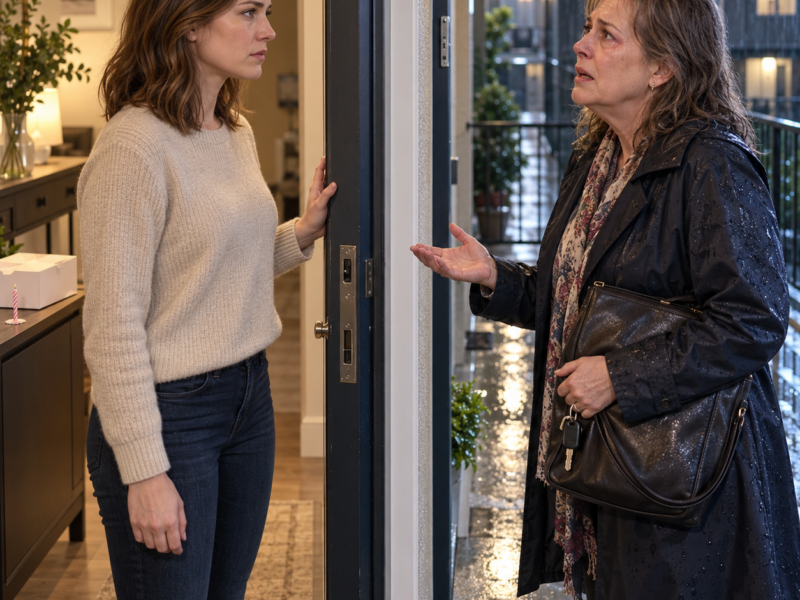
My mother stood in the hallway outside my apartment with rain dripping from her hair and mascara running beneath both eyes.
She looked terrified.
For most of my life, that would have been enough.
I would have opened the door before she finished the second knock. I would have found a towel. Made coffee. Sat her down. Asked what happened. Taken whatever crisis she carried and turned it into something manageable.
That was what I did.
I fixed things.
I made reservations when my parents forgot.
I filled out insurance forms.
I drove people to appointments.
I remembered passwords.
I paid bills when money got tight.
I organized birthdays that were not mine.
I sent flowers with my sister’s name on the card when she forgot Mother’s Day.
I was the dependable daughter.
The easy daughter.
The independent daughter.
The daughter who, according to my mother, “didn’t need much.”
So when she knocked again and called my name through the door, every part of my body knew what came next.
Open.
Comfort.
Explain.
Forgive.
Instead, I stayed behind the deadbolt and looked through the peephole.
“Brooke.”
Her fist hit the door again.
“Please.”
Three days earlier, I had turned twenty-nine.
My parents had forgotten.
My sister had forgotten.
No card.
No text.
No call.
Nothing.
For the fifth year in a row.
Then at 9:34 that night, while I sat alone in my apartment with two slices missing from a small pizza, Instagram showed me what my family had remembered.
Ashley had passed her real-estate licensing exam.
My younger sister was standing in my parents’ driveway in a white dress, both hands over her mouth, beside a brand-new white convertible with a red bow across the hood.
My father had one arm around her shoulders.
My mother was laughing and holding the keys.
The photograph looked like an advertisement for a family I had spent my whole life trying to join.
Ashley’s caption called them the best parents in the world.
My mother commented:
You deserve it, sweetie. So proud of you.
Nobody had remembered that on the same day, twenty-nine years earlier, my mother had given birth to another daughter.
Me.
I had stared at that photograph long enough to understand something I should have understood years before.
They were not bad at love.
They were not too busy.
They were not emotionally awkward.
They knew how to celebrate.
They knew how to spend money.
They knew how to make someone feel chosen.
They simply did not do those things for me.
So that night, instead of calling and reminding them that I existed, I started disconnecting the systems that allowed them to depend on me while treating me like background furniture.
The phone plan.
The monthly transfers.
The so-called family emergency fund that was almost entirely my money.
My access.
My labor.
My availability.
For three days I gave them the silence they had given me for years.
Now Mom had come to my door because the silence was finally costing her something.
I reached for the deadbolt.
Then stopped.
My hand hovered there.
My mother knocked again.
“Brooke, honey, please open the door.”
I closed my eyes.
The strangest thing was that I did not hate her.
I wanted to.
Hatred would have been easier than what I felt.
What I felt was exhaustion.
Twenty-nine years of it.
I unlocked the deadbolt.
The click sounded louder than it should have.
Then I opened the door.
But I did not step aside.
My mother looked at me as though she had been holding her breath for seventy-two hours.
“Oh my God.”
She reached for me.
“Brooke.”
I stepped backward.
Her arms closed on nothing.
She froze.
The confusion on her face almost made me laugh.
My mother had never imagined a version of me who did not catch her.
“Come in,” I said.
Not because she was welcome.
Because I wanted, for once, to finish a conversation without somebody changing the subject.
My name is Brooke Ellison.
I grew up in a brick colonial outside Columbus, Ohio, in a neighborhood with maple trees, basketball hoops over driveways, and mailboxes mounted on identical cedar posts because the homeowners association believed visual variety was how civilization ended.
There were two daughters in our family.
Ashley and me.
But if you had measured attention instead of bedrooms, there had really been one child.
Ashley.
I was two years older.
From the day she could walk, she was the center of my parents’ emotional weather.
Ashley was loud.
Messy.
Funny.
Impulsive.
My mother called her spirited.
My father called her “our little firecracker.”
When Ashley drew flowers across a hallway wall in permanent marker at five years old, my parents took a photograph before painting over them.
When she lost her lunchbox three times in one semester, my mother drove to three stores until she found the exact replacement with the same pink unicorn.
When she failed a math test in sixth grade, my parents hired a tutor and took her out for ice cream afterward because she was “taking it hard.”
When I brought home straight A’s, Dad looked at the report card.
“Good.”
That was it.
Once, when I was fourteen, I asked:
“Is that all?”
He looked up.
“What else do you want?”
I did not know how to answer.
Maybe a smile.
Maybe:
I’m proud of you.
Maybe ten seconds where excellence felt like something I had done instead of the minimum rent charged for being Brooke.
Instead, I said:
“Nothing.”
Dad nodded.
“That’s what we expect from you.”
Those words shaped me more than any compliment could have.
What we expect.
Achievement became the admission price for remaining unobjectionable.
Ashley got rewarded for recovering from mistakes.
I was rewarded by having my successes treated as normal.
At twelve, I spent six months saving for my mother’s Christmas present.
I earned allowance.
Washed Mrs. Collins’s dog down the street.
Raked leaves for another neighbor.
Skipped buying pizza at school enough Fridays that my friends noticed.
At the mall, I found a silver heart-shaped locket.
It cost more than I had ever spent on anything.
Inside, I put a tiny photograph of Ashley and me.
On Christmas morning, I waited while Ashley ripped through presents.
New phone.
Makeup.
Clothes.
A pair of boots she had pointed to in a catalog.
I got books and a sweater.
Nothing wrong with either.
I remember telling myself not to compare.
That became another habit.
Do not compare.
Do not count.
Do not notice.
When it was time for us to give presents, I handed Mom the little wrapped box.
My palms were sweating.
She opened it.
Saw the locket.
“Oh, Brooke.”
She smiled politely.
“That’s nice.”
Nice.
One word.
Then Ashley realized she had forgotten to buy either parent anything.
She grabbed a ball of discarded wrapping paper, threw it at Dad, and yelled:
“My gift is my presence.”
Dad burst out laughing.
Mom pulled Ashley against her.
“You are a gift.”
She kissed the top of her head.
“You really are.”
I sat on the carpet with the empty locket box in my lap.
That may sound like a small childhood memory.
It was.
Families are built from small things repeated.
No single event made me invisible.
It happened by inches.
By fifteen, I had stopped expecting celebration.
By eighteen, I had become useful.
Useful was safer.
If I could not be loved the way Ashley was loved, I could at least be needed.
I became the person who remembered.
Mom’s medication refill.
Dad’s work anniversary.
Ashley’s college-deposit deadline.
Grandma’s birthday.
Oil changes.
Tax forms.
Christmas reservations.
I learned how to make myself valuable without asking anyone to look directly at me.
College made the financial difference impossible to ignore.
My parents told me money was tight.
This was partly true.
Dad worked in commercial insurance. Mom had gone back to part-time administrative work after years at home.
They were comfortable, not wealthy.
When I was accepted to Ohio State, they explained that I would need scholarships and loans.
“You’re resourceful,” Mom said.
“I know you’ll figure it out.”
So I did.
I worked at the campus library.
Then evenings at a hotel front desk.
During one semester, I also picked up Saturday inventory shifts at a small distribution warehouse near Grove City.
I lived with three roommates.
Bought textbooks used.
Carried granola bars because campus food added up.
There were months when dinner was ramen, eggs, or whatever my roommate’s mother had sent from Cleveland.
I did not resent it then.
I was proud.
I was building my life.
Then Ashley graduated high school.
She wanted a private university in North Carolina.
My parents paid.
Tuition.
Dorm.
Sorority dues.
Plane tickets.
Spring break.
I found out about the Mexico trip because Mom sent a photograph.
Your sister is finally relaxing!
I stared at it from the hotel desk during a night shift where I had just been yelled at because a guest believed the ice machine was “too far from civilization.”
One Thanksgiving I finally asked.
Not angrily.
Maybe that would have been easier for everyone.
“Why are you paying for Ashley’s school?”
Mom immediately stiffened.
“We helped you.”
“With what?”
“Brooke.”
“I’m asking.”
“You’re so independent.”
She said it like praise.
“You know how to take care of yourself.”
“And Ashley?”
“She needs more help.”
“Why?”
“She’s sensitive.”
There were two family code words.
Independent meant:
safe to neglect.
Sensitive meant:
someone else should absorb the consequences.
I accepted the explanation because not accepting it meant confronting a possibility I was not ready to face.
My parents did not simply believe Ashley needed more.
They liked helping her more.
Helping Ashley made them feel loving.
Helping me felt unnecessary.
That difference followed us into adulthood.
I never hated my sister.
That is important.
I wanted to sometimes.
It would have simplified things.
But Ashley was raised inside the same system I was.
She learned early that if she waited long enough, somebody would handle whatever she had forgotten.
Usually Mom.
Then Dad.
Eventually me.
She did not wake up one morning and decide her sister was an ATM.
We trained one another.
When Ashley’s car needed four new tires at twenty-two, Mom called.
“She cannot afford all four.”
“Then replace the worst two now.”
“Brooke, that isn’t safe.”
“Then she needs a payment plan.”
“You have savings.”
I paid for the tires.
When she wanted to move apartments but could not cover first month plus deposit, I lent her $1,500.
She repaid $300.
Then stopped.
Nobody mentioned it.
At Christmas, I still bought her a present.
When Mom needed a ride to a specialist because Dad had a meeting, she called me.
I rearranged work.
The drive took forty-five minutes each way.
I remember trying to tell her about a promotion I was being considered for.
Halfway through, Mom looked at her phone.
“Did you see Ashley’s new haircut?”
I stopped speaking.
Mom held the phone toward me.
“Look how pretty.”
“Yeah.”
“Do you think she should go lighter?”
“I don’t know.”
“What were you saying?”
“Nothing important.”
Another habit.
I worked hard enough that by twenty-seven I had become a project manager for a regional logistics company.
The work suited me.
Timelines.
Budgets.
Dependencies.
If a shipment was delayed in Kansas City, nobody told me the problem was “sensitive.”
We tracked the delay.
Assigned responsibility.
Updated the plan.
People think project management is about spreadsheets.
It is mostly about getting adults to say what they actually mean before Friday.
I was good at it.
Good salary.
Modest apartment in northwest Columbus.
Six-year-old Honda.
Retirement account.
Emergency fund.
A house fund I wanted to grow large enough for a down payment on something small.
Maybe a townhouse.
Maybe a bungalow with enough yard for a dog.
Then Dad proposed the family emergency account.
We were eating Sunday dinner.
He had a legal pad.
That should have warned me.
“We all need a rainy-day fund.”
Mom nodded.
“Something family can use if there’s a real emergency.”
“What kind?”
“Medical.”
“House repair.”
“Job loss.”
“Something major.”
It sounded responsible.
Dad proposed everyone contribute according to income.
He put in the first $1,000.
Mom added $500 over several months.
I began transferring $500 every month.
Ashley contributed nothing.
After six months, I asked Dad.
“When is Ashley starting?”
“She’s just getting established.”
She was twenty-six.
Doing social-media work part-time and trying to get into real estate.
“Five hundred is hard for me too.”
“You make more.”
“I’m saving for a house.”
“You’ll get there.”
Then Dad used the sentence that had controlled me for years.
“Family supports family.”
I kept paying.
Five hundred dollars a month is not a fortune.
It is also six thousand dollars a year.
For a woman trying to save a down payment, it mattered.
I skipped a trip to Portugal with friends.
Delayed replacing my car.
Worked overtime on a system conversion.
Put a large portion of the bonus into the family account.
Every transfer made me feel strangely proud.
There.
I was part of the team.
I was protecting everybody.
Maybe, somewhere underneath, I believed money could purchase the sense of belonging I never received for free.
The account balance climbed.
Dad occasionally added small amounts.
Mom almost never did.
Ashley never did.
Nobody called it Brooke’s fund.
It was the family fund.
That language mattered.
My birthdays were getting worse.
Twenty-one:
Card arrived a week late.
Mom wrote:
Sorry! Life is crazy.
Twenty-four:
Dad texted around eleven-thirty at night after Facebook reminded him.
Twenty-five:
My parents came to dinner, but Ashley had just broken up with someone named Trevor, so the entire meal became emergency relationship counseling.
My birthday cake sat unopened until Mom left.
Twenty-six:
Nothing.
Twenty-seven:
Mom called two days late.
Not to say happy birthday.
To ask whether I could cover an unexpected car repair.
Twenty-eight:
Nothing again.
I told Sarah, my closest friend from college, that I no longer cared.
She stared at me over brunch.
“You care.”
“I don’t.”
“You absolutely care.”
“I’m twenty-eight. Birthdays are for kids.”
“Then why did you plan your mother’s sixtieth for six months?”
“That’s different.”
“How?”
I hated Sarah sometimes because she listened.
I changed the subject.
At twenty-nine, I tried something new.
I took the day off.
Not because I expected family celebration.
I told myself I wanted one peaceful day.
Coffee.
Bookstore.
Lunch alone.
Maybe buy myself cake.
But some stubborn childish part of me still waited.
At seven in the morning, I checked the phone.
Nothing.
Fine.
Early.
At nine.
Nothing.
I made coffee.
Sat by the window.
People walked dogs below.
A woman struggled with a stroller and a golden retriever who wanted to greet everybody separately.
I checked again at ten-thirty.
Weather notification.
Slack message from work.
Credit-card alert.
No Mom.
No Dad.
No Ashley.
At noon, I went to a sandwich place near my apartment.
Put the phone face-up beside my iced tea.
Every vibration lifted my heart before my mind could stop it.
Spam email.
Target promotion.
Work calendar reminder.
At two, Sarah texted.
HAPPY BIRTHDAY, OLD WOMAN.
Then:
Dinner Friday. Non-negotiable.
I smiled.
At least one person remembered.
By six, my apartment was dim.
I had not turned on the lights.
That is the kind of detail people say means depression.
Maybe it did.
I think I simply did not want to make the evening more visible.
I sat on my couch looking at the dark television screen.
The hurt became heavy.
Then colder.
Five years.
I opened a message to Mom.
Hey, just checking if you guys are around tonight.
I stared.
Deleted it.
Why did I have to remind the woman who gave birth to me which day it happened?
At seven-thirty, I ordered a small pizza.
At eight, I ate two slices.
At nine-thirty-four, my phone lit up.
My heart jumped.
Instagram.
Ashley.
The photograph filled the screen.
White convertible.
Red bow.
Balloons.
Ashley in a white dress.
Mom holding the keys.
Dad smiling like Ashley had just been elected governor.
The caption:
BEST PARENTS EVER!!! Can’t believe they surprised me with this beauty for FINALLY passing my real estate exam. Literally the luckiest girl alive. Love you guys so much.
Then hashtags.
New car.
Blessed.
Family goals.
I zoomed in.
I wish I could say I do not know why.
I studied their faces.
Dad looked proud.
Mom looked delighted.
Nobody looked busy.
Nobody looked exhausted.
Nobody looked like a person who had forgotten anything important.
The timestamp showed the post had gone up fifteen minutes earlier.
They were together.
Right then.
Probably still celebrating.
Then I saw Mom’s comment.
You deserve it, sweetie. So proud of you.
I put the phone down.
Then picked it up again.
I looked at the date.
September 14.
My birthday.
I sat completely still.
The distinction arrived with almost mathematical clarity.
They had not forgotten because they were overwhelmed.
They had remembered something else more.
They had built an event around Ashley on the day they could not spare ten seconds for me.
For years, I told myself my parents were simply bad at showing affection.
That night, I had a photograph proving otherwise.
They were excellent at affection.
They were capable of balloons.
Cars.
Bows.
Dinner.
Praise.
They knew exactly what choosing a daughter looked like.
They just had a preferred daughter.
I expected tears.
None came.
Instead, I felt calm.
Cold.
Clean.
Like stepping into winter air after leaving a crowded room.
“Okay.”
I said it aloud.
My apartment did not answer.
“Okay.”
If my role in the family was to provide resources without requiring recognition, then I could stop providing resources.
No speech.
No accusation.
No Instagram comment.
No public embarrassment.
Just a change in access.
I opened my laptop.
The first thing I ended was the family group chat.
The B Team.
Dad had named it years ago because our last name began with B.
It had become the place Mom posted garden photographs.
Dad posted bad jokes.
Ashley posted dresses and asked which one “looked expensive.”
I sent reminders.
Happy anniversary.
Good luck at your exam.
Don’t forget Grandma’s birthday.
I tapped:
Exit group.
The phone asked if I was sure.
My finger hesitated.
Not because I wanted to stay.
Because I had been trained to imagine other people’s feelings before acting on my own.
Will Mom think I’m mad?
Will Dad call?
Will Ashley feel rejected?
Then I looked at the clock.
11:45 p.m.
Fifteen minutes left in my birthday.
Nobody had asked whether I felt rejected.
I left.
Next came the mobile account.
Four years earlier, Dad retired earlier than planned after a reorganization.
He asked whether I could temporarily take over the family phone bill while he adjusted to pension income.
The account was already in my name because I had negotiated a cheaper plan through my employer discount.
Temporary became permanent.
Four lines.
Mine.
Mom.
Dad.
Ashley.
About $240 every month.
Ashley had unlimited high-speed data because her “brand” required constant uploading.
I had complained once.
Mom said:
“You make more.”
I logged into the carrier portal.
Transferred my own number to a separate individual account.
Changed the billing information.
Removed my checking account from the remaining family lines.
The old account was still legally mine.
I could terminate or suspend service subject to carrier terms.
I hovered over the control.
This was the first point where anger entered the decision.
Removing autopay was a boundary.
Immediate suspension was consequence.
I knew the difference.
I clicked suspend anyway.
I will not rewrite myself as a saint.
I wanted them to notice.
The three lines went inactive.
Then I opened online banking.
Family Emergency Fund.
Balance:
$18,403.27.
I had kept a spreadsheet of deposits because project managers become project managers everywhere.
Dad’s opening contribution:
$1,000.
Mom’s total:
$500.
Two later deposits from Dad:
$300.
Interest.
Everything else, approximately $16,600, had come from me.
My monthly transfers.
Bonus deposits.
A tax refund.
I stared at the balance.
The account was jointly titled with Dad, which meant both of us could access the funds according to the bank’s account agreement.
That did not mean I wanted a fight later about who had contributed what.
So before moving anything, I downloaded three years of statements.
Saved the contribution ledger.
PDF.
Cloud backup.
Then I transferred the balance into my personal savings.
I knew Dad might claim part of it.
If he wanted to discuss his documented contributions, I would return them.
What I was no longer willing to accept was the assumption that the entire fund belonged to “the family” when one family member had built almost all of it.
The transfer confirmation appeared.
My hands shook.
I sat back.
For years, I had imagined power would feel like other people finally loving me.
It did not.
It felt like realizing access was optional.
Then I removed Mom as emergency contact from my medical portal.
Added Sarah.
Removed Dad from the authorized visitor list at my apartment complex.
Changed account-recovery questions.
Updated passwords.
Not because I thought they were criminals.
Because I had spent years mixing love with access.
Money.
Phone accounts.
Medical information.
Household permissions.
Availability.
That night, I separated them.
At one in the morning, I closed my laptop.
My birthday had ended.
The apartment was completely silent.
Usually silence felt like proof nobody had remembered me.
That night it felt protected.
The next morning, I went to work.
I managed distribution projects for a logistics company based near Columbus.
Our clients moved everything from auto parts to medical equipment.
My days were spreadsheets, carrier negotiations, vendor meetings, exception reports, budgets, warehouse schedules, and conference calls where someone inevitably said “circle back” because apparently “talk later” had been banned by corporate policy.
Normally, family messages interrupted my day.
Mom needed a password.
Dad wanted help comparing insurance.
Ashley had forgotten a payment.
That Wednesday, my phone stayed face-down.
At ten-thirty, I imagined the chaos beginning.
Ashley waking up.
Opening Instagram.
No mobile data.
Restarting.
Toggling airplane mode.
Calling Mom.
Call failed.
Dad trying his phone.
No service.
Then banking.
The transfer alert.
I expected guilt.
Instead, I cleared my email backlog before noon.
Around two, actual emails began.
Ashley first.
Subject: PHONE
Brooke, why is my phone not working? Mom’s and Dad’s are off too. Did you forget to pay? Fix it ASAP. I have content to post for the car.
No:
Happy birthday.
Not even late.
I created a folder in my email.
FAMILY ACCOUNT CHANGES.
I moved the message there.
An hour later:
Subject: ARE YOU SERIOUS?
Brooke, call me. Dad says something is wrong with the savings account too. What is going on?
At four:
Dad.
Subject: PLEASE CALL IMMEDIATELY
Brooke, we cannot reach you. Your mother is extremely worried. The phone service is suspended and there has been unauthorized activity in the family savings. We need to speak right now.
Unauthorized.
I laughed once.
Quietly.
A coworker looked over the cubicle divider.
“Everything okay?”
“Better than yesterday.”
He nodded.
Corporate America accepts vague suffering if you look busy enough.
I drove home without calling Mom.
That felt unnatural.
For years, I called her after work several times a week.
Most conversations followed the same structure.
I asked about her.
She told me about Ashley.
I offered something about myself.
Mom redirected.
That evening I listened to music instead.
I remembered half the lyrics to a song from college.
I sang badly.
At home, I made salmon and roasted vegetables.
Poured wine.
No apology emails.
No explanations.
By day two, the tone changed.
Mom emailed.
Subject: BROOKE HONEY PLEASE
Are you okay? We are so worried. We can’t reach you. Is your phone broken too? Dad is going to the bank tomorrow. Please tell us you’re safe.
For a second, I almost replied.
I pictured her face.
My mother probably was worried.
Human beings can be selfish and still experience genuine fear.
I am not interested in pretending every emotion she had was fake.
She may have believed something terrible happened.
But even in panic, no one wrote:
We realized we missed your birthday.
That absence mattered.
Then Dad emailed after visiting the bank.
Brooke,
The bank confirmed you initiated the transfer. I do not understand what you are doing. That account is family money. Ashley has expenses coming with the new vehicle, including insurance. You cannot simply remove funds everyone depends on.
If you do not restore the money, we have a serious problem.
The car.
There it was.
I reread that sentence.
Ashley has expenses coming with the new vehicle.
They had purchased a car for my sister.
They were already planning to use the emergency account I had funded to absorb some of the cost.
Nobody had asked.
They did not even recognize asking as necessary.
That was the moment I understood the joint account itself had become dangerous, regardless of who was legally entitled to access it.
My family did not see my deposits as support.
They saw them as infrastructure.
I still did not answer.
The silence continued through the second day.
Then third.
At work, I started anticipating escalation.
People who are accustomed to instant access do not gracefully accept silence.
On the third evening after my birthday, rain came down hard enough to blur the apartment windows.
I sat on the couch reading.
The building buzzer sounded.
Once.
Then again.
Then again.
I checked the intercom camera.
Mom.
No coat.
Hair getting wet.
Dad’s sedan parked at the curb.
She pressed the buzzer repeatedly.
I did not answer.
Five minutes later, somebody pounded on my apartment door.
Apparently, Mom had followed a resident inside.
“Brooke.”
Bang.
“Brooke, open the door.”
I stood in the living room.
Heart pounding.
This was the scene my mother had always won.
She arrived emotional.
I became functional.
She cried.
I comforted.
She demanded.
I solved.
She panicked.
I reassured.
Those were our family jobs.
Mom knocked again.
I walked toward the door.
Looked through the peephole.
Mascara streaked.
Wet hair.
Hands shaking.
A small part of me whispered:
She is your mother.
Open it.
Another part answered:
Exactly.
I unlocked the deadbolt.
Opened the door.
But I did not step aside.
Mom gasped.
“Oh my God.”
She reached for me.
“You’re alive.”
I stepped back.
Her arms fell.
She stared.
“What is wrong with you?”
Not:
What happened?
What is wrong with you.
Familiar.
“Come in.”
She walked past me.
Looked around the apartment as though checking for evidence of some crisis that would explain my behavior more acceptably than choice.
“Why didn’t you answer?”
She paced.
“Your father is sick with worry. Ashley is hysterical. Our phones stopped working. The bank account is empty. We thought your identity had been stolen.”
I closed the door.
Locked it.
“I did not answer because I did not want to talk to you.”
Mom stopped.
“What?”
“I didn’t want to talk.”
“We’re your family.”
“Sit down.”
“Brooke.”
“Please.”
I pointed to the armchair.
Not the couch beside me.
One chair across the room.
Mom sat slowly.
As soon as she knew I was physically safe, fear began turning into indignation.
Predictable.
“You cut off the phones.”
“Yes.”
“Your father’s card was declined at a gas station.”
“That wasn’t because of me.”
“He had to move money around because the savings account was empty.”
“The savings account was funded almost entirely by me.”
“That was family money.”
“No.”
Her eyes widened.
“Excuse me?”
“It was money I contributed for actual emergencies.”
“Exactly.”
“Buying insurance for Ashley’s convertible is not an emergency.”
Mom froze.
There.
I watched the car enter the room before I said another word.
She looked away.
“I saw it.”
Silence.
“The car.”
Mom twisted her wedding ring.
“We wanted to surprise her.”
“I know.”
“She worked hard.”
“She failed the test twice.”
“She has anxiety.”
I almost smiled.
Sensitive had evolved into anxiety.
Same structure.
Different vocabulary.
“She passed.”
Mom continued.
“Real estate is image-driven. She needs something reliable.”
“A thirty-thousand-dollar convertible?”
“It wasn’t thirty.”
“How much?”
“That isn’t the point.”
“No.”
I stood.
“It’s actually close to the point.”
Mom’s face hardened.
“You have a reliable car.”
“Yes.”
“I bought it.”
“With your own money.”
“Yes.”
“You’re doing well.”
“Yes.”
“And you know Ashley is just getting started.”
The old math.
I had more.
Therefore Ashley deserved access.
I walked to the kitchen counter.
Picked up my phone.
Opened the saved Instagram picture.
Held it toward Mom.
“You look happy.”
She glanced.
“What?”
“You look really happy.”
“We were happy for her.”
“What time?”
“Brooke.”
“What time was this?”
“Around seven.”
“Tuesday?”
“Yes.”
“The fourteenth?”
“Yes.”
Mom’s forehead tightened.
I watched memory search her face.
Then fail.
“Do you know what else happened Tuesday?”
She stared.
Nothing.
I said:
“It was my birthday.”
The color left her face.
Instantly.
Her hand covered her mouth.
“Oh.”
Not Happy birthday.
Oh.
“Brooke.”
“Five years.”
“Honey.”
“Five years.”
“I am sorry.”
“No card.”
“Brooke.”
“No call.”
“We have had such a crazy week.”
“You were at a car celebration.”
She began crying.
“We forgot.”
“That is the problem.”
“It was not intentional.”
“I believe you.”
That stopped her.
I sat across from her.
“I genuinely believe you did not wake up Tuesday and say, ‘Let’s hurt Brooke.’”
Mom’s shoulders lowered.
For half a second she thought I was letting her off.
Then I continued.
“You did something worse.”
Her face tightened.
“You did not think of me at all.”
Tears slid down her face.
“That’s not fair.”
“Which part?”
“We love you.”
“How would I know?”
“You know.”
“No.”
I shook my head.
“That is what I have been telling myself my whole life.”
“Brooke.”
“Love is not a title.”
“I’m your mother.”
“Yes.”
“That is a title too.”
She stared at me.
I had never talked to her like that.
Not because the words were cruel.
Because they were declarative.
I was no longer presenting my feelings for review.
I was reporting them.
“On my twenty-fifth birthday, you came over and spent the whole dinner talking about Ashley’s breakup.”
Mom looked down.
“Twenty-six, nothing.”
“I’m sure we…”
“Nothing.”
“Twenty-seven, you called two days late because you needed money for a car repair.”
“That cannot be right.”
“I have the bank transfer.”
My project-manager brain had apparently been waiting years for this meeting.
“Twenty-eight, nothing.”
I leaned back.
“Twenty-nine, a convertible for Ashley.”
“We did not buy it to hurt you.”
“I know.”
“That should matter.”
“It does.”
She stared.
“It means the neglect is natural.”
That one landed.
Mom’s face folded.
For a moment, I almost apologized.
Then I remembered every time I had apologized for making somebody uncomfortable with an accurate sentence.
I stopped.
Mom whispered:
“We can make it up.”
“I don’t want you to.”
“What?”
“I don’t want dinner.”
“We could do something this weekend.”
“No.”
“Just us.”
“No Ashley.”
I almost laughed at the casual sacrifice.
Ashley had been the center of the family for twenty-seven years, and suddenly my mother was willing to exclude her from dinner if that would restore the family billing department.
“I don’t want a replacement birthday.”
“Then what do you want?”
Her voice rose.
“Tell me.”
I stayed quiet.
“Do you want a car?”
I stared.
“We’ll figure something out.”
“Mom.”
“You think this is about the car?”
“No.”
She looked desperate.
“Then what?”
I thought about the twelve-year-old girl with the silver locket.
The nineteen-year-old working night shifts.
The twenty-five-year-old birthday dinner spent discussing Trevor.
The twenty-eight-year-old paying everybody’s phone bill.
The twenty-nine-year-old watching balloons reflect off a white convertible on Instagram.
“Nothing.”
Mom blinked.
“What?”
“I want nothing.”
“Don’t say that.”
“For twenty-nine years, I wanted you to be proud of me without me earning it first.”
“Brooke.”
“I wanted you to notice when I succeeded.”
“We do.”
“I wanted you to call because you missed me, not because you needed something.”
“I call.”
“You call with tasks.”
“That is not true.”
“When is the last time you called me to ask how I was?”
Mom opened her mouth.
No answer.
I continued.
“I wanted you to look at me the way you look at Ashley.”
“That’s not fair to Ashley.”
“I’m not blaming her.”
“You sound like you are.”
“No.”
I stood.
“This is between you and me.”
Mom wiped her cheeks.
I said:
“But now I don’t want any of it.”
“You don’t mean that.”
“I do.”
“People say things when they’re hurt.”
“I have never been calmer.”
That frightened her more.
Anger can be negotiated.
Calm finality cannot.
“What about the money?”
There.
The question had been waiting.
“The money I contributed stays with me.”
“Your father contributed.”
“I have the statements.”
“I’ll return whatever portion he can document as his.”
Mom looked shocked.
“You’re treating us like strangers.”
“No.”
“I am treating money like money.”
“We rely on that fund.”
“For what?”
“Emergencies.”
“Name one.”
“What if the furnace breaks?”
“You own a home-equity line.”
“What if Dad gets sick?”
“You have insurance and retirement savings.”
“What if Ashley needs…”
She stopped.
Exactly.
I waited.
Mom looked away.
“What about the phone plan?”
“Tomorrow, I’ll arrange for the remaining numbers to be released so you can transfer them to your own account.”
That was more reasonable than the suspension I had imposed.
The anger had passed.
I no longer wanted to strand anyone without access to their number.
I wanted responsibility transferred.
Not destruction.
“You can keep your numbers.”
“You’re not paying?”
“No.”
“We rely on you.”
“You have been relying on the wrong person.”
Mom looked up.
“What is that supposed to mean?”
“Call Ashley.”
“She just started real estate.”
“She also has a new car.”
“That car has payments.”
“You bought a car with payments as a gift?”
Mom became defensive.
“The dealership had an incentive.”
I closed my eyes.
Of course.
“Then I hope the incentive helps.”
She stood.
“You cannot just cut off your family.”
“Why not?”
“Because family does not work that way.”
“How does it work?”
“We help each other.”
“Who helps me?”
Silence.
“Brooke.”
“Who?”
“We raised you.”
There it was.
The invoice.
“We fed you.”
“Clothed you.”
“Paid for activities.”
“Parenting is not a loan.”
Her face hardened.
“That is an ugly thing to say.”
“No.”
“It is an adult thing to understand.”
Mom looked around my apartment.
“You have become very selfish.”
I almost admired it.
Three days.
That was how long it took a family to transform the woman financing their phone service and emergency account into selfish.
“I think you should go.”
She stared.
“Brooke.”
“I’m done for tonight.”
“Your father is waiting downstairs.”
“Tell him I’m safe.”
“He wants to see you.”
“Not tonight.”
“You’re punishing him too?”
“No.”
“I’m setting one boundary with both parents.”
Mom reached toward me again.
I did not step back.
But I did not hug her either.
Her hand fell.
“So that’s it?”
“For tonight.”
“You’re just done?”
“I’m here.”
I looked around.
“I’m right here.”
Then something came out that I had not planned.
“I’m just not yours in the way I used to be.”
Mom’s eyes filled again.
“What does that mean?”
“It means I’m not available because you expect me to be.”
Her shoulders collapsed.
For a long moment, she stood there.
Then she walked to the door.
Hand on the knob.
Without turning, she asked:
“You’ll call after you cool down?”
She still believed this was heat.
A tantrum.
A reaction.
She did not understand I had been cooling for years.
“Take care, Mom.”
She turned.
“Brooke.”
I opened the door.
“Good night.”
She stepped into the hall.
I closed it.
No slam.
Just the latch.
Then deadbolt.
Then chain.
I put my forehead against the wood.
Waited for guilt.
It did not come.
Not immediately.
What came was relief.
The apartment was mine.
My sofa.
My books.
My quiet.
My rent.
My electricity.
My decisions.
I walked into the kitchen.
A small white bakery box sat on the counter.
I had bought it on my birthday.
Then left it unopened because eating birthday cake alone had felt too much like admitting something.
I opened it.
One slice of chocolate cake.
A frosting flower.
I found a candle in the junk drawer.
Turned off the overhead light.
Lit it.
For a few seconds, the tiny flame reflected in the kitchen window.
I thought about Ashley’s car.
My mother downstairs.
Dad in the sedan.
The family savings account now empty except for whatever documented amount I would return to Dad.
I did not wish them harm.
That surprised me.
I did not want Ashley’s car repossessed.
Did not want Dad embarrassed.
Did not want Mom miserable.
I simply did not want responsibility for preventing those things anymore.
“Happy birthday, Brooke.”
I blew out the candle.
The next morning, I emailed Dad.
Not Mom.
Not Ashley.
Dad,
I am safe.
I initiated the transfer from the family account because the majority of funds were deposited by me. I have downloaded the account statements and contribution records. I am willing to return the exact amount of your documented contributions and attributable interest. I will not return my own deposits.
I have also stopped paying the family mobile account. I will authorize number transfers so each of you can establish your own service.
Please do not come to my apartment without permission.
I need space.
Brooke
He replied twenty minutes later.
You are blowing this completely out of proportion.
Then five minutes later:
Your mother is devastated.
Then:
What exactly do you mean documented contributions?
That last one made me smile.
Numbers had entered the conversation.
Now we were somewhere I knew how to operate.
I sent the ledger.
Dad had contributed $1,600 total, including the opening $1,000 and two later deposits.
Mom had contributed $500.
Interest attribution was negligible.
I offered to send them $2,150, more than their total principal share.
Dad replied:
That is not the point. The account was for all of us.
I wrote:
Then all of us should have funded it.
No answer.
Three hours later:
Ashley.
She emailed from a new temporary address because apparently she had gotten Wi-Fi.
Subject: I CANNOT BELIEVE YOU
You shut off my phone because Mom and Dad bought me a car? Are you insane? You could have told me you were upset. I had no idea it was your birthday.
That was almost funny.
I replied once.
Exactly.
She sent four more emails.
I did not answer.
By Friday, the phone numbers had transferred away from my account.
Dad opened a new family plan.
Ashley apparently complained about the cost of her unlimited data.
That was no longer a logistical issue I owned.
The emergency account remained empty after I returned the documented $2,150 to Dad.
The first real consequence arrived the following week.
Not financially.
Emotionally.
Sarah took me to dinner.
She had booked a small Italian place.
When I arrived, three friends from work were already there.
No banner.
No enormous production.
Just six people.
A grocery-store cake.
One card signed by everyone.
Sarah handed me a gift.
Inside was a ridiculously expensive set of noise-canceling headphones I had talked myself out of buying.
“You remembered.”
She looked offended.
“Of course I remembered.”
That simple answer almost made me cry in a restaurant.
I realized I had built a standard for love so low that remembering a birthday felt extravagant.
That was uncomfortable.
The first month of low contact was harder than the night I cut everything off.
There was adrenaline in the beginning.
A line crossed.
Actions taken.
Then came ordinary Tuesdays.
No call from Mom.
No family group chat.
No one asking whether I could fix the printer.
I had wanted quiet.
Then discovered quiet could still hurt.
I would finish work and instinctively reach for the phone.
Who do I call?
For years, Mom had filled that slot even if most conversations left me emptier.
Habits survive people.
I began seeing a therapist named Denise Carter.
Not because I believed boundaries required therapy to be legitimate.
Because I wanted to understand why I had spent nearly three decades volunteering for a role I hated.
During our third session she asked:
“What did being useful give you?”
“Stress.”
She waited.
“Debt.”
She waited.
“I’m not in debt.”
More waiting.
I hated therapists.
“Belonging.”
There it was.
“If your parents needed you, what did that prove?”
“That I mattered.”
“And if they stopped needing you?”
My chest tightened.
“I don’t know.”
“Then perhaps being needed became safer than asking to be loved.”
I sat with that one for a week.
She was right.
Money had not only flowed out of me because my family demanded it.
Sometimes I offered first.
Dad mentioned taxes.
“I can look at them.”
Mom sighed about a doctor appointment.
“I’ll drive.”
Ashley said she was moving.
“I have boxes.”
Every offer created a small burst of satisfaction.
See?
I’m essential.
If I was essential, perhaps I could never become completely invisible.
Except that is exactly what happened.
I became so useful that people noticed the function and stopped noticing the person.
That was not only their failure.
I had participated.
The first person from my family to try a different approach was Dad.
Six weeks after my birthday, he emailed.
Not about money.
Subject: YOUR GRANDMOTHER’S RECIPE BOX
I found Grandma’s old recipe box in the basement. Do you want it?
That was all.
No guilt.
No lecture.
No Mom is devastated.
I replied:
Yes.
He mailed it.
Inside was a note.
I’m sorry I forgot your birthday.
Dad
Five words.
No explanation.
No demand that I forgive him.
I cried harder over that note than I had on my birthday.
Not because it fixed everything.
Because it acknowledged the correct wound.
Two weeks later, Dad asked if I would meet him for breakfast.
Neutral diner.
I said yes.
He looked uncomfortable without Mom beside him.
For most of my life, my parents had operated as one unit.
Mom handled emotion.
Dad supported the conclusion.
That morning, he stirred coffee for too long.
“I looked at the account statements.”
“Okay.”
“You put in more than I realized.”
“Yes.”
“I thought your mother was contributing.”
“She wasn’t.”
He nodded.
“I should have known.”
“Why?”
“I set it up.”
That was accountability.
Small.
Actual.
Then:
“The car was my idea.”
I became still.
“Ashley had been talking about needing something more professional.”
“Professional does not mean convertible.”
“I know.”
“Now.”
“Yes.”
He stared at the table.
“We financed most of it. I used a credit card for part of the down payment, planning to reimburse it from the family account.”
There was the missing detail.
They had not already spent my savings.
They had already spent money assuming my savings would cover them afterward.
Functionally, not much better.
“I did not ask you.”
“No.”
“I think part of me believed I didn’t need to.”
I waited.
“Because family fund.”
“Yes.”
“And because I put your name on everything we couldn’t figure out.”
That was almost a joke.
Neither of us laughed.
Dad continued.
“You became the person we assumed would handle the difference.”
I looked at him.
“Do you know what hurt most?”
“Birthday.”
“No.”
He looked surprised.
“The fact that when I took my money back, you called it theft before asking why.”
He closed his eyes.
“I know.”
“That told me what I was to you.”
“That isn’t what you are.”
“It is what I was functioning as.”
He nodded.
Then:
“I am sorry.”
I believed him.
I did not restore the phone plan.
I did not reopen the family account.
That is important.
An apology does not require reinstalling the old system.
Dad and I began talking occasionally.
Slowly.
Separately from Mom.
I learned he had been more aware of the favoritism than I realized.
“I thought you were okay.”
He told me once.
“I was.”
“Then…”
“No.”
I corrected him.
“Being okay now does not prove everything was okay then.”
He nodded.
That sentence became one of the few he remembered without arguing.
Mom took longer.
She sent cards.
Too many.
One arrived with a $100 restaurant gift certificate and a note:
Dinner on us for your birthday, whenever you’re ready.
I mailed the gift certificate back.
Not angrily.
I wrote:
I do not want compensation for being forgotten.
Three weeks later, she mailed another note.
I don’t know what you want from me.
I did not respond because that had been the question at my apartment.
What do you want?
For years the answer was simple.
Notice me.
By then, I was learning how dangerous it was to make my peace dependent on whether she could finally provide what she had withheld.
I could want repair.
I could not require it in order to live.
Ashley’s reaction was messier.
At first she treated everything as jealousy over the car.
She posted vague quotes online.
Some people only support you when they’re above you.
Then:
Family shows true colors around money.
I muted her.
Sarah sent screenshots anyway until I threatened to confiscate her phone.
Three months after my birthday, Ashley appeared at my office.
Not my apartment.
Work.
Reception called.
“There’s someone named Ashley here.”
I nearly said send her away.
Instead, I went downstairs.
She was wearing a cream blazer and carrying a leather portfolio.
Real estate had made her look unexpectedly professional.
The white convertible was parked outside.
Of course.
“Hi.”
“What do you need?”
Her face tightened.
“You’re really going to talk to me like a client?”
“I’m at work.”
“Can we go somewhere?”
I checked the time.
“Twenty minutes.”
We walked to a coffee shop.
Ashley sat across from me.
For the first time in my memory, she looked nervous around me.
Not defensive.
Nervous.
“I didn’t know.”
“About my birthday?”
“About everything.”
I waited.
“Mom told me you liked being independent.”
I laughed once.
“So you thought I enjoyed paying your bills?”
“No.”
She flushed.
“I mean… I didn’t think about it.”
Exactly.
She rubbed one thumb along the coffee lid.
“When I got to college, Mom said you had scholarships and liked working.”
“I did have scholarships.”
“She said you didn’t want their help.”
“That is not true.”
Ashley’s eyes lifted.
“I didn’t know.”
“You also never asked.”
“I know.”
We sat.
Then she said:
“The car was too much.”
“Yes.”
“I told them that.”
“Before or after?”
“After.”
At least honest.
“Dad offered. Mom got excited.”
“And you accepted.”
“Yes.”
She looked down.
“I always accept.”
There it was.
The entire family in three words.
I always accept.
Ashley had been trained to receive the same way I had been trained to give.
Neither role was healthy.
“Are you keeping it?”
“Yes.”
I appreciated that she did not perform some grand gesture and sell it to prove remorse.
The car was financed.
Selling immediately might have created another bad financial decision for symbolism.
“Then keep it.”
She looked surprised.
“I don’t care about the car.”
“You obviously care.”
“I care what it represented.”
“What?”
“That they could make a huge effort for you on a day they forgot me.”
Ashley’s face changed.
“I posted that photo.”
“Yes.”
“I feel awful.”
“That is yours to work through.”
“I’m sorry.”
I nodded.
She waited for more.
There was none.
“What does this mean for us?”
I thought.
“I don’t know.”
“You’re my sister.”
“Yes.”
“That should mean something.”
“It does.”
“What?”
“It means I am willing to see if we can build a relationship that isn’t based on me cleaning up your life.”
That hurt her.
Good boundaries often sound harsher to people who benefited from the old arrangement.
She nodded.
“Okay.”
Then:
“I changed my own phone plan.”
I smiled.
“Congratulations on adulthood.”
“Shut up.”
It was the first time we laughed together in months.
Ashley and I began meeting without Mom.
Occasional coffee.
Lunch.
No loans.
No requests.
The first time she asked me a financial question, she caught herself.
“I’m not asking you to fix it.”
“What?”
“My credit card.”
“Okay.”
“I just want to know how you make a budget.”
That was different.
I showed her a template.
Did not pay the balance.
She started contributing to her own emergency fund.
At first, $100 a month.
Then $200 after real-estate commissions improved.
One afternoon she texted me a screenshot.
Emergency savings: $3,000.
I replied:
Look at you.
She sent back:
I hate that this feels better than a convertible.
I wrote:
Growth is ugly.
She responded:
That should be on a mug.
Mom continued holding out.
Or perhaps I did.
The truth depends on perspective.
We went eight months without speaking directly.
Then Grandma fell.
My father’s mother.
Eighty-seven.
Hip fracture.
Hospital.
Family logistics.
Old Brooke would have taken over immediately.
Instead, Dad called.
“Can you help coordinate?”
I felt the familiar pull.
Then stopped.
“What exactly?”
“Visiting schedule and rehab options.”
“I can research three rehab facilities.”
“That would help.”
“I am not managing the whole schedule.”
“Okay.”
Simple.
I researched.
Sent information.
Ashley took two visiting days.
Dad took three.
Mom handled laundry.
A cousin covered another.
The world did not collapse because I declined to become the project manager for an entire extended family.
At the hospital, Mom and I saw each other.
First time in eight months.
She stood near the vending machines.
I had just come from Grandma’s room.
“Brooke.”
“Hi.”
Her hair had more gray.
Or maybe I had not been close enough to notice before.
“How are you?”
It was such an ordinary question that I almost laughed.
“I’m good.”
She nodded.
“Ashley says you two have been having lunch.”
“Sometimes.”
Mom looked hurt.
Old reflex told me to fix it.
Invite her.
Explain.
I did neither.
“That’s good.”
She said.
Then:
“I miss you.”
My chest tightened.
“I know.”
“I don’t know how to do this.”
“What?”
“Talk to you without asking for something.”
I stared.
That was the first truly useful thing my mother had said since my birthday.
“You could start with talking.”
A tiny smile.
“That simple?”
“No.”
“But start there.”
She nodded.
We talked for ten minutes.
Grandma.
Work.
My apartment.
Her garden.
No Ashley.
No money.
No apology demand.
When we parted, Mom did not hug me.
She asked:
“Can I?”
I said yes.
It was awkward.
Short.
Real.
Repair with my mother came like that.
Not one grand confession.
Small proof.
She stopped calling me first for emergencies.
At Christmas, she invited me without pressure.
I declined the first year.
Accepted the second.
The family phone plan was still theirs.
The emergency fund did not return.
Dad and Mom created their own savings account.
Ashley contributed to one separately.
No shared family pool.
That turned out to be healthier.
Specific households.
Specific responsibilities.
If a crisis came, we could decide what help looked like then.
Mom finally apologized properly almost a year after the birthday.
We were sitting in her kitchen.
Same room where I had filled out FAFSA forms and signed birthday cards with Ashley’s name when she forgot.
Mom was slicing apples.
She stopped.
“I need to tell you something without explaining it.”
I waited.
“I favored Ashley.”
The knife stayed against the cutting board.
No defense.
“I did.”
I felt my body go still.
“I told myself it was because she needed more.”
Mom’s eyes filled.
“But I liked being needed by her.”
There.
My mother’s version of my own discovery.
“I didn’t know what to do with you because you rarely needed rescuing.”
“I needed a mother.”
She closed her eyes.
“I know.”
“No.”
My voice softened.
“You know now.”
She nodded.
Tears fell.
“I was proud of you.”
“That was not enough if you never said it.”
“I know.”
“I thought expecting more from you was respect.”
“It felt like I could never arrive.”
Mom sat down.
“I forgot your birthdays because you made forgetting survivable.”
That sentence hurt.
Not because it blamed me.
Because it was honest.
“I knew you’d be there Sunday.”
“I knew you’d answer the phone.”
“I knew you’d fix the account.”
“I knew you’d eventually forgive us.”
She wiped her face.
“I took your reliability and turned it into permission.”
I said nothing.
Then she added:
“And we took your money.”
There.
Not borrowed.
Not shared.
Took.
“We assumed because you contributed it, we could decide what family meant.”
I looked at the kitchen table.
“What do you want from me?”
Mom almost smiled.
“Nothing.”
For once, the correct answer.
“I wanted you to know I see it now.”
I believed her.
Trust returned slower than belief.
That is another distinction people often miss.
I could believe my mother was genuinely sorry long before I trusted her not to repeat the pattern.
So I watched behavior.
Birthdays became strange.
At thirty, Mom sent one card.
On time.
No expensive gift.
Inside:
Happy birthday. No repair attempt. Just love.
I kept it.
At thirty-one, she called at nine in the morning.
“Happy birthday.”
“Thank you.”
Then she asked what I was doing.
Listened.
Did not mention Ashley.
The call lasted six minutes.
Perfect.
At thirty-two, Mom forgot to mail the card until the day before.
It arrived late.
She called on time.
I did not spiral.
Repair is not perfection.
It is a pattern becoming trustworthy enough that a mistake can return to being a mistake.
Ashley also changed.
Real estate actually suited her.
She was good with people.
Excellent at open houses.
Remembered clients’ children.
Learned contracts because she had to.
She sold the white convertible four years later and bought a used SUV.
I teased her.
“Image matters.”
She rolled her eyes.
“I hate you.”
“No, you don’t.”
“No.”
She smiled.
“I don’t.”
When she bought her first house, Mom wanted to give her furniture money.
Ashley said:
“No.”
Everybody became quiet.
“What?”
Mom asked.
“I have enough.”
Mom looked at me.
I shook my head.
“Don’t drag me into it.”
Ashley laughed.
“I want to buy it myself.”
Mom struggled.
Then accepted.
That was growth for both.
Dad had his own reckoning.
He retired fully.
Without me handling phone bills and family spreadsheets, he became responsible for systems he had outsourced to me.
He learned online banking.
Complained constantly.
“Why does every site require a code now?”
“Security.”
“Security against what?”
“People like you.”
He laughed.
Dad and I developed a relationship I had never known was possible.
Not deep in the confessional sense.
He was still Dad.
He believed talking about feelings longer than fifteen minutes could damage your knees.
But he started asking about work.
Actual questions.
“What project are you running?”
“How many warehouses?”
“Did that Kentucky contract get approved?”
He remembered.
Once, I told him about a difficult vendor negotiation.
He listened.
Then said:
“You’re good at this.”
I became completely still.
“What?”
“You’re good at your job.”
“You know that?”
He looked confused.
“Of course.”
“You never say it.”
Dad’s face changed.
Then:
“I should.”
That evening I cried in my car.
Not because he had repaired childhood.
Because the child in me finally received one sentence she had stopped expecting.
There is a temptation when people finally change to give them too much credit.
I avoid that.
My parents did not become better because I cut off their phones.
They changed because consequences created space where the old arrangement stopped protecting everyone from self-awareness.
And even then, they could have chosen not to change.
Boundaries do not transform people.
They reveal choices.
My first boundary was clumsy.
Suspending the phone service immediately was partly angry.
I can admit that.
If I were advising someone else, I would say:
Move your number.
Stop paying.
Give the other account users a short window to transfer service.
Do not use access as a surprise punishment.
I eventually corrected that.
The money was different.
Leaving nearly seventeen thousand dollars of my contributions in a joint account where people had begun planning expenses without my consent would have been foolish.
I documented.
Returned Dad and Mom’s share.
Closed my participation.
That was not revenge.
That was accounting.
The most important thing I did was quieter.
I stopped volunteering.
Mom once mentioned that her printer was broken.
Old Brooke:
I’ll come over.
New Brooke:
What does the screen say?
She read it.
“Paper jam.”
“Have you opened the back?”
“No.”
“Try that.”
She did.
Problem solved.
No forty-minute drive.
Dad complained about an insurance form.
“I can send you the number for the agent.”
Not:
Send it to me.
Ashley called because a client inspection report confused her.
“Ask your broker.”
Not:
Email it.
At first, saying those things felt selfish.
Then I noticed something.
They became more competent.
Mom learned technology.
Dad learned accounts.
Ashley learned business.
My rescuing had not only exhausted me.
It had quietly prevented them from building skills.
That was not generosity.
That was a system.
Denise, my therapist, asked one day:
“What happens when no one needs you?”
I smiled.
“They still call.”
“For what?”
“Dinner.”
“Conversation.”
“Dad sent me a picture of a cardinal.”
“Did it require solving?”
“No.”
“How did that feel?”
I thought.
“Better.”
Because at thirty-three, I finally had something I had wanted since childhood.
Calls without tasks.
One Sunday, Mom phoned.
I answered cautiously.
“What happened?”
“Nothing.”
“What do you need?”
“Nothing.”
I heard her laugh.
“I saw a dress and thought you’d like it.”
That was all.
She texted the picture.
I did like it.
No request.
No debt.
No emergency.
I stared at my phone after we hung up.
Then laughed.
Sarah asked later:
“What?”
“My mother called me for no reason.”
“Normal people do that.”
“Apparently.”
Sarah had become my emergency contact permanently.
I never changed it back.
Mom knew.
She never asked.
That was another form of respect.
The house fund I had been building before the family emergency account resumed.
Five hundred dollars a month.
Then more.
The same amount I had sent to “family” now went into an account with one name.
Mine.
At thirty-one, I bought a small townhouse on the northwest side of Columbus.
Two bedrooms.
Tiny patio.
One-car garage.
Not the kind of place Ashley’s real-estate Instagram would call breathtaking.
I loved it.
Closing day, Dad offered to come.
Mom did too.
I hesitated.
Then said yes.
At the title office, I signed the final papers.
The keys landed in my palm.
Mom cried.
Quietly.
Dad hugged me.
Ashley brought a bottle of champagne.
No red bow.
Thank God.
We drove to the townhouse.
The refrigerator hummed in an empty kitchen.
Boxes everywhere.
Mom wandered into the living room.
“You did this yourself.”
I looked at her.
“Yes.”
She nodded.
“I’m proud of you.”
The words still mattered.
But not in the desperate way they once had.
That was how I knew I was healing.
Approval had become something lovely to receive instead of oxygen.
I slept on a mattress on the floor that first night because the bed frame had not arrived.
I remember lying there listening to unfamiliar house sounds.
Furnace.
Neighbor’s garage door.
A dog barking somewhere.
I thought about the apartment door my mother had stood behind two years earlier.
The deadbolt.
The rain.
The cake.
I had believed then that closing a door would be the end of my family.
It was not.
It ended one version.
The version where I purchased belonging with usefulness.
The family that eventually returned had different rules.
We asked.
We did not assume.
Money was named.
Gift.
Loan.
Shared expense.
Optional.
No hidden “family” category large enough to swallow one person’s salary.
When Dad needed $1,200 after a plumbing emergency and wanted to avoid putting it on a high-interest card, he called.
“Can I borrow twelve hundred?”
Not:
We need twelve hundred.
“Repay when?”
“Four months.”
We wrote it down in a text.
He paid $300 monthly.
The final payment came with:
PAID IN FULL, LOAN SHARK.
I replied:
INTEREST PENALTY FOR ATTITUDE.
We laughed.
It was the healthiest money exchange we had ever had.
When Ashley had a slow commission month, she did not call me.
Later she told me she had eaten eggs for dinner for two weeks rather than ask.
“That is not necessarily healthy independence.”
She laughed.
“I wanted to know I could.”
“Now you know.”
“I do.”
“Next time you can ask if you genuinely need help.”
“But you might say no.”
“Yes.”
“That’s rude.”
“Welcome to adulthood.”
The family emergency fund never returned.
We did not need it.
Each household built its own emergency savings.
If someone had a genuine crisis, we decided then.
No one was automatically responsible.
That change made generosity easier.
When Dad needed outpatient surgery, I took two days off.
Not because he expected it.
Because I wanted to.
Mom said:
“You don’t have to.”
I knew.
That made yes feel different.
Ashley once had a real estate client abandon a closing and leave her short on business expenses.
I lent her money.
Written.
She repaid.
No resentment.
Choice transformed everything.
There was one birthday I feared.
My thirty-fourth.
Five years after the one they forgot.
I expected the date itself to activate something old.
Instead, I woke to a text from Dad at 7:03.
HAPPY BIRTHDAY. I AM FIRST.
At 7:04, Mom:
Your father set an alarm. This is cheating.
At 7:05, Ashley:
I was awake at midnight but decided Dad needed this.
I laughed in bed.
Then Sarah:
Still old.
I made coffee.
No waiting.
No checking.
No silent test.
That evening we had dinner.
Not huge.
No convertible.
No balloons except Ashley brought one that said OVER THE HILL because she remains annoying.
Mom gave me a small box.
Inside was the silver locket.
The one I had bought her at twelve.
I recognized it instantly.
My breath stopped.
“I found it in my jewelry box.”
Mom’s eyes filled.
“I wore it more than you knew.”
I opened it.
The tiny picture of Ashley and me was still inside.
Faded.
I looked at Mom.
“I thought you didn’t care about it.”
“I did.”
“Then why did you just say it was nice?”
Mom closed her eyes.
“Because I was careless.”
No excuse.
Then:
“And because Ashley was easier to react to.”
That made painful sense.
Ashley leaned over.
“Still am.”
Mom laughed.
Then looked at me.
“I should have made you feel seen when it mattered.”
I held the locket.
“I know.”
She did not ask me to absolve her.
That helped.
I wore it home.
Not every old object needs to be thrown away after hurt.
Sometimes meaning can change if behavior changes first.
My relationship with Ashley became one of the surprises of adulthood.
As children, we were assigned opposing roles.
She was the needy one.
I was the capable one.
Favoritism made closeness almost impossible because any success she had felt like evidence of what I lacked, and anything I received threatened the identity she had been given.
Once our parents stopped funding that structure and I stopped rescuing, we had room to become sisters.
Actual sisters.
She called me after bad dates.
I told her she had terrible taste.
She helped me stage my townhouse when I sold it years later.
I told her to stop moving my books because humans lived there.
She became good at real estate.
Very good.
One day she admitted:
“I used to think you looked down on me.”
“I did sometimes.”
She stared.
I shrugged.
“You wanted honesty.”
“Why?”
“Because I worked for everything and watched you get rescued.”
She absorbed that.
Then:
“I thought you liked working for everything.”
“Of course you did.”
“That’s what Mom said.”
“I know.”
Ashley looked sad.
“I think they made both of us into cartoons.”
That was exactly it.
The spoiled one.
The responsible one.
Neither full person.
She learned dependence was charming.
I learned need was shameful.
Both lessons cost us.
At thirty-six, Ashley married.
Second serious relationship after several disasters.
His name was Marcus.
A home inspector.
Quiet.
Competent.
He owned a used pickup truck and had no interest in social media.
The white convertible had been sold by then.
At their rehearsal dinner, Ashley gave me a small envelope.
Inside was a check.
$1,200.
I frowned.
“What is this?”
“The rest of the money I owed you from my apartment deposit.”
“That was fifteen years ago.”
“Fourteen.”
“I wrote it off.”
“I didn’t.”
I looked at her.
“I don’t need this.”
“I know.”
She smiled.
“I do.”
I accepted.
Sometimes refusing repayment is another way of staying superior.
I had learned that too.
At the wedding, Mom cried.
Dad cried more.
I signed the card only from myself.
Ashley laughed when she noticed.
“Progress.”
“Yes.”
No one forgot my name.
My parents aged.
That changed the direction of care again.
Mom’s knees worsened.
Dad’s hearing became terrible in restaurants, though he insisted everybody else had begun mumbling.
The old family role tried to return.
Appointments.
Forms.
Medicare notices.
Technology.
For a while, I felt the tug toward over-functioning.
Then we held a meeting.
Not an intervention.
A practical meeting at their kitchen table.
Mom.
Dad.
Ashley.
Me.
We divided tasks.
Ashley handled home-service vendors because she knew contractors.
I handled insurance paperwork because I was better with forms.
Dad remained responsible for daily banking.
Mom maintained medical calendar.
If one of them eventually needed more help, we would revisit.
No invisible assignment to Brooke.
The meeting lasted forty-five minutes.
Mom said afterward:
“We should have done this years ago.”
“Yes.”
Dad:
“We did.”
“No.”
I reminded him.
“You did meetings where you assigned things to me.”
He laughed.
“Fair.”
Caregiving became something I participated in rather than disappeared inside.
When Mom had knee replacement, I stayed two nights.
Ashley stayed two.
Dad handled more than either of us believed he could.
We hired a home health aide for the first week.
Mom hated strangers in the kitchen.
Survived.
I did not move in.
That mattered.
At seventy, Dad experienced a health scare.
Nothing catastrophic.
But enough that the emergency contact issue came up.
A nurse called Ashley because Dad had listed her first.
Old Brooke would have felt rejected.
Instead, I thought:
Good.
Ashley called me from the hospital.
“Dad’s okay.”
“I’m coming.”
“Drive safe.”
No hierarchy.
Just family.
There is a version of this story where I cut everyone off forever after my twenty-ninth birthday.
Maybe it would be more satisfying to some readers.
It is not what happened.
I did cut off the system.
I did not permanently erase the people.
The distinction took years to understand.
No contact can be necessary.
Distance can be necessary.
Permanent separation can be healthy when people continue harming you.
But a boundary is not automatically a sentence.
It is information.
Here is what I will accept.
Here is what I will no longer fund.
Here is what happens when you cross the line.
My family responded badly at first.
Then some of them changed.
So I changed my access based on new evidence.
That is not weakness.
It is what I wish I had done from the beginning.
Trust should not be a lifetime membership.
It should be updated.
Not obsessively.
But honestly.
My mother is allowed in my home now.
She still knocks.
Even when the door is unlocked.
The first time she did that after I bought the townhouse, I opened it.
“You know you can come in.”
She looked at me.
“I know.”
“Then why knock?”
“Because I remember what happened at the apartment.”
I became quiet.
She smiled sadly.
“I am trying not to assume doors open for me anymore.”
That sentence stayed.
Not only because of her.
Because I had spent my whole life assuming my own boundaries had to open for family.
Money door.
Time door.
Emotional door.
Home door.
Phone door.
My mother learning to knock helped me learn I was allowed to decide when to answer.
Dad became much less dramatic about money.
One Christmas he gave each daughter the same amount in an envelope.
Ashley whispered:
“Look at us. Socialism.”
I almost laughed during grace.
Mom glared.
Later, I told Dad equal gifts were not required.
“I know.”
“Then why exactly equal?”
He shrugged.
“I’m tired.”
Fair.
My relationship with my birthday changed too.
For years, the date had been an annual exam my family kept failing.
Would they remember?
Would they call?
Would this be the year?
That is not celebration.
That is surveillance.
I stopped testing people.
I began planning something I wanted every year regardless of anyone else.
Thirty.
Weekend in Chicago with Sarah.
Thirty-one.
A cooking class.
Thirty-two.
Bought myself a beautiful watch.
Thirty-three.
Quiet dinner at home.
Thirty-four.
Family dinner with the locket.
Thirty-five.
Solo trip to Santa Fe.
That one mattered.
At twelve, I had saved lunch money for my mother’s locket.
At thirty-five, I spent money on a hotel room with a balcony overlooking desert light.
No guilt.
I walked through galleries.
Bought turquoise earrings.
Ate breakfast alone.
Not lonely.
Alone.
There is a difference.
On the morning of my birthday, Mom called.
I answered from a café.
“Where are you?”
“Santa Fe.”
“Alone?”
“Yes.”
Pause.
Old Mom would have said:
That sounds sad.
New Mom said:
“Send pictures.”
So I did.
That may sound small.
Most real change is.
Nobody becomes a different person in one dramatic scene.
They catch themselves.
Choose another sentence.
Pay their own bill.
Ask instead of assume.
Remember.
Knock.
The family emergency fund taught all of us a money lesson.
A joint account is not a substitute for an agreement.
If several adults contribute to shared savings, document:
Who contributes?
How much?
What counts as an emergency?
Who can withdraw?
Does spending require unanimous consent?
What happens when someone leaves?
We had done none of that.
We had a label.
Family emergency.
That was not governance.
It was sentiment.
Sentiment is terrible financial control.
Afterward, when Ashley and Marcus started a shared household account, she called.
“Tell me what rules I need.”
I laughed.
“First rule: Don’t let Mom name it.”
“Serious.”
I told her.
Separate personal accounts.
Joint household account.
Clear contribution percentages.
Emergency fund purpose.
Both can see everything.
Neither makes large transfers without discussion.
She wrote it down.
“Look at you.”
She rolled her eyes.
“You created this monster.”
“No.”
“Trauma created this monster.”
We laughed.
There are things I would do differently if I could return to my twenty-ninth birthday.
I would not immediately suspend my parents’ phone lines.
I would move my number, stop the payment, tell them they had several days to transfer theirs.
The surprise felt powerful.
It was also punitive.
There is a difference between ending support and creating panic.
I learned that.
I would still move my money from the joint account after documenting contributions.
Absolutely.
I would still block calls for a few days.
I needed quiet.
I would still refuse to rescue everybody from consequences.
But I would make my boundary clearer sooner.
Anger helped me finally move.
It did not need to design every detail.
That distinction matters.
There is something intoxicating about watching people panic when they finally experience the inconvenience you have been absorbing for years.
Be careful with that feeling.
It can turn a boundary into revenge.
Revenge keeps the other person at the center of your decisions.
Freedom means they eventually stop being the point.
The night Mom left my apartment, I thought I had won because the deadbolt was locked.
I had not.
Winning came later.
The first time my phone rang and I did not feel responsible before answering.
The first vacation I booked without wondering whether the family fund needed the money more.
The first time Ashley asked for advice instead of money.
The first time Dad paid back a loan on schedule.
The first time Mom called just to show me a dress.
The first birthday I woke without checking whether anybody had remembered.
Those were wins.
Boring ones.
Better ones.
My mother once asked if I regretted the way everything happened.
We were in my kitchen peeling potatoes before Thanksgiving.
“I regret that it had to get that bad.”
“That’s not what I asked.”
I looked at her.
“What did you ask?”
“Do you regret cutting us off?”
“No.”
She nodded.
I expected hurt.
Instead, she said:
“I don’t think we would have listened otherwise.”
That was sad.
And true.
Then she added:
“But I wish you had told me sooner.”
I put down the peeler.
“I did.”
Mom frowned.
“When?”
“Every time I said I was tired.”
“Every time I asked why Ashley got something I didn’t.”
“Every birthday I planned for you while you forgot mine.”
“Every loan that was never repaid.”
“You heard words.”
“You just didn’t hear a consequence.”
Mom leaned against the counter.
“That’s fair.”
I started peeling again.
Then she said:
“I think you also hid behind being easy.”
That irritated me because it was true.
“What does that mean?”
“You rarely told us when something hurt.”
“Because you dismissed me.”
“Yes.”
She nodded.
“So you stopped telling us.”
“Yes.”
“And then waited for us to know.”
I looked at her.
“That sounds suspiciously like therapy.”
“I have been going.”
That surprised me more than almost anything else in this story.
“Since when?”
“After your birthday.”
“Which one?”
She smiled.
“The bad one.”
We laughed.
Then Mom became serious.
“I was wrong. But I also want you to know you don’t have to earn the right to complain by being silent for ten years first.”
That sentence became useful outside my family too.
At work, I stopped quietly covering for a colleague who missed deadlines.
I addressed it.
In friendships, I became more direct.
Sarah once canceled dinner twice.
Old Brooke would say:
No worries!
New Brooke:
I know you’re busy, but repeated cancellations make me feel like backup plans. Can we schedule when you actually have room?
Sarah called.
“Who are you?”
“Therapy.”
“Terrible.”
She showed up next time.
Boundaries were not just for toxic family.
They were how healthy relationships stayed healthy.
At thirty-seven, I met Daniel.
Not my brother. I do not have one.
A software implementation consultant named Daniel Perez.
We met through work on a warehouse project that ran three months late and almost killed both of us.
He was calm.
Divorced.
No children.
Had a strange devotion to gas-station coffee.
Our first real date happened after the project ended because neither of us wanted HR becoming creative.
Dating brought the old family wound into new territory.
The first time Daniel forgot a small plan, I felt my entire body interpret it as evidence.
Of course.
Here we go again.
People forget me.
Instead of punishing him silently, I told him.
“I know this sounds bigger than the thing itself.”
Then explained.
He listened.
Did not say:
You’re overreacting.
Did not buy me a car.
He said:
“Thank you for telling me what it touches.”
That sentence nearly ruined me.
Healthy love can feel suspicious when you are used to earning attention.
We took our time.
When Daniel met my family, Ashley behaved normally for almost forty-five minutes.
Then she told the convertible story.
I threatened her life with my eyes.
Daniel laughed.
Later he asked:
“Was it really on your birthday?”
“Yes.”
“Damn.”
“Very thoughtful.”
He took my hand.
No speech.
Sometimes affection is simply somebody understanding why a story still stings without requiring you to stop being affected by it.
I did not marry Daniel immediately.
I had no interest in proving healing through romance.
We dated.
Built a good life.
Eventually moved in together after discussing money more thoroughly than some corporations discuss mergers.
Separate accounts.
Joint household.
Emergency fund.
Contribution rules.
Large-purchase threshold.
Beneficiaries.
Property agreement.
Daniel stared at my spreadsheet.
“This is terrifying.”
“It’s romantic.”
“It has conditional formatting.”
“Exactly.”
We laughed.
Clarity felt like romance to me.
Years earlier, “family” had been used to make financial boundaries sound cold.
Now structure made love safer.
My parents liked Daniel.
Mom tried very hard not to overperform.
At our first holiday together, she asked whether he wanted pie once.
Only once.
A miracle.
Dad asked him about football.
Daniel did not care about football.
They survived.
When Daniel and I eventually bought a house, my parents did not contribute.
Not because they could not.
Because I did not want to reopen the old score.
They gave us a housewarming gift.
A framed print of the Columbus skyline.
Ashley gave us a smoke detector.
“Romantic.”
“It’s code compliant.”
She had married a home inspector and become unbearable.
On move-in day, Mom arrived with sandwiches.
She looked around our kitchen.
“You did good.”
I smiled.
“We did.”
There was no child inside me begging her to say more.
That was perhaps the greatest change.
I still care what my mother thinks.
Healing is not indifference.
But her approval no longer decides whether I can enjoy my own life.
Dad died when I was forty-two.
A stroke.
Sudden enough that nobody had time to prepare.
The call came from Mom.
I drove to the hospital.
Ashley arrived fifteen minutes after me.
Daniel drove separately because I could barely remember putting shoes on.
Dad never regained meaningful consciousness.
We had one day.
Then another.
Then the neurologist gave us the truth.
I sat beside his bed and held his hand.
I thought about the man who expected perfect grades.
The man who forgot my birthdays.
The man who later learned to text at seven in the morning because he wanted to beat everybody else.
The man who had called my money family money.
The man who repaid twelve hundred dollars in four monthly installments and called me a loan shark.
People become easier to love accurately when you stop forcing them into either villain or saint.
Dad failed me.
Dad loved me.
Dad changed.
All true.
Before they withdrew life support, I whispered:
“I know you were proud.”
I believed it by then.
That mattered.
After the funeral, old family dynamics threatened to return.
Mom overwhelmed.
Paperwork.
Insurance.
Accounts.
Ashley and I looked at each other.
Then divided work.
I handled estate forms.
Ashley handled house logistics.
Daniel coordinated food.
Marcus handled repairs.
No one person disappeared.
At the attorney’s office, we learned Dad had left his estate equally between Ashley and me.
The amount was not enormous.
Enough to matter.
I felt something inside me brace anyway.
Equal.
There it was.
Not because I needed matching dollars.
Because at the end, my father had seen two daughters.
Ashley squeezed my hand beneath the conference table.
Later, in the parking lot, she said:
“Do you feel weird?”
“Yes.”
“Me too.”
“What are you doing with yours?”
She laughed.
“Probably the most boring investment account possible because you infected me.”
Good.
Mom lived another nine years.
She stayed in the family home until maintaining it became genuinely hard.
The conversation about selling it came from her.
Not from us.
“I’m tired of stairs.”
Ashley immediately started sending condo listings.
I said:
“Slow down, realtor.”
Mom laughed.
We toured places.
She chose a two-bedroom condo near a grocery store and church.
Her decision.
Her money.
Her timing.
At closing, Ashley handed her the keys.
Mom looked at both of us.
“I raised two very competent daughters.”
I smiled.
“You eventually noticed.”
She winced.
Then laughed.
“Fair.”
There was no need to punish forever.
That is another thing boundaries taught me.
If somebody truly changes over years, you do not honor your younger self by refusing to update the evidence.
You can remember and still allow new behavior to mean something.
My mother never became perfect.
Nobody does.
She still called Ashley more often.
They had more similar personalities.
They liked shopping.
Real-estate gossip.
Church fundraisers.
I stopped treating closeness as a scoreboard.
Mom and I had our own relationship.
Coffee.
Books.
Old movies.
Occasional arguments.
One evening, when she was seventy-eight, we sat on her condo balcony.
She asked:
“Did you really think we didn’t love you?”
I looked at her.
“At twenty-nine?”
“Yes.”
“I did.”
Her face tightened.
“I’m sorry.”
“I know.”
“We did.”
“I know that now too.”
She was quiet.
Then:
“Why couldn’t you know then?”
The question was sad, not defensive.
“Because love people cannot feel is not enough.”
Mom nodded slowly.
“I wish someone had told me that earlier.”
“I did.”
She smiled.
“Yes.”
“You did.”
When she died, I found the silver locket in her jewelry box again.
She had worn it often in later years.
The chain was worn thin.
Inside remained that tiny photograph of Ashley and me.
I kept it.
Not as proof she had secretly loved me all along.
I no longer needed retroactive evidence.
I kept it because twelve-year-old Brooke had worked very hard to buy it.
That girl deserved to have something she chose returned to her.
Ashley and I split Mom’s jewelry.
No fight.
She took the wedding ring.
I took the locket.
Years earlier, that distribution might have become a referendum on who Mom loved more.
Now it was simply jewelry.
That is what healing does to objects.
It makes them smaller again.
I am older than twenty-nine now.
Much.
The white convertible is long gone.
The family phone plan has been replaced several times.
That emergency account vanished into history.
The apartment where my mother stood crying in the hallway belongs to someone else.
My old six-year-old Honda survived long enough to become almost heroic before I finally sold it.
The bakery that made my birthday cake closed during the pandemic.
So much of what felt permanent that night was temporary.
What stayed was the lesson.
For most of my life, I believed love was something earned through usefulness.
Be good.
Be easy.
Get the grades.
Pay the bill.
Fix the problem.
Remember everyone.
Need nothing.
Then maybe somebody will look up and say:
You are a gift.
That is not love.
That is employment with terrible benefits.
Real love has responsibilities.
Of course.
Families help.
They sacrifice.
They show up when it is inconvenient.
But healthy sacrifice is chosen.
It is not assigned forever to the person least likely to complain.
If you are always the dependable one, ask yourself whether people know you are dependable or simply assume you are available.
Those are different.
If you are always the independent one, ask whether independence is genuinely your preference or the role you built because asking for care became humiliating.
If everyone calls you when something breaks but nobody calls to hear your voice, notice.
Do not immediately conclude they do not love you.
But notice.
Then speak before resentment becomes your only language.
I wish I had done that sooner.
I also know why I did not.
Children adapt to the family they receive.
I became low-maintenance because attention felt scarce.
Ashley became high-maintenance because attention arrived fastest when she needed rescue.
My parents created those roles.
Then we all reinforced them.
Stopping the system hurt everyone because it required us to become people outside the jobs we had been performing.
Mom had to learn she could love a daughter without being needed.
Dad had to learn competence still required praise.
Ashley had to learn receiving less help did not mean being abandoned.
I had to learn being unnecessary did not mean being unloved.
That was hardest.
For months after I cut them off, no emergency felt like emptiness.
I had been so accustomed to rescuing people that peace felt like unemployment.
Then peace became peace.
Daniel once asked what I wanted for my birthday.
We had been together four years by then.
I said:
“Nothing.”
He frowned.
“That sounds like a trauma answer.”
I laughed.
“Maybe dinner.”
“Where?”
“Anywhere.”
“No.”
He picked up his phone.
“You get to have preferences.”
That sentence still challenges me.
I chose a restaurant.
Italian.
Window table.
Chocolate cake.
No red bows.
No dramatic gifts.
At dinner he raised his glass.
“To Brooke.”
I waited for:
the fixer.
the project manager.
the responsible one.
He simply said:
“Who I’m very glad was born.”
I cried.
Of course.
He panicked.
“Was that bad?”
“No.”
I laughed through tears.
“It was exactly right.”
There is still a photograph from my twenty-ninth birthday on an old phone backup.
Ashley beside the white convertible.
Mom holding the keys.
Dad smiling.
I used to think it represented everything I lacked.
Now I see something else.
It was evidence.
Not that I was unlovable.
That my family had built a distorted pattern and I had finally reached the point where participating hurt more than leaving it.
The picture did not end my family.
It ended my willingness to finance my own invisibility.
That is different.
On my forty-fifth birthday, Ashley texted the old photo into our sister chat.
Remember when this almost destroyed the family?
I replied:
The car?
She wrote:
My face. Why was my mouth open like that?
I sent:
Because you were shocked anyone would give you more stuff.
She responded with several rude emojis.
Then:
Love you.
I wrote:
Love you too.
No resentment.
No denial.
History.
Mom’s old words still visit me sometimes.
You’re so independent.
They no longer sound like an insult.
I am independent.
I can also ask for help.
I can be capable and still deserve celebration.
I can pay my own bills and still want somebody to remember my birthday.
I can forgive people and still keep financial accounts separate.
I can love someone without giving them unrestricted access to my life.
Those combinations once seemed impossible.
They are not.
The door my mother cried outside was not the most important door in the story.
The important door was the one I had kept open inside myself for twenty-nine years, waiting for my parents to walk through and finally give me the exact childhood love I believed would make everything balance.
Closing that door did not mean I stopped loving them.
It meant I stopped waiting in the doorway.
That was when I finally had room to build something else.
A home.
A career.
A healthier relationship with money.
A sister instead of a dependent.
Parents who eventually learned how to know me.
Friends who had never required earning.
A partner who asked my preferences.
And a birthday that belonged to me whether anybody remembered or not.
I still buy myself cake sometimes.
Not every year.
Enough.
Chocolate.
Usually one candle, because forty-five candles on a small cake become a fire-code matter.
I light it.
Not because I need to prove I can celebrate alone.
I am not alone.
I light it because I remember the woman standing in the dark apartment at twenty-nine, staring at a flame after finally telling her mother she wanted nothing.
She did not really want nothing.
She wanted freedom from begging.
Those are not the same.
I wish I could tell her that sooner.
I wish I could tell her:
Your family is going to hurt when you stop carrying them.
You will hurt too.
Some people will call you selfish because your boundary changes what they receive.
Do not let that automatically make them wrong or make you right.
Check the facts.
Own the angry parts.
Correct what you did out of revenge.
Keep what you did out of self-respect.
Let behavior after the boundary tell you who deserves another door opened.
Do not make permanent decisions just because pain is loud today.
But do not return to a harmful role just because somebody cries outside the door.
And most of all:
Do not spend twenty-nine years believing you must earn the right to be celebrated.
You were already here.
That was enough.
The cake candle flickers.
I blow it out.
No wish.
I learned years ago that some things are better built than wished for.









