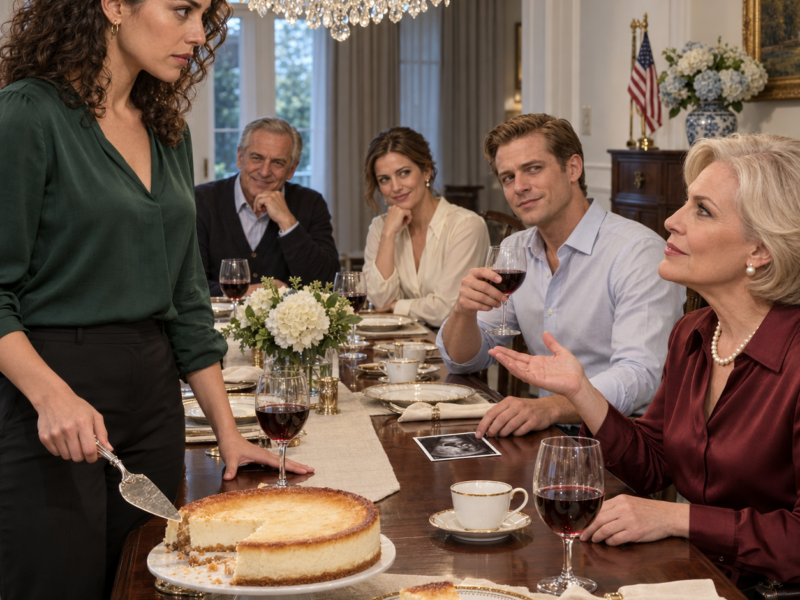
For nearly two years, I secretly learned German because I wanted to feel closer to my husband’s family. They assumed I still understood nothing, so during Sunday dinner, they discussed his pregnant mistress, my money, and the plan to make me raise his child while I sat beside them. When my mother-in-law smiled and said, “Claire will sign anything once she becomes attached to the baby,” everyone laughed. I placed my napkin beside my plate and answered in German: “You should be more careful when planning someone’s life in front of her.”

For almost two years, I secretly learned German because I wanted to surprise my husband’s family. I imagined revealing it over Christmas dinner, perhaps by answering one of his mother’s questions before Julian could translate. I thought they would laugh, embrace me, and finally understand how much I wanted to belong.
Instead, the first complete conversation I understood was about how they planned to make me raise my husband’s baby with another woman.
It happened on a Sunday night in the dining room of Helga and Klaus Bennett’s home outside Milwaukee. I had been married to their son for ten years, yet every time the family switched from English to German, I became a guest at the table.
Helga always apologized afterward.
“Old habit,” she would say, patting my hand. “You understand. Some ideas are easier in the language of home.”
I did understand. At least, I thought I did.
That was why I began taking lessons through an online language school. I practiced during my lunch breaks, listened to German news while driving, and kept a notebook hidden inside a box of old tax returns because Julian never opened anything labeled taxes.
By the second year, I could follow ordinary conversation. I could read newspapers, write short messages, and understand most of what Helga said when she believed I could not.
I had not told Julian because I wanted the reveal to be perfect.
On that Sunday, Helga served sauerbraten, potato dumplings, and red cabbage in the formal dining room she reserved for family occasions. The mahogany table had been a wedding gift from her and Klaus. It was so dark and polished that every face appeared faintly reflected in its surface.
Julian sat beside me. Across from us were Helga, Klaus, and Julian’s younger sister, Marta.
At first, dinner was ordinary.
Klaus discussed replacing the fence around his garden. Marta complained about a supervisor at the dental practice where she worked. Helga asked whether Julian’s latest business trip to Chicago had gone well.
“Very productive,” he said.
His hand settled on my knee beneath the table.
I smiled because that was what I had done for ten years whenever Julian touched me in public. I treated the gesture as evidence that we were still connected.
Then Helga looked at me.
“Claire, you seem tired.”
“It has been a long week.”
“Another medical appointment?”
Her tone sounded sympathetic, but I felt Marta’s eyes shift toward me.
“Tuesday,” I said. “Just a follow-up.”
Julian squeezed my knee.
For six years, we had been trying to have a child.
At first, we approached it with optimism. We bought ovulation tests at Target and joked about future baby names. Then a year passed. Then two. The jokes disappeared, replaced by appointments, blood draws, hormone injections, and monthly hope that ended in the bathroom with another negative test.
I underwent three procedures. I changed my diet. I gave up coffee for eight months, even though Julian continued drinking it beside me every morning. I scheduled work around clinic visits and learned to inject medication into my stomach while standing beneath the harsh light of our bathroom mirror.
Julian attended many appointments. He held my coat, drove when medication made me dizzy, and told me not to blame myself.
“It’s okay,” he would whisper when another cycle failed. “We still have each other.”
I believed his gentleness was love.
At thirty-eight, I had begun questioning how much longer I could continue. Our specialist recommended one final treatment cycle before discussing alternatives. Adoption. Donor eggs. A life without children.
Every possibility carried its own grief.
Helga had never accepted uncertainty gracefully. She wanted a grandson with the Bennett name and spoke about it as though biology were a family debt I had failed to pay.
She did not insult me directly. Her cruelty came wrapped in concern.
“Stress can make conception difficult.”
“Career women sometimes wait too long.”
“In my generation, we did not analyze everything so much.”
Julian always told me to ignore her.
“She’s old-fashioned,” he said. “She doesn’t mean anything by it.”
That night, after asking about my appointment, Helga changed the subject. Dessert arrived. Marta poured coffee. The conversation shifted to Christmas plans and a cousin’s upcoming wedding.
Then Marta began speaking German.
“How much longer are we going to pretend she does not know?”
I nearly dropped my spoon.
Nobody noticed.
Julian answered in German. “Not tonight.”
Helga glanced at me. I lowered my eyes to the apple cake and acted as if I were trying to separate a walnut from the frosting.
“Sophie cannot hide the pregnancy much longer,” Marta said.
The name meant nothing to me then.
Helga spoke sharply. “Keep your voice down.”
Marta gave a small laugh. “Why? Claire never bothered to learn.”
My pulse began hammering against my ribs.
Julian’s hand was still resting on my knee.
I forced myself not to move.
Klaus spoke next. “The child is Julian’s responsibility. This must be handled before the birth.”
The child.
Julian.
Sophie.
I understood every word, yet my mind rejected the meaning.
Helga leaned toward her son.
“You will not leave Claire now. That would be foolish.”
Julian lifted his coffee. “I know.”
“Her insurance is better than yours. The house belongs to her, but you have marital rights. And after everything she has spent trying to have a baby, she will not walk away from a newborn.”
Marta whispered, “You truly think she will raise Sophie’s child?”
Helga looked across the table at me.
I smiled faintly, pretending to notice her attention without understanding its cause.
Then she answered in German.
“We will make her raise this baby.”
The room did not change. The candles continued burning. The grandfather clock ticked in the hallway. Klaus drank his coffee. Julian’s thumb moved once against my knee.
But the marriage I had trusted for ten years ended inside me at that table.
I wanted to stand and overturn every plate. I wanted to demand the woman’s name, the due date, and how long my husband had been lying. I wanted to ask Julian how he could hold my hand in a fertility clinic while preparing another woman to give birth to his child.
Instead, I remembered something my father taught me when I was sixteen and discovered an employee stealing from his hardware store.
“Never confront a liar before you know what the lie is protecting,” he had said.
So I kept eating.
Marta continued. “What if Claire refuses?”
Helga dismissed the possibility with a wave of her hand. “She won’t. Women who want children that badly will forgive almost anything.”
Julian spoke quietly. “She may be angry.”
“Then give her time. Cry if you have to. Tell her Sophie cannot manage motherhood. Claire will convince herself she is saving the child.”
Klaus shifted in his chair. “This is going too far.”
Helga turned toward him. “What would you suggest? That Julian lose his home and half his income over one mistake?”
One mistake.
Julian did not correct her.
He did not say the affair was wrong or that I deserved the truth. He asked only, “What if Sophie expects me to leave?”
“She is young,” Helga said. “She will accept what you provide.”
Marta glanced at me. “And Claire?”
Helga’s smile was almost tender.
“Claire will accept what she believes is her last chance to become a mother.”
I pressed my thumbnail into the side of my finger until the pain anchored me.
Julian turned toward me and switched to English.
“You’re quiet.”
Five faces watched me.
I lifted one hand to my temple.
“I have a terrible headache.”
His expression shifted into concern so naturally that I nearly doubted what I had heard.
“Do you want to go home?”
“Please.”
Helga stood. “I’ll pack dessert.”
“No, thank you. I feel nauseated.”
That part was true.
During the twenty-minute drive home, Julian rested one hand on the steering wheel and the other near the center console. Normally, I would have placed my hand over his.
I kept both hands in my lap.
“You’ve been pushing too hard,” he said. “Maybe take Monday off.”
“Maybe.”
“I hate seeing you like this.”
I looked through the passenger window at familiar streets passing in the darkness.
“Do you?”
He glanced at me. “Of course.”
At home, he brought me water and two pain relievers. He closed the curtains, adjusted the thermostat, and kissed my forehead.
Then he carried his phone into the bathroom.
I heard the shower start.
By the time he returned, I was lying beneath the blankets with my eyes closed. He stood beside the bed for several seconds, perhaps checking whether I was awake.
His phone vibrated once.
He silenced it immediately.
I waited until his breathing became slow and even. At 1:20 in the morning, I slipped into the guest room with my laptop.
The first search was Sophie.
Julian followed three women with that name on social media. One was a college classmate living in Oregon. One appeared to be a consultant in Boston. The third was Sophie Weber, a German-born marketing specialist in Chicago.
Her profile photograph showed a tall blond woman standing near the Chicago River. Buried among older pictures was one taken at a New Year’s party four years earlier. Julian stood behind her with one hand on her shoulder.
The caption called him an old friend.
I searched Julian’s calendar.
His Chicago trips had increased during the previous eight months. At first, there was one each month. Then two. During the last ten weeks, he had gone almost every weekend.
He worked as a regional sales director for a medical-equipment distributor, so travel was believable. His company had clients throughout Illinois and Wisconsin. I had packed his shirts, reminded him to carry medication, and kissed him goodbye at our front door.
Now I created a spreadsheet.
Date. Claimed destination. Hotel charge. Gas purchase. Calendar entry. Message sent to me.
The structure calmed me.
Pain was chaotic. Evidence was not.
One trip stood out. Julian told me he was in Indianapolis for a three-day conference, but the joint credit card showed restaurant charges in Chicago. Another weekend, he claimed he had stayed near O’Hare after a canceled flight. No airline charge appeared, but there was a parking payment near Sophie’s neighborhood.
At 3:40, I found a photograph on Marta’s account from a summer festival. Helga, Marta, and Sophie stood together holding paper cups. The picture had been posted six months earlier.
Helga had known Sophie long before that dinner.
I copied everything into a folder stored in a new encrypted account.
The next morning, Julian made coffee and asked whether I felt better.
“Not really.”
“Stay home.”
“I will.”
He kissed me and left at 7:15.
At 7:22, I watched his car turn out of our subdivision.
At 7:30, I changed the password to my personal email.
At 7:45, I called the fertility clinic and requested copies of my complete medical file.
At 8:10, I called in sick for the first time in four years.
I worked as a finance director for a regional health-care nonprofit. The job was demanding, but it gave me a useful habit: when something felt wrong, I stopped relying on impressions and began reconciling records.
I opened ten years of joint tax files, retirement statements, mortgage records, and bank notices. The house was mine before the marriage. My grandmother had helped with the down payment, and I continued paying most of the mortgage because my salary was higher. Julian covered utilities, insurance deductibles, and many daily expenses.
At least, that was the arrangement I believed we had.
Over the previous eighteen months, several transfers had left our joint savings account. Julian labeled them investment contributions and told me they were going into a diversified fund managed through his employer’s adviser.
I had signed no investment paperwork.
That fact now seemed impossible to ignore.
I searched the home office. I did not force locks or open anything clearly private. I reviewed household files we both used. Bank envelopes had disappeared from their usual cabinet. A folder marked retirement contained only old statements. Our most recent tax packet was missing the schedule listing outside accounts.
At noon, Julian texted.
Feeling any better?
I answered: Sleeping. Head still hurts.
He sent a heart.
I stared at it until my vision blurred.
At 1:00, I drove to a coffee shop where Julian rarely went. I chose a corner table, ordered tea I did not drink, and spread my notes around me.
There were twenty-three questionable business trips, seven unexplained transfers, three bank notices I could not locate, and one pregnant woman whose name had been discussed by my husband’s family as if her child were an asset to be assigned.
I was comparing dates when my phone rang from an unfamiliar Chicago number.
Normally, I would have ignored it.
That day, I answered.
“Is this Claire Bennett?” a woman asked.
“Yes.”
There was a pause.
“My name is Sophie Weber.”
Every sound in the coffee shop seemed to disappear.
The milk steamer.
The clinking cups.
The low conversation around me.
All of it faded beneath the pounding in my chest.
I tightened my grip around the phone.
“I think we need to talk.”
I stared at the list of Julian’s business trips spread across the table.
“How did you get my number?”
“Julian’s phone.”
My stomach turned.
Sophie spoke quickly.
“He left it in my apartment Saturday morning. I found your number under Emergency Contact. I copied it before he came back.”
Saturday morning.
Julian had told me he was meeting a client at seven.
I looked down at the date on my notes.
Another lie.
“Why are you calling me?”
Another silence.
Then Sophie said something I wasn’t expecting.
“Because I heard what his family is planning.”
My fingers went numb.
“You speak German?”
“I am German.”
Of course she was.
I almost laughed at the absurdity.
Instead, I whispered, “Tell me.”
“I don’t want to do this over the phone.”
“Then where?”
She named a bakery twenty minutes away.
“Come alone.”
“I will.”
“And Claire?”
“Yes?”
“Don’t tell Julian I contacted you.”
The line disconnected.
I sat there for another thirty seconds without moving.
Then I gathered my notes.
For the first time since dinner, I wasn’t only hurt.
I was alert.
Because Sophie hadn’t sounded like a victorious mistress.
She had sounded afraid.
I reached the bakery before she did.
I chose a table facing the entrance.
Eleven minutes later, a tall blonde woman walked inside wearing a loose gray coat despite the warm weather.
I recognized her immediately.
Julian still had old photographs buried deep in his Facebook account.
Sophie looked older now.
More tired.
And unmistakably pregnant.
She saw me.
Stopped.
Then walked over.
“Claire?”
I nodded.
She sat across from me.
For several seconds, neither of us spoke.
Finally, she placed her phone on the table.
“I’m sorry.”
I almost stood up.
Sorry.
That word felt obscene.
“You’ve been sleeping with my husband for at least five months.”
“Eight.”
The answer hit harder because she didn’t soften it.
“Eight months?”
“Yes.”
I looked toward the window.
Eight months.
During my fertility treatments.
During the hormones.
During the mornings Julian drove me to the clinic.
During the night he held an ice pack against my stomach after an injection and told me he loved me.
Eight months.
Sophie’s eyes filled.
“I knew he was married.”
“Then don’t insult me by pretending you’re innocent.”
“I’m not.”
That stopped me.
She swallowed.
“I did something terrible. I knew you existed. Julian told me your marriage had been over emotionally for years. He said you were only staying together because selling the house would be complicated.”
I laughed once.
It sounded empty.
“He took me to Paris for our anniversary two years ago.”
Her face changed.
“He told me you slept in separate bedrooms.”
“We don’t.”
“He said you refused physical intimacy.”
“He was holding my hand in a fertility clinic six weeks ago.”
Sophie looked sick.
For the first time, I saw genuine shock.
Then she opened her phone.
“There’s more.”
She slid it toward me.
A message thread.
Julian’s name at the top.
Sophie had taken screenshots.
I read.
Once the baby is born, Claire will come around.
Another.
She wants a child more than anything. Once she bonds with him, she won’t leave.
My throat closed.
Sophie watched me.
“Keep reading.”
I scrolled.
Mom says we need to handle it carefully. Claire can’t know you and I plan to be together eventually.
Then:
She has the house, the insurance, and the better job. It makes sense for the baby to stay there at first.
My stomach twisted.
Our house was mine before Julian.
My grandmother had left me the down payment.
My salary covered most of our mortgage.
Our health insurance came through my employer.
And suddenly Helga’s words made perfect sense.
We’ll make her raise this baby.
Not metaphorically.
Literally.
I pushed the phone back.
“You knew about this?”
“Not all of it.”
“You were going to let me raise your child?”
“No.”
Her voice cracked.
“I thought Julian was going to leave you before the birth.”
“And now?”
“Now I think he never planned to leave you.”
I looked at her.
She wiped beneath one eye.
“Last week, I overheard Julian arguing with Helga. They thought I was sleeping.”
“What did they say?”
“Helga told him divorcing you now would be stupid. She said your income was useful. Your house was useful. Your medical insurance was useful. She said after everything you had spent trying to have a baby, you would accept his son because you would be desperate enough to call it a miracle.”
I felt physically ill.
Sophie continued.
“Julian said you might leave.”
“What did Helga say?”
Sophie’s jaw tightened.
“She said you wouldn’t.”
“Why?”
“Because they had made sure you couldn’t.”
A cold sensation crawled across my skin.
“What does that mean?”
“I didn’t know.”
She unlocked her phone again.
“This morning I found out.”
She showed me another screenshot.
This one wasn’t from Julian.
It was from Helga.
If Claire becomes difficult, remind Julian about the account. She cannot afford a fight once she realizes what he has done.
I stared at it.
“The account?”
“I hoped you knew.”
I didn’t.
But suddenly I remembered the bank envelopes I had seen Julian hide in his office drawer.
Statements he always called retirement paperwork.
The strange transfer six months earlier that he dismissed as an automatic investment.
The tax document he had insisted on handling himself.
I stood.
“I need to go.”
Sophie grabbed her bag.
“Claire.”
I stopped.
“I know you have no reason to trust me.”
“You’re right.”
“But whatever Julian is doing with your money, check it before you confront him.”
I looked at her.
“Why are you helping me?”
Her hand moved instinctively over her stomach.
“Because last night he told me something.”
“What?”
“He said once the baby was born, I needed to be patient.”
I waited.
“He said you would be the legal mother figure. I would be ‘Aunt Sophie’ for a while.”
My mouth fell open.
“He told you that?”
“He said eventually you would become unstable. Jealous. Emotional. Then he could divorce you and ask for the house.”
The room tilted.
Sophie looked directly at me.
“And when I asked where that would leave me, he said, ‘Don’t make this complicated.’”
For the first time, we understood each other.
Neither of us was part of Julian’s future.
We were resources.
I left without hugging her.
Without forgiving her.
But I left with every screenshot she had.
By two that afternoon, I was sitting across from a lawyer named Rachel Kim.
I had called her office from the parking lot.
She had received a cancellation.
I told her everything.
The German conversation.
Sophie.
The pregnancy.
The messages.
The hidden account.
Rachel didn’t react emotionally.
That was exactly what I needed.
She listened.
Took notes.
Then asked one question.
“Do you have joint finances?”
“Some.”
“Separate accounts?”
“Yes.”
“Does Julian have access to yours?”
“Not officially.”
Rachel leaned back.
“First thing you do is change every password. Email. Banking. Cloud storage. Phone carrier. Retirement accounts. Everything.”
I nodded.
“Second, download statements before he realizes you’re looking.”
“What if he has taken money?”
“Then we document it.”
“What if I confront him?”
“Don’t.”
My eyes lifted.
Rachel’s voice stayed calm.
“If he believes you know nothing, let him keep believing that.”
That evening, I went home.
Julian was cooking pasta.
Actually cooking.
He smiled when I walked in.
“Feeling better?”
I nearly flinched.
Then I remembered.
He thought I’d called in sick.
“Much.”
He kissed my forehead.
Behind him, his phone rested beside the cutting board.
He turned back toward the stove.
“Sophie called me today.”
The wooden spoon stopped.
Just for half a second.
Then he continued stirring.
“Sophie?”
“From my office.”
His shoulders relaxed.
“My Sophie is in Chicago.”
My Sophie.
I smiled.
“Of course.”
That night, I waited until he slept.
Then I went downstairs.
Rachel had told me not to access accounts illegally.
But she had also told me I had every right to review statements from accounts bearing my name.
Our joint savings account was first.
Three minutes later, I understood Helga’s message.
There had once been $118,000 in it.
Money accumulated over ten years.
My bonuses.
My grandmother’s final inheritance payment.
Our supposed future-child fund.
The current balance was $41,306.
I stared at the screen.
Then searched the transactions.
Transfers.
$5,000.
$8,500.
$12,000.
$4,000.
Again.
Again.
Again.
All moved into an investment account I didn’t recognize.
Seventy-six thousand dollars.
Over eighteen months.
I downloaded everything.
Then I checked our home equity documents.
That was when I stopped breathing.
There was an application.
Incomplete.
For a $150,000 home equity line of credit.
Julian had started it six days earlier.
On my house.
His stated purpose?
Home renovation.
We hadn’t discussed any renovation.
But it got worse.
The application listed a personal email address I didn’t know.
I searched it.
Buried in autofill records on our family laptop was an inbox Julian had forgotten to sign out of.
I should have closed it.
Instead, I saw Helga’s name in the preview.
Claire signature
I clicked.
There were scanned documents attached.
My driver’s license.
My tax returns.
My pay stubs.
And a practice copy of my signature.
Dozens of times.
Claire Bennett.
Claire Bennett.
Claire Bennett.
My own name stared back at me in Julian’s handwriting.
I photographed the screen.
Then called Rachel.
At 1:13 in the morning.
She answered.
“Tell me you didn’t confront him.”
“No.”
“Good.”
“I found attempted signature forgery.”
Silence.
“Send me everything.”
I did.
The next morning, Rachel brought in a forensic accountant.
By Thursday, we knew enough.
Julian hadn’t just been cheating.
He had been preparing.
The investment account receiving our savings wasn’t an investment account at all.
It belonged to a limited liability company.
JHB Property Holdings.
Julian Heinrich Bennett.
Registered six months earlier.
The address?
Helga and Klaus’s house.
Then the accountant found another transfer trail.
Money from Julian’s LLC had been used for deposits on two condominiums.
One was rented.
One was still under construction.
The second unit had an occupancy date three weeks before Sophie’s due date.
I knew before anyone said it.
“That’s where he was planning to live with her.”
The accountant nodded.
But Rachel shook her head.
“Not exactly.”
She placed another document in front of me.
The purchase agreement listed the future occupant as Julian.
No Sophie.
There was also a draft lease for the rental unit.
Tenant name:
Sophie Weber.
“He was going to keep her separately housed,” Rachel said.
“And live with me?”
“That appears to have been his short-term plan.”
I stared at Julian’s signature.
The cruelty was so organized.
That was the worst part.
This wasn’t one impulsive affair.
It was architecture.
He had designed a life where every woman around him served a function.
Sophie produced the child.
I produced the money.
Helga produced the strategy.
And Julian got everything.
On Friday, Helga called me.
“Dinner Sunday?”
Her voice was warm.
Almost maternal.
“We’re celebrating some family news.”
I almost laughed.
“I’d love to.”
Sunday arrived.
I dressed carefully.
Navy dress.
Pearl earrings.
The same perfume Julian bought me for our anniversary.
Then I placed a small digital recorder inside my purse.
Rachel had already explained the laws in our state.
I knew exactly what I could and could not record.
At seven, I sat again at the mahogany dining table.
Same room.
Same people.
Helga.
Klaus.
Marta.
Julian.
They served roast chicken.
German potatoes.
Wine.
I smiled.
I asked about Klaus’s garden.
I complimented Marta’s necklace.
I kissed Helga’s cheek.
They relaxed.
Halfway through dinner, Marta switched to German.
“Has Sophie agreed to everything?”
Julian glanced at me.
I was cutting chicken.
“Yes.”
A lie.
Sophie had agreed to nothing.
She had retained her own lawyer two days earlier.
Helga lowered her voice.
“What about Claire’s signature?”
My pulse hammered.
Julian drank wine.
“I can handle Claire.”
Klaus frowned.
“You said the bank might require her in person.”
“They won’t if we use the online process.”
Marta laughed.
“What if she notices?”
Julian looked at me.
I smiled innocently.
He turned back.
“She doesn’t even check the account.”
They laughed.
My fingernails pressed into my palm beneath the table.
Helga leaned closer.
“Once Sophie delivers, we move quickly. Claire will be emotional. She will think this is her only chance to have a child.”
Marta whispered, “You really think she’ll accept him?”
Helga smiled.
“She will if Julian cries enough.”
Another laugh.
Something inside me finally became still.
Not broken.
Still.
There was a difference.
Julian said, “She’ll be angry at first.”
“Then tell her Sophie can’t care for the baby,” Helga replied. “Tell her the mother is unstable.”
My fork stopped.
Sophie wasn’t unstable.
She was terrified.
Helga continued.
“And once Claire starts caring for the boy, she won’t walk away. Women like her get attached.”
Women like her.
Women who had lost pregnancies.
Women who wanted children.
Women whose grief could be weaponized.
Then Klaus said the sentence that ended whatever mercy I had left.
“After a year, refinance the house. By then she’ll sign anything.”
I placed my napkin on the table.
Everyone looked at me.
Julian smiled.
“You okay?”
I looked at him.
Then answered in German.
Perfectly.
Fluently enough.
“I’m wonderful.”
Silence.
Marta’s face emptied.
Klaus froze.
Helga’s wineglass stopped halfway to her lips.
Julian stared at me.
“What did you say?”
I smiled.
Then continued in German.
“I said I’m wonderful. Although I admit dinner was more entertaining last week, when you explained how you intended to make me raise Sophie’s baby.”
No one moved.
Julian’s face drained of color.
Helga whispered, “You speak German?”
“For two years.”
Marta covered her mouth.
I looked at Julian.
“And apparently much better than you realized.”
He stood.
“Claire—”
“Sit down.”
Maybe it was my tone.
Maybe it was the expression on my face.
But he sat.
I switched back to English.
“I know about Sophie.”
Julian swallowed.
“I can explain.”
“I know she’s eight months into an affair with you.”
Helga whispered something under her breath.
I answered her in German.
“Yes, Helga. I understood that too.”
Her face reddened.
I continued.
“I know about the $76,000 you moved from our joint savings.”
Klaus turned sharply toward Julian.
Interesting.
He hadn’t known the amount.
“I know about JHB Property Holdings.”
Now Marta looked confused.
“And I know about the condos.”
Helga stared at her son.
Apparently she hadn’t known everything either.
That was when I realized Julian had been lying to them too.
Not as much.
But enough.
“Claire,” he said, lowering his voice, “you’re upset.”
I laughed.
“Do not use that word.”
He stood again.
“We should go home and discuss this privately.”
“We don’t have a home together anymore.”
His face changed.
I reached into my purse.
Not for the recorder.
For an envelope.
I slid it across the table.
Julian opened it.
His eyes moved over the first page.
Then stopped.
Divorce petition.
Marta gasped.
Helga pushed back from the table.
“You cannot do this over one mistake.”
“One?”
I turned toward her.
“Was the affair one mistake? Or stealing our savings? Or trying to forge my signature? Or discussing how to psychologically manipulate me into raising my husband’s affair baby?”
Helga went pale.
Klaus slowly lowered his fork.
Julian’s jaw tightened.
“There was no forgery.”
I looked at him.
“Then you’ll have no problem explaining those practice signatures to the bank’s fraud department.”
He froze.
“And the police.”
Helga whispered, “Police?”
I watched Julian finally understand.
This wasn’t a marital argument.
This wasn’t something he could smooth over with flowers.
He had crossed into documents.
Money.
Fraud.
He lunged for my purse.
Klaus grabbed his arm.
“Julian!”
I stood.
“Don’t touch me.”
Julian pulled free.
“You went through my things!”
“Our joint financial records.”
“You had no right—”
“No right to discover you were stealing my money?”
“I was investing it for us!”
“In condos Sophie didn’t even know existed?”
Another silence.
That landed.
Helga turned.
“What?”
Julian looked at me with pure hatred.
I smiled.
“You didn’t tell your mother?”
I pulled another document from the envelope.
“Sophie wasn’t going to live with Julian.”
Helga grabbed the page.
“She was going to be placed in one condo. Julian planned to remain married to me.”
Marta looked at her brother.
“Is that true?”
He didn’t answer.
“And the baby?” Helga demanded.
I watched her carefully.
That was what she cared about.
The grandchild.
Julian’s heir.
Her plan.
I said, “Sophie knows everything.”
Helga’s face changed.
“You spoke to her?”
“She called me.”
Julian exploded.
“That lying—”
“Be careful,” I interrupted. “That woman is carrying your child.”
He stopped.
I stepped away from the table.
“And unlike all of you, she eventually decided that turning a baby into leverage was disgusting.”
Helga stood.
“You poisoned her against us.”
“No.”
A voice came from behind me.
Everyone turned.
Sophie stood in the dining room doorway.
Julian went completely white.
She wasn’t alone.
A middle-aged woman in a dark blazer stood beside her.
Her attorney.
Sophie looked at Julian.
“You did that yourself.”
He stumbled backward.
“What are you doing here?”
“Claire invited me.”
That wasn’t entirely true.
Rachel had.
But the effect was worth it.
Sophie walked toward the table.
“I know about the apartment.”
Julian opened his mouth.
“I know about Claire’s money.”
His mouth closed.
“I know you told your mother I was emotionally unstable.”
Helga stiffened.
“I know you planned to have Claire care for my son while telling people I was unfit.”
Julian looked around the room.
For the first time, no one was on his side.
Not even Helga.
“You’re twisting things,” he said.
Sophie laughed bitterly.
“You told me Claire was barren and cold.”
My stomach tightened at the word.
Sophie looked at me.
“I’m sorry.”
I nodded once.
Not forgiveness.
Acknowledgment.
Then she faced Helga.
“And you told Julian he should make me sign temporary custody paperwork after delivery.”
Helga’s mouth opened.
“I said only if necessary.”
Sophie’s attorney stepped forward.
“We have the messages.”
Helga sat down.
Julian looked trapped.
Then he made one final mistake.
He turned to me.
“You think Sophie is your friend now?”
“No.”
That seemed to surprise everyone.
I looked at Sophie.
“She slept with my husband knowing he was married.”
Sophie lowered her eyes.
“I haven’t forgotten that.”
Then I looked at Julian.
“But the difference is Sophie finally told the truth.”
I picked up my purse.
“You still haven’t.”
I walked out.
Julian followed me into the driveway.
“Claire!”
I kept walking.
“Claire, stop!”
I turned.
Ten years of marriage stood twenty feet behind me.
The man I had loved.
The man whose children I had tried desperately to carry.
The man who had rubbed my back while I cried.
He suddenly looked very small.
“You’re really going to throw away ten years?”
I stared at him.
“I didn’t throw them away.”
He stepped closer.
“I love you.”
“No.”
“I do.”
“You love what I provide.”
His eyes filled.
Maybe the tears were real.
That didn’t matter anymore.
“You wanted my house.”
“Claire—”
“My insurance.”
“That isn’t—”
“My salary.”
“Stop.”
“My grief.”
His face twisted.
“And eventually,” I whispered, “you wanted me to give your betrayal a bedtime story and call it motherhood.”
He had no answer.
I got into my car.
Three months later, Julian moved into a one-bedroom rental.
The court froze the disputed accounts.
The bank canceled the home equity application.
The forensic audit uncovered enough irregularities that Julian’s attorney quickly stopped talking about an amicable reconciliation and started talking about settlement.
Most of the missing money was recovered.
Not all.
Enough.
Helga called me eleven times.
I answered once.
She told me family should forgive.
I asked her in German whether that principle applied before or after forging a daughter-in-law’s signature.
She hung up.
Marta sent an apology.
Klaus sent nothing.
Julian sent everything.
Flowers.
Emails.
Letters.
Photographs.
A ten-page handwritten explanation.
I read none of it.
Then, one rainy Tuesday morning, Sophie called.
“I had the baby.”
I closed my eyes.
“Is he healthy?”
“Yes.”
I was surprised by how relieved I felt.
“What did you name him?”
“Leon.”
Silence stretched between us.
Then she said, “Julian wants visitation.”
“He’s the father.”
“I know.”
“And you’ll have to work that out.”
“I know.”
She hesitated.
“There’s something else.”
My stomach tightened.
“What?”
“I found something in Julian’s storage box.”
I almost told her I didn’t care.
Then she said, “It has your name on it.”
Two days later, Sophie mailed me a small envelope.
Inside was a photocopy of a clinic document dated three years earlier.
A fertility specialist.
My fertility specialist.
At first, I didn’t understand why Julian had it.
Then I read the second page.
There were two patient sections.
Claire Bennett.
Julian Bennett.
My results were familiar.
Julian’s were not.
I had never seen them.
Severe male-factor infertility.
Additional testing recommended.
Probability of natural conception extremely low.
I read it twice.
Then three times.
My hands began shaking.
For six years, Julian had let me believe the problem was primarily mine.
My irregular cycles.
My age.
My hormones.
My body.
I remembered every injection.
Every apology I had made to him.
Every time I whispered, “I’m sorry I can’t give you a baby.”
And every time he answered:
“It’s okay.”
Not once had he told me.
I called Rachel.
Then the fertility clinic.
There had been follow-up results.
Julian had requested that his records be released separately.
He had known.
For years.
But there was one more page in the envelope.
A DNA laboratory receipt.
Recent.
Very recent.
I called Sophie.
She answered immediately.
“What is this?”
Her voice went quiet.
“I was hoping you would see that last.”
“What test?”
“Julian ordered it.”
“When?”
“After Leon was born.”
I stopped breathing.
“Why?”
“Because Helga demanded it.”
I closed my eyes.
“And?”
Sophie began crying.
“Leon isn’t Julian’s.”
The room went silent around me.
“What?”
“He’s not the father.”
I sat down.
Sophie struggled to speak.
“I didn’t know.”
“Then whose child is he?”
“My ex-fiancé’s, probably. I saw him once during the same month Julian and I started seeing each other. I thought the dates made Julian more likely.”
The irony was almost impossible to process.
Julian had destroyed a ten-year marriage.
Stolen money.
Planned a second life.
Manipulated his pregnant mistress.
Humiliated his wife.
And built an entire conspiracy around a baby who wasn’t even his.
But then Sophie said something that made the ending even stranger.
“Julian already knows.”
I stared at the wall.
“What did he do?”
“He accused me of ruining his life.”
I laughed.
I couldn’t help it.
For almost a full minute, I laughed until tears ran down my face.
Not because any of it was funny.
Because somewhere between betrayal and absurdity, my body had run out of other reactions.
Sophie stayed silent.
Finally, I said, “Take care of your son.”
“I will.”
“And Sophie?”
“Yes?”
“Don’t ever let anyone convince you that Leon exists to repair someone else’s life.”
She started crying again.
“I won’t.”
We never became friends.
That wouldn’t have been honest.
But we stopped being enemies.
The divorce became final eleven months after that dinner.
I kept my house.
Recovered most of my money.
And Julian signed the settlement two days before prosecutors formally charged him over documents connected to the fraudulent credit application.
Helga didn’t attend the hearing.
Neither did Marta.
Klaus did.
He sat in the back row without looking at me.
Julian looked ten years older.
As I walked past him, he whispered my name.
“Claire.”
I stopped.
For one terrible second, I remembered our first apartment.
Our wedding.
Our trip to Italy.
The night we painted the kitchen until two in the morning.
The man I thought he was existed inside those memories.
But memory is not evidence.
I turned.
He looked at me.
“Did you ever love me?”
I considered the question.
“Yes.”
His face crumpled.
Then I finished.
“I loved someone who never existed.”
I walked away.
Six months later, I sold the mahogany dining table Helga had given us as a wedding gift.
I replaced it with a simple oak table beside a window.
Nothing ornate.
Nothing dark.
Nothing that reminded me of people whispering in another language while assuming I was too stupid to understand them.
On the first Sunday after it arrived, I made dinner for myself.
I poured one glass of wine.
I sat down.
And for the first time in years, the silence around my table felt peaceful instead of lonely.
My phone buzzed.
It was a photo from Sophie.
Leon was sitting upright for the first time.
Round cheeks.
Tiny hands.
A ridiculous blue hat.
Under the picture, she had written:
He’s doing well. Thought you might like to know.
I smiled.
Not because he was mine.
Not because he ever would be.
But because somewhere along the way, I had finally understood something Julian and Helga never had.
Wanting a child had never made me weak.
Loving someone had never made me stupid.
Trusting my husband had not made me incapable of surviving his betrayal.
They had mistaken my patience for ignorance.
My grief for desperation.
My kindness for obedience.
And my silence for permission.
I typed back:
He looks happy. Take care of him.
Then I set the phone down.
Outside, the evening light stretched across my kitchen floor.
For almost two years, I had secretly learned German because I wanted to belong to my husband’s family.
In the end, the language gave me something far more valuable.
It taught me exactly who they were.
It also forced me to learn who I was without Julian.
That part took longer than the divorce.
For the first few months, I woke before dawn with the conviction that I had forgotten something important. My body remembered the old schedule before my mind did. Check whether Julian needed a clean shirt. Confirm his flight. Pack his medication. Review the clinic calendar. Ask whether he would be home for dinner.
Then I would open my eyes and see only my side of the bedroom occupied.
The quiet felt frightening at first. It seemed to accuse me of failing. Ten years of marriage had trained me to measure a successful day by how smoothly I made life run for two people. When there was only one person left, I did not know what counted as enough.
Rachel recommended a therapist named Dr. Lena Morris, who specialized in betrayal and financial abuse.
During our first appointment, I spent forty minutes describing Julian’s behavior in the language of an audit. Dates. Transfers. Messages. Documents. I explained the affair, the proposed credit line, the forged signature, and Helga’s plan in a voice that sounded as if I were reporting another family’s losses.
Dr. Morris listened until I finished.
Then she asked, “What did this do to you?”
I pointed toward the folder on my lap. “I just told you.”
“You told me what he did.”
“Isn’t that the same thing?”
“No.”
I had no answer.
Facts had always protected me. If I could establish exactly what happened, I did not have to sit inside the humiliation of having loved the person responsible.
Dr. Morris never asked me to stop being practical. She asked me to notice when practicality became hiding.
“You are allowed to grieve a marriage you are relieved to leave,” she said.
That sentence gave me permission I had not known I needed.
I grieved in ordinary places. In the supermarket when I reached automatically for Julian’s cereal. In the garage when I found the folding chairs from our first apartment. At work when a colleague announced her pregnancy and immediately apologized for telling me.
“Please don’t make your happiness smaller for me,” I told her.
I meant it.
Then I went into the restroom and cried for five minutes before returning to a budget meeting.
Healing was not graceful. It was a collection of small, sometimes contradictory choices. I could wish Sophie a safe delivery and still feel anger when I saw her name. I could remember Julian rubbing my back after a failed treatment and understand that the comfort had existed beside deception. I could love the life I thought we shared without wanting the man who had lied about it.
The financial case moved more slowly than my emotions wanted. Lawyers requested records. The bank’s fraud team examined access logs and timestamps. A handwriting specialist compared my genuine signature with the practice pages recovered from Julian’s hidden email account.
Julian initially claimed he was preparing the documents so we could discuss the credit line later. That explanation lasted until investigators found a message to Helga saying the online application might avoid an in-person signature review.
His attorney then argued that no money had actually been borrowed, so no real harm occurred.
Rachel’s response was simple.
“The fact that the lock worked does not make attempted entry harmless.”
The prosecutor eventually offered Julian an agreement that required restitution, probation, financial monitoring, and a formal admission concerning the falsified application materials. He avoided incarceration, partly because the loan was stopped before funds were released and partly because he cooperated after the evidence became impossible to deny.
I did not object.
I wanted protection and accountability, not a punishment dramatic enough to satisfy strangers. Julian had lost his marriage, his access to my house, much of his savings, and the career position that depended on his reputation. He would spend years repaying what remained missing.
Consequences did not need to destroy him to be real.
The day he signed the agreement, he sent one message through Rachel.
Please tell Claire I understand that she saved herself because I gave her no other choice.
I read it once.
“Do you want to respond?” Rachel asked.
“No.”
Understanding arrived too late to rebuild our marriage, but I hoped it might stop him from repeating the same damage with someone else.
Helga handled consequences differently.
She spent months searching for a version of events in which she remained the protector of her family. She blamed Sophie for the affair, me for investigating, Marta for speaking too openly at dinner, and eventually Klaus for not stopping Julian sooner.
She never blamed the plan itself.
Klaus moved into the guest room shortly after the dinner confrontation. Six months later, he rented an apartment. He wrote me one letter before the divorce became final.
Claire,
I was present when things were said that should never have been said. I told myself silence meant I had not participated. I was wrong. I am sorry.
The apology did not ask me to return, forgive, or protect the family’s reputation. I appreciated that.
I wrote back with two sentences.
Thank you for acknowledging it. I hope you choose differently the next time silence is convenient.
Marta apologized too, though hers came in stages. The first message said she was sorry I had overheard a private conversation. I answered that the privacy of a conversation did not change its content.
Three weeks later, she tried again.
I am sorry I spoke about you as though you were an obstacle instead of a person sitting across from me. I knew about Sophie and did not tell you. There is no excuse for that.
I did not become close to Marta, but when we later crossed paths at a hospital fundraiser, we could greet each other without pretending the past had not occurred.
Sophie’s life was more complicated.
The DNA result ended Julian’s paternity claim, but it did not solve the practical realities of raising Leon. Her ex-fiancé, a man named Erik, completed a legal test confirming he was the father. He was shocked, angry, and initially uncertain about what role he wanted.
Sophie called me once during that period.
“I don’t know why I’m telling you this,” she said.
“Neither do I.”
“You are the only person who knows the whole story.”
“Knowing it does not make me the right person to guide you.”
“I know.”
I could hear Leon fussing in the background.
Sophie lowered her voice. “How do I make sure I never become like Helga?”
The question surprised me.
“Tell the truth before a child has to discover it,” I said. “Do not make Leon responsible for repairing your shame. And let his father prove what kind of parent he will be through actions, not promises.”
Erik eventually chose shared responsibility. It was not a romantic reunion. He and Sophie attended mediation, created a parenting plan, and learned to communicate through a scheduling application when direct conversations became tense.
That ordinary arrangement seemed healthier than every grand promise Julian had made.
Sophie later returned the $9,000 Julian had given her for expenses during the pregnancy. Her lawyer advised her that she was not legally required to do so, but she insisted. The money became part of my restitution.
I almost refused it.
Dr. Morris asked why.
“Because Sophie has a baby to support.”
“And because accepting repayment makes you feel unkind?”
“Maybe.”
“Claire, compassion does not require you to subsidize the person who participated in harming you.”
I accepted the money.
That boundary helped both of us. Sophie was no longer trying to purchase forgiveness, and I was no longer confusing forgiveness with relieving everyone else of consequences.
At work, I became more attentive to financial-abuse cases involving employees and family members. Our nonprofit served patients, but many of their crises arrived with practical problems that medical care alone could not solve. Older spouses discovered accounts emptied during illness. Adult children pressured parents to sign property documents. Women stayed in unsafe relationships because their partners controlled every password and bank statement.
I proposed a financial-safety program with a local legal clinic. We trained social workers to recognize warning signs and helped clients secure identification, review credit reports, and understand documents before signing.
The program was not named after me. I did not tell clients my story.
But each time someone recovered access to an account or stopped an unauthorized loan, I felt that some useful thing had grown from what happened.
One woman in her late sixties held my hand after we helped block the sale of her home.
“I feel stupid,” she whispered. “It was my own son.”
“Trusting someone you love is not stupidity,” I told her. “The deception belongs to the person who chose it.”
I heard my own words and realized I finally believed them.
The house changed slowly.
I repainted the bedroom a pale blue Julian had once dismissed as too cold. I converted his office into a reading room and donated the oversized desk. I replaced the family photographs in the hallway with pictures of places I had traveled before marriage and wanted to visit again.
On my fortieth birthday, I flew to Vancouver with my college friend Natalie. We ate seafood beside the harbor, took a ferry in the rain, and spent an entire afternoon in a bookstore without anyone checking the time.
At dinner, Natalie raised her glass.
“To the first year nobody gets to manage for you.”
I laughed. “I still manage myself.”
“You know what I mean.”
I did.
The following spring, I returned to German class.
For several months after the divorce, I could not bear to hear the language. Its rhythm pulled me back to Helga’s dining room and the sound of people discussing my life as if I were furniture.
Then I realized the language did not belong to them.
I had spent hundreds of hours learning it. I had read novels, memorized poems, and discovered music that had nothing to do with the Bennett family. Abandoning it would give them ownership over something I had earned.
My new instructor, Anja, organized a conversation group at a neighborhood bakery. The first evening, I sat among teachers, retirees, college students, and immigrants helping American spouses speak with grandparents overseas.
Nobody whispered around me.
Nobody used language as a locked door.
We made mistakes, corrected each other, and laughed.
I finally understood that belonging was not something another family could grant by allowing me to decode their secrets. It was something built through mutual respect.
Nearly two years after the dinner, I received a letter from Julian. It had been screened by Rachel and contained no legal issue, so she asked whether I wanted it.
I did.
He wrote that he had left medical-equipment sales and was working for a small logistics company. He attended counseling and a financial-accountability group. He had not spoken to Helga for several months.
The letter did not ask for reconciliation.
Near the end, he wrote:
I used your desire for a child because I believed it guaranteed you would stay. I knew about my diagnosis and let you carry the blame because admitting the truth frightened me. There is no explanation that makes that less cruel. I am sorry for the years you spent believing your body had failed us when I had hidden information that belonged to both of us.
I cried after reading it.
Then I placed it in the same file as the settlement and clinic report.
I did not answer.
Some apologies are important even when they do not reopen a relationship. They can return the truth to the person who was forced to live inside a lie.
By then, I no longer wanted a child at any cost. I also no longer assumed motherhood was closed to me. I met with an adoption counselor, attended one information session, and decided I was not ready. For once, I allowed uncertainty to remain without treating it as an emergency.
My life was not a waiting room for the family I had imagined.
It was already a life.
And the last time I ever saw Helga, months after the divorce, we crossed paths outside a grocery store.
She looked older.
Smaller somehow.
She stared at me for several seconds before speaking.
In German.
“You destroyed our family.”
I looked directly into her eyes.
Then I answered her in the language she once used to hide the truth from me.
“No, Helga.”
I smiled.
“I just finally understood what you were saying.”
And I walked away.









