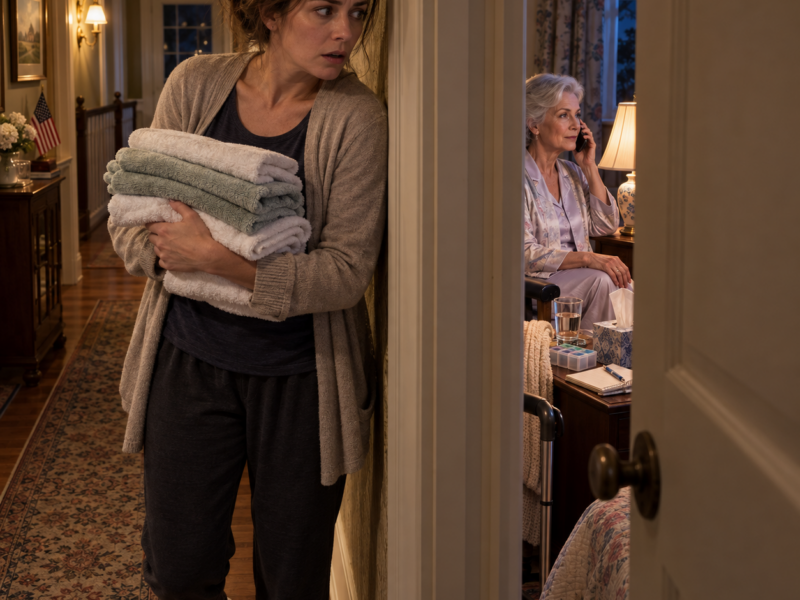
For eight months, I bathed my mother-in-law, cut her food, changed her sheets, and eventually quit my job because everyone said her memory was disappearing. My husband kept telling me, “She only trusts you, Natalie.” Then one night, I passed Vivian’s bedroom and heard her speaking on the phone in a voice I hadn’t heard in months—clear, sharp, completely focused. “Friday is the last step,” she said. “Natalie signed what mattered.” Then she laughed and added, “She still has no idea.” The person on the other end was my husband.
The first thing that exposed Vivian Mercer was not her voice.
It was the way she laughed.
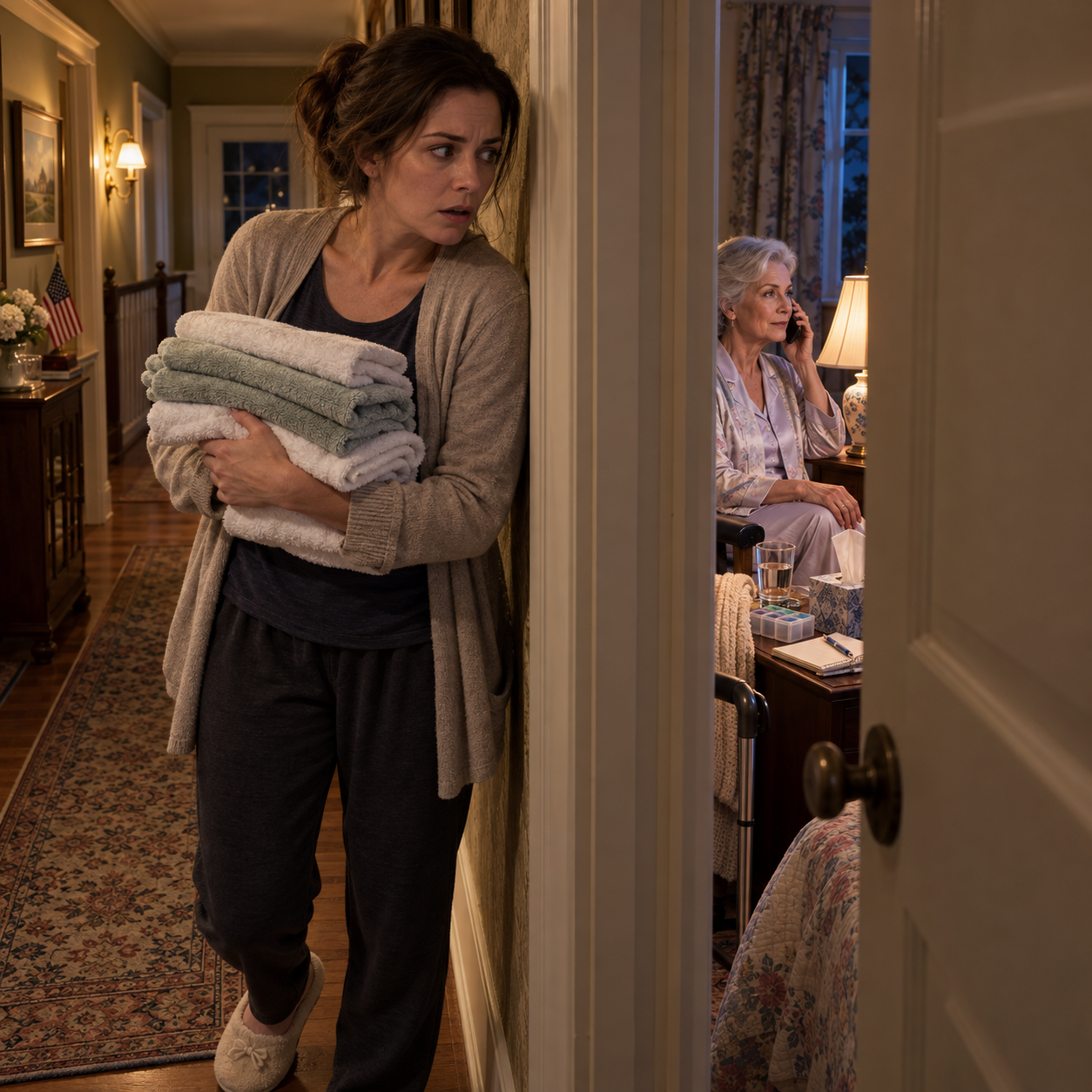
I was halfway down the upstairs hall with a stack of folded towels pressed against my chest when I heard it through her bedroom door.
Low.
Sharp.
Satisfied.
Nothing like the uncertain little chuckle she used around me when she pretended not to understand why the television remote had stopped working.
Nothing like the embarrassed laugh she gave when she supposedly forgot my name.
This laugh belonged to a woman who knew exactly where she was, exactly who she was talking to, and exactly what she was doing.
I stopped walking.
The dryer thumped downstairs.
Rain tapped softly against the old bedroom windows.
Vivian’s door stood open barely an inch.
Then she said, clear as day:
“No, Grant. Listen to me. Friday is the last step.”
My fingers tightened around the towels.
Grant.
My husband.
There was a pause.
I could not hear him on the other end of the call, but I could hear Vivian.
“She signed what mattered.”
Another pause.
“You worried for nothing.”
I stopped breathing.
Vivian continued.
“Natalie thinks those papers were related to my care.”
And then she laughed.
That laugh.
The sound would stay with me for years.
“She still has no idea.”
Eight months.
For eight months I had cut her food into small pieces because she supposedly forgot how to use a knife.
I had buttoned her sweaters when her fingers became “confused.”
I had shampooed her hair because she cried that she could not remember the right order.
I had changed sheets after accidents she described with trembling humiliation.
I had sat beside her at three in the morning while she asked where her dead husband was.
I had watched her stare blankly at a grocery receipt as though numbers no longer meant anything.
I had left my job.
Stopped seeing friends.
Canceled two planned weekends with my aunt in Cincinnati.
Put my marriage under a strain so constant that I had stopped remembering what life before caregiving felt like.
And my husband had repeated the same sentence every time I said I could not keep doing it.
“She only trusts you, Natalie.”
Standing outside Vivian’s bedroom, I finally understood why.
Trust was never the point.
Access was.
I nearly pushed the door open.
I could see myself doing it.
Towels hitting the floor.
Vivian jumping.
Me demanding to know what she meant.
Grant rushing home.
Everybody shouting.
Years earlier, that probably would have been exactly what I did.
But exhaustion changes people.
So does running the front office of a dental practice for eleven years.
Four dentists.
Six hygienists.
Insurance claims.
Payroll.
Supply vendors.
Staff schedules.
Patient complaints.
Deposit discrepancies.
Denied benefits.
Invoices that somehow became more expensive between estimate and delivery.
Our accountant used to joke that I could find a seven-dollar error buried in six months of transactions before lunch.
I had not stopped being that woman because I became tired.
I had only forgotten her for a while.
One thought cut through the shock.
Friday is the last step.
Friday was three days away.
Whatever Grant and Vivian were doing, they believed they were almost finished.
If I confronted them now, they would know I had finally started looking.
So I did the hardest thing I had done in months.
Nothing.
I walked downstairs.
Folded the towels again because my hands had ruined the stack.
Placed them in the linen closet.
Then stood in the kitchen until my breathing slowed.
At 12:18 a.m., Vivian rang the little brass bell Grant had placed beside her bed.
I went upstairs.
By the time I entered, her face had changed completely.
Her eyes wandered.
Her mouth hung slightly open.
“Natalie?”
“Yes, Vivian.”
“Is it morning?”
“No.”
She frowned at the clock.
“What day is it?”
“Tuesday.”
Her chin trembled.
“I’m sorry.”
“For what?”
“I’m so much trouble.”
Three hours earlier, that sentence would have made my heart ache.
Now I looked at her.
At the watery eyes.
The shaking hand.
The blanket pulled neatly to her waist.
For the first time, I noticed how controlled the shaking was.
Not constant.
Not involuntary.
It appeared when she wanted me watching it.
“I need the bathroom.”
She whispered.
“Of course.”
I helped her stand.
She leaned heavily on my arm.
For eight months, I had believed all of that weight.
That night I wondered how much she was choosing to give me.
When she was back in bed, she reached for my wrist.
“You’re such a good girl.”
I was thirty-four.
She had called me girl since the first year of my marriage.
That night, I heard something inside the phrase that had always been there.
Approval for obedience.
I smiled.
“Get some sleep.”
Downstairs, I sat at the kitchen table until almost two.
I did not call Grant.
I did not call my sister.
I did not search the house wildly.
I opened the notes app on my phone and typed three lines.
Tuesday, 11:52 p.m.
Vivian speaking normally to Grant from bedroom.
Quote: “Friday is the last step.” “She signed what mattered.” “Natalie thinks those papers were related to my care.”
Then I added:
Vivian laughed. No apparent confusion.
It looked absurdly clinical on the screen.
Good.
Clinical was useful.
My grandmother, June Harper, raised me from the time I was nine.
My mother had disappeared slowly before she disappeared physically.
Alcohol first.
Then men.
Then long absences.
Then a move to Arizona with somebody named Rick, followed by birthday cards that stopped arriving two years later.
Grandma never bad-mouthed her.
That was one of the quietest kindnesses she ever gave me.
“She loves you,” Grandma would say.
“Some people love badly.”
I did not understand then.
I would later.
June Harper’s house stood on a tree-lined street in Kettering, Ohio, where the lawns were small, the brick homes solid, and every October the neighborhood maples turned the whole block copper and red.
It was not glamorous.
Two stories.
Three bedrooms.
Squeaky oak staircase.
Narrow kitchen.
A screened porch Grandma refused to enclose because “a porch needs air.”
The mortgage was paid off before I graduated college.
Grandma had worked as a bookkeeper for decades, saved carefully, bought almost nothing on impulse, and considered credit-card interest a personal insult.
When she died, she left the house to me.
Only me.
No mortgage.
No co-owner.
No complicated trust.
The deed read:
Natalie June Harper.
I was twenty-seven.
Grant Mercer entered my life about a year later.
We met at a backyard cookout hosted by a man named Daniel Keene, whom I knew through one of the dentists at work.
String lights.
Cheap folding chairs.
A grill that smoked so badly everybody moved ten feet away.
Grant was standing beside a cooler when Daniel introduced us.
He was thirty-one.
Tall.
Dark blond hair.
Blue eyes.
A smile that made you feel as if you had just said something more interesting than you actually had.
He sold commercial kitchen equipment across Ohio and northern Kentucky.
Restaurants.
School systems.
Nursing facilities.
Hotels.
He knew how to talk to people.
More importantly, he knew how to listen.
That was what I loved first.
I had grown up around people who waited for their turn to speak.
Grant listened with his entire face.
When I told him I managed a dental office, he asked how insurance write-offs worked.
Nobody had ever asked me that at a cookout.
I laughed.
“It’s boring.”
“Then make it not boring.”
So I did.
We talked until the mosquitoes became aggressive.
He walked me to my car.
Three days later he called.
Within a year, he had a drawer in my bedroom.
Within two, we were engaged.
He moved into Grandma’s house after the wedding.
I had offered to sell it.
Grant refused.
“Your grandmother left you a home.”
He stood in the kitchen running one hand across the old laminate counter.
“Why would we throw that away?”
At the time, that sentence felt like love.
He liked the house.
Or seemed to.
He repaired the porch steps.
Replaced a broken exterior light.
Painted the guest room.
He used to say the old oak staircase had “character.”
I would tease him.
“That means it squeaks.”
“Character squeaks.”
Our marriage was good for the first several years.
Not movie good.
Real good.
Takeout on Wednesdays.
Grocery-store arguments over cereal.
Long drives.
Sex that improved after we stopped pretending married people were supposed to know everything automatically.
Grant traveled for work but called every night.
He brought home hotel soap for Grandma before she died because she liked the little bars.
When June became ill, Grant helped me care for her.
That mattered.
Grandma’s final six months were difficult.
Congestive heart failure.
Falls.
Medication changes.
Grant assembled a shower chair without complaining.
Drove us to appointments.
Made grilled-cheese sandwiches badly enough that Grandma told him he was a threat to dairy products.
She died in her bedroom with me holding one hand and Grant holding the other.
That was why I trusted him so completely.
Betrayal becomes harder to understand when the person who later harms you was once kind in moments nobody forced him to be kind.
For almost two years after Grandma died, the house felt empty.
Grant and I considered moving.
Then Vivian began declining.
Or so we believed.
Vivian Mercer had never liked me.
She was never openly cruel.
Vivian’s specialty was concern.
“Natalie works so hard.”
Meaning:
Grant deserved a wife who was home more.
“Natalie is very independent.”
Meaning:
She did not know how to build family.
“That house must be difficult to maintain.”
Meaning:
Why was a property from my side of the family still solely mine?
She asked about the deed twice during our engagement.
The first time, Grant looked embarrassed.
“Mom.”
“What?”
“I’m just asking.”
Vivian smiled at me.
“In marriage, usually the big things become shared.”
“It’s inherited property.”
I said.
“I know.”
She squeezed my hand.
“Of course.”
The second time came after the wedding.
“Have you added Grant yet?”
“No.”
“Why not?”
Grant answered for me.
“Mom, stop.”
I loved him for it.
Years later, I would wonder whether he had already known she would ask.
Vivian’s supposed cognitive decline began gradually.
A missed appointment.
A pot left on the stove.
Getting lost driving to a grocery store she had used for fifteen years.
Calling Grant twice in one morning and forgetting the first call.
Then a fall.
Then another.
A neurologist evaluated her.
Mild cognitive impairment was mentioned.
More testing recommended.
Nothing definitive at first.
Vivian became terrified.
Or performed terror well.
“I don’t want to end up somewhere.”
She cried in my kitchen.
I held her.
Grant sat across from us with his face in his hands.
“No one is putting you anywhere.”
He said.
She looked at me.
Not Grant.
Me.
“Natalie?”
“What?”
“Promise?”
I did.
That promise nearly cost me my house.
At first, Vivian stayed with us for one weekend.
Then a week.
Then another.
Her condo felt unsafe, Grant said.
We would figure out long-term care later.
She moved into Grandma’s old room.
That should have felt strange.
It did.
But guilt overrode it.
A sick older woman needed help.
We had space.
Family helps family.
That sentence can contain love.
It can also hide a great deal of unpaid labor.
By the second month, Vivian needed help bathing.
By the third, she supposedly forgot whether she had eaten.
By the fourth, she became distressed whenever I left for work.
Grant called me one afternoon at the dental office.
“Mom’s crying.”
“I’ll be home at six.”
“She thinks you abandoned her.”
“I told her I was going to work.”
“She doesn’t remember.”
“What do you want me to do?”
Silence.
Then:
“Can you come?”
I did.
That became a pattern.
The dentists were understanding at first.
Dr. Monroe rearranged schedules.
My office manager duties shifted.
I cut from forty hours to thirty.
Then twenty-four.
Then I started doing administrative work from home.
Vivian interrupted constantly.
She wandered into video meetings.
Called for help.
Needed meals.
Medication reminders.
Laundry.
Bathroom assistance.
The work I had once been exceptionally good at slowly became something I performed between emergencies.
Grant’s work did not change.
“She only trusts you.”
His sentence.
Always.
When I asked why he could not take a week of leave:
“I carry the insurance.”
When I asked why we could not hire an aide:
“Mom panics around strangers.”
When I suggested adult day care:
“She’d feel abandoned.”
When I said I was exhausted:
“This won’t be forever.”
Eight months later, I quit.
Dr. Monroe asked twice if I was sure.
“No.”
I admitted.
“Then don’t.”
“I can’t keep getting calls.”
“We can adjust.”
“It’s already unfair to everyone.”
He leaned back.
“Natalie.”
I looked at him.
“Being needed at home doesn’t mean you are the only person who can do the work.”
I cried in his office.
Then resigned anyway.
Grant hugged me when I told him.
“You won’t regret this.”
That sentence came back after I heard Vivian laugh.
The morning after the phone call, I woke before Grant.
I made coffee.
Packed his lunch.
Vivian came downstairs in her robe, moving with the tiny shuffling steps she had adopted over the previous months.
“Morning.”
I said.
She stared at me for two seconds.
Then:
“Emily?”
Wrong name.
She had never called me Emily before.
I almost admired the commitment.
“Natalie.”
“Oh.”
Her face collapsed.
“I’m sorry.”
“It’s okay.”
Grant came down.
He kissed my cheek.
“Sleep?”
“Some.”
He looked toward his mother.
“She have a rough night?”
“Bathroom once.”
Vivian stared into her oatmeal.
I placed a spoon beside her.
She held it awkwardly.
Turned it over.
Then looked helplessly toward me.
I cut a banana into small pieces.
Grant smiled.
“See?”
“What?”
“She only lets you help.”
I looked at him.
For half a second, I wondered if he knew I had heard them.
His expression was ordinary.
Relaxed.
Then I smiled.
“Long day?”
“Probably.”
He kissed me again.
“Love you.”
“You too.”
The words came automatically.
At 8:07, his truck backed out.
I watched until it disappeared.
Vivian was upstairs supposedly napping.
I went into Grant’s home office.
Small room off the den.
Desk.
Filing cabinet.
Sales awards.
Computer.
Framed photograph from our honeymoon in Charleston.
I opened the top drawer.
Pens.
Receipts.
A hotel key.
Second drawer.
Locked.
Grant had never locked it before.
That did not prove anything.
It told me where to look.
The key took forty minutes.
Not because I became a burglar.
Because Grant stored random hardware everywhere.
Garage.
Toolbox.
Kitchen junk drawer.
Eventually I found a tiny brass key taped beneath a shelf near his workbench.
I stood holding it.
One last chance to stop.
Marriage should include privacy.
That matters.
Suspicion does not automatically give you moral permission to search everything.
But I had heard my husband discussing paperwork I had signed without understanding the real purpose.
Property might be involved.
Friday mattered.
I decided the risk justified looking.
The key fit.
Inside the drawer sat three folders.
VIVIAN – MEDICAL.
TAX.
Unlabeled blue folder.
I opened the blue folder first.
Page one:
LIMITED PROPERTY AUTHORIZATION.
My name.
Home address.
Legal description of Grandma’s property.
Grant listed as authorized representative.
Authority related to “property management, financing inquiries, title correction, and administrative recording matters.”
I read the signature.
Mine.
Real.
I remembered signing it.
Or thought I did.
Three months earlier, Grant brought me a stack of documents while I was spoon-feeding Vivian soup.
“These are care reimbursement forms.”
He had placed colored sticky flags beside signature lines.
I had signed.
One.
Two.
Three.
Maybe seven.
I did not read them fully.
That fact embarrassed me.
Even now.
I had managed dental insurance contracts for years and knew better.
Exhaustion makes competent people behave unlike themselves.
That does not excuse deception.
Both truths matter.
Underneath the authorization was a draft quitclaim deed.
Grantor:
Natalie June Harper.
Grantee:
Mercer Holdings LLC.
I had never heard of Mercer Holdings.
The next page was an entity printout.
Organizer:
Grant Mercer.
Formation date:
Six months earlier.
Then a handwritten note.
FRIDAY – RECORD AFTER BANK CLEARANCE.
My stomach rolled.
I photographed every page.
Front.
Back.
Folder arrangement.
Drawer.
Then replaced everything exactly.
I called Rachel Patterson from the backyard.
Rachel was married to Dr. Patterson, one of the dentists at my old practice.
She was also a real-estate and estate-planning attorney.
We had never been close friends, but she had helped Grandma with a minor title issue years earlier.
“Natalie?”
“I need legal advice.”
“Okay.”
“I think Grant is trying to transfer my house.”
Silence.
Then:
“Start from the beginning.”
I did.
Not every emotion.
Facts.
Vivian’s call.
The signatures.
Grant’s company.
Quitclaim draft.
Friday.
Rachel’s voice changed.
“Do not confront either of them.”
“I wasn’t planning to.”
“Good.”
“Send me copies through the secure link I’m about to text.”
“Okay.”
“Where are the originals?”
“Grant’s locked drawer.”
“Leave them.”
“Should I go?”
“Do you feel physically unsafe?”
“No.”
“Has Grant ever threatened or harmed you?”
“No.”
“Vivian?”
“No.”
“Then don’t make a dramatic move yet.”
Her tone sharpened.
“But if they realize you know, do not stay alone to prove courage.”
“I understand.”
“Also, do not sign anything else.”
“No kidding.”
“I’m serious.”
“I know.”
“And Natalie?”
“Yes?”
“Call the county recorder.”
I did.
Montgomery County property records.
I gave the parcel information.
The clerk searched.
“There appears to be a pending document in the e-recording queue.”
My hand tightened on the counter.
“What kind?”
“Quitclaim deed.”
“To whom?”
Pause.
“Mercer Holdings LLC.”
“Has it recorded?”
“No.”
“Can you stop it?”
“I can’t provide legal advice. If you believe the filing is fraudulent, contact counsel immediately.”
Rachel was already counsel.
Within an hour, she had begun formal steps to dispute and flag the instrument before recording.
No magical county “fraud unit” appeared at my door.
Real property systems are less cinematic.
Lawyers call.
Recorders note disputes.
Affidavits get prepared.
Title companies get notified.
Courts become involved if necessary.
What mattered was that the deed had not completed.
Friday had not arrived.
The “bank clearance” became our next question.
Rachel searched Mercer Holdings through Ohio business records.
Formed six months earlier.
Registered agent:
Grant.
Mailing address:
A post-office box I did not know.
No obvious public operations.
“What does he need the house for?”
She asked.
“I don’t know.”
“Debt?”
“Grant has never told me we had debt.”
“That sentence contains two separate facts.”
I almost smiled.
She continued.
“Do you know your household finances?”
“Yes.”
“Joint accounts?”
“Yes.”
“His business obligations?”
“He’s an employee. Sales.”
“Any side business?”
“Not that I know.”
“So Mercer Holdings may exist solely for the property.”
My throat tightened.
“Why?”
“That’s what we find out.”
I returned inside.
Vivian was in the kitchen.
She looked at the empty blue file folder I had intentionally left on the table.
Just a cheap office folder.
Nothing inside.
Her eyes snapped toward it.
Not drifted.
Snapped.
I walked into the garage.
Retrieved the brass key.
Placed it beside the folder.
Then went upstairs.
Vivian’s bedroom door slammed.
No shuffle.
No hesitant call.
Ten minutes later, footsteps pounded down the stairs.
She appeared in the kitchen wearing her lavender robe.
Fast.
Upright.
Furious.
“What did you do?”
I looked at her.
For eight months, she had sometimes pretended not to recognize the refrigerator.
Now she recognized a key from thirty feet away.
“Good morning, Vivian.”
Her face changed.
“Natalie.”
“Yes.”
“What did you do?”
The doorbell rang.
Vivian turned.
Rachel stood outside.
Beside her was Marcus Hill, an investigator retained through her firm who specialized in financial and real-estate fraud matters.
Not police.
Not yet.
That was important.
We were still establishing facts.
I opened the door.
Vivian looked at Rachel.
Then at Marcus.
Her body changed before my eyes.
Shoulders sagging.
Mouth trembling.
Hands beginning to shake.
“I don’t understand.”
Marcus stared at her.
“You were moving pretty quickly a minute ago.”
Vivian looked confused.
“Who are you?”
Rachel placed a folder on the table.
“Counsel for Natalie Harper.”
Vivian’s eyes sharpened for a fraction of a second.
Rachel caught it.
“The pending property filing has been challenged and will not quietly record tomorrow.”
Vivian stopped shaking.
Not gradually.
Stopped.
Then she sat.
Crossed one leg over the other.
Her back straightened.
The helpless woman disappeared.
In her place sat the Vivian I remembered from the first years of my marriage.
Sharp.
Controlled.
Proud.
“So.”
She said.
“You finally looked.”
I stared.
“How long have you been pretending?”
She ignored the question.
Rachel answered instead.
“That is relevant, Vivian.”
Vivian smiled.
“Eight months.”
The word punched harder than I expected.
I gripped the chair.
“Every day?”
“Not every symptom.”
That surprised me.
She continued.
“My knee actually hurts.”
“You bathed me because bending is difficult.”
“I do forget small things occasionally.”
“Everyone my age does.”
“But dementia?”
She smiled.
“No.”
The kitchen felt suddenly too bright.
“Why?”
Vivian looked toward the walls.
Grandma’s walls.
Then at me.
“I wanted this house.”
There.
Simple.
Rachel spoke.
“For Grant?”
Vivian’s smile changed.
“You think you understand.”
Marcus opened his notebook.
“Then explain.”
Vivian looked at me.
“It was never really about Grant getting the house.”
“What was it about?”
“Your grandmother.”
I almost laughed.
“My grandmother has been dead seven years.”
“Yes.”
“And you barely knew her.”
Vivian’s eyes held mine.
“No.”
“Natalie.”
“I knew June Harper very well.”
My skin prickled.
“You’re lying.”
“Ask who she worked for.”
Grandma had been a bookkeeper before retirement.
Manufacturing company.
That was all I knew.
She rarely discussed the job.
Vivian said:
“Mercer Fabrication.”
The surname hit me.
Mercer.
Grant’s family.
“My father owned it.”
I stared.
“In 1989, nearly two hundred thousand dollars disappeared.”
Rachel’s expression became cautious.
Marcus stopped writing for a moment.
Vivian continued.
“My father found records leading to June.”
“No.”
“She had access to accounts.”
“My grandmother was not a thief.”
Vivian reached toward her robe pocket.
Marcus immediately lifted one hand.
“Slowly.”
She smiled.
Then pulled out nothing but a tissue.
“Upstairs.”
She said.
“Blue suitcase. False bottom.”
Marcus looked at Rachel.
Rachel looked at me.
“I’ll go with him.”
I said.
“No.”
Rachel stood.
“You stay.”
“I live here.”
“Exactly.”
Then Marcus and Rachel went upstairs together.
Vivian and I remained in the kitchen.
The woman I had fed.
Washed.
Comforted.
Vivian looked at me.
“You always were too soft.”
I almost laughed.
“You spent eight months pretending to be cognitively impaired so I would sign away my house.”
“Because you would never have listened otherwise.”
“To what?”
“That your grandmother built your security on money taken from my family.”
“You have had years to make that claim legally.”
“I tried.”
“When?”
“Before Grant married you.”
My body went cold.
“What?”
Vivian smiled.
Then stopped because Rachel returned.
Marcus carried an old blue suitcase.
Inside the false bottom:
Yellowed bank statements.
Photocopies.
A ledger.
Corporate records from the late 1980s.
One account statement showed a deposit.
$187,400.
Account name:
June Harper.
Date:
1989.
I stared.
Grandma purchased the Kettering house the following year.
Cash.
I knew that much.
My thoughts began collapsing.
Vivian spoke almost gently.
“You live in a house purchased with my family’s money.”
Rachel took the page.
“A photocopy of a decades-old bank record is not a complete chain of evidence.”
“Verify it.”
Vivian seemed unconcerned.
Then she looked at me.
“I tried to tell Grant what your family did.”
I frowned.
“What does Grant have to do with this?”
Everything inside the room shifted.
Vivian smiled.
“Your marriage did not begin by accident.”
I stared.
“What does that mean?”
“You think Daniel Keene happened to put you beside Grant at a cookout?”
My mouth went dry.
“You arranged that?”
“I arranged an introduction.”
“Why?”
“So Grant could learn what June left behind.”
A sound came from the entry.
The front door.
Grant.
He walked into the kitchen.
Stopped.
Rachel.
Marcus.
Vivian upright and completely coherent.
Me.
The blue suitcase.
His face went gray.
“Natalie.”
I looked at him.
“Did you know who I was before we met?”
He looked at Vivian.
One glance.
Enough.
“How long?”
“Natalie.”
“How long, Grant?”
He set his keys down slowly.
“A few weeks.”
I felt nothing at first.
No anger.
Just absence.
“You met me because of this house.”
“Yes.”
Vivian laughed.
Grant turned on her.
“Shut up.”
I had never heard him speak to her that way.
He looked back at me.
“I met you because Mom wanted information.”
“How romantic.”
“I didn’t marry you because of the house.”
“You prepared documents to steal it.”
His eyes filled.
“I know.”
“You watched me leave my job.”
“I know.”
“You watched me bathe your mother.”
His face twisted.
“I know.”
“You let me clean her sheets.”
“I know.”
“Feed her.”
“I know.”
“Miss my friends.”
“I know.”
“Every time I said I couldn’t do it anymore, you said she only trusted me.”
Grant covered his face.
“I’m sorry.”
The apology made me feel almost nothing.
That frightened me.
“Why?”
He lowered his hands.
“Why what?”
“Why would you do that if you loved me?”
He started crying.
Vivian rolled her eyes.
I looked at her.
“Do not.”
Something in my voice stopped her.
Grant sat.
He told the story in pieces.
Vivian had raised him believing June Harper destroyed the Mercer family.
Harold Mercer’s company had failed several years after the missing-money scandal.
Vivian blamed the loss on June.
Said the theft caused layoffs.
Debt.
His grandfather’s decline.
Family bitterness.
When Vivian discovered that June’s granddaughter owned the Kettering house, she told Grant there might be a legitimate claim.
At first, she wanted information.
That was why Daniel Keene was asked to invite us both to the cookout.
Grant said he did not know the full reason before the introduction.
He knew only that his mother had “unfinished business” with my family.
After the cookout, Vivian explained the story.
The alleged theft.
The house.
The money.
Grant believed her.
He continued seeing me.
At some point, he said, the purpose changed.
“I loved you.”
I stared.
“I did.”
“Then you should have told me.”
“I kept thinking I would.”
“When?”
He looked down.
“Before engagement.”
“Didn’t.”
“Before wedding.”
“Didn’t.”
“After?”
His face crumpled.
“No.”
“Then years passed.”
“Yes.”
“And when your mother’s legal claim went nowhere?”
He looked at Vivian.
“She said there had to be documents in the house.”
“What documents?”
“Proof.”
“Of Grandma stealing?”
“Yes.”
I looked at the old suitcase.
“Then why transfer the house?”
Grant swallowed.
“Mom said if Mercer Holdings controlled title, we could refinance, compensate her family, then search properly during renovation.”
Rachel cut in.
“That makes almost no legal sense.”
Grant looked ashamed.
“I know that now.”
“Did you know it then?”
Silence.
“Grant?”
“I knew it was wrong.”
That was enough.
The immediate property transfer was stopped.
What followed was not one dramatic arrest.
It was weeks of document review.
A civil petition.
Forensic examination of the authorization papers.
Questions about whether signatures had been obtained under false pretenses.
Potential criminal referral.
Medical records showing Vivian’s claimed cognitive decline had never actually been formally diagnosed at the severe level Grant and Vivian represented to me.
Her doctors had documented mild age-related complaints, anxiety, arthritis, and one episode of confusion after medication.
Nothing close to the helpless condition she had performed at home.
That mattered.
So did my resignation from work.
Not because quitting was illegal.
Because it showed the scale of the deception’s impact.
Rachel helped me obtain copies of every document I had signed during the caregiving period.
Some were legitimate.
Medical releases.
Insurance permissions.
Household reimbursement forms.
Two were not what Grant had told me they were.
The limited property authorization was one.
The other gave Grant broad authority to communicate with financial institutions regarding expenses allegedly connected to Vivian’s care.
He had described both as administrative paperwork.
Could I have read them?
Yes.
I did not.
That is my responsibility.
Did that make Grant’s explanation honest?
No.
That distinction became important in every legal discussion afterward.
People can be careless and still be deceived.
One does not erase the other.
The quitclaim deed contained my signature reproduced from an earlier document.
Forensic review later concluded it had not been signed by me on that deed.
That crossed a different line.
Grant claimed Vivian arranged it.
Vivian claimed Grant did.
The evidence took time.
Meanwhile, the old 1989 records became their own investigation.
Vivian’s story looked powerful at first.
June Harper.
Bookkeeper.
Money missing.
Account in her name.
House purchased for cash a year later.
Enough to destroy a dead woman’s reputation if you stopped there.
Rachel did not stop.
Neither did I.
We found June’s old tax records in a storage box in the attic.
Then letters.
Then the name of an attorney who had represented her.
Dead.
His firm still existed.
Archives had been transferred.
That led to a settlement reference.
Not the settlement itself.
A file number.
Then a former Mercer Fabrication employee.
Elaine Porter.
Rachel called me from her office almost two weeks after Vivian’s story exploded.
“Come in.”
“What happened?”
“Just come.”
A thin white-haired woman sat beside Rachel’s desk.
Seventy, maybe.
Elegant posture.
Hands folded around a paper cup she had not touched.
“I’m Elaine.”
She said.
“Elaine Porter.”
The name meant nothing at first.
Then she placed a photograph on the desk.
Three young women outside an industrial building.
1988 written on the back.
Grandma June.
Vivian.
Elaine.
My throat tightened.
“You knew her.”
“Yes.”
Elaine touched Grandma’s face.
“June saved my life.”
That was not the sentence I expected.
“What happened in 1989?”
Elaine looked toward Rachel.
Rachel nodded.
Then Elaine told me.
She had worked as an assistant bookkeeper at Mercer Fabrication.
Vivian, Harold Mercer’s daughter, also worked intermittently in company administration.
Vivian was twenty-seven.
Beautiful.
Restless.
Dating a man Harold disliked.
That man had gambling and investment debts.
Vivian began moving money.
Small amounts first.
Then larger.
Company checks manipulated.
Transfers disguised.
Vendor adjustments.
June noticed.
Bookkeepers notice patterns when other people see paperwork.
Grandma confronted Vivian privately.
Mistake.
Vivian panicked.
She used personnel information from June’s employment file to open an account linked to June’s identity.
Money moved there.
Records were adjusted to point toward Grandma.
Harold believed the evidence.
June was fired.
No criminal prosecution followed immediately because Harold wanted the scandal quiet while he investigated.
Grandma’s reputation still collapsed inside their business community.
Then another accountant noticed discrepancies continuing after June left.
That changed everything.
Harold hired outside counsel.
They traced payments.
Found Vivian’s role.
By then, some funds had already vanished.
The $187,400 account under June’s name was real.
June had not controlled it.
Vivian had used it.
“How do you know?”
I asked.
Elaine opened a folder.
Sworn statement.
Old.
Notarized.
Her signature.
“I saw Vivian with June’s personnel file.”
“I heard her arguing with the man she was dating.”
“I knew enough to understand what happened.”
“Why didn’t you say anything sooner?”
Elaine’s face changed.
“Because I was scared.”
Then:
“And because I was pregnant.”
The sentence landed strangely.
I did not yet understand why.
Rachel handed me another document.
Cashier’s check.
One year after the alleged theft.
Payee:
June Harper.
Source:
Mercer Estate Settlement Account.
Amount:
$194,000.
Grandma bought the Kettering house weeks later.
Not with stolen money.
With settlement money.
Compensation for being falsely accused and fired.
My eyes blurred.
“She was innocent.”
Elaine nodded.
“Yes.”
“Vivian knew.”
Rachel turned the settlement agreement.
At the bottom was a witness signature.
Vivian Mercer.
My skin went cold.
She had signed the document acknowledging June’s innocence.
Thirty-seven years later, she told Grant the opposite.
“She knew.”
I whispered.
Rachel nodded.
“She always knew.”
The house was not built on a theft.
It was bought with the money paid because Vivian had framed my grandmother for stealing.
The property she had spent years claiming should return to the Mercers existed because of her own wrongdoing.
I laughed.
Then cried.
Then laughed again.
There are revelations so cruelly symmetrical that the mind does not know which emotion deserves the first turn.
I drove home.
Walked through Grandma’s kitchen.
Touched the old wood window frame.
For years, I had known she paid cash for the house but never knew how.
June was private about money.
Maybe ashamed of the scandal even after clearing her name.
Maybe protecting me from family history.
Maybe simply tired.
Dead people leave questions because death is rude and final.
I wished she had told me.
That became a recurring thought.
Elaine’s story still had one gap.
Why had Grandma protected her?
Why had Vivian arranged for Grant to meet me even before telling him the fake story about June?
Rachel found that answer later.
Grant did.
By then, criminal investigators had become formally involved because of the forged deed and related documents.
Grant’s attorney advised him to cooperate where appropriate.
Vivian became less cooperative.
Their alliance fractured quickly once consequences became personal.
Grant moved out.
I did not change the locks in a burst of drama.
Rachel made sure we followed proper procedures concerning marital residence.
The house was my separate inherited property, but Grant had lived there for years.
We handled occupancy through counsel.
He left voluntarily after a week.
Vivian moved to a short-term rental arranged by Grant’s cousin.
Her “dementia” vanished entirely once the performance no longer helped her.
That alone made me furious enough to avoid seeing her.
Grant asked to meet three weeks after leaving.
Rachel insisted her office.
He arrived carrying a folder.
He looked ten years older.
“I found something.”
I stared.
“What?”
“Mom’s laptop.”
His attorney had obtained access to certain family files during document collection.
Grant found an old email.
One year before we met.
Sender:
Vivian Mercer.
Recipient:
Daniel Keene.
The cookout host.
Subject:
Natalie Harper.
My name.
Workplace.
A photograph pulled from the dental practice’s public website.
Then:
Make sure Grant meets her naturally. He can never know why I chose her.
I read the line three times.
“You said she told you about Grandma after the cookout.”
“She did.”
“Then why did she choose me before you knew?”
Grant’s eyes filled.
“I didn’t know.”
Rachel leaned forward.
“Did you ask Vivian?”
“She won’t answer.”
He opened the folder again.
Then pulled out a DNA report.
I saw his name.
Grant Mercer.
Then Elaine Porter.
Probability of biological maternity:
99.97%.
I looked up.
“No.”
Grant’s face collapsed.
“She’s my mother.”
My first thought was that grief had broken his mind.
“Vivian?”
“No.”
He shook his head.
“Elaine.”
The woman in Rachel’s office.
Grandma’s coworker.
The woman who said June saved her life.
“She gave birth to me.”
I stared.
Grant was thirty-seven.
Elaine was around seventy.
The math worked.
My body felt cold anyway.
“What are you talking about?”
Grant rubbed both hands over his face.
“Vivian never gave birth to me.”
The story came slowly because even Grant barely understood it.
Elaine became pregnant in 1988.
The father was a married man from another company.
He disappeared when she told him.
Her own parents refused to help.
Vivian, who knew Elaine through Mercer Fabrication, offered assistance.
By then Vivian had already begun manipulating company money.
Elaine was frightened.
Broke.
Alone.
She gave birth to a boy.
Grant.
Vivian presented herself as a temporary caregiver while Elaine recovered and searched for stable housing.
Then paperwork appeared.
Custody arrangements.
Private adoption discussions.
Elaine said she never knowingly consented to a permanent adoption at first.
Vivian used family connections, money, and an attorney willing to move too quickly.
By the time Elaine understood what had happened, Grant was living with Vivian.
Harold Mercer believed his daughter had adopted a child from a young woman who could not care for him.
Elaine challenged it.
Then was threatened with exposure of her relationship with the married father, employment consequences, and financial ruin.
Different era.
Different power balance.
She kept fighting quietly.
June discovered enough of the situation while investigating Vivian’s financial misconduct to believe Elaine.
That was why Grandma helped her.
Letters.
Copies.
Names.
Records.
Elaine never succeeded in reversing the adoption.
By the time Grant was older, courts and lawyers treated the existing family structure as settled.
Vivian raised him as her son.
Elaine spent decades living with the fact that her biological child was nearby and did not know she existed.
“Why didn’t she tell me?”
Grant asked.
His voice broke.
I did not know.
Neither did Rachel.
Elaine later answered.
“I tried twice.”
She told us during another meeting.
“Vivian intercepted one letter.”
“The other came back.”
“Then June asked me to wait until she had enough documentation that Vivian couldn’t convince Grant I was unstable.”
Grandma had spent years collecting evidence.
Then she died.
The pieces ended up somewhere in the house.
Vivian knew.
She did not know where.
That was why she targeted me.
Not simply to obtain a valuable house.
To control the location where June might have hidden proof of Vivian’s old fraud and Grant’s birth history.
The meeting at the cookout was surveillance disguised as romance.
At first, Grant did not know.
Vivian wanted him close to me.
A natural reason to visit the house.
Ask questions.
Notice boxes.
Eventually, after Vivian told him the fabricated stolen-money story, his role became more active.
He believed he was reclaiming family property.
At some point, he also loved me.
That was what made everything unbearable.
If Grant had never loved me, the story would have been easier.
Predator meets target.
Marriage as fraud.
Done.
But life refused the clean version.
Grant brought me soup when I had the flu.
Sat through Grandma’s final nights.
Remembered the anniversary of my father’s death even though I rarely discussed him.
Massaged my feet after ten-hour workdays.
Cried at our wedding.
Loved me.
Then helped his mother deceive me into signing documents aimed at taking my house.
Both.
Grandma June had understood something I had not yet learned.
Love and innocence are different categories.
The hidden evidence was still missing.
Vivian’s entire plan depended on the belief that June had kept copies inside the house.
For once, she had been right.
Rachel and I searched properly.
Not ripping walls apart.
Not movie-style hidden rooms.
Grandma hated clutter but loved strange storage.
Recipe tins.
Sewing boxes.
Old trunks.
A false-bottom jewelry chest.
We searched the attic.
Basement.
Bedroom closets.
Garage shelving.
Old file boxes.
Nothing.
Then one afternoon I stood upstairs looking at a wooden wall clock.
Grandma had owned it as long as I could remember.
Handmade.
Shaped vaguely like a maple tree.
A little ridiculous.
Grant hated it.
I loved it.
The clock had stopped working two years before Grandma died.
She refused to throw it away.
“Decorative now.”
She said.
I lifted it from the wall.
Heavier than it should have been.
The back panel contained four screws.
I removed them.
The base was hollow.
Inside:
Letters.
Bank records.
Elaine’s maternity documents.
Copies of adoption papers.
Correspondence with attorneys.
Harold Mercer’s settlement agreement.
Photographs.
And one sealed envelope.
My name.
NATALIE.
Grandma’s handwriting.
I sat on the stairs.
Opened it.
My sweet Natalie,
If you are reading this, then Vivian has come close enough that you need the truth.
I hope I told you myself.
If I did not, forgive me.
I spent too many years believing silence protected children from ugly adult stories.
Often it only leaves them defenseless against the person willing to tell the first lie.
My hands shook.
Grandma continued.
I did not steal from Harold Mercer.
Vivian did.
Harold learned the truth before he died and compensated me privately for what his accusation cost.
That money bought this house.
The documents are here because someday Vivian may tell a different story.
Elaine Porter is Grant’s biological mother.
Vivian arranged his adoption in ways I have never believed were honest.
I helped Elaine preserve records because she had less money, less influence, and fewer people willing to believe her.
If Grant comes into your life, do not assume he knows any of this.
Vivian has spent his entire life deciding which truths he is allowed to have.
Then the line I would read until I memorized it.
Do not confuse love with innocence.
A person can truly love you and still betray you.
If that happens, make them answer for both.
Love does not erase responsibility.
Responsibility does not prove love was fake.
Love,
Grandma June
I read it three times.
Then pressed the paper against my chest and cried.
Not pretty crying.
Not cinematic.
The kind that hurts the throat.
The kind that comes when grief gets new information years too late.
Grandma knew.
Grandma knew Vivian might come.
Grandma knew Grant might not understand why.
And she had tried, imperfectly, to leave truth behind.
The documents changed the cases.
Vivian’s defense around the historic financial story collapsed.
The old misconduct was far beyond simple prosecution in some respects, but it established motive, pattern, and credibility problems relevant to the current property scheme.
The adoption records triggered separate legal review.
Not everything old could be undone.
Time destroys remedies even when it preserves pain.
But truth still mattered.
The current deed scheme mattered more immediately.
The forged quitclaim deed.
The misleading authorizations.
The creation of Mercer Holdings.
Vivian’s staged cognitive impairment used to induce reliance.
Grant’s participation.
Investigators reconstructed communications.
Vivian was the architect.
Grant was not innocent.
That distinction mattered.
He had not known everything.
He did know enough.
He knew I believed Vivian was severely impaired.
He knew that belief kept me from reading papers carefully.
He knew the property authorization was not presented honestly.
He knew the deed was intended to move title without me understanding.
He knew Mercer Holdings belonged to him.
He knew I would say no if asked directly.
That was enough.
Grant eventually accepted a plea on charges connected to fraudulent documents and the attempted property transfer.
His cooperation exposed Vivian’s broader planning and reduced his consequences.
Vivian also entered a negotiated resolution after the evidence became overwhelming.
She did not go to prison for every terrible thing she had ever done.
Real law does not work as a moral ledger.
Some conduct was too old.
Some was civil.
Some could not be proved beyond the required standard.
Some had occurred under legal systems and paperwork that were more complicated than our family story wanted them to be.
She still faced serious consequences for the current fraud.
Financial penalties.
Restitution.
Restrictions.
Loss of credibility that mattered to her more than she admitted.
Most importantly to me, the deed never transferred.
The house remained mine.
I filed for divorce.
Grant did not fight the decision.
He fought property questions.
Then stopped after counsel explained the strength of my separate-property claim and the evidence around the deed.
We had joint savings.
Household belongings.
Retirement interests.
Ordinary marital things to divide.
Those took months.
I kept Grandma’s home.
No grand courtroom declaration.
The deed had always said Natalie Harper.
It still did.
The divorce hurt in ways the criminal process did not.
Law could classify documents.
Marriage could not be audited cleanly.
What percentage of our first date belonged to Vivian’s setup?
What percentage became real?
When did Grant stop observing me and start loving me?
Did those periods overlap?
Was our honeymoon honest?
Were his tears at Grandma’s funeral real?
Did he ever look at the staircase and think about taking the house while I slept beside him?
I asked him some of those questions once.
Rachel’s office.
Neutral room.
Grant looked exhausted.
“I don’t know when it changed.”
“That is not an answer.”
“It’s the only one I have.”
He stared at his hands.
“At first, Mom asked questions.”
“What does the house look like?”
“Does Natalie still have June’s old records?”
“Are there boxes in the attic?”
“Did June leave anything else?”
“I answered.”
“Then we kept dating.”
He looked at me.
“I started ignoring Mom’s questions.”
“For how long?”
“Months.”
“Why?”
“Because I liked you.”
“That isn’t love.”
“No.”
“Then I loved you.”
I stayed quiet.
“She started telling me the money story after she realized we were serious.”
“The fake story.”
“I believed it.”
“Why?”
“She raised me.”
The answer was simple.
Devastating.
“Did you ever question it?”
“Yes.”
“When?”
“After Grandma June got sick.”
I stared.
“Why?”
“Because she wasn’t what Mom described.”
Grandma had liked Grant.
That hurt.
“She said June was manipulative.”
“She wasn’t.”
“I know.”
“Now.”
He closed his eyes.
“Yes.”
“Why didn’t you walk away from Vivian’s plan?”
“I kept telling myself the house should have belonged to the Mercers anyway.”
“So fraud felt like correction.”
His eyes filled.
“Yes.”
I thought of every person in history who had used a story of entitlement to justify taking something from someone else.
Family wealth.
Land.
Time.
Labor.
Consent.
“If you loved me, how did you watch me quit my job?”
Grant cried.
“I hated myself.”
“That did not answer.”
“I thought once the documents were finished, Mom would stop the dementia act.”
“And then?”
“We’d get help for her.”
“You thought I would what?”
“Forgive you?”
Silence.
Yes.
He had assumed my love could be converted into retroactive permission.
That may have been his ugliest mistake.
Not believing Vivian.
Believing I would stay.
“I really did love you.”
He whispered.
Once, I would have needed to argue.
Now I understood Grandma’s sentence.
“I know.”
Grant looked up.
“You believe me?”
“Yes.”
That almost hurt him more.
I continued.
“And I’m still divorcing you.”
His face crumpled.
“Why?”
“Because love is not innocence.”
I slid a copy of Grandma’s letter across the table.
He read the underlined sentence.
Do not confuse love with innocence.
His hands began shaking.
“I’ll regret this forever.”
“I hope not.”
He stared.
“How can you say that?”
“Regret can become another way of making yourself the center.”
I surprised myself.
“I hope you understand what you did.”
“That is different.”
Grant nodded.
We finished the divorce six months later.
By then, he had begun speaking with Elaine.
Very slowly.
The first call lasted eleven minutes.
According to Grant, neither knew what to say.
Their first coffee lasted twenty minutes.
The second, nearly two hours.
Elaine did not demand to become “Mom.”
That mattered.
She told him:
“I gave birth to you.”
“Vivian raised you.”
“Both facts happened.”
Grant asked why she had not fought harder.
Elaine answered honestly.
“I did.”
“Then I became afraid.”
“And then years passed.”
Not every lost relationship can be restored by discovering the truth.
They built something new.
Adult.
Awkward.
Fragile.
I stayed out of it.
That story belonged to them.
Vivian and Grant eventually stopped speaking for almost a year.
Then limited contact resumed.
People found that shocking.
I did not.
She raised him.
Badly in profound ways.
Lovingly in others, perhaps.
Human attachment does not disappear simply because a DNA report arrives.
Grant had to decide what relationship, if any, he wanted.
Not me.
I had spent enough years making decisions around Vivian.
My own life needed attention.
The first thing I did after the divorce was call Dr. Monroe.
My former employer.
“I need a reference.”
He laughed.
“For what?”
“Work.”
“About time.”
“I’ve been out almost a year.”
“You ran my office for eleven.”
“Systems changed.”
“Insurance is still terrible.”
True.
I did not return as office manager.
That position had been filled.
Good.
Another woman should not lose her job because I wanted my old identity back.
I took a part-time role handling insurance appeals and revenue reconciliation for a different dental group.
Three days a week.
Remote plus one office day.
My first paycheck made me cry.
Not because I needed the amount desperately.
Because the money belonged to work I had chosen.
Vivian’s care had consumed thousands of hours without recognition.
Unpaid family caregiving can be an act of profound love.
What I had done was built on fraud.
That distinction took therapy to untangle.
I had trouble helping anyone afterward.
If a friend asked:
“Can you drive me to an appointment?”
My whole body heard:
Give up your job.
Sign here.
Lose your house.
Trauma is not logical.
My therapist, Dr. Chen, asked:
“What did Vivian take?”
“My time.”
“Your job?”
“Yes.”
“Trust?”
“Yes.”
“Anything else?”
I thought.
“My confidence.”
That one hurt.
For eight months, I had seen inconsistencies.
Vivian occasionally used the right word after supposedly forgetting it.
Once she corrected me about a news anchor’s name, then immediately pretended not to know what channel we were watching.
She remembered which cupboard held her favorite tea but forgot where the bathroom was.
She could not supposedly operate a television remote, yet once I found her phone battery at thirty percent after I thought it had been unused all day.
I explained everything away.
Illness fluctuates.
Cognition fluctuates.
Maybe she had good moments.
Maybe I was being unfair.
Grant reinforced every excuse.
So when the truth came, I blamed myself.
“You should have known.”
Dr. Chen said:
“No.”
“I did know something was wrong.”
“You noticed inconsistencies.”
“And ignored them.”
“You trusted the people giving you the context.”
“That was the mistake.”
“Trust is not a diagnostic error.”
I hated that sentence initially.
Eventually, I believed it.
The wrongdoing belonged to them.
My task was to rebuild judgment without turning judgment into permanent suspicion.
That took longer than the divorce.
The house changed after everyone left.
Not structurally.
Emotionally.
Grandma’s room had been Vivian’s room for eight months.
I could not sleep near it.
The brass bell sat on the nightstand.
I threw it away.
Then retrieved it from the trash.
Then threw it away again.
Ridiculous object.
Enormous meaning.
I repainted the room.
Not because paint heals betrayal.
Because the lavender Vivian chose made me angry.
I painted it pale green.
Turned it into an office.
Desk under the window.
Bookshelves.
Printer.
The old maple-tree clock remained in the hallway.
I repaired the mechanism.
The first night it ticked again, I stood under it and cried.
For years, that clock held Grandma’s evidence.
Now it simply told time.
Objects should be allowed to become ordinary again.
That became important.
The blue suitcase went into evidence storage for a while.
Eventually returned.
I donated it.
The legal documents moved to a bank box and secure digital archive.
Not the kitchen.
Not under my bed.
I did not want my house becoming a crime museum.
Rachel became a real friend.
That surprised both of us.
Lawyers and clients do not always remain friends after litigation.
We had coffee.
She asked about work.
I asked about her children.
No fraud.
No documents.
One afternoon, she said:
“You should consider doing professional caregiver advocacy.”
I stared.
“Absolutely not.”
“You understand administrative systems.”
“I also understand running away from old women with bells.”
She laughed.
“Fair.”
But the idea stayed.
Not caregiving.
Caregiver systems.
I eventually volunteered with a local nonprofit that helped family caregivers understand respite programs, power-of-attorney documents, reimbursement rules, and the importance of reading what they signed.
I never told my full story at first.
I simply said:
“Exhaustion changes decision-making.”
People nodded.
They knew.
A woman caring for her husband with Parkinson’s told me:
“I signed three things last week without reading.”
I looked at her.
“Then let’s review what they were.”
Not:
How could you?
Caregiving is a perfect environment for exploitation because competent people become tired enough to accept shortcuts.
That lesson was useful.
I hated where I learned it.
Both could be true.
Vivian’s sentencing took place almost a year after I heard the laugh.
Her attorney emphasized age.
Health.
The fact that the property never actually transferred.
Her cooperation in resolving parts of the old records.
The defense argued Grant had been the one handling modern documents.
Grant’s cooperation pointed back toward her planning.
Again, law did not produce a perfect moral scoreboard.
Vivian received consequences for provable conduct.
The old financial fraud from 1989 had legal limits and evidentiary complications after nearly four decades.
The adoption history was even more complicated.
Some conduct that felt morally monstrous had been processed through documents that, however manipulated, had once carried legal force.
Elaine pursued separate remedies where any remained available.
Mostly, what she got was truth.
People underestimate truth when money cannot follow it.
Elaine told me once:
“I spent thirty years thinking maybe I remembered it wrong.”
I understood that.
Records gave her back certainty.
Vivian’s biggest loss was not prison time or money.
It was narrative control.
For decades, she decided who June Harper was.
Thief.
Who Elaine was.
Unstable young mother.
Who Grant was.
Her son.
Who I was.
Means to an end.
Once documents became public in the legal process, Vivian no longer had exclusive authority over the story.
That mattered to her.
At one hearing, she looked toward me.
Not angry.
Almost confused.
As if she could not understand why I had refused to return to the role she assigned.
I did not look away.
Afterward Rachel asked:
“How do you feel?”
“Hungry.”
We went to a diner.
Grilled cheese.
Tomato soup.
Justice is often less cinematic than exhaustion.
I never visited Vivian after the case ended.
She wrote once.
Four pages.
I read them.
She said she had always believed her father’s company should have belonged to her.
She resented June for being trusted with books Vivian herself was not trusted to manage.
When Vivian started taking money, she told herself it was an advance against what Harold would eventually give her.
Then the debts grew.
Then she needed someone to blame.
June was convenient.
Competent.
Quiet.
Not family.
Vivian wrote:
Once the lie began, every year made correcting it harder.
That was perhaps the most honest sentence she ever gave me.
Then she ruined it.
If June had not interfered, none of this would have happened.
There she was.
Still.
I stopped reading.
Burned nothing.
Sent the letter to the archive with Rachel.
Evidence can be stored without becoming sacred.
Grant came to the house one final time after the divorce was complete.
By appointment.
He brought a box of photographs.
Wedding.
Vacations.
Grandma.
Christmas.
Some I wanted.
Some I did not.
We stood beneath the maple tree.
Autumn.
Helicopter seeds scattered across the porch.
He looked toward the house.
“I really did love you.”
I believed him.
“I know.”
His face changed.
Maybe he expected anger.
Maybe forgiveness.
I gave neither.
“I thought you’d say I didn’t.”
“No.”
I held the box.
“Love is not the question.”
He looked down.
“I have Grandma’s letter.”
I handed him a copy.
He read the underlined sentence.
Do not confuse love with innocence.
His eyes filled.
“I’ll regret what I did for the rest of my life.”
“I hope you don’t.”
He looked at me sharply.
“I hope you understand it.”
I said.
“That is harder.”
He folded the paper.
“Elaine said something similar.”
“She sounds smart.”
“She is.”
Pause.
“I don’t know what to call her.”
“You don’t have to decide quickly.”
Grant smiled faintly.
“You always were better at that than me.”
“No.”
I looked toward the house.
“I got better.”
He turned toward his car.
Then stopped.
“Natalie?”
“Yes?”
“If you hadn’t heard Mom on the phone…”
He did not finish.
Neither of us needed him to.
Vivian would have kept pretending.
Grant would have kept bringing papers.
Friday would have come.
Maybe the deed would have recorded.
Maybe Rachel could have reversed it later.
Maybe not quickly.
Maybe Mercer Holdings would have taken a loan against the property before I understood.
Maybe I would have lost months or years fighting.
Maybe the hidden clock records would have disappeared.
There are alternate lives you should not spend too much time imagining.
“I know.”
I said.
Grant left.
I closed the front door.
Not slammed.
Closed.
Then locked it.
For months afterward, nighttime footsteps unsettled me.
The house creaks.
Old houses do.
At 11:52, I would sometimes wake and hear Vivian’s laugh in memory.
“She still has no idea.”
At first, the sentence humiliated me.
Then angered me.
Eventually, it became almost useful.
Because she had been right.
I had no idea.
No idea my marriage began through an arranged introduction.
No idea Grandma had been framed.
No idea Elaine existed.
No idea Vivian was not Grant’s biological mother.
No idea my home had been purchased using a settlement connected to the exact lie Vivian later resurrected.
No idea an old decorative clock held enough records to dismantle thirty-seven years of manipulation.
But Vivian had no idea either.
She did not know the exhausted woman outside her bedroom had spent eleven years reconciling insurance payments and payroll deposits.
She did not know I could remember which document Grant handed me while I spoon-fed soup.
She did not know a blank folder on a kitchen table could tell me where her eyes went.
She did not know I had retained relationships outside the marriage even after she helped isolate me.
She did not know Rachel would answer.
She did not know county filings could be challenged before her Friday deadline.
Most importantly, she did not understand that once I trusted my own observation again, the performance was over.
People like Vivian often rely on complexity.
Too many years.
Too many documents.
Too many emotional relationships layered together.
They assume the person being deceived will become overwhelmed and retreat to the easiest explanation.
I almost did.
The way out was not one brilliant revelation.
It was small questions.
What exactly did I sign?
Who owns Mercer Holdings?
When was it formed?
Why Friday?
Why does Vivian remember some things and not others?
Where did the 1989 money actually go?
What funded Grandma’s house purchase?
Who was Elaine?
Why did Vivian contact Daniel Keene before Grant and I met?
Each question removed one place for the lie to hide.
That principle followed me back into work.
When I returned full-time years later, it was not dental administration.
I joined a healthcare-management company coordinating billing compliance for several clinics.
My old skills came back quickly.
New software.
Same human habits.
One afternoon, a junior analyst apologized for questioning a seven-dollar discrepancy.
I laughed.
“What?”
“Nothing.”
I told her:
“Never be embarrassed by the small number that does not fit.”
A seven-dollar discrepancy can be nothing.
It can also tell you a process is wrong.
Vivian’s laugh was my seven-dollar discrepancy.
A sound that did not fit the report.
A competent person who had spent months doubting herself finally noticed.
That became one of the central truths of my life.
Not every inconsistency means conspiracy.
Most do not.
But when reality repeatedly conflicts with the story someone insists you accept, you are allowed to look.
You are not cruel for looking.
You are not disloyal for reading before signing.
You are not selfish for asking what authority a document gives another person.
You are not a bad spouse because you keep inherited property in your own name.
You are not a bad daughter-in-law because full-time unpaid care destroys you.
And you are not obligated to continue believing something once evidence changes.
My relationship with Grandma changed after all of this too.
That sounds strange.
She was dead.
But I became angry with her.
For keeping the secrets.
For not telling me Vivian existed.
For not telling me about Elaine.
For hiding documents in a clock and hoping I would somehow find them if needed.
Dr. Chen let me complain for weeks.
Then asked:
“What do you think June was afraid of?”
I hated the question.
“I don’t know.”
“Guess.”
“Hurting Grant?”
“She didn’t know him well.”
“Vivian retaliating.”
“Possible.”
“Dragging me into old trauma.”
“Possible.”
I sat.
Then:
“She thought silence protected me.”
There.
The same family mistake appearing in different forms.
Vivian used silence to control.
Grandma used silence to protect.
Both left me without information.
Intent mattered.
So did effect.
I loved Grandma.
I also decided I would not repeat that pattern.
My estate plan became painfully clear.
House.
Accounts.
Beneficiaries.
No hidden instructions unless necessary for security.
No riddles.
No “someday you’ll understand.”
Rachel laughed when she reviewed it.
“June would be offended by how boring this is.”
“Good.”
Boring estate planning became one of my favorite luxuries.
I also changed the house.
Slowly.
Not to erase Grandma.
To stop treating preservation as loyalty.
The kitchen counters finally went.
She would have approved.
They were terrible.
I restored the oak floors.
Converted the old dining room into a larger kitchen because I actually lived there.
Kept her yellow mixing bowl.
The screened porch stayed.
“Porches need air.”
Some rules survive.
The maple tree had to come down five years later after a storm split one side.
I cried harder than I expected.
Tree crews cut it.
I kept one section of trunk.
A local woodworker turned it into a small bench for the porch.
No plaque.
No inscription.
I know what it is.
Enough.
Elaine visited the house once.
Only once.
She stood in the kitchen.
Touched the windowsill.
“June made coffee here?”
“Every morning.”
Elaine smiled.
“She made terrible coffee at work.”
“Also here.”
We laughed.
She looked toward the stairs.
“Did she ever mention me?”
“No.”
Elaine nodded.
Not hurt exactly.
Accepting.
“She was protecting me.”
“From what?”
“Shame.”
I looked at her.
“She thought I had enough.”
There again.
Silence as protection.
“Do you wish she had told Grant?”
“Every day.”
Then:
“And I understand why she didn’t.”
Both.
That word appeared everywhere after the case.
Both.
Grandma protected Elaine and left Grant ignorant.
Grant loved me and betrayed me.
Vivian raised Grant and lied about his identity.
I was deceived and I ignored documents I should have read.
Elaine was wronged and sometimes too afraid to keep fighting.
Human beings resist “both” because certainty feels cleaner.
Life rarely cooperates.
Grant and Elaine eventually found a rhythm.
He began calling her Elaine.
Then, years later, Mom once.
By accident.
He told me through Rachel because he was embarrassed.
I smiled.
Not my story.
Still, I was glad.
Vivian’s relationship with Grant never returned to what it had been.
How could it?
But it did not disappear completely.
When she became genuinely ill years later, Grant visited.
People judged him.
I did not.
She was the woman who raised him.
Attachment is not a legal finding.
He could hold her accountable and still sit beside a hospital bed.
Grandma’s letter allowed that too.
Do not confuse love with innocence.
The sentence worked in both directions.
Love does not make someone innocent.
Guilt does not prove love never existed.
I carried that lesson into my own future relationships.
Dating after Grant was terrible.
Not because men were terrible.
Because every ordinary question sounded suspicious.
“Do you own this house?”
My entire nervous system:
Property scheme.
“How long have you lived here?”
Fraud.
“Do you have siblings?”
Possibly identity theft.
I nearly gave up.
Then I met Ethan Cole through a volunteer housing-repair project.
Electrician.
Divorced.
One adult daughter.
Funny in a quiet way.
He asked almost nothing about the house.
First visit, he noticed an outlet near the porch door.
“That needs replacing.”
I tensed.
He saw.
“What?”
“Nothing.”
“Okay.”
He did not fix it.
That surprised me.
“You’re an electrician.”
“Yes.”
“You said it needs replacing.”
“Yes.”
“Why aren’t you doing it?”
He looked confused.
“You didn’t ask.”
I almost cried.
Ridiculous.
A light switch should not create emotional revelation.
Trauma is embarrassing.
“Can you replace it?”
“Sure.”
He did.
Sent me a receipt for the part because he had learned enough about me by then to know surprise financial favors made me twitchy.
We dated three years before marriage.
I kept the house solely mine.
Prenup.
His lawyer.
Mine.
Grant’s history fully disclosed.
No shame.
Ethan had his own home.
Sold it before marriage and kept proceeds separate according to our agreement.
We created a joint household account.
Clear.
Unromantic.
Beautiful.
On our wedding day, Rachel sat in the second row.
Dr. Monroe came.
So did several former dental coworkers.
Elaine sent flowers.
Grant did not attend.
Correct.
Vivian was not invited.
Also correct.
No dramatic forgiveness tableau.
Just a new life.
Ethan never asked me to sell Grandma’s house.
Years later, I did anyway.
That shocked everyone.
Why?
Because stairs.
Because maintenance.
Because I wanted a one-story home with a bigger garden and less emotional architecture.
The decision took almost a year.
At first, selling felt like letting Vivian win retroactively.
Then I heard myself.
If staying somewhere only proves someone else failed to take it, they still influence where you live.
So I sold.
Fair price.
Normal buyer.
Young couple with a toddler.
At closing, I handed over keys.
The woman said:
“We love the maple bench.”
I smiled.
“It’s staying.”
I drove away.
Cried.
Then felt lighter.
Grandma did not leave me the house so I would become its caretaker forever.
She left me security.
Once security existed elsewhere, I could choose.
Choice.
That was the thing Vivian tried to take.
Not brick.
Not deed.
Choice.
I bought a ranch house fifteen minutes away.
Smaller.
Bright kitchen.
No upstairs hallway.
No bedroom door where a woman could fake dementia while plotting title transfer.
The first night, Ethan and I ate pizza on moving boxes.
He lifted his cup.
“To no stairs.”
I laughed.
“To no hidden clocks.”
He looked around.
“Should I be worried about that sentence?”
“No.”
“Good.”
The maple clock came with me.
I almost left it.
Could not.
It hangs in my new office.
The cavity is empty.
Documents live with lawyers and in secure storage like civilized evidence.
The clock tells time.
That is all.
Sometimes I hear it tick while working.
I remember Grandma.
Not Vivian.
That took years.
My work with caregiver advocacy expanded.
Eventually, I joined the nonprofit’s board.
One program focused on preventing financial abuse inside caregiving situations.
Not because family caregivers are suspicious.
Most are exhausted people doing impossible work.
That exhaustion is precisely why clear systems matter.
Separate records.
Read powers of attorney.
Know the difference between medical authorization and property authority.
Do not sign stacks under pressure.
Use respite.
Let professionals help.
Keep your own income if possible.
Protect passwords.
None of that means you do not love family.
Love is not improved by making exploitation easier.
We trained social workers, caregivers, clinic staff.
I occasionally told a sanitized version of my story.
No names.
No adoption history.
Just:
I became exhausted enough that I stopped reading documents.
Someone I trusted used that.
The room always became quiet.
Then somebody would say:
“I do that.”
Exactly.
People are not stupid.
They are tired.
Systems should account for tired humans.
Grant eventually rebuilt his life too.
After legal consequences and divorce, his career changed.
His old sales territory disappeared.
Employers saw the record.
Some would not hire him.
He took a lower-paying position with a regional appliance distributor.
Then moved into warehouse operations.
Less polished.
More honest.
Elaine told me he was good at it.
I did not ask.
Years later, Grant sent one letter.
Not an apology exactly.
A report.
Natalie,
I used to think the worst thing I did was help Mom try to take the house.
It wasn’t.
The worst thing was watching you disappear while telling myself I loved you.
I saw you leave your job.
Lose friends.
Stop laughing.
I knew why.
And I let you believe it was necessary because I wanted something at the end.
I don’t know what to do with that except never do it to anyone again.
Elaine says understanding is a better use of regret than punishment.
You said something similar.
I hope you’re well.
Grant
I read it.
Showed Ethan.
He asked:
“Want to respond?”
“No.”
“Okay.”
No jealousy.
No demand.
I filed the letter with divorce papers.
Then, years later, shredded it after deciding I no longer needed it.
The final legal record remained.
The emotional evidence did not need permanent storage.
There is a difference.
Vivian died at seventy-nine.
Grant told Elaine.
Elaine told Rachel.
Rachel told me because she thought I should know.
I sat quietly for a minute.
“What do you feel?”
Rachel asked.
“Nothing clear.”
“That sounds normal.”
I did not attend the funeral.
Grant did.
Elaine did not.
Different choices.
Both valid.
Vivian left almost no estate.
Legal expenses, penalties, ordinary aging, and years of living had reduced what she once controlled.
Irony tempted me.
I let it pass.
A person’s financial end is not moral arithmetic.
Her real legacy was more complicated.
Grant.
Lies.
Damage.
Also whatever kindness she had given him as a child.
Meals.
School pickups.
Birthday cakes.
The human mind dislikes letting terrible people contain ordinary love.
But most do.
That does not rescue them from responsibility.
It simply makes responsibility more honest.
After her death, Grant found one photograph.
Vivian holding him as a baby.
On the back:
My boy. 1989.
He sent a scan to Elaine.
Elaine cried for two days.
Not because Vivian had raised him.
Because the photograph proved her child had at least been held lovingly by someone when she could not reach him.
Life is strange that way.
Even evidence of loss can contain relief.
I think Grandma understood that before any of us.
Do not confuse love with innocence.
The sentence has been quoted back to me by people who do not know where it came from.
I used it in a caregiver-training workshop once.
Someone wrote it down.
Later it appeared in a newsletter.
No attribution.
Fine.
Grandma would have disliked becoming inspirational.
She distrusted sayings printed on kitchen signs.
My favorite memory of her is not the hidden clock.
Not the settlement.
Not her brave work helping Elaine.
It is a Sunday morning when I was twelve.
Pancake batter everywhere.
I had broken a glass.
I started crying because I thought she would be angry.
Grandma looked at the floor.
Then me.
“Did you cut yourself?”
“No.”
“Then we own a broom.”
That was June.
Practical.
No theater.
When the Mercer story finally became public within a small circle of family and legal records, people tried to turn Grandma into a saint.
She was not.
She could be stubborn.
Judgmental about money.
Terrible at apologies.
She once gave me the same sweater three Christmases in a row because she kept forgetting she had already bought it.
She also believed evidence mattered.
She kept records.
Not because she wanted revenge.
Because lies become stronger when everyone with contrary information disappears.
That is what I think about when I look at the clock now.
Truth sometimes needs storage.
Not worship.
Storage.
A safe place to wait until someone is ready to use it.
For decades, those records sat behind wood while I lived downstairs knowing nothing.
That unsettles me.
Then comforts me.
The house held evidence without demanding I spend my childhood inside a scandal.
Could Grandma have told me earlier?
Yes.
Would I have understood?
Maybe.
Should she have tried?
Probably.
I am allowed to love her and critique the choice.
Again:
Both.
The last time I saw Grant was at Elaine’s seventy-fifth birthday.
I had not planned to attend.
Elaine invited me.
Ethan said:
“You should go if you want.”
“Do you want to come?”
“No.”
I laughed.
“Why?”
“That seems like a room with history I do not need.”
Smart man.
I went alone.
Small restaurant.
Fifteen people.
Grant sat across the room.
Older.
Gray at the temples.
He stood when I entered.
Then did not approach until I nodded.
“Hi.”
“Hi.”
“How’s Ethan?”
“Good.”
“Elaine says you moved.”
“Yes.”
“You sold the house?”
“I did.”
His eyes widened.
Then he laughed.
“Mom would be furious.”
“Probably.”
We both laughed.
That was new.
Not forgiving the scheme.
Not nostalgia.
Just two people far enough from catastrophe to notice the absurdity.
“Do you miss it?”
He asked.
“Sometimes.”
“Do you regret selling?”
“No.”
He nodded.
Then:
“I thought the house was everything.”
“I know.”
“I don’t anymore.”
“Good.”
Elaine called us for cake.
We moved toward the table.
No closure speech.
No tears.
Life had already closed that chapter without ceremony.
That is another lesson.
Not every relationship needs a final dramatic sentence.
Sometimes enough years of no shared future become the ending.
At sixty, I still wake occasionally when someone laughs in another room.
My body remembers before my brain does.
Then the moment passes.
Ethan sleeps beside me.
Clock ticks in the office.
No one is pretending.
No one needs bathing.
No property documents sit under dinner plates.
If something worries me, I ask.
If someone hands me a form, I read it.
All of it.
Annoyingly.
A contractor once waited while I read a two-page change order.
“You’re thorough.”
He said.
“You have no idea.”
I signed after asking three questions.
Normal.
That is the life I value now.
Normal agreements.
Clear consent.
Boring paperwork.
Help requested instead of assumed.
Love that does not require confusion.
The night Vivian laughed, I thought I had discovered one betrayal.
My mother-in-law was faking dementia.
Then I discovered my husband knew.
Then the property scheme.
Then the lie about Grandma.
Then Elaine.
Then Grant’s birth.
Then Vivian arranging our meeting.
Every revelation made the story larger until it seemed my entire marriage and family history had been designed by somebody else.
For a while, that was unbearable.
I felt as though nothing in my life belonged to me.
Even meeting Grant had been arranged.
Even the house carried a history I did not know.
Even caregiving had been scripted.
Therapy helped me understand something vital.
Origin is not ownership.
Vivian arranged the introduction.
She did not create every conversation Grant and I had afterward.
She did not manufacture every laugh.
Grandma’s settlement money bought the house.
It did not own every Christmas morning I spent there.
Elaine gave birth to Grant.
Vivian raised him.
Neither fact erased the other.
A manipulator can arrange circumstances.
They cannot retroactively own every genuine feeling that later develops inside them.
That distinction gave parts of my past back.
My marriage ended because Grant betrayed me.
It did not become imaginary.
I had loved him.
He loved me.
We hurt each other unequally.
We ended.
All real.
Vivian wanted control of the house because she believed controlling property would control history.
That is why documents mattered so much.
A deed says who owns land.
It cannot decide who owns truth.
A birth certificate can identify parents.
It can still conceal a story.
A marriage license proves marriage.
It does not prove innocence.
A medical chart can record symptoms.
It cannot know whether someone is performing more than illness.
Every document has limits.
So does memory.
The best we can do is compare.
Paper.
Behavior.
Timing.
Motives.
Witnesses.
And ask what story explains all of them without requiring us to ignore the inconvenient parts.
Vivian’s story required everyone to ignore something.
June’s innocence.
Elaine’s claim.
Grant’s uncertainty.
My consent.
Her own signature.
Eventually, there were too many ignored facts.
The lie collapsed under its maintenance cost.
That is often how lies end.
Not because one heroic person defeats them.
Because reality accumulates.
My contribution was simply to stop helping the lie survive.
I stopped dismissing the laugh.
Stopped signing.
Stopped explaining away locked drawers.
Stopped accepting Grant’s “she only trusts you” as a complete answer.
Stopped treating my exhaustion as evidence I was failing rather than evidence the arrangement was unsustainable.
The moment people call empowerment often came later.
Lawyer.
Frozen filing.
Court.
Divorce.
Those were consequences.
The real shift happened in the upstairs hallway.
Towels against my chest.
Vivian laughing behind a door.
A tiny part of me saying:
That does not fit.
Listen.
I did.
That saved the house.
Maybe my finances.
Certainly my judgment.
People sometimes ask what I would do differently.
Many things.
I would not quit my job before insisting Grant take formal leave or share care.
I would hire respite help even if Vivian protested.
I would insist on independent medical assessments before restructuring my entire life around uncertain symptoms.
I would read every document.
I would keep friends close.
I would tell my aunt what was happening.
I would not confuse being a good wife with absorbing whatever my husband’s family required.
Most of all, I would not wait until I was nearly erased before treating exhaustion as important information.
Caregiving can become dangerous when one person’s needs are considered morally superior to everyone else’s.
A sick person deserves care.
The caregiver remains a person.
Both.
Again.
Always both.
When I teach family caregivers now, I tell them:
If the care plan requires one human being to stop having a life, it is not a care plan.
It is a collapse waiting for a date.
Build redundancy.
Ask for help.
Use professionals.
Keep financial boundaries.
Do not sign when exhausted.
And if someone says:
Only you can do this.
Ask whether that is actually true or simply convenient.
Grant said Vivian trusted only me.
The truth was worse.
She chose me because I was easier to exhaust than her son.
That realization once made me furious.
Now it mostly makes me sad for the woman I was.
She wanted so badly to be good.
Good wife.
Good daughter-in-law.
Good caregiver.
People who need to exploit you often discover the identity you are proudest of and make it expensive to stop performing it.
Vivian knew I valued being reliable.
Grant knew I hated disappointing people.
So every boundary became a moral test.
Can you really leave her?
Can you really go to work while she cries?
Can you really bring a stranger into the house?
Can you really make your husband choose?
Eventually I answered:
Yes.
Yes, I can work.
Yes, professionals can help.
Yes, my husband should share responsibility.
Yes, I can disappoint someone who wants access to my property.
Yes, I can leave a marriage where love became justification for deception.
The word no returned my life in small pieces.
No magic.
No revenge.
No inheritance twist making me rich.
I already had the most important asset.
A house in my name.
A mind I eventually trusted again.
A grandmother who left records.
Friends who answered.
Work I could return to.
Those things were enough.
The maple clock is still five minutes slow.
I could fix it.
I do not.
Grandma always kept it that way because she claimed arriving exactly on time was “socially aggressive.”
Nonsense.
I leave it.
Some imperfections do not need correction simply because you understand them.
The hollow base remains empty.
Every few years I remove the back panel anyway.
Habit.
Nothing inside.
Then I screw it shut.
Ethan once watched.
“You expecting another family conspiracy?”
“No.”
“Then why check?”
I thought.
“Because I can.”
He nodded.
Fair.
The freedom to look.
The freedom to know.
The freedom to ask.
Those became precious after years of being told not to.
One night, long after Vivian died and Grant had become someone I heard about only occasionally, I stood in the kitchen pouring water.
The house was quiet.
Not Grandma’s old house.
My newer one.
The clock ticked in the office.
Rain against windows.
For a second, the sound took me back.
Towels.
Hallway.
Door cracked open.
Vivian’s voice.
“She still has no idea.”
I smiled.
Not because anything was funny.
Because she had underestimated the wrong thing.
Vivian thought not knowing meant being powerless.
It did not.
Everyone begins by not knowing.
Power begins when you become willing to find out.
She also believed exhaustion had made me stupid.
It had not.
It had made me delayed.
There is a difference.
She thought love would keep Grant obedient to her story.
For a while, it did.
Then truth complicated his loyalty.
She thought forged papers could turn my home into an asset she controlled.
They became evidence.
She thought Grandma’s silence meant the old truth had died.
Grandma had left copies.
She thought an old woman’s performance would be more convincing than one small laugh.
It almost was.
Almost.
That laugh was not Vivian’s victory.
It was the first crack.
Once I noticed it, I stopped plastering over everything else.
The locked drawer.
The strange paperwork.
The empty company.
The deed.
The ledger.
Elaine.
The old settlement.
Grant’s DNA.
The clock.
One crack became a line.
The line became an opening.
Then the whole story came apart.
Grandma used to tell me that bookkeeping was not really about numbers.
“It’s about promises.”
I was young when she said it.
I thought she meant invoices.
Later I understood.
Every number is attached to a claim.
This money came from here.
This person paid that.
This account belongs to someone.
This balance is correct.
When one claim is false, the books stop agreeing.
Families work the same way.
Vivian’s family story said:
June stole from us.
The bank records eventually said otherwise.
Her motherhood story said:
Grant is mine.
Elaine’s documents complicated that.
My marriage story said:
Grant protects me.
His paperwork contradicted it.
The caregiving story said:
Vivian needs Natalie.
Her midnight laugh broke it.
Once the stories stopped reconciling, I began auditing my own life.
Not obsessively.
Accurately.
Which relationships leave room for my no?
Who gets angry when I ask questions?
Who benefits when I am confused?
Who shows up when helping me costs them something?
Who expects access simply because they call themselves family?
Those questions do not make life colder.
They made mine safer.
And strangely, warmer.
Because once you stop calling exploitation love, ordinary kindness becomes easier to recognize.
Ethan asking before fixing an outlet.
Rachel answering a midnight call.
Dr. Monroe offering a reference without making me beg.
Elaine giving Grant room to decide what to call her.
Mallory from the nonprofit bringing soup after my surgery and leaving when I said I needed rest.
Small things.
No pressure.
No hidden paperwork.
No performance.
I once thought trust meant not needing to verify anything.
Now I think trust means verification does not threaten the relationship.
If Ethan asks me to sign something, he expects me to read it.
If I ask where money went, he answers.
If he needs privacy, he says so rather than making me feel cruel for noticing a locked drawer.
Healthy people do not require you to disable your judgment in order to prove love.
That may be the single best thing Vivian accidentally taught me.
The night she laughed, she believed she was three days away from winning.
Friday.
The last step.
A deed.
A company.
A house.
She had spent months building a performance around my exhaustion.
What she did not understand was that a plan built on someone never looking closely has one fatal weakness.
Eventually, they might.
I did.
And once I did, the old brick house she wanted never became hers.
More importantly, neither did the woman living inside it.









