
“Don’t just stand there. Go to the kitchen and prepare a proper dinner. We’re about to have an important guest,” my mother-in-law said, like I was staff in my own home. Before I could ask who she meant, my husband smiled and delivered the answer himself. “My ex-wife is going through a hard time, so I’m letting her stay with us for a while. You need to treat her well.” His mother looked pleased. He looked confident. They both thought I would swallow the insult and start cooking. Instead, I walked to the drawer, took out the folder I had signed that morning, and placed it on the table.
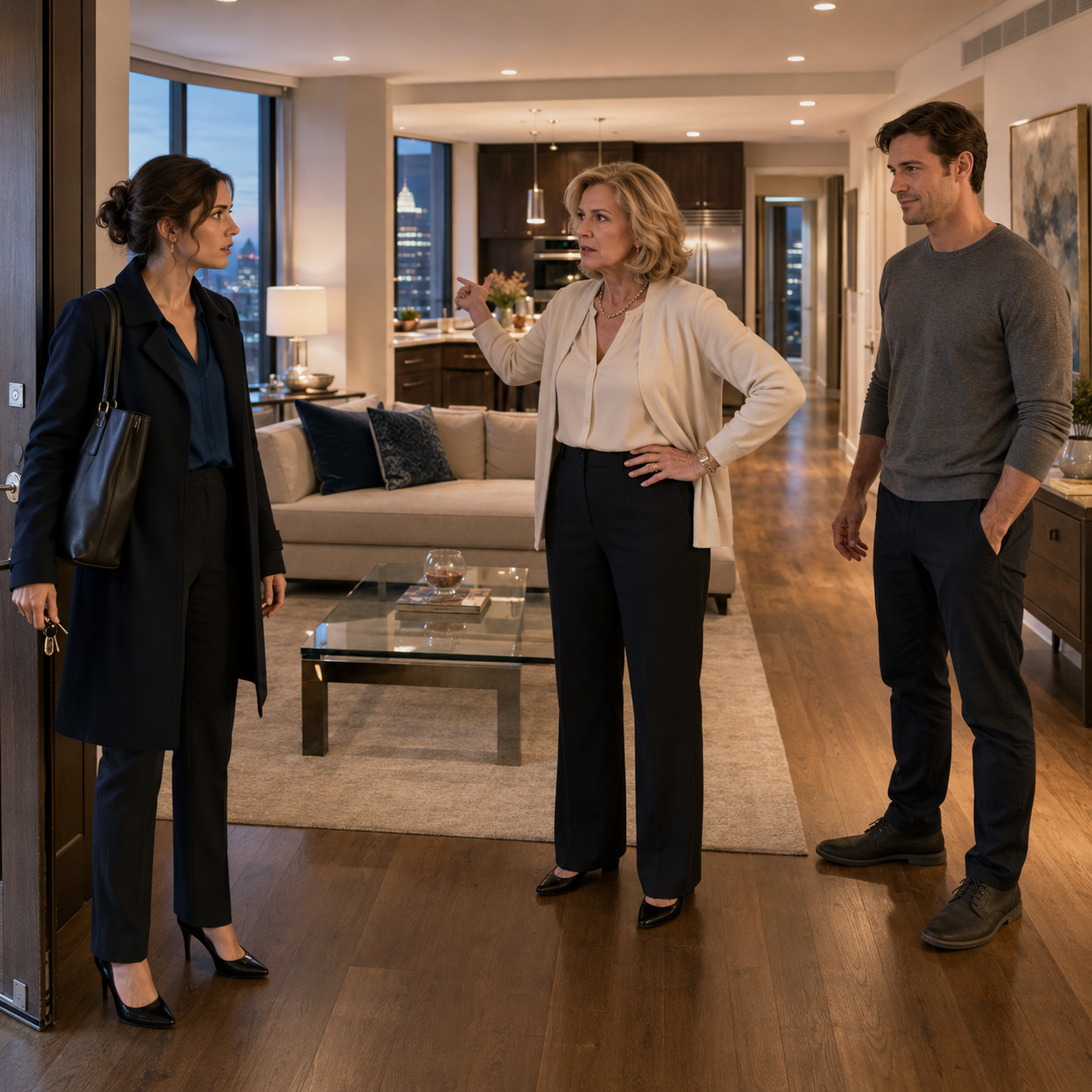
My Husband Told Me His Ex-Wife Was Taking My Bedroom—Then His Mother Learned Whose Name Was Actually on the Deed
The metallic click of my front door sounded unusually loud the evening I came home and discovered my mother-in-law standing in the middle of my living room as if she had been waiting to inspect an employee who was late for her shift.
I was thirty-two years old, exhausted from a twelve-hour design deadline, carrying a leather tote that felt as if somebody had filled it with bricks, and thinking about nothing more ambitious than reheating soup and taking off my shoes.
Instead, Gladys Porter planted both hands on her hips and pointed toward my kitchen.
“Don’t just stand there, Miranda. We need a proper dinner tonight.”
I stared at her.
Gladys had been in our condo plenty of times over the three years Shane and I had been married, but she had never looked quite this comfortable giving orders.
My husband appeared from the hallway before I could answer.
“Listen to Mom,” he said.
He had showered. His hair was still damp. He wore the expensive charcoal sweater I had given him at Christmas.
I noticed all of that before I noticed the expression on his face.
Not embarrassment.
Determination.
“Felicia’s having a rough time,” he continued. “I told her she and Hazel could stay here for a few weeks.”
I waited for the joke.
None came.
Felicia was Shane’s ex-wife.
Hazel was their fourteen-year-old daughter.
I liked Hazel. Or, more accurately, I had spent three years trying to build a careful relationship with a teenager whose parents had separated when she was ten and whose mother alternated between treating me as harmless and treating me as evidence of Shane’s betrayal of their old family.
Felicia and Shane had been divorced for almost five years before I met him.
Their marriage had ended badly, but not because of me.
I knew that mattered.
I also knew none of it explained why my husband had invited his ex-wife to move into our home without discussing it with me.
“You told her what?”
Shane lifted one hand.
“Miranda, don’t start.”
That phrase changed the temperature of the room.
Don’t start.
As though the problem had already become my reaction.
Gladys moved toward the kitchen.
“Felicia was given thirty days to leave her rental. She’s had enough stress without being interrogated by you the second she gets here.”
“The second she gets here?”
“They’ll be here shortly.”
I looked at Shane.
“You already gave her permission?”
“Yes.”
“To stay here?”
“Yes.”
“For weeks?”
“She’s Hazel’s mother.”
“I know who she is.”
“Then act like it.”
I almost laughed.
My shoulder strap slipped down my arm.
I let the tote fall onto the small bench near the entrance.
Shane stepped closer.
“I’m serious, Miranda. Hazel needs stability right now.”
“Of course she does.”
“Good.”
“And you think moving your ex-wife into our home without asking me provides stability?”
He sighed.
“You always turn everything into a process.”
That was rich coming from a man who routinely asked me which recycling bin took cardboard because, according to him, the city’s printed diagram was “unnecessarily bureaucratic.”
“This is not a process.”
I kept my voice quiet.
“It is my home.”
“Our home.”
“Yes.”
I nodded.
“Our home. Which means one of us does not move two additional people into it without the other agreeing.”
Gladys gave an exaggerated breath from the kitchen.
“You have three bedrooms.”
“No.”
I looked toward her.
“We have two bedrooms and my studio.”
“Exactly. Plenty of space.”
Something in the way she said studio made my stomach tighten.
I walked down the hallway.
Behind me, Shane said my name.
I did not stop.
My studio door stood open.
I knew immediately something had happened.
The room smelled like bleach.
My drafting cabinet was open.
Three storage drawers had been emptied onto the floor.
Paper samples, cutting mats, presentation boards, camera equipment, ink cartridges, and a box of typography books had been shoved into a plastic tote.
The shelves where I kept reference objects and framed artwork were half empty.
My desk chair had been moved into the hallway.
Two flattened cardboard boxes leaned against the wall.
I stood in the doorway.
For several seconds, I said nothing.
Graphic design sounds clean when people describe it at parties.
Computers.
Color palettes.
Logos.
Clever people sitting in glass offices arguing about typefaces.
My actual work was messier.
Mockups.
Packaging samples.
Paper stocks.
Cameras.
Lights.
Proof sheets.
Sketches.
And sometimes physical pieces I kept because texture mattered.
That room was where I had built my freelance practice before joining a design studio downtown.
It was also where I still took select private clients.
My first serious national account had been won from the desk sitting against the south wall.
My mother had celebrated by painting a small oil landscape of the canyon near the house where I grew up.
She was not a professional artist.
That was why the painting mattered.
Mom had spent six weekends working on it.
On the back, in her handwriting, she wrote:
For the first room that is truly yours.
She died four years later.
Cancer.
Fast enough that sometimes I still thought of her death as something that had happened while I was looking in another direction.
I turned toward the shelving unit.
The painting was gone.
My heart began beating faster.
“Shane.”
He appeared behind me.
“What?”
“Where is my mother’s painting?”
He looked toward the shelves.
“I don’t know.”
“Your mother cleared this room.”
“Ask her.”
I turned.
Gladys was standing near the kitchen island, wiping the counter with a damp cloth she had apparently brought from home, because ours were blue and this one was yellow.
“Where is the painting that was on the second shelf?”
She barely looked up.
“I threw away some junk.”
I stared.
“What?”
“There was too much clutter.”
My body moved before my thoughts caught up.
The kitchen trash can stood beneath the far counter.
I opened it.
Cereal packaging.
Coffee grounds.
Plastic wrap.
Paper towels.
And there, angled beneath a crushed cardboard box, was the edge of a wooden frame.
I pulled it out.
My mother’s painting.
A dark scratch ran across the lower half of the canvas where something sharp had scraped it.
For a moment, I could not breathe.
I held it against my chest.
“Why would you throw this away?”
Gladys looked over.
“That?”
“Yes.”
“It looked old.”
“It is old.”
“Well, there you go.”
I stared.
She continued wiping the counter.
“We needed the shelves clear because Felicia has a lot of things.”
I felt my hands begin shaking.
“Then put Felicia’s things somewhere else.”
“Where?”
“Not in my studio.”
Gladys finally turned fully toward me.
“Norman will not allow her back into our house.”
Norman was Shane’s father.
He and Gladys had been married almost forty years.
He disliked conflict but disliked Felicia more.
Five years earlier, when Felicia and Shane divorced, Gladys lent Felicia nearly thirty thousand dollars to cover legal fees and a car loan.
Felicia never repaid most of it.
Norman found out afterward.
The resulting argument had been legendary enough that even people who had not attended knew pieces of it.
Since then, Norman’s rule was simple.
Felicia did not stay under his roof.
That apparently meant she would stay under mine.
“My husband refuses to help,” Gladys said, “so somebody has to.”
“That somebody does not automatically become me.”
She crossed her arms.
“Hazel is your stepdaughter.”
“Yes.”
“And I would never let Hazel sleep in her car.”
“Is Hazel sleeping in a car?”
“No.”
“Does Felicia have nowhere to stay tonight?”
Gladys hesitated.
“She has options.”
“Then why are you acting like I’m abandoning a child in a snowbank?”
“Because family helps family.”
There it was.
The phrase adults use when they want generosity without consent.
Shane came into the kitchen.
“You’re making way too much of this.”
I looked at him.
“My dead mother’s painting was in the garbage.”
He sighed.
“Mom shouldn’t have thrown it away.”
Gladys looked offended.
“Shane.”
“But it’s damaged, not destroyed.”
He pointed toward the canvas.
“Get it restored.”
I stared.
He continued.
“We have more important things happening tonight.”
More important than my mother.
More important than my workspace.
More important than asking me.
Something cold began replacing anger.
“What exactly have you promised Felicia?”
Shane rubbed the back of his neck.
“Temporary housing.”
“Where?”
“Here.”
“Which room?”
Gladys answered.
“Your studio will be storage.”
“My studio is not storage.”
“And Felicia and Hazel will use the primary bedroom.”
For a moment, I genuinely thought I had misheard.
“The primary bedroom.”
“Yes.”
Gladys nodded as if describing hotel reservations.
“They need space.”
“And where do Shane and I sleep?”
“You can use the guest room.”
Shane looked at his mother.
Apparently that detail was new to him too.
Gladys continued.
“Hazel is a growing teenager, and she should not be squeezed into some tiny little room after what she has been through.”
“Our guest room is not tiny.”
“It has one queen bed.”
“Yes.”
“Felicia and Hazel need the larger bath.”
I waited.
Gladys added:
“And if Shane wants to sleep in the guest room, you can use the couch.”
There it was.
I laughed.
Not because it was funny.
Because my body needed somewhere for the disbelief to go.
Gladys stared.
“I do not see what is amusing.”
“I came home after twelve hours of work and learned that you threw my mother’s painting in the garbage, emptied my office, reassigned my bedroom to my husband’s ex-wife and daughter, and moved me to the couch.”
“When you say it like that—”
“How else should I say it?”
Shane stepped between us.
“Enough.”
I looked at him.
“Your mother says I’m sleeping on the couch.”
“She’s trying to solve the room problem.”
“There was no room problem until you invited people to live here.”
Shane’s face hardened.
“I’m your husband.”
“I am aware.”
“I have a right to decide who stays in my home.”
My home.
Not our.
His.
That caught me.
He continued, apparently mistaking my silence for uncertainty.
“I bought this place.”
The room became very still.
Gladys nodded immediately.
“That is exactly what I told her.”
My eyes remained on Shane.
“You bought this condo.”
“Yes.”
He puffed his chest slightly.
“I worked for it.”
I almost admired the confidence.
The condo occupied the twenty-first floor of a modern building near downtown Salt Lake City, with a view toward the Wasatch Range and windows so large my mother used to joke that we were paying a mortgage on sunlight.
Except there had never been a mortgage.
My parents purchased the condo for me when I was twenty-seven.
Not as a surprise gift.
As part of an estate plan.
My father had sold a small software company he co-founded, invested well, and decided he would rather help his children while alive than become generous from a grave.
He and Mom funded the purchase.
The deed was placed solely in my name.
When Shane and I married, the condo remained my separate property under a prenuptial agreement his own attorney reviewed.
Shane knew.
He had signed a document acknowledging exactly that.
Apparently his mother did not.
That explained more than I wanted it to.
Gladys had always treated me like the less financially successful half of the marriage.
I assumed that was because Shane worked in medical-equipment sales and liked discussing commissions loudly.
Maybe it was because he had been telling her he owned everything.
“You bought this condo.”
I repeated.
His eyes flickered.
“Obviously, we’re married.”
“That isn’t what I asked.”
“You know what I mean.”
“No.”
I shook my head.
“I suddenly don’t.”
Gladys looked between us.
“Shane told me he purchased this place before the wedding.”
My husband’s face lost a little color.
There.
Truth arriving.
I looked at him.
“Did you?”
“Miranda.”
“Did you tell your mother you purchased my condo?”
“It’s not important.”
Gladys turned.
“What do you mean, your condo?”
I held my mother’s damaged painting against my chest.
For the first time since walking through the door, I understood the architecture of the evening.
Gladys believed her son was the wealthy homeowner.
Therefore his wife was merely occupying a place he provided.
Therefore Gladys felt entitled to rearrange rooms.
Therefore Felicia could be invited.
Therefore I could be moved to the couch.
The cruelty rested on a lie.
And Shane had built it.
I could have argued.
Instead, I walked back to my studio.
“Where are you going?”
“Getting something.”
Beneath my desk sat a small fireproof document safe.
Not dramatic.
No secret vault.
Tax records.
Insurance.
Estate papers.
Passports.
I opened it.
Pulled out a certified copy of the deed.
The original purchase closing statement.
The prenuptial schedule identifying the condo as my premarital separate property.
Then I stopped.
Anger wanted spectacle.
Some primitive part of me wanted to slam papers onto the table and watch Gladys realize her son had lied.
I looked down at my mother’s scratched painting.
Then heard the doorbell.
Three sharp chimes.
Shane hurried toward the entrance.
“Great.”
He sounded relieved.
“They’re here.”
I almost laughed.
Of course.
Felicia entered first.
Large pink suitcase.
Camel coat.
Dark hair tied back.
She looked tired rather than glamorous.
That surprised me.
For years, Shane had described Felicia as demanding, manipulative, financially reckless, and impossible to satisfy.
I had met her perhaps fifteen times.
She could be abrasive.
She also spent most of those encounters protecting Hazel from the tension between two parents who still resented each other.
Hazel came behind her dragging an equally large suitcase.
Fourteen.
Blue bubble gum.
Oversized hoodie beneath a puffer coat.
She barely glanced at me.
Not because she hated me.
Because teenagers under stress are often busy surviving their own embarrassment.
Felicia hugged Gladys.
“Thank you.”
Then looked around.
“This is beautiful.”
Gladys smiled.
“You girls need something comfortable right now.”
Felicia looked toward Shane.
“Thank you for letting us stay.”
Shane gave the warmest smile I had seen on his face in weeks.
“Of course.”
Then Felicia said:
“I still can’t believe you bought this place.”
Silence.
There it was.
Not only Gladys.
Felicia too.
Shane had told his ex-wife he owned the condo.
Hazel dropped her backpack onto the entry bench.
“Where’s the big bedroom?”
I looked at her.
She gave me an awkward half-smile.
“Dad said Grandma got us the room with the huge bathroom.”
Dad said.
I turned toward Shane.
He looked cornered now.
“Hazel—”
Gladys took over.
“Down the hall.”
She pointed toward my bedroom.
“Your grandmother already arranged everything.”
Hazel began rolling her suitcase.
I stepped in front of the hallway.
“Stop.”
She did.
Immediately.
Unlike the adults.
Her expression became uncertain.
Felicia looked at me.
“What’s wrong?”
I placed the painting carefully on the dining table.
Then set the folder of documents beside it.
“Before anyone moves another bag, we need to correct something.”
Shane’s face hardened.
“Miranda.”
“No.”
One word.
Gladys crossed her arms.
“This can wait.”
“No.”
I opened the folder.
“This is the recorded deed for this condominium.”
Nobody moved.
I pointed toward my name.
MIRANDA ELLIS PORTER.
Sole title holder.
Felicia leaned closer.
Gladys squinted.
Shane stared at the floor.
I placed the closing statement beside it.
Purchase funds.
My parents.
No Shane.
Then the prenup acknowledgment.
Separate property.
Signed by Shane.
I looked at him.
“You did not buy this condo.”
Gladys turned slowly.
“Shane?”
He rubbed his face.
“It’s a legal technicality.”
“No.”
I said it calmly.
“It is ownership.”
“You’re my wife.”
“Yes.”
“This is our marital home.”
“Yes.”
“That gives me rights.”
“Occupancy rights while we’re married are not the same as ownership.”
He looked at me.
I continued.
“And neither one gives you the right to move your ex-wife into the primary bedroom without my consent.”
Felicia stared at him.
“You told me this was yours.”
Shane’s jaw tightened.
“It is functionally ours.”
“That is not what you told me.”
He turned.
“Felicia, come on.”
“No.”
She looked at the deed again.
“You said you bought this after your divorce.”
Gladys whispered:
“You told me the same thing.”
Hazel’s gaze moved from her father to me.
Then to the suitcases.
“This is Mom’s place?”
“No.”
I answered.
“It’s mine.”
Hazel looked embarrassed.
“Okay.”
She pulled her suitcase backward.
That simple action made my throat tighten.
The fourteen-year-old understood a boundary faster than every adult in the room.
Felicia did not move.
“How much of what you told me is true?”
Shane’s expression changed.
“Do not turn this into—”
“Into what?”
“You said your wife didn’t work much.”
My eyes narrowed.
Felicia looked toward me.
“He told me you freelanced from home and basically lived off your parents.”
Shane looked at her.
“Felicia.”
She laughed once.
“You really are unbelievable.”
I stared at my husband.
“My salary pays most of our monthly expenses.”
Gladys looked stunned.
That was apparently new too.
Shane worked.
He was not unemployed.
Some years he earned well.
Others, commissions dipped.
Over the last eighteen months, my income from a senior design role plus private branding contracts had covered roughly sixty percent of our shared expenses.
I had never cared.
Marriage is not a scoreboard.
Apparently Shane had.
He had told his family a different story.
Gladys looked toward the kitchen.
“But he buys groceries.”
I almost laughed.
“Yes.”
“Sometimes.”
Shane snapped:
“This is humiliating.”
I looked at him.
“No.”
I said it quietly.
“This is accurate.”
He stared.
Accuracy was what humiliated him.
Not me.
Felicia looked toward the damaged painting.
“What happened to that?”
“My mother-in-law threw it in the trash because she needed shelf space for your luggage.”
Felicia’s face changed.
Gladys immediately said:
“It looked like clutter.”
Felicia stared at her.
“That’s awful.”
Interesting.
I had spent years assuming Felicia and I would automatically be enemies if pushed into the same room.
Instead, she looked more horrified than my husband had.
Gladys turned.
“Do not start taking her side.”
“I’m not taking sides.”
Felicia looked tired.
“I’m saying throwing someone’s dead mother’s painting in the garbage is awful.”
Hazel whispered:
“Grandma.”
That might have been the first moment Gladys looked ashamed.
Not because of me.
Because Hazel saw her.
The room grew quiet.
I turned toward Felicia.
“Do you actually have nowhere to stay tonight?”
She shook her head.
“No.”
Another surprise.
“My cousin has a basement apartment.”
“Then why are you here?”
Felicia looked toward Shane.
“Because he told me I didn’t need to pay rent for a few months.”
There.
Shane closed his eyes.
“How long?”
I asked.
Felicia hesitated.
“He said through the end of the school year.”
My stomach dropped.
That was not a few weeks.
It was November.
“You told your mother a few weeks.”
Gladys looked at him.
“What?”
I stared.
“Felicia, did Shane tell you I agreed?”
Her expression became uncomfortable.
“He said you’d be difficult at first.”
“That is not what I asked.”
“No.”
She admitted.
“He said he didn’t need permission.”
Hazel looked at her father.
The entire room shifted.
Shane had not simply lied about ownership.
He had been performing authority.
For his mother.
His ex-wife.
His daughter.
Possibly himself.
He wanted to be the man who owned the impressive condo and rescued his former family.
Why?
That question came later.
At the time, I knew only one thing.
They were not staying.
I looked at Felicia.
“You and Hazel cannot move in.”
She nodded.
“Okay.”
Shane stared.
“What?”
Felicia pulled her suitcase handle.
“She said no.”
“You need housing.”
“I have housing.”
“Bad housing.”
“My cousin has a finished basement.”
“You hate that place.”
“I hate this more.”
Her voice sharpened.
“You brought us here under a lie.”
Hazel muttered:
“Can we just go?”
Shane’s face flushed.
“Hazel.”
“I don’t want to stay where she doesn’t want us.”
She pointed vaguely toward me.
“And you lied.”
Teenagers.
Brutal.
Accurate.
Gladys stepped forward.
“No one is leaving until we figure this out.”
I looked at her.
“Felicia and Hazel are leaving because I’m asking them to.”
“This is Shane’s home too.”
“It is his residence.”
“Yes.”
“And?”
“He does not have unilateral authority to add long-term occupants.”
Gladys snapped:
“You’re splitting hairs.”
“No.”
I gestured toward my studio.
“You emptied my workplace.”
“You threw away my property.”
“You assigned my bedroom to someone else.”
“Then you told me to sleep on the couch.”
Her mouth tightened.
“That is not splitting hairs.”
Felicia had already started toward the door.
Shane grabbed her suitcase handle.
“Stop.”
She looked at his hand.
“Let go.”
“Felicia.”
“Shane.”
Her voice became cold.
“You told me you owned this place.”
“I was trying to help.”
“No.”
She shook her head.
“You were trying to look important.”
That landed.
Shane released the bag.
Felicia continued.
“You’ve been telling Hazel for years you’re doing better financially.”
“That isn’t wrong.”
“You told her you bought a downtown condo.”
Hazel looked down.
My chest tightened.
This was not just vanity.
He had built a false father for his daughter too.
I looked at her.
“Hazel.”
She looked up.
“None of this is your fault.”
Her eyes filled instantly.
Teenagers can hold emotion right up until an adult gives them permission not to.
“Okay.”
“You came because your dad told you this was arranged.”
She nodded.
“I’m not angry with you.”
Another nod.
Then:
“Can I use the bathroom before we go?”
Despite everything, I almost smiled.
“Of course.”
She disappeared down the hall.
Felicia looked at me.
“Thank you.”
“No problem.”
Gladys seemed unable to understand why the person she had described as demanding was now behaving more reasonably than her own son.
Then Felicia looked at Shane.
“You told me Miranda’s parents gave you money toward this place.”
He swallowed.
I turned.
“What?”
“I never said that.”
“Yes, you did.”
Felicia pointed.
“You said her parents helped with the down payment because they wanted their daughter ‘taken care of.’”
Something inside me went cold.
My parents had not funded Shane taking care of me.
They had bought me a home because they had the means and wanted to.
Dad had told Shane that directly before our wedding.
My mother had been dead by then.
My father sat across from us during the prenup meeting and said:
“The condo is Miranda’s. You will build whatever else you build together.”
Shane had nodded.
Apparently every year afterward, he revised the history inside his own head.
Gladys stared.
“You told me exactly that.”
He turned toward her.
“It sounds worse when everybody repeats it.”
I almost laughed.
“Because it is worse.”
Shane rubbed both hands over his face.
“Fine.”
He looked at me.
“I lied.”
Silence.
“I wanted my family to think I was doing well.”
“You are doing well.”
“Not compared with you.”
There.
The first honest thing.
His voice became bitter.
“You have a paid-off condo.”
“Your parents had money.”
“You earn more.”
“Your clients send gifts.”
“People talk about your work.”
He looked toward his mother.
“Every time I came here with family, they acted impressed.”
“I liked that.”
My anger changed shape.
Not disappeared.
Became sadder.
“Why not tell me?”
“What was I supposed to say?”
“That my wife owning the house makes me feel small?”
“Yes.”
He laughed bitterly.
“You would’ve loved that.”
“No.”
I stared.
“I would have understood it better than this.”
Gladys looked from him to me.
“You lied to us because your wife owns the house.”
Shane snapped:
“Do not reduce it.”
“What else is there?”
Plenty, as it turned out.
But the immediate problem remained simple.
Felicia returned with Hazel.
“Come on.”
Hazel took her suitcase.
Gladys tried to hug her.
She accepted reluctantly.
Then Felicia stopped near me.
“I’m sorry.”
I waited.
“For showing up like I had a right to be here.”
She looked toward Shane.
“I believed him.”
Then:
“I should still have asked whether you knew.”
Specific.
Fair.
“Thank you.”
She nodded.
They left.
No screaming.
No dramatic insults.
No teenager declaring the condo insufficient.
Real people are usually less satisfying than revenge fantasies.
Hazel waved awkwardly before the door closed.
Then the apartment became quiet.
Just me.
Shane.
Gladys.
And my mother’s scratched painting.
Gladys turned toward her son.
“You made a fool out of me.”
Shane stared.
“Mom.”
“You told me you were the provider.”
“I am a provider.”
“For what?”
She gestured around.
“Miranda owns this.”
“This furniture?”
Some mine.
Some joint.
“This kitchen?”
Not really how kitchens work.
Gladys was too angry for precision.
“Why did you let me rearrange her office?”
That question almost offended me.
“You chose to rearrange my office.”
She looked at me.
“I thought Shane wanted it.”
“And that made it okay?”
Silence.
Good.
She had no answer.
I picked up my mother’s painting.
“Gladys, you need to leave too.”
Her eyes widened.
“What?”
“I need my home back.”
“But I’m family.”
“Yes.”
“And tonight you entered my workspace, threw away something irreplaceable, reassigned my bedroom, and told me where I was sleeping.”
“I was helping.”
“No.”
I kept my voice calm.
“You were taking authority you did not have.”
She looked toward Shane.
He said nothing.
That mattered.
Gladys gathered her handbag.
At the door, she turned.
“I hope you understand what this is doing to your marriage.”
I stared.
“No.”
“What?”
“I hope Shane understands what lying did to the marriage.”
Her face hardened.
Then she left.
Shane and I stood in silence.
For years later, whenever people heard an exaggerated version of that night, they imagined he dropped to his knees.
He did not.
He sat on the sofa.
Put his elbows on his knees.
And cried.
Quietly.
That was worse.
A villain begging would have been easier.
My husband looked like a frightened forty-year-old man who had constructed an entire false identity and just watched it collapse in front of his mother, ex-wife, daughter, and wife.
I sat across from him.
My mother’s painting between us.
“Why did you invite Felicia?”
He wiped his face.
“She really is struggling.”
“I believe that.”
“Hazel hates the basement.”
“I believe that too.”
“I thought we could help.”
“Then you ask me.”
“I knew you would say no.”
There.
“Why?”
He looked around.
“Because of Felicia.”
“Maybe.”
I nodded.
“Maybe I would have said we could take Hazel temporarily.”
“Maybe I would have helped Felicia with a deposit.”
“Maybe I would have said no to everything.”
“That was my right.”
He looked down.
“I know.”
“Did you?”
Silence.
I continued.
“You knew I would say no, so you arranged it before I came home.”
“Yes.”
“You let your mother clear my studio.”
“Yes.”
“You knew she planned to give Felicia our bedroom.”
His face changed.
“No.”
That surprised me.
“She told me guest room.”
“Did you know I was being moved out of my own bed at all?”
“No.”
“Would you have stopped it?”
His eyes moved toward the painting.
“I don’t know.”
That answer ended something.
Not the marriage entirely.
A particular assumption.
I had believed, despite all our problems, that Shane would protect my basic place in our home.
He could not say he would have.
I placed the painting on the table.
“You need to stay somewhere else tonight.”
He looked up.
“This is my home.”
“Yes.”
I acknowledged.
“You live here.”
I was not going to misuse ownership.
“You are my spouse, and this has been our marital residence.”
“I am asking you to leave tonight.”
“Not claiming I can erase your occupancy with a deed.”
His eyes filled.
“Where?”
“Hotel.”
“Friend.”
“Your parents.”
“My dad won’t want me there after Mom tells him.”
“That is not my problem tonight.”
He laughed once.
Fair.
“Can I come back tomorrow?”
“I don’t know.”
“Miranda.”
“I don’t know.”
He packed a duffel.
Not everything.
That mattered legally and emotionally.
This was not an eviction.
Space.
Before leaving, he touched the painting frame.
“I’m sorry about this.”
“You didn’t throw it out.”
“I let Mom treat this place like I owned it.”
“Yes.”
He looked at me.
“I’m sorry.”
I believed he meant it.
Still.
He left.
The condo became silent.
I stood in my ruined studio.
Then cried.
Not because I had “won.”
Because my husband had lied about who we were.
Because my mother’s painting was scratched.
Because Hazel had walked into a family conflict she did not create.
Because Felicia, of all people, had shown me more respect in the final twenty minutes than Gladys had all evening.
And because I had seen the shape of Shane’s shame before.
I just never understood how large it had become.
The next morning, I called a conservator about the painting.
Then a lawyer.
In that order.
My divorce attorney, Lena Ortiz, worked three blocks from my office.
She was fifty-five, direct, and unimpressed by dramatic stories unless they changed legal facts.
“Who owns the condo?”
“I do.”
“Premarital?”
“Yes.”
“Parents funded purchase?”
“Yes.”
“Deed solely in your name?”
“Yes.”
“Prenup?”
“Yes.”
“Independent counsel for him?”
“Yes.”
She nodded.
“Good.”
Then:
“Did you physically remove him?”
“No.”
“He left voluntarily overnight.”
“Good.”
“Has he returned?”
“No.”
“Any threats?”
“No.”
“Violence?”
“No.”
“Financial misconduct?”
“I don’t know.”
She stopped writing.
“Why don’t you know?”
Because suddenly I realized I knew less about my marriage than I thought.
Shane had lied to his mother for years.
Felicia.
Hazel.
If he lied about the condo, what else?
“I need to check.”
Lena looked at me.
“Do not turn anxiety into a forensic expedition without reason.”
I almost smiled.
“You need to understand marital finances because that affects divorce.”
“If there is no divorce yet?”
“Then decide what you want.”
That was harder.
I wanted him punished.
Temporary feeling.
I wanted Mom’s painting restored.
Practical.
I wanted Gladys to apologize.
Maybe.
I wanted Shane to explain.
Definitely.
Did I want divorce?
I did not know.
That surprised me.
The betrayal was not an affair.
Not fraud.
Not violence.
It was ego.
Dishonesty.
A willingness to displace me inside my own home so he could preserve a fantasy.
Could that be repaired?
Maybe.
Should it?
Different question.
Lena closed the folder.
“Go home.”
“Think.”
“Do not move money.”
“Do not change locks.”
“Do not throw his belongings out.”
“Do not send his mother anything you will enjoy rereading too much.”
Good advice.
Shane called that afternoon.
“Can we talk?”
“Yes.”
“At home?”
I hesitated.
Then:
“Coffee shop.”
Public.
Not because I feared him.
Because our condo had become too charged.
We met at a diner near Liberty Park.
Shane looked terrible.
He had stayed with a coworker.
Gladys had apparently gone home and confessed the entire evening to Norman.
Norman’s first response, according to Shane, had been:
“You told your mother you bought Miranda’s condo?”
Even his father understood the central stupidity.
Shane sat across from me.
“I’ve been lying for almost three years.”
I stared.
“That long?”
“Maybe longer.”
“About what?”
“Money.”
There.
He told me.
Not illegal money.
Not secret gambling.
Image.
After our wedding, Gladys began making comments about how fortunate Shane was that I had parents who “helped.”
He hated it.
At a Christmas dinner, Norman joked:
“Looks like Miranda is the real estate baron.”
Everyone laughed.
Shane did too.
Then later told his mother the condo purchase had been mostly his.
Why?
He wanted to shut her up.
That small lie required others.
When his income dipped, he told Gladys he was investing more.
When I paid for a trip, he said it was his bonus.
When my father gave us a furniture allowance before he died, Shane told his family he had upgraded the apartment.
Each lie created a more successful Shane.
His mother liked that version.
Felicia did too.
Most painfully, Hazel did.
“She thinks I’m doing better than her mom.”
He looked ashamed.
“You wanted your daughter to think you were winning the divorce.”
“Yes.”
That hurt.
“Why?”
“I don’t know.”
“You do.”
He stared at coffee.
“Felicia left me.”
That surprised me.
Their official story had always been mutual.
He continued.
“She was unhappy.”
“I was controlling.”
“Angry about money.”
“She said I made everything a competition.”
I almost laughed.
Pattern.
“After the divorce, I wanted Hazel to see me as stable.”
“Successful.”
“The parent who had it together.”
“You were stable.”
“Not the way I wanted.”
He looked toward the window.
“Then I met you.”
“Your parents helped with the condo.”
“You had a career.”
“Everything looked good.”
“So I borrowed it.”
The phrase stopped me.
“Borrowed what?”
“Your success.”
There.
Honest.
“I let people think your life proved something about me.”
That was the real betrayal.
Not merely ownership.
He had treated my accomplishments as stage scenery.
“What about Felicia staying?”
“She got a notice.”
“Her lease ends.”
“She has debt.”
“Hazel hates moving again.”
“I felt responsible.”
“You’re Hazel’s father.”
“Yes.”
“But not Felicia’s husband.”
“No.”
“I thought if I could give them the condo, I’d finally be the person who had rescued everybody.”
“With my property.”
“Yes.”
“And without asking.”
“Yes.”
No excuses now.
“What did you think would happen when I came home?”
He covered his face.
“I thought Mom would have everything set up.”
“You’d explain.”
“You’d be furious.”
“Then you’d calm down.”
I stared.
There it was.
“You counted on me eventually giving in.”
He looked at me.
“Yes.”
That answer hurt more than every lie about the deed.
He did know me.
He knew I hated extended conflict.
Knew I often gave in after arguments because peace felt easier.
He turned that into strategy.
“I need time.”
I stood.
“Miranda.”
“No.”
“I’m not deciding today.”
He nodded.
“Can I come home?”
I thought.
Legally, he could likely return absent an agreement or court order.
Emotionally, neither of us was ready.
“Can you stay with your coworker through the weekend?”
“Yes.”
“Then do that.”
He nodded.
No fight.
Progress too late to know what it meant.
Gladys called that night.
I did not answer.
Then Norman.
I almost ignored him.
Answered.
“Miranda.”
“Hi.”
“I heard.”
“I assumed.”
Silence.
Then:
“I’m sorry.”
My throat tightened.
“You didn’t do it.”
“No.”
“But Gladys is my wife.”
“Shane is my son.”
“And I should’ve challenged the nonsense about him owning that place years ago.”
That surprised me.
“You knew?”
“I knew something didn’t add up.”
“Why didn’t you say anything?”
“Because every family dinner already felt like a hostage negotiation.”
I laughed despite myself.
Norman continued.
“That is an excuse.”
“Yes.”
“I’m sorry.”
Then:
“Felicia is not staying here.”
I almost laughed again.
“I didn’t ask you to take her.”
“I know.”
“I’m simply maintaining one boundary before your mother-in-law decides this whole disaster means I need to solve it.”
Fair.
Norman was angry with Gladys.
But he did not throw her out.
That part matters because reality is less satisfying than cruel stories.
He told her she could not use family money to help Felicia without discussing it with him.
They started counseling months later.
Their marriage survived.
Barely for a while.
Eventually better.
No garbage bags on sidewalks.
No elderly woman freezing at a bus stop.
Consequences should be proportional, not theatrical.
Felicia called me too.
Two days later.
“Is this weird?”
“Yes.”
“Okay.”
She paused.
“Hazel feels terrible.”
“She shouldn’t.”
“I told her.”
“Good.”
“She says she was rude about the bedroom.”
“She’s fourteen.”
“Still.”
“No.”
I meant it.
“She arrived based on what all of you told her.”
Felicia sighed.
“I told her your place belonged to Shane.”
“Because he told you.”
“Yes.”
Then:
“I owe you another apology.”
“For?”
“I liked believing it.”
There.
“Why?”
“Because after the divorce, Shane being successful helped me feel less guilty about leaving.”
Interesting.
“If he was thriving, then maybe I hadn’t ruined anything.”
I stayed quiet.
“And if his new wife was living comfortably because of him, I could tell myself I had been the difficult one, but at least he changed.”
“That is complicated.”
“Tell me about it.”
She laughed weakly.
Then:
“I also enjoyed showing up expecting you to make room.”
“That part was ugly.”
“Yes.”
“I’m sorry.”
Specific.
Good.
I thanked her.
We ended the call.
Over the next month, Shane and I began marriage counseling.
Not because I had decided to stay.
Because I wanted to know what I was deciding.
Dr. Celeste Warren had the unfortunate first name Celeste, which I joked was already a strike against her even though nobody in our family was named Celeste.
She did not laugh.
Good therapist.
Her first question:
“What was the injury?”
Shane said:
“I lied.”
I said:
“He displaced me.”
She looked at me.
“Explain.”
“He made promises about my home based on an identity he built using my money.”
“And?”
“He expected me to surrender once the decision was made.”
There.
The deepest injury.
Not deed.
Not Felicia.
Consent.
Shane looked down.
Celeste asked him:
“Did you believe Miranda would agree eventually?”
“Yes.”
“Why?”
“She hates conflict.”
“Is that consent?”
“No.”
“Did you know that then?”
Silence.
“I didn’t think about it.”
“That is not the same as no.”
He looked at me.
“Yes.”
“I knew.”
Good.
No hiding.
Therapy uncovered a marriage I had misunderstood too.
Shane’s shame had not begun with my condo.
He grew up with a father who measured usefulness through earning.
Norman was not cruel.
Still, money mattered.
Shane’s first marriage became financially unstable.
Felicia was impulsive.
Shane controlling.
They fought.
After divorce, he promised himself he would never look financially weak again.
Then married a woman whose family had more money.
His nightmare.
He loved me.
Resented what my circumstances made him feel.
Never told me.
I had my own contribution.
I enjoyed being the financially calmer partner.
I never rubbed the condo in his face.
Still, I sometimes used competence as authority.
If he suggested a repair, I said:
“I’ll handle it.”
If he asked about HOA documents:
“I know.”
If he wanted to choose furniture:
“I already ordered it.”
Small.
Repeated.
The condo was mine.
The home was ours.
I had not always acted like both could be true.
Again.
Not equal.
My behavior did not justify his lies.
It mattered if we wanted honest repair.
Celeste said:
“Responsibility is not a competition.”
Useful sentence.
Shane and I tried.
Three months.
He returned to the condo after two weeks.
At first, separate bedrooms.
Then eventually shared.
Gladys did not visit.
That boundary was mine.
Hazel visited once with advance planning.
No Felicia.
We ate pizza.
Hazel asked:
“Is Dad still in trouble?”
Shane almost choked.
I said:
“Yes.”
She nodded.
“Fair.”
Teenagers.
She and I became closer after that, oddly.
Without Gladys or Felicia defining me, Hazel discovered I was a person who liked old movies and hated olives.
I discovered she loved animation.
She started asking about design software.
One Saturday, she spent three hours in my studio while I showed her Adobe Illustrator.
She saw my mother’s restored painting on the wall.
“I’m glad they fixed it.”
“Me too.”
“Grandma was really wrong.”
“Yes.”
No need to soften.
“Does she know?”
“Yes.”
“Good.”
Gladys’s apology came six months after the incident.
Not because I asked.
She mailed a letter.
Miranda,
I have started this three times because every version sounded like I was explaining instead of apologizing.
Good.
I kept reading.
I should not have entered your studio.
I should not have touched your belongings.
I should not have thrown away your mother’s painting.
I should not have reassigned rooms in a home that was not mine.
I behaved that way because I believed Shane owned the condo.
That belief explains my confidence.
It does not excuse my behavior, because even if Shane owned it, you lived there and deserved to be consulted.
There.
Specific.
Then:
I have also had to admit that I liked the story Shane told because it made me proud of him.
I did not ask whether it was true.
I am sorry.
No request for forgiveness.
No demand to visit.
I cried.
Not because everything was fixed.
Because it was the first time Gladys admitted authority was not hers even under the version she believed.
I wrote back:
Thank you for being specific. I’m not ready for visits yet.
She responded:
Understood.
Behavior.
Months.
No surprise drop-ins.
No messages through Shane.
No guilt.
That mattered.
The harder truth arrived around month five of counseling.
Shane and I were eating dinner at home.
Nothing dramatic.
Pasta.
He asked:
“Do you think we’re going to make it?”
I looked at him.
I had been asking myself the same thing.
Our relationship had improved.
He was honest about money.
We created a joint budget.
Separated household contributions from property ownership.
He told Hazel the truth.
The condo belonged to me.
He apologized for lying.
His relationship with Felicia became clearer.
Parenting only.
No savior role.
Yet something in me remained tired.
“I don’t know.”
He put down his fork.
“I’m doing everything.”
“I know.”
“What else do you need?”
That question clarified it.
Not because he said anything wrong.
Because the answer came.
“I don’t want to need more.”
He stared.
“What?”
“I think I’m done.”
His face collapsed.
I started crying.
“I wanted to repair enough to know whether I was leaving from anger.”
“And?”
“I’m not angry the way I was.”
“That’s worse.”
“Yes.”
We sat.
Long.
He asked:
“Is it because of Felicia?”
“No.”
“Mom?”
“No.”
“The condo?”
“Partly.”
“Then what?”
I thought.
“It’s the person I became around you after.”
“What person?”
“Suspicious.”
“When you tell a story, I check whether details match.”
“When you talk about money, I wonder who else heard a different version.”
“When your mother calls, I prepare for something.”
“When you say you’ve handled a problem, I wonder what handling means.”
He cried.
“I can rebuild trust.”
“I believe you.”
“Then why?”
“Because I don’t want to spend the next decade evaluating whether it has been rebuilt.”
Silence.
That was the sad truth.
Sometimes repair is possible in theory and still not desirable enough for both people to continue.
We filed for divorce.
No dramatic courthouse showdown.
Lena handled it.
Shane retained independent counsel.
The prenup held.
The condo remained my separate property.
His occupancy ended by agreement once he moved to a rental.
Joint savings were divided.
Furniture divided reasonably.
He kept the dining table his father had built.
I kept my mother’s painting.
Obviously.
No one ended homeless.
Shane rented a decent one-bedroom apartment about twenty minutes away.
Not glamorous.
Not a freezing basement.
He could afford it.
His salary was respectable when no longer supporting an image above it.
He learned to live within it.
Later, he told Hazel:
“I spent years wanting to look rich instead of becoming secure.”
Good lesson.
The divorce became final eight months after the night Gladys stood in my living room ordering me to cook.
I stood outside the courthouse afterward holding the decree.
No triumphant music.
I felt sad.
Relieved.
Scared.
Free.
All.
I went home.
The condo was quiet.
I entered the bedroom.
For the first time, there were no Shane clothes in the closet.
No argument about who belonged.
I sat on the bed.
Then laughed.
Because after all the drama about the primary bedroom, I decided I did not want it.
I moved my bedroom into the smaller guest room.
Why?
Morning light.
The windows faced east.
I converted the large primary bedroom into a combined studio and guest suite.
Not for revenge.
Because my needs had changed.
Ownership is most satisfying when it becomes ordinary enough to rearrange.
My freelance design work expanded after the divorce.
Not because Shane had been secretly sabotaging me.
He hadn’t.
I simply had more emotional energy.
I accepted two major branding projects.
Then became creative director at my firm.
Eventually started a boutique studio with a colleague named Priya Shah.
We called it Ellis & Shah.
Priya hated ampersands.
I insisted.
Marriage had apparently not cured my appetite for conflict.
Our studio did well.
Not billionaire well.
Real-business well.
Six employees.
Then twelve.
Healthcare.
Hospitality.
Technology clients.
I learned payroll is an excellent cure for romantic ideas about entrepreneurship.
Hazel stayed in my life.
That surprised everyone.
Especially me.
She was Shane’s daughter.
No legal tie after divorce.
Yet three months after the decree, she texted:
Can I show you something I drew?
I said yes.
She sent a character design.
Good.
I told her.
She asked whether she could visit the studio.
I asked Shane.
He said:
“Of course.”
Felicia agreed.
So Hazel came.
No family drama.
Art.
At sixteen, she applied to a summer design program.
I helped with portfolio.
Did not pay tuition.
Shane and Felicia did.
That mattered.
I was mentor.
Not rescue fund.
At eighteen, Hazel got into an illustration program.
She called me before announcing online.
“I got in.”
I screamed louder than her mother did.
Probably.
At graduation years later, I sat in the audience beside Shane and Felicia.
Strange.
Healthy enough.
Gladys attended too.
We had repaired somewhat.
Not close.
Respectful.
She never entered my home without invitation again.
The first time she did come after divorce, almost four years later, she stood outside holding flowers.
“May I come in?”
That question mattered.
I opened the door.
She saw my mother’s painting restored above the fireplace.
Her eyes filled.
“I’m glad.”
“So am I.”
She did not touch it.
Growth.
Norman and Gladys remained married.
Counseling changed them.
Norman admitted he had spent decades dismissing Gladys’s instincts so often that she had begun seeking usefulness by inserting herself into other people’s problems.
Again.
Explanation.
Not excuse.
Gladys learned helping without permission often served the helper more than the person being helped.
Felicia rebuilt too.
She moved into her cousin’s basement for four months.
Then found a townhouse.
Got a better job in medical billing.
Paid Norman and Gladys part of what she owed over several years.
Not all immediately.
Realistic.
She and I never became friends.
We became cordial.
At Hazel’s college graduation, Felicia said:
“I still cringe thinking about that suitcase.”
I laughed.
“Which part?”
“Walking into your house like I had keys.”
“You didn’t know.”
“I knew enough to ask.”
Fair.
“Then we both learned.”
She nodded.
No hug.
Good.
Shane struggled after divorce.
Not financially destroyed.
Identity.
The image he built disappeared.
He told his coworkers some version of the truth before rumors did.
That surprised me.
One colleague later told Hazel:
“Your dad said his marriage ended because he lied about money and authority until he believed his own story.”
Specific.
Good.
He stayed in medical sales for another few years.
Then moved into account management with a smaller company.
Less commission volatility.
More predictable salary.
That suited him.
He eventually bought a modest townhouse.
With a mortgage.
In his own name.
The day he closed, he sent me a photo of keys.
No caption.
I stared.
Then replied:
Congratulations.
He answered:
Thanks. I read the deed twice.
I laughed.
That was one of the first times the old event became funny without becoming cruel.
Shane remarried when he was forty-nine.
A middle-school counselor named Rebecca Lang.
He told me only because Hazel was worried it might be awkward at graduation.
It was not.
Rebecca was kind.
No reason to punish her for history.
We met once.
She said:
“I know enough to know not to ask about the condo.”
I smiled.
“Excellent judgment.”
She laughed.
They were still married the last time I heard.
Good.
I also had to examine why the condo had mattered so much to me emotionally.
It was not just property.
My mother.
Dad.
Proof of independence.
Before Mom died, she stood in the empty living room on closing day and turned slowly beneath the windows.
“You have a room.”
She smiled.
“Your own.”
Then:
“Don’t fill it with things people tell you should be there.”
I laughed at the time.
Years later, Gladys literally filled my rooms with things she thought belonged.
Suitcases.
Other people.
Her authority.
No wonder I reacted strongly.
The painting restoration took three months.
The conservator could not erase the scratch completely.
She reduced it.
Stabilized the paint.
The mark remained faintly visible if light hit at an angle.
At first, I hated that.
Then loved it.
Not because damage is beautiful.
Because restoration should not have to pretend damage never happened.
That became a useful idea far beyond the canvas.
My relationship with Shane was restored enough for honesty.
Not marriage.
My relationship with Gladys became respectful.
Not intimate.
The painting remained altered.
Still my mother’s.
Repair is not erasure.
I learned that.
At forty-two, my father died.
He had been living in Arizona after retiring.
Heart failure.
Not sudden enough to be shocking.
Sudden enough to leave things unsaid.
I flew down.
In his study, I found a folder containing the condo purchase documents.
He kept copies.
On top was a sticky note from the year Shane and I married:
MIRANDA’S. DO NOT LET MARRIAGE MAKE SIMPLE THINGS CONFUSING.
I laughed and cried.
Dad.
Always documents.
At the funeral, Shane came.
Not because I asked.
Hazel did.
He stayed in the back.
Afterward:
“Your dad never liked me.”
“He liked you enough.”
“He knew.”
“Knew what?”
“That I was weird about the condo.”
I stared.
“He asked me once why I told people I bought it.”
My stomach tightened.
“When?”
“Years before everything.”
“What did you say?”
“Joke.”
“He told me not to build a marriage on jokes I needed people to believe.”
Dad had seen.
I felt angry.
“Why didn’t he tell me?”
Shane looked sad.
“Probably because he thought it was my job.”
Maybe.
Dead parents do not answer follow-up questions.
I chose to accept Dad’s logic.
Mostly.
Years later, I opened my own studio space downtown.
Not inside the condo.
A proper commercial office.
At the entrance, I hung Mom’s painting.
Priya stared.
“This goes in your house.”
“No.”
“It belongs here.”
Why?
Because Mom painted it to celebrate my first design contract.
The studio was where the story belonged now.
Not the condo incident.
People saw it.
Asked who painted.
“My mother.”
“That’s beautiful.”
I never mentioned the scratch unless light revealed it.
Then:
“It was damaged once.”
That was all.
No need to turn every object into autobiography.
At forty-eight, I met Thomas Reed.
No relation to anyone.
Architectural photographer.
Divorced.
No children.
He rented his apartment.
I owned my condo.
The first time money came up, my body tightened.
I noticed.
Therapy again.
Dr. Nadia Cole.
I explained.
She asked:
“Does Thomas behave like Shane?”
“No.”
“Has he lied about ownership?”
“No.”
“Then why is your nervous system arguing with a man who isn’t in the room?”
Annoying.
We talked.
Thomas and I.
Not every number.
Enough.
“I own my condo outright.”
He nodded.
“I have a retirement account and a 2017 Subaru.”
I laughed.
“Impressive portfolio.”
“I also own two camera lenses worth an irresponsible amount.”
Honesty.
We dated.
He moved in after three years.
That was hard.
Not because he asked.
Because I had turned the condo into territory.
Mine.
Safe.
Inviting someone felt like surrender.
Nadia corrected me.
“Sharing is not surrender if you choose it.”
Choice.
Again.
Thomas moved in under a cohabitation agreement.
Not romantic?
Maybe not.
We also bought flowers.
People survive paperwork.
He never called the condo his when speaking legally.
He called it home.
That distinction made me cry once.
He noticed.
“What?”
“Nothing.”
“Miranda.”
“Home is good.”
He smiled.
“Okay.”
We married eventually.
Small.
My second marriage.
I kept the condo separate.
Thomas kept his photography business.
Joint accounts for household.
Independent savings.
No secrets.
He sometimes cooked with better pans than Shane’s old set.
I did not keep rusted pans as revenge artifacts because, despite what the original family story might suggest, Shane had contributed plenty to household life over the years.
Groceries.
Utilities.
Travel.
Furniture.
Labor.
The phrase “he contributed only a mop and rusty pans” would have made a satisfying insult.
It would not have been true.
I learned to distrust satisfying lies even when they favored me.
That mattered.
The condo itself changed.
New floors.
Different couch.
Kitchen renovated.
Primary bedroom became studio, then bedroom again after Thomas moved in because he liked the west-facing view.
My mother’s painting moved downtown.
Gladys’s violation slowly lost visual territory.
That is one way homes heal.
You keep living inside them.
Spill coffee.
Paint walls.
Host birthdays.
Replace furniture.
Create enough ordinary memories that the bad night becomes one layer.
Not wallpaper.
Hazel became a professional illustrator.
She worked on children’s books.
Then animation.
At thirty, she called.
“I’m buying a condo.”
I laughed.
“Dangerous.”
“Do not.”
She sent the listing.
Small.
Sunny.
She asked:
“Can you look at the design layout?”
“Yes.”
Then:
“Dad is obsessed with the deed.”
We both laughed.
Shane apparently asked his attorney seventeen questions.
Good.
Hazel bought it with her own savings and a mortgage.
At the housewarming, she handed me a framed print.
Her illustration.
A woman standing inside a bright room while suitcases waited outside.
I stared.
“Subtle.”
She grinned.
“Therapy.”
I laughed.
The print hangs in my hallway now.
Not because I need the memory.
Because it is hers.
A teenager caught in an adult mess turned it into art.
That feels right.
Gladys died in her eighties.
Not alone.
Not abandoned.
Norman beside her.
Shane.
Hazel.
Other family.
I visited two weeks before.
She had heart failure.
Was tired.
Her hands trembled.
She looked at me.
“I still think about your painting.”
“So do I.”
“I was jealous of it.”
That surprised me.
“What?”
“Your mother.”
I waited.
Gladys stared toward the window.
“You spoke about her like she saw you.”
“She did.”
“I never felt Shane saw me unless he needed something.”
That was sad.
“And when he asked me to prepare the condo for Felicia, I felt important.”
There.
Same human weakness.
“I decided important meant entitled.”
She swallowed.
“I’m sorry.”
“I know.”
“Did you forgive me?”
“Yes.”
I had.
Not forgotten.
Different.
She smiled.
“Good.”
Then:
“Norman still says I had no business touching your shelves.”
“He is correct.”
She laughed until coughing.
We had come a long way.
At her funeral, Felicia attended.
Of course.
Whatever happened with the loan, Gladys had loved Hazel.
Shane gave the eulogy.
He did not make his mother perfect.
Good.
“She helped people even when they didn’t ask.”
People laughed.
He smiled sadly.
“Sometimes that was generosity.”
“Sometimes control.”
“She spent the later part of her life learning the difference.”
That was honest.
I cried.
Families can become healthier after damage.
Not always.
Ours did enough.
Norman lived another three years.
After Gladys died, he called me once a month.
No idea why.
We discussed weather.
HOA fees.
Hazel.
Then one evening:
“I should’ve stopped her sooner.”
“What?”
“All those years.”
“Gladys?”
“Yes.”
“I told myself her meddling was harmless because arguing with her was exhausting.”
He sighed.
“That makes me part of the problem.”
“Sometimes.”
He laughed.
“Your diplomacy needs work.”
“Retired.”
He accepted.
Thomas and I grew older together.
No children.
We considered adoption briefly.
Decided no.
Not tragedy.
Choice.
Hazel remained in my life.
Priya’s children too.
Friends.
Students.
Employees.
A life can be full without following one template.
I sold the condo when I was sixty-five.
That surprised everyone.
After decades of treating it as such a symbol, I wanted a smaller place.
Thomas and I bought a house outside Park City.
Jointly.
That decision was harder than selling.
Joint ownership.
After everything.
Nadia, still occasionally in my life as therapist until she retired, asked:
“What are you afraid of?”
“Being trapped.”
“By?”
“Documents.”
She almost laughed.
“You have become afraid of the thing that protected you.”
Fair.
Thomas and I bought the home 50-50.
Clear agreement.
Estate plan.
No secret superiority.
No one’s parents funding it.
We signed at a title office.
Afterward, Thomas held up the deed.
“Look.”
I laughed.
“Both names.”
“Scary?”
“Yes.”
“Good scary?”
“Yes.”
That was healing.
The old condo sold to a young physician.
At closing, she said:
“This is my first home.”
I smiled.
“It was mine too.”
She looked toward the windows.
“I love the light.”
“So did my mom.”
No more.
I did not tell her about Shane.
Gladys.
Felicia.
The studio.
She bought a condo.
Not a story.
I took one last walk through.
Empty rooms.
No furniture.
Without my things, it looked smaller.
The kitchen where Gladys commanded me to cook.
Hallway where Hazel’s suitcase stopped.
Living room where I showed the deed.
Studio where Mom’s painting was thrown away.
All empty.
I stood near the entrance.
Then left.
Ownership should not become imprisonment.
That lesson took thirty years.
At seventy, I retired from design work almost completely.
Priya’s daughter joined the studio.
No nepotism without qualification.
She had a degree.
Portfolio.
Worked elsewhere first.
Good.
We renamed the firm Shah Ellis Studio after Priya complained for thirty years that my surname should not always come first.
Fair.
I taught occasional classes in visual communication.
Students loved dramatic career stories.
I told boring ones.
Bad client feedback.
Missed deadlines.
Designs rejected.
A packaging project that cost us money.
One student asked:
“What’s the biggest lesson from running a creative business?”
I thought about consent.
Territory.
Ego.
Then:
“Do not confuse ownership with authorship.”
She frowned.
I explained.
“You can own a company and still not be the person with the best idea.”
“You can own a house and still share it.”
“You can be married and still not own another person’s choices.”
“Authority has categories.”
That sounded more like therapy than design.
Age.
Allowed.
The original property deed stayed in my files for years.
After selling, I considered framing it.
Then laughed.
Why?
The deed had served its purpose.
Proof during one bad night.
Protection during divorce.
After sale, history.
I kept a digital copy where tax records required.
Shredded the extra certified paper.
No shrine.
Same with the prenuptial schedule.
No reason to reread.
The painting stayed.
Of course.
My mother’s canyon.
Scratch barely visible.
That was the object worth keeping.
Because it existed before the conflict.
It represented work.
Love.
A mother seeing her daughter.
Not ownership.
That distinction mattered.
One afternoon, decades after everything, Hazel visited my house outside Park City.
She brought her own teenage daughter.
Lena.
Fifteen.
Artistic.
Moody.
Excellent eyebrows.
Lena saw the painting.
“Who did that?”
“My mother.”
“She was good.”
“She was enthusiastic.”
Hazel smiled.
Then told her daughter:
“Grandma Gladys once threw that in the trash.”
I stared.
“Hazel.”
“What?”
Lena’s eyes widened.
“Why?”
I sighed.
“Family boundary problem.”
“That’s insane.”
“Yes.”
Then Lena looked at her mother.
“Did you live with Aunt Miranda?”
Hazel became embarrassed.
“Almost.”
I laughed.
She corrected:
“For about seven minutes.”
We all laughed.
That was the first time the story felt completely ordinary.
Not erased.
Safe enough to joke because every adult had acknowledged what happened years before.
Humor after accountability.
Different from ridicule before it.
Lena asked:
“Were you mad at Mom?”
“No.”
“Why?”
“She was fourteen.”
I looked at Hazel.
“And the adults lied to her.”
Important.
Children should not inherit blame for being used inside adult power struggles.
Shane had learned that too.
He once told Hazel:
“I made you part of a lie about my success.”
She said:
“Yes.”
No comfort.
Good.
Then later forgave.
Family repair became a sequence of specific sentences.
Not dramatic redemption.
That is what I would tell anyone now.
Watch whether apologies become more precise over time.
“I’m sorry you were upset.”
Bad.
“I’m sorry things got out of hand.”
Not enough.
“I’m sorry I invited people to live in our home without your consent and lied about ownership because I was ashamed.”
Real.
Shane got there.
Gladys did.
Felicia did.
I had my apologies too.
To Shane:
“I’m sorry I sometimes treated owning the condo as if it made every household decision mine.”
To Hazel:
“I’m sorry the adults made you feel unwanted that night.”
She corrected me.
“You didn’t.”
Still, I said it.
To myself:
“I’m sorry you thought protecting your space required never sharing it again.”
That took longest.
Thomas helped.
Joint deed.
Ordinary home.
No drama.
Shane died before me.
Seventy-six.
Stroke.
Hazel called.
“Miranda.”
I knew from her voice.
“I’m sorry.”
“So am I.”
That surprised her.
Maybe not.
Shane and I had been divorced for decades.
Still, history has tendons.
It connects.
Hazel asked if I wanted to attend the funeral.
“Yes.”
Thomas came.
Rebecca, Shane’s second wife, greeted me warmly.
Felicia was there too.
Three women who had once occupied different roles around the same man.
No rivalry.
Age strips glamour from old competitions.
At the service, Hazel spoke.
“My dad spent a lot of his early life trying to look like the man he thought other people would respect.”
She paused.
“He got better once he stopped performing.”
My throat tightened.
She continued.
“He taught me something by getting it wrong first.”
“That asking is not weakness.”
“Being honest about what you have is better than pretending you have what somebody else built.”
I cried.
Afterward, Rebecca handed me an envelope.
“Shane wrote this years ago.”
I waited a month.
Then opened.
Miranda,
If I’m dead, I assume enough time has passed that you cannot accuse me of avoiding hard conversations.
I laughed.
Still Shane.
He wrote:
I used to tell myself the condo incident happened because I wanted to help Hazel.
That was partly true.
The harder truth is that I wanted to feel powerful in front of Felicia and my mother.
I had spent years feeling like the second most successful person in my own marriage.
Instead of being proud of you, I treated your success like a light that made me smaller.
That was mine.
Then:
The thing I regret most is not saying I bought the condo.
Embarrassing as that was.
It is that I believed your eventual willingness to avoid conflict was the same as permission.
I knew you would probably surrender once everyone arrived.
I counted on it.
I am sorry.
Tears came.
Then:
Thank you for not using ownership to make me homeless that night.
You asked me to leave.
You did not pretend a deed erased the fact that the condo had been my home too.
I did not appreciate the distinction then.
I do now.
That mattered.
He continued.
Our marriage ended for more reasons than one lie.
Some mine.
Some ours.
But the lie forced us to stop pretending.
I am sorry for the pain.
I’m grateful for the years before.
I hope you are too.
Shane.
I was.
That became easy to admit with age.
Our marriage was not a mistake.
It ended.
Different.
I kept the letter.
Not beside my mother’s painting.
Different history.
Thomas died at eighty.
Heart failure.
We had thirty-one years together.
That grief was larger than language.
No betrayal.
No legal file.
Just absence.
I sold the Park City house afterward.
Too large alone.
Moved into a condo again.
Funny.
Smaller.
No twenty-first-floor mountain wall.
One bedroom.
Studio.
Enough.
The first night, I hung Mom’s painting.
Different wall.
Same canvas.
I stood back.
The scratch was invisible from where I sat.
Not gone.
Invisible at that angle.
That felt like memory.
Some days old damage catches the light.
Other days it does not.
Both are healing.
When people hear the story of the night Shane tried to move his ex-wife into my condo, they usually want the satisfying version.
Husband says he owns everything.
Wife pulls deed.
Mother-in-law goes pale.
Ex-wife leaves.
Husband ruined.
Simple.
Real life was more interesting.
Shane lied because shame had become identity.
Gladys violated my space because she confused being needed with having authority.
Felicia entered arrogantly because she had been given false information and enjoyed believing it.
Hazel was a child caught in adult theater.
I owned the property but had sometimes failed to distinguish ownership from shared home.
Norman avoided conflict long enough that Gladys’s meddling became normalized.
Everyone had a role.
Only some choices were equally wrong.
That distinction matters.
I refuse to turn nuance into equal blame.
I did not cause Shane’s lie because I earned more.
I did not cause Gladys to throw away my painting because my studio was messy.
I did not force them to invite Felicia.
Those decisions belonged to them.
But understanding my own habits helped me build better relationships afterward.
That is the point of self-reflection.
Not redistributing someone else’s responsibility.
Changing what belongs to you.
I also stopped describing Shane as financially worthless.
He was not.
He worked.
Contributed.
Helped with bills.
Cooked.
Maintained the condo in many ordinary ways.
His mistake was pretending legal ownership and financial dominance he did not have.
If I exaggerate him into a man who never contributed a dollar, I commit the same sin I resented.
Replacing truth with a story that makes someone easier to judge.
I am too old for that.
The deed already told enough truth.
I did not need rusted pans as symbols.
Gladys did not die homeless.
Felicia did not suffer poetic ruin.
Hazel did not become a spoiled villain.
Shane did not spend his life eating beans in a basement.
People changed.
Some relationships ended.
Others improved.
That is more satisfying to me now than destruction.
The real victory was not making Shane’s family see whose name was on a property record.
It was learning what ownership could and could not solve.
A deed could settle title.
It could not create respect.
A prenup could protect property.
It could not protect intimacy from shame.
A lock could keep someone outside.
It could not tell you whether the relationship should reopen later.
Those decisions required judgment.
Time.
Behavior.
Consent.
If I could return to that evening and stand beside thirty-two-year-old Miranda before she opened the door, I would tell her several things.
First:
Put your bag down.
Drink water.
You are exhausted, and exhaustion makes every insult feel sharper.
Second:
When Gladys orders you to cook, do not immediately treat it as proof she has always hated you.
She is acting on a false story her son told.
Her behavior is still unacceptable.
But facts matter.
Third:
Go to your studio.
Rescue the painting.
Then stop.
Do not keep arguing while holding something from your dead mother in your hands.
You are too raw.
Fourth:
When Shane claims ownership, show the deed.
Calmly.
Paper is enough.
You do not need a speech about every bill he failed to pay because that would not be accurate anyway.
Fifth:
Do not humiliate Hazel.
You won’t.
Good.
She is a child.
Sixth:
Let Felicia leave with dignity.
She will apologize later.
Her bad choice does not require you to make her small.
Seventh:
Ask Shane to leave for the night.
Not because title gives you instant power to evict a spouse.
Because the relationship needs space.
Be legally accurate even when anger wants shortcuts.
Eighth:
Go to counseling before filing.
Not because every marriage should be saved.
Because you want to know what you are ending.
Ninth:
Accept Gladys’s apology only after behavior matches it.
No surprise visits.
No room assignments.
No guilt.
And finally:
Do not spend the rest of your life guarding the condo as proof that nobody can take anything from you.
The home is yours.
Then shared by choice.
Then sold.
That is healthy.
A possession should serve a life.
Not become the border of one.
The night began with Gladys pointing toward the kitchen and ordering me to prepare a feast for an “important guest.”
She believed Felicia’s arrival mattered more than my exhaustion.
Shane believed being my husband allowed him to make decisions he knew I would reject.
Felicia believed Shane had enough authority to offer her a home.
Hazel believed adults had arranged something legitimate.
Everybody entered the room carrying a different version of reality.
The deed corrected one.
Conversation corrected others.
The marriage ended because the problem was deeper than title.
It ended because Shane’s shame had made honesty feel dangerous to him and my competence had made control feel safe to me.
We loved each other.
We also became bad partners in specific ways.
He crossed a line I could not unknow.
We repaired enough to separate without hatred.
That is not failure.
At least I no longer think so.
The painting my mother gave me remains with me.
On the back, her handwriting has faded slightly.
For the first room that is truly yours.
When I was young, I thought she meant property.
Now I think she meant something else.
A room can belong to you even when you invite someone inside.
Belonging is not isolation.
It is the knowledge that your presence does not need to be negotiated after everybody else arrives.
Shane’s mistake was not forgetting my name on the deed.
He knew it.
His mistake was believing my place in the marriage could become secondary whenever his need to impress people became stronger.
Gladys’s mistake was similar.
She saw a room and assigned it.
Saw shelves and cleared them.
Saw a daughter-in-law and treated her as movable.
Eventually, both learned.
I learned too.
Nobody in a healthy home should be movable without being asked.
Not wife.
Ex-wife.
Child.
Mother.
Husband.
Consent does not become optional because family logistics feel urgent.
That principle became almost embarrassingly important to me.
Years later, Hazel stayed at my Park City house during a snowstorm.
She was thirty.
Her car could not safely make it home.
“Can I use the guest room?”
I laughed.
“What?”
“Nothing.”
“Why are you laughing?”
“History.”
She rolled her eyes.
“I’m literally asking.”
“I know.”
“Yes.”
She stayed.
The next morning, she made coffee.
No drama.
That simple overnight visit healed something the original confrontation could not.
Same person once brought into my home through someone else’s false authority.
Years later, she asked.
I said yes.
Healthy access.
That was the real opposite of what happened.
Not throwing everyone out.
Choice.
I did not need to become a woman who never opened her door.
I needed to become one who knew opening it was voluntary.
At eighty-two, I spend mornings near a window with coffee.
Graphic design changed beyond recognition.
Half the tools I used early in my career are museum pieces.
Students create in seconds things that once took me an afternoon.
Good.
Every generation should make the previous one slightly obsolete.
I still sketch.
Paper.
Pencil.
Mom’s painting on the wall.
Thomas’s photographs in the hallway.
Hazel’s print near the door.
Shane’s letter in a desk drawer.
No deed framed anywhere.
I know what I owned.
I do not need paper on a wall to remind me.
The final lesson became simpler than the drama.
When someone tells a lie about power, facts matter.
When someone abuses access, boundaries matter.
When somebody apologizes, behavior matters.
And when a relationship changes, you are allowed to decide whether repair means reunion, distance, or simply no longer carrying anger.
My marriage did not survive.
My dignity did.
So did my relationship with Hazel.
Parts of Shane’s family.
My mother’s painting.
My career.
My capacity to trust someone else.
Those things feel more important now than who stood embarrassed beside the coffee table.
If I close my eyes, I can still see Shane’s face when Gladys read my name on the deed.
For years, people would probably call that the best moment.
It wasn’t.
The best moment came much later.
Thomas and I were signing papers for our Park City house.
The title officer turned the deed toward us.
Two names.
Thomas looked at me.
“You okay?”
I was afraid.
“Not really.”
He smiled.
“We can stop.”
There.
Choice.
No embarrassment.
No pressure.
No audience.
“We can stop.”
I looked at the document.
Then at him.
“No.”
I picked up the pen.
“I want this.”
And signed.
That was the moment I knew the old night no longer owned me.
Not when I proved the first condo was mine.
When I became safe enough to share another home again.









