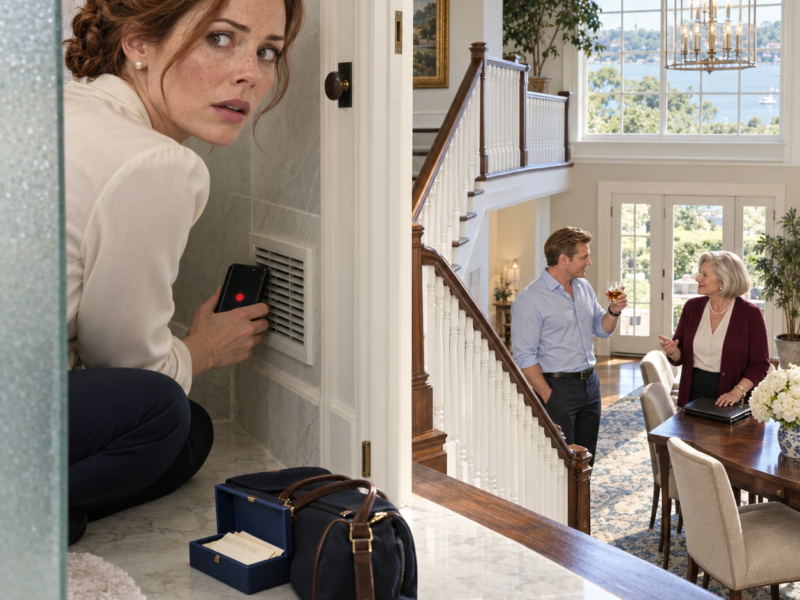
“By the time she gets back from Paris, everything will belong to us.” My husband was downstairs, celebrating with his family in the house my grandmother had left me. I was upstairs on the bathroom floor, holding my phone beside the air vent. The anniversary trip he had given me that morning was supposed to make sure I never heard a word.

Evelyn put her hand on the open car door before I could get inside.
“Clara,” she said, “leave your suitcase where it is.”
The driver had already lifted my bag into the trunk. Behind us, my house stood in the pale Saturday sunshine, its upstairs windows open to the first mild afternoon of April.
I looked at my neighbor’s face.
“What’s wrong?”
“Your mother-in-law just went through your side entrance with three other people.”
“Eric probably invited them.”
“Perhaps.” Evelyn glanced toward the house. “But the man carrying the briefcase waited behind that maple tree until he saw your husband wave him over. And Eleanor brought champagne.”
I almost smiled.
It sounded like something innocent described by someone who had spent too many years noticing suspicious details.
Then Evelyn added, “I heard her say, ‘Make sure she’s actually gone this time.’”
The driver shifted beside the trunk.
“Everything okay, ma’am?”
I looked back at the front door.
Fifteen minutes earlier, Eric had kissed me there, tucked my scarf inside my coat, and told me to enjoy every second of Paris.
For our tenth anniversary, he had arranged four nights in a small hotel near Luxembourg Gardens.
The card beside my breakfast had said, Get some rest. This time, let me take care of you.
I had cried when I read it.
Now Evelyn’s fingers tightened around my wrist.
“You may have a perfectly ordinary explanation,” she said. “But I think you should find out before you leave the country.”
I asked the driver to cancel the trip.
I paid for his time, apologized, and watched him lift my suitcase back onto the driveway.
Evelyn took the handle.
“I’ll keep this at my house.”
I stood there another second, staring at the home I had owned longer than I had known my husband.
Then I went around through the garden.
The mudroom door opened with the key Eric always teased me for carrying.
“You don’t need a spare when we have a keypad,” he liked to say.
I had grown up in that house. I trusted a metal key more than a battery.
Inside, the kitchen smelled of the cinnamon coffee he had made that morning. My cup still stood beside the sink, a faint crescent of lipstick on its rim.
Voices came from the dining room.
I heard Eric laugh.
Then a cork popped.
I started toward the doorway, ready to ask why his family had arrived through the side entrance.
Before I reached it, his mother spoke.
“Finally. You’ve lived in Clara’s house like a guest long enough.”
My hand stopped against the wall.
Eric answered, “By Tuesday, that won’t be the problem anymore.”
I stepped backward.
The rear staircase stood beside the pantry. I climbed it without thinking, following the childhood instinct that had once sent me upstairs when adults argued downstairs.
Our bathroom sat directly over the dining room. An old service chase ran behind the linen cupboard, carrying plumbing and far more sound than it should have.
I had complained about it during renovations.
Eric had said fixing it wasn’t worth the trouble.
That afternoon, it saved me.
I lowered myself onto the tile beside the cupboard.
Below me, glasses clinked.
“While she’s in Paris,” Eric said, “we’ll get the guarantee through the remaining review. Richard receives the money, and I file Monday.”
“Your divorce attorney is ready?” Eleanor asked.
“I’ve had the papers for a month.”
The bathroom seemed to tilt.
I pressed my palm flat against the floor.
Eric continued.
“If she starts moving money when she finds out, we’ll say we were worried about her leaving the country and hiding assets. She’ll have to explain that.”
A man I didn’t recognize said, “Keep the divorce separate from the financing. I need the supporting documents to remain consistent.”
“What else do you need?” Richard asked.
“Confirmation of the property information. The preliminary package has the tax returns, the statements, and her authorization.”
“And the signature?”
A pause.
“The copy is adequate for the initial review. Before closing, there are further requirements. Don’t contact the lender yourselves.”
I pulled out my phone.
My fingers were clumsy. I opened the wrong application, closed it, and found the recorder.
Then I pressed the red button.
My husband’s sister, Sarah, spoke next.
“Richard only needs three months. The investors come in, we repay the line, and nobody has to lose anything.”
“We’re talking about a million and a quarter,” the unfamiliar man said. “You need to be precise about what the funds are for.”
“That saves Nebula,” Richard answered.
I stared at the bathmat.
I had bought it two weeks earlier.
A stupid detail to notice, but my mind held on to it: pale blue, folded over the radiator because Eric hated stepping onto a damp mat.
A week ago, I had cared whether his feet were warm.
Now he was downstairs discussing a loan secured by my home.
Then Richard asked, “And what happens if she finds the four hundred and eighty thousand?”
Nobody spoke.
The silence lasted long enough for me to hear water moving through a pipe behind the wall.
Finally, Eric said, “She hasn’t found it in two years.”
Sarah gave a short laugh.
“She checks strangers for a living.”
“She trusts the summaries,” Eric said.
I pressed my free hand over my mouth.
There were several kinds of betrayal in that room.
The loan.
The divorce.
The money.
But that sentence found a place beneath all of them.
She trusts the summaries.
He knew exactly where I had left the door open.
Eleanor broke the silence.
“Family money changes pockets. It doesn’t change owners.”
I kept recording.
Then Sarah asked, “What about Chloe?”
The name meant nothing to me.
Eric’s response came too quickly.
“Not now.”
“She’s expecting you Tuesday.”
“I said not now.”
My phone kept counting the seconds.
Downstairs, my husband poured another glass.
I was forty-two, a senior risk auditor at a consulting firm in Manhattan.
For nearly twenty years, I had studied the distance between what people said about money and what the records showed.
I had found inflated revenue, concealed liabilities, circular transactions, and executives who believed that moving a problem between accounts made it disappear.
At work, I asked for original records.
At home, I had accepted a PDF my husband prepared every quarter.
That fact would shame me for months.
It also required an explanation more complicated than the one Eric’s family gave it.
I had not simply handed him everything and forgotten I owned money.
When we married, Eric worked in operations for a medical-equipment distributor. He was organized, patient, and proud of being the person who remembered renewals and due dates.
I handled investments and taxes with professional advisers. He managed household administration: utilities, insurance paperwork, maintenance bills, the shared account we used for ordinary expenses.
It was a division of labor, not a surrender.
Then my mother became ill.
For nearly a year, my life narrowed to hospital appointments, work, and late-night calls about medications. During that time, Eric offered to assemble the statements I needed for meetings with my accountant.
He created a household dashboard.
Balances. Upcoming expenses. Insurance renewals. A reassuring green line showing that everything remained where it belonged.
He had access to the email address where financial notices arrived because we used it for household records. He knew where I kept certain credentials. He helped me recover an account once when I was at the hospital and couldn’t remember the answer to a security question.
Trust accumulated in small permissions.
So did opportunity.
After my mother died, I kept the arrangement.
I reviewed what he compiled. I asked questions when figures changed. He supplied explanations that sounded ordinary because most financial explanations are ordinary.
A transfer between cash reserves.
A certificate renewing.
Money temporarily positioned for tax payments.
Nothing in his summaries looked like half a million dollars disappearing.
I had not understood that he was changing the summaries themselves.
The house was another matter.
My grandmother, Margaret, had transferred it to me when I was twenty-three, eight years before I met Eric. By the time we married, it had been mine for almost a decade.
It was a large old house in Greenwich, comfortable rather than fashionable, with uneven floors upstairs and a kitchen window that stuck in humid weather.
My grandmother had planted the lilac beside the gate.
My grandfather’s pencil marks remained on a cellar beam.
Eric liked the address.
Eleanor liked mentioning it to people.
Neither liked being reminded that it had come from my family.
For years, I had softened that fact.
I said “our house” because it was our home.
I put Eric’s choices into the renovations. I made space for his furniture. I never wanted him to feel that marrying me meant living on somebody else’s permission.
Apparently, he had interpreted my effort to make him comfortable as evidence that I could be pushed farther.
On the bathroom floor, I remembered a conversation from the previous winter.
Eleanor had criticized the dining room wallpaper.
“Eric should have some say in his own home.”
“He chose the wallpaper,” I had answered.
She looked surprised.
Then she said, “Well, he knows what you like.”
There had been no possible answer that made us equal in her mind.
If I chose, I controlled.
If Eric chose, I had influenced him.
What she wanted was not for him to have a home.
She wanted him to own mine.
I stayed upstairs until I heard chairs moving.
The man with the briefcase was leaving first.
Eric walked him to the door and said a name I repeated silently so I would remember it.
“Thanks, Martin.”
The man replied, “Don’t send anything else until I call.”
Then the side door closed.
Richard and Sarah left a few minutes later.
Eleanor remained.
For a moment, her voice softened.
“You’re sure about leaving her?”
Eric sighed.
“It’s been over for a while.”
I closed my eyes.
I had spent Thursday evening ordering his favorite dessert for the anniversary dinner we would have after my trip.
“What about the house?” she asked.
“We’ll deal with it.”
“You deserve something after ten years.”
He said, “I know.”
I waited until she left.
Then Eric went upstairs.
I heard the bedroom door open.
His footsteps stopped outside the bathroom.
I stopped breathing.
For several seconds, the only sound was a drawer opening.
He was in the bedroom.
The phone continued recording in my hand.
A hanger scraped across the closet rail. His shoes crossed the floor again. Then he went downstairs, picked up his keys, and left.
I remained on the tile until my legs began to hurt.
When I finally stood, my reflection startled me.
I looked almost ordinary.
The same dark hair tucked behind my ears. The same travel clothes. The same small gold earrings I had chosen for Paris.
There should have been some visible sign of what had happened.
Instead, I had a red mark on one palm from pressing it too hard against the floor.
I left through the mudroom and crossed the street.
Evelyn opened her door before I knocked.
She took one look at my face and moved aside.
“Come in.”
I tried to tell her.
What came out was, “He’s been taking my money.”
She guided me to a chair at her kitchen table.
“Are you safe right now?”
“I think so.”
“Does he know you heard?”
“No.”
“Good. Start there.”
She put a glass of water in front of me.
I drank half of it before I realized how thirsty I was.
Then I told her about the house, the loan, the divorce, and the amount Richard had named.
When I said Chloe, Evelyn’s expression changed.
Not surprise.
Sadness.
“You don’t have to figure out every part of this today,” she said.
“I need to know what they can do before Tuesday.”
“That,” she said, pushing my phone gently toward me, “is a question for your lawyer.”
Evelyn had worked as a paralegal for thirty-eight years. Retirement had not cured her of distinguishing between what she knew and what someone else needed to determine.
She did not tell me that I could have Eric arrested immediately.
She did not promise that the house was untouchable.
She said, “Call someone who can protect you properly.”
So I called Eva.
Eva had handled my grandmother’s property documents and later helped me update my estate plan.
We were not close friends, but she knew enough of my life to hear that something was wrong before I finished saying her name.
“Clara?”
“I need help.”
“What happened?”
I told her the simplest version I could.
She listened without interrupting.
Then she asked where I was, whether Eric knew I had returned, and whether I had any immediate concern that he might come looking for me.
“I’m across the street.”
“I’d prefer you weren’t somewhere he can easily guess once he realizes you’re not traveling.”
The suggestion made the situation feel real in a new way.
This was no longer something I was overhearing.
It was something I needed to survive carefully.
Eva asked me to preserve the recording without editing it. She also cautioned me that recording rules and the use of the audio would require review.
“Don’t send it around. Don’t post it. Don’t assume it belongs in a courtroom because it feels conclusive.”
“But I heard them.”
“That matters. So does what the documents show. We’ll build this on evidence we can verify independently.”
She gave me the number for the bank’s fraud department and joined the call.
I reported that I believed my credentials and financial identity had been used without authorization.
The representative asked specific questions.
Which accounts?
Which transactions?
Did Eric have formal authority?
Was there a pending loan?
At first, I could answer only some of them.
The bank did not immediately reverse two years of transactions because I sounded frightened.
It secured my individual access, documented the complaint, and began reviewing the information.
I changed passwords from Evelyn’s device after confirming it was safe to use. I removed unfamiliar recovery details. I replaced the household email address on my individual accounts.
Then we addressed the joint accounts separately.
Eva made me slow down.
“Don’t empty shared funds. Don’t try to punish him through the banking system. We need to preserve records and prevent unauthorized activity while respecting whatever rights each of you actually has.”
It was the kind of distinction I made at work every day.
Hearing someone make it for me was a relief.
By late afternoon, I had direct access to statements I had not downloaded myself in nearly two years.
I opened the first.
Then the second.
The numbers did not resemble Eric’s summaries.
There were transfers I recognized.
There were transfers I didn’t.
There were months in which a small, legitimate movement had been followed by a much larger one to an unfamiliar destination.
I created a folder.
Then I stopped.
My hands were shaking so badly I had misnamed it twice.
Evelyn touched my shoulder.
“Let someone else do some of the work.”
“I do this for a living.”
“Then you know why people hire you instead of investigating themselves while they’re in shock.”
She was right.
Being capable did not make me an appropriate one-person response team for my own betrayal.
Eva arranged for a forensic accountant, Nadia Chen, to begin reviewing my records.
I would provide what I knew.
Nadia would test it.
For once, I let that be enough.
At seven that evening, Eric called.
His name appeared above a photograph I had taken on a beach in Maine.
He was squinting in the sunlight, holding two paper cups of coffee.
I stared until the call stopped.
Then he texted.
Everything all right? Send me a picture when you get there.
My flight would have been in the air by then.
For several minutes, I considered telling him exactly where I was.
I wanted to hear what his voice would sound like when he knew.
Eva had already warned me against that impulse.
“You don’t gain protection by giving him time to coordinate explanations.”
So I did not confront him.
I also did not want to begin an elaborate performance that I would have to maintain.
I sent one message.
Travel has been exhausting. I’ll be off my phone for a while.
It was true in ways he did not understand.
He replied with a heart.
Then:
You deserve this break. Everything will be different when you get home.
I handed the phone to Evelyn.
“I can’t look at it.”
She read the message.
Her mouth tightened.
Then she set it facedown.
That night, I stayed at a hotel Eva recommended near her office, under my own reservation, with instructions that my room information was not to be shared.
Evelyn drove me.
Before leaving her house, I borrowed a plain overnight bag. My Paris suitcase seemed to belong to someone who no longer existed.
At the hotel, I stood beneath the shower until the water cooled.
Then I wrapped myself in a robe and looked at the bedside clock.
Eleven-twenty-three.
Eric was probably at home.
In our bed.
Perhaps telling Chloe I had finally left.
The thought made me sit down on the floor.
For the first time all day, I cried.
Not neatly.
Not in a way that left room for dignified observations.
I cried until my face hurt.
I had lost my husband before I knew there was a competition.
And the man who had replaced him knew where I kept my passport, how I took my coffee, and which memories would make his lies easiest to believe.
Sunday morning, Nadia met me at Eva’s office.
She arrived with a laptop, a notebook, and no interest in dramatic conclusions.
“First,” she said, “we separate what you authorized from what you didn’t. Then we identify what can be traced. Anything uncertain stays uncertain until the records resolve it.”
I liked her immediately.
We began with the household reserve accounts.
Some held money inherited from my grandmother and mother. Others contained earnings I had saved over years. The legal treatment of those funds would not necessarily be identical, especially where money had moved between accounts.
Eva would handle that.
Nadia focused on the transactions.
Eric’s summaries had not merely omitted withdrawals. They had carried forward balances that no longer existed and labeled certain missing funds as deposits held elsewhere.
It was crude in places.
That made it worse.
He had not needed brilliance.
He had needed me to believe that the man beside me was not trying to deceive me.
I showed Nadia the quarterly PDFs.
She placed one beside the original statement.
“Here,” she said.
A balance of $318,000 in his summary corresponded to an actual balance of less than $190,000.
The difference had been explained in an email as a reserve moved to a short-term deposit.
No such deposit appeared in my accounts.
“Did you ask for confirmation at the time?” she said.
“Yes.”
“What did he send?”
I opened another file.
A document with my bank’s logo.
Nadia looked at it for several seconds.
“We’ll ask the bank to authenticate this.”
She did not need to say more.
I remembered receiving that document while waiting outside an oncology clinic.
My mother had been asleep against my shoulder ten minutes earlier.
I had opened it on my phone, seen the logo, and felt grateful Eric had handled something for me.
Now I stared at the same file on a conference-room screen.
There are memories that become unbearable when you learn what was happening just outside the frame.
We found one transfer I had approved: $24,000 lent to Sarah after a serious water leak in her house.
There was a repayment record.
Nadia removed it from the disputed total.
I was glad she did.
I needed accuracy more than I needed every fact to be terrible.
Then we found the rest.
Payments routed through an account Sarah controlled.
Transfers to a business associated with Nebula Systems.
Reimbursements to Eric that did not match household expenses.
The amount Richard named downstairs—approximately $480,000—began to look less like an exaggeration and more like an internal tally.
By midday, I had stopped asking how much.
I was asking when it started.
The earliest transaction Nadia identified fell six weeks after my mother’s funeral.
I left the conference room and stood in the hallway.
Eva found me there.
“He waited until I was tired.”
She didn’t offer an easier explanation.
“Yes,” she said. “It appears he used that period.”
I pressed my fingers against my eyes.
“I thanked him.”
“Of course you did. You believed he was helping.”
“I should have checked.”
“You can learn from what happened without accepting responsibility for his decision to deceive you.”
I had said similar things to clients.
They were harder to believe when someone said them to me.
At two, the unfamiliar woman acquired a last name.
Chloe Vance.
The name appeared in a travel confirmation forwarded to the shared household email and then moved into an archive folder I rarely used.
Eric had been careless in ways he assumed would remain invisible.
There were flights.
Hotel reservations.
An apartment application listing him as an anticipated occupant.
Some expenses had been paid from his own cards. Others connected to money moved from my accounts.
We did not yet know what Chloe understood.
Eva insisted on that distinction.
“An affair is one question. Participation in financial wrongdoing is another. Don’t combine them because you’re hurt.”
I nodded.
Still, I looked at the photographs attached to one reservation.
A hotel overlooking the water in Miami.
Eric had told me he was there for a distribution conference.
I had stayed home with a fever and texted him that I missed him.
He had replied, Wish I could be there taking care of you.
I remembered being touched.
Across from me, Nadia quietly closed the image.
“We have what we need from that document.”
It was an act of kindness so small I might have missed it on another day.
She returned us to dates and amounts.
Over time, the tracing would show that roughly $140,000 of the disputed funds had supported travel, gifts, lodging, and other spending associated with Eric’s relationship with Chloe.
That did not mean Chloe had received $140,000 in cash.
It did not mean every restaurant charge proved an affair.
It meant the records, taken together, told a story Eric had hidden.
Another substantial portion had reached Nebula or covered business expenses.
The rest had supported personal spending by Eric and other members of the family.
The boundaries between rescue, entitlement, and theft had blurred for them long before I heard the champagne cork.
At four that afternoon, I found a message from Sarah in an old thread.
Thank you for being so generous with Richard. It means more than you know.
At the time, I had thought she meant a professional introduction I had made.
I had replied, I hope it helps.
Now I wondered whether she had kept that message as permission.
Eva asked for the full conversation, not the isolated exchange.
“Context matters,” she said.
For once, I was grateful my professional habits had survived into ordinary life.
I had kept records.
I simply hadn’t known what story they were keeping.
The man with the briefcase was Martin Kessler.
He operated a small commercial-finance brokerage and had helped Richard prepare a loan package for Nebula.
Eva contacted the proposed lender through independently verified channels.
She did not use the number on Martin’s paperwork.
That one decision mattered.
The lender’s fraud team confirmed that a preliminary application existed.
It referred to me as a supporting guarantor and identified my residence as proposed collateral.
The package included financial statements and a consent document bearing what appeared to be my signature.
It had not completed the requirements needed to create a valid mortgage or fund the line.
My house had not secretly changed ownership while I sat at Evelyn’s kitchen table.
But someone had begun a process using my identity, my records, and my property without my permission.
That was serious enough.
I spoke directly to the lender’s investigator.
“I did not authorize this application. I have not agreed to guarantee any debt of Nebula Systems.”
She asked me to repeat the statement while she documented it.
Then she requested written confirmation and identification through a secure process.
By Sunday evening, the proposed financing was under review and could not proceed on the existing package.
Eva also prepared the appropriate notices and arranged for a title professional to check the local land records when the offices opened Monday.
“There is no magic switch that freezes a house,” she told me. “We’re checking filings, alerting the relevant parties, and responding to what exists.”
I appreciated the bluntness.
My life had already been damaged by someone presenting paperwork as magic.
I did not want protection described that way, too.
That evening, Eva asked what I wanted to do about the marriage.
I looked at her.
“There isn’t one.”
“There is a legal marriage.”
“Then I want to end it.”
She referred me to a family-law attorney, Rebecca Sloan, and arranged an early meeting.
I signed the engagement paperwork with a hand that felt oddly separate from me.
Ten years earlier, I had signed our marriage license in a little room filled with flowers.
Now I was checking that my name was spelled correctly on documents intended to untangle what remained.
Outside Eva’s office, Manhattan traffic moved through the wet streets.
People carried groceries.
A man argued cheerfully with a child about whether umbrellas belonged indoors.
Life looked indecently ordinary.
I wanted to stop someone and say, Do you understand what happened to me?
Instead, I went back to the hotel and ordered soup.
I ate three spoonfuls.
Then I called Evelyn.
She asked whether I had eaten.
I said yes.
She waited.
“Three spoonfuls,” I admitted.
“Have three more.”
I did.
Nebula’s investor event was scheduled for Monday morning at a Midtown hotel.
Richard had invited me weeks earlier.
He had called it a milestone presentation, an opportunity to show current backers and prospective investors that the company was ready for its next stage.
I had declined because of the Paris trip.
Eric had been pleased.
“You need to stop working on your vacation.”
Now the timing looked different.
The presentation materials referred to a new $1.25 million financing facility.
The language was more confident than the lender’s description of the application.
Eva sent a narrowly written notice to Nebula’s board through its outside counsel.
It stated that my identity and property had been used in a financing package I had not authorized and that the lender had been notified.
We offered supporting documents privately.
We did not send an accusation to every guest on the invitation list.
Sunday night, Thomas Sterling called Eva.
He was one of Nebula’s principal backers and a board member. He had invested in several technology companies and had a reputation for asking uncomfortable questions before writing another check.
He wanted to meet.
At first, he sounded guarded.
A spouse reporting a family dispute on the eve of an investor presentation could be telling the truth.
She could also be misinterpreting something.
He did not know which.
Neither Eva nor I asked him to take my word for it.
We sent the lender’s acknowledgment, the document carrying my purported signature, and records showing the ownership of the house.
Then we explained that tracing of prior transfers was underway.
There was a long silence on the call.
Finally, Thomas asked, “How much prior money?”
“Approximately four hundred and eighty thousand dollars is under examination,” Eva said. “We are not representing that every dollar has reached Nebula.”
“That amount,” he said slowly, “is close to several funding explanations Richard gave the board.”
The room seemed to contract.
“What explanations?” I asked.
Thomas did not answer immediately.
Then he said, “We need our own counsel and records in front of us before I go further.”
It was the correct response.
I disliked it anyway.
I wanted certainty.
I wanted someone important to say that what had happened was as terrible as it felt.
Instead, we arranged a meeting before the public presentation.
Evidence would arrive before applause.
That was enough for one night.
On Monday, I put on a charcoal suit I usually wore when I expected a difficult audit committee meeting.
The blouse beneath it was cream.
My grandmother’s watch sat on my wrist.
I chose it because she had given it to me when I graduated, with a note saying, Your time will become valuable. Remember that it belongs to you.
For ten years, I had treated my time, money, and patience as proof of loyalty.
That morning, I wanted to remember ownership without confusing it with selfishness.
Rebecca met me before I went to the hotel.
We discussed immediate safety, access to the house, preservation of assets, and communication with Eric.
She explained that premarital ownership mattered, but divorce involved more than pointing at a deed and declaring the conversation finished.
“We’ll document the history properly,” she said. “And we won’t make promises before we review the full picture.”
I signed what needed signing.
The divorce would proceed through the ordinary process.
There would be no attorney dramatically handing Eric a bundle of unrelated criminal charges and divorce papers as though they were one document.
Different matters required different steps.
I was beginning to find comfort in those distinctions.
The people downstairs on Saturday had blurred everything together until wanting something seemed to make it theirs.
The people helping me now kept separating things.
Ownership from access.
Suspicion from evidence.
Marriage from permission.
At eight-forty, Eva and I entered the hotel.
The ballroom doors stood open.
Inside, staff adjusted chairs beneath a large screen displaying Nebula’s name.
Richard was near the stage, smiling at a man in a navy suit.
Sarah held her phone upright.
Eleanor stood beside a floral arrangement, wearing the pearl necklace I had given her three Christmases earlier.
Eric was at the registration table.
He saw me before anyone else did.
His expression changed so quickly that for a second I recognized the boyish face from our wedding photographs.
Then it closed.
“Clara?”
I stopped a few feet away.
“Aren’t you supposed to be in Paris?”
“Yes,” I said. “That was the plan.”
He looked at Eva.
Then back at me.
“What are you doing here?”
“Meeting with the board.”
His eyes moved toward Richard.
It was a tiny glance.
It told me more than any denial could have.
“We should talk privately.”
“Counsel will handle the arrangements.”
“I’m your husband.”
I looked at him.
The sentence had once meant safety.
That morning, it sounded like a claim he expected me to honor after he had abandoned every obligation attached to it.
Thomas approached from the corridor.
“Mrs. Mercer?”
I nodded.
“Thank you for coming. This way.”
Behind me, Eric said my name again.
I followed Thomas.
The meeting took place in a conference room beside the ballroom.
There were no reporters inside.
No audience waiting to gasp.
Just a table, a screen, water bottles, and people who understood that something expensive might already have gone badly wrong.
Thomas sat with two other directors and Nebula’s outside attorney.
Richard entered a few minutes later with Eric, Sarah, and a face that had lost its presentation smile.
Eleanor tried to follow.
The attorney told her the meeting concerned company business and she would need to wait outside.
For the first time since I had known her, being someone’s mother did not give her access.
She looked offended.
The door closed.
Thomas began.
“The lender has informed us that the proposed facility is on hold pending a fraud review.”
Richard shook his head.
“This is a domestic misunderstanding.”
“Then the documents should resolve it.”
I placed a copy of the authorization in front of me.
“I did not sign this.”
Eric leaned forward.
“You knew I was helping Richard.”
“I knew you were advising him.”
“You knew money was tight.”
“That is not consent to use my identity or pledge my house.”
Sarah made a small impatient sound.
“Nobody was taking your house.”
I turned toward her.
“Then why was it listed as collateral?”
“It was temporary.”
Eva spoke before I could.
“Temporary is not a substitute for authorization.”
Richard looked at Thomas.
“The business has revenue coming in. The facility was a bridge.”
Thomas opened a folder.
“Before we discuss the bridge, we need to discuss the revenue.”
For the next twenty minutes, the room became quieter.
Bank references on several transfers did not match the customer receipts Richard had described.
Some funds identified internally as customer-related inflows appeared connected to family transfers or short-term advances.
We did not settle every accounting issue in that room.
We established that the explanations already given to the board required independent examination.
Richard grew defensive.
Then angry.
“You don’t understand what it takes to keep a company alive.”
One of the directors, a woman named Helen Park, answered.
“I understand that investors need accurate information about where the money comes from.”
“People would have lost their jobs.”
“Then we should have been told what the company actually needed.”
Sarah reached for Richard’s arm.
He pulled away.
Eric had stopped looking at the screen.
He was watching me.
I wondered whether he was trying to calculate how much I knew.
So I told him.
“I heard you on Saturday.”
His face went still.
“What?”
“I came back.”
Nobody moved.
“I heard the discussion about the guarantee. I heard you say you had divorce papers ready. I heard Richard ask about the four hundred and eighty thousand dollars.”
Sarah stared at the table.
Richard opened his mouth, then closed it.
Eric said, “You were spying on us?”
I almost laughed.
Almost.
“I was in my house.”
“Our house.”
“The house you were discussing using without my permission.”
He looked toward the others.
“This has nothing to do with Nebula.”
Thomas’s voice hardened.
“If company funding was obtained through unauthorized transfers or false representations, it has everything to do with Nebula.”
Eva confirmed that the recording existed but was being preserved for legal review, not played as entertainment.
The documents were already enough to require action.
That seemed to frighten Eric more than the recording.
There was no performance he could interrupt.
No speaker he could unplug.
Just records that would still exist after the meeting ended.
At nine-thirty, the public presentation was postponed.
Staff informed guests that the financing announcement could not proceed and that the company would provide an update later.
Some people left.
Others waited in the lobby, asking questions no one could answer neatly.
Richard insisted the delay would kill the business.
Thomas told him the board would not allow a presentation describing financing as confirmed when it was not.
An independent review was authorized.
Company records were to be preserved. Access and payment authority would be reviewed under counsel’s direction.
Nobody declared every person guilty.
Nobody promised investors their money was safe.
That restraint made the room feel more serious, not less.
When we emerged into the corridor, Eleanor came toward us.
“What have you done?”
The question was directed at me.
Even then.
I was almost grateful for the consistency.
It removed the last possibility that I had misunderstood her.
“I told the truth.”
“You humiliated this family.”
Eric stepped between us.
“Mom, stop.”
She ignored him.
“Whatever happened should have been handled at home.”
I looked at her pearls.
“At home, you called my savings family money.”
Her mouth opened.
Then she looked at Eric.
He said nothing.
“I heard you,” I told her.
For a moment, I saw calculation replace anger.
How much?
Which sentence?
Could it be explained?
Then she tried softness.
“Clara, people say things. We were trying to help Richard.”
“With money I hadn’t agreed to give.”
“You have so much.”
There it was.
The justification beneath every explanation.
Not that I had consented.
Not that the documents were genuine.
That losing it would hurt me less than admitting they wanted it would hurt them.
“I worked for part of it,” I said. “People I loved left me the rest. Neither makes it available without my permission.”
Sarah appeared beside her.
“You’re going to ruin us over money.”
I turned to her.
“Was Chloe part of helping Richard?”
Eric shut his eyes.
Sarah went pale.
Eleanor looked from one face to another.
“Who is Chloe?”
Nobody answered.
I did not describe hotels in the corridor.
I did not need strangers passing with conference badges to witness that part of my marriage.
“You should ask your son,” I said.
Then I walked toward the elevator with Eva.
Eric followed.
“Clara. Please.”
I stopped because I wanted to hear whether he could say anything honest.
He came close enough that I could smell his cologne.
I had bought it for his birthday.
“I was going to put it back.”
“How much?”
He hesitated.
The question was too specific for the sentence he had prepared.
“All of it.”
“When?”
“Once Richard’s funding came through.”
“From the loan against my house?”
He looked away.
We stood there, and I understood the shape of it.
New money would cover old missing money.
The risk would move.
The records would be adjusted.
He would leave before the structure failed and tell a court that I had become difficult about shared assets.
“Who paid for Paris?” I asked.
He blinked.
“What?”
“The trip. What account did you use?”
He didn’t answer.
Later, I learned the truth.
My anniversary gift had been purchased with money he had moved from me.
Even the distance he needed between us had been charged to my life.
I stepped into the elevator.
The doors closed while he was still saying my name.
I did not return to the house that afternoon.
Rebecca arranged communication about temporary living arrangements and access to personal belongings.
Eric initially insisted he would remain.
Then his attorney advised him to stop contacting me directly and agreed to a short-term arrangement while the court process moved forward.
There were conditions.
Written schedules.
A neutral person present when belongings were collected.
It was slower and less satisfying than changing the locks while his suitcase sat on the lawn.
It also protected me better.
On Wednesday, Evelyn accompanied me home.
I had expected the house to feel violated.
Instead, it felt heartbreakingly familiar.
The bowl by the door still held receipts and spare change.
Eric’s reading glasses sat beside the sofa.
A pair of his shoes remained beneath the bench in the mudroom.
Ten years did not vanish because lawyers exchanged emails.
In the kitchen, I found the little blue box from the anniversary breakfast.
The card was still inside.
This time, let me take care of you.
I sat at the table holding it.
Evelyn waited.
After a while, I said, “I don’t know which parts were real.”
She pulled out the chair opposite me.
“Probably some of them.”
“That’s worse.”
“I know.”
If every moment had been false, I could have packed the marriage into a single category and thrown it away.
Instead, there had been real laughter.
Real illness.
Real mornings when he held my hand because I was frightened.
At some point, a man who had done those things decided that my trust was a resource he could spend.
I would never find a date precise enough to make that change understandable.
Evelyn helped me box documents and valuables I wanted secured.
We checked rooms without turning the house into a crime scene in my imagination.
When we reached the bathroom, I stopped at the door.
The blue bathmat had dried.
The ordinary sight nearly brought me to my knees again.
“I can’t,” I said.
“Then not today.”
She closed the door.
Nobody told me I needed to be strong because I had already handled so much.
We went downstairs.
She made sandwiches.
I ate mine standing by the kitchen window where my grandmother used to watch birds.
It was the first food I had prepared at home since the trip that never happened.
The weeks that followed were less dramatic than the hotel meeting and harder to live through.
There were calls.
Forms.
Requests for records.
Questions about transactions I had not thought about in years.
A bank investigator asked me to explain the difference between permission Eric had to pay a household bill and permission he did not have to transfer reserve funds.
I understood why she asked.
I still felt accused.
Nadia reminded me that clear distinctions helped establish what happened.
“Your job is to tell us the facts,” she said. “Not to make every answer look perfect.”
Some transfers were disputed.
Some documentation was incomplete.
Some money had passed through accounts in which access rights complicated the analysis.
A spouse’s ability to initiate a transaction was not the same as proof that the other spouse had knowingly agreed to its purpose.
But proving that difference took work.
The criminal investigation and the divorce did not move at the same speed.
The lender investigated the application.
The banks examined account activity.
Authorities requested records through proper channels.
Nebula’s independent review began uncovering a pattern that extended beyond my marriage.
Employees had been paid late.
Vendors had received explanations about incoming investment that never arrived.
Internal reports had presented temporary support as something more stable.
Richard had not built an imaginary company.
Nebula had employees, software, customers, and people who had worked hard because they believed in it.
That made his conduct worse in a way I had not expected.
He had used real effort to give his false assurances credibility.
When the company eventually failed, people who had never met me lost jobs.
I thought about them often.
Eric tried to use that against me.
Through his attorney, he suggested that a private settlement could reduce disruption.
Rebecca read the proposal with me.
The financial terms were vague. The confidentiality terms were not.
“He wants you to resolve several different matters through one broad release,” she said.
“Can he do that?”
“He can ask.”
I looked at the document.
Another version of the same arrangement.
I would absorb the damage so everyone else could avoid the full explanation.
We declined.
That did not mean we refused every settlement discussion.
It meant I would not purchase an easier divorce by pretending the underlying conduct had not occurred.
At work, I told my managing director, Daniel Lopez, more than I wanted to.
I explained that I was dealing with financial identity misuse and a divorce, that outside professionals were handling it, and that I might need time for appointments.
He listened.
Then he asked whether any company information or systems were involved.
“No.”
“Good. We’ll keep this separate from client work.”
“I can still manage my accounts.”
“I know you can. That wasn’t my question.”
He offered temporary coverage.
I nearly refused.
Then I remembered Evelyn asking whether I would tell a client to investigate herself while in shock.
“I’d appreciate help with the travel schedule,” I said.
“Done.”
Nobody asked how an auditor could have missed it.
I asked myself enough for everyone.
The first time I reviewed a client’s reconciliation report after returning to work, I felt physically sick.
A discrepancy appeared between two schedules.
It was small and routine.
My body reacted as though I were back on the bathroom floor.
I closed the file, walked to the restroom, and stood with cold water running over my hands.
Later, I found a therapist.
Not because I needed someone to tell me Eric was wrong.
Because I needed to stop treating every overlooked detail as proof that I could no longer trust my own mind.
In our second session, she asked what I believed the fraud said about me.
“That I should have known.”
“Always?”
“In this case.”
“Because it was your profession?”
“Yes.”
She let the silence sit.
Then she said, “At work, your role is to verify. At home, you believed you were in a relationship where both people had agreed to be honest. He used the difference.”
It did not absolve me of future responsibility to protect myself.
It did release me from the impossible requirement that I should have treated my husband as a suspect every morning.
I could improve my safeguards.
I did not have to rewrite trust itself as stupidity.
Chloe contacted Eva in June.
Her message was brief.
She had learned that Eric was not separated in the way he had described. She had also been contacted about certain expenses and wanted independent counsel before providing records.
I read the message three times.
At first, I wanted to dismiss it.
Of course he told her we were separated.
Of course she would say she believed him.
Eva did not ask me to decide whether I liked her.
“She may have relevant documents.”
I agreed that her attorney could communicate with ours.
What emerged was uncomfortable in several directions.
Chloe knew Eric was legally married.
She said he told her the marriage had ended privately and that we were resolving property matters before making it public.
There were messages supporting that claim.
There were also messages in which she pressed him about the delays.
She had accepted gifts and travel without asking many questions about how he could afford them.
That did not automatically make her a participant in the account transfers or loan application.
The evidence concerning each person had to stand on its own.
One message from Eric to Chloe was dated the night before my Paris departure.
She’ll be gone tomorrow. I can finally breathe.
I had been downstairs wrapping a small anniversary gift for him.
A first edition of a novel he loved.
I remembered smoothing the paper.
There are facts you learn once and then spend months learning how to carry.
Chloe supplied information about an apartment they had discussed.
She also provided messages in which Eric claimed he was about to receive a substantial settlement from the house.
That claim mattered.
He had been planning a future based on money he did not yet possess and permission I had never given.
I never met her.
There was no confrontation in a restaurant.
No comparison of faces or ages.
My husband had betrayed me.
I did not need to stand beside another woman to measure the damage.
When her attorney returned certain identifiable funds still held and provided requested records, I accepted the practical benefit without confusing it with forgiveness.
Some relationships never require a personal ending.
They require documentation and distance.
Eleanor continued calling.
At first, she demanded that I stop the investigation.
Then she asked me to think about what criminal proceedings might do to Eric.
Then she said my grandmother would be ashamed of me.
That message hurt more than I wanted it to.
My grandmother had fed half the neighborhood from our kitchen. She had lent money without making people feel small. She had believed that generosity was one of the pleasures of having enough.
Eleanor had mistaken that history for an obligation I inherited along with the house.
For an hour, I considered answering.
I wanted to tell her that my grandmother also balanced her checkbook every Friday and returned incorrect change even when it favored her.
I wanted to explain that kindness had never meant permission to take.
Then I realized Eleanor knew enough about kindness to imitate it when she needed something.
The problem was not a missing explanation.
I sent the messages to Eva and stopped listening to new ones myself.
Sarah wrote once.
She said Richard was blaming her.
She said she had believed Eric when he told her I knew about the money.
Then she asked whether I could confirm that some support had been voluntary.
I forwarded the message to Nadia and Eva.
There had been voluntary support.
The $24,000 loan was one example.
It remained excluded from the disputed total.
I would not exaggerate to make my case stronger.
I also would not let one authorized transaction turn two years of concealment into generosity.
Sarah later provided records through counsel.
Some helped clarify where the money went.
Some showed that she had known more than she first admitted.
She had received payments for handling expenses and covering explanations.
Whether she called it helping her brother or avoiding conflict, she had participated in keeping me uninformed.
That was the part I could not get past.
She had sat at my kitchen table.
Accepted meals.
Asked after my mother.
And helped Eric make sure I would not ask the right question.
By late summer, the house was quiet in a way that no longer felt temporary.
Eric’s belongings had been removed under the agreed arrangements.
I changed access codes and locks when I could properly do so.
I updated the alarm contacts.
I replaced the shared household email with systems I controlled directly.
My accountant began receiving original statements from the institutions rather than files assembled by anyone at home.
Nadia helped me create a review process that did not depend on constant vigilance.
I did not want to spend the rest of my life checking balances at midnight.
The point of safeguards was to let me live.
One afternoon, I found a list Eric had made for a renovation we never started.
New kitchen island.
Wine storage.
Outdoor heating.
At the bottom, in his handwriting, were the words Ask C. about budget.
I sat on the stairs with it in my hand.
There had been a time when he asked.
A time when the answer mattered.
I wondered whether he resented every question he ever had to put to me.
I wondered whether saying yes more often would have changed anything.
Then I caught the thought.
There it was again: my mind searching for a version of my behavior that could have prevented his choices.
I tore up the renovation list.
Not as a ceremony.
It was simply no longer needed.
The kitchen island stayed where it was.
The house did not require transformation to prove I had survived.
I liked much of it.
That mattered, too.
Nebula entered liquidation after efforts to find a viable restructuring failed.
Its independent review identified serious accounting problems and transactions requiring referral to authorities.
Richard faced proceedings that did not resolve quickly.
Sarah’s involvement was examined separately.
Their marriage deteriorated under financial pressure, accusations, and the collapse of explanations they had once shared.
I heard some of this through lawyers.
I heard other pieces from relatives who still believed passing information counted as support.
Eventually, I asked them to stop.
“If there’s something legally relevant, send it to Eva. Otherwise, I don’t need daily reports.”
A cousin sounded offended.
“I thought you’d want to know.”
“I wanted them not to do it.”
That ended the conversation.
I did not enjoy their losses.
I also stopped pretending that not enjoying them required me to intervene.
Employees at Nebula had legitimate claims and needs. Investors had their own losses to examine. Creditors had procedures.
My money did not become the solution to every consequence merely because it had been part of the story.
There were moments when guilt came anyway.
I would see a message about someone losing a job and imagine the counterfactual: if I had stayed silent, perhaps they would have been paid another month.
Then Nadia would remind me what the records showed.
The financing did not create a healthy business.
It would have moved the risk onto my house while concealing the same problems.
A delay in collapse was not the same as a cure.
I began to understand how easily people confuse rescue with postponement when someone else bears the cost.
The divorce took more than a year.
So did much of the financial investigation.
There were negotiations, sworn statements, revised calculations, and days when I was certain nothing was moving.
The ownership history of the house was documented in detail.
So were the accounts, the unauthorized transfers, and the representations Eric had made.
He did not receive the windfall he had described to Chloe.
I retained the house under the final resolution.
That outcome depended on the facts and the work done to establish them, not simply on my anger or the age of the deed.
Some money was recovered.
Some remained subject to restitution and collection efforts.
Too much had already gone into payroll, travel, interest, rent, and purchases whose resale value bore little resemblance to what had been paid.
There was no check that made me whole.
Eric eventually accepted a plea agreement concerning conduct supported by the investigation.
The consequences were real.
They also did not restore the years in which he had let me thank him for helping.
Before the final divorce paperwork was completed, he sent a letter through counsel.
It was six pages long.
For five pages, he explained pressure.
Richard’s company.
His mother’s expectations.
His own humiliation at earning less.
The feeling that everything in our life had been built before he arrived.
On the sixth page, he wrote that he had loved me.
I believed that he believed it.
I did not know what to do with a love that could coexist with such deliberate harm.
I put the letter away.
I never answered it.
Not every explanation creates a conversation.
Some only confirms that the person offering it still places his feelings at the center of what he did to you.
On the first anniversary of the canceled trip, I went upstairs and opened the bathroom door.
I had used the room for months by then, but I still avoided sitting near the linen cupboard.
That afternoon, sunlight fell across the tile.
I knelt where I had hidden.
For a moment, memory arrived with such force that I could hear the glasses again.
Then I noticed something else.
The floor was warm.
I had expected cold because cold was how I remembered it.
But the sun had been on it all afternoon.
I sat there for a while, letting the present contradict the memory in small, physical ways.
No voices below.
No phone recording.
No plan unfolding without me.
Just a house settling around its owner.
Later, I called a contractor about repairing the sound transfer through the service chase.
He explained the work.
I approved the estimate.
The repair took two days.
I did not preserve the flaw as a monument to what it had revealed.
It had served its purpose.
I wanted a bathroom that felt like a bathroom again.
When the work was finished, I put fresh towels in the cupboard.
The blue bathmat had already been replaced because it was worn out.
Not because I needed every object from my marriage gone.
Some things could leave for ordinary reasons.
I found comfort in that.
Evelyn and I had dinner most Thursdays.
Sometimes at my house.
Sometimes at hers.
She was an excellent cook when she felt like cooking and completely unashamed of serving scrambled eggs when she didn’t.
One evening, I asked why she had intervened so firmly that afternoon.
She was cutting an apple at my kitchen counter.
“I told you. Eleanor’s comment.”
“But before that. You noticed the car. The man. All of it.”
Evelyn set down the knife.
“I spent a long time watching people sign documents they didn’t understand because someone they loved told them it was fine.”
“Did you think that was happening to me?”
“I thought somebody was unusually interested in making certain you left.”
She divided the apple between two plates.
“That was enough to ask a question.”
“You could have been wrong.”
“Yes.”
“You weren’t worried about looking nosy?”
She gave me a look.
“Clara, I’m seventy. Looking nosy is not among my greatest fears.”
I laughed.
It came easily.
Then she became serious.
“You didn’t need me to solve anything. You needed one person to say that something didn’t look right.”
I thought about how close I had come to getting into the car.
A hand on an open door.
A sentence spoken quietly.
That was all it had taken to change the direction of my life.
I had spent years believing protection looked like expertise, money, or a carefully drafted document.
Sometimes it looked like a neighbor willing to risk being awkward.
I reached across the counter and squeezed her hand.
“Thank you.”
She squeezed back.
Then she told me to stop hovering and set the table.
I eventually went to Paris.
Not on the original booking.
Not with the blue box or the card.
I booked the trip myself almost eighteen months later, after a busy quarter at work and a long conversation with Evelyn about how a place should not become the property of the person who used it to hurt you.
She came with me.
She had always wanted to see the Musée d’Orsay.
I wanted to spend a morning somewhere without needing to prove I was enjoying it.
We stayed in a small hotel with an unreliable elevator and excellent bread.
On our first day, it rained.
Evelyn bought an umbrella from a shop near the hotel and complained that it was too expensive.
I reminded her where we were.
“Rain is rain,” she said. “It shouldn’t cost more because the buildings are pretty.”
We walked anyway.
There was no grand moment when I looked at a famous landmark and knew I was healed.
I got tired.
My feet hurt.
I ordered the wrong thing once and discovered I liked it.
One morning, Evelyn went to a museum while I sat alone in Luxembourg Gardens.
Children pushed little boats across the pond.
A man read a newspaper with the patient concentration of someone who expected to finish it.
I took out my phone.
For years, I had photographed beautiful things with the immediate intention of sending them to Eric.
The impulse came.
Then passed.
I took a picture of the chairs beneath the trees.
I kept it.
That evening, Evelyn asked whether the trip felt strange.
“A little.”
“Because of him?”
“At first.”
“And now?”
I thought about it.
“Now it mostly feels like a trip.”
She smiled.
“Good.”
That was enough.
When I returned to Greenwich, the lilac beside the gate was beginning to bloom.
I carried my suitcase through the mudroom.
The house smelled faintly of wood polish and the coffee beans I had forgotten to seal before leaving.
There was mail on the table.
A utility bill.
A note from a friend.
A bank statement addressed directly to me.
I put the statement in the folder where it belonged.
Then I opened the kitchen window.
For a long time, I had thought reclaiming my life would feel dramatic.
I imagined a final conversation, an apology precise enough to satisfy me, or a day when the missing money stopped mattering.
None of those things happened.
What happened was smaller.
I learned to ask for help before I was exhausted.
I stopped explaining boundaries to people who treated explanations as openings.
I trusted professionals with the work they were hired to do.
I let trustworthy people become close without giving anyone unchecked access to everything.
And I learned that an unanswered call did not always require a return call.
Some afternoons, grief still surprised me.
A song in a store.
A photograph discovered in a drawer.
The memory of Eric holding my mother’s hospital bag while I helped her into the car.
I did not erase those moments.
I stopped using them as evidence against what I knew.
A person could have been kind once and dangerous later.
A marriage could contain real happiness and still need to end.
I could regret what happened without wishing I had stayed ignorant.
That evening, Evelyn came over carrying a paper bag.
“Dinner,” she announced.
“What did you make?”
“A reservation mistake. We have enough Chinese food for six people.”
I took the bag from her.
We spread the containers across the kitchen table beneath the window my grandmother had loved.
Evelyn asked about a project at work.
I told her.
She asked questions that had nothing to do with how much I earned.
Afterward, she went home with half the leftovers.
I locked the door, turned off the kitchen light, and went upstairs.
In the bathroom, I brushed my teeth and opened the linen cupboard for a fresh towel.
No voices came through the wall.
I paused, listening to the simple quiet.
Then I closed the cupboard and went to bed in the house that was still mine.









