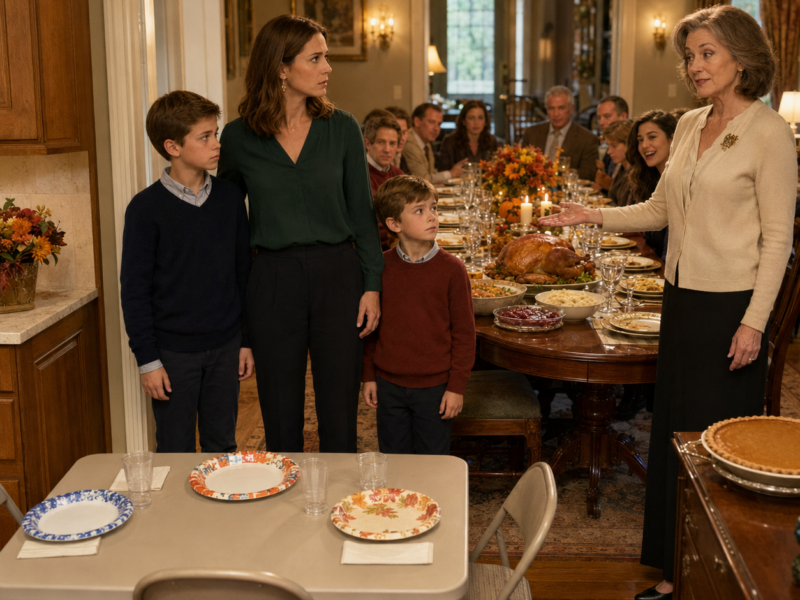
At Thanksgiving, my mother set a tiny folding table in the corner for me and my two sons while the rest of the family sat at the main table. Then she smiled and said, “This is where the poor relatives sit.” My boys went quiet before I did. I looked at their mismatched plates, then at the woman who thought poverty meant she could shame my children in my father’s house. I didn’t argue. I didn’t cry. I took my sons by the hand and walked out before the turkey was carved. She thought she had put me in the corner. By Monday morning, the bank would show her exactly whose signature controlled the trust she had been stealing from.
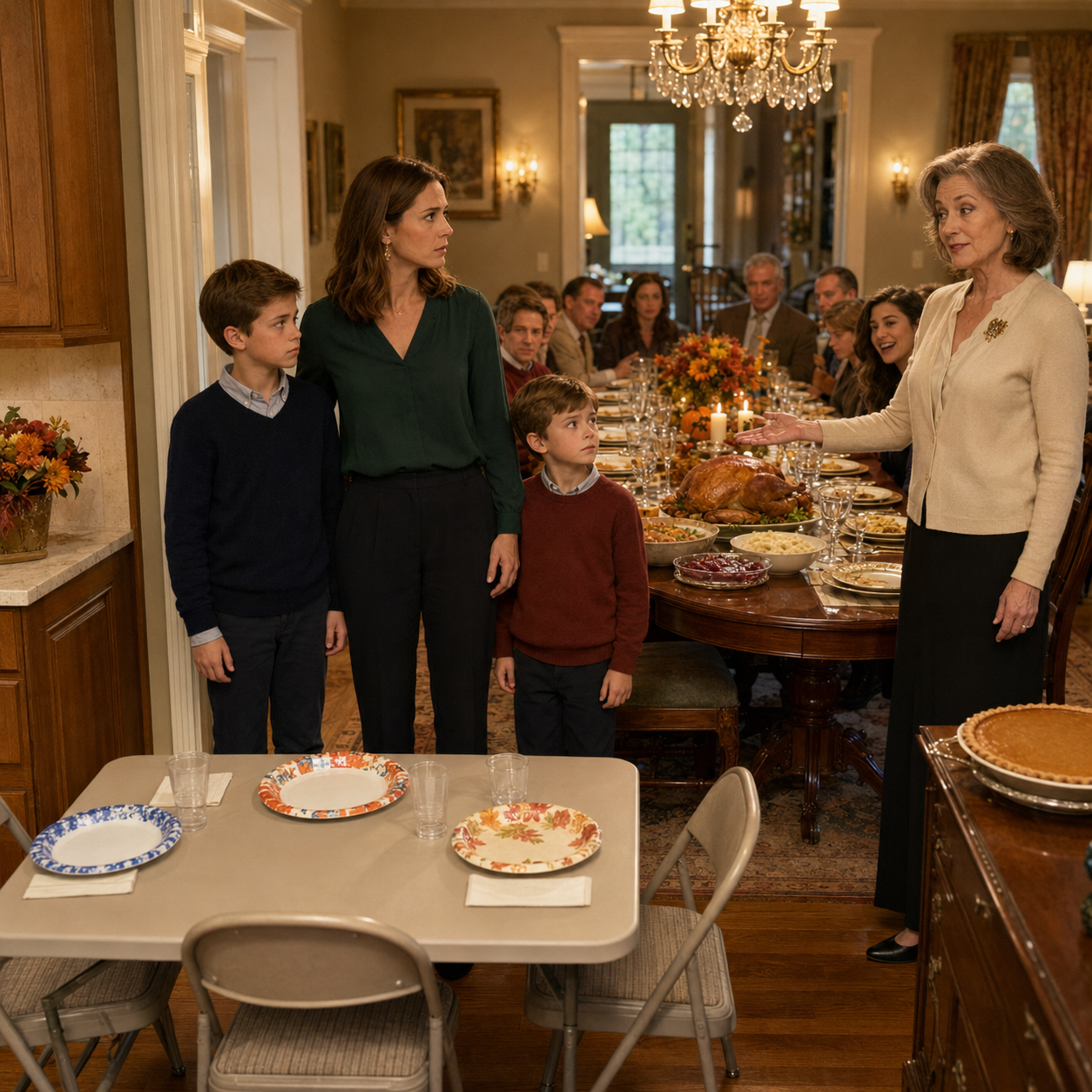
My mother pointed toward the little folding table beside the kitchen doorway and smiled as if she had arranged a charming surprise.
“This is where the poor relatives sit.”
For a second, nobody moved.
Three mismatched dinner plates waited on a white plastic table barely large enough for a card game. Someone had pulled three metal folding chairs out of the garage and squeezed them around it. One chair faced the refrigerator. Another sat close enough to the kitchen traffic that anybody carrying a serving tray would have to turn sideways to pass.
Ten feet away, the real Thanksgiving table stretched almost the full length of my mother’s dining room.
White linen.
Matching china.
Wineglasses.
Candles.
My older brother Hollis sat there with his wife and their three boys. My younger sister Verity was beside her husband, Graham, with their daughter between them. My mother had taken the place at the head of the table that my father used to occupy before he died.
There were empty inches between chairs at that table.
Not a lot.
Enough.
My eleven-year-old son, Rowan, looked at the folding table.
Then at the long table.
Then at me.
Beckett, eight, was still holding the pumpkin pie he had helped me bake that morning. His fingers were pressed carefully beneath the glass dish because he had spent the entire two-hour drive warning me not to brake hard and “destroy Thanksgiving.”
Now his face changed.
“What does she mean?”
Nobody answered.
My mother, Marian Thane, gave a soft little laugh.
“Oh, don’t make a thing out of it. We’re just teasing.”
Hollis’s two older boys laughed because their grandmother had laughed.
Verity looked down at her water glass.
Graham adjusted his napkin.
Hollis met my eyes for half a second and then looked toward the turkey.
That hurt more than I expected.
Not one adult said, “There’s room here.”
Not one pulled out another chair.
Not one told my mother that a joke about money had stopped being a joke the second two children realized it included them.
I set the basket of homemade rolls on the buffet.
Then I looked at my mother.
She seemed perfectly comfortable.
That was the moment something in me stopped trying to translate her into a kinder language.
For thirty-four years, I had explained my family to myself.
Mom doesn’t mean things the way they sound.
Hollis is just louder.
Verity needs more attention.
Everybody depends on me because I’m dependable.
They joke because they’re comfortable with me.
They don’t ask about my job because they don’t understand health care.
They don’t ask about the kids because they assume I’ll tell them if something matters.
It had taken a folding table, three mismatched plates, and six stupid words to make all my explanations feel ridiculous.
I bent toward Beckett.
“Hand me the pie.”
He looked worried.
“Did I mess it up?”
“No, baby.”
I took it carefully and placed it beside the rolls.
Then I turned to both boys.
“Get your coats.”
Rowan understood first.
“Are we leaving?”
“Yes.”
My mother’s smile hardened.
“Saskia.”
I ignored her.
Beckett whispered, “But dinner…”
“We’ll get dinner.”
“Where?”
“I don’t know yet.”
That seemed to concern him more than the humiliation.
Children prefer logistics.
Rowan grabbed their coats from the pile in the hall.
I expected someone to stop us.
That may be the most embarrassing part of the memory.
After everything, some piece of me still expected somebody to stand.
Hollis.
Verity.
My mother.
Anyone.
Instead, Mom said, “If you’re going to be this sensitive, I can’t stop you.”
I looked at her.
“You could have stopped me thirty seconds ago.”
Her face tightened.
“I was joking.”
“Rowan didn’t think it was funny.”
“Children take cues from their parents.”
That sentence settled the matter more completely than the first.
I helped Beckett into his coat.
My mother called after me as I reached the front door.
“At least leave the rolls.”
I stopped.
Not because I was reconsidering.
Because the absurdity was almost impressive.
Then I said, “Happy Thanksgiving, Mom.”
We left.
The first twenty minutes of the drive home were silent.
The roads were already darkening under a dull November sky. Bare trees blurred along the highway. Every few miles we passed another car full of people heading toward dinner, trunks probably filled with pies and casseroles and folding chairs that would be added to tables without anybody assigning moral value to them.
Beckett finally spoke from the back seat.
“Mom?”
“Yes?”
“Are we poor?”
My hands tightened around the wheel.
I signaled and pulled into the parking lot of a closed farm-supply store because I could not answer that question while driving seventy miles an hour.
I turned around.
Both boys were watching me.
“We have less money than Uncle Hollis and Aunt Verity.”
Rowan crossed his arms.
“That’s not what he asked.”
He was eleven and already irritatingly precise.
I smiled despite myself.
“No. We are not poor in the way Grandma meant it.”
“What way did she mean?”
I took a breath.
“We rent our house.”
“We drive an old car.”
“I work as a dental hygienist instead of having a job Grandma thinks sounds fancy.”
“Those are facts.”
“None of those facts make us less important.”
Beckett stared down at his hands.
“Then why did she put us there?”
That was the harder question.
“I don’t know.”
Rowan did.
“Because she thinks money makes people better.”
I looked at him.
He shrugged.
“She always talks about Uncle Hollis’s house.”
Children notice the curriculum adults never admit they are teaching.
I reached into the back seat and squeezed his knee.
“She was wrong.”
“About us?”
“Yes.”
“About money?”
“Yes.”
Beckett asked, “Can we still eat the pie?”
I started laughing.
It came out halfway between a laugh and a sob.
“We left the pie.”
His face collapsed.
“Oh.”
“I’m sorry.”
“That was my pie.”
“I know.”
“You said it came out good.”
“It did.”
He stared dramatically out the window.
“Worst Thanksgiving ever.”
Rowan said, “The table was worse than the pie.”
Beckett considered.
“Close.”
I pulled back onto the road.
By the time we reached Midlothian, every restaurant that was open had a waiting list, so we ended up at a twenty-four-hour diner attached to a truck stop.
Three booths were occupied.
A paper turkey was taped crookedly to the cash register.
The waitress called both boys “hon” and told us the Thanksgiving special still had turkey, mashed potatoes, green beans, stuffing, cranberry sauce, and pie.
Beckett looked at me.
“They have pie.”
“Apparently the nation survives.”
We slid into a booth.
Three equal seats.
Nobody in a corner.
The turkey was dry.
The mashed potatoes came from something that probably began life in a bag.
It was one of the best meals I remember.
Not because it tasted good.
Because Rowan started laughing when Beckett tried to determine whether diner pumpkin pie counted as “real Thanksgiving pie,” and for a little while the humiliation at my mother’s house became smaller than the three of us sitting together.
That was the first table I chose.
I did not yet know that four days earlier, a bank investigator had finished tracing nearly ninety thousand dollars that had quietly disappeared from the education trust my father created for all six of his grandchildren.
I did not yet know my mother’s address was attached to the paperwork.
I did not yet know the money had eventually landed in an account connected to Graham’s event-planning business.
And I certainly did not know that by Monday afternoon the woman who had put me at the “poor relatives” table would be sitting in her own kitchen learning that the lake property she had been treating as family property for six years did not belong to her at all.
None of that caused me to leave Thanksgiving.
That distinction matters.
I left because of my children’s faces.
Everything else simply arrived afterward.
I grew up in a family where hierarchy was rarely announced because it did not need to be.
Hollis was three years older than me.
He was charming before he was old enough to understand charm had value.
Teachers remembered him.
Coaches liked him.
Relatives told stories about things he had said at family gatherings as if every child did not say funny things.
He played football badly but confidently, which in our town outside Charlottesville seemed to matter more than playing well quietly.
Dad liked Hollis.
Mom admired him.
Those are not the same.
My father, Corbett Thane, was a quiet man who spent thirty years repairing farm equipment.
He began with a two-bay shop beside a feed store and ended with a service business that handled tractors, commercial mowers, diesel generators, and enough agricultural machinery that half the farmers in three counties knew his number by memory.
Dad was not wealthy in the way Hollis later imagined success.
He owned a business.
A modest house.
Some land.
A lake cabin.
Retirement savings he built slowly.
He wore the same work boots until the soles separated.
Mom cared more about appearances than Dad did.
Not because she was shallow in every way.
She had grown up poor.
Real poor.
One bathroom for seven people.
School clothes on layaway.
A mother who saved aluminum foil and reused it until it tore.
When Dad’s business began doing well, Marian Thane discovered the comfort of never having to explain why she could not afford something.
She liked that comfort.
Then she began liking the appearance of comfort almost as much.
The right neighborhood.
The right car.
The right church committees.
Children whose achievements could be summarized quickly.
Hollis was easy.
Regional manager at an insurance company.
Big house.
Three-car garage.
Wife who decorated beautifully.
Three sons in sports.
Verity was easier.
She came nine years after me, the surprise baby.
By then Dad’s business was stable, Mom had more time, and every small event in Verity’s life seemed to arrive under brighter lighting.
Dance classes.
Choir.
Birthday parties.
When Verity married Graham, whose parents owned two successful casual restaurants, Mom almost glowed.
“They work in hospitality.”
she would tell people.
That sounded impressive to her.
I became a dental hygienist.
I loved the work.
I liked the precise combination of health science and conversation.
You see people every six months.
You notice changes.
A dry mouth from medication.
Gum inflammation.
A patient who has stopped caring for himself because his wife died.
A teenager terrified of being judged.
An older woman embarrassed by years of deferred care because she raised four children before paying for herself.
It was close work.
Useful work.
Clean enough to explain.
Not prestigious enough for Mom.
At church, she introduced me as:
“My daughter Saskia. She works in health care.”
Technically true.
Conveniently vague.
One woman once asked:
“Are you a nurse?”
Before I could answer, Mom said:
“Something like that.”
I corrected her.
“I’m a dental hygienist.”
The woman smiled.
“My hygienist saved my teeth.”
Perfectly nice.
Mom changed the subject.
I noticed.
Then made an excuse for her.
I was good at that.
As a child, I became the dependable one early.
When I was ten and Hollis forgot his lunch, Mom asked me to give him half of mine.
“He’s growing.”
Apparently I wasn’t.
When I was twelve, Dad spent Saturdays at the shop and Mom took Verity to toddler activities, so I learned to start laundry.
At thirteen:
“Saskia remembers.”
At fourteen:
“Ask Saskia.”
At fifteen:
“She doesn’t mind.”
The last one became dangerous.
People decide you do not mind because you have learned complaining changes nothing.
At Christmas, Mom distributed gifts one at a time.
Hollis usually went last because whatever he received was often the item she considered the big gift.
New stereo.
Sports equipment.
Later, car keys.
Verity received an avalanche because she was small.
I got sensible things.
Good things.
A coat.
Books.
A watch.
I was grateful.
Gratitude became another way I disappeared.
At nineteen, during my first year of college, Dad met me in the driveway before I returned to campus after Thanksgiving.
He slipped an envelope into my hand.
“What’s this?”
“Gas.”
“I have gas money.”
“Then groceries.”
“I have grocery money.”
“Then stop arguing.”
Inside was six hundred dollars.
At nineteen, that felt enormous.
“Dad.”
“Don’t tell your mother.”
“Why?”
His expression changed.
“She thinks you don’t need it.”
I laughed.
“I don’t.”
Dad looked at me.
“That’s because you never ask.”
I remember that sentence better now than I did then.
At nineteen, I heard praise.
Strong Saskia.
Independent Saskia.
Years later, I heard warning.
You have trained everybody to assume you can live without care.
Dad saw more than he said.
Not enough.
That is important too.
He loved me.
He also allowed the family hierarchy to continue because challenging Marian exhausted him.
Parents can recognize injustice and still fail to dismantle it.
I do not idealize him simply because he later trusted me.
He should have spoken more.
So should I.
Life rarely gives us one guilty person.
What Dad did give me was responsibility without spectacle.
When I became pregnant with Rowan at twenty-two, he asked:
“You good?”
“Yes.”
“Need money?”
“No.”
“Need your mother?”
I laughed.
“Probably not.”
He smiled.
“That sounded hereditary.”
My marriage to Dean Mercer lasted eight years.
We were twenty-three when we married.
Too young?
Maybe.
Not disastrously.
We grew in slightly different directions.
He worked construction estimating, then moved into commercial project management.
I finished hygiene school.
Rowan came.
Then Beckett.
By thirty, Dean and I had become two respectful coworkers operating a household.
No affair.
No cruelty.
No giant betrayal.
We went to counseling.
Tried.
Eventually admitted affection had survived better than marriage.
We separated four years before that Thanksgiving and built a custody schedule that worked.
The boys lived with me most school nights because their school was close to my dental office and Dean traveled for projects.
He had them every other weekend and several weeknights when he was local.
Child support arrived.
We communicated.
He remarried later.
No villain.
My mother hated the divorce anyway.
Not because she adored Dean.
Because divorce altered the family photograph.
“You couldn’t have tried longer?”
“I tried for eight years.”
“People stay married through difficult seasons.”
“We had a difficult climate.”
She did not laugh.
Afterward, my financial choices became another item in her private evidence file.
I rented a small three-bedroom house.
Why rent?
Because housing prices were high, I wanted flexibility, and a hygienist’s income plus child support did not make me eager to buy at the top of the market.
Mom heard:
Failure.
I kept my Toyota Camry long after the odometer passed 180,000 miles.
Why?
It ran.
Mom heard:
Poor.
I packed lunches.
Bought store-brand cereal.
Vacationed with the boys at state parks and one inexpensive beach rental each summer.
Mom saw Hollis taking his family to Disney and Verity posting from resort hotels.
Different choices became ranking.
Dad did not think that way.
When he became ill six years before Thanksgiving, pancreatic cancer took him faster than any of us expected.
Seven months from diagnosis to hospice.
During his final week, he asked everyone to leave his hospital room except me.
His hand trembled around mine.
“I need you to listen.”
“Okay.”
“The lake property goes to you.”
I stared.
“What?”
“The cabin and the four acres.”
“Mom—”
“Your mother can use it.”
“So can Hollis.”
“Verity.”
“Kids.”
“But deed goes to you.”
“Why?”
“Because somebody has to maintain it.”
“Make decisions.”
“Pay taxes.”
“Say no when it needs a no.”
I almost laughed.
“You have met Mom.”
“Yes.”
That faint smile.
Then he became serious.
“There’s a trust.”
“I know.”
He had mentioned education money before.
“More specific than I told everybody.”
He explained.
Over years, he had moved a portion of business-sale proceeds and investments into a revocable trust.
At death, a separate grandchildren’s education trust would become irrevocable.
The trust would benefit all six grandchildren equally.
My boys, Rowan and Beckett.
Hollis’s sons, Jude, Mason, and Caleb.
Verity’s daughter, Lila.
Funds could be used for college, community college, trade school, professional training, and certain education-related housing costs.
Any balance remaining for a beneficiary at thirty could be distributed under the terms he had written with his attorney.
“Who’s trustee?”
I asked.
“You.”
“No.”
Dad’s mouth moved slightly.
“Excellent start.”
“Dad.”
“Why me?”
“Because Hollis thinks money is for using.”
“Verity thinks money is for fixing discomfort.”
“Your mother thinks need should decide.”
“And you?”
He looked at me.
“You read things.”
That was his first answer.
Then the real one.
“You’re fair when nobody’s watching.”
My throat closed.
“Don’t make me into something.”
“I’m making you trustee.”
“Different problem.”
He smiled.
Then coughed until the nurse came.
The formal documents were more boring than the conversation.
Good.
Boring legal documents are safer than dramatic ones.
The trust was administered through Commonwealth Community Bank as custodian.
I, as trustee, had fiduciary authority and responsibility.
I could approve legitimate distributions within Dad’s instructions.
I had to keep records.
File tax returns.
Provide annual accountings.
I could not simply decide I liked one grandchild more and move money around.
That was the whole point.
The lake cabin transferred to me through Dad’s estate after probate.
Mom knew he had made me “responsible for the cabin.”
She apparently never understood that responsible meant owner.
I did not correct the assumption because family use continued as before.
That was one of my mistakes.
The deed was recorded in my name.
I paid property taxes.
Insurance.
Repairs.
Hollis occasionally sent money for dock maintenance.
Verity’s family used it several weekends each summer.
Mom booked dates in the family calendar as though nothing had changed.
I allowed it.
Why?
Peace.
Again.
After Dad died, Mom told people the trust was “handled by the bank.”
I never corrected her publicly.
The bank held assets.
I held trustee authority.
No reason for speeches.
I met with Marguerite Voss, Dad’s estate attorney, twice a year.
Reviewed investments with the bank.
Filed tax documents.
Approved one distribution for Hollis’s eldest when Jude took dual-enrollment courses.
Nobody cared who signed.
That was fine.
I was not doing it for recognition.
The trouble began four months before Thanksgiving.
I was reviewing the annual trust ledger during my lunch break when I noticed an educational distribution I did not remember approving.
$28,800.
Beneficiary notation:
Jude Thane.
Purpose:
Postsecondary housing deposit and tuition reservation.
Jude was sixteen.
He lived with Hollis.
No college housing.
I called Marguerite.
“Probably coding error?”
she said.
“Maybe.”
“Call the bank.”
I did.
The trust officer pulled records.
“There is a trustee direction.”
“I didn’t send one.”
Silence.
“Ms. Thane, I’m going to transfer you to compliance.”
That was the beginning.
The document bore a signature resembling mine.
Not Dad’s.
Mine.
A scanned trustee authorization approving the withdrawal.
I had not signed it.
Supporting paperwork included an invoice from something called Northstar Event & Hospitality Consulting.
That made no sense for an education trust.
The bank had coded the transfer incorrectly after a manual override.
Even stranger, the mailing address on correspondence had been changed from my post-office box to my mother’s home.
I answered security questions.
Provided identification.
Signed an affidavit.
The bank froze discretionary distributions pending review.
I told no siblings.
Why?
I did not know what happened.
Perhaps someone at the bank attached the wrong document.
Perhaps fraud.
Perhaps clerical error.
Accusations should come after facts.
That principle has saved more relationships than people realize.
The review expanded.
Another $31,200 transfer appeared from two months earlier.
Then $22,400.
Total unauthorized outflow:
$82,400.
Enough to matter.
Not enough to empty the trust.
Enough to damage the allocations for two grandchildren significantly if it was not recovered.
The recipient accounts traced through Northstar, a small event-planning and hospitality business launched by Graham, Verity’s husband, that spring.
I knew the business existed.
I had attended their vow renewal party.
Expensive venue.
Flowers.
Live band.
Cocktail station with a man making smoked drinks nobody needed.
I had admired the decorations.
A month before Thanksgiving, I saw Graham loading new golf clubs into a new SUV after Lila’s school recital.
Business must be doing well.
That was what I thought.
Then I went home.
The bank investigation continued.
Marguerite said:
“Do not discuss this with family yet.”
“Because they might be involved?”
“Because you don’t know.”
Important.
I kept working.
Cleaning teeth.
Driving boys to school.
Paying cabin insurance.
Buying pie ingredients.
Then Thanksgiving happened.
My mother called us poor.
I left.
The trust review would have concluded Monday whether she insulted me or not.
That fact became important later when Verity accused me of using fiduciary power for revenge.
I could always answer:
The bank opened the investigation in July.
Your mother made the joke in November.
Chronology is an underrated form of truth.
After the diner, we went home.
Dean called because Rowan texted him.
“What happened?”
I explained.
There was silence.
Then:
“She said that in front of them?”
“Yes.”
“You want me to pick them up?”
“No.”
“Are you okay?”
That question.
Simple.
I cried.
“I will be.”
He offered to keep the boys the next day if I needed space.
I said no.
We spent Friday in pajamas.
Ate grilled cheese.
Watched movies.
Beckett made another pumpkin pie from a grocery-store crust because justice apparently required pastry.
Saturday, Rowan asked:
“Are we going to Christmas?”
“I don’t know.”
He looked worried.
“If we don’t, Grandma will say we’re dramatic.”
Maybe.
“What do you want?”
He thought.
“I don’t want that table.”
“You’ll never sit at that table again.”
The certainty in my own voice surprised me.
Sunday evening, after the boys slept, I called Odalie.
Odalie Ruiz had worked beside me at Westbridge Dental for six years.
She was the kind of friend who could spend twenty minutes saying nothing without making silence feel like an emergency.
I told her everything.
The table.
My mother.
The boys.
She listened.
Then:
“Saskia.”
“Yeah?”
“You’ve spent your whole life trying to earn a seat at a table that was never going to make room for you.”
My throat tightened.
“Maybe it’s time you stopped applying.”
I stared at my cold tea.
“That sounds like something from a greeting card.”
“Then buy the card.”
I laughed through tears.
She softened.
“You don’t have to decide forever tonight.”
“I know.”
“But you do have to stop teaching those boys that belonging means letting somebody humiliate their mother.”
That stayed.
Monday morning, Marguerite called at 9:02.
I was off work because the dental office opened late after Thanksgiving weekend.
I sat at the same kitchen table where Beckett had rolled pie dough four days earlier.
“Is it bad?”
Marguerite paused.
Her pauses were famous.
“It is not simple.”
“Marguerite.”
“Yes.”
“It’s bad enough.”
She explained.
The bank’s fraud examiners had reconstructed the three unauthorized distributions.
All used digital copies of my trustee signature.
Two contained formatting lifted from an older legitimate distribution authorization.
The contact address had been changed to Mom’s house through a mailed service request.
The request itself contained enough correct personal information to pass initial verification.
That was a banking failure too.
Compliance acknowledged the institution should have performed a direct callback to me before accepting the address change and the high-dollar distribution directions.
They had not.
That mattered because responsibility was not limited to family.
Systems need controls precisely because signatures can be forged.
“Where did the money go?”
I asked.
“Northstar.”
“All of it?”
“Most.”
Then:
“Some moved again.”
“Where?”
Marguerite inhaled.
“Venue deposits.”
“Vendor accounts.”
“A credit-card payment.”
“What venue?”
She told me.
The vow renewal venue.
I closed my eyes.
“How much?”
“About fourteen thousand tied directly to the event.”
I stared at the table.
We had attended a family celebration funded partly with money my father set aside for grandchildren’s education.
“Are you sure?”
“Yes.”
“Could Graham think this was legitimate investment money?”
“Possibly.”
“That question remains open.”
“What about Mom?”
“The correspondence change uses her address.”
“That proves address.”
“Not who filled it out.”
“Correct.”
Marguerite had taught me well.
Then:
“There is more.”
Of course.
“The bank contacted Marian this morning because she is listed as a secondary family contact in older estate records.”
“What did she say?”
“She described the money as a family advance.”
I laughed once.
“What family advance?”
“She said she believed she had authority as Corbett’s widow to approve temporary use.”
“She does not.”
“I know.”
“So does the bank.”
I put my head in my hands.
“Did she admit doing it?”
“Not formally.”
“She said she gave Graham permission.”
“That’s different.”
“Yes.”
“Where am I in this?”
“You remain trustee.”
“What happens to the trust?”
“The bank has frozen further discretionary activity.”
“No beneficiary will lose access for legitimate education expenses once we put an interim process in place.”
“Because the bank missed verification steps, it has opened a reimbursement claim.”
“The trust should be restored while the bank pursues recovery.”
I breathed.
The grandchildren would be protected.
That was my first concern.
Then:
“Do I have to call them?”
“No.”
“You should not personally negotiate repayment.”
“Bank legal and I will handle communications.”
Good.
Then Marguerite added:
“Your mother mentioned the lake property.”
My stomach tightened.
“What about it?”
“She said if repayment became necessary, the family could sell the cabin.”
I became very still.
“What did you say?”
“That she cannot sell property she does not own.”
Silence.
Then I laughed.
Not because it was funny.
Because the woman who put me at the poor table had apparently spent six years assuming the cabin deed was another thing she could direct by force of motherhood.
“What did she say?”
“She asked whose name is on it.”
“And?”
“I told her.”
I pictured Mom at her kitchen table.
My old kitchen.
The long Thanksgiving table probably still extended with leaves.
The little folding table likely back in the garage.
“Saskia?”
“I’m here.”
“She did not take it well.”
“I’m shocked.”
Marguerite sighed.
“Do not enjoy this too much.”
“I’m not.”
Then I corrected myself.
“A little.”
“Human.”
She became serious.
“You are trustee.”
“Your responsibility is to every beneficiary.”
“That includes Verity’s daughter.”
“I know.”
“You cannot use distributions or cabin access as leverage in the family conflict.”
“I know.”
I sat straighter.
“That matters to me.”
“Good.”
“If Lila needs tuition, she gets tuition.”
“If Hollis’s boys need it, same.”
“Even if their parents never speak to me again.”
“Yes.”
Dad had chosen correctly about one thing.
I could separate anger from fiduciary duty.
I wish I could say Monday ended there.
At 11:34, Mom called.
I let it ring twice.
Then answered.
“What did you do?”
No hello.
“What are you referring to?”
“The bank.”
I closed my eyes.
“I didn’t do anything this morning.”
“They are talking about fraud.”
“They opened a compliance review months ago.”
Silence.
“What?”
“July.”
“You started this in July?”
“I reported an unauthorized withdrawal.”
“You could have called me.”
“I didn’t know you were involved.”
“I am not involved.”
“Then why did you tell the bank you approved it?”
Another silence.
Mom recovered.
“I said I knew about the money.”
“That is not the same.”
“Your sister’s family needed help.”
“There it was.”
Need.
Mom’s favorite justification.
“Whose signature was on the trustee direction?”
“That is what the bank is sorting out.”
“You know what I mean.”
“No.”
I stayed calm.
“I know my signature appears on documents I did not sign.”
“If you know something about that, tell the bank.”
“Saskia.”
“No.”
“This is not Thanksgiving.”
“This is not about your joke.”
“This is money Dad legally restricted for six children.”
“Six.”
“Not Verity.”
“Not Graham.”
“All six.”
Mom’s voice sharpened.
“Your father would have wanted family helping family.”
“Dad wrote what he wanted.”
“He made me trustee.”
“That’s a technicality.”
That sentence hurt more than the poor-table joke.
A dead man’s estate plan.
A fiduciary appointment.
Six grandchildren.
Technicality.
“No.”
I said.
“It is the opposite of a technicality.”
Mom began crying.
Not loudly.
The soft wounded crying that had ended arguments my entire childhood.
I waited.
“What happens now?”
she asked.
“The bank and attorney handle it.”
“What about the cabin?”
“It belongs to me.”
Silence.
“That cabin is family property.”
“It is family-use property because I’ve allowed family use.”
“Dad left it to me.”
“He told me you’d manage it.”
“He told you what made you comfortable.”
“That doesn’t change the deed.”
Mom’s crying stopped.
Cold replaced it.
“So this is what you’re doing.”
“What?”
“Punishing everyone because I made a joke.”
I almost admired the speed.
“Mom, the deed was recorded six years ago.”
“The bank review began four months ago.”
“Thanksgiving was four days ago.”
“Those dates exist whether you like me or not.”
“You always do this.”
“Do what?”
“Make everything complicated.”
The old line.
I smiled sadly.
“No.”
“I read complicated things after other people decide not to.”
Then:
“Going forward, all trust communication goes through Marguerite.”
“You’re my daughter.”
“Yes.”
“Then act like it.”
I thought of Rowan’s face.
“I am.”
I ended the call.
Hollis called Wednesday.
He sounded uncomfortable.
“I didn’t know.”
“About which thing?”
“Mom.”
“The trust.”
“Table.”
“Choose.”
He sighed.
“Both.”
I waited.
He started with Thanksgiving.
“I should’ve said something.”
“Yes.”
“I almost did.”
“That helps less than you think.”
“I know.”
Silence.
Then:
“Jude asked why I let Grandma talk about you like that.”
My throat tightened.
“What did you say?”
“That I was embarrassed and didn’t know what to do.”
“Honest.”
“He said that sounded weak.”
I laughed.
“Children.”
“Yeah.”
Hollis continued.
“The bank called.”
“Because Jude’s allocation was used in one of the records.”
“Yes.”
He sounded shaken.
“I didn’t know there was that much.”
“You weren’t supposed to need to know exact numbers.”
“Is his money gone?”
“No.”
That was the first thing I wanted him to hear.
“The bank expects restoration.”
“I will make sure every child’s share is protected.”
Hollis went quiet.
“You.”
“Yes.”
“You’re trustee.”
“Yes.”
“Mom said the bank handled it.”
“The bank holds assets.”
“I make trustee decisions.”
He exhaled.
“How long?”
“Since Dad died.”
“Why didn’t you tell us?”
“Why would I?”
“I don’t know.”
Then he laughed weakly.
“Maybe because we apparently know nothing about you.”
There.
He continued.
“Do you know where the money went?”
“Some went to Graham’s business.”
“Jesus.”
“Some was used for Verity’s vow renewal.”
More silence.
“We were there.”
“Yes.”
“I ate their shrimp.”
I laughed despite everything.
“So did I.”
Then:
“You think Verity knew?”
“I don’t know.”
“What about Graham?”
“I don’t know what he believed about authorization.”
“Hollis, don’t build facts we don’t have.”
He sighed.
“You sound like Dad.”
“That is offensive.”
“It was intended as a compliment.”
We talked longer than we had in years.
Not close.
Honest.
Two days later, Verity called.
She was furious.
“You have lost your mind.”
“Hello to you too.”
“Graham’s clients are getting calls.”
“I didn’t call them.”
“The bank contacted his business.”
“Yes.”
“Because of you.”
“Because money from Dad’s trust went there under a document I didn’t sign.”
“You’ve always been jealous.”
The word arrived exactly on schedule.
“Of what?”
“Us.”
“Our home.”
“Graham’s business.”
“The fact that things worked out for me.”
I sat at the kitchen table.
“Odalie would love this.”
“What?”
“Nothing.”
Verity continued.
“You couldn’t stand Mom celebrating me.”
“So now you’re going to destroy Graham.”
“I don’t control the bank.”
“You control the trust.”
“Yes.”
“That is not the same thing.”
“You could tell them it was allowed.”
“Was it?”
Silence.
“Did I authorize the transfer?”
“No.”
“Did you?”
“I didn’t know about it.”
That sounded honest.
I paused.
“You didn’t?”
“No.”
“Graham said an investor gave him bridge money.”
My anger shifted.
“Did he say who?”
“Family.”
That could mean anything.
“Verity, get your own lawyer.”
“What?”
“Not Mom’s.”
“Not Graham’s business attorney.”
“Your own.”
She became cold.
“You’re enjoying this.”
“No.”
That was almost true.
“I enjoyed Mom finding out she doesn’t own my cabin for about four minutes.”
“But this?”
“No.”
“Lila’s education money was affected.”
Verity stopped breathing for a second.
“What?”
“Your daughter is one of the six beneficiaries.”
“Dad’s trust belongs to the children.”
“Not us.”
Her voice dropped.
“How much of hers?”
“I’m not discussing internal allocation until the bank finalizes restoration.”
“But she’s protected?”
“Yes.”
“I will protect her exactly the same as Rowan.”
“Why?”
The question hurt.
“Because she’s my niece.”
“And because Dad told me to.”
Verity cried.
Not apology.
Fear.
For her daughter.
That was okay.
Human beings often find morality through personal proximity.
The legal process moved slowly.
Good.
Slow processes frustrate people who want emotional timing.
They also prevent some bad decisions.
Commonwealth Community Bank completed its internal review in January.
It concluded that its employees had failed required verification procedures when the trustee mailing address was changed and when unusually large distributions were requested.
The bank restored the $82,400 to the trust under its fraud-loss procedures while reserving the right to pursue recovery from responsible parties.
Interest adjustments followed.
The six grandchildren’s internal balances were corrected.
No child lost education funding.
That mattered more to me than anything else.
The bank referred the documents to its fraud insurer and to law enforcement as required by its policies.
I gave a statement.
Provided travel records proving I had been at a dental continuing-education course in Charlotte when one authorization supposedly originated from me in Virginia.
Provided signature samples.
Then stepped back.
Marguerite reminded me:
“You are a witness and trustee.”
“You are not investigator.”
Fine.
I did not call Mom asking for confession.
Did not threaten Graham.
Did not post screenshots in family chats.
I worked.
Took Rowan to basketball.
Helped Beckett build a solar-system model that somehow involved enough glitter to contaminate the kitchen for months.
That December, we did not attend Mom’s Christmas.
She sent no invitation directly.
Hollis said:
“Mom thinks you know you’re welcome.”
I said:
“That’s not an invitation.”
He paused.
“You’re right.”
New behavior.
We spent Christmas morning in pajamas.
Dean came by for brunch before taking the boys to his parents that afternoon.
Odalie brought cinnamon rolls.
My house was small.
We used the dining table I bought secondhand after the divorce.
Four chairs.
Then dragged in two from the kitchen.
Everybody fit.
Rowan noticed.
Of course.
After New Year’s, Mom retained an attorney.
The first letter framed the trust transfers as “good-faith family loans” Marian believed she could arrange based on her status as Corbett’s surviving spouse.
Marguerite answered politely.
The trust document contained no such authority.
Mom was not trustee.
Not co-trustee.
Not beneficiary of the grandchildren’s fund.
There was no widow’s share inside that trust.
Dad had provided separately for her through life insurance, retirement assets, and the marital property they already owned.
The education money was not hers.
The cabin was not hers either.
Mom’s lawyer apparently discovered that part in the title search.
She called Hollis.
Hollis called me.
“Mom says Dad cheated her.”
I closed my eyes.
“How?”
“Cabin.”
“She knew he left it to me.”
“She thought you were managing.”
“That is her misunderstanding.”
“Was it separate property?”
“Yes.”
Dad had inherited the original lake parcel from his uncle before he married Mom.
Later improvements were more complicated, but his estate plan and prior marital agreements had addressed them.
Marguerite had made sure the transfer was valid.
No last-minute deathbed trick.
No secret signature.
Mom had signed estate-planning acknowledgments years earlier and apparently never absorbed what they meant.
Again:
People see what fits.
Hollis asked:
“What are you going to do with the cabin?”
“Pay the taxes.”
“I mean family use.”
“Nothing right now.”
He became quiet.
“Are we banned?”
“No.”
“Mom?”
I thought.
“For now, yes.”
“Why?”
“Because she tried to offer my property as restitution without asking me.”
Fair.
He sighed.
“Yeah.”
Then:
“Can I take the boys fishing in spring?”
“Ask me in spring.”
“Look at you, drunk with power.”
I laughed.
“Go away.”
That humor mattered.
Hollis and I were becoming siblings instead of roles.
The golden son and reliable daughter were fading.
Not gone.
Fading.
Verity’s marriage became harder.
Graham insisted he had believed Marian had authority to arrange the money as a family investment.
Documents partly supported that.
He had signed a promissory note acknowledging Northstar received an $82,400 “Thane Family Education Trust bridge investment” through Marian.
That should have raised questions.
Why was Marian signing for a trust bearing another trustee’s name?
Graham claimed Mom told him she was authorized behind the scenes.
Emails showed he asked once:
Does Saskia need to sign?
Mom responded:
I handle family estate matters. Don’t bother her.
He accepted that answer.
Was he criminally fraudulent?
Investigators eventually concluded they could not prove he knew my signature had been falsified when funds moved.
Civil liability was easier.
His company had received money it was not entitled to retain.
Northstar entered a repayment agreement with the bank’s insurer.
The business survived two more years in smaller form, then closed after Graham took a salaried event-management position with a hotel group.
No prison.
No spectacular downfall.
Consequences.
The vow renewal became embarrassing in hindsight.
Verity hated that.
She told me once:
“Every time I see the pictures, I wonder what was paid with trust money.”
“That isn’t your fault if you didn’t know.”
“I should have asked where the money came from.”
“Why?”
“Because we didn’t have it.”
There.
She looked exhausted.
“We were struggling.”
“Graham wanted the business to look successful.”
“Mom wanted to help.”
“I liked not asking.”
Honesty.
Verity and Graham stayed married.
That surprised some relatives.
People expected the financial scandal to reveal a loveless marriage.
It did not.
It revealed bad judgment, shame, and a family system where asking where money came from was considered less polite than accepting it.
They entered counseling.
Sold the SUV.
Moved from their large rental into a smaller house.
Paid the repayment agreement over several years.
Not glamorous.
Adult.
Mom’s legal consequences were more serious.
The altered trustee authorizations were traced to a computer at her house.
A forensic review found scanned copies of my signature and draft versions of the forms.
She eventually admitted completing and submitting them.
Her explanation remained consistent:
She believed the money was family money.
She believed Dad would have approved.
She believed she could “borrow” temporarily because Verity’s family needed help.
Belief did not create legal authority.
The county prosecutor accepted a plea to a reduced fraud-related charge after restitution arrangements, her lack of prior record, the bank’s own verification failures, and her cooperation were considered.
She did not go to prison.
She received supervised probation, financial restrictions related to fiduciary roles, and restitution obligations to the bank’s insurer.
Some relatives said she got off easy.
Others said any charge was cruel for a woman in her sixties.
I said neither.
Sentencing was not my job.
That distinction saved me from becoming organized around punishment.
I had enough jobs.
Dental hygienist.
Mother.
Trustee.
Daughter at a distance.
I did not need prosecutor too.
What hurt more than the legal process was Mom’s refusal to connect any of it to Thanksgiving.
For almost two years, she told people:
“Saskia misunderstood a seating arrangement.”
Then:
“She was under stress because of the trust.”
Wrong order.
Trust review started before.
But Mom preferred a story where my emotional instability caused the family fracture.
That story protected her from the simpler truth.
She humiliated her daughter and grandchildren because she believed money justified hierarchy.
Then she was caught treating a grandchildren’s trust according to the same hierarchy.
The two events were not causally connected.
They came from the same belief.
Some people matter more because they appear more successful.
Some needs are more worthy because they belong to the child Mom identifies with.
Some children can wait because they are strong.
I recognized that pattern because I had lived inside it since childhood.
The school counselor helped Rowan and Beckett in the months after Thanksgiving.
I arranged a few sessions through their elementary school.
Not because they were traumatized in some dramatic clinical way.
Because children should not have to protect a parent while processing family conflict.
Rowan told the counselor he wanted to know why adults laugh when they know something is mean.
Good question.
Beckett drew tables.
According to the counselor, almost every picture of a house included a table.
All chairs equal.
No corner.
That broke me more effectively than anything my mother said.
One night, Rowan asked:
“Are we spending every holiday alone now?”
I sat beside him on his bed.
“No.”
“Grandma says family is family.”
“Yes.”
“Then what are we?”
I thought.
“A family.”
“You, me, Beckett.”
“Your dad.”
“His family.”
“Uncle Hollis if he wants to show up.”
“Aunt Odalie even though she isn’t really your aunt.”
“Odalie says she is.”
“Then apparently she outranks me.”
Rowan smiled.
“Family doesn’t have to all be in one room to be real.”
He looked at me.
“Are you mad at Grandma?”
“Yes.”
“Do you hate her?”
“No.”
That answer surprised him.
“How?”
“People can hurt you without becoming monsters.”
He thought.
“Do we have to forgive her?”
“No.”
“You don’t have to decide anything yet.”
That became another rule.
I would not use my children as soldiers in my conflict.
Mom sent Beckett a birthday card the following summer.
No note beyond:
Love, Grandma.
I handed it to him.
“Do I have to write thank you?”
“No.”
“Can I?”
“Yes.”
He shrugged.
“I’ll do it later.”
He never did.
I did not force.
Rowan wanted no contact.
For a while.
Hollis started visiting.
At first alone.
Then with the boys.
He never cut Mom off.
I never asked.
That was his relationship.
One Saturday he helped Rowan build a bike ramp and nearly broke his ankle trying it himself.
I laughed so hard I had to sit down.
He looked at me from the grass.
“You could help.”
“You’re a regional manager.”
“Exactly.”
“Manage yourself.”
His boys developed a closer relationship with mine.
The trust stopped being mysterious as college approached.
When Jude turned eighteen and enrolled at Virginia Tech, Hollis contacted me through Marguerite formally because I had insisted all distribution requests be documented.
He hated that at first.
“Do I really need to send tuition statements to my own sister?”
“Yes.”
“You know he goes there.”
“Yes.”
“Fine.”
He sent them.
I approved tuition.
Housing within the trust standard.
Books.
No drama.
Then Hollis called.
“Thank you.”
“For what?”
“For doing exactly what Dad asked.”
I sat with that.
“You’re welcome.”
When Verity’s daughter Lila entered nursing school two years later, Verity submitted paperwork.
We had barely spoken.
I approved eligible costs the same week.
She called.
“You didn’t have to make it easy.”
“Yes, I did.”
“What?”
“As trustee.”
Her voice softened.
“I’m sorry.”
“For?”
“For thinking you’d use the trust against us.”
I looked out my office window at the parking lot.
“I won’t.”
“Even after Mom?”
“Especially after Mom.”
“Then I’d become her.”
Silence.
That was one of the first bridges between us.
Small.
Strong enough for one conversation.
Verity and I never returned to childhood closeness because we had never actually had much.
We became adult sisters.
Coffee every few months.
Children’s events.
No pretending.
She eventually apologized for Thanksgiving.
Three years after.
We were waiting outside Lila’s school awards night.
She said:
“I saw the table before you did.”
I looked at her.
“What?”
“That Thanksgiving.”
“Mom showed me.”
“When?”
“Morning.”
My chest tightened.
“What did she say?”
“She thought it was funny.”
“And you?”
Verity looked down.
“I told her it was mean.”
“Then why didn’t you say anything when I arrived?”
Tears filled her eyes.
“Because she looked at me like I was ruining the holiday.”
There.
Power.
“So I decided you could handle it.”
Strong child tax again.
“I’m sorry.”
“Thank you.”
“I watched Rowan’s face.”
“I still think about it.”
Good.
Remorse should sometimes remain uncomfortable.
Not forever destructive.
But enough to teach.
We stood silently.
Then Lila came out holding a certificate.
Conversation shifted.
Life.
That was how repair happened.
Not one giant table-clearing confession.
Minutes between ordinary events.
Mom’s probation ended.
Restitution completed partly through retirement savings and a negotiated sale of an investment account.
She kept her house.
Nobody threw her into poverty.
She lived comfortably enough.
She lost access to financial decision-making for other relatives because nobody trusted her with it anymore.
That consequence hurt her more than money.
Mom had always been the person people called.
Which caterer?
Which bank?
Who should handle Grandma’s estate sale?
Which child needs help?
After the trust scandal, relatives began asking twice.
Sometimes calling someone else.
Mom noticed.
She called it disrespect.
Others called it caution.
I called it evidence changing behavior.
The cabin became another battleground until it didn’t.
First summer after Thanksgiving, Mom announced in the family group chat:
Lake weekend July 12–14.
I replied:
The cabin is not available that weekend.
She called immediately.
“We’ve used that weekend for years.”
“I’m taking the boys.”
“You can go another weekend.”
“No.”
“You’re doing this to hurt me.”
“No.”
“I own it.”
That sentence felt strange at first.
Not triumphant.
Heavy.
Ownership includes responsibility.
Mom said:
“Your father would hate this.”
I almost laughed.
“Dad gave me the deed.”
She hung up.
We went.
Rowan fished.
Beckett hated fishing but loved driving the little aluminum boat with me at idle speed.
We grilled burgers.
No fancy furniture.
Dad’s old coffee mug still in cabinet.
At sunset, I sat on the dock alone and thought about him.
“Did you know?”
I asked the lake.
No answer.
Would Dad have predicted Mom forging my signature?
No.
I do not think so.
Would he have predicted she might favor one branch?
Yes.
Maybe that was why he wrote rules.
Love people.
Use documents.
Not contradictory.
The next year, I created a formal cabin-use calendar.
Every branch of family could request dates.
Maintenance contributions transparent.
No one branch automatic priority.
Mom hated the formality.
Hollis loved it because his wife had been quietly furious for years about Verity claiming every Memorial Day weekend.
Amazing what written rules reveal.
Fairness often feels rude only to people who benefited from ambiguity.
Mom did not request a weekend for two years.
Then she did.
A Tuesday email.
Saskia,
I would like September 8–10 if available.
Mom.
I stared.
No assumption.
Request.
I checked.
Available.
Approved.
She went with Aunt Ruth.
Nothing bad happened.
That was change, though neither of us called it that.
The first Thanksgiving after the corner table, we hosted at my rented house.
“Hosted” sounds grand.
It was six adults and six children packed around two tables pushed together.
Odalie brought mac and cheese.
Dean stopped by for dessert after the boys returned from his parents.
Hollis asked if he and his boys could come.
His wife was visiting her mother.
I said yes.
Rowan insisted on carving the turkey.
He was twelve.
Terrible idea.
The bird looked as though it had lost an argument with machinery.
Nobody cared.
Before we ate, Beckett wanted to say grace.
We were not especially religious, but he had apparently prepared remarks.
“Thank you for food.”
Good start.
“Thank you for family.”
Fine.
“Thank you for Uncle Hollis not falling off the bike ramp this year.”
Hollis protested.
Then:
“Thank you for tables where everybody fits.”
My throat closed.
Odalie looked at me.
I stood.
“Forgot the cranberry sauce.”
Nobody said anything.
I went into the kitchen.
Cried quietly for thirty seconds.
Then returned with cranberry sauce we did not actually need.
That table became tradition.
Not always same people.
That mattered.
Some years Hollis.
Some Dean.
Odalie almost every year.
Verity eventually once.
Later Mom, but much later.
Family no longer required one central house.
We distributed.
No matriarch.
No head table.
It felt healthier.
My career remained ordinary.
I say that with pride.
I did not secretly become a millionaire.
Did not inherit some giant fortune.
Dad’s trust was not mine.
The cabin gave me an asset but also bills.
I continued working as a dental hygienist.
Eventually I moved into a lead clinical role and trained new hygienists.
At forty-one, I completed a bachelor’s degree part-time because I wanted to teach clinical courses at the community college.
Two nights a week, I taught students how to talk to frightened patients without making them feel stupid.
I loved it.
Mom once asked:
“Does teaching pay more?”
“No.”
“Then why?”
“Because I like it.”
She looked confused.
Then stopped herself from commenting.
Progress can look like an unsaid sentence.
I bought a modest townhouse at thirty-eight.
Not because the family conflict made me suddenly wealthy.
Because I saved.
Interest rates shifted.
Dean’s child support stayed consistent.
I received a raise.
The down payment took years.
At closing, my hands shook.
Not because the house was huge.
Three bedrooms.
Tiny backyard.
One-car garage.
Mine.
Rowan said:
“Are we rich now?”
I laughed.
“No.”
“Then what?”
“Homeowners with debt.”
Beckett said:
“That sounds worse.”
Correct.
Mom heard about the purchase from Hollis.
She sent flowers.
Card:
Proud of you.
No hidden line.
I kept it.
Not because it repaired the past.
Because changed behavior deserves room in memory too.
The first real conversation with Mom came six years after Thanksgiving.
Long time.
She had spent years defending the seating arrangement as a joke.
Then one afternoon she called.
“I found something.”
“What?”
“Your father’s letter.”
My heart tightened.
“What letter?”
“Estate papers.”
She had been cleaning a filing cabinet.
Dad had left a memorandum for Marguerite explaining why he selected me as trustee.
Not legally operative.
Personal.
Mom read part.
Marian,
I know you will think Saskia has too much responsibility already. That is part of why I chose her. She understands that needing something and being entitled to it are not the same. She also sees all the children as children, not reflections of their parents.
Mom stopped.
I said nothing.
Her breathing changed.
“He knew.”
“Knew what?”
“That I did that.”
“Favored people.”
I sat at my desk after clinic hours.
Sunlight fading outside.
“Probably.”
Mom cried.
Then:
“I put you at that table because I was angry.”
Finally.
“About what?”
“Your life.”
I frowned.
“My life?”
“You never needed me.”
There.
Old family wound.
“You divorced Dean and survived.”
“You raised the boys.”
“You worked.”
“You didn’t call asking for money.”
“Hollis called.”
“Verity called.”
“You just…”
She stopped.
“What?”
“Kept going.”
Her voice cracked.
“I told myself that meant you thought you were better.”
My eyes filled.
“I never thought that.”
“I know.”
Then:
“I wanted everybody to see that money mattered.”
“That Hollis and Verity had done things right.”
“And you…”
She breathed.
“I made you the example of what happens when you don’t.”
I felt cold despite the warm office.
“You used my children.”
“Yes.”
No defense.
“I’m sorry.”
There.
Six years.
I had imagined the apology.
In my imagination, I felt triumphant.
In real life, I felt tired.
“Thank you.”
“That’s all?”
“What do you want?”
“I don’t know.”
“Forgiveness?”
She whispered:
“Maybe.”
I thought.
“I forgave parts a long time ago.”
“What does that mean?”
“It means I stopped wanting to punish you.”
“It doesn’t mean the boys forget.”
“It doesn’t mean we go back.”
Mom cried quietly.
“I understand.”
Then:
“And the trust?”
I almost laughed.
“Different apology.”
She actually laughed through tears.
Good.
Then she said:
“I stole.”
No euphemism.
“Yes.”
“I told myself I borrowed.”
“Yes.”
“I didn’t have permission.”
“No.”
“I’m ashamed.”
That mattered.
“I’m sorry.”
Again.
“Thank you.”
We talked an hour.
Not enough for six years.
Enough for one evening.
I told Rowan and Beckett that Grandma apologized.
Rowan was seventeen.
Beckett fourteen.
Rowan said:
“Okay.”
Nothing more.
Beckett asked:
“Can she come to Christmas?”
Interesting.
“Do you want her to?”
“Maybe.”
Rowan shrugged.
“If she doesn’t make money jokes.”
Reasonable.
Mom came.
First holiday at my house since Thanksgiving.
She brought sweet potatoes.
Asked where to sit.
That question almost undid me.
“Anywhere.”
She looked at the table.
No head.
Round extension arrangement.
She chose a chair near the end.
During dinner, Hollis made a joke about his own expensive truck.
Mom started:
“Well, some of us…”
Then stopped.
Everybody noticed.
She looked at me.
“I’m learning.”
We laughed.
Safe enough.
Not fully safe.
Getting there.
The trust continued doing what Dad wanted.
Jude completed engineering.
Mason went to community college then became an electrician.
Caleb used funds for nursing school.
Lila became a physical therapist assistant after changing majors twice.
Good.
No penalty.
Rowan surprised everyone by choosing an HVAC apprenticeship instead of four-year college.
Mom asked:
“Does the trust cover that?”
“Yes.”
“Dad wrote trade school specifically.”
She nodded.
“Good.”
No disappointment.
That was growth.
Beckett went to Virginia Commonwealth for environmental science.
Changed to urban planning.
Then again to data analytics.
I told him:
“Your grandfather did not establish a trust to finance permanent indecision.”
He laughed.
Eventually graduated.
Every beneficiary received what the trust allowed.
No special treatment.
At age thirty, unused balances distributed according to Dad’s terms.
I sent final accountings.
Closed subaccounts.
Years of paperwork ending one child at a time.
When the last grandchild reached the distribution point, I sat with Marguerite, now partially retired.
She pushed the final signature page toward me.
“How does it feel?”
“Like I never want to see Form 1041 again.”
She laughed.
Then:
“Your father chose well.”
I looked down.
“He chose burden.”
“Same thing sometimes.”
“No.”
I smiled.
“Different.”
I had learned to stop romanticizing reliability.
Being dependable is good.
Being assigned everyone’s dependence without consent is not.
Dad trusted me.
Good.
The trust also had professional support.
Bank.
Attorney.
Accountant.
I was not carrying it alone.
That made the difference.
The cabin remained in my name until I was fifty-eight.
By then, maintenance had become expensive.
Dock repairs.
Roof.
Septic.
Insurance.
My children lived elsewhere.
Hollis’s boys scattered.
Verity’s daughter had her own family.
The property no longer served childhood the same way.
I invited everyone to a meeting.
At the cabin.
Not to ask permission.
To explain.
“I’m thinking of selling.”
Mom was eighty.
She looked out at the lake.
“I wondered when.”
Hollis said:
“Can we afford to keep it as a group?”
Dangerous question.
We ran numbers.
Actual numbers.
Taxes.
Maintenance.
Insurance.
Reserve.
Everyone became quiet.
Verity laughed.
“Apparently family nostalgia is expensive.”
Yes.
We considered forming an LLC with proportional ownership.
Bad fit.
Different incomes.
Different usage.
Future conflict.
Eventually, everyone agreed selling made sense.
Again, legally I did not need agreement.
Emotionally, consultation was kind.
I sold the cabin to a retired couple from North Carolina who promised nothing about preserving our memories because property buyers should not have to inherit sellers’ sentiment.
Good.
I kept Dad’s mug.
One photograph from the dock.
Nothing else.
Part of the proceeds funded my retirement.
Part went toward my sons’ first-home gifts, equal amounts, written as gifts with no strings.
I paused before doing that.
Family money had taught me caution.
I told both:
“This is a gift.”
“Not ownership.”
“Not future authority.”
Rowan laughed.
“Mom.”
“I’m serious.”
“We know.”
Good.
I wrote gift letters anyway.
Boring.
Healthy.
Mom sold her house around the same time.
Downsized to a condo near Hollis.
I helped with boxes.
Not money.
She did not ask.
One afternoon we found the folding table in the garage.
Same one?
Maybe.
White plastic.
Metal legs.
I stood staring.
Mom saw.
Her face changed.
“I should throw that away.”
I touched the edge.
“No.”
“Keep it.”
She stared.
“Why?”
“It’s a table.”
That surprised both of us.
Objects do not become guilty because people use them badly.
Mom gave it to a church rummage sale.
Somebody probably bought it for ten dollars and hosted card games.
Good.
The table did not need to carry us forever.
My relationship with Verity took the longest to become comfortable.
She had been the favorite.
That role harmed her too.
It took me years to see.
After Graham’s business closed, Verity admitted she had no idea how much of her self-worth depended on other people believing they were doing well.
“My whole marriage,” she said once, “I kept asking whether things looked successful.”
Not:
Were we okay?
Were we in debt?
Did Graham like the work?
Were we happy?
Looked successful.
Mom’s language living in another daughter.
Verity went back to work full-time after years of part-time administration in the restaurants.
She became event coordinator at a community arts center.
Smaller salary.
Loved it.
One afternoon, she called.
“I got promoted.”
I said:
“Congratulations.”
Then:
“Do you want dinner?”
Silence.
She started crying.
“What?”
“Mom always made promotions into rankings.”
I understood.
“I’m not ranking.”
“I know.”
We went to dinner.
No champagne.
Tacos.
Good.
Hollis had his own reckoning.
His insurance company reorganized when he was fifty-two.
Regional manager became redundant.
For six months, he was unemployed.
The first month he called me.
“I feel like a failure.”
I almost said:
Welcome to the poor table.
I did not.
That joke would have been revenge wearing humor.
Instead:
“You lost a job.”
“That is not the same as becoming less.”
He went quiet.
Then:
“Did you learn that at Thanksgiving?”
“Yes.”
“Damn.”
He laughed.
Found another position at lower title, better hours.
Liked his life more.
Family hierarchy dissolved partly because life eventually rearranges everybody’s résumé.
Money changes.
Marriage changes.
Cars age.
Jobs disappear.
Children grow.
The measurements Marian Thane used to rank us turned out to be terrible long-term instruments.
At seventy, I taught dental hygiene part-time and worked only two clinic days.
My hands had started aching.
Years of instruments.
Posture.
Repetition.
I mentored younger hygienists.
One student, twenty-two, apologized every time she needed help.
“I’m sorry.”
“Stop.”
“Sorry.”
I stared.
She laughed nervously.
“My mom says I ask too many questions.”
“That is literally how school works.”
She became quiet.
I recognized something.
Reliable child.
Small.
Trying to need less.
I told her:
“You do not earn competence by pretending you already know.”
That sentence was for both of us.
She became an excellent clinician.
Not because I saved her.
Because somebody gave her permission to ask.
At seventy-four, Mom had a stroke.
Small.
Enough to change life.
Hollis called.
I drove to the hospital.
No resentment.
Choice.
Mom looked frightened in the bed.
Speech intact.
Right hand weak.
I sat.
She said:
“You came.”
“Yes.”
Tears.
“Thank you.”
No:
Of course.
I had learned not to erase choices.
We arranged rehabilitation.
Not me alone.
Hollis handled insurance.
Verity coordinated appointments.
I managed legal documents because I understood them.
Distributed care.
Mom watched.
One afternoon:
“You kids are good.”
Hollis laughed.
“Don’t sound surprised.”
Mom smiled weakly.
Then:
“I made you compete.”
The room became quiet.
All three of us were there.
Verity sat beside the window.
Hollis near the door.
I looked at Mom.
“Yes.”
“I thought competition made children stronger.”
Hollis said:
“It made us annoying.”
I laughed.
Verity cried.
Mom continued.
“I thought if one of you did well, I should use it to motivate the others.”
“That is not what happened.”
“No.”
She looked at me.
“I used you as the example of what not to become.”
My throat tightened.
“And then Dad trusted you with everything that actually needed trust.”
No triumph.
Just sadness.
Mom whispered:
“I’m sorry.”
Hollis said:
“For all of us?”
“Yes.”
Verity took Mom’s hand.
I did not immediately.
Then did.
That did not make us a perfect family.
It made one hospital room honest.
Mom recovered enough to return to assisted living rather than independent condo.
We visited.
Not weekly all of us.
Separate.
She became gentler because age and consequence had reduced the usefulness of performance.
At eighty-two, she asked me:
“Do you think I loved you less?”
I thought.
“No.”
She looked surprised.
“Really?”
“I think you understood me less.”
“That’s worse.”
“Sometimes.”
I smiled sadly.
“You loved what you could categorize.”
“Hollis looked successful.”
“Verity looked like the daughter you knew how to help.”
“I looked like I didn’t need anything.”
Mom cried.
“You did.”
“Yes.”
“Why didn’t you ask?”
There it was.
Even late.
I laughed softly.
“I did when I was young.”
“You taught me not to.”
Her face broke.
No defense.
“I’m sorry.”
“I know.”
Then:
“I taught my boys differently.”
She nodded.
That was the real consequence.
Rowan and Beckett grew up knowing need could be spoken.
They did not always speak it.
Nobody does.
But asking was allowed.
At thirty, Rowan called:
“Mom, I need help.”
My heart almost stopped because he never used that opening.
“What happened?”
“Daycare fell through.”
He and his wife had a baby.
“Can you take Lucy Thursday?”
“Yes.”
One day.
Not automatic childcare.
Ask.
Choice.
Beckett called months later:
“I’m short on a home repair.”
“How short?”
“Five thousand.”
“Is this a loan or are you asking for a gift?”
Silence.
“I don’t know.”
“Figure out which.”
We discussed.
I lent.
Written repayment schedule because the amount mattered.
He paid.
No shame.
Family finance without fog.
That was a legacy I liked better than the cabin.
Mom died at eighty-five.
All three children there over her final days.
No dramatic confession.
She had already done the work available.
At the funeral, I did not mention Thanksgiving.
Neither did anyone.
I spoke about Mom’s hands.
How she could arrange flowers.
Fold fitted sheets.
Make pie crust without measuring.
How she remembered every grandchild’s birthday even during the years she could not treat their parents equally.
People contain contradiction.
That is not hypocrisy.
It is humanity.
Afterward, in the church basement, Hollis found me near the coffee urn.
“You okay?”
“No.”
“Same.”
Verity came over.
We stood.
Then Hollis said:
“You know Mom would hate this coffee.”
I laughed.
“She’d complain the cups are cheap.”
Verity looked at the folding tables around us.
White plastic.
For one second all three of us saw it.
Thanksgiving.
Hollis’s face changed.
Then he said:
“Anybody need the rich table?”
I stared.
Too soon?
Mom was dead.
Decades had passed.
Verity laughed first.
Then me.
Safe humor.
Why?
Because the harm had been named.
Accountability occurred.
Nobody was being pushed out.
That is when humor becomes memory instead of weapon.
After Mom’s death, we found one envelope in her papers addressed to me.
Not dramatic.
No secret fortune.
One page.
Saskia,
I have rewritten this many times.
I used to think fairness meant helping the child who seemed to need the most. Then I confused need with preference and preference with love.
Your father trusted you because you could separate those things.
I resented that.
I also resented that you did not build the life I could easily brag about.
At Thanksgiving, I wanted the family to laugh with me because if they did, I would not have to ask why I needed you to be lower in order to feel right about my other children.
I am ashamed that Rowan and Beckett heard it.
I am more ashamed that when you left, my first thought was that you had embarrassed me.
You did not.
I embarrassed myself.
I am sorry.
Mom.
I read it twice.
Then put it away.
Not because it fixed anything.
Because it completed her side of the record.
That was enough.
At eighty, I live in a small condo near Charlottesville.
No cabin.
No trust.
No patients.
No long drives to Mom’s house.
My dining table seats six.
Round.
I bought it after retirement because rectangular tables started feeling unnecessarily political.
Rowan laughs about that.
Beckett says I have “table trauma.”
Possibly.
They bring families.
Hollis comes sometimes.
Verity too.
Odalie lives in Florida now and complains about humidity despite voluntarily moving there.
Dean and I still exchange birthday texts because divorce does not require pretending someone never mattered.
My father’s education trust ended exactly as intended.
Six grandchildren.
Six sets of records.
Different paths.
No child penalized for parent behavior.
That part makes me proud.
Not because I was perfect trustee.
I made mistakes.
Missed an investment review deadline once.
Approved one textbook reimbursement twice and had to correct it.
Argued with the bank.
But fairness survived.
That was the assignment.
People sometimes hear the short version of this story and love the reveal.
Poor relatives table.
Secret trustee.
Mother stealing from trust.
Cabin actually daughter’s.
Bank investigation.
Perfect reversal.
I understand why.
But hidden authority is not why the Thanksgiving insult was wrong.
That matters enough to say plainly.
Suppose Dad had left me nothing.
Suppose there was no trust.
No cabin.
Suppose I really was poor.
Would my mother’s table become acceptable?
No.
Suppose I was unemployed.
Living in public housing.
Driving no car.
Would Rowan and Beckett deserve smaller chairs?
No.
The secret paperwork makes a satisfying story because it exposes how inaccurate Mom’s hierarchy was.
But it does not create my dignity.
I already had that when I walked through her door carrying rolls.
Dental hygienist.
Divorced mother.
Old Camry.
Rented house.
Enough.
That lesson became clearer with age.
We love stories where an underestimated person secretly owns the company, the house, the trust, the land.
Then everyone feels foolish.
Fine.
But what about people who own nothing?
They still deserve the main table.
That is the real floor.
Human dignity cannot depend on a future reveal.
I told Rowan that once.
He was forty.
We were talking about Thanksgiving.
He said:
“Grandma would’ve treated you differently if she knew you controlled the trust.”
“Maybe.”
“Doesn’t that make it worse?”
“Yes.”
Then:
“But not for the reason you mean.”
He frowned.
“If respect increases when somebody discovers your hidden power, they were never giving you respect.”
He sat with that.
Then:
“Did you ever want to tell her at the table?”
“I didn’t have the full fraud answer yet.”
“I knew I was trustee.”
“But no.”
“Why?”
“Because saying ‘Actually, I control Dad’s trust’ would’ve taught you and Beckett the wrong lesson.”
“What lesson?”
“That we deserved a better table because I had leverage.”
Rowan nodded.
“Instead you made us eat truck-stop turkey.”
I laughed.
“You survived.”
“Barely.”
He smiled.
That diner closed years ago.
Gas station expanded.
Parking lot repaved.
The booth likely gone.
Good.
Places do not need to become monuments.
The little folding table from Mom’s garage also gone.
The big dining table sold with the house.
The cabin sold.
Dad’s shop demolished after the buyer relocated.
Objects disappear.
Behavior leaves longer traces.
Rowan still sets matching plates.
Beckett still asks whether everybody has a seat before holidays.
Not obsessively.
Habit.
One year, we had seventeen people and not enough chairs.
Beckett brought two folding chairs from his garage.
I stared.
He noticed.
“Mom.”
“What?”
“They’re chairs.”
I laughed.
Exactly.
Healing is not banning folding furniture.
It is removing hierarchy from where you put it.
We mixed chairs around the room.
Some padded.
Some wood.
Two folding.
Nobody called one poor.
Dinner worked.
At eighty-three, my granddaughter Lucy asked:
“Why do we have so many different chairs in old pictures?”
I told her:
“Families collect things.”
She accepted.
Later, when she was older, Rowan told her the story.
She called me.
“Grandma Marian really said that?”
“Yes.”
“That’s awful.”
“Yes.”
“Did you yell?”
“No.”
“Why?”
“I didn’t have anything useful to say.”
She laughed.
“I would’ve yelled.”
“Probably.”
“Would that have been wrong?”
“No.”
This matters too.
My quiet exit was not morally superior to confrontation.
It was what I could do.
Some people speak.
Some leave.
Some need time.
The goal is not copying a style.
The goal is protecting dignity safely.
At thirty-four, silence was my clearest boundary.
Later, I learned sentences.
“That wasn’t funny.”
“No.”
“Ask me.”
“I’m not paying for that.”
“You don’t have permission.”
“We’re leaving.”
Words got easier with practice.
I wish I had practiced sooner.
The corner table was not the first boundary violation.
It was the first one large enough that I stopped swallowing.
People often wait for large cruelty because small cruelty feels hard to prosecute emotionally.
A joke.
A seat.
An introduction.
A forgotten question.
One child always last.
Another always rescued.
You tell yourself none is enough.
Then culture forms.
I learned to address earlier.
When Mom later compared Hollis’s new house to my rental:
“Mom, stop ranking us.”
She blinked.
“I’m not.”
“You are.”
Conversation ended.
Next time, she caught herself.
That is how patterns change.
Not only through catastrophic Thanksgiving.
Tiny corrections.
I taught my children that.
Once Beckett was sixteen and teased Rowan about his summer job at a grocery store.
“Future CEO.”
I heard.
“Beckett.”
He rolled his eyes.
“What?”
“We don’t rank work.”
“It’s a joke.”
“Then make a better one.”
He apologized.
Small.
Culture.
That is parenting.
You are always teaching what the house permits.
Mom taught hierarchy.
I spent years unteaching.
Then had to avoid creating a reverse hierarchy where I became morally superior because I was the injured one.
That temptation is real.
After the fraud surfaced, relatives praised me.
“You’re the responsible one.”
“Corbett knew.”
“You saved the children’s money.”
Part of me liked it.
Then Odalie said:
“Careful.”
“What?”
“You’re getting addicted to being right.”
I stared.
She continued.
“You were right.”
“That’s different from needing everybody to organize the family around your rightness now.”
Annoying woman.
I listened.
I stopped retelling every detail to anyone who asked.
Let institutions work.
Let Mom have her lawyer.
Let Verity be confused.
Let Hollis repair at his pace.
My pain did not make me family CEO.
Good.
That may be the hardest part of escaping hierarchy.
Not rebuilding it with yourself on top.
Dad’s trust taught the same.
Trustee is not owner.
Authority tied to duty.
I controlled decisions only within written limits.
Could not give Rowan extra because he was mine.
Could not punish Lila because Verity hurt me.
Power with constraints.
Families need more of that.
Not legal documents for every feeling.
Principle.
If you hold more power, your responsibility increases.
Parent over child.
Wealthier sibling.
Homeowner hosting guests.
Trustee over assets.
Grandmother setting tables.
Power is not proof of worth.
It is an obligation to use position without humiliating those who have less.
Mom forgot.
I try not to.
Near the end of my teaching years, one dental-hygiene student apologized because her uniform shoes were cheap.
“Why are you telling me?”
“Everyone else has Cloves.”
I looked at her sneakers.
“Are they clean?”
“Yes.”
“Closed toe?”
“Yes.”
“Supportive?”
“Yes.”
“Then stop financing other people’s eyeballs.”
She laughed.
I thought of Mom.
Class signals.
Shoes.
Cars.
Tables.
The world offers endless opportunities to turn money into moral ranking.
Professional spaces too.
I became deliberate.
Students did not need expensive instruments beyond program requirements.
Patients did not need to feel ashamed of delayed care.
Nobody got better health because somebody made them feel poor.
That insight was not dramatic.
It affected hundreds of ordinary interactions.
Maybe that is what we do with pain when we are lucky.
Not monetize it.
Not worship it.
Use it to reduce somebody else’s unnecessary shame.
At eighty-five, I sometimes think about Corbett.
Dad.
Would he be pleased?
Probably.
Would he be surprised by the fraud?
Yes.
Would he blame himself?
Definitely.
He was good at carrying too much private guilt.
I would tell him:
“You did what estate planning is supposed to do.”
He wrote instructions for after he could no longer intervene.
They held.
The bank failed a control.
Then corrected.
Attorney acted.
Trustee acted.
Beneficiaries protected.
Documents cannot guarantee good people.
They can limit damage.
Dad’s choice of trustee mattered.
His choice to separate the cabin mattered.
I do not interpret that as proof he loved me most.
No.
He trusted a particular skill.
That is different.
I wish Mom had understood sooner.
I wish I had too.
Being selected for responsibility does not mean being selected for love.
Children confuse those.
Reliable kids especially.
If Dad gave me tasks, I felt seen.
Sometimes I was simply the person most likely to complete them.
Love should have existed outside usefulness.
That became one of the lessons I gave Rowan and Beckett.
I told them:
“You do not have to become useful to me to be welcome.”
They still help.
Good.
But choice.
One Christmas, I needed help moving a cabinet.
Rowan said no because his back hurt.
Old Marian voice briefly appeared in my head.
After everything I’ve done.
I almost laughed.
Generational ghosts are boringly predictable.
I said:
“Okay.”
Called a handyman.
Family pattern interrupted by sixty-five dollars.
Worth it.
That is the unglamorous work.
The story ends nowhere dramatic.
No courthouse steps.
No family screaming in a mansion.
No mother begging at my door.
It ends at tables.
Different ones.
The poor relatives table.
The truck-stop booth.
My rented dining table.
Dad’s cabin picnic table.
Mom’s assisted-living cafeteria.
Hollis’s kitchen after retirement.
Verity’s taco dinner.
My condo table now.
Seats.
Ordinary.
That first Thanksgiving, I thought walking out meant I had lost my family.
I had not.
I lost an arrangement.
The arrangement said Mom decided rank.
Hollis performed success.
Verity received protection.
I absorbed.
Dad quietly compensated.
Everyone called the result family.
When I stopped playing my part, the arrangement cracked.
Some relationships survived in changed form.
Some narrowed.
Some improved.
My children got to see adults repair.
Not perfectly.
That is more useful than pretending good families never hurt each other.
Good families can hurt each other.
The measure is what happens when truth arrives.
Denial?
Retaliation?
Or eventual responsibility?
Mom spent years in denial.
Then eventually responsibility.
Hollis moved faster.
Verity slower.
I had my own responsibility too.
I should have spoken earlier.
I should not have allowed Mom to book my cabin as if she owned it for six years while privately resenting the assumption.
I should have corrected introductions.
Stopped laughing.
Explained needs.
Asked for help.
Those failures do not make her Thanksgiving joke my fault.
Important.
Owning your share should not become false symmetry.
I failed to set boundaries.
She chose humiliation.
Different.
The trust fraud was hers.
Bank control failure was bank’s.
Graham’s acceptance without verification was his.
Verity’s refusal to ask hard questions was hers.
Hollis’s silence at the table was his.
Everyone can own the correct piece.
That is how systems get repaired without making one person carry all blame or all redemption.
If I could sit beside thirty-four-year-old Saskia in the diner booth after Thanksgiving, I would tell her several things.
First, let Beckett complain about the pie.
He is eight.
He needs something simple to be angry about.
Second, Rowan understood more than you think.
Do not lie.
Tell him Grandma was wrong.
You do.
Good.
Third, call Odalie.
She has the sentence you need.
Fourth, do not connect Thanksgiving to the trust investigation emotionally before facts arrive.
The timelines are separate.
Keep them separate.
Fifth, Monday will be bad.
Sit down before Marguerite speaks.
Sixth, when you learn Mom is involved, do not call her immediately.
Let professionals document.
Seventh, protect all six grandchildren equally.
Especially Lila.
Your anger at Verity does not belong in trust administration.
Eighth, let the bank own its control failure.
Do not carry institutional guilt.
Ninth, do not promise the children Grandma will apologize.
You cannot control that.
Tenth, do not make Hollis choose sides.
Invite behavior.
If he changes, notice.
Eleventh, let Verity be defensive for a while.
Her family identity is collapsing too.
Twelfth, when Mom eventually apologizes, do not pretend it is too late simply because you learned to live without it.
If the apology is real, let it add information.
Thirteen, do not restore old access automatically.
Forgiveness does not mean cabin keys.
Fourteen, sell the cabin when it becomes work rather than joy.
Dad left it to you, not to the family mythology.
Fifteen, buy the round table.
You will laugh every time.
And finally:
You do not have to become richer than the people who mocked you to prove they were wrong.
That one matters most.
Your life is enough before the trust.
Before the deed.
Before the house purchase.
Before your sons grow up.
Before Mom understands.
Enough at the small table.
Enough walking out.
Enough in the Camry.
Enough cleaning teeth on Monday morning.
Do not build another hierarchy where your secret authority becomes the reason you deserve dignity.
You deserve it because you are a person.
Your children do too.
Simple.
Harder than it sounds.
I sometimes wonder what would have happened if Mom had looked at our faces that Thanksgiving and immediately said:
“That was ugly. I’m sorry. Move over, everybody.”
Maybe the family rupture would have stopped there.
The fraud investigation still would have happened.
Mom still would have faced legal consequences.
But the emotional damage could have been smaller.
One sentence.
That is another lesson.
Apologize fast when you know.
Do not spend six years protecting pride.
Pride charges interest.
Mom paid plenty.
So did we.
Rowan once asked whether I would go back and change Thanksgiving if I could.
“Yes.”
He looked surprised.
“I thought it made us stronger.”
I shook my head.
“Pain does not need to happen to justify strength.”
He became quiet.
“What would you change?”
“I’d make Grandma not say it.”
“That’s all?”
“Yes.”
“I’d still want the trust fraud caught.”
“Obviously.”
He laughed.
Good.
We do not need to be grateful for humiliation because growth followed.
Growth is ours.
Harm belongs to the person who caused it.
Separate accounts.
Always.
Beckett, now a father himself, still bakes pumpkin pie.
Better than at eight.
Barely.
Every Thanksgiving, he sends me a photograph.
No caption needed.
One year, he set the pie on a folding table.
I replied:
Bold choice.
He sent:
All tables are equal under the law.
I laughed until my eyes watered.
Safe.
The story had become ours.
Not Mom’s weapon.
Not my wound.
Family history.
Flexible enough for humor.
At ninety, if I make it there, I imagine I will remember less.
Maybe not the amount.
$82,400.
Maybe not the bank.
Marguerite’s pauses.
Dates.
I think I will remember Rowan’s face.
Beckett holding his pie.
Odalie’s sentence.
Dad’s hand in the hospital.
Mom asking where to sit six years later.
Those are the pieces that carry meaning.
Money was evidence.
Tables were evidence.
Behavior was the real story.
My mother thought the poor relatives belonged in the corner.
My father, in a very different way, had built an estate plan because he knew the loudest need should not always control the family.
I spent half my life caught between those two lessons.
Eventually, I chose Dad’s better principle and improved it.
Fairness is not making every person identical.
It is refusing to use difference as a reason for humiliation.
Hollis had more money.
Fine.
Verity had more visible social success.
Fine.
I had stability, work I respected, two sons, and a life that fit me.
Fine.
Nobody needed a ranking.
Once we stopped ranking, we actually became more curious about each other.
I learned Hollis hated management but loved training new employees.
Verity was talented at event logistics and less interested in luxury than Mom assumed.
Mom had been frightened by poverty her entire life.
Dad’s business success never fully erased the fear.
I had spent years believing independence meant not asking.
My children taught me to ask.
Everybody became more complicated.
That was an improvement.
Complex people do not fit neatly at head tables.
Good.
At my own table now, there is no head.
The round surface does not allow it.
That was not intentional.
Mostly.
Sometimes Rowan sits where he thinks the head should be anyway.
Oldest child behavior.
I move the bread basket in front of him.
Power contained.
We eat.
Talk.
Argue.
Nobody earns dessert through salary.
Nobody gets smaller china because of a job title.
Sometimes somebody arrives late and uses a folding chair.
Nobody cares.
That is the family culture I wanted.
Not grand.
Not wealthy.
Not impressive enough for Marian Thane at fifty.
Perhaps exactly what she wanted by eighty.
A place where nobody needs to perform success to belong.
The Thanksgiving I walked out of her house used to feel like the day my family broke.
I see it differently now.
The family had been bent for years.
That day I stopped standing in the shape that kept the bend hidden.
Monday brought documents.
The bank brought facts.
Law brought consequences.
Time brought some repair.
But the important movement happened before all of that.
A woman saw her children realize they were being ranked and decided the ranking would stop with her.
She did not know the trust would be restored.
She did not know her mother would ever apologize.
She did not know Hollis would change.
She did not know Verity would one day cry over tacos.
She did not know the cabin would be sold or the folding table donated or that decades later her sons would joke about equal chairs.
She knew only that three plates had been placed in a corner and her mother had called them poor loudly enough for children to hear.
That was enough information for one decision.
Get your coats.
Sometimes one decision does not need the whole future attached.
You just need to know what happens next.
Stand.
Take the hands that trust you.
Walk out.
Find another table.
The rest can be figured out Monday.









