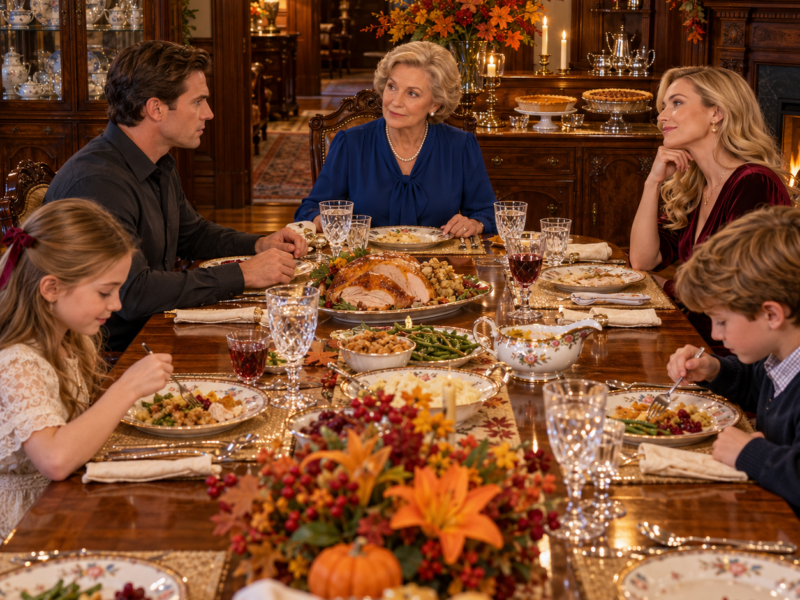
At Thanksgiving dinner, my son hurled the turkey platter at me and shouted, “You belong in a nursing home, you useless old woman!” A week later, I heard him and his wife discussing what they would buy after selling my house. When they handed me a brochure for Cedar Grove, I smiled and asked when they wanted me to visit. Neither of them thought to ask who owned the house by then.
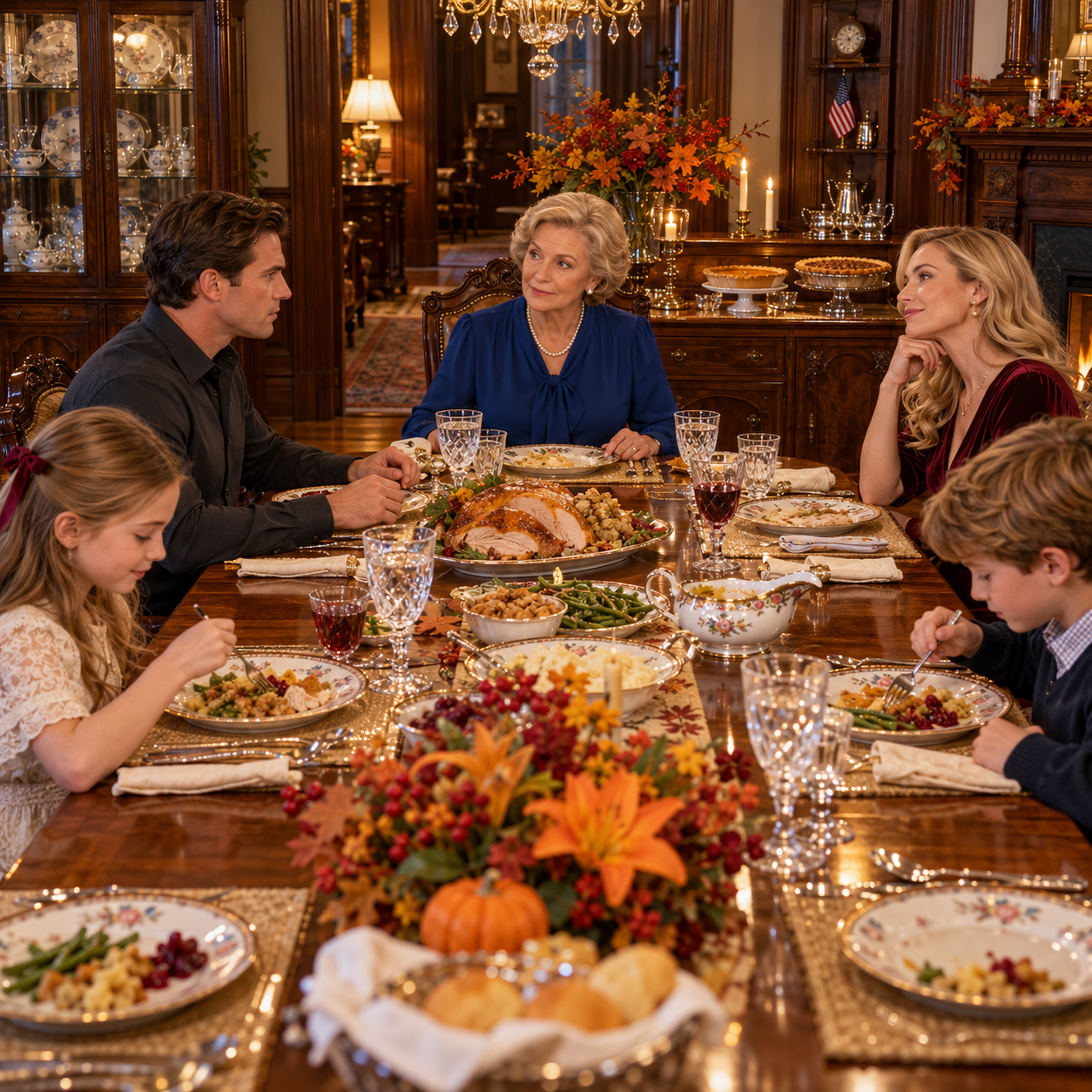
The turkey struck my chest before I understood Stuart had picked up the platter.
For one second, everything in the dining room seemed to stop. Then the platter hit the floor, gravy splashed across the leg of my chair, and my grandson Max began to cry.
Stuart stood at the other end of the table with his hands still raised. His wife, Jennifer, reached for a napkin but made no move to come toward me. Sixteen-year-old Lily stared at her father. Max pressed his face into her shoulder.
I looked down at my blouse. A piece of turkey had landed in my lap.
“Mom,” Stuart said, “you’re refusing to hear me.”
I had heard him. I simply had not agreed to sell my house to solve a problem he would not explain.
I picked up the piece of turkey and set it on the table. My hands were shaking, so I folded them in front of me.
“You need to go upstairs,” Stuart told me.
That was the moment something changed.
He was standing in the dining room where his father and I had eaten for thirty-two years. I had cooked the meal. He had thrown it at me. And he was telling me to leave the room.
“No,” I said. “I need you to stop shouting in front of the children.”
Lily put her arm around Max. Stuart glanced at them, and for a moment I thought he might apologize. Instead, he turned away.
I went upstairs to change because gravy was soaking through my blouse. In our bedroom, I could hear cupboards opening and voices rising from below. Robert’s photograph stood on the dresser. He was laughing in it, one hand resting on the porch rail he had painted himself.
I took off my stained blouse and sat on the edge of the bed.
Robert had been gone four years. I had grown used to making decisions without him, though I still caught myself wondering what he would think. That afternoon, I knew he would have come upstairs after me. Whatever disagreement we had, he would never have left me alone to clean food from my clothes while our grandchildren waited downstairs.
I found a clean sweater and went back to the dining room.
Jennifer had wiped the table. The platter was gone. Stuart was sitting beside Max, asking about a school project in the falsely cheerful voice adults sometimes use when they want children to forget what they have seen.
I asked whether anyone wanted pie.
Lily looked at me so sadly that I nearly lost the composure I had worked to recover.
The rest of dinner passed in fragments. Max accepted a slice of apple pie but hardly touched it. Jennifer talked about traffic on the drive over. Stuart answered her. I could hear each word, yet none of it seemed connected to the turkey stain still drying on the chair cushion.
When the children went into the living room, Jennifer followed them. Stuart stayed at the table.
“I didn’t mean to throw it at you,” he said.
I looked at the gravy on the floorboards. “You picked up the platter.”
“I was frustrated.”
“You frightened your son.”
He glanced toward the doorway. “I’ll talk to him.”
“You need to.”
Stuart leaned back in his chair. He had Robert’s dark eyes. Sometimes that resemblance comforted me. That afternoon, it made it harder to look at him.
“We have to discuss your future,” he said.
“Not today.”
“It can’t wait forever.”
“I said not today.”
He stood. For a second I braced myself, though he only gathered the plates.
I wish I could say the turkey was the first sign that something was wrong. By Thanksgiving, Stuart and Jennifer had been talking about my “future” for months. They meant the house whenever they said it. They meant Robert’s and my savings when they thought I would not notice.
My name is Inz. I was seventy-one that Thanksgiving, a retired elementary school teacher, and fully capable of deciding where I wanted to live.
The house was large for one person. I knew that better than anyone. It had a steep staircase, gutters that needed repair, and rooms I sometimes kept closed because heating them seemed wasteful. I had considered moving. I had even spoken with a real estate agent.
What troubled me was how often Stuart and Jennifer spoke as though considering a move meant I had given them the right to arrange it.
During the summer, Jennifer asked whether I had ever thought about a retirement community. When I said I preferred my house, she mentioned maintenance costs. Stuart offered to review my investments. I thanked him and said my adviser and I were handling them.
At Sunday dinners, the questions continued.
Had I remembered to pay the property tax bill?
Would I be safer somewhere without stairs?
Did I still drive after dark?
Were there days when I lost track of appointments?
I kept a calendar. I paid my bills. I drove when I felt comfortable driving. Still, each question made me feel as though I had to demonstrate my competence in my own kitchen.
One afternoon, I came home from the library to find Jennifer in Robert’s study.
She said she was looking for wrapping paper. It was possible; I stored holiday supplies in a closet there. But the closet door was closed, and one of Robert’s desk drawers stood open.
“I didn’t find any,” she said.
“It’s in the hall closet now.”
She smiled. “I can never keep up with how you organize things.”
After she left, I checked the desk. I could not identify anything missing. I told myself I was being suspicious because the questions had made me uneasy. Then I moved the folder containing my estate papers into a fireproof box in my bedroom.
Three weeks before Thanksgiving, I called Martha Bell.
Martha had helped a friend sell her house after her husband died. She came over on a Saturday morning, walked through every room with me, and gave me an honest estimate of what a sale might bring.
“Would you want to list it right away?” she asked.
“I want to know my options first.”
“That’s fair.”
We sat in Robert’s study afterward. Afternoon light came through the stained-glass panel above the front door and laid colored shapes across the hallway floor.
“Would it feel like leaving him?” Martha asked gently.
I looked at Robert’s desk. “Some days it does.”
“And other days?”
“Other days I’m tired of being afraid I’ll slip on the front steps.”
She nodded. Martha was good at letting an answer remain complicated.
I told Stuart none of this. I was not keeping a secret to punish him. I needed to hear my own thoughts without having to defend them.
After another week, I asked Martha to list the house quietly. We arranged private showings. I visited my friend across town while prospective buyers walked through. When an offer came from a couple named Henderson, I asked questions, read every page Martha brought me, and took two days to decide. Their cash offer was fair. They liked the old staircase and the stained glass. I accepted, subject to the remaining checks and closing.
I had not yet signed away the house. I had also not told my son.
On Thanksgiving, before Stuart arrived, I stood at the dining room window and tried to imagine telling him after we had eaten. I expected him to be surprised. I knew he might feel sad about losing the house where he had grown up. I intended to hear him out.
Then he arrived already angry.
It began while I was putting dishes on the table. Stuart asked why there had been a car from a real estate office outside the house earlier that week. A neighbor had mentioned it to him.
“I asked someone to come look at the property,” I said.
“Without telling me?”
“I wanted to understand its value.”
Jennifer looked up sharply. Stuart asked whether I intended to sell.
“I’m considering it,” I said.
He set down his water glass. “We’ve been discussing this for months. You can’t go behind our backs.”
I could not understand why he felt entitled to speak of my decision as something done behind his back.
“The house is mine, Stuart.”
“Dad built half of what’s in here.”
“He and I cared for it together.”
“And you’re just going to sell it to strangers?”
Lily was listening. Max had begun separating peas from the rest of his dinner. I suggested we talk after the meal.
Stuart refused.
He said it made no sense for me to live alone in a house of that size. Jennifer said there were excellent places nearby where I would have help when I needed it. Stuart started calculating what a sale might yield after costs.
“You’re speaking about the money as though I won’t be here to decide what to do with it,” I said.
Jennifer leaned toward me. “We want you to be comfortable. That’s all.”
“Then give me room to make a decision.”
Stuart pushed back his chair. “Mom, you always say that when anyone tries to help.”
“I didn’t ask you for help selling my house.”
“You shouldn’t have to ask. We’re your family.”
“We can talk when we’re all calmer.”
He reached for the turkey platter. At first I thought he was going to move it out of his way.
Then it was coming toward me.
After dinner, Lily helped Max put on his coat while Jennifer searched for her keys. She came back into the dining room carrying a glossy brochure.
“Just look at it,” she said.
The cover showed a stone entrance framed by flowering trees. Across the top were the words *Cedar Grove*. It was a residential retirement community about twenty minutes from town.
“We put down a deposit,” she said. “It’s refundable.”
I placed the brochure beside my plate.
“You put down a deposit without asking me?”
“We wanted to make sure you had the option.”
Stuart watched my face. He seemed to expect relief that somebody had taken the trouble to find me a place.
“What does it cost?” I asked.
Jennifer named a monthly figure. Stuart offered to compare it with what I spent keeping the house. Their voices were gentle now, as though the turkey had never struck my chest.
I listened until they had finished.
“You’ve given me a great deal to think about,” I said.
Stuart’s shoulders loosened. He had mistaken the sentence for agreement. He asked if he could take another slice of pie before they left.
I cut it for him. That was the hardest part of the evening. He still expected me to feed him.
When their car was gone, I carried the brochure into Robert’s study. On the back, someone had written an appointment time for the following Thursday. Stuart and Jennifer expected me to attend a tour.
I was about to put the brochure away when I heard their voices again in my memory. Before dinner, while I was upstairs changing, they had been in the study. I had come down the hall intending to ask whether Max needed help washing his hands. The door was not quite closed.
Stuart had said, “She won’t go willingly.”
Jennifer answered, “Then we start documenting incidents. You have that old power of attorney.”
I remained in the hallway, unable to move.
“The house could be on the market by spring,” she continued. “There are antiques in here too, and her investments. We could finally stop worrying.”
Stuart said something low that I did not catch. Then I heard, clearly, “It would help our future.”
I had stepped away before they saw me.
That night I went to my bedroom, opened the fireproof box, and took out the power of attorney Robert and I had signed years earlier. Stuart was named as my agent if I met its incapacity requirements. At the time, he was our only child, responsible and kind. I had never questioned the choice.
I sat on the floor with the document in my lap until well past midnight.
In the morning, I called Martha.
“Is something wrong with the offer?” she asked.
“No. I need to know whether the Hendersons can close before Thursday.”
There was a pause while she checked her notes.
“They asked for flexibility,” she said. “They’re paying cash, and their attorney has already begun the title work. I can ask.”
“Please do.”
“Inz, are you all right?”
I looked toward the dining room. Mother’s china was back in its cabinet. I had washed gravy from the chair cushion, but a pale mark remained.
“I will be,” I said.
Martha called that afternoon. The Hendersons could close the following Wednesday if the remaining paperwork cleared.
I had a date to work toward. Before I signed anything, I needed to know whether Stuart had any authority to interfere.
On Monday, I took the fireproof box to Ellen Price, an attorney whose office Robert and I had used for years. Ellen had taken over the practice after the founding partner retired. She gave me time to explain Thanksgiving, the conversation I had overheard, and my concerns about the power of attorney.
When I finished, she read it carefully.
“Have you signed anything for Stuart or Jennifer since Robert died?” she asked.
“No.”
“Has Stuart ever acted for you using this document?”
“Not that I know of.”
“Under its terms, his authority begins only if the incapacity requirements are met,” she said. “You can revoke it now.”
I had imagined Stuart turning up with a doctor and taking my keys. Ellen did not treat that fear as foolish, but she helped me distinguish it from what the document actually allowed. We prepared a revocation, discussed how to notify my financial institutions, and made a list of records to review.
Then she asked whom I wanted to name if I truly could not make decisions for myself.
For years, I would have answered Stuart without thinking.
“I need time,” I said.
“Take it. We can complete the revocation today.”
I signed. My hand stayed steady until the final letter of my name.
Ellen made copies and explained the next steps. She also asked me something I appreciated.
“Are you selling the house because you want to move, or because Stuart has made you feel you must leave?”
“I’ve been considering it for longer than he knows,” I told her. “I looked at an apartment before Thanksgiving.”
I had found it months earlier while visiting a former colleague. It had two bedrooms, a balcony, an elevator, and a grocery store within walking distance. The town library was close enough that I could stop by whenever I liked. I had kept the leasing office’s number in my handbag.
“I called about it before I called Martha,” I said.
Ellen waited.
“I love the house. I’m also tired of asking it to stand in for Robert.”
Stuart’s cruelty had made me act sooner. It had not made the choice for me.
During the next two days, I worked through Ellen’s list. I called the bank and my investment firm. I made sure each had the revocation and the instructions for speaking only with me about my accounts. I booked an appointment with my doctor and told her directly that my son and daughter-in-law had discussed my mental capacity without my consent.
She listened, documented what I said, and offered to review any actual health concerns with me, in my presence. I did not need her to declare me perfectly healthy forever. I needed to know I could be part of any conversation about my own life.
I left her office with my keys and my records in my handbag. On the way to my car, I stopped beneath a tree whose leaves had nearly all fallen. I stood there for a minute, breathing in the cold air.
At home, I began packing one room at a time.
Photographs first. Then books. I wrapped Mother’s china in dish towels and marked the boxes carefully. Robert’s tools took longer. In his workbench drawers I found a bent nail, a pencil worn almost to nothing, a brass hinge he had intended to repair, and a folded list of things he wanted to plant in the spring before he died.
I kept the list.
Packing revealed how much of our life had been stored in places I no longer looked. A small mitten of Stuart’s had fallen behind a stack of table linens. Robert’s old reading glasses were in a kitchen drawer. There were greeting cards in a cabinet above the refrigerator, including one I had written to Robert and apparently forgotten to give him.
Some evenings I packed until my back hurt. Other evenings I sat on the floor holding something he had touched.
On Monday, Lily came to the door with her backpack still on one shoulder.
“Dad said you were looking at Cedar Grove,” she said.
“I looked at a brochure.”
“He said you liked it.”
I opened the door wider. “Come in.”
Two packing boxes stood beneath the kitchen window. Lily saw them immediately.
“You’re moving?”
“Yes.”
“Where?”
“I’ll tell you once the arrangements are finished.”
“Are you moving because of Thanksgiving?”
“That dinner made some things clearer.”
She put her backpack on the floor. At sixteen, she had Robert’s dark eyes and Stuart’s habit of twisting a napkin when she was worried.
“I should’ve said something when Dad yelled at you.”
“You and Max were frightened.”
“I still knew it was wrong.”
I pulled out a chair. She remained standing.
“Max keeps asking if you’re mad at us,” she said. “Mom tells him to leave you alone. She says you need quiet because you’re getting confused.”
Anger rose so quickly that I had to wait before I answered.
“I’m not confused, Lily.”
“I know. I told him that.”
She reached into her backpack and took out a folded drawing. Max had drawn a turkey with enormous wings flying above three people whose hands reached toward one another.
“He wanted you to have it,” she said. “He thinks the turkey should’ve flown away before dinner.”
I laughed, then covered my mouth. Lily’s eyes filled.
“I miss you,” she whispered.
“I miss you too.”
I wanted to tell her exactly where I was going. I also knew the house sale had not closed, and Stuart still had an emergency key. I would not ask Lily to keep a secret she had never agreed to carry.
“You can call me whenever you want,” I said. “I’ll make sure you and Max know where to find me.”
Before she left, she hesitated beside the boxes.
“Dad’s been acting strange for months,” she said.
“In what way?”
“He takes phone calls outside, even when it’s cold. Mom gets angry if he lets them go to voicemail.” She looked uncomfortable. “I heard them arguing about a loan.”
I kept my voice even. “Did you hear what kind?”
“No. Dad said he’d never agreed to it. Mom said it didn’t matter because he’d signed.”
She seemed ashamed of listening through a door.
“You didn’t do anything wrong by telling me,” I said.
She bent to pick up her backpack. “I don’t want you to think he always treats you that way.”
“I know he hasn’t always.”
After she left, I put Max’s drawing on the refrigerator. Then I called Ellen.
The loan could explain Stuart’s desperation. It could not excuse what he had done. Ellen advised me to keep the sale and my financial information private until it closed, and to call immediately if anyone presented a document bearing my name.
The next morning, the bank’s fraud department called.
A woman had contacted them the day before, asking about my account values and the requirements for using a power of attorney. She said she was calling on behalf of my son.
Because I had just updated the instructions on file, an employee had flagged the call. The bank had not disclosed any account information.
“Did she give you her name?” I asked.
“Jennifer.”
I thanked the employee, wrote down the date and time, and called Ellen.
Afterward, I walked through the house looking at the things that remained unpacked. Jennifer had spoken of the house as money, but she had also tried to learn what I owned elsewhere.
I opened the case containing my mother’s silver serving pieces. One spoon was missing.
I could not prove when it had vanished. I wrote it in my notebook anyway.
Wednesday arrived cold and bright. Martha met me outside Ellen’s office. The Hendersons were waiting inside with their attorney.
They were younger than I had expected. Mrs. Henderson held a folder against her chest and told me she had grown up in a house with stained glass above the front door. Her husband asked whether Robert had restored the staircase himself.
“Every spindle,” I said.
He glanced at his wife. “We’ll take care of it.”
I believed him, and I was surprised by how much I needed to.
Ellen walked me through the documents and the closing figures. I asked questions. I read before signing. The money would go into an account solely in my name, with instructions we had already checked. The Hendersons had agreed that I could remain in the house until the move-out date we had set.
At last, Ellen turned the final page toward me.
I signed my name.
The house was sold.
Outside, cars passed along the street. Someone at the reception desk laughed at something a colleague had said. I had expected a sound large enough to mark the end of thirty-two years, but the room went on as it had before.
Martha touched my arm.
“You have time to finish packing,” she said.
“I know.”
“Do you want me to come by tonight?”
“Yes,” I said. “I think I do.”
We ate soup from paper containers at my kitchen table that evening. She did not tell me I had made the right choice or ask whether I was relieved. She helped me wrap the last of the china and carried a box down from the linen closet. Before she left, she reminded me that the movers would arrive Saturday at eight.
On Thursday, the appointment time written on the Cedar Grove brochure passed while I packed winter coats.
Stuart called twice. I let the phone ring.
He called again that evening.
“Mom, you missed the appointment.”
“I know.”
“They held a place for you.”
“I didn’t ask them to.”
“Jennifer spent hours arranging it.”
“I’m sure she did.”
He grew quiet. “Can we come over and talk?”
“Not tonight.”
“Is something going on?”
I looked around the bedroom. The closet was nearly empty. Robert’s photograph had been wrapped in a towel and placed in a box I intended to carry myself.
“Yes,” I said. “We’ll talk soon.”
I ended the call before he could ask another question.
On Friday, Lily called from school during her lunch break.
“Dad’s upset,” she said. “Mom says you were rude about Cedar Grove.”
“I told him I wasn’t going.”
“Good.”
There was noise behind her: lockers closing, young voices calling across a hall.
“Lily, I need you to know something. I love you and Max. Whatever you hear this weekend, that won’t change.”
“What’s happening this weekend?”
“I’ll tell you when I can explain it properly.”
She did not like that answer. I did not like giving it. But closing had happened, and I needed one more day to move before I told her.
The movers arrived at eight on Saturday. By noon, the rooms had begun to echo. I stood in Robert’s study while two men carried out his desk.
Behind it, the wallpaper was darker where sunlight had never reached. I ran my fingers along the clean rectangle left on the wall.
Then I heard Stuart’s car.
Martha had agreed to meet him after I left and tell him how to contact me. I had hoped to be gone first. His footsteps were already on the porch.
He let himself in with the emergency key.
“Mom?”
One mover passed him carrying a lamp. Another asked where to put a box marked *bedroom*.
Stuart stopped in the hall.
“What is this?”
“I’m moving.”
“To Cedar Grove?”
“No.”
Jennifer came in behind him. She looked at the bare walls and the exposed stair treads.
“Where’s the furniture?” she asked.
“Some is coming with me. The rest has been sold or donated.”
Stuart walked into the dining room. The china cabinet was empty.
“You can’t just move out,” he said.
“I can.”
He came back to the hall. “What did you do with the house?”
“I sold it.”
Jennifer gripped the doorframe.
“When?” she asked.
“I signed the closing papers Wednesday.”
“That’s impossible. We would have known.”
“You know now.”
Stuart looked toward the moving truck. “I thought we were going to decide together.”
“You told me what you had decided. I made my own decision.”
Jennifer came closer. “After everything we’ve done for you?”
I thought of the brochure, the bank call, and my grandson crying at the table. I asked them to step out of the movers’ way.
“Where did the money go?” Jennifer demanded.
Stuart turned toward her. “Jennifer.”
“What? You want to know too.”
He looked at me. For a moment I saw the boy who used to come running through this hallway with muddy shoes. Then I saw the man who had thrown our dinner at me.
“I do need to know what happened to it,” he said.
“The proceeds went into my account. I’ll discuss my finances with my attorney.”
“You have an attorney now?” Jennifer asked.
“Yes.”
Stuart stared at me. “Did you change the power of attorney?”
“I revoked it.”
“You think I would use it against you?”
“I heard you and Jennifer talking in Robert’s study.”
The moving truck’s lift rattled outside. One of the men waited just beyond the front door, uncertain whether to come in. I told him to take his break.
Jennifer recovered first. “You were listening to a private conversation?”
“In my own house.”
“We were making a plan because you refused to.”
“I heard the plan.”
Stuart rubbed a hand over his mouth.
“Mom, I said things I shouldn’t have.”
“You said I wouldn’t go willingly. Jennifer said you needed to document incidents. You spoke about my house as though I were already gone.”
He did not deny it.
Jennifer folded her arms. “You’re twisting what we meant.”
“Which part?”
She opened her mouth, then looked away.
I turned to Stuart. “There’s a loan, too.”
He looked startled. I had no intention of naming Lily as the person who had told me. Jennifer and Stuart had been arguing loudly enough for a child to hear.
“I don’t need to know the amount,” I said. “I need to know whether either of you used my name.”
“No,” Stuart answered immediately.
Jennifer glanced toward the front door.
I saw it. So did he.
“Jen?”
“I told you I was trying to solve our problem.”
“What problem?” I asked.
Stuart went into the dining room and sat on the one chair the movers had not yet loaded. He kept his eyes on the floorboards.
His small building business had lost two contracts in the spring. He had continued paying his workers, certain the next project would come. Jennifer had arranged a loan to cover the gap. Stuart signed after she assured him the payments would be manageable.
The loan was larger than he had understood.
“I thought I’d read everything,” he said. “I know what you’re going to say. I should have.”
“Yes,” I said.
He accepted that.
The lender had begun calling. Jennifer believed that if I sold the house and moved to Cedar Grove, I might give them enough to clear the urgent debt. She had talked to Stuart as though asking me was only a formality.
“I said we should come to you and explain,” he told me. “She said you’d refuse.”
“You could have asked.”
He stared at the floor. “By Thanksgiving, I couldn’t bear hearing you say no.”
He had come to my table needing help, and had demanded my house instead. When I would not let him decide for me, he had thrown dinner at me.
“You hurt me because you were afraid of being embarrassed,” I said.
He looked up. His eyes were wet.
“Yes.”
Jennifer let out a hard breath. “That’s a convenient way to put it. You knew exactly why we needed money.”
“I knew we needed help,” Stuart said. “I didn’t know you were calling Mom’s bank.”
Jennifer’s face changed.
I took my notebook from my purse and gave Stuart the date the bank had called me.
“They gave Jennifer no account details,” I said. “They told me she had asked what I owned and how the power of attorney worked.”
“I wanted to know what resources she had before we discussed care,” Jennifer said.
“You called after I refused the Cedar Grove appointment.”
Jennifer looked toward the study. She pushed past us and went inside.
The desk was gone. She stopped at the bare wall where it had stood and looked toward the shelves.
“What are you looking for?” Stuart asked.
“Nothing.”
He remained in the doorway. “Jennifer.”
She closed her eyes. “There’s another notice from the lender.”
“How long?”
“Two weeks.”
“Why didn’t you show me?”
“Because I knew what you’d say.”
I stepped back. Their marriage had reached a part of the story I did not know. I could listen to what involved me; I could not mend it for them.
Jennifer pressed her hands against her eyes.
“When your contracts fell through, I thought the next ones would come,” she said. “I kept paying the bills. Then I borrowed more.”
“You told me we could cover it,” Stuart said.
“We could, until we couldn’t.”
He asked about the vacation she had spoken of in the study. She said she had never booked one. She had talked about going away because she wanted something pleasant to imagine after months of worrying.
I believed her fear. I had heard it beneath her words often enough now. I also knew how far she had been willing to go to escape it.
I thought of the missing spoon.
“Jennifer, did you take anything from this house?”
“No.”
I waited.
She opened her handbag and removed my mother’s silver serving spoon, wrapped in a napkin. She set it on the floor where Robert’s desk had stood.
“I meant to put it back.”
“Why take it at all?”
She looked at it. “I thought it might be worth something.”
It was worth something. Just not in the way she meant.
“Stuart,” I said, “I want the emergency key.”
He took it from his ring and placed it on the windowsill.
The movers returned. I asked Stuart and Jennifer to leave so the men could finish their work.
Stuart followed me onto the porch.
“Mom, I didn’t know about the extra borrowing.”
“I believe you.”
“I knew about Cedar Grove. I knew what Jennifer hoped you’d do with the house. I should have stopped it.”
“Yes.”
He looked toward his car. “What do I tell Lily and Max?”
“The truth you can tell without making them responsible for fixing any of this.”
He nodded slowly.
“Will you let them see you?”
“Of course.”
“Will you let me?”
I held the porch rail. Robert had painted it twice because I had found a spot he missed the first time.
“I don’t know yet.”
Stuart seemed about to argue. Then he went down the steps.
I watched him drive away before returning inside. The study was nearly empty. I picked up the silver spoon and carried it to the kitchen, where I put it in the box with the rest of Mother’s serving pieces.
At my new apartment that evening, boxes occupied almost every corner. I unpacked a kettle, two cups, and a photograph of Stuart as a little boy. In the picture, he had one front tooth missing and was holding a cardboard castle he had made at school. I set it on a shelf, then turned it slightly away from the kitchen.
I wanted to remember him. I also needed room to see who he had become.
Martha called to ask how the move had gone. I told her the Hendersons could collect the keys from their attorney on Monday. I told her Stuart knew.
“Are you safe?” she asked.
“Yes.”
She waited a moment. “Unpack your bed and leave the rest until morning.”
I followed her advice.
The next day, Lily and Max came over. Stuart drove them and stayed in the car.
Max carried a bakery bag with both hands.
“Dad said you already moved your pies,” he announced, “so I brought cookies.”
He put them on the counter, inspected the balcony, and decided it needed a bird feeder. Lily stood near the doorway until I showed her the second bedroom. I had placed a folded quilt on the bed and left space for another mattress if they wanted to sleep over.
“There’s room for both of you,” I said.
She touched the edge of the quilt.
“Dad told us what he did at Thanksgiving,” she said. “He said he was scared about money and took it out on you.”
“That sounds true.”
“He said being scared didn’t make it okay.”
I nodded. It was a start.
“Is Mom coming?”
“Not today.”
Lily sat down. “They’re arguing a lot.”
“I’m sorry you have to hear it.”
“They think we don’t.”
I sat beside her. I wanted to promise that their home would settle and their parents would work things out. I knew none of that.
“If it gets too loud, you can call me,” I said. “You and Max can come here.”
She leaned against my shoulder.
From the living room, Max called, “Grandma, how many cookies can a bird eat?”
“Fewer than you,” I called back.
He laughed. Lily did too.
Two days later, Stuart came alone. He stood outside the apartment with his hands in his coat pockets. I let him in, and we sat at the little table by the window.
He and Jennifer had met with a debt counselor and an attorney. They were reviewing the loan documents and the business accounts. Stuart had sold one of his trucks. Jennifer had agreed to show him every notice she had kept from him.
They had not decided what would happen to their marriage.
“I wanted to tell you myself,” he said, “so you didn’t hear it through Lily.”
“Thank you.”
He looked around the apartment. “It’s nice here.”
“I like it.”
For a while, we watched a delivery van pull up across the street.
“I kept thinking about Dad’s house,” Stuart said. “I thought he’d want it to stay in the family.”
“Robert wanted me to have a home.”
He swallowed. “I know.”
I had spent years protecting Stuart from the full weight of my disappointment. When he was small, I could bear a scraped knee more easily than I could bear his tears. That habit did not disappear when he grew taller than me.
Still, I needed him to hear what happened after he threw the platter.
“When I went upstairs to change, I waited for you to come up,” I said. “I thought you would at least knock.”
He looked at me.
“I heard you talking downstairs while I cleaned my blouse. I came back because Lily and Max were still at the table. I asked about dessert so they would know the evening could go on.”
“I remember.”
“I don’t think you understood what that cost me.”
He put a hand over his eyes, then lowered it.
“I’m sorry, Mom.”
I let the words stand. They could not undo Thanksgiving. I could hear that he meant them.
“I won’t give you money to solve the loan,” I said.
“I didn’t come to ask.”
“I need to say it anyway. And if we’re going to see each other, you cannot bring plans for my house, my money, or my care into this apartment and expect me to accept them.”
“I understand.”
“You’ll have to show me that over time.”
He nodded.
Before he left, he noticed Max’s drawing on the refrigerator. I had put it there with an apple-shaped magnet one of my former students had given me.
“He worked hard on that,” Stuart said.
“I can tell.”
At the door, he hesitated. “Could I bring the kids Saturday?”
“Yes. Call first.”
After he left, I watched him walk to his car. I felt grief for what had happened and relief that I had finally told him. Both stayed with me as I unpacked another box.
On Saturday, Lily brought potting soil. Max carried a bird feeder he had chosen with Stuart. We planted basil in two pots on the balcony and hung the feeder where we could see it from the kitchen.
Stuart stayed long enough to help Max fill it. He did not ask about the sale or offer advice about my apartment. Before he left, he washed the soil from the kitchen floor without being asked.
It was a small act. I let it be small.
That evening, after they were gone, I opened the balcony door. Cool air moved through the apartment. The feeder swayed gently on its hook. No birds had found it yet.
Max’s drawing lay on the table where we had moved it while we worked. I smoothed its folded corner and set it beneath the window. Then I put water on for tea and looked out over the street I was beginning to know.









