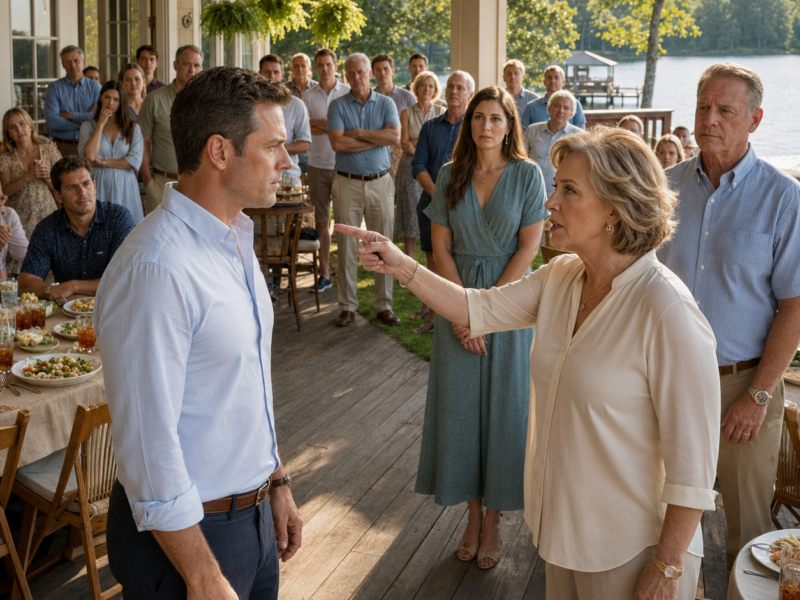
At my wife’s family reunion, her mother pointed at me in front of 37 people and said, “You have two choices. Apologize to this family, or leave.” I looked at Catherine, my wife of eleven years, expecting one sentence in my defense. She looked at the floor. So I smiled, thanked her mother for finally being clear, went inside, packed my bag, and booked a one-way flight from Nashville to Chicago. They thought I had chosen the second option. They were wrong. I had chosen a third one—and Catherine wouldn’t understand what that meant until a courier arrived at her mother’s lake house four days later.

Evelyn Whitmore lifted one hand and pointed at me across the back porch as if she were calling on somebody in a courtroom.
Thirty-seven people went quiet.
There were cousins in lawn chairs, children sitting cross-legged on the steps, three uncles clustered beside the cooler, and enough aunts under the striped patio umbrella to form their own committee. Beyond them, late-afternoon sunlight lay flat across Watts Bar Lake, turning the water almost white.
My wife stood eight feet away.
Not beside me.
That was the detail I noticed.
Catherine had spent eleven years standing beside me through mortgage closings, bad flu seasons, her father’s knee replacement, my first disastrous year in business, and one emergency-room visit involving a nail gun and a level of confidence I had not earned.
Now she stood next to her older sister Amber.
Their shoulders nearly touched.
Evelyn still had one finger raised.
“You have two choices, Joseph.”
Her voice was calm.
That made the humiliation worse.
“You can apologize to this family for the way you’ve treated us and we can move forward like adults.”
She paused.
“Or maybe it’s best if you leave.”
Nobody laughed.
Nobody said:
Evelyn, come on.
Nobody asked what exactly I was apologizing for.
Even Richard, my father-in-law, stared into his iced tea as though the answer might be floating somewhere beneath the lemon slice.
I looked at Catherine.
She looked at the porch floor.
That was when I understood the meeting was not spontaneous.
Maybe nobody had planned the exact words.
But enough people had discussed me beforehand that my wife already knew which side of the porch she intended to occupy.
I felt something inside me settle.
Not break.
Settle.
“Apologize or leave,” Evelyn repeated.
I nodded.
Then smiled.
That smile frightened her more than anger would have.
“Thank you.”
Her hand dropped.
“For what?”
“The clarity.”
I walked into the house before anybody could answer.
My name is Joseph Taylor.
I was forty-one years old that summer, married eleven years, and standing in a lake house in rural Tennessee that I had personally helped keep from falling apart for most of the previous decade.
I had repaired the basement after a storm flooded it.
Replaced rotten deck boards.
Installed two toilets.
Driven Catherine’s younger sister Zoe to Nashville International Airport at two in the morning because nobody else wanted to wake up.
Loaned Richard my truck.
Helped Bennett move.
Rebuilt a retaining wall behind the guest cabin.
Attended fourteen Whitmore family reunions.
Fourteen.
I know because the reunion where they told me to apologize or leave was the first one I finally counted.
That weekend was not when my marriage first developed problems.
It was simply the first time all the problems stood in one place and introduced themselves.
I went to the guest room, zipped my suitcase, and booked a one-way flight from Nashville to Chicago.
But to understand why I did not walk back onto that porch and negotiate, you have to understand who I had spent eleven years becoming inside Catherine’s family.
And why, by that Sunday afternoon, I was exhausted from pretending endurance was the same thing as being loved.
Catherine and I met in Chicago when we were twenty-eight.
She was working in health-care administration at Northwestern Memorial, coordinating clinical programs with the kind of efficiency that made physicians twice her age stop arguing when she opened a spreadsheet.
I had just left a commercial real-estate firm where I had spent six years managing office and retail properties for people who regarded broken HVAC systems as evidence of personal betrayal.
We met at a charity 5K neither of us wanted to run.
I had agreed because my company sponsored a team.
Catherine had agreed because her friend canceled at the last minute and she had already paid the registration fee.
At mile two, she looked at me and said:
“If you pass me, I will hate you.”
“We don’t know each other.”
“I make fast decisions.”
I stayed beside her.
Not from romance.
I was also dying.
We crossed the finish line nine minutes slower than my normal pace.
She bought me coffee afterward.
Technically I bought it because she had left her wallet in the car.
That became one of the first family jokes.
“Joseph financed the relationship from day one.”
Evelyn loved telling that story.
Early on, I liked her.
That matters.
Family conflict becomes too easy to understand when everyone was terrible from the beginning.
The Whitmores were not.
Richard was a retired electrical contractor who had built his own small company outside Knoxville before selling it to a regional firm. Evelyn had taught high school English, then spent years volunteering with church groups, literacy programs, and local charities.
They bought the lake property in the nineties.
A cedar-sided main house.
Small guest cabin.
Dock.
Two acres rolling down to the water.
The place was beautiful.
Catherine grew up spending summers there.
So did her siblings.
Amber was the oldest.
Catherine next.
Then Bennett.
Then Zoe, nearly ten years younger than Catherine and treated by the family as both baby and public utility.
Need someone cheerful?
Zoe.
Need someone to distract Grandma?
Zoe.
Need somebody willing to make a liquor-store run because thirty adults miscalculated wine?
Also Zoe.
The extended Whitmore family spread through Tennessee, Georgia, Kentucky, and North Carolina.
Every summer they gathered.
At first I found the reunion charming.
People brought casseroles.
Kids jumped off the dock.
Richard smoked pork overnight.
Somebody always played guitar badly.
The first year, Evelyn introduced me to everyone.
“This is Catherine’s Joseph.”
I remember liking that.
Belonging.
The second year, Richard discovered I knew how to repair a sump-pump line.
By the third, I had become unofficial maintenance staff.
No one announced the role.
Family roles rarely need job descriptions.
They form because one person says yes often enough.
“Joseph, could you look at the deck?”
“Joseph, the guest-bath toilet keeps running.”
“Joseph, my car is making a weird sound.”
“I manage buildings, Amber. I’m not a mechanic.”
“But you’re handy.”
That phrase.
Handy.
I had a bachelor’s degree in business, years of commercial property experience, and by the time Catherine and I married I was beginning to build a property-management company.
But in the Whitmore family, I was handy.
Hayes, Amber’s husband, had an MBA from Vanderbilt.
When he explained something about interest rates, everyone listened.
When I explained that the lake-house crawl space needed drainage work before more drywall repair, Richard said:
“Maybe we should get a professional opinion.”
I remember staring at him.
“I manage forty commercial buildings.”
“Right.”
Then:
“I mean somebody who does foundations.”
I hired the foundation contractor for him.
Of course.
At first, none of this seemed serious enough to challenge.
That is how disrespect survives in otherwise functional families.
It arrives below the threshold where confrontation feels socially efficient.
You are ignored once.
Was that intentional?
Someone makes a joke.
Maybe you are sensitive.
Someone asks for help, then dismisses your expertise.
Not worth ruining Thanksgiving.
Each moment becomes too small for a trial.
Then ten years pass and you realize you have been serving a sentence no one ever had to pronounce.
Catherine saw some of it.
Not all.
That became important later.
The first three years of our marriage were good.
Actually good.
Not:
Good until I discovered everything was secretly fake.
I hate that kind of retrospective editing.
We laughed.
Traveled.
Saved.
Cooked badly.
Bought an old two-flat in Chicago and renovated the upper unit while renting the lower.
Catherine helped me paint the first office when I started Taylor Commercial Management.
It was one room in a converted warehouse near the river.
One folding desk.
Two clients.
No assistant.
No guarantee I would make payroll for myself.
Catherine believed in it before I did.
“You know buildings.”
she told me.
“I know how expensive they are.”
“Same thing.”
For the first year, she carried more of our household expenses.
I never forgot.
By year four, the company had twelve employees.
We managed apartment buildings, mixed-use properties, two medical-office portfolios, and several industrial sites.
Forty-three properties by the reunion.
Not enormous.
Not a secret empire.
A solid company I had built carefully.
I did not mow lawns.
We contracted landscaping.
That distinction would become relevant.
My work hours grew.
Too much.
Catherine was right about that.
I was frequently out before seven.
Home after eight during crisis periods.
A broken boiler does not care about date night.
Neither does a burst pipe at 2:00 a.m.
Still, overwork became a habit beyond necessity.
That part belongs to me.
I liked being needed by the business.
Work gave clear feedback.
Problem.
Action.
Result.
Families are less cooperative.
In business, if someone refuses to renew a service agreement, you can ask why.
In Catherine’s family, if Evelyn skipped your coffee, you were expected to consider the possibility that coffee itself was not important.
The marriage began losing warmth around year eight.
Not dramatically.
No affair.
No secret gambling.
No midnight revelation.
Catherine became increasingly involved in her family’s needs.
Her father had health issues.
Zoe went through a difficult breakup.
Amber’s oldest child struggled at school.
Every event became a reason Catherine needed to drive to Tennessee or spend hours on family calls.
I tried to support her.
Sometimes badly.
“I thought we were going to Wisconsin this weekend.”
“Dad needs help with the dock.”
“He has Bennett.”
“Bennett has kids.”
“So do Amber and Hayes.”
She would become angry.
“It’s my father.”
Then I would go.
Of course.
Because saying no made me feel like the unreasonable husband the Whitmores already suspected I was.
I repaired the dock.
Canceled Wisconsin.
Nobody noticed the trade.
Why would they?
The work simply appeared.
The first time I realized Catherine had started protecting her family from me rather than me from her family was at Thanksgiving three years before the reunion.
We were at Amber and Hayes’s house outside Nashville.
Amber asked:
“How’s the little building business?”
I looked at her.
“Little?”
She smiled.
“You know what I mean.”
“No.”
Hayes changed subject.
Later in the car:
“Why do you let her talk to me like that?”
Catherine stared out the windshield.
“She wasn’t trying to be mean.”
“Does intent change vocabulary?”
“Joseph.”
“What?”
“You always want to make things into an issue.”
That sentence.
I remember the interstate lights passing across her face.
“I want you to notice.”
“I notice everything.”
“Then why don’t you say anything?”
“Because I don’t want every holiday turning into an argument.”
There was the choice.
Family comfort versus marital alignment.
At the time, I blamed Amber.
Later, I understood Catherine was exhausted too.
Her family had trained her to keep the ecosystem stable.
Evelyn disliked open conflict.
Richard withdrew from it.
Amber controlled social tone.
Bennett joked.
Zoe smoothed.
Catherine mediated.
Then I arrived with the dangerous habit of asking:
Why?
People who survive through ambiguity often experience questions as aggression.
I did not know that then.
I just knew my wife increasingly told me:
Let it go.
By reunion year eleven, I had gotten very good at letting things go.
Friday evening, Catherine and I drove from Chicago to Tennessee.
Yes.
Chicago to Tennessee by car.
Long drive.
We made a mini-trip of it.
Stopped in Louisville.
Stayed Thursday night.
Friday afternoon we crossed into Tennessee with the windows down because Catherine hated air-conditioning unless the temperature became medically unreasonable.
She rested one hand on my knee.
Music low.
For two hours, we felt married again.
That memory matters.
At one point she looked over.
“I’m glad you came.”
“I always come.”
“I know.”
“You say that like you’re surprised.”
She smiled.
“I just want this weekend to be easy.”
There.
Easy.
Not good.
Not fun.
Easy.
“For whom?”
I asked.
She gave me the look.
“Joseph.”
“I’m asking.”
“For everyone.”
I should have heard the warning.
Instead:
“Sure.”
We arrived around six.
Zoe spotted us from the dock.
“Joseph!”
She ran up the lawn barefoot, nearly dropped a canned seltzer, and launched herself at me.
I caught her.
“You started drinking before we arrived.”
“I started drinking because you were arriving.”
“Is that better?”
“Much.”
I genuinely loved Zoe.
She was twenty-four.
Funny.
Messy.
Working her first serious job as a physical-therapy assistant in Chattanooga.
She had borrowed money from me exactly once and repaid it three days early.
High character by Whitmore standards.
Evelyn came from the porch.
“Joseph.”
“Evelyn.”
She gave me the arm pat.
“You made it.”
“Wouldn’t miss it.”
Behind her, Amber.
Yellow sundress already.
Hayes carrying luggage.
Bennett with his girlfriend Sydney.
Dylan Whitmore leaning against a railing despite apparently having completed no task that required leaning afterward.
Dylan was Catherine’s cousin.
Twenty-nine.
Occasional freelance photographer.
Occasional bartender.
Occasional “creative consultant.”
Permanent family darling.
He once lived in Richard’s guest cabin for eight months rent-free while “figuring things out.”
That was considered artistic exploration.
I worked sixty hours and was career-obsessed.
Families are fascinating.
Friday went fine.
Grill.
Beer.
Lake.
Small talk.
Saturday morning, Evelyn served breakfast on the porch.
Biscuits.
Sausage casserole.
Fruit.
Coffee.
She moved down the table with the pot.
Richard.
Amber.
Hayes.
Bennett.
Sydney.
Dylan.
Catherine.
Then went inside.
My mug sat empty.
I looked at it.
Hayes saw.
Our eyes met.
He looked away.
That detail stayed with me.
Not because coffee mattered.
Witness matters.
I got up.
Poured my own.
Catherine was laughing with Zoe.
I said nothing.
At therapy years later, the counselor asked:
“Why not?”
Because describing it out loud would sound petty.
That was the genius of the act.
Too small to prosecute.
Large enough to register.
Saturday afternoon, Richard gathered the men near the dock.
Drainage issue beside the boat shed.
Water pooling after storms.
He asked Hayes.
Then Bennett.
Then Dylan.
“I can look.”
I said.
Richard shook his head.
“I think Hayes has more experience with that sort of thing.”
Hayes worked in commercial banking.
He looked horrified.
“Richard, I actually don’t.”
I said:
“I handled the drainage remediation at your house four years ago.”
“I know.”
Richard smiled.
“But this might be different.”
It was a French drain.
Not nuclear engineering.
I nodded.
“Sure.”
That was the last offer I made.
Hayes later found me by the cooler.
“Sorry.”
“For what?”
“That was weird.”
“Yes.”
“Why does he think I know drainage?”
“MBA.”
He laughed.
“Apparently Vanderbilt has expanded curriculum.”
Good moment.
Hayes was not the enemy.
His silence later mattered because I expected better.
Different.
Saturday dinner became the real warning.
Long tables outside.
Fairy lights.
Kids running.
Lake beautiful.
Catherine happy.
I loved seeing her happy.
That is why I stayed as long as I did.
No one wants to be the spouse who forces someone to choose between marriage and family.
Healthy marriages should not require that choice.
Unhealthy systems create it anyway.
Zoe sat beside me.
“You okay?”
“Outstanding.”
“Liar.”
“Drunk.”
“Three drinks.”
“Exactly.”
Then Dylan called across the table.
“Joseph.”
I looked.
“Catherine says your business is doing well.”
“Going okay.”
“What do you do again?”
I waited.
Everyone knew.
“Commercial property management.”
He nodded slowly.
“Right.”
Then:
“Like landscaping?”
Silence.
Amber laughed.
Not loudly.
Enough.
I looked at Catherine.
She was cutting chicken.
Sawing it with unnecessary concentration.
That image hurt more than Dylan.
“Property management.”
I said.
“Buildings.”
“Operations.”
“Maintenance.”
“Tenant services.”
“Capital planning.”
“Yeah.”
Dylan grinned.
“So mowing lawns but corporate.”
More laughter.
I smiled.
“Something like that.”
Then I ate.
Why?
Because I did not want Catherine to spend the rest of dinner telling me I had embarrassed her.
There.
Truth.
The easy weekend required my silence.
Later, Zoe found me near the kitchen.
“I wanted to throw a roll at him.”
“Why didn’t you?”
“Mom.”
We both laughed.
Then stopped.
Same answer.
Sunday morning, I woke at six.
Walked to the dock.
Catherine joined me twenty minutes later.
For a moment, we were quiet.
“Beautiful.”
she said.
“Yes.”
Then:
“You seemed off last night.”
I stared at the water.
“Did I?”
“You were quiet.”
“That was the assignment.”
“What does that mean?”
I almost turned toward her.
Then Zoe called from the porch asking about sunscreen.
Conversation ended.
No accident.
Families know when to interrupt without knowing they know.
After lunch, Amber cornered me near the storage shed.
“I want to be honest.”
Terrible opening.
“Okay.”
“Catherine isn’t happy.”
I waited.
“She tries to protect you.”
Interesting.
“From what?”
“From everyone worrying.”
“About?”
“Your marriage.”
I stared.
Amber folded her arms.
“You work constantly.”
“You’re cold at family events.”
“You don’t engage.”
“You act like you’re better than people.”
“Who says that?”
“This isn’t about who says what.”
“It usually is.”
She sighed.
“See?”
“What?”
“Everything with you becomes a debate.”
I almost laughed.
“Amber, you’re telling me my wife is unhappy with me in a storage shed.”
“She talks to Mom.”
There.
“About our marriage.”
“She needs support.”
“From her mother.”
“Yes.”
“Does she talk to me?”
“You don’t listen.”
I thought about late dinners.
Cancelled weekends.
My own overwork.
Maybe.
There were truths in Amber’s accusation.
That is what made it dangerous.
A distorted case is strongest when built from real facts.
I did work too much.
I had become withdrawn around the Whitmores.
I was impatient.
I had stopped trying.
But nobody asked why.
History began at reaction.
Not cause.
“Anything else?”
Amber looked frustrated by my calm.
“Your mother-in-law feels disrespected.”
“How?”
“She says you barely speak to her.”
“Yesterday she poured coffee for everyone but me.”
Amber rolled her eyes.
“Do you hear yourself?”
Yes.
That was the trap.
I walked away.
Catherine stood by the lake.
I sat beside her.
“Amber talked to me.”
“I know.”
That answer.
“You knew?”
“She said she wanted to clear the air.”
“And you thought that was appropriate?”
Catherine kept looking at water.
“She’s worried.”
“About our marriage?”
“Yes.”
“Did you discuss our marriage with her?”
“Of course I talk to my sister.”
“About me?”
“Joseph.”
“Answer.”
“Yes.”
My stomach turned.
“Why didn’t you talk to me?”
“I tried.”
“When?”
“You come home late.”
“We talk about work.”
“You’re always distracted.”
There.
Some truth.
“What did you tell Amber?”
“That I’m lonely.”
The anger stopped.
Immediately.
That was the sentence she should have said six months earlier.
I looked at her.
“You’re lonely?”
“Yes.”
“Why didn’t you say that?”
“I did.”
“No.”
“You said I work too much.”
“That means the same thing.”
“No.”
It did not.
Catherine’s eyes filled.
“You always need everything stated perfectly.”
“I need my wife to tell me she’s lonely before her sister tells me.”
She wiped one tear angrily.
“My family sees me.”
That hurt.
“And I don’t?”
“Sometimes no.”
I sat quietly.
Then:
“Your family also treats me like dirt.”
She looked away.
“See?”
“What?”
“You can’t hear my pain without making it about them.”
Fair.
I breathed.
“Okay.”
That moment could have changed the weekend.
Maybe the marriage.
If we had stayed there.
Two people.
No audience.
I could have said:
I’m sorry.
She could have said:
I should have spoken sooner.
We could have gone home.
Instead, Catherine said:
“Maybe if you tried harder with them, things would be easier for me.”
There.
Her loneliness became my obligation to win approval from the people disrespecting me.
“I’ve been trying eleven years.”
She had no answer.
An hour later, the porch tribunal assembled.
I still do not know who called whom.
Zoe later said Evelyn had spent thirty minutes speaking with Amber and Catherine inside.
Richard joined.
Then people drifted.
By the time I walked from the guest room, thirty-seven people were in loose formation.
Not all active participants.
Some victims of geography.
Still.
Evelyn stepped forward.
“Clear the air.”
Fifteen minutes.
Respect.
Family.
My coldness.
My work schedule.
My supposed arrogance.
Richard said:
“We’ve always tried to welcome you.”
Amber:
“Everybody feels tension.”
Dylan ate a cookie.
Bennett looked miserable.
Hayes stared at the railing.
Catherine stood with Amber.
Nobody said:
Catherine told us she’s lonely, so maybe husband and wife need privacy.
No.
The family had turned marital pain into a public loyalty test.
Then Evelyn:
Apologize or leave.
I chose neither.
I chose information.
“Thank you for the clarity.”
Then the guest room.
Phone.
Flight.
One way.
Not because I knew divorce was certain.
Because I knew I was not sleeping another night in that house.
Important difference.
People sometimes make permanent decisions because one temporary exit feels powerful.
I did not want that.
I wanted distance.
Nashville to Chicago.
6:45 p.m.
I booked.
Packed.
Zoe appeared.
“What are you doing?”
“Leaving.”
“Joseph.”
“I’m not staying.”
“Can we talk?”
“You and me?”
“Yes.”
“Sure.”
She sat on the edge of the bed.
“I’m sorry.”
“You didn’t do anything.”
“I didn’t say anything.”
There.
I looked at her.
She cried.
“I should have.”
“Yes.”
She flinched.
Old Joseph would have rescued.
“It’s okay.”
It was not.
I softened without lying.
“You were put in a bad position.”
“Still.”
“Yes.”
She hugged me.
Then:
“Tell Catherine.”
I started.
Zoe shook her head.
“Tell her yourself.”
I knew.
“You think she won’t come?”
Zoe’s face answered.
That hurt.
I carried my bag onto the porch.
Silence.
Evelyn:
“Where are you going?”
“You told me.”
“I said if you weren’t willing to apologize.”
“I’m not.”
Richard stood.
“Joseph, let’s not be dramatic.”
There.
Again.
The man leaving is dramatic.
The family trial is normal.
Bennett stood.
“Come on.”
I appreciated that.
“Thanks, Bennett.”
He looked helpless.
I turned to Catherine.
Her face was pale.
She had expected negotiation.
Probably tears.
Maybe an apology.
Not a suitcase.
“Catherine.”
Just her name.
I did not deliver a speech.
Speeches are often attempts to make people understand before evidence is ready.
I left.
Forty-three minutes to the airport.
Phone rang.
Catherine.
Amber.
Evelyn.
Catherine.
Texts.
Where are you going?
Call me.
This is not okay.
Then:
Please.
At a red light, I read please.
For one second, I almost turned around.
Eleven years.
House.
Marriage.
Catherine’s hand on my knee Friday.
Lonely.
All real.
Then I remembered the porch.
Not Evelyn.
Catherine looking at floor.
I kept driving.
At the airport, I parked in long-term parking because I did not know when I would return for the car.
No bourbon.
I changed that detail when retelling.
I needed clear judgment.
I ate a sandwich.
Drank water.
Sat near the gate.
Then called Mara Levine.
My attorney.
Not divorce attorney originally.
Business counsel.
She answered because we had worked together eight years.
“Joseph?”
“Sorry.”
“What happened?”
“I need a family lawyer.”
Pause.
“How bad?”
“I left my wife in Tennessee.”
Another pause.
“Are you safe?”
“Yes.”
“Is she?”
“Yes.”
“Kids?”
“No kids.”
“Property?”
“House in Chicago.”
“Business.”
“Retirement.”
“Okay.”
“Do not make legal decisions at an airport gate.”
That irritated me.
Correct.
“Come in tomorrow.”
“I’m flying.”
“Sleep.”
“Then call.”
Good lawyers reduce drama.
I landed at O’Hare after eight.
Took a cab to a small furnished suite my company rented near our office for visiting managers and overnight emergencies.
Not secretly mine.
Company expense.
I informed operations I was using it personally and would reimburse.
Again:
Clarity.
I slept.
Actually slept.
Monday morning, Mara referred me to family-law attorney Rebecca Sloan.
She was fifty, direct, and unimpressed by revenge fantasies.
I explained.
She listened.
Then:
“Are you filing because her mother embarrassed you?”
“No.”
“Good.”
“Are you filing because Catherine failed to defend you?”
“Partly.”
“Partly isn’t enough.”
I stared.
She continued.
“Divorce is not a disciplinary action.”
“Do you believe the marriage is over?”
“I don’t know.”
“Then do not file today.”
That stopped me.
In the source version of my life, I filed Tuesday.
Reality was slower.
Better.
Rebecca continued.
“Let’s understand finances.”
Taylor Commercial Management had been founded four years into the marriage.
That made most of its value accumulated during marriage potentially marital under Illinois law, regardless of whose name appeared on corporate documents.
Important.
Sole ownership did not mean Catherine had zero economic interest.
I had formed the company.
Managed it.
Held shares.
But marital labor, income, and value growth mattered.
“What about protecting operations?”
I asked.
“We can seek structures where you retain ownership and she receives an offset if appropriate.”
“Valuation.”
“Negotiation.”
“But you do not get to erase her marital interest because the reunion went badly.”
I liked Rebecca immediately.
Joint home.
Marital.
Retirement contributions.
Accounts.
Furniture.
Ordinary complexity.
No hidden offshore fortress.
No “everything protected.”
I had spent eighteen months tightening business governance because Catherine once asked what would happen if we divorced after an argument about finances.
That had led me to improve shareholder agreements, key-person coverage, management succession, and records.
Not asset hiding.
Good.
Those structures would help the company survive a divorce.
They would not make marital law disappear.
Rebecca asked:
“Does Catherine work?”
“Yes.”
“Income?”
“About one hundred twenty thousand.”
“Yours?”
“Fluctuates.”
“Last year two-fifty including distributions.”
“No children.”
“Marriage eleven years.”
“Okay.”
Then:
“What do you want today?”
I answered:
“A week without anybody from her family telling me what I should feel.”
That was manageable.
Rebecca advised me to communicate directly with Catherine.
Not ghost.
Not punish.
Set boundaries.
So I texted:
I’m safe. I need several days. I’m not discussing our marriage with your family. If you want to speak with me directly, I will call Thursday.
She replied immediately:
Come home.
Then:
We need to fix this before it gets bigger.
Then:
Mom is sorry.
No:
I’m sorry.
Thursday, I called.
Catherine answered first ring.
“Joseph.”
“Hi.”
“Where are you?”
“Chicago.”
“Home?”
“No.”
Silence.
“Why not?”
“I need space.”
“You left me there.”
“You stood there while your family told me to apologize or leave.”
“I was overwhelmed.”
“Okay.”
“I didn’t know what to say.”
“That was an answer too.”
She started crying.
“You are blowing up our marriage over one terrible weekend.”
“No.”
“Then what?”
“Eleven years.”
“That is not fair.”
I smiled sadly.
“Everybody likes that word after the pattern gets named.”
“Joseph.”
“I work too much.”
“Yes.”
“You’re lonely.”
“Yes.”
“We needed to deal with that.”
“Yes.”
“Your family humiliating me is a second problem.”
She became quiet.
“Do you want divorce?”
“I don’t know.”
That honesty surprised both of us.
“What do you want?”
“I want us to talk without Amber.”
“Without Evelyn.”
“Without thirty-seven people.”
Catherine sniffed.
“Okay.”
“Can you come back?”
“Not yet.”
“I want couples counseling.”
There.
Her suggestion.
I agreed.
Not because I had decided reconciliation.
Because eleven years deserved more than one airport call.
We found a therapist in Chicago.
Dr. Helen Ward.
First session ten days after reunion.
Catherine came home by then.
I stayed in the company suite another week.
Helen asked:
“What happened?”
Catherine began with reunion.
I began with coffee cup.
Helen stopped us.
“Those are events.”
“What is the pattern?”
Silence.
Then Catherine:
“I feel alone in his life.”
Me:
“I feel disposable in hers.”
Good start.
Over six sessions, ugly truths appeared.
I had become married to the company in ways I had denied.
Catherine had asked for time.
I gave solutions.
“Hire help.”
“Schedule something.”
“Put it on calendar.”
She wanted presence.
I gave process.
That hurt her.
Her family became where she felt emotionally witnessed.
Understandable.
Then she used them as marital jury.
Not acceptable.
Evelyn treated my quietness as contempt because in her family participation meant visible enthusiasm.
I had stopped performing.
The less I performed, the more she punished.
The more she punished, the less I participated.
Feedback loop.
Helen asked Catherine:
“When your mother skipped Joseph’s coffee, what did you think?”
Catherine cried.
“I noticed.”
That surprised me.
“You saw?”
“Yes.”
“Why didn’t you say anything?”
“Because if I said something, Mom would make it a whole thing.”
I laughed without humor.
“So you let me sit there.”
“Yes.”
She cried harder.
“I’m sorry.”
Specific.
That mattered.
Then the dinner joke.
She admitted she heard Dylan.
Saw me look.
Why cut chicken?
“Because I knew if I defended you, Amber would say I was too sensitive about you.”
There.
Family policing.
Then porch.
“Why stand beside Amber?”
Catherine covered face.
“I don’t know.”
Helen waited.
Eventually:
“Because Mom told me if I stood next to Joseph, everybody would think I was choosing him against family.”
The room went silent.
I felt sick.
“And you believed that?”
“No.”
She looked at me.
“I was afraid of it.”
That was worse.
Not malice.
Conditioning.
We kept attending.
For two months.
I wish I could say Catherine apologized and marriage healed.
That would make a satisfying reconciliation story.
Not ours.
The deeper issue was not whether Catherine understood.
She increasingly did.
The issue was whether I could return to the marriage we had after seeing how far we had drifted.
During therapy, I asked:
“If your family never changes, can you build a marriage where they do not get a vote?”
Catherine hesitated.
Too long.
Then:
“I don’t want to lose them.”
“I didn’t ask you to.”
“I know.”
“But it feels like that.”
There.
We were stuck.
I did not want her estranged.
She experienced boundaries as potential abandonment.
Different histories.
Helen gave us exercises.
Separate family issues from marriage.
Direct communication.
No discussing marital conflict with relatives without consent except individual support that does not recruit sides.
Holiday limits.
Work limits for me.
Protected weekends.
For several months, we improved.
I hired an operations director earlier than planned.
Name: Leon Harris.
Thirty-nine.
Brilliant at systems.
He took emergency calls I had insisted only I could manage.
Nothing exploded.
Humbling.
I came home at six twice a week.
Catherine and I cooked.
Walked.
For a while, I remembered us.
Then Christmas.
Evelyn invited us to Tennessee.
I said:
“I’m not ready.”
Catherine said:
“I want to go.”
“Go.”
“What about us?”
“We can spend Christmas Eve.”
“She’ll think you’re punishing her.”
“I’m not responsible for her interpretation.”
Catherine cried.
We argued.
Then she went.
Fine.
The problem came when she stayed five days instead of two because Evelyn became “devastated” that I refused.
Our protected New Year’s weekend disappeared.
Catherine called:
“Mom needs me.”
There.
Same pattern.
Different packaging.
I sat alone in our Chicago house on December twenty-ninth and understood love was still present.
Compatibility was not.
Catherine returned.
We had one final couples session.
Helen asked:
“If nothing changed from today forward, would you choose this marriage?”
Catherine cried.
I answered:
“No.”
Silence.
Then Catherine whispered:
“I don’t know.”
That was our ending.
Not the porch.
Not the one-way flight.
A therapist’s office in Chicago four months later.
Two adults telling the truth.
We separated formally.
Filed after.
The process took seven months.
Business valuation became the hardest part.
Taylor Commercial Management had grown during marriage.
Catherine had supported the household when I launched it.
That mattered.
I wanted to keep the company.
She deserved recognition of marital value.
We hired a neutral valuation expert.
Adjusted for owner compensation.
Contracts.
Recurring revenue.
Debt.
Goodwill.
Future speculative growth not automatically hers.
Current marital value, yes.
We negotiated.
I refinanced part of our joint house equity and transferred investment assets to offset Catherine’s share so the company ownership remained with me.
She received a fair settlement.
No one “won.”
We sold the house because neither wanted it.
Retirement accounts divided as required.
No spousal support after negotiation because both had substantial income and assets, though the exact property distribution reflected marriage length and contributions.
Boring.
Clean.
Painful.
Real.
At mediation, Catherine cried once.
Not over money.
The dining-room table.
“What?”
I asked.
“I want it.”
“You hate that table.”
“It was our first real furniture.”
I looked.
She was right.
We had bought it after closing on the two-flat.
Eight hundred dollars felt insane then.
“Take it.”
Her attorney looked at me.
“You sure?”
“Yes.”
No leverage.
A table.
The divorce became final roughly fourteen months after the reunion.
By then, Taylor Commercial Management had added six properties.
Not because revenge made me brilliant.
Because Leon freed me to focus on business development and our team had been pursuing contracts before the reunion.
I promoted Mariah Soto to senior portfolio manager.
Raised salaries.
Implemented comp time for emergency weekends.
I also learned something embarrassing.
My overwork had not only harmed Catherine.
It had trained employees to imitate me.
People answering email at eleven because owner did.
I stopped.
Leadership.
Boundary.
Personal failure becoming better system.
I bought a two-bedroom condo downtown.
Good windows.
No emotional ghosts.
One room became office.
One remained guest room.
Zoe visited once.
She stood by window.
“Fancy.”
“Mortgage.”
“Less fancy.”
We laughed.
She remained in my life.
Carefully.
Catherine never asked her to choose sides.
Good.
Zoe also refused to carry messages.
Better.
Amber tried.
First text:
I hope once emotions settle you understand how destructive your reaction was.
I deleted.
Second:
Catherine is suffering.
No response.
Evelyn wrote a letter.
Four pages.
Family.
Respect.
Misunderstanding.
Not one sentence:
I publicly humiliated you.
I returned it unopened.
Not as revenge.
No useful content likely.
Richard called.
“I think everybody said things they regret.”
I answered:
“What do you regret?”
Silence.
Then:
“I should’ve stopped Evelyn.”
“That is specific.”
“I’m sorry.”
I appreciated.
No renewed relationship.
Bennett texted:
Man. Didn’t think it would go this far.
I replied:
I did.
No answer.
Dylan sent a joke.
Blocked.
Zoe called.
“Catherine says you blindsided her.”
“I told her in therapy for four months.”
“I know.”
“She’s hurting.”
“I know.”
“You okay?”
“Yes.”
Then:
“No.”
That was more honest.
Divorce is not freedom montage.
There were nights I missed Catherine so intensely I reached for my phone.
One February morning, I heard our song in a coffee shop and had to leave.
I missed the way she slept with one foot outside blanket.
The ridiculous number of throw pillows.
Her hand on my knee during road trips.
People often want betrayal to retroactively erase intimacy.
It does not.
I still loved a woman I no longer trusted as a spouse.
That grief took years.
Therapy continued after divorce.
Helen referred me to individual therapist James Park.
He asked:
“Why fourteen reunions?”
“Marriage.”
“That isn’t an answer.”
“Because Catherine wanted me there.”
“Why did her wanting always outrank your not wanting?”
I hated him.
“Compromise.”
“Compromise changes who gives.”
Silence.
In our marriage, family compromise had become one-directional.
I attended.
Helped.
Fixed.
Drove.
Stayed.
Smiled.
Catherine believed I disliked them but should try harder.
I believed she loved them but should protect me more.
Neither set a threshold.
Resentment handled bookkeeping.
Bad system.
James also challenged my revenge language.
I said once:
“The best revenge is thriving.”
He stared.
“What if your business fails next year?”
I frowned.
“Then what?”
“Do they win?”
No.
Exactly.
If my dignity depended on outperforming the Whitmores after divorce, I was still letting them keep score.
That changed something.
I stopped checking whether Catherine viewed my LinkedIn.
I stopped asking Zoe what Evelyn said.
When colleagues mentioned Nashville relatives through social connections, I changed topic.
No looking back became less dramatic.
More practical.
Do not monitor.
That is harder.
Curiosity feels harmless.
Sometimes it is attachment wearing a mask.
Eighteen months after the reunion, I attended a property-development conference in Nashville.
Rooftop reception.
Two hundred people.
I was speaking with developers from Louisville when I saw Hayes.
Amber’s husband.
He saw me.
His face became the expression of a man discovering an old argument at an open bar.
“Joseph.”
“Hayes.”
We stood.
Then he said:
“You look well.”
“I am.”
He stared at drink.
“I want to say something.”
I waited.
“I didn’t agree with what happened at the reunion.”
I looked at him.
“I know that probably doesn’t mean much.”
“You were there.”
“Yes.”
“You saw coffee.”
His head rose.
“You noticed?”
“Yes.”
“The dock?”
“Yes.”
“Dinner?”
“Yes.”
“Porch?”
“Yes.”
“And you said nothing.”
His face tightened.
“I should have.”
“Yes.”
“I was afraid of Amber.”
Honesty.
“That sounds bad.”
“It sounds true.”
He laughed sadly.
“I thought if I challenged her family, I’d be next.”
There.
System.
I could have said:
Coward.
Instead:
“I appreciate the apology.”
He looked surprised.
“But?”
“No but.”
I continued.
“I needed a voice then.”
“You didn’t use it.”
“That changed how I see you.”
“Still, thank you for saying it now.”
Hayes nodded.
Fair consequence.
Not permanent punishment.
He asked:
“How’s Catherine?”
“I don’t know.”
“You don’t?”
“No.”
He seemed shocked.
Real no-contact.
Then:
“Do you want to?”
I thought.
“I hope she’s well.”
Different from wanting details.
We shook hands.
I walked away.
No triumphant dismissal.
Why give a late apology zero value simply because the cost is lower now?
It does not repair the past.
It can update the person.
I allowed that.
Two years after divorce, Catherine emailed.
Subject:
I owe you an apology.
I waited three days.
Opened.
Joseph,
I have spent a lot of time telling myself the reunion destroyed our marriage.
That is easier than admitting our marriage was already in trouble and I used my family instead of dealing with you directly.
Good opening.
She continued.
I was lonely.
You were working too much.
I had a right to be hurt by that.
I did not have a right to recruit my family into our marriage.
There.
At breakfast, I saw Mom skip you.
I knew she did it intentionally.
I said nothing because I was afraid of her reaction.
At dinner, Dylan humiliated you.
I cut my food because I wanted the moment to pass.
On Sunday, Amber told me she was going to talk to you.
I let her.
Then Mom told me to stand with Amber because otherwise it would look like I was choosing you over the family.
I stood there.
I have spent two years trying to understand how I could do that to my husband.
My throat tightened.
Then:
The hardest part is that I know you hurt me too.
Work.
Absence.
Defensiveness.
But none of that makes the porch okay.
I kept using your failures to excuse mine.
I’m sorry.
Specific.
No request.
At end:
I do not expect an answer. I wanted you to have the truth without needing it from Zoe or anybody else.
I replied one week later:
Thank you for naming it clearly. I’m sorry for how absent I became in the marriage. I wish we had spoken before other people spoke for us. I hope you’re doing well.
That was it.
No reconciliation.
No friendship.
A closed account with accurate final statement.
Catherine later remarried.
I learned years afterward, accidentally.
Zoe told me after asking:
“Can I mention her?”
“Yes.”
“She got married.”
“How is she?”
“Good.”
“Good.”
No ache?
Some.
Enough years had passed.
I dated.
Too soon once.
Stopped.
Then met Lena Morris at forty-five.
Architect.
Divorced.
One teenage daughter.
We met through a building-renovation project.
Nothing happened until after project closed.
Good ethics.
Our first disagreement involved my work hours.
She said:
“You disappeared into email at dinner.”
I almost defended.
Then:
“You’re right.”
She stared.
“That easy?”
“Therapy cost too much to waste.”
We laughed.
Dating after divorce taught me boundaries need not be dramatic.
Lena:
“I don’t want to spend every holiday with your business phone.”
Me:
“Fair.”
Me:
“I need one weekend a month with no social obligations.”
Her:
“Good.”
No tribunals.
No family votes.
Negotiation.
Her mother disliked me initially.
I told Lena.
She said:
“That’s hers.”
Not:
Try harder.
That sentence nearly made me cry.
Lena and I eventually married.
Small ceremony in Chicago.
Zoe attended.
No other Whitmores.
Not because banned.
Because they were no longer my family.
Catherine did not attend.
Obviously.
No invitation.
Healthy endings should be allowed to remain endings.
Taylor Commercial Management grew steadily.
At fifty, I sold a minority stake to an employee ownership trust and senior managers.
Why?
Because I had spent years centralizing too much authority in myself.
Leon challenged.
“If you get hit by a bus, Joseph, half the client relationships live in your phone.”
Rude.
Correct.
Succession.
Governance.
I remembered family systems.
One person as center creates fragility.
We built distributed leadership.
By fifty-five, I worked three days a week operationally.
The company managed over one hundred properties.
Good.
No empire.
No revenge fantasy.
Employees owned meaningful stake.
I was proud.
One summer, Zoe invited me to coffee in Chattanooga.
“Mom’s selling the lake house.”
I froze.
“What?”
“Richard can’t maintain it.”
“Why tell me?”
“Because I thought you might care.”
I did.
The property carried history.
Not only bad.
Friday arrivals.
Dock.
Catherine happy.
Zoe launching herself at me.
Fourteen summers.
I asked:
“How’s Richard?”
“Arthritis.”
“Evelyn?”
“Same.”
We smiled.
Then Zoe became serious.
“Mom has changed some.”
“How?”
“She apologized to Catherine.”
“Good.”
“And Hayes.”
“Interesting.”
“She never apologized to you.”
“No.”
“Do you want her to?”
I thought.
“No.”
Not because unworthy.
Because I no longer needed relationship.
That difference.
Zoe asked:
“Would you ever go back?”
“To the lake?”
“Yes.”
I said:
“I don’t think so.”
She accepted.
Months later, a package arrived.
From Richard.
Inside:
A small brass key.
Old lake-house guest-cabin key.
Note:
Joseph,
You fixed more of this place than any of us deserved.
We sold the house last week.
I found this and thought it belonged to you more than the junk drawer.
I’m sorry I did not speak when I should have.
Richard.
I stared.
Then laughed.
The key did not belong to me.
Legally or morally.
I kept it anyway.
Memory.
Not access.
Lena asked:
“What is it?”
“Old place.”
“Good memories?”
“Some.”
“Bad?”
“Some.”
She nodded.
Whole.
That was marriage now.
No demand for simple story.
At sixty, Zoe married.
Second marriage after an early brief one.
She invited me.
I asked:
“Are you sure?”
“Yes.”
“Your mother?”
“She knows.”
“Catherine?”
“Knows.”
“I don’t want to make your wedding weird.”
Zoe laughed.
“My family has demonstrated it can make weddings weird without help.”
Fair.
I went.
Outdoor ceremony outside Chattanooga.
Beautiful.
Evelyn there.
Richard with cane.
Catherine there with her husband.
First time I saw her in nearly fifteen years.
My stomach tightened.
Then passed.
We met near reception tables.
“Joseph.”
“Catherine.”
She smiled.
“You look good.”
“So do you.”
No dramatic reunion.
Her husband joined.
Nice man named Mark.
I shook his hand.
Lena came.
Introductions.
Four adults carrying history without demanding it become present emergency.
That is maturity.
Later, Catherine found me alone near bar.
“Can I ask something?”
“Sure.”
“Do you regret leaving that day?”
I thought.
“No.”
Her eyes changed.
“I regret how final I became so quickly.”
“What does that mean?”
“I wish I had understood earlier that leaving the lake and ending the marriage were separate decisions.”
“You did therapy.”
“We did.”
“Yes.”
“Still.”
I looked at her.
“I should have stayed away from the house.”
“Taken space.”
“Asked you to come home.”
“Then decided.”
She nodded.
“Would outcome change?”
“I don’t think so.”
“Me neither.”
Sad.
Not regret.
“Do you regret standing there?”
“Yes.”
Immediate.
“Every time.”
I looked toward dance floor.
Zoe laughing.
“Then we both learned something.”
Catherine smiled.
“I suppose.”
Before returning:
“I’m glad you’re happy.”
“You too.”
We hugged.
Brief.
Not rekindling.
Goodbye finally without anger.
Evelyn approached me later.
Of course.
Older.
Smaller.
Not softened magically.
She said:
“Joseph.”
“Evelyn.”
“I owe you an apology.”
I waited.
“For telling you to apologize or leave.”
“Also?”
She blinked.
Specificity still hard.
“Coffee.”
I almost laughed.
“You remember?”
“Yes.”
“The dock.”
“The dinner.”
“The way I talked about your work.”
She looked down.
“I believed Catherine’s loneliness meant you were failing her.”
“That gave me permission, in my mind, to treat you as the problem.”
There.
“I should have stayed out of your marriage.”
“Yes.”
“I should have told my daughter to go home and talk to her husband.”
“Yes.”
“I’m sorry.”
I took a breath.
“Thank you.”
She started:
“Do you think—”
I shook my head gently.
“Don’t ask for anything from it.”
She stopped.
Then nodded.
“Fair.”
That was enough.
No coffee invitation.
No renewed family membership.
A late apology heard.
Access unchanged.
At sixty-three, Richard died.
Zoe called.
I did not attend funeral.
Why?
Not anger.
I was recovering from knee surgery and travel difficult.
Also:
We had repaired enough for a note.
I sent flowers signed Joseph and Lena.
No title.
No history.
Zoe later said Evelyn appreciated.
Fine.
At sixty-five, I fully retired from day-to-day company leadership.
Leon was CEO by then.
Mariah COO.
Employee trust owned majority.
I retained a small board role for three more years.
Then left.
One thing I wanted desperately:
Do not become the founder everyone works around because he cannot let go.
Families and businesses both suffer when one person mistakes centrality for love.
I had watched Evelyn.
Learned.
Retirement brought weird silence.
I missed emergencies.
Not the damage.
The usefulness.
Lena noticed.
“You need a hobby.”
“I manage a garden.”
“You have a landscaping service.”
“Corporate landscaping.”
She stared.
I laughed.
Dylan would have loved it.
Yes.
Years later I could laugh.
I began mentoring small business owners.
Not motivational.
Practical.
Delegation.
Governance.
Succession.
Marital financial transparency.
One owner told me:
“My wife doesn’t understand why I work so much.”
I asked:
“Do you?”
He laughed.
“No.”
“Then start there.”
I did not tell him my marriage story immediately.
Later.
He hired operations manager.
Stayed married.
Different evidence.
Good.
Stories are not prescriptions.
My leaving was right for me.
Someone else may need a conversation.
Another boundary.
Another year.
Or immediate exit if safety.
No universal third option.
Mine happened to be leaving a system that had stopped allowing adult marriage.
At seventy, I found the reunion flight confirmation in an old email archive.
One way.
Nashville to Chicago.
6:45.
I stared.
There was pride.
Also compassion.
Forty-one-year-old Joseph had felt powerful booking it.
He was also terrified.
I no longer romanticize his calm.
He shook in the airport bathroom.
He checked his phone fifteen times.
He nearly called Catherine before boarding.
He sat in 14C and cried silently after takeoff.
That is true too.
The old version:
He packed efficiently, smiled, walked away, slept like stone.
Good storytelling.
Incomplete man.
I slept because I was exhausted.
Then woke at four with panic.
Did I just end my marriage?
No clarity.
Only distance.
It took months.
That is the truth I prefer now.
The revenge was never thriving.
Calling it revenge kept me emotionally attached too long.
The real victory was eventually not needing Catherine or her family to know whether I thrived.
For the first year, I wanted them watching.
Yes.
I imagined Amber checking LinkedIn.
Evelyn hearing business had grown.
Dylan learning “landscaping” company was profitable.
That was still dependence.
Their attention remained audience.
Therapy stripped that slowly.
James asked:
“If they never find out you’re successful, does success become smaller?”
“No.”
“Then stop writing imaginary press releases.”
Rude.
Correct.
I did.
The business growth became about employees.
Clients.
My own satisfaction.
Not scoreboard.
At seventy-two, Zoe called with news.
Evelyn had died.
I paused.
“How are you?”
“Sad.”
“I’m sorry.”
“Thank you.”
Then:
“She had a letter for you.”
“No.”
“You don’t want it?”
“I don’t know.”
“I can hold.”
Good.
Six months later, I asked for it.
Not because unfinished business.
Curiosity.
Evelyn wrote:
Joseph,
I spent years thinking you took Catherine from us.
Then I spent more years realizing I trained Catherine to believe marriage was acceptable only if family approved.
When she chose us on that porch, I felt victorious.
That is difficult to admit.
Within a year, I understood I had helped my daughter lose a marriage.
That does not mean you were a perfect husband.
Catherine would be angry if I wrote that.
You worked too much.
You withdrew.
But those were her problems to bring to you.
Not ours to prosecute.
I am sorry.
I used the word family as if it meant authority.
It should have meant welcome.
I did not give you that.
Evelyn.
I read twice.
Then put in a box with Richard’s key.
No response possible.
Dead.
Apology still useful.
Not for relationship.
History.
At seventy-five, Lena became ill.
Breast cancer.
Treatable.
Still frightening.
I discovered I had retained one bad habit.
Overfunctioning.
Appointments.
Meal plans.
Research.
Spreadsheets.
She finally said:
“Joseph.”
“What?”
“Stop managing me.”
I froze.
“I’m helping.”
“You’re managing.”
“I’m scared.”
There.
Better.
She took my hand.
“Say that.”
So I did.
Marriage healthier.
Same man.
Old patterns remain ready.
We learn repeatedly.
Lena recovered.
Good.
Not every illness becomes death for narrative.
We traveled.
Wisconsin.
Maine.
Tennessee once.
Not the lake.
Nashville.
I drove past highway exit toward old property.
Kept going.
No need.
At eighty, if I reach it, I imagine fourteen reunions will compress into one image.
Coffee cup.
Empty.
Richard asking Hayes about drainage.
Dylan saying landscaping.
Catherine cutting chicken.
Evelyn’s finger.
But I hope other images remain.
Zoe laughing on dock.
Catherine’s hand on my knee.
Richard’s old key.
Hayes apologizing.
Evelyn’s letter.
Whole record.
Not all pain.
That matters because families are not court cases.
Evidence should improve accuracy, not produce conviction as identity.
I was hurt.
They were wrong.
I was also imperfect husband.
Catherine was lonely.
Her family loved her.
Their love became interference.
All.
We often want the person who leaves to be completely right.
Then leaving feels safe to celebrate.
Reality rarely cooperates.
I did not need complete innocence to deserve respect.
Catherine did not need complete malice to be wrong.
Evelyn did not need to be evil for boundary to be necessary.
That complexity became freeing.
The divorce did not prove I won.
It proved marriage could not reorganize itself enough to keep us both.
Sad.
Final.
Still right.
If I could stand beside forty-one-year-old me on the guest-room carpet, phone in hand, before he books that flight, I would tell him several things.
First:
Book hotel first.
You do not need to fly tonight to prove you mean it.
You are angry.
You can leave property without leaving state.
He would ignore me.
Fine.
Second:
Do not say “third option” as if you discovered philosophy.
You are simply leaving.
Still powerful.
Third:
Tell Catherine:
I am leaving the lake. I am not deciding our marriage today.
That would be wiser.
Fourth:
Take your car or arrange how to retrieve it before flying.
Long-term parking in Nashville while living Chicago is annoying.
You will have to send an employee to get it later.
Expensive.
Fifth:
Call lawyer for information.
Do not file immediately.
You eventually do that.
Good.
Sixth:
Remember the business is marital-value issue despite being in your name.
Do not let anger invent legal facts.
Seventh:
Do not hide assets.
Do not transfer money.
Do not lock Catherine out.
Clean process protects both.
Eighth:
Go to counseling.
Not because marriage must survive.
Because you need to know which problem you are ending.
Ninth:
Own work addiction.
It does not excuse porch.
It still hurt Catherine.
Tenth:
Let her own family enmeshment.
Do not diagnose.
Observe.
Eleventh:
When Christmas reveals pattern remains, believe it.
Twelve:
When divorce begins, negotiate fair.
Do not turn business into trophy.
Catherine helped you build early years.
Thirteen:
Do not use silence as punishment.
Communicate through agreed channels.
Fourteen:
Zoe is not courier.
Do not make her carry family history.
Fifteen:
When Hayes apologizes, accept what is true and maintain what changed.
Sixteen:
When Catherine writes, answer if you want.
Not because she is entitled.
Because truth can complete the story.
Seventeen:
When you remarry, stop expecting in-laws to disrespect you.
New people do not owe old patterns.
Eighteen:
When Evelyn apologizes late, listen.
No access required.
Nineteen:
Stop calling success revenge.
That keeps the porch alive in your condo.
Twenty:
You are allowed to miss Catherine.
Leaving does not require pretending love died first.
That one would matter.
At forty-one, I thought strength meant not looking back.
At seventy, I know better.
Sometimes you should look back.
Not return.
Look.
Understand.
Correct your own story.
A person who never looks back risks turning one moment into permanent mythology.
I looked back enough to know:
The family reunion did not destroy my marriage.
It exposed the weakest structural point.
The weak point was not Evelyn.
It was that Catherine and I had stopped functioning as primary partners.
I hid inside work.
She hid inside family.
When conflict arrived, I withdrew.
She recruited.
The porch made those habits visible.
Then we tried repair.
Could not rebuild enough.
We ended.
That is more honest than:
Her family gave me two choices and I became rich without them.
Less exciting.
More useful.
I still enjoy the phrase third option.
Human weakness.
But my third option was not disappearing.
It was choosing a life in which no relationship required public humiliation as admission price.
And no business required me to be absent from everyone I loved.
That second part matters.
I had to change too.
After divorce, I became the boss who left by six more often.
After remarriage, the husband who said:
“I’m scared.”
The friend who answered calls.
The mentor who told founders:
“If your company works only because you never go home, you do not own a company. You own a job with hostages.”
They laughed.
I meant it.
Catherine once told me I made everything a system.
She was right.
Systems can become armor.
But good systems also create fairness.
At Taylor Commercial Management, we wrote succession.
Vacation.
Emergency rotation.
Equity.
No one employee became the “strong one” who carried every crisis because they could.
Why?
Because I knew what that role did.
At family level too.
Lena’s daughter needed help with college rent once.
We discussed.
Amount.
Gift or loan.
Terms.
No vague:
We’ll figure out later.
People sometimes think written clarity is cold.
Ambiguity is often colder.
It lets stronger personalities rewrite memory.
I had lived enough of that.
Richard’s key still sits in my desk drawer.
Old brass.
No lock it opens.
The lake house belonged to another family for decades by then.
Why keep it?
Because meaning.
Not ownership.
Once, my granddaughter—Lena’s daughter eventually had children and I became Grandpa Joe by marriage—found it.
“What’s this?”
“Key to an old house.”
“Do you own it?”
“No.”
“Then why?”
I thought.
“Because I used to think being let into that house meant I belonged somewhere.”
She frowned.
“Did it?”
“Sometimes.”
“Do you belong now?”
Children ask brutal things.
“Yes.”
“With us?”
I looked at her.
“Yes.”
She put the key back.
Done.
No speech.
That was enough.
At eighty-five, perhaps I will forget Evelyn’s exact words.
I hope not entirely.
Apologize or leave.
The phrase changed my life.
Not because ultimatum possessed magic.
Because it forced me to stop pretending the arrangement was neutral.
But I hope I also remember my own worst phrase.
“Third option.”
Funny.
Self-important.
A man trying to feel powerful while hurt.
I forgive him.
We need our little dramatic moments to cross thresholds.
Then mature later.
That is fine.
The final time I saw Catherine was at Zoe’s wedding.
That is the image I keep now.
Not porch.
Not therapy.
She stood beside Mark, her second husband.
She looked peaceful.
I stood beside Lena.
We spoke.
Apologized without re-entering.
Two lives.
The marriage had not failed because neither person deserved happiness.
It ended because we could not build it together anymore.
Then both built elsewhere.
No villain.
No winner.
Evelyn’s family eventually learned boundaries through loss.
I learned boundaries through exit.
Catherine learned them through therapy.
Zoe had somehow known parts already.
Hayes learned that silence has cost.
Richard learned late.
Amber? I never learned enough to know.
Good.
Not every character needs redemption.
Some simply leave your field of view.
That is healthy.
I used to believe the ultimate revenge was making them disappear.
Now I think revenge is overrated.
The better thing is irrelevance.
Not contempt.
Not hatred.
Not dramatic blocking.
Just:
Their opinion no longer participates in your decisions.
That took longer than the divorce.
Maybe five years.
One morning I realized I had signed a new client, gone for a run, eaten breakfast with Lena, and driven to work without once imagining what Evelyn might think.
That was freedom.
No announcement.
No audience.
You cannot force that moment.
It arrives after enough days lived elsewhere.
So when people ask what I would do if I could return to the lake reunion, I do not say:
I would leave sooner.
Maybe.
I would speak sooner.
That is different.
Friday night:
Catherine, I feel dismissed here.
Saturday breakfast:
Evelyn, you skipped my cup. Was that intentional?
Dock:
Richard, I’m confused. You asked for drainage help and then ignored the person who has done this work for you before.
Dinner:
Dylan, you know what I do. If you want to insult me, at least make it original.
Most importantly:
Catherine, when you cut chicken instead of defending me, I felt alone.
Direct.
Before resentment hardens.
Would it change outcome?
Maybe not.
But I would leave with fewer years of swallowed evidence.
That is worth something.
Families often do not collapse because somebody finally sets a boundary.
They collapse because nobody set small boundaries when the stakes were low.
Coffee.
Joke.
Weekend.
Holiday.
Then eventually all correction feels catastrophic because entire structure depends on silence.
Say the small thing.
Early.
Healthy people adjust.
Unhealthy systems reveal themselves.
Either result helps.
I attended fourteen reunions.
The number used to make me angry.
Now it makes me laugh.
Fourteen summers.
I could have skipped five.
Nothing terrible would have happened.
That was the secret.
I behaved as though Catherine’s family acceptance was essential.
They behaved accordingly.
Once I learned it was optional, everything changed.
That is not a revenge lesson.
It is adulthood.
Love can be necessary.
Approval is often optional.
Family invitations too.
Coffee definitely.
At the last business dinner I attended before retiring, Leon raised a glass.
“To Joseph.”
I groaned.
“Don’t.”
He ignored.
“For building a company.”
Then:
“And eventually figuring out how to leave it alone.”
Everyone laughed.
That may be the best compliment I received.
Letting go.
I had spent decades learning.
A marriage.
An insult.
A business.
A founder identity.
A key.
A grievance.
Each in its time.
Not all at once.
Not because somebody pointed at me and offered two choices.
Because life keeps offering choices after the dramatic one.
Stay angry.
Or update.
Carry everything.
Or delegate.
Demand apology.
Or move without it.
Accept apology.
Or not.
Reconcile.
Or close gently.
Every morning contains another option.
The third option was never one-way ticket.
It was refusing to live only inside choices other people framed for me.
That began at the lake.
It kept happening afterward.
And if I had to reduce the whole thing to one moment, I would not choose Evelyn’s finger.
Or Catherine’s silence.
Or airport.
I would choose the second before I walked into the house to pack.
The lake behind everyone.
Thirty-seven people watching.
My wife looking down.
Evelyn waiting for surrender.
I realized no answer I gave would make that porch fair.
Apology would confirm their story.
Argument would entertain it.
So I stopped trying to win the room.
That was new.
For most of my life, I believed respect meant persuading people to give it.
Explain yourself better.
Work harder.
Help more.
Show up.
Fix basement.
Drive airport.
Attend reunion.
Maybe eventually they will understand.
They understood enough.
They simply preferred the arrangement.
The moment I stopped auditioning for fair treatment, the decision became simple.
Not easy.
Simple.
I walked inside.
Packed.
Left.
Then spent years learning leaving a room is only the first boundary.
The harder one is refusing to carry the room with you.
Eventually, I managed that too.









