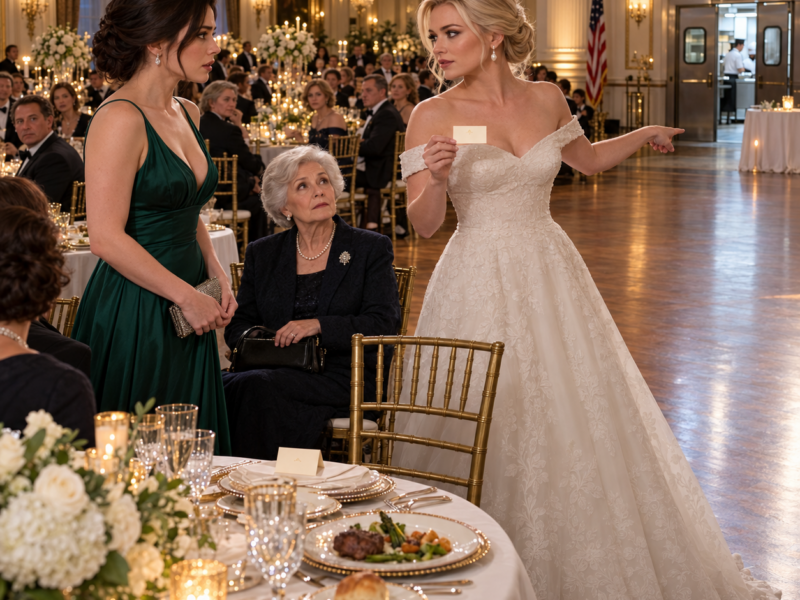
At my sister’s wedding reception, Vanessa had my chair removed from the family table in front of nearly two hundred guests. She pointed me toward a tiny table beside the swinging kitchen doors, then looked me in the eye and said, “Half-sister.” I walked toward the exit, refusing to give her the scene she seemed to want. But Grandma Margaret stood up, picked up her handbag, and announced, “If Clara isn’t family, then neither am I.” Within seconds, relatives began leaving their seats—until Vanessa’s new husband grabbed the microphone and asked, “Where exactly did you move your own sister?”
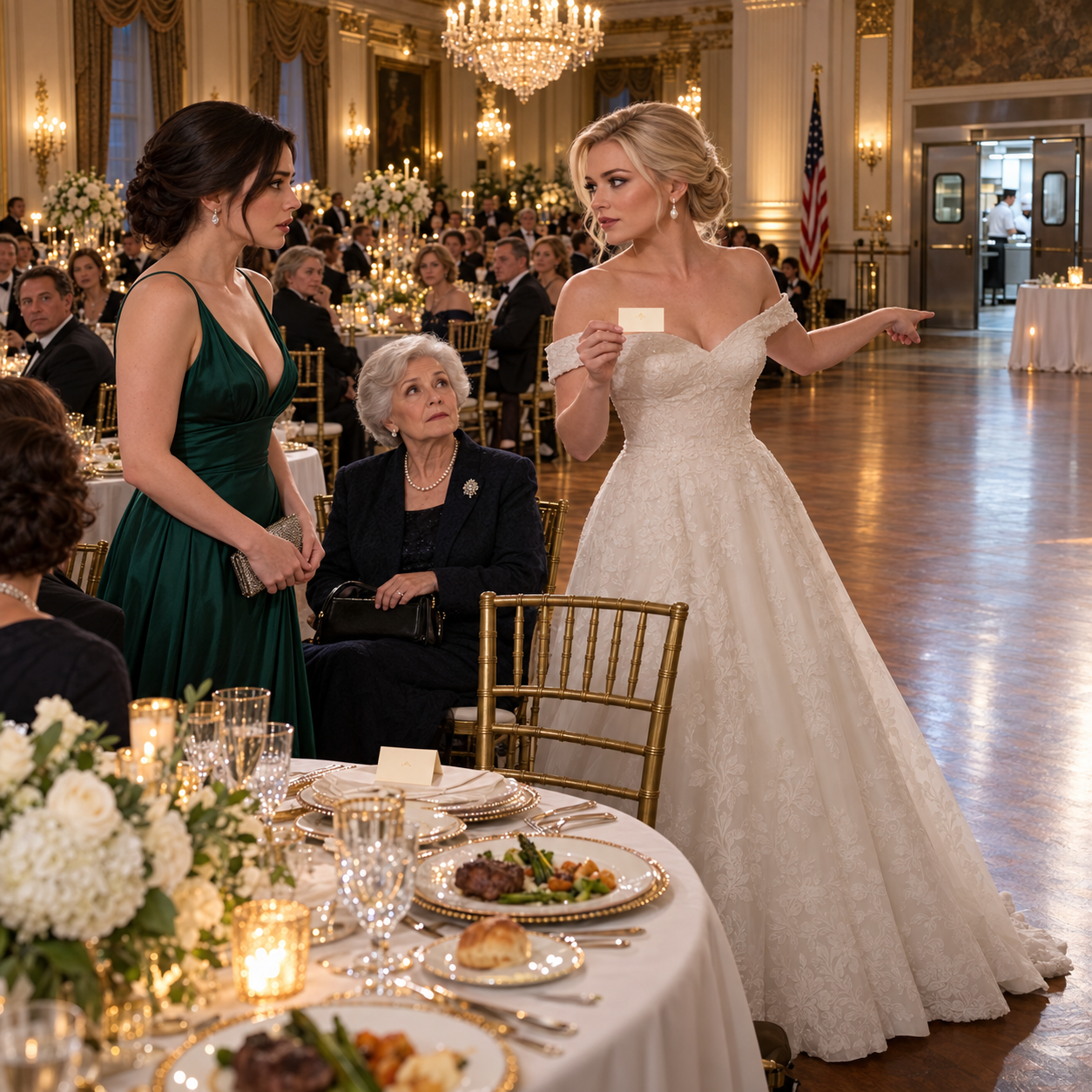
The first thing my sister removed from her wedding reception was my chair.
My place card was still at Table Seven, set between my grandmother’s pearl-trimmed clutch and my cousin Emma’s glass.
**CLARA BENNETT**
Cream cardstock. Gold lettering. A tiny pressed sprig of lavender in the corner.
A plate and folded linen napkin sat beneath it. There was silverware for me and a menu printed with Vanessa and Daniel’s initials. But there was nowhere to sit.
For a moment, I thought someone had borrowed the chair. Nearly two hundred guests filled the Hawthorne Hotel ballroom, and people had been moving furniture all afternoon for photographs. I looked behind the nearest table, then toward the dance floor.
I stopped searching when I saw Vanessa watching me.
She stood a few feet away in her satin wedding gown, a cathedral-length veil trailing behind her. She had spent fourteen months planning this reception. She had chosen the precise shade of ivory for the linens and made our aunt Patricia change her dress because its color was too close to champagne. My missing chair was unlikely to be an oversight.
“Vanessa,” I said, keeping my voice low. “Do you know what happened to my seat?”
“It was moved.”
“Where?”
She pointed across the ballroom, past the bar and the family tables. Beside the swinging doors to the kitchen was a small table occupied by two members of the band, the photographer’s assistant, and a woman with a florist’s clipboard.
I looked back at her.
“You moved me to the vendor table?”
“It’s an overflow table.”
“My place card is still here.”
She reached around me and picked it up.
“I was about to take it over.”
The quartet that had played during cocktails was gone. Soft jazz came through the speakers while servers carried champagne between the tables. Nothing else in the room had changed. Grandma Margaret was seated three places away in a silver dress with a pearl brooch. Aunt Patricia and Uncle Robert sat across from her. Our cousins Emma and Nicholas were nearby, along with Vanessa’s godmother Helen and George, an old friend of our father’s.
I knew every person at Table Seven. It was the family table.
“Why move only me?” I asked.
Vanessa glanced toward the photographer setting up near the head table.
“Please don’t do this at my wedding.”
“I’m asking about my chair.”
“The seating plan changed.”
“You confirmed my place here this morning.”
“And now I’m telling you where to go.” She held out the card. “Clara, it’s dinner. Sit down and enjoy it.”
Aunt Patricia had stopped unfolding her napkin. Grandma was looking directly at us.
“I’m your sister,” I said.
Vanessa’s expression hardened.
“Half-sister.”
She said it quietly. Everyone close enough to hear went still.
Technically, the word was accurate. We shared a father and had different mothers. Vanessa was eighteen when I was born. She had used that word more often in the years since Dad died, but never so pointedly, never while holding my place card as she sent me away from the family table.
She saw the people listening and put on the smooth smile she had worn in photographs all day.
“You know what I mean,” she said.
I did. That was what hurt.
“All right,” I said.
She blinked. “All right?”
I picked up my clutch.
“I’m going home.”
Alarm replaced her smile.
“You can’t leave.”
“You’ve told me where to sit. I’d rather not stay.”
“I didn’t tell you to leave. You’re making a seating adjustment into something enormous.”
“I haven’t asked anyone else to move. Enjoy your reception, Vanessa.”
I turned toward the doors.
My legs felt steady, though my hands were shaking around my clutch. I had no idea whether the people near Table Seven would watch me go or turn back to their dinners. I wanted to make it out before I cried.
I was halfway across the ballroom when a chair scraped sharply against the floor.
I turned.
Grandma Margaret was standing beside Table Seven with her handbag in one hand. She was eighty-two and barely over five feet tall. She pushed her chair neatly under the table and faced Vanessa.
“If Clara isn’t family,” she said, “then neither am I.”
Conversations stopped near us.
“Grandma,” Vanessa said with a strained laugh, “don’t be ridiculous.”
Grandma raised an eyebrow.
“I’ll decide when I’m being ridiculous.”
Aunt Patricia stood next. Uncle Robert looked at her, then rose as well. Emma got to her feet, followed by Nicholas. Helen stood more slowly. George took his jacket from the back of his chair.
“Everybody, please sit down,” Vanessa said.
Nobody did.
“Grandma,” I called, “you don’t have to leave.”
“I know, sweetheart.”
She began walking toward me.
More chairs moved. At Table Nine, our cousin Melissa stood, and her husband followed. I saw two of Dad’s cousins near the windows gather their handbags. Some people looked confused and stayed where they were. Others asked what had happened, then made their own decisions.
I had expected to leave alone. Now I stood by the doors while relatives crossed the ballroom toward me, and I wished Vanessa had let me reach the elevator before anyone noticed.
The music stopped.
Daniel, my new brother-in-law, was beside the DJ booth. His bow tie had loosened, and he looked as though someone had interrupted him in the middle of an ordinary conversation.
“What’s happening?” he asked.
“Nothing,” Vanessa said quickly. “It’s a seating issue.”
Grandma reached my side and took my hand.
“Something happened,” she said.
Daniel looked at me.
“Clara?”
“I’m leaving,” I told him. “You don’t need to stop dinner over it.”
“Why?”
Vanessa answered before I could.
“I had to rearrange a few seats. Clara took it personally.”
Daniel looked toward Table Seven. My setting remained there, with an empty space beneath it. Vanessa still held my card.
“Where was she moved?” he asked.
“To another table.”
“Which one?”
Vanessa pointed toward the kitchen doors.
Daniel’s expression changed.
“The table by the service corridor?”
“There are guests sitting there.”
One of the photographers, standing a few feet away, spoke reluctantly.
“We were assigned there with the band.”
Vanessa shot him a look. He lowered his eyes.
Daniel walked to Table Seven. He looked at my plate and then at the missing chair.
“You moved your sister to the vendor table?”
“Half-sister,” Vanessa said.
Grandma’s hand tightened around mine.
Daniel stared at his wife.
Vanessa closed her eyes briefly, as though she wished she could take the word back now that everyone had heard it twice.
I had not intended to leave in front of the whole room. I had hoped to get home, take off my dress, and cry where nobody could tell me I was spoiling the evening. Yet here we were, standing beneath the chandeliers while the bride’s seating choice became the only thing anyone could see.
“I don’t want to argue,” I said.
Grandma turned toward me.
“You didn’t begin one.”
She started for the doors, and I went with her.
There were plenty of things about Vanessa’s childhood that I learned only after I became an adult. I knew the broad outline while I was growing up: our father, Thomas Bennett, had married her mother, Diane, when they were young. Diane died when Vanessa was eleven. Dad raised Vanessa alone for several years, then married my mother, Rachel. I was born when Vanessa was eighteen.
That made our childhoods different. Vanessa had already gone to college by the time I was old enough to remember her coming home.
To me, she was the glamorous older sister who knew how to braid hair and drive on the interstate. When I was little, she brought me a stuffed bear from the city where she lived. She painted my nails on summer visits, taught me to ride a bike, and let me sleep on her bedroom floor during thunderstorms.
Dad took photographs of us whenever she visited. In most of them I am leaning toward her, and she is making some absurd face to get me to laugh.
I knew she missed her mother. Dad kept Diane’s photograph on a shelf in his study, and when I was old enough to ask, he told me about her without making her into a stranger. My mother did the same. She never asked Vanessa to call her Mom or pretend our house was the one Vanessa had grown up in.
For years, I believed we had found a way to be a family that made room for everyone.
When Dad died of a heart attack, I was twenty-four. Vanessa was forty-two. He had called me the night before to ask if I wanted an old bookshelf he was clearing out. By the following afternoon, Grandma was in my living room telling me he was gone.
At the funeral, Vanessa held my hand so tightly our fingers ached. We stood together beside his grave. She was the one who remembered to bring water for my mother and make sure Grandma sat down.
In the months after, she became harder to reach. I told myself she was grieving in her own way. When she began introducing me as her half-sister, I told myself it was a factual word and that I ought not to mind it.
Little exclusions followed. A Christmas lunch I learned about afterward. A photograph she posted that cropped Mom and me from one end of the group. A family story she told as though Dad’s later years were an interruption of the ones that counted.
Sometimes I asked about these things. Vanessa said I was reading too much into them. I wanted our old closeness back badly enough that I let myself believe her.
Then came the wedding.
Fourteen months earlier, when Vanessa called to say Daniel had proposed, I had been happy for her. She sent me photographs of venues and asked which flowers looked best with her dress. I answered every message. When she grew tired of choosing tablecloths, I brought coffee and sat through samples with her.
Two days before the ceremony, I found out Mom would not attend. She was recovering from a minor procedure and said she was tired. I offered to drive her and bring her home before the reception if she needed to leave.
“Your sister has everything planned,” Mom said. “I don’t want to make it harder.”
I took that as concern about changing the seating at the last minute. Remembering it now, as the elevator doors closed on Grandma and me, I was no longer sure.
Twenty-three relatives and family friends ended up at a diner three blocks from the Hawthorne. We filled two long tables in evening clothes while a waitress brought coffee in thick mugs. Grandma ordered apple pie. I ordered water and sat with my hands folded in my lap.
“I’m sorry,” I said when everyone had settled.
Aunt Patricia looked at me. “For what?”
“You all missed dinner.”
“We chose to come,” she said.
“Daniel didn’t know what was happening. Vanessa’s reception—”
“Clara.” Grandma set down her menu. “You were already leaving. Nobody had to follow you.”
She was right. I had seen that with my own eyes. Still, I thought of Daniel standing on the dance floor while guests walked out. He had always been kind to me, and I did not believe he had known about the chair.
My phone lit up with a message from him.
*I’m sorry. I genuinely didn’t know.*
A few minutes later, he wrote again.
*Vanessa is telling people you organized the walkout.*
I showed Aunt Patricia. She looked toward the other end of the table, where Grandma was spooning ice cream onto her pie.
“Your grandmother stood up before you even knew what she was doing,” Patricia said. “I can tell anyone who asks.”
I put the phone away. I was too tired to defend myself to people who had watched it happen.
Later, as the coffee cups emptied, Grandma asked whether she could come with me to Mom’s house. I said yes. Aunt Patricia came too.
Mom opened the door in her pajamas. She looked at my face and pulled me into her arms. I had kept myself together through the ballroom and the diner. In her living room, I cried.
“I should have told you,” she whispered.
I drew back. “Told me what?”
“That Vanessa called.”
“When?”
“Tuesday.”
We sat down. Grandma took the chair opposite us. Aunt Patricia remained standing near the fireplace, her coat still over one arm.
“Why aren’t you at the wedding?” I asked Mom.
“I’m still recovering.”
“I know that’s part of it.”
She looked down at her hands.
“Vanessa said the family table was full. She thought the long day might be too much for me.”
“She told me you canceled.”
“I decided to stay home after we spoke.”
“What else did she say?”
Mom glanced at Grandma, then back at me.
“She said the table was for Diane’s side and your father’s original family. She didn’t want anyone feeling awkward.”
For a moment, I could only hear the clock in the hallway.
“Dad’s original family,” I repeated.
Mom nodded. “I should have told you. I didn’t want you to arrive already angry with her.”
I had called her that morning. She had texted me to wish Vanessa a beautiful day and said she did not want to make anything harder. I thought she meant walking too much in heels after surgery. She had been trying to make her absence easy for me to accept.
Grandma pressed her lips together.
“I spoke to Vanessa about Rachel’s place at the table weeks ago,” she said. “She told me it was settled.”
Mom gave a weary little smile. “She may have meant that I wasn’t coming.”
Aunt Patricia finally took off her coat.
“This goes back farther than the wedding,” she said.
“I know there have been comments,” I said. “I thought Vanessa was still grieving Dad.”
“She is,” Grandma said. “She is also responsible for what she did tonight.”
I looked at her. I had grown up hearing Grandma defend Vanessa whenever someone criticized her. Hearing her say that mattered.
My phone buzzed.
*I hope you’re happy,* Vanessa had written. *Half the reception left because of you. Daniel barely spoke to me afterward. You could have sat at the other table for two hours.*
I read the message to Mom and Grandma.
“She thinks I knew you would follow,” I said.
“Did you?” Grandma asked.
“No. I thought everyone would stay.”
“Then tell her that much.”
I typed slowly.
*I left without asking anyone to follow me. I didn’t know Grandma was getting up. Moving my chair and calling me your half-sister was your choice.*
Vanessa replied almost immediately.
*You always get to be the victim.*
I turned off the screen. I knew any answer I gave that night would become another argument about my tone.
Mom brought out a blanket, and I slept on her sofa. In the morning, I went home and left my dress hanging on the closet door. I could still see the ballroom when I looked at it: my place card in Vanessa’s fingers, the empty space at Table Seven, Grandma rising.
Three days passed before we spoke again.
I learned bits of what had happened after we left. Some guests remained and dinner was served. Daniel sat through the speeches. Vanessa told people the seating plan had been misunderstood. Aunt Patricia corrected that account when someone asked her. Grandma declined to discuss it beyond saying she had heard Vanessa’s words and made her own choice.
On the fourth day, Grandma called.
“Come over,” she said. “I found something.”
“What?”
“A letter your father wrote.”
I sat down.
“He addressed it to both of you,” she said. “The envelope says, ‘For my daughters. Together.’”
Grandma had found it inside the family Bible while looking for an old photograph. Dad had written it years before his death, after an episode of chest pain frightened him. He recovered and apparently never asked for the letter back.
“Have you opened it?” I asked.
“No.”
“Does Vanessa know?”
“Not yet. I thought you should both hear about it from me.”
I wanted to drive to Grandma’s house immediately. Then I thought of the envelope with both our names on it. Vanessa would have every right to be angry if I read it first.
I called her. She did not answer, so I sent a message.
*Grandma found a letter Dad wrote for both of us. I haven’t opened it.*
She called within a minute.
“What letter?”
“I don’t know what it says. Grandma has it.”
“Why does she have it?”
“She found it in the family Bible.”
“You expect me to believe nobody read it?”
“I haven’t. Grandma says she hasn’t.”
A long pause followed.
“I’ll be there at six,” Vanessa said.
At 5:58, she came through Grandma’s front door without Daniel. She wore jeans and a sweater. Her hair was pulled back, and she looked as tired as I felt.
The envelope lay on the dining table.
Vanessa stopped when she saw Dad’s handwriting. I could tell the sight of it had reached her before she had decided how to behave toward me.
Grandma explained how she had come to have the letter. Vanessa listened until Grandma said she had put it in the Bible for safekeeping and forgotten it after Dad recovered.
“You forgot?” Vanessa said.
“Yes,” Grandma answered. “I did.”
“After he died, you could have checked.”
“I wish I had.”
Vanessa sat down abruptly. Her anger was understandable. So was Grandma’s regret. Neither changed the fact that the letter was finally in front of us.
“Open it,” Vanessa told me.
I took out four handwritten pages. Dad’s writing leaned slightly to the right. It was the same writing on the labels of my childhood school folders and the grocery lists he used to leave beside the fridge.
I began to read.
He wrote that he loved both of us. Then he wrote about Diane’s death and the years that followed. He said he had worked late because he was frightened of losing the house and because he did not know what to do when Vanessa cried. He had told himself that providing for her was enough.
I had known Dad as a patient man who came to my soccer games and made pancakes shaped like animals on Saturday mornings. The father on those pages sounded like someone I had never met.
Vanessa reached across the table.
“Let me.”
I handed her the letter. She read silently.
Dad had written that she deserved a father who sat beside her when she cried. He knew she had spent too many evenings with Grandma and Aunt Patricia while he stayed at work. He had tried, years later, to become more present, and he knew he could not give those years back.
Vanessa pressed her fingers against her mouth.
Farther down the page, Dad wrote about meeting Rachel and having me. Becoming a father again had given him chances to do ordinary things differently. He knew Vanessa had seen that change. He feared she might believe the difference meant he loved her less.
He told her it did not. He also wrote that loving her was no substitute for having been there when she needed him.
Vanessa moved her hand from her mouth and read one line aloud.
“Clara did not take those things from you. I did.”
My eyes filled.
Grandma looked down at the table. For years she had helped Dad care for Vanessa and watched him struggle to speak to her about Diane. I wondered what she was remembering.
Dad’s final request was that we not make our connection into a contest over which of us had received the better version of him. He called us his daughters. He hoped we would keep knowing each other as sisters after he was gone.
When Vanessa finished, she placed the pages between us.
“He understood more than I thought,” she said.
“Some of it,” Grandma replied.
“Why couldn’t he tell me?”
“I think he tried. He should have tried harder.”
Vanessa nodded. Tears ran down her face, and she did not wipe them away.
I wanted the letter to make everything simple. Dad had named the difference between our childhoods with more honesty than I had expected. He had also died before he and Vanessa could finish talking about it. I could not ask him what he remembered of any particular day. Vanessa could not have the conversations she had needed at eleven or seventeen.
She picked up the pages again.
“He took you to school every morning,” she said to me. “Do you remember?”
“Most mornings.”
“He never came to mine. Grandma did.”
I thought of Dad standing by the front door with my lunch bag, hurrying me to the car. Until that moment, it had been an ordinary memory. I looked at Vanessa across the table and understood why she had carried a different one.
“I didn’t know,” I said.
“I know you didn’t.”
For once, she said it without accusation.
We sat quietly. Then I asked the question the letter could not answer.
“Why did you take away my chair?”
Vanessa stared at the pages.
“When I saw the seating chart, Rachel’s name was on it. So was yours. Grandma had a place. Patricia had a place. I kept looking at the table and thinking my mother was the only person who couldn’t be there.”
“Diane couldn’t be there,” Grandma said gently. “Rachel wasn’t the reason.”
“I know.” Vanessa’s voice tightened. “Knowing didn’t change how I felt when I looked at it.”
“You called Mom and told her she wasn’t part of Dad’s original family,” I said.
“Yes.”
“You moved my chair after I arrived.”
“Yes.”
“Did you want me to notice?”
She nodded.
“Did you think it would hurt?”
“Yes.”
I had spent days wondering whether she had meant to embarrass me or whether she had somehow persuaded herself it was a seating problem. Now she was telling me. It was painful to hear, but I was relieved not to be asked to doubt what had happened.
“I thought you’d be angry and argue with me,” she said. “I didn’t think you would leave.”
“You planned for me to argue?”
“I knew you’d ask why.”
“And you’d tell people I was making a scene.”
She closed her eyes.
“I probably would have.”
Grandma sat very still. Vanessa opened her eyes and looked at me.
“I’m sorry,” she said. “I have been angry about Dad for a long time, and I chose to hurt you with it. You didn’t deserve that.”
I believed she meant the apology. I also needed more than one honest evening before I could feel comfortable around her again.
“You hurt Mom too,” I said.
“I know. I need to speak to her.”
“You also lied to Daniel.”
“I did.”
I stood, and Vanessa’s gaze followed me.
“I’m going home,” I said.
“Are we going to talk again?”
“I think so. I need some time first.”
She nodded.
As I reached the hall, she said, “Daniel’s staying with his brother.”
I stopped.
“He asked me before the wedding if Rachel was coming. I told him she chose not to. And when he saw the seating chart earlier that day, I said the coordinator had handled the last-minute changes.” She swallowed. “He found out neither was true in front of everyone.”
“I’m sorry he found out that way.”
“I am too.”
I left Grandma’s house carrying a photograph she had given me of Dad with both his daughters. Vanessa was twenty and holding me on one hip. Dad stood behind us, smiling into the sun. I set it on my bookshelf at home. For a while, I could not look at it without seeing the letter beside it.
Three weeks later, Mom called on a Sunday morning.
“Vanessa is here,” she said.
“Is everything all right?”
“Yes. She brought a chair.”
I asked her to repeat herself.
“An old dining chair,” Mom said. “From your father’s house.”
I drove over curious despite myself.
The chair stood in Mom’s living room. It was one of six wooden chairs from the table where we had eaten hundreds of family dinners. I recognized a shallow scratch near the back, left when Dad tried to carry it through a doorway without turning it sideways.
Vanessa stood beside it, looking embarrassed.
“I bought the dining set after Dad’s house was sold,” she said. “I’ve had it in storage.”
“You said you didn’t want much of his furniture.”
“I didn’t want it in my house then. I couldn’t let it go either.”
Mom sat on the sofa, watching us.
“I’ve been thinking about the family table,” Vanessa said. “This seemed like a good idea when I loaded it into the car.”
“It’s strange,” I said.
“I know.”
“It’s also Dad’s chair.”
She gave a brief smile. “Yes.”
Then she turned toward Mom.
“I owe you an apology that I should have made before the wedding,” she said. “I told you there wasn’t room for you because I didn’t want you there. I was angry about Dad building a life after my mother died. I made you carry that anger when you had always tried to be kind to me.”
Mom folded her hands.
“You hurt Clara,” she said.
“I know.”
“You’ve apologized to her?”
“Yes. I’m still trying to understand how long I’ve treated her that way.”
Mom nodded. “That will take longer than one visit.”
“I know.”
We had coffee. Vanessa stayed only half an hour, then asked if Mom wanted her to take the chair back.
Mom looked at the place near her dining table where it would fit.
“Leave it for now,” she said.
Vanessa called Daniel that evening and told him she had spoken to us. I learned later that she told him the full story of the seating chart without blaming the coordinator or my reaction. He did not return home immediately. They began counseling, and Vanessa started going on her own too.
I did not ask for updates. Sometimes she sent one.
*I apologized to Aunt Patricia today.*
Another week:
*Daniel and I talked about the wedding. I understand if you don’t want to answer.*
That last sentence mattered. In the past, Vanessa had treated my silence as another offense against her. Now she was allowing me time without demanding that I use it to reassure her.
I answered when I wanted to. We met for coffee twice. The first conversation was awkward. We talked about Grandma’s garden, a new restaurant Daniel liked, and almost nothing that mattered. The second time, Vanessa asked how Mom was doing. When I said Mom was planning a trip with an old friend, she listened without turning the answer back toward herself.
At Thanksgiving, Grandma hosted dinner. When Mom and I arrived, Vanessa was in the dining room helping Aunt Patricia set out serving dishes.
She saw me and pulled out the chair beside hers.
“Would you sit here?”
I looked at it, then at her.
“You checked the seating plan?”
She winced. “I deserved that.”
“Yes.”
She smiled a little. “I’m asking you this time.”
I sat down.
Mom took the chair across from us, and Grandma sat at the head of the table. We ate turkey that Uncle Robert had nearly overcooked, sweet potatoes Aunt Patricia defended against everyone’s criticism, and enough rolls that nobody needed dessert.
Halfway through dinner, Vanessa and I reached for the mashed potatoes at the same moment.
“You go ahead,” she said.
“No, take them.”
Grandma looked over her glasses.
“There are enough potatoes for both of you.”
Everyone laughed. Vanessa passed me the bowl.
I had wanted an evening like that for years: sitting beside my sister without trying to guess whether she resented my place there. It was one dinner. I let myself enjoy it.
Daniel came to Grandma’s birthday celebration the following spring. He and Vanessa had worked through enough to live together again. He brought flowers for Mom as well as Grandma, as he had on his first Christmas with our family.
When I thanked him, he said, “Vanessa told me what she said to Rachel before the wedding. I’m sorry I believed she’d chosen to stay home.”
“You had no reason not to believe her.”
“I asked once and accepted the answer.”
“That’s what most people would have done.”
He glanced toward Vanessa across the room. “We’re learning to ask each other harder questions.”
I hoped they would keep doing it.
After dinner, Vanessa and I ended up on Grandma’s porch. Inside, someone was clearing plates, and Grandma was insisting nobody put the cake away before she had a second slice.
“There’s something I haven’t said properly,” Vanessa told me.
I waited.
“When I moved your chair, I expected you to argue. I had already decided that if you did, I’d tell everyone you were making my wedding about yourself.”
“I thought so.”
“But you left. I blamed you for Grandma following because I couldn’t bear that everyone had seen what I did.”
The porch light caught in her eyes. She looked uncomfortable, but she kept going.
“I’m sorry I put you in a position where you could either accept the insult or be called difficult for objecting. I did that to you more than once after Dad died.”
I thought of the cropped photographs and missed invitations. “You did.”
“I don’t expect you to forget it.”
“I won’t.”
She nodded.
“If you’re angry with me again,” I said, “tell me what you’re angry about. Don’t make Mom or me guess which gathering we’re allowed to attend.”
“I will.”
I could not know whether she would always manage it. I knew she had spent months showing up for conversations she once would have escaped. I was ready to make my own choice about what came next.
“I forgive you,” I said.
Her eyes filled. She did not reach for me or turn the moment into a promise that everything was fixed.
“Thank you,” she said.
Grandma opened the screen door.
“Are you two coming in? I’ve saved cake, but I’m not saving it forever.”
We went inside.
Almost a year after the wedding, Daniel and Vanessa held a small anniversary dinner at a restaurant. When I arrived, Vanessa was waiting near the long table. My name card sat beside hers. It was cream cardstock with gold lettering.
I picked it up.
“Seriously?”
She looked uncertain. “I thought you might find it funny.”
“I might in another year.”
“That’s fair.”
I sat down anyway.
Grandma arrived soon afterward and counted the chairs before taking off her coat.
“Grandma,” Vanessa said, “please stop counting.”
“I trust you,” Grandma replied. “I can also count.”
Even Vanessa laughed.
Later, I stepped outside for a few minutes of air. Through the window I could see Mom talking to Daniel, Aunt Patricia handing Grandma the dessert menu, and Vanessa leaning toward our cousin Emma. They looked like a family because they were one, though every person at that table remembered the wedding differently.
Vanessa came out to join me.
“Are you all right?”
“Yes. Just needed a minute.”
She stood beside me. Traffic passed at the far end of the street.
“I wish Dad had given us that letter himself,” she said.
“So do I.”
“I wish I’d asked him more while I could.”
“You were allowed to be angry with him.”
“I know. I let you carry it.”
“Yes.”
She accepted the answer. That was one of the ways I knew our conversations had changed.
Grandma noticed us through the restaurant window and tapped her watch with theatrical impatience.
“We’re being summoned,” I said.
Vanessa touched my arm before we went in.
“Thank you for coming.”
“I wanted to.”
At the table, Grandma had ordered dessert for everyone. Someone shifted a serving plate to clear space in front of my chair. Vanessa sat beside me and passed down the spoons.
I put my place card in my purse before we left. At home, I set it beside the photograph of Dad, Vanessa, and me. I still had the one from the wedding too. The names looked the same on both cards.
What had changed was that Vanessa had asked me to sit down.









