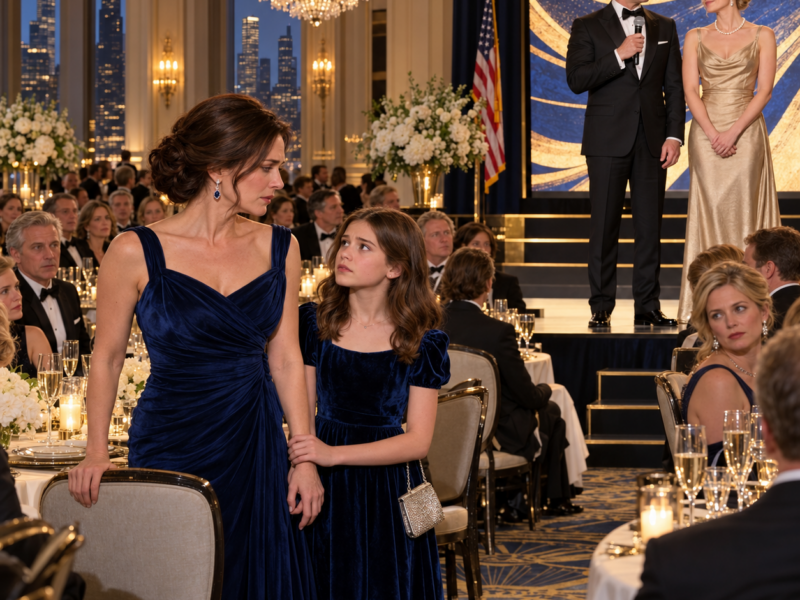
At my husband’s awards dinner, his mistress walked toward the stage wearing my late mother’s pearls. I was about to leave when my thirteen-year-old daughter caught my hand and whispered, “Mom, give me five minutes.” As Daniel began thanking the woman beside him, Ellie stepped onto the stage and said, “Before you thank her, there’s something Grandma left for Mom that everyone should see.” Then the screen behind them went black.
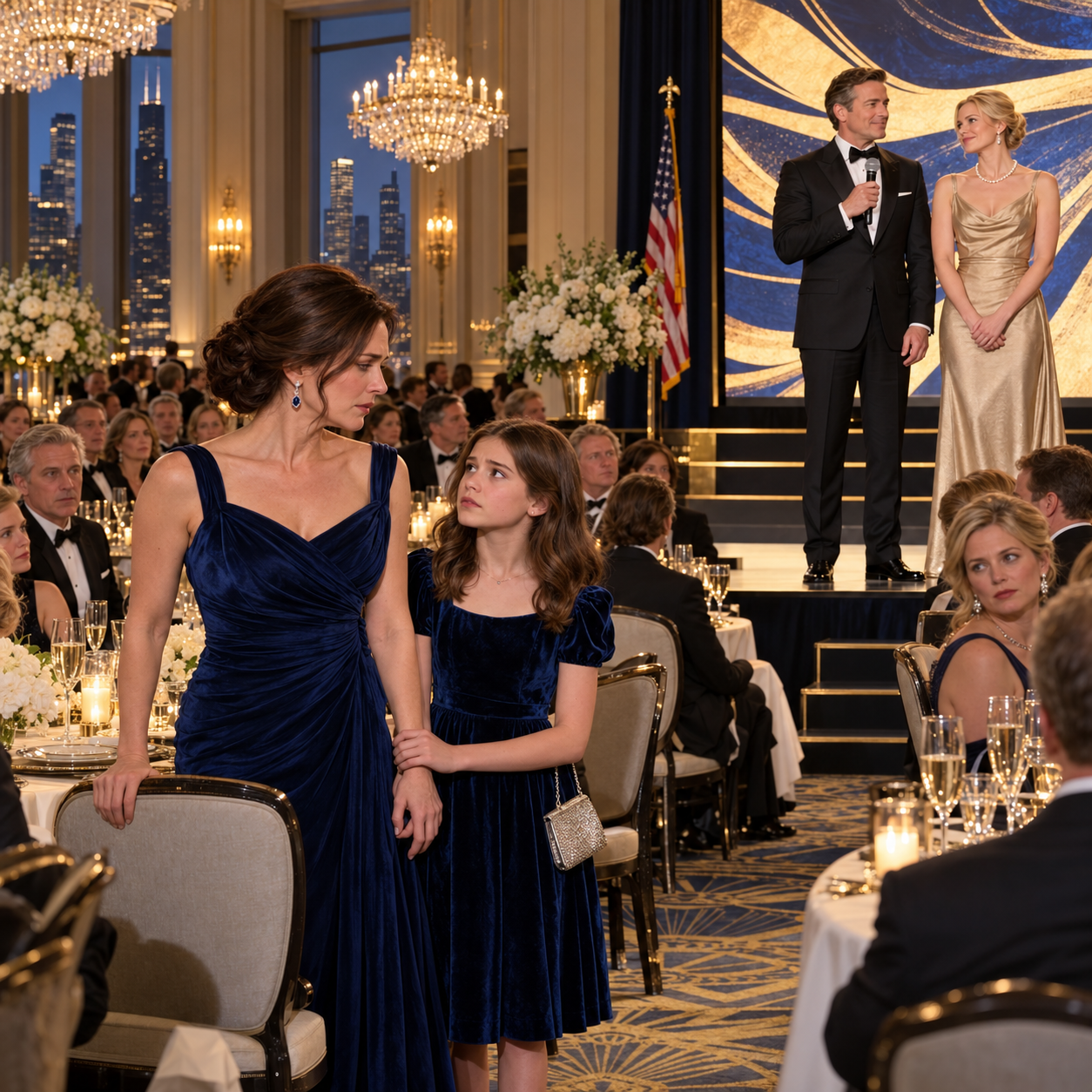
“Mom, please don’t leave.”
My thirteen-year-old daughter caught my hand just as I began to stand.
Across the ballroom, my husband was walking toward the stage with another woman on his arm.
Around that woman’s neck were the pearls my mother wore on her wedding day.
“Ellie, sweetheart, I can’t do this.”
She looked at the necklace.
Then at the enormous screen above the stage.
Then back at me.
“Just five minutes. Please.”
I had never seen that expression on her face before.
Not quite anger.
Not quite fear.
A kind of determination so familiar that, for a moment, it felt as though my mother had returned and taken the seat beside me.
The Grand Palmer Hotel in downtown Chicago was filled with nearly three hundred people celebrating the twentieth anniversary of Harrison Custom Homes.
Architects. Bankers. Longtime employees. Clients whose kitchens I could still picture because I helped them choose the cabinets. City officials who knew my husband’s name better than they knew the people who kept his projects moving.
And Daniel stood beneath the chandeliers, smiling for photographs beside Lauren Mitchell.
His executive assistant.
That was what he called her whenever I asked a question he did not want to answer.
Lauren was thirty-one, beautiful, and wearing a champagne-colored gown I recognized from a shopping bag Daniel brought home two weeks earlier.
He said it was a birthday present for his sister.
Apparently, his sister also needed my mother’s pearls.
I sat beside Ellie and tried to understand how someone could destroy twenty-two years of marriage while looking so pleased with himself.
“Maybe she borrowed them,” Ellie whispered.
She was not really asking.
She was offering me one last opportunity to explain the scene in a way that made her father different from the man we were watching.
“No, honey.”
My voice barely worked.
“She didn’t borrow them from me.”
My mother, Margaret, died four years earlier.
The pearls were the only valuable piece of jewelry she owned.
My father bought them after saving money from double shifts at a tire factory. They were not the sort of pearls someone insured for a fortune.
They mattered because of who wore them.
Mom wore them to my wedding.
She wore them when Ellie was baptized.
Three days before she died, she placed them in my hands and asked me to give them to Ellie when she was old enough to understand that beautiful things were not always expensive.
One pearl near the clasp had a small gray mark.
When Lauren turned toward the photographer, I recognized the shape of the necklace and the old clasp. Then the camera feed appeared briefly on the screen, enlarging her face and shoulders.
There was the gray-marked pearl.
No uncertainty remained.
Three months earlier, Daniel offered to have the necklace cleaned before our anniversary celebration.
I thanked him.
I kissed him.
I gave him the case.
Now another woman stood beneath the chandeliers touching those pearls as though she had always owned them.
“Ladies and gentlemen,” the master of ceremonies announced, “please welcome the man whose vision built Harrison Custom Homes from a small family operation into one of Chicago’s most respected residential construction companies—Daniel Harrison.”
The applause rose around us.
I looked down at the printed program.
My name was not in it.
Twenty years earlier, Daniel and I worked out of our garage.
He built houses.
I answered calls, ordered materials, managed invoices, handled payroll, and learned which supplier would give us another week before suspending delivery.
When our first major client refused to pay, I took a second job.
Seven years later, Ellie slept in a portable crib beside my desk while I worked through purchase orders.
Daniel’s toolbox had been useful.
So had everything he preferred not to mention.
He walked to the microphone.
Lauren followed.
That was when I noticed the head table.
My place card was gone.
Lauren’s stood beside Daniel’s.
Ellie saw it too.
“Did Dad tell you she was coming?”
I shook my head.
She reached beneath our table and picked up her silver evening bag.
“What are you doing?”
She took out her phone.
“Something Grandma taught me.”
My stomach tightened.
“Whatever you’re thinking, you do not have to defend me.”
“I know.”
She leaned closer.
“But Grandma would want you to see this.”
Before I could ask what she meant, Daniel began speaking.
“Twenty years ago, I started this company with a pickup truck, a toolbox, and a dream.”
People applauded.
I remembered selling a bracelet I had been given when we became engaged so we could make payroll.
Daniel smiled toward Lauren.
“And tonight, I’d like to recognize someone who has reminded me what it means to believe in the future.”
Lauren lowered her eyes.
At the next table, a woman stopped clapping.
Ellie stood.
Her chair scraped the floor.
“Sit down,” I whispered.
She kissed my cheek.
“Five minutes.”
Then she walked toward the stage.
I followed with my eyes, ready to rise if anyone tried to stop her.
She approached the event coordinator standing beside the screen.
The woman recognized her.
They spoke.
Ellie opened her bag and showed her phone.
The coordinator’s expression changed.
Onstage, Daniel reached for Lauren’s hand.
“Sometimes,” he continued, “the people who change your life arrive when you least expect them.”
Someone near me whispered my name.
Claire.
It sounded like pity.
Then Daniel noticed his daughter.
His smile disappeared.
“Sweetheart, what are you doing?”
Ellie climbed the three steps.
She wore the blue velvet dress my mother bought for her ninth birthday, carefully altered so she could wear it one last time.
She looked at Lauren’s necklace.
Then she held out her hand for the microphone.
“Dad,” she said, “before you thank her, there’s something Grandma left for Mom that everyone should see.”
The enormous screen went black.
For one second, I thought something had gone wrong.
Then I heard my mother’s laugh.
It was a small, familiar laugh, the one she made when a camera appeared before she had decided whether she looked presentable.
“Oh, Ellie. Give me a moment.”
My hands gripped the edge of the table.
The screen brightened.
Mom sat in our kitchen, wearing a pale green cardigan and the pearls.
Sunlight fell across the table.
A mixing bowl stood beside her.
I remembered that afternoon.
She had been helping Ellie make cinnamon rolls.
It was less than a week before the hemorrhage that took her from us.
She looked tired in the video.
I had noticed then.
I had not understood what it meant.
“Are you ready?” Ellie’s nine-year-old voice asked from behind the phone.
“As ready as I’ll ever be.”
The room became completely quiet.
Mom looked into the camera.
“Claire, if your daughter manages to keep this recording safe, you are probably watching it at that company anniversary you keep talking about.”
I made a sound I could not stop.
She smiled.
“You said twenty years deserved a proper celebration. I agree. But I know you, and I know you’ll stand in the back checking whether everyone has a drink instead of letting anyone say what you did.”
Daniel moved toward the coordinator.
She looked at him.
Then at Ellie.
The recording continued.
“You helped build that business. I watched you work nights. I watched you worry about wages. I watched you sell something you loved because other people’s families needed their paychecks.”
A few people turned toward me.
I could not look at them.
I could only look at my mother.
“Daniel had skill,” she said. “You had skill too. Different kinds. Both mattered.”
The camera shifted.
Ellie asked a question.
“Grandma, can you show the necklace?”
Mom touched the pearls.
“These?”
“Tell the story.”
“Oh, she likes this story.”
Mom unclasped the necklace and laid it across her palm.
The camera moved closer.
The gray-marked pearl appeared beside the old clasp.
“Your grandfather saved for these,” she said. “For months. He pretended he was working late because they needed him. Really, he wanted to give me something I would never have bought for myself.”
She smiled.
“I was annoyed about the late dinners until I found out why.”
A few people laughed softly.
I cried harder.
“These will belong to your mother,” Mom continued. “And someday, when she decides you’re ready, they’ll belong to you.”
The camera remained on her hand.
“Not because they’ll make either of you important. You already are. They’re a reminder that somebody loved me enough to make a quiet plan and carry it through.”
Onstage, Lauren’s hand moved to her neck.
Daniel stopped beside her.
Mom looked back into the lens.
“Claire, don’t let your name disappear from a life you helped build. Being modest is lovely. Being erased is something else.”
I closed my eyes.
When I opened them, she was still there.
“And Ellie, if your mother forgets what I said, remind her. Kindly. She gets stubborn when she’s tired.”
The recording ended with Ellie giggling and Mom reaching toward the phone.
The screen faded.
Nobody applauded immediately.
The silence was too full.
Then someone at a table near the back began clapping.
Not wildly.
Not for the scandal.
For my mother.
For what she said.
Others joined.
Ellie stood beside the microphone with both hands wrapped around it.
Her face had lost some of its determination.
Now she looked thirteen.
She looked frightened.
I stood.
Before I reached the stage, she spoke again.
“My grandmother gave those pearls to my mom.”
Her eyes moved toward Lauren.
“They weren’t Dad’s to give anybody.”
Daniel reached for the microphone.
“Ellie, this is not—”
I stepped onto the stage.
“Enough.”
He stopped.
I went directly to my daughter.
I put one arm around her.
Then I took the microphone gently from her hands.
“Thank you, sweetheart.”
She looked up.
“I didn’t want them to forget you.”
“They haven’t.”
Her lips trembled.
I turned toward the audience.
“That recording was a surprise for me. I’m grateful to my daughter for keeping it safe.”
I did not explain the affair.
I did not list the lies.
Three hundred people did not need to become witnesses to everything I had not yet processed.
“Daniel and I both contributed to the company’s beginnings. The employees here have contributed to everything that followed. We should recognize that accurately.”
I looked toward the coordinator.
“Please allow the program to continue after a short break.”
Then I turned toward Lauren.
My voice remained low.
“Those pearls belong to me. I’d like them returned.”
She stared at me.
Daniel said, “We can discuss this privately.”
“Yes,” I said. “We will.”
I gave the microphone to the master of ceremonies.
Then I led Ellie offstage.
For the first time that night, Daniel followed us.
The coordinator took us into a small room behind the ballroom.
Her name was Rebecca Sloan.
I knew her.
We had worked together on two client events before Lauren began handling Daniel’s schedule.
Rebecca closed the door.
She looked at Ellie.
“Would you like some water?”
My daughter nodded.
Her hands were shaking.
I sat beside her.
“Look at me,” I said.
She did.
“Are you all right?”
“I’m sorry.”
“For what?”
“I made everyone look.”
I took her hands.
“You showed a recording Grandma made. You wanted people to remember me. I understand.”
“Dad’s angry.”
I looked toward the door.
Daniel stood there with Lauren beside him.
“Yes,” I said. “He may be. That is not your job to fix.”
Ellie began crying.
Quietly at first.
Then with the exhausted sobs of a child who had held herself together too long.
I pulled her against me.
Daniel took a step forward.
“Ellie.”
I raised my hand.
“Give her a minute.”
He stopped.
For once, he did not argue.
Rebecca placed a glass of water on the table.
Then she said, “I can arrange a quiet place for Ellie while you speak, if she wants.”
I looked at my daughter.
“Would you rather stay with me or sit with Aunt Beth for a few minutes?”
Daniel’s sister was somewhere in the ballroom.
She had not received the champagne gown.
She had been wearing a dark dress she owned for years.
Ellie wiped her face.
“Aunt Beth.”
I nodded.
Rebecca went to find her.
While we waited, I looked at Daniel.
“How did Lauren get my mother’s necklace?”
He glanced at Lauren.
Then at me.
“I intended to explain.”
“That is not an answer.”
Lauren touched the clasp.
“He told me it was a family piece he wanted me to wear.”
“Whose family piece?”
She hesitated.
“His mother’s.”
Daniel closed his eyes.
I stared at him.
“Your mother is alive.”
“I know.”
“My mother is not.”
“I know.”
“Then explain how you decided you could take what she left me and call it yours.”
He looked toward Ellie.
I stopped.
Not because the question was finished.
Because my daughter deserved not to hear the answer.
Beth arrived.
She took one look at Daniel, then at Lauren’s neck.
Her expression changed.
“Claire.”
“Will you stay with Ellie?”
“Of course.”
She knelt slightly.
“Come with me, kiddo. We’ll find somewhere quiet.”
Ellie looked at me.
“You’re coming back?”
“Yes.”
“Soon?”
“As soon as I’ve handled this.”
She nodded.
Before she left, she hugged me again.
I kissed her forehead.
“You don’t have to do another thing tonight.”
After the door closed, the room felt colder.
Rebecca remained.
I asked her to stay.
I wanted a witness for the return.
I did not yet know what other facts I would need.
Lauren reached behind her neck.
The clasp caught in her hair.
For a moment, she struggled.
Then she looked at Daniel.
He did not help.
Rebecca stepped forward.
“May I?”
Lauren nodded.
The necklace came free.
Rebecca laid it carefully on a folded napkin.
I picked it up.
The weight was familiar.
So was the tiny roughness near the clasp.
I held it in my palm.
The relief hurt.
Three months.
Three months I had believed it was being cleaned.
I thought of the case missing from my drawer.
The times I asked whether the jeweler called.
Daniel’s answers.
They’re busy.
They found a problem with the clasp.
I’ll handle it.
I had trusted him with something my mother placed in my hands.
He had turned that trust into a gift for another woman.
Lauren said, “I didn’t know it belonged to your mother.”
I looked at her.
“You know now.”
She nodded.
“I’m sorry.”
I could not yet determine how much she knew before that room.
I did not pretend I could.
The necklace was back.
That was the immediate fact.
Daniel said, “This got out of hand.”
I looked at him.
“What did?”
“The evening.”
“No. Be specific.”
He rubbed his forehead.
“Bringing Lauren onto the stage.”
“And?”
“The necklace.”
“And?”
He looked irritated.
“Claire.”
“You are not going to make this sound like a seating problem.”
Rebecca’s face remained still.
I was grateful she did not leave.
Daniel lowered his voice.
“This is private.”
“It should have been. You brought another woman to the head table, put my mother’s pearls around her neck, and began thanking her in front of our daughter.”
Lauren looked down.
Daniel said, “You’re making assumptions.”
“Then tell me there’s no relationship.”
He did not.
The silence gave me the answer I had been trying not to hear for months.
I had noticed distance.
Late evenings.
A phone turned facedown.
Trips that changed at the last minute.
A strange impatience whenever I asked about plans.
I had not been oblivious.
I had been tired.
Work, parenting, caring for Daniel’s father after surgery, and keeping a household moving had made suspicion another task I could not bear to take on without something definite.
Now it was definite.
I put the pearls in my bag.
“I’m leaving with Ellie.”
“We need to talk.”
“We will. Tomorrow. When she is somewhere comfortable.”
“You can’t just walk out.”
I looked at him.
“I can.”
Rebecca opened the door.
Daniel did not stop me.
That was the first boundary I put into effect.
It would not be the last.
Beth sat with Ellie in a quiet lobby lounge.
My daughter had a cup of hot chocolate she had barely touched.
When she saw me, she stood.
I showed her the necklace.
Her face changed.
“You got them.”
“Yes.”
She reached out and touched one pearl.
Then she looked at me.
“Did he say why?”
“He gave an explanation. I have more questions.”
“Is he coming home?”
I took a breath.
“I’m taking you home now. Dad and I will make adult decisions after that.”
She nodded.
Beth asked whether I wanted her to come.
“Yes.”
I did not try to prove I could carry every part alone.
Rebecca arranged for our coats and bags.
A staff member brought my car from the garage.
The hotel continued around us.
Guests checked in.
A man asked for directions.
Someone laughed near the elevators.
The world had not stopped because my family changed in a small room behind a ballroom.
I found that both comforting and unbearable.
In the car, Ellie asked whether she ruined the awards dinner.
“No.”
“Dad will think so.”
“Dad is responsible for the decisions he made tonight.”
“But I played the video.”
“Yes.”
She looked out the window.
I waited.
Then I said, “We will talk about what happened. You are not in trouble for loving me. I also do not want you feeling responsible for protecting me in front of grown-ups.”
She looked back.
“But someone had to.”
That sentence followed me all the way home.
Someone had to.
My daughter believed it had to be her.
I had spent years being the steady adult.
The organizer.
The person who softened every disagreement.
I had not realized how often she watched me do that while nobody else stood beside me.
That night, she stepped into the empty space.
I loved her courage.
I also grieved that she felt the space belonged to her.
At home, Beth made tea.
Ellie changed into pajamas.
I placed the pearls in their case, which I found empty in Daniel’s desk drawer.
That discovery made me sit down.
He had not lost the case.
He had not sent it away.
He left it where he could see it while repeatedly telling me the necklace remained with a jeweler.
I closed the lid.
Then I went upstairs.
Ellie lay awake.
Her blue velvet dress hung over a chair.
It had been let out at the seams by a careful seamstress.
Mom bought it shortly before she died.
Ellie wore it that night because she wanted part of Grandma with her at the company celebration.
I sat beside the bed.
“Tell me about the video.”
She looked uncertain.
“What part?”
“How did you find it?”
“On Grandma’s old phone.”
The phone had been kept with family things.
I thought the photographs were already copied.
Ellie used it occasionally to look at videos.
“She made a folder,” Ellie continued. “For later.”
I remembered my mother labeling everything.
Freezer containers.
Photograph envelopes.
Keys whose purpose everyone else forgot.
Of course she made a folder.
“I saw it last month,” Ellie said. “I was looking for the cinnamon roll video.”
“The one where the dough stuck to the ceiling?”
She smiled.
“Not the ceiling. The cabinet.”
“Your grandmother said it was the ceiling.”
“She was being dramatic.”
We laughed softly.
The sound helped.
Ellie explained that she had been making a birthday video for Beth and found the recording about the company anniversary.
Mom knew we planned a twentieth-year celebration someday.
She did not know she would not be alive for it.
She simply recorded a message because Ellie liked making videos and my mother liked making sure people were remembered.
Ellie asked Rebecca weeks earlier whether a surprise could be included.
Rebecca placed a short family tribute in the draft program.
Then Lauren’s revisions removed it.
Ellie learned that at the hotel when Rebecca said the schedule had changed.
“Why didn’t you tell me?”
“It was supposed to be a surprise.”
“And when you saw the pearls?”
“I thought you should see Grandma before you left.”
I held her hand.
“Rebecca said she couldn’t let me put anything on the screen without looking at it first.”
“Good.”
“She watched the beginning and the necklace part. She asked if I was sure. I said yes.”
I was relieved there had been an adult making a decision.
Ellie had not broken into a system.
She had not taken over the equipment.
She had shown a planned family recording to someone responsible for the event.
That mattered.
Still, I needed to speak with Rebecca about the rest.
My daughter’s brave request did not remove the adults’ responsibility to protect her.
Ellie looked at me.
“Are you mad?”
“No.”
“At Grandma?”
“Never for that video.”
“At Dad?”
“Yes.”
She nodded slowly.
“I am too.”
“You’re allowed.”
“Even though he’s my dad?”
“Yes.”
I brushed hair from her forehead.
“You can love someone and be angry about what they did.”
“Can you still love him?”
I could not answer simply.
“I have a lot to think about.”
“Okay.”
She looked at the ceiling.
Then she whispered, “I don’t want everything to change.”
I lay down beside her.
“I know.”
“It already did.”
“Yes.”
She cried.
I held her.
I did not promise that tomorrow would look the same.
I promised that I would keep telling her what she needed to know and that the adults would handle the decisions.
Eventually, she slept.
I remained until Beth knocked softly.
“Tea’s cold,” she said.
“That sounds right.”
We went downstairs.
Daniel had sent seventeen messages.
I read none until Ellie was asleep.
They ranged from requests to speak to anger about the public interruption.
One said our daughter had been manipulated.
I showed Beth.
She looked at the phone.
“He can say that to somebody else.”
I nearly laughed.
Then I cried.
Beth sat beside me.
She had known me since before the company existed.
She remembered the garage.
She remembered the bracelet.
She remembered who answered the phone while Daniel drove to jobsites.
“You weren’t imagining it,” she said.
I looked at her.
“The distance. The way he changed the story. I noticed.”
“Why didn’t you say something?”
She lowered her eyes.
“I thought maybe I didn’t understand what was happening. I should have asked you.”
I appreciated that she did not claim there was nothing she could have done.
We sat for a long time.
Then I sent Daniel one message.
Ellie is safe and asleep. I will speak with you tomorrow about practical arrangements. Do not come home tonight without confirming with me first.
He replied immediately.
It is my house too.
I knew that.
I also knew conflict at midnight would not help our child.
Beth suggested I call someone for advice rather than negotiate while exhausted.
I contacted an attorney a friend had recommended years earlier for a different matter.
Her name was Patricia Reed.
I left a message.
Then I called my sister, Anna.
She answered despite the hour.
When I explained, she said, “Bring Ellie here if you need to.”
That offer changed how trapped the house felt.
I had somewhere to go.
I did not need to decide whether to use it immediately.
I told Daniel that Beth was staying and that if he insisted on returning while angry, Ellie and I would spend the night elsewhere.
He did not come.
I slept for two hours.
At seven, I made breakfast.
Ellie wanted toast.
I wanted coffee strong enough to hold a spoon upright.
Beth looked at the pearls on the counter.
I had put the closed case there because I did not want it in Daniel’s desk.
“Do you want to put them somewhere safe?”
“Yes.”
We arranged that later in the day.
For the morning, they stayed within my reach.
Daniel arrived at nine after confirming by message.
Ellie was upstairs with Beth.
I asked him to sit in the kitchen.
He looked tired.
The tuxedo was gone.
So was the easy confidence from the stage.
He began with our daughter.
“What she did was inappropriate.”
I looked at him.
“Begin somewhere else.”
“Claire.”
“You are not going to make Ellie the first problem.”
“She embarrassed—”
“She showed a video of her grandmother. You brought your relationship into a room containing your wife and child.”
He stared at the table.
“Are you admitting there is a relationship?”
After a long silence, he said yes.
I felt the word land.
Even with everything I had seen, hearing it mattered.
“How long?”
“Several months.”
“How many?”
He looked away.
I waited.
“Eight.”
Eight months.
Longer than the pearls had been gone.
Longer than the gown.
Longer than some of the trips I remembered asking about.
I wrote the number down.
He looked at the notebook.
“Do you have to do that?”
“Yes.”
“Why?”
“Because I don’t want us having a different version tomorrow.”
He exhaled.
We discussed facts.
Not feelings first.
Who knew.
Where money had been spent.
What company resources had been used.
Whether Lauren had access to personal property.
Why my place card disappeared.
Why the family tribute was removed.
Daniel did not answer everything.
Some responses were evasive.
Some were direct.
He said he gave Lauren the necklace after telling her it had belonged to his family.
He said he intended it as a loan for formal events.
I asked why he did not ask me.
He said he knew I would object.
I let that sentence remain in the room.
It explained enough.
He knew the boundary.
He crossed it because asking would make the answer unavoidable.
“What did you think would happen when I saw it?”
He rubbed his face.
“I didn’t think you would notice.”
I looked at him.
For years, I had remembered every supply order, every client preference, every school form.
He thought I would not recognize the necklace my mother placed in my hands.
I did not know whether arrogance or indifference hurt more.
Then he said, “I wasn’t thinking clearly.”
“You were thinking clearly enough to give me several explanations about a jeweler.”
He had no answer.
I asked about the dress.
He admitted buying it for Lauren.
He admitted telling me it was for Beth because he expected the explanation to end the conversation.
He knew his sister’s birthday was approaching.
He used an ordinary family event to support a lie.
I wrote that down too.
The notebook was not revenge.
It kept me from being pulled into the familiar fog of what he meant, what I misunderstood, and why everyone was tired.
Patricia returned my call while Daniel remained at the table.
I stepped into the dining room.
She asked whether I was safe.
Yes.
Whether Ellie was safe.
Yes.
Whether there had been threats or violence.
No.
She explained that immediate separation, access to documents, finances, parenting arrangements, and the business required careful planning.
I should not assume that leaving the ballroom ended anything legally.
I should not make agreements about shares or property in an emotional conversation.
I should preserve records I was entitled to access.
I should obtain independent business advice as well as family counsel.
I scheduled a meeting.
When I returned, Daniel looked suspicious.
“Who was that?”
“An attorney.”
His expression changed.
“We don’t need lawyers yet.”
“I do.”
“We can handle this.”
“We have not handled it.”
He leaned forward.
“Twenty-two years.”
“Yes,” I said. “That is one reason it requires care.”
For the first time, he seemed to hear the years as something he endangered rather than something that obligated me to remain.
I told him I needed space.
He said he would stay at a hotel for the next few nights.
We put that temporary arrangement in writing through counsel later.
I did not pretend one promise at the kitchen table settled residence rights.
It was an immediate practical agreement.
Then I asked whether he wanted to speak with Ellie.
He nodded.
I called Beth downstairs first.
I told Ellie privately that Dad was there, that she could choose whether to speak now, and that Beth or I could remain.
She chose Beth.
I did not listen at the door.
Later, Beth told me the conversation began poorly.
Daniel said he wished Ellie had come to him rather than going onstage.
Ellie replied, “I did come to you. You were with her.”
Beth interrupted before it became an argument.
She told Daniel that his daughter needed reassurance, not instruction about protecting his reputation.
He apologized to Ellie for upsetting her.
It was not enough.
It was a beginning.
When he left, Ellie came downstairs.
She looked tired.
“Can I not talk about it for a while?”
“Yes.”
We went for a walk.
We discussed a dog we passed.
A tree she thought looked like a person.
A homework assignment.
I did not interpret ordinary conversation as denial.
Sometimes a child needed the world to contain something other than the adults’ failure.
That afternoon, I met Patricia.
She listened without treating the awards dinner as the entire marriage.
We reviewed the years before it.
The finances.
The company.
The house.
The documents I signed when Harrison Custom Homes incorporated.
Daniel owned half the shares.
I owned half.
We both knew that.
The company’s public story had increasingly omitted it.
Ownership had not disappeared merely because my name was missing from the program.
Patricia asked whether I remained involved in operations.
“Yes. Less visibly than before, but yes.”
“What responsibilities?”
Payroll oversight.
Supplier relationships.
Selected client accounts.
Insurance coordination.
Personnel questions.
Budget review.
The work had grown more formal as the company expanded.
I had taken a reduced daily schedule after Mom died, then increased it again as Ellie grew older.
Lauren handled Daniel’s calendar and event coordination.
That had become an entry point for controlling information.
I had accepted changes because they appeared administrative.
One fewer meeting.
One revised invitation.
One client dinner I did not need to attend.
A pattern did not always begin with a grand exclusion.
Sometimes it formed through ordinary emails whose meaning became visible later.
Patricia recommended independent corporate counsel.
I contacted Martin Ellis, an attorney who had worked with us on earlier governance issues but had not been involved in Daniel’s personal matters.
He referred me to a separate colleague, Sofia Grant, to avoid conflicting duties.
I appreciated that.
The company belonged to both of us.
It employed people who deserved stability.
It could not become a stage on which we continued the marriage argument.
That distinction became my responsibility as much as Daniel’s.
Rebecca called the following morning.
She wanted to apologize for the seating changes.
I asked for the records.
The original plan placed me beside Daniel.
Lauren sent a revised plan replacing me and moving Ellie and me to a family table farther from the stage.
The explanation said I preferred not to participate in the presentation.
That was false.
Rebecca had not confirmed directly because Lauren was the designated contact.
She recognized the failure.
“I should have called you.”
“Yes.”
“I treated it as a change in preference.”
“It changed who the room understood to be part of the company.”
She was quiet.
“I see that now.”
I asked about the family video.
Rebecca explained that Ellie requested a surprise tribute.
It was in the early program.
Lauren later removed it, describing the evening as a professional event with a strict schedule.
At the hotel, Ellie asked why.
Rebecca said she assumed I knew.
Then Ellie saw the pearls and showed her the recording.
Rebecca watched enough to verify it was a family message and agreed to restore the tribute.
“I should have spoken to you before putting Ellie onstage,” she said.
“Yes.”
“I thought you would want the message shown.”
“I did. But wanting it shown and placing a thirteen-year-old in the middle are different questions.”
Rebecca accepted that.
I was glad.
Adults could admire a child’s courage while still acknowledging they should not leave the child carrying the room.
We agreed to preserve the event records.
I asked that footage involving Ellie not be used for promotion.
Rebecca said the hotel would cooperate with requests concerning its own materials.
She could not control guests’ phones.
Neither could I.
That was another practical consequence.
A short clip circulated.
It showed Ellie’s statement about the pearls.
It did not include the full video.
Some people called her fearless.
Some called me lucky.
Some demanded immediate revenge.
I did not want my daughter’s painful evening converted into entertainment.
Patricia helped prepare a brief statement.
Our family was dealing with a private matter.
Ellie was a minor.
We asked people not to circulate footage or contact her.
The company would address any business issues through proper channels.
No allegations beyond what was necessary.
No dramatic title.
No invitation to choose sides.
Some people respected it.
Others did not.
I informed Ellie’s school.
The counselor offered support.
I explained that Ellie did not need to discuss the incident with classmates, answer questions, or defend me.
We developed simple responses.
“That’s private.”
“I’m not talking about it.”
“Please stop showing that.”
She practiced them once.
Then she rolled her eyes.
“I know how to say stop, Mom.”
I smiled.
“I know. I want you to know adults will back you up.”
That was the part she needed.
A week later, she came home upset because a classmate showed the clip.
The school addressed it.
I did not ask whether she had been strong enough.
I asked whether she felt supported.
She said yes.
That mattered more.
We began seeing a family therapist.
Her name was Dr. Miriam Cole.
The first session involved only me.
She asked what frightened me most.
“That Ellie thinks she has to take care of me.”
Dr. Cole nodded.
“What do you do when she tries?”
“I tell her she doesn’t.”
“Then?”
I thought.
“I sometimes let her because I’m tired.”
There was the difficult truth.
Ellie brought me tea.
She watched my face.
She tried to make jokes when the house grew quiet.
I thanked her.
Sometimes that was ordinary kindness.
Sometimes she was checking whether the adult world remained stable.
I needed to notice the difference.
Dr. Cole explained that I should give her clear information without making her a confidante.
I should not discuss legal strategy with her.
I should not ask her to evaluate her father’s sincerity.
I should not tell her she saved me.
Even if part of me felt that she had.
“You can thank her for the video,” Dr. Cole said. “You can tell her it mattered. Then show her that you are handling what comes next.”
I wrote that down.
The next evening, I told Ellie I had people helping me.
Lawyers.
Beth.
Anna.
A therapist.
Friends.
She looked skeptical.
“Are they good at it?”
“I think so.”
“Better than Dad?”
I paused.
“Different question.”
She smiled a little.
I continued.
“You don’t have to check every morning whether I’m all right.”
“But are you?”
“Some mornings I’m sad. I can be sad and still take care of us.”
She looked relieved.
Then she asked if we could watch a movie without discussing anything.
We could.
We did.
The corporate review began quietly.
Sofia obtained the governance documents and advised me on my rights and obligations.
The company’s accountant, Arthur Levin, reviewed expenses through the appropriate process.
We did not accuse employees merely because they worked closely with Lauren.
We examined approvals.
Travel.
Client entertainment.
Personal purchases.
Changes to event budgets.
Certain charges required correction.
The champagne gown had been paid through a company account under a description that did not reflect its personal purpose.
There were travel expenses whose business basis was incomplete.
There were gifts.
Some were legitimate.
Some were not.
The distinction mattered.
I insisted on recording the items that were proper as carefully as those that were improper.
This would not become an exercise in making every action look suspicious.
The company had contracts to complete.
Employees to pay.
Clients expecting homes.
Lenders expecting accurate information.
I had spent twenty years caring about those obligations.
Daniel’s betrayal did not release me from them.
Arthur called after reviewing the first batch.
“I’m sorry, Claire.”
“For what?”
“That you’re having to do this.”
“So am I.”
He was quiet.
Then he said, “Your role was never small.”
I looked at the payroll spreadsheet on my desk.
“I know.”
It felt unfamiliar to answer that way without a qualification.
Arthur continued.
“We need the company records to reflect it.”
“Yes.”
The twentieth-anniversary program had erased me socially.
The corrective work would not consist only of a revised brochure.
It would involve governance, access, financial controls, and clear responsibilities.
Public recognition mattered.
So did the unglamorous system behind it.
Daniel objected to the review.
At first, he called it punitive.
Sofia explained through counsel that examining company spending and approval practices was appropriate regardless of the personal dispute.
He said employees would lose confidence.
I said uncertainty grew when records were unclear.
He said clients did not need to know private details.
I agreed.
They needed to know their projects remained properly managed.
We found common ground there.
Not warmth.
A shared obligation.
That was enough to begin.
Lauren resigned before the review finished.
She submitted her resignation through counsel.
I did not celebrate.
The company needed her access removed appropriately, devices and records preserved, and responsibilities transferred.
Her departure was not a substitute for understanding what happened.
She contacted me once through an attorney concerning personal property and statements made about her.
I directed it to counsel.
I did not call her.
I did not ask why she wanted my husband.
I did not need her answer to make my decision.
Whether she knew whose pearls they were became part of the factual record.
Messages showed Daniel described them as a family necklace.
Some suggested she asked whether I would object.
His response minimized my interest and said the necklace had been sitting unused.
I read that phrase.
Unused.
As though an object required regular display to remain mine.
As though he could convert my restraint into abandonment.
The thought made me angrier than the dress purchase.
Mom’s pearls had rested in a case because I was afraid of losing them.
Because wearing them sometimes made grief too sharp.
Because certain occasions still felt incomplete without her.
Daniel interpreted absence as availability.
He had done something similar with my place in the company.
If I did not stand at the microphone, he could describe the work as his alone.
If I did not attend every dinner, he could let another woman occupy the chair.
If I did not wear the pearls, he could give them away.
The pattern was not complicated.
It was painful.
I began making my presence clear.
I returned to several operational meetings.
I did not arrive with speeches.
I arrived prepared.
Budget questions.
Supplier concerns.
Project schedules.
Staffing.
The employees responded mostly with relief.
They did not want to choose a spouse.
They wanted someone to answer questions.
I answered what I could.
I referred what I could not.
I made sure payroll continued.
A longtime site supervisor, Miguel, stopped me after one meeting.
“Good to see you back more often.”
“Thank you.”
He hesitated.
“Some of us knew the story at the dinner was incomplete.”
“Which story?”
“The pickup truck.”
I smiled sadly.
“Daniel did have one.”
“We remember who made sure it had insurance.”
I laughed.
For the first time in days, the laughter did not feel borrowed.
It was mine.
The people who watched us build knew more than the printed program suggested.
I had not been completely erased.
I had been allowing the inaccurate version to travel without correcting it.
That could change.
The marriage could not return merely because the company story did.
Daniel asked for counseling.
I agreed to one session to discuss communication and parenting.
I did not agree to reconciliation.
The distinction was written clearly.
He was disappointed.
I accepted that.
During the session, he said he had felt unappreciated.
I listened.
Then the counselor asked how he responded to that feeling.
He described the affair as something that developed.
The counselor asked again.
He finally said he chose to continue it.
That word mattered.
Chose.
I had been lonely too.
I had been tired.
I had felt unseen.
Those conditions did not hand my mother’s pearls to another woman.
They did not replace his decisions.
He said he wanted to repair the marriage.
I asked what he thought repair meant.
He spoke about returning home.
Ending contact with Lauren.
Being more attentive.
I said repair would begin with truth, not proximity.
He did not have enough truth ready.
Perhaps he would eventually.
I was not required to keep the marriage available until he found it.
I told him I wanted to separate permanently.
He cried.
I had not seen Daniel cry often.
The sight hurt.
I did not confuse hurt with doubt.
We had spent twenty-two years together.
There were real memories.
A road trip before the company.
Our first house.
Ellie’s birth.
The nights he walked her when she cried as a baby.
The way he once brought my mother groceries without being asked.
Betrayal did not make all those things disappear.
It made them insufficient to carry what happened now.
I could acknowledge the good without returning to the harm.
That became one of the most important things I learned.
We told Ellie together.
Dr. Cole helped us plan the conversation.
No blaming speeches.
No details she did not need.
No claim that the decision was her fault.
We sat in the living room.
Daniel said we would be living separately.
I said we both loved her and would work out a schedule.
She looked at him.
“Because of the video?”
“No,” he said.
I watched him.
He continued.
“Because of choices I made before the video.”
Ellie’s eyes filled.
That answer mattered.
It did not make her happy.
It removed a burden.
She asked where he would live.
He explained.
She asked whether she had to meet Lauren.
“No,” I said.
Daniel nodded.
“No.”
She asked whether the house would be sold.
“We haven’t decided every financial question,” I said. “We will tell you before changes that affect where you live.”
She looked frustrated.
“I hate not knowing.”
“I know.”
She went upstairs.
We let her.
Daniel sat with his head in his hands.
For once, he did not ask me to tell him what to say.
I was grateful.
Parenting arrangements took time.
There were school schedules, work obligations, and Ellie’s needs.
The lawyers helped.
So did Dr. Cole.
I did not deny Daniel contact to punish him.
I did insist that contact be emotionally appropriate and that Ellie not be exposed to adult pressure about reconciliation.
He initially wanted her to encourage me.
The therapist addressed that directly.
A child did not become a messenger because the parents found direct conversation difficult.
He listened.
Sometimes reluctantly.
Sometimes well.
Progress was uneven.
I stopped expecting one sincere afternoon to transform a pattern.
I watched behavior over time.
Ellie’s relationship with him changed.
It had to.
She was old enough to understand betrayal but young enough to still need her father.
I did not make her choose one feeling.
She could enjoy an afternoon with him and come home angry.
She could miss him and not want to answer his call.
She could remember kindness and still ask hard questions.
I gave those feelings room.
When she asked whether I minded that she had fun with him, I said no.
“Really?”
“Really.”
“You don’t look happy sometimes.”
“Sometimes I’m tired. That does not mean you have to make your day worse.”
She looked at me carefully.
Then she nodded.
A few weeks later, she came home laughing about something Daniel said.
I listened.
It hurt a little.
I let it.
Her happiness did not betray me.
That was my adult work.
The financial separation was complicated because of the company.
Harrison Custom Homes was an operating business, not a collection of objects we could divide by alternating choices.
There were employees, projects, debt, equipment, client deposits, and long-term contracts.
Independent advisers valued the interests.
We considered several structures.
A buyout.
Continued ownership with separate management.
A sale to outside buyers.
None could be decided responsibly in one angry week.
Daniel wanted to remain sole public face.
I was no longer willing to support that arrangement without accurate governance and accountability.
Eventually, we negotiated a transition.
Professional management would take on more day-to-day responsibility.
Daniel’s role would be reduced during the restructuring.
I would retain an active position through the transition and evaluate a later financial arrangement under clear terms.
The marriage settlement and corporate agreements were coordinated carefully but not treated as interchangeable.
Personal pain would not become an undisclosed business obligation.
The details took months.
That was frustrating.
It was also appropriate.
Twenty years of work deserved more than a dramatic dissolution on a stage.
The company issued an accurate anniversary history.
It credited both founders.
It recognized employees.
It corrected the event program in archived materials.
I reviewed the wording.
I removed several sentences that made my contribution sound like sentimental support rather than work.
I had not merely believed in Daniel.
I had negotiated terms.
Managed cash.
Protected payroll.
Handled clients.
Built systems.
Belief was not an invoice.
The record needed the actual labor.
When the revised history appeared, I sent a copy to Beth.
She replied with three words.
About time, Claire.
I smiled.
Then I printed one for Ellie.
She read it at the kitchen table.
“They put your name first here.”
“Because the names are alphabetical in that section.”
“Oh.”
She grinned.
“Still counts.”
I laughed.
It did.
The pearls remained in secure storage for a while.
I could not wear them immediately.
They were back, but the sight of them brought the ballroom too close.
I did not force myself.
I also did not want Daniel’s choice to become the final story attached to them.
That would take time.
Ellie asked whether she could see them one Sunday.
I brought the case home.
We sat at the table.
She lifted the necklace carefully.
“They look the same.”
“They are the same.”
“Can something be the same after something bad happens to it?”
I thought about the question.
“Sometimes the object stays the same. Our feelings need time.”
She touched the gray pearl.
“Grandma said this one was special because it wasn’t perfect.”
“Yes.”
“Did Grandpa know?”
“He did.”
“Did he want to replace it?”
“No.”
She smiled.
“Good.”
We looked at the video again that afternoon.
Not the ballroom clip.
The original recording.
The whole thing.
Mom laughed.
Ellie asked questions.
The mixing bowl appeared.
A cinnamon roll fell off the tray.
Mom called it a structural failure.
I had forgotten that line.
I laughed until I cried.
Ellie laughed too.
For the first time, the recording belonged more to our kitchen than to the awards dinner.
That felt like recovery.
We copied it to several safe places.
Not because we expected another crisis.
Because family memories deserved better preservation than an old phone drawer.
Ellie helped organize the files.
She named one folder Grandma Being Grandma.
It was accurate.
Inside were recipes, songs, terrible jokes, and a recording in which Mom told Daniel to stop sanding something in the house.
He had tracked dust through the kitchen.
We watched that one too.
I did not delete him from every memory.
He had been part of the family.
The future would be different.
The past did not need to be falsified to support it.
As spring arrived, I began sleeping better.
Not every night.
Enough.
I spent more time with friends.
I took walks without turning them into calls about suppliers.
I replaced a worn chair I had been meaning to repair for years.
I chose the new one because it was comfortable.
Ellie said it looked like something Grandma would approve of.
That pleased me.
The divorce process continued.
There were disclosures.
Negotiations.
Revisions.
Days when I wanted it finished so badly I was tempted to agree to terms I had not fully examined.
Patricia stopped me.
“Urgency is not clarity.”
I wrote that on a note beside my desk.
It helped.
Daniel became less defensive over time.
That did not happen because I finally found the perfect explanation.
It happened because the consequences remained and people other than me insisted he answer.
Counsel.
The accountant.
The therapist.
The management team.
His daughter.
He could no longer treat every objection as my emotional reaction.
One day, he sent a written apology.
It named the pearls.
The affair.
The false story at the dinner.
The seating change.
The pressure placed on Ellie.
It did not begin with how tired he had been.
It did not say he never meant to hurt us.
It said he chose things he knew he should not do.
I read it carefully.
Then I put it away.
Later, I told him I appreciated the specificity.
He asked whether it changed my decision.
“No.”
He was quiet.
Then he said, “I understand.”
I hoped he did.
An apology could be worthwhile without purchasing a return.
That was something he needed to learn.
It was something I needed to trust.
The company held a smaller employee gathering six months after the awards dinner.
No grand stage.
No televised presentation.
No romantic tribute disguised as a corporate acknowledgment.
The purpose was to explain the transition, answer questions, and recognize long service.
I attended.
Daniel attended.
We sat separately.
The atmosphere was awkward at first.
Then work took over.
Employees asked about projects.
Benefits.
Management responsibilities.
Who approved what.
Those questions deserved answers.
We provided them.
I thanked the teams who stayed steady while leadership dealt with matters that should not have burdened them.
I did not tell the affair story.
They had heard enough.
Arthur presented financial information.
The incoming operations leader explained the structure.
Daniel spoke briefly.
He acknowledged that the company had been built by more than one person.
I listened.
The words were overdue.
They still mattered.
Afterward, a longtime employee named Grace approached me.
She had worked in the office when Ellie was a baby.
“I remember the crib beside the desk.”
“So do I.”
“You used to mute calls while rocking it with your foot.”
I laughed.
“I hoped nobody noticed.”
“We noticed everything.”
She smiled.
“You were doing three jobs.”
“Sometimes badly.”
“Mostly well.”
I thanked her.
The conversation gave me something the ballroom could not.
Recognition without spectacle.
Just memory offered honestly.
At home that evening, Ellie asked how the meeting went.
“Well.”
“Did you have to stand up and be brave?”
“I mostly had to answer questions about budgets.”
She looked disappointed.
“That sounds boring.”
“Very important things often do.”
She thought about it.
“Grandma would say that.”
“Yes.”
We ate dinner.
Then she did homework.
The ordinary evening felt like an achievement neither of us needed to announce.
The divorce became final later that year.
I signed the last documents at Patricia’s office.
There was no music.
No applause.
No moment when the world arranged itself neatly into before and after.
I went outside.
The day was windy.
I stood on the sidewalk and called Beth.
“It’s done.”
She asked whether I wanted company.
“Yes.”
We met for coffee.
I did not cry immediately.
I talked about the weather, the business, Ellie’s school project.
Then I cried halfway through a sentence about a broken kitchen drawer.
Beth passed a napkin.
“Of course,” she said.
“What?”
“Of course it comes out through the drawer.”
I laughed and cried at the same time.
She stayed.
That was what helped.
Not a speech about how strong I was.
Someone willing to sit while I stopped performing steadiness.
Daniel and I continued communicating about Ellie and the company transition.
The arrangements became clearer.
Less improvisation.
Fewer opportunities for feelings to masquerade as urgent business.
We used written channels where appropriate.
We confirmed plans.
We did not send messages through our daughter.
When something went wrong, we addressed it directly.
Not perfectly.
Better.
Ellie began trusting that she could leave us to it.
That was one of the changes I valued most.
She stopped asking whether I had read Daniel’s message.
She stopped trying to interpret his mood for me.
She stopped checking every morning whether I looked sad.
She returned to being impatient about school, enthusiastic about friends, and mysteriously hungry ten minutes after dinner.
I loved all of it.
Her fourteenth birthday approached.
She asked for a small party.
Pizza.
A movie.
Friends.
No ballroom.
I agreed.
Beth came early to help.
Anna brought dessert.
Daniel saw Ellie separately according to the plan we made.
The day did not require everyone in one room proving we were all fine.
We could give her a good birthday without forcing a picture the adults were not ready to inhabit.
Before her friends arrived, she asked about the pearls.
“I’m not asking to keep them now.”
“I know.”
“Could I wear them for a photograph?”
I considered it.
Mom asked me to give them when Ellie understood what mattered.
Understanding was not a single birthday.
It was a process.
Still, a photograph was simple.
“Yes.”
I brought the case.
Ellie stood before the mirror.
The pearls looked different on her.
Not because the necklace changed.
Because time had moved.
My mother.
Me.
My daughter.
I fastened the clasp.
The gray-marked pearl rested near the back.
Ellie turned.
“Do I look like Grandma?”
“A little.”
“Good.”
I took the photograph.
Then she removed them carefully.
“They’re heavy.”
“Yes.”
“Grandma made it look easy.”
“She made many things look easy.”
Ellie smiled.
Then she said, “You do too.”
I looked at her.
“I’m trying to stop.”
She laughed.
“Good.”
We put the necklace away.
Then she went downstairs to argue about which movie everyone would watch.
That was exactly where she belonged.
A few weeks later, I wore the pearls myself.
To dinner with friends.
Not an awards ceremony.
Not a public statement.
Not to show Daniel they were mine.
I put them on because I wanted Mom close.
At first, the clasp made me think of Lauren’s hand.
Then the memory passed.
I looked in the mirror.
I saw my mother on her wedding day.
I saw her at my wedding.
I saw her holding Ellie at the baptism.
I saw her palm in the video.
The necklace contained more years than one terrible evening.
I let those years return.
At dinner, nobody knew the full story.
A friend complimented them.
“Thank you,” I said. “They were my mother’s.”
That was enough.
The next morning, Ellie noticed the case on my dresser.
“You wore them.”
“Yes.”
“How was it?”
“Good.”
She looked pleased.
Then she said, “Grandma would like that.”
“I think so.”
We went downstairs.
There was breakfast to make.
Life had become more honest.
That did not mean easier in every way.
Some decisions were harder without the familiar habit of deferring them.
Some evenings were lonely.
Some memories still hurt.
But the loneliness no longer required me to disappear beside someone.
I could feel it, call a friend, sit with it, or let it pass.
I could be tired without pretending the tiredness explained every other person’s conduct.
I could love Ellie without making her my protector.
I could remember Daniel’s kindness without using it to deny his choices.
I could keep the company steady without preserving an inaccurate story about who built it.
Those distinctions made room.
My mother’s recording had not magically repaired the marriage.
It had not given me ownership I already held.
It had not proved every business fact.
It reminded me to stop abandoning facts I knew.
My work existed.
My mother’s gift belonged to me.
My daughter was a child.
My husband’s choices were his.
The next decisions were mine.
A year after the awards dinner, Rebecca contacted me.
She was preparing another event for a different company and wanted to know whether I would review a proposed policy about family speakers and personal tributes.
I agreed.
The policy required adult confirmation before a minor went onstage.
Clear authorization for changes to honoree seating.
Direct verification with the person whose role was altered.
No one could erase a founder from a program because an assistant described it as a preference.
The rules were practical.
I appreciated that.
Rebecca said Ellie’s courage stayed with her.
“I’m glad,” I said. “But remember the part where she should not have needed it.”
Rebecca was quiet.
Then she said, “I do.”
That mattered more.
We did not want the next event to produce another brave child.
We wanted the adults to handle the room properly.
One evening, Ellie and I watched the original video again.
Mom sat in the kitchen.
The mixing bowl.
The cardigan.
The pearls.
Her voice came through the speakers.
Don’t let your name disappear from a life you helped build.
Ellie looked at me.
“Did you know she was making that?”
“No.”
“Do you wish you saw it sooner?”
“Yes.”
“Would everything be different?”
I thought about it.
“Maybe some things.”
“Not all?”
“Probably not.”
She nodded.
Then she said, “I’m glad I kept it.”
“So am I.”
I took her hand.
“And I’m glad you let the adults help afterward.”
She smiled.
“You had a lot of them.”
“I needed a lot.”
“Lawyers are expensive.”
I laughed.
“Very.”
“Grandma would have told you to keep the receipts.”
“Yes, she would.”
We watched the rest.
At the end, Mom reached toward the phone and said, “Save that somewhere sensible, Ellie.”
My daughter looked pleased.
“I did.”
“You did.”
We turned off the screen.
The living room grew quiet.
For a moment, I remembered the black screen in the ballroom.
The dread.
The sound of my mother’s laugh.
The relief and pain arriving together.
Then I looked at Ellie beside me in an old sweatshirt, her feet tucked under a blanket.
No stage.
No microphone.
No need to ask for five minutes.
We had the whole evening.
That was what I wanted for her.
At bedtime, she stopped in my doorway.
“Mom?”
“Yes?”
“Do you think Grandma would be proud?”
I looked toward the photograph on my dresser.
Mom wearing the pearls.
Smiling with the slightly amused expression she had whenever she believed we were all making life harder than necessary.
“Yes,” I said.
“Of the video?”
“Of you keeping her message. Of you caring. And of you learning that you don’t have to carry every grown-up problem.”
Ellie nodded.
Then she asked, “Of you too?”
I smiled.
“I think she would be glad I’m putting my name back where it belongs.”
My daughter came over and hugged me.
Not urgently.
Not as though she was checking whether I would fall apart.
Just a hug.
Then she went to bed.
I stayed by the dresser.
The pearl case rested beside the photograph.
I opened it.
The necklace lay in its velvet lining.
One pearl near the clasp had a gray mark.
I touched it gently.
My father saved for those pearls because he wanted to give my mother something beautiful.
My mother kept them because she loved the man who made that quiet effort.
She gave them to me because love could move forward without becoming less itself.
One day, I would give them to Ellie.
Not as a reward for rescuing me.
Not as compensation for an evening she should never have had to endure.
As something her grandmother wanted her to have when the time was right.
Until then, I would wear them.
I would let them belong to happy evenings again.
I would let my daughter see beautiful things cared for without being used to measure anybody’s worth.
And I would remember the woman whose voice filled a ballroom after everybody else had forgotten to say my name.
I closed the case.
Then I turned off the light and went to bed.
The house was quiet.
My daughter was safe.
The work ahead was real.
So was the life I had begun making visible again.









