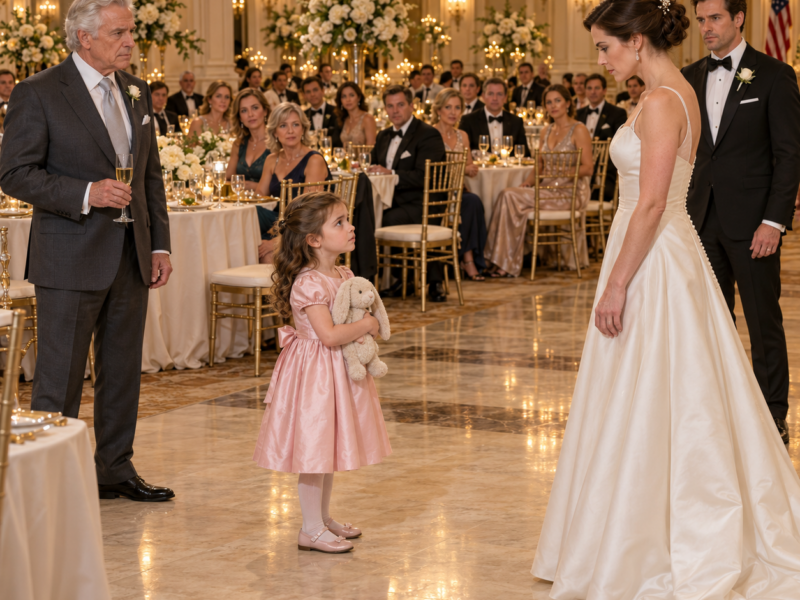
At my former son-in-law’s wedding, his new bride told my five-year-old granddaughter, “You’re not the most important girl in your dad’s life anymore. Stay out of the family photos.” Moments later, Margot was crying in the hallway in her little pink dress. At the reception, I stood and raised my glass. This time, the bride had to listen.
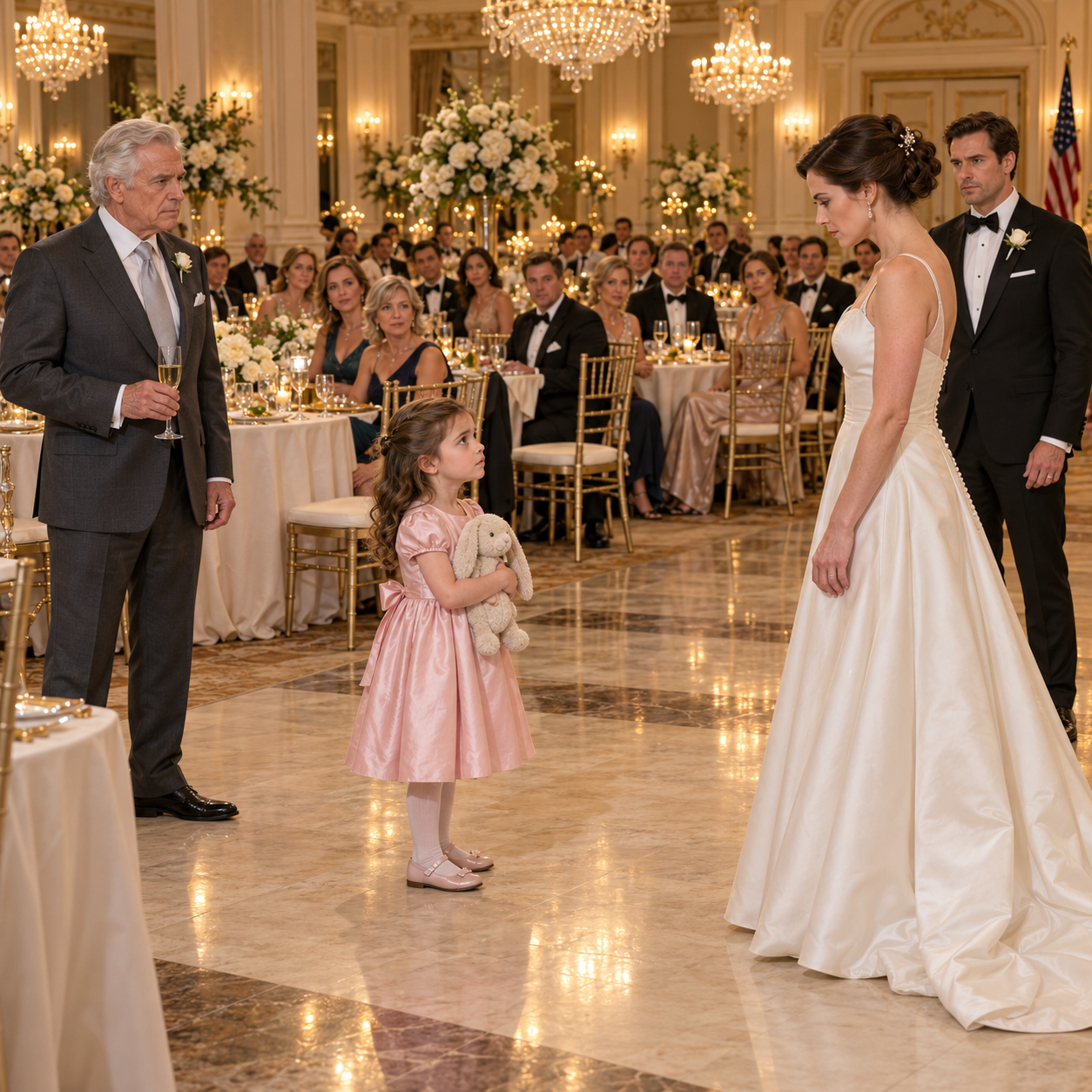
By sixty-eight, I had buried the two women I loved most.
My wife, June, died after thirty-seven years of marriage. Three years later, our only daughter, Phoebe, was killed in a car accident on an ordinary Tuesday afternoon.
There are dates a man remembers because they belong on a calendar.
Then there are dates that divide his life.
Phoebe’s husband, Emmett, called me from the hospital. I knew from the sound of his breathing that something terrible had happened before he managed to say her name.
Their daughter, Margot, was two.
For weeks afterward, she kept asking when Mommy was coming home.
I would have given anything to answer differently.
Emmett had begun as my son-in-law. Over the years, he became something closer to a son. After we lost Phoebe, the distinction seemed less important than what we needed to do for the little girl who still reached toward the door whenever she heard a car outside.
We learned together.
How to explain death without making sleep frightening. How to wash a favorite pink shirt at midnight because it was the only one Margot would wear the next morning. How to make dinner while holding a child who had suddenly remembered that the person she wanted most was gone.
We made mistakes.
We also kept showing up.
Three years later, on Emmett’s wedding day, five-year-old Margot stood in a hotel hallway wearing a pink dress and holding a stuffed rabbit.
Her eyes were full of tears.
I had just heard his new bride tell her, “You’re not the most important girl in your dad’s life anymore. Stay out of the family photos.”
For a moment, I couldn’t move.
I had spent years helping that child understand that her mother’s death had not made love disappear.
Now a woman her father was about to marry had told her that another kind of disappearance was beginning.
I went straight to Margot.
She was sitting on a quiet chair beside a tall arrangement of flowers, looking down at her shoes.
“Grandpa?”
I knelt.
“What happened, sweetheart?”
She tried to speak, then shook her head.
I had already heard enough.
I put my arms around her and let her press her face into my shoulder.
Inside the bridal room, someone laughed at something unrelated. A door closed farther down the corridor. The hotel continued with the ordinary business of a wedding while my granddaughter cried into the front of my suit.
Every part of me wanted to walk through that door.
I wanted to confront Claire.
I wanted to find Emmett.
I wanted the sentence she had spoken to become impossible to ignore.
But first, I needed Margot to stop believing she had done something wrong.
“You belong with your daddy,” I told her quietly.
She gripped the rabbit.
“Even when he’s married?”
“Yes.”
She looked up.
“In the pictures?”
“Yes.”
Then she asked the question that stayed with me long after the wedding was over.
“Did Mommy know he was getting a new girl?”
I closed my eyes for a second.
When I opened them, I made myself speak slowly.
“Your mommy knew Daddy loved you. That hasn’t changed.”
Margot leaned against me again.
And I realized that whatever I did next would become part of the way she understood love.
Phoebe had been a lively child.
She argued about bedtime, brought injured insects into the house, and once used my good work gloves to make a bed for a baby bird that did not appreciate the arrangement.
June understood her better than I did.
“She wants to help everything,” my wife would say.
“So do I. I’d prefer the bird help itself outside.”
They both laughed at me.
Our daughter grew into a woman who could make a room warmer simply by entering it. She worked at a community library, remembered what people liked to read, and always had three projects underway that she insisted were almost finished.
When she first brought Emmett home, I was prepared to be cautious.
A father can spend years imagining that he will be dignified when his daughter introduces the man she loves. Then the moment arrives, and he finds himself evaluating how firmly the fellow shakes hands and whether he notices that she is carrying too many things.
Emmett noticed.
He took the cake from Phoebe before greeting me.
That helped.
He was quiet, practical, and a little nervous. At dinner, he asked June about her garden and listened carefully enough that she later told me she liked him.
“He didn’t pretend to know more than he did,” she said.
“A rare quality.”
“In men?”
“In everybody.”
Over time, I learned that Emmett’s steadiness was not an act.
When Phoebe’s car needed repairs, he arranged them without making her feel foolish for ignoring the noise. When June became ill, he came over on weekends to handle things I didn’t want to admit were becoming difficult.
He fixed a loose porch rail.
He carried bags of soil.
He sat beside my wife at the kitchen table and let her tell the same story twice because she liked how it ended.
After June died, he checked on me without treating me as a broken appliance that needed supervision.
Sometimes he brought dinner.
Sometimes he brought Phoebe.
Sometimes he simply called and asked whether I wanted company.
I began answering honestly.
That was why, when Phoebe died, we already knew how to sit together in terrible silence.
The first night after the funeral, Emmett brought Margot to my house.
She had cried so hard in the car that she had exhausted herself. He carried her inside, laid her on the couch, and sat beside her with his hands hanging between his knees.
“I don’t know how to do this,” he said.
I looked at him.
“Neither do I.”
He nodded.
There was comfort in not pretending.
We did not have to become wise immediately.
We had to get through the night.
Margot woke an hour later and asked for her mother.
Emmett picked her up.
“Mommy died, sweetheart.”
“I want her.”
“I know.”
“Call her.”
He looked at me over Margot’s head.
I had nothing that could repair that request.
So I sat beside them.
We stayed there until she slept again.
In the months that followed, my house became part of their daily routine.
I picked Margot up from preschool when Emmett’s work ran late. He brought groceries when he came to collect her. We ate together several nights a week.
There were photographs of Phoebe in both houses.
We did not turn every room into a memorial.
But we refused to make her absence a subject that had to be approached carefully, like something dangerous beneath the floor.
Margot could ask about her mother.
She could look at photographs.
She could be sad.
She could also spend an entire afternoon laughing without someone telling her that she ought to remember.
One day, she asked why Mommy was smiling in a picture.
“Because you had put a bowl on your head,” I told her.
She studied the photograph.
“Was I funny?”
“Very.”
“Did she love funny?”
“She loved you.”
Margot considered that.
Then she put a mixing bowl on her head and ran into the kitchen to show Emmett.
We laughed.
Afterward, he stood beside the sink and cried quietly while I dried the bowl.
Grief is not always separate from joy.
Sometimes they arrive together.
A few months after Phoebe’s death, Emmett told me he had met someone.
He said it carefully.
We were sitting on my porch while Margot drew on the walkway with chalk.
“I’m not trying to replace her,” he said.
“I know.”
“I didn’t plan it.”
“You don’t need to make it sound like an accident.”
He looked relieved and guilty at the same time.
Her name was Claire.
They had met through a work-related volunteer project. At first, they had only talked. Then there was coffee. Then dinner.
I had feelings about it.
Of course I did.
Part of me still expected Phoebe to walk around the corner carrying a bag of library books.
But Emmett was alive.
He was young enough to build a future, and I did not want love for my daughter to become a rule that condemned him to loneliness.
“Does she know about Margot?” I asked.
“Yes.”
“And Phoebe?”
“Yes.”
“Then take your time.”
He nodded.
“I will.”
He dated Claire for two years before proposing.
That was not recklessness.
It mattered to me later because I knew how much care he believed he had taken.
Claire seemed pleasant when I first met her.
She brought a small box of pastries and remembered that Margot liked strawberries. She sat on the floor to look at a puzzle and did not appear annoyed when a five-piece explanation took fifteen minutes.
At dinner, she asked about Phoebe.
Not many people did.
Some were afraid of upsetting us. Others acted as though a new relationship meant the old one should quietly disappear.
Claire asked what she had been like.
I told her about the baby bird and the work gloves.
She laughed.
Emmett smiled.
That evening, I thought perhaps this could be good.
I wanted it to be good.
Margot seemed to like her too.
She called her “Daddy’s Claire” at first, as though it was necessary to distinguish her from any other Claire in the world.
They baked cookies.
They chose paint colors for a small shelf in Margot’s room.
Claire came to preschool events when her work allowed.
When Margot asked whether she could call her Mommy, Claire said she could keep calling her Claire.
I respected that.
I thought it showed understanding.
Perhaps, in that moment, it did.
I do not believe every kind thing Claire did was false.
That would make the story easier, but it would not make it truer.
People can show care and still carry resentments they have not admitted. They can like a child when the relationship is convenient and struggle when the child’s needs interfere with the life they imagined.
I did not know enough about Claire to see the difference.
Neither did Emmett.
There were warning signs.
Not dramatic ones.
At a birthday dinner, Margot asked to look at a photograph of Phoebe. Claire said, “Maybe we can focus on the people who are here tonight.”
Emmett answered that there was room for both.
Claire smiled.
“Of course.”
Another time, Margot climbed onto her father’s lap while they watched a film. Claire made a joke about never getting her own seat beside him.
Everyone laughed lightly.
Margot slid down.
Emmett pulled her back.
Later, I wondered whether those moments should have told me more.
At the time, I saw an adult adjusting to a family that already had a history.
That adjustment could be hard without making the person unkind.
I did not want to interpret every awkward remark through my fear of losing Phoebe again.
So I watched.
I also reassured myself.
That was where I made my own mistakes.
When Emmett proposed, he called me before he announced it widely.
“I wanted you to hear from me.”
“Thank you.”
“I hope you’re happy.”
“I am,” I said.
And I meant it.
Not every part of me was simple.
But happiness for someone else does not require every private feeling to disappear.
We told Margot at my house.
She asked whether the wedding would have cake.
“Yes,” Claire said.
“Chocolate?”
“Maybe one layer.”
Margot nodded.
Then she asked, “Will I be there?”
Emmett’s face changed.
“Of course you’ll be there.”
“In the pictures?”
“Of course.”
Claire smiled and said they would find her a lovely dress.
That promise became important to Margot.
For months, she spoke about “Daddy’s wedding pictures.”
She chose a pink dress.
Nothing elaborate.
A little satin sash, a skirt that moved when she turned, and a cardigan for the evening.
She wanted shoes that made a clicking sound.
Emmett said they had to be comfortable.
She tested three pairs by walking up and down the shop.
The pair she chose barely clicked.
She accepted the compromise reluctantly.
On the wedding morning, she stood in my living room with her rabbit tucked beneath one arm.
“Grandpa, do I look fancy?”
“Very.”
“Daddy said I’m a special guest.”
“You are.”
“Claire said I can’t touch her dress.”
“That’s reasonable. Wedding dresses are easy to mark.”
She nodded solemnly.
“I’m not going to.”
I adjusted her cardigan.
For a moment, she looked so much like Phoebe at that age that I had to turn toward the window.
Margot noticed.
“Are you sad?”
“A little.”
“Because Mommy?”
“Yes.”
She patted my arm.
“We can still have cake.”
I laughed.
“Yes, sweetheart. We can.”
The wedding was held at a small hotel with a garden courtyard and a reception room overlooking the grounds.
There were about a hundred guests.
The flowers were cream and green. The chairs had pale ribbons. A string quartet was rehearsing near the ceremony area.
I arrived early with Margot.
Emmett was in a room upstairs with his brother and two close friends. I took her to see him.
He crouched when she entered.
“There’s my girl.”
She ran into his arms.
“Do I look like the pictures?”
“What pictures?”
“The wedding ones.”
“You look exactly like Margot. That’s who we need.”
She smiled.
He kissed her forehead.
Then somebody came in with a question about the schedule.
A photographer needed the groom downstairs.
The coordinator needed the rings.
Margot wanted to see Claire.
It all became busy in the ordinary way weddings do.
Claire’s cousin offered to walk her to the bridal room.
I stayed with Emmett for a few minutes.
We spoke about Phoebe.
Only briefly.
“I thought this morning would feel stranger,” he admitted.
“How does it feel?”
“Happy. And sad.”
“That sounds about right.”
He looked down at his hands.
“I wish she could know Margot’s okay.”
I put a hand on his shoulder.
“Then keep making that true.”
He nodded.
Neither of us knew how soon those words would matter.
When I went to find Margot, the corridor outside the bridal room was quiet.
I heard Claire before I saw anyone.
Her voice was low, but clear.
“You’re not the most important girl in your dad’s life anymore. Stay out of the family photos.”
There was no laugh.
No playful tone.
No reasonable request buried inside an unfortunate phrase.
It was an adult telling a five-year-old where she believed the child belonged.
Then the door opened.
Margot stepped into the hall.
She did not see me immediately.
She walked to the chair beside the flowers and sat down.
Her rabbit’s ears dragged across the carpet.
That was when I went to her.
She cried for several minutes.
I held her.
I told her she had done nothing that made her less loved.
When she could speak, she said she had asked whether she could stand between Daddy and Claire in a picture.
“That’s all?”
She nodded.
“Did you spill anything?”
“No.”
“Were you carrying a drink?”
She shook her head.
I did not ask ten more questions.
A child’s distress is not a witness statement to be extracted while she is still shaking.
I had heard Claire myself.
Margot didn’t need to prove the rest.
Once she settled, I asked whether she wanted to sit with me.
“Yes.”
I took her downstairs.
The ceremony was about to begin.
I looked for Emmett.
A coordinator told me he was being moved to the courtyard entrance and would be unavailable for a few minutes.
I could have insisted.
I know that now.
I could have told the coordinator there was a concern involving his daughter.
I could have asked them to pause.
Instead, I thought about Margot hearing an argument through a door. I thought about guests arriving, the music starting, and the possibility that I had misunderstood enough of the surrounding moment to make a public disaster.
I did not misunderstand the words.
But I hesitated anyway.
That hesitation is part of the story.
I won’t pretend the toast was the only possible choice or the wisest thing I did that day.
I was hurt.
I was angry.
I was trying to protect Margot while also trying not to become the older man people would accuse of opposing Emmett’s happiness.
For several years, I had worked hard to show that I did not resent Claire.
Now that effort made me slower than I should have been.
So I sat through the ceremony.
Margot sat beside me.
When she looked up, I smiled.
Emmett glanced toward her and smiled too.
Claire walked down the aisle.
The guests stood.
The vows were spoken.
I heard them through a haze of anger and disbelief.
Promises of kindness.
Promises of shared life.
Promises to care for what mattered to the other person.
I looked at Margot’s little shoes.
She had chosen them so carefully.
At one point, she whispered, “Are the pictures after?”
“Yes.”
“Can I go?”
“We’ll see Daddy together.”
I did not tell her she had to wait for permission to belong.
After the ceremony, guests moved toward the garden for photographs.
Emmett came straight to Margot.
He lifted her into his arms.
“How’s my girl?”
She put both arms around his neck.
I stood close enough to speak.
“Emmett, I need a private minute with you.”
He looked at my face.
“All right.”
Before we moved, the photographer called for the first group.
Claire’s mother came over with a list.
There were elderly relatives who needed to sit, people who had traveled, and a schedule already running behind.
Emmett said, “Give me five minutes, Dad.”
He had called me Dad for years.
The word nearly made me tell him everything immediately.
Instead, I nodded.
Margot was still in his arms.
For that moment, she looked safe.
They took a photograph of Emmett and Claire.
Then one with the bridal party.
Then parents and siblings.
When it was time for the family group, the photographer looked toward Margot.
“And we’ll bring the little one in.”
Claire said, “Let’s get the formal adults first.”
The words alone could have been ordinary.
After what I had heard, they were not.
Margot stiffened beside me.
Emmett turned.
“Margot comes in this one.”
Claire smiled.
“Of course. I just meant the order.”
He reached for his daughter’s hand.
She went to him cautiously.
The photograph was taken.
I could see her smile was not the smile she had worn that morning.
Then a relative wanted another picture, and Emmett was pulled away again.
I should have insisted.
I didn’t.
That is something I later apologized for.
By the time we entered the reception room, my anger had hardened into a plan.
There would be speeches.
I had been asked to give one.
I had written a warm toast about Emmett, Claire, and the courage to love again after loss.
The paper was in my jacket pocket.
I could not read it.
Not after what I had heard.
I sat with Margot and my sister, Lydia, near the front of the room.
Lydia had helped care for Margot after Phoebe died. She knew when the child was pretending to be cheerful.
“What happened?” she whispered.
I told her briefly.
Her face changed.
“Have you told Emmett?”
“Not properly.”
“Then tell him.”
“I will.”
She looked at the head table.
“Privately.”
I nodded.
I wanted to believe I would do that.
Then the best man stood.
There were jokes, applause, and a story about Emmett forgetting an umbrella on his first date with Claire.
Margot leaned against me.
“Can I have my rabbit?”
I handed it to her.
Lydia touched my arm.
“Let me take her to the little lounge. She needs a quiet minute.”
I looked at Margot.
“Would you like that?”
She nodded.
“Will you come?”
“Soon.”
Lydia took her to the adjoining family lounge, where a few children were drawing with crayons while an event attendant watched the door.
I was grateful.
At least Margot would not sit beneath the full weight of what I was about to say.
When the coordinator announced my name, I stood.
I picked up my glass.
At the head table, Claire was smiling.
Emmett turned toward me with the expression of a man expecting affection.
I looked at them both.
Then I said, “To the woman who found the courage this afternoon to tell a five-year-old child that she is no longer the most important girl in her father’s life.”
The room went silent.
Claire’s smile vanished.
Emmett stared at me.
The sentence was sharp.
I intended it to be.
I also knew, even as I spoke, that sarcasm was not the same as clarity.
So I set down the glass.
“I need to stop pretending this is a toast.”
A chair shifted.
Nobody laughed.
“Emmett, before the ceremony, I heard Claire tell Margot she was no longer the most important girl in your life and that she should stay out of the family photographs.”
Claire stood halfway.
“That is an outrage.”
I kept looking at Emmett.
“I heard the words myself. Margot was not the person who brought me an accusation. She walked into the hallway crying.”
Claire’s mother began to speak.
Emmett raised a hand.
“Wait.”
His face had gone pale.
I took a breath.
“When Phoebe died, you became the person who made our little girl’s world safe enough to keep living in. I have watched you do that every day. I cannot sit here and celebrate a new family while a child in that family believes she has become less welcome.”
Claire shook her head.
“He’s trying to ruin this.”
“I am telling you why Margot has been quiet.”
“She was in the way.”
The words came out quickly.
Then Claire stopped.
Emmett turned toward her.
“In the way of what?”
“She was asking questions. She wanted to be in every picture. I needed a few minutes.”
“Did you say it?”
“She nearly spilled punch on my gown.”
I remembered Margot shaking her head when I asked whether she had been carrying a drink.
But I did not turn the room into an argument about punch.
Emmett’s voice was low.
“Did you tell her she wasn’t the most important girl in my life anymore?”
Claire’s mouth tightened.
“I was trying to explain that things are different now.”
He sat very still.
“That is not an explanation you give a five-year-old.”
“She needs boundaries.”
“She needs adults who don’t make love sound like a competition.”
The silence in the room changed.
It was no longer shock alone.
People had begun to understand what the child had heard.
Claire reached for his arm.
“Emmett, don’t do this in front of everybody.”
He moved his arm away.
“Where is Margot?”
“With Lydia,” I said. “In the family lounge.”
He stood.
For a moment, I thought he might say something to the room.
Instead, he walked out.
I followed.
Claire called his name.
He did not turn.
In the lounge, Margot was sitting on a low couch with her rabbit.
She looked up when her father entered.
“Daddy?”
He knelt in front of her.
His tuxedo trousers creased against the carpet.
“Hi, sweetheart.”
She looked at his face.
“Are you mad?”
“No. Not at you.”
Her eyes filled.
“Did I ruin the pictures?”
He shook his head.
“No.”
“Claire said—”
“I know.”
He swallowed.
“I’m sorry you heard that.”
Margot watched him carefully.
He put his hands around hers.
“Getting married does not make me less your daddy. You don’t have to be the most important girl in a contest. There is no contest. You are my daughter, and that place doesn’t go away.”
Her chin trembled.
“Even if I’m little?”
“Especially while you’re little, I have to make sure you’re safe.”
She leaned into him.
He held her.
I stood beside Lydia near the door.
For the first time since the corridor, I felt the anger loosen enough to reveal how frightened I had been.
Not that Claire could say something cruel.
That Emmett might defend it.
That I might lose the person who had helped me keep Phoebe’s child safe.
Instead, he held his daughter and told her the truth.
After several minutes, he looked up at me.
“Dad, let’s take Margot home.”
I nodded.
He asked Lydia to stay with her while we went back into the reception room for our coats and to speak with the coordinator.
He did not bring Margot into a room full of watching adults.
That mattered.
There had been enough attention on her already.
In the hallway, Claire approached us.
Her face was flushed.
“You’re leaving our wedding?”
Emmett stopped.
“I’m taking my daughter somewhere quiet.”
“We need to talk.”
“We will.”
“Now.”
“No.”
She looked at me.
“You got what you wanted.”
I answered carefully.
“What I wanted was for Margot to enjoy her father’s wedding.”
Claire laughed bitterly.
“You never accepted me.”
Emmett stepped slightly between us.
“This is not about whether he accepted you.”
“He’s using Phoebe against me.”
My daughter’s name in that sentence made my chest tighten.
Emmett looked at Claire.
“Phoebe is not a weapon. Margot is not a rival. If that is how you understand this family, we have a much bigger problem than a wedding.”
Claire began crying.
Her mother came down the corridor and put an arm around her.
“You’re humiliating her,” she told Emmett.
He looked exhausted.
“I am trying to stop my child from believing she has been replaced.”
The coordinator approached quietly.
Emmett asked her to end the formal reception program.
Guests could finish their meals if they wished. Staff would handle the remaining service. He would settle practical matters later.
There was no need to throw food away or make workers lose the evening because our family had broken apart.
Then he went into the reception room.
I stayed near the door.
He spoke briefly.
“Thank you for being here. I’m sorry, but the celebration is ending early for family reasons. Please give us privacy.”
He did not describe Margot’s tears.
He did not invite guests to judge Claire.
Then we collected our things and left.
Outside, the air was cool.
Margot rested against her father’s shoulder.
She looked at me.
“Are we in trouble?”
“No, sweetheart.”
“Because we’re leaving?”
“No.”
Emmett kissed her hair.
“We’re going somewhere quiet.”
She nodded.
In the car, she held her rabbit and watched the lights pass.
Nobody spoke for several minutes.
Then she asked whether there would still be cake.
Emmett made a sound that was half laugh, half sob.
“Yes,” he said. “We can get cake.”
We stopped at a grocery store.
He stayed in the car with her while I went inside.
I bought a small chocolate cake, milk, strawberries, and the plain bread she liked.
There was nothing symbolic about the purchase.
A five-year-old had been promised cake.
The adults had made the day painful.
She could still have dessert.
We went to my house.
Emmett did not want to return to the home he and Claire had begun sharing.
He needed time to decide what came next.
I gave him the guest room.
Margot took the small room she used for sleepovers.
Before bed, we sat at the kitchen table in our formal clothes and ate cake from ordinary plates.
Margot’s pink dress had a small frosting mark near the sash.
I could not have cared less.
She asked whether Daddy and Claire were still married.
Emmett put down his fork.
“Yes, sweetheart. We got married today.”
“Then why isn’t she here?”
He looked at me.
I let him answer.
“Because the grown-ups need to think and talk about something important. Tonight, we’re staying with Grandpa.”
“Did she do a bad thing?”
“She said something hurtful.”
“Will she say sorry?”
“I don’t know yet.”
Margot considered that.
“Do I have to hug her?”
“No.”
Emmett answered without hesitation.
“You do not have to hug anybody to make them feel better.”
She nodded.
That night, she fell asleep with one hand wrapped around his finger.
I stood in the doorway for a moment.
Then I went downstairs.
Emmett joined me half an hour later.
He had changed into an old sweatshirt I kept in the guest room.
He sat on the couch and looked at the floor.
“How did I miss it?”
I didn’t answer immediately.
Because that was the question every adult asks after a child reveals something painful.
How did we miss it?
Sometimes we missed it because it was hidden.
Sometimes because it happened gradually.
Sometimes because we wanted a future badly enough that we interpreted warning signs generously.
“I missed things too,” I said.
He shook his head.
“You heard it today.”
“And I waited too long to tell you directly.”
He looked at me.
“I should have stopped everything and told you in private before the ceremony,” I continued. “I was afraid of making a scene. Then I made a larger one.”
He leaned back.
“You were protecting her.”
“I was trying. That doesn’t mean every decision was right.”
He was quiet.
Then he said, “I’m glad you told me.”
“So am I.”
“But I wish I’d known before.”
“I know.”
It was important that I let him have that feeling.
My anger at Claire did not erase the effect of my own timing.
A public speech had forced the truth into the open.
It had also made the truth part of a hundred people’s wedding memory.
Margot deserved more privacy than that.
I would spend the following weeks making sure my satisfaction at being heard did not become an excuse to ignore what the scene had cost her.
Emmett’s phone rang repeatedly.
Claire.
Her mother.
His brother.
Friends asking whether he was all right.
He answered his brother.
The rest could wait.
Then he put the phone on the table.
“She told me once that Margot needed to stop being the center of everything.”
I looked at him.
“What did you say?”
“That she was four. That her needs had to come first in certain ways.”
“And Claire?”
“She said I misunderstood.”
He rubbed his face.
“There were things about photographs. About Phoebe’s birthday. About how often Margot came here.”
I felt my shoulders tighten.
“Did she want you to bring her less?”
“Sometimes.”
“Why?”
“She said we were building a new household.”
We sat quietly.
I understood the legitimate part of that concern.
A new spouse could want private time, shared routines, and room to create a home.
But no healthy household could be built by teaching a child that her grief, her grandfather, or her mother’s memory was an obstacle.
“Wanting a marriage is reasonable,” I said.
He nodded.
“Making Margot feel like competition is not.”
“No.”
Emmett looked toward the stairs.
“I thought she’d settle into it.”
That sentence broke my heart.
Not because it was foolish.
Because so many people build lives around the hope that a difficult pattern will improve once the next milestone arrives.
After the engagement.
After the wedding.
After the move.
After things calm down.
But sometimes the milestone does not change the pattern.
It only gives it more room.
The next morning, Margot woke early.
She came downstairs wearing pajamas and the clicking shoes.
I looked at her feet.
“Interesting choice.”
“I wanted them.”
“Fair enough.”
She climbed into the chair beside me.
“Is Daddy here?”
“Yes. He’s upstairs.”
“Did he leave?”
“No.”
She looked relieved.
I made toast.
When Emmett came down, she ran to him.
He picked her up.
That happened several times over the next few days.
She needed to see him.
Needed to know where he was going.
Needed reassurance that an adult leaving a room was not the beginning of another loss.
We did not tell her to stop asking.
We answered.
Then we made the answers predictable.
Daddy was going to take a shower.
Daddy was going to the store.
Daddy would be back after lunch.
Grandpa was staying downstairs.
The little facts mattered.
Safety returned through repetition.
On the third day after the wedding, Emmett met with a family-law attorney.
He wanted to know whether the marriage could be annulled because Claire had concealed how she felt about his daughter.
The attorney listened and explained that annulment was not automatically available because a spouse behaved cruelly or a marriage failed immediately. The law required particular grounds, and whether the facts qualified would need careful review.
Emmett could seek advice, preserve relevant information, and begin the appropriate process.
He could also decide not to remain in the marriage.
That decision did not require a judge to agree that the wedding had never happened.
He came home carrying a folder.
“What did she say?” I asked.
“That ending it may be simpler than proving it should be erased.”
I nodded.
“How do you feel?”
“Tired.”
He sat down.
“I wanted there to be a way to say it wasn’t real.”
I understood.
But it had been real.
The ceremony.
The promises.
The hurt.
Sometimes moving forward means accepting that something happened and choosing what happens next.
Emmett began the legal process that week, after discussing the options with counsel. It was not completed in three days.
There were documents, property questions, and communications that had to be handled.
Claire had moved belongings into his house. Some wedding expenses were shared. There were accounts to review and contracts to settle.
No child was involved in their marriage together.
That made some matters simpler.
It did not make the emotions simple.
Claire wanted to meet.
At first, Emmett declined.
Then he agreed to a conversation in a neutral place with clear limits.
I did not attend.
This was his marriage.
I had a place in protecting Margot.
I did not need to become the person directing every decision between him and Claire.
When he returned, he looked drained.
“She says you misunderstood.”
I waited.
“Then she says she didn’t mean it that way.”
I nodded.
“Then she says Margot needs to learn she can’t always come first.”
He looked at me.
“And I kept asking why she said it to a five-year-old in a room where I wasn’t there.”
“What did she say?”
“That I would have made a fuss.”
We sat in silence.
“She knew,” he said finally.
“She knew you wouldn’t approve.”
He nodded.
That mattered.
A hurtful comment can come from exhaustion or carelessness.
The knowledge that an adult chose privacy because the parent would object made the problem deeper.
“She also said she felt like Phoebe was always in the room.”
I looked toward the photograph on my shelf.
I could understand that feeling.
A dead spouse leaves a complicated presence in a new relationship.
But the answer could not be to make the child carry the discomfort.
“She could have spoken to you,” I said.
“She did. Sometimes. I tried to listen.”
“Did you?”
He looked at me directly.
“Not always well.”
I appreciated that answer.
He did not need to pretend he had been a perfect partner to decide Claire’s treatment of Margot was unacceptable.
“She wanted fewer photographs in certain rooms,” he said. “I thought she meant we should make the house feel shared. I agreed to some changes.”
“That can be reasonable.”
“I know.”
He rubbed his hands together.
“But I didn’t understand that she saw Margot’s attachment to her mother as part of the same problem.”
I took a breath.
There it was.
Furniture could be rearranged.
Photographs could be placed thoughtfully.
A child’s relationship with her dead mother was not clutter.
In the week after the wedding, I spoke with Lydia often.
She had been the first person to tell me to speak privately.
I needed someone who would not turn my toast into a legend.
Some relatives were already doing that.
They called it brave.
They said I had put Claire in her place.
One wanted to know the exact words so she could repeat them to a friend.
I refused.
“This involved a child,” I said.
That usually stopped the conversation.
Lydia was more direct.
“You were right to act,” she told me. “But you don’t need to be proud of every part of how you acted.”
“I know.”
“Good.”
She said it kindly.
I needed kindness that could include correction.
I had spent years believing age should make a person wiser.
Sometimes age only makes you more confident in the mistake you are about to make.
I had heard something terrible and let anger choose a microphone.
The truth needed telling.
It did not need Margot’s story turned into entertainment afterward.
So I contacted the wedding photographer.
Emmett had already asked that no images involving Margot be shared publicly without his approval. I reinforced the request concerning the reception.
There had been a videographer too.
The speeches were recorded.
We asked that the recording remain private and be provided only through the agreed channels.
No clips went online from the official files.
We could not control every guest’s phone.
But we asked relatives not to circulate anything involving the confrontation.
Most respected that.
One cousin sent me a message saying people ought to see what Claire was like.
I answered, “Margot should not have to become evidence for strangers.”
He apologized.
That was the right outcome.
Not applause.
Restraint.
Emmett arranged counseling for Margot.
She had already seen a child therapist after Phoebe’s death, though the sessions had become less frequent as she settled.
Her name was Dr. Nina Patel.
Margot liked her because there were small animal figures and a dollhouse with furniture she could move.
Before the first appointment after the wedding, Emmett asked what we should tell her.
“Tell her the truth simply,” Dr. Patel said. “That there was a difficult day, and she has a place to talk or play about it.”
We did.
Margot went into the office carrying her rabbit.
I waited with Emmett.
Neither of us demanded a report when she came out.
She showed us a drawing of a house with three windows.
“That’s Grandpa’s.”
“Lovely.”
“I made Daddy’s room blue.”
“An excellent choice.”
Then she asked for a snack.
Children can carry serious feelings and still need crackers.
We tried to remember that.
Dr. Patel met with Emmett separately and, with his permission, included me in a later conversation about supporting Margot.
She explained that reassurance should not become a promise no one could keep.
We should not tell Margot that nobody would ever hurt her feelings again.
We should tell her that she could speak, that adults would listen, and that being hurt did not make her responsible for repairing the person who caused it.
We should also avoid teaching her that she had defeated Claire.
“Her father’s relationship ending is not a victory she earned,” Dr. Patel said.
Emmett nodded.
“She didn’t cause it.”
“Exactly. She needs to know that.”
I looked down at my hands.
I had called my granddaughter my entire world many times.
The feeling was real.
But I began to understand that a child should not be made responsible for being the entire reason an adult keeps living.
Margot needed a grandfather.
Not another grieving person whose happiness depended on her.
I had my own work to do too.
That became clear one afternoon when she asked, “Did Claire go away because I told?”
I was at the kitchen counter.
Emmett was sitting at the table.
He put down his pen.
“Come here, sweetheart.”
She approached slowly.
He lifted her onto his lap.
“No. You did not make Claire go away.”
“But Grandpa said.”
“I made a decision about the marriage because of things the grown-ups said and did. You didn’t decide it.”
She looked at me.
“Did you?”
“I told Daddy what I heard,” I said. “That was my responsibility.”
“Because it was mean?”
“Yes.”
She leaned against him.
“Can people stay if they say sorry?”
Emmett took a breath.
“Sometimes. But saying sorry also means changing what happens next. And grown-ups can decide they need different homes.”
Margot thought about that.
“Like Sophie’s mom and dad?”
“A little like that.”
“Does Sophie make them separate?”
“No.”
“Then I don’t?”
“No,” he said firmly. “You don’t.”
She nodded.
Then she asked whether the rabbit could have a blanket.
We found one.
There was comfort in ending a difficult conversation with an ordinary task.
Claire sent a letter to Margot through Emmett.
He did not hand it over immediately.
He read it with Dr. Patel’s guidance and considered whether it would help or confuse her.
The letter said she was sorry Margot had been upset.
That wording mattered.
It did not clearly say she was sorry for what she had said.
It also suggested they could all be a family if everyone tried harder.
For a five-year-old already wondering whether she caused the separation, that was too much.
Emmett did not give her the letter.
He asked Claire, through counsel, to keep communication directed to him.
She called that cruel.
He maintained the limit.
Not every apology needs an audience.
Not every expression of regret belongs in a child’s hands.
Eventually, Claire wrote a different letter to Emmett.
She acknowledged saying the words.
She said she had felt overwhelmed, insecure, and afraid she would never have an important place in his life.
He let me read part of it.
I understood more after that.
Understanding did not change what Margot needed.
A person can be frightened and still responsible.
A person can want love and choose a damaging way to claim it.
Claire’s fear might have been real.
So was the fact that she had directed it toward someone with far less power.
Emmett did not return to the marriage.
He told her that clearly.
Their legal separation and the final dissolution took months. His attorney handled the filings and agreements. The possibility of annulment was reviewed, but he did not build his future around forcing the law to describe the marriage the way he wished it had been.
He wanted it ended properly.
He wanted Margot settled.
He wanted to stop having the same argument in different forms.
Those were sensible goals.
The house required changes.
Claire’s belongings were collected at scheduled times while Margot was elsewhere.
No one put boxes on the lawn.
No one asked the child to watch.
Emmett arranged for his brother to be present.
I took Margot to the library.
She chose seven books and argued that the rabbit needed one too.
We checked out an eighth book.
When we returned, some rooms looked different.
Margot noticed.
“Where’s the shiny lamp?”
“Claire took it to her place,” Emmett said.
“Oh.”
She walked into the living room.
Then she pointed to the shelf.
“Mommy’s picture is still there.”
“Yes.”
“Okay.”
That was all.
Objects can carry enormous meaning for children.
We tried not to dismiss it.
Emmett and Margot moved back home after two weeks at my house, though they continued coming for dinner.
The first night, she asked whether I would stay.
“I can stay until bedtime,” I said.
“Not all night?”
“Daddy is here all night.”
She looked toward him.
He nodded.
“Right here.”
It took time.
There were extra bedtime calls.
A few tears.
Several mornings when she needed to know exactly who would pick her up.
But she settled.
Predictability did what dramatic promises could not.
I also apologized to her.
Not for telling Emmett.
For making the room feel frightening.
One afternoon, we were drawing at my kitchen table.
I said, “Do you remember when Grandpa stood up at the wedding?”
She nodded.
“The room got quiet.”
“Yes.”
“Were you angry?”
“I was.”
“At me?”
“No.”
“At Claire?”
“Yes.”
She drew a purple line across the page.
“I thought everybody was looking.”
“I’m sorry about that.”
She looked up.
“You’re sorry?”
“Yes. I needed to tell Daddy something important. I should have done that in a quieter place sooner.”
She considered it.
“Did you make a mistake?”
“I did.”
Margot smiled faintly.
“Grown-ups do?”
“Quite often.”
She returned to the drawing.
Then she said, “You can tell Daddy without a glass next time.”
I laughed.
“That is excellent advice.”
It was one of the best conversations we had.
Not because she forgave me in some formal way.
Because she learned that adults could acknowledge a mistake without falling apart or making the child take care of them.
I wanted her to know that.
Emmett and I had our own difficult conversation several weeks later.
We sat on the porch after Margot went to bed.
He said, “I need to ask you something.”
“All right.”
“If I hadn’t believed you immediately, what would you have done?”
I thought carefully.
“I would have told you what I heard. I would have made sure Margot was safe for the evening. Then I would have asked you to take it seriously.”
“Would you have taken her?”
“Not without speaking to you unless I believed she was in immediate danger.”
He nodded.
“I need you to remember I’m her father.”
“I do.”
“You’ve been there for everything. Sometimes I lean on you so much it gets blurry.”
I understood.
After Phoebe died, we had shared responsibilities without always naming them.
That had helped us survive.
Now we needed clearer boundaries.
“You make the decisions,” I said. “I can tell you what I see. I can help. I shouldn’t take over.”
He looked relieved.
“I want you in her life.”
“I’m not going anywhere.”
“Neither am I.”
We sat quietly.
Then he said, “I also need you to tell me things directly, even if I’m busy.”
“I will.”
“And I need to stop making people wait until the schedule is convenient.”
“That would help.”
He laughed.
A tired laugh.
But real.
We were not only recovering from Claire’s words.
We were learning how to become a family after grief without letting urgency turn into permanent confusion.
I began doing things for myself again.
Not because Margot mattered less.
Because she should not have to fill every empty room June and Phoebe left behind.
I joined a woodworking group at the community center.
I met an old friend for breakfast.
I took walks that did not end at preschool.
At first, I felt guilty.
Then I imagined what June would say.
Probably that she had told me to find a hobby twenty years earlier.
I could almost hear her laughing.
One morning, Margot asked where I had been the day before.
“At my class.”
“What class?”
“Woodworking.”
“Are you learning to make trees?”
“No. Things from wood.”
She frowned.
“Trees are wood.”
“A fair point.”
I showed her a small box I was making.
She touched the lid.
“Can it be for crayons?”
“Eventually.”
“Then it’s important.”
I laughed.
It was important.
Not because it served Margot.
Because I was making something, learning something, and remembering that my life could contain more than waiting to be needed.
Emmett noticed the difference.
“You seem better,” he said.
“I’m busy in a different way.”
“Good.”
He started making changes too.
He adjusted work travel.
He asked for help more specifically.
He stopped apologizing every time he needed an evening alone, but he also stopped assuming I would always be available.
When I had plans, he arranged another sitter.
Margot learned that Grandpa could be elsewhere and still love her.
That lesson was good for all of us.
The wedding photographs arrived about a month after the event.
Emmett did not open the gallery immediately.
When he did, he asked whether I would sit with him.
I agreed.
There were beautiful photographs.
The garden.
The flowers.
Claire smiling.
Emmett waiting near the aisle.
Then Margot in her pink dress.
In one image, she was looking up at him before the ceremony.
Her face was full of trust.
He stared at it for a long time.
“I thought I was giving her something good.”
“You were trying to.”
“That isn’t enough.”
“No.”
He nodded.
I did not tell him he should have known.
I did not tell him he had failed as a father.
He had made a serious decision based on what he believed about a person.
Then, when he learned something that changed the decision, he acted.
That mattered.
We saved the photographs of Margot.
The image of her with Emmett.
The one of her holding my hand in the garden.
The one where Lydia was helping straighten her cardigan.
The wedding did not have to disappear from her history.
But neither did it need to be displayed as though nothing painful had happened.
A few weeks later, Margot saw one of the pictures on Emmett’s phone.
“Can I have that?”
“Which one?”
“The one with you.”
He printed it.
She put it beside a photograph of Phoebe.
Then she said, “Now Mommy can see the dress.”
Emmett had to turn away for a moment.
I understood why.
Children create their own ways of holding a family together across loss.
Our job was not to correct every gentle imagination.
Our job was to make sure imagination did not become fear.
As summer approached, Margot began asking about her mother more often.
Would Mommy like her new haircut?
Did Mommy know she could write her name?
Would Mommy be proud she was learning to swim?
We answered carefully.
We could tell her what Phoebe had valued.
We could say her mother loved her.
We did not claim to know exactly what a person who had died was doing.
One afternoon, Margot asked, “Did Mommy want Daddy to get married?”
Emmett looked at me.
Then he sat beside her.
“Mommy wanted us to have good lives.”
“Was the wedding bad?”
“Some parts were happy. Some parts were difficult.”
“Can we have good lives without it?”
“Yes.”
She leaned against him.
“Okay.”
That answer seemed to settle something.
For months, the wedding had stood in her mind as a door to the next version of her family.
Now she was learning there were other doors.
Ordinary ones.
A summer picnic.
A new school year.
A Saturday at the pool.
A dinner where nobody argued about who belonged in a photograph.
Emmett did not date again for a long while.
He was not required to prove his commitment to Margot by remaining alone forever.
But he needed time to understand his own choices.
He worked with a counselor.
He talked about grief, loneliness, and the way relief can feel like compatibility when someone enters a painful life and makes it easier for a while.
He did not tell me every detail.
I respected that.
One evening, he said, “I think I wanted to believe we’d already survived the worst thing.”
I looked at him.
“So the next thing would have to be better.”
I nodded.
“I’ve thought that too.”
Life does not make that bargain.
Losing Phoebe did not guarantee the next person would be safe.
It did make us hungry for safety.
That hunger deserved compassion.
It also required care.
The marriage ended legally before the year was out.
Emmett came to dinner after the final paperwork.
He looked quiet.
Margot was drawing at the table.
“Is something done?” she asked.
He smiled slightly.
“Yes. Some grown-up paperwork.”
“About Claire?”
“Yes.”
“Do I have paperwork?”
“No.”
“Good.”
She went back to drawing.
We laughed softly.
The legal ending did not create a celebration.
Emmett felt relief.
He also felt sorrow.
There had been real hopes inside the relationship.
Ending it did not require pretending every memory was false.
After Margot went upstairs, he said, “I don’t hate her.”
“You don’t have to.”
“I’m angry.”
“That makes sense.”
“I wish she’d said what she felt to me before she said it to Margot.”
“So do I.”
He nodded.
Then he looked at the photographs on my shelf.
“I’m glad you were there.”
I swallowed.
“I’m glad I heard.”
There was a difference.
I wished there had been nothing to hear.
But once there was, silence would have been another choice.
I had made some mistakes in how I broke that silence.
I had not been wrong to break it.
For Margot’s sixth birthday, we planned a party in my backyard.
A few friends.
Cupcakes.
A sprinkler if the weather was warm.
She wanted a rabbit cake.
Not a real rabbit.
A cake shaped like one.
Emmett and I were relieved to discover that distinction before purchasing anything unfortunate.
Lydia helped decorate.
Margot wore a yellow dress she chose herself.
Nobody told her to stay out of a photograph.
Nobody made her responsible for looking grateful.
When the camera came out, Emmett asked, “Who do you want in this one?”
She pointed.
“Daddy. Grandpa. Aunt Lydia.”
We stood together.
Then she said, “And Rabbit.”
The stuffed rabbit joined us.
Later, she wanted a photograph by herself.
We took that too.
Belonging did not mean she had to stand between adults every time.
It meant she could join without wondering whether her presence was unwelcome.
After the party, she sat on the grass beside me.
“Grandpa?”
“Yes?”
“Was I the important girl today?”
I looked at her.
It was not a question to dismiss.
“You were the birthday girl.”
She nodded.
“But am I always important?”
“Yes.”
“Even when someone else has a birthday?”
“Yes.”
She thought.
“Even when Daddy has a friend?”
“Yes.”
I smiled.
“Importance isn’t a chair that only one person can sit in.”
She looked at the lawn chairs.
“There are lots of chairs.”
“Exactly.”
She accepted that.
Children do not always need elaborate explanations.
Sometimes they need the right ordinary picture.
That summer, Emmett took Margot to the beach.
Just the two of them.
I stayed home.
The first morning, he sent a photograph.
Margot stood near the water with her shoes in one hand and the rabbit safely tucked in a bag.
Her grin filled the image.
I looked at it for a long time.
Then I put the phone away and went to my woodworking class.
I did not need to be present at every happy moment to know she was loved.
That was another lesson grief had made difficult.
For years, I feared missing anything because I had already missed all the years Phoebe would never have.
But Margot needed a childhood.
Not a series of moments gathered to soothe my loss.
When they returned, she told me about waves for nearly an hour.
I listened.
She had a life beyond my house.
I was grateful.
Near the anniversary of the wedding, I found the toast I had originally written.
It was still folded in the jacket I had worn.
The words were kind.
I had written about Emmett’s courage and Claire’s willingness to join a family shaped by grief.
I read it slowly.
Then I placed it in a drawer.
I didn’t burn it.
I didn’t keep it as proof I had been deceived.
It was a record of what I had hoped.
Hope is not shameful because events disappoint it.
What matters is whether we change our actions when the facts change.
I also thought about the sentence I had actually spoken.
The room falling silent.
Claire’s face.
Emmett standing.
In the first weeks, some part of me had replayed those moments with satisfaction.
I was not proud of that.
It was human.
A man who has watched a child hurt can feel relief when the person responsible loses control of the room.
But that feeling was not where I wanted to live.
The point had not been Claire’s humiliation.
The point had been Margot’s safety.
Once I understood that fully, the wedding stopped feeling like a story about a devastating toast.
It became a story about what the adults did after the room went quiet.
Whether we listened.
Whether we corrected ourselves.
Whether Emmett protected his daughter without making her responsible for his marriage.
Whether I learned that being right about the danger did not make every method right.
Those were the parts that mattered.
One afternoon, almost a year later, Margot found the pink dress in the closet at my house.
We had kept it because she loved how the skirt moved.
She held it against herself.
“It’s too little.”
“You’ve grown.”
“Can I wear it?”
“Perhaps for a minute. The zipper may not close.”
She tried it over her clothes.
The sash barely tied.
She turned in a small circle.
Then she looked at me.
“This was the wedding dress.”
“Your dress for the wedding.”
She nodded.
“I cried in it.”
“Yes.”
She touched the skirt.
“I also had cake.”
“You did.”
“And Daddy hugged me.”
“He did.”
She smiled faintly.
“Then it wasn’t all bad.”
I felt my throat tighten.
“No, sweetheart. It wasn’t all bad.”
She took it off carefully.
“Can we keep it?”
“Of course.”
“Maybe for Rabbit.”
I laughed.
“Rabbit would need substantial alterations.”
She grinned.
The dress went back into the closet.
Not hidden.
Not displayed.
Simply kept.
A child could have a memory with sadness inside it and still decide it belonged to her.
I was glad she was learning that.
I was learning it too.
Eventually, Emmett met another woman.
Not soon.
Not dramatically.
Her name was Anna, and he introduced her slowly.
At first, Margot only knew she was someone Daddy sometimes had coffee with.
Then she joined us for lunch.
She asked Margot about a book.
When Margot spoke about Phoebe, Anna listened.
She did not rush to say she would never replace her.
She simply made room for the name.
Afterward, Margot asked whether Anna liked Mommy.
“Anna didn’t know her,” Emmett said.
“But she can like hearing about her?”
“Yes.”
“Okay.”
That was enough.
I was cautious.
Emmett knew.
He did not ask me to pretend otherwise.
But caution could not become a rule that every new person had to answer for Claire’s behavior.
We watched actions.
We communicated.
We allowed time.
One day, Anna was helping Margot put on a coat while Emmett collected their things.
Margot asked whether she could sit beside Daddy in the car.
Anna said, “Your seat is in the back where it’s safe. I’ll sit in front. You can tell us both about the book.”
It was such an ordinary answer.
No contest.
No claim.
Just an adult helping a child understand the practical world.
I nearly cried over it.
Not because Anna was perfect.
Because kindness often looks small until you have seen what its absence can do.
Emmett noticed me watching.
Later, he said, “I’m taking my time.”
“I know.”
“I’m talking about the difficult things.”
“Good.”
“And if Margot is uncomfortable, I’ll listen.”
I nodded.
That was what I needed.
Not a guarantee.
A father willing to remain attentive.
Years would continue to bring changes.
New schools.
New friendships.
Perhaps another marriage someday.
My own age would bring limits.
I could not promise Margot I would always be the man waiting beside the preschool door.
I could promise that, while I was here, I would listen.
I could teach her that love does not demand silence.
That photographs are not the measure of a family, but deliberately excluding someone can reveal what a person believes.
That apologies matter most when they name the harm and change the next choice.
And that grown-ups are allowed to be corrected.
One evening, Emmett and Margot came over for dinner.
She was building a small wooden frame at the table from pieces I had prepared.
Inside, she wanted to place a photograph of herself and Phoebe.
I helped with the glue.
Emmett stirred pasta sauce.
The kitchen smelled of tomatoes and garlic.
There was a little music playing from the radio June used to keep near the window.
For a moment, the ordinary warmth of it struck me so strongly I had to sit down.
Margot looked up.
“Are you tired?”
“A little.”
“You can rest. I know where this piece goes.”
“I believe you.”
She pressed it carefully into place.
Then she looked toward Emmett.
“Daddy?”
“Yes?”
“Can we take a picture after dinner?”
“Of course.”
“With everybody?”
“Yes.”
She smiled.
“Good.”
After we ate, we stood in the living room.
Emmett set the camera timer.
Margot held the rabbit.
I stood beside them, one hand on her shoulder.
The first photograph came out blurred because she laughed and moved.
We took another.
Then she asked whether the frame could be in the picture too.
So we took a third.
There was Phoebe, smiling in the little frame.
There was Emmett.
There was Margot.
There was me.
Not every person we loved could stand in the room.
Not every person who had entered our lives belonged there forever.
But the people who were present understood something we had learned painfully.
A child does not earn her place by being convenient.
She does not lose it because an adult wants a different kind of attention.
And love is not made stronger by teaching her to stand outside the picture.
When Margot saw the photograph, she nodded with satisfaction.
“That’s our family.”
Emmett kissed her hair.
“Yes.”
I looked at the image.
Then I looked at my granddaughter.
The toast had made a room fall silent.
This was the moment I wanted to remember.
A child speaking without fear.
A father listening.
An ordinary evening in which nobody had to fight for the right to belong.









