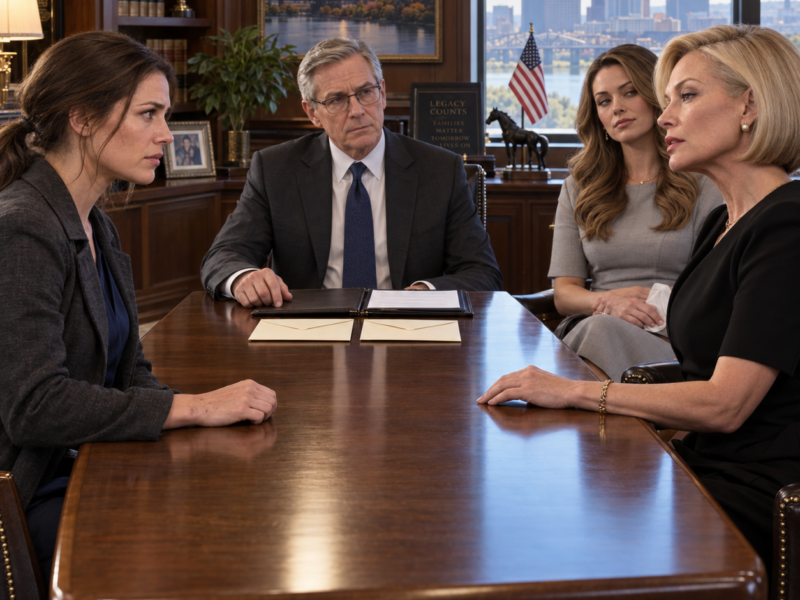
At my father’s will reading, my mother looked down the table at me and said, “You aren’t his daughter. You’re not entitled to a cent.” My younger sister was named to receive a house, the family company, and six million dollars. For me, there were two sealed envelopes with my father’s handwriting on them. My mother called them “sentimental nonsense.” Then the attorney reached for a letter opener, and she tried to take them off the table.
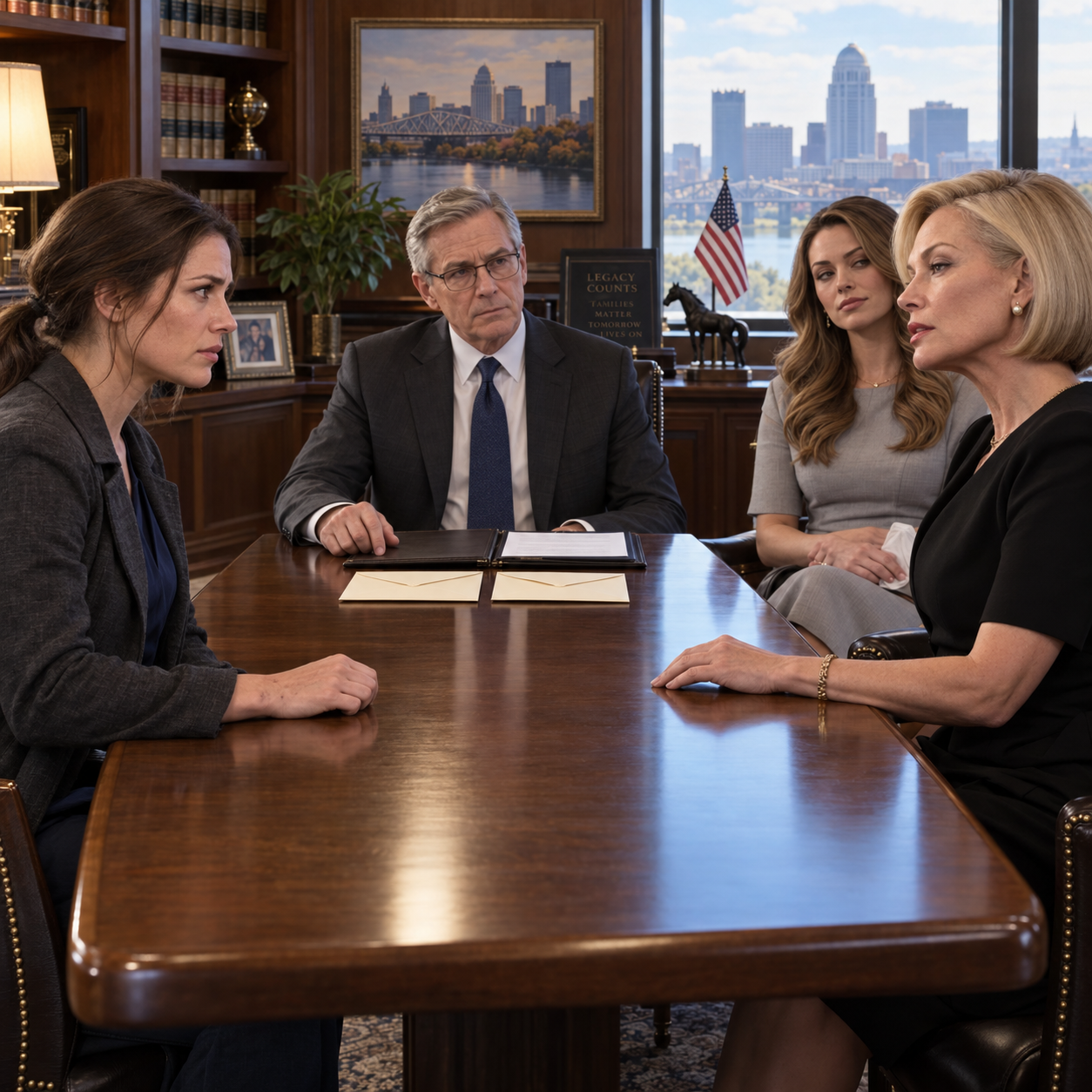
My mother reached across the conference table so quickly that her bracelet struck the water glass beside her.
Peregrin Vance moved the two envelopes out of her reach.
“Those stay with me, Mrs. Thorne.”
For a moment, her hand remained suspended over the polished wood. The diamonds in her bracelet caught the light from the window. Then she drew her hand back, folded it over the other, and smiled.
“I was only moving them out of the way.”
My father’s attorney looked at her for a long moment.
“They are where your husband instructed me to put them.”
I sat at the far end of the table, watching my father’s handwriting on the upper envelope.
Sabriel.
He had always made the capital S too large, as though the rest of my name were trying to catch up with it.
Eleven days earlier, I had watched them lower his casket into the ground. That morning, I had come to an office in downtown Louisville expecting paperwork, uncomfortable silences, and perhaps a box of things nobody else wanted.
Then my mother told me he had never been my father.
Now she was trying to take the only things on the table with my name on them.
Beside her, my younger sister adjusted the cuff of her gray dress.
“What are they?” Deline asked.
My mother answered before the attorney could.
“Personal papers. Your father kept far too many.”
Peregrin rested his hand beside the envelopes.
“We’ll come to them.”
Outside the windows, rain moved over the city in thin gray sheets. Cars passed below on wet pavement. Somewhere in the hallway, a receptionist answered the phone in the bright, professional voice people use when grief is only one appointment on a busy calendar.
I looked at my hands.
They were clean. I had scrubbed them twice before coming, though the faint scars across my knuckles would not wash away, and a dark line beneath one thumbnail had resisted everything short of removing the nail.
My mother had noticed it when I arrived.
“You could have made an effort.”
I had spent twenty minutes choosing the only jacket I owned that felt right for the occasion. I had brushed the lint from its sleeves, changed into clean shoes, and sat in my truck outside the building until I could trust myself to walk in.
But effort, in our family, had never been measured by what something cost me.
It was measured by whether my mother liked the result.
I was thirty-three years old.
Deline was thirty.
Our father was dead.
And somehow, sitting across from Isold Thorne in that room, I still felt like the child waiting to learn whether there was a place for her at the table.
The meeting had begun badly before Peregrin opened his folder.
My mother arrived with Deline, both of them carrying the careful composure they had worn through the funeral. Mom was fifty-eight, slender, elegantly dressed, and accustomed to having people interpret her certainty as evidence.
She kissed the air beside my cheek.
“You’re early.”
“So are you.”
“Deline and I have matters to discuss afterward.”
I looked at my sister.
She gave me a small, uncomfortable smile and sat beside Mom.
There was another chair near them.
I chose the one across the table.
A few minutes later, Hollis Reed came in wearing a suit I had never seen him wear. He had been my father’s shop foreman for twenty-five years. His hands looked too large for the folded program he carried from the funeral.
He stopped beside me.
“You holding up, kid?”
“Mostly.”
“That’ll do for today.”
He took a chair near the wall. He had been asked to attend the first part because my father had left him a personal bequest.
Peregrin entered last.
He was about sixty, lean and silver-haired, with the patient manner of a man who had learned that moving slowly often got people through difficult business faster.
He greeted each of us by name.
Then he placed his leather folder on the table and set the envelopes beside it.
My mother watched them.
I saw that now.
At the time, I thought she was simply waiting to begin.
Peregrin explained that this was a private family meeting to review the estate documents and practical next steps. Nothing would be distributed merely because we sat around a table and listened.
There were filings, valuations, debts, taxes, and administrative work ahead.
My mother gave a restrained nod.
“Yes, of course. But there is something that should be clarified before we waste time.”
Peregrin looked up.
“Mrs. Thorne?”
She turned toward me.
The room became unpleasantly still.
“Sabriel was adopted,” she said. “Allaric wasn’t her biological father. She needs to understand that she isn’t entitled to a cent simply because she uses his name.”
I stared at her.
For several seconds, the words did not settle into meaning.
Adopted.
Not his.
Uses his name.
Deline turned toward Mom.
“What?”
My mother’s expression remained composed.
“Your father and I kept certain things private.”
Hollis sat forward.
“Isold.”
She ignored him.
“It’s difficult, but there’s no point pretending now.”
I looked at Peregrin.
He had stopped turning pages.
“Mrs. Thorne,” he said, “an assertion about biology does not determine the terms of a will. Nor would adoption, by itself, disqualify a named beneficiary.”
Mom lifted her chin.
“I’m explaining the family situation.”
“You’re making a serious claim.”
“One my husband understood.”
Peregrin’s gaze moved to the envelopes.
Then back to her.
“We will address what the documents actually establish.”
My mouth had gone dry.
“Why are you telling me this now?” I asked.
Mom’s eyes touched mine.
“Because you need to accept reality.”
I had spent my life accepting her reality.
For the first time, I wondered whether any part of it had ever belonged to me.
My earliest memory of my father involved a broken kitchen drawer.
I was four.
He had taken the drawer out and placed it upside down on the floor. I sat beside him holding a little cup of screws while he repaired the runner.
Every few minutes, he asked for one.
I handed it over with the solemn care of a person entrusted with something essential.
My mother stood in the doorway.
“Why is she sitting on the floor in that dress?”
Dad looked up.
“Because the drawer is down here.”
I laughed before I knew why it was funny.
Mom did not.
Later, she took the dress off me and examined the hem as though I had deliberately damaged something precious.
I remembered that afternoon for years because my father had needed me.
Not to be pretty.
Not to sit still.
To hold something useful and pay attention.
Allaric Thorne understood work in a way my mother never chose to.
He had built Thorne Iron Works from a small fabrication shop into a company that supplied structural steel and architectural metal across the region. He knew what it meant to spend an entire day fitting something that would look effortless once it was installed.
People saw a finished staircase.
He remembered the measurements, the weight, the truck that arrived late, and the man who stayed an extra hour to get the last section ready.
My mother preferred the staircase after it had been photographed.
She liked the company once it paid for a house with rooms nobody used.
She liked the hands that built it best when they were hidden in formal portraits.
As children, Deline and I learned our places through small things.
Her drawings went on the refrigerator.
My projects went in the garage.
When she performed at a dance recital, Mom invited relatives and bought flowers.
When I won a school design competition with a little bridge made from scrap wood, Mom asked whether the trophy could stay in my room because it did not match the living room shelves.
Deline was not cruel at six.
She sometimes brought her flowers into my bedroom and let me choose one.
I would keep it in a jelly jar until it collapsed.
But by adolescence, she understood which side of our mother’s approval was warmer.
She became careful.
Agreeable.
Beautiful in a way Mom could point to and claim.
I became capable.
That was useful too, though nobody framed it.
I repaired things. I carried boxes. I made myself available when being useful was the closest thing to affection I could reliably earn.
Dad praised what I built.
He did not always stop what happened afterward.
That distinction would take me years to admit.
At nineteen, I told my parents I wanted an apprenticeship instead of the four-year college my mother had selected.
We were eating chicken in the formal dining room, though there were only four of us and the kitchen table would have been easier.
Mom put down her fork.
“You are not throwing away your future to work in a garage.”
“It’s a fabrication shop.”
“That’s not an improvement.”
“I want to learn the trade properly.”
Deline looked between us.
Dad asked which program I had researched.
I told him.
We discussed the instructors, the hours, the safety training, and what I could expect to earn while learning.
My mother sat through it as though we were discussing a contagious illness.
Finally, she said, “Allaric, please tell her this is absurd.”
He took a drink of water.
“I don’t think it is.”
She stared at him.
For a month afterward, she spoke to me only when necessary.
Dad drove me to the company on the Saturday before my apprenticeship began.
He did not hand me a torch and tell me to discover courage.
He found me properly fitting gloves, showed me where the eye protection belonged, and made Hollis explain the shop’s rules even though I had been visiting since childhood.
“Knowing somebody here doesn’t make you harder to hurt,” Hollis said.
Then Dad took me to a practice station.
He demonstrated.
I tried.
The first result looked as though a nervous insect had crossed the metal.
Dad studied it.
“Well.”
I winced.
“That’s encouraging.”
“It’s a first attempt, Sabriel. It doesn’t have to be a monument.”
My mother had spent years teaching me that being bad at something was embarrassing.
My father, standing beside that workbench, made it seem temporary.
A few months later, I made him an iron bird.
It was about the size of my fist, assembled from offcuts and a stubborn idea I could not get out of my head.
One wing was larger than the other.
The body sat slightly crooked.
The welds were visible, uneven, and nowhere near what I would have accepted on customer work.
I wrapped it in a dish towel because I had forgotten to buy paper.
Mom unfolded the towel first.
“What on earth is that supposed to be?”
“A bird.”
“I can see what you intended.”
She set it down by the edge of the table.
Dad picked it up.
He turned it in his hands, examined the feet, and pressed his thumb against the larger wing.
“She made this.”
“I heard her.”
“With her own hands.”
I could feel my face getting hot.
“It’s not very good.”
“It’s yours,” he said. “And I know what went into it.”
He put it beside the telephone in his home office.
It stayed there for fourteen years.
Clients saw it.
Bankers saw it.
A state official once picked it up and asked whether it was an award.
Dad said, “Better. My daughter made it.”
I had forgotten some birthdays.
I had forgotten most of the expensive dinners.
I never forgot the sound of that sentence.
In Peregrin’s conference room, I wanted the bird so badly it felt physical.
If my mother was telling the truth, I needed to see the object that proved my father had loved me before anybody began measuring blood.
If she was lying, I needed it for the same reason.
“Where is it?” I asked.
Everyone looked at me.
“What?” Mom said.
“The bird on his desk.”
She made a small dismissive movement.
“Sabriel, we are discussing an estate.”
“I’m asking where it is.”
Peregrin answered.
“Your father made specific arrangements for personal items. The bird is included.”
I looked at him.
“Included how?”
“Set aside for you.”
For the first time that morning, I could draw a full breath.
Mom noticed.
She always noticed what mattered to me.
“Sentimental objects are one thing,” she said. “Responsibility is another.”
Peregrin opened the folder.
“Then let’s discuss the actual documents.”
He began with the practical provisions.
There was a bequest to Hollis, accompanied by a note thanking him for twenty-five years of showing up when problems were still small enough to fix.
Hollis bowed his head.
My father had also left money to a local technical program that trained welders and machinists. Another bequest established help with required equipment and transportation for apprentices who could manage tuition but struggled with the costs surrounding it.
I could hear Dad in that.
A person could receive a place in a program and still lose it because their car broke down.
He understood that.
He left a set of measuring tools to a young employee he had mentored.
A watch to a nephew.
A modest amount to a former office manager who had retired years earlier but still called every December to check whether he was taking time off.
My mother listened patiently.
None of it threatened what she believed belonged to her.
Peregrin paused when the individual bequests were finished.
Hollis stood.
“I’ll be outside, Sabriel.”
He did not ask whether I needed him.
He simply made himself available.
I nodded.
After he left, the room felt smaller.
Only four of us remained.
My mother, my sister, the attorney, and me.
Peregrin laid a second document beside the first.
“There is an earlier will and a later executed codicil. They must be considered together. I will explain the original provisions before the amendments so there is no confusion about what changed.”
Mom’s eyes narrowed.
“What amendment?”
“We will come to it.”
“I was involved in the planning.”
“You attended some earlier meetings.”
“I managed his affairs.”
“Your husband remained my client.”
Deline looked toward Mom.
I watched my mother’s right thumb press hard against the side of her index finger.
It was a small movement.
As children, we had learned to notice smaller ones.
Dad had been ill for almost a year.
At first, the illness was something we could organize around.
Appointments.
Treatments.
Meals.
A calendar on the refrigerator with different colors for different kinds of visits.
I came twice a week, sometimes more.
I drove him when the schedule allowed and brought things he wanted from the office. We watched old detective shows in which the clues were obvious and the furniture was better than the plots.
He liked them because he could miss ten minutes and still know who had done it.
My mother let me come when my presence made her look well supported.
As he became weaker, the visits grew harder to arrange.
He’s sleeping.
The doctor said no excitement.
You should have called earlier.
He’s having a difficult day.
Some of those explanations were true.
That made the rest harder to challenge.
I did not want to barge into a sick man’s room because I resented being told to wait.
So I waited.
Then I discovered he thought I was too busy.
I had finally reached him directly on the phone one Thursday evening.
“You working late again?” he asked.
“No. I called this morning to see if I could come.”
There was a pause.
“Your mother said you had an installation.”
“That was Tuesday.”
“Oh.”
One small word.
But it altered the entire week in my memory.
I began asking clearer questions.
I contacted the care coordinator after Dad confirmed that he wanted me involved. The nurses did not make my mother’s preferences into medical orders. They helped arrange some visits and made sure his wishes were heard.
Still, a house could be difficult in ways no appointment system could completely solve.
A phone left upstairs.
A message answered vaguely.
A visit canceled before anybody realized the cancellation had not come from him.
In his final four months, I had six long visits that felt like our own.
I remembered each one.
I remembered the weather.
What he ate.
Which chair I sat in.
That was how scarce ordinary time had become.
During the fifth visit, he asked me to open the bottom drawer of his desk.
Inside were old shop notebooks.
“Not those,” he said. “The blue one underneath.”
I brought it to him.
He flipped through the pages slowly, stopping at a sketch of a stair railing we had discussed years earlier.
“Did you ever build that?”
“A variation.”
“How’d it turn out?”
“Better than the bird.”
He smiled.
“Low bar.”
I laughed so suddenly that my throat hurt.
Then he took my hand.
“Keep going to the shop.”
“I will.”
“I mean it. Don’t let all this take that too.”
I thought he meant grief.
Later, I would wonder how much else he had been trying to say.
My mother stood in the doorway before I could ask.
“He needs rest.”
Dad closed his eyes.
I kissed his forehead and left.
I was still angry at myself for going.
Peregrin’s voice brought me back.
“Under the earlier instrument, Mrs. Thorne was to retain the marital residence and receive financial provision through the estate plan.”
Mom nodded once.
“To Deline Thorne, the controlling interest in Thorne Iron Works, the Mercer Street property, and a six-million-dollar cash bequest.”
Deline inhaled.
She knew about the company.
I could tell from how little surprise reached her eyes.
The cash was the part that moved her.
Mom touched her hand.
I looked at the rain.
The Mercer Street property was not our childhood home. It was an older commercial building Dad had kept near the original shop. He had once talked about turning part of it into a training space.
I could see him walking through it with a tape measure.
I could see him explaining where the light was best.
Now every piece of the future I had associated with him seemed to be sliding toward the other side of the table.
Peregrin had warned that amendments followed.
I heard him.
I still felt the original words.
People who think a preliminary statement cannot hurt have never heard a dead parent’s voice apparently choosing someone else.
Mom leaned back.
“Your father knew who would preserve things.”
I looked at her.
“Did he?”
Her expression cooled.
“Deline has always understood the family’s position.”
Deline stared at the table.
She did not defend me.
I knew she was grieving.
I knew she had lived inside Mom’s approval for so long that disagreement probably felt like stepping into open air.
I also knew she was thirty years old.
At some point, fear stopped explaining every silence.
Peregrin continued.
“The earlier document also directed that two sealed packets entrusted to me be offered to Sabriel and Deline for review at this meeting, with the related personal statement.”
Mom’s head turned.
“Deline?”
“Yes.”
“I don’t understand.”
“These are the packets we discussed.”
“They weren’t part of anything I saw.”
“No,” he said. “They were not.”
She reached.
Her bracelet hit the glass.
And Peregrin moved the envelopes away.
That was the moment when her certainty first failed.
I saw it now in full.
She did not know what my father had done.
For years, I had assumed she knew everything that happened in our family because she acted as if she did.
But there were two envelopes she had never seen.
A later document she had not reviewed.
A man she had mistaken for defeated simply because he was tired.
Peregrin looked at my sister and me.
“These packets contain sensitive family information. Your father asked that you receive it together. You each signed authorization for the underlying testing and the sharing of the family findings, but I want to confirm your wishes today. We can also pause.”
My stomach tightened.
The testing.
Six months earlier, Dad had asked us separately to participate in a laboratory comparison.
He said there were old family records he wanted to put in order while he could still answer questions about them.
The paperwork had been clear that biological relationships would be examined.
I read it.
I signed it.
I remember teasing him.
“Are you finally checking whether I was switched with a more obedient child?”
He smiled weakly.
“Wouldn’t trade you if you were.”
I gave my sample through the laboratory’s arranged collection process, showed identification, and went back to work.
There was no stolen hairbrush.
No secret sample taken while I slept.
I simply had not understood why my father wanted confirmation of something I had never doubted.
When he asked whether I wanted my copy immediately or with the records he was organizing, I said he could keep the packet until we reviewed everything.
I thought we would do that together.
I did not think he meant after the funeral.
Across the table, Deline looked frightened.
“The samples?” she asked.
Peregrin nodded.
Mom stared at her.
“You did that?”
“Dad asked me.”
“You should have told me.”
Deline lifted her eyes.
For the first time that morning, something sharper than discomfort entered her face.
“He asked me, Mom.”
Peregrin waited.
I looked at the envelope with my name.
“Open it.”
He turned to Deline.
She swallowed.
“Both. Please.”
My mother pushed her chair back slightly.
“I don’t think this is appropriate.”
“You began the meeting by questioning my parentage,” I said.
“That is different.”
“How?”
She looked at Peregrin.
He picked up the letter opener.
The paper made a soft tearing sound.
Nothing dramatic.
Just a blade passing beneath a flap.
My father had folded the contents carefully. Peregrin took out a laboratory report and an accompanying page, read them silently, and placed them in front of him.
Then he opened the second envelope.
Deline gripped the edge of the table.
Mom watched Peregrin’s face.
I watched my name.
There was something unbearable about a stranger reading facts about my own body while I waited for the meaning.
Finally, Peregrin removed his glasses.
He looked at me.
Then at Deline.
Then he turned toward my mother.
“Mrs. Thorne, would you like to explain which daughter’s biological parentage your husband had reason to question?”
Mom’s mouth opened.
No sound came out.
Peregrin did not fill the silence immediately.
He gave her time.
I had seen my mother angry, disappointed, impatient, and offended.
I had almost never seen her without an explanation ready.
Now she looked at the two reports as though she had not known paper could oppose her.
Deline whispered, “Mom?”
My mother kept her eyes on Peregrin.
He spoke gently.
“The report concerning Sabriel supports Allaric Thorne as her biological father. It does not support the claim made at the beginning of this meeting.”
I gripped the chair beneath me.
For a moment, I felt nothing.
Then everything arrived at once.
Relief.
Anger.
The memory of my father holding a drawer while I passed him screws.
The sudden understanding that my mother had looked at me and said something she knew could tear through all of it.
I turned toward her.
“You knew.”
She pressed her lips together.
“You knew he was my father.”
Peregrin continued before she could divert the question.
“The second report excludes Allaric as Deline’s biological father.”
Deline made a sound I had never heard from her.
Not a gasp arranged for attention.
A small, wounded breath.
My mother reached for her.
Deline moved away.
“Don’t.”
Mom’s hand stopped.
“Darling—”
“Don’t call me that right now.”
The room was quiet except for the rain.
Deline stared at the report.
“Are you sure?”
Peregrin turned the pages toward her.
“The findings are from the laboratory retained by your father, with documented collection and identification. You are entitled to independent review and any further confirmation you choose.”
She looked at the first line.
Then the next.
I could see that she was no longer reading words so much as waiting for them to become something else.
“Does this say who my father is?”
“No,” Peregrin said. “This comparison cannot identify an untested person.”
Deline turned toward Mom.
“Who?”
My mother closed her eyes.
“Who is he?”
“That’s not a conversation for this room.”
“Apparently none of the important conversations were.”
I looked at my sister.
I had never heard her speak to our mother that way.
It gave me no pleasure.
She looked young and lost and furious.
I knew the combination.
I had simply never seen it on her side of the table.
Deline looked at me.
“Did you know?”
“No.”
“Did Dad tell you?”
“No.”
She nodded, once, as if she needed to put that fact somewhere solid.
Then she said, “So I wasn’t his.”
The sentence hurt more than I expected.
“He was your dad,” I said.
She stared at me.
“He raised you.”
“But this says—”
“It says something about biology. It doesn’t erase him teaching you to drive.”
My mother made a small sound.
I turned toward her.
“You don’t get to use that against either of us.”
Her face changed.
It was the first time that morning I had said anything she could not easily reduce to wanting money.
If adoption had been true, I would still have been his daughter.
If Deline was not biologically his, she still had thirty years of loving him.
My mother had tried to make blood a weapon.
I was not going to pick it up simply because it had turned in my direction.
Peregrin nodded.
“Your father’s final documents name you both as his daughters. The distribution does not depend on anyone earning that title through a laboratory result.”
Deline lowered her head.
Mom looked toward the door.
For the first time, she seemed to want the meeting to end before the paperwork did.
“Why did you lie about me?” I asked.
She looked back.
“I was trying to protect—”
“Who?”
She stopped.
“Deline?”
My sister lifted her head.
“Don’t say me.”
Mom’s eyes filled.
“I was trying to protect this family.”
“By telling me my dead father wasn’t mine?”
“You don’t understand the circumstances.”
“Then explain them.”
She looked at Peregrin.
He remained silent.
No ally.
No interruption.
No socially acceptable exit.
Finally, she said, “Your father knew there had been someone else.”
“When?” Deline asked.
“A long time ago.”
“How long?”
Mom looked at her.
“Before you were born.”
Deline’s face tightened.
“And you let him believe—”
“I didn’t know for certain.”
It was possible.
Not knowing for certain could be true.
But uncertainty had not stopped her from making a definite claim about me.
I said so.
Mom’s tears spilled then.
I watched them without moving.
I had spent thirty-three years treating her distress as a command.
Comfort her.
Apologize.
Make the room easier.
My hands remained in my lap.
Peregrin gave us several minutes.
Then he asked whether we wanted to continue.
“Yes,” I said.
Deline wiped her face.
“Yes.”
Mom said nothing.
Peregrin put his glasses back on.
“The later codicil was executed four months ago. It replaces the principal distribution provisions I summarized earlier.”
Mom sat up.
“He was very ill.”
“He was.”
“Then you know he wasn’t himself.”
“He was physically ill. His ability to understand these decisions was assessed and documented as part of the process.”
“You saw what you wanted to see.”
Peregrin did not argue with her.
“You may obtain independent legal advice. For now, I’m explaining the documents in my custody.”
He placed a copy before each of us.
“This amendment is not activated by opening the envelopes. The envelopes explain part of your father’s reasoning. The amendment itself was executed during his lifetime.”
That mattered.
My father had not designed a contest where the right DNA result unlocked a fortune.
He had made a decision.
My mother’s certainty had simply rested on an older version.
Peregrin began explaining the changes.
Dad had owned eighty percent of Thorne Iron Works. The remaining shares belonged to two longtime partners who had helped build the business.
His controlling sixty-percent interest would pass to me through the estate arrangements.
Deline would receive his remaining twenty percent.
The six-million-dollar cash provision from the earlier will had been replaced with equal allocations to the two of us, subject to administration and the estate’s obligations.
The Mercer Street property would come to me, along with a written explanation of Dad’s hope that it could eventually support training or small fabrication work.
My mother remained provided for.
The marital home and the separate financial arrangements intended for her were not being stripped away.
Deline was not being punished for how she had been conceived.
I was no longer being excluded to preserve my mother’s preferred future.
Mom stared at the page.
“He promised Deline the company.”
Peregrin looked at her.
“He changed his instructions.”
“Sabriel runs a little workshop.”
“I know what she runs.”
“She has no idea how to manage a company this size.”
That struck closer to the truth than anything else my mother had said.
I knew welding.
I knew customers, schedules, estimates, payroll for a small crew, and the exhausting mathematics of keeping a workshop alive.
I did not know everything required to lead Thorne Iron Works.
Before I could say it, Peregrin continued.
“Your husband anticipated a transition. The existing management team remains in place. Ownership does not require Sabriel to pretend she has no learning to do.”
I looked at him.
Then down at the paper.
My father had left me responsibility without requiring me to perform instant certainty.
It was one of the kindest things in the document.
Mom turned toward Deline.
“We will discuss this with someone else.”
My sister looked at the two reports.
“I’m not discussing money right now.”
“Deline.”
“I want to know why you let him die before telling me.”
Mom looked wounded.
As if the question were an injury somebody had done to her.
Peregrin folded his hands.
“There are personal letters for both of you. Your father asked that Sabriel’s be read here, but Sabriel, that choice remains yours.”
I looked at the page beneath my report.
“Read it.”
He began.
“My dear Sabriel,
“I have written business letters when a shipment was late, when a bank needed reassuring, and when a customer needed to be told something he did not want to hear. None of them were as difficult as this one.
“I need to apologize before I give you anything.
“You were my daughter before there was a report. You would have remained my daughter if that report had said something different. I ordered the testing because I had heard enough changing stories to know that facts might become important after I was gone.
“I should not have allowed you to learn how much you mattered to me through a lawyer.”
I looked at the ceiling.
There was a small stain near the air vent.
I focused on it because if I looked at the page, I might reach for a hand that was no longer there.
Peregrin continued.
“I thought for years that loving you privately would make up for failing to defend you publicly. I was wrong.
“I thought keeping the peace meant I was protecting the family. Too often, it meant leaving you alone with something I did not want to confront.
“You deserved more than a place in my workshop. You deserved a place at your own table.
“I saw how hard you worked. I saw you learn. I saw you return to a job because you were not satisfied with it, even when the customer would never have known the difference.
“I am leaving you responsibility for the company because of those choices. Not because a report says you resemble me.”
A tear reached my jaw.
I let it fall.
“Deline remains my daughter. What adults did before she was born was never her fault. Do not let the truth become another way for this family to rank its children.
“You do not owe anyone management of their shame.
“You do owe the people at the iron works honesty, care, and the good sense to ask questions when you need help.
“Take your time. Listen to Hollis. Listen to the people who know what you do not.
“And keep the bird.
“I kept it because you made it. There was never anything more complicated about my pride in you than that.
“Dad.”
Peregrin stopped.
No one moved.
I looked at my mother.
She was crying too.
But for once, her tears were not the center of the room.
My father had said the thing I had waited my whole life to hear.
He had also admitted the thing I had been afraid to say about him.
Both were true.
I loved him.
He had failed me.
He had tried, late and imperfectly, to put something right.
An inheritance could not give me back the visits I missed.
A letter could not sit beside me at dinner when I was twelve.
But it could stop the lie from being the final word.
Deline asked for her letter without looking at anyone.
Peregrin gave it to her.
She held it unopened.
Mom reached toward her shoulder.
My sister stood.
“I need a minute.”
She walked out.
For a moment, Mom looked as though she might follow.
Then she remained seated.
I wondered whether it was the first time Deline had left a room without waiting to see if she was permitted.
Peregrin asked whether I wanted water.
I nodded.
He moved the glass closer.
The bracelet that had struck the other glass earlier lay against my mother’s wrist, perfectly still.
“What happens now?” I asked.
“Today, very little. You receive copies. You take time. We begin the administrative process.”
“And the company?”
“The existing team continues operating. There will be meetings. Nothing needs to be decided in grief before you understand it.”
I nodded again.
Mom looked at him.
“I will challenge this.”
“You are entitled to seek advice.”
“You encouraged him.”
“I followed his instructions.”
She turned toward me.
“You must have known.”
“I didn’t.”
“You expect me to believe that?”
“No,” I said. “I’ve stopped expecting you to believe anything that doesn’t suit you.”
Her face hardened.
There she was again.
The mother I recognized.
For a moment, that familiar anger was easier to bear than the broken woman she had seemed to become.
Then I stood.
“I want copies of everything I’m entitled to receive. And I want the bird.”
Peregrin nodded.
“I’ll arrange both.”
Mom looked at my hands.
Perhaps she was searching for the dirt she could still criticize.
I picked up my jacket.
There was nothing on it she could use.
Hollis was in the hallway.
He stood when he saw me.
For a second, I could not speak.
Then I said, “He left me the company.”
Hollis closed his eyes.
When he opened them, they were wet.
“He told me he hoped you’d come.”
“Did you know?”
“Not the papers. He didn’t tell me details.”
I leaned against the wall.
“I don’t know how to do all of it.”
“Neither did he when he started.”
“That’s not comforting.”
Hollis gave a short laugh.
“Good. Then you’re listening.”
Deline stood near the elevator with her letter pressed between both hands.
She looked at us.
Then away.
I walked toward her.
“Do you have a ride?”
“Mom.”
We both glanced at the conference room door.
“Do you want a different one?”
She swallowed.
“Yes.”
I drove her home.
Not to our mother’s house.
To her apartment, a place I had visited only twice because most of her life still seemed to happen wherever Mom was.
The rain had stopped.
We sat in my truck outside her building for almost ten minutes.
Finally, she said, “I didn’t know.”
“I believe you.”
“About any of it.”
I looked at her.
“You knew about the old will.”
She nodded.
“Mom told me.”
“Then not about any of it.”
Her face crumpled.
“You’re right.”
I appreciated the correction more than an immediate apology.
“I knew she said I’d get the company,” Deline continued. “I didn’t know she was going to say that about you.”
“Would you have stopped her?”
She stared at the dashboard.
“I don’t know.”
It was an ugly answer.
An honest one.
We sat with it.
Then she asked, “Did he love me after he knew?”
I looked at the letter in her hands.
“Read what he wrote you.”
“What if it’s worse?”
“What if it isn’t?”
She unfolded it slowly.
I looked out the windshield while she read.
Halfway through, she covered her mouth.
I did not ask to see the page.
It belonged to her.
When she finished, she whispered, “He said none of it was my fault.”
“It wasn’t.”
“He said he should have told me sooner.”
I nodded.
“He said he was afraid.”
For a long time, neither of us spoke.
Then Deline said, “I thought she protected me because I was better at being her daughter.”
I felt my throat tighten.
“I thought that too.”
She looked at me.
The admission did something neither of us had been prepared for.
We had lived inside the same arrangement from opposite sides.
Now, for the first time, we were describing it without our mother present.
Deline folded the letter.
“I don’t know who I am.”
“You don’t have to figure it out tonight.”
It was advice I needed as much as she did.
She nodded and got out of the truck.
I waited until she was inside.
Then I drove to my workshop.
I did not go there to prove that money had not changed me.
I went because I knew where everything was.
The lights.
The coffee.
The stool with one foot wrapped in tape.
My employee Mara was finishing paperwork in the small office when I came in.
She looked at the time.
“I wasn’t expecting you.”
“Neither was I.”
She took one look at my face and closed the folder.
“What happened?”
I sat on the stool.
Then I told her enough.
Not all of it.
I could not have said all of it yet.
Mara brought water.
She did not suggest that being rich would make me feel better.
She did not call my sister illegitimate or say my mother had finally gotten what she deserved.
She said, “That’s too much for one morning.”
I nodded.
Across the shop, Luis was putting away tools.
He looked over.
“Do you need us to stay?”
“No. Go home.”
“You sure?”
“Yes.”
Mara hesitated at the door.
“Don’t start anything with heat tonight.”
I almost smiled.
“I won’t.”
After they left, I walked between the worktables.
A set of railings waited for finishing.
A repaired gate leaned in its rack.
There were measurements written in chalk and a coffee cup I had meant to wash before leaving that morning.
The world had not reorganized itself around the two envelopes.
The gate still needed its hinge checked.
The customer still expected delivery on Thursday.
I found that comforting.
Then I sat on the floor beside my desk and cried.
The next several months were less dramatic than the meeting and more exhausting.
My mother retained an attorney.
She questioned the amendment, my father’s understanding, the timing, the influence of people she believed had taken advantage of his illness.
For a while, I woke every morning expecting another accusation.
Peregrin advised me to obtain my own counsel for the matters affecting my interests, and I did.
A lawyer named Naomi Ellis explained the process without promising certainty she could not provide.
“Careful documentation helps,” she said. “It doesn’t mean nobody can make a dispute expensive.”
I appreciated that.
I had heard enough absolute statements from my mother to distrust anyone who made difficult things sound inevitable.
There were records of Dad’s private meetings.
Witnesses to the execution.
Contemporaneous notes about his instructions.
Documents showing that his decisions were discussed over time rather than produced in one confused afternoon.
The biological reports explained the family revelation.
They did not prove testamentary capacity or settle every legal question.
Those were separate matters, addressed with separate evidence.
My mother’s position weakened as the records were reviewed.
Eventually, after months of correspondence and negotiation over administrative details, she stopped pursuing the challenge.
There was no courtroom speech that restored my childhood.
There was an agreement.
A process that continued.
Documents arriving in envelopes I sometimes left unopened until after dinner because I wanted one part of the day to remain mine.
Meanwhile, I began visiting Thorne Iron Works.
Hollis met me at the entrance the first morning.
He handed me visitor protection even though my name was in the estate paperwork.
“Same rules.”
“I’d be worried if they weren’t.”
He smiled.
Inside, the shop sounded like memory.
Machines.
Voices.
The brief metallic ring of something set down on a workbench.
I had been there many times as an adult, but grief made familiar places strange.
Dad’s office was still upstairs.
His jacket no longer hung behind the door.
The empty hook hurt more than the desk.
Marianne Price, the company’s finance director, joined us with a stack of reports.
She had worked there for eleven years and wore the expression of someone who did not intend to let sentiment interfere with payroll.
I liked her immediately.
“We should begin with cash flow,” she said.
“Not the office furniture?”
“Unless you plan to pay suppliers with a credenza.”
Hollis laughed.
I sat down.
For the next two hours, I learned how much I did not know.
Receivables.
Inventory commitments.
Insurance renewals.
A large customer stretching payment terms.
An equipment purchase postponed during Dad’s illness.
The existing managers had kept the company working while he declined.
They had not been waiting helplessly for a daughter to arrive.
That was a relief.
It was also humbling.
At the end, I said, “I don’t want to make promises I can’t keep.”
Marianne closed the report.
“Then we may get along.”
I did not become chief executive because I could identify a sound weld.
For months, I worked alongside the established leadership, learned the financial systems, visited projects, and asked questions that sometimes revealed how little I understood about larger contracts.
My small workshop continued under Mara’s day-to-day management while I reduced new commitments and decided what I wanted its future to be.
I paid her for the increased responsibility.
I did not call it loyalty and expect the work for free.
At Thorne Iron Works, I made mistakes.
In my third week, I suggested accelerating a delivery without checking what that would do to another customer’s schedule.
The production manager looked at me.
“Which promise do you want us to break?”
I stopped.
“None. Walk me through it.”
He did.
I apologized to the scheduler whose work I had nearly disrupted.
That mattered more than whether I looked impressive in the meeting.
Slowly, I found a role that used what I knew while leaving room for what other people knew better.
By the time I accepted the position leading the company, it felt like work I had prepared to do, not a costume handed over with an inheritance.
My mother had been right about one thing.
I had not known how to do it all.
The difference was that I had never believed learning was beneath me.
The bird came to me in a plain cardboard box.
Peregrin’s office arranged the collection of personal items, and an estate representative brought several things from Dad’s study.
Notebooks.
A battered ruler.
A photograph of him at the original shop.
The bird was wrapped in clean tissue.
I lifted it out and almost laughed.
It was worse than I remembered.
The larger wing stuck out at an awkward angle. One foot was slightly too short. The weld on the back looked like a line of tiny, uneven pebbles.
Fourteen years of my father’s pride had not improved my first attempt.
Thank goodness.
If it had been beautiful, I might have misunderstood why he kept it.
There was a note in the box.
Found beside the telephone, as specified.
I ran my thumb beneath the wing.
A house employee later told the estate representative that Mom had wanted the “scrap ornament” cleared away with other miscellaneous objects.
I did not call her about it.
I had spent enough time asking her to recognize things she preferred not to value.
I put the bird beside my own telephone.
For a week, I moved it every morning, trying to decide where it belonged.
Then I left it where Dad had kept it.
Close enough to touch while waiting for somebody to answer.
Deline called about a month after the meeting.
Her voice sounded different.
Quieter, but less polished.
“I’m not calling about money.”
“All right.”
“I asked Mom for his name.”
I sat down.
“Did she tell you?”
“Eventually.”
I did not ask.
Deline continued.
“He knew her before Dad’s company got big. It lasted a few months. She says he never knew about me.”
“Do you believe her?”
“I don’t know what I believe.”
That seemed reasonable.
She was working with her own counselor and attorney where she needed help. She had arranged independent confirmation of the biological findings and was deciding whether to contact the man identified by our mother.
I did not offer to investigate him.
I did not turn her uncertainty into a project that would make me feel useful.
Instead, I asked what she needed from me.
There was a long pause.
“I need you to believe I didn’t know why she treated us differently.”
“I believe you.”
“But I knew she did.”
“Yes.”
“I let her.”
“Yes.”
She began to cry.
I stayed on the phone.
After a while, she said, “She used both of us.”
I looked at the bird.
“Differently.”
“I don’t know which one of us she hurt more.”
“Maybe we don’t need to decide.”
She was quiet.
Then she said, “I’ve spent my whole life deciding who was doing better.”
“So have I.”
We were not close after that call.
Not suddenly.
Years did not vanish because we had finally named the pattern.
But she began sending ordinary messages.
A photograph she found of Dad carrying both of us through shallow water at a lake.
A question about a tool in an old picture.
A memory of the terrible pancakes he made when Mom was away.
I answered when I could.
Sometimes we disagreed.
Sometimes I heard our mother’s tone in her voice and had to stop the conversation.
Sometimes she heard judgment in mine where I had not intended it.
We learned slowly.
There was no prize for becoming sisters quickly enough to make the ending easier.
My mother wrote once after the estate dispute ended.
The letter began with grief.
Then embarrassment.
Then the pressure she had been under for thirty years.
The apology came near the bottom of the second page.
I am sorry for the things I said in Mr. Vance’s office.
I read it several times.
It was not nothing.
It was also not the whole thing.
She had lied about my father.
She had limited access while telling people I did not care.
She had encouraged Deline to expect a future built around my exclusion.
The meeting was where those things became visible.
It was not where they began.
I did not answer.
I had stopped treating every opening as an obligation to enter.
Naomi helped route necessary communication through the appropriate channels.
Deline understood that I did not want updates on Mom’s feelings unless there was something practical I needed to know.
Hollis corrected one rumor at the shop when he heard that I had barely visited Dad.
He did not tell me until later.
“What did you say?”
“That I’d seen you trying.”
I looked away.
He cleared his throat.
“Your dad knew too.”
“I wish he’d made it easier.”
Hollis nodded.
“He should have.”
I loved him for that.
For refusing to polish a dead man into someone who had never failed.
It left room for the father I had actually known.
Kind.
Talented.
Proud of me.
Too willing, for too long, to call avoidance peace.
I began speaking with a grief counselor that winter.
At first, I talked mostly about work.
Safer things.
Concrete problems.
Then one afternoon she asked what I would say to Dad if I could have ten minutes.
I answered too quickly.
“Thank you.”
She waited.
I looked at the window.
“Why didn’t you stop her?”
There it was.
The question beneath all the others.
Why did you let me think I was difficult?
Why did you let her tell people I was absent?
Why did you leave the explanation in an envelope when I needed it in a room where you were still alive?
I cried.
I was angry with him.
Then I felt guilty for being angry.
The counselor did not ask me to choose between gratitude and grief.
She said I could love him without protecting him from the truth.
It sounded simple.
Like most useful things, it took practice.
In spring, we opened the Mercer Street building for a full assessment.
It needed more work than Dad’s hopeful sketches suggested.
The roof required repairs.
The electrical service needed review.
Accessibility improvements would cost money.
An architect walked through with us and politely dismantled three of my favorite assumptions.
I listened.
Marianne brought a budget.
Hollis brought a list of practical concerns written on the back of an old envelope.
The technical program sent two instructors.
We discussed a modest training partnership rather than announcing a grand center before knowing whether it could operate.
I liked that.
A room with enough ventilation.
Safe equipment.
Qualified instruction.
A schedule adults with jobs could actually attend.
Transportation help when needed.
Useful things.
Not a monument that looked good in a photograph and failed everyone on Tuesday nights.
During one meeting, somebody suggested naming the program after me.
“No,” I said.
Marianne looked amused.
“After your father?”
“Maybe the program can just have a name that tells people what it does.”
We settled on Mercer Trades Workshop.
Dad would have complained that it sounded plain.
Then he would have asked when the first class started.
Deline attended the opening the following autumn.
She asked before coming.
I noticed that.
She wore jeans and a dark jacket, her hair tied back. She no longer looked as though every photograph needed to be approved by our mother first.
We stood near a workbench while an instructor explained the course.
“I never came here,” she said.
“To Mercer Street?”
“To any of it. Dad asked me once. I said I’d be bored.”
I looked at her.
“You were seventeen.”
“I said it again at twenty-six.”
I smiled despite myself.
“At least you’re accurate.”
She laughed.
Then she grew serious.
“I thought liking this meant becoming you.”
The sentence was painful in a quiet way.
“What would have been wrong with that?”
She looked down.
“I don’t know anymore.”
We watched an instructor adjust a student’s position before the demonstration began.
Deline said, “I’m sorry.”
I nodded.
“Thank you.”
She did not ask whether we were all right now.
We were not all right.
We were there.
That was enough for the afternoon.
Later, she came upstairs to my office.
She stopped when she saw the bird.
“He really kept it the whole time.”
“Yes.”
She picked it up after asking permission.
One finger traced the crooked wing.
“I thought he kept it because you’d be hurt if he didn’t.”
I leaned against the desk.
“So did I, sometimes.”
She looked up.
Then we both looked at the bird.
It was strange how much of our father’s love we had allowed Mom to translate for us.
Deline set it down carefully.
“He kept the shell necklace I made at camp,” she said.
I remembered it.
A ridiculous collection of broken shells on elastic.
“It was in his bedside drawer.”
I smiled.
“Did you take it?”
“Yes.”
For the first time, her memory of being loved did not feel like evidence against mine.
There had been room for both.
Not enough protection.
Not enough honesty.
But love had not been as scarce as our mother made it seem.
That realization hurt.
It also gave something back.
A year after the meeting, I sat in Dad’s old office waiting for a customer who was late.
The shop floor moved beyond the interior windows.
A forklift passed in the marked lane.
Hollis stopped beside an apprentice and pointed toward something on a drawing.
Downstairs, people were doing the work that kept the company real.
On my desk lay a cash-flow report, two proposals, and a list of questions I wanted to ask before agreeing to either.
The bird stood beside the phone.
My customer arrived carrying a coat and apologizing for traffic.
While I finished a note, he picked up the bird.
“What’s this?”
I looked at it in his hand.
For years, that question had made me brace.
My mother had used the same words when I first unwrapped it.
What is that supposed to be?
This man was simply curious.
I let the difference matter.
“I made it when I was nineteen.”
He turned it over.
“First project?”
“One of them.”
“You’ve improved.”
I laughed.
“Fortunately.”
He looked toward the shop floor.
“Why keep this one?”
I thought of Dad’s desk.
His hand beneath the larger wing.
The way he said my daughter as if there were nothing uncertain about it.
“My father kept it for fourteen years,” I said. “I’m continuing the tradition.”
The customer set it down.
Carefully.
Then we talked about the job.
That evening, after everyone left, I stayed a few minutes at a practice station downstairs.
I still worked with metal when my schedule allowed, within the same safety rules and expectations as everyone else. I did not need burns to prove I belonged. Good work required attention, and attention included taking care of the hands doing it.
I checked a small piece I had been making.
A second bird.
Not a replacement.
The first would remain exactly as it was.
This one had cleaner lines and more balanced wings. I had begun it without knowing whom it was for.
Now I did.
I finished what I could that evening and set it aside for the next day.
Then I went upstairs for my keys.
My phone held a message from Deline.
Found another picture of Dad. Want me to send it?
I typed yes.
The photograph arrived a moment later.
Dad stood in the old backyard wearing a faded work shirt. I was on one side of him, Deline on the other. He had an arm around each of us.
My mother must have taken it.
For once, she had not been able to crop either daughter out.
I saved the picture.
Then I switched off the office light.
The inheritance had given me more than I expected.
Money.
Responsibility.
A company whose future I now helped shape.
But the most important change had happened before a single asset was transferred.
My mother had named me an outsider.
A man with two envelopes had refused to let her statement become the record.
And my father, imperfect and too late in some things, had finally left words clear enough that nobody else could explain them away.
I was his daughter before the test.
Deline was his daughter after it.
The lie belonged to our mother.
I did not have to carry it into the rest of my life.
At the door, I looked back once.
The bird stood beside the phone, one wing larger than the other, entirely unchanged.
For fourteen years, Dad had kept it where people could see.
Now it was my turn.









