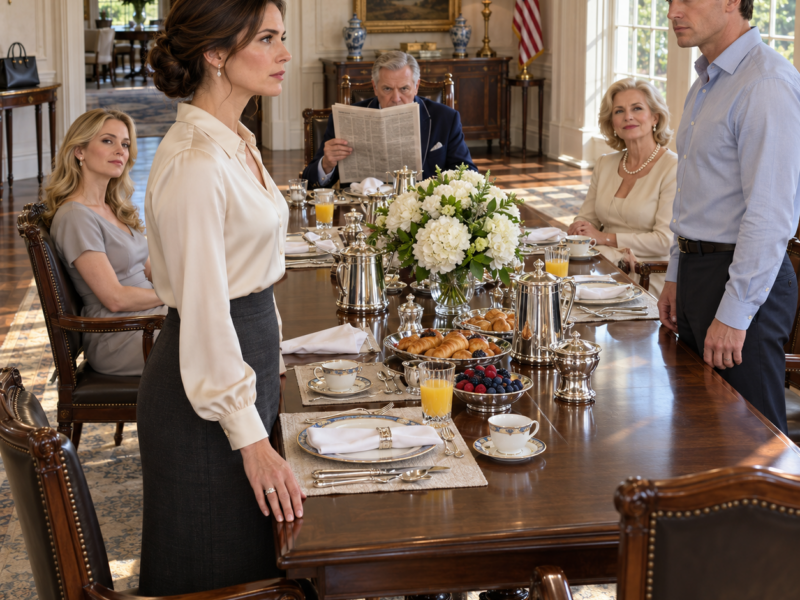
“Are you going to apologize to my mother?” Julian asked after slapping me at breakfast the morning after our wedding. His mother smiled. His father went back to his newspaper. I took off my wedding ring, placed it beside my plate, and left. Julian had insisted on a prenup to protect his family’s money. That morning, I drove to my office and opened my copy to the provision addressing domestic violence.
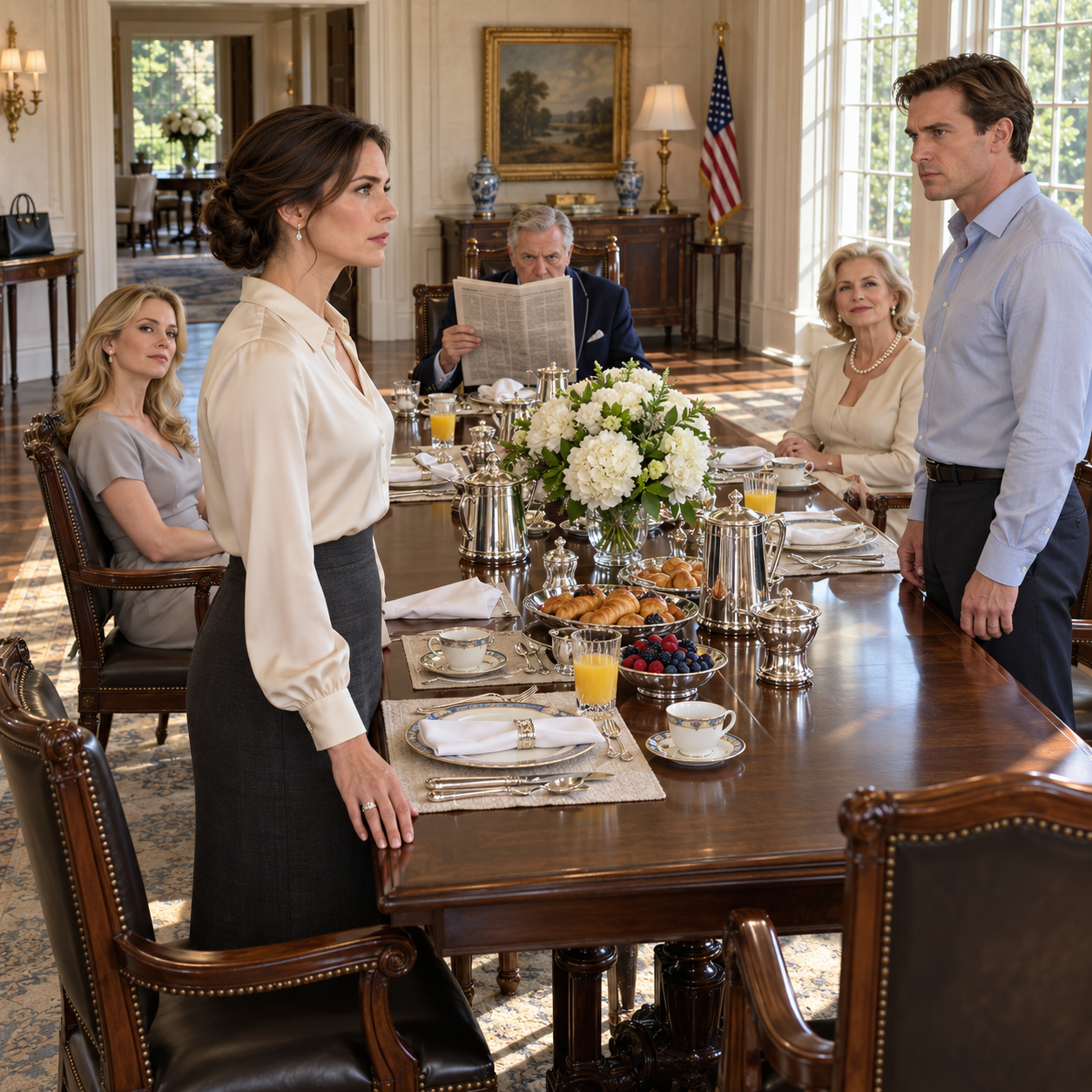
My husband slapped me in front of his entire family the morning after our wedding because I refused to behave like their servant.
His mother smiled.
His father went back to his newspaper.
His sister looked satisfied.
And Julian clearly expected me to apologize.
I did not cry.
I did not beg.
I looked straight at him, because none of them knew the slap had just activated the one provision in our prenuptial agreement that could destroy every protection Julian thought he had.
Breakfast at the Vance estate outside Greenwich, Connecticut, had started like a performance.
Towering windows faced a rolling lawn silvered by morning frost. Fresh flowers stood between covered serving dishes. The mahogany table was long enough to make every conversation feel like a board meeting.
I had slept barely three hours after our wedding reception, but Victoria Vance was already testing me.
“A bride should know her role,” she said while I poured coffee.
I let the comment pass.
Then she tasted the eggs I had helped the cook prepare and placed her fork down with theatrical disappointment.
“Too much salt.”
Julian laughed nervously.
His sister, Claire, leaned back in her chair. “Maybe business deals are more her specialty than cooking.”
The table filled with polite little laughs.
I stayed still.
Julian’s father, Graham, folded one side of his newspaper. “A Vance wife should learn to accept criticism with grace.”
That was when I answered.
“A Vance wife should not be treated like household staff.”
The room went silent.
Victoria’s eyes hardened. “Excuse me?”
“You heard exactly what I said.”
Julian pushed his chair back so fast it scraped the floor.
For months, he had told me he was not like them.
He said he hated their arrogance. He said he wanted a marriage built on respect. He said I would never have to become one of those women who disappeared into the Vance family name.
That morning, I learned how quickly promises vanished when his family was watching.
“You will not speak to my mother like that,” Julian snapped.
I kept my voice level.
“I speak to people according to how they treat others.”
His hand moved before anyone said another word.
The slap cracked through the dining room.
My cheek burned.
Claire’s smile widened.
Victoria did not even pretend to be shocked.
Graham calmly lifted his newspaper again.
They were all waiting for the same thing.
Tears.
An apology.
Submission.
I gave them none of it.
I looked at Julian and saw something I should have recognized sooner.
He was not embarrassed that he had hit me.
He was embarrassed that I had challenged him in front of his family.
“Say something,” he demanded.
I did not.
While they watched my face, I was thinking about a locked cabinet in my office.
Inside were banking records, witness statements, corporate agreements, and documentation tied to the businesses that allowed the Vances to pretend their empire was untouchable.
They thought I was simply a successful consultant Julian had married.
They did not know I had spent eleven years building an investigations firm through trusted partners.
They did not know several agreements their companies depended on were controlled through professional relationships and entities connected to me.
They certainly did not know how much I already understood about what they had worked so hard to hide.
Still, none of that was the first thing I intended to use.
The first thing was simpler.
The prenup.
Julian had insisted on it.
His family’s lawyers treated the negotiations like they were protecting a kingdom from an invading army. Every clause was designed to keep Vance money away from me. Every inheritance was separated. Every possible exit had been calculated.
Except one.
A provision tied to intentional physical violence.
Julian had barely glanced at it when the document was finalized.
I had read every word.
He stepped toward me.
“Are you going to apologize to my mother?”
Victoria folded her hands, waiting.
Claire looked amused.
I reached for my wedding ring.
For the first time, Julian’s expression changed.
I slid the ring from my finger and placed it beside my untouched plate.
The small click against the china sounded louder than the slap.
“What are you doing?” Julian asked.
I picked up my purse.
Graham lowered the newspaper again.
Now everyone was watching.
I walked toward the doorway.
Julian followed two steps behind me.
“You are being dramatic.”
I stopped.
“No,” I said. “I am being careful.”
He gave a short laugh, but uncertainty had entered it.
“You think walking out changes anything?”
I turned to face him.
That was his mistake. He still believed this was about winning an argument at breakfast. He still believed the Vance name was stronger than anything I could do.
He believed I had entered his world without understanding how much power his family held.
None of them understood that I had known exactly who they were long before I walked down the aisle.
“I am about to show you what happens when you underestimate the wrong woman,” I said.
Then I walked outside, got into my car, and closed the door.
Only when the estate disappeared in my rearview mirror did I reach into my purse for my phone.
I called my attorney, Naomi Feld.
Then I called my business partner, David Chen.
By the time Julian tried calling me, three people connected to the Vance business structure knew something had changed.
His name flashed across my screen again and again.
I ignored every call.
Instead, I drove straight to my office in Stamford, unlocked the cabinet behind my desk, and removed a thick folder marked with the date of our prenup.
Inside were the documents Julian and his family never believed I would need.
I opened the agreement to Section 14.6.
Then I placed the financial records beside it.
My phone rang again.
This time, the caller was Naomi.
I answered.
“Are you sure you want to move forward?” she asked.
I looked down at the evidence spread across my desk.
“Yes.”
There was a pause, followed by the sound of papers moving.
“Then I will start with the Vance agreements.”
I opened the folder wider.
Across town, Julian finally stopped calling.
Naomi arrived twenty-seven minutes later, carrying a leather briefcase and wearing running shoes beneath her dark suit. She had been at her daughter’s soccer practice when I called. She did not waste time asking whether I was certain the slap had happened.
She asked whether I was safe.
Then she asked whether anyone had witnessed it.
“Four members of his family, two house employees in the adjoining service hall, and at least one camera facing the breakfast room entrance,” I said.
“Any visible injury?”
“My cheek is red. My jaw hurts.”
“We document it now.”
She photographed my face under neutral office lighting and instructed me not to apply makeup. Then we drove to an urgent care clinic where a physician examined me, recorded tenderness along my cheekbone, and noted the outline of fingers beginning to appear beneath my left eye.
I told the truth in plain language.
My husband struck me with an open hand during an argument. I did not strike him. I left immediately.
The physician asked whether I wanted the police called.
“Yes,” I said.
Naomi did not smile, but approval softened her expression.
For years, my work had taught me the difference between evidence and outrage. Outrage can be dismissed as emotion. Evidence has dates, names, photographs, medical notes, and a chain of custody.
I gave a statement to a Greenwich police officer in a consultation room at the clinic. I described the dining room, the seating positions, the words spoken, and the direction Julian’s hand traveled. I provided the names of the employees I had seen.
I did not exaggerate.
I did not mention Vance Holdings.
I did not threaten revenge.
I reported an assault.
When the officer finished, Naomi placed a copy of the prenup on the table.
Section 14.6 had been added during the final round of negotiations. It stated that if either spouse committed an intentional act of physical violence against the other, supported by contemporaneous medical evidence, a police report, an admission, or credible witness testimony, several waivers in the agreement would terminate.
The offending spouse would also owe a liquidated payment of $3.5 million from an escrow account created at signing, plus reasonable legal fees and temporary housing costs.
It did not decide guilt in a criminal court.
It enforced a private contract Julian had signed voluntarily with independent counsel.
The clause existed because Naomi had asked a question no Vance lawyer expected.
“What happens if their definition of family discipline becomes Elena’s problem?”
My name is Elena Ward. I was forty years old when I married Julian Vance, and I had spent enough time around powerful families to understand that public manners do not always predict private conduct.
Julian’s attorney had laughed at Naomi’s proposed language.
“My client is not violent,” he said.
“Then the clause costs him nothing,” Naomi answered.
Graham approved it because he believed refusing would look suspicious. Julian signed because he was impatient to finish. Victoria called it insulting, which told me more than she intended.
Now the language they dismissed sat between us and three fresh medical photographs.
The officer asked whether Julian knew about the clause.
“He knew it existed,” I said. “I doubt he remembers the details.”
Naomi closed the folder.
“He will remember by lunchtime.”
She was right.
At 12:18 p.m., Julian left me a voicemail.
His voice had changed from angry to smooth.
“Elena, this has gone too far. I was exhausted. We both were. I barely touched you, and everyone at breakfast knows you provoked the situation. Come home so we can discuss this privately.”
Naomi listened twice.
“Barely touched you,” she said. “That is close to an admission.”
At 12:31, Victoria texted.
Marriage requires maturity. Do not embarrass Julian over a misunderstanding.
At 12:44, Claire wrote.
You were rude to Mom. Julian reacted. Stop pretending you are a victim.
At 1:03, Graham’s attorney emailed Naomi asking for an immediate confidential meeting.
The Vances had spent the morning giving us exactly what careful people never give an opposing attorney: coordinated messages before they knew what evidence existed.
Naomi preserved each communication.
Then she served Julian with formal notice that I was invoking Section 14.6, seeking temporary exclusive use of my Manhattan apartment, and requesting that all communication pass through counsel.
The apartment had been mine before marriage. The Vances had required the prenup to classify it as my separate property. Their own protections made it impossible for Julian to claim a right to remain there.
He had moved some clothes into the closet two weeks before the wedding.
By three that afternoon, a licensed service had packed them under video supervision and delivered them to his attorney’s office.
I changed the locks.
That evening, I sat on the floor of my living room because the wedding gifts crowded every chair. Crystal bowls, silver frames, monogrammed towels, and expensive objects chosen by people who believed our marriage would last longer than one breakfast.
My wedding dress still hung in its garment bag near the bedroom door.
I expected grief to arrive as tears.
Instead, it came as embarrassment.
I remembered every warning I had explained away.
Julian correcting the way I spoke to his mother.
Julian asking me not to discuss my clients at family dinners because Graham found working women “too competitive.”
Julian telling me Claire’s insults were jokes.
Julian insisting our wedding take place at the Vance estate so his parents could control the guest list.
None of those moments predicted a slap by themselves.
Together, they described a man teaching me to accept smaller and smaller versions of myself.
My phone lit up with a message from David.
Do not open any Vance case files. We have isolated your access and preserved the logs. Call when you are ready.
That message mattered.
Ward Integrity Partners investigated corporate fraud, hidden ownership, vendor conflicts, and suspicious transfers for banks, insurers, and private companies. I had founded the firm with David after leaving federal contract work. We employed thirty-two people and maintained strict conflict rules.
Three months earlier, North Atlantic Commercial Bank retained us to review a group of construction loans connected to six anonymous holding companies.
The borrowers were masked during the preliminary phase. My team received coded entities, payment trails, and vendor data. We were not told the controlling family’s name.
Two weeks before my wedding, an outside attorney disclosed that several entities were affiliated with Vance Holdings.
I immediately recused myself.
David took control of the engagement. Our general counsel froze my access to the digital workspace. An independent reviewer confirmed I had not opened the restricted records after the conflict became known.
That was why the locked folder in my office did not contain stolen bank files.
It contained public corporate records, copies of agreements my own company had signed, meeting notes I was entitled to keep, and disclosures Julian had made during prenup negotiations.
The distinction was not dramatic.
It was essential.
I did not need to break the law to expose people who assumed rules belonged only to others.
The Vance agreements Naomi mentioned were three legitimate contracts between Ward Integrity Partners and independent vendors partly owned by Vance entities. Each included a morality and cooperation provision. If a principal became involved in alleged violence, witness intimidation, or material misrepresentation, my firm could suspend performance while counsel reviewed risk.
Suspension would not bankrupt Vance Holdings.
It would do something Graham hated nearly as much.
It would force lenders to ask questions.
I called David.
“What have you done?” I asked.
“Only what the contracts require. I notified general counsel and the bank’s independent committee that a personal conflict involving a Vance principal had become active. You remain recused.”
“Did you mention the assault?”
“Only that law enforcement took a report and counsel invoked a contractual review. No conclusions. No private medical details.”
“Good.”
“Elena, are you all right?”
I looked at the wedding dress.
“Not yet.”
“That is an honest answer.”
David had known me for fifteen years. He did not tell me I was strong. He did not say everything happened for a reason. He offered to have his wife bring dinner and sleep in the guest room.
I said yes.
Accepting help felt harder than invoking a contract.
That night, Julian was arrested after agreeing to meet detectives at the Greenwich station. He was processed on a misdemeanor assault charge and released with instructions not to contact me directly.
His family issued no public statement.
Privately, they began moving with astonishing speed.
Graham’s lawyers challenged the prenup notice. They argued the clause required a conviction, though the text plainly listed several independent forms of proof. They claimed I had provoked Julian. They suggested the redness on my face might have come from wedding makeup or an allergic reaction.
Then they made their first serious mistake.
They submitted sworn statements from Victoria, Graham, and Claire describing the breakfast.
All three insisted Julian had merely raised his hand defensively when I lunged toward Victoria.
The statements used nearly identical language.
None mentioned the ring I placed on the plate.
None mentioned Julian following me to the doorway.
All claimed no employees were present.
By then, the police had interviewed Marta Ruiz, the estate’s breakfast cook, and Anthony Bell, a houseman who had been carrying linens through the service hall.
Marta heard the slap and saw my head turn.
Anthony saw Julian’s arm extended and heard him demand an apology.
The camera at the breakfast room entrance had no audio, but it showed my position, Julian rising, the sudden movement of his arm, and my immediate departure.
It also showed Graham lowering his newspaper before the strike and lifting it afterward.
The family’s synchronized story began to collapse.
Naomi watched the footage in her office while I sat beside her.
Seeing it was worse than remembering it.
On screen, Julian moved with no hesitation. Victoria remained seated. I never lunged toward anyone. After he struck me, Claire leaned closer, not away.
“Turn it off,” I said.
Naomi stopped the video.
“We do not have to use it today.”
“We will use it when necessary.”
My voice shook.
“I just do not want to watch it twice.”
The next morning, a courier delivered a white box containing my wedding ring.
Julian had removed it from the breakfast table and sent it back with a note.
When you calm down, we can fix this.
I gave both to Naomi.
“He still thinks the problem is your emotion,” she said.
“Emotion is easier for him to manage than evidence.”
“Not anymore.”
On Monday, we attended the first settlement conference by video. Julian appeared from a conference room at his father’s law firm. He wore a navy suit and a pale tie, the uniform of an innocent executive.
Graham sat beside him despite not being a party to our marriage.
Victoria joined from another screen. Her attorney said she was present as a potential witness. Naomi objected to turning the conference into a family tribunal.
The mediator asked everyone except the spouses and their counsel to leave.
Graham looked personally offended.
Julian looked frightened.
When we were alone, his attorney offered an annulment, mutual confidentiality, and $250,000 if I withdrew the police complaint and released the Section 14.6 claim.
Naomi answered before I could.
“The escrow alone contains fourteen times that amount.”
“The clause is unenforceable,” his attorney said.
“Then why are you offering anything?”
Julian leaned toward the camera.
“Elena, please. We loved each other yesterday.”
I looked at the man whose vows had lasted less than a night.
“I loved the person you pretended to be.”
His face tightened.
“You humiliated my mother.”
“Your mother asked your wife to serve breakfast so she could demonstrate authority. I objected. You struck me.”
“It was one mistake.”
“It was one act witnessed by a room full of people who considered it normal.”
The mediator intervened before Julian could answer.
We ended the session without agreement.
That afternoon, the bank placed two Vance credit facilities under enhanced review. It did not freeze accounts or accuse anyone of fraud. It requested updated beneficial ownership records, vendor certifications, and proof that certain project expenses matched approved budgets.
Graham blamed me immediately.
Through counsel, he accused me of weaponizing confidential information to extort a divorce settlement.
David responded with an audit trail showing my recusal, blocked access, and absence from all investigative decisions.
The bank’s committee confirmed that its review had begun before the wedding.
The facts removed me from the center of the financial inquiry.
That made the Vances more afraid, not less.
If I was not controlling the review, I could not stop it.
Three days later, Claire came to my office.
She arrived without an appointment and demanded to see me. Reception called David, who called Naomi, who advised that I could speak with Claire only if another attorney remained present and the conversation was recorded with her consent.
Claire agreed.
She entered the conference room carrying a designer handbag and the confidence of someone who had never been made to wait in a lobby.
“You have made your point,” she said.
“What point is that?”
“Julian should not have touched you.”
It was the first direct acknowledgment from any Vance.
“Correct.”
“But destroying the company hurts thousands of employees.”
“I am not destroying the company.”
“The bank review is your doing.”
“It began before the wedding, and I am recused.”
She studied me.
“You expect me to believe you happened to investigate us?”
“My firm was retained by a bank. Your family’s name was masked. The moment I learned of the connection, I withdrew.”
Claire’s certainty slipped.
“Julian said you targeted him.”
“Julian says many things when the truth is inconvenient.”
She looked toward Naomi.
“Is this a threat?”
“No,” Naomi said. “It is an observation.”
Claire opened her handbag and removed a flash drive.
“My father told me to give this to you.”
Naomi stopped her before she placed it on the table.
“What is on it?”
“A proposed settlement.”
“Then his lawyer can transmit it to me.”
Claire’s fingers tightened around the drive.
“There are also personal files.”
“Whose?” I asked.
She did not answer.
Naomi leaned back.
“Claire, did an attorney advise you to deliver that device?”
“No.”
“Did your father explain why he did not send it through counsel?”
Her face changed.
For the first time, she looked less like Julian’s satisfied sister and more like a daughter realizing she had been used as a courier.
“He said Elena would understand.”
“I understand that accepting unknown electronic files during an active bank review would be reckless,” I said.
Claire returned the drive to her bag.
“You really think everyone is trying to trap you.”
“No. I verify before I trust.”
She stood.
At the door, she turned back.
“For what it is worth, I did not know he would hit you.”
“But when he did, you smiled.”
Color rose into her face.
“I was uncomfortable.”
“That is not what the camera shows.”
Claire left without another word.
Two hours later, she called Naomi.
She wanted her own lawyer.
The flash drive, it turned out, contained copies of altered vendor invoices, internal email, and a draft statement claiming I had solicited confidential Vance information from Julian while dating him.
Graham had sent his daughter into my office carrying evidence and a false accusation without telling her what it was.
Claire retained independent counsel and surrendered the device to the bank under a preservation agreement.
That decision did not make her my ally.
It made her unwilling to become her father’s shield.
Families like the Vances appear strongest when everyone agrees to carry the same lie. The moment one person sets it down, the weight shifts onto the others.
Julian felt it first.
He called from a blocked number late that evening.
I answered without thinking.
“You turned Claire against us,” he said.
“Do not call me again.”
“She stole company records.”
“Your father gave them to her.”
Silence.
“Who told you that?”
“Do not call me again.”
“Elena, listen to me. My father is panicking. If you give him a path out, he will pay whatever you want.”
“This is not a negotiation about your father.”
“Everything is a negotiation.”
There it was.
The belief beneath the slap, the prenup, and the breakfast performance.
Everything could be priced.
“No,” I said. “Some things are consequences.”
I ended the call and reported it to Naomi and the police.
The court replaced Julian’s informal no-contact instruction with a temporary protective order.
His attorney blamed confusion.
Julian blamed love.
The judge called it prohibited contact.
For the first time, a person outside his family defined his behavior without asking permission.
The bank’s review expanded during the following month.
Again, I did not participate.
David gave me only the information our general counsel authorized him to share: the review involved duplicated invoices, undisclosed related vendors, and certifications signed by executives who claimed they had relied on subordinates.
Several transactions led to Bellwether Advisory LLC, a company registered in Delaware eighteen months earlier.
During prenup disclosure, Julian had listed a minority interest in Bellwether as having nominal value.
Now the bank wanted to know why Bellwether had received $6.8 million from Vance construction projects.
Naomi requested updated financial disclosure in our annulment case.
Julian resisted.
That resistance activated another provision his lawyers had written for my benefit almost by accident. If either party materially concealed assets during prenup negotiations, the innocent spouse could challenge the separate-property classification associated with those assets.
The Vance team had included the clause to protect Julian from me.
They assumed a self-made woman with a private company was the likely liar.
Now Bellwether sat at the center of it.
Naomi subpoenaed its ownership records through proper court process.
Forty percent belonged to Julian.
Thirty percent belonged to Graham through a trust.
Twenty percent belonged to Victoria.
The remaining ten percent was held by an entity managed by Claire.
None of them had disclosed the full structure.
Julian’s prenup schedule valued his interest at $40,000.
Bank records valued distributions to him at more than $1.2 million in the previous two years.
The slap did not create the fraud inquiry.
It opened a contractual door the Vances had assumed would remain locked.
Their own aggressive demand for disclosure now required Julian to explain the asset under oath.
He asked for another settlement conference.
This time, Graham was not permitted in the building.
Julian looked thinner. The polished certainty had left his face.
He offered the full $3.5 million escrow payment, my legal fees, an annulment, and a confidentiality clause limited to personal matters. In exchange, he wanted me to waive all claims related to Bellwether and state that I had no evidence of criminal misconduct.
“I cannot make that statement,” I said.
“Why not?”
“Because I have seen inconsistent disclosures in a court case. I will not characterize them beyond what the documents show.”
His attorney interrupted.
“Ms. Ward is not a regulator.”
“Correct,” Naomi said. “Which is why she is not offering regulatory immunity.”
Julian looked at me.
“You are enjoying this.”
I considered the accusation.
“I enjoyed our wedding,” I said. “I enjoyed believing you respected me. I do not enjoy learning how completely I was deceived.”
“Then take the money and let it end.”
“The marriage can end. The truth does not become mine to bury.”
We agreed on the financial and marital terms but refused the false statement.
The remaining issues went before a Connecticut Superior Court judge.
The hearing on Section 14.6 lasted two days.
Marta testified first. She had worked for the Vances for nineteen years. Victoria’s lawyer tried to suggest she resented the family because her Christmas bonus had been smaller the previous year.
Marta remained calm.
“Mrs. Vance told Elena to pour coffee,” she said. “Elena did. Mrs. Vance criticized the food. Elena said she was not staff. Mr. Julian stood and hit her.”
“Did Elena move toward Mrs. Vance?”
“No.”
“Could the contact have been accidental?”
“No.”
“How can you be certain?”
Marta looked directly at Julian.
“Because I have seen men make accidents. That was a decision.”
Anthony testified next.
The urgent care physician authenticated the medical record. The detective described the statements and video. Naomi played Julian’s voicemail saying he had barely touched me.
Then Julian testified.
He said he had been exhausted, humiliated, and alarmed when I stepped toward his mother. He admitted his hand touched my face but denied intending harm.
Naomi asked him to demonstrate how a defensive movement traveled across the full width of the table opening and left four distinct marks on the opposite side of my face.
He could not.
She asked why he demanded I apologize after the contact.
He said he did not remember.
She asked why his voicemail described the contact as slight instead of denying it.
He said he had been trying to calm me.
Finally, she placed the prenup in front of him.
“Did you read Section 14.6 before signing?”
“My attorney reviewed the agreement.”
“That was not my question.”
He glanced at his lawyer.
“I read it.”
“Did anyone force you to sign?”
“No.”
“Did you have independent counsel?”
“Yes.”
“Did you represent during negotiations that you were not a violent person?”
“Yes.”
“Was that representation true when you made it?”
Julian hesitated.
“Yes.”
“Then the only person who changed the cost of this agreement was you, correct?”
His attorney objected.
The judge sustained the objection, but the question remained in the room.
I testified last.
I did not tell the judge the Vances were evil. I did not turn the hearing into a history of every insult. I described the breakfast and the slap.
Under cross-examination, Julian’s lawyer asked whether I had married him while my firm was investigating Vance entities.
“I learned of the potential conflict two weeks before the wedding and recused myself immediately,” I said.
“But you continued with the marriage.”
“The preliminary bank review had not established wrongdoing. Professional suspicion is not proof, and Julian told me he was not involved in those entities.”
“Was that naive?”
“Yes.”
The honest answer seemed to surprise him.
“So you admit your judgment was poor.”
“I admit I trusted the man I planned to marry. That does not authorize him to strike me.”
The judge enforced Section 14.6 in full.
She found the language clear, the evidence credible, and Julian’s account inconsistent with the video and witness testimony.
The escrow agent was ordered to release $3.5 million, plus temporary housing costs and legal fees. Several waivers protecting undisclosed marital acquisitions were terminated. The court permitted additional discovery concerning Bellwether.
Julian did not look at me when the ruling was read.
Graham waited outside the courthouse behind a row of attorneys.
Victoria sat in a black SUV.
Claire was nowhere in sight.
Reporters had learned about the hearing because the docket was public. Naomi and I walked past them without comment.
I did not need to announce victory.
The court order said enough.
The criminal case resolved two weeks later. Julian entered a diversion program available to first-time offenders. He accepted responsibility in court, completed an intervention program, performed community service, and remained subject to the protective order.
Some people told me the outcome was too gentle.
Others said it was too harsh for one slap.
Neither group had lived inside my marriage.
The criminal court addressed a misdemeanor. The contract addressed a promise. The annulment addressed a marriage built on material deception.
No single proceeding could carry the whole truth.
The bank investigation continued on its own track.
Subpoenaed records showed Bellwether had submitted consulting invoices for work performed by ordinary Vance employees already paid through project budgets. Funds then moved into family trusts and personal investment accounts.
Graham insisted the arrangement reflected legitimate management services.
The bank disagreed.
It referred portions of the matter to federal and state authorities, accelerated two loans, and demanded repayment of unsupported charges.
Vance Holdings did not collapse overnight.
Real companies rarely disappear in one dramatic afternoon. They enter negotiations, sell assets, replace executives, settle claims, and spend years paying for decisions made in private rooms.
Graham resigned as chairman.
Julian was removed as chief operating officer.
Victoria lost her board seat after outside directors learned she had received Bellwether distributions while signing annual conflict certifications.
Claire cooperated through counsel and avoided charges. She admitted that her father had used her entity to hold an interest she did not fully understand. That explanation did not excuse her failure to ask questions, but it distinguished negligence from design.
The company appointed an independent monitor and preserved most of its workforce.
That mattered to me.
Accountability should reach decision-makers before it crushes receptionists, equipment operators, and payroll clerks who never saw the hidden invoices.
David’s team completed the engagement without me.
When the final report was delivered, our general counsel allowed me to read only the public settlement summary. My recusal remained documented from beginning to end.
The Vances had tried to portray me as a rejected bride using confidential information for revenge.
The audit trail proved something less cinematic and more powerful.
I had followed procedure.
The unraveling of Vance Holdings was slower than the headlines suggested.
For several weeks, the company continued issuing polished statements about routine governance improvements. Its website still showed Graham standing in front of a glass tower with his arms folded. Julian’s biography still described him as a principled operator committed to responsible growth.
Inside the company, however, people had begun preserving email instead of deleting it.
That change mattered.
An assistant in the development division produced calendar entries showing that Bellwether meetings occurred on the same mornings as official Vance project reviews. A project accountant found invoices bearing her electronic approval even though she had never seen them. A regional manager admitted Graham’s office instructed him to split large charges into amounts below the bank’s secondary review threshold.
None of those employees contacted me.
They spoke with independent counsel, bank examiners, or the monitor. The process remained separate from my divorce. Keeping those lines clear protected the truth from becoming a family argument.
Graham tried to make the separation disappear.
His public relations adviser circulated a draft statement describing me as a financially motivated former bride who had exploited a private disagreement. The draft never became an official release because the company’s outside directors refused to approve it.
One director later testified that Graham slammed his fist on the conference table and said, “She was supposed to be part of the family.”
He did not mean loved.
He meant controlled.
Naomi obtained the draft during discovery because it referenced the prenup and my claim. The metadata showed Julian had edited it. He changed “alleged physical incident” to “minor marital misunderstanding.”
When Naomi questioned him in a deposition, he insisted the phrase came from public relations counsel.
She placed the version history in front of him.
“Is this your user account?” she asked.
“It appears to be.”
“Did someone else have your password?”
“My assistant may have.”
“Your assistant testified that she did not.”
Julian shifted in his chair.
“Then I do not remember.”
“You used the phrase misunderstanding in your mother’s text, your first settlement proposal, and this draft statement. Is that another coincidence you do not remember?”
His attorney objected to the tone.
Naomi waited until the objection ended.
“Mr. Vance, do you understand that changing the label does not change the event?”
Julian looked toward me.
I was permitted to attend, though I chose a chair behind Naomi where I did not have to meet his eyes.
“I understand now,” he said.
It was the first time he spoke those words under oath.
Understanding did not undo anything, but it marked the point where denial became more expensive than honesty.
The deposition also forced Julian to explain our courtship.
We had met at a regional banking conference in Boston two years earlier. I spoke on a panel about fraud controls in family-owned companies. Julian approached afterward and told me my presentation had made him reconsider several weaknesses in his own organization.
At the time, I found the admission refreshing.
He asked informed questions. He listened without interrupting. He did not mention the size of his family’s estate or the society pages that photographed his mother. He told me he wanted to build an identity outside his father’s shadow.
For our first date, we ate chowder at a small restaurant near the harbor. Julian wore an ordinary sweater and arrived without a driver. When the server dropped a glass, he helped pick up the larger pieces before anyone asked.
That was the man I believed I had married.
During the deposition, Naomi asked whether Julian’s interest in me had anything to do with my firm’s banking relationships.
“No,” he said.
“Did your father encourage the relationship?”
“He approved of Elena.”
“That was not my question.”
Julian hesitated.
“He believed she would be good for me.”
“Did he ever say she would be good for Vance Holdings?”
Another pause.
“Possibly.”
Naomi showed him a message Graham sent six days after our engagement.
Bring Elena closer. Her bank network will be useful when we refinance Harbor Point.
I had never seen it.
Julian read the message without expression.
“Did you tell Ms. Ward that your father viewed her professional relationships as a corporate resource?”
“No.”
“Did you disagree with him?”
“I told him Elena made her own decisions.”
“Where is that response?”
“It was a phone conversation.”
“Convenient.”
His attorney objected again.
I barely heard the exchange that followed.
The room had fallen away, replaced by memories I now had to examine from a different angle.
Graham inviting me to sit beside him at a lender dinner.
Victoria asking which bank presidents sent wedding gifts.
Julian suggesting our honeymoon wait until after the Harbor Point refinancing.
At the time, each moment seemed explainable. Together, they showed a family studying the usefulness of my name while pretending to welcome me.
During a break, I went to the restroom and locked myself in a stall.
I did not cry because I wanted Julian back.
I cried because manipulation makes a person distrust her own memories. Even happy moments become evidence to review. Every kindness acquires a question attached to it.
Naomi waited outside without rushing me.
When I emerged, she handed me water.
“You can leave,” she said. “I can finish without you.”
“No. I want to hear the rest.”
“That is your choice. Staying is not proof of strength, and leaving is not proof of weakness.”
I nodded.
That sentence returned to me many times afterward.
The Vances had taught everyone around them to treat endurance as loyalty. Naomi reminded me that choice was the part that mattered.
When the deposition resumed, she asked Julian about the prenup negotiations.
He admitted Graham selected his first attorney and reviewed every draft. He admitted Victoria requested a lifestyle provision requiring me to attend family events and avoid public criticism of Vance relatives. My lawyer had rejected it immediately.
He also admitted Claire suggested a clause preventing me from keeping the Vance name after divorce.
“Why?” Naomi asked.
“She believed the name had value.”
“Did you?”
“At the time.”
I almost laughed.
The Vances feared I wanted their name while planning to use mine.
The domestic violence provision entered the draft after Victoria sent me a forty-page household protocol for the estate. It covered formal dinners, holiday seating, approved charities, photographs, and how family disagreements should remain private.
One line stated that public disloyalty could cause lasting harm to the family and should be corrected within the home.
Naomi read the words differently than I did.
“Corrected how?” she asked me.
I had shrugged.
“Probably money, invitations, access.”
“Perhaps. But we are defining what they cannot do.”
She proposed Section 14.6 the next day.
During negotiations, Graham called it melodramatic. Victoria said decent families did not need written rules against violence. Julian kissed my forehead and told me to let the lawyers have their strange little victory.
Now, under oath, Naomi asked him why he had not objected.
“Because I never imagined it would apply,” he said.
“You imagined your wife would never accuse you?”
“I imagined I would never hit her.”
The room became still.
Julian looked down.
“I was wrong.”
His attorney requested a break.
The transcript of that admission became part of the settlement record.
Outside the legal proceedings, I began rebuilding the ordinary portions of my life.
I returned wedding gifts one by one. Some stores issued refunds. Others provided credit I donated to a housing program. Gifts from close friends came with notes asking me to keep them, but I could not look at monograms bearing initials that described a marriage no longer real.
The florist sent me the invoice for preserving my bouquet in glass.
I canceled the order.
The photographer wrote with unusual kindness. She had captured nearly nine hundred images of the wedding and offered to hold them until I decided what I wanted.
For months, I could not open the gallery.
Eventually, I asked her to select photographs of my friends, my aunt, David and his wife, and the people who had come because they loved me rather than the event.
In those pictures, joy still existed.
It did not become false because Julian was false.
That distinction helped me reclaim the day from him.
My aunt Rosa flew from Chicago and stayed for two weeks. She was seventy-one, retired from teaching middle school, and completely unimpressed by the Vance family.
She filled my refrigerator, criticized my expensive coffee maker, and moved the wedding dress into a closet without asking.
On her third night, she found me sitting at the kitchen counter reading messages from strangers who had learned about the court hearing.
Some called me brave.
Some called me calculating.
Some insisted a wife should not destroy a husband’s career over a private mistake.
Rosa took the phone from my hand and turned it facedown.
“Do any of those people know where you keep the extra sheets?” she asked.
“No.”
“Then they do not live here and do not vote.”
It was not sophisticated advice.
It worked.
I stopped reading public comments.
Instead, I began seeing a counselor named Dr. Maya Patel. In our first session, I tried to explain the corporate inquiry before discussing the slap.
She interrupted gently.
“You are telling me why leaving was strategically justified,” she said. “Do you believe being hit was not enough?”
I had no answer.
My professional life rewarded complete evidence. I wanted patterns, corroboration, and material impact. A single act felt too small to reorganize a future, even though that act had already done so.
Dr. Patel asked what I would tell an employee who came to me with the same story.
“Document it. Get safe. Contact counsel.”
“Would you require her to uncover six million dollars in suspicious invoices before she deserved to leave?”
“No.”
“Why do you require more from yourself?”
That question hurt more than I expected.
Over time, I understood that the financial scandal had become emotionally convenient. It made my exit look intelligent and powerful. It allowed me to speak about contracts instead of betrayal.
But even if Vance Holdings had been perfectly honest, Julian’s slap would still have mattered.
Even if Section 14.6 had not existed, I still had the right to walk away.
Even if nobody had believed me, the event still would have been real.
The contract provided leverage.
It did not create my worth.
David protected my role at the firm while I worked through that distinction. I temporarily stopped meeting clients whose cases involved family coercion. Another partner handled media calls. Our employees were told only that I was addressing a personal legal matter and remained fully supported by leadership.
Not everyone approved.
One senior manager privately complained that my situation created reputational risk. David invited him to put his concerns in writing and explain which firm policy I had violated.
The complaint disappeared.
Two junior analysts left handwritten notes on my desk.
One said her mother had remained in a violent marriage because the family business depended on appearances.
The other said seeing a powerful person report an assault made her reconsider what strength looked like.
I kept both notes in the same locked cabinet that once held the prenup.
The first time I returned to a client meeting, my hands trembled beneath the table. Nobody mentioned the news. They discussed procurement data, deadlines, and a spreadsheet with missing vendor addresses.
Ordinary professionalism felt like mercy.
Afterward, I walked three blocks in cold rain without opening an umbrella.
I had completed a meeting.
I had made a recommendation.
I had laughed once.
Recovery often entered through moments too small for anyone else to notice.
Meanwhile, Victoria attempted to preserve the family’s social position.
She hosted a foundation luncheon at the estate and appeared in photographs beside a banner about women’s leadership. The contradiction might have been funny if it were not so familiar.
Marta later told investigators that Victoria instructed staff never to mention the breakfast and warned that anyone cooperating with me would lose references.
That warning became relevant to the witness-intimidation review in the vendor contracts.
Victoria denied it.
Then Anthony produced a voice memo he had recorded after she summoned the household staff.
Her voice was calm and unmistakable.
“Family loyalty supports every paycheck issued from this house,” she said. “People who forget that should not expect the Vances to support their future.”
She never used the word lie.
She did not need to.
The message was clear.
When the recording reached the company’s outside directors, Victoria lost her remaining committee roles. The foundation removed her from the luncheon series. She blamed cancel culture in a letter to friends.
Marta called it consequences.
Graham responded more aggressively.
He filed a civil claim accusing Ward Integrity Partners of interference with prospective business relationships. Our insurer appointed counsel. The complaint relied heavily on the theory that I had orchestrated the bank review after Julian struck me.
The dates defeated it.
North Atlantic Commercial Bank had retained us ninety-four days before the wedding. Its first concern about Bellwether appeared in an internal memo seventy-one days before the wedding. I recused myself fourteen days before the wedding. David notified the bank’s committee about my personal conflict the morning after the assault, as required by contract.
Graham withdrew the claim after our lawyers sought discovery into his communications with lenders.
He called the withdrawal a business decision.
Naomi called it fear of sunlight.
The closest I came to speaking with him occurred outside the courthouse after the prenup ruling.
He stepped away from his attorneys and approached until a court officer moved between us.
“You could have handled this privately,” he said.
I looked at the man who had lifted his newspaper after watching his son strike me.
“You had a private room,” I said. “This is how you handled it.”
His face hardened.
“Julian lost control for one second.”
“No. He enforced what your family had been teaching him for years.”
“You know nothing about my family.”
“I know exactly what everyone did when his hand came down.”
The court officer asked him to step back.
Graham returned to his lawyers.
I never spoke to him again.
Claire’s path was less direct.
After retaining separate counsel, she gave three days of interviews to the bank’s investigators. She disclosed that Graham had asked her to create a consulting entity while she was in graduate school. He described it as tax planning and told her accountants would handle everything.
For years, she signed annual forms without reading them.
That did not make her innocent of carelessness. It showed how the Vance system reproduced itself. Graham distributed privilege in exchange for unquestioning signatures. The children learned that comfort arrived when they stopped asking what a document meant.
Claire had mocked me at breakfast because my resistance threatened more than Victoria’s pride. It threatened the family arrangement that paid for her apartment, travel, and foundation role.
In a later letter, she admitted something I had not known.
When she was nineteen, Graham slapped her during an argument about college. Victoria told her he was under pressure and insisted she apologize for provoking him. Julian brought ice to her room but begged her not to tell anyone.
At breakfast, Claire had watched the same ritual begin again.
She smiled because joining the powerful side felt safer than remembering the powerless one.
I sat with that letter for a long time.
It deepened my understanding.
It did not erase her choice.
Pain can explain cruelty without converting it into innocence.
Through counsel, Claire entered therapy and gave up financial support from the family trust while the inquiry continued. She accepted a job at a nonprofit arts organization in New Haven. The salary was modest by Vance standards and substantial by everyone else’s.
Marta saw her once at a grocery store. Claire apologized to her beside the produce section.
I learned that detail months later and felt something inside me loosen.
Accountability had begun traveling into rooms where I was not present.
That was how I knew it might be real.
Julian’s intervention program required him to write an accountability statement. I was not required to receive it, but I chose to let Naomi read it first.
The first draft disappointed her.
It focused on stress, alcohol from the wedding, and family expectations. It said the incident did not reflect his true character.
His counselor rejected it.
The second draft named the act directly.
I hit my wife because she challenged my mother and I believed I had the right to restore my position in front of my family.
He wrote that he had watched Graham intimidate employees and relatives throughout his childhood. He learned that apologies flowed toward the most powerful person, regardless of who caused harm. He believed being a good son meant maintaining that order.
He also admitted that he proposed partly because he loved me and partly because my reputation made him feel independent from Graham while increasing his value to the company.
Those motives had lived together inside him.
Human betrayal is often more complicated than a single lie.
I asked Naomi whether accepting the statement would weaken any claim.
“No,” she said. “But you do not owe him a response.”
I stored it without answering.
For several months, that felt unfinished.
Then I realized silence can be a complete boundary when it is chosen freely.
Six months after the wedding, the annulment became final.
The legal basis included fraud in financial disclosure and circumstances surrounding consent to the marriage. The exact language mattered less to me than the practical result.
I would not spend years tied to Julian while his family used delay as punishment.
The settlement money entered a separate account I did not touch for months.
It did not feel like a prize.
Part represented the value Julian’s own lawyers assigned to the risk of violence. Part reimbursed costs. Part existed because contracts are promises with consequences.
Eventually, I used a portion to establish a legal assistance fund for employees and spouses facing financial coercion. The fund paid for independent consultations, emergency document replacement, credit freezes, and safe temporary housing.
I did not put my name on it.
I did not want gratitude.
I wanted other people to have a door available before they needed to run through it.
Marta left the Vance estate three weeks after testifying.
Victoria accused her of disloyalty and withheld her final paycheck. Naomi referred her to an employment attorney, who recovered the wages and statutory penalties.
Marta later took a position managing a small catering company in Port Chester.
The first time I visited, she served me eggs with too much salt.
“They are perfect,” I told her.
She laughed so hard she had to sit down.
Claire contacted me once after the annulment.
Her email was short.
I am sorry I smiled. I had spent my whole life treating cruelty as entertainment before it could be aimed at me. That explains it. It does not excuse it.
I read the message twice.
Then I wrote back.
Thank you for telling the truth.
I did not offer friendship.
Forgiveness and access are not the same thing.
Graham never apologized.
Victoria sent a letter describing herself as a mother protecting her son. She wrote that every family had private customs outsiders could misunderstand.
I returned the letter to her attorney without response.
The word outsider no longer wounded me.
It had become a place of safety.
Julian wrote from a court-approved communication channel after completing his intervention program.
He said he finally understood that the slap had not been an isolated loss of control. It was the visible result of years spent believing respect flowed upward toward power and obedience flowed downward toward everyone else.
He did not ask me to return.
He did not ask me to forgive him.
He said he was sorry.
For a week, I considered whether to answer.
Then I wrote one sentence.
I hope you become someone who never needs another person’s silence to feel strong.
That was the last message between us.
One year after the wedding, I returned to the Greenwich area for a client conference. The hotel stood only a few miles from the Vance estate.
On the second morning, I drove past the road that led to the house.
The stone entrance looked smaller than I remembered.
I did not turn in.
Instead, I continued toward Tod’s Point, parked near the water, and walked along the cold shoreline. Long Island Sound was gray beneath an April sky. Runners passed me. A father helped his daughter fly a red kite. Two older women carried coffee and argued cheerfully about a crossword clue.
Ordinary life surrounded me.
For months, people had asked when I first knew the marriage was over.
They expected me to say it ended when Julian’s hand touched my face.
The truth was more precise.
It ended in the second after the slap, when I looked around the table and saw an entire family waiting for me to make his violence comfortable for them.
That was the inheritance Julian had received.
Not the estate.
Not the company.
Not the trusts or the newspaper photographs.
He had inherited a system in which harm became acceptable if everyone important agreed not to name it.
The prenup did not save me by itself.
Paper cannot leave a room for you.
A clause cannot make a phone call, document an injury, report an assault, preserve a record, or withstand the first wave of people insisting you misunderstood what happened.
The agreement mattered because I used it.
The evidence mattered because people were willing to tell the truth.
The law mattered because I stopped treating the Vance family’s comfort as more important than my own safety.
I had once believed power meant knowing where every account led and which signature controlled a company.
Now I understood a quieter kind of power.
It was the ability to say, This happened.
It was the refusal to add, but perhaps it was my fault.
It was accepting help without surrendering judgment.
It was allowing consequences to continue even when the person who hurt you finally sounded sorry.
I stood near the water until the wind made my eyes tear.
Then I touched the left side of my face.
The bruise had disappeared within two weeks. The tenderness lasted a month. The lesson stayed longer.
Julian thought the slap would restore order at his family’s breakfast table.
Instead, it revealed the order that had always existed.
Victoria’s smile.
Graham’s newspaper.
Claire’s satisfaction.
Julian’s expectation that I would apologize.
My silence had frightened them because it was the first thing they could not control.
They mistook it for shock.
It was clarity.
I had not entered their family powerless. I had entered with my work, my judgment, my records, my friends, my attorney, and a life I had built before Julian knew my name.
Walking away did not create those things.
It allowed me to remember them.
As I returned to my car, the red kite lifted higher over the shore.
I thought about the ring clicking against china, the sound so small beside the slap.
That sound had marked the beginning of my exit.
Not because a piece of jewelry controlled my marriage.
Because placing it down was the first decision I made without considering what the Vances would permit.
I drove back toward Stamford with the windows cracked open to the cold air.
At the office, a new client was waiting.
She was the chief financial officer of a family-owned company and had discovered that her husband was using her signature on loan documents. She looked embarrassed when she explained why she had waited six months to seek advice.
“I kept thinking I could fix it privately,” she said.
I recognized the sentence.
I closed the conference room door and sat across from her.
“You do not have to earn the right to protect yourself,” I said.
Then I listened.
That was what my life became after Julian.
Not a revenge story.
Not a victory measured by money taken from a family that had too much.
It became a life in which I no longer confused patience with permission, privacy with silence, or love with endurance.
The Vances believed their name made them untouchable.
What protected them was never the name.
It was the cooperation of everyone who saw the truth and looked back down at a newspaper.
The morning after my wedding, I stopped cooperating.
Everything that followed began there.
Two years later, Naomi invited me to speak at a continuing education program for family lawyers in Hartford. She did not ask me to describe the slap. She asked me to explain why careful agreements matter when affection makes people reluctant to imagine harm.
I stood at a lectern before sixty attorneys and showed them a redacted copy of Section 14.6.
“This clause did not predict violence,” I told them. “It identified a boundary and assigned a consequence before anyone was frightened enough to bargain it away.”
One lawyer asked whether every couple should include a similar provision.
“Every couple should receive independent advice,” I said. “No clause can replace safety planning, law enforcement, medical care, or a court. But no one should be mocked for asking what happens when promises fail.”
After the program, a young attorney waited while the room emptied. Her mother had signed a prenup thirty years earlier that left her financially dependent on a husband who controlled every account.
“She thinks planning to leave would make her disloyal,” the attorney said.
“Planning to be safe is not betrayal.”
The words sounded simple.
They had taken me a long time to believe.
On the train home, I opened the old wedding gallery for the first time without feeling sick. I found one photograph taken just before the ceremony. I stood alone near a window, looking toward the lawn. Julian was not in the frame. Neither were the Vances.
The woman in the picture looked hopeful, intelligent, and unaware of what morning would bring.
For months, I had been angry with her.
I thought she should have noticed more. Asked more. Delayed the wedding. Walked away before a ring, a reception, and a public failure made the exit so visible.
That afternoon, I looked at her differently.
She had made the best decision she could with the truth available to her. When new truth arrived, she acted.
I saved the photograph.
Not as a wedding memory.
As evidence that trust is not stupidity, and betrayal belongs to the person who exploits it.
When I reached Stamford, rain had begun tapping against the station roof. David waited near the curb because my train was late and he knew I hated searching for a rideshare in bad weather.
“How was the speech?” he asked.
“Nobody objected.”
“Lawyers must be losing their touch.”
I laughed and climbed into the car.
We drove past my office, where lights still glowed on the seventh floor. The locked cabinet remained behind my desk, but the folder inside no longer felt like a weapon or a shield.
It was a record of a promise, a violation, and a consequence.
Nothing more.
My life had grown larger around it.
I had dinner with friends. I called Aunt Rosa every Sunday. I learned to leave work before dark at least twice a week. I dated no one for a long time, then accepted coffee with a man who asked questions and did not treat listening as a performance.
I did not know where that relationship would lead.
For once, uncertainty did not frighten me.
I had survived certainty built on a lie.
Now I preferred a future that asked for honesty one day at a time.
At home, I placed the photograph from the gallery in a plain wooden frame. It sat on a shelf beside no wedding portrait and carried no Vance name.
It showed me before the truth.
The woman standing in my apartment carried everything that came after.
Both women belonged to me.
The morning after my wedding, Julian believed silence would return me to the place his family had chosen. Instead, silence gave me room to hear my judgment. Once I trusted it, no estate, fortune, contract, or family name could contain me.









