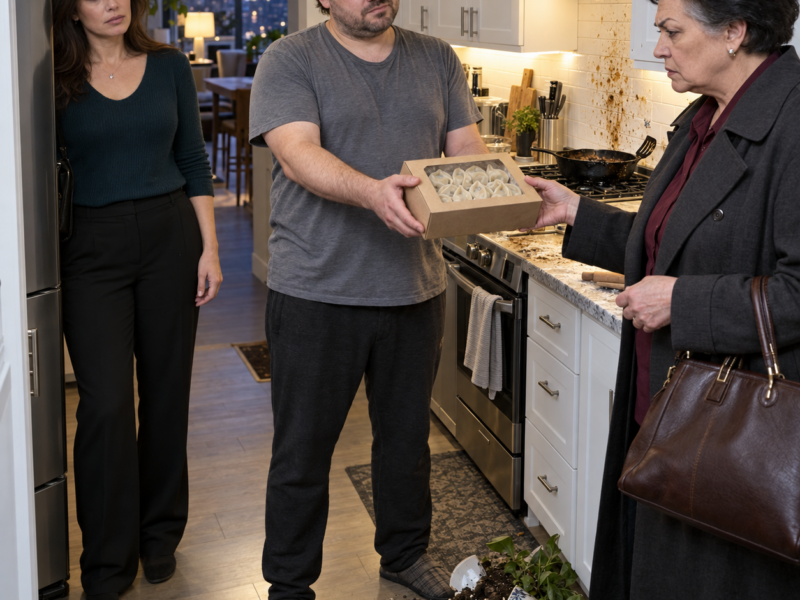
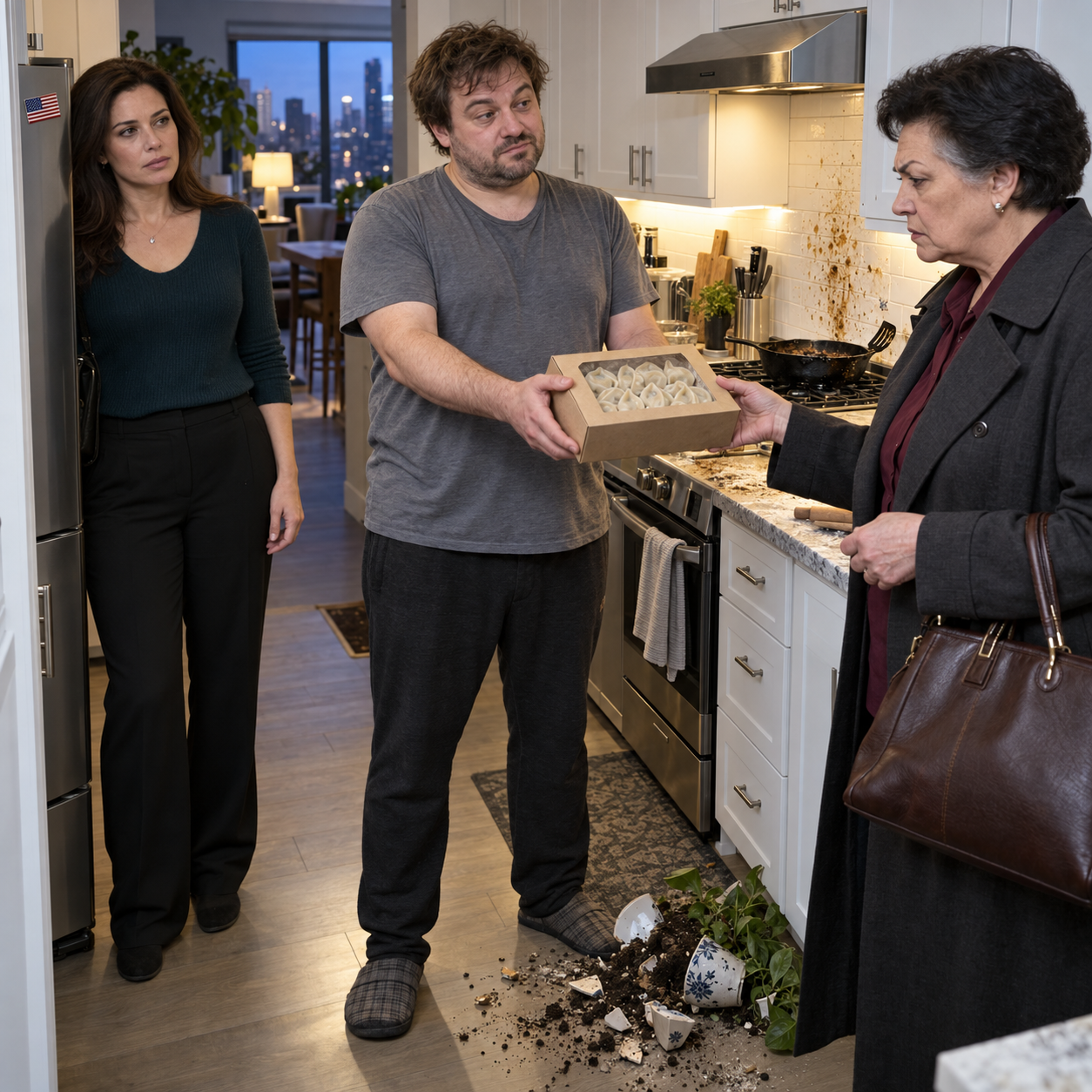
“A real wife cooks from scratch,” my husband told me before my twelve-hour shift. He hadn’t earned a paycheck in six months. When I came home, the kitchen was covered in grease, broken pottery, and the remains of the eggs he’d tried to fry. I told him to clean it. He sent his mother pictures and blamed the mess on me. “She’ll teach you how to be a wife,” he said. But when his mother arrived, she barely listened to him. She was studying the box of dumplings he’d pulled from our freezer. “Marina,” she asked, “where did you get these?” My husband smiled. He thought she was on his side.
At 6:40 on a Tuesday morning, my husband pushed his breakfast away and told me I had forgotten how to be a wife.
The plate struck the edge of the kitchen counter with a hard ceramic knock. Seven dumplings rolled into one another, glossy with butter and sprinkled with dill. I had boiled them before sunrise, packed my lunch, fed the cat, and wiped down the stove while Vadim sat in front of his computer wearing boxer shorts and an expression of profound disappointment.
“You expect me to eat this store-bought cardboard?” he asked. “There is no soul in it. A wife should make food with her own hands, not throw plastic-wrapped scraps at her husband.”
I stood at the sink with a half-washed coffee mug in my hands. In twenty minutes, I needed to leave for a twelve-hour shift at an auto detailing shop outside Cleveland. My wrists already ached from the previous day, and a faint chemical dryness clung to the skin around my nails.
Vadim leaned back in the gaming chair we were still paying off. It complained beneath him. Sunlight from the window caught the crumbs in his beard and the pale blue glow of the monitor reflected in his eyes.
He called himself an independent digital entertainment consultant. In practice, he tested unfinished video games, posted two-paragraph reviews online, and earned almost nothing. For six months, his income had hovered around zero while his opinions grew more expensive by the week.
I looked at him, then at the food.
There had been a time when I would have defended myself. I would have explained that the dumplings came from a good local maker, that I had worked late, that handmade dough did not become more nourishing simply because an exhausted woman rolled it at midnight. I might even have apologized for something that was not wrong.
That morning, my supply of free explanations was empty.
A rough, demanding meow rose from below the counter. Kuzya, our enormous black-and-white cat, rubbed against my calf. He had the face of an experienced card cheat and the moral standards of a dockside thief, but he had never once criticized my cooking.
I picked up Vadim’s plate.
“Here, Kuzya,” I said. “Let them cool first.”
I tipped the dumplings into his metal bowl.
Vadim’s mouth fell open.
“You are putting your husband on the same level as an animal?”
“No,” I said, drying my hands. “Kuzya catches mice at the cottage. He contributes.”
The cat began eating with noisy satisfaction.
“You have not paid the internet bill in three months,” I continued. “Breakfast is over. There are eggs in the refrigerator if you want them.”
I lifted my backpack from the chair, checked that my car keys were in the side pocket, and walked out before he could build his outrage into a speech.
The lock clicked behind me. I did not know it then, but that small sound marked the beginning of the end of the life Vadim thought he was entitled to live.
I worked at Lakefront Auto Renewal, a family-owned detailing business in Parma. The name sounded polished and pleasant. The work was neither. We took vehicles that smelled like wet dogs, spilled coffee, cigarette smoke, and old fast food, then returned them looking almost new.
That Tuesday, a black SUV waited in my bay. Two golden retrievers had coated every inch of the interior with hair, and a large vanilla latte had soaked into the passenger-side headliner. The owner had tried to scrub it with dish soap, leaving a pale halo the size of a dinner plate.
I changed into my coveralls, pulled on nitrile gloves, and studied the damage.
Detailing rewarded patience. Leather could not be rushed. Paint could not be bullied. If I held the polishing machine too long against the edge of a door, I could burn through the clear coat and owe the shop hundreds of dollars. If I soaked a headliner, the adhesive might fail. Every chemical needed the right dilution, every stain the right temperature, every tool the right pressure.
That precision quieted my mind.
By eight o’clock, I was vacuuming dog hair with a rubber brush. By ten, I had removed the seats. At noon, I was balancing on a step platform, lifting coffee from the ceiling one careful pass at a time.
My manager, Luis, watched from the next bay.
“You are taking the full interior package?” he asked.
“I need the hours.”
He nodded toward my wrists. “You also need hands when you are sixty.”
“I will buy new ones.”
Luis smiled, but his eyes stayed serious. He knew Vadim was out of work. He did not know the details because I had spent years protecting my husband from the judgment he had earned.
I had become good at turning the truth into softer language. Vadim was not unemployed. He was reevaluating his career. He did not refuse ordinary jobs. He was waiting for work that respected his potential. He did not spend all day gaming. He was building a platform.
The platform had nineteen followers, seven of whom appeared to be automated accounts.
Five days remained before the rent was due. Our lease was in my name because Vadim’s credit history looked like a trail of broken promises. The electric bill came from my account. So did the car insurance, groceries, and monthly payment on his computer.
I had once believed temporary support was part of marriage. Everyone stumbled. Everyone needed help. But temporary had slowly become our permanent arrangement, and gratitude had curdled into expectation.
The more I carried, the more Vadim criticized the way I carried it.
At one o’clock, while I ate a turkey sandwich beside the supply shelves, my phone buzzed.
Vadim had sent a photograph of an empty egg carton.
No message accompanied it.
I stared at the picture, remembering that six eggs had been there that morning. I typed, “Did you eat all six?” Then I erased it.
Whatever had happened in my kitchen could wait until I finished earning the money that kept the kitchen ours.
I put the phone away and returned to the SUV.
Later, I learned exactly what happened after I left.
Kuzya ate every dumpling, licked his bowl, and walked over to Vadim’s chair. Then he burped against Vadim’s bare leg with the solemnity of a man delivering a verdict.
Humiliated by a cat, Vadim decided to prove his culinary superiority.
He would make what he later described as an “author’s breakfast,” a phrase so ridiculous that even he stopped using it once the smoke cleared. His plan was simple. He would cook eggs, leave the masterpiece on the table, and wait for me to return. One bite, he believed, would expose the inadequacy of everything I had ever served him.
In the lower cabinet rested my grandmother’s cast-iron skillet. It was heavy, black, and smooth from decades of careful seasoning. My grandmother had cooked pancakes in it during power outages, fried potatoes for six children, and carried it with her when she moved across three states. After she died, the skillet came to me.
I treated it like an heirloom because it was one.
Vadim placed it on the largest burner and turned the flame as high as it would go. He poured in a generous amount of sunflower oil and waited until blue smoke began rolling toward the ceiling.
Then he smashed three eggs against the edge of the sink.
One yolk landed on the floor. Egg white ran down the cabinet doors. Shell fragments stuck to his fingers. He threw what remained into the smoking oil.
The pan erupted.
Hot droplets covered the backsplash. The eggs blackened almost instantly, their edges becoming a porous sheet of carbon. Instead of turning off the burner and covering the skillet, Vadim scooped water from the faucet and threw it into the oil.
Steam struck the ceiling. Grease flew across the room.
One drop landed on Kuzya’s back. The cat launched himself onto the refrigerator, knocking a potted geranium from the top of a cabinet. The pot shattered, and damp soil spread across the tile.
At that point, most people would have admitted defeat.
Vadim reached for flour.
He had heard somewhere that powder could smother a kitchen fire. He emptied half a paper bag into the skillet. The flour mixed with oil, water, egg, and heat, forming a thick adhesive paste over the burned mass.
The range hood blew a cloud of white dust through the kitchen. Flour settled on the kettle, counters, window, and broken flowerpot. The skillet continued smoking beneath its new cement-like crust.
Vadim finally turned off the burner.
Then, because reality had been unfair to his talent, he left the wreckage exactly where it was and returned to his computer.
At seven that evening, I completed the SUV. Its black paint reflected the lights above the bay like still water. The coffee stain was gone, the dog hair had disappeared, and the owner added a generous tip when he picked it up.
My arms trembled from the polishing machine, but the completed work gave me a clean kind of satisfaction. A difficult thing had been made right because I understood it and stayed with it.
On my way home, I stopped at West Side Market.
At the end of one aisle, behind a modest refrigerated case, Rosa Davidovna sold handmade dumplings. Everyone called her Aunt Rosa whether they were related to her or not. She chopped pork and marbled beef instead of grinding them into paste. Her dough was thin enough to show the shadow of the filling, and each dumpling carried the same neat braided seal.
They were expensive. They were also excellent.
I bought two pounds, enough for several quick meals, and tucked the kraft-paper box carefully into my work bag.
The moment I opened our apartment door, I smelled burned oil, wet dirt, and something bitter enough to sting my throat.
Kuzya sat on top of the refrigerator, dusted with flour like an angry gargoyle. He looked at me with a degree of sympathy I had never before seen in a cat.
Broken pottery covered the floor. Grease streaked the tile. Flour coated the counters. In the center of the stove sat my grandmother’s skillet, filled with a black, shining monument to incompetence.
I stepped closer.
For a few seconds, I heard only the refrigerator compressor and gunfire from Vadim’s game in the next room.
My exhaustion disappeared. In its place came a cold clarity.
Vadim emerged wearing sweatpants and the expression of an injured man forced to confront an unreasonable world.
“I tried to make dinner for us,” he began. “But your stupid stove spits fire, and that ancient skillet is garbage. Everything sticks to it. You should have bought normal nonstick cookware years ago instead of keeping that piece of scrap metal.”
I looked at him.
In my work, almost every mess could be cleaned. The real question was whether the thing beneath the dirt was worth saving.
For the first time, I asked that question about my marriage.
“This is what will happen,” I said. “You will sweep up the soil. You will pick up the broken pot. You will degrease the backsplash and clean the floor. Then you will soak the skillet without using a metal brush, because you will not destroy the seasoning.”
I pointed toward the stove.
“You will remove every bit of that mess.”
He blinked. “I am not cleaning this. It is the result of my culinary effort. You should appreciate that I tried.”
“Your effort broke a flowerpot and nearly started a grease fire.”
“My eyes hurt from the monitor. I am exhausted.”
I poured a glass of water and drank it slowly.
“Vadim, you will clean this before I finish my shower. If you do not, tomorrow you can pack your computer, your clothes, and your dirty socks and go create masterpieces at your mother’s house. The lease is mine. Right now, you are an unemployed guest, and guests do not destroy the host’s kitchen.”
His face changed at the mention of his mother.
Tamara Ilyinichna was sixty-four, broad-shouldered, sharp-eyed, and incapable of pretending foolishness was complicated. She had spent forty years in institutional kitchens, including twenty-seven as manager of the cafeteria at a machine-tool plant. She could calculate food quantities for eight hundred workers without a spreadsheet and identify spoiled beef from across a room.
Vadim claimed she had been too demanding during his childhood. I believed him. I had also seen her show up at five in the morning to cook for a neighbor after surgery and spend an entire weekend teaching a widower how to make soup.
She respected effort. She had no patience for theater.
I went to the bathroom and turned on the shower.
Behind the closed door, Vadim decided he would not surrender. Instead, he opened the freezer looking for something to eat and found Rosa’s box.
Through the clear window, rows of perfect dumplings stared back at him. He saw packaged food and imagined evidence. If his mother knew I had brought home more “store-bought poison” after humiliating him that morning, she would surely put me in my place.
Vadim photographed the box. Then he took a photograph of himself in front of the ruined kitchen, arranging his face into an expression of brave suffering.
He sent both to Tamara with a message.
Mom, save me. Marina treats me like I am not human. She bought more supermarket trash, destroyed the kitchen, and ordered me to clean it. I cannot live in this pigsty anymore.
Tamara answered with one word.
Coming.
When I left the bathroom twenty minutes later, the kitchen had not changed. Vadim stood in the bedroom doorway with his arms folded.
“You are finished,” he announced. “My mother is on her way. I sent her pictures of your cooking and your filthy kitchen. She will explain how a wife is supposed to take care of her husband.”
“Excellent,” I said. “She can help you get the flour off the wall.”
I walked past him, dried my hair, and changed into clean clothes.
Tamara arrived thirty minutes later. The doorbell rang once, long and commanding. Vadim hurried to open it, arranging his face before he reached the hall.
She entered in a dark raincoat, carrying a leather bag that looked sturdy enough to contain medical instruments. Her short black hair had not moved despite the damp wind outside.
“Where?” she asked.
Vadim attempted a wounded embrace. She stepped around him.
“In the kitchen, Mom. Look at the conditions I am forced to live in.”
She marched down the hall. He followed, already talking. I came behind them with Kuzya in my arms. The cat began purring. He understood that the evening had finally found competent management.
Tamara stopped in the center of the kitchen.
Her gaze moved from the soil and broken ceramic to the grease on the wall. She examined the flour, the egg on the cabinets, and finally the skillet.
Vadim launched his case.
“I asked for normal food. I tried to fry eggs, but Marina ruined the skillet so badly that everything burned. Then she gave me an ultimatum and ordered me to clean while she went to relax.”
He ran to the freezer, seized Rosa’s box, and held it beneath his mother’s nose.
“Look. More plastic garbage. She is poisoning me with dumplings.”
Tamara took the box.
For one quiet moment, she studied the braided edges through the clear window. Her nostrils widened. She felt the cardboard, checked the label, and looked again at her son.
“Supermarket garbage?” she asked.
Her voice had dropped into the register that once made intoxicated delivery drivers straighten their uniforms at the plant cafeteria.
Vadim smiled, mistaking danger for agreement.
“Exactly. Chemicals and cheap filling.”
Tamara tucked the box beneath one arm and went to the stove. She bent over the skillet, pressed one finger against the hardened mass, and smelled it.
“Refined sunflower oil,” she said. “Eggs thrown into overheated fat. Water added while the oil was hot. Raw wheat flour poured on top.”
She straightened.
“Vadim, you are a spectacular idiot.”
His smile vanished.
“Mom, what are you talking about? She never cooks.”
“Close your mouth and open your ears. I gave Marina this skillet for your wedding. It is high-quality cast iron, seasoned correctly. Food does not stick to it when the cook has hands attached in the usual location.”
She tapped the blackened crust.
“You overheated the pan, poured water into oil, coated the kitchen in grease, broke a flowerpot, dumped flour into the wreckage, and then called me to complain that your wife would not serve you.”
Vadim pointed desperately at the box beneath her arm.
“But you always say packaged food is terrible.”
Tamara looked at me.
“Marina, where did you get these?”
“Aunt Rosa’s counter at West Side Market.”
Respect softened her face.
“Rosa Davidovna trained under me in 1989,” she told Vadim. “She can roll dough thin enough to read a newspaper through it. Those dumplings contain more real meat than you contain common sense. They are handmade with premium ingredients.”
Vadim stared at the box.
“You paid that much for frozen food?”
“For skilled labor,” Tamara snapped. “Marina pays for it with money she earns cleaning strangers’ cars for twelve hours a day. She comes home with chemical burns and calluses while you shoot imaginary monsters and wait for a hot meal to fly into your mouth.”
Vadim backed against the doorframe.
Tamara surveyed the room, spotted the damp floor cloth hanging near the radiator, and threw it at him. It struck his chest and slid into his hands.
“That is your equipment for the next hour.”
“What?”
“Sweep the dirt. Collect the broken pot. Clean the tile. Put cold water and baking soda in the skillet and loosen that disgrace with a sponge. No steel wool. If I find one scratch, I will personally put your computer in a trash bag.”
“You cannot do that. It is my property.”
Tamara took one step toward him.
Vadim picked up the broom.
She turned to me, still holding the dumplings.
“Do you have sour cream?”
“Only the light kind.”
“I brought the real kind.”
She opened her leather bag and produced a glass jar of thick farm sour cream, two lemons, a bunch of parsley, and a wrapped loaf of rye bread. Tamara never went anywhere without provisions.
For the next hour, Vadim worked while his mother supervised with the attention of a military inspector. I sat on the balcony with tea, listening to the scrape of a plastic spatula and the occasional instruction from the kitchen.
“Cold water, I said.”
“Wring out the cloth.”
“The grease is still behind the kettle.”
“Do not wipe flour with a dry rag unless you want paste on every surface.”
Kuzya settled across my feet.
Tamara joined me for a few minutes after the worst of the debris was gone. The wind carried the smell of rain and traffic from the street below.
“How long?” she asked.
I knew exactly what she meant.
“Six months without income. Longer than that if we are being honest about useful income.”
“Why did you not tell me?”
“He is my husband. I thought it was my responsibility to give him time.”
“Time for what?”
I looked through the balcony door. Vadim was crouched in front of the lower cabinets, scrubbing dried egg from the wood.
“I kept hoping he would become embarrassed before I became resentful.”
Tamara was silent.
“Resentment arrived first?” she asked.
“Months ago.”
She nodded without defending him.
“My fault is in there too,” she said. “I made everything for him when he was young because it was faster than making him do it. Then I complained that he could not do anything. A mother can create the man who exhausts another woman and call it love.”
I had never heard her speak that way.
“He is forty,” I said. “You do not own what he chooses now.”
“No. But I will not help him lie about it.”
When the kitchen was finally clean, my grandmother’s skillet sat on the stove with a fresh sheen of oil. Vadim’s hands were red from cold water and baking soda. His shoulders curved with fatigue that, for once, had been earned.
Tamara and I boiled Rosa’s dumplings. We added bay leaves, peppercorns, and salt to the water. When the dumplings rose, she gave them two more minutes, then lifted them into deep bowls and topped them with butter and sour cream.
The smell filled the kitchen.
Kuzya sat on a chair we had pulled near the table, watching Vadim with narrowed eyes.
Vadim dried his hands on his sweatpants and approached hopefully.
“Sit,” Tamara said, pointing toward a stool in the corner.
He moved toward the table.
“Not here. On the stool.”
His face fell.
“There is barley in the pantry. You may cook yourself porridge. It is good for the brain.”
“Mom, seriously?”
“Very seriously. And Marina told me the car wash in the next block needs an assistant manager. Two days on, two days off. Stable salary. You will interview tomorrow at eight.”
Vadim opened his mouth, perhaps to explain his untapped potential or the toxicity of conventional employment. Then he looked at his mother, looked at me, and understood that his audience had closed.
“Send me the address,” he said.
I dipped a dumpling in sour cream and took a bite.
The dough was tender. The filling tasted of beef, pork, onion, and black pepper. After the day I had endured, it was one of the best things I had ever eaten.
But the truest flavor at that table was not meat or butter. It was the first clean taste of peace in my own home.
I wish I could say Vadim changed the next morning.
Life does not usually turn that neatly. A man does not surrender years of entitlement because his mother makes him scrub a skillet. Shame can interrupt a habit, but it rarely replaces one.
At 7:15 the next day, his alarm began ringing.
He silenced it.
At 7:25, Tamara called him.
He ignored her.
At 7:32, I switched on the bedroom light.
“Your interview is at eight.”
Vadim rolled toward the wall. “I barely slept. My hands are ruined from those chemicals.”
“Baking soda is not a chemical injury.”
“Everything is a chemical if you understand science.”
“Then scientifically get out of bed.”
He pulled the blanket over his head.
I stood there for a moment, feeling an old reflex urge me to solve the problem. I could make coffee. I could find his clean shirt. I could drive him. I could call the manager and invent a reason he was late.
That reflex had kept our marriage functioning long after the partnership disappeared.
I turned off the light and left for work.
At 9:10, Tamara called me.
“Did he go?”
“You need to ask him.”
She was quiet for a beat. “That means no.”
“It means I am no longer reporting on his choices.”
“Fair.”
At noon, Vadim sent a message.
The interview was not right for me. Manager seemed controlling.
I asked, “Did you meet him?”
He replied, I could tell from the job posting.
I put my phone away.
That evening, he had moved from the bedroom to the couch. He wanted me to ask why. I did not.
For three days, he performed an elaborate injury. He flexed his fingers when I entered the room, sighed while opening jars, and told friends online that domestic abuse could take many forms. He also ate the barley.
I cooked for myself, washed my own dishes, and locked Rosa’s remaining dumplings in the freezer drawer beneath a bag of spinach he would never move.
On Friday, the internet stopped working.
Vadim emerged from the office as if smoke had been detected in a hospital.
“The router is down.”
“The router is fine.”
“Then why is there no connection?”
“The service was suspended because the bill was not paid.”
“You said I had not paid it. You knew.”
“Yes.”
“Why did you let them shut it off?”
I looked up from the book I was reading.
“It is your bill.”
“We are married.”
“That did not seem to matter when you were assigning kitchen work.”
“My work depends on the internet.”
“Then your work should pay for it.”
He stared at me with genuine confusion. The system had changed without his permission, and he could not find the button that restored it.
“You are punishing me because Mom took your side.”
“No. I am declining to rescue you from a bill you agreed to pay.”
“Same thing.”
“Only to someone who believes consequences are revenge.”
He called Tamara from his phone. I heard the entire conversation because he put her on speaker, expecting support.
“Mom, Marina let them turn off the internet.”
“Pay it.”
“With what?”
“Money.”
“I do not have any.”
“Then acquire some through employment.”
“You do not understand the modern economy.”
“I understand that the grocery store on Fulton is hiring overnight stockers.”
Vadim ended the call.
For the first time in years, boredom accomplished what my pleading could not. Without a stable connection, he spent Saturday searching job listings at the library. On Monday, he attended an interview at a tire shop. On Wednesday, they offered him a front-desk position.
He accepted, then came home expecting a celebration.
“I start tomorrow,” he announced.
“Good.”
“That is all?”
“What would you like?”
“Some encouragement. A special dinner, maybe.”
I closed the cabinet.
“Going to work is normal, Vadim. I am glad you found a job, but I am not throwing a parade because you agreed to support yourself.”
“You have become very cold.”
“No. I have become accurate.”
He lasted nine days.
On the tenth morning, he returned home before lunch and threw his name badge on the counter.
“The owner is insane.”
I continued slicing an apple.
“What happened?”
“He expects me to arrive fifteen minutes early even though I am not paid for those minutes. He monitors breaks. Customers are rude. And he told me I cannot watch review videos when the desk is quiet.”
“So you quit?”
“I defended my dignity.”
I placed the knife down.
“How much did you earn?”
His expression sharpened. “That is not the point.”
“It is exactly the point. Rent is due in four days.”
“You always make everything about money.”
“Because money is what the landlord accepts.”
Vadim paced across the kitchen, building momentum from his own voice.
“Maybe if I had a supportive wife, I could take a risk. Successful people are not trapped in meaningless jobs. They build something.”
“What are you building?”
“A brand.”
“What does it sell?”
“Perspective.”
“How much perspective did we sell last month?”
He slammed his palm on the counter.
“You enjoy humiliating me.”
Kuzya lifted his head from the windowsill.
I spoke quietly.
“No. I no longer enjoy protecting you from facts.”
That night, I opened a spreadsheet.
I listed every household expense and divided the total in half. Rent. Utilities. Groceries. Insurance. Household supplies. I added the remaining balance on his computer and gaming chair, both purchased on my credit card after he promised to repay me.
Then I created a second page showing what I had paid during the previous eighteen months.
The number at the bottom startled even me.
I printed both pages and placed them beside his keyboard.
He found them the next morning.
“What is this?”
“Our household budget.”
“It looks like an invoice.”
“It is information.”
“You cannot bill your husband.”
“I am showing you what our life costs. Starting next month, you are responsible for half.”
“And if I cannot pay?”
“You will live somewhere you can afford.”
He stared at me, waiting for the familiar softness to appear. It did not.
“You would throw me out over money?”
“I would end an arrangement that is destroying my respect for both of us.”
“My name is on this home too.”
“No, it is not.”
He went still.
Years earlier, when we applied for the apartment, Vadim had been between jobs and carried unpaid debts from a failed phone-resale business. The property company approved me alone. He had never cared because paperwork bored him.
Now he understood the practical meaning of that boredom.
“A marriage gives me rights.”
“It does. It does not give you ownership of a lease you did not sign or an exemption from contributing.”
He snatched the pages and tore them in half.
“There. Problem solved.”
I opened the printer tray and removed a second copy.
“I made three.”
Kuzya jumped onto the desk and sat beside the papers.
Vadim looked at the cat, looked at me, and left the apartment without a coat.
He went to his mother’s house.
Tamara called an hour later.
“He says you are evicting him.”
“I gave him a budget and a month to contribute.”
“He left that detail out.”
“He usually removes the part where he has a choice.”
Tamara sighed.
“He wants to stay here.”
“That is between you and him.”
“No, it is between me and my good sense. I love my son. I will not recreate your problem in my spare bedroom.”
“Then tell him no.”
“I did. He said you turned us both against him.”
“That must be comforting. If I control everyone, he controls nothing and is responsible for nothing.”
She was silent.
“You sound finished,” she said.
I looked around the kitchen. The skillet hung on its hook. The replacement geranium, a gift from Tamara, stood on the windowsill. Everything was orderly, but the peace I had tasted over dumplings had vanished again.
“I may be.”
“Do not stay because of me.”
“I would never leave because of you.”
“Good. Then choose based on the man he is when nobody cleans behind him.”
Vadim returned that evening after Tamara refused him a room. He did not apologize. Instead, he spent two hours applying for jobs with the aggrieved energy of a prince forced to inspect common labor.
Within a week, he found work at a warehouse distribution center. The schedule began at six in the morning. The job was physical, repetitive, and entirely uninterested in his potential.
To my surprise, he stayed.
His first paycheck covered the internet bill and a portion of the rent. He placed the transfer confirmation on the kitchen table.
“There,” he said. “Now I contribute.”
“Yes.”
“Do I get dinner tonight?”
“There is stew in the refrigerator.”
He smiled, expecting the old world to return.
“Heat it yourself,” I added.
His smile disappeared, but he heated the stew.
For several weeks, we moved through an uneasy truce. Vadim woke early, complained about his back, and went to work. He paid part of the bills. He also waited for his employment to erase everything that had come before.
When I did not immediately become grateful and affectionate, he accused me of holding a grudge.
“What more do you want?” he asked one Sunday.
“A partner.”
“I have a job.”
“That makes you an employed adult.”
“I clean now.”
“You wash your plate and occasionally take out the trash.”
“Nothing is enough for you.”
“You are treating basic participation as a favor. That is the problem.”
He sat across from me, jaw tight.
“You liked being needed.”
The sentence landed because part of it was true.
For years, competence had been my identity. I was the person who remembered appointments, carried emergency cash, found lost documents, and turned chaos into a schedule. Vadim’s dependence had exhausted me, but it had also made my role unquestionable.
“Maybe I did,” I said.
He looked surprised.
“That does not excuse the way you used it,” I continued. “And it does not require me to keep living that way.”
We tried counseling.
The therapist, Dr. Levin, was a calm woman with silver hair and a habit of waiting through uncomfortable silence. In our first session, Vadim described the skillet incident as a misunderstanding about breakfast.
“What did the misunderstanding mean to you?” she asked me.
“That my work was invisible until it stopped.”
“And to you?” she asked him.
“That Marina and my mother ganged up on me.”
“What did you need in that moment?”
“Respect.”
Dr. Levin looked at him. “How were you showing respect?”
He talked for six minutes without answering.
We attended four sessions. During the fifth, he announced that therapy was biased because questions made him feel judged.
He refused to return.
I kept going alone.
In that office, I began separating kindness from rescue. Kindness offered help without erasing another person’s responsibility. Rescue took over, absorbed the cost, and often asked for nothing because asking felt dangerous.
I had rescued Vadim so often that he experienced boundaries as abandonment.
Understanding that did not make me hate him. It made the decision ahead of me clearer.
The final break came three months after the dumpling morning.
I had been promoted to lead detailer. The raise was modest, but the position meant training new employees and handling our most difficult restoration work. Luis arranged a small celebration after closing. There was grocery-store cake, paper cups, and a handmade card signed by the crew.
I arrived home carrying the card and half the cake.
Vadim sat at the kitchen table with Tamara. I had forgotten she was coming by to return a casserole dish.
“We have news,” I said.
Vadim glanced at the cake. “Whose birthday?”
“I was promoted.”
Tamara stood and hugged me.
“Lead detailer? I knew Luis would recognize you.”
Vadim remained seated.
“How much more does it pay?”
I told him.
He shrugged. “That is not much for extra responsibility.”
Tamara looked at him.
“Say congratulations.”
“I am being practical. She works herself to death for people who barely value her.”
“They put my name on the bay,” I said.
“A sign does not pay the mortgage.”
“We rent.”
“You know what I mean.”
I set the cake on the counter.
The promotion did not need to impress him. But his instinctive need to reduce it exposed something no job or clean dish could repair. My achievement threatened the arrangement in which he remained the person with grand potential while I performed small labor.
“Why is it difficult for you to be happy for me?” I asked.
“I am happy. I just refuse to pretend this is some major career.”
Tamara inhaled sharply.
I raised one hand. I did not need her to defend me.
“Vadim, I want you to move out.”
He laughed.
“Because I did not cheer loudly enough?”
“Because I no longer like who I am with you. I become tired, suspicious, and smaller. You become dependent, resentful, and cruel. We have tried changing the chores, the money, and the schedule. The contempt remains.”
“Contempt? Listen to the way you talk to me.”
“I am listening. That is why I am ending this.”
His chair scraped backward.
“You cannot make a decision like that alone.”
“Ending a marriage is one of the decisions a person can make alone.”
“Mom, say something.”
Tamara’s eyes filled, but her voice remained steady.
“She said it clearly.”
“You are taking her side again.”
“There should not be sides between a man and the consequences of his behavior.”
He stood and walked out, slamming the bedroom door.
Tamara sat down.
“I am sorry,” she said.
“So am I.”
We ate the cake at the kitchen table. It was too sweet and slightly dry. Tamara asked about my new responsibilities, and I told her everything. We both cried a little, though neither of us named the reason.
Vadim moved into a rented room near the warehouse two weeks later. His mother helped him find it but refused to pay the deposit. He took the gaming computer and chair, four boxes of clothes, and a collection of cables he insisted were valuable.
He left the barley.
The divorce was not dramatic. We owned no property together and had no children. His lawyer initially argued that I should support him because he had sacrificed career opportunities during our marriage. My attorney requested evidence of those opportunities. The claim disappeared.
Vadim sent long messages at night.
Some were angry. Some were tender. Some rewrote our history so completely that I barely recognized the people in it. He said I had always looked down on him. He said his creativity frightened me. He said Tamara had destroyed our marriage by humiliating him.
Once, he apologized.
I almost believed it until the final sentence.
I am sorry you made me feel so powerless that I reacted badly.
I did not answer.
Six months after he left, I bought a small house in Old Brooklyn. It had two bedrooms, an unfinished basement, and a narrow kitchen with green cabinets from the 1970s. The previous owner had planted mint directly in the yard, so it appeared everywhere with the confidence of a weed that knew nobody could defeat it.
I loved the place immediately.
Tamara helped me move. She arrived with labeled boxes, cleaning supplies, and enough food for twelve people. Kuzya inspected every room, selected the largest bedroom window, and claimed it.
In the kitchen, I hung my grandmother’s skillet above the stove.
The black surface still carried a faint patch where Vadim’s flour cement had damaged the seasoning. Tamara had offered to strip and restore it completely, but I asked her to leave the mark.
“Why preserve a scar?” she asked.
“Because it reminds me that damage can be cleaned without pretending it never happened.”
She considered that and nodded.
On my first evening in the house, we made dumplings from scratch.
Not because a wife owed anyone handmade food. Not because packaged food lacked soul. We made them because neither of us had anywhere else to be, and the work felt companionable.
Tamara mixed flour, egg, salt, and water. I chopped beef and pork with onion. She showed me how to feel when the dough had rested enough and how to pinch the edge so steam could not escape.
“Rosa is faster,” she said.
“Rosa has thirty years on me.”
“Forty.”
“Then I am doing wonderfully.”
We made dumplings that were uneven, overfilled, and far less elegant than Rosa’s. They tasted excellent.
Kuzya received one after it cooled.
Tamara raised her bowl.
“To food made by choice.”
I touched my spoon to hers.
“And to the people who clean their own kitchens.”
Months passed. My work expanded. Luis sent me to certification classes for paint correction and ceramic coatings. I learned to repair small leather tears, restore cloudy headlights, and train younger employees without doing every task for them.
That last skill was harder than it sounded.
When a trainee moved slowly, my instinct was to take the tool and finish. Instead, I learned to explain, demonstrate, and step back. People became competent by carrying appropriate weight, not by watching me carry it beautifully.
The lesson applied far beyond the shop.
Vadim kept his warehouse job. Tamara told me this without offering details, careful not to turn me into an audience for his life. He was promoted to inventory clerk after a year and rented a small apartment.
One afternoon, he came to the detailing shop.
I saw him through the glass office wall. He wore work boots and a navy jacket with the warehouse logo. He looked thinner. The receptionist asked whether I wanted her to send him away.
“No,” I said. “I will speak to him outside.”
We stood beside the parking lot while September wind moved dry leaves across the pavement.
“I heard about your certification,” he said.
“Thank you.”
“Mom talks about you.”
“We are friends.”
He nodded, looking toward the service bays.
“I used to hate that.”
“I know.”
“I thought she chose you over me.”
“She chose not to lie for you.”
“I understand that now.”
I waited.
“The first room I rented had a shared kitchen,” he said. “Three men used it. Nobody cleaned. I spent an hour scrubbing grease off the stove one night, and all I could think about was that skillet.”
Despite myself, I smiled.
“Was there flour?”
“No. Apparently I remain the only person creative enough to try flour.”
His smile faded.
“I came to apologize properly. Not to get you back. I know that is over.”
He took a breath.
“I treated your labor as proof that I mattered. When you stopped serving me, I felt worthless, so I tried to make you feel cruel. I lied to my mother. I destroyed something precious and blamed you. I am sorry.”
The apology did not repair our marriage. It could not return years or erase contempt. But it belonged to him completely. There was no sentence hiding the blame inside my hands.
“Thank you,” I said.
“Do you forgive me?”
I considered the question.
“I do not carry anger every day. If that is forgiveness, then yes. But forgiveness is not an invitation back into my life.”
“I understand.”
He looked relieved and sad.
Before leaving, he handed me a small paper bag. Inside was a new geranium in a terracotta pot.
“For the one I broke,” he said.
I placed it in the shop office window.
Vadim left without asking for my phone number, which had not changed, or suggesting we meet again. That restraint was another small piece of evidence that he meant what he had said.
For several minutes, I remained beside the parking lot. An apology I had wanted for so long had finally arrived, yet I did not feel triumphant. I felt the way I sometimes felt after removing a deep stain from leather. The damage was no longer spreading, but the material remembered.
Luis came outside holding two paper cups of coffee.
“Everything all right?”
“Yes.”
He offered me one cup. “That looked like a serious yes.”
“My former husband apologized.”
“Do we like the apology?”
I smiled. “We respect the apology. We are not rebuilding a marriage around it.”
“Good distinction.”
We drank our coffee while a delivery truck backed toward the parts entrance. Then Luis handed me a folder.
“Since today is apparently a day for serious conversations, I have one more.”
Inside was a proposal for a mobile detailing division. Corporate offices, apartment buildings, and customers with private collections had been asking whether we could service vehicles on location. Luis wanted me to lead the pilot program and train a four-person crew.
My first response was practical.
“We need a water-recovery system. We cannot let runoff enter storm drains.”
“Already priced.”
“A generator quiet enough for residential work.”
“Three options on page six.”
“Insurance will change.”
“Page nine.”
I looked at him.
“You knew I would try to solve it before saying yes.”
“That is why I want you in charge.”
The position included profit sharing and a schedule I could design. It also frightened me. I knew cars and chemicals. Managing routes, clients, equipment, and employees introduced dozens of ways to fail.
Old Marina would have worked twice as hard in secret until she could guarantee success. The woman I was becoming asked for three days to review the proposal and scheduled a meeting with an accountant.
Tamara celebrated the offer more loudly than she had celebrated my promotion.
“A business division,” she said over the phone. “Now we need champagne.”
“We need spreadsheets.”
“Spreadsheets taste terrible with fish.”
She arrived at my house Friday evening carrying smoked trout, dark bread, pickles, and a bottle of sparkling wine. Rosa came with her, still wearing the red scarf she tied around her hair at the market.
I had met Rosa dozens of times across her counter, but I had never shared a table with her. She was smaller than Tamara and quicker in every movement. Her hands looked delicate until she kneaded dough. Then the tendons rose beneath her skin like cords.
“So this is the woman who caused my dumplings to become evidence in a domestic trial,” she said.
“Your dumplings were innocent witnesses.”
“Tamara says they saved a marriage.”
“They ended one.”
Rosa considered that. “Then they performed the correct service.”
We ate in my green kitchen while I explained the mobile program. Tamara asked about staffing and Rosa asked about margins. Both women had managed operations long before anyone used fashionable language for it.
“Do not price only the labor you can see,” Rosa warned. “Customers pay for travel, preparation, equipment wear, and the years it took you to know what not to do.”
“And do not hire anyone you are afraid to correct,” Tamara added. “Fear turns a manager into a servant with a title.”
Their advice made its way into my final plan.
We launched the division in April with one van, four employees, and six recurring clients. The first week was chaos. A pressure hose split in a corporate parking garage. Our booking software assigned two crews to one address and nobody to another. A new employee used the wrong towel on a black hood and left fine scratches under direct sunlight.
I fixed what needed fixing. More importantly, I did not hide every error or pay for every solution alone. We documented failures, changed procedures, and assigned responsibility.
The employee who scratched the hood expected to be fired. His name was Marcus, a nineteen-year-old community college student who spoke very little during training.
“I will stay late and repair it,” he said.
“You do not know how yet.”
His face fell.
“So I will teach you. Then you will repair it while I supervise.”
It took three hours. When the final polish revealed a clear reflection, Marcus looked relieved enough to cry.
“I thought mistakes meant you were done here.”
“Hiding mistakes might mean that. Making one means you are human.”
As I said it, I realized I was describing the difference between accountability and punishment. Vadim had treated both as the same because punishment attacked identity while accountability required action. One said, You are bad. The other said, You caused harm, and now you must participate in repair.
That distinction had been missing from our home.
By midsummer, the mobile division was profitable. We added a second van and a waiting list. Luis gave me authority to hire another lead.
I selected Marcus.
He stared at the offer letter.
“But I am the youngest person here.”
“You report problems before they become disasters. You teach without showing off. And nobody maintains the extractors better than you.”
“I scratched a customer’s hood my first week.”
“Then you learned how to correct black paint under supervision. Experience is not a list of things that never went wrong.”
He accepted.
The following winter, she slipped on ice outside the market and fractured her wrist. Rosa called me from the emergency room.
Vadim arrived twenty minutes after I did.
For one tense second, the three of us stood beside Tamara’s hospital bed, unsure how to arrange ourselves.
Then Tamara lifted her uninjured hand.
“If either of you turns my wrist into a symbolic family event, I will walk home.”
Vadim laughed first. I followed.
We divided the practical work. He drove her to follow-up appointments because his warehouse schedule ended early. I prepared meals she could handle with one hand and changed the dressings after surgery. Rosa managed the market stall.
Nobody performed sacrifice. Nobody kept score.
One evening, I arrived with soup and found Vadim washing dishes in his mother’s kitchen. The counters were clean. A skillet soaked in cold water beside the sink.
“I know,” he said when he saw me looking at it. “No flour.”
“Progress.”
We ate at opposite sides of Tamara’s small table while she criticized the hospital’s tea. Conversation stayed ordinary. Work. Weather. The rising price of beef. Ordinary conversation was once something I had undervalued. After years of emotional negotiations, it felt luxurious.
When Vadim left, Tamara watched through the window until his car disappeared.
“He is better,” she said.
“He seems better.”
“Does that make you wonder?”
I understood her carefully neutral question.
“No.”
She nodded.
“A repaired man is not automatically the right husband,” I said. “And becoming healthier does not create a debt in the people he hurt.”
“Good.”
“Would you have wanted me to say yes?”
“I wanted to know you could say no without anger. Now I know.”
I squeezed her shoulder.
Vadim’s improvement belonged to him. It was not a delayed payment requiring me to reopen a closed account. I could wish him well without volunteering to verify every change at close range.
That understanding mattered when he began dating someone named Elena.
Tamara told me because she did not want me to hear accidentally at a family gathering. Elena worked as a respiratory therapist and had a teenage son. Vadim had apparently cooked dinner for them twice.
“Successfully?” I asked.
“Nobody called the fire department.”
I laughed.
A year earlier, the news might have stirred jealousy or injustice. Why should another woman receive the version of him I had begged to meet? By then, I understood change differently. If our ending had forced him to confront himself, that did not mean I had lost the prize. It meant the cost of our marriage might produce something better beyond it.
Elena did not owe me gratitude. Vadim did not owe me a performance. I owed myself only the honesty to remain outside their story.
My own life was not empty of companionship. I made friends through pottery, work, and a neighborhood garden group. I dated a history teacher for three months and ended it kindly when we discovered that he wanted to spend retirement traveling while I wanted roots.
The experience surprised me. No catastrophe followed a respectful mismatch. Nobody needed to become a villain so the other person could leave.
Later, I met James, a widowed electrician who brought his old pickup to our shop for an interior cleaning. The truck contained three screwdrivers, two dog leashes, a bag of sunflower seeds, and enough sawdust to build a chair.
“I promise it looked worse last week,” he said.
“That is not reassuring.”
He laughed and paid the estimate without bargaining.
After picking up the truck, he returned with coffee for the crew. Two weeks later, he asked whether I would meet him for breakfast. I said yes, then spent the entire evening worrying that agreement meant I had learned nothing.
Dr. Levin reminded me that boundaries did not require isolation.
“The goal is not to need nobody,” she said. “The goal is to notice whether care travels in both directions.”
With James, it did. He cooked because he enjoyed it, cleaned while he cooked, and never presented either task as evidence of unusual virtue. When my mobile unit broke down, he helped diagnose the alternator but waited for me to decide what repair I wanted. When his sister needed rides during chemotherapy, he reorganized his own schedule before asking what I could offer.
Reciprocity was quieter than rescue. It did not create the intoxicating feeling of being indispensable. It created room.
The first time James ate at my house, I served Rosa’s dumplings.
He took one bite and closed his eyes.
“These are extraordinary.”
“They came from a box.”
James lifted the skillet from the hook, examined the seasoning, and warmed it gradually before adding oil. We cooked potatoes with onions and rosemary. Nothing stuck.
The moment was ordinary, which made it precious. An object that had once become a battlefield returned to being a tool.
Three years after the Tuesday morning that changed everything, Lakefront Auto Renewal made me a partner. Luis and his wife planned to reduce their hours, and the mobile division accounted for nearly a third of our revenue.
I signed the agreement in the same office where the geranium sat in the window.
It had grown wide and healthy. I had repotted it twice.
At the small celebration, Marcus presented me with a framed photograph of our first van. Every employee had signed the mat around it. Tamara brought dumplings from Rosa. James brought the lopsided blue bowl filled with sour cream.
Even Dr. Levin sent a card.
The gathering was not elegant. We stood among tool cabinets and shelves of polish. Music played from a speaker, and someone spilled sparkling water near the tire rack. I looked around at the people who knew my work without confusing it for my entire worth.
That distinction still moved me.
Near the end of the evening, Tamara pulled me aside.
“Vadim asked me to give you something.”
She handed me a small envelope.
Inside was a copy of a receipt. He had donated his expensive gaming chair and part of his old computer setup to a youth center that ran a digital media program. At the bottom, he had written one sentence.
Turns out equipment becomes useful when it serves more than one person.
I smiled and returned the paper to the envelope.
“He is learning,” Tamara said.
“So am I.”
Learning did not mean I never slipped into old habits. When the shop became busy, I sometimes stayed late rather than delegate. When James looked worried, I sometimes offered solutions before asking whether he wanted them. When Tamara complained about her knees, I once scheduled an orthopedic appointment without consulting her.
She canceled it immediately.
“Boundaries work both ways,” she reminded me.
“I hate when you use my own education against me.”
“That is why I remember it.”
We rescheduled together.
The healthier my life became, the less dramatic growth looked. It appeared in corrected assumptions, returned phone calls, honest refusals, and tasks left for capable people to complete. It appeared when I accepted help without directing every detail. It appeared when I rested before exhaustion gave me permission.
Most of all, it appeared in my kitchen.
I no longer regarded every meal as a referendum on love. Some nights I cooked slowly. Some nights I opened soup. Sometimes James brought takeout. Sometimes I ate bread, cheese, and an apple over the sink after a long day.
Food could carry history, skill, pleasure, and care. It could not prove a woman’s moral worth.
On the anniversary of my move, Tamara and Rosa came over to make dumplings again. This time, Marcus and his fiancée joined us, along with James and two neighbors. We pushed the table against the wall, covered the counter with flour, and formed a loose assembly line.
Rosa rolled dough. Tamara cut circles. James portioned filling. My neighbor sealed the edges badly. Marcus arranged the finished dumplings on trays while Kuzya patrolled beneath us for fallen meat.
Nobody performed the work alone.
When the first batch boiled, we crowded around the table with mismatched bowls. Some dumplings opened in the water. Others had thick seams. Rosa declared them structurally embarrassing and ate twelve.
I looked at the flour on the floor and grease near the stove. The kitchen was messier than it had been the night Vadim called his mother.
But the mess carried no threat.
People who had created it stayed to clean. Marcus swept. James washed the pot. Tamara dried the bowls with her good hand while Rosa packed leftovers. My neighbors wiped the table.
That was the difference I had once been unable to name. A shared life was not a spotless room maintained by one exhausted person. It was a room everyone was willing to restore together.
After they left, I stood alone beneath the warm kitchen light. The counters shone. Containers of dumplings filled the freezer. The air smelled faintly of onions and soap.
Kuzya sat beside his bowl, waiting.
“You contributed nothing,” I told him.
He meowed.
“Emotional supervision is not a recognized chore.”
He meowed again, louder.
I gave him a cooled piece of filling.
Some privileges, I had learned, could be granted without becoming obligations.
That evening, I drove home through early darkness. My house was quiet when I entered, but it was not the old, tense quiet in which I listened for a complaint. It was spacious. It allowed me to hear the heater click on, the soft thump of Kuzya jumping from the sofa, and rain beginning against the kitchen window.
I took a box of Rosa’s dumplings from the freezer.
I still bought them. Learning to make something did not create an obligation to make it every time. Skill was not servitude, and convenience was not a moral failure.
While the water boiled, I wiped the counter and fed Kuzya. I added salt, peppercorns, and a bay leaf to the pot, then lowered in six dumplings.
Only six. Enough for me.
For years, I had measured love by how much exhaustion I could absorb without complaint. I believed a good wife anticipated needs, softened consequences, defended weaknesses, and made hard things disappear. I called that devotion because I was afraid to call it fear.
I feared being selfish. I feared being alone. I feared that if I stopped being useful, nobody would choose me.
What I did not understand was that anyone who chose only my usefulness had not chosen me at all.
The dumplings rose to the surface. I gave them another two minutes, then lifted them into my favorite blue bowl. Butter melted over the dough. I added sour cream and fresh dill.
Kuzya watched from the chair.
“You already ate,” I told him.
He narrowed his eyes, unconvinced by evidence.
I cooled one small piece and placed it in his bowl.
That did not make us equals. It made us two creatures sharing a peaceful kitchen, each receiving what I freely chose to give.
I sat by the window with my dinner. The skillet hung above the stove, dark and solid, its damaged patch visible in the warm light.
Vadim had once called that skillet useless because he did not know how to care for it. He had called good food garbage because he did not understand the work inside it. For too long, he had treated me the same way.
I could have spent the rest of my life proving my value in forms he recognized. Hot meals. Paid bills. Clean rooms. Silence. I could have worked harder until there was nothing left of me but usefulness.
Instead, I let the kitchen become dirty enough for the truth to show.
The truth was not that Vadim was evil or that I was blameless. It was simpler and more useful. He had learned to expect care without reciprocity, and I had learned to offer care without limits. His entitlement and my rescuing fit together so neatly that we called the arrangement marriage.
The morning he rejected those seven dumplings, I finally stopped fitting.
People sometimes imagine that freedom arrives in a dramatic moment. A slammed door. A signed decree. A suitcase carried into the rain. Mine began when I lifted a plate from the counter and gave breakfast to a cat.
It grew when I refused to pay an internet bill, when I placed a budget beside a keyboard, when I celebrated a promotion without permission, and when I said the marriage was over in an ordinary kitchen.
None of those actions felt heroic. They felt late.
But late is not the same as never.
I ate slowly, tasting pepper and onion beneath the thin dough. Outside, rain silvered the street. Inside, nothing needed to be defended, excused, or cleaned on behalf of another adult.
When I finished, I washed my bowl, dried it, and hung the towel neatly beside the sink.
Then I turned off the kitchen light and went to bed in the home I had built for myself, carrying no plate, no apology, and no one else’s unfinished life.









