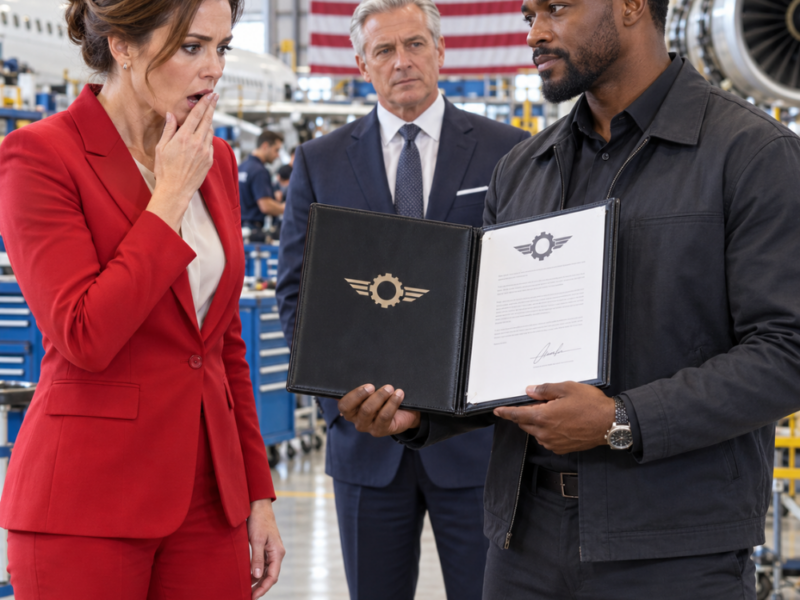
“You’re Too Slow!” CEO Fired the Black Single Dad Mechanic—14 Months Later, She Regretted It

“You’re too slow,” the CEO said before firing the mechanic—fourteen months later, she stood in the rain asking him to save the company
Claire Bennett laid the termination letter on the steel worktable without blinking.
“Effective immediately,” she said. “You’re done.”
The entire maintenance floor seemed to stop breathing.
Pneumatic tools fell silent one by one. Somewhere near Bay Six, a socket rolled across concrete, struck the leg of a tool cart, and spun in a slow metallic circle before falling flat. Seventeen mechanics looked anywhere except directly at the man standing in front of their new CEO.
Andre Walker held a pair of work gloves in one hand.
Twenty minutes earlier, those same hands had found a fracture that everyone else had missed.
He looked at Claire, then at the paper on the table.
“You’re firing me today?”
“I’m ending your employment because the performance problem has continued despite repeated discussions.”
Andre glanced toward the emergency-response vehicle behind them.
The thermal shield was still open.
Beneath it, visible only if someone knew where to look, a hairline fracture ran across a coolant coupling beside the high-voltage battery assembly. The crack had survived the standard pressure test. It had survived a twelve-minute inspection by one of Titan Mobility Systems’ fastest mechanics.
Under prolonged load, it would not have survived much else.
Andre looked back at Claire.
“I found a failure that would have shut that vehicle down in the field.”
“And I acknowledged that,” Claire said.
Her voice was calm. Measured. Executive calm. The kind that sounded reasonable because it never rose high enough to expose what sat underneath it.
“But one good catch does not erase eight months of missed productivity targets.”
No one moved.
Andre nodded once.
He had learned long ago that when a person had already reduced you to a number, arguing about the number usually gave them more confidence.
He placed his gloves on the hood of the nearest vehicle.
Then he walked toward his toolbox.
Behind him, Claire looked down at the report she had brought onto the floor.
Andre Walker. Maintenance Mechanic, Grade Three.
Average inspection time: 38.4 minutes.
Company standard: 20 minutes.
Team average: 19.6.
Ryan Mercer: 11.7.
Andre had been with Titan for eight months.
Claire had been CEO for three.
She was thirty-six years old, sharp, disciplined, and newly responsible for a company that manufactured electric emergency-response vehicles for state agencies, municipal fleets, and federal disaster programs. Titan had spent the previous two years missing production deadlines. Customers were threatening penalties. Investors wanted margins restored. The board wanted growth.
Claire had arrived with consultants, dashboards, efficiency metrics, and the conviction that most operational problems could be solved by measuring them accurately enough.
Andre’s work did not fit the dashboard.
That afternoon in Detroit, rain hammered the tall windows along the west wall and turned the parking lot outside into a gray sheet of reflected sky.
Ryan Mercer stood six feet away from Andre’s open toolbox.
At twenty-eight, Ryan had quick hands, excellent mechanical instincts, and the confidence of a man who had spent most of his career being praised for finishing first.
He had completed the vehicle inspection in eleven minutes and forty seconds.
He had also missed the fractured coupling.
Andre packed without hurrying.
Ratchets into their foam slots.
Meters into the upper drawer.
Reference gauges wrapped in cloth.
A flashlight whose casing was scratched from years of use.
A small flathead driver he kept for removing access covers nobody else bothered opening unless the checklist required it.
Claire watched him.
So did Samuel Grant, the maintenance supervisor.
Samuel was fifty-six and had worked at Titan for eleven years. He had read Andre’s full résumé when HR hired him. Not the one-page summary. The real document.
Seventeen years in mechanical reliability.
Military vehicle maintenance early in his career.
Private engineering consultancy.
Federal infrastructure contracts.
Published failure-analysis work.
A commendation from a national transportation program.
Samuel had known from the first month that Andre was overqualified for the job.
He had also understood why Andre wanted it.
Steady hours.
Health insurance.
No constant travel.
A daughter starting college.
A life that had already demanded enough unpredictability.
Samuel stood behind the supervisor station with one hand half raised.
He could interrupt.
He could tell Claire that Andre had once written reliability protocols used by organizations far larger than Titan.
He could explain that Andre’s “extra” inspection time was not laziness.
He could say that several of the quiet modifications Andre had made to his own inspection routine had already caught problems before they became repair orders.
Samuel looked at Claire.
Then at the report in her hand.
Then at the seventeen employees watching.
He lowered his hand.
That decision would follow him for fourteen months.
Andre closed the final drawer of his toolbox.
Before he turned toward the service door, he looked at Claire one last time.
“Someday,” he said, “somebody in this building is going to have to choose between being fast and being certain.”
The room stayed still.
Andre’s voice carried no anger.
That made the words land harder.
“I hope they choose right.”
Then he rolled his toolbox through the service entrance and into the rain.
The drive home took thirty-one minutes.
For four of them, Andre sat in his truck without starting the engine.
His 2009 Ford F-150 was parked at the far edge of Titan’s employee lot, where the rain struck the windshield hard enough to blur the building into a block of light.
He rested both hands on the steering wheel.
He had not cried since his wife’s funeral six years earlier.
He did not cry now.
But he sat there long enough for his breathing to change.
That counted for something.
Eventually, he turned the key.
The truck started with the old familiar vibration he could feel through the steering column.
He drove home.
Maya was in the kitchen when he walked through the door.
She was nineteen and had her mother’s eyes, which meant Andre rarely succeeded in pretending with her.
She looked at his toolbox.
Then at the bag over his shoulder.
Then at his face.
“Dad?”
“Hey, baby.”
“What happened?”
Andre removed his wet jacket and hung it on the hook beside the pantry.
“Got let go.”
Maya set down the spatula she had been holding.
“Let go?”
“Terminated.”
She stared at him.
“Why?”
Andre pulled out a chair at the kitchen table.
“They said I was too slow.”
For three seconds, Maya said nothing.
Then her expression changed.
“You found something today.”
Andre looked at her.
She knew him too well.
“How do you know that?”
“Because you have that face.”
“What face?”
“The one where you’re not angry because you’re too busy being disappointed in everybody.”
He almost smiled.
Maya folded her arms.
“What did you find?”
“A fractured coolant coupling.”
“Serious?”
“Could’ve shut down the battery system under extended load.”
“And they still fired you?”
“Yeah.”
“That’s insane.”
“Maya.”
“No, Dad. That’s insane.”
She sat across from him.
She was studying engineering at Wayne County Community College while working weekends at a restaurant downtown. Her books were stacked near the end of the kitchen counter, yellow sticky notes protruding from chapters on materials science and structural fatigue.
Andre had never encouraged her to follow his field.
He had wanted the choice to be hers.
She had chosen it anyway.
“What are we going to do?” she asked.
“We’re going to be fine.”
“Tuition is due again in March.”
“I know.”
“I can pick up more shifts.”
“No.”
“Dad.”
“No.”
She looked at him.
He knew that look too.
It had belonged to her mother first.
“I have contacts,” he said. “I have references. I’ll start calling tomorrow.”
“You shouldn’t have to start over because somebody doesn’t understand what you do.”
Andre leaned back.
“People misunderstand things every day.”
“That doesn’t make it okay.”
“No.”
“Then say you’re mad.”
He looked toward the dark kitchen window.
“I’m tired.”
Maya’s face softened.
“I made dinner.”
“I can see that.”
“Then eat.”
They ate chili at the kitchen table while the rain continued tapping against the back windows.
Andre asked about her classes.
She told him about a lab involving fatigue cracks in dissimilar metals.
He listened.
He always listened.
After dinner, Maya went upstairs.
Andre washed the bowls.
Then he opened a legal pad and began writing names.
Former colleagues.
Fleet managers.
Consultants.
Engineering directors.
People he had worked with in Ohio, Arizona, Nevada, Pennsylvania, and Virginia.
By the time he stopped, he had filled two and a half pages.
He sat with the list.
Then he walked into the garage.
At the back, beneath a workbench he had built from reclaimed oak, sat a gray steel case.
He had not opened it since before taking the Titan job.
Andre crouched and pulled it out.
The combination was still Maya’s birthday.
He opened the lid.
Inside were certificates, consulting credentials, old project photographs, technical papers, letters of recommendation, and one published article from the Journal of Mechanical Systems Reliability.
Lead author: Andre Walker.
Near the front sat a federal commendation recognizing his work on heavy-equipment reliability standards.
Most people on the Titan floor had never seen any of it.
Claire Bennett had not either.
Andre lifted a business card from the case.
Thomas Reed.
Mechanical Systems Consulting.
Phoenix, Arizona.
Thomas had known him for more than thirty years.
They had met in the Army, long before either man had gray in his beard.
Eighteen months earlier, when Andre told him he was taking a staff mechanic position at Titan, Thomas had laughed.
“You are going to lose your mind.”
“I need something steady.”
“You need something worthy of you.”
“My daughter’s starting college.”
“You have consulting work.”
“Consulting means airports.”
“Airports have coffee.”
“Bad coffee.”
Thomas had sighed.
“You’re overqualified.”
“I know.”
“Then why?”
Andre had looked toward Maya’s bedroom.
“Because steady matters right now.”
Thomas had understood.
He had not agreed.
Andre held the card for a while.
Then he put it back.
He closed the case.
Not yet.
The first applications went out the next morning.
Fleet garages.
Equipment dealers.
Municipal maintenance centers.
Industrial shops around Detroit.
Andre tailored every résumé.
He included the certifications.
The published work.
The federal consulting.
For the first week, he expected calls.
During the second, he began checking his phone too often.
By the third, the pattern was obvious.
Polite rejection.
Position filled.
Different candidate selected.
Thank you for your interest.
Eventually, the real explanation came through the informal network every trade has, the one that never appears in emails.
Titan Mobility had fired him for poor productivity.
That was the story traveling ahead of him.
Not that he had caught a fractured coupling.
Not that he had repeatedly questioned Titan’s shortened inspection procedures.
Not that he had seventeen years of reliability experience.
Just slow mechanic.
Terminated.
Poor performance.
The bills did what bills always do when income disappears.
They kept arriving.
Mortgage.
Electric.
Car insurance.
Tuition.
The furnace failed in February.
Nine hundred dollars.
His truck needed tires.
The back porch needed repair.
The dining-room window leaked cold air around the lower seal.
Andre postponed what he could.
Then he sold his motorcycle.
It was a 2003 Harley-Davidson Heritage Softail, black, meticulously maintained, bought before Maya was born.
He and his wife, Renee, had ridden it on weekends before illness turned weekends into appointments and pharmacy runs.
A man in Dearborn paid six thousand dollars.
The bike was worth more.
Andre needed the money that week.
He watched the buyer trailer it away.
Then he drove home and never mentioned it.
Maya noticed the empty space in the garage.
She did not mention it either.
One Tuesday night, close to midnight, she came downstairs and found Andre at the kitchen table.
“Dad?”
He looked up.
“You should be asleep.”
“So should you.”
“I’m working.”
“You’re staring at the same page.”
He put down his pen.
She sat across from him.
“I talked to financial aid.”
Andre’s face changed.
“No.”
“You don’t even know what I was going to say.”
“Yes, I do.”
“I could drop to half-time for one semester.”
“No.”
“I could work more hours.”
“No.”
“It would help.”
“You are not giving up school.”
“I wouldn’t be giving it up.”
“You would be delaying it because somebody misunderstood my value.”
Maya leaned back.
“Misunderstood your value?”
Andre looked at the list of unanswered contacts.
“Yes.”
“That’s what you think this is?”
“That’s what it is.”
“They made you feel disposable.”
Andre was silent.
Maya’s voice softened.
“They made you feel like all those years didn’t count because one spreadsheet said you took too long.”
He looked at her.
Renee had always been able to find the sentence he was avoiding.
Apparently that talent had survived in their daughter.
Andre folded the legal pad shut.
“I’m not letting it cost you your future.”
“And I’m not asking permission to help you.”
“I know.”
“Then don’t shut me out.”
He reached across the table.
“I’m not.”
She let him hold her hand.
After a moment, she said, “Okay.”
“Okay.”
She stood.
“Good night.”
“Good night, baby.”
Andre remained at the table another hour.
Then he went to the garage.
He opened the steel case.
He took out Thomas Reed’s business card.
This time, he carried it back inside.
Nine days later, Thomas called first.
The phone rang at 6:43 in the morning.
Andre had not yet started the coffee.
“I heard what happened,” Thomas said.
No hello.
No preamble.
Andre smiled faintly.
“You always this cheerful before seven?”
“Only when somebody I warned does exactly what I warned him not to do.”
“Good morning, Thomas.”
“Titan fired you.”
“Yes.”
“For being slow.”
“Yes.”
Thomas exhaled.
“I am trying very hard not to enjoy being right.”
“Try harder.”
“Fine. Banebridge Mining outside Tucson.”
Andre reached for the coffee maker.
“What about it?”
“Three drivetrain failures in eight months. Two engineering teams. No root cause.”
“You’re calling because?”
“They asked me to go.”
“And?”
“I’m tied up in Calgary.”
Andre stopped moving.
Thomas continued.
“I told them I knew somebody.”
Andre looked at the business card sitting beside the sugar jar.
“How long?”
“Two weeks. Maybe three.”
“Rate?”
Thomas told him.
Andre went quiet.
“Yeah,” Thomas said. “That’s why I called before you made coffee.”
Andre laughed once through his nose.
“I’ve been telling Maya we’re fine.”
“Are you?”
Andre looked at the overdue utility notice clipped to the refrigerator.
“Send me the contract.”
He flew to Tucson on a Sunday.
Banebridge’s mine sat forty miles outside the city, surrounded by desert so open that the industrial buildings looked temporary.
Five engineers met him in the operations office.
The lead was Eric Patterson, thirty-four, Stanford master’s degree, excellent reputation, and the strained confidence of someone who had spent months failing to solve a problem he believed should already be solved.
“So you’re Thomas Reed’s specialist.”
“That’s what he says.”
Patterson gestured toward binders.
“We’ve completed full component teardown. Our current theory is motor housing deformation.”
Andre did not touch the binders.
“Can I see the machines?”
“We can save you some time if we walk through the analysis first.”
“I’d rather see the machines.”
Patterson’s expression tightened.
“We’ve already done extensive physical inspections.”
“I know.”
“You haven’t read the reports.”
“I will.”
“Then what exactly are you looking for?”
Andre picked up his flashlight.
“I don’t know yet.”
He spent four hours on the floor.
For the first ninety minutes, he barely touched anything.
He walked around the failed units.
Crouched near axle assemblies.
Studied wear patterns on parts already removed.
Placed his palm against housings.
Read temperature logs.
Looked at shutdown sequences.
Opened access panels others had opened before.
Then opened two they had not.
Patterson finally approached.
“Are you planning to disassemble anything?”
“I’m looking.”
“You’ve been looking for hours.”
Andre glanced up.
“When a patient describes pain, do you interrupt halfway because you’ve already decided what the diagnosis is?”
“I’m a mechanical engineer.”
“I know.”
Andre turned back to the drivetrain.
“I’m listening.”
The answer came at 11:40 that night.
Not from a broken component.
From a supplier change record.
Seven months earlier, Banebridge had changed bearing-sleeve manufacturers.
The new part met the written specification.
Same dimensions.
Same rated load.
Same tolerance range.
On paper, equivalent.
In Arizona, under repeated heavy operational cycling, not equivalent.
The replacement alloy expanded differently under heat.
The difference was measured in thousandths of an inch.
One cycle meant nothing.
Fifty created measurable shift.
Hundreds slowly moved the bearing assembly off center until lateral load began tearing the drivetrain apart from inside.
Andre checked the failure dates.
Then the cycle counts.
First breakdown: cycle 437.
Second: 451.
Third: 460.
He wrote until after two in the morning.
Thomas replied to the report at 2:49.
Of course it was the bearing sleeve.
Andre typed:
Long enough, Thomas.
The next morning, Patterson challenged the conclusion.
“The differential you’re describing is three-thousandths of an inch.”
“Yes.”
“That’s within tolerance.”
“Under one standard thermal cycle.”
Patterson pointed at the report.
“You’re saying cumulative drift.”
“I’m saying your machines operate through sixty-degree temperature swings between startup and peak load. Two shifts a day. Hundreds of cycles since the supplier change.”
He slid a page across the table.
“Look at your failures.”
Patterson read.
Andre watched his expression slowly change.
“The first failure occurred seventeen cycles after your calculated threshold.”
“Yes.”
“The second thirty-one.”
“Yes.”
“The third forty.”
“Yes.”
Patterson sat back.
“How did our team miss this?”
Andre considered the answer.
“You were looking for a bad part.”
Patterson waited.
“I was looking for a good part in the wrong environment.”
Two days later, Patterson was bringing coffee to Andre’s temporary office.
By Day Eleven, the machines were running.
Banebridge paid the contract.
Then they asked Andre to stay another week.
He declined.
He wanted to go home.
At the airport, he called Maya.
“Fixed it.”
“What was it?”
He explained.
She listened.
Then said, “We literally covered thermal expansion in materials last week.”
“I know.”
“Dad.”
“What?”
“You could teach this.”
“No.”
“You just taught five engineers.”
“That’s different.”
“How?”
Andre had no useful answer.
He got home after midnight.
Maya had made chili.
He slept eight uninterrupted hours for the first time since Titan fired him.
The next morning, Thomas called again.
“Patterson used the word extraordinary.”
“That sounds unlike him.”
“He never uses adjectives.”
Andre poured coffee.
“What do you want?”
“Memphis.”
“What about Memphis?”
“Cargo equipment company. Drivetrain problem.”
Andre sighed.
“Thomas.”
“Also Columbus.”
“Thomas.”
“And Gary.”
“Stop.”
Thomas laughed.
“One at a time.”
Andre went to Memphis.
Then Columbus.
In Columbus, the municipal fleet’s recurring electrical fault took four days.
A grounding defect was intermittently masked by resistance fluctuation in a secondary circuit. The diagnostic system never saw the problem long enough to classify it correctly.
Ernie, the fleet center’s lead technician, watched Andre work.
On the fourth morning, he said, “I’ve been doing this thirty years.”
Andre kept tracing the circuit.
“Congratulations.”
“I’ve never seen anybody work the way you do.”
Andre looked at him.
“Meaning?”
“You don’t hurry.”
“No.”
“But you don’t waste time either.”
Andre sat back.
“When I was in the Army, one of my sergeants said, ‘Slow is smooth. Smooth is fast.’”
Ernie nodded.
“That’s exactly it.”
In Gary, Indiana, Andre found an advanced bearing failure in six hours.
The plant manager estimated the avoided downtime at $4.6 million.
Andre’s invoice was a fraction of that.
By spring, facility managers were passing his name around.
Not on social media.
Not in magazine profiles.
Through phone calls.
Emails.
Coffee.
“Guy in Detroit you should know.”
His rates increased.
He repaired the porch.
Replaced the leaking window seal.
Paid Maya’s tuition.
The furnace invoice disappeared from the counter.
The nervous habit of checking his banking app every ten minutes disappeared with it.
Then came Cincinnati.
Forty-seven cargo vehicles.
Recurring hydraulic pressure losses.
Three service companies had already investigated.
Andre found the cause in four days.
A manufacturer had changed the internal geometry of a pressure valve but failed to update the installation torque specification.
Nothing was technically broken.
Everything had been assembled according to an outdated instruction.
Under heavy load, microscopic leakage accumulated until pressure collapsed.
Patricia Chen, the company’s operations director, watched Andre explain the finding.
“So speed created the blind spot,” she said.
Andre took a sip of coffee.
“Speed always creates blind spots.”
“That sounds like an argument against efficiency.”
“No.”
He looked toward the row of vehicles.
“It’s an argument for knowing what efficiency costs.”
Patricia studied him.
“Who are you?”
“A reliability consultant.”
“That’s not what I meant.”
Andre smiled faintly.
“It’s enough.”
Three days later, Patricia found him near Bay Nine.
She held out a business card.
“This is from Warren Ellis.”
Andre read it.
Federal Infrastructure Reliability Program.
Deputy Director of Equipment Standards.
“He wants to talk,” Patricia said.
“I’m not looking for a federal job.”
“He’s not offering one.”
“What does he want?”
“Independent review work. Heavy emergency-response equipment.”
Andre looked at her.
“What kind?”
“The kind made by companies like Titan Mobility.”
For several seconds, neither spoke.
Andre slid the card into his shirt pocket.
“Tell him I’ll call.”
He waited six days.
Then he did.
Warren Ellis answered immediately.
“Mr. Walker.”
“Mr. Ellis.”
“Patricia Chen speaks highly of you.”
“She runs a good operation.”
“She says you’re the only consultant she’s hired who didn’t start by asking who was responsible.”
Andre looked out the kitchen window.
“Blame doesn’t repair equipment.”
“That’s why I called.”
Ellis explained the program.
Federal agencies were preparing to expand electric emergency-response fleets for wildfire, flood, hurricane, and infrastructure operations.
The concern was reliability under extreme conditions.
High heat.
Cold.
Water.
Sustained load.
Repeated thermal cycling.
“Commercial certification tells us what happens in normal use,” Ellis said. “We need somebody who asks what happens when normal stops being relevant.”
Andre understood immediately.
“That will create uncomfortable reports.”
“I hope so.”
“One condition.”
“Name it.”
“My findings go into the final report exactly as I write them.”
A pause.
“Agreed.”
“No editing because a contractor gets nervous.”
“Agreed.”
“No political softening.”
“Agreed.”
Andre leaned back.
“Send the paperwork.”
By summer, he was consulting across the Midwest and Southwest and doing quarterly federal reviews.
At Maya’s insistence, he enrolled in a technical-writing class at Wayne County Community College.
He was the oldest student in the room.
On his first major assignment, Professor Nneka Okafor read his analysis twice.
“Mr. Walker.”
“Yes?”
“How long have you been writing technical reports?”
“Seventeen years.”
She looked over her glasses.
“This should be submitted for publication.”
“I’m not an academic.”
“That has nothing to do with whether this is publishable.”
Maya agreed.
Naturally.
His paper was accepted in August.
She framed it.
He protested.
She ignored him.
The article hung in the hallway outside the kitchen.
Andre saw his name every morning.
In September, fourteen months after Claire Bennett fired him, the phone rang.
Detroit area code.
He answered.
“Mr. Walker, this is Samuel Grant.”
Andre went still.
“I remember you.”
Samuel swallowed on the other end.
“I need to talk to you.”
“About?”
“Titan.”
Andre looked at the framed journal article.
Samuel took a breath.
“We have a problem.”
He spoke for twelve minutes.
Andre interrupted only once.
Two Guardian HX9 emergency-response vehicles had suffered catastrophic drivetrain shutdowns during a federal endurance demonstration.
Certification was suspended.
Titan had ten days to identify the cause.
If it failed, the company could lose a contract worth nearly nine hundred million dollars.
There were thirty-one HX9 units tied to the program.
Three engineering teams had already reviewed the failures.
No root cause.
Andre listened.
When Samuel finished, Andre said, “You know I left Titan under difficult circumstances.”
“I know.”
“You were there.”
“Yes.”
“You were quiet.”
Four seconds passed.
“Yes.”
Samuel’s voice had changed.
“I think about that.”
Andre said nothing.
“I’m not asking you to forgive me. I’m asking you to let me show Claire your full file. The one she should have read before she fired you.”
Andre looked toward the kitchen.
“Show her.”
Claire called two days later.
No assistant.
No attorney.
Her personal number.
Andre let it ring three times.
“Mr. Walker.”
“Ms. Bennett.”
Silence.
“I owe you an apology.”
Andre looked outside.
The maple tree in his yard had begun turning orange.
“You owe me several things.”
Claire did not defend herself.
“Yes.”
“An apology is the cheapest.”
Another pause.
“That’s fair.”
He waited.
She explained the HX9 crisis.
Two failed units.
Federal certification frozen.
Nine hundred million dollars at risk.
Supplier agreements.
Hundreds of jobs.
Ten days.
“We need you,” she said.
Andre looked at the framed photograph of Maya and Renee on the kitchen shelf.
“No.”
Claire exhaled.
“Mr. Walker—”
“Not yet.”
Silence.
“I want you to listen.”
“All right.”
“Fourteen months ago, you watched me work for less than an hour. You looked at a productivity sheet and decided you knew what I was worth.”
Claire said nothing.
“You never asked about my background. You never asked why I worked the way I did. You never asked why my inspection time was longer.”
Andre kept his voice level.
“The number told you everything you wanted to know.”
Claire breathed quietly.
“I spent three months after that unable to find work because the only story traveling ahead of me was that Titan’s slowest mechanic had been fired for poor performance.”
“Mr. Walker—”
“I sold my motorcycle.”
She stopped.
“My daughter almost offered to leave school.”
“I didn’t know.”
“No.”
Andre looked through the window at his truck.
“You didn’t know because you never thought you needed to.”
That silence was different.
When Claire spoke again, the polished CEO voice was gone.
“You’re right.”
“Being wrong is easy.”
Andre folded one hand over the other.
“Changing what made you wrong is harder.”
“I know.”
“I’ll think about helping.”
“Thank you.”
“Don’t thank me. I haven’t said yes.”
Maya came home that afternoon.
She knew something had happened before Andre spoke.
“Titan called.”
Her backpack slipped from her shoulder onto the kitchen chair.
“Claire Bennett?”
“Yes.”
“What does she want?”
Andre explained.
When he reached the nine-hundred-million-dollar figure, Maya did not react.
When he told her about the thirty-one vehicles, she did.
“Emergency vehicles?”
“Yes.”
“What are they used for?”
“Flood response. Wildfires. Infrastructure emergencies.”
“And they don’t know why they’re failing?”
“No.”
She sat across from him.
“Are you going?”
Andre looked at his hands.
“I keep thinking about the guys on that floor.”
“Not Claire.”
“No.”
“The workers.”
“Yeah.”
“And the people those vehicles are supposed to reach.”
Andre nodded.
Maya watched him.
“You don’t have to save Claire Bennett.”
“I know.”
“You don’t have to prove anything.”
“I know.”
“So what’s the actual question?”
Andre looked at her.
“Can I walk away knowing those vehicles might fail because the person asking for help is the person who humiliated me?”
Maya’s voice was quiet.
“Can you?”
Andre knew the answer.
“No.”
Two mornings later, Samuel sent photographs.
Seventeen images from the failed HX9 units.
Andre sat at the kitchen table at 6:40 a.m. and enlarged them one by one.
Image eleven stopped him.
A faint deformation pattern around the rear torque-transfer housing.
Almost invisible.
Andre enlarged it again.
Thermal mismatch.
He had seen the signature before.
Arizona.
Gary.
Failure-analysis case studies.
Two materials expanding at different rates through repeated heat cycles.
He called Samuel.
“The torque-transfer housing.”
Samuel answered on the first ring.
“You see it?”
“Tell me about supplier changes.”
Silence.
“Six months after you left, procurement approved a new coupling.”
“Material?”
“Cast replacement. Lighter. Cheaper.”
“Original?”
“Forged.”
“Who approved the change?”
Samuel hesitated.
“The procurement committee. Under Claire’s efficiency initiative.”
“Thermal-cycle testing?”
“Standard exposure test.”
“Repeated extreme cycling?”
“No.”
Andre closed his eyes.
“I submitted internal notes about that protocol.”
“I found them.”
“Where?”
“Archived under your termination file.”
Andre opened his eyes again.
The irony almost felt too precise.
“Send me both material specifications.”
He had confirmation twenty minutes after receiving them.
Original forged coupling: uniform alloy behavior.
Replacement: two-part cast construction with different alloys at the interface.
Thermal expansion differential small enough to disappear in ordinary operating conditions.
Large enough, over hundreds of extreme cycles, to move the drivetrain out of alignment.
He called Claire.
She answered immediately.
“I know what it is.”
Silence.
Then, “Tell me.”
He did.
When he finished, she said, “How bad?”
“Thirty-one vehicles?”
“Yes.”
“Ground all of them.”
“That’s going to—”
“All of them.”
Claire stopped herself.
Andre continued.
“You may have more depending on production date.”
“We have two in assembly.”
“Stop the line.”
Silence.
“Okay.”
“I’m not done.”
Claire waited.
“I’ll come in under conditions.”
“Name them.”
“I control the investigation.”
“Yes.”
“No imposed deadline inside the ten-day federal window.”
“Yes.”
“I get every supplier record, every procurement decision, every test result, every archived note.”
“Yes.”
“Nobody overrides a safety call because of cost.”
“Yes.”
“Every person on the investigation team can stop work if they see something they believe is unsafe.”
A pause.
“Yes.”
“And Ryan Mercer works with me.”
Claire sounded genuinely surprised.
“Ryan?”
“Yes.”
“Why?”
“Because he’s fast.”
“That’s exactly why—”
“Fast is useful.”
Andre looked at the old legal pad still stored in a kitchen drawer.
“He just has to learn when fast stops being useful.”
Claire was quiet.
“All right.”
“One more thing.”
“Yes?”
“If I arrive tomorrow and one HX9 is still operational, I leave.”
“They’ll be grounded.”
“Seven a.m.”
“We’ll be ready.”
Andre hung up.
Then he called Thomas.
“I’m going back to Titan.”
Silence.
“How long?”
“As long as it takes.”
Thomas sighed.
“You don’t owe them anything.”
“No.”
“Then why?”
“Thirty-one emergency-response vehicles.”
Thomas understood.
“I’ll come up from Columbus.”
“You don’t need to.”
“I know.”
“Thomas.”
“I’ll bring coffee.”
Andre smiled.
“Seven-thirty.”
He called Maya last.
“I’m going back.”
“I know.”
“How?”
“Dad, I’ve known you my entire life.”
She laughed softly.
“You were going back the minute Samuel called.”
“I have conditions.”
“Of course you do.”
“Maya.”
“Go fix their machines.”
Andre walked into the garage.
He opened the steel case.
He looked at every document inside.
Then closed it.
He did not take the certificates.
He did not take the commendation.
He did not take the journal article.
He took his toolbox.
The dented one.
The one Claire had watched leave through the rain fourteen months earlier.
At 6:53 the next morning, Andre parked outside Titan Mobility Systems.
Seven minutes early.
The building had not changed.
Same gray walls.
Same loading docks.
Same row of employee parking.
Same service door.
Andre sat in his truck and gave himself one minute before going inside.
At 7:29, Thomas arrived with two coffees.
“You ready?”
Andre looked at the building.
“The answer is in there.”
“That was not my question.”
“It’s my answer.”
Claire was waiting in the lobby.
She looked older than fourteen months should have made her.
Not physically.
In the way responsibility can age a person once certainty fails.
She extended her hand.
Andre shook it.
“Thank you for coming.”
“Vehicles?”
“All thirty-one grounded.”
“Assembly line?”
“Stopped on the two additional units.”
Andre nodded.
“Then we work.”
Samuel stood near the maintenance entrance.
When he saw Andre, guilt and relief crossed his face together.
He offered his hand.
Andre looked at it.
Then shook it.
“The records?”
“Conference room.”
“Everything?”
“Everything I could access.”
“Good.”
They entered the maintenance floor.
Several mechanics looked up.
Some recognized Andre immediately.
One stopped tightening a wheel assembly.
Another lowered his coffee.
The room shifted around him.
Then Andre saw Ryan.
Ryan stood beside a tool cart.
Their eyes met across the floor.
For three seconds, neither man moved.
Ryan no longer looked like the same twenty-eight-year-old who had laughed about Andre retiring beneath a truck.
Something quieter lived under the confidence now.
Andre did not approach him.
Not yet.
He entered the conference room.
Files covered two tables.
Supplier reports.
Production logs.
Heat-cycle data.
Procurement approvals.
Inspection histories.
Andre sat.
He read for ninety-four minutes without speaking.
Claire waited outside.
At one point, Samuel started to ask whether Andre needed anything.
Thomas shook his head.
“No.”
“How long is he going to—”
“As long as it takes.”
At 8:27, Andre closed the last folder.
“Supplier change occurred six weeks after I was fired.”
Samuel nodded.
“The procurement approval includes Claire’s authorization.”
“Yes.”
“My three safety notes were submitted before termination.”
“Yes.”
“And they were archived with my personnel file after I left.”
Samuel looked down.
“Yes.”
“So the safety warnings disappeared because the person who wrote them was classified as a performance problem.”
No one answered.
Andre stood.
“Let’s inspect.”
The first three HX9 units showed the same pattern.
Coupling deformation.
Alignment drift.
Thermal mismatch.
Andre measured each at three points.
Then requested the full production run.
Samuel brought it.
Thirty-three vehicles had the cast coupling.
Thirty-one completed.
Two in assembly.
All affected.
The production manager arrived while Andre was examining the log.
“Stopping those final two units will cost us—”
“Stop them,” Claire said.
“Ms. Bennett—”
“Stop the line.”
He looked at her.
Then at Andre.
Then left.
Thomas leaned closer.
“That was different.”
Andre said nothing.
By 10:14, they had inspected six units.
Ryan approached.
“I want to help.”
Andre looked at him.
“You know why I’m here?”
“Yes.”
“You know what happened fourteen months ago?”
Ryan swallowed.
“I cleared a vehicle in eleven minutes and forty seconds.”
Andre waited.
“You found a fracture I missed.”
“Yes.”
“And I made fun of you for taking too long.”
Andre said nothing.
Ryan met his eyes.
“I was wrong.”
Andre handed him a deformation gauge.
“Vehicle Seven.”
Ryan blinked.
“That’s it?”
“What do you want, a ceremony?”
“No.”
“Then measure three points and call the readings.”
Ryan crouched.
He worked quickly.
Then stopped.
Repositioned the gauge.
Checked again.
He called the numbers.
Andre verified them.
“You weren’t wrong because you were fast,” Andre said.
Ryan looked up.
“You were wrong because you thought fast meant finished.”
Ryan absorbed that.
Then Andre explained thermal expansion.
Two alloys.
Repeated cycling.
Cumulative drift.
A failure that did not exist at Cycle One but became inevitable by Cycle Four Hundred.
Ryan stared at the housing.
“That’s what you were checking in those extra twenty minutes.”
“Some of it.”
“All those months.”
“Yes.”
Ryan looked down.
“I owe you an apology.”
“You owe yourself better habits.”
Andre pointed toward Vehicle Eight.
“Move.”
They did.
At 1:03, Samuel found the first truly frightening piece of evidence.
Vehicle Fourteen had forty-three more thermal cycles than its production history suggested.
Andre requested the predeployment record.
Samuel returned with it.
His face had gone pale.
“There was a thermal management flag.”
“When?”
“Three days before final clearance.”
“What happened?”
“It was marked resolved.”
“By who?”
Samuel handed him the page.
Ryan Mercer.
Ryan was standing nearby.
He looked at the signature.
“I remember it.”
Andre waited.
“The supplier rep said it was a sensor calibration issue.”
“Did you independently verify the system?”
Ryan did not answer immediately.
Andre did not rescue him from the silence.
Finally:
“No.”
“Why?”
“Delivery deadline.”
Andre nodded once.
Not approval.
Recognition.
Vehicle Fourteen went to Bay Three.
Andre spent twenty-two minutes inspecting it.
Then he stood.
“This unit is critical.”
Claire stopped breathing.
“The fatigue progression is much further advanced than the others.”
“How far?”
“Under field conditions?”
“Yes.”
“Three to five operational days.”
Claire stared.
“Before what?”
Andre looked at her.
“Structural failure.”
The bay went quiet.
“Not a protective shutdown?”
“No.”
“A physical drivetrain failure under load?”
“Yes.”
Claire looked toward the line of grounded vehicles.
“These were scheduled for spring response deployment.”
“I know.”
“Four weeks.”
“I know.”
The CFO arrived twenty minutes later.
He carried a tablet and the expression of a man whose entire job had become a very large negative number.
“We need to discuss restricted deployment.”
“No,” Andre said.
The CFO looked at him.
“With respect, Mr. Walker, financial and operational decisions ultimately belong to—”
“These vehicles were built for wildfire and flood response.”
“Yes, but if we limit them to moderate—”
“Then they can’t do the job they were purchased to do.”
The CFO opened his mouth.
Andre held up Vehicle Fourteen’s report.
“This one would fail structurally within days under extreme deployment.”
The CFO stopped.
Andre’s voice stayed quiet.
“You have two choices. Explain today why you grounded unsafe rescue vehicles, or explain later why you sent them into a disaster after your own reliability investigation told you not to.”
Claire looked at the CFO.
“They stay grounded.”
He stared at her.
“The board will push back.”
“I know.”
“The contract exposure—”
“I know.”
He looked at Andre.
Then back to Claire.
“I’ll schedule the board call.”
The inspections continued.
Andre expanded the team.
He trained each mechanic before letting them touch a vehicle.
Not because they lacked skill.
Because they needed to know what they were looking for.
Torres, a twenty-four-year-old mechanic with eight months at Titan, called out an abnormal reading on Vehicle Nineteen.
Andre checked it.
“Good catch.”
Torres looked startled.
Andre noticed.
“When a number feels wrong, say it.”
“Yes, sir.”
“You don’t need permission to notice.”
Torres nodded.
By evening, all thirty-three vehicles showed the same core defect.
Four were already advanced.
Vehicle Fourteen was critical.
Andre drafted a repair protocol.
Replace cast couplings with the original forged specification.
Check housing deformation.
Verify alignment.
Run thermal-cycle testing under simulated extreme conditions.
Two-person signoff on every repair.
No exceptions.
Claire asked the question every CEO eventually had to ask.
“How long?”
“Eight days.”
“Our federal deadline is ten.”
“I know.”
“Can you do it?”
Andre looked at the vehicles.
“If we do it correctly.”
Claire did not ask him to go faster.
That mattered more than either of them said.
The next morning, Andre arrived early.
Ryan was already there.
He stood beside Vehicle Fourteen.
“You’ve been thinking,” Andre said.
“All night.”
“Good.”
Ryan looked at the housing.
“If Samuel hadn’t called you…”
“He did.”
“If you hadn’t come…”
“I did.”
“If this deployed…”
Andre stopped him.
“Don’t build your life around sentences that start with ‘if.’”
Ryan looked at him.
“Build it around what you do next.”
Andre handed him a wrench.
“You’re with me.”
The work settled into rhythm.
Remove.
Measure.
Replace.
Verify.
Document.
Repeat.
Slow is smooth.
Smooth is fast.
By Day Two, the CFO returned.
He suggested reducing two-person verification on lower-risk units.
Claire said no before Andre had to.
“The board will want justification.”
“Tell them I made the decision.”
“Claire—”
“No.”
The CFO stared.
She turned toward him.
“You can tell the board Titan will not trade verification for schedule. If they want to remove me over that, they can call a vote.”
Andre continued tightening the fixture in front of him.
But he heard.
Being wrong is easy.
Changing what made you wrong is harder.
Claire had listened.
Day Three brought a second failure mode.
Vehicle Twenty-Two passed the coupling repair but produced asymmetric heat distribution.
Andre stopped the team.
For forty minutes, he said almost nothing.
Ryan waited.
Thomas waited.
Torres waited.
No one complained.
At Minute Thirty-Eight, Andre found secondary deformation in the housing seam.
Minor.
Not dangerous under certification testing.
Dangerous under forty-plus hours of extreme continuous service.
Thomas looked at him.
“The federal test is twelve hours.”
“Yes.”
“So this could pass certification.”
“Yes.”
“And still fail in the field.”
Andre nodded.
Three vehicles required expanded repairs.
Housing reinforcement.
Additional thermal checks.
New documentation.
The schedule tightened.
No one suggested skipping steps.
On Day Five, Warren Ellis called.
“Your deadline remains Day Ten.”
“I know.”
“We can request an extension if you tell me now you need one.”
Andre looked at the work chart.
Thirty-three vehicles.
Three secondary repairs.
Two teams.
He calculated.
“Ten days.”
“You’re certain?”
“No.”
Ellis went quiet.
Andre continued.
“I’m confident in the protocol and the people. Certainty comes after the test.”
Ellis laughed softly.
“That may be the most reassuring answer I’ve heard this week.”
Andre split the team into parallel repair tracks.
Thomas led one.
Andre the other.
Torres worked with Thomas.
Ryan worked with Andre.
They gained a day and a half without removing a single verification step.
That was the difference Andre had tried to explain fourteen months earlier.
Efficiency was not speed.
Efficiency was doing exactly what mattered and nothing that did not.
Day Seven changed the investigation again.
A materials engineer named Quan brought Andre a supplier bulletin.
Dated eight months earlier.
The manufacturer of the cast coupling had documented a known thermal expansion concern under repeated extreme cycling.
The notice had been sent to Titan.
Andre read the distribution list.
Procurement committee.
He found Claire.
She was in the conference room.
He placed the bulletin in front of her.
She read.
Her face changed.
“We received this.”
“Yes.”
“Eight months ago.”
“Yes.”
“And nobody escalated it.”
“No.”
She sat down.
The room remained quiet.
Andre let her think.
Finally, Claire said, “I have to send this to Ellis.”
“Yes.”
“This expands the federal review.”
“Yes.”
“This could trigger penalties.”
“Yes.”
Her hand rested on the paper.
“I could wait until after certification.”
Andre looked at her.
“You could.”
She raised her eyes.
“But then I’d be hiding it.”
“Yes.”
Claire picked up her phone.
“I’m calling him now.”
Andre turned toward the door.
“You’re not staying?”
“No.”
“Why?”
“You don’t need me in the room to do the right thing.”
He went back to work.
Day Eight.
Day Nine.
The final repairs finished.
Thirty-three couplings replaced.
Three housing seams reinforced.
Every measurement documented.
Two signatures on every vehicle.
Ryan’s inspections no longer took eleven minutes.
They did not take forty either.
He had learned where speed was useful and where it was dangerous.
On Vehicle Thirty-One, Ryan checked the housing twice.
Andre watched.
“Why’d you repeat that reading?”
“It was inside tolerance.”
“I know.”
“But not consistent with the previous unit.”
Andre nodded.
“So?”
Ryan repositioned the gauge.
“The number isn’t wrong. The pattern is.”
Andre smiled slightly.
“Now you’re looking.”
Day Ten arrived cold and clear.
Federal inspectors reached the gate at seven.
Warren Ellis came with them.
They chose Vehicle Fourteen for certification.
The worst unit.
The one with forty-three extra thermal cycles.
The one Ryan had once signed off without verifying.
The one that would have failed first.
“If Fourteen passes,” Andre said, “we know the repair protocol holds under the worst documented progression.”
Inspector Caldwell walked around the vehicle three times.
Andre liked her immediately.
She did not talk while she looked.
The twelve-hour endurance test began at 8:17 a.m.
Full load.
Repeated cycling.
Thermal monitoring.
Alignment checks every two hours.
Heat mapping every four.
Two hours.
Clean.
Four hours.
Clean.
Six.
Clean.
At eight hours, Caldwell approached Andre.
“Point Seven is reading one-point-three degrees above projection.”
Andre looked at the tablet.
Within tolerance.
Above expected trend.
“Give me twenty minutes.”
“Why?”
“Because I need to know whether it’s an anomaly or a consequence of the secondary repair.”
Caldwell considered.
“Twenty.”
Andre crouched beside Vehicle Fourteen.
The maintenance floor grew silent.
Fourteen months earlier, silence on that floor had meant people were waiting to see him fail.
Now it meant they understood he was working.
Andre measured the seam.
Then a point outside the standard monitor grid.
Then another.
He stood.
“The temperature is bleed from the reinforced housing seam. The reinforcement material conducts slightly more heat into the sensor zone.”
Caldwell frowned.
“And the drivetrain?”
“Nominal.”
“Coupling?”
“Stable.”
“Alignment?”
“Unchanged.”
Andre handed her the gauge.
“Check it.”
She did.
Returned.
Entered a note on her tablet.
“Continue.”
The room exhaled.
Ten hours.
Eleven.
Twelve.
At 8:21 p.m., four minutes beyond the required endurance time, Caldwell reviewed the final log.
Then she looked at the team.
“Pass.”
No one shouted.
That was not this kind of place anymore.
But people clapped.
Torres laughed.
Samuel sat down and covered his face with both hands.
Ryan stood motionless beside Andre.
After a moment, he asked, “How did you know Point Seven wasn’t the coupling?”
Andre looked toward Vehicle Fourteen.
“Because the coupling wasn’t telling me that.”
Ryan smiled.
“Machines talk.”
“They do.”
“How long does it take to learn the language?”
Andre thought about seventeen years.
About federal sites.
Arizona.
Cincinnati.
Detroit.
About mistakes.
About the Harley.
About Renee.
About Maya.
“A while.”
Ryan waited.
Andre added, “Start now.”
Ellis shook Andre’s hand.
“Outstanding work.”
“Outstanding team.”
“I want you involved in the supplier-notification review.”
“Send me the scope.”
“That’s all?”
“That’s all.”
At 11:40 that night, the facility was nearly empty.
Andre was packing his toolbox.
Claire stood several feet away.
“I have an offer.”
Andre continued putting tools into their slots.
“No.”
She almost smiled.
“You don’t know the offer.”
“I know enough.”
“Senior vice president of reliability and safety. Executive compensation. Staff of twelve. Full authority over—”
“No.”
Claire nodded slowly.
“I expected that.”
Andre closed one drawer.
“Then why ask?”
“Because I had to.”
He looked at her.
Claire put her hands in her jacket pockets.
“What do you want?”
Andre leaned against the toolbox.
“An independent reliability and safety division.”
She waited.
“Separate from production.”
“Yes.”
“Separate from finance.”
Claire’s eyebrows lifted.
Andre continued.
“Authority to stop a production run, delivery, deployment, or certification sequence when a legitimate safety concern exists.”
“The board will have concerns.”
“Of course.”
“Anything else?”
“Any mechanic, technician, or engineer can call a stop if they see something unsafe without needing a supervisor to protect them from retaliation.”
Claire said nothing.
“Two-person verification stays.”
She nodded.
“The productivity quota system goes.”
Another nod.
“Accuracy, reliability, and verified outcomes matter more than units per hour.”
“Yes.”
“Ryan gets training.”
That surprised her.
“Ryan?”
“He has good instincts.”
“He missed the original coupling.”
“And then he learned.”
Andre looked toward the empty bays.
“Punishment is not the same thing as development.”
Claire considered.
“What role do you want?”
“Outside director. Quarterly review. I keep my consulting business.”
“Your schedule?”
“My schedule.”
She nodded.
“Done.”
Andre reached for the toolbox handle.
“Claire.”
She looked at him.
“I don’t need you to feel guilty for the rest of your career.”
Her expression changed.
“That’s not useful.”
He continued.
“But I need you to understand what went wrong.”
“I fired the wrong person.”
“No.”
She frowned.
Andre shook his head.
“That’s the easy explanation.”
“What’s the harder one?”
“You built a culture where the worst possible thing a person could be was slow.”
Claire looked away.
“You optimized everything around time.”
“Yes.”
“You never asked what the extra time was protecting.”
She was quiet.
“And when somebody didn’t fit the system, you assumed the person was the defect.”
Claire leaned against the table.
“That’s exactly what I did.”
“You shortened inspection times.”
“Yes.”
“You created an environment where the warning notes of the person who challenged those times could disappear into a termination file.”
“Yes.”
“You made speed look like excellence.”
Claire looked across the empty floor.
“For years.”
“Yes.”
“And silence looked like incompetence.”
Andre met her eyes.
“Yes.”
She swallowed.
“I read your three internal notes.”
Andre waited.
“They were clear.”
He said nothing.
“They were specific.”
Still nothing.
“They were right.”
Claire folded her arms.
“And I never read them because I had already decided what kind of employee wrote them.”
Andre picked up the toolbox handle.
“Now you know.”
She nodded.
He started toward the service entrance.
“Andre.”
He stopped.
“What should the division be called?”
He looked back.
“You want me to name it?”
“You built the idea.”
Andre thought for a moment.
“The Listening Division.”
Claire’s expression softened.
“Why?”
“Because that’s what reliability is.”
He nodded toward the dark maintenance bays.
“Listening before the machine has to say something loud enough for everybody to hear.”
He walked outside.
The night air was cold.
Detroit winter was close.
Fourteen months earlier, Andre had stood in the same parking lot under heavy rain with no job and no idea how he would pay spring tuition.
Now his phone rang before he could reach the truck.
Maya.
“Well?”
“Pass.”
A sharp breath came through the phone.
“The whole thing?”
“Twelve hours. Clean.”
“Dad.”
He smiled.
“Yeah.”
“Are you okay?”
Andre stood beside the truck.
The question made him look back at Titan.
At the service entrance.
At the building that had misjudged him.
At the building he had just helped save.
He thought about Thomas calling before sunrise.
About Patterson in Arizona.
Ernie in Columbus.
Patricia Chen in Cincinnati.
Torres calling out an odd reading.
Ryan slowing down long enough to see.
Samuel finally raising the hand he should have raised fourteen months earlier.
Claire telling her own board no.
“Yeah,” Andre said.
“Come home.”
“What’d you make?”
“Chili.”
He laughed.
“Of course you did.”
Three months later, a Guardian HX9 deployed during spring flooding in southern Michigan.
Cold rain.
Standing water.
Extended load.
Twenty-two hours of continuous operation.
No drivetrain anomalies.
Stable temperature.
Stable alignment.
The rescue crew returned safely.
That same month, Andre stood at the front of a classroom at Wayne County Community College.
Twenty-three students watched him write four words on the board.
Slow is smooth.
Smooth is fast.
He turned.
“This is not a class about moving slowly.”
A few students glanced at one another.
Andre set down the marker.
“It’s a class about knowing the difference between movement and progress.”
He pointed toward a drivetrain assembly mounted on a teaching stand.
“Most machines do not fail suddenly.”
He walked closer.
“They warn you.”
One student raised a hand.
“How?”
“Temperature.”
Another.
“Vibration?”
“Yes.”
“Wear patterns?”
“Yes.”
“Noise?”
“Yes.”
Andre nodded.
“Data. Alignment. Repeated small deviations. Changes in behavior that fall inside normal tolerance individually and tell you something completely different when you understand the relationship between them.”
He leaned against the desk.
“The problem is not that machines don’t communicate.”
The room had become quiet.
“The problem is that people are often moving too fast to hear them.”
Students began writing.
Andre looked around the classroom.
A young man in the second row reminded him of Ryan.
Too confident.
Too eager.
Fast hands.
Maybe one day that young man would save somebody because he learned when to slow down.
A woman near the window had highlighted half her textbook.
She reminded him of Diaz in Arizona.
Andre smiled.
“Your job,” he said, “is not to be the smartest person in the room.”
Pens moved.
“It is not to finish first.”
More writing.
“It is to understand what you are responsible for.”
He paused.
“Because when you sign your name beneath an inspection, somebody you will never meet may someday trust their life to the thing you said was ready.”
No one looked away.
After class, Andre packed his notes.
Professor Okafor stopped at the door.
“You’re good at this.”
“I’m still deciding.”
“You’re teaching another section next semester.”
Andre smiled.
“That sounds less like a question.”
“It is not a question.”
He walked out into the hallway.
Maya was waiting near the vending machines.
“What are you doing here?”
“My class ended early.”
She looked through the classroom window.
“How was it?”
“Fine.”
“Fine?”
“Fine.”
“You had twenty-three people taking notes like their lives depended on it.”
“Maybe they like writing.”
She laughed.
“Dad.”
“What?”
“You love this.”
Andre looked back through the glass.
A few students were still around the drivetrain stand, arguing about a measurement he had shown them.
“I like teaching people to look.”
“That’s teaching.”
“Maybe.”
Maya looped her arm through his.
They walked toward the parking lot.
Outside, late winter sun reflected off old snowbanks along the curb.
“What happened with Titan?” she asked.
“Listening Division starts next month.”
“Who’s running it?”
“They hired a director.”
“And you?”
“Quarterly oversight.”
“Ryan?”
“Reliability training.”
“Torres?”
“Promoted.”
Maya smiled.
“And Claire?”
Andre took a moment.
“Learning.”
“That sounds generous.”
“It’s accurate.”
They reached his truck.
Maya stopped.
“You still haven’t bought another motorcycle.”
Andre looked at her.
“You’re very persistent.”
“I get that from you.”
“No. That is absolutely your mother.”
She smiled Renee’s smile.
“Buy the motorcycle.”
“We’ll see.”
“Dad.”
“Get in the truck.”
A month later, he did.
Not the same model.
Not an attempt to replace what he had sold.
Some things belonged to earlier versions of your life and should be remembered without being recreated.
He bought a used touring bike from a retired firefighter in Ann Arbor.
Maya made him promise not to take it apart completely before riding it once.
Andre promised.
Then violated the spirit of the promise by inspecting nearly everything anyway.
On the first warm Saturday in April, he rode west out of Detroit.
No destination.
No consulting site.
No airport.
No production deadline.
Just the road.
At a red light outside Plymouth, he rested both boots on the pavement and thought about how strange fourteen months could be.
Long enough to lose a job.
Sell something you loved.
Question your own usefulness.
Start over.
Find people who understood your work.
Learn new things at forty-two.
Publish.
Teach.
Go back to the place that discarded you.
Save it.
Leave again on your own terms.
The light changed.
Andre accelerated smoothly.
Not quickly.
Smoothly.
At Titan Mobility, the culture changed in ways that did not fit easily into a press release.
There was no dramatic overnight transformation.
Companies did not work like that.
People did not either.
The first month, inspection times increased by eighteen percent.
The CFO hated the chart.
Warranty claims declined.
The second month, technicians logged thirty-seven more preventative findings than during the same period the previous year.
The production manager complained about delays.
Then realized those delays were preventing rework three stages later.
By the fourth month, average total production time had fallen despite longer inspection windows because fewer vehicles were returning to bays with unresolved defects.
The numbers had finally caught up with the truth.
Claire printed the report herself.
She brought it to the maintenance floor.
Ryan was leading a training session.
Andre happened to be there for his quarterly review.
Claire stood near the same bay where she had fired him.
“Can I show you something?”
Andre took the paper.
Inspection duration up.
Failure escapes down.
Rework down.
Warranty exposure down.
Delivery reliability up.
He handed it back.
“You look happy.”
“I am.”
“It’s a spreadsheet.”
She laughed.
“I know.”
“That feels dangerous.”
Claire shook her head.
“The spreadsheet wasn’t the problem.”
“No.”
“The belief that the spreadsheet was the whole truth was.”
Andre nodded.
“That’ll do.”
Ryan finished the training session.
He walked over.
“Got a minute?”
Andre checked his watch.
“Maybe.”
Ryan smiled.
“I found something.”
They walked toward Vehicle Forty-One.
Ryan opened an access cover.
“This vibration reading was technically inside tolerance.”
Andre crouched.
“But?”
“It didn’t match the pattern of the three prior units.”
Andre examined the mount.
Ryan pointed.
“Supplier changed the bushing material last quarter. Same load rating. Different damping response.”
Andre looked at him.
“How long did the inspection take?”
Ryan smiled.
“Thirty-three minutes.”
Claire heard.
Fourteen months earlier, that number would have landed on a performance report in red.
Now she said:
“Good.”
Ryan looked at Andre.
Andre said nothing.
He did not need to.
The machine had spoken.
Someone had listened.
And that, in the end, was what Claire Bennett had failed to understand the day she fired the slowest mechanic in her company.
Andre Walker had never been slow because he lacked urgency.
He was slow because he understood consequences.
He knew a two-minute shortcut could become a two-day shutdown.
A missed hairline fracture could become a stranded rescue vehicle.
A supplier bulletin left unread could become hundreds of millions of dollars in exposure.
A mechanic silenced by a metric could take critical knowledge out the door with him.
He knew that systems rarely collapse because of one enormous mistake.
They collapse because small warnings are repeatedly classified as inconvenient.
A vibration.
A temperature difference.
An employee who keeps asking why.
A technician who says the checklist is incomplete.
A supervisor who almost raises his hand and then does not.
A CEO who believes a number before she believes the person standing in front of her.
Andre had spent most of his career noticing those moments.
He had noticed them in machines.
Eventually, other people learned they existed in organizations too.
At home that night, Maya sat at the kitchen table studying for an exam.
Andre stood at the stove reheating chili.
Some things did not change.
She looked up from her notes.
“Dad?”
“Yeah?”
“Professor Ellison asked what made me interested in failure analysis.”
Andre stirred the pot.
“What’d you tell him?”
“That my father is obsessed with broken machines.”
Andre looked over his shoulder.
“That is not an accurate technical description.”
“She liked it.”
“I’m sure.”
Maya smiled.
“Then I told her the real answer.”
Andre turned the burner down.
“What’s the real answer?”
Maya looked at the legal pad covered in equations in front of her.
“You taught me that things usually tell you they’re failing before they fail.”
Andre did not speak.
She continued.
“You just have to care enough to notice.”
For a moment, the kitchen felt very still.
He thought of Renee.
She would have liked that sentence.
Probably would have stolen it and repeated it for years.
Andre filled two bowls.
He placed one in front of Maya.
“Eat.”
She smiled.
“That your emotional response?”
“Yes.”
“Very healthy.”
“Eat your chili.”
They did.
Outside, traffic moved along the wet street.
Inside, the refrigerator hummed.
The furnace ran quietly.
The porch steps no longer sagged.
The window no longer leaked.
The framed journal article hung in the hallway.
Andre’s new motorcycle sat in the garage.
And beneath the old workbench, the steel case remained closed.
He no longer needed to open it when he wanted to remember what he was worth.
That had changed too.
For years, Andre had thought expertise meant knowing the answer.
Age had taught him something different.
Expertise often meant refusing to pretend you had the answer before you had listened long enough.
That was harder.
Less impressive in meetings.
Impossible to measure in twelve-minute increments.
But when the stakes were real, when equipment had to perform in wildfire heat or floodwater or the worst night of somebody else’s life, the machine did not care who finished first.
It cared whether the person who signed the inspection had been right.
Andre understood that at twenty-five.
At forty-two, he finally stopped apologizing for it.
And the people around him finally stopped asking him to hurry.









