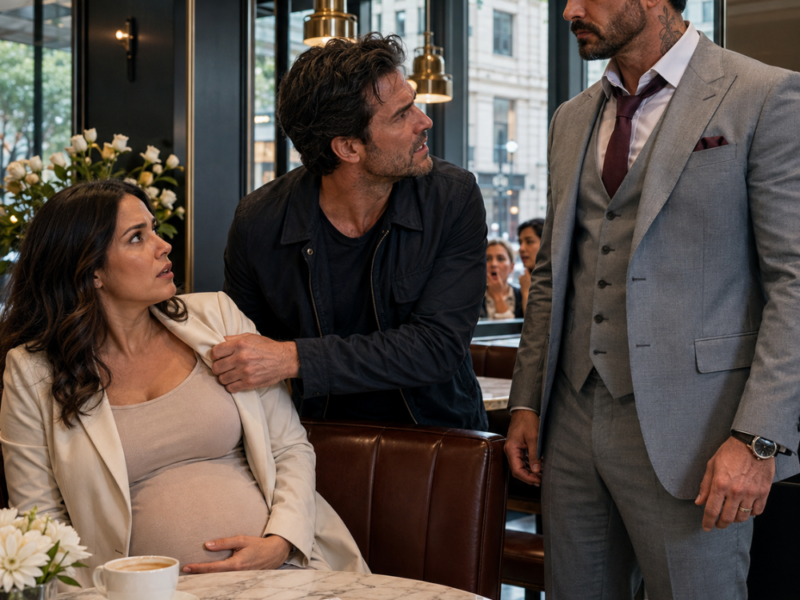
You Got Pregnant! Her Toxic Ex Grabbed Her Throat At a Café,Unaware the Mafia Boss Was Her Husband
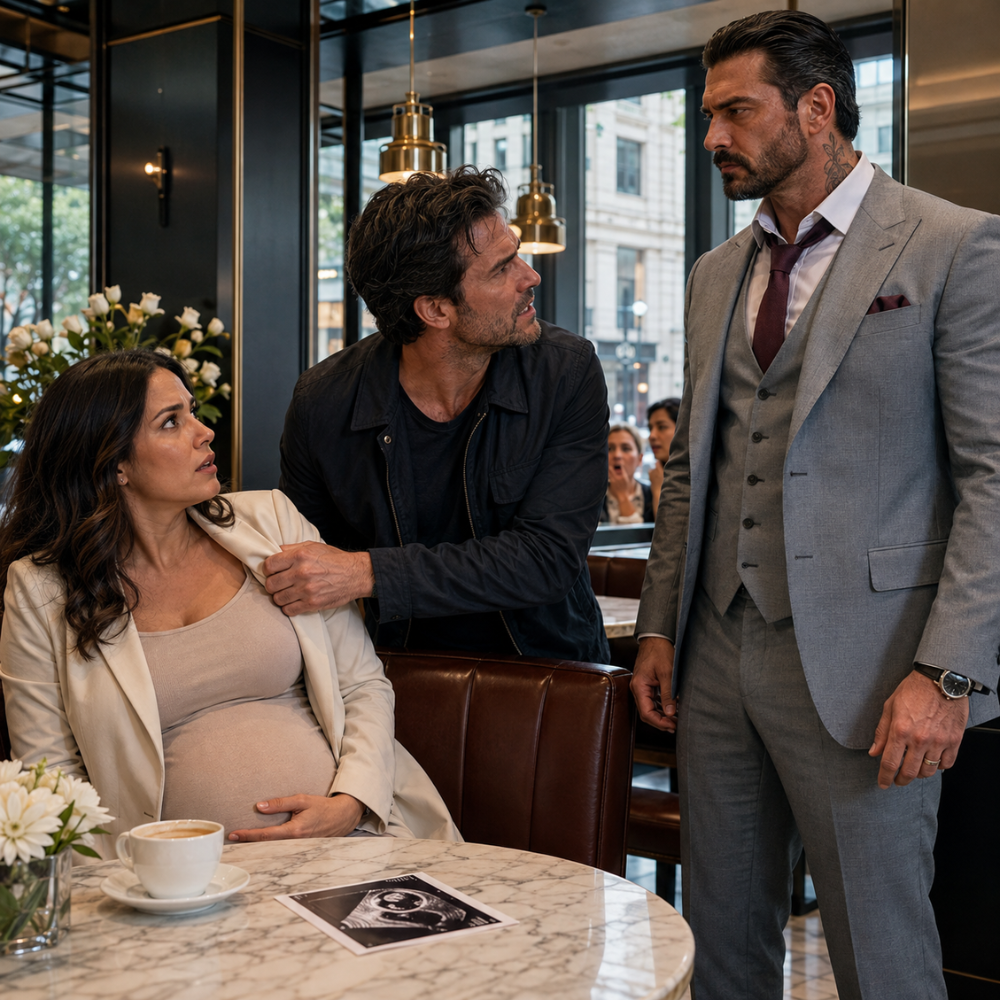
Her ex cornered her in a Manhattan café and saw the ultrasound—then the husband he never expected walked through the door
The ultrasound photograph slipped from Carissa Russo’s fingers and landed faceup beside her coffee.
For one second, nobody moved.
Carissa stared at it.
Liam Simpson stared at it.
The grainy black-and-white image was nothing more than a blur to anyone else in the crowded Greenwich Village café, but Carissa knew exactly where to look.
There.
That tiny shape.
That impossible little beginning.
Her child.
Daniel’s child.
The baby she had learned about less than three hours earlier.
Liam reached for the photograph.
Carissa reacted before she thought.
“Don’t.”
His hand stopped over the table.
He looked up.
The expression on his face changed.
Not all at once.
First confusion.
Then comprehension.
Then something Carissa remembered too well.
Possession.
“You’re pregnant.”
She pulled the photograph toward her.
“That has nothing to do with you.”
Liam laughed softly.
It was the soft laugh that frightened her.
He had always been most dangerous when he lowered his voice.
Around them, the café continued for another few seconds as if nothing had happened.
The espresso machine hissed.
A college student in a gray NYU hoodie typed on a laptop.
Someone near the windows was arguing quietly about a freelance invoice.
Two women in workout clothes shared a pastry at the counter.
Outside, taxis crawled through midday Manhattan traffic beneath a sharp October sky.
Then Liam leaned across the little marble table.
Carissa pushed her chair backward.
“Stay away from me.”
“You disappear for three years, marry some rich guy, and now you’re having his baby?”
“You need to leave.”
“I asked you a question.”
“You don’t get to ask me questions anymore.”
That sentence landed.
Carissa knew it had because Liam’s jaw tightened.
Three years earlier, she would have seen that tightening and immediately started repairing the moment.
I didn’t mean it like that.
I’m sorry.
Let’s not fight.
Please calm down.
She had once spent entire evenings rearranging her own words so Liam would not have to be responsible for his reactions.
She did not do that now.
She stood.
Her chair scraped the tile.
A few people looked over.
“Move away from me, Liam.”
His hand closed around her wrist.
The contact sent a bolt of old fear through her body so violently that for a second she was no longer in Manhattan.
She was twenty-eight again.
Astoria.
A one-bedroom apartment over a laundromat.
Rain against the windows.
A shattered drinking glass in the kitchen sink.
Liam standing between her and the front door.
She remembered his voice.
Look what you make me do.
Carissa pulled her wrist back.
“Let go.”
“Sit down.”
“No.”
His grip tightened.
A barista looked over.
“Sir?”
Liam ignored her.
Carissa’s free hand went to her abdomen without conscious thought.
Barely six weeks.
Too early to show.
Too early for anyone passing on the sidewalk to know there was another life inside her.
Not too early for Carissa to feel that everything had changed.
“Let go of me.”
Liam’s eyes dropped to her hand.
Then to the ultrasound photograph.
His face darkened.
“You really are.”
Carissa did not answer.
The first person to stand was a young man at the next table.
“Hey.”
Liam turned his head.
The student raised both hands slightly.
“Maybe just back off.”
“Sit down.”
“Come on, man.”
“I said sit down.”
The student hesitated.
Liam took one aggressive step toward him.
The room finally understood.
Phones appeared.
Someone near the counter moved toward the door.
The manager came around the espresso bar.
“Sir, you need to leave.”
Liam turned back to Carissa.
“You always do this.”
Carissa stared at him.
“Do what?”
“Make people think I’m the problem.”
“You are holding my wrist.”
His fingers opened.
For one hopeful second, Carissa believed the worst of the moment had passed.
Then Liam saw that hope.
And something inside him seemed to resent it.
He stepped forward.
His hand rose toward her neck.
Carissa moved sideways, but the table trapped her.
His fingers caught the collar of her black turtleneck and pressed against the base of her throat.
Not long.
Not enough to stop her breathing completely.
Enough.
Enough to bring every old memory alive.
Enough for the manager to shout.
Enough for someone to call 911.
Enough for Carissa to know with terrifying clarity that the man she had spent three years escaping had found her again.
“Liam.”
Her voice shook.
“Take your hand off me.”
“You think you can erase me?”
“I don’t think about you.”
That made him angrier.
“You were mine.”
“No.”
His face moved closer.
“You were.”
“No.”
The café door opened.
Nobody noticed at first.
Not Carissa.
Not Liam.
The young student did.
He looked toward the entrance, then stopped moving.
Two men in dark business coats had entered.
Behind them came Daniel Russo.
He did not look like a rescuer from a movie.
He looked like a man who had been interrupted during the middle of a workday.
Charcoal suit.
White shirt.
Dark tie.
Cashmere overcoat open at the front.
One hand still holding his phone.
His hair slightly windblown from the street.
Nothing about him should have changed the temperature of the room.
Yet it did.
Daniel stopped when he saw Carissa.
Then he saw Liam’s hand.
The phone lowered from Daniel’s ear.
His expression did not explode.
That was what frightened the men who worked for him.
Daniel Russo was never most dangerous when angry.
He was most dangerous when he became quiet.
“Take your hand off my wife.”
The words crossed the café without effort.
Liam froze.
Carissa felt his fingers loosen.
He turned.
For a moment, his face showed only irritation.
Then recognition arrived.
Liam had worked in Manhattan finance before his life fell apart.
He knew names.
Russo Freight and Logistics had offices overlooking the Hudson, warehouse interests in Brooklyn and New Jersey, port contracts from Baltimore to Boston, and enough political and business connections to fill a charity gala ballroom.
Daniel’s public reputation was carefully respectable.
Privately, people described him in more complicated terms.
He was a man nobody pressured casually.
A man whose family had roots in New York neighborhoods where old loyalties survived long after everyone involved began wearing tailored suits.
A man who had spent twenty years turning a rough family shipping operation into a legitimate corporation while never entirely losing the authority that came from where the company had started.
Liam knew enough to become afraid.
His hand dropped.
Carissa stepped away immediately.
Daniel crossed the room.
He did not touch Liam.
He did not threaten him.
He moved directly to Carissa.
“Are you hurt?”
She tried to answer.
Her voice came out rough.
“I’m okay.”
Daniel looked at her neck.
A faint red mark was beginning along the collar line.
His eyes changed.
Carissa saw it.
So did Vincent DeLuca, Daniel’s head of corporate security, who had entered behind him.
Vincent stepped closer without being asked.
Daniel’s voice remained controlled.
“Call an ambulance.”
“I don’t need one.”
Daniel looked at her.
“You were just assaulted.”
“I can breathe.”
“I know.”
His hand stopped several inches from her face.
He did not touch her until she nodded.
Then he gently cupped her cheek.
“Let a doctor make the next decision.”
Carissa’s eyes filled.
The tenderness almost broke her faster than the fear had.
She nodded.
“Okay.”
Daniel turned.
Liam had backed toward the wall.
The café manager stood between him and the exit.
The NYU student still had his phone raised.
Another customer was speaking to a 911 dispatcher.
Daniel looked at Liam.
“Do not leave.”
Liam laughed nervously.
“You don’t get to order me around.”
“No.”
Daniel glanced toward the door.
“Police do.”
Liam blinked.
That was not the response he expected.
Carissa almost saw the old version of Daniel inside the new one.
The younger man.
The one people whispered about.
The one who had grown up understanding a different kind of justice.
But Daniel had spent fifteen years building something his future children would not need to apologize for.
He had learned that power felt cleanest in the moment and costliest afterward.
So he did not hit Liam.
Did not have his security men drag him into an alley.
Did not allow anger to decide what happened next.
He simply stood between Liam and Carissa.
“You have violated an active protection order,” Carissa said.
Daniel looked at her.
“Still active?”
“Yes.”
Liam’s face changed.
Daniel turned back.
“That simplifies things.”
“You think I’m scared of a restraining order?”
Daniel’s expression barely moved.
“No.”
“Then what?”
“I think you should be scared of how much evidence is currently being recorded.”
Liam looked around.
Phones everywhere.
Security camera above the espresso bar.
Street-facing camera near the windows.
The café’s own system.
Daniel’s men.
The student.
The manager.
A room full of witnesses.
For the first time, Liam seemed to understand that the afternoon had moved beyond his control.
Sirens approached.
Carissa lowered herself into the booth.
Her knees had started shaking.
Daniel sat beside her.
Not too close.
“Look at me.”
She did.
“You’re safe right now.”
The words were careful.
Not you’re safe forever.
Not nothing can happen to you.
Right now.
The distinction mattered.
Carissa nodded.
Daniel noticed something near his shoe.
The ultrasound photograph.
He bent down.
Picked it up.
Carissa’s breath caught.
Daniel turned the image over once, thinking perhaps it was something that had fallen from Liam.
Then he saw her name printed across the top.
CARISSA RUSSO.
He went completely still.
Carissa watched his face.
All the noise around them seemed to recede.
The sirens.
The manager.
Liam arguing with somebody near the door.
Daniel looked at the photograph.
Then at her.
“Carissa.”
She started crying.
Not from fear this time.
At least not entirely.
Daniel held the photograph by the edges as though it were something impossibly delicate.
“Is this…”
She nodded.
“I found out this morning.”
His eyes moved back to the image.
“How far?”
“Six weeks.”
He stared.
“I was going to tell you tonight.”
His mouth opened.
No words.
Carissa laughed shakily.
It hurt her throat.
“I had an entire plan.”
Daniel still said nothing.
“Dinner. Your favorite place. I was going to give you a box.”
He looked at her again.
“We’re having a baby?”
“Yes.”
The man who negotiated hundred-million-dollar contracts without reading from notes sat speechless in a coffee shop.
Carissa had imagined his reaction all morning.
She had expected disbelief.
Then joy.
Maybe tears if she was lucky.
She had not imagined him learning while police sirens approached because her former partner had just put his hands on her.
Daniel’s eyes lowered to her stomach.
Then immediately returned to her face.
“Are you bleeding?”
“No.”
“Pain?”
“No.”
“Cramping?”
“No.”
He stood.
“Vincent.”
The security chief moved over.
“Car is downstairs.”
“Take us to Lenox Hill.”
Carissa touched Daniel’s hand.
“The ambulance is coming.”
Daniel stopped.
Right.
Procedure.
Doctors.
Police.
Evidence.
He sat again.
“I’m sorry.”
“For what?”
“I’m trying to control everything.”
“You always try to control everything.”
“That was charming before.”
“Debatable.”
For one brief second they almost smiled.
Then Carissa glanced toward Liam.
Two uniformed officers had entered.
Liam was already talking.
His hands moving.
His voice urgent.
He looked like a man assembling a version of events while witnesses still stood around him.
Daniel followed her gaze.
“Do you want me here when they take your statement?”
“Yes.”
The answer came immediately.
Daniel nodded.
“Then I’m here.”
The police separated everyone.
Officer Elena Morales spoke first with the café manager.
Her partner, Officer Brennan, spoke to Liam.
Liam’s voice carried.
“She attacked me emotionally for years.”
Brennan stared at him.
“Emotionally.”
“She ruined my career.”
“Did she physically touch you?”
“That’s not the point.”
Brennan looked around.
“It is currently one of several points.”
Morales approached Carissa.
“Mrs. Russo?”
“Yes.”
“I’m Officer Morales. Ambulance is two minutes out. Are you comfortable answering a few questions?”
Carissa nodded.
“Who is that man?”
“My former fiancé. Liam Simpson.”
“When did the relationship end?”
“Three years ago.”
“Any history of domestic violence?”
“Yes.”
“Protection order?”
Carissa reached for her bag.
Daniel stopped her gently.
“I’ll get it.”
He opened the tote only after she nodded.
Inside was a leather wallet, lipstick, appointment paperwork, prenatal vitamins purchased that morning, and a small white pharmacy bag.
The protection order was stored digitally on Carissa’s phone.
Morales confirmed it.
“Has he contacted you recently?”
“No.”
“Do you know how he found you?”
“No.”
That question stayed in the air.
Daniel looked at Carissa.
She looked back.
Neither liked it.
The paramedics arrived.
They examined the marks at Carissa’s neck, her airway, blood pressure, oxygen level, and abdomen.
“No significant airway compromise at the moment,” one said. “But given pregnancy and the mechanism, I’d prefer hospital evaluation.”
Daniel nodded before Carissa could object.
She gave him a look.
“What?”
“You are not the patient.”
“No.”
“Then stop agreeing for me.”
The paramedic hid a smile.
Daniel lifted both hands.
“Your decision.”
Carissa exhaled.
“Hospital.”
“Good decision,” Daniel said.
She stared.
He immediately added, “Personal opinion.”
The paramedic laughed.
The tension released for perhaps three seconds.
Then Officer Morales returned.
“We’re arresting Mr. Simpson for violation of the protection order and assault-related offenses. Detectives will follow up.”
Carissa looked toward Liam.
An officer had turned him toward the wall.
His hands were being cuffed.
He twisted around.
“Carissa.”
She looked away.
“Carissa, tell them.”
No response.
“You know me.”
She closed her eyes.
That had once been the problem.
She knew him too well.
His charm.
His apologies.
The morning after.
The flowers.
The promises.
The careful explanation that what happened was private.
That couples fought.
That she was dramatic.
That he loved too intensely.
That nobody would understand their relationship.
“Carissa.”
Daniel shifted beside her.
She touched his arm.
“Don’t.”
He looked down.
“I’m fine.”
He understood.
This moment belonged to her.
Liam raised his voice.
“I loved you.”
Carissa finally looked at him.
The room became quiet again.
“No.”
Liam stared.
“You loved being obeyed.”
His face collapsed into anger.
She continued.
“That is not the same thing.”
The officer guided him toward the door.
Liam resisted just enough to make the movement awkward.
Then he was gone.
Carissa watched the police car leave through the café window.
Her whole body began shaking afterward.
Not while he was present.
After.
Daniel wrapped his overcoat around her shoulders.
She turned into him.
For several seconds, he held her without speaking.
The ambulance ride to Lenox Hill took eighteen minutes.
Daniel rode with her.
Vincent followed in a company SUV.
The paramedic asked medical-history questions.
Carissa answered.
Daniel kept staring at the ultrasound photograph.
Finally Carissa said, “You’re going to wear a hole through it.”
He looked up.
“What?”
“The picture.”
He glanced down.
He had been holding it for ten minutes.
“I don’t know what I’m looking at.”
She smiled.
“Neither did I at first.”
“Where is the baby?”
She pointed.
“There.”
Daniel stared.
“That?”
“That.”
“It’s extremely small.”
“That’s how pregnancy works.”
“I understand conceptually.”
“Apparently not visually.”
The paramedic looked away to hide a smile.
Daniel leaned closer.
“That is our baby.”
“Yes.”
Something happened in his face.
A softness very few people saw.
He sat back and swallowed.
“My father never saw me on an ultrasound.”
Carissa’s smile faded.
Daniel rarely talked about his father.
Salvatore Russo had been dead twelve years.
A dockworker’s son who became a trucking contractor, then something larger, then something dangerous enough that Daniel spent much of adulthood dismantling the parts of the family empire that could not survive daylight.
“What are you thinking?” Carissa asked.
Daniel continued looking at the photograph.
“That I want our child to know a different life.”
Carissa watched him.
“Different from yours?”
“Yes.”
“How different?”
Daniel smiled faintly.
“I would like his greatest crisis at seventeen to involve a scratched car.”
“His?”
Daniel looked alarmed.
“Or hers.”
“Good recovery.”
“I have excellent lawyers.”
The hospital evaluation found no serious injury.
That was the phrase doctors used.
No serious injury.
Carissa had always found it strange how medical language could make something frightening sound almost insignificant.
There were red marks.
Tenderness.
A strained voice.
A small bruise developing near her collarbone.
But her airway was stable.
The pregnancy appeared unaffected.
The obstetric resident repeated an ultrasound because Carissa was frightened.
Daniel stood beside the bed in a dim exam room.
The machine produced an image.
Then sound.
A quick, delicate rhythm.
Daniel looked at the monitor.
“What is that?”
The technician smiled.
“Heartbeat.”
Daniel’s hand closed around Carissa’s.
He did not speak for several seconds.
Then he whispered, “That fast?”
“Very normal.”
Carissa looked at him.
His eyes were wet.
He noticed her noticing.
“Don’t.”
“What?”
“You’re going to make a thing out of this.”
“I’m not saying anything.”
“You’re smiling.”
“I’m having a nice moment.”
“Suspicious.”
The technician laughed.
Afterward, while they waited for discharge paperwork, Daniel became serious again.
“How did Liam know where you were?”
Carissa leaned against the raised hospital bed.
“I don’t know.”
“Did you post anything?”
“No.”
“Tell anyone?”
“I told nobody about the pregnancy except the doctor.”
“Not pregnancy. The café.”
“No.”
“Driver?”
“I walked.”
“Security?”
Carissa winced.
Daniel saw it.
“What?”
“I asked them not to follow me today.”
His face became still.
“Why?”
“I wanted a few hours alone.”
“You dismissed the detail?”
“They stayed at the building.”
“Carissa.”
“Don’t.”
He stopped.
“I know.”
She folded her hands.
“I know what you’re going to say.”
“What?”
“That if they had been there, this wouldn’t have happened.”
“Yes.”
“That may be true.”
Daniel waited.
“But I am not going to spend the rest of my life surrounded by four men because somebody from my past is unstable.”
“Two.”
“What?”
“Two men.”
She almost laughed.
“Excellent. Liberty restored.”
Daniel rubbed his forehead.
“I’m scared.”
The honesty changed the conversation.
Carissa looked at him.
Daniel sat beside her.
“I walked into that café and saw somebody’s hand on your neck.”
He swallowed.
“Then I picked up a photograph and learned there were two people I could lose.”
Carissa’s anger disappeared.
“Daniel.”
“I know security cannot become a cage.”
“Good.”
“I know.”
He held her hand.
“But we need something reasonable.”
“What does reasonable mean to a man whose office has bullet-resistant glass?”
“Very funny.”
“I’m serious.”
Daniel sighed.
“You carry the panic button.”
“I already do.”
“You actually charge it.”
“That sounds personal.”
“It was dead last month.”
“I charged it.”
“You charged it after Vincent complained.”
“Still counts.”
“And you allow discreet coverage when you’re alone until Liam’s case is resolved.”
Carissa thought.
“One person.”
“Two.”
“One.”
“Carissa.”
“One visible to me, one invisible to everybody else.”
Daniel stared.
“That is two.”
“It sounds psychologically like one.”
Despite himself, he smiled.
“Fine.”
“Fine?”
“Fine.”
She squeezed his hand.
“Look at us.”
“What?”
“Healthy compromise.”
“Don’t tell anyone.”
The detective assigned to Liam’s case called before they left the hospital.
Detective Mara Chen worked domestic-violence investigations out of Manhattan South.
She spoke with Carissa by phone first, then arranged an interview for the following morning.
“Mrs. Russo, I want to ask one question tonight.”
“Okay.”
“Did Mr. Simpson say anything suggesting somebody told him where you would be?”
Carissa thought back.
No.
He had simply appeared.
“I don’t think so.”
“Did he seem surprised to find you?”
“No.”
Daniel looked at her.
Chen heard the pause.
“Your husband is there?”
“Yes.”
“Does he have a concern?”
Daniel leaned toward the phone only after Carissa nodded.
“He knew where she was.”
“That’s what it sounds like.”
“Liam hasn’t been part of her life in three years.”
“Understood.”
“He has no legitimate access to her location.”
“Understood.”
“Then someone provided it.”
“Possibly.”
Daniel disliked that word.
Chen continued.
“We seized his phone incident to arrest. We’ll pursue the appropriate legal process for its contents. Please do not conduct your own investigation.”
Daniel’s expression became almost offended.
Carissa looked at him.
The detective had clearly done her homework.
Daniel said, “I wasn’t planning to.”
Chen was silent.
Carissa covered a laugh with a cough.
“Mr. Russo.”
“Yes.”
“If that changes, change it back.”
“Detective, people have developed a highly exaggerated view of me.”
“Good night, Mr. Russo.”
The call ended.
Carissa laughed until her throat hurt.
“You deserved that.”
Daniel slipped the phone into his pocket.
“I am a taxpayer.”
“You terrify half the city.”
“Those things are not mutually exclusive.”
They left the hospital shortly after four.
The city had entered evening rush.
Daniel’s car waited beneath the hospital canopy.
Not an armored convoy.
One black sedan.
One security vehicle behind it.
Carissa appreciated the restraint.
Inside the car, Daniel looked again at the ultrasound.
“You know they gave us another copy.”
“I know.”
“You can stop checking that one for damage.”
“I’m preserving the original.”
“For what?”
“I don’t know.”
She smiled.
“You are going to be unbearable.”
“I’m already unbearable.”
“True.”
They rode south.
Carissa watched Manhattan move past the window.
People waiting at crosswalks.
Delivery bikes.
Parents pushing strollers.
Office workers carrying salad containers.
The ordinary city.
This morning, she had walked through it feeling almost invincible.
She had believed the past was finished because enough time had passed.
By afternoon, she understood something harder.
A past could return without becoming your future.
That distinction mattered.
At home, Daniel canceled dinner.
Carissa protested.
“We had reservations.”
“You were assaulted.”
“I know.”
“You were in the hospital.”
“I also know.”
“And you want to put on heels?”
“No.”
“Then what?”
“I want pasta.”
“We have a chef.”
“I don’t want our chef’s pasta.”
Daniel stared.
“Whose pasta?”
“The little place on Greenwich.”
“Lucia’s?”
“Yes.”
“They don’t deliver.”
“They do if you ask nicely.”
“They refused last time.”
“You asked Vincent to call.”
“Vincent is polite.”
“Vincent sounds like a bank foreclosure notice.”
Daniel took out his phone.
Carissa pointed.
“You call.”
Twenty minutes later, Daniel Russo, CEO of one of the largest private freight companies on the East Coast, personally negotiated the delivery of two containers of rigatoni alla vodka, garlic bread, and tiramisu from a neighborhood restaurant six blocks away.
Carissa listened from the sofa.
“Please,” Daniel said into the phone.
She raised both eyebrows.
He turned away.
“Thank you.”
When he hung up, she clapped.
“Humiliating.”
“You survived.”
Dinner arrived.
They ate at the kitchen island because the formal dining table suddenly felt ridiculous.
Daniel opened sparkling water.
Carissa held up her glass.
“To finding out in the least romantic way possible.”
Daniel touched his glass to hers.
“I had an entire speech planned for someday.”
“What speech?”
“When you told me you were pregnant.”
“You planned a pregnancy reaction?”
“No.”
“That is what you just said.”
“I imagined.”
“Same thing.”
He looked embarrassed.
“What were you going to say?”
“I don’t remember.”
“Liar.”
He looked down.
Then said quietly, “I was going to tell you that everything I built before you was about surviving, and everything I built after you was about staying.”
Carissa stopped smiling.
Daniel continued.
“And that if we ever had a child, I wanted to build something worth inheriting.”
She reached across the counter.
He took her hand.
“You can still say it.”
“I just did.”
“That was beautiful.”
“Don’t tell Vincent.”
“I’m telling everybody.”
After dinner, Carissa went to bed early.
Daniel did not.
At eleven, he stood in his home office looking over Manhattan.
Russo Freight’s corporate security director, Vincent DeLuca, sat across from the desk.
“The detective called?”
“Yes.”
“Phone is in evidence.”
“Yes.”
“We do nothing?”
“We preserve our own information.”
Vincent nodded.
That was lawful.
That was also useful.
They pulled building camera logs.
Vehicle records.
Employee access.
Carissa’s household-security schedule.
No one outside a small group should have known she was without a close detail.
Vincent found the first anomaly at 12:43 a.m.
“The detail schedule was accessed yesterday.”
Daniel looked up.
“By who?”
“Internal login.”
“Whose?”
“Martin Keane.”
Daniel’s expression changed.
Keane was a midlevel security operations manager who had worked for Russo Freight for seven years.
“Why would Martin access my wife’s schedule?”
“He shouldn’t.”
“Where is he?”
“Home.”
“Do we call him?”
“No.”
Daniel leaned back.
Vincent continued.
“If somebody sold information, confronting him tells them we know. Better to preserve the access logs and give them to Detective Chen.”
Daniel smiled faintly.
“You are becoming boring.”
“Your lawyers call it mature.”
“My lawyers have destroyed you.”
“They’ve kept us out of federal court.”
“That too.”
At eight the next morning, Vincent delivered an evidence packet to Detective Chen.
By noon, investigators had extracted enough data from Liam’s phone to identify a chain of messages from an encrypted messaging service.
The sender did not use a name.
But payment records pointed toward a consulting firm.
The consulting firm pointed toward Keane.
Keane’s bank records later revealed several deposits routed through shell companies.
This was no romantic obsession operating alone.
Someone had helped Liam find Carissa.
The reason took another week to understand.
Arthur Sullivan was a competing logistics executive.
Publicly, Sullivan Distribution operated warehouses, trucking fleets, and import services.
Privately, Sullivan had spent years furious at Russo Freight’s dominance of several port contracts.
He believed Daniel’s political connections had blocked his expansion.
Some of his complaints were legitimate business grievances.
Others belonged to the old neighborhood world Daniel had spent years trying to leave behind.
Arthur did not order Carissa harmed.
At least investigators never found evidence that he had.
What he had done was almost more revealing.
He paid Keane for information.
Carissa’s movements.
Daniel’s travel schedule.
Security routines.
Household staffing.
The apparent goal was pressure.
Find a vulnerability.
Create fear.
Make Daniel understand that family made him reachable.
Liam had been selected because he was unstable, angry, financially desperate, and already obsessed with Carissa.
A tool with plausible deniability.
Arthur’s messages never said hurt her.
They said:
REMIND HIM HE ISN’T UNTOUCHABLE.
MAKE HIM FEEL EXPOSED.
LET THE EX HANDLE THE REST.
That final line ended Arthur Sullivan’s career.
Detective Chen called Carissa and Daniel into a conference room at One Police Plaza.
An assistant district attorney was present.
So was Daniel’s attorney, Rachel Stein.
The ADA laid out the evidence carefully.
“We can establish conspiracy-related conduct, unlawful access, stalking facilitation, and several financial offenses. We’re still reviewing whether Sullivan can be tied legally to the physical assault itself.”
Daniel’s jaw tightened.
“He selected the man who assaulted her.”
“That matters.”
“But?”
“It doesn’t automatically prove he intended the assault.”
Daniel looked toward Rachel.
She nodded.
The law was the law.
Carissa asked, “Will Liam remain in custody?”
“Judge denied release.”
“Arthur?”
“Arrest warrant is being prepared.”
“Martin Keane?”
“Cooperating.”
Daniel looked surprised.
“Already?”
The ADA almost smiled.
“White-collar defendants discover cooperation quickly.”
Carissa leaned back.
The room smelled of stale coffee and printer toner.
Nothing about accountability looked the way movies made it look.
No warehouse.
No revenge.
No shadowy convoy.
Folders.
Subpoenas.
Bank records.
A detective asking permission before showing sensitive photographs.
An assistant district attorney explaining intent standards.
A defense lawyer negotiating preservation agreements.
Carissa found that strangely comforting.
It meant what happened did not depend on Daniel being feared.
The system could carry it.
Maybe imperfectly.
Maybe slowly.
But carry it.
Arthur Sullivan surrendered through counsel the following morning.
Television cameras caught him entering the courthouse in a navy overcoat.
He gave no statement.
Daniel watched the footage from his office.
Vincent stood beside him.
“That satisfy you?”
Daniel considered.
“No.”
“Good.”
Daniel looked over.
“Why good?”
“Because satisfaction isn’t the purpose.”
Vincent turned toward the window.
“Your wife is safe. People responsible are being prosecuted. Your company found a security breach.”
Daniel nodded.
Vincent continued.
“If you’re looking for satisfaction beyond that, you’re looking for something the system cannot give you.”
Daniel thought about the younger version of himself.
That man would have called satisfaction justice.
The older Daniel understood they were often enemies.
Liam’s criminal case moved faster than Arthur’s.
The protection-order violation was straightforward.
The café footage was devastating.
There were twelve witnesses.
Three independent phone recordings.
The student who had stood up agreed to testify.
The manager agreed.
The red marks on Carissa’s neck were documented at the hospital.
Liam’s attorney sought treatment-based alternatives because of his substance-use history.
Carissa supported treatment.
She did not support avoiding accountability.
Those positions could coexist.
During a victim-services meeting, a counselor asked whether she wanted to provide a statement at sentencing.
Carissa said yes.
Daniel offered to attend.
She said no.
He stared at her.
“No?”
“I want to do it alone.”
“Why?”
“Because you were there when he was arrested.”
“Yes.”
“And you’ve been there every day since.”
“Yes.”
She took his hand.
“But I need one room where Liam sees me without you standing between us.”
Daniel struggled.
She saw it.
“This isn’t me rejecting your protection.”
“I know.”
“It’s me choosing.”
“I know.”
He looked away.
Then nodded.
“I’ll wait outside.”
Carissa smiled.
“That is still technically hovering.”
“I’m compromising.”
The sentencing took place seven months after the café assault.
By then, Carissa was visibly pregnant.
She wore a navy maternity dress and low heels.
Daniel waited in the hallway with Vincent.
No entourage.
No dramatic presence.
Just her husband.
Inside, Liam sat beside his public defender.
He looked healthier.
Treatment in custody had changed his face.
The frantic hollowness was gone.
That complicated Carissa’s feelings.
She had spent months remembering him only as the man in the café.
Now she could also see the twenty-four-year-old he once was.
College library.
Cheap pizza after exams.
The first Christmas he bought her a ridiculous scarf because he had no idea what women liked.
People did not become harmless simply because they had once been lovable.
People did not become entirely inhuman because they caused harm.
Carissa had learned to hold both facts.
The judge invited her to speak.
She stood.
Her hands were steady.
“Liam, I spent a long time believing the worst thing you did was hurt me.”
He looked down.
“It wasn’t.”
The courtroom remained quiet.
“The worst thing was teaching me to doubt my own boundaries.”
She rested one hand lightly over her abdomen.
“You made me believe that if somebody loved me, I owed him access to me.”
Liam’s face tightened.
“I spent years relearning that love is not permission.”
Carissa looked directly at him.
“The day you came into that café, I was afraid of you.”
She paused.
“I’m not ashamed of that.”
Liam finally looked up.
“I was afraid because I knew what you were capable of.”
Her voice remained calm.
“But I still told you no.”
A longer pause.
“That is the part I want to remember.”
Not Daniel entering.
Not the police.
Not the headlines that briefly surrounded the case.
Carissa saying no before anybody powerful arrived.
“You will not be part of my child’s life.”
Liam closed his eyes.
“You will not contact me.”
Silence.
“You will not ask other people to contact me.”
Silence.
“And when your sentence ends, I hope you build a life in which nobody has to be afraid of you again.”
That sentence surprised him.
It surprised her too.
She returned to her seat.
The court imposed a custodial sentence followed by years of supervision, mandatory treatment, and permanent protective conditions.
It was not cinematic.
It was enough.
Daniel stood when Carissa emerged from the courtroom.
He looked at her face.
“How was it?”
“Hard.”
He waited.
“Good hard?”
She thought.
“Necessary hard.”
He kissed her forehead.
Then immediately looked at her abdomen.
“What?”
“Baby kicking?”
“She has been kicking for twenty minutes.”
Daniel’s face lit up.
“She?”
Carissa froze.
Daniel froze.
Vincent, several feet away, slowly turned toward the wall.
Carissa covered her mouth.
Daniel stared.
“You know?”
She began laughing.
“I was going to tell you tonight.”
“Again?”
“I had a box.”
“You need a new strategy.”
Daniel put both hands over his face.
“A daughter.”
“Yes.”
He looked almost frightened.
Carissa laughed harder.
“What?”
“I understand sons.”
“No, you don’t.”
“I understand conceptually.”
“That line didn’t work in the ambulance.”
“A daughter.”
He looked at Vincent.
“What do I do with a daughter?”
Vincent stared.
“I have three.”
“Yes.”
“They ignore you.”
Daniel looked horrified.
Carissa leaned against the courthouse wall laughing.
For the first time that day, the building felt light.
Arthur Sullivan’s case took almost a year.
He eventually pleaded guilty to charges related to stalking facilitation, unlawful access, bribery of an employee, and financial offenses.
Martin Keane received reduced punishment for cooperation.
Russo Freight overhauled its security department.
Daniel also made a decision that surprised his board.
He separated family security entirely from corporate operations.
No executive employee could access household information.
An outside licensed security firm handled personal protection.
Regular audits went to independent counsel.
“You don’t trust your own people?” one director asked.
Daniel answered, “I trust systems that assume people can fail.”
That was something he had learned from Carissa.
Power was safest when it expected its own weaknesses.
Their daughter was born on a rainy June morning.
Daniel had spent months pretending he was prepared.
He had read four parenting books.
Taken an infant CPR class.
Installed the car seat himself, then paid a professional to confirm it.
Converted one penthouse room into a nursery.
Rejected twelve cribs before Carissa threatened divorce.
“You run ports.”
“Yes.”
“You can select furniture.”
“These standards are unclear.”
“They are literally printed on the box.”
“Manufacturers exaggerate.”
“You are impossible.”
He had also become obsessed with outlet covers.
Their daughter would not be mobile for months.
Daniel covered every outlet anyway.
Carissa found him at two in the morning installing another lock on a low cabinet.
“Daniel.”
He turned.
“What?”
“She cannot crawl.”
“I know.”
“She cannot hold her own head up.”
“I know.”
“She cannot access the cleaning supplies.”
“Not currently.”
Carissa sat on the kitchen stool.
“What are you afraid of?”
The screwdriver stopped.
Daniel looked at the cabinet.
“Everything.”
She softened.
He put the tool down.
“I know that isn’t reasonable.”
“It’s new.”
“I spent my whole life believing danger was something you identified and removed.”
“And now?”
He looked toward the nursery.
“Now there are choking hazards.”
Carissa laughed.
He did too.
Their daughter arrived at 6:17 a.m.
Seven pounds, four ounces.
Dark hair.
Powerful lungs.
Daniel cried before the baby did.
The obstetrician denied this afterward for professional reasons.
Carissa did not.
When the nurse placed the newborn against Carissa’s chest, Daniel stood beside the bed with one hand over his mouth.
“Come here.”
He stepped closer.
Carissa shifted the blanket.
“Meet Sofia.”
Daniel stopped.
They had discussed names.
He had not known she had decided.
“Sofia?”
Carissa nodded.
Daniel’s mother’s name.
His eyes filled again.
“You said Elena.”
“I changed my mind.”
“When?”
“When I saw your face.”
“That feels unfair.”
“Fatherhood is difficult.”
He touched one finger to the baby’s tiny hand.
Sofia grabbed it.
Daniel inhaled.
Carissa watched the exact second one of the most controlled men she had ever known became helpless.
“She has me.”
“Yes.”
Daniel did not look away from his daughter.
“This is catastrophic.”
Carissa smiled.
The first year was not easy.
Beautiful did not mean easy.
Carissa had postpartum anxiety severe enough that she returned to therapy.
Daniel slept badly.
Sofia hated naps.
The night nurse they initially hired quit after three weeks because Daniel kept checking the baby monitor from another room and then walking into the nursery to verify the monitor was accurate.
Carissa eventually confiscated his phone after midnight.
“You are waking her by checking whether she is sleeping.”
“That seems circular.”
“It is.”
At four months, Sofia developed a fever.
Daniel wanted the best pediatric infectious-disease specialist in New York.
Their pediatrician recommended infant acetaminophen, fluids, and observation.
Daniel called two additional doctors.
Carissa took his phone.
“Stop.”
“She is sick.”
“She has a cold.”
“She cannot tell us whether it’s only a cold.”
“She is currently chewing your tie.”
Daniel looked down.
Sofia had the silk tie in both fists.
He stared.
“She seems vigorous.”
“Excellent diagnosis.”
They laughed.
Ordinary parenthood did something money and power never had.
It humbled Daniel daily.
Babies did not care about board meetings.
They did not respect privacy.
They spit up on expensive shirts.
They screamed during important calls.
At ten months, Sofia said her first clear word.
“Dog.”
Daniel had spent months trying to teach her “Dada.”
Carissa laughed for two days.
At eighteen months, Sofia discovered the word no.
Daniel looked at Carissa across the breakfast table.
“Is this genetic?”
“Yes.”
“From which side?”
“Mine.”
“Obviously.”
Sofia slapped both hands on the high-chair tray.
“No.”
Daniel stared.
Carissa pointed.
“Remember this moment.”
“Why?”
“You are going to spend the next twenty years teaching yourself that her no is allowed to remain no.”
The humor left Daniel’s face.
He looked at his daughter.
Then at Carissa.
The sentence carried history.
The café.
Liam.
Everything before Daniel.
He nodded.
“Yes.”
Carissa saw he understood.
That mattered more than any security detail.
Years later, Sofia would know almost nothing about the day her parents learned they were having her.
Not until she was old enough.
Carissa did not want her daughter growing up with the idea that her existence had inspired a violent reckoning or an underworld war.
There had been no war.
That became one of the most important changes from the life Daniel had inherited.
Arthur Sullivan went to court.
Liam went to court.
Martin Keane cooperated with investigators.
Lawyers argued.
Judges ruled.
Companies changed.
People served sentences.
Life continued.
Daniel never regretted choosing that path.
He admitted once, years later, that the old instincts had been strong.
They were sitting in the kitchen after Sofia’s fifth birthday party.
The apartment looked destroyed.
Pink paper crowns.
Half a Costco sheet cake because Sofia had insisted the fancy bakery cake “looked too serious.”
Gift bags everywhere.
One tiny sock inexplicably beside the refrigerator.
Carissa sat on the counter with wine.
Daniel had coffee.
“You remember the café?” he asked.
She looked over.
“Of course.”
“I wanted to hurt him.”
“I know.”
“No.”
Daniel stared into the mug.
“I mean I wanted to erase him.”
Carissa was quiet.
“What stopped you?”
“You.”
“I didn’t say anything.”
“You didn’t have to.”
He looked toward Sofia’s bedroom.
“I had spent years telling you I was different from the men you survived.”
Carissa waited.
“If I had turned your trauma into an excuse for my violence, then I would have made the day about me.”
She took that in.
Daniel continued.
“And I wanted our child to arrive in a family moving forward, not one beginning a feud.”
Carissa smiled.
“That is suspiciously healthy.”
“I’ve been in therapy.”
“You complain about therapy.”
“Complaining is participation.”
She laughed.
The marks Liam left on her throat disappeared within days.
The deeper effects took longer.
For months, Carissa avoided that section of Greenwich Village.
Then one Thursday she told Daniel she wanted to go back.
He immediately stood.
She shook her head.
“Alone.”
He stared.
“Carissa.”
“Nearby security.”
“Define nearby.”
“Not inside.”
Daniel struggled.
She watched him struggle.
“Please.”
He nodded.
The café had changed owners by then.
New menu.
Different manager.
Same marble tables.
Carissa ordered decaf.
She sat near the window.
Not the corner.
Corners had once made her feel safe.
Now she wanted to see the room.
A young mother sat two tables away bouncing a baby on one knee while trying to answer emails.
Two college students debated graduate-school applications.
A construction worker ate a blueberry muffin with enormous concentration.
Ordinary.
Carissa took the ultrasound photograph from her wallet.
Not the original.
A copy.
The original was in Sofia’s memory box beside her hospital bracelet and first pair of socks.
Carissa looked at the tiny blur.
She had once thought the most important moment in the café was Daniel walking through the door.
For years, other people would have agreed.
A powerful husband arrives.
A dangerous ex becomes afraid.
Protection.
Rescue.
It was a compelling version.
It was also incomplete.
The important moment happened before Daniel arrived.
Carissa had told Liam to let go.
She had stood.
She had told him he had no right to ask questions about her life.
She had refused to apologize for leaving him.
Daniel did not give her those things.
Therapy did not give her those things.
Money did not.
They had helped.
They had supported.
But the decision belonged to her.
That realization freed Carissa from another kind of dependence.
Daniel could protect her.
He could not be the source of her safety.
No person could.
Safety had to include her own judgment.
Her own boundaries.
Her own capacity to act.
When she returned home, Daniel was in the living room assembling a wooden dollhouse with Sofia.
The instructions lay abandoned.
Carissa looked at them.
“You’re building that wrong.”
Daniel looked offended.
“I run a logistics company.”
“You have installed the roof backward.”
Sofia nodded solemnly.
“Daddy did it wrong.”
Daniel looked betrayed.
“You were helping me.”
“I’m five.”
Carissa laughed.
She crossed the room.
Daniel stood.
“How was the café?”
“Fine.”
He searched her face.
She saw the questions.
Did you panic?
Did you see him?
Did you feel watched?
Instead he asked only:
“Coffee good?”
Carissa smiled.
“Pretty good.”
He nodded.
Then sat back down.
That was love too.
Not demanding a report because he was anxious.
Trusting her to tell him what she wanted to tell him.
Sofia held up a miniature chair.
“Mommy, where does this go?”
Carissa sat on the rug.
“In the kitchen.”
“No.”
“What?”
“It goes on the roof.”
Daniel pointed.
“See?”
Carissa looked between them.
“You are both impossible.”
Sofia grinned.
Daniel leaned toward his daughter.
“Genetic.”
Years passed.
Russo Freight grew.
Daniel stepped away from day-to-day operations before sixty, shocking nearly everybody.
He kept the title of chairman.
Hired a chief executive from outside the family.
Built a formal board.
Established compliance structures no relative could override.
At his retirement dinner, one longtime employee asked why a man famous for control had spent the last decade designing systems that reduced his own authority.
Daniel looked toward Carissa.
Then toward Sofia, now a teenager, sitting beside her mother.
“Because if an organization only functions when one good person has all the power, then one bad person can destroy it.”
That became one of the most quoted lines of the evening.
Carissa knew where it really came from.
Liam had taught them something neither wanted to learn.
So had Arthur.
So had Martin Keane.
People failed.
Loyalty failed.
Judgment failed.
Love could become control if nobody checked it.
Protection could become a cage if fear was allowed to make every decision.
Good systems did not assume goodness.
They prepared for human weakness.
Sofia grew up knowing her father as a man who made pancakes badly on Sundays.
A man who checked door locks twice.
A man who cried at school plays and denied it.
A man whose employees treated him with unusual respect.
She knew there were stories about the Russo family.
Old stories.
Dock stories.
Neighborhood stories.
She asked once when she was fourteen.
“Were you in the Mafia?”
Daniel nearly choked on coffee.
Carissa looked down at her plate.
Sofia waited.
Daniel put down his mug.
“My family was involved in businesses and relationships that were not always lawful.”
Sofia stared.
“That sounds like lawyer language.”
“It is.”
“So yes?”
Daniel sighed.
“Parts of the family, yes.”
“You?”
“I inherited connections I should never have inherited.”
“That’s still not an answer.”
Carissa smiled.
“Welcome to my marriage.”
Daniel gave her a look.
Then turned back to Sofia.
“I made decisions when I was young that I would not make now.”
“Did you hurt people?”
Silence.
Daniel answered carefully.
“My decisions contributed to harm.”
Sofia processed that.
“Did Mom know?”
“Eventually.”
“Why did she marry you?”
Daniel looked at Carissa.
Carissa answered.
“Because people are more than the worst thing they’ve done if they actually change what they do next.”
Sofia frowned.
“That sounds annoyingly wise.”
“It gets worse as you age.”
Sofia turned back to Daniel.
“Did you change because of Mom?”
Daniel looked at his daughter.
“Partly.”
“Because of me?”
“Partly.”
“What else?”
“Because eventually a man has to decide whether he is proud of the system that will outlive him.”
Sofia thought about that.
Then shrugged.
“Okay.”
She returned to her cereal.
Daniel stared.
“That’s it?”
“I have chemistry.”
After she left, Daniel looked at Carissa.
“I prepared for that conversation for fifteen years.”
“You overprepared.”
“She said okay.”
“She is your daughter.”
“She interrogated me like a federal prosecutor and then left for chemistry.”
Carissa kissed his cheek.
“Parenthood.”
The past occasionally returned in paperwork.
Liam completed his sentence.
Years of supervision followed.
He entered long-term recovery.
Through counsel, he sent one request asking whether Carissa would accept a written apology.
She declined.
Not angrily.
She simply did not need it.
The victim-services coordinator asked whether she wanted notification if Liam moved back to New York.
“Yes.”
That was not fear.
That was information.
He did not return.
Arthur Sullivan served his sentence, lost his company, and disappeared into a quieter life in Connecticut.
Martin Keane never worked in security again.
The cases became old newspaper archives.
The café closed during a rent increase and became a boutique furniture shop.
The city changed.
Carissa changed.
One summer afternoon, when Sofia was seventeen, mother and daughter were cleaning a closet.
Sofia found the memory box.
Hospital bracelet.
First lock of hair.
Tiny knitted hat.
Ultrasound photographs.
She held up the oldest.
“Was this me?”
Carissa looked over.
“Yes.”
“I look like a bean.”
“You were a beautiful bean.”
Sofia turned the photograph.
“There’s coffee on this.”
Carissa froze.
A faint brown stain remained near one corner.
She had forgotten.
Sofia noticed her face.
“What?”
Carissa sat on the floor.
For seventeen years, she had known the question might come.
Now it had.
“That photograph was with me during a difficult day.”
“What happened?”
Carissa could have changed the subject.
Instead she told her daughter.
Not everything.
Not graphic detail.
Enough.
She told her about Liam.
The old relationship.
Why she left.
The protection order.
The café.
How he found the ultrasound.
How frightened she was.
How Daniel walked in.
Sofia listened without interrupting.
When Carissa finished, her daughter looked at the photograph.
“Dad must have gone insane.”
Carissa laughed softly.
“Almost.”
“Did he hurt him?”
“No.”
Sofia looked surprised.
“Really?”
“Really.”
“Dad?”
“Your father has evolved.”
“That is not the version Uncle Vincent tells.”
“Uncle Vincent enjoys drama.”
Sofia smiled.
Then became serious.
“Were you scared?”
“Yes.”
“Like really scared?”
“Yes.”
Sofia looked at her mother.
“What did you do?”
Carissa thought.
“I told him no.”
“That’s it?”
“At first.”
“But Dad came.”
“Yes.”
“And police.”
“Yes.”
“And everybody helped.”
“Yes.”
Sofia waited.
Carissa understood the question beneath the question.
“What mattered is that help came after I had already decided the boundary.”
Sofia frowned slightly.
Carissa continued.
“When somebody treats you badly, you are not required to wait until a stronger person agrees before you call it wrong.”
Her daughter listened.
“You do not need me.”
A pause.
“You do not need your father.”
A pause.
“You do not need a judge or a friend or a whole coffee shop to tell you that your no matters.”
Sofia looked at the photograph.
“What if the other person doesn’t listen?”
“Then you get help.”
“What if help doesn’t come?”
“You keep making the safest choice available until it does.”
Carissa’s voice softened.
“But you never confuse someone else ignoring your boundary with your boundary being invalid.”
Sofia nodded.
Then asked the question that nearly made Carissa cry.
“Is that why Dad always knocks on my door?”
Carissa smiled.
“Yes.”
Even when the door was open.
Even when Sofia was six.
Even when she yelled come in before the first knock finished.
Daniel knocked.
He had turned a small ritual into something almost sacred.
Your room.
Your body.
Your privacy.
Your decision.
Power asks.
It does not assume.
That evening, Sofia brought the ultrasound photograph to dinner.
Daniel saw it.
“Where did you get that?”
“Memory box.”
He put down his fork.
“You told her?”
Carissa nodded.
Sofia looked at her father.
“Mom said you didn’t hurt Liam.”
Daniel stared at his wife.
“Your mother is destroying my reputation.”
Sofia smiled.
“Were you scared?”
Daniel stopped joking.
“Yes.”
“Of Liam?”
“No.”
“Then what?”
Daniel looked at Carissa.
“Of losing your mother.”
Sofia became quiet.
“And you?”
Carissa asked.
Daniel understood.
“What was I scared of in myself?”
“Yes.”
He thought for a long time.
“That I would use love as permission to become somebody I had spent years trying not to be.”
Sofia looked between them.
“You two are intense.”
Daniel sighed.
“That is a fair assessment.”
She picked up the ultrasound photo.
“So this ugly little blob caused all this?”
“You were not ugly.”
“I was a circle.”
“A beautiful circle.”
“Dad.”
“Bean.”
“Better.”
They laughed.
The photograph went back into the box.
The brown coffee stain remained.
Carissa never tried to remove it.
Once, she would have wanted the damage gone.
She understood scars differently now.
Not every mark needed to disappear to prove healing.
Some became borders.
Evidence of where one chapter ended.
Where another began.
The day at the café could have become a story about a powerful husband protecting his pregnant wife.
People loved stories like that.
They were simple.
Comforting.
A dangerous man arrives and fear ends.
But Carissa’s life had taught her that safety built entirely around another person’s power was fragile.
Because what happened when that person was not there?
Real safety was slower.
Less dramatic.
A protection order.
A working panic button.
A café customer willing to stand.
A manager calling police.
An officer who believed evidence.
A detective following money.
A prosecutor explaining what could and could not be proved.
A husband strong enough not to turn his fear into control.
A woman strong enough to insist privacy still mattered after danger returned.
A daughter raised to believe that love never canceled consent.
Those were not the parts anyone would have put in a movie trailer.
They were the parts that lasted.
On the twentieth anniversary of that afternoon, Daniel and Carissa walked through Greenwich Village after dinner.
Sofia was away at college.
The old café was gone.
The furniture store had become a pharmacy.
Manhattan never stopped replacing its own memories.
Daniel stopped outside.
“This was it?”
Carissa looked through the glass.
“Same address.”
“You sure?”
“Yes.”
He frowned.
“I remember the door farther left.”
“You were slightly distracted.”
“Reasonable.”
She smiled.
They stood among people hurrying past.
Nobody recognized them.
A young couple argued gently over directions.
A dog pulled toward a trash can.
Somebody on a bike shouted at a taxi.
Carissa slipped her arm through Daniel’s.
“You know what I remember most?”
“What?”
“The ultrasound hitting the table.”
“Really?”
“Yes.”
“I remember his hand.”
“I know.”
Daniel’s voice tightened even after twenty years.
Carissa squeezed his arm.
“But I remember the photograph because everything changed at once.”
She looked at the pharmacy window.
“I had spent that morning thinking becoming a mother meant I needed more protection.”
“And?”
“It did.”
Daniel smiled.
“But not the kind I thought.”
He waited.
Carissa looked at him.
“I needed a life where our daughter would see boundaries respected before she ever had to fight for them.”
Daniel nodded.
“We did okay.”
“We did.”
“Just okay?”
“Don’t push it.”
They continued walking.
At the corner, Daniel stopped for the light.
Carissa did not.
The street was clear.
She stepped off the curb.
Daniel caught himself before automatically reaching for her.
She noticed.
“So much growth.”
“Twenty years of training.”
“You’re welcome.”
He laughed and followed.
The traffic signal changed behind them.
Carissa walked through the city beside the man she loved.
Not behind him.
Not protected by his shadow.
Beside him.
That difference had taken both of them years to understand.
And somewhere in a box at home remained a coffee-stained photograph of the child who had been there at the beginning, no larger than a bean, already changing the direction of two lives before either parent had any idea how much they still had left to learn.









