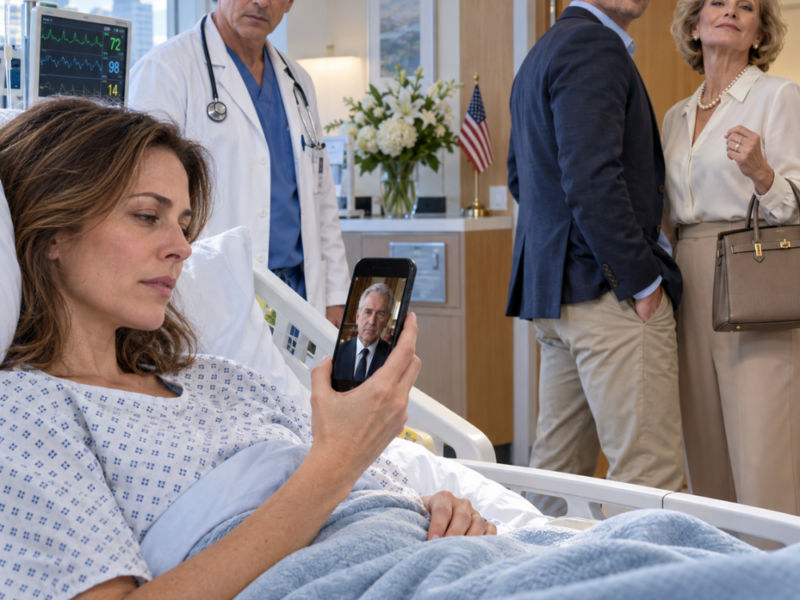
WHEN MY HUSBAND & M.I.L HEARD THE DOCTOR SAY I HAD 3 DAYS LEFT, MY MIL SMIRKED: “3 DAYS? PERFECT. I’M TAKING THE HOUSE.” MY HUSBAND LAUGHED: “AND IN 3 DAYS, I CAN MARRY JENNIFER.” AFTER THEY LEFT, I CALLED MY FATHER. “DAD, IT’S TIME.” HE SAID: “I’VE BEEN… “WAITING FOR THIS CALL.

The doctor said the next 72 hours could be critical. My mother-in-law whispered, “Perfect. I’m taking the house.” Then my husband said, “And I can finally marry Jennifer.”
The worst moment of my life did not begin when the doctor showed me the scan.
It began three seconds later, when I realized the two people sitting beside me were not afraid of losing me.
They were planning what they would gain.
My name is Claire Bennett. I was thirty-eight years old when a headache divided my life into before and after.
It began quietly.
No collapse at work. No ambulance. No dramatic seizure in a grocery-store aisle.
Just a headache.
A dull pressure behind my right eye that appeared one Monday morning and refused to leave.
I blamed my computer screen.
I worked as a senior project administrator for a commercial construction company outside Columbus, Ohio, and August had been brutal. We had two school renovations behind schedule, a medical-office build with a contractor threatening a change order every time the wind shifted, and an owner who believed Friday afternoon was the ideal time to request revised budgets.
I lived on coffee, ibuprofen, and the belief that responsible adults did not fall apart over headaches.
By the second week, the pain was accompanied by moments of dizziness.
I would stand up too quickly and need to grip my desk.
Once, while walking through Kroger after work, the cereal aisle seemed to tilt beneath me.
I waited.
It passed.
I bought milk, tomatoes, rotisserie chicken, and the aspirin Warren had texted me to pick up for him.
That small detail stayed with me later.
Even while my own head felt like it had been packed with wet sand, I remembered his aspirin.
At home, Warren barely noticed anything had changed.
He had always been someone who could live beside a problem until it interfered with his routine.
A leaking faucet could drip for three weeks.
A strange sound in the car existed only once the car stopped.
His wife having headaches fell into roughly the same category.
“You should get your eyes checked,” he said one evening.
“I did last year.”
“Maybe you need new glasses.”
“I don’t wear glasses.”
He looked up from his phone.
“Then there you go.”
I stared at him.
“What does that even mean?”
He smiled faintly and returned to whatever he was reading.
Once, that would have irritated me.
By then, it mostly made me tired.
Warren and I had been married eleven years.
If you had asked me in year three whether I was happy, I would have said yes without hesitation.
If you asked me in year eight, I would have paused before answering.
By year eleven, I had become skilled at describing the marriage in facts instead of feelings.
We owned a nice house.
We had stable jobs.
We rarely yelled.
We paid bills on time.
We took one vacation most years.
We had never cheated on each other.
At least I believed that last part then.
What we had stopped doing was seeing each other.
That kind of disappearance can happen inside a marriage without anyone moving out.
You stop asking follow-up questions.
Stop noticing haircuts.
Stop telling stories about your day because the other person listens with half a face while scrolling.
You remember to purchase their toothpaste and forget to ask what they are afraid of.
Marriage becomes logistics with photographs attached.
I did not admit any of that.
Not even to myself.
The headache continued.
On the twenty-second morning, I tried to get out of bed and the room rolled hard to the left.
I sat back down.
Waited.
Tried again.
Same thing.
The dresser seemed to slide toward the wall.
I caught the mattress.
Warren was buttoning his shirt near the closet.
“I need help.”
“With what?”
“Standing.”
That finally made him look at me.
“What happened?”
“I’m dizzy.”
“You got up too fast.”
“No.”
I put my feet on the floor again.
The carpet shifted beneath them.
“I can’t walk straight.”
He sighed.
Not dramatically.
That was worse.
A sigh of inconvenience.
“Claire, I’ve got the Clifton meeting at nine.”
I stared.
“I didn’t ask about your meeting.”
“I’m saying I can’t spend six hours in an emergency room because you have vertigo.”
“I’ve had a headache for three weeks.”
“Then call your doctor.”
“She can’t see me until Thursday.”
“Urgent care.”
“I’m dizzy enough that I don’t think I should drive.”
He checked his watch.
“Take an Uber.”
That sentence changed something.
Not enough for me to understand immediately.
Enough that I remember the exact angle of morning light on the bedroom wall.
“You’re telling me to call an Uber.”
“I’m telling you I have a client meeting I cannot move.”
“You can.”
“No, Claire. I really can’t.”
I watched my husband put on his watch.
Straighten his cuff.
Pick up his phone.
“Take aspirin. Drink water. If you still feel bad at lunch, text me.”
I almost asked whether he would actually answer.
Instead, I said:
“Go.”
He hesitated.
Maybe guilt.
Maybe annoyance.
Then he kissed my forehead.
“Call me.”
The front door closed fifteen minutes later.
I sat on the edge of the bed.
The house became still.
For the first time in weeks, I stopped negotiating with my own body.
Something was wrong.
I called my primary care office again.
When I described the persistent headache, dizziness, and difficulty walking, the nurse’s tone changed.
“Claire, I want you evaluated today.”
“At urgent care?”
“If you’re having significant balance issues, I’d prefer the emergency department.”
That frightened me more than I expected.
“Okay.”
“Do not drive yourself if you’re dizzy.”
I called Warren.
Voicemail.
Again.
Voicemail.
Then I called my father.
Walter answered on the second ring.
“Hey, kiddo.”
At thirty-eight, I was still kiddo.
“Dad.”
He became serious immediately.
“What happened?”
“I’m going to the hospital.”
“What?”
“I’ve been having headaches.”
“How long?”
“Three weeks.”
“Three weeks?”
I closed my eyes.
“Don’t start.”
“I’m not starting. Why didn’t you tell me?”
“Because headaches are boring.”
“You sound scared.”
“I’m dizzy.”
“I’m coming.”
“No.”
“What?”
“You’re forty minutes away.”
“So?”
“Mom has physical therapy at eleven.”
“I’ll call your mother.”
“Dad.”
“Claire.”
I smiled despite myself.
Same tone.
“Warren can meet me.”
Silence.
“Can he?”
I hated how quickly Dad heard what I had spent years disguising.
“He’s working.”
Another silence.
Then:
“I’ll come.”
“No. I’m calling a ride.”
“I don’t like it.”
“I know.”
“Text me when you arrive.”
“I will.”
“And Claire?”
“What?”
“If anybody says anything you don’t understand, call me before you sign something.”
I laughed weakly.
“Dad, I’m going to the ER, not closing on a mortgage.”
“Doctors have forms.”
“Goodbye.”
“Text me.”
“I will.”
I called a rideshare.
Twenty minutes later, I was at Riverside Medical Center.
The first two hours blurred together.
Triage.
Blood pressure.
Questions.
A nurse asking whether I might be pregnant.
Blood work.
Neurological exam.
A CT scan.
Then another scan was ordered.
Contrast.
More waiting.
Hospitals have a particular way of stretching time.
A television mounted near the ceiling showed a daytime game show nobody watched.
Somebody wheeled a crying toddler past the doorway.
A man in the next bay complained repeatedly about missing his shift.
I kept checking my phone.
Warren finally texted at 11:42.
How’s it going?
I answered:
They’re doing scans.
His reply:
Okay keep me posted.
No call.
At one, Eleanor arrived.
I had not asked her.
She swept through the curtain with a tote bag and a cardigan draped over one arm.
“There you are.”
I stared.
“How did you know?”
“Warren called.”
Of course he did.
He could call his mother.
“He said you were at the hospital alone.”
“I’m fine.”
Eleanor’s eyes moved around the room.
“You don’t look fine.”
There were few people in the world who could make concern sound accusatory.
Eleanor Whitmore had mastered it.
She had never liked me.
Not openly.
She was too socially trained for open hostility.
Her disapproval came through sugar.
The first Christmas after Warren and I started dating, she looked at my sweater and said:
“That color is very brave on you.”
When Warren proposed:
“Well, he always did know his own mind.”
At our wedding:
“You’re not what I pictured for him, but perhaps that’s a good thing.”
I spent the first five years trying to win her over.
Hosted Thanksgiving.
Remembered her birthday.
Helped organize her husband’s seventieth.
Drove her to an outpatient procedure when Warren was traveling.
None of it changed the essential fact that Eleanor believed her son had married below his possibilities.
By year eleven, I no longer auditioned.
She sat beside my hospital bed.
“Have they said anything?”
“No.”
“Where is Warren?”
“Working.”
Her mouth tightened.
“He should be here.”
That surprised me.
“Yes.”
“Did you tell him that?”
“I asked him to drive me.”
“And?”
“He had a meeting.”
Eleanor looked toward the curtain.
Then said the strangest thing.
“Well. Work is complicated right now.”
I studied her.
“What does that mean?”
“Nothing.”
“Eleanor.”
“I said nothing.”
She opened her purse and took out her reading glasses.
The conversation ended.
At three-thirty, I was moved to a quieter room.
At four-ten, a physician named Dr. Whitfield came in.
He was in his late fifties with gray hair and tired eyes.
There was another doctor behind him, younger, and a nurse carrying a tablet.
You know something is wrong when the room suddenly contains more professionals than the conversation seems to require.
“Ms. Bennett?”
“Yes.”
“I’m Aaron Whitfield. I’m the attending physician coordinating your evaluation.”
I sat straighter.
Eleanor closed her handbag.
“Okay.”
He pulled a chair closer.
“Your imaging shows a mass in the right frontal region with significant surrounding swelling.”
The room became distant.
“A tumor?”
“We’re concerned about that possibility.”
“Cancer?”
“We do not know yet.”
I looked at Eleanor.
For once, she had no expression.
Dr. Whitfield continued.
“The swelling is likely contributing to your headache and balance symptoms.”
“Can you remove it?”
“That will depend on what it is, where it originates, and what additional imaging shows.”
I tried to follow.
He said words like edema.
Lesion.
Neurosurgery.
Urgent MRI.
Possible biopsy.
Steroids to reduce swelling.
Somewhere during the explanation, Warren entered.
He was still wearing his work clothes.
He looked annoyed at first.
Then saw the doctor.
“What’s happening?”
Dr. Whitfield began again.
Warren stood beside his mother rather than me.
That detail would matter later.
The MRI came back faster than anyone expected.
Not because of some miraculous diagnosis.
Because the imaging department had an opening and the radiologist flagged my symptoms as urgent.
Near seven, Dr. Whitfield returned.
This time his concern was more visible.
“The mass has features that are worrisome.”
“What does worrisome mean?”
He paused.
“We need neurosurgery involved immediately.”
“Is it cancer?”
“We still cannot say definitively from imaging alone.”
“Then what are you saying?”
He looked at me directly.
“I’m saying the appearance raises concern for an aggressive process, and the amount of swelling means we need to act quickly.”
“How quickly?”
“The next seventy-two hours are important.”
Eleanor inhaled.
Dr. Whitfield continued.
“I do not mean you have exactly seventy-two hours to live.”
That clarification mattered.
“I mean there is a risk of rapid neurological deterioration if the swelling continues untreated. We’re starting medication now, and neurosurgery is reviewing the scans.”
I nodded because nodding was easier than understanding.
“So I could die.”
“We take this seriously.”
“When?”
“Claire, there is no responsible way for me to give you a countdown from these images.”
My throat tightened.
“But if this is aggressive—”
“We’ll know more after further testing.”
Eleanor leaned toward Warren.
She thought she lowered her voice enough.
She did not.
“Three days.”
I turned.
She looked at Warren.
Then whispered:
“Perfect.”
The word was so wrong I thought I had misheard.
“What?”
Eleanor looked at me.
For a fraction of a second, guilt crossed her face.
Then disappeared.
“I said the timing is—”
“Perfect for what?”
She stared.
Warren closed his eyes.
“Mom.”
But Eleanor had never been good at retreat once challenged.
“The house.”
Dr. Whitfield’s face changed.
I could see him deciding whether he should leave.
Eleanor continued.
“The deed issues. If something happens, we need to make sure the property stays in the family.”
My brain could not catch up.
“What house?”
“Our house?” Warren asked quietly.
“No.”
Eleanor looked at him.
“Your grandmother’s house. Claire’s mother’s place.”
My mother’s house.
The house I had inherited after she died.
Eleanor had apparently already decided death would convert it into family inventory.
I laughed.
One short sound.
Not humor.
Disbelief escaping under pressure.
“You think you’re getting my house.”
“Claire, this isn’t the time to be defensive.”
I turned toward Warren.
He was not looking at me.
“Say something.”
His jaw tightened.
“Everyone’s emotional.”
“No.”
“Claire.”
“Say something.”
He finally looked at me.
What I saw there was not grief.
It was calculation.
Then his phone vibrated.
He glanced at the screen.
That was when the final piece arrived.
“Who is Jennifer?”
The question came out before I planned it.
Warren went completely still.
Eleanor looked at him.
Not surprised.
That told me she knew.
My stomach dropped.
“Who is Jennifer?”
“Claire.”
“Who is she?”
Dr. Whitfield stood.
“I think perhaps I should—”
“No.”
I looked at him.
“Please stay.”
That surprised everyone.
But suddenly I wanted a witness.
A neutral human being in the room.
Somebody who would know I had not invented what happened next.
Warren rubbed his face.
“This is not the time.”
“Apparently I may have a brain tumor. I think my schedule just opened up.”
Eleanor hissed:
“Claire.”
“What?”
“Stop creating a scene.”
I stared at her.
“A scene.”
Warren laughed then.
Small.
Nervous.
Cruel enough that I remember it perfectly.
“And if the worst happens, maybe I can finally stop pretending this marriage works.”
The air left my lungs.
Then he added:
“Jennifer and I have been talking about a future.”
Dr. Whitfield stared at him.
Eleanor whispered:
“Warren.”
“What? She asked.”
I looked at my husband.
“How long?”
“Don’t.”
“How long?”
He looked away.
“About a year.”
A year.
The late nights.
Phone angled downward.
Sudden gym membership.
Business dinners.
New cologne.
His smile at messages.
I had not failed to see.
I had refused to name.
“Were you going to leave me?”
Silence.
“Were you?”
“Yes.”
Eleanor said sharply:
“Warren, enough.”
But now he seemed relieved.
Truth can feel good to the person who has been hiding it, even when it destroys everyone else.
“I was waiting for the right time.”
I looked toward my scan on Dr. Whitfield’s tablet.
“Apparently my possible death looked convenient.”
He did not answer.
That was answer enough.
I stood.
The room tilted.
The nurse moved toward me.
“Ms. Bennett—”
“I’m fine.”
I wasn’t.
But I was leaving that room.
Dr. Whitfield stopped me near the door.
“You are not medically cleared to drive.”
“I won’t.”
“We’re admitting you tonight.”
I turned.
“What?”
“With the degree of swelling, I do not want you leaving.”
Warren spoke.
“I can stay.”
I looked at him.
“No.”
“Claire.”
“No.”
Eleanor stood.
“Don’t be ridiculous.”
I looked at her.
“You were planning ownership of my house before the doctor finished discussing my brain.”
Her face reddened.
“That isn’t fair.”
“Leave.”
“This is my son’s—”
“Leave.”
The nurse stepped between us.
“Mrs. Whitmore, I think Ms. Bennett has made her wishes clear.”
Eleanor looked offended.
Warren looked angry.
Neither looked heartbroken.
They left.
Dr. Whitfield waited until the door closed.
Then he sat back down.
For several seconds, he said nothing.
Finally:
“I’m sorry.”
I looked at him.
“For which part?”
His face softened.
“That isn’t mine to answer.”
I started crying.
Quietly.
No dramatic sobs.
Just tears.
He gave me a box of tissues and stepped out.
That night, I called my father.
Walter answered on the second ring.
“Claire?”
My voice broke before I got through his name.
“Dad.”
“I’m coming.”
“You don’t know what happened.”
“I know how you sound.”
“I’m at Riverside.”
“I’m coming.”
“Dad, wait.”
He stopped.
“There’s a mass.”
Silence.
“They think it could be serious.”
“Okay.”
“They’re admitting me.”
“Okay.”
“And Warren—”
I could not finish.
Dad’s voice changed.
“What did he do?”
I looked toward the hospital door.
“He’s been seeing someone.”
Long silence.
“Claire.”
“And Eleanor was talking about Mom’s house.”
“What about it?”
“She thinks she gets it if I die.”
My father became very quiet.
I knew that kind of quiet.
Walter Bennett had spent thirty-eight years as a probate and estate attorney before retiring.
He did not raise his voice when angry.
He became precise.
“Claire.”
“Yes?”
“Do not sign anything Warren puts in front of you.”
“I won’t.”
“Do not discuss the house with Eleanor.”
“I won’t.”
“Do not go home.”
I stopped.
“What?”
“Not tonight. Not tomorrow.”
“Dad.”
“Listen to me.”
I closed my eyes.
“I have been waiting for a reason to tell you several things I hoped I would never need to tell you.”
“What things?”
“About Warren.”
Cold moved through me.
“What do you know?”
“I’m coming to the hospital.”
“Dad.”
“Claire.”
Then he said:
“It’s time.”
Those two words carried something I did not understand.
By nine-thirty, he was beside my bed.
Seventy-two years old.
Brown jacket.
Reading glasses still in his shirt pocket.
He looked older than he had that morning.
Maybe I did too.
He hugged me.
Hard.
Then pulled a chair close.
“First, the medical part.”
I nodded.
“I want a second opinion.”
“So do I.”
“I know a neuro-oncologist at Ohio State.”
“You know everyone.”
“I’m old.”
That almost made me smile.
“I’ve already called him.”
“You did?”
“He owes me a favor.”
“Why?”
“His divorce.”
“Of course.”
Dad took my hand.
“He will review your imaging tonight if Riverside transfers the records. Dr. Whitfield agreed.”
“You spoke with him?”
“Ten minutes ago.”
My father had been in the building less than half an hour.
He had already built a plan.
That was Walter.
Then his expression changed.
“Now Warren.”
I felt sick.
“What do you know?”
Dad looked at me for several seconds.
“About eighteen months ago, I became concerned.”
“Why?”
“Your mother’s trust.”
“What about it?”
“Warren asked questions he should not have been asking.”
I frowned.
“What questions?”
“When your mother died, her house and several investment accounts passed through an estate structure we had set up years earlier.”
“I know.”
“You know the simple version.”
I waited.
Dad continued.
“Your mother was worried about protecting the assets if you ever had financial trouble, a lawsuit, or a divorce.”
“She never liked Warren.”
“She did in the beginning.”
“That changed.”
“Yes.”
Mom died four years earlier.
Pancreatic cancer.
Fast enough to feel unreal.
She had loved Warren once.
Then, during her final year, she stopped trusting him.
I assumed it was because he visited less.
Apparently not.
Dad said:
“She asked me to restructure the remaining inheritance so the house and investment assets would be held in trust for your benefit.”
“I thought I owned the house.”
“You have the beneficial interest and control under the trust terms. But the title is held by the trust.”
I stared.
“Why didn’t you tell me?”
“You signed the documents.”
“I signed eighty documents while Mom was dying.”
“I know.”
His face softened.
“We explained it.”
“I remember almost none of that year.”
“I know.”
“Does Warren know?”
“Not completely.”
That was the point.
Dad opened the leather portfolio he carried.
Inside were copies.
Trust.
Deed.
Asset schedule.
The house I believed was personally titled to me was owned by the Bennett Family Irrevocable Trust, with me as sole lifetime beneficiary and an independent trustee structure protecting principal from spousal claims.
The terms were more complicated than I understood that night.
The simple part:
Warren did not own it.
He had no survivorship right.
Eleanor had no claim whatsoever.
If I died, the remainder interest passed according to my mother’s plan, largely to a charitable foundation and several younger relatives—not to Warren.
I almost laughed.
“Does he think he gets it?”
“Yes.”
“Why?”
“Because he tried to make sure he would.”
My stomach tightened.
“What does that mean?”
Dad looked tired suddenly.
“Two years ago, Warren asked me whether we should create a broad durable power of attorney naming him.”
“I remember.”
“He said it was practical for married couples.”
“Yes.”
“I advised against the version he brought.”
“Why?”
“It gave him extensive control over your trust-related financial decisions.”
“I thought you were being overprotective.”
“You told me that.”
“Sorry.”
“Not important.”
Dad continued.
“I had one of my former partners review the source of the document.”
“What source?”
“Warren didn’t draft it himself.”
I felt cold.
“It came through an attorney who had represented a company tied to one of Warren’s colleagues.”
“Jennifer?”
“We did not know about Jennifer then.”
“But now you do.”
Dad looked down.
“Yes.”
“How?”
He hated the next part.
I could see it.
“I hired an investigator.”
I pulled my hand away.
“You what?”
“Claire.”
“You had me followed?”
“No.”
“You had my husband followed.”
“Yes.”
“That is not better.”
“No.”
I stared.
“When?”
“Eighteen months ago.”
“You knew for eighteen months?”
“I suspected financial misconduct for eighteen months.”
“The affair?”
“Confirmed about eight months ago.”
I stood too quickly.
The room shifted.
Dad reached for me.
I pulled away.
“You knew.”
“I had evidence he was meeting a woman.”
“You knew.”
“Yes.”
“And you didn’t tell me.”
“I wanted to.”
“Then why didn’t you?”
“Because every time I tried to ask whether you were happy, you defended him.”
“That didn’t give you the right.”
“No.”
Dad’s honesty took some of the force out of me.
“I was wrong about that.”
I stared.
He continued.
“I told myself I was protecting you until I had undeniable proof. Then when I had proof, your mother was gone, you were grieving, and I kept waiting for a moment that wouldn’t destroy you.”
“That moment doesn’t exist.”
“I know that now.”
I sat.
My anger at Warren had been simple for maybe two hours.
Now everything had layers.
“Who is Jennifer?”
“Jennifer Cole. She works at Warren’s company.”
“How old?”
“Thirty-three.”
“Does that matter?”
“No.”
I hated myself for asking.
Dad said:
“She and Warren have been traveling together under business pretexts. Hotels. Restaurants. Jewelry purchases. A separate phone plan.”
My chest hurt.
“Did Mom know?”
“No.”
“Good.”
That came out as a whisper.
I could not stand the idea of her dying with another worry about me.
Dad reached across the bed.
“I’m sorry.”
I looked at him.
“For what?”
“For deciding what truth you could handle.”
I cried again.
This time not quietly.
By midnight, the neuro-oncologist had reviewed my scans.
His name was Dr. Samuel Levin.
He called into the hospital room with Dr. Whitfield present.
He agreed the mass was real.
He disagreed with how confidently anyone could characterize it from the available images.
“There are features I want evaluated differently,” he said.
“What does that mean?”
“It means you need a dedicated MRI with a different protocol and neurosurgical review before anybody gives you a diagnosis.”
“Do you think I’m dying?”
“I think anyone giving you a three-day life expectancy from what I’ve seen is speaking far beyond the evidence.”
Dr. Whitfield looked pained.
He had never literally said I had three days to live.
Fear had filled the gaps.
Eleanor’s interpretation had made it worse.
Dr. Whitfield spoke.
“I want to clarify something, Ms. Bennett.”
I looked at him.
“My concern was the swelling and risk of deterioration. If I communicated that in a way that sounded like a definitive terminal prognosis, I’m sorry.”
“You said seventy-two hours were important.”
“Yes.”
“That became three days.”
“I understand.”
He looked genuinely upset.
“We need to be precise.”
My father nodded.
“Thank you.”
That mattered.
Nobody in that room pretended doctors were infallible.
Nobody accused Dr. Whitfield of malicious incompetence.
Medicine under urgency contains uncertainty.
The mistake had been letting worst-case concern become certainty before pathology existed.
The next morning, I was transferred for specialized imaging.
Dad came.
Warren called six times.
I answered none.
At nine, he sent:
Please call me. We need to discuss what happened.
At ten:
Mom is upset.
That nearly made me throw the phone.
At eleven:
I know last night was awful but don’t make permanent decisions while you’re scared.
Permanent decisions.
From the man who had spent the previous year sleeping with Jennifer.
I handed the phone to Dad.
“Keep this.”
“Gladly.”
The second MRI lasted almost an hour.
Then more waiting.
At two-thirty, Dr. Levin entered with a neurosurgeon, Dr. Priya Nandakumar.
They sat.
My father gripped his notebook.
I gripped his hand.
Dr. Levin began.
“The new imaging gives us a much clearer picture.”
I tried to breathe.
“The mass is serious, but it does not look like the aggressive diffuse malignancy initially feared.”
My entire body went cold.
“What does it look like?”
Dr. Nandakumar answered.
“A well-circumscribed lesion with significant surrounding edema. Based on its location and imaging characteristics, we believe it is likely a meningioma, though pathology will confirm that after surgery.”
I knew only one word.
“Likely.”
“Yes.”
“Cancer?”
“Many meningiomas are benign.”
I started crying before she finished.
“We cannot promise anything before pathology,” she continued, “but this is a very different situation from what you feared yesterday.”
Dad squeezed my hand.
“Treatment?”
“Surgery.”
“When?”
“Soon. The swelling and your symptoms make this urgent.”
“Today?”
“We’re planning within forty-eight hours.”
“Am I going to die?”
Dr. Nandakumar looked directly at me.
“Every surgery has risk. But based on what we see now, we are talking about treatment, not preparing you to die in three days.”
I covered my face.
For several minutes, the room disappeared behind tears.
Relief is not gentle.
People think good news feels light.
Sometimes it crushes you because your body has already prepared for the funeral.
Dad cried too.
He tried hiding it by cleaning his glasses.
He cleaned them for five straight minutes.
I finally said:
“Dad.”
“What?”
“They’re clean.”
“They’re not.”
“Give me those.”
He laughed.
That was the first laugh that did not hurt in two days.
I did not call Warren.
Not yet.
That decision surprised Dad.
“You sure?”
“Yes.”
“He should know you’re having surgery.”
“He’ll know.”
“Claire.”
“I need one day where my medical information belongs to me.”
Dad nodded.
“Okay.”
That became one of the most important words of my recovery.
Okay.
Not but.
Not are you sure.
Okay.
We spent the afternoon with lawyers.
That sounds absurd when you are waiting for brain surgery.
But death, illness, betrayal, and property have a way of creating administrative urgency.
Dad’s former partner, Patricia Sloan, came to the hospital.
She specialized in trusts and domestic asset protection.
She was sixty-four, wore navy suits, and spoke to me as if my life had not become a television drama.
Exactly what I needed.
She explained the trust.
The house.
The investment account.
My rights.
Warren’s lack of rights.
Then she asked:
“Do you want to change any beneficiary designations you control personally?”
“Yes.”
“Good. We can prepare documents.”
“Can Warren challenge the trust?”
“He can challenge anything if he finds a lawyer willing to file.”
“That’s not what I asked.”
She smiled.
“Your father’s daughter.”
“Unfortunately.”
Dad looked offended.
Patricia continued.
“The trust was created before the marital crisis became visible and funded with your mother’s separate property. The house is not titled jointly. Warren has no automatic claim simply because he resides there.”
“What if I die during surgery?”
“The trust follows its terms.”
“To whom?”
She explained.
A portion for my father’s lifetime benefit if needed.
Then charitable gifts.
Scholarship fund.
My cousin’s children.
Not Warren.
Not Eleanor.
I sat quietly.
“So Eleanor was planning curtains for a house she cannot inherit.”
Patricia’s mouth twitched.
“Legally speaking, yes.”
Dad looked toward the window because laughing under the circumstances apparently felt rude.
I laughed anyway.
Then Patricia became serious.
“There is another issue.”
“What?”
“The power-of-attorney documents.”
My stomach tightened.
“What about them?”
“Your father’s investigator found a draft bearing what appears to be a version of your electronic signature.”
I stared.
“I never signed.”
“We know.”
“Warren forged it?”
“We do not know who created the signature. We know the document was never validly executed and was never accepted by the trustee.”
“Why didn’t anyone tell me?”
Dad looked down.
Patricia answered.
“Because the attempt failed and your father asked us to continue monitoring quietly.”
I looked at him.
His face was ashamed.
“I was trying to protect the trust.”
“You were also protecting me from knowing my husband might be trying to steal from me.”
“Yes.”
I closed my eyes.
“Dad.”
“I know.”
“Stop deciding what I can survive.”
His voice broke.
“I know.”
I looked at him.
“Promise.”
“I promise.”
That promise became our new relationship.
The next morning, I finally called Warren.
He answered immediately.
“Claire.”
“I have an update.”
“Thank God. How are you?”
Too late.
The words might once have sounded caring.
Now I heard performance.
“I’m not dying.”
Silence.
Not long.
Maybe two seconds.
Long enough.
“What?”
“The initial prognosis was wrong.”
More silence.
Then:
“What do you mean wrong?”
“I mean the mass appears treatable. I’m having surgery tomorrow.”
“Oh.”
Oh.
Not:
Thank God.
Not:
Claire.
Not a sob.
Oh.
I closed my eyes.
Across the hospital room, Dad stared at the floor.
Warren recovered.
“That’s good.”
“Yes.”
“That’s really good.”
His voice was trying to catch up with the sentence.
“Eleanor with you?”
“No.”
“Where are you?”
“At Ohio State.”
“You transferred?”
“Yes.”
“Why didn’t you tell me?”
“Because yesterday you were discussing Jennifer before anyone had diagnosed me.”
“Claire.”
“No.”
“That conversation got out of control.”
“It was the first honest conversation we’ve had in a year.”
“That’s not fair.”
“I know about her.”
Silence.
“I know about the hotels.”
Silence.
“The phone.”
“Claire.”
“The jewelry.”
His breathing changed.
“Your father.”
There it was.
Not denial.
My father.
“Do not make this about him.”
“He had me investigated.”
“Yes.”
“That is insane.”
“Maybe.”
“He invaded my privacy.”
“You were having an affair.”
“That doesn’t justify—”
“Do you hear yourself?”
He stopped.
I continued.
“You were preparing documents to gain control over my mother’s trust.”
“That is not what those documents were.”
“Good. Then you won’t mind our lawyers reviewing them.”
Long silence.
“Lawyers.”
“Yes.”
“What are you doing?”
“Getting well.”
“Claire.”
“And getting divorced.”
His breath left in a rush.
“Don’t do this while you’re terrified.”
“I was terrified yesterday.”
I looked at the hospital window.
“I’m very clear today.”
“You can’t just erase eleven years.”
“I’m not.”
I swallowed.
“I’m finally reading them correctly.”
“Can I see you?”
“No.”
“I’m your husband.”
“For now.”
“Claire.”
“The house belongs to the trust.”
That silenced him completely.
I waited.
Then:
“What?”
“You heard me.”
“You own that house.”
“I am the beneficiary. The trust owns it.”
“That makes no sense.”
“It makes plenty of sense to estate lawyers.”
“What are you saying?”
“I’m saying your mother is not getting it.”
“That isn’t—”
“And neither are you.”
“Claire, I never—”
“Jennifer can help you find curtains somewhere else.”
I hung up.
Petty?
Yes.
I allow myself one line.
Brain surgery the next morning was not poetic.
It was terrifying.
Moments of my life came back while nurses prepared me.
My mother making pancakes in the lake house kitchen.
Dad teaching me to drive in a church parking lot.
Warren on one knee at Franklin Park Conservatory.
Our honeymoon in Maine.
The first Christmas in the house.
The year Mom died.
All of it.
Good memories do not disappear when a relationship reveals rot.
That complicates leaving.
If Warren had been cruel from the beginning, divorce would have been easier.
He had once loved me.
Or something close enough to love that I had built a life around it.
He sat beside my mother’s hospice bed.
Made coffee for Dad.
Held me while I cried after the funeral.
Those things happened.
Then other things happened.
Human beings dislike stories where both are true.
I had to learn to tolerate it.
The last thing I remember before anesthesia was Dad beside the bed.
“I’ll be here.”
“I know.”
“Claire?”
“What?”
“Your mother would be furious.”
I smiled.
“At Warren?”
“At everyone.”
“That sounds right.”
Then darkness.
The surgery took almost six hours.
The tumor was removed completely.
Pathology later confirmed a WHO grade 1 meningioma.
Benign in the technical sense.
Not harmless.
The swelling had been causing the headaches and neurological symptoms.
I spent two days in intensive monitoring and another five in the hospital.
Recovery was not fast.
Steroids made me restless and emotional.
My face puffed.
I tired easily.
For weeks, reading more than a few pages gave me headaches.
I had trouble trusting stairs.
Physical therapy worked on balance.
Occupational therapy worked on endurance.
Dad moved into my guest room after I returned home.
Not the house Warren and I shared.
My father’s house.
I refused to return to the marital residence while Warren was there.
Patricia arranged temporary legal steps through my divorce attorney, Melissa Carter.
The trust’s counsel sent formal notice concerning the property.
Warren had no ownership interest and, under the occupancy terms, no independent right to remain after our separation without my authorization.
He left.
Not happily.
But he left.
Jennifer did not move in.
That would have been almost too neat.
She apparently ended their relationship shortly after learning I was not dying.
I learned this from Warren’s sister, who called under the pretense of asking how I was recovering.
“She didn’t know he was married?”
I asked.
Long silence.
“She knew.”
“Then why did she leave?”
“I think everything became too much.”
I laughed.
“That’s poetic.”
The divorce filing went forward.
No dramatic grounds that magically stripped Warren of all marital property.
Ohio divorce law did not operate like a revenge story.
We still had marital assets.
Retirement contributions earned during marriage.
Joint savings.
Vehicles.
Furniture.
Debts.
Those were divided through negotiation.
What Warren did not get was the property he had counted on.
My mother’s trust remained separate.
The house remained with the trust.
The inherited investment assets remained protected.
The attempted financial documents became relevant in settlement negotiations and a separate investigation by counsel, but because they had never been validly executed and the circumstances around the electronic signature could not be cleanly attributed beyond dispute, there was no cinematic fraud conviction.
Real life often leaves ugly behavior in the category of legally suspicious but difficult to prove.
I learned to live with that too.
My marriage did not need a criminal conviction to end.
The affair was enough.
The hospital was enough.
The expression on Warren’s face when I told him I would live was enough.
Eleanor called me six days after surgery.
Dad wanted to block her number.
I said no.
Not because I wanted reconciliation.
Because I wanted to hear what she would say.
“Claire.”
Her voice was careful.
“How are you feeling?”
“Like someone operated on my brain.”
“I heard surgery went well.”
“It did.”
“Thank God.”
I said nothing.
She continued.
“I want to apologize for the hospital.”
“For which sentence?”
Silence.
“I was in shock.”
“You said, ‘Three days, perfect. I’m taking the house.’”
“I did not mean it like that.”
I laughed.
My scar pulled slightly.
“How else can that sentence mean anything?”
“I was thinking practically.”
“About my death.”
“Claire.”
“Before anyone had even confirmed the diagnosis.”
Eleanor began crying.
Once, her tears would have made me soften automatically.
Illness had changed my patience.
“You have to understand,” she said, “that house belonged to your mother, and I thought Warren would inherit—”
“Why did you think that?”
“Because you’re married.”
“That is not how inheritance works.”
“I know that now.”
“No.”
I looked out Dad’s kitchen window.
“You know now that your plan failed.”
She became quiet.
“That is different from understanding you had no right to make the plan.”
“Do you hate me?”
I thought.
“No.”
She sniffed.
“Then maybe we can—”
“I don’t want a relationship with you.”
The crying stopped.
“What?”
“I don’t hate you.”
“Claire.”
“I also don’t want you in my life.”
“You can’t erase me. I’m Warren’s mother.”
“Warren is becoming my ex-husband.”
“But after eleven years—”
“You spent my possible final hours discussing property.”
“I said I was sorry.”
“Yes.”
“What else do you want?”
Nothing.
That was the answer.
For years, I wanted Eleanor to approve of me.
Then respect me.
Then at least behave politely.
Surgery burned the last of that need away.
“Nothing.”
I said it gently.
“That’s the point.”
I ended the call.
Recovery came in increments so small they were almost insulting.
The first shower without Dad waiting outside the bathroom because I was dizzy.
The first walk to the mailbox.
The first afternoon without a nap.
The first time I drove again.
The first work email I answered without needing to reread every sentence.
I returned part-time after eight weeks.
My boss, Monica, met me at the elevator.
“You’re doing three hours.”
“I can do five.”
“Three.”
“Monica.”
“Three.”
“I have an executive meeting.”
“I moved it.”
“You moved my meeting?”
“Yes.”
“That is abuse of authority.”
“HR disagrees.”
I laughed.
Then nearly cried.
Normal irritation felt wonderful.
People at work knew I had undergone brain surgery.
They did not know the entire marriage story.
I preferred it that way.
For the first time in months, people asked me about schedules instead of tumors and divorce.
A subcontractor was late with shop drawings.
A budget needed correction.
The coffee machine still produced liquid that technically qualified as coffee.
Ordinary problems returned.
I welcomed them.
Dad drove me to work the first week.
I protested.
He ignored me.
On Friday, I said:
“You can stop.”
“I know.”
“I’m serious.”
“I know.”
“Dad.”
He looked at me.
“Are you asking me to stop because you want independence or because you think you’re burdening me?”
I stared.
That was unfairly perceptive.
“Both.”
“Then I’ll stop Monday.”
“Why Monday?”
“Because today I brought donuts.”
Fine.
He stopped Monday.
That mattered.
Dad had spent part of my marriage crossing boundaries too.
Not like Warren.
But enough.
Hiring an investigator without telling me.
Monitoring.
Protecting.
Deciding.
During therapy, I confronted him.
We sat in Dr. Hannah Lee’s office.
Dad had agreed to one joint session because I refused to keep having the argument over Sunday dinner.
“You don’t get to do that again.”
“I know.”
“No investigators.”
“I know.”
“No asking Patricia to monitor my finances unless I ask.”
“Understood.”
“No protecting me from information.”
His face tightened.
“That one is harder.”
“Dad.”
“I said harder, not impossible.”
Dr. Lee looked at him.
“Why is it harder?”
He rubbed his hands together.
“Because her mother died.”
My anger softened slightly.
“And I promised Elaine I’d look after her.”
“I’m thirty-eight.”
“I know.”
“You cannot keep Mom alive by controlling my risk.”
He looked down.
That sentence hurt him.
Good therapy often does.
“I know.”
He wiped at one eye.
“She made me promise.”
“What exactly?”
“That I wouldn’t let Warren take advantage of you.”
I stared.
“What did she know?”
Dad became quiet.
Then, because of his promise to stop protecting me from truth:
“She thought he was overly interested in the inheritance.”
“How long?”
“Before she died.”
My stomach tightened.
“Did she know about Jennifer?”
“No.”
“Did she dislike Warren?”
“By the end, yes.”
“Why didn’t anyone tell me?”
Dad looked at me.
“We thought you’d defend him.”
“I probably would have.”
“That’s why.”
I shook my head.
“No.”
He waited.
“You still tell me.”
He closed his eyes.
“Yes.”
I cried.
Not because Mom had doubted my marriage.
Because she died carrying a worry I never let her voice clearly.
For years, Warren told me my parents were too involved.
In some ways, they were.
The irony was that I used that accusation to distance myself from warnings I might have considered if they came from anyone else.
Healthy independence, I learned, is not refusing other people’s observations.
It is hearing them without surrendering the final decision.
Dad had failed by withholding evidence.
I had failed by making honesty with me feel too dangerous.
Neither mistake excused Warren.
But healing required sorting responsibility accurately.
The divorce took ten months.
Warren fought hardest over the house.
Not because his lawyer believed he owned it.
Because giving up the house meant accepting he had misunderstood our financial life for years.
At mediation, he sat across the table in a gray suit.
Our attorneys moved in and out of separate rooms most of the day.
Finally, Warren requested a private conversation with counsel nearby.
I agreed.
He looked tired.
“I honestly thought the house would come to me if something happened to you.”
“I know.”
“Your mother told me once that she wanted you secure.”
“That is not the same as wanting you enriched.”
His jaw tightened.
“I was your husband.”
“Yes.”
“I lived there.”
“Yes.”
“I paid toward expenses.”
“Utilities and household costs. The trust paid property taxes and capital improvements.”
He stared.
“You always had this protected.”
“My mother did.”
“From me.”
“From any spouse.”
He looked down.
“That feels personal.”
“It wasn’t when she created it.”
“Wasn’t it?”
I thought about Mom’s later concerns.
“Maybe eventually.”
He laughed bitterly.
“Of course.”
Then:
“Did you know Jennifer left?”
“Yes.”
“Who told you?”
“Does it matter?”
“No.”
He stared at his hands.
“She thought I was going to divorce you.”
“You told her that?”
“Yes.”
“How long?”
“Almost a year.”
“Why didn’t you?”
He did not answer immediately.
“Money.”
At least it was honest.
I sat still.
“What money?”
“Divorce would have been expensive.”
“Meaning my inheritance.”
“I didn’t understand it wasn’t marital.”
“You could have asked your own lawyer.”
“I thought waiting made more sense.”
“Waiting for what?”
His face tightened.
I knew.
He did not want to say it.
I made him.
“Waiting for what, Warren?”
He looked at me.
“For things to change.”
“You mean my health.”
“Not originally.”
“But at the hospital?”
He closed his eyes.
“Yes.”
There it was.
The ugliest truth of our marriage, finally spoken without decoration.
When Warren believed I might die, some part of him calculated that death would solve the expensive problem of divorce.
No one needed to prove that in court.
I heard it.
That was enough.
“Thank you.”
He looked startled.
“For what?”
“For finally telling the truth.”
“Claire.”
“I’m done.”
He became pale.
“Do you hate me?”
“No.”
That seemed to hurt more.
“I wish I did.”
He swallowed.
“I’m sorry.”
“I believe you.”
“You do?”
“Yes.”
“Does that change anything?”
“No.”
That was the moment our marriage ended emotionally.
The legal judgment came three months later.
The house stayed in trust.
Inherited assets stayed separate.
Joint marital property was divided.
Warren retained his retirement share.
I retained mine.
We sold one jointly owned investment account and split proceeds.
No one walked away with “nothing.”
Reality is more disciplined than revenge.
Eleanor lost something she valued more than money.
Access.
I did not invite her to appointments.
Did not call on birthdays.
Did not answer letters.
Warren moved into a condominium across town.
Jennifer transferred to another office.
I never met her.
For a while, I imagined confronting her.
Then I realized I had nothing useful to say.
She knew Warren was married.
That was enough information for me.
The person who owed me fidelity was Warren.
Keeping that distinction prevented me from spending years fighting the wrong woman.
Dad stayed close during recovery.
Sometimes too close.
He eventually learned to ask.
“Want company?”
Not:
I’m coming.
“Want advice?”
Not:
Here’s what you should do.
The difference looked tiny from outside.
Inside our relationship, it was enormous.
Six months after surgery, my follow-up MRI showed no residual tumor.
At one year, still clear.
At two years, clear.
I will always be monitored.
I am comfortable with that now.
The first follow-up scan terrified me more than surgery.
I sat in the waiting room gripping Dad’s hand.
“You’re hurting me.”
“Sorry.”
I loosened my grip.
He squeezed mine.
“Not that much.”
Dr. Levin eventually entered.
“No recurrence.”
I cried.
Dad cried.
The doctor pretended not to notice either.
On the drive home, Dad said:
“Your mother would’ve made us stop for pie.”
“She would’ve made us buy an entire pie.”
“And complained when I ate half.”
“You would eat half.”
“That’s not relevant.”
We stopped at a diner.
Bought pie.
Mom remained present that way.
Not as a legal trust.
Not as a house.
As habits.
A recipe card.
A phrase.
The way Dad folded napkins because she used to criticize him for leaving them crumpled.
That helped me reclaim the house emotionally.
For almost a year, I could barely enter it.
Too many memories.
Mom.
Warren.
The hospital sentence about curtains.
Eventually, Dad and I went together.
The place smelled closed.
Dust on the piano.
A stack of Warren’s old mail still on the counter because no one had cleared it.
I stood in the living room.
Dad waited.
“Want to leave?”
“No.”
I walked through every room.
Upstairs.
Guest room.
The bedroom Warren and I had shared.
His side of the closet was empty.
Mine still held clothes I had not worn in months.
I opened the window.
Outside, late spring air moved through the trees.
That was the beginning.
I renovated slowly.
Not out of revenge.
To make the house mine again.
Paint.
New bedroom carpet.
Removed the oversized sectional Warren insisted on buying.
Turned his home office into a reading room.
Kept the dining table.
Kept Mom’s curtains.
Eleanor never got them.
I found that more satisfying than it probably should have been.
One afternoon, while sorting drawers, I found a birthday card Warren had given me during our third year of marriage.
Inside he wrote:
I still can’t believe I get to build a life with you.
I sat on the floor holding it.
Then cried for the man who wrote it.
Not the man at the hospital.
That distinction mattered.
I do not believe our entire marriage was fake.
I believe Warren changed.
I changed.
Resentments grew.
Entitlement grew.
He made choices.
Then made worse choices to protect earlier choices.
People sometimes want betrayal stories to contain one moment where the villain reveals he never loved anyone.
Real life is more uncomfortable.
People can love you and still become unsafe.
They can once be good to you and later justify terrible behavior.
Past tenderness does not create permanent credit against future cruelty.
That became one of the hardest lessons.
Dad knew that too.
Two years after the divorce, we sat on his porch.
He was seventy-four then.
His knees had begun bothering him.
I noticed.
Of course I did.
“Dad?”
“Yeah?”
“Why did you really hire the investigator?”
He sighed.
“I thought we finished this.”
“We finished being angry.”
“That sounds ominous.”
“Answer.”
He looked toward the yard.
“Your mother.”
“What about her?”
“Before she died, she told me she thought Warren was waiting for something.”
“What?”
“Money.”
My chest tightened.
“Why?”
“He asked her once what would happen to the house if you died before him.”
I stared.
“When?”
“About six months before she died.”
“Why would he ask that?”
“He framed it as estate planning.”
“Did she tell you?”
“Immediately.”
“And you never told me.”
“I know.”
“God, Dad.”
“I know.”
He leaned forward.
“I was afraid you’d stop bringing Warren around while your mother was dying.”
I became quiet.
That was different.
“She loved him?”
“She loved you.”
He looked at me.
“She wanted peace at the end.”
I stared toward the yard.
“She still should’ve told me.”
“Yes.”
He nodded.
“She knew.”
The sadness was enormous.
Not anger.
Mom had made a decision too.
Maybe wrong.
Maybe understandable.
Both.
I had spent years thinking safety came from identifying the bad person and standing with the good ones.
Recovery taught me everyone can fail you differently.
The question is what they do when the failure becomes visible.
Dad admitted.
Changed.
Asked permission.
Warren minimized until consequences arrived.
Eleanor apologized only after learning the house was unavailable.
Patterns mattered.
Three years after surgery, I met someone named Evan.
Not at a hospital.
Not through Dad.
At a Saturday volunteer project repairing homes for seniors.
I had joined because my company sponsored the event.
Evan was an electrician.
Forty-two.
Divorced.
One teenage daughter.
He spent the first hour complaining about whoever had wired the house twenty years earlier.
“That person hated future electricians.”
I was painting trim.
“Maybe they were expressing themselves artistically.”
“They expressed themselves with junction boxes hidden behind drywall.”
“Bold.”
“Criminal.”
I laughed.
We ate lunch on the homeowner’s porch.
Turkey sandwiches.
Chips.
Lemonade from a plastic cooler.
He asked about the scar near my hairline.
Not immediately.
Months later.
By then, we had been dating long enough that pretending not to see it would have been stranger.
“Brain surgery.”
His face changed.
“You okay now?”
“Yes.”
“Want to tell me?”
“Eventually.”
“Okay.”
That word again.
No demand.
No morbid curiosity.
Okay.
When I told him the full story, he sat at my kitchen table and listened.
At the end:
“What do you need from me?”
I laughed.
“What?”
“If you have another headache.”
“Oh.”
“What do you need me to do?”
Nobody had asked that before.
“Believe me.”
He nodded.
“Easy.”
It was not easy.
People promise well.
I watched behavior.
The first time I got sick, it was bronchitis.
Nothing serious.
I woke feverish.
Evan canceled dinner before I asked.
Brought soup.
Then said:
“Doctor or rest?”
“Rest.”
“Okay.”
At midnight, my cough worsened.
He asked again.
“Doctor?”
“Morning.”
“Okay. If breathing changes, we’re going sooner.”
No argument.
No sigh.
My body noticed before my mind did.
Safety is quiet.
We married five years after my divorce.
Small wedding at the house.
Dad walked me across the lawn.
Not down an aisle.
Mom’s roses bloomed beside the porch.
Before the ceremony, Dad stood in the kitchen staring at me.
“What?”
“You look like your mother.”
I cried immediately.
“Great. Thanks.”
“She’d be happy.”
“I know.”
“She’d probably complain about the flowers.”
“She chose the roses.”
“She’d still find something.”
We laughed.
Dad walked me outside.
At the edge of the chairs, he stopped.
“Claire.”
“What?”
“You sure?”
I stared.
“Are you asking me on my wedding day?”
“I’m giving you an exit.”
I smiled.
“I’m sure.”
He nodded.
“Then go.”
That was my father.
Protection had matured into permission.
Evan’s daughter stood beside him.
My cousin held Mom’s old handkerchief.
No Eleanor.
No Warren.
No Jennifer.
Not out of vengeance.
Because some chapters do not need cameos in the next one.
Years later, I ran into Warren at a pharmacy.
Of all places.
I was fifty.
He was fifty-four.
We both reached for the same bottle of vitamins.
Then stopped.
“Claire.”
“Warren.”
He looked older.
So did I.
Neither of us pretended otherwise.
“How are you?”
“Good.”
“Health?”
“Good.”
“That’s good.”
He meant it.
I could hear that now.
“Your mom?”
He looked down.
“Passed last year.”
“I’m sorry.”
“Thank you.”
We stood beside shelves of vitamin D and magnesium, two former spouses with an entire broken life between them.
Then he said:
“I think about the hospital.”
I said nothing.
“Every time I remember what I said, I—”
He stopped.
I waited.
“I don’t know who that man was.”
I looked at him.
“Yes, you do.”
He swallowed.
“That’s worse.”
“Yes.”
He nodded.
“I was waiting for an easy way out.”
“I know.”
“I convinced myself you had stopped loving me.”
“Had I?”
He looked surprised.
“No.”
I thought.
“Maybe I had stopped trusting you before I knew why.”
“That’s fair.”
He looked at his cart.
“I’m sorry.”
“I know.”
“You forgave me?”
I smiled faintly.
“I stopped needing you to be punished.”
He considered.
“That sounds different.”
“It is.”
“Better?”
“For me.”
He nodded.
We said goodbye.
No hug.
No coffee.
No exchanging numbers.
Closure is often just discovering you do not need another conversation.
Dad lived long enough to see my ten-year surgery anniversary.
We celebrated with pie.
Of course.
Dr. Levin officially moved me to longer-interval monitoring.
Dad brought a card.
Inside:
TEN YEARS. STILL BOSSY.
I wrote beneath it:
HEREDITARY.
He laughed.
Two years later, he died in his sleep.
No long illness.
No last speech.
He went to bed after watching baseball and did not wake.
For weeks afterward, I reached for my phone to call him.
Medical bill.
Home repair.
Something Evan said.
A recipe Mom used to make.
Every time, the absence arrived fresh.
Grief does not care how mature you are.
It does not care that you knew the day would come.
I found one of Dad’s old legal pads in his desk.
On the top page he had written:
CLAIRE — HOUSE TRUST REVIEW
Beneath it:
Make sure she understands everything this time.
I sat on the floor laughing and crying.
Everything this time.
He had learned.
So had I.
The trust eventually passed fully under my control according to its terms.
I kept the house.
Not because Eleanor wanted it.
Not because Warren had wanted it.
Because I did.
I started a small scholarship through part of the trust income in Mom’s name for women returning to college after major illness or family disruption.
The first recipient was thirty-six.
Two children.
Breast cancer survivor.
Studying accounting.
At the award lunch, she cried.
So did I.
Mom would have hated the attention and loved the woman.
The rest of the money remained boringly invested.
Dad would have approved.
Illness permanently changed how I understand time.
Not in the motivational-poster way.
I do not wake every morning thrilled to be alive.
Sometimes I wake annoyed that the garbage truck is early.
Sometimes I complain about meetings.
Sometimes I waste an entire Sunday watching television.
Survival does not obligate you to become inspirational.
It simply gives you days.
What you do with them can be gloriously ordinary.
I garden badly.
I travel with Evan.
Call his daughter more than she calls us.
I still work part-time because retirement lasted six months before I got bored.
I volunteer with a patient-advocacy group focused on second opinions and clear medical communication.
Not because every frightening diagnosis is wrong.
Most are not.
Because uncertainty should be explained accurately.
Patients deserve to know what doctors know.
What they suspect.
What they do not know yet.
My first hospital experience taught me how fear fills blank spaces.
Dr. Whitfield and I eventually spoke again.
Years after my surgery, I saw him at a hospital fundraiser.
He recognized me.
“Ms. Bennett.”
“Claire.”
“How are you?”
“Still here.”
He smiled.
“I’m glad.”
Then his expression became serious.
“I think about your case.”
I waited.
“I was concerned about the swelling.”
“You were right.”
“Yes.”
“But I let urgency and worst-case possibilities become muddled.”
I nodded.
“I remember.”
“I changed how I speak to patients after that.”
That surprised me.
“How?”
“I stopped using time frames without immediately explaining exactly what they referred to.”
He looked at me.
“The seventy-two hours referred to the neurological risk. Your family heard life expectancy.”
“So did I.”
“I know.”
He sighed.
“I’m sorry.”
“Thank you.”
That conversation mattered.
Not because I blamed him for Warren and Eleanor.
Their reactions belonged to them.
But precision matters when frightened people are listening.
Doctors are human.
Patients are terrified.
Language becomes architecture.
I forgave him easily.
He had looked directly at his error and changed behavior.
Again:
Patterns.
That is what I learned from the worst day of my life.
Not that villains get punished.
Not that secret trusts save good women.
Not that every devastating diagnosis has a miraculous second opinion.
Most do not.
The lesson was simpler and harder.
Crisis reveals structure.
A house looks solid until a storm tests it.
A marriage looks solid until illness asks who will carry weight.
A family relationship looks loving until money enters the room.
A promise sounds beautiful until keeping it becomes inconvenient.
When Dr. Whitfield said the next seventy-two hours were critical, Warren and Eleanor believed death had entered the room.
Their first instincts were not grief.
They were acquisition.
Property.
Freedom.
Jennifer.
Those instincts told me more than eleven years of arguments ever could.
My father’s first instinct was different.
Come here.
Do not sign anything.
Get another medical opinion.
Tell me the truth.
Then, when I learned he had protected me badly by withholding information, he did something Warren almost never did.
He admitted it.
Changed.
That is what integrity looks like to me now.
Not perfection.
Correction.
Evan and I still live partly in the house Warren once expected to inherit.
I say partly because we spend winters in Florida now.
Ohio has become less charming to my knees.
Evan jokes the house is haunted by lawyers.
He may be right.
Dad’s files remain in one closet.
Mom’s cookbooks fill a shelf.
One afternoon, I found Eleanor’s old Christmas card tucked into a drawer.
She had written years before everything happened:
To Claire and Warren, wishing you a lifetime of happiness in your beautiful home.
I stared at the words.
Then laughed.
Life is strange.
The house had always been beautiful.
The marriage simply had not remained worthy of it.
I threw the card away.
No ceremony.
Some things deserve that.
Every year on the anniversary of my surgery, I do one thing.
Nothing dramatic.
I make pancakes.
Mom’s recipe.
Too much vanilla.
Evan complains because I use every mixing bowl.
Then we sit at the kitchen table.
One year, he asked:
“Why pancakes?”
I looked around the room.
“Because my mother made them here.”
“That’s it?”
“Yes.”
He nodded.
Then ate four.
That is how I understand legacy now.
Not ownership.
Use.
Care.
Memory.
Eleanor wanted the house because she saw property.
Mom gave me the house because she saw shelter.
Dad protected it because he saw responsibility.
Warren saw potential value.
I eventually learned to see all of it and still choose what it meant to me.
The trust did not save my life.
Doctors did.
Medicine did.
Luck did.
My body did.
Dad’s persistence helped.
The trust saved something else.
Time.
It prevented my illness from becoming an opportunity for somebody else to seize control while I was vulnerable.
That mattered.
But the real protection began when I stopped thinking love required me to ignore what people revealed.
Warren revealed himself.
Eleanor revealed herself.
Dad revealed both his love and his flaws.
So did I.
I had spent years pretending my marriage was healthier than it was because divorce felt like failure.
I ignored Jennifer-shaped spaces before I knew her name.
I minimized the loneliness of sitting beside someone who no longer asked how I was.
I accepted contempt in small doses because each individual moment seemed survivable.
Then illness removed all subtlety.
Maybe that was the strange gift inside the terror.
I stopped bargaining with evidence.
Today, when younger women ask what I would do differently, they expect me to say I would leave Warren earlier.
Maybe.
I do not know.
Hindsight turns crossroads into road signs.
At the time, there were good days.
Real affection.
Financial entanglement.
Grief after Mom.
Habit.
Hope.
I am cautious about judging the woman I was with information she did not have.
What I would tell her is this:
Notice patterns sooner.
Do not explain away contempt because it arrives politely.
Do not confuse the absence of yelling with the presence of respect.
Do not assume someone’s history with you guarantees their future behavior.
And when a person shows relief at the thought of your disappearance, believe what that reveals.
The evening before my surgery, I thought I might have very little life left.
I spent part of that night angry about eleven wasted years.
Dad sat beside me and said:
“Stop.”
“What?”
“They weren’t wasted.”
I glared.
“How can you say that?”
“Because you lived them.”
“With Warren.”
“Yes.”
“That feels wasted right now.”
He looked toward the dark hospital window.
“You learned things. Loved your mother. Built a career. Traveled. Made friends.”
He squeezed my hand.
“Your marriage does not own every year that happened during it.”
I have never forgotten that.
Warren was part of those years.
He did not get to retroactively possess them.
The same way cancer fear did not get to own the years after.
The same way betrayal did not get to turn every happy memory into fraud.
Life is larger than the worst person in it.
That is freedom too.
When I think about that hospital room now, I remember details nobody would expect.
The squeak of Eleanor’s shoe.
The scratch on the arm of Dr. Whitfield’s chair.
Warren’s blue tie.
The light from the monitor reflected in the window.
And the silence after I said Jennifer’s name.
That silence was the real diagnosis.
Not medical.
Marital.
The scans required better imaging.
The marriage did not.
I had all the evidence I needed.
Three days later, I was not dead.
I was recovering from surgery with my father asleep in a chair beside the bed, his glasses crooked on his face and a legal pad on his lap because apparently even brain surgery could not stop Walter Bennett from making lists.
Warren was somewhere else.
Eleanor was somewhere else.
Jennifer was already becoming irrelevant.
For years afterward, people told me I was lucky.
They meant the tumor.
They were right.
I was extraordinarily lucky.
I do not use survival as proof I deserved it more than someone who received a worse pathology report.
That would be cruel.
Disease is not moral.
But I was also lucky in another way.
The crisis ended an illusion I might otherwise have lived inside for another decade.
That does not mean I am grateful for the tumor.
I am not.
I am grateful I listened to what the crisis revealed.
There is a difference.
The morning I came home after surgery, Dad helped me up the front steps of his house.
I stopped halfway because I was exhausted.
He said:
“Take your time.”
I looked at him.
“What if this is how I am now?”
“It won’t be.”
“You don’t know that.”
“No.”
He adjusted his grip on my arm.
“But if it is, we’ll build a ramp.”
I started laughing.
Then crying.
Dad waited.
That was love.
Not promising the stairs would become easy.
Promising we would adapt if they did not.
Warren had spent years promising futures.
Dad dealt in supports.
I know which one I trust now.
The day Eleanor whispered, “Perfect, I’m taking the house,” she thought my story was ending.
So did Warren.
In a way, they were right.
One version of me ended in that hospital.
The woman who kept hoping enough patience would turn disregard into devotion.
The wife who mistook endurance for loyalty.
The daughter who let her father protect her from truths she had a right to know.
The person who waited for other people to decide how much reality she could handle.
That woman did not come home.
I did.
Scarred.
Exhausted.
Alive.
And finally willing to build a life around people who were relieved when I survived rather than inconvenienced by it.
That is the standard I wish I had learned earlier.
Simple enough to fit into one sentence.
Pay attention to who is happy you are still here.









