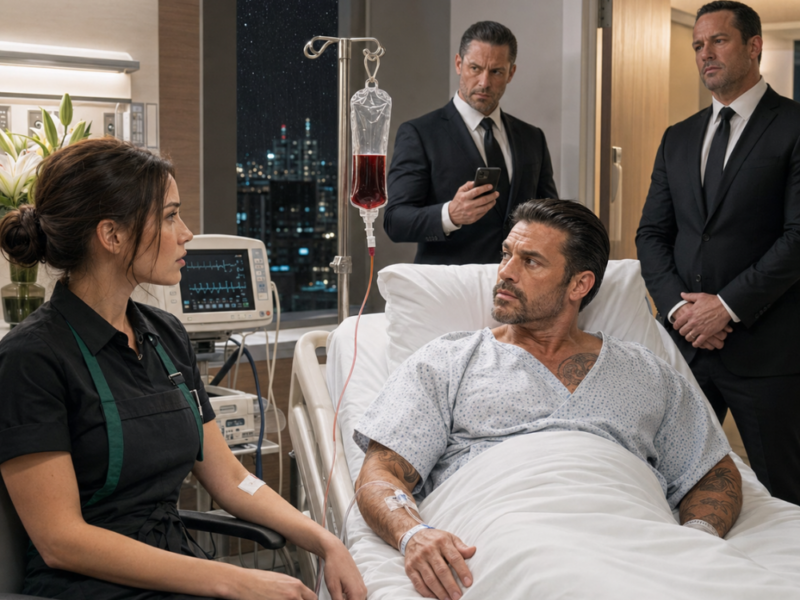
Waitress Donated Blood To Save A Stranger’s Life—Unaware He Was A Powerful Mafia Boss

She Donated Blood to Save a Stranger—Then the Man She Saved Came Looking for Her
The coffee cup hit the tile at 2:17 in the afternoon and shattered into three large pieces beneath table twelve.
Clara Hayes looked down at it.
Then at the man who had dropped it.
He did not look back.
“Watch where you’re going, sweetheart.”
He said it with the casual irritation of someone who assumed the universe had assigned other people to clean up behind him.
Clara had been nowhere near the cup when it fell.
She still reached for the broom.
“Sorry.”
The apology left her mouth automatically.
Ten hours into a double shift, her body had developed its own machinery.
Smile.
Refill.
Clear.
Apologize.
Repeat.
The Starlight Diner sat beneath the elevated train on the west side of Manhattan, a narrow place with cracked red booths, chrome trim polished brighter than the walls deserved, and a cook named Lou who claimed he had been threatening to retire since the Reagan administration.
The coffee was strong.
The pie was better than it looked.
The fluorescent lights made everyone appear slightly ill.
Clara had worked there for almost four years.
At twenty-four, she knew exactly how long a customer could stare at an empty mug before deciding poor service had become a personal injustice.
She knew which regulars wanted conversation and which wanted silence.
She knew that truckers tipped better on Fridays, tourists overordered pancakes, and men wearing expensive watches sometimes left fifty cents because they believed friendliness was part of the price printed on the menu.
She also knew exactly how much money sat in her checking account.
Eighty-seven dollars and fourteen cents.
Before the automatic electric payment.
Before Owen’s prescription.
Before rent.
The rent was already three days late.
Clara swept the cup pieces into a dustpan.
“Another one?” Lou called through the kitchen pass.
“Table twelve.”
“He paying?”
The customer looked up.
Clara smiled brightly.
“Of course he is.”
The man frowned.
Lou laughed.
Clara carried the pieces to the trash.
Her lower back ached.
Her feet hurt inside nonslip shoes that should have been replaced six months earlier.
She had slept four hours.
None of that mattered until she had enough money to let it matter.
Her younger brother Owen was seventeen.
Smart.
Funny.
Annoyingly optimistic.
He also had a congenital heart condition complicated by severe asthma.
Most weeks, he looked completely healthy.
That was the dangerous part.
People saw a skinny high-school junior with messy brown hair and assumed Clara worried too much.
They did not see the pharmacy bag.
The cardiology appointments.
The inhaler on the nightstand.
The emergency room visit the previous winter that generated a bill Clara still kept folded inside a kitchen drawer because looking at it too often made breathing difficult.
Their parents had died when Owen was twelve and Clara nineteen.
A highway accident in Pennsylvania.
A funeral.
A probate office.
Two bewildered children sitting beneath beige fluorescent lights while an attorney explained that the modest life-insurance policy would disappear quickly once debts were settled.
Clara left community college.
She became Owen’s legal guardian.
People told her she was brave.
She did not feel brave.
She felt busy.
Bravery suggested choice.
Most of her decisions had looked more like arithmetic.
Owen needed an adult.
Clara was the adult available.
Rent required money.
The diner paid money.
His medication required money.
So Clara worked.
That was the whole philosophy.
At 10:48 that night, she untied her apron and counted tips at the employee table near the kitchen.
Sixty-four dollars.
Lou looked over.
“Bad?”
“I’ve had worse.”
“That means bad.”
“It means sixty-four dollars.”
He slid half a sandwich toward her.
“Take that home.”
“I’m not stealing food.”
“You’re stealing it if I call the cops.”
“Threatening.”
“I’m serious.”
Clara wrapped the sandwich in foil.
“Thank you.”
Lou waved her off.
“You working tomorrow?”
“Seven.”
“You’re going to kill yourself.”
“Not in the schedule.”
Outside, Manhattan had turned slick with light rain.
Clara pulled her coat tight and started downtown.
Her apartment was in a five-story walk-up where the lobby radiator clanged all winter and the landlord periodically described basic maintenance as renovation.
She should have gone home.
Instead, she headed toward St. Jude’s Hospital.
Owen’s medication refill was waiting at the hospital pharmacy because his cardiology clinic used the same network.
The copay was seventy-eight dollars.
Clara had sixty-four dollars in cash and fourteen dollars on a debit card after setting aside enough for subway fare.
Exact.
She hated being exact.
Exact meant no margin.
No coffee tomorrow.
No surprise grocery item.
No broken shoelace.
No life.
The hospital lobby was nearly empty at eleven-thirty.
Night changed hospitals.
During the day, they were bureaucracies.
At night, they became waiting rooms for fear.
Security guards spoke more softly.
Television sets glowed over rows of plastic chairs.
Vending machines hummed.
Someone always seemed to be asleep under a coat.
Clara approached the pharmacy window.
Then the ambulance doors opened.
The sound reached her before the sight.
Fast wheels.
A paramedic’s voice.
“Male, approximately forty, penetrating trauma, severe blood loss, pressure unstable.”
A gurney came through.
Doctors and nurses moved around it.
Clara backed toward the wall.
The patient’s face was partly covered by an oxygen mask.
His white shirt had been cut open.
There was blood.
Not the dramatic bright-red kind movies liked.
Dark.
Too much.
Clara looked away.
She had no desire to see a stranger dying.
She had seen enough hospitals.
Then someone shouted:
“What type?”
“AB negative.”
A nurse answered:
“We’re low.”
“How low?”
“None available in-house.”
“Red Cross?”
“Earliest delivery thirty-five minutes.”
“He does not have thirty-five minutes.”
The words traveled farther than they were intended to.
Clara heard them.
AB negative.
She knew that.
The little donor card in her wallet.
A blood drive at community college six years earlier.
The nurse at the folding table had joked that Clara was “collectible.”
Clara had not donated since.
She stood still for several seconds.
This was not her problem.
She had sixty-four dollars.
A sick brother.
Four hours of sleep coming if she hurried.
Her own body was already exhausted.
Then the gurney rolled past.
One of the patient’s hands hung over the side for a second before a nurse lifted it back onto the mattress.
Clara thought of Owen.
Not logically.
Just the hand.
Someone’s brother.
Someone’s family.
She stepped away from the pharmacy window.
“Excuse me.”
Nobody heard.
She tried again.
“I’m AB negative.”
A nurse turned.
“What?”
“I’m AB negative.”
The woman stared.
Clara pulled the donor card from her wallet.
The nurse moved instantly.
“What’s your name?”
“Clara Hayes.”
“When did you last eat?”
“About two hours ago.”
“Any recent illness?”
“No.”
“Medication?”
“No.”
“Pregnant?”
“No.”
“Any reason you cannot donate?”
“I don’t think so.”
The nurse took her arm.
“Come with me.”
Clara was screened properly despite the urgency.
Questions.
Vitals.
Consent.
A rapid compatibility check.
The medical staff did not simply transfer blood directly from Clara into the unknown patient as the panic in the hallway had made it sound.
Hospital transfusion remained controlled.
Her donation entered an emergency collection and processing pathway used only because the patient’s blood type was rare and outside units were delayed.
Clara understood almost none of the details.
She sat in a narrow room while a technician prepared equipment.
“You okay?” the nurse asked.
“Yes.”
“You look tired.”
“I’m a waitress.”
The nurse smiled.
“That is not a medical diagnosis.”
“It should be.”
The needle went in.
Clara looked away.
She hated needles.
Owen found this funny because she could discuss his cardiac procedures calmly while nearly fainting over a vaccination.
The collection bag slowly filled.
The nurse brought orange juice.
“You’re doing something important.”
Clara shrugged.
“Somebody needed blood.”
The nurse looked at her.
“That is generally why important things happen.”
Clara smiled faintly.
She never saw the patient’s face.
She never asked his name.
By the time the donation was complete, he was already in surgery.
The hospital took her information because regulations required records and follow-up.
The nurse assured her that patient privacy and donor privacy would be protected.
Clara drank the orange juice.
Ate two crackers.
Then remembered the pharmacy.
She paid for Owen’s medication at 12:46 in the morning.
Her debit balance dropped to almost nothing.
She walked home carrying a white pharmacy bag and Lou’s sandwich.
That was what she remembered most about the night later.
Not heroism.
Not fate.
The pharmacy receipt.
$78.00.
Clara put it in her coat pocket and forgot about the stranger.
Leo Salvatore woke nine hours later.
Pain arrived before memory.
A deep, hot pressure beneath his ribs.
Then the steady electronic beep of a monitor.
Then anger.
He opened his eyes.
White ceiling.
Hospital.
He hated hospitals.
He hated being injured more.
A man stood near the window.
Marco Bianchi.
Fifty-eight.
Silver hair.
Dark suit wrinkled from a night without sleep.
Marco had worked beside Leo’s father before Leo was old enough to drive.
Family lawyer.
Business adviser.
Confidant.
In a different century, people might have called him consigliere.
Marco preferred general counsel.
It looked better on legitimate paperwork.
“You’re awake,” Marco said.
Leo swallowed.
His throat hurt.
“What happened?”
“You know what happened.”
“Humor me.”
Marco came closer.
“There was an attack at Bellucci’s.”
Memory returned.
Dinner.
A private room.
A supposed discussion about waterfront development contracts.
Vincent Moretti smiling across the table.
Then shouting.
Glass breaking.
Security moving.
Gunfire.
Leo closed his eyes briefly.
“How many?”
“Three of ours hospitalized. One still critical.”
“And Moretti?”
“Gone.”
Leo tried to sit.
Pain stopped him.
Marco pressed the call button.
“Do not be stupid.”
“I’m leaving.”
“You were in surgery nine hours.”
“I have meetings.”
“You have staples.”
Leo stared.
Marco stared back.
They had been having versions of this argument for twenty years.
A doctor entered.
Leo Salvatore had a reputation in newspapers as a businessman surrounded by persistent rumors.
Construction.
Waste hauling.
Nightlife.
Private security.
Real estate.
Federal investigations that produced less than reporters expected.
His grandfather had been indicted twice.
His father once.
Leo had never been convicted of a crime.
His legitimate businesses employed thousands.
His less legitimate associations were the reason detectives knew his name without introductions.
The doctor knew none of that mattered medically.
“You lost a dangerous amount of blood.”
Leo looked at the IV tubing.
“What did you give me?”
“Blood products.”
“I’m AB negative.”
“Yes.”
“We do not keep a large reserve of that type.”
“Apparently not.”
The doctor checked the monitor.
“You were fortunate.”
Marco looked toward him.
“Someone donated.”
Leo turned.
“What?”
Marco had already heard the story from hospital administration.
“A woman in the emergency department happened to be compatible.”
The doctor corrected him.
“She volunteered after hearing staff discuss the shortage. The blood was processed through emergency protocol. Other products arrived afterward.”
Leo absorbed this.
“Who?”
The doctor’s expression changed.
“I cannot disclose donor information to you.”
Leo looked at Marco.
Marco already knew what that meant.
Privacy law.
Hospital records.
A line Leo could cross.
Marco hoped he would not.
Leo looked back at the doctor.
“Did she leave?”
“Yes.”
“Did she know who I was?”
“I sincerely doubt it.”
That interested Leo.
His world had trained him to distrust free gestures.
Nothing was free.
Favors became obligations.
Kindness created leverage.
Generosity arrived with invisible invoices.
A stranger had given blood without knowing his name.
Leo could not make that fact fit comfortably anywhere.
After the doctor left, he asked Marco:
“Find out who she is.”
Marco sighed.
“No.”
Leo stared.
Marco rarely told him no directly.
“That is protected medical information.”
“I know.”
“Then do not ask me to steal it.”
Leo’s jaw tightened.
“I owe her my life.”
“You owe the medical team too.”
“I’ll donate a wing.”
“They will be thrilled.”
“The woman.”
Marco sat.
“If she wanted contact, she could have left permission.”
Leo looked toward the window.
His impulse was control.
Find her.
Know everything.
Resolve the debt.
Marco had spent decades helping him understand where control stopped being useful and became dangerous.
“Send the hospital a letter,” Marco said.
“To whom?”
“The donor.”
“They cannot give it to her.”
“They can forward it if their policy allows.”
Leo thought.
That was less satisfying.
Also more respectful.
“Do it.”
Marco almost smiled.
“Growth.”
“Do not irritate me while I’m medicated.”
Leo remained hospitalized six days.
Longer than he wanted.
Shorter than doctors preferred.
He received no answer to the letter.
That should have ended the matter.
It did not.
The hospital had sent Clara a sealed envelope two weeks after the donation.
She opened it after returning from work.
No name.
Only a brief message.
You did not know me, and you asked for nothing. I am alive partly because you stopped and helped. I will remember that for the rest of my life. If you ever wish to receive a formal thank-you, the hospital has my permission to provide my contact through counsel. If not, I will respect your privacy.
Clara read it twice.
Then put it into the drawer beside overdue electric notices.
She did not respond.
Not because the letter meant nothing.
Because she had more immediate problems.
Donnie Rizzo had started waiting outside the apartment building.
Donnie was not a cinematic loan shark.
He was worse in the ordinary way.
Small.
Persistent.
Connected enough to scare people without being important enough for law enforcement to prioritize.
Clara had borrowed fifteen hundred dollars from him eight months earlier when Owen required a procedure and she needed money immediately for travel, medication, and expenses the hospital assistance application had not covered yet.
She repaid almost two thousand.
Donnie insisted interest meant she still owed nine hundred.
The numbers changed every time she challenged them.
At first he called.
Then came to the diner.
Then the apartment.
One Thursday evening, Clara found him leaning beside the lobby mailboxes.
“Five hundred tomorrow.”
“I don’t owe five hundred.”
“You owe whatever the balance says.”
“What balance?”
“The one I keep.”
She laughed despite fear.
“That is not how debt works.”
“It is how mine works.”
He glanced toward the staircase.
“Owen home?”
Clara’s entire body tightened.
“Don’t.”
Donnie smiled.
“I asked a question.”
“You stay away from him.”
“Then pay me.”
Clara stepped closer.
“I’ve paid you more than I borrowed.”
“Interest.”
“Show me paperwork.”
Donnie laughed.
“You think this is a bank?”
“No.”
“That is why you came to me.”
He walked past her.
Then stopped.
“Tomorrow.”
Clara stood in the lobby until the front door closed.
That night she did not tell Owen.
She did what she always did.
Checked his homework.
Heated soup.
Asked whether he used the inhaler after gym.
Then sat alone at the kitchen table calculating money that did not exist.
The next afternoon, Leo received a call from St. Jude’s patient relations office.
The donor had not responded.
That should have been the end.
Instead, another event connected them.
A man affiliated loosely with Salvatore-controlled businesses mentioned during a routine financial review that one of Donnie Rizzo’s illegal lending collections had become a problem because Rizzo was using Salvatore’s name to intimidate borrowers.
Marco investigated.
Rizzo was claiming his debts were “backed by the Salvatores.”
They were not.
That was enough to bring him to Leo’s attention.
The list of borrowers contained a name Marco recognized.
Clara Hayes.
He stared at it.
Then took the file to Leo.
“This is coincidence.”
Leo read.
“Clara Hayes.”
“Yes.”
“The donor?”
“Same address the hospital has on the forwarding record.”
Leo looked up.
“How did Rizzo get her?”
“Medical expense.”
“For her?”
“Brother.”
Leo read the collection notes.
Marco continued.
“Before you decide destiny has personally delivered a woman to your door, I would like to suggest something boring.”
“What?”
“We cancel Rizzo’s false debt because he is using our name.”
Leo looked at him.
“And?”
“And nothing.”
Leo stared.
Marco sighed.
“You can help someone without owning the outcome.”
Leo hated when Marco sounded like a priest.
“Send someone.”
“No threats.”
“He threatened her brother.”
“I know.”
Leo looked at the page.
“No threats.”
Rizzo received a visit from Salvatore Security’s compliance director and an attorney.
Not gunmen.
Not an alley.
Paper.
A notice explaining that Rizzo had falsely represented affiliation with Salvatore-controlled businesses and was to cease using the name immediately.
The attorney also offered Clara access to a consumer-law clinic that would review her debt without cost.
Rizzo disappeared from her building within two days.
Clara did not understand why.
Then the legal clinic called.
“We were referred your case anonymously.”
“By whom?”
“They did not authorize disclosure.”
The attorney reviewed her payments.
Most of Donnie’s claimed balance was unenforceable.
The original informal lending arrangement violated several state requirements.
The threats were documented.
Clara owed nothing further.
She sat in the small legal-aid office holding a tissue.
“That’s it?”
“That’s it.”
“He can’t come after my brother?”
“If he threatens either of you, call police and us.”
Clara looked at the attorney.
“Why are you helping me?”
The lawyer smiled.
“Someone paid for a block of cases involving predatory lending.”
“Someone?”
“I genuinely do not know the donor’s identity.”
Clara thought of the hospital letter.
Then dismissed the thought.
Coincidences happened.
Two weeks later, Leo sent a second letter.
Not through the hospital.
Through the legal clinic, with Clara’s permission after the attorney asked whether she was willing to receive correspondence from the person who had funded the referral.
Clara hesitated.
Then agreed.
The note said:
I learned indirectly that someone was using my family name to threaten you. That should never have happened. The legal help was not payment for your blood donation and does not create any obligation to me. I wanted that stated clearly.
The signature:
Leo Salvatore.
Clara knew the name.
Everyone in New York knew some version of the name.
She sat at the diner break table reading the letter.
Lou looked over.
“You look like you saw a ghost.”
“Maybe.”
“Good ghost or bad ghost?”
“I don’t know.”
She searched the name on her phone.
Headlines.
Real-estate billionaire.
Salvatore Holdings.
Federal probe.
Nightclub shooting.
Philanthropic hospital donation.
Organized-crime allegations.
No convictions.
Leo Salvatore stood in photographs wearing dark suits beside politicians, priests, developers, union officials, and men who looked like they never stood in grocery-store checkout lines.
Clara put the phone down.
The stranger at the hospital had not been just a stranger.
That did not make her feel lucky.
It made her nervous.
She ignored the letter.
Leo respected that.
For three months.
Then St. Jude’s Hospital invited Clara to a donor-recognition dinner.
She almost declined.
The hospital foundation had covered part of Owen’s treatment through assistance programs over the years.
Clara felt obligated.
She bought a simple navy dress from a department store sale rack.
Owen looked at her before she left.
“You look rich.”
“I look like I spent sixty-nine dollars.”
“Exactly. Rich.”
She rolled her eyes.
“Finish your chemistry.”
The dinner was held in a hotel ballroom near Central Park.
Clara hated it immediately.
Too many forks.
Too many people who knew how to speak while barely moving their mouths.
She sat at a table with nurses, donors, and a retired dentist who discussed marathon training.
Halfway through dinner, the hospital foundation chair approached the lectern.
Among the benefactors thanked that evening was Salvatore Holdings.
Clara’s stomach tightened.
Then Leo entered.
No dramatic arrival.
He had been delayed at another event.
He took a seat near the front beside Marco.
Clara recognized him from photographs.
He looked different in person.
Less polished.
More tired.
A faint stiffness remained when he walked.
The injury.
She looked away.
Later, while guests stood for coffee, Leo noticed her.
Not magically.
The hospital donor coordinator introduced them.
“Ms. Hayes, there is someone who has hoped to thank you.”
Clara turned.
Leo stopped several feet away.
For the first time, the powerful man who filled newspaper columns looked uncertain.
“Clara Hayes.”
She nodded.
“Mr. Salvatore.”
“You know who I am.”
“I used Google.”
He almost smiled.
“That is rarely kind to me.”
The coordinator excused herself.
Marco remained at a respectful distance.
Leo looked at Clara.
“I owe you an apology.”
“For what?”
“Wanting to find you immediately.”
Clara blinked.
“You didn’t.”
“Marco stopped me.”
She glanced toward the older man.
“Good.”
Marco smiled slightly.
Leo laughed.
That surprised her.
“I wanted to thank you.”
“You sent letters.”
“I know.”
“You paid for the legal clinic.”
“I funded a program.”
“Because of me.”
“Partly.”
Clara folded her arms.
“I don’t want money.”
“I understand.”
“Do you?”
“Yes.”
His answer was immediate.
“That is why I did not bring a check.”
She looked almost disappointed by how reasonable he was being.
Leo noticed.
“You expected something else?”
“I read the newspapers.”
“Ah.”
“Apparently you’re dangerous.”
Marco coughed to hide a laugh.
Leo looked at him.
Then back at Clara.
“Newspapers simplify.”
“Do they lie?”
“Sometimes.”
“About you?”
“Sometimes.”
Clara waited.
Leo smiled faintly.
“Not always.”
That answer she believed.
They spoke for ten minutes.
Nothing dramatic.
Owen.
The diner.
Leo’s recovery.
Hospital food.
Clara eventually asked the question that had bothered her.
“Why does this matter so much to you?”
“What?”
“The donation.”
Leo thought.
“Because most people who help me know who I am.”
“That sounds lonely.”
The word hit him unexpectedly.
“Yes.”
Clara looked toward the ballroom.
“I didn’t know.”
“I know.”
“That doesn’t make what I did more valuable.”
“No.”
Leo’s voice softened.
“It makes it cleaner.”
Clara looked back at him.
“Cleaner?”
“Untangled.”
She understood.
Maybe too well.
Her life had been built from transactions.
Hours for wages.
Late fees for delay.
Medical help for paperwork.
Donnie’s money for fear.
A gift without an invoice did feel unusual.
Leo said:
“May I buy you coffee sometime?”
Clara stared.
“That sounds like a terrible idea.”
“It may be.”
“You have people following you.”
“Usually.”
“I work at a diner.”
“I know.”
“That was slightly creepy.”
“I deserve that.”
She almost smiled.
“No promises.”
“That is not no.”
“It is not yes.”
Leo nodded.
“Progress.”
Marco looked deeply worried.
Clara eventually agreed to coffee.
Not at Leo’s penthouse.
Not at an estate.
A public café.
Marco insisted on security outside.
Clara insisted they sit near the window.
Leo arrived early.
That impressed her.
They talked for ninety minutes.
Then again a week later.
Then dinner.
Slowly.
No marriage proposal.
No contract.
No demand that Clara disappear from her life.
That would have made her run.
Leo understood something during those weeks.
His first instinct after waking in the hospital had been to convert gratitude into obligation.
Find her.
Pay her.
Protect her.
Bring the debt to zero.
That instinct came from his world.
Debts were dangerous if left undefined.
Clara refused that language.
“I don’t want you owing me.”
They were walking through Riverside Park one afternoon.
“You saved my life.”
“I donated blood.”
“To me.”
“To a patient.”
Leo frowned.
“That distinction matters to you.”
“Yes.”
“Why?”
“Because if I had known it was you, I hope I would have done the same thing.”
He looked at her.
“I don’t know if that makes you kinder or more reckless.”
“Probably both.”
Clara continued working at the diner.
Leo hated it.
Not because he considered the work beneath her.
Because she worked too much.
“You did fourteen hours yesterday.”
“Thirteen.”
“That does not improve it.”
“Rent enjoys consistency.”
“I could—”
“No.”
Leo stopped.
Clara pointed at him.
“You were about to offer money.”
“I was about to offer an alternative.”
“With money.”
“Yes.”
“No.”
He learned.
Owen met Leo six months later.
Clara had not told him everything about Leo’s reputation.
Owen was seventeen, not stupid.
He searched.
At dinner, he looked at Leo.
“Are you actually in the mafia?”
Clara nearly dropped her fork.
Leo considered.
“No.”
Owen frowned.
“The internet says yes.”
“The internet says many things.”
“So you’re not?”
Leo looked at Clara.
She raised an eyebrow.
He returned to Owen.
“My family has had relationships with people I would not recommend as career mentors.”
Owen stared.
“That is the most lawyer answer I have ever heard.”
“Marco will be pleased.”
Clara rubbed her forehead.
“This dinner is going well.”
It actually did.
Owen liked Leo.
More cautiously than Leo wanted.
Less cautiously than Clara preferred.
Leo arranged no special medical care without Clara’s permission.
That was deliberate.
He had offered once.
She said:
“If you want to help, help me understand options. Don’t choose them for us.”
So Leo found specialists.
Clara and Owen chose whether to consult them.
One cardiologist at Columbia identified a medication adjustment that reduced Owen’s symptoms.
Insurance covered most of it.
Leo covered nothing.
Clara was irrationally proud of that.
Leo understood why.
Their relationship became public accidentally.
A photographer captured them leaving a restaurant.
The story spread.
MYSTERY WAITRESS DATING LEO SALVATORE.
Clara hated the word waitress in the headline for reasons she could not fully explain.
She was a waitress.
The headline used it to imply mismatch.
Leo called.
“Do you want my people to respond?”
“No.”
“Do you want security at the diner?”
“No.”
“Do you want anything?”
“Yes.”
“What?”
“Stop saying ‘my people.’”
He laughed.
“You are difficult.”
“You survived.”
“Because of you.”
She groaned.
“We are not doing that forever.”
He smiled.
“Apparently I am.”
The attention changed the diner.
Tourists came hoping to see her.
Lou banned photographs after one man stood on a booth.
Clara considered quitting.
Not because she disliked the work.
Because her presence had become disruptive.
That decision hurt.
The diner had carried her through four hard years.
Lou pretended not to care.
“You should leave.”
Clara stared.
“That is touching.”
“You’re ruining my table turnover.”
“More touching.”
He looked at her.
“You’re smart.”
“So are you.”
“Not enough to get out when I was twenty-four.”
Clara looked down.
“Do something you want.”
That sentence became more important than anything Leo offered.
Clara enrolled in culinary school.
Part-time at first.
She had always wanted to cook.
Not diner eggs.
Real food.
She had postponed the dream so long she stopped naming it.
Leo paid nothing.
He offered.
She refused.
She received grants, worked weekends, and eventually accepted a small scholarship from the school after Lou secretly wrote a recommendation letter describing her as “the only employee who ever told me my soup needed acid.”
Leo attended her first student tasting.
He ate a badly plated mushroom risotto without complaint.
Clara watched him.
“It’s overcooked.”
“It is excellent.”
“You are lying.”
“I am supportive.”
“You are lying supportively.”
“Better?”
“No.”
Their relationship deepened because Leo learned boundaries he had never needed before.
Clara learned something too.
Leo’s world was not the operatic criminal empire newspapers imagined.
It was a complicated network of legitimate family businesses, old loyalties, political relationships, and people whose pasts sometimes crossed legal lines.
There were men around him Clara did not trust.
Marco was one.
At first.
Marco distrusted her too.
Not because she was poor.
Because Leo changed around her.
He took fewer unnecessary risks.
Canceled meetings with men Marco believed needed watching.
Started asking whether traditions were useful instead of automatically preserving them.
Change threatened people whose authority depended on old rules.
One evening Marco found Clara in the library at Leo’s townhouse.
“You are changing him.”
Clara closed her book.
“Is that a complaint?”
“An observation.”
“Then observe quietly.”
Marco almost smiled.
“I understand why he likes you.”
“That sounded painful.”
“It was.”
He sat opposite her.
“Leo’s father believed affection created openings.”
“For enemies?”
“For anyone.”
“That seems healthy.”
“It kept him alive.”
“Did it make him happy?”
Marco went silent.
Clara nodded.
“That is what I thought.”
Marco looked at her.
“You think happiness matters in this family?”
“I think if it doesn’t, you are all doing a lot of work for nothing.”
That sentence followed Marco for years.
The threat from Vincent Moretti remained.
But instead of turning Clara into bait or pretending romance belonged inside a war story, Leo did something less dramatic.
He increased security.
Shared information with law enforcement when specific threats emerged.
Separated Clara from business meetings that could create legal or physical risk.
Clara demanded honesty about danger.
Not details of questionable business.
Enough to make informed choices.
“If I am at risk, I get to know that.”
Leo hated it.
Then agreed.
The first serious threat came at a charity gala almost a year after they met.
Moretti attended.
So did Leo.
Clara chose to come.
She wore an emerald dress because Owen said navy made her “look like someone attending a bank hearing.”
When Vincent Moretti approached, his smile was polished.
“Leo.”
“Vincent.”
They shook hands.
Moretti looked toward Clara.
“And this is?”
“Clara Hayes.”
Leo did not call her his woman.
His possession.
His responsibility.
Just Clara.
She appreciated that.
Moretti took her hand.
“I’ve heard quite a story.”
Clara smiled.
“I hope it was entertaining.”
“A waitress saves the great Leo Salvatore.”
His tone made waitress sound like the headline had.
Clara recognized the technique.
Make the person defend her place.
She did not.
“I was in the right hallway.”
Moretti smiled.
“Fate.”
“Hospital staffing.”
Leo almost laughed.
Moretti looked between them.
“You have changed him.”
Clara said, “People keep saying that.”
“Doesn’t it worry you?”
“What?”
“Changing powerful men.”
Clara smiled pleasantly.
“I worry more about powerful men who never change.”
Moretti’s smile faded.
He looked at Leo.
“Sharp.”
Leo said, “Yes.”
Moretti walked away.
Marco appeared several minutes later.
“That was reckless.”
Clara looked at him.
“I answered a question.”
“You embarrassed him.”
“He asked badly.”
Marco looked at Leo.
Leo shrugged.
“I agree with her.”
Marco closed his eyes.
“Of course you do.”
That gala became the source of another rumor.
People said Clara publicly challenged Moretti and earned Leo’s respect.
The truth was less theatrical.
Leo already respected her.
That was why she could speak normally without performing fear.
Respect did not arrive because she behaved like a mafia queen.
It arrived because she refused to become one.
The relationship eventually reached marriage.
But only after several years.
No contract.
No debt.
No threat.
Leo proposed in Clara’s restaurant kitchen.
By then she was twenty-eight and co-owned a small neighborhood restaurant with Lou, who had finally retired and then continued appearing every morning because retirement bored him.
The restaurant was called Hayes.
Owen designed the menu logo.
Leo was sitting at a prep table after closing.
Clara was reducing stock.
“Can you turn that off?”
“No.”
“It smells good.”
“That is why.”
Leo watched her.
Then took a small box from his pocket.
Clara stared.
“No.”
“You do not know what I am asking.”
“You have a ring.”
“Possibly.”
“Leo.”
He stood.
“I have spent three years trying to thank you.”
“That is a terrible beginning.”
“I know.”
He smiled.
“So I am not thanking you.”
“Good.”
“I am asking you something selfish.”
She turned off the burner.
“Better.”
“I want to come home to you.”
Clara’s expression changed.
Leo continued.
“I want Owen complaining about my coffee.”
“He does.”
“I want you telling me my mother’s Sunday sauce is too sweet.”
“It is.”
“That opinion may end the marriage before it starts.”
Clara laughed.
Leo opened the box.
Simple ring.
Smaller than she expected.
“I do not want to own your life.”
His voice softened.
“I want a place in it.”
Clara stared at him for several seconds.
Then asked:
“Are you still dangerous?”
Leo almost laughed.
“Yes.”
“Complicated?”
“Very.”
“Annoying?”
“Frequently.”
“Do I get my own bank account?”
“Yes.”
“My restaurant?”
“Yes.”
“My name?”
“Yes.”
“Good.”
She looked at the ring.
“Then ask properly.”
Leo did.
She said yes.
Marco acted offended.
“I expected consultation.”
Clara looked at him.
“You were not marrying him.”
“That has never stopped family.”
Owen was twenty-one by then.
His health had stabilized enough for college.
He studied architecture.
Not because Leo paid.
Owen received aid, scholarships, and a college fund Clara had slowly built after the restaurant became profitable.
Leo contributed only after Owen, now an adult, agreed to accept a wedding gift placed into an independently managed trust.
That distinction mattered to all of them.
The wedding was small.
A church.
A restaurant reception.
No armed men lining staircases.
No criminal families making vows under chandeliers.
Just people.
Clara wore her mother’s locket.
Leo wore the expression of a man who had survived being told no for years and somehow enjoyed it.
Marco cried.
Denied it later.
The Salvatore businesses changed gradually after the marriage.
Not because Clara took a throne.
There was no throne.
She had no interest in running companies she did not understand.
But she asked questions.
About payroll.
Pensions.
Employees.
Contracts.
Why certain vendors existed because someone’s uncle had been paid for thirty years.
Leo occasionally discovered traditions were simply inefficient arrangements everyone was too intimidated to challenge.
Clara found this delightful.
“You built your reputation terrifying people.”
“Apparently.”
“And now they’re afraid to tell you your waste contract is bad.”
“That seems possible.”
“Congratulations.”
Marco began sending her contracts before meetings.
Leo complained.
“You are creating a second command structure.”
Marco said, “She reads.”
Clara smiled.
The old adviser had changed too.
Years earlier, he had believed protecting the family meant keeping outsiders distant.
Eventually he understood that closed systems became fragile.
Not because outsiders always improved them.
Because nobody inside questioned inherited assumptions.
Vincent Moretti eventually went to federal prison on charges unrelated to Leo.
No final war.
No dramatic confrontation.
No Clara standing beside Leo with a crown.
The Moretti organization fragmented.
Several legitimate businesses were sold.
Others survived.
The city moved on.
That was what cities did.
People disappeared from headlines faster than they expected.
Leo stepped farther away from questionable associations over time.
Partly because law enforcement scrutiny increased.
Partly because legitimate businesses became more profitable.
Partly because Clara had once asked a question he could not answer.
“What are you preserving?”
They were eating breakfast.
Leo looked up.
“The family.”
“What part?”
“All of it.”
“That is not an answer.”
He frowned.
Clara continued.
“Your father’s businesses?”
“Yes.”
“His enemies?”
Silence.
“His grudges?”
Leo looked down.
“His rules?”
Clara waited.
“Which part is family, and which part is habit?”
That question irritated him for six months.
Then changed his decisions for ten years.
Leo never became a harmless man.
Clara never tried turning him into one.
That would have been another kind of fantasy.
He remained powerful.
Private.
Capable of cold decisions.
But he became more interested in whether power created durable things than whether it inspired fear.
Salvatore Holdings expanded housing development.
Infrastructure.
Hospital systems.
Private security.
Legitimate investments.
Newspapers continued using the word mafia whenever traffic needed help.
Leo stopped reading them.
Clara’s restaurant became three restaurants.
Then five.
She hated the fifth.
“Too corporate.”
Leo looked at the balance sheet.
“It is your most profitable.”
“Exactly.”
“You have become irrationally successful.”
“I am selling it.”
He stared.
“You cannot sell profitable things because they annoy you.”
“Watch me.”
She sold two locations and returned to three.
Leo told Marco:
“This is what freedom looks like. Financially offensive decisions.”
Marco replied:
“You married her.”
Owen became an architect.
He specialized in public schools and community health buildings.
At thirty-one, he designed an outpatient cardiac center in Brooklyn.
Clara stood beside him during the opening ceremony.
A plaque recognized donors.
SALVATORE FAMILY FOUNDATION appeared near the bottom.
Clara looked at Leo.
“You donated?”
“Owen asked.”
Owen smiled.
“I did.”
Clara narrowed her eyes.
“You conspired.”
Leo said, “Family tradition.”
She laughed.
That hospital center later became the place where Leo volunteered for a blood-donor drive every year.
AB negative.
He hated needles.
Clara discovered this and never let him forget it.
“You nearly pass out.”
“I do not.”
“You turn gray.”
“I am Sicilian. We have dramatic coloring.”
“Terrible liar.”
Twenty years after the night Clara donated blood at St. Jude’s, the hospital invited them to a gala celebrating its expanded emergency transfusion program.
Clara almost declined.
Then Helen, the nurse who had screened her that night, wrote personally.
Helen was retiring.
Clara went.
The hospital had changed.
New emergency entrance.
Digital check-in.
Renovated pharmacy.
Clara stood near the old hallway.
Leo came beside her.
“Here?”
“Somewhere around here.”
“You don’t remember?”
“I was tired.”
“You changed my entire life and forgot the room.”
“I also bought Owen’s inhaler afterward.”
Leo looked at her.
“That is what you remember?”
“The receipt.”
“How much?”
“Seventy-eight dollars.”
He smiled.
“You remember the exact amount.”
“Of course.”
“Why?”
Clara looked toward the pharmacy.
“Because that was my life then.”
Leo understood.
Seventy-eight dollars had once been the difference between safe and unsafe.
Medicine and waiting.
Electric bill and no electric bill.
The blood donation had cost her nothing financially.
Her kindness had occurred inside a life where almost everything else did.
That made his early instinct to repay her with money seem cruder in retrospect.
“I’m glad you didn’t take the check,” he said.
Clara smiled.
“What check?”
He stared.
She laughed.
“The first one.”
“I remember.”
“Two hundred fifty thousand dollars.”
“You were dramatic.”
“You were impossible.”
“I was poor.”
“Exactly why I offered it.”
“Exactly why I couldn’t trust myself to take it.”
He looked at her.
“You never told me that.”
Clara shrugged.
“At the time, I thought accepting it might make the donation feel like a transaction.”
“And now?”
“Now I know accepting help does not automatically corrupt kindness.”
Leo smiled.
“Growth.”
“Don’t get excited.”
They found Helen near the donor-recognition wall.
Her hair was silver now.
She hugged Clara.
Then Leo.
“You’re the difficult patient.”
Leo looked offended.
“I was told I was charming.”
“You tried to leave intensive care with surgical drains.”
Clara laughed.
Helen looked between them.
“So this is still happening.”
“What?” Clara asked.
“The two of you.”
Leo smiled.
“Apparently.”
Helen shook her head.
“I forwarded two letters and assumed that would be the end.”
Clara looked at Leo.
“It nearly was.”
“Lies,” he said.
They ate dinner with physicians, donors, former patients, and hospital staff.
Nobody discussed organized crime.
Nobody called Clara an angel.
She preferred that.
After dessert, the foundation chair told the story of emergency blood shortages and introduced Clara as one example of a community donor whose decision helped a stranger survive.
The chair did not say Leo’s name until afterward.
Clara liked the order.
She had always wanted the act to matter independently of who received it.
When invited to speak, Clara declined.
Leo did too.
They stood.
People applauded.
Then sat.
Simple.
Outside after the gala, Leo waited while the driver brought the car.
Clara looked toward the hospital windows.
“You know what bothers me about the story people tell?”
“Which story?”
“Ours.”
Leo smiled.
“There are many.”
“The one where the poor waitress saves a dangerous billionaire and gets rewarded with marriage.”
Leo’s smile faded.
“You hate that one.”
“Yes.”
“Why?”
“Because it makes marriage sound like payment.”
He nodded.
“And because it makes me lucky you picked me.”
“You were lucky.”
She punched his arm lightly.
He laughed.
Clara continued.
“I was lucky we met.”
“That is different.”
“Yes.”
She looked at him.
“You did not owe me a life.”
“No.”
“I did not owe you love because you helped Owen.”
“No.”
“We chose all of that afterward.”
Leo took her hand.
“That part is less dramatic.”
“Better.”
The car arrived.
They drove home.
Not to a fortress.
They sold the old estate years earlier.
Too large.
Too dark.
Too much staff.
Clara had never liked it.
They lived in a brownstone overlooking Riverside Park.
Beautiful.
Expensive.
Still a home where Clara loaded her own dishwasher badly and Leo pretended not to notice.
Marco lived six blocks away in retirement and came to Sunday dinner without invitation.
Owen brought his wife and two children.
The grandchildren called Leo Nonno and Clara Aunt-Clara because Owen found “Grandma Clara” hilarious and refused to correct them.
Ordinary family confusion.
That became Clara’s favorite form of wealth.
Not the house.
Not travel.
Not security.
Choice.
She could close the restaurant on Mondays.
Could help Owen without choosing between medicine and electricity.
Could say no to people and survive the consequences.
That was what money had changed most.
Leo learned this because Clara told him.
“You grew up thinking money meant power.”
“What does it mean to you?”
“Margin.”
He frowned.
“What?”
“Room.”
Clara leaned back in her kitchen chair.
“Room for something to go wrong without everything collapsing.”
Leo thought about it.
“A tire.”
“Yes.”
“A prescription.”
“Yes.”
“A day off.”
“Yes.”
“Bad investment?”
“No.”
He smiled.
“Different scale.”
“Exactly.”
Clara’s life before Leo had no margin.
One bad week could become debt.
One medical problem could become rent trouble.
One predatory lender could make fear feel permanent.
Marriage did not rescue her from that.
Resources did.
Education did.
The legal clinic did.
Her restaurant did.
Leo’s support did too.
All were true.
Clara refused to reduce complex survival into romance.
Years later, she served on the board of a nonprofit supporting family caregivers under financial stress.
She rarely spoke publicly about Leo.
She spoke about Owen.
About leaving school.
About work.
About the strange humiliation of discovering a healthcare form required proof you were poor enough to deserve help but organized enough to produce three years of documents.
At one event, a young woman approached.
“My mother needs cancer treatment.”
Clara listened.
“I’m thinking about quitting school.”
Clara did not tell her not to.
That would have been easy.
Instead:
“What are your options?”
The woman looked exhausted.
“Not many.”
“Let’s list them.”
A social worker joined them.
Emergency grants.
Transportation help.
Flexible scheduling.
Family leave.
The woman eventually stayed in school part-time.
Her mother’s treatment continued.
Clara thought about that more often than the hospital gala.
Kindness did not need to become destiny.
Sometimes it needed to become infrastructure.
Leo understood that lesson later.
The Salvatore Foundation funded emergency medical grants through independent nonprofits instead of choosing recipients directly.
“No debt?” Leo asked Clara when the program launched.
“No debt.”
“No recognition?”
“No.”
“No dinner where they thank us?”
“Absolutely not.”
He sighed.
“Philanthropy is less entertaining with you.”
“Good.”
The program’s checks carried no Salvatore name.
That was Clara’s condition.
A nurse at St. Jude’s once unknowingly told her:
“We have a fund that helps families cover emergency medication.”
Clara smiled.
“I’ve heard.”
She never explained.
Leo was sixty-two when he had another serious health scare.
Not violence.
A heart arrhythmia.
Far less dramatic.
More frightening to Clara.
He collapsed during breakfast.
She called 911.
At the hospital, she sat beside the bed while cardiologists discussed treatment.
Leo woke after sedation.
His first words:
“This is humiliating.”
Clara stared.
“You are alive.”
“Yes.”
“You are sixty-two.”
“Insulting.”
“You have a heart.”
“Apparently.”
She took his hand.
For several seconds, neither spoke.
Then Leo smiled.
“Still your blood?”
Clara rolled her eyes.
“That is not how transfusions work after thirty-eight years.”
“I prefer my version.”
“Your version is medically ridiculous.”
“You married me.”
“Evidence of poor judgment.”
He laughed weakly.
That was the moment Clara realized the blood donation no longer felt like the beginning.
Not really.
Beginnings were convenient lines people drew backward.
Their marriage had many.
Coffee.
The donor letter.
The diner.
Owen’s dinner.
The proposal.
The first time Leo apologized without defending himself.
The first time Clara accepted help without feeling owned.
The first time Marco called her family and did not sound sarcastic.
Lives were not one decision.
They accumulated.
After Leo recovered, he stepped back from several businesses.
Not because Clara demanded it.
Because he was tired.
Marco had been telling him for ten years.
“Let younger people make mistakes now.”
Leo hated that.
Then accepted it.
Their final decades together became quieter.
Travel.
Grandchildren.
Restaurant openings.
Hospital appointments.
Arguments about salt.
Clara insisting Leo wear hearing aids after he began pretending everyone else was mumbling.
He called the devices government surveillance.
She called him ridiculous.
The Salvatore name remained complicated publicly.
Some old accusations never disappeared.
Some were deserved.
Others exaggerated.
Clara never tried cleaning the history into respectability.
People were entitled to facts.
Leo had inherited a family system built partly on fear.
He spent much of adulthood shifting it toward legitimate business.
That did not erase the past.
It changed the future.
At eighty, Leo stood in the kitchen watching Clara teach their granddaughter how to make pasta dough.
His hands shook slightly now.
Clara’s hair was silver.
The granddaughter looked at him.
“Nonno, is it true Grandma saved your life?”
Leo smiled.
“Yes.”
Clara did not look up.
“Do not start.”
“She did.”
“She donated blood.”
“To me.”
“To a patient.”
The granddaughter laughed.
“You still argue about this?”
“For sixty years,” Leo said.
Clara dusted flour from her hands.
“Your grandfather thinks everything is about him.”
“He survived long enough to become arrogant.”
Leo walked closer.
“The doctor said I would have died without the transfusion.”
Clara looked at the girl.
“Medical teams saved him.”
Leo sighed.
“She will never let me have the romantic version.”
“Because it is wrong.”
The granddaughter looked between them.
“What’s the real version?”
Clara thought.
Then smiled.
“I helped a stranger.”
Leo nodded.
“And later we stopped being strangers.”
That was the version they kept.
No blood vow.
No coronation.
No waitress becoming queen.
No billionaire paying a debt with marriage.
Just a tired young woman who happened to be the right blood type in the wrong hallway at the right moment.
A wounded man who struggled to understand kindness that did not ask to be repaid.
A brother who needed medicine.
A diner that smelled like burnt coffee.
A legal clinic.
A first cup of coffee.
Arguments.
Choices.
Years.
Love came much later.
That distinction made all the difference.
When Clara was eighty-six, St. Jude’s Hospital asked permission to include her story in an exhibit about emergency blood donation.
She agreed under one condition.
The exhibit could mention Leo only after explaining the donation process.
The curator laughed.
“Why?”
“Because the person receiving blood should not determine whether the donor’s choice mattered.”
The exhibit eventually read:
In 20XX, during a severe local shortage of AB-negative blood, twenty-four-year-old Clara Hayes volunteered after overhearing that an emergency patient urgently needed compatible blood. Her donation was processed under emergency hospital protocols and contributed to the patient’s successful treatment.
Only below that:
The patient was businessman Leo Salvatore, whom Hayes later married several years afterward.
Clara approved.
Leo complained.
“I am a footnote.”
“You always were.”
He smiled.
“Cruel woman.”
“Still alive.”
“Because of you.”
She sighed.
Some arguments were not meant to end.
Leo died first.
Eighty-eight.
At home.
No enemies.
No dramatic final reckoning.
Pneumonia after a long winter.
Clara sat beside him.
Owen, now elderly himself, stood near the window.
Marco had been gone fifteen years.
Most of the old men were gone.
Leo opened his eyes once near dawn.
“Clara.”
“I’m here.”
He smiled faintly.
“You saved me.”
Clara leaned closer.
“No.”
He frowned weakly.
“Do not argue today.”
She laughed through tears.
“Fine.”
He closed his eyes.
Clara held his hand.
“You saved yourself after.”
His fingers tightened once.
That was the final truth she gave him.
He had not chosen the circumstances of his birth.
He had chosen, imperfectly, what to do with them.
So had she.
After the funeral, reporters called.
Books were proposed.
One producer wanted to tell their “forbidden mafia romance.”
Clara declined.
Again.
And again.
A younger journalist eventually asked:
“What do you wish people understood about your marriage?”
Clara looked toward Riverside Park.
“That I was never payment for a debt.”
The journalist wrote it down.
“And he was never my reward for being kind.”
Another note.
“We met because of kindness.”
She smiled.
“We stayed because we learned how to choose each other without owing each other.”
That became the headline.
Clara hated headlines.
This one she allowed.
Years after Leo’s death, she kept the original hospital letter in the kitchen drawer of the brownstone.
The paper had yellowed.
The message remained simple.
You did not know me, and you asked for nothing.
Clara read it sometimes.
Not because it reminded her of Leo’s power.
Because it reminded her of who she had been before any of it.
A waitress.
A sister.
A frightened young woman counting sixty-four dollars in tips.
A person who did not have enough margin for another problem and stopped anyway because someone else was running out of time.
She no longer thought kindness always came back.
Sometimes it did not.
Sometimes good people helped strangers and remained poor.
Sometimes they were never thanked.
Sometimes the world stayed unfair after generosity.
Clara had spent enough of her life around wealth to hate stories that promised goodness automatically attracted reward.
That was not why she had stepped forward.
The act had mattered before she knew the patient’s name.
That was precisely what made it hers.
On her ninetieth birthday, Owen’s granddaughter found the old donor card inside Clara’s desk.
AB NEGATIVE.
She held it up.
“This?”
Clara smiled.
“That.”
“So all of it started because you had rare blood.”
“No.”
The girl frowned.
Clara pointed toward the card.
“That was circumstance.”
“Then what started it?”
Clara thought about the hospital hallway.
The gurney.
The pharmacy bag.
The sixty-four dollars.
The exhaustion.
The fact that she could have kept walking and nobody would have blamed her.
“I stopped.”
The girl waited.
“That’s all?”
“That’s usually where choices begin.”
Clara took the card.
She had lived long enough to distrust grand lessons.
Life was too complicated for slogans.
But there were a few things she knew.
A desperate person should not have to trade freedom for safety.
A gift is not a debt simply because someone powerful receives it.
Protection without choice can become another form of control.
Money can save enormous amounts of suffering without creating love.
Love means very little if it requires somebody else to become smaller.
And gratitude becomes cleanest when it does not demand repayment.
Leo had needed years to learn that.
So had Clara.
She placed the donor card back into the drawer.
Outside, afternoon light moved across the kitchen floor.
The same city continued beyond the windows.
Sirens.
Buses.
People carrying groceries.
Hospital workers changing shifts.
Waitresses counting tips.
Brothers worrying their sisters.
Strangers passing one another without ever knowing which life might unexpectedly touch theirs.
Clara closed the drawer.
Most people would always prefer the dramatic version.
The waitress who saved a mafia boss.
The powerful man who searched for her.
The impossible romance.
The fortune.
The danger.
The vow.
Clara preferred what actually mattered.
One exhausted woman heard that somebody needed help.
She knew she could help.
So she did.
Everything else came later.









