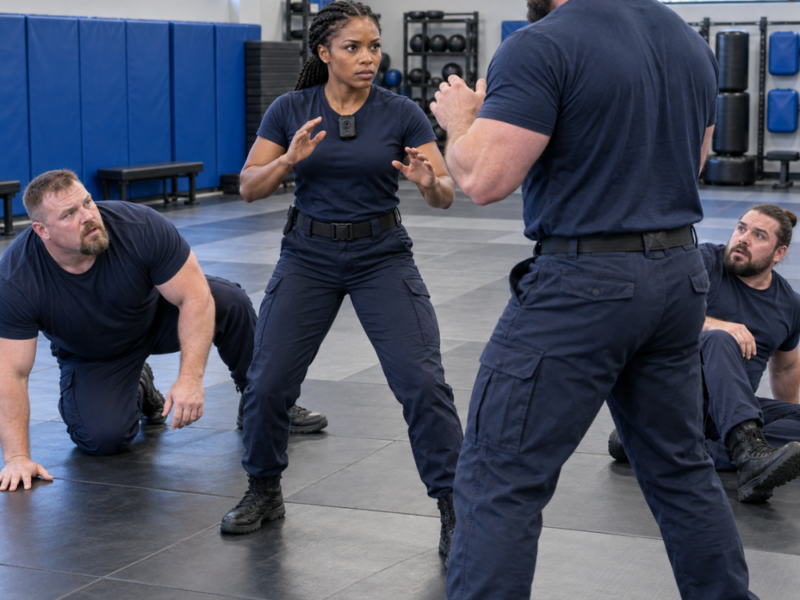
Three Big Cops Surrounded a Black Female Rookie—After Two Takedowns, She Stopped Holding Back
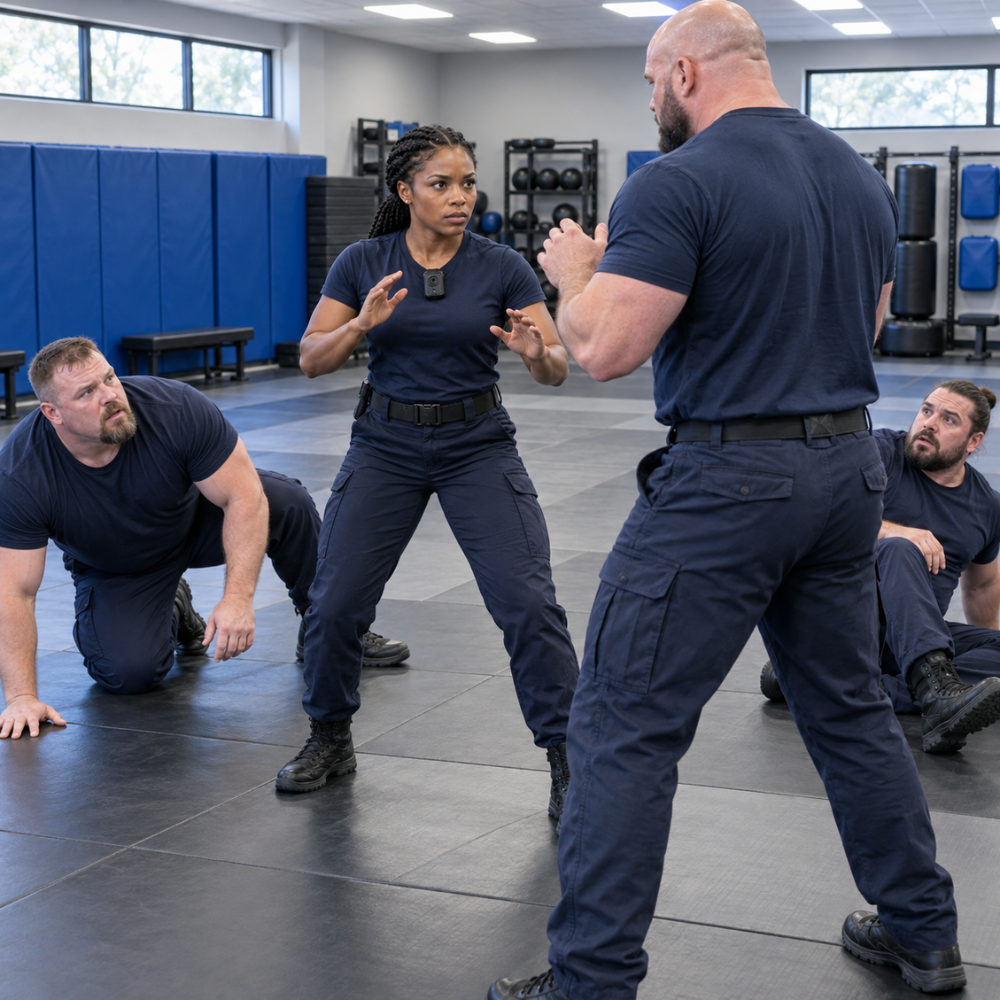
The training sergeant tried to make a rookie fail—then a sealed federal file revealed why she had let three veteran officers take her down
The warning appeared before Maya Williams had finished signing for her radio.
A red box filled the equipment terminal.
FEDERAL SERVICE RECORD RESTRICTED.
ADDITIONAL AUTHORIZATION REQUIRED.
Sergeant Dean Mercer leaned toward the screen.
Maya remained where she was on the other side of the equipment counter, hands resting loosely near the binder she had brought to her first week of probationary training.
Around them, the Mason Ridge Police Department was beginning its Monday morning routine.
Radios charging.
Lockers closing.
Coffee brewing somewhere down the hall.
A dozen new recruits waiting to receive cameras, batons, handcuffs, and the other equipment they would be responsible for during field training.
Nothing in the room suggested that a career could begin going wrong over one red message on a computer.
Mercer read it twice.
Then looked at Maya.
“What exactly is sealed in that file, Williams?”
Maya was thirty-one, tall without being imposing, with dark hair pulled into a tight bun and a way of standing that made stillness look intentional.
Her answer came without hesitation.
“If the department is authorized to know, Sergeant, the information will be released through the appropriate process.”
Mercer’s eyebrows lifted.
“That wasn’t my question.”
“It is the answer I’m authorized to give.”
A recruit beside the lockers glanced toward them.
Mercer noticed.
He turned back to the terminal and entered a senior supervisor code.
The system rejected it.
He tried again.
ACCESS DENIED.
Then the terminal logged him out entirely.
For several seconds, Mercer stared at the blank login screen.
Maya said nothing.
That silence irritated him more than a challenge would have.
He turned away from the computer.
“Fine. Finish your equipment issue.”
Quartermaster Luis Ortega slid the remaining items across the counter.
Department radio.
Training body camera.
Expandable baton sealed inside a numbered carrier.
Maya inspected each one before initialing the custody sheet.
Serial numbers.
Battery status.
Seal number.
Camera housing.
She checked everything carefully enough that Mercer finally said, “You planning to inventory the building while you’re at it?”
Maya looked up.
“No, Sergeant.”
She signed.
Ortega signed.
The equipment became her responsibility at 7:42 a.m.
Twenty minutes later, Mercer stopped her in the hallway.
“Williams.”
She turned.
“Sergeant.”
“Equipment inspection.”
Maya moved to the wall with the other recruits.
Mercer checked her camera first.
Then her radio.
Then he reached toward the baton carrier.
His thumb stopped.
The plastic security seal had been broken.
Mercer lifted the carrier.
“Explain this.”
Maya looked at it.
The expression on her face changed only slightly.
“It was intact at issue.”
Mercer gave a short laugh.
“It isn’t now.”
“No.”
“You’ve had it less than half an hour.”
“Yes.”
“Then explain why your assigned equipment is already compromised.”
Several recruits were watching.
Maya looked toward Ortega.
The quartermaster had already returned to the equipment room.
Then she looked at the carrier again.
“I inspected the seal before signing custody.”
“So?”
“So the break occurred after custody was documented.”
Mercer’s mouth tightened.
“You’re responsible for the equipment once you sign.”
“I understand.”
“Then why are you talking like somebody else is responsible?”
Maya’s voice remained even.
“Because there should be a record of any later equipment access.”
Mercer stared at her.
Maya continued.
“The radio log should show whether anyone accessed the assigned unit after issue. The baton seal inventory should also show any replacement seal removed from stock.”
That answer was too precise.
Mercer did not like it.
“You’re blaming a supervisor now?”
“No.”
“You just said someone accessed your equipment.”
“I said the records can establish whether anyone did.”
Mercer stepped closer.
“You have a lot of confidence for somebody on her first week.”
Maya held his gaze.
“I’m asking for the equipment log.”
That was all.
Not a speech.
Not an accusation.
The recruits watching could not easily decide who had won the exchange because Maya had refused to turn it into one.
Mercer took the radio.
“Ortega.”
The quartermaster appeared in the doorway.
“Pull the technical activity on unit 317.”
Ortega entered the serial number.
The screen loaded.
His forehead creased.
“There was a diagnostic request.”
“When?”
“7:56.”
Maya had signed for the radio at 7:42.
Mercer looked at the screen.
“Source?”
Ortega clicked.
“Training supervisor terminal.”
The hallway became quieter.
Maya looked at Mercer.
She did not accuse him.
That somehow made the moment worse.
Mercer said, “Shared terminal.”
“Yes,” Ortega replied.
“Could have been maintenance.”
“Could’ve.”
“Was it scheduled?”
Ortega checked.
“No maintenance ticket.”
Mercer turned toward Maya.
“You touch that terminal?”
“No.”
“Give anyone your login?”
“No.”
“Then maybe you hit something on the unit that triggered remote access.”
Maya shook her head.
“The log says supervisor terminal.”
Mercer raised the broken baton seal.
“And this?”
“I don’t know.”
He stared at her.
Then made a decision.
“All issued tactical equipment is confiscated pending accountability review.”
Maya nodded.
“Understood.”
“You’re also removed from defensive tactics until the review is complete.”
A few recruits looked toward one another.
Maya asked, “Can I have a copy of the confiscation record?”
Mercer blinked.
“What?”
“The record showing the radio, camera, and baton were collected, including serial numbers, reason, date, and supervisor authorization.”
“You’ll get whatever the system generates.”
“I’d like a printed copy now.”
Mercer’s expression hardened.
“You planning to file a grievance?”
“No.”
“Then why?”
“Because the equipment is no longer in my custody.”
For the first time, Officer Helen Carter, standing near the doorway with a mug of coffee, looked up fully.
Carter had been with Mason Ridge for eighteen years.
She knew young recruits who argued.
She knew recruits who panicked.
She knew recruits who said yes, Sergeant to absolutely everything because probation made people afraid of becoming memorable.
Maya Williams did none of those things.
She simply made sure the paper trail followed the property.
Mercer printed the form.
Maya read it before leaving.
Serial numbers correct.
Reason stated.
Supervisor listed.
She slid it into her binder.
That was the first document.
By Friday, the binder held seven.
Without her tactical equipment, Maya could not participate in the normal defensive-control blocks.
The other recruits practiced standing restraints, escort positions, handcuffing, controlled takedowns, and ground recovery.
Maya spent those hours doing inventory.
Processing policy acknowledgments.
Scanning old training forms.
Updating equipment worksheets.
Mercer called it temporary reassignment.
Technically, it was.
But temporary restrictions developed a way of becoming permanent descriptions if nobody watched the wording.
On Wednesday, Maya’s training schedule said:
DEFENSIVE TACTICS — EXCUSED PENDING EQUIPMENT REVIEW.
On Thursday, Mercer’s daily note said:
Candidate continues to lack exposure to required tactical skills.
Maya read the entry at the end of the day.
Then asked for a copy.
Mercer looked at her over his desk.
“You want copies of everything?”
“If it concerns my probation.”
“You know probation isn’t litigation, right?”
“Yes.”
“You’re acting like you’re building a case.”
Maya held out the evaluation.
“I’m maintaining my record.”
Mercer signed the copy reluctantly.
By Friday, the language had shifted again.
Limited tactical adaptability. Requires additional observation before normal field progression.
Maya read that one twice.
“You removed me from the sessions.”
“I removed you because your equipment was compromised.”
“Yes.”
“And now you’re behind.”
“Because I was removed.”
Mercer leaned back.
“Police work doesn’t care why you’re behind.”
Maya considered that.
“Training should.”
His eyes narrowed.
“You have an answer for everything.”
“No, Sergeant.”
“You do.”
Maya put the evaluation in her binder.
“I have the timeline.”
That sentence stayed with Mercer after she left.
At lunch, Helen Carter sat across from Maya in the break room.
Maya had brought leftover chicken and rice in a plastic container.
Carter pointed toward the binder beside her.
“You carry that thing everywhere?”
“For now.”
“How much is in it?”
“Enough.”
Carter poured coffee into the lid of her steel thermos.
“I’ve seen Mercer push recruits before.”
Maya waited.
“He likes people to react.”
“That seems inefficient.”
Carter laughed.
“You really talk like that?”
“Like what?”
“Like somebody is going to read the transcript later.”
Maya smiled faintly.
“Habit.”
Carter looked toward the closed break-room door.
“What was your military job?”
Maya’s expression did not change.
“Federal record.”
“Right.”
Carter held up both hands.
“I’m not asking you to violate anything.”
“Thank you.”
“I’m just curious.”
“So is Mercer.”
“That bother you?”
“No.”
“Really?”
Maya looked at the coffee machine.
“It bothers me that he thinks curiosity gives him authority.”
Carter nodded slowly.
That was a different thing.
Across the building, Mercer made his second unauthorized attempt to access Maya’s federal record that afternoon.
The computer rejected him again.
Officer Cole Barrett happened to be standing nearby.
Barrett was thirty-four, physically confident, popular, and waiting for an opening in Mason Ridge’s tactical-response unit.
He saw the red restriction notice.
“What is she, CIA?”
Mercer closed the screen.
“I don’t care what she was.”
Barrett smiled.
“You absolutely care.”
Mercer looked toward the hallway.
“I care when probationary officers think sealed records make them special.”
“Maybe she did classified logistics.”
“Then she can say that.”
“Maybe she can’t.”
Mercer turned toward him.
“Everybody can say something.”
Barrett shrugged.
Mercer added, “If she won’t, then she gets evaluated on what she demonstrates here.”
That sounded fair.
Barrett nodded.
What Mercer did not say was that he had already begun deciding what Maya’s silence meant.
Secrecy became arrogance.
Calmness became calculation.
Documentation became distrust.
Each interpretation made the next one easier.
That evening, Maya met Naomi Price at a diner off Route 19.
Naomi had known Maya since Army days, though neither spoke openly about exactly what they had done together.
Now Naomi worked in federal emergency management and traveled constantly.
She was in Mason Ridge for one night before heading to Richmond.
The diner had vinyl booths, laminated menus, and coffee strong enough to remove paint.
Naomi looked at the binder.
“How many?”
“Two pressure moves.”
“Equipment and training?”
“Yes.”
“Anything you can prove was intentional?”
“No.”
Naomi stirred sugar into her coffee.
“Good.”
Maya raised an eyebrow.
“That doesn’t sound good.”
“It is.”
“Why?”
“Because you’re not jumping ahead of the evidence.”
Maya leaned back.
Naomi continued.
“First incident can be bad luck.”
She lifted one finger.
“Second can be a pattern beginning.”
A second finger.
“Third?”
Maya knew.
“Choice.”
Naomi nodded.
“What do you do if they make a third move?”
“Preserve everything.”
“And?”
“Force independent review.”
“And?”
Maya looked at her.
“Don’t get angry.”
Naomi smiled.
“You can get angry.”
“I know.”
“Just don’t let anger become your evidence.”
Maya looked toward the window.
Rain had begun against the parking lot.
“You sound like my old instructor.”
“I was your old instructor.”
“Different one.”
“Insulting.”
Maya smiled.
Then Naomi became serious.
“Whatever is sealed in your record, don’t use it too early.”
“I wasn’t planning to.”
“Good.”
“Why?”
“Because if you’re only treated fairly after they discover you’re impressive, they never learned fairness.”
Maya looked at her.
That sentence would matter later.
At the time, she merely nodded.
Monday morning, Mercer announced a stress-resilience evaluation.
The other recruits had one-on-one scenarios.
Control a resisting partner.
Disengage safely.
Handcuff under time pressure.
Maya’s sheet was different.
Three veteran officers.
Cole Barrett.
Eric Holstead.
Travis Boone.
All larger than Maya.
All experienced.
None of them probationary.
Helen Carter read the scenario.
Then looked at Mercer.
“You’re doing a three-on-one evaluation?”
“Yes.”
“Policy requires approval for modified multi-officer drills.”
Mercer held up the form.
“Approved by training supervisor.”
“You are the training supervisor.”
“Yes.”
Carter stared.
“That’s convenient.”
Mercer’s face hardened.
“Williams missed most of defensive tactics.”
“You removed her.”
“Equipment review removed her.”
“You ordered it.”
“Are we doing semantics now?”
“No.”
Carter tapped the paper.
“I’m doing causation.”
Several recruits pretended not to listen.
Mercer looked toward Maya.
“Williams, do you object?”
It was a trap no matter how she answered.
If Maya objected, she became resistant.
If she accepted, the drill moved forward.
Maya took the form.
Read every line.
Then asked, “What are the permitted defensive actions?”
Mercer almost smiled.
“Finally. A useful question.”
He explained.
Maya could evade.
Frame.
Maintain posture.
Break basic grips using academy techniques.
She could not use joint locks.
No strikes.
No advanced takedowns.
No controls outside the curriculum.
The three officers could close distance, establish contact, bring her down, and demonstrate a secure restraint.
Maya looked at the form.
“Are the three officers evaluated?”
“No.”
“Only me.”
“Yes.”
“What ends each attempt?”
“Full control.”
“How many attempts?”
Mercer paused.
“As many as needed.”
Carter immediately said, “That isn’t written.”
Mercer looked at her.
“It is my evaluation.”
Maya turned toward him.
“Please write the attempt standard before I sign.”
That irritated him.
He took the form.
Added:
MULTIPLE ATTEMPTS PERMITTED AT EVALUATOR DISCRETION.
Signed.
Maya read the addition.
Then signed beneath it.
Before stepping onto the mat, she activated her training camera.
Mercer’s eyes went to it.
“Recording?”
“Yes.”
“You planning to make a documentary?”
“Training cameras are authorized.”
“Keep it unedited.”
“Of course.”
Nearly forty officers and recruits gathered around the mat.
Word had spread.
Three veteran officers against one rookie was unusual enough to attract an audience even without the tension surrounding Maya.
Barrett rolled his shoulders.
“You ready?”
Maya looked at him.
“Yes.”
Holstead stood to her left.
Boone to her right.
Mercer remained just off the mat holding a clipboard.
“Begin.”
Barrett approached first.
Open hands.
Moderate speed.
Maya stepped back.
Holstead closed from the side.
Boone shifted behind her right shoulder.
Within seconds, the geometry narrowed.
Maya had one opening.
She could have turned through it.
She didn’t.
Barrett caught her right arm.
Holstead controlled the left shoulder.
Boone supported the rear angle.
Maya kept her head aligned, lowered her center, and went down safely when the combined control made resistance useless within the stated rules.
Barrett established the hold.
Mercer raised one hand.
“Control.”
They released.
Maya rolled to one knee.
Then stood.
Her breathing remained normal.
Barrett smiled at Holstead.
“That was easy.”
Boone looked at Maya.
Something about the takedown bothered him.
Not because she lost.
Because she lost efficiently.
Most rookies fought until balance disappeared.
Maya had protected herself all the way to the mat.
Mercer said, “Reset.”
Carter looked toward him.
“One successful control.”
“I can count.”
The second attempt began.
Holstead moved first.
Maya broke the first grip.
Barrett stepped in immediately.
Again, a gap opened.
Again Maya could have used movement beyond the limited academy techniques to escape the three-man convergence.
Again she did not.
They established control.
Brought her down.
Safe.
Clean.
Mercer raised his hand.
“Second control.”
Barrett stood.
“Two for two.”
Maya got up.
Carter moved closer to Mercer.
“You have your result.”
“No.”
“Dean.”
The use of his first name made several people look over.
Mercer kept his eyes on Maya.
“Pressure response requires continued exposure.”
“Three officers controlled her twice.”
“Yes.”
“What additional result are you expecting?”
Mercer finally looked at Carter.
“Are you running this assessment?”
“No.”
“Then let me do my job.”
Boone stepped closer.
“Sergeant.”
Mercer looked at him.
“I think we’re good.”
Barrett frowned.
“What?”
Boone ignored him.
“We’ve established the condition twice.”
Mercer’s jaw tightened.
“Reset.”
Holstead hesitated.
“Again?”
“Yes.”
Maya remained in the center.
She looked directly at Mercer.
“You have recorded two successful controls.”
“Yes.”
“You are directing a third attempt.”
“Yes.”
“I want that confirmed.”
Mercer’s eyes moved toward the camera on her vest.
“Your camera is running.”
“Yes.”
“Then it’s clear.”
Maya nodded.
“Understood.”
Boone felt something shift.
Carter did too.
The first two attempts had been an evaluation.
The third had now become something else simply because Maya had forced Mercer to own it aloud.
Barrett moved back into position.
He looked more relaxed than before.
He had already succeeded twice.
Maya had shown nothing remarkable.
“Ready?”
She did not answer.
Mercer said, “Begin.”
Barrett reached for Maya’s right shoulder.
This time, she did not step backward.
She moved outside his lead arm, redirected his forward pressure, changed the angle of her hips, and used his own momentum to guide him onto the mat.
It happened so smoothly that several observers needed a second to understand what they had seen.
Barrett landed safely.
Maya released him immediately.
Holstead came in from her left.
More cautious.
He established contact with both arms.
Maya waited until his grip was committed.
Then stepped outside his base, rotated through the weak point of his control, and guided him down onto one knee before establishing a stable shoulder position.
No strike.
No painful lock.
No flourish.
The moment Holstead stopped resisting, Maya released him.
The room went silent.
Barrett pushed up.
“What the hell was that?”
Mercer raised a hand.
“Stay out.”
Only Boone remained.
He stood six feet from Maya.
She did not approach him.
“Your choice.”
Boone looked at Mercer.
“We’re done.”
“Complete the evaluation.”
“Sergeant.”
“That’s an order.”
Boone exhaled.
He stepped forward.
Reached for Maya’s wrist.
She allowed contact.
Then rotated through the weakest portion of his grip, moved outside his stance, redirected his balance, and guided him safely to the mat.
Boone stopped resisting.
Maya released instantly.
Then stepped back.
Nobody cheered.
That helped.
The scene did not feel like entertainment.
It felt like a room realizing it had misunderstood someone.
Barrett got to his feet.
“Where did you learn that?”
Maya looked at Mercer.
“The evaluation is complete.”
Barrett stepped closer.
“I asked you a question.”
Maya turned toward him.
“That wasn’t part of the evaluation.”
Carter almost smiled.
Mercer did not.
“That’s enough.”
He dismissed everyone.
Maya reached toward her camera.
Then stopped.
“Sergeant, should the complete recording be submitted to training records?”
Mercer’s eyes remained on her.
“Yes.”
“Unedited?”
His jaw tightened.
“Obviously.”
“Understood.”
She removed the camera according to procedure and handed it to the technician.
Then asked for the receipt.
Another document for the binder.
Later, Barrett found Maya near the water fountain.
“You could’ve done that the first time.”
“Yes.”
“Then why didn’t you?”
“Because those were not the rules.”
“You let us take you down.”
“I complied with the evaluation.”
“And the third?”
“The third was ordered after the stated objective had already been demonstrated twice.”
Barrett frowned.
“That gave you permission?”
“No.”
“What did?”
“The techniques I used were still within the restrictions as stated.”
He thought back.
No strikes.
No joint locks.
No dangerous counters.
Maya had used none.
“Mercer is going to lose his mind.”
“That is not relevant.”
Barrett stared at her.
“You are weird.”
Maya gave him a small smile.
“I’ve heard that.”
By afternoon, Mercer had found a new problem.
Candidate employed control methods not taught in Mason Ridge academy curriculum and demonstrated undisclosed tactical preparation inconsistent with the known probationary training history.
Maya received the evaluation electronically.
She printed it.
Helen Carter read over her shoulder.
“He couldn’t write that you failed.”
“No.”
“So now you’re in trouble because you didn’t.”
Maya folded the page into the binder.
“He changed the question.”
Carter lowered her voice.
“You could explain your background.”
“I could.”
“Wouldn’t that end this?”
“Maybe.”
“Then why not?”
Maya looked toward the training room.
“Because the rules don’t become fair after people discover I knew more than they thought.”
Carter studied her.
“You really mean that.”
“Yes.”
Before the day ended, the situation became worse.
Recruit Evan Ror submitted a witness statement.
According to Ror, Maya had said before the evaluation:
They’ll regret touching me again.
Mercer called Maya into the administrative office.
He placed the statement in front of her.
“You want to respond?”
Maya read it.
Then again.
“I never said that.”
“That all?”
“Yes.”
“You think Ror made it up?”
“I don’t know why he wrote it.”
“You two have problems?”
“No.”
“Did you say anything similar?”
“No.”
Mercer leaned back.
“You understand how this looks.”
Maya looked at him.
“I understand what the statement says.”
“Same thing.”
“No, Sergeant.”
Mercer’s expression hardened.
Maya continued.
“How something looks depends on whether the statement is accurate.”
He dismissed her.
Maya requested a copy.
The binder grew.
Recruits began avoiding her.
Not because everybody believed Mercer.
Some didn’t.
But nobody wanted to become part of the review.
Lunch tables filled before Maya arrived.
Conversations stopped when she entered locker areas.
People who had joked with her during the first days now found reasons to check phones.
Carter noticed.
“You know half of them don’t believe Ror.”
“They don’t have to.”
“They’re acting like they do.”
“They’re acting like they don’t want their names connected to an internal investigation.”
Carter frowned.
“You make cowardice sound very reasonable.”
“No.”
Maya closed the binder.
“I make it understandable.”
“Difference?”
“Understanding why someone is afraid doesn’t make what they do harmless.”
Carter nodded.
That evening Maya met Naomi at the diner again.
Naomi had extended her trip.
Maya placed Mercer’s new evaluation and Ror’s statement between them.
Naomi read both.
“Third move.”
“Yes.”
“You filing now?”
“Not yet.”
Naomi looked up sharply.
“Why?”
“Because words can still be reframed.”
“You have the equipment issue.”
“Shared terminal.”
“Training?”
“Mercer has discretion.”
“False statement?”
“I can deny it. Ror can repeat it.”
Naomi leaned back.
“What are you waiting for?”
“Records that agree with each other.”
Naomi smiled slowly.
“There she is.”
Two days later, Mercer submitted a recommendation that Maya’s probation be terminated before Internal Affairs finished reviewing the tactical evaluation.
That was the moment Maya stopped waiting.
The recommendation listed:
Unresolved equipment-accountability concerns.
Insufficient tactical adaptability.
Undisclosed prior tactical preparation.
Possible premeditated deviation from training procedures.
Questions regarding candor.
Maya read it once.
Then walked directly to Internal Affairs.
Lieutenant Rebecca Sloan sat behind the counter reading another file when Maya approached.
Sloan was forty-five, calm in the way people became calm after years of interviewing officers who wanted to sound calmer than they felt.
“What do you need?”
“Evidence preservation.”
Sloan looked up.
“For?”
“My probation review.”
“Be specific.”
Maya handed her a typed page.
Equipment custody documents.
Radio diagnostic metadata.
Supervisor terminal logs.
Baton seal inventory.
Training schedules.
All versions of probation evaluations.
Revision history.
Training-camera file.
Room surveillance.
Building access logs.
Witness statements.
System access showing who opened or edited any probation record.
Sloan read the list.
“This is broad.”
“Yes.”
“You alleging Mercer altered evidence?”
“No.”
Sloan looked up.
“Then what are you alleging?”
“Nothing yet.”
Maya placed the termination recommendation on the counter.
“I want the sequence preserved before anyone changes anything else.”
Sloan looked at her for several seconds.
Then signed the preservation request.
That changed the review.
Until then, Maya had been responding to allegations.
Now the records themselves would be investigated.
Sloan began with the training video.
Technical Services reported that the primary file was incomplete.
The video showed corruption during the latter portion.
Mercer told Sloan automatic storage rotation had likely damaged it before the evidence hold.
Possible.
Not proof of anything.
Sloan preserved secondary storage anyway.
Then she requested Maya’s first-week radio logs.
The unauthorized diagnostic access was there.
Training supervisor terminal.
7:56 a.m.
Fourteen minutes after custody.
She requested badge access into the training office.
Mercer entered at 7:52.
No other supervisor with terminal authority entered between 7:40 and 8:05.
Still not proof he used the terminal.
But narrowing.
Then baton-seal inventory.
One replacement seal from the same numbered batch was removed that morning without an equipment assignment.
No disposal notation.
No completed replacement form.
Three records now sat beside one another.
Maya signed for intact equipment.
Mercer entered the training office.
Her radio was remotely accessed from that office.
A seal disappeared from inventory.
Mercer then discovered her broken seal.
Sequence.
Not conclusion.
Sloan called Helen Carter.
Recorder on.
“Tell me only what you saw.”
Carter nodded.
“I watched Williams inspect the baton carrier before she signed.”
“Could you see the seal?”
“Yes.”
“Intact?”
“Yes.”
“You saw anyone break it?”
“No.”
“Radio?”
“I didn’t see anyone access it.”
“Was Williams treated differently afterward?”
“She was removed from tactics.”
“For equipment review.”
“Yes.”
“Anything else?”
“She later got criticized for insufficient tactical adaptability.”
Sloan looked up.
“You think those are connected?”
“I think she was removed from training and then criticized for missing training.”
“That is an interpretation.”
Carter shook her head.
“No. Those are two documented decisions.”
Sloan almost smiled.
Maya’s influence, apparently.
Carter continued.
“You decide what the connection means.”
Sloan wrote it down.
“Do you believe Mercer targeted her?”
Carter took her time.
“I think every time the standard touched Williams, it changed.”
“Explain.”
“Equipment problem? She’s careless. Equipment log shows supervisor access? She’s secretive. Remove her from training? Then she’s behind. She handles the three-officer drill? Now the problem is she knows too much.”
Carter folded her hands.
“At some point, changing the question becomes the answer.”
Sloan did not use that line in her formal notes.
Too interpretive.
But she remembered it.
Maya’s first Internal Affairs interview lasted ninety minutes.
Sloan began with the obvious question.
“Where did you learn the control methods used during the third attempt?”
“The relevant information is in my federal record.”
“You may voluntarily disclose it.”
“I prefer verified records to speak for me.”
“That may make your review harder.”
“I understand.”
“You’re not denying prior training.”
“I’m not discussing sealed information.”
Sloan watched her.
“You are very careful with wording.”
“Yes.”
“Why?”
“Because wording has been part of the problem.”
Sloan turned the page.
“Why did you allow the first two takedowns?”
“The restrictions permitted evasive movement and academy grip releases. They did not permit the methods I later used.”
“So you could have avoided control?”
“Yes.”
“But not under the stated rules?”
“Correct.”
“Why change in the third?”
“Because Mercer ordered a third attempt after the objective had been satisfied twice.”
“That doesn’t automatically expand your permitted techniques.”
“No.”
“Then what did?”
“The methods I used did not violate the written restrictions.”
Sloan looked at her notes.
“No strikes.”
“Correct.”
“No joint locks.”
“Correct.”
“No dangerous takedowns.”
“Correct.”
“No initiating contact.”
“Correct.”
“You believe Mercer created ambiguity.”
“Yes.”
“Could you have refused the third attempt?”
“Yes.”
“Why didn’t you?”
“Because refusal would have entered my probation file.”
Sloan did not argue.
They moved to Ror.
“He says you threatened to make the officers regret touching you.”
“I did not.”
“Why would he lie?”
“I don’t know.”
“Do you dislike him?”
“No.”
“Any conflict?”
“No.”
Sloan closed the folder.
“You’re giving me almost nothing about motive.”
“Because I can’t verify motive.”
That answer frustrated Sloan professionally.
It also increased her respect for Maya.
The review needed facts.
Maya refused to decorate them.
Meanwhile, Mercer continued writing.
Poor transparency.
Unexplained advanced preparation.
Questionable judgment.
Maya printed every addition.
Then one afternoon, Travis Boone discovered the recording.
He had used his phone to dictate notes before the three-on-one evaluation.
The voice-memo app kept running when Mercer called Boone, Barrett, and Holstead into the equipment room.
Boone had not known.
Days later, while clearing storage, he heard Mercer’s voice.
Two clean controls first. Keep it inside the stated rules.
Barrett said something muffled.
Then Mercer:
If she changes the drill on the third attempt, that’s what goes in the report.
A pause.
The record needs to show she couldn’t stay inside procedure.
Boone sat in his pickup with the phone in one hand.
He replayed it.
Then again.
At the time, Mercer had described the third attempt as increased pressure.
Boone understood evaluations could escalate.
But the recording sounded different now.
Mercer had discussed what Maya’s third response would mean before the first response existed.
Boone opened an email to Internal Affairs.
Attached the file.
Then stopped.
He had applied to Mason Ridge’s tactical unit.
Mercer’s recommendation mattered.
Boone had worked six years for the chance.
He removed the attachment.
Locked his phone.
Went home.
The next morning, Mercer called him into the office.
“Close the door.”
Boone did.
Mercer leaned back.
“How’s your unit application?”
“Pending.”
“I put in a good word.”
“Thank you.”
“Strong officers need good judgment.”
Boone said nothing.
Mercer continued.
“Internal Affairs has a way of making people second-guess things that made perfect sense in the moment.”
“I remember the evaluation.”
“Good.”
“Sergeant, are you asking me something?”
“No.”
Mercer smiled.
“I’m reminding you that departments remember who stays reliable when things get uncomfortable.”
No direct threat.
None needed.
Boone left.
Spent the day hearing the sentence.
That evening, he saw Maya crossing the parking lot alone with her binder.
No friends around her.
No one waiting.
Boone sat in his truck.
Opened the recording.
Mercer’s voice filled the cab.
The record needs to show she couldn’t stay inside procedure.
Boone opened the email again.
This time he attached the file.
He still did not send it.
Not until the next day.
Technical Services had recovered part of the training video by then.
Sloan interviewed Boone and showed him the first two attempts.
Maya stayed within restrictions.
Went down safely.
No advanced controls.
Then the reset.
Video showed Maya speaking to Mercer.
Audio damaged.
Mercer answering.
Then the third attempt.
Barrett controlled.
Holstead controlled.
Boone hesitating.
Sloan froze the frame on him.
“What are you thinking here?”
“That we had already done enough.”
“Did you say that?”
“Yes.”
“To Mercer?”
“Yes.”
“What did he say?”
“Complete the evaluation.”
“Why did you?”
Boone looked at the screen.
“He was my training sergeant.”
“That explains chain of command.”
Sloan leaned back.
“It does not explain judgment.”
Boone felt the phone in his pocket.
He left the interview.
Walked toward the parking lot.
Then turned around.
Mercer called from the other end of the hallway.
“Boone.”
He stopped.
Mercer stared at him.
“Think carefully about the career you want.”
Boone looked toward the Internal Affairs door.
Then back at Mercer.
For years he had treated the tactical unit as something he had earned.
Now he understood that protecting a career and deserving one were not the same.
He opened the Internal Affairs door.
Sloan was still at her desk.
“What?”
Boone held up the phone.
“I have a recording.”
Everything changed after that.
Sloan did not let him email it.
She documented the original device.
Serial number.
Model.
Time.
Chain of custody.
Technical Services took the phone.
The file metadata confirmed creation before Maya’s evaluation.
Continuous recording.
No edits.
No insertions.
Mercer’s voice was clear.
Two clean controls first.
If she changes the drill on the third attempt, that’s what goes in the report.
The record needs to show she couldn’t stay inside procedure.
Sloan listened three times.
Then called Boone back.
“When Mercer said clean controls, what did you understand?”
“That we stayed inside the limits.”
“Third attempt?”
“Different pressure.”
“Did you know he planned to use Maya’s third response as a separate basis for evaluation?”
“Yes.”
“At the time?”
“Yes.”
“Did you think that was unfair?”
Boone hesitated.
“I thought it was unusual.”
“That is not the same answer.”
“No.”
“Did Mercer tell you to hurt her?”
“No.”
“Break safety rules?”
“No.”
“Make sure she failed?”
“Not directly.”
Sloan nodded.
“Good.”
Boone looked confused.
“Good?”
“I want what you know.”
She pointed to the recorder.
“Not what you think will help Williams now.”
The next interview was Mercer.
He sat across from Sloan.
Hands folded.
Controlled.
“You expanded the investigation.”
“Yes.”
“Based on what?”
“New evidence.”
“What evidence?”
“A recording made before the evaluation.”
Something moved in his eyes.
“By whom?”
“That will be addressed through process.”
“If someone secretly recorded a training conversation, policy may have been violated.”
“It was incidental.”
“You’ve already decided that?”
“Technical Services authenticated it.”
Sloan placed a transcript in front of herself.
“You told the three officers the first two controls should be clean.”
“That is standard.”
“You then said if Williams changed the drill on the third attempt, that change would go into the report.”
“Yes.”
“Before the first attempt occurred.”
“Yes.”
“Why?”
“Planning.”
“You also said the record needed to show she couldn’t remain inside procedure.”
Mercer’s jaw tightened.
“She had already displayed procedural concerns.”
“Which concerns?”
“The equipment issue.”
“Currently unsubstantiated.”
“Her refusal to explain the federal file.”
“That is not a probation violation.”
“Her undisclosed training.”
“You didn’t know about that yet.”
Mercer stopped.
Sloan waited.
“What exactly are you suggesting?”
“Nothing yet.”
He almost laughed.
“You sound like Williams.”
“That is because she was correct about one thing.”
“What?”
“We need the sequence.”
For the first time, Mercer had no immediate answer.
Sloan widened the investigation formally.
Then turned to Evan Ror.
His statement had supported Mercer.
Now she wanted location data.
Training schedule showed Maya in the records room before the evaluation.
Ror had been across the building in briefing.
Hall cameras showed Maya leaving records with a folder.
She walked directly toward the training area.
Minutes later, Ror exited his briefing with two recruits.
Their paths never crossed.
Sloan placed Ror’s signed statement in front of him.
“You heard her say this where?”
“Outside training.”
“Show me.”
She played the hall camera.
Maya alone.
Then later Ror.
He shifted.
“Maybe I got the location wrong.”
“Then where?”
“I don’t remember.”
“You swore you heard her personally.”
“I did.”
Sloan opened building access.
“At the only time you could have heard this, you were in briefing.”
Ror stared at the table.
“I could have heard it later.”
“When?”
Silence.
Sloan pulled another document.
Mercer’s recommendation for Ror’s specialized assignment.
Filed three days after the internal review began.
“Did Mercer ask you for a statement?”
“No.”
“Did he discuss Williams?”
“Not directly.”
“What did he say?”
Ror’s hands tightened.
“He said good officers support the department when things get difficult.”
“What did that mean to you?”
“That people remember who backs them.”
“Did he tell you what to write?”
“No.”
“Did you hear Maya Williams say the sentence you signed?”
Ror did not answer.
Sloan waited.
Finally:
“No.”
The room went silent.
“Why did you write it?”
“I thought it was what happened.”
“You reported a sentence.”
“Yes.”
“A sentence you did not hear.”
Ror’s eyes reddened.
“I thought Mercer already knew.”
Sloan’s voice stayed calm.
“That is not testimony.”
Ror nodded.
“No.”
His statement was removed from Maya’s evidentiary file and became the subject of his own disciplinary review.
By then, the equipment evidence had become stronger too.
Badge logs showed Mercer entering the training office four minutes before Maya’s radio was accessed.
No other authorized training supervisor entered.
The terminal still could not prove which individual touched the keyboard.
But then technical services recovered system-audit fragments.
A supervisor code had been used.
It belonged to a small permission group.
Mercer.
Captain Ellis.
Training Lieutenant Norman.
Ellis had been in a budget meeting.
Norman was off-site at firearms training.
Again, sequence.
The missing replacement baton seal remained unexplained.
No direct video of Mercer damaging the carrier existed.
Internal Affairs did not pretend there was.
Instead, Sloan wrote:
Evidence does not support finding that Officer Williams caused or failed to report damage to the issued baton carrier. Available records indicate post-issue access by training-supervisor systems and an unaccounted replacement seal during the relevant period.
That was enough to remove the equipment violation.
Maya received the notice.
Read it.
“Will the original stay in the audit history?”
Sloan looked surprised.
“Yes.”
“Good.”
“Most people ask me to delete bad paperwork.”
“If you delete it, nobody can review how the conclusion changed.”
Sloan studied her.
“You really mean that.”
“Yes.”
“The equipment allegation is gone.”
“From disciplinary use?”
“Yes.”
“Then that’s what matters.”
Sloan leaned back.
“You don’t want to know what happens to Mercer?”
“I want the investigation completed.”
“That wasn’t my question.”
Maya almost smiled.
“No.”
The complete training video was recovered four days later.
Technical Services restored the secondary archive from an off-site redundancy system.
Sloan scheduled a formal review.
Maya.
Mercer.
Barrett.
Holstead.
Boone.
Carter.
Captain Robert Ellis.
Department labor representative.
No audience.
No recruits.
No rumor.
Just evidence.
Sloan began before pressing play.
“We are reviewing what occurred, not what anyone expected to occur. Nobody interrupts the recording.”
The first attempt played.
Barrett approached.
Maya stayed within the stated limitations.
Three officers established control.
Safe takedown.
Release.
Sloan paused.
“Sergeant Mercer, successful control?”
“Yes.”
“Any violation by Williams?”
“No.”
Second attempt.
Same pattern.
Maya evaded initial grip.
No advanced technique.
Combined control.
Safe descent.
Release.
Sloan paused.
“Second successful control?”
“Yes.”
“So the stated objective had been demonstrated twice.”
“The evaluation remained active.”
“We’ll get there.”
Video resumed.
Carter’s voice:
That’s two successful controls. You have enough.
Mercer:
I’m still evaluating.
Then Maya:
You recorded two successful controls.
Mercer:
I did.
Maya:
You’re directing a third attempt.
Mercer:
Correct.
Maya:
I want that clear.
Mercer:
Your camera is running. Everything is clear.
Sloan stopped the video.
No one moved.
The room knew the pre-evaluation recording now.
Mercer had planned to use the third response before the drill started.
Maya had forced him to confirm the third attempt during the drill.
Sloan looked at him.
“Why was the third attempt necessary?”
“Continued pressure.”
“Was the third attempt judged under different expectations?”
“No.”
Sloan looked at the transcript.
“You discussed it differently before the first attempt.”
“Planning is not changing criteria.”
“Was that planning written?”
“No.”
“Was Williams told?”
“No.”
Sloan resumed.
Barrett reached.
Maya redirected him.
Safe takedown.
Immediate release.
Holstead approached.
Grip broken.
Angle changed.
Controlled restraint.
Immediate release.
Boone hesitated.
Maya said:
Your choice.
Boone:
We’ve established the scenario. There’s nothing else to prove.
Mercer:
Complete the evaluation.
Boone approached.
Maya escaped the wrist grip.
Changed position.
Guided him down.
Released.
Sloan stopped the recording.
“No strikes.”
Silence.
“No joint locks.”
Silence.
“No pressure continued after resistance ceased.”
Silence.
“No initiated contact against Boone.”
Captain Ellis looked at the labor representative.
He nodded.
Sloan turned to Mercer.
“Your report called this procedural deviation.”
“She used techniques outside academy curriculum.”
“That is not automatically procedural misconduct.”
“She was told to use academy methods.”
Maya spoke for the first time.
“I was told no joint locks, no strikes, and no unapproved dangerous counters.”
Mercer turned toward her.
“You knew what I meant.”
Sloan intervened.
“No.”
Everyone looked at her.
“Evaluations are not graded on what the instructor meant privately.”
She pointed to the video.
“They are graded on the stated criteria.”
Mercer’s face reddened.
Sloan continued.
“Show me the prohibited joint lock.”
No answer.
“Show me a strike.”
None.
“Show me extended force.”
None.
“Show me Williams initiating against Boone.”
None.
Sloan closed the video.
“The tactical-misconduct allegation is not sustained.”
Maya nodded.
Mercer’s chair shifted.
“So we’re ignoring the fact that a probationary rookie walked in with undisclosed advanced training.”
“No.”
Sloan reached for a sealed folder beside her.
For the first time, Mercer stared at it.
Maya did not.
“Internal Affairs requested limited federal disclosure,” Sloan said. “Only enough to determine whether Officer Williams’s hiring materials contained a disqualifying omission and to identify the source of prior tactical training.”
Mercer leaned forward.
“You got access?”
“Limited.”
He looked toward Maya.
She kept her eyes on Sloan.
Sloan placed one hand on the sealed file.
“Before we discuss this, something needs to be clear.”
The room waited.
“Officer Williams has already been cleared of the equipment and tactical allegations based on ordinary department evidence.”
She touched the other records.
“Custody forms. System logs. Seal inventory. Video. Witness interviews. Boone’s recording.”
Then the federal folder.
“This file does not make her truthful. It does not make Mercer wrong. It answers one remaining question only.”
She opened the first page.
“Officer Williams previously served in the United States Army.”
Nobody reacted strongly.
That much had been known generally.
Sloan turned a page.
“The authorized section confirms advanced defensive-control training, close-contact restraint, proportional-force instruction, and tactical movement.”
Barrett looked at Maya.
Mercer said, “That still doesn’t explain what happened.”
Sloan read the next paragraph.
“It does.”
She looked toward Maya once.
Then:
“Officer Williams was certified as an instructor.”
The room became silent.
Sloan continued.
“Her federal service included training personnel in controlled restraint, safe takedowns, balance disruption, close-contact recovery, and proportional use of force.”
Holstead looked down.
Boone closed his eyes briefly.
Barrett stared.
The woman they had surrounded on the mat had not been a rookie learning how to control people.
She had taught people how to do it.
Mercer’s expression changed from anger to something closer to disbelief.
“Why wasn’t that disclosed in hiring?”
Sloan looked at him.
“It was.”
“No, it wasn’t.”
“It was disclosed to the federally authorized hiring authority.”
“I reviewed her application.”
“You reviewed the portion of her background this department was entitled to see.”
“That skill set was relevant to training.”
“The department was informed she had prior military experience and no disqualifying issues.”
Sloan’s voice remained level.
“Detailed duties were restricted.”
Mercer looked toward Maya.
“So you let us evaluate you while knowing you had more experience than the instructors.”
Maya answered calmly.
“I let the department evaluate me under the rules it gave me.”
“You could have told us.”
“I was not authorized to discuss sealed material.”
“You could have said you had advanced experience.”
“I was not required to waive federal restrictions because you were curious.”
Mercer laughed without humor.
“You knew this would make us look foolish.”
Maya met his gaze.
“My background should not have been necessary to prove that the process changed around me.”
Nobody spoke.
Maya continued.
“If fairness only appears after you find out someone has an impressive past, then it was not fairness before.”
Captain Ellis looked down at his notes.
Sloan closed the folder.
“That distinction is important.”
She resealed it.
“Officer Williams’s federal record explains capability. It does not establish credibility.”
She tapped the department evidence.
“These records did.”
Barrett looked across the table.
“You let us take you down twice.”
Maya turned toward him.
“I followed the restrictions.”
“You could have embarrassed all three of us.”
“That wasn’t the assignment.”
Holstead spoke quietly.
“Did you know exactly what you’d do on the third?”
“No.”
Mercer scoffed.
Maya looked at Holstead instead.
“I knew what I was permitted to do. I responded to your positions.”
Holstead nodded.
He believed her.
That was the difference training gave experienced people.
Real skill was less about choreography than options.
Boone said, “Does our role change the findings?”
Sloan looked at him.
“Each person remains responsible for his own decisions.”
She turned to Barrett and Holstead.
“You participated in an unusual drill. Neither of you injured Williams. Your actions on the mat were within the safety conditions. Your statements and conduct will be reviewed separately.”
Then Boone.
“You raised concerns and eventually provided critical evidence.”
He waited.
“That does not erase your delay.”
“I understand.”
Finally Mercer.
“The investigation into Officer Williams is closing.”
His jaw tightened.
“The investigation into the training process is not.”
“What exactly are you accusing me of?”
“Nothing in this room.”
Sloan looked down at the list.
“We are examining equipment access, unequal inspection practices, removal from training, later criticism based on the training she was prevented from receiving, design of the three-officer assessment, preplanned use of the third attempt, handling of video records, influence on a witness, and the recommendation to terminate probation before review was completed.”
Mercer leaned back.
“You can make any series of administrative decisions look suspicious if you arrange them afterward.”
“No.”
Sloan looked directly at him.
“That is why we preserved the timestamps.”
Mercer had no answer.
After the meeting, Maya stayed behind.
Sloan collected documents.
“Your record will be corrected.”
“Thank you.”
“Equipment violation removed.”
Maya nodded.
“Tactical allegation closed.”
Another nod.
“Ror’s statement excluded.”
Maya looked toward the sealed federal envelope.
Sloan noticed.
“You hate that part.”
“What part?”
“That everybody finally knows.”
Maya thought.
“I didn’t want the review to become a reveal.”
“Why?”
“Because the secret wasn’t the reason I was right.”
Sloan’s expression softened.
“No.”
“It just makes a better story.”
“Yes.”
Maya looked at her binder.
“I wanted the ordinary records to be enough.”
“They were.”
For the first time since arriving at Mason Ridge, Maya smiled without restraint.
Small.
Tired.
Relieved.
“Good.”
The department’s final findings took another three weeks.
They were not dramatic.
No public hearing.
No crowded auditorium.
Mercer did not get marched from the building.
Administrative accountability was quieter.
The report concluded that Maya’s equipment violation could not be supported.
It found the training-office access sequence inconsistent with Mercer’s original explanation and referred the unexplained equipment access for separate disciplinary consideration.
It found Maya’s removal from defensive tactics had been used later as justification for a tougher evaluation.
It found the modified evaluation lacked independent review.
It found Mercer’s own recorded comments showed he had planned to treat the third attempt differently before the drill began.
It found his report overstated Maya’s deviation from rules.
It found Ror’s statement false.
It found Mercer’s termination recommendation premature and unsupported by the completed review.
Mercer was removed from all probationary training and evaluation duties.
His disciplinary process continued privately under department rules and the police union contract.
Maya did not ask for details.
That surprised Captain Ellis.
“You don’t want to know what happens to him?”
“It isn’t my process.”
“You filed the preservation request.”
“Yes.”
“You’re the reason we opened the full review.”
“No.”
Ellis looked at her.
“The records are.”
That answer was beginning to sound less strange to people around her.
Ror faced his own discipline.
He approached Maya once in the hallway.
Stopped twenty feet away.
Neither spoke.
Maya did not need an apology offered before his own review finished.
Boone came to her differently.
He found her near the training room.
“Maya.”
She turned.
“Can we talk?”
“Yes.”
He kept his hands at his sides.
“I knew the drill felt wrong.”
“I know.”
“I asked once.”
“Yes.”
“Then I did it anyway.”
Maya waited.
“I kept the recording.”
“Yes.”
“I waited because of the tactical-unit assignment.”
Maya nodded.
“I know.”
Boone looked uncomfortable.
“You’re making this difficult.”
“How?”
“I expected you to say something.”
“What?”
“I don’t know. That I did the right thing eventually.”
“You did.”
He looked surprised.
Maya continued.
“You also waited too long.”
Boone nodded.
“That’s fair.”
“Being afraid does not decide what kind of person you are.”
He looked at her.
“What you do while you’re afraid does.”
He was quiet.
Maya added, “You eventually opened the door.”
Boone nodded.
“Next time, do it before somebody has to stand alone on the other side.”
“I will.”
She believed him.
That did not erase his delay.
It did not need to.
Accountability did not require permanent condemnation.
Barrett apologized too.
Less gracefully.
He caught Maya before morning training.
“I thought you were hiding something because you thought you were better than everybody.”
“I was hiding nothing.”
“I know that now.”
“Okay.”
He rubbed the back of his neck.
“When Mercer said you were behind, I believed him.”
“I was behind.”
“Because he took you out.”
“Yes.”
“I should have thought harder about that.”
“Yes.”
Barrett laughed.
“You don’t make apologies easy.”
“I don’t know what I’m supposed to add.”
“Most people say it’s fine.”
“It wasn’t.”
He nodded slowly.
“Right.”
After a moment:
“For what it’s worth, I’m sorry I treated you like you didn’t belong.”
Maya looked toward the training room.
“Treat the next rookie differently.”
Barrett followed her gaze.
“Fair.”
No hug.
No handshake.
Maya preferred it.
The larger changes began with equipment.
Every radio, camera, and baton carrier would now be scanned electronically at issue.
Seal numbers entered automatically.
Any later maintenance access required an individual login.
Shared supervisor credentials were removed from sensitive systems.
If a custody record changed, the original remained visible.
Technical Services called it annoying.
Maya called it useful.
The second change involved evaluations.
One instructor could no longer design a modified high-pressure scenario, conduct it, and issue the sole final grade without another qualified instructor reviewing the criteria.
Live instructors could still stop or alter drills immediately for safety.
But if an alteration increased difficulty or changed pass-fail standards, the change had to be documented and independently reviewed.
Training video automatically copied to a secondary archive outside the evaluator’s control.
Once an internal complaint opened, deletion locks engaged.
Probationary officers received every written evaluation automatically.
No more requesting copies one by one.
Revisions attached to originals.
Nothing quietly replaced.
Captain Ellis formed a curriculum committee.
Helen Carter joined.
Internal Affairs.
Technical Services.
Patrol.
Senior instructors.
Then Ellis asked Maya.
“You want me on the committee because of the federal file?”
“No.”
“Why?”
“Because three veteran officers were ordered to control you under a scenario you believed was unfair, and you still used only the control necessary to end each contact.”
Maya looked at him.
“I don’t need sealed paperwork to know that judgment belongs in our training program.”
She accepted.
The first meeting was more contentious than Ellis expected.
Senior Instructor Paul Dempsey read the proposed oversight policy.
“You’re going to slow everything down.”
Carter drank from her thermos.
“Good.”
Dempsey ignored her.
“Live training requires instructor discretion.”
Maya nodded.
“Yes.”
Dempsey looked surprised.
“Then why require a second reviewer?”
“For consequences.”
“What?”
“An instructor should be able to stop or change anything immediately for safety.”
Maya pointed to the draft.
“But if the change affects whether somebody passes, fails, or gets a disciplinary notation, another qualified person should be able to review why.”
Dempsey frowned.
“That is different.”
“It should be.”
Carter leaned back.
“If your decision can’t survive another instructor reading it, maybe the recruit isn’t the problem.”
Dempsey glared.
“You enjoy this.”
“Very much.”
Technical Services presented the equipment changes.
Individual credentials.
Immutable audit logs.
Version history.
Maya asked, “Can the issuing supervisor overwrite the original custody record?”
“No.”
“Can they revise it?”
“Yes, but the revision is appended.”
“The original remains?”
“Yes.”
“Good.”
Dempsey looked at her.
“You really like paperwork.”
Carter answered.
“You would too if someone used it to define your career.”
The room went quiet.
Maya glanced at Carter.
Carter shrugged.
“I’m too old for subtlety.”
The committee approved the equipment proposal.
Then evaluations.
Automatic copies.
Original and revised versions preserved.
Maya pushed hardest for that.
Ellis asked, “Even when the original was wrong?”
“Especially then.”
“Why?”
“Because the cleaned-up version doesn’t show how the wrong conclusion happened.”
Sloan nodded.
“That matches Internal Affairs recommendations.”
Maya continued.
“The next person needs to be able to see the pathway, not just the final answer.”
That language made it into the policy memo.
Weeks later, Captain Ellis placed a draft defensive-tactics manual on a folding table.
Maya flipped through.
Grip positions.
De-escalation.
Safe takedown.
Ground stabilization.
Handcuffing.
Release.
The final evaluation section contained a new criterion.
Candidate demonstrates recognition of the point at which control is established and reduces restraint accordingly.
Maya read it again.
Ellis watched her.
“You suggested that.”
“Something close.”
“You approve?”
“Yes.”
“What would you call the principle?”
Maya looked toward the mat.
“Control needs a stopping point.”
Ellis wrote it in the instructor notes.
The first class under the new system began the next month.
Maya remained a probationary officer.
Ellis made that clear.
She was not promoted.
Not made academy commander.
She simply helped teach the sections she had redesigned.
Paul Dempsey served as second instructor.
Twenty recruits stood along the wall.
Most knew nothing about Maya’s review.
Ellis had prohibited instructors from turning it into department mythology.
Maya liked that.
No rookie should enter believing Maya Williams was some secret military legend they needed to impress.
The point was the procedure.
Dempsey addressed the class.
“You have the updated standards.”
A few recruits nodded.
He pointed toward Maya.
“Officer Williams is leading control mechanics. I’m documenting.”
One recruit raised his hand.
“Both of you grading?”
“Yes.”
“If you disagree?”
Dempsey looked at Maya.
She answered.
“The disagreement goes in the record until we resolve it.”
The recruit frowned.
“You leave the wrong answer in?”
“Yes.”
“Why?”
“So people can see why it changed.”
Dempsey smiled faintly.
“Welcome to the paperwork era.”
Carter, observing near the doorway, lifted her thermos in salute.
Maya called two volunteers.
Daniel Foster.
Lisa Grant.
Foster was broad-shouldered and strong.
Grant smaller, faster.
“Foster, establish control without forcing her off balance unnecessarily.”
He nodded.
“Grant, maintain position and disengage if you can.”
They started.
Foster reached too high.
Maya stopped them.
“Reset.”
He released.
“What?”
“Your base.”
He looked down.
“Narrow.”
“Yes.”
“Why does that matter?”
“If she changes direction, you compensate with your arms.”
“So?”
“More force.”
He nodded.
They tried again.
Better position.
Then Foster tightened as Grant rotated.
Maya stopped them.
“Reset.”
He exhaled.
“I thought I had her.”
“You had contact.”
“What’s the difference?”
“Control lets you use less force.”
Maya demonstrated.
“If every movement from the other person makes you increase pressure, you do not have reliable control yet.”
The recruits listened.
Foster tried again.
This time, when Grant shifted, he moved with her.
Established position.
Reduced force.
Maya nodded.
“Release.”
Foster released immediately.
“Good.”
She looked at the class.
“That part matters as much as the restraint.”
A recruit near the back asked, “The release?”
“Yes.”
“Why grade it?”
Maya looked at him.
“Because force that continues after the need ends is no longer solving the same problem.”
Dempsey wrote something on his evaluation sheet.
Carter smiled.
The class moved through drills.
Mistakes happened.
People got corrected.
Nobody got humiliated.
That was another change Maya wanted.
Training was supposed to expose mistakes before the street did.
Not turn mistakes into identity.
At one point, Dempsey marked a recruit’s control successful.
Maya disagreed.
“He still has an exit.”
Dempsey looked.
“I think position is stable.”
Maya stepped onto the mat.
“Show me.”
The recruit recreated it.
Maya demonstrated the escape.
Dempsey nodded.
“You’re right.”
He revised the evaluation.
The original notation remained in the system.
The recruit stared at the tablet.
“It still shows you marked me good first.”
“Yes.”
“Does that count against me?”
“No.”
“Then why keep it?”
Maya answered.
“Because your instructors are evaluated too.”
The recruit laughed nervously.
Dempsey pointed at Maya.
“She’s serious.”
During break, Carter walked over.
“No yelling.”
“No.”
“Nobody publicly destroyed.”
“Not yet.”
“Department going soft.”
Dempsey looked at her knees.
“You volunteering for the pressure drill?”
Carter snorted.
“I’ve been here eighteen years. I don’t even bend down for dropped pens anymore.”
Maya laughed.
Carter looked around the room.
“It feels different.”
“Yes.”
“Good.”
Then she lowered her voice.
“Don’t get sentimental.”
“Never.”
Before the pressure drills, Maya reviewed criteria aloud.
Objectives.
Permitted techniques.
Stopping point.
What could change.
Who could change it.
How changes would be documented.
A recruit asked, “If we tell you something feels unsafe, that won’t count against us?”
“Not for speaking.”
Dempsey added, “If your concern is wrong, we explain why. If it’s right, we stop.”
Maya nodded.
“That’s how training should work.”
The drills began.
Nothing dramatic happened.
That was success.
No one became a viral department legend.
No secret record opened.
No unfair challenge.
Just training.
Several weeks later, Boone received his disciplinary finding.
He was allowed to remain on patrol.
His tactical-unit application was suspended for a year.
The finding said he failed to promptly report a known concern and delayed providing relevant evidence.
He told Maya near the training room.
“How do you feel?”
Boone exhaled.
“A month ago, I’d have been furious.”
“And now?”
“I think it’s fair.”
Maya nodded.
“My unit application stays eligible later.”
“You applying again?”
“Maybe.”
He looked through the window at recruits.
“I used to think the next assignment proved I was moving forward.”
“What do you think now?”
“That I should do this job correctly for a while.”
“Reasonable.”
He hesitated.
“If I apply again, I want a recommendation from somebody who doesn’t owe me.”
Maya smiled faintly.
“It’ll mean more.”
He nodded.
Ror’s outcome was harsher.
False official statements mattered in policing for obvious reasons.
He remained employed after a suspension and integrity review but had probation extended and became ineligible for specialized assignments during that period.
Maya did not follow his every consequence.
One afternoon he finally approached.
“Maya.”
She stopped.
“I owe you an apology.”
She waited.
“I didn’t hear you say that.”
“I know.”
“I convinced myself it was close enough to what Mercer thought.”
Maya said nothing.
Ror continued.
“I wanted him to recommend me.”
“I know.”
“That doesn’t excuse it.”
“No.”
“I’m sorry.”
Maya looked toward the hallway.
“Do you understand why the statement mattered beyond me?”
Ror nodded.
“Because if I would write something false about another officer in training…”
He did not finish.
He did not need to.
Maya said, “Fix that before you worry whether I forgive you.”
Ror swallowed.
“Yes.”
He left.
Carter, watching from nearby, came over.
“You could’ve been nicer.”
“I wasn’t cruel.”
“No.”
Carter smiled.
“That’s why I said nicer.”
Maya shook her head.
One morning, Mason Ridge installed a small sign beside the training equipment desk.
VERIFY.
PRESERVE.
REVIEW.
No name.
No reference to Maya.
Captain Ellis showed it to her.
“You approve?”
“It’s simple.”
“That was intentional.”
Maya looked at the three words.
“Let’s see whether people follow them when nobody is being investigated.”
Ellis nodded.
That was the real test.
Policies were easy while everyone remembered the scandal.
The next year would reveal whether Mason Ridge had changed or merely reacted.
Maya’s probation continued under normal standards.
No special conditions.
That was what she had wanted from the beginning.
Her final probation file contained the three-officer evaluation with an attached finding explaining the scenario had been improperly structured.
The original equipment report remained sealed inside the audit history.
The false Ror statement remained preserved within the Internal Affairs case but not as evidence against Maya.
Mercer’s reports remained visible to authorized reviewers.
Nothing vanished.
When Ellis showed Maya the final record, he said, “Most officers want the bad pages gone.”
“If they’re gone, the file lies differently.”
“How?”
“It makes the final outcome look inevitable.”
Maya closed the folder.
“It wasn’t.”
Ellis considered that.
“You want people to remember the department nearly terminated you?”
“I want the next person reviewing the policy to know why it exists.”
That answer changed how Ellis thought about institutional memory.
Departments loved clean files.
Clean statistics.
Resolved complaints.
Closed cases.
Sometimes cleanliness was useful.
Sometimes it was how organizations forgot the cost of learning.
Helen Carter said it differently over coffee.
“Departments are like families.”
Maya looked up.
“How?”
“They’ll spend twenty years pretending Uncle Eddie isn’t a problem because admitting he’s a problem makes Thanksgiving uncomfortable.”
Maya laughed.
“That is extremely specific.”
“My sister married badly.”
“Sorry.”
“She’s divorced.”
Carter poured coffee.
“Anyway, one person finally says something, everybody gets mad at that person, then five years later they all act like they knew from the beginning.”
Maya nodded.
“That part does sound familiar.”
Carter tapped the probation folder.
“You know what most people here are going to remember?”
“What?”
“Three veteran cops hitting the mat.”
Maya sighed.
“That is the least important part.”
“I know.”
Carter smiled.
“But people like physical stories.”
“The physical story was easy.”
“What was hard?”
“Getting people to look at the records before they looked at the secret.”
Carter nodded.
That was it.
The sealed military file became department legend anyway.
Rumors grew.
Special Forces.
Intelligence unit.
Protective detail.
Counterterrorism.
Maya corrected none unless a claim became operationally relevant.
When a recruit once asked directly whether she had “trained commandos,” Maya said, “You need to work on your grip.”
The recruit laughed.
Question unanswered.
Eventually, curiosity faded.
Competence became less interesting once it became familiar.
Maya preferred that too.
Two years after joining Mason Ridge, she became a full patrol officer.
Three years later, defensive tactics instructor certification within the department.
Not because of the federal file.
She completed Mason Ridge’s requirements.
Passed the instructor board.
Taught probationary recruits.
Her first evaluation as an instructor included criticism from Paul Dempsey.
“Too patient.”
Maya stared.
“That’s a problem?”
“With some recruits.”
“Explain.”
“They need pressure sooner.”
Maya considered.
Then changed one section of her teaching.
Not because Dempsey outranked her.
Because he was right.
Fairness did not mean Maya was always correct now.
That was another danger she wanted the department to avoid.
The person once treated unfairly did not become the permanent moral authority.
Systems were supposed to make everybody reviewable.
Including her.
During one drill, a recruit named Jamal Price challenged Maya’s instruction.
“Ma’am, you changed the start position.”
Maya stopped.
He was right.
She had moved the scenario three feet to avoid a wet spot on the mat but had not restated how that affected his exit route.
Old instinct would have been easy.
Minor change.
Instructor discretion.
Keep going.
Instead Maya said, “Good catch.”
She reset.
Explained.
Documented the change.
The recruits watched.
Later Carter asked, “Embarrassing?”
“A little.”
“Survived?”
“Barely.”
Carter laughed.
Maya understood something then that the Mercer investigation had taught only halfway.
Fair systems did not exist to identify bad people.
They existed because good people made mistakes too.
The goal was not catching villains.
It was making correction normal.
That idea became central to Mason Ridge’s training.
One instructor could be wrong.
One recruit could be wrong.
One supervisor.
One witness.
One report.
No single version should become untouchable simply because it arrived first.
Captain Ellis retired after thirty-four years.
At his retirement lunch, somebody brought a Costco sheet cake because the department budget had been cut after building repairs.
Carter looked at it.
“Luxury.”
Ellis complained the icing had his rank wrong.
CAPTIN ELLIS.
Maya photographed it.
“Documentation.”
Ellis pointed at her.
“This is your fault.”
The department replaced him with Rebecca Sloan.
Internal Affairs to captain.
Some officers groaned.
Carter said, “Hide your paperwork.”
Sloan heard.
“Too late.”
As captain, Sloan kept the audit reforms.
That mattered.
Policies often disappeared when the people associated with them left.
She expanded review controls into field training.
No probationary officer could receive a termination recommendation from one supervisor without independent record review.
Complaint tracking became automated.
Training cameras held longer.
Shared credentials disappeared department-wide.
The changes were not popular.
Neither was Sloan.
She seemed comfortable with that.
Five years after Maya’s arrival, Mason Ridge hired a new academy class.
One recruit, Danielle Morgan, had no military record.
No unusual background.
Twenty-five.
Former elementary-school teacher.
Average physical scores.
Good written scores.
During defensive tactics, she struggled with ground recovery.
An instructor marked her deficient.
Second session.
Same problem.
Third session, she improved.
The old system might have reduced her to the first label.
Under the new one, each evaluation stayed visible.
Deficient.
Improving.
Meets standard.
One afternoon Danielle approached Maya.
“Can I ask something?”
“Yes.”
“Did you really fight three officers?”
Maya sighed.
“Who told you?”
“Everybody.”
“Then everybody is bored.”
Danielle smiled.
“Were you scared?”
That question was better.
“Yes.”
She looked surprised.
“You didn’t look scared in the video.”
“You saw the video?”
“Training excerpt. Not the whole thing.”
Maya made a mental note to ask who was still using the old excerpt.
Then answered.
“Looking calm and being calm aren’t the same.”
Danielle nodded.
“I get scared when instructors watch me.”
“Most people do.”
“What if I freeze?”
“Then we reset and figure out why.”
“Does that go in my record?”
“If it matters.”
Danielle’s face fell.
Maya continued.
“So does the reset.”
She looked confused.
Maya explained.
“Your record should show the problem and what happened after.”
That seemed to comfort her more than a promise that mistakes wouldn’t count.
Because promises like that were dishonest.
Mistakes mattered.
Growth mattered too.
The following month, Danielle passed ground control.
No heroics.
No hidden talent.
Exactly what Maya wanted.
Fairness should work for ordinary people.
Especially ordinary people.
Maya’s sealed federal record remained sealed.
The limited disclosure never entered routine personnel files.
Sloan made sure of that.
Officers who had been in the review knew only what the authorization allowed.
Eventually, even those details stopped mattering.
Maya became known less as the recruit with a secret past and more as the officer who corrected paperwork before lunch.
That reputation amused Naomi.
They met at the old diner whenever Naomi passed through town.
Six years after the investigation, Naomi sat across from Maya.
“Remember when Mercer tried to open your file?”
“Yes.”
“You ever wonder what would’ve happened if you just told him?”
“Probably.”
“And?”
Maya considered.
“He would have treated me differently.”
“Better?”
“Maybe.”
Naomi smiled.
“And that would have been the problem.”
“Yes.”
They drank coffee.
Naomi looked around.
“Still terrible.”
“Consistent.”
“The highest American diner compliment.”
Maya laughed.
Naomi pointed toward her.
“You happy here?”
Maya looked through the window toward Mason Ridge’s Main Street.
Hardware store.
Pharmacy.
Library.
A church sign advertising Wednesday supper.
A police cruiser parked outside the grocery store.
“Most days.”
“That’s suspiciously healthy.”
“I’ve matured.”
“No.”
“Fair.”
Maya had learned not to make the Mercer episode the center of her career.
It had mattered.
It had also ended.
That was important.
Unfairness could become identity if you spent too long proving it happened.
Maya wanted more.
Good calls.
Bad calls.
Paperwork.
Training.
People.
She eventually became sergeant herself.
The first day she received supervisor system credentials, Technical Services made her sign three separate forms acknowledging audit monitoring.
Carter, now nearing retirement, watched.
“You know who caused that.”
Maya looked at her.
“Technology?”
“You.”
“Good.”
As sergeant, Maya discovered how easy it was to become what she had once distrusted.
Not maliciously.
Through efficiency.
A rookie submitted an incomplete report.
Maya corrected it herself because she could do it faster.
Then stopped.
Called the rookie back.
“Fix this.”
The rookie looked confused.
“You already know what’s wrong.”
“Yes.”
“Why not just change it?”
“Because it’s your report.”
Another time, Maya nearly reassigned a struggling officer without documenting why.
Caught herself.
Wrote the explanation.
Sent it for second review.
The safeguards were annoying when applied to her.
That proved they were real.
Carter retired the following year.
The department held a lunch in the community room.
Another cake.
This one spelled everything correctly.
Carter was disappointed.
“No character.”
She gave Maya her old steel thermos.
“This thing is disgusting.”
“Sentimental.”
“Needs bleach.”
Maya held it.
“Thank you.”
Carter looked around.
“You know what I was wrong about?”
“Only one thing?”
“Careful.”
Maya smiled.
Carter continued.
“When your equipment report happened, I thought Mercer was just being Mercer.”
“What does that mean?”
“Difficult.”
“You thought it was normal.”
“Yes.”
Carter looked toward the hallway.
“That was the part I had to learn.”
“What?”
“Normal can still be wrong.”
Maya nodded.
Carter added, “And once you know that, calling it normal doesn’t help.”
They hugged.
Carter whispered, “Don’t turn into management.”
Maya whispered back, “Too late.”
Carter groaned.
Years after the original investigation, Sergeant Dean Mercer became a name new recruits barely knew.
His disciplinary outcome had eventually included demotion, loss of training authority, and departure from Mason Ridge after his union appeal concluded.
Some older officers believed he had been treated too harshly.
Others believed not harshly enough.
Maya had no opinion she shared publicly.
People sometimes asked whether she hated him.
No.
That answer confused them.
Mercer had nearly cost her a career.
But hate would have required keeping him current.
Maya had work.
She did not need him in the room anymore.
Once, while attending a statewide training conference, she saw him across a hotel lobby.
Older.
Civilian clothes.
They recognized each other.
Mercer looked as if he might approach.
Maya waited.
He did not.
Neither did she.
That was all.
No cinematic confrontation.
No apology.
No final victory.
Sometimes endings were simply people no longer having authority over each other.
Maya preferred that.
At forty-one, she became lieutenant.
Her office overlooked the training yard.
The same building.
New cameras.
New equipment desk.
Same basic mats.
One morning, a probationary officer came to her upset.
His evaluation described him as defensive during feedback.
“What did you do?” Maya asked.
“I asked why my score changed.”
“Did you raise your voice?”
“No.”
“Refuse instruction?”
“No.”
“Then why defensive?”
“He said my tone.”
Maya opened the evaluation.
Then the training video.
Not because the recruit must be right.
Because the record could answer more than either person’s memory.
The video showed the recruit frustrated.
Voice firm.
Not threatening.
Instructor frustrated too.
Maya called both in.
They watched together.
The instructor sighed.
“I used the wrong word.”
The recruit looked surprised.
Maya asked, “What word describes the behavior?”
The instructor thought.
“Questioned evaluation basis after score reduction.”
Maya nodded.
“Better.”
He revised it.
Original remained.
The recruit left.
No scandal.
No complaint.
Twenty minutes.
Maya looked through her office window.
That was what success looked like.
Nobody had to become extraordinary.
No sealed file.
No whistleblower.
No weeks of isolation.
A word was challenged.
Evidence checked.
Record corrected.
Move on.
At the academy that afternoon, Maya taught a class on control.
She was not scheduled to, but the instructor called out sick.
Twenty-three recruits sat on bleachers.
She stood beside the mat.
“Control has three parts.”
She held up one finger.
“Restraint.”
Second.
“Judgment.”
Third.
“Accountability.”
A recruit raised his hand.
“Why accountability in defensive tactics?”
“Because force doesn’t become correct just because the technique was correct.”
She looked around.
“You need to know why you’re using it, whether it’s proportional, and when to stop.”
Another recruit asked, “What if someone resists again?”
“Then conditions changed.”
“So we use more force?”
“Maybe.”
“Maybe?”
Maya nodded.
“You will spend your entire career wishing every question had a yes or no answer.”
Some recruits laughed.
“It doesn’t.”
She stepped onto the mat.
“Your job is to make decisions you can explain afterward using facts that remain true when the adrenaline is gone.”
The room quieted.
Near the entrance, the old sign remained.
VERIFY. PRESERVE. REVIEW.
The paint had been replaced twice.
Words stayed.
Maya’s name still was not on it.
Good.
A department that required a hero every time a supervisor behaved unfairly had not learned much.
A fair system should protect the next rookie if she had no military past at all.
No secret instructor certification.
No impressive file.
No unusual skill.
No connection.
Nothing beyond an ID card and the expectation that the same published rules applied to her.
That was the real lesson from Maya’s first week.
People later remembered the mat because physical reversals were easy to tell.
Three veterans took her down twice.
Then she controlled all three.
Clean.
Dramatic enough to become legend.
But Maya knew the most important moment happened earlier at the equipment counter.
A broken seal.
A system log.
A sergeant deciding the quickest explanation was the recruit.
Then another decision.
And another.
Each one easier because the one before had already been written down.
The real danger was never that Mercer underestimated Maya’s ability.
It was that procedure gave his assumptions a professional shape.
A wrong decision typed into the right form still looked official.
That was why Maya kept copies.
Not because paper was more trustworthy than people.
Because people got afraid.
Embarrassed.
Ambitious.
Tired.
Defensive.
Loyal.
Paper could too, in a way.
A report could lie.
But records that had to coexist with video, timestamps, access logs, revision history, and independent review became harder to bend.
Maya learned to trust systems not when they prevented every mistake, but when they allowed a mistake to remain visible long enough to be corrected.
That principle followed her beyond policing.
When her mother died years later and Maya handled the estate, she kept every probate document.
When Naomi teased her, Maya said, “This is normal.”
Naomi said, “For you.”
When her younger brother disputed one of their mother’s insurance payments, Maya did not say trust me.
She showed him the statement.
They settled it in ten minutes.
At Thanksgiving, Carter visited and made the family argument worse by agreeing with everyone.
“Departments are families,” she announced.
Maya’s brother looked confused.
“Why is this woman here?”
“Historical witness.”
Carter lifted her wineglass.
“Documentation.”
Everyone laughed.
That was what time did.
It returned scale.
Events that once felt capable of consuming an entire life became one story among many.
The Mercer review mattered.
It did not become Maya.
Her career also contained domestic calls where nobody got arrested.
Traffic crashes in rain.
Missing children found behind a neighbor’s shed.
A veteran she sat beside for two hours until his daughter arrived.
Promotion boards she failed.
Reports she rewrote.
Recruits she misjudged and later corrected herself.
The ordinary work mattered more than the legend.
That was the work she wanted remembered.
On her final day before retirement, nearly twenty-eight years after first entering Mason Ridge as a rookie, Maya walked through the training building alone.
The equipment counter had been remodeled.
Touch-screen terminals replaced the old monitor.
Every item now scanned automatically.
A recruit stood there signing for a radio.
The quartermaster said, “Check the serial.”
The recruit did.
“Seal?”
“Intact.”
“Camera?”
“Good.”
“Sign.”
Maya stopped a few feet away.
Nobody noticed her.
Perfect.
The recruit signed.
The system timestamped custody.
Maya walked toward the training room.
New mats.
New instructors.
Same smell of vinyl and disinfectant.
A class was ending.
The instructor called, “Release.”
A recruit immediately reduced pressure and stepped away.
“Good,” the instructor said. “Again.”
Maya stood in the doorway.
Nobody told the recruits why release mattered so much in Mason Ridge’s curriculum.
Nobody told them about Barrett.
Holstead.
Boone.
Nobody needed to.
The lesson had survived the story.
Captain Rebecca Sloan, now retired herself, had come back for Maya’s ceremony.
She appeared beside her.
“You getting sentimental?”
“No.”
“Liar.”
Maya smiled.
Sloan looked toward the mats.
“Remember the federal folder?”
“Yes.”
“I thought Mercer was going to crawl across the table when I opened it.”
“You enjoyed that.”
“A little.”
Maya laughed.
Sloan became serious.
“You were right not to open it sooner.”
“I know.”
“Arrogant.”
“Evidence.”
Sloan nodded toward the recruits.
“Most people still tell the story wrong.”
“How?”
“They think the reveal was that you were secretly more qualified than everyone.”
Maya watched a young woman return a training baton to the equipment desk.
The scanner beeped.
Custody complete.
“That was never the point.”
“I know.”
Sloan smiled.
“What was?”
Maya looked at the sign near the door.
Verify.
Preserve.
Review.
“Nothing about me should have mattered.”
Sloan nodded.
They walked toward the retirement reception.
Carter had brought another thermos despite being in her seventies.
Naomi had flown in.
Boone, now a patrol lieutenant in another county, attended with his wife.
Barrett came too.
Ror sent a letter Maya read privately.
Captain Ellis had died several years earlier, and a photograph of him sat near the cake.
There was always a cake.
This one from Costco.
Maya stared.
Carter grinned.
“Tradition.”
“You know I hate sheet cake.”
“You have authority over many things.”
Carter cut a massive corner piece.
“Not this.”
People told stories.
Most funny.
Some embarrassing.
Nobody mentioned the three-on-one drill until Boone finally stood.
“I have one.”
Maya pointed at him.
“No.”
Everyone laughed.
Boone ignored her.
“When Maya was a rookie, I learned something about evidence.”
Carter groaned.
“Here we go.”
Boone looked around.
“I had evidence that mattered.”
He did not dramatize.
“I waited because I was scared it would cost me something I wanted.”
The room grew quieter.
“Maya never let me pretend turning it over later erased that.”
He looked toward her.
“That helped more than forgiveness would’ve.”
Maya lowered her eyes.
Boone continued.
“I spent the rest of my career trying to be the officer who opens the door sooner.”
That was enough.
He sat.
No applause at first.
Then Carter started.
Others followed.
Maya hated it.
Also loved it.
After the reception, when almost everyone had left, a young recruit approached.
Maya did not know her.
“Lieutenant Williams?”
“Retired Lieutenant Williams as of forty minutes ago.”
The recruit smiled nervously.
“I heard about what happened when you were in academy.”
Maya sighed.
“Of course.”
“Can I ask something?”
“Yes.”
“Why did you let them take you down twice?”
Maya had answered versions of that question for almost three decades.
She thought about giving the standard answer.
Rules.
Restrictions.
Documentation.
Instead, she said:
“Because I wanted to know whether the process could be trusted before I decided the people couldn’t.”
The recruit frowned slightly.
“Could it?”
“Not then.”
“And now?”
Maya looked toward the equipment desk.
The scanner.
The immutable logs.
The training room.
Two instructors.
Secondary archive.
Written criteria.
The sign.
“More than before.”
The recruit nodded.
“Do you think it’ll ever be completely fair?”
“No.”
That surprised her.
Maya smiled.
“Why not?”
“Because people operate it.”
The young woman laughed.
“That’s depressing.”
“No.”
Maya shook her head.
“It means fairness is maintenance.”
The recruit waited.
“Not a trophy.”
Maya looked toward the hallway.
“You check it. Repair it. Keep records. Question things that stop making sense.”
She picked up her retirement gift bag.
“And when you discover you’re wrong, correct yourself before your pride becomes policy.”
The recruit nodded.
Maya started walking.
Then turned back.
“One more thing.”
“Yes?”
“You do not need a remarkable past to deserve fair treatment.”
The recruit stood still.
“Don’t forget that when you have authority.”
“I won’t.”
Maya smiled.
“You probably will once.”
The recruit looked alarmed.
“Then what?”
“Correct it.”
That was the answer.
Not perfection.
Correction.
Maya walked out of Mason Ridge Police Department carrying one retirement plaque, Carter’s old thermos, a stack of cards, and the same thick binder she had kept from her probation years.
The binder was worn now.
The first confiscation report remained inside.
So did the evaluation calling her tactically limited.
The false statement.
The termination recommendation.
The corrected findings.
Nothing destroyed.
Nothing erased.
Her federal service record was not there.
It never needed to be.
Outside, late-afternoon sunlight fell across the parking lot.
Naomi waited beside a rental car.
“You really brought the binder?”
“Yes.”
“Why?”
“Historical record.”
“You’re retired.”
“Still a record.”
Naomi opened the passenger door.
“Come on, Sergeant Paperwork.”
“Lieutenant.”
“Not anymore.”
Maya stopped.
Naomi smiled.
“Feels weird?”
“A little.”
“Good.”
Maya got in.
As they drove away, the department building became smaller in the mirror.
The training room disappeared first.
Then the equipment entrance.
Then the roof.
Maya looked ahead.
Years earlier, Mercer had believed the most important thing about Maya Williams was hidden inside a sealed federal file.
He had been wrong.
The file explained why she knew how to control three larger officers without hurting them.
It explained her balance.
Her restraint.
Her ability to remain calm under physical pressure.
But it did not explain why she asked for copies.
Why she preserved the original reports.
Why she refused to accuse Mercer before the evidence supported it.
Why she waited for the third move.
Why she wanted the wrong documents preserved after they were corrected.
Why she taught recruits that release mattered as much as control.
Those choices belonged to Maya.
No classified history required.
And that was why, years after the surprise of her background faded, the lesson remained useful.
Fairness should not begin after someone proves she is exceptional.
It should begin when she walks through the door.
Before the résumé.
Before the title.
Before the impressive past.
Before anyone has a reason to fear being wrong about her.
The system should work for the person with no secret file at all.
The rookie who struggles.
The recruit nobody notices.
The officer without connections.
The employee who asks an inconvenient question.
The person whose only evidence at first is a record saying something changed after she signed her name.
Maya had spent a career learning that power was not most dangerous when it shouted.
It was most dangerous when it could write the first version and assume nobody would check.
That was why the three words remained beside the training-room door long after she left.
Verify.
Preserve.
Review.
Not because Maya Williams had once been secretly extraordinary.
Because nobody should have to be.









