They Laughed at the Quiet Nurse During an Emergency—Then a Helicopter Changed Everything
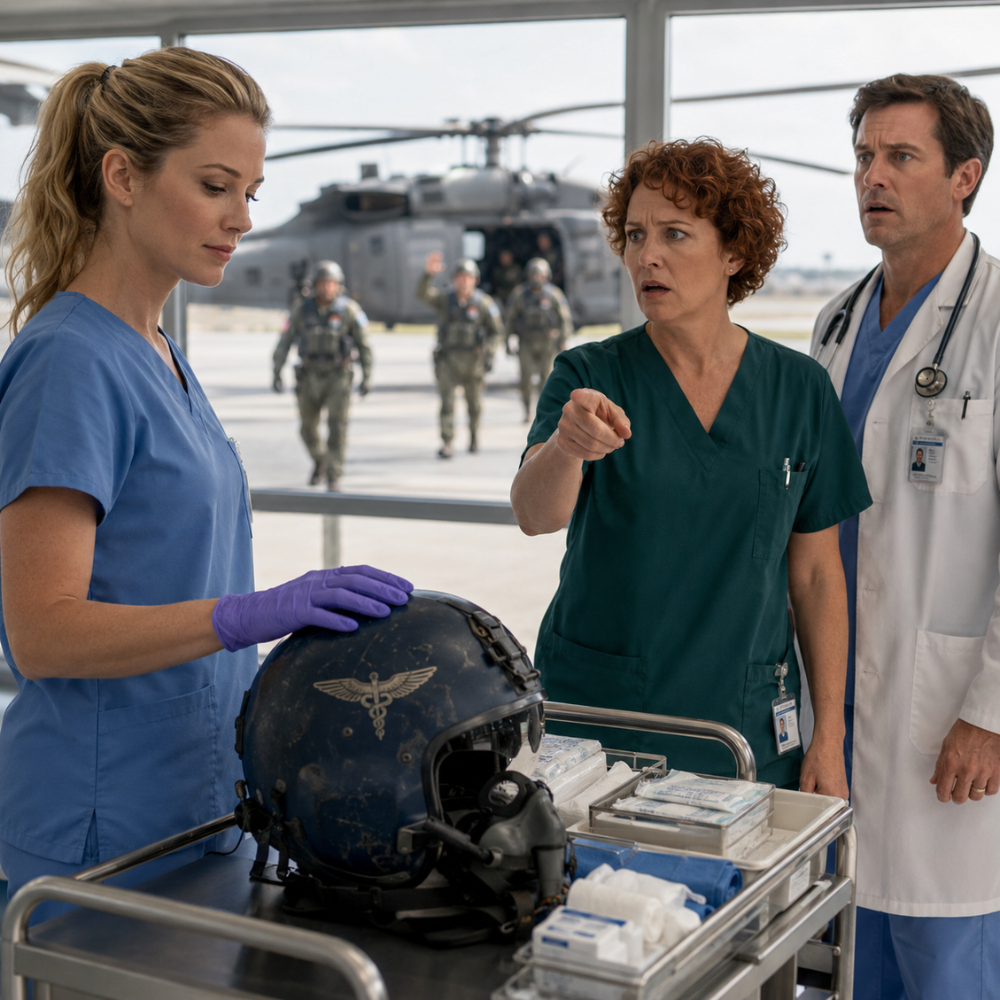
The nurse they had just suspended was walking out when a military helicopter landed—and the crew asked for her by name
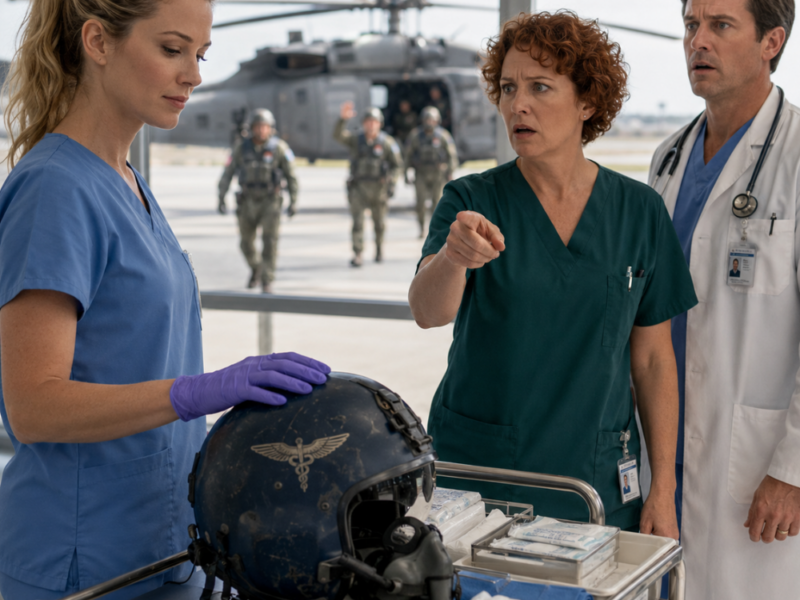
Norah Voss had one hand on the hospital’s glass exit door when the helicopter came down through the rain.
She stopped.
The sound reached her before the aircraft became visible, a low, hard percussion that seemed to push through the concrete walls of Harlow Creek General and vibrate somewhere behind her ribs.
Rotor blades.
Heavy transport.
Not the civilian air ambulance that used the roof pad twice a week.
Something larger.
Something military.
Behind Norah, the emergency department was already changing shape.
Phones rang at the nursing station. A crash cart rolled across the polished floor. Charge Nurse Diane Coffey stood with a receiver pressed against one ear while trying to direct three people at once. Dr. Garrett Hale had disappeared into Trauma Bay Two. A resident sprinted past the lobby carrying an unopened pack of sterile gowns.
Norah looked down at herself.
Blue scrubs.
Personal bag over one shoulder.
No hospital badge.
She had surrendered it twenty-three minutes earlier.
The suspension form was already signed.
Effective immediately.
She was not supposed to go back onto the floor.
Through the rain-streaked doors, she saw the silhouette of the helicopter descending toward the hospital pad.
Its navigation lights cut through the Montana evening.
For a moment, Norah remained exactly where she was.
Then Diane looked through the glass partition and saw her.
Something in the charge nurse’s face changed.
“Nora!”
Norah turned.
“What’s incoming?”
Diane still held the phone.
“Military transport. Three casualties. One critical. Gunshot injuries. ETA less than two minutes.”
The rotor noise deepened.
Norah lowered her bag to the floor.
She did not pick it back up.
Thirty-one hours earlier, she had driven into the employee parking lot ten minutes before six in the morning with fog on the windshield and coffee too hot to drink.
Harlow Creek General Hospital sat at the edge of Caldwell, Montana, a regional city large enough to have a Costco, two competing high schools, a trauma center, and enough new subdivisions to irritate people who remembered when the western edge of town had been cattle land.
The hospital itself was functional rather than impressive.
Six floors.
A newer surgical wing attached to an older brick structure.
A cafeteria that made good soup and terrible eggs.
A chapel almost nobody used until they desperately needed it.
Harlow Creek was a Level II trauma center, which meant it handled more than outsiders expected and transferred fewer cases than people assumed.
Norah had been there three weeks.
Three weeks was long enough for people to form opinions.
Too short for most of them to be correct.
She was twenty-eight, average height, brown hair worn in a tight braid, and quiet enough that people often mistook the quiet for uncertainty.
She did flinch sometimes when somebody shouted unexpectedly.
That part was true.
Her nervous system had been trained for six years in places where a sharp voice often meant incoming danger rather than an irritated surgeon.
Fourteen months after leaving that world, her body occasionally reacted before her mind remembered that a hospital corridor in Montana was not a forward operating base.
Someone in the break room had noticed.
By the second week, a nickname appeared.
Rabbit.
Norah learned about it accidentally.
She had been outside the break-room door when a nurse inside said, “Did you see the rabbit jump when Hale barked at her?”
Another person laughed.
“She looked like she was going to disappear into the supply cabinet.”
Norah stood in the hallway for four seconds.
Then walked to another coffee machine.
She never confronted them.
Partly because she did not want to.
Partly because people were allowed to misunderstand her.
She had spent enough years in systems where correction required energy she did not always have.
What mattered, she told herself, was the work.
She had been trying to believe that since taking the job.
At six-oh-five that morning, she logged into the nursing station and opened the first chart.
“Voss.”
Dr. Garrett Hale stood at the counter.
He did not look at her initially.
He scrolled through a tablet.
“Tell me you’re not primary on Bed Seven.”
“I’m support.”
Hale looked up.
Forty-three.
Senior trauma surgeon.
Excellent reputation.
A man who had spent so many years being one of the most capable people in a room that he no longer noticed when capability turned into territorial ownership.
Norah had recognized the type.
Not evil.
Not stupid.
More difficult than either.
“Your name is on a medication variance from Tuesday.”
“The patient had a documented sulfa allergy. Antibiotic order was corrected before administration.”
“By the attending.”
“After I flagged it.”
“You flagged it by going around the attending.”
“I asked him twice.”
Hale set the tablet down.
“You’ve been here three weeks.”
“I know.”
“And in three weeks you’ve questioned physician orders four times.”
“Three were changed.”
“That is not the issue.”
Norah waited.
Hale leaned slightly toward the counter.
“The issue is that you don’t yet understand how this floor functions.”
“I understand the chain of responsibility.”
“Then use it.”
“I did.”
His eyes narrowed.
“You seem to have an answer for everything.”
“No.”
“Good.”
His tone remained polite.
That somehow made the condescension sharper.
“You have good instincts. I’m not denying that. But instincts do not replace experience. We have physicians here with fifteen years on you.”
Norah looked at him.
“Understood.”
“Is it?”
“Yes.”
He left.
Priya Shah, one of the nurses at the neighboring station, looked over.
“Sorry.”
Norah opened another chart.
“For what?”
“He does that.”
“I noticed.”
Priya smiled slightly.
“You really are impossible to read.”
“That’s what my sister says.”
“You have a sister?”
Norah looked over.
Priya laughed.
“See? Three weeks and that is the first personal fact I’ve gotten.”
Norah almost smiled.
The morning accelerated.
That was what emergency departments did.
A fall.
A child with a deep forearm cut.
A sixty-year-old man with a probable hip fracture.
A college student with dehydration.
A woman with a migraine who kept apologizing for “wasting everybody’s time” while vomiting into a plastic basin.
Norah moved between them.
No drama.
No history.
Nothing about the six years before nursing school.
That was deliberate.
Her civilian HR file showed only what it needed to show.
Nursing degree.
Trauma certifications.
Two short civilian clinical placements.
A background check that came back clean but unusually slow.
What it did not show in ordinary administrative screens was Lieutenant Commander Norah Elaine Voss, attached medical officer, Special Operations Support Group, Pacific Command.
It did not show three deployments.
Austere trauma management.
Ballistic injury stabilization.
Forward surgical support.
Prolonged casualty care in environments where “transport delayed” sometimes meant twelve hours.
It did not show the commendation sealed behind a classification level most people at Harlow Creek could not access even if they somehow knew it existed.
Norah had wanted it that way.
After leaving the military, she wanted a job where a patient arrived with a name, insurance card, medical history, and family member in the waiting room.
She wanted working lights.
Full oxygen tanks.
Pharmacy access.
A CT scanner.
She wanted the problems to be medical rather than tactical.
She wanted to sleep.
Mostly, she wanted nobody to need the version of her that had existed before.
At nine-fifteen, Margaret Schultz came in by ambulance.
Fifty-seven.
Retired elementary-school teacher.
Chest pain.
Sweating.
High blood pressure.
Pain radiating toward the shoulder.
The paramedic called it probable cardiac ischemia.
Norah was charting at the station when the stretcher passed.
She looked up.
Then looked down again.
Three seconds later, she looked up a second time.
Something was wrong.
Not dramatically.
Margaret was breathing too shallowly for the apparent pain response.
Her skin tone was wrong in a slightly different direction than Norah expected.
Her right shoulder seemed elevated.
Her hand rested against the center of her sternum rather than clutching the left side of her chest.
Nothing individually significant.
Together, enough to bother Norah.
Dr. Simmons was already leading the case.
Hale stood beside him.
Competent team.
Clear plan.
Norah stayed at the station for forty more seconds.
Then crossed the floor.
She stopped at the trauma-bay doorway.
“Dr. Simmons?”
He looked over.
“Yes?”
“Have you listened to the right chest yet?”
Hale’s head turned immediately.
“Voss.”
Norah ignored the tone.
“I’m asking because her respiratory pattern is asymmetric.”
Simmons looked toward the patient.
“We’re working a cardiac event.”
“I know.”
“You’re not assigned here,” Hale said.
“I know.”
“Then please go back to your patients.”
Norah remained where she was.
“Before I do, can someone listen to the right side?”
Hale’s face hardened.
Simmons stared at Norah for a second.
Then, to his credit, picked up the stethoscope.
He listened.
His expression changed.
“Diminished.”
Hale looked irritated.
“That can happen.”
Simmons moved higher.
Listened again.
Then looked at Margaret’s neck.
Norah said quietly, “Possible deviation.”
Simmons stepped back.
Portable imaging was ordered.
The team recalculated.
Seven minutes later, the working diagnosis had changed.
A spontaneous tension pneumothorax had presented with chest pain convincing enough to steer the room toward cardiac disease.
They treated it.
Margaret stabilized.
Norah returned to her charting.
Simmons passed the station twenty minutes later.
“Good catch.”
“Thank you.”
Hale said nothing.
At eleven-thirty, Diane Coffey called Norah into the small office beside the charge desk.
Diane was fifty-four and had spent nine years running the ER with the unglamorous authority of someone who knew where everything was, who had worked every holiday at least twice, and who remembered how each physician behaved when frightened.
She folded her hands on the desk.
“Dr. Hale filed a concern.”
Norah sat.
“About Schultz?”
“Yes.”
“She had a pneumothorax.”
“That’s not disputed.”
“Then what is?”
“How you entered the case.”
Norah said nothing.
Diane leaned back.
“You crossed into a bay you were not assigned to and challenged the attending team.”
“I asked a clinical question.”
“In front of the patient, staff, and residents.”
“She could have arrested.”
“I know.”
Diane’s tone softened slightly.
“And your observation mattered.”
Norah waited.
“But this is the second time this week we’ve had an escalation issue.”
“Medication allergy.”
“Yes.”
“Also correct.”
Diane sighed.
“You keep saying correct as though outcome is the only thing that matters.”
“No.”
“What else matters?”
“Whether the patient gets there safely.”
Diane studied her.
“That is exactly the answer that worries me.”
Norah frowned.
“Why?”
“Because people who are right a few times start believing process applies only to people who are wrong.”
Norah absorbed that.
It was a fair concern.
“I don’t believe that.”
“Good.”
Diane slid a form across.
“Hale requested you be moved off primary trauma for the rest of the week.”
Norah looked at the paper.
Not suspension.
Reassignment.
She nodded.
“Okay.”
“You’re not angry?”
“Yes.”
That surprised Diane.
Norah continued.
“I also understand the instruction.”
Diane’s mouth moved slightly.
“Good.”
Norah spent the rest of the afternoon in lower-acuity intake.
Sprained ankle.
Viral syndrome.
Panic attack.
Wrist fracture.
She treated each one carefully.
Work did not become unimportant because it failed to challenge her.
At three-forty, the trauma alert sounded.
Norah kept walking.
The order was clear.
She was not assigned there.
Excellent people were in the bay.
She had spent years learning that one of the fastest ways to create danger during complex work was to invent authority you had not been given.
So she did not go.
Twelve minutes later, Priya appeared in the doorway of the intake room.
“Hale wants you.”
Norah looked up from a discharge sheet.
“He removed me from trauma.”
“I know.”
“Then why?”
Priya’s face was wrong.
That was enough.
Norah followed.
The patient was a construction worker in his midforties.
He had fallen from scaffolding and struck his chest against equipment on the way down.
His pressure was collapsing.
Heart rate rising.
Visible trauma existed, but not enough to explain the speed of deterioration.
Hale stood near the head of the table.
For the first time since Norah met him, he looked uncertain.
She moved closer.
“Mechanism?”
“Blunt chest impact,” a paramedic answered. “About twelve feet.”
Norah looked at the neck.
Jugular venous distention despite hypotension.
She listened briefly.
Heart sounds quiet.
Too quiet.
The combination landed immediately.
“Tamponade.”
A resident looked toward her.
Norah repeated:
“Cardiac tamponade.”
Hale stared.
She pointed only with her eyes.
“Hypotension. JVD. Muffled heart sounds.”
The resident listened.
Then looked up sharply.
“She’s right.”
Hale moved.
No argument.
No pride.
Not this time.
The intervention was performed.
Pressure improved.
The patient survived the immediate crisis.
Norah helped only where she was needed.
Then stepped back.
Hale looked at her.
“Where have you seen that presentation?”
“A long time ago.”
“Where?”
“Different setting.”
He waited.
Norah did not explain.
He nodded once.
She left.
The construction worker, Doug Martin, would later make a full recovery.
At that moment, Norah sat alone in the break room for eleven minutes with cold coffee in both hands.
Priya joined her.
“He’s going to make it.”
“Good.”
“Hale signed the Schultz note.”
Norah looked up.
“What?”
“Diane made him.”
“That should not require Diane.”
“No.”
Priya took a sip.
“People are noticing.”
“Noticing what?”
“You.”
Norah looked toward the wall.
“I was already here.”
Priya understood more than Norah intended.
The next morning, the department was quieter.
Not slow.
Emergency departments were rarely slow in meaningful ways.
But nobody arrived actively dying before ten.
Norah handled intake.
Helped a mother advocate for her son whose triage score did not match how sick he actually looked.
Caught another small medication discrepancy.
Said nothing about it afterward.
At two-ten, Garrett Hale appeared in the trauma-bay doorway.
“Voss.”
Norah looked up.
“In here.”
Diane stood inside.
So did a resident.
That told Norah this was not casual.
Hale had a form in front of him.
“I reviewed your employment file.”
Norah waited.
“I also reviewed the incident notes from the last three weeks.”
Silence.
“You have good clinical instincts.”
There it was again.
Good instincts.
A phrase people used when they wanted to praise the result without respecting the knowledge beneath it.
Hale continued.
“But you repeatedly bypass attending authority.”
“I raised safety concerns.”
“You created conflict in active clinical spaces.”
“Because the concerns were active.”
His jaw tightened.
“This is exactly the issue.”
Norah said nothing.
“Effective immediately, you’re suspended pending departmental review.”
Diane looked at her.
Norah looked at the form.
“This is not termination,” Hale said.
Not yet.
Nobody spoke the phrase.
Everybody heard it.
Norah signed.
No argument.
She handed over her badge.
Went to her locker.
Put spare shoes, a paperback, phone charger, and unopened packet of peanut butter crackers into her personal bag.
Priya found her there.
“You’re leaving?”
“For now.”
“This is insane.”
“No.”
“He’s punishing you for being right.”
“That is one version.”
“What is yours?”
Norah zipped the bag.
“His job includes controlling a department.”
Priya stared.
“He’s doing that badly.”
“Also true.”
“You are infuriatingly fair.”
“Thank you.”
“That was not praise.”
Norah smiled slightly.
Then walked toward the exit.
Rain hammered the parking lot.
She could have gone home.
Probably should have.
Then the helicopter arrived.
Norah put her bag down.
She walked back through the partition.
Diane stared.
“You are suspended.”
“I know.”
“So what exactly are you doing?”
“Standing here.”
The rotor sound became enormous.
Hale stepped from Trauma Bay One.
“Voss.”
“Military transport.”
“I heard.”
“What trauma protocol are you using for incoming ballistic casualties?”
He looked irritated.
“Standard ATLS.”
“That is not what I asked.”
His face changed slightly.
Norah continued.
“If these are special operations casualties arriving directly from a field environment, they may have prolonged-care interventions already in place.”
Hale stared.
She asked:
“Do you have TCCC handoff familiarity in this room?”
The resident looked blank.
That was answer enough.
Norah turned toward Diane.
“I need gloves.”
Hale said, “You’re suspended.”
“Yes.”
“I could have security remove you.”
“Yes.”
The helicopter engines changed pitch.
Landing.
Hale looked toward the trauma doors.
Then back at her.
“Why should I keep you here?”
Norah gave him the only useful answer.
“Because when those doors open, somebody may need the six years you don’t know about.”
For the first time, Hale did not challenge the sentence.
He looked at Diane.
“Get her gloves.”
Thirty seconds later, the doors opened.
Two walking wounded entered first.
Behind them came a stretcher.
Two military medical personnel ran beside it.
The patient was male.
Late forties or early fifties.
Chest wound.
Abdominal wound.
Pale.
Still conscious.
Norah clocked the field interventions in seconds.
Pressure dressings.
Decompression needle.
IV access.
Fluid already given.
Someone had done competent work before reaching the hospital.
The military medic closest to the stretcher was a woman in her early thirties.
“Vitals eighty over fifty. Tachycardic. Right chest GSW ninety minutes ago. Abdominal wound forty minutes. Right tension pneumo decompressed in the field. Seal may have failed.”
Hale went to the head.
Norah moved right.
“Can I assess the chest?”
Hale did not look at her.
“Do it.”
That single sentence mattered.
Not because it restored her job.
Because he was finally separating authority from ego.
Norah examined the field decompression.
The seal had failed.
Reaccumulation.
She called it.
The resident prepared the tray.
Hale managed airway and blood.
Norah helped reestablish chest drainage with the physician team.
Oxygenation improved.
Then the abdomen took over as the main problem.
The wound trajectory bothered her.
Too irregular.
Pressure falling in a pattern that suggested bleeding outside the obvious path.
Hale made the operating-room call.
Correct.
Norah would have called a few minutes earlier.
That did not matter.
The patient reached surgery alive.
Norah stepped back.
The military medic appeared beside her at the sink.
“You’ve done field trauma.”
“Some.”
“Where?”
“A while ago.”
The woman studied her.
“The abdominal round tumbled.”
“I think so.”
“There was probable ricochet before entry.”
“That fits.”
“The surgeon needs to know.”
“Tell them.”
“They’ll hear it differently from you.”
Norah looked over.
“Why?”
The medic held her gaze.
“Because I know who you are.”
Norah’s body went still.
The medic continued:
“We knew before we landed.”
The answer arrived before the explanation.
Norah returned to the floor.
The two walking wounded occupied adjacent bays.
One had a manageable arm wound.
The other had blunt head trauma from a vehicle impact.
Norah sat briefly with the younger man.
He was perhaps twenty-five.
Pupils reactive.
Vitals stable.
He had the faraway expression of someone whose body had finished surviving before his mind knew what had happened.
She did not ask him for details.
Sometimes silence was the most professional thing available.
Diane found her fifteen minutes later.
“Hale wants you upstairs.”
“In surgery?”
“Yes.”
“He filed you as a temporary trauma consultant.”
Norah stared.
“That is not an actual hospital title.”
“No.”
Diane handed her surgical scrubs.
“The paperwork problem belongs to tomorrow.”
Norah changed.
Upstairs, the abdominal case was more complicated than the initial imaging suggested.
Dr. Thomas Roark, vascular surgeon, was working.
“Secondary bleed doesn’t match entry path,” a resident said.
Norah stopped at the edge of the room.
“Round probably tumbled.”
Roark looked up.
“Who are you?”
“Hale asked me to consult on field injury pattern.”
Roark looked annoyed.
Norah understood.
Another person entering his OR with information he had not requested.
She did not take it personally.
“The projectile likely fragmented or changed trajectory before entry. If so, your second bleed may be medial to the primary path rather than along it.”
Roark stared.
“You’ve seen that?”
“Yes.”
“Where?”
“Forward environments.”
He looked at her differently.
Then repositioned.
The resident found the secondary injury.
“There.”
Roark said nothing.
He fixed it.
Norah stayed out of his way.
When the patient stabilized, Roark looked toward her.
“Military?”
“Former.”
“How long?”
“Enough.”
“Useful answer.”
“It’s the one I have.”
She returned downstairs.
At nine-thirty, Priya sat with her in the break room.
“The patient will make it.”
“Good.”
“Both military patients are stable.”
Norah nodded.
“Hale met with the chief.”
“About?”
“You.”
Norah stopped drinking.
“And the military medic went in too.”
“What did she say?”
“I don’t know.”
Priya lowered her voice.
“But she asked where you were afterward.”
Norah stood.
She went to the nursing station.
Pulled the temporary military intake record.
The patient was still listed under a protected administrative code.
Transport origin showed a unit designation.
Norah read it once.
Then again.
She knew the command.
Had worked beside it for three deployments.
Her hands rested flat on the counter.
The ER doors opened.
The field medic returned.
Two men followed.
Civilian clothing.
Military posture.
One carried a folder.
They walked directly toward Norah.
“We need to talk.”
Norah looked at the folder.
“About the patient?”
The medic shook her head.
“About you.”
The small conference room near the ER still had scheduling notes on the whiteboard from the day shift.
FLOAT COVERAGE THURSDAY.
CHECK COFFEE ORDER.
Ordinary hospital debris.
The medic introduced herself.
Petty Officer First Class Elena Ramirez.
The man with the folder said only:
“Mercer. NCIS.”
Norah sat.
Mercer opened the folder.
The seal on the first document was Naval Special Operations Medical Command.
Below it:
LIEUTENANT COMMANDER NORAH ELAINE VOSS.
ATTACHED MEDICAL OFFICER.
SPECIAL OPERATIONS SUPPORT GROUP.
PACIFIC COMMAND.
Norah had not seen the full designation printed in fourteen months.
“We need confirmation,” Mercer said.
“It’s me.”
“You separated fourteen months ago.”
“Yes.”
“Honorable?”
“Yes.”
“Why is none of this in your hospital file?”
“Because none of it is required for civilian nursing licensure.”
Ramirez leaned forward.
“We knew you were here.”
“How?”
“High-value casualty transfer protocols include facility screening.”
“For what?”
“Relevant capabilities.”
Norah almost laughed.
“So somebody discovered the suspended ER nurse was the most relevant capability after the helicopter was already inbound.”
“I did not know you were suspended.”
“Lucky timing.”
Mercer looked at her.
“The patient is Rear Admiral Dennis Koval.”
Norah went still.
She knew the name.
Not personally.
Pacific Special Operations Group deputy commander.
The injured man upstairs had been a flag officer.
“He’s stable?”
“Guarded but improving.”
Mercer continued.
“He was injured at a training facility ninety miles north.”
“Training accident?”
“No.”
Norah looked at him.
Mercer’s expression remained flat.
“He was shot with a weapon that should not have been inside the facility.”
“Internal incident.”
“Under investigation.”
Norah processed that.
“What do you need from me?”
“Admiral Koval’s next seventy-two hours are medically significant.”
“So?”
“Dr. Roark says the ballistic injury pattern is unusual.”
“It is.”
“You recognized it immediately.”
“Yes.”
“We want you available as a medical consultant while he remains here.”
Norah looked toward the whiteboard.
“My badge is in a tray downstairs.”
Mercer said:
“Your suspension is being discussed upstairs.”
“That is not the same thing as resolved.”
“No.”
Ramirez looked at Norah.
“We are asking you to stay in the building.”
Norah exhaled.
“Fine.”
At eleven-twenty-three, Hale entered the break room.
He sat opposite Norah.
For the first time, there was no supervisory audience.
No resident.
No charge nurse.
No form.
“Why didn’t you tell me?”
Norah knew immediately what he meant.
“About the military.”
“Yes.”
“I applied to be a civilian nurse.”
“That does not answer the question.”
“It does.”
Hale rubbed both hands over his face.
“You spent six years in special operations trauma.”
“Yes.”
“You let us treat you like a first-year nurse.”
“I have been a nurse here for three weeks.”
“You know what I mean.”
“Yes.”
“Why?”
Norah thought.
“Because I didn’t want to trade on history.”
“That’s admirable to the point of stupidity.”
“Maybe.”
“You could have said something when I moved you off trauma.”
“Would it have changed your decision?”
Hale opened his mouth.
Stopped.
Norah continued.
“What exactly would I have needed to say?”
“I treated people under fire?”
“I have a classified commendation?”
“Believe me because an institution you respect once gave me rank?”
Her voice remained calm.
“You either evaluate the information I give you or you don’t.”
Hale looked at the table.
“The tamponade patient.”
Norah waited.
“You said you’d seen it somewhere else.”
“Vehicle casualty holding point.”
“Did he survive?”
“No.”
Hale looked up.
“Why not?”
“We were too far from surgery.”
Silence.
“That is why I recognized it quickly.”
Hale leaned back.
“I’m sorry.”
Norah did not answer immediately.
“For suspending you.”
Another pause.
“And for the way I’ve treated you since you arrived.”
Norah looked at him.
“Do you know what the problem was?”
“I thought you were inexperienced.”
“That wasn’t the problem.”
“What was?”
“You thought inexperience meant I didn’t get to notice something you missed.”
Hale sat with that.
Norah continued.
“You should listen to an inexperienced nurse too.”
He nodded slowly.
“Yes.”
“Because once in a while, they will see something you don’t.”
“Yes.”
“That is the whole job.”
Hale looked toward his coffee.
The midnight meeting formally rescinded Norah’s suspension.
Dr. Alderton, the hospital chief of staff, sat behind his desk.
Hale stood by the wall.
Diane attended.
Commander Paige from regional Naval Medical Command attended on behalf of the military.
Norah sat in the only empty chair.
“The suspension is rescinded immediately,” Alderton said.
“Administrative review will continue.”
Norah nodded.
Commander Paige continued.
“We would like you assigned temporarily as consulting trauma support for Admiral Koval.”
“What does that mean operationally?”
“You work through Dr. Roark.”
“Good.”
“You flag field-specific concerns directly.”
“Good.”
“You do not run the ICU.”
“I had no intention.”
Paige almost smiled.
“Good.”
Norah looked toward Hale.
He met her eyes.
Did not look away.
For the next four hours, she moved between the ICU and lower floors.
At three-oh-seven in the morning, Admiral Koval’s pressure began trending downward.
Not a catastrophic drop.
The kind of slow drift people can rationalize.
Norah had been waiting for it.
The wound pattern made delayed vascular injury possible.
She entered.
The ICU nurse looked at her.
“Pressure’s soft.”
Norah examined Koval’s abdomen gently.
Response on the right.
Subtle.
“Call Roark.”
“It’s three in the morning.”
“I know.”
The nurse picked up the phone.
Norah called Dr. Roark and gave him the pattern.
Possible delayed renal-artery complication.
Progressive retroperitoneal bleed.
She was careful.
Not diagnosis.
Concern.
Roark arrived in twenty-two minutes.
He agreed enough to act.
Angiography found the developing problem before it became catastrophic.
They treated it.
At four-forty, the pressure line began climbing.
Mercer stood beside Norah outside the procedure room.
“You knew.”
“I suspected.”
“That is becoming a recurring distinction with you.”
“It matters.”
“How long were you in the field?”
“Six years.”
“And you left voluntarily.”
“Yes.”
“Why?”
Norah watched the monitor.
“I wanted enough light to see the patients.”
Mercer frowned.
She corrected herself.
“I wanted infrastructure.”
“Equipment.”
“Time.”
“A full team.”
“Medicine without somebody shooting at the building.”
He was quiet.
“Did you get what you wanted?”
Norah looked through the window.
“I’m still deciding.”
At six-forty, Admiral Koval opened his eyes.
Norah entered.
He tracked her.
“Who are you?”
“Nurse.”
His expression suggested he did not believe that was the whole answer.
“Nobody important,” Norah added.
Koval studied her.
“You have the look.”
Norah knew exactly what he meant.
“Rest.”
His eyes closed.
In the hallway, Commander Tessa Ward was waiting.
Senior officer.
Pacific Command.
Folder in hand.
“Lieutenant Commander Voss.”
Norah glanced at the folder.
“I’m separated.”
“I know.”
“What happened?”
“We need to know whether you recognize a name.”
Ward opened the folder.
WARRANT OFFICER FIRST CLASS WARREN ODELL, RETIRED.
Norah felt the corridor disappear for a second.
Not literally.
But the hospital noise receded.
The monitors.
Footsteps.
Voices.
All of it.
“Where did you find him?”
“Forty miles north.”
“Running?”
“No.”
Norah looked at the name again.
She knew Warren Odell.
Too well.
During her final military deployment, Odell had overseen procurement and facility access for several forward sites.
Norah found irregularities.
Equipment billed as delivered that never reached field teams.
Vendor discrepancies.
Credentials appearing in places they should not.
She documented it.
Filed a report.
Six weeks before her separation.
Then Odell filed complaints against her.
Two.
Both framed as professionalism issues.
Command friction.
Failure to stay within medical authority.
It sounded familiar now.
“I filed an IG complaint against him.”
Ward nodded.
“I know.”
“What happened to it?”
“Closed.”
Norah’s face hardened.
“I never received final disposition.”
“Insufficient evidence.”
“That was wrong.”
“Yes.”
Ward’s answer came immediately.
“The investigation has been reopened.”
“Because he shot Admiral Koval.”
“Yes.”
“Why?”
“We believe the admiral initiated a new contractor-access audit.”
Norah looked toward Koval’s ICU room.
“Odell knew the audit would reopen his procurement network.”
“That is the working theory.”
Norah handed the folder back.
“What do you need?”
“Your original documentation.”
“Testimony.”
“Everything you did not have time to finish.”
Norah exhaled.
“Okay.”
For the next several hours, Norah worked with Mercer and another investigator named Foss.
She reconstructed her original filing from memory.
Dates.
Vendor names.
Shipment numbers she could still remember.
Access discrepancies.
Which claims she filed formally.
Which she had only suspected.
She drew the line carefully.
“I did not file this part because I couldn’t support it.”
Mercer looked over.
“You still think it was true?”
“Yes.”
“But you didn’t include it.”
“No.”
“Why?”
“Because suspicion is not evidence.”
Foss nodded.
That line appeared in her notes.
At eight-fifteen, Mercer received a call.
Odell was talking through counsel.
He wanted sentencing consideration.
The procurement network was larger than the original report suggested.
Eleven contractors.
Multiple facilities.
Millions in fraudulent billing.
Unauthorized access arrangements.
Norah listened.
“The IG who closed my report.”
Mercer became still.
“We are looking at that.”
“Is he involved?”
“That is one of the questions Odell is answering.”
Norah leaned back.
The anger came slowly.
Not hot.
Cold.
She had spent fourteen months wondering whether she had overreacted.
Whether she had made herself professionally inconvenient over a series of discrepancies that maybe had simpler explanations.
She had never believed she was wrong.
But institutions could make certainty expensive.
Especially when the institution itself told you the issue had been reviewed and closed.
Dr. Roark found her around ten.
“You need sleep.”
“I’m fine.”
“You’ve been awake more than twenty hours.”
“I slept yesterday.”
“That is not a defense.”
She looked at him.
He was not being dismissive.
That mattered.
“How long?”
“Three hours minimum.”
“I can do three.”
“Four.”
“Three.”
Roark sighed.
“Fine. Three.”
She slept in her car for two hours and fifty minutes.
At one-fifteen, she returned to the ICU.
Koval was awake enough to recognize her.
“You were here before.”
“Yes.”
“Voss.”
“Yes.”
His face changed at the name.
“I know you.”
Norah watched.
“Odell.”
The word cost him effort.
“You filed against him.”
“Yes.”
“I reviewed two complaints against you.”
Norah went still.
“The retaliation complaints?”
“Yes.”
“What did you do?”
“Closed them.”
She stared.
“Why?”
“They were unsupported.”
He breathed slowly.
“They read like attempts to discredit a person rather than investigate conduct.”
Norah had not known.
“Why are you telling me?”
Koval looked at her.
“Because you have the expression of someone who believes the institution failed entirely.”
He paused to breathe.
“It did not.”
Another pause.
“It failed in the part you could see.”
Norah sat.
Koval continued.
“I didn’t know about the IG procurement report then.”
“The complaints came through another channel.”
“Yes.”
“I cleared what I saw.”
He closed his eyes briefly.
“Someone else buried what I didn’t.”
Norah absorbed that.
Institutions fail partially.
The sentence stayed with her.
She had spent more than a year thinking the machine had rejected the truth.
Maybe parts of it had.
Other parts had held.
Quietly.
Invisible to her.
That did not erase the failure.
It made the picture more complicated.
At three-forty that afternoon, Hale found Norah outside ICU.
“Your suspension review is closed.”
Norah waited.
“Fully rescinded.”
“Back pay?”
“Yes.”
“File?”
“Removed.”
“Good.”
He looked uncomfortable.
“There will be written commendations on Schultz and the tamponade case.”
Norah nodded.
“I should have done that before.”
“Yes.”
Hale winced slightly.
“The rabbit thing.”
Norah looked at him.
“I didn’t start it.”
“No.”
“I knew it existed.”
“Yes.”
“I should have stopped it.”
“Yes.”
He nodded.
Norah did not rescue him from the discomfort.
He did not deserve cruelty.
He did deserve the full weight of the answer.
“I’m not good at being wrong,” he said.
“That can be learned.”
He almost smiled.
“I suspect you’re going to enjoy this.”
“No.”
“Liar.”
Norah looked at him.
That was the first joke he had made with her.
Awkward.
But real.
At four-thirty, the investigation changed again.
The officer who had ordered Norah’s IG file closed was not acting independently.
Rear Admiral Philip Cass, deputy director of special operations contracting, had directed the closure.
He also approved Odell’s retirement and post-service contractor access.
Odell had not been the top.
He had been middle management in corruption.
Norah sat in a conference room while a senior officer on secure video explained the arrests.
Cass.
The IG investigator.
Others.
Her original report had been accurate.
Sufficient.
Actionable.
Someone had made sure it disappeared.
“It held,” Norah said quietly.
Commander Ward looked at her.
“The record held.”
Norah looked down at her hands.
She had written that report on a borrowed laptop with a cracked hinge in a converted supply room eighteen months earlier.
She had chosen each sentence carefully because she knew retaliation would come.
She had been right.
The truth had survived because the document had survived.
That felt less like triumph than she expected.
More like exhaustion finally being allowed to put something down.
The following evening, Norah returned to ordinary work.
She wanted it.
An ankle injury.
A teenager with dehydration.
An older man with pneumonia.
Doug Martin, the construction worker from the tamponade case, asked her directly what had happened to him.
Norah explained.
Not dramatically.
Pressure had built around his heart.
The heart could not fill properly.
His blood pressure fell.
They relieved the pressure.
He listened.
“You figured it out.”
“I flagged it.”
“You figured it out enough to flag it.”
“Yes.”
“That matters.”
Norah thought about Harold Beam’s reading glasses though she had not met him yet in this version of her life.
Different patient.
Same truth.
Listening mattered.
The staff began treating Norah differently after the helicopter.
She disliked most of it.
People asked about the military.
Some whispered.
Someone looked up her name and discovered a sparse record with enough official acknowledgment to make the mystery worse.
Norah refused to become entertainment.
Diane handled it pragmatically.
At afternoon handoff, she addressed the nursing staff.
“Lieutenant Commander Voss’s prior service history is her business unless it affects patient care.”
A few people looked down.
Diane continued.
“What is our business is that several of you have treated a colleague as though quiet meant incapable.”
Silence.
“No names.”
That somehow made everyone feel named.
“We work in emergency medicine.”
Diane looked around.
“You will occasionally need information from somebody whose title does not impress you.”
A pause.
“Learn to listen anyway.”
The nickname disappeared.
Nobody announced its death.
Norah simply stopped hearing it.
Three weeks later, she gave a formal deposition in Billings.
Long table.
Video camera.
Federal prosecutor.
Military counsel.
She answered questions for four hours.
Original report.
Odell.
Procurement.
Access irregularities.
Retaliation.
Why she separated.
At the end, the prosecutor said:
“Your initial IG filing was unusually detailed.”
Norah replied:
“I knew it would need to survive people who wanted it not to.”
The prosecutor looked at her.
“It did.”
Norah drove back to Caldwell through mountain roads and intermittent radio signals.
She spent much of the drive thinking about justice.
People talked about justice as if it arrived like weather.
One dramatic moment.
Verdict.
Arrest.
Apology.
Vindication.
Real correction felt slower.
A file reopened.
A bad decision acknowledged.
A policy changed.
A name attached to an action.
A person forced to answer publicly for something that had once been done quietly.
The wrong was not erased.
It was placed on the correct side of the record.
Maybe that was enough.
Admiral Koval remained at Harlow Creek four weeks.
He was not an easy patient.
Not because he complained.
Because he asked questions about everything.
Medication.
Physical therapy.
Lab trends.
Pain management.
Why his blood pressure changed after meals.
Whether one surgeon’s definition of “light activity” was identical to another’s.
Norah respected him.
On his discharge morning, he walked into the ER instead of sending for her.
He wore civilian clothes.
His protective team followed several steps behind.
“I already thanked you,” he said.
“Yes.”
“I’m doing it again.”
Norah smiled faintly.
“Why?”
“I mean it more than once.”
He extended his hand.
She shook.
“What are you going to do?” he asked.
“Finish this shift.”
“After that.”
“Another shift.”
“You know what I mean.”
Norah looked around.
ER board.
Nurses.
Residents.
Phones.
People arriving with ordinary emergencies that felt extraordinary only to them.
“This.”
Koval nodded.
“You’re good at this.”
“Yes.”
“And the other work.”
“Yes.”
“They don’t conflict?”
Norah thought.
“Not as much as I believed.”
He looked toward the entrance.
“You should teach.”
“I’ve heard that.”
“I’m serious.”
“So was everybody else.”
“I’ll send something.”
She sighed.
“Of course you will.”
He left.
Norah watched the doors close behind him.
Then returned to the patient board.
Her reinstatement was handled quietly.
Exactly as she requested.
No ceremony.
No hospital-wide email praising her.
The suspension disappeared from her file.
Formal commendations were added.
More importantly, Harlow Creek created a structured clinical-escalation pathway allowing nursing staff to raise immediate concerns without needing permission from the physician whose decision they were questioning.
Diane called it the Voss Protocol.
Norah hated that.
“Change the name.”
“No.”
“It sounds self-important.”
“Good.”
“I’m serious.”
“So am I.”
“Diane.”
“It’s in the system.”
Norah gave up.
The protocol was not revolutionary.
It simply created a recognized phrase and a documented path.
Any nurse could call a clinical review when a patient-safety concern was being dismissed.
The attending remained responsible for the final medical decision.
But the concern had to be heard.
Not necessarily followed.
Heard.
That distinction mattered.
Six weeks after the helicopter, Norah received an envelope from Naval Medical Command.
Inside was an invitation.
Senior clinical instructor.
Seabrook, California.
Training special operations corpsmen, medics, and trauma nurses.
Ballistic injury.
Austere care.
Civilian-military trauma integration.
Norah placed the letter on her kitchen table.
Left it there three days.
She had come to Caldwell because she wanted ordinary.
Now somebody was offering her a way to make the old knowledge useful without returning to the old life.
She thought about Margaret Schultz.
Doug Martin.
Rear Admiral Koval.
The unnamed military casualty whose fragments had gone in a direction civilian imaging initially missed.
She thought about the young service member in the side bay who barely spoke.
About the people she had cared for overseas.
About mistakes she had made.
About the patients who survived.
About the ones who did not.
She thought about multiplication.
One pair of hands could save one patient at a time.
Teaching twenty people changed the equation.
Norah picked up a pen.
She gave Harlow Creek eight weeks’ notice.
Hale found her in the break room the next morning.
“You’re leaving.”
“Yes.”
“Because of what happened here?”
“No.”
“Are you sure?”
“Yes.”
He looked unconvinced.
“The offer existed because of what happened.”
“That is different.”
“Where?”
“California.”
“Military?”
“Training.”
Hale nodded.
“I want a favor.”
Norah waited.
“Case review before you leave.”
“Which cases?”
“Schultz.”
“Doug.”
“The admiral.”
“The military surgical case.”
He paused.
“And any others where you think we missed something.”
Norah almost smiled.
“That could become unpleasant.”
“I’m trying something new.”
“What?”
“Being wrong.”
She laughed before she could stop herself.
Hale looked offended.
“That was more enthusiastic than necessary.”
The case review ran ninety minutes.
Residents attended.
Nurses.
Physicians.
Diane.
Norah did not turn it into a lecture about herself.
She broke each case into observations.
Margaret Schultz.
Why had everyone seen cardiac disease?
Because the symptoms supported it.
Where had the story stopped fitting?
Respiratory pattern.
Breath sounds.
Tracheal position.
Doug Martin.
Why had blunt trauma obscured tamponade?
Because visible injuries created a stronger initial narrative.
Admiral Koval.
Why had the military injury been difficult?
Because civilian systems saw the body without the tactical mechanism that produced the injury.
The lesson was not:
Norah was smarter.
The lesson was:
The first story is not always the whole story.
One resident asked:
“How do you know when to challenge the attending?”
Norah replied:
“You don’t challenge a person.”
He frowned.
“You challenge the mismatch.”
“What does that mean?”
“When the data no longer fits the plan, say exactly which data.”
“Not ‘I think you’re wrong.’”
“Say ‘his neck veins are distended despite hypotension.’”
“Or ‘breath sounds are absent on the right.’”
“Or ‘the pressure trend changed after this medication.’”
She looked around.
“Precision makes disagreement useful.”
Diane nodded.
Hale wrote it down.
Norah noticed.
On her third-to-last day, a nurse named Yolanda stopped her in the hallway.
“I owe you an apology.”
Norah waited.
“The rabbit thing.”
Silence.
“I said it.”
“I know.”
Yolanda looked surprised.
Norah continued:
“I heard you.”
Yolanda’s face flushed.
“I’m sorry.”
Norah could have made it easy.
Could have said no big deal.
Could have told her everybody jokes.
Instead:
“Okay.”
Yolanda nodded.
“I should not have.”
“No.”
“I know.”
She walked away.
That was all.
Actual apologies were often disappointing compared with stories.
No music.
No tears.
Just a person standing in a hallway and admitting something.
Norah respected that.
She packed her apartment on a Saturday.
It did not take long.
She had never fully unpacked.
The drive to Seabrook took two days.
She crossed Idaho, Nevada, then west toward California.
Stopped at a diner outside Winnemucca.
Eggs.
Toast.
Coffee.
A waitress named Carla who told Norah snow would come early because her knee hurt.
Norah sat in the booth twenty minutes longer than necessary.
Sunlight moved across the window.
Nobody knew her.
Nobody needed anything urgent.
It felt good.
Seabrook Naval Medical Training Center sat on a hillside above the Pacific.
The view surprised her.
So did the office.
Small.
One window facing the training yard.
Perfect.
Captain Marcus Devo ran the program.
He had the social efficiency of someone who did not mistake friendliness for wasted time.
“You’ll teach two days.”
“Curriculum one.”
“Simulation two.”
“Clinical review one.”
“And the rest?”
“Whatever breaks.”
“That sounds familiar.”
“You’ll fit.”
Her first class had twenty-three students.
Corpsmen.
Combat medics.
Two nurses.
Norah placed a composite casualty case on the screen.
No classified details.
No names.
No heroic backstory.
“What’s wrong?”
The students answered.
Blood pressure.
Airway.
Possible bleed.
She kept asking.
“What else?”
They found another clue.
Then another.
Not all.
That was the point.
At the end, a young corpsman raised his hand.
“Ma’am, are these real cases?”
“Parts.”
“Did people survive?”
“Some.”
He looked uncomfortable.
“What about the others?”
Norah thought about the tamponade patient she had once treated in a vehicle and lost before reaching surgery.
She did not give the class that story.
Not yet.
“When people got it wrong, they studied why.”
She looked across the room.
“That matters too.”
Three months later, Admiral Koval visited.
He sat in a student chair after the official tour.
“How is it?”
“Good.”
“That’s all?”
“Better than expected.”
“What did you expect?”
Norah looked toward the training yard.
“I thought teaching would feel like stepping away.”
“And?”
“It feels like leverage.”
“Explain.”
“Twenty-three people.”
She nodded toward the empty seats.
“If I teach them to recognize a pattern correctly, then twenty-three sets of hands carry it forward.”
Koval nodded.
“That’s the math.”
Norah smiled.
“I didn’t see it before.”
“I reviewed your case again.”
“Which one?”
“All of it.”
She sighed.
He continued.
“Cass was dishonorably discharged.”
Norah waited.
“Federal sentencing pending.”
“Odell?”
“Six years under cooperation terms.”
“The IG investigator?”
“Convicted on obstruction-related charges. Lost rank.”
“Bray?”
“The analyst who called you.”
“Yes.”
“Cooperation credit. Supervised release.”
Norah thought about the different outcomes.
Different culpability.
Different choices.
No clean symmetry.
Probably more honest that way.
Koval looked at her.
“You told me once you were nobody important.”
“I was tired.”
“You were wrong.”
Norah did not answer.
He smiled slightly.
Then left.
Norah stayed in the classroom.
She looked at the whiteboard.
Tomorrow’s lesson:
PATTERN RECOGNITION UNDER INCOMPLETE INFORMATION.
She stood there for a while.
The path from Montana to California looked obvious only because she was standing at the far end of it.
It had not felt obvious while walking.
Nothing important usually did.
She had filed a report eighteen months earlier without knowing whether it would matter.
She had joined a civilian hospital without knowing whether normal work would feel normal.
She had been called fragile because people saw a flinch and knew nothing about what created it.
She had been suspended because the structure of the room valued hierarchy more than interruption.
Then a helicopter landed.
A patient needed exactly what Norah knew.
Not because destiny had arranged it.
Because lives are full of accidents that expose assumptions.
Hale assumed quiet meant inexperienced.
The nursing staff assumed flinching meant weakness.
The IG system assumed—or pretended—that insufficient evidence meant there was nothing left to pursue.
Norah had made assumptions too.
She assumed if she stayed quiet long enough, the old life would stop belonging to her.
It had not.
The knowledge remained.
So did the cost.
So did the usefulness.
The trick was not to become the old person again.
It was to stop pretending the old person and the new one had nothing to teach each other.
Months became years.
Norah became one of the training center’s most respected instructors.
Not famous.
She disliked attention too much for that.
But respected.
She taught students to distinguish confidence from certainty.
To understand that field medicine was not improvisation without rules.
It was disciplined decision-making when normal rules lost infrastructure.
She taught them that civilian medicine had lessons field medicine often underestimated.
Documentation.
Redundancy.
Specialization.
Consultation.
The ability to say, “I don’t know, call someone who does.”
She taught them both directions.
One afternoon, a trainee asked:
“What was the hardest thing to learn after leaving operations?”
Norah considered.
“Waiting.”
“Waiting?”
“Yes.”
“In the field, if you saw the problem, you acted.”
“In hospitals, systems have more layers.”
“Is that bad?”
“No.”
She paused.
“Sometimes layers protect patients.”
“Sometimes they slow the truth down.”
The trainee nodded.
“How do you know which?”
Norah smiled.
“That is why we train.”
She never taught people to ignore authority.
That would have been irresponsible.
She taught them to use authority correctly.
A rank.
A title.
A license.
An attending role.
A command role.
All useful.
None magical.
The person with the highest title might know the most.
Often did.
But medicine was too complicated for that to be assumed every time.
One year after Norah left Harlow Creek, Diane mailed her a photograph.
The ER nursing station.
A laminated card beside every workstation.
CLINICAL ESCALATION: STATE THE MISMATCH.
Below it:
- WHAT DO YOU SEE?
- WHAT DOES THE CURRENT PLAN ASSUME?
- WHERE DO THEY CONFLICT?
- WHO NEEDS TO HEAR IT NOW?
Diane wrote on the back:
YOUR ANNOYING LITTLE PROTOCOL IS WORKING.
Norah placed the photograph in her office.
Hale emailed occasionally.
Never sentimental.
“Caught a posterior bleed after a nurse called mismatch.”
Or:
“Resident challenged my interpretation today. He was right. Irritating.”
Norah usually answered one line.
Good.
Or:
Survive it.
Three years after leaving Montana, Harlow Creek invited her back for a trauma-education weekend.
She almost declined.
Then accepted.
The ER looked smaller than she remembered.
Priya hugged her.
Diane complained that California had made Norah look “too rested.”
Hale shook her hand.
“You’re late.”
“By two minutes.”
“Still counts.”
The nickname rabbit had become a strange little historical embarrassment nobody mentioned.
Norah appreciated that.
She did not need ceremonial remorse.
The department was different.
Not transformed.
Different.
A young nurse questioned a medication order at the station.
The resident looked irritated.
Then stopped.
“What’s the mismatch?”
The nurse explained.
They reviewed it.
The order changed.
No drama.
Norah watched.
That mattered more than an apology speech.
During the weekend seminar, Hale introduced Norah.
He did not list every classified accomplishment.
Did not call her a hero.
He said:
“Years ago, I almost fired this woman because she kept noticing things I didn’t want her to notice.”
The audience laughed.
Hale continued:
“She turned out to be right often enough that I eventually had to learn the uncomfortable lesson.”
He looked toward Norah.
“What’s the lesson?”
Hale smiled.
“That my title means I’m responsible for the decision.”
A pause.
“Not entitled to be the only person who influences it.”
Norah nodded.
That was accurate.
After the seminar, she walked toward the glass doors where she had once stood with a suspension form signed and her badge surrendered.
Rain had fallen that day.
Tonight the sky was clear.
The helipad lights glowed across the hospital grounds.
Priya came beside her.
“Do you think about it?”
“The helicopter?”
“Yes.”
“Sometimes.”
“What part?”
Norah looked toward the pad.
“The bag.”
Priya frowned.
“What bag?”
“My personal bag.”
“I set it down in the lobby.”
“Oh.”
Priya waited.
“Why that?”
Norah thought.
“Because it was the decision point.”
“Going back in?”
“Yes.”
“You were suspended.”
“Yes.”
“You could have left.”
“Yes.”
“What if you had?”
Norah looked at her.
“Somebody else might have handled it.”
“That is a very unsatisfying answer.”
“It’s the honest one.”
Priya smiled.
“You haven’t changed.”
“I have.”
“How?”
Norah looked back through the ER windows.
“When I worked here, I thought being underestimated was not my problem.”
“Wasn’t it?”
“Mostly no.”
She paused.
“But I also used that belief to avoid telling people what I knew.”
Priya listened.
“I thought if they were wrong about me, the burden was entirely theirs.”
“And now?”
“Sometimes people need context.”
“That sounds dangerously social.”
“I’m working on it.”
They laughed.
Norah had learned one other thing after leaving Harlow Creek.
Being believed was not the same as being right.
That mattered.
Early in her teaching career, a student challenged her interpretation of a simulation.
Norah dismissed it too quickly.
Then the data came back.
The student was right.
Norah called the class together the next morning.
“I made an error yesterday.”
Twenty-three faces looked surprised.
She explained it.
No excuses.
One student asked:
“Why are you making such a big deal out of it?”
“Because this is how expertise becomes dangerous.”
Silence.
“When people begin believing the expert instead of checking the evidence.”
She looked around.
“Do not turn me into the person Dr. Hale almost became.”
A few students who knew the story smiled.
“Titles are tools.”
“Experience is evidence.”
“Neither is immunity.”
That sentence became part of her curriculum.
Years later, Norah still occasionally flinched when someone raised a voice behind her unexpectedly.
Less often.
Not never.
She stopped being embarrassed by it.
The reflex was history.
Not identity.
Her students noticed once.
A training explosive went off during an outdoor scenario.
Planned.
Safe.
Norah’s shoulders tightened before relaxing.
One young medic saw.
Later, he asked quietly:
“You okay?”
Norah smiled.
“Yes.”
“You jumped.”
“I did.”
“I thought you were used to that stuff.”
“I am.”
He looked confused.
Norah explained.
“Being used to something does not mean your body forgets.”
The medic nodded.
“Does it bother you?”
“Less now.”
“How?”
“I stopped treating the reaction like evidence that something was wrong with me.”
She looked toward the training yard.
“Sometimes the body remembers faster than the mind.”
He seemed relieved.
Norah wondered whether he had asked for himself.
Probably.
That was teaching too.
Admiral Koval eventually retired.
At his retirement ceremony, he invited Norah.
She did not attend.
Crowds.
Speeches.
Uniforms.
Too much.
She sent a note instead.
THANK YOU FOR LISTENING WHEN IT MATTERED.
He mailed it back with one sentence written underneath.
YOU FIRST.
She kept that.
By forty, Norah ran the entire advanced clinical simulation program at Seabrook.
She still worked occasional trauma shifts at a nearby civilian hospital to keep her hands honest.
That was how she described it.
“Hands honest.”
Administrators liked her less than trainees did.
She challenged curricula.
Asked why a requirement existed.
Refused to let field medicine become mythology.
She also refused to let civilian clinicians dismiss military experience as reckless improvisation.
Both cultures had blind spots.
That was where she did her best work.
One Wednesday afternoon, a new instructor showed her a training case.
Young combat medic.
Blast exposure.
Delayed respiratory collapse.
Norah stopped.
The case looked familiar.
Not General Merritt.
Not exactly.
The same pattern.
“You wrote this?”
“Composite.”
“Good.”
The instructor looked nervous.
“What?”
“Nothing.”
“You made a face.”
“I have history with delayed blast pneumothorax.”
The instructor smiled.
“The general story?”
Norah sighed.
“Apparently nobody forgets anything around here.”
“You saved him.”
“Dr. Hale performed the decompression.”
“You found it.”
Norah looked at the young instructor.
“Do you know why that distinction matters?”
“Because teamwork?”
“Because the story changes depending on where you put the hero.”
The instructor frowned.
Norah continued.
“If the lesson is ‘wait for a secret expert to arrive,’ we learned nothing.”
She pointed to the case.
“The lesson is that the signs were present.”
“Anybody trained to read them could have caught it.”
“So train people to read them.”
She handed the file back.
“Do not build systems that require Norah Voss.”
The instructor nodded slowly.
“Build systems that make Norah Voss less necessary.”
“Yes.”
That became the philosophy beneath almost everything she designed.
People loved exceptional individuals because exceptional individuals made stories satisfying.
Institutions survived through ordinary competence repeated correctly.
Norah preferred the second.
At Harlow Creek, Diane Coffey eventually retired.
The hospital held a dinner at a country club outside Caldwell.
Diane complained about the location.
“Too much carpet.”
Norah flew in.
During the speeches, Diane pointed toward her.
“Three weeks on my floor and I suspended her.”
Everybody laughed.
Norah covered her face.
Diane continued.
“Technically, Hale suspended her.”
Hale raised a hand.
“Thank you.”
“That is not better.”
More laughter.
Then Diane grew serious.
“I thought my job was protecting process.”
She looked around the room.
“I still do.”
A pause.
“What Norah taught me was that process should protect the patient from us too.”
Silence.
“From our certainty.”
“From our hierarchy.”
“From the days we are too tired to see past the first answer.”
Diane raised a glass.
“To people who interrupt us for the right reasons.”
Norah stood with everyone else.
Afterward, Diane found her near the coat room.
“You hated the speech.”
“Yes.”
“I know.”
“You did it anyway.”
“Yes.”
“Why?”
“Because I’m retired.”
“That is not a reason.”
“Retired people are allowed to become sentimental.”
“You are still working per diem.”
“Technicality.”
They hugged.
Norah stayed in Montana one extra day.
She drove past the old apartment building.
Same flickering hallway light visible through the stairwell window.
Same parking lot.
Different cars.
She stopped at a diner on the highway out of town.
Coffee.
Eggs.
A waitress arguing about football with a truck driver.
Ordinary American morning.
Norah sat by the window.
Her phone buzzed.
A message from a Seabrook instructor.
One of the trainees had caught a simulation error before the instructors.
HE CALLED A STOP.
WHAT DO YOU WANT ME TO TELL HIM?
Norah typed:
Tell him good.
Then:
Ask what he saw.
The instructor responded:
THAT’S IT?
Norah smiled.
That was it.
The whole point had never been making people fearless.
Or brilliant.
Or defiant.
It was teaching them how to see clearly enough that authority, pressure, embarrassment, and uncertainty did not erase the evidence in front of them.
Norah paid for breakfast.
Left a tip.
Went back to her car.
The Montana sky was sharp and pale.
Somewhere behind her sat Harlow Creek General, where a glass door had once divided two versions of her life.
On one side, a suspended civilian nurse walking away.
On the other, people who needed something she knew how to do.
The helicopter did not make her who she was.
The military file did not make Hale wrong.
Her hidden rank did not make the nickname crueler.
None of those things were the real reveal.
The real reveal was simpler.
Norah had always been competent.
Before anyone knew why.
Before anyone respected it.
Before the folder.
Before the aircraft.
Before a flag officer knew her name.
The mistake was believing hidden credentials were required to prove a quiet person deserved to be heard.
She understood that now.
So did Hale.
So did Diane.
So did the people she trained.
Norah started the car.
Her phone connected automatically.
No messages.
No emergency.
No classified call.
Just road.
She pulled onto the highway.
For once, nobody needed her in the next thirty seconds.
She appreciated that.
Then she drove west toward the airport and the work waiting for her in California, where twenty-three students would walk into a classroom the following morning believing they were there to learn trauma medicine.
They were.
But underneath the procedures, underneath anatomy and pressure and blood loss and field algorithms, Norah intended to teach them something harder.
How to recognize the moment when the room was wrong.
How to separate doubt from paralysis.
How to speak without making ego the point.
How to listen when the person speaking did not have the title you expected.
How to remain teachable even after becoming the expert.
And how to understand that courage was often nothing more dramatic than seeing what was happening, admitting that it mattered, and refusing to walk through the exit simply because somebody else had decided you no longer belonged in the room.









