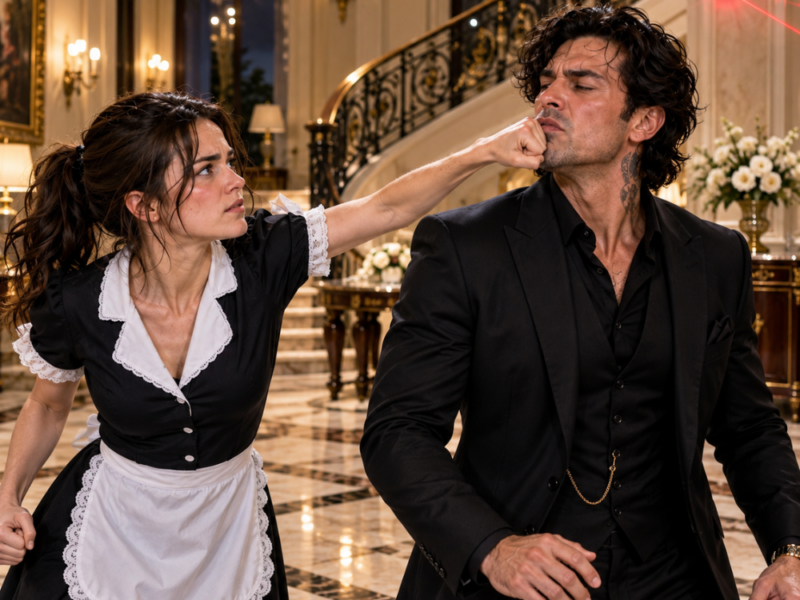
The Poor Maid Punched the Mafia Boss to Save His Life—What He Did Next Changed Her Life Forever
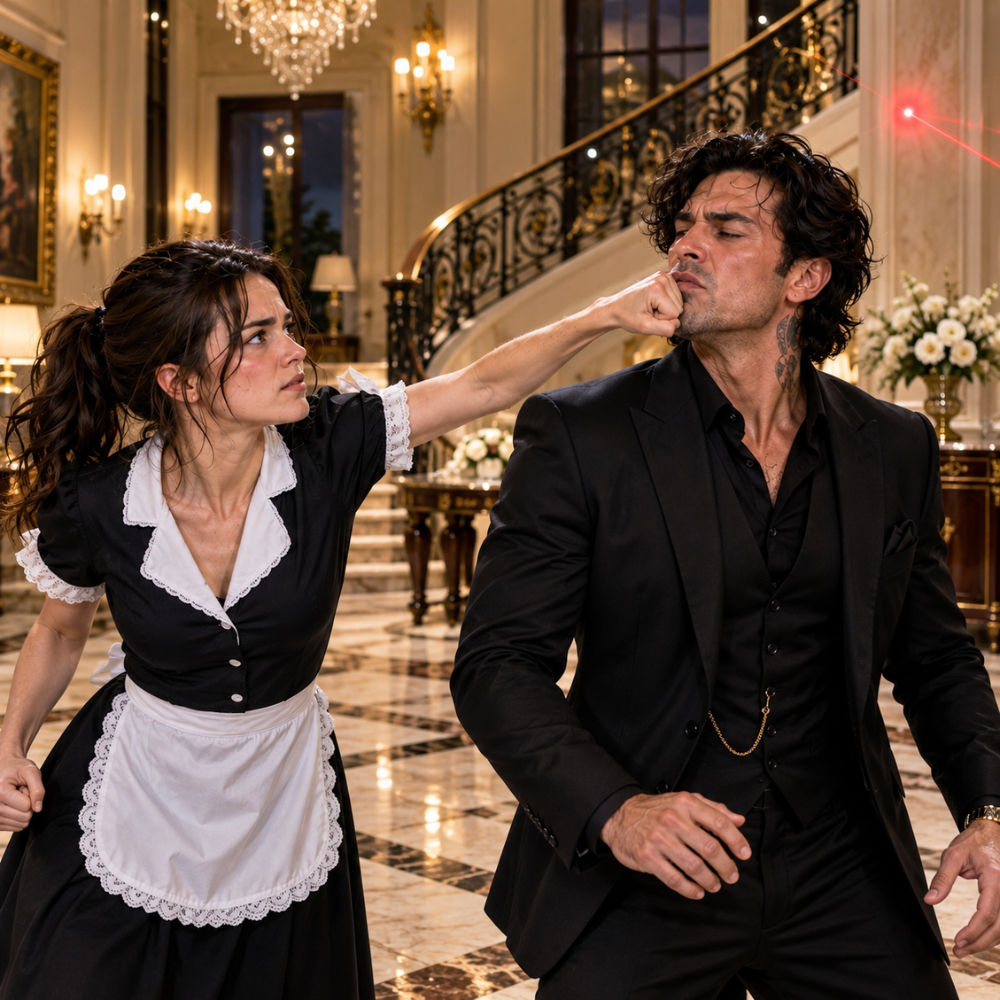
The housekeeper broke Chicago’s most feared security magnate’s jaw, and only then did he see the red dot on the wall
The first thing Norah Hayes noticed was not the red light.
It was the reflection.
A tiny interruption in the dark glass of the rear foyer window, no larger than the head of a pin, moving across the polished marble wall behind Daniel Russo.
Norah stopped scrubbing.
The brush remained in her right hand.
Dirty water dripped from the bristles into a gray plastic bucket beside her knee.
Ten feet away, Daniel stood at the bottom of the staircase, listening to Carmine DeLuca complain about a stalled shipment at the Port of Chicago.
Neither man was looking toward the courtyard.
Daniel had one hand at the back of his neck.
His charcoal suit jacket hung open.
He looked tired.
Not weak.
Nobody who worked inside the Russo estate used that word.
But tired.
For two years, Norah had learned to notice the difference between the man everyone described and the man who occasionally appeared when nobody important seemed to be watching.
The public Daniel Russo was the founder of Russo Meridian Logistics, a private security and transportation company whose armored-freight contracts, port operations, and commercial real-estate holdings had made him one of the most powerful businessmen in Chicago.
The whispered Daniel Russo was something else.
His father had built trucking terminals and private clubs during years when investigators used the Russo name in stories nobody inside the family ever discussed.
Daniel had spent much of his adult life cleaning those businesses, consolidating them, selling the most troublesome pieces, and surrounding everything that remained with lawyers, auditors, compliance officers, and legitimate contracts.
The rumors survived anyway.
They always did.
To the house staff, the distinction mattered less than the rules.
Keep your head down.
Do not repeat what you hear.
Do not ask why executives meet at midnight.
Do not touch papers left on desks.
Do not become memorable.
Mrs. Gable, the head housekeeper, gave Norah those instructions on her first morning.
The pay was almost three times what she had earned cleaning hotel rooms.
Norah needed every dollar.
Her mother had died of leukemia two years earlier.
The hospital bills did not disappear with her.
Norah had inherited none of her mother’s property because there had been almost none.
She did inherit collection notices, a credit score ruined by accounts she had cosigned, and the stubborn belief that if she simply worked enough hours, she could eventually make the numbers stop chasing her.
So she cleaned.
Office suites before sunrise.
The Russo estate during the day.
Occasional evening shifts helping an older neighbor with move-out apartments.
She had become excellent at being invisible.
That was why the red reflection bothered her.
Invisible people saw things.
Norah lifted her eyes.
Beyond the arched rear window, evening had begun settling over the snow-covered courtyard.
Bare trees stood dark against the bluish light.
Security lamps had just clicked on.
A faint red line cut through the shadow between the trees.
Norah followed it.
Across the glass.
Across the foyer.
Toward Daniel.
The dot rested against his right temple.
Her body understood before her mind formed a full sentence.
Carmine was looking down at his phone.
Daniel was still talking.
“If the port authority delays another forty-eight hours,” he said, “move the schedule through Milwaukee and charge the client the difference.”
“They’ll blame us.”
“They already blame us.”
Daniel rubbed the back of his neck again.
Norah looked toward the courtyard.
The light did not move.
She knew very little about firearms.
Enough.
Her mother’s second husband had kept a hunting rifle in a locked cabinet.
Norah grew up on the South Side in a neighborhood where teenagers learned the sound of gunfire long before they learned how bullets traveled.
You did not need technical expertise to understand a weapon aimed at someone’s head.
She could yell.
If Daniel turned toward her, the dot might move with him.
She could run toward the guards near the front door.
Too far.
She could push him.
Daniel outweighed her by perhaps seventy pounds.
Her mind performed the fastest and strangest calculation of her life.
Move the target.
Not the whole man.
His head.
Norah dropped the brush.
The clatter made Carmine look up.
Daniel turned slightly.
The red dot slid toward his cheek.
Norah ran.
Daniel saw a gray-uniformed housekeeper crossing the foyer toward him at full speed.
His expression changed from confusion to alarm.
Norah did the only thing she could think of.
She swung.
Her right fist connected with the side of Daniel’s jaw.
Pain shot through her hand.
Daniel’s head snapped sideways.
He lost balance.
At the same instant, the rear window burst.
A sharp crack.
Then reinforced glass fractured across one corner.
Something struck the wall near the staircase hard enough to tear plaster loose.
Daniel hit the floor.
Norah fell with him.
The bucket overturned.
Gray water spread across the marble.
For half a second, nobody moved.
Then the house became noise.
“Down!”
Carmine grabbed Daniel by the shoulder and dragged him behind the stone base of the staircase.
Security officers rushed from the front vestibule.
One shouted toward the rear.
Another pulled Norah away from the open sightline and forced her flat behind the heavy console table.
Norah’s injured hand felt as though electricity had been trapped inside it.
She tried to speak.
Nobody heard.
“Rear courtyard!”
“Call it!”
“Seal the west gate!”
“Daniel?”
“I’m fine.”
He was not fine.
Even from several feet away, Norah could see blood at the corner of his mouth.
His right cheek had already begun swelling.
Daniel looked toward the crater in the wall.
Then at the broken glass.
Then at Norah.
Everything changed in his face.
He understood.
The security officer nearest her did not.
He grabbed her wrists.
“She rushed him.”
“She saved him,” Carmine snapped.
The guard froze.
Carmine stared at the wall damage.
Then at Norah.
Daniel pushed himself upright against the staircase.
“Get her hand checked.”
His words came strangely.
The swelling made his voice thick.
Norah stared at him.
A minute earlier, she had been cleaning his floor.
Now half the estate was shouting into radios because she had punched him.
Daniel pointed toward the rear window.
“Find out where that came from.”
Then he looked at Norah again.
“Not the basement.”
The security officer glanced toward Carmine.
Daniel repeated, slower.
“Guest room.”
That was the first indication Norah’s life had moved somewhere she had not agreed to go.
Dr. Evan Rhee arrived within an hour.
He was an orthopedic physician who sometimes handled executive medical visits for Russo Meridian employees and family members.
Unlike the version of such men Norah had imagined from television, he did not carry a secret black bag or ask no questions.
He asked many.
Mostly irritating ones.
“Where does it hurt?”
“Everywhere between my fingers and elbow.”
“Useful.”
He pressed carefully over her hand.
Norah hissed.
“More useful.”
X-rays arranged through a nearby urgent-care facility showed a fractured metacarpal.
Nothing catastrophic.
Splint.
Rest.
Follow-up.
No punching anyone else.
Dr. Rhee made that last instruction while looking at Daniel across the sitting room.
Daniel’s own evaluation was less comfortable.
The blow had fractured his jaw.
Not dramatically.
Enough to require oral surgery, fixation, and several weeks of a soft-food diet.
Norah sat on the edge of the guest-room bed holding an ice pack against her hand when Carmine entered.
He was fifty-one, short, broad, and permanently suspicious.
He had worked with Daniel since both men were in their twenties.
His broken nose and heavy shoulders made him look more intimidating than he usually sounded.
Tonight he sounded exactly as intimidating as he looked.
“You understand what you did?”
Norah looked at him.
“I hit your boss.”
“You broke his jaw.”
“I noticed.”
“You could have yelled.”
“I didn’t have time.”
“You could have pushed him.”
“He’s built like a refrigerator.”
Carmine almost smiled.
Then remembered his role.
“Daniel wants to speak to you tomorrow.”
“Why?”
Carmine looked toward the splint.
“Because every security person in the house missed what you saw.”
Norah laughed once.
“That’s not my problem.”
“It is now.”
“No.”
His eyebrows lifted.
“No?”
“I saved him.”
She shifted the ice pack.
“I don’t want a promotion. I want to go home.”
Carmine stared.
“Most people offered anything by Daniel Russo do not start with no.”
“Most people didn’t just fracture their hand on his face.”
That time Carmine did smile.
Briefly.
Then he said:
“Your debt is being handled.”
Norah went still.
“What?”
Carmine realized he had said too much.
“Daniel had legal pull your background after the shooting.”
“Why?”
“Because somebody tried to kill him while a house employee moved at exactly the same moment.”
Norah’s anger replaced fear.
“You investigated me.”
“Of course.”
“You had no right.”
Carmine looked genuinely confused by the objection.
“That is how this works.”
“No.”
Norah stood.
Pain shot through her hand.
“This is how your world works.”
She pointed toward herself.
“I clean this house. That does not give you permission to take apart my life.”
Carmine’s expression hardened.
“Your mother’s debt could make you vulnerable.”
“My mother’s debt makes me poor.”
“That is what vulnerable means to people who buy leverage.”
Norah stared at him.
That sentence frightened her because it sounded plausible.
Carmine continued.
“Somebody paid for a sniper. We are looking at every access point.”
“I understand that.”
“Good.”
“I still did not give you permission to run my credit.”
Carmine looked toward the door.
“Tell Daniel.”
“I will.”
Daniel arrived the next morning wearing a dark sweater instead of a suit.
The swelling along his jaw made him look both more dangerous and less mythical.
He had difficulty speaking.
That did not stop him.
He stood near the window while Norah sat in a chair.
Carmine remained by the door.
Daniel held up one hand.
“Leave.”
Carmine frowned.
“Boss.”
Daniel looked at him.
Carmine left.
Norah watched.
“You always get that response?”
“Usually.”
The word came out rough.
She almost smiled.
Daniel sat opposite her.
He placed a thick envelope on the table.
Norah did not touch it.
“What?”
“Your debt.”
“No.”
His eyes narrowed slightly.
“I know what Carmine said.”
“I did not ask you to pay anything.”
“I owe you my life.”
“That is not a debt.”
“To me it is.”
Norah looked at the envelope.
“How much?”
“Seventy-two thousand.”
Her stomach tightened.
Exactly.
Medical debt.
Collection fees.
Interest.
Some disputed charges she had never managed to challenge.
Daniel continued.
“The collection company agreed to settle for considerably less.”
“That is worse.”
He frowned.
“Why?”
“Because now I owe you.”
“No.”
“You just said you owe me.”
He stared.
Norah leaned back.
“You are trying to erase your discomfort by writing a check.”
Daniel’s expression changed.
Not anger.
Interest.
“You don’t like owing people.”
“No.”
“Neither do I.”
“That sounds like your problem.”
His injured jaw prevented him from laughing properly.
He made a painful sound that might have been one.
Norah pointed at the envelope.
“Take it back.”
“You saved me.”
“I know.”
“Why?”
She looked confused.
“What do you mean?”
“Why did you move?”
Norah stared.
“Because there was a red dot on your head.”
“Most people would have yelled.”
“I didn’t.”
“Most people would have frozen.”
“I almost did.”
Daniel looked at her for a long time.
“Why?”
Norah finally understood the real question.
Why care whether Daniel Russo lived?
Why risk anything?
She thought of her mother.
Not the illness.
Earlier.
A grocery store parking lot when Norah was eleven.
A stranger collapsed.
Her mother dropped two bags and ran across the pavement.
Norah had asked afterward:
“Did you know him?”
Her mother looked surprised.
“No.”
“Then why did you help?”
“Because I was there.”
Norah looked at Daniel.
“I was there.”
He absorbed that.
No heroic speech.
No loyalty.
No fear.
She had helped because she was there.
Daniel looked down at the envelope.
Then slid it away.
“All right.”
Norah was surprised.
“That easy?”
“No.”
“What happens now?”
“The debt remains yours.”
“Yes.”
He nodded.
“I can have an attorney review whether the collection amounts are lawful.”
Norah hesitated.
“That I would accept.”
“You pay the lawyer?”
“I can pay.”
“Consultation is free.”
“Fine.”
Daniel’s mouth twitched.
Then he became serious.
“I want to offer you another job.”
“No.”
“You have not heard it.”
“I know.”
“Security observation.”
“No.”
“You noticed something professionals missed.”
“I was cleaning a floor.”
“You notice rooms.”
Norah stared.
“That is not a job qualification.”
“It is in my company.”
Daniel leaned forward carefully.
“You understand staff behavior. Movement. who belongs where.”
“Because I’m invisible.”
He did not answer immediately.
Norah continued.
“People say things around housekeepers because they do not think we count.”
Daniel’s eyes shifted.
“That is information.”
“It is also insulting.”
“Yes.”
For the first time, he sounded ashamed.
Norah noticed.
Daniel said, “The job would be legitimate.”
“Define legitimate.”
“Russo Meridian executive risk division.”
“Payroll?”
“Yes.”
“Taxes?”
“Yes.”
“Benefits?”
“Yes.”
“Written job description?”
His eyebrows lifted.
“Yes.”
“Training?”
“Yes.”
“No guns.”
He paused.
“Fine.”
“Carmine can’t threaten me.”
That took longer.
Finally:
“Fine.”
“I go home every night.”
“Yes.”
“I’m not moving into your house.”
“You already work here.”
“Not after today.”
He looked at her.
“Are you quitting?”
“I broke my hand saving the owner.”
She lifted the splint.
“I think it’s time.”
Daniel almost laughed again.
“Salary?”
Norah narrowed her eyes.
“You really do expect to win.”
“Yes.”
“Why?”
“Because debt.”
She hated that he knew.
He continued.
“Health insurance.”
She hated that more.
“Normal hours.”
“Define normal.”
“More normal than housekeeping.”
Norah looked toward the envelope.
Then toward him.
“Send me the offer.”
Daniel smiled.
“Written?”
“Yes.”
“Of course.”
She signed three days later.
Not because Daniel ordered it.
Because the salary was double her housekeeping wage, the health insurance was good, and the job description contained one line she read four times.
Environmental and behavioral observation in support of executive and facility safety.
No secret underworld.
No “become my shadow.”
No ownership.
A job.
That mattered.
Her first week humiliated her.
Carmine made her memorize building plans.
Security zones.
Employee access levels.
Vehicle procedures.
Emergency exits.
Who belonged where.
What normal movement looked like.
He corrected her constantly.
“This is not cleaning.”
“I know.”
“Stop looking at dirt.”
“Dirt tells you who walked through.”
Carmine stared.
Then:
“Fine. Keep looking at dirt.”
Norah learned cameras.
Not how to hack them.
How to understand coverage.
Blind spots.
Lighting.
Traffic flow.
She learned how a security team prepared travel without turning an executive’s life into a military operation.
Most importantly, she learned that good security was mostly boring.
Logs.
Access badges.
Schedules.
Background verification.
People noticing when a door that usually stayed locked was suddenly open.
Daniel returned to work slowly.
His jaw surgery left him speaking only when necessary.
For several weeks he used a tablet during longer meetings.
Norah was assigned to observe executive movement because the attempted shooting remained unresolved.
The company hired outside investigators and cooperated with federal authorities.
That too surprised her.
“You called the FBI?” she asked Carmine.
“What did you expect?”
“I don’t know.”
“Movies?”
“Maybe.”
Carmine snorted.
“Daniel spent twenty years making this company clean enough for banks to lend us money.”
He looked at her.
“He is not throwing that away because some idiot fired through a window.”
Norah began questioning the mythology.
Maybe that was dangerous in a different way.
It meant Daniel became human.
Six weeks after the shooting, Norah attended her first high-level client dinner.
Private restaurant room in the Loop.
Not criminals.
A Canadian freight executive named Viktor Volkov.
Two attorneys.
Three Russo Meridian security managers.
A port consultant.
Daniel.
Carmine.
Norah stood near the side wall because she was still more comfortable there.
The topic was stolen cargo and a security breach affecting several cross-border shipments.
Nobody had proven whether the sniper attempt connected to those problems.
Daniel’s company believed they might.
The investigators did not yet know.
Norah watched the room.
Not faces only.
Patterns.
One temporary waiter entered carrying water.
She had reviewed the staffing list because Carmine made her.
His face was not on it.
Could be substitution.
Then she noticed the shoes.
Heavy work boots.
Not impossible.
Odd.
He held the tray with both hands gripping the edge.
Too tight.
He never looked at the glasses.
His attention stayed on Daniel.
Norah moved toward him.
“Excuse me.”
The man flinched.
Small.
Enough.
“What?”
“Who assigned you to this room?”
He looked toward the kitchen.
“Manager.”
“Name?”
The tray tilted.
His right hand moved toward his jacket.
Norah kicked the leg of an empty chair into his path.
He stumbled.
The tray hit the floor.
Carmine reacted instantly.
So did hotel security stationed outside.
The man was restrained before anything worse happened.
A handgun was recovered.
No shots fired.
No body on the carpet.
No blood.
Just another prevented act because somebody noticed the wrong shoes.
Police took over.
The dinner ended.
Viktor Volkov’s attorney complained loudly about being held for questions.
Everybody survived.
In the armored SUV afterward, Norah could not stop shaking.
Daniel sat beside her.
His jaw had healed enough that he could speak again, though his voice remained rougher.
“You saw him.”
Norah looked out the window.
“Everybody saw him after.”
“You saw him before.”
She looked at her hands.
“What if I’d been wrong?”
“Then you would have asked a waiter for his supervisor.”
“And embarrassed him.”
“Better than ignoring the concern.”
Norah laughed weakly.
“Security philosophy?”
“Insurance philosophy.”
She turned.
“Do you ever talk like a normal person?”
“No.”
That helped.
They rode several blocks in silence.
Then Norah said:
“I don’t want to become somebody who thinks everyone is dangerous.”
Daniel looked toward the city lights.
“That happens.”
“To you?”
“Yes.”
“What stops it?”
He thought.
“Evidence.”
She waited.
“I do not let suspicion become verdict.”
Norah smiled faintly.
“You’re better at saying that than Carmine.”
“Carmine thinks suspicion is a food group.”
“Accurate.”
Daniel became quiet.
Then:
“You were right about the debt.”
Norah looked over.
“What?”
“I was going to pay it because I did not like owing you.”
“I know.”
“That would have turned your good decision into my control.”
She stared.
Daniel continued.
“I did not understand that immediately.”
That mattered more than if he had paid it.
Norah’s debt was eventually reduced through legal review.
Some charges had been improperly calculated.
The collection agency accepted a structured settlement for far less than the claimed balance.
Norah paid it herself over eighteen months.
Her new salary made that possible.
The final payment was $611.43.
She printed the confirmation.
Carmine found it on her desk.
“What’s that?”
“Freedom.”
He looked.
“Medical debt?”
“Finished.”
“Daniel could have handled that in one call.”
Norah looked at him.
“I handled it in eighteen months.”
Carmine considered.
Then nodded.
“Better.”
Their relationship had improved.
A little.
Carmine still distrusted everyone.
Norah still corrected him when distrust became an excuse for being rude.
He hated that.
Also needed it.
The outside investigation into the attacks moved slowly.
Slow enough that people inside Russo Meridian began inventing explanations.
Volkov.
A rival logistics company.
Union dispute.
Former employees.
Daniel’s father’s enemies.
Norah listened.
She kept coming back to internal patterns.
The attack at the estate required knowledge of Daniel’s schedule.
The restaurant incident required knowledge of a private meeting.
Those facts did not prove an insider arranged anything.
They suggested information was leaking.
Norah began reviewing access logs with the corporate compliance team.
That was how she noticed Frankie Bell.
Frankie had been with Russo Meridian for nineteen years.
Senior director of port operations.
Carmine’s closest friend after Daniel.
Godfather to Carmine’s oldest daughter.
The kind of employee nobody described as an employee.
Family.
Norah did not care about that category.
She looked at numbers.
A series of minor consulting invoices appeared across several shipping subsidiaries.
Security consulting.
Temporary staffing.
Emergency port services.
Each small enough not to trigger senior review.
Together, more than $800,000 over fourteen months.
The vendor address matched a warehouse closed two years earlier.
Norah brought it to Sofia Mendes, the company’s internal audit director.
Not Daniel.
That was another lesson.
Follow process.
Sofia reviewed.
Then expanded.
The amounts became larger.
Three shell vendors.
False invoices.
A personal investment account connected indirectly to Frankie’s brother-in-law.
Still not proof of assassination.
Proof of financial misconduct.
Sofia called Daniel and Carmine into a conference room.
Norah sat beside her.
Frankie was not invited.
Carmine read the first page.
Then shook his head.
“No.”
Sofia did not react.
“These invoices were approved through Mr. Bell’s authorization credentials.”
“Someone copied them.”
“Possible.”
“Frankie wouldn’t steal.”
Sofia looked at him.
“That is not an audit conclusion.”
Carmine’s face reddened.
“He has been with us twenty years.”
Norah looked at him.
“You keep saying that like time is evidence.”
Carmine turned.
“You don’t know him.”
“No.”
She pointed toward the binder.
“I know these.”
Daniel remained quiet.
His eyes moved from Carmine to Norah.
Then Sofia.
“What do we do?”
Sofia answered.
“Freeze relevant vendor payments. Preserve all records. Independent forensic audit. Restrict access without accusation until we understand what happened.”
Daniel nodded.
Carmine looked betrayed.
“You’re suspending him?”
“Temporarily.”
“He’ll know we suspect him.”
“He should not have access while we determine whether the credentials were compromised.”
Carmine looked at Norah.
“You started this.”
She held his gaze.
“The invoices did.”
That sentence ended the argument.
Frankie’s suspension became confrontation the next morning.
He arrived at headquarters demanding to see Daniel.
Security did not allow him beyond reception.
That alone told Norah how much the company had changed from its old reputation.
Nobody dragged him downstairs.
Nobody threatened him.
He called a lawyer.
The lawyer called corporate counsel.
Then the investigation became paper.
Months of it.
The forensic audit confirmed Frankie had siphoned more than $2.1 million through fraudulent vendors.
Federal investigators uncovered communications between one shell-company intermediary and a private contractor linked to the attempted restaurant attack.
The estate shooting remained harder to connect.
Ballistic evidence and financial transfers eventually established enough for charges against several people, including the contractor.
Whether Frankie personally ordered the first attack remained disputed.
Prosecutors did not need to solve every rumor to charge provable crimes.
Daniel hated that.
“You want the whole story,” Norah told him.
They were sitting in his office after another meeting with attorneys.
“I want to know who tried to kill me.”
“Understandable.”
“And why.”
“Also.”
“Yet?”
Norah looked toward the windows.
“Sometimes evidence gives you enough for accountability without giving you enough for emotional satisfaction.”
Daniel stared.
“When did you become unbearable?”
“About six weeks after you promoted me.”
“Carmine blames himself.”
“I know.”
“He introduced Frankie to my father.”
“Still not Carmine’s crime.”
Daniel looked down.
“I spent my whole life being told loyalty was the only safe currency.”
Norah sat opposite him.
“And?”
“It appears loyalty is not an audit control.”
She smiled.
“Put that on a mug.”
He almost laughed.
Frankie eventually pleaded guilty to fraud, conspiracy related to unlawful threats, and weapons charges tied to the restaurant attempt. Other defendants faced separate charges.
Nothing ended in an abandoned factory.
No bodies in concrete.
No final execution.
It ended in a federal courtroom with fluorescent lights and lawyers arguing over guidelines.
Carmine attended sentencing.
Norah went with him.
Daniel chose not to.
“He doesn’t want to see me,” Frankie said when he noticed Daniel’s empty seat.
Carmine looked at him.
“No.”
Frankie’s face tightened.
He had expected rage.
Perhaps disappointment hurt more.
Afterward, Carmine stood outside the courthouse in cold rain.
“He was my best friend.”
Norah said nothing.
“I kept thinking there would be some explanation.”
“There was.”
“Money?”
“Partly.”
“Resentment.”
“Probably.”
Carmine stared at the street.
“He said Daniel pushed him aside.”
“Did Daniel?”
“Yes.”
Norah looked surprised.
Carmine continued.
“Frankie wanted a bigger role. Daniel wouldn’t give it.”
“Because?”
“He cut corners.”
Norah sighed.
“So the thing Daniel distrusted eventually became the thing that hurt him.”
“Pretty much.”
Carmine looked at her.
“Don’t enjoy being right.”
“I don’t.”
That was true.
Being right had cost too much.
Norah’s role changed again.
Formal this time.
Risk intelligence analyst.
Then senior analyst.
No one called her Daniel’s shadow.
She refused.
“I have a job.”
Daniel smiled.
“I know.”
She attended meetings because her function belonged there.
Not because Daniel owned her attention.
That distinction became essential as their relationship began changing.
It started so slowly neither admitted it.
Coffee after late meetings.
Arguments about books.
Daniel discovering Norah watched old cooking shows because her mother had loved them.
Norah discovering Daniel visited his mother’s grave every February and told nobody.
He had inherited money, fear, and a surname that people still whispered.
He had not inherited much emotional vocabulary.
Norah found that almost funny.
“You can negotiate a hundred-million-dollar logistics contract but cannot answer ‘How are you?’”
“It is an imprecise question.”
“It has six letters.”
“Depending on how is counted.”
“Unbearable.”
Daniel smiled.
By the time the company’s internal case resolved, Norah had worked for him almost two years.
She was twenty-eight.
Her debt was gone.
She rented a small apartment in Lincoln Square with windows that leaked cold air but belonged entirely to her lease.
Daniel had offered a company apartment.
She refused.
“Of course.”
“You sound offended.”
“I’m adapting.”
Her mother’s photograph sat on the kitchen shelf.
Norah still took the train some days.
Not because she lacked a car.
Because after years of feeling trapped by money, owning options mattered more than displaying them.
Daniel visited the apartment for dinner for the first time on a snowy Thursday.
He looked enormous in the narrow kitchen.
Norah handed him a knife.
“What’s this?”
“Onion.”
“I see that.”
“Chop it.”
“You invited me to work.”
“I invited you to dinner.”
“This is labor.”
“Yes.”
“You still have management issues.”
“So do you.”
He chopped badly.
Norah watched.
“You’re going to lose a finger.”
“I run a security company.”
“You are losing to an onion.”
The meal was pasta.
Cheap wine.
Store-bought bread.
Daniel ate two servings.
Then helped with dishes.
That impressed Norah more than the Russo estate.
“Why are you staring?”
“You know how to wash a plate.”
“My father believed dishwashers were spies.”
Norah laughed.
“Was he serious?”
“Probably.”
“What was he like?”
Daniel became quiet.
“Complicated.”
Norah waited.
“He loved me.”
A pause.
“He also taught me that being feared was the safest form of respect.”
“And you believed him.”
“For a long time.”
“You still do sometimes.”
“Yes.”
That honesty mattered.
“What changed?”
Daniel dried a plate.
“You punched me.”
She stared.
“Very romantic.”
“I’m serious.”
“Why?”
“You saw danger and acted before knowing whether I deserved help.”
Norah’s expression softened.
“You keep making that too important.”
“It was.”
“No.”
She put down the towel.
“I would have done it for Mrs. Gable.”
“I know.”
“For Carmine.”
“I know.”
“For a stranger.”
Daniel looked at her.
“That is why.”
Norah understood.
He had spent a life where people calculated his value before deciding how to behave around him.
Fear.
Money.
Access.
Protection.
Advantage.
Norah had seen a red dot.
Nothing else.
She had acted.
Daniel had been trying to understand that ever since.
Their first kiss did not happen in a foyer after violence.
It happened six months later outside Norah’s apartment after dinner.
Quiet hallway.
No gun.
No blood.
Daniel asked first.
That surprised her.
“Can I kiss you?”
Norah stared.
“You sound terrified.”
“I am.”
She laughed.
Then said:
“Yes.”
It was gentle.
Almost disappointingly normal.
Norah liked normal.
They dated carefully.
Too carefully, according to Carmine.
“You two have had legal review of dinner reservations.”
Norah looked at him.
“Workplace relationship.”
“Daniel owns the company.”
“Exactly.”
The board knew.
HR knew.
Norah’s reporting line moved away from Daniel.
Compensation decisions were independent.
She insisted.
Daniel agreed.
His general counsel called it unusually thorough.
Norah called it obvious.
“Romance is not a governance exemption.”
Daniel looked at her.
“Who are you?”
“The maid who read the policy manual.”
He smiled.
They kept separate homes for almost another year.
When Norah finally moved into Daniel’s house, it was not the Russo estate.
He sold that.
The house carried too many layers of family history and corporate functions.
Too many employees moving through private rooms.
Too much mythology.
They bought a smaller house in Evanston.
Still large by Norah’s standards.
No marble foyer.
Wood floors.
A kitchen people actually used.
Daniel kept one room for work.
Norah banned security meetings from the dining table.
Carmine complained.
“Where are we supposed to meet?”
“Office.”
“Like accountants?”
“Yes.”
He looked horrified.
That made her happy.
Daniel proposed at home.
No restaurant.
No velvet box hidden inside dessert.
He came into the kitchen while Norah was sorting mail.
“What?”
“I have a question.”
“You look like someone died.”
“No one died.”
“Good start.”
He put a ring box beside a ComEd bill.
Norah stared.
“This is your plan?”
“I rehearsed something.”
“Where?”
“Car.”
“Of course.”
He opened the box.
Simple ring.
Elegant.
Daniel had learned.
“I spent a long time believing the safest life was one where nobody could become leverage.”
Norah stopped smiling.
“I know.”
“I was wrong.”
“Yes.”
He sighed.
“Do you want me to finish?”
“Sorry.”
He continued.
“You gave me no choice about living that first night.”
“I broke your jaw.”
“Exactly.”
She laughed.
“After that, every important choice you gave back to me.”
Norah’s eyes filled.
“My debt.”
“Yours.”
“My job.”
“Yours.”
“My apartment.”
“Yours.”
“This house.”
“Ours.”
Daniel looked at her.
“I want the rest to be ours too.”
He paused.
“If you do.”
Norah swallowed.
“Yes.”
The wedding was small.
Carmine cried and denied it.
Mrs. Gable attended.
So did Dr. Rhee, who gave them a card saying:
Please avoid facial fractures in marriage.
Norah laughed until she had to sit down.
They did not tell guests the story as a fairy tale.
Norah refused.
No maid saves feared boss and becomes queen.
No violence turning into destiny.
She corrected anyone who tried.
“I saved his life.”
She would say.
“Then we spent several years finding out whether we actually liked each other.”
That version suited Daniel too.
Russo Meridian changed during those years.
The assassination attempts exposed weaknesses beyond one disloyal executive.
Security staff had become too deferential to senior people.
If Daniel changed a schedule without notifying the system, employees adjusted rather than documenting it.
If Carmine waved someone through, people hesitated to challenge him.
Trusted employees accumulated permissions no one periodically reviewed.
The company relied too much on reputation.
Norah helped rebuild it around verification.
Annual access reviews.
Conflict disclosures.
Independent internal audit.
Whistleblower channels outside operating leadership.
No permanent exceptions based on tenure.
One rule became famous internally.
If someone says, “He’s been here twenty years,” ask the next question anyway.
Carmine hated being the reason for the wording.
He framed it in his office.
By forty, Norah led corporate risk culture across Russo Meridian.
Her office looked nothing like the marble foyer where she began.
Plants.
Stacks of reports.
A framed photograph of her mother.
The original gray housekeeping badge in the bottom drawer.
Sometimes she took it out.
NORAH HAYES.
HOUSEHOLD SERVICES.
Nothing about the badge suggested judgment.
Pattern recognition.
Courage.
Financial discipline.
Leadership.
People were always more than the role powerful systems had assigned them.
That lesson became central to how Norah hired.
One analyst came from a grocery-store loss-prevention department.
Another from hotel operations.
A former flight attendant became excellent at behavioral risk because she had spent fifteen years noticing passengers before they became problems.
A warehouse supervisor became one of their strongest compliance investigators.
Daniel once asked:
“Do we still hire people with security degrees?”
“Sometimes.”
“Reassuring.”
Norah smiled.
“Credentials matter.”
“Then?”
“Noticing matters too.”
The story of the first punch occasionally resurfaced in business profiles.
Daniel Russo credits wife with saving his life.
Housekeeper became security executive after spotting assassination attempt.
Norah hated most versions.
They emphasized how hard she hit.
Not what she saw.
One magazine asked her to recreate the punch for a photo.
She ended the interview.
Daniel thought that was hilarious.
“They wanted you to punch me?”
“Again.”
“For art?”
“Apparently.”
“I would have charged them.”
“Of course.”
The more mature version of the story interested Norah.
A housekeeper noticed a threat trained security professionals missed.
Why?
Because she had been watching the window while everyone important watched Daniel.
That mattered.
Hierarchy directed attention.
People looked where status trained them to look.
Norah looked at the room because that was her job.
It saved him.
Later, the company started requiring leaders to include frontline staff in security walk-throughs.
Housekeepers.
Drivers.
Receptionists.
Loading dock employees.
Not to turn them into security officers.
To ask:
What looks different?
Who enters without being challenged?
Which door never closes?
What visitor makes everyone nervous?
What rule gets ignored for senior executives?
The answers were useful.
Once, a receptionist mentioned a vendor who always arrived after shift change because the evening guard “didn’t want to bother checking him.”
Audit found nothing criminal.
Just bad access discipline.
Fixed.
No assassination.
No scandal.
Norah loved those stories most.
Prevention looked boring after it worked.
Ten years after the red dot, Daniel sold the last business his father had created.
A small private club near Cicero.
It had never been central financially.
Daniel kept it because his father loved it.
Norah asked why he finally sold.
“It belongs to a version of the family I no longer need to maintain.”
She nodded.
“Sad?”
“Yes.”
“Relieved?”
“Yes.”
“Both?”
“Unfortunately.”
Norah smiled.
“You’re learning emotion.”
“Terrible system.”
They drove past the old Russo estate after the closing.
Different owner now.
A technology executive.
The front landscaping had changed.
Norah looked toward the arched rear window, though from the street she could not see it.
“Do you miss it?”
“No.”
“That was fast.”
Daniel glanced at her.
“You hated the marble.”
“I did.”
“It was cold.”
“Always.”
He touched his jaw.
The fracture had healed years earlier.
Slight asymmetry remained if someone knew.
Norah knew.
“Still hurt?”
“In winter.”
“My hand too.”
He smiled.
“Romantic.”
“Very.”
Norah’s mother’s medical debt file remained in storage even after the debt was settled.
One afternoon Norah found it while cleaning the attic.
Collection notices.
Hospital statements.
Insurance denials.
Payment plans.
Her old handwritten budget.
Rent.
Bus pass.
Food.
Mom medication.
She sat on the attic floor.
Daniel found her there.
“What?”
She held up a statement.
“I used to think this paper decided my whole life.”
He sat beside her.
“It did for a while.”
“I took that job because of this.”
“Yes.”
“If Mom never got sick…”
“You probably never clean my foyer.”
“No.”
He looked at her.
“Do not say everything happens for a reason.”
“I wasn’t.”
“Good.”
Norah hated that sentence.
Her mother did not die so Norah could meet Daniel.
Debt did not exist to teach strength.
A sniper did not fire to create a marriage.
Violence had no secret wisdom.
Meaning came from what people did afterward.
That distinction stayed important.
Norah shredded most of the collection notices.
Kept one.
Not as gratitude.
Record.
Her life had once been that narrow.
Now it was not.
Carmine retired at sixty-eight.
Russo Meridian held a dinner.
He insisted no speeches.
Everyone gave speeches.
Norah went last.
“When I met Carmine, he thought I had conspired with a sniper.”
Carmine covered his face.
People laughed.
“He investigated my credit before learning my birthday.”
More laughter.
“He threatened to fire me from a job I did not want.”
“Accurate,” Carmine said.
Norah smiled.
“Then he taught me how to read a security map.”
She looked at him.
“He also taught me something he did not intend.”
Carmine raised an eyebrow.
“Loyalty without scrutiny is not loyalty.”
The room quieted.
“It is dependency.”
Carmine nodded slowly.
Norah continued.
“Real loyalty can survive questions.”
She raised her glass.
“To Carmine.”
He stood.
Hugged her.
Then whispered:
“You were still annoying.”
“Still am.”
After retirement, Carmine became an obsessive gardener.
Nobody predicted it.
Daniel visited and came home with tomatoes every August.
Life became ordinary.
That was the best possible ending for people whose lives had once revolved around threat assessments.
Norah and Daniel never had children.
Not tragedy.
Choice.
They became the adults friends called during emergencies.
Carmine’s granddaughter interned at Russo Meridian and was terrified Norah would favor her.
Norah rejected her first application because her résumé was careless.
Carmine called.
“You rejected Sofia?”
“She submitted three spelling errors.”
“She’s nineteen.”
“She has spell-check.”
“You’re cold.”
“You taught me.”
Sofia applied again.
Got in.
Years later she ran regional compliance.
Nobody could say she had been handed it.
At fifty-two, Norah stepped away from corporate operations.
She stayed on the board.
Daniel had already retired from chief executive duties.
A younger CEO ran Russo Meridian with less drama and better software.
Norah began teaching executive-risk courses at DePaul.
Her first class always began with a photograph.
Not the red dot.
Not Daniel.
A polished office lobby.
Students looked confused.
“What do you see?”
“Reception desk.”
“Security camera.”
“Door.”
“People.”
Norah waited.
Then:
“Who knows this room best?”
Students offered answers.
Security.
Facilities.
Reception.
Norah smiled.
“All of them know different rooms.”
She taught them that risk did not belong exclusively to specialists.
Specialists needed to interpret and act.
But raw observations came from everywhere.
The delivery driver who noticed a loading door propped open.
The housekeeper who saw a light where no light belonged.
The assistant who knew a trusted executive had begun changing travel at the last minute.
The accountant who noticed a repeated small invoice.
The employee who asked one irritating question before everyone agreed.
One student asked:
“What’s the biggest mistake powerful leaders make about security?”
Norah thought of Daniel.
“Believing danger is always outside.”
The room quieted.
“And personally?”
She smiled.
“Believing the people with the least status have the least information.”
Daniel attended one lecture anonymously.
Norah saw him in the back.
Afterward she said:
“You were checking on me.”
“I was auditing.”
“You are retired.”
“So are you.”
“Apparently neither of us understands the term.”
They walked to dinner.
No armored SUV.
No entourage.
Daniel drove an electric sedan and complained about charging stations.
The man newspapers once called intimidating now spent most of his anger on software updates.
Norah enjoyed this immensely.
On the twentieth anniversary of the estate shooting, Daniel woke her before dawn.
“What?”
“Come with me.”
“If this is exercise, divorce.”
“No.”
They drove to Lake Michigan.
Cold morning.
Gray water.
Almost nobody around.
Daniel carried two paper cups of coffee.
They sat on a bench.
“You remembered.”
“Yes.”
“I didn’t.”
“I know.”
Norah looked at his jaw.
“You want me to apologize again?”
“No.”
“Good.”
“I want to thank you.”
She sighed.
“We did this twenty years ago.”
“I know.”
“Then?”
Daniel looked toward the water.
“I used to thank you for saving me.”
Norah waited.
“That is not what I mean anymore.”
“What do you mean?”
“You interrupted the worst thing my father taught me.”
She looked over.
“That everyone either fears you or wants something from you?”
“Yes.”
“I didn’t fix that.”
“No.”
He smiled.
“You refused it.”
Norah sipped coffee.
“Repeatedly.”
“Yes.”
He took her hand.
“Thank you for that.”
She squeezed.
“You’re welcome.”
Simple.
Years earlier Daniel would have tried to pay for the moment.
Now he could receive it.
That was growth too.
The old housekeeping staff remained part of Norah’s memory.
Mrs. Gable died at eighty-four.
Her daughter invited Norah to the memorial lunch.
Someone from the estate staff brought an old photograph.
Norah in gray uniform beside three other housekeepers.
She stared.
“I looked exhausted.”
“You were exhausted.”
A former cook laughed.
“You used to fall asleep on the bus.”
Norah smiled.
That was another life.
Not inferior.
Not embarrassing.
She had cleaned floors because the work paid more than the alternatives available to her.
There was dignity in that.
Norah became angry whenever profiles described her as “only a maid.”
Only.
As though cleaning another person’s home required apology.
The remarkable thing was not that a maid possessed intelligence.
The remarkable thing was how many people found that remarkable.
At one of her last public talks, a moderator asked:
“Did saving Daniel Russo reveal a talent you did not know you had?”
Norah thought.
“No.”
The moderator looked surprised.
“What did it reveal?”
“That other people had not been looking.”
She explained.
She had always observed.
As a child she noticed when her mother pretended utility bills were not overdue.
As a hotel cleaner she knew which rooms had hosted parties from the pattern of towels and trash.
At the Russo estate she knew which executives were nervous by whether they left coffee untouched.
Observation had always been there.
The title changed.
The value assigned to it changed.
The person did not suddenly appear when Daniel noticed.
That was one of Norah’s strongest convictions.
Recognition does not create ability.
It only changes who benefits from it.
After the talk, a hotel housekeeper named Leticia waited near the stage.
“I wanted to thank you.”
“For?”
“My manager asked us to join the safety walk after seeing one of your interviews.”
Norah smiled.
“Useful?”
Leticia laughed.
“We found three fire doors supervisors had been letting vendors prop open.”
“There you go.”
“They acted shocked.”
“They usually do.”
Leticia hesitated.
“I never thought stuff I noticed counted.”
Norah looked at her.
“It counted before they asked.”
That sentence traveled.
Someone quoted it online.
Norah pretended not to care.
She saved the post.
At seventy, Daniel’s jaw bothered him enough during Chicago winters that he switched to Florida for part of January.
Norah refused.
“Florida is humid.”
“Chicago hurts my face.”
“Wear a scarf.”
“You broke it.”
“I saved it.”
“Technical distinction.”
They compromised on two weeks in Charleston.
Marriage remained negotiation.
One evening there, they sat on a hotel balcony.
Daniel rubbed his jaw.
“Still worth it?”
“What?”
“The punch.”
He looked at her.
“That is a dangerous question.”
“I’m curious.”
Norah thought about it.
“If I could do it again?”
“Yes.”
“I would shove you.”
Daniel laughed.
“Less effective.”
“I was younger.”
“You might miss.”
“I broke my own hand.”
“Fair.”
She became serious.
“I would still move you.”
“I know.”
“Not because I knew who you were.”
“I know.”
“Not because of everything that happened after.”
“I know.”
She looked toward the harbor.
“Because I was there.”
Daniel nodded.
He remembered that answer.
It remained the truest one.
Norah outlived the mythology of Daniel Russo.
By the time they were older, younger Chicago executives barely knew the rumors around his father.
Russo Meridian became just another large logistics and security company.
Publicly audited.
Professionally boring.
Daniel considered that his greatest business achievement.
“Your father would hate boring.”
“He would.”
“Proud?”
“Maybe.”
Norah smiled.
“Complicated.”
“Always.”
When Daniel died in his eighties after a brief illness, Norah did not hold a grand public memorial.
Employees wanted one.
The board wanted one.
She agreed to a modest company service and a private family gathering.
At the company event, Carmine’s granddaughter Sofia spoke.
She described Daniel’s reforms.
The legitimate businesses.
The expansion.
The culture.
Then she said:
“He spent the first half of his career making people afraid to disappoint him.”
Norah looked up.
Sofia continued.
“He spent the second half building a company where people could tell him he was wrong.”
That was accurate enough to hurt.
Norah cried.
Afterward, she returned home alone.
Daniel’s coat still hung beside the door.
She touched the sleeve.
For decades, his life had been tied to one violent second in stories other people told.
The housekeeper.
The punch.
The red dot.
Norah knew better.
People did not become a marriage in one second.
They became one through thousands of ordinary choices.
Daniel choosing not to pay her debt after she said no.
Norah accepting the job only after it became a real job.
Daniel agreeing to independent reporting lines when they dated.
Norah refusing to let his fear become her cage.
Daniel learning that security did not mean control.
Norah learning accepting help did not mean surrender.
Breakfast.
Arguments.
Illness.
Taxes.
Carmine’s tomatoes.
Bad vacations.
Late-night television.
Ordinary years.
That was where love lived.
Not in the bullet.
Not in the fist.
The dramatic beginning had merely forced two people to notice each other.
Everything afterward required work.
Several months after Daniel’s death, Norah returned to the original Russo estate.
The current owners had renovated again and planned to sell.
Their real-estate agent, a woman who knew the history, invited Norah privately.
“You don’t have to.”
“I know.”
She went.
The foyer looked almost nothing like she remembered.
Lighter floors.
Different console table.
The arched window remained.
Norah stood in the center.
Once, she had been on her knees there.
Gray uniform.
Ammonia.
Brush.
Debt.
Cold marble.
She looked toward the wall where the bullet struck.
No mark.
Repaired decades ago.
She closed her eyes.
Could almost hear the bucket fall.
Daniel’s startled breath.
Glass.
Carmine shouting.
Then she opened them.
Nothing.
Just a beautiful room in a house belonging to strangers.
The agent waited.
“You okay?”
“Yes.”
“Real yes?”
Norah smiled.
“That phrase follows me.”
She walked toward the window.
Outside, the old oak tree was gone.
A younger tree had replaced it.
Norah liked that.
She placed one hand against the glass.
For years she had thought that afternoon divided her life into before and after.
Maybe.
But age had changed the way she understood divisions.
Before Daniel, she was not incomplete.
She was tired.
Poor.
Grieving.
Observant.
Stubborn.
Capable.
After Daniel, those same things remained in different proportions.
He did not create her courage.
He witnessed it.
He did not rescue her from an insignificant life.
Cleaning was never insignificant.
Debt made the life difficult.
Poverty narrowed options.
Grief hurt.
The job itself had dignity.
Norah had saved a powerful man because he was standing in the wrong place at the wrong time.
He later gave her access to a career that recognized abilities she already had.
And, eventually, the humility to let her remain herself inside his world.
That was the story.
Not a housekeeper becoming a queen.
Not a feared man claiming the woman who saved him.
Norah belonged to nobody.
Daniel had learned that earlier than some men ever did.
The best thing he gave her was not money, protection, or status.
It was room.
Room to say no.
Room to leave.
Room to become more without pretending the woman who scrubbed the floor had been less.
Norah turned toward the real-estate agent.
“I’m ready.”
They walked out.
On the front steps, winter wind hit her face.
Chicago remained cold.
That had apparently never improved.
A car waited at the curb.
Norah did not get in immediately.
She looked back once.
The enormous house.
The arched window.
The room where everyone else had been looking at Daniel while one housekeeper looked beyond him.
That was what saved him.
Maybe that was the lesson worth keeping.
Power teaches rooms where to look.
At the billionaire.
The executive.
The politician.
The person whose name appears on the building.
But danger, truth, competence, and courage do not always occupy the most important chair.
Sometimes they are carrying trays.
Driving cars.
Answering phones.
Balancing ledgers.
Cleaning the marble nobody else notices until it is dirty.
The people who appear invisible are often the ones with the widest view.
Norah had been one of them.
The red dot did not turn her into somebody.
It merely created one impossible second when everyone else finally saw what had already been there.
She smiled.
Then got into the car.
The house disappeared behind her.
No dramatic music.
No gunfire.
No kingdom of shadows.
Only an old woman traveling home through Chicago traffic after visiting a place she had once cleaned for a living.
That felt right.
Because the most important part of Norah Hayes’s life had never been that she broke Daniel Russo’s jaw.
It was that after the danger passed, neither of them ever again confused power with ownership, protection with control, or invisibility with insignificance.
And that lesson lasted far longer than any bruise.









